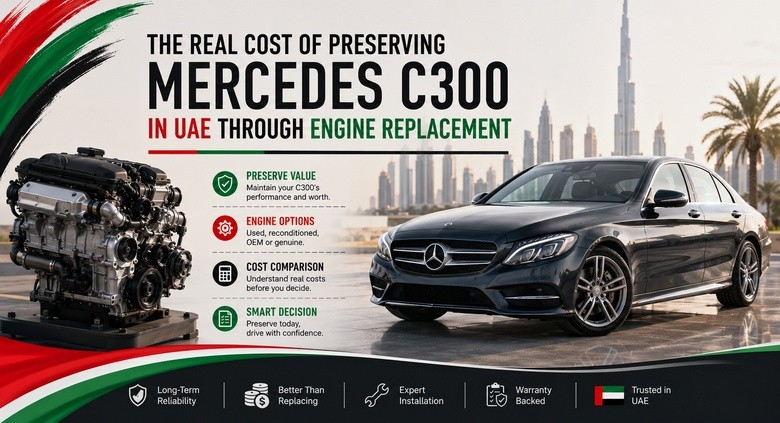
The Real Cost of Preserving a Mercedes C300 in UAE Through Engine Replacement
June 11, 2026
Most engine replacement conversations begin in the wrong place.
They begin with the engine.
That sounds sensible until you spend a few years living with a Mercedes C300.
Then the relationship changes.
The car stops being a specification sheet. It stops being a monthly payment. It stops being something chosen from a showroom floor.
Instead, it becomes familiar.
You know exactly how the steering feels during an early morning drive through Dubai Marina. You know the sound the doors make when they close. You know how comfortably it settles into a motorway cruise between Dubai and Abu Dhabi.
That familiarity matters.
Which is why many Mercedes owners react differently when major engine problems appear.
The discussion isn't merely about repair.
It's about preservation.
Preserving comfort.
Preserving value.
Preserving a vehicle that still feels worth keeping.
And in a country where premium German saloons often accumulate significant mileage under demanding climate conditions, that question arrives more frequently than many owners expect.
The Moment a Mercedes C300 Stops Feeling Like a Reliable Companion and Starts Feeling Like a Financial Question
Engine failures rarely arrive dramatically.
Most arrive quietly.
The process begins with uncertainty.
Perhaps oil consumption increases slightly.
Perhaps a warning light appears and then disappears.
Perhaps the vehicle feels marginally less responsive than it once did.
Nothing alarming.
Nothing urgent.
At least that's what owners tell themselves.
Then the workshop visits become more frequent.
Diagnostic invoices start accumulating.
Minor repairs gradually become major discussions.
The vehicle that once inspired confidence now raises questions.
And eventually the owner reaches an uncomfortable crossroads.
Continue investing?
Or walk away?
The answer depends on far more than the engine itself.
Early Signs That Preservation Conversations Are Approaching
- Increased oil consumption
- Rough idle conditions
- Reduced performance
- Repeated warning lights
- Cooling-system concerns
- Unusual noises
- Intermittent misfires
- Excessive exhaust smoke
- Rising maintenance frequency
A single symptom isn't necessarily alarming.
Several together often signal that bigger decisions are approaching.
Why Vehicle Preservation Means Something Different for Mercedes Owners Than It Does for Ordinary Car Buyers
Not every vehicle deserves preservation.
That may sound harsh.
It's also true.
Many vehicles reach a point where further investment becomes difficult to justify.
The Mercedes C300 occupies a different category.
Owners are not simply preserving transportation.
They are preserving a driving experience.
The cabin quality.
The refinement.
The engineering character.
The motorway comfort.
The sense of solidity that helped justify purchasing a premium German vehicle in the first place.
This changes the financial equation.
A replacement engine may appear expensive.
But replacing the entire ownership experience can prove even more expensive.
That's particularly relevant in the UAE luxury-car market, where replacing a well-maintained Mercedes often requires a significantly larger financial commitment than preserving an existing one.
Typical Ownership Preservation Comparison
| Decision | Estimated Cost (AED) |
| Major Engine Repair | 5,000 – 15,000 |
| Replacement Engine Project | 18,000 – 55,000+ |
| Comparable Used Mercedes Purchase | 70,000 – 150,000+ |
| New Premium Saloon Purchase | 180,000 – 350,000+ |
Viewed from that perspective, preservation starts looking less emotional and more rational.
How Years of UAE Heat, Traffic and High-Speed Motorway Driving Gradually Shape the Future of a Mercedes C300 Engine
Luxury cars are not immune to climate.
In fact, many sophisticated engines become even more dependent on careful maintenance when operating in difficult environments.
And the UAE is demanding.
Dubai summers punish cooling systems.
Sharjah traffic punishes thermal management.
Abu Dhabi motorway driving creates prolonged operating loads.
Ajman, Ras Al Khaimah, Fujairah and Umm Al Quwain each introduce their own combinations of heat, distance and driving conditions.
Over time these conditions accumulate.
Not dramatically.
Gradually.
The engine survives one summer.
Then another.
Then another.
Eventually hundreds of heat cycles begin leaving their mark.
Common UAE Climate Stress Factors
- Extreme ambient temperatures
- Prolonged air-conditioning usage
- Heavy traffic congestion
- Long-distance motorway driving
- Dust contamination
- Cooling-system strain
- Oil degradation acceleration
- Repeated thermal expansion cycles
None of these immediately destroy an engine.
Together, however, they influence long-term durability.
Components Commonly Affected by UAE Conditions
| Component | Climate Impact |
| Cooling System | High |
| Water Pump | Moderate to High |
| Thermostat | Moderate |
| Turbo Components | Moderate to High |
| Engine Seals | High |
| Hoses | High |
| Sensors | Moderate |
| Lubrication System | High |
This is one reason preventative maintenance often proves dramatically cheaper than corrective maintenance.
The Warning Signs Mercedes C300 Owners Often Dismiss Until the Preservation Conversation Becomes Unavoidable
Luxury vehicles can hide problems remarkably well.
That's part of their appeal.
The cabin remains quiet.
The ride remains refined.
The vehicle continues functioning.
Even while mechanical concerns develop beneath the surface.
Owners frequently mistake this refinement for mechanical health.
The two are not always connected.
A Mercedes C300 may continue driving comfortably while significant wear accumulates internally.
That's why warning signs deserve attention.
Not panic.
Attention.
Warning Signs That Require Investigation
- Persistent engine management warnings
- White exhaust smoke
- Blue exhaust smoke
- Knocking noises
- Misfire conditions
- Oil contamination
- Coolant loss
- Rising operating temperatures
- Reduced fuel economy
- Power delivery changes
Experienced workshops tend to recognise patterns quickly.
Owners often recognise them later.
That timing difference can become expensive.
Mercedes C300 Replacement Engine Costs Across the UAE: Understanding the Real Financial Commitment Before Making a Preservation Decision
Most readers eventually arrive here.
The numbers.
The difficult part.
The reality is that Mercedes C300 replacement-engine costs vary significantly depending on engine source, specification, mileage, warranty support and installation requirements.
There is no universal price.
There are only ranges.
And understanding those ranges helps owners make realistic decisions.
Used Mercedes C300 Replacement Engine
Often sourced from donor vehicles or imported inventory.
Typical Cost:
AED 8,000 – AED 18,000
Advantages:
- Lower purchase cost
- Faster availability
- Suitable for budget-conscious preservation
Risks:
- Unknown operating history
- Variable mileage
- Limited warranty protection
Reconditioned Mercedes C300 Engine
Professionally rebuilt and refreshed.
Typical Cost:
AED 15,000 – AED 30,000
Advantages:
- Improved reliability
- Better inspection standards
- Longer service expectations
Risks:
- Rebuild quality varies significantly
OEM Mercedes C300 Engine
Manufactured to original standards.
Typical Cost:
AED 25,000 – AED 45,000
Advantages:
- Excellent compatibility
- Strong long-term confidence
- Better resale support
Genuine Mercedes Engine
The premium option.
Typical Cost:
AED 35,000 – AED 65,000+
Advantages:
- Maximum confidence
- Premium quality assurance
- Strongest preservation strategy
Quick Cost Comparison
| Engine Type | Typical Cost (AED) |
| Used Engine | 8,000 – 18,000 |
| Reconditioned Engine | 15,000 – 30,000 |
| OEM Engine | 25,000 – 45,000 |
| Genuine Engine | 35,000 – 65,000+ |
Price matters.
But preservation decisions rarely succeed when based solely on price.
Why Mileage Alone Rarely Determines Whether a Mercedes C300 Is Worth Preserving
Many buyers become obsessed with mileage.
Sometimes understandably.
Sometimes excessively.
Mileage tells part of the story.
It does not tell the entire story.
A carefully maintained Mercedes with 220,000 kilometres may represent a better preservation candidate than a poorly maintained example with half that figure.
History matters.
Documentation matters.
Mechanical condition matters.
Ownership quality matters.
This becomes particularly important when evaluating replacement engines.
Factors Often More Important Than Mileage
- Service history
- Compression results
- Cooling-system condition
- Oil-analysis findings
- Maintenance consistency
- Previous repair quality
- Engine operating history
- Diagnostic reports
A healthy high-mileage engine can outlast a neglected low-mileage engine.
Experienced specialists understand this instinctively.
The smartest buyers eventually learn it too.
And once preservation becomes the goal, evidence becomes far more valuable than assumptions.
Compression Testing, Engine Health Reports and the Mechanical Evidence That Should Guide Every Preservation Decision
Luxury-car ownership has a habit of encouraging optimism.
The car still looks beautiful.
The cabin still feels expensive.
The doors still close with that reassuring Mercedes weight.
Surely the engine is fine.
Maybe.
Maybe not.
The problem is that preservation decisions worth tens of thousands of dirhams should never rely on assumptions.
They should rely on evidence.
Compression testing remains one of the most valuable tools available when evaluating either the original engine or a replacement candidate.
It answers an important question.
How healthy is the engine internally?
Not cosmetically.
Mechanically.
Healthy Compression Typically Suggests
- Strong cylinder sealing
- Better combustion efficiency
- Lower oil consumption risk
- Better long-term durability
- Improved reliability outlook
Poor Compression May Indicate
- Piston-ring wear
- Valve leakage
- Cylinder-wall wear
- Head-gasket concerns
- Internal engine fatigue
Compression Assessment Guide
| Condition | Risk Level |
| Uniform Cylinder Readings | Low |
| Minor Variation | Moderate |
| Noticeable Variation | High |
| Multiple Weak Cylinders | Very High |
A compression report costs very little compared with the financial consequences of buying the wrong engine.
That's why experienced preservation-focused owners insist on data before committing money.
Used, Reconditioned, OEM or Genuine? Understanding Which Engine Type Best Supports Long-Term Vehicle Preservation Goals
The wrong question is:
"Which engine is cheapest?"
The better question is:
"Which engine best preserves the vehicle I already own?"
Those are very different conversations.
A preservation strategy focuses on protecting the overall ownership experience rather than simply reducing today's invoice.
Used Engine Strategy
Best suited for:
- Short-term ownership
- Budget-conscious projects
- Older vehicles with limited future value
Estimated Cost:
AED 8,000 – AED 18,000
Reconditioned Engine Strategy
Often the most balanced preservation option.
Estimated Cost:
AED 15,000 – AED 30,000
Suitable for:
- Medium to long-term ownership
- Sensible budget management
- Improved reliability expectations
OEM Engine Strategy
Designed for owners prioritising long-term confidence.
Estimated Cost:
AED 25,000 – AED 45,000
Genuine Mercedes Engine Strategy
The preservation-first solution.
Estimated Cost:
AED 35,000 – AED 65,000+
Particularly attractive for owners planning many more years of ownership.
Preservation Value Comparison
| Engine Type | Initial Cost | Preservation Potential |
| Used | Lower | Moderate |
| Reconditioned | Medium | Strong |
| OEM | Higher | Very Strong |
| Genuine | Highest | Excellent |
For many UAE owners, reconditioned and OEM engines often represent the sweet spot between preservation and practicality.
The Hidden Costs That Appear After the Engine Quote and Why Preservation Projects Almost Always Cost More Than Expected
This is the section nobody enjoys reading.
Unfortunately, it's also one of the most important.
Engine quotations rarely tell the entire story.
Not because workshops are dishonest.
Because workshops can't see everything until dismantling begins.
The moment technicians start removing components, additional information appears.
Sometimes that information is inexpensive.
Sometimes it isn't.
Common Hidden Costs
| Item | Typical Cost (AED) |
| Engine Mounts | 800 – 3,500 |
| Water Pump | 600 – 2,000 |
| Thermostat | 300 – 1,000 |
| Cooling Hoses | 500 – 2,000 |
| Turbo Components | 1,500 – 8,000 |
| Sensors | 500 – 5,000 |
| Oil Cooler Components | 1,000 – 5,000 |
| Fluids & Filters | 500 – 2,000 |
| Diagnostics | 300 – 2,000 |
Typical Preservation Budgets
Budget Preservation Project:
- Engine: AED 12,000
- Labour: AED 5,000
- Additional Parts: AED 3,000
Total:
AED 20,000
Mid-Level Preservation Project:
- Engine: AED 22,000
- Labour: AED 7,000
- Additional Parts: AED 6,000
Total:
AED 35,000
Premium Preservation Project:
- Engine: AED 40,000
- Labour: AED 10,000
- Additional Parts: AED 10,000
Total:
AED 60,000
This is why realistic budgeting matters.
Preservation projects reward preparation.
Not optimism.
Compatibility Mistakes That Can Quietly Destroy the Financial Logic Behind an Otherwise Sensible Engine Replacement
Mercedes engines are sophisticated.
That's one reason they drive so well.
It's also one reason compatibility matters so much.
A replacement engine that appears perfect on paper can become surprisingly expensive if critical systems fail to align properly.
Areas Requiring Verification
- Engine codes
- ECU compatibility
- Transmission compatibility
- Wiring harness compatibility
- Turbocharger configuration
- Sensor specifications
- Cooling-system integration
- Emissions equipment compatibility
One overlooked detail can generate days of additional labour.
Potential Compatibility Costs
| Issue | Typical Cost (AED) |
| ECU Programming | 1,000 – 5,000 |
| Sensor Replacement | 500 – 5,000 |
| Wiring Modifications | 1,000 – 8,000 |
| Additional Diagnostics | 500 – 3,000 |
Preservation projects work best when surprises remain limited.
Compatibility verification helps achieve exactly that.
The Parts Worth Replacing While the Engine Is Out and Why This Often Represents the Cheapest Reliability You'll Ever Buy
A curious thing happens once the engine leaves the vehicle.
Access improves dramatically.
Parts normally hidden become visible.
Labour normally expensive becomes comparatively affordable.
This creates an opportunity.
Smart preservation strategies take advantage of it.
Components Worth Serious Consideration
| Component | Typical Cost (AED) |
| Water Pump | 600 – 2,000 |
| Thermostat | 300 – 1,000 |
| Engine Mounts | 800 – 3,500 |
| Drive Belts | 300 – 1,500 |
| Cooling Hoses | 500 – 2,000 |
| Spark Plugs | 500 – 2,500 |
| Sensors | 500 – 5,000 |
| PCV Components | 300 – 1,500 |
Many owners focus exclusively on the engine.
Experienced specialists often focus on everything surrounding it.
That's usually where future reliability is won or lost.
How Long Does a Mercedes C300 Engine Replacement Really Take in UAE Workshops and Why Preservation Projects Rarely Follow Perfect Timelines
Owners imagine a schedule.
Workshops encounter reality.
The two do not always match.
Engine sourcing delays.
Parts availability.
Unexpected wear discoveries.
Diagnostic complications.
All can influence timelines.
Typical Timeline Breakdown
| Stage | Estimated Duration |
| Engine Sourcing | 2–14 Days |
| Inspection & Verification | 1–3 Days |
| Engine Removal | 1–3 Days |
| Installation | 3–7 Days |
| Diagnostics & Testing | 1–4 Days |
Typical Total Timeline
Best Case:
- 1 week
Normal Case:
- 2 weeks
Complex Case:
- 3–5 weeks
Patience becomes part of the preservation process.
Rushing rarely improves outcomes.
The Cost of Waiting Another Summer: Why Delaying a Preservation Decision Can Turn a Manageable Project Into a Major Financial Event
The UAE climate has a remarkable ability to expose mechanical weaknesses.
Particularly during summer.
A cooling-system concern that appears manageable in February can become something very different by August.
Heat accelerates consequences.
Small issues become larger issues.
Larger issues become engine projects.
What Delay Can Lead To
- Complete engine failure
- Turbocharger damage
- Cooling-system collapse
- Catalytic-converter damage
- Reduced resale value
- Emergency towing costs
- Additional labour requirements
Cost-of-Delay Analysis
| Decision Timing | Estimated Cost Impact |
| Early Repair | AED 2,000 – 8,000 |
| Major Mechanical Repair | AED 8,000 – 20,000 |
| Replacement Engine Project | AED 20,000 – 60,000+ |
| Engine Failure Plus Secondary Damage | AED 30,000 – 80,000+ |
Many expensive engine replacements begin with relatively modest maintenance concerns.
That may be the most frustrating reality of all.
The vehicle often provides warnings.
The owner notices them.
Life gets busy.
The conversation gets postponed.
Then another UAE summer arrives.
And suddenly preservation becomes far more expensive than it needed to be.
Why Many Preservation-Focused Owners Choose Carefully Sourced Replacements Instead of Walking Away
This is where preservation and economics finally intersect.
A properly selected replacement engine doesn't simply solve a mechanical problem.
It preserves years of ownership value.
It preserves comfort.
It preserves familiarity.
And for owners researching online Mercedes C300 engines for sale, the goal shouldn't be finding the cheapest engine available.
The goal should be finding the engine that best protects the vehicle they already trust.
That distinction changes everything.
Preserving a Mercedes C300 Versus Replacing It Entirely: The Financial Comparison Many Owners Oversimplify
There is a moment during almost every major engine discussion when somebody says:
"Just buy another car."
Simple advice.
Often expensive advice.
The problem is that replacing a Mercedes C300 doesn't simply mean replacing an engine problem.
It means replacing an entire ownership history.
A vehicle you've already maintained.
A vehicle whose strengths and weaknesses you understand.
A vehicle that has already absorbed much of its depreciation.
That history has value.
A value that doesn't appear on price-comparison websites.
Typical Financial Comparison
| Option | Estimated Cost (AED) |
| Used Engine Preservation Project | 20,000 – 30,000 |
| Reconditioned Engine Preservation Project | 30,000 – 45,000 |
| OEM Engine Preservation Project | 40,000 – 60,000 |
| Comparable Used Mercedes C300 | 70,000 – 150,000+ |
| New Premium Saloon | 180,000 – 350,000+ |
Now the conversation becomes more interesting.
The replacement-engine project that initially seemed expensive suddenly begins competing with far larger financial commitments.
Preservation isn't always the correct answer.
But it is often more competitive than owners initially assume.
First-Year Ownership Costs After Engine Replacement and Why Preservation Is a Long-Term Commitment Rather Than a Single Repair
One of the biggest mistakes owners make is stopping their calculations too early.
The engine replacement isn't the finish line.
It's the beginning of a new ownership phase.
A preserved Mercedes should continue delivering confidence.
That requires planning.
Typical First-Year Ownership Costs
| Category | Estimated Cost (AED) |
| Scheduled Servicing | 1,500 – 4,000 |
| Fluids & Filters | 800 – 2,000 |
| Diagnostics | 500 – 2,000 |
| Minor Repairs | 1,500 – 5,000 |
| Contingency Budget | 2,000 – 8,000 |
Realistic First-Year Scenarios
Conservative Preservation Plan:
- Engine Project: AED 25,000
- First-Year Running Costs: AED 5,000
Total:
AED 30,000
Balanced Preservation Plan:
- Engine Project: AED 40,000
- First-Year Running Costs: AED 8,000
Total:
AED 48,000
Premium Preservation Plan:
- Engine Project: AED 60,000
- First-Year Running Costs: AED 12,000
Total:
AED 72,000
These numbers are significant.
But they should always be compared against replacement costs rather than viewed in isolation.
Family Owners, Executive Drivers and Business Users Often View Preservation Through Completely Different Lenses
The same Mercedes C300 can represent very different things to different owners.
Family Ownership Perspective
For many families, preserving the vehicle means preserving predictability.
The vehicle is known.
The maintenance history is known.
The ownership costs are broadly understood.
That certainty can be valuable.
Particularly during periods when replacing a vehicle would place unnecessary strain on household finances.
Executive Ownership Perspective
Executives often prioritise:
- Comfort
- Presentation
- Reliability
- Daily convenience
For this group, downtime becomes particularly important.
The vehicle isn't merely transportation.
It's part of a professional routine.
Business Ownership Perspective
Businesses calculate differently.
A vehicle sitting in a workshop is generating no value.
Questions become practical.
- How quickly can it return to service?
- How reliable will it be afterwards?
- What are the long-term operating costs?
Different ownership categories.
Different priorities.
Different answers.
Can a Replacement Engine Actually Protect Resale Value? Understanding What Future Buyers Really Care About
Many owners assume replacement engines automatically damage resale value.
Reality tends to be more nuanced.
Buyers dislike uncertainty.
They don't necessarily dislike replacement engines.
In many cases, buyers prefer documented replacement work to a tired original engine approaching the end of its useful life.
Documentation creates confidence.
Confidence creates value.
Documents Worth Preserving
- Engine purchase invoice
- Installation records
- Warranty paperwork
- Compression reports
- Diagnostic reports
- Service history
- Engine serial information
When resale discussions begin, paperwork often becomes more persuasive than promises.
Insurance, Registration and Documentation Considerations That Preservation-Focused Owners Should Never Ignore
Documentation rarely feels important at the beginning.
It becomes extremely important later.
Insurance enquiries.
Ownership transfers.
Warranty claims.
Vehicle sales.
Suddenly paperwork becomes valuable.
Essential Records
- Engine source documentation
- Purchase invoices
- Installation records
- Warranty certificates
- Workshop reports
- Inspection documentation
- Maintenance records
The owners who maintain organised records usually enjoy smoother ownership experiences later.
Coincidence?
Probably not.
The First 1,000 Kilometres After Engine Installation Can Determine Whether the Preservation Strategy Succeeds
There is a temptation to celebrate once the vehicle leaves the workshop.
The hard part appears finished.
Not quite.
The first thousand kilometres often reveal more about the quality of the installation than the workshop handover ever could.
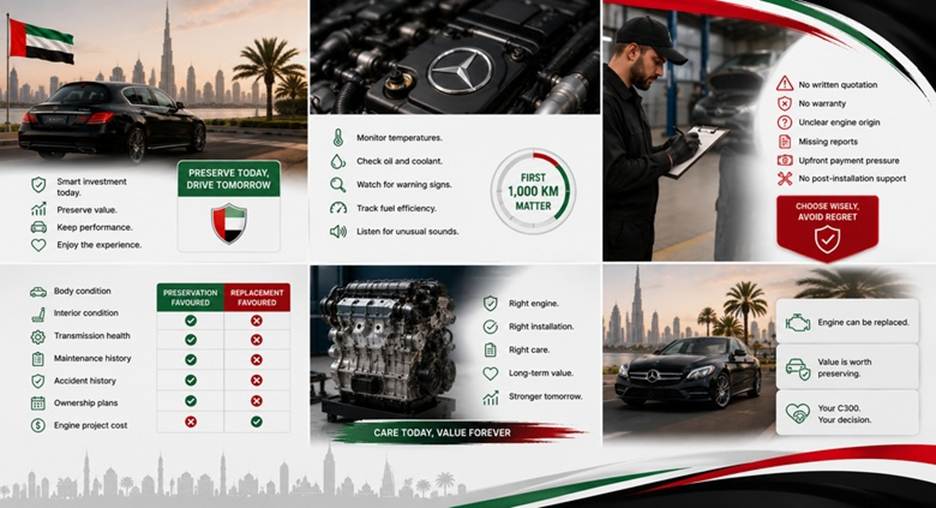
Monitor Carefully
- Oil levels
- Coolant levels
- Engine temperatures
- Warning lights
- Fluid leaks
- Fuel economy
- Unusual sounds
Avoid During Initial Running Period
- Aggressive acceleration
- Extended high-speed driving
- Excessive engine loads
- Sudden mechanical stress
Listen carefully.
The vehicle often tells you whether everything is settling correctly.
Workshop Red Flags, Supplier Warnings and Preservation Mistakes That Can Turn a Sensible Investment Into an Expensive Regret
The quality of the engine matters.
The quality of the installation matters equally.
Sometimes more.
Warning Signs Worth Taking Seriously
- No written quotation
- No warranty documentation
- Unclear engine origin
- Missing compression reports
- Pressure for immediate payment
- Refusal to explain labour charges
- No diagnostic evidence
- No post-installation support
Professional workshops generally welcome questions.
Unprofessional workshops often become uncomfortable when asked them.
That distinction matters.
A Practical Preservation Decision Matrix for Mercedes C300 Owners Still Unsure Which Path Makes Sense
| Factor | Preservation Favoured | Vehicle Replacement Favoured |
| Body Condition | Excellent | Poor |
| Interior Condition | Excellent | Worn |
| Transmission Health | Strong | Questionable |
| Maintenance History | Documented | Unknown |
| Accident History | Minimal | Significant |
| Ownership Plans | Long-Term | Short-Term |
| Engine Project Cost | Reasonable | Excessive |
The more boxes appearing on the left-hand side, the stronger the preservation argument becomes.
Preserving the Engine Is Straightforward. Preserving the Value, Character and Ownership Experience of the Mercedes C300 Is the Real Objective
The interesting thing about vehicle preservation is that it is rarely about machinery alone.
Machines can be repaired.
Machines can be replaced.
Machines can be rebuilt.
Ownership is different.
A Mercedes C300 that has survived years of UAE summers, motorway journeys, business meetings, family commitments and daily life becomes more than a collection of parts.
It becomes familiar.
That familiarity has value.
The smartest owners across Dubai, Abu Dhabi, Sharjah, Ajman, Ras Al Khaimah, Fujairah and Umm Al Quwain understand something that casual buyers often miss.
Preservation is not about refusing to move on.
It's about recognising when a vehicle still deserves investment.
If the structure remains strong, the transmission remains healthy, maintenance has been consistent and future ownership plans extend beyond the immediate future, a replacement engine can represent one of the most financially rational decisions available.
For many preservation-minded owners researching replacement options through PartFinder UAE, the goal isn't simply finding another engine.
The goal is protecting years of ownership value, preserving a premium driving experience and ensuring that a vehicle worth keeping remains exactly that.
Because the most important question is not:
"Can the engine be replaced?"
The more important question is:
"Is the Mercedes C300 still worth preserving?"
And for many well-maintained examples, the answer remains remarkably compelling.
Frequently Asked Questions
Categories
- Audi
- BMW
- Car Accessories
- Car Tips
- Ford
- Land Rover
- Mazda
- Range Rover
- Top 10
- UAE Car Parts
- Used Car Parts
- Toyota
- Replacement Engines
- Nissan
- Hyundai
- Mitsubishi
- Volkswagen
- Honda
- Kia
- Chevrolet
- Dodge
- Jeep
- Subaru
- Renault
- Lexus
- Mercedes
- Suzuki
- Hummer
- Porsche
- Infiniti
- Peugeot
- GMC
- Mini
- Volvo
- Replacement Gearboxes
- MG
- Jaguar
- Skoda
- Cadillac
- Daihatsu
- Fiat
- German Car Parts
- Japanese Car Parts
- Aftermarket Car Parts
- Genuine Car Parts
- New Car Parts
- Reconditioned Car Parts
- European Car Parts
- American Car Parts
- Korean Car Parts
- British Car Parts
- Chinese Car Parts
- Sports/Exotic Car Parts
- Luxury Car Parts
- Performance Car Parts
- SUV/4x4 Spare Parts
- Truck Spare Parts
- EV Car Parts
- Hybrid Car Parts
- Auto Spare Parts in UAE
- Tesla
- Isuzu
- Ram
- Ferrari
- Bentley
- Lamborghini
- Genesis
- Maserati
- Lincoln
- Chrysler
- Opel
- Citroen
- SsangYong
- Seat
- McLaren
- Aston Martin
- Rolls Royce
- Maybach
- Alfa Romeo
- Bugatti
- Scion
- Abu Dhabi Car Parts
- Ajman Car Parts
- Al Khan Car Parts
- Al Sajaa Car Parts
- Deira Car Parts
- Dubai Car Parts
- Fujairah Car Parts
- Industrial Area 6 Car Parts
- Mussafah Car Parts
- Ras Al Khaimah Car Parts
- Sharjah Car Parts
- Umm Al Quwain Car Parts
- Acura
- BYD
- Chery
- Dacia
- DS
- Geely Emgrand
- EXEED
- GAC
- GAC Gonow
- Geely
- Gonow
- Great Wall
- Haima
- Haval
- Holden