The True Reliability Cost of Delaying a Subaru Legacy Engine Replacement in UAE
June 11, 2026
Reliability failures rarely arrive dramatically.
That is the uncomfortable truth.
Owners often imagine engine failure as a sudden event. A loud noise. A warning light. A breakdown on Sheikh Zayed Road. A recovery truck. A workshop diagnosis.
Reality is usually less dramatic.
And far more expensive.
Reliability degradation often begins quietly. A small increase in oil consumption. Slight coolant loss. A temperature gauge behaving differently during a Dubai summer afternoon. A subtle decline in fuel economy. An occasional vibration nobody remembers noticing six months earlier.
Tiny changes.
Then more changes.
Then one day the owner discovers that the problem they postponed has developed into several problems working together.
This is where reliability engineering becomes useful.
Unlike conventional repair thinking, reliability engineering does not focus solely on today's fault.
It studies how faults evolve.
How systems interact.
How small failures become major failures.
And perhaps most importantly, how delaying action changes future costs.
The Subaru Legacy occupies an interesting position within the UAE market.
Many examples have accumulated significant mileage.
Many remain mechanically rewarding to drive.
Many owners develop genuine trust in them.
That trust can be valuable.
Occasionally it becomes dangerous.
Because reliable vehicles sometimes convince owners they can continue absorbing problems indefinitely.
Eventually even well-engineered systems reach a point where intervention becomes necessary.
The challenge is identifying that point before reliability deterioration accelerates.
Understanding Reliability Degradation: Why Most Subaru Legacy Engine Failures Begin Long Before Owners Notice Them
Machines rarely fail overnight.
Components wear gradually.
Lubrication efficiency changes gradually.
Heat exposure accumulates gradually.
Material fatigue develops gradually.
The failure merely appears sudden because the deterioration occurred unnoticed.
Reliability engineers refer to this as failure progression.
The Subaru Legacy engine, like any mechanical system, operates within a reliability curve.
Initially:
- Failure probability remains low.
- Wear rates remain predictable.
- Maintenance controls risk effectively.
As mileage accumulates, however, degradation begins affecting multiple systems simultaneously.
Not dramatically.
Incrementally.
Typical Reliability Degradation Factors
- Thermal cycling
- Lubrication breakdown
- Seal ageing
- Bearing wear
- Cooling-system fatigue
- Sensor deterioration
- Combustion inefficiencies
- Material fatigue
Individually these issues may seem insignificant.
Together they create reliability decline.
Reliability Progression Model
| Stage | Reliability Condition |
| Early Life | Very High Reliability |
| Stable Service Life | High Reliability |
| Progressive Wear | Moderate Reliability Decline |
| Accelerated Degradation | Significant Reliability Loss |
| Failure Escalation Phase | High Breakdown Risk |
The difficulty is that many owners only notice the final stage.
Reliability engineers focus on the stages before it.
The Reliability Cost of Waiting: How Small Engine Issues Often Develop Into Major Mechanical Failures in UAE Conditions
One of the most misunderstood concepts in vehicle ownership is the cost of delay.
Most owners evaluate today's repair bill.
Few evaluate tomorrow's failure risk.
That distinction matters enormously.
Especially in the UAE.
Heat changes everything.
A small coolant leak may initially appear harmless.
Then cooling efficiency decreases.
Then operating temperatures rise.
Then lubrication performance suffers.
Then seals experience greater stress.
Then reliability begins deteriorating across multiple systems simultaneously.
One fault becomes several.
Common Failure Escalation Pathways
Initial Issue:
- Minor coolant loss
Potential Escalation:
- Chronic overheating
- Head-gasket damage
- Cylinder-head distortion
- Internal engine wear
Initial Issue:
- Increased oil consumption
Potential Escalation:
- Lubrication deficiency
- Bearing wear
- Internal scoring
- Complete engine failure
Cost Escalation Example
| Stage | Estimated Cost (AED) |
| Early Repair | 800 – 4,000 |
| Intermediate Repair | 4,000 – 10,000 |
| Major Engine Repair | 10,000 – 20,000 |
| Replacement Engine Project | 15,000 – 55,000+ |
This is why reliability engineers often sound cautious.
They have seen too many inexpensive problems become expensive ones.
How UAE Heat, Traffic Congestion and Continuous Air-Conditioning Loads Accelerate Reliability Decline
The UAE creates an operating environment that reliability engineers immediately recognise as challenging.
Not impossible.
Challenging.
A Subaru Legacy operating in Dubai during August experiences conditions very different from those assumed during many global reliability calculations.
Heat increases stress.
Traffic increases stress.
Continuous air-conditioning operation increases stress.
Together they influence virtually every major system.
Environmental Reliability Stressors
- Extreme ambient temperatures
- High cooling-system demand
- Prolonged idle periods
- Urban traffic congestion
- Dust contamination
- Thermal cycling
- Extended highway operation
What makes reliability engineering fascinating is that systems rarely fail independently.
They influence each other.
A cooling-system issue affects lubrication.
Lubrication issues affect bearing life.
Bearing wear affects engine performance.
Performance changes influence fuel efficiency.
One variable influences another.
Then another.
Systems Most Affected by UAE Conditions
| System | Environmental Impact |
| Cooling System | Very High |
| Lubrication System | High |
| Engine Seals | High |
| Sensors | Moderate |
| Fuel System | Moderate |
| Air Intake Components | High |
| Turbo Components | High |
Reliability is rarely determined by one component.
It is usually determined by the interaction between many.
Early Warning Indicators That Reliability Engineers Treat Seriously Even When Drivers Do Not
Reliability engineers spend their careers looking for patterns.
The goal is not predicting the exact moment of failure.
The goal is identifying increasing probability.
This changes how symptoms are interpreted.
Owners often ask:
"Is the car still driving normally?"
Reliability engineers ask:
"Is the vehicle behaving differently from six months ago?"
That distinction matters.
Reliability Warning Indicators
- Increased oil consumption
- Coolant loss
- Temperature fluctuations
- Rough idle conditions
- Reduced fuel economy
- Increased exhaust emissions
- Delayed starting
- Power loss
- Unusual vibrations
None of these guarantee immediate failure.
That is not the point.
The point is that reliability trends often emerge before failures do.
Reliability Risk Matrix
| Observation | Reliability Concern |
| Stable Operation | Low |
| Minor Changes | Moderate |
| Repeated Symptoms | High |
| Multiple Symptoms | Very High |
| Escalating Symptoms | Critical |
The earlier these indicators are addressed, the more options owners usually retain.
Subaru Legacy Replacement Engine Costs in UAE: Used, Reconditioned, OEM and Genuine Reliability Comparisons
Eventually every reliability discussion reaches economics.
Not because reliability is unimportant.
Because ownership decisions require balancing reliability and cost.
The ideal solution would provide perfect reliability at minimal cost.
Real life tends to be less cooperative.
Used Subaru Legacy Engine
Typical Cost:
AED 7,000 – AED 15,000
Advantages:
- Lower acquisition cost
- Faster availability
- Suitable for shorter ownership horizons
Reliability Considerations:
- Unknown operating history
- Variable wear levels
- Limited predictability
Reconditioned Subaru Legacy Engine
Typical Cost:
AED 12,000 – AED 22,000
Advantages:
- Refreshed internal components
- Improved reliability outlook
- Better lifecycle expectations
OEM Engine
Typical Cost:
AED 18,000 – AED 35,000
Advantages:
- Strong compatibility
- Predictable reliability
- Better long-term ownership prospects
Genuine Engine
Typical Cost:
AED 30,000 – AED 55,000+
Advantages:
- Maximum reliability potential
- Strong resale confidence
- Lowest uncertainty levels
Reliability Comparison Table
| Engine Type | Initial Cost | Reliability Confidence |
| Used | Low | Variable |
| Reconditioned | Moderate | Strong |
| OEM | Higher | Very Strong |
| Genuine | Highest | Excellent |
Reliability engineering rarely asks:
"What is cheapest?"
It usually asks:
"What creates the lowest total risk?"
Reliability-Centred Cost Analysis: Why the Cheapest Engine Option Can Produce the Highest Ownership Cost
This is where ownership psychology becomes interesting.
People naturally focus on purchase prices.
Reliability engineers focus on lifecycle costs.
Those are different calculations.
A cheaper engine may reduce today's invoice.
It may also increase:
- Failure probability
- Downtime exposure
- Future repair costs
- Diagnostic costs
- Replacement risks
The cheapest engine is not always the least expensive ownership decision.
Sometimes it is the opposite.
Lifecycle Cost Considerations
| Factor | Immediate Focus | Reliability Focus |
| Engine Cost | High | Moderate |
| Future Repairs | Low | High |
| Downtime Risk | Low | High |
| Service Life | Low | High |
| Reliability Stability | Low | Very High |
Example Lifecycle Cost Comparison
| Engine Type | Initial Cost (AED) | Potential Long-Term Ownership Cost |
| Used | 7,000 – 15,000 | Variable |
| Reconditioned | 12,000 – 22,000 | More Predictable |
| OEM | 18,000 – 35,000 | Lower Risk |
| Genuine | 30,000 – 55,000+ | Lowest Reliability Risk |
Reliability engineering ultimately focuses on predictability.
Not perfection.
The goal is not eliminating every possible failure.
The goal is reducing uncertainty.
And uncertainty becomes far more expensive when owners delay decisions that evidence already suggests should be made.
Compression Testing, Leak-Down Testing and Evidence-Based Reliability Assessments Before Replacement Decisions
Reliability engineering begins with measurement.
Not opinions.
Not assumptions.
Not internet forums.
Measurement.
One reason owners delay replacement decisions is uncertainty.
The vehicle still starts.
The vehicle still moves.
The vehicle still feels usable.
Therefore the problem cannot be serious.
Can it?
Reliability engineers distrust that logic.
Systems often continue functioning while reliability quietly deteriorates underneath.
That is why diagnostic testing matters.
Compression testing measures a fundamental engineering reality:
Can each cylinder consistently generate the pressure required for efficient combustion?
Leak-down testing goes further.
It identifies where performance is escaping.
The distinction matters.
Because two engines may feel similar from behind the steering wheel while having dramatically different reliability outlooks.
Compression Testing Helps Identify
- Cylinder wear
- Ring wear
- Valve sealing problems
- Internal engine deterioration
- Combustion inefficiencies
Leak-Down Testing Helps Identify
- Air leakage past valves
- Ring-sealing failure
- Cylinder-wall wear
- Head-gasket concerns
- Internal leakage pathways
Reliability Assessment Matrix
| Test Result | Reliability Outlook |
| Consistent Strong Readings | Excellent |
| Minor Variations | Good |
| Moderate Variations | Monitor Closely |
| Significant Variations | Elevated Risk |
| Multiple Weak Cylinders | High Failure Risk |
A few hundred dirhams spent on diagnostics often provide more useful information than hours of speculation.
Failure Mode Analysis: Identifying Which Subaru Legacy Engine Problems Can Be Stabilised and Which Usually Escalate
One of the most useful tools in reliability engineering is failure-mode analysis.
The idea is surprisingly simple.
Not all faults behave the same way.
Some remain manageable for extended periods.
Others accelerate.
The challenge is identifying which category applies.
Commonly Manageable Issues
- Minor sensor faults
- Isolated gasket leaks
- Early-stage cooling issues
- Small vacuum leaks
- Minor oil seepage
These issues deserve attention.
But they do not automatically indicate impending catastrophe.
Commonly Escalating Issues
- Repeated overheating
- Compression loss
- Internal bearing wear
- Chronic oil starvation
- Head-gasket failure
- Persistent coolant contamination
These failures often worsen over time.
Sometimes rapidly.
Escalation Risk Matrix
| Failure Type | Escalation Probability |
| Minor Sensor Issue | Low |
| Cooling-System Deficiency | Moderate |
| Oil Consumption Trend | Moderate to High |
| Compression Loss | High |
| Bearing Damage | Very High |
| Repeated Overheating | Critical |
The purpose of engineering analysis is not predicting the future perfectly.
It is improving decision quality.
The Hidden Reliability Risks That Often Appear After Engine Failure Has Already Begun
Engine failures rarely travel alone.
That is the problem.
A vehicle experiencing engine deterioration often creates stress elsewhere.
Sometimes the secondary failures eventually cost more than the original issue.
This surprises owners.
It rarely surprises engineers.
Secondary Systems Commonly Affected
- Cooling systems
- Turbochargers
- Catalytic converters
- Sensors
- Fuel systems
- Ignition systems
- Lubrication systems
Consider a simple overheating issue.
Initially the repair may appear relatively affordable.
Then repeated heat cycles affect seals.
Then sensors.
Then coolant pathways.
Then lubrication quality.
One issue becomes several.
Hidden Reliability Cost Examples
| Secondary Damage Area | Typical Cost (AED) |
| Radiator Replacement | 800 – 3,500 |
| Water Pump Replacement | 500 – 2,500 |
| Turbo Repairs | 2,000 – 10,000 |
| Sensor Replacement | 300 – 5,000 |
| Cooling-System Restoration | 1,500 – 8,000 |
The reliability cost of delay rarely appears in a single invoice.
It accumulates.
Why Supporting Components Often Determine the Success or Failure of a Replacement Engine Project
Owners focus on engines.
Reliability engineers focus on systems.
That difference explains many successful ownership experiences.
And many disappointing ones.
A replacement engine installed into an ageing support network does not automatically create reliability.
It creates potential.
The surrounding systems must still perform.
Critical Supporting Components
- Radiator
- Thermostat
- Water pump
- Cooling hoses
- Oil cooler
- Sensors
- Engine mounts
- Fuel delivery components
Imagine installing an excellent replacement engine while retaining a marginal cooling system.
The engine itself may be healthy.
Its operating environment is not.
Reliability suffers.
Supporting-System Investment Matrix
| Strategy | Initial Cost | Reliability Outcome |
| Engine Only | Lower | Moderate |
| Engine Plus Critical Components | Moderate | Strong |
| Comprehensive System Refresh | Higher | Excellent |
Reliability engineering consistently favours complete-system thinking.
Reliability Modelling of Cooling Systems, Lubrication Systems and Thermal Management Components
If reliability engineers could choose one system to monitor closely in UAE conditions, many would select the cooling system.
Without hesitation.
Heat management influences everything.
Combustion efficiency.
Lubrication quality.
Material stress.
Component longevity.
The cooling system functions as a reliability multiplier.
Healthy cooling improves reliability everywhere.
Weak cooling increases risk everywhere.
Cooling-System Reliability Factors
- Radiator efficiency
- Thermostat performance
- Water-pump condition
- Coolant quality
- Hose integrity
- Fan operation
Lubrication-System Reliability Factors
- Oil quality
- Oil pressure stability
- Filter condition
- Oil cooler performance
- Service intervals
Reliability Impact Table
| System | Reliability Influence |
| Cooling System | Very High |
| Lubrication System | Very High |
| Fuel System | Moderate |
| Air Intake System | Moderate |
| Sensor Network | Moderate |
In engineering terms, these are dependency systems.
Failure in one affects others.
How UAE Summer Temperatures Change Reliability Calculations
Reliability calculations rarely exist in isolation.
Operating environments matter.
The UAE creates unique thermal demands.
Particularly during summer.
A Subaru Legacy sitting in stop-start Dubai traffic during peak afternoon temperatures experiences significantly different operating stress than one cruising through cooler climates.
Summer Reliability Stressors
- Elevated coolant temperatures
- Increased air-conditioning loads
- Higher oil temperatures
- Greater thermal expansion
- Accelerated seal ageing
- Increased cooling-system workload
Reliability engineers pay attention to environmental context because reliability is never purely mechanical.
It is environmental as well.
The Cost of Delayed Intervention: Comparing Early Action, Major Repair and Complete Engine Failure Scenarios
Most reliability discussions eventually return to economics.
Not because engineers love spreadsheets.
Because failure progression has financial consequences.
And those consequences rarely move in a favourable direction.
Early Intervention Scenario
Typical Cost:
AED 1,000 – AED 8,000
Potential Actions:
- Cooling-system repairs
- Sensor replacement
- Gasket repairs
- Preventative maintenance
Major Repair Scenario
Typical Cost:
AED 8,000 – AED 20,000
Potential Actions:
- Cylinder-head work
- Internal repairs
- Major cooling-system restoration
Replacement Engine Scenario
Typical Cost:
AED 15,000 – AED 55,000+
Potential Actions:
- Used engine installation
- Reconditioned engine installation
- OEM replacement
- Genuine replacement
Catastrophic Failure Scenario
Typical Cost:
AED 20,000 – AED 75,000+
Potential Consequences:
- Secondary component damage
- Extended downtime
- Additional labour
- Reduced resale value
Reliability Cost Escalation Matrix
| Intervention Timing | Financial Exposure |
| Early Action | Lowest |
| Moderate Delay | Moderate |
| Significant Delay | High |
| Catastrophic Failure | Highest |
Reliability engineering repeatedly reaches the same conclusion.
Most failures become expensive not because they occur.
Because they were ignored while evidence was already available.
Reliability-Centred Maintenance: The Difference Between Preserving Reliability and Chasing Failures
There are two approaches to ownership.
Reactive ownership.
Reliability-centred ownership.
Reactive ownership waits for failures.
Reliability-centred ownership manages probabilities.
The distinction sounds subtle.
It is not.
Reactive Ownership Characteristics
- Repair after failure
- Lower short-term spending
- Higher uncertainty
- Greater failure exposure
Reliability-Centred Ownership Characteristics
- Preventative interventions
- Better predictability
- Reduced failure risk
- Stronger long-term outcomes
For owners researching Subaru Legacy engines for sale, this distinction becomes particularly important.
The goal is not merely replacing an engine.
The goal is restoring a reliability system.
And reliability systems rarely depend on a single component.
They depend on the interaction between every component surrounding it.
That is why the most successful replacement-engine projects often look expensive at first glance.
Then surprisingly economical several years later.
Replace the Engine or Replace the Vehicle? A Reliability Engineering Framework for Rational Decision-Making
Reliability engineering has an irritating habit.
It removes emotion from decisions people desperately want to make emotionally.
Owners often ask:
"Do I still love the car?"
Reliability engineers ask:
"Does the system still justify investment?"
Those questions are not always aligned.
The Subaru Legacy has earned a loyal following because many examples remain rewarding long after other vehicles begin feeling tired.
That reputation matters.
But reputation does not alter physics.
Or economics.
Or reliability curves.
Eventually every owner reaches a point where the question becomes unavoidable:
Should the engine be replaced?
Or should the vehicle itself be replaced?
The answer depends on system condition.
Not engine condition alone.
Indicators Supporting Engine Replacement
- Strong chassis condition
- Healthy transmission
- Good service history
- Stable electrical systems
- Predictable maintenance record
- Long-term ownership plans
Indicators Supporting Vehicle Replacement
- Structural deterioration
- Multiple major system failures
- Escalating repair frequency
- Declining reliability trends
- Poor maintenance history
- Limited future value potential
Reliability Decision Matrix
| Factor | Engine Replacement Favoured | Vehicle Replacement Favoured |
| Chassis Integrity | Strong | Weak |
| Transmission Condition | Healthy | Deteriorated |
| Service History | Complete | Inconsistent |
| Electrical Systems | Stable | Unstable |
| Ownership Horizon | Long-Term | Short-Term |
| Reliability Trend | Stable | Declining |
Reliability engineering does not seek the cheapest answer.
It seeks the lowest long-term risk.
First-Year Reliability Expectations After Engine Replacement and the Variables That Influence Long-Term Success
Many owners assume reliability returns immediately after engine replacement.
Sometimes it does.
Sometimes it does not.
The first year often determines everything.
A successful replacement project is not simply an installation.
It is a reliability restoration programme.
The difference matters.
Variables Affecting First-Year Reliability
- Engine quality
- Installation quality
- Cooling-system condition
- Lubrication-system condition
- Maintenance discipline
- Driving behaviour
- Environmental exposure
Two identical replacement engines can produce completely different outcomes.
Because the surrounding systems differ.
First-Year Reliability Risk Categories
| Category | Reliability Impact |
| Quality Installation | Very Positive |
| Cooling-System Refresh | Very Positive |
| Preventative Maintenance | Positive |
| Delayed Supporting Repairs | Negative |
| Poor Installation Quality | Severe Negative |
Reliability engineering consistently reaches the same conclusion.
The installation is only the beginning.
Reliability Differences Between Daily Commuters, Long-Distance Drivers, Family Owners and High-Mileage Users
An interesting reality emerges when studying reliability data.
Different users create different reliability profiles.
The same vehicle.
The same engine.
Different outcomes.
Daily Urban Drivers
Common Characteristics:
- Stop-start traffic
- Frequent idling
- Repeated thermal cycling
Primary Reliability Risks:
- Cooling-system stress
- Lubrication degradation
- Sensor wear
Long-Distance Drivers
Common Characteristics:
- Extended highway operation
- Stable temperatures
- Consistent operating conditions
Primary Reliability Risks:
- High cumulative mileage
- Cooling-system ageing
- Component fatigue
Family Owners
Common Characteristics:
- Predictable usage
- Long-term ownership
Primary Reliability Priorities:
- Dependability
- Safety
- Predictable maintenance
High-Mileage Users
Common Characteristics:
- Heavy utilisation
- Accelerated wear accumulation
Primary Reliability Priorities:
- Failure prevention
- Cost predictability
- Downtime reduction
Reliability engineering always begins with operating conditions.
Because operating conditions shape outcomes.
Documentation, Service Records and Maintenance History as Reliability Indicators Rather Than Administrative Records
Many people view maintenance records as paperwork.
Reliability engineers view them differently.
Documentation is evidence.
Evidence reduces uncertainty.
And uncertainty is expensive.
A Subaru Legacy with complete service records often provides a far clearer reliability picture than one with limited history.
Not because paperwork improves performance.
Because it improves predictability.
Valuable Reliability Records
- Service history
- Oil-change records
- Cooling-system maintenance
- Diagnostic reports
- Compression-test results
- Leak-down reports
- Engine installation records
- Warranty documentation
Reliability Confidence Matrix
| Documentation Quality | Predictability |
| Comprehensive | Very High |
| Strong | High |
| Partial | Moderate |
| Limited | Low |
| Missing | Very Low |
The records do not prevent failures.
They help reveal their probability.
Workshop Quality, Installation Standards and Human Factors That Influence Reliability Outcomes
Machines matter.
People matter too.
Sometimes more than owners realise.
An excellent engine installed poorly can become unreliable remarkably quickly.
A well-managed installation often extends service life significantly.
Reliability engineering refers to this as human-factor influence.
The quality of decisions surrounding a repair often affects the outcome as much as the parts themselves.
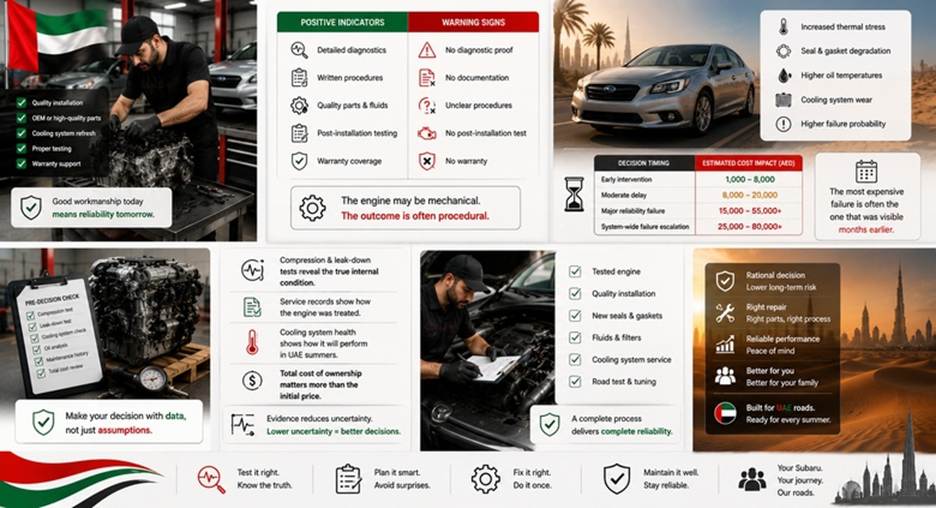
Positive Reliability Indicators
- Detailed diagnostics
- Written procedures
- Quality control processes
- Documented testing
- Post-installation inspections
- Warranty support
Reliability Warning Signs
- No diagnostic evidence
- No installation documentation
- Unclear labour procedures
- Missing warranty coverage
- No post-installation testing
Workshop Impact Matrix
| Installation Quality | Reliability Outcome |
| Excellent | Excellent |
| Good | Strong |
| Average | Moderate |
| Poor | Weak |
| Uncontrolled | High Risk |
The engine may be mechanical.
The outcome is often procedural.
The Reliability Cost of Delaying a Decision for Another UAE Summer
Every UAE summer creates a reliability experiment.
The vehicle either passes.
Or it accumulates stress.
Owners frequently postpone decisions until after summer.
Reliability engineers usually become uncomfortable when they hear that.
Because summer is rarely neutral.
Reliability Consequences of Delay
- Increased thermal stress
- Greater seal degradation
- Elevated oil temperatures
- Accelerated cooling-system wear
- Increased failure probability
Cost-of-Delay Comparison
| Decision Timing | Estimated Financial Exposure (AED) |
| Early Intervention | 1,000 – 8,000 |
| Moderate Delay | 8,000 – 20,000 |
| Major Reliability Failure | 15,000 – 55,000+ |
| System-Wide Failure Escalation | 25,000 – 80,000+ |
The most expensive failure is often the one that was visible months earlier.
The Final Reliability Matrix: Determining Whether Delaying a Subaru Legacy Engine Replacement Still Makes Engineering Sense
Reliability engineering is not about perfection.
It is about probability.
Every ownership decision changes probabilities.
Every delay changes probabilities.
Every repair changes probabilities.
The question is whether those probabilities are moving in your favour.
The Subaru Legacy remains one of those vehicles that often rewards careful ownership.
Many examples survive impressive mileage figures.
Many continue delivering dependable service long after expectations suggest otherwise.
But durability should never be confused with invincibility.
The two are not the same.
A reliable vehicle can still experience reliability decline.
A strong engine can still experience failure progression.
A manageable issue can still become an expensive one.
That is why evidence matters.
Compression testing matters.
Leak-down testing matters.
Cooling-system analysis matters.
Maintenance history matters.
Reliability trends matter.
For owners researching replacement options through PartFinder UAE, the objective should not simply be finding an engine.
The objective should be restoring system reliability while reducing long-term uncertainty.
Because the true reliability cost of delaying a Subaru Legacy engine replacement is rarely measured by today's repair bill.
It is measured by the failures that become possible tomorrow.
And reliability engineering has taught the same lesson for decades:
Small problems are usually cheapest when they are still small.
Frequently Asked Questions
Categories
- Audi
- BMW
- Car Accessories
- Car Tips
- Ford
- Land Rover
- Mazda
- Range Rover
- Top 10
- UAE Car Parts
- Used Car Parts
- Toyota
- Replacement Engines
- Nissan
- Hyundai
- Mitsubishi
- Volkswagen
- Honda
- Kia
- Chevrolet
- Dodge
- Jeep
- Subaru
- Renault
- Lexus
- Mercedes
- Suzuki
- Hummer
- Porsche
- Infiniti
- Peugeot
- GMC
- Mini
- Volvo
- Replacement Gearboxes
- MG
- Jaguar
- Skoda
- Cadillac
- Daihatsu
- Fiat
- German Car Parts
- Japanese Car Parts
- Aftermarket Car Parts
- Genuine Car Parts
- New Car Parts
- Reconditioned Car Parts
- European Car Parts
- American Car Parts
- Korean Car Parts
- British Car Parts
- Chinese Car Parts
- Sports/Exotic Car Parts
- Luxury Car Parts
- Performance Car Parts
- SUV/4x4 Spare Parts
- Truck Spare Parts
- EV Car Parts
- Hybrid Car Parts
- Auto Spare Parts in UAE
- Tesla
- Isuzu
- Ram
- Ferrari
- Bentley
- Lamborghini
- Genesis
- Maserati
- Lincoln
- Chrysler
- Opel
- Citroen
- SsangYong
- Seat
- McLaren
- Aston Martin
- Rolls Royce
- Maybach
- Alfa Romeo
- Bugatti
- Scion
- Abu Dhabi Car Parts
- Ajman Car Parts
- Al Khan Car Parts
- Al Sajaa Car Parts
- Deira Car Parts
- Dubai Car Parts
- Fujairah Car Parts
- Industrial Area 6 Car Parts
- Mussafah Car Parts
- Ras Al Khaimah Car Parts
- Sharjah Car Parts
- Umm Al Quwain Car Parts
- Acura
- BYD
- Chery
- Dacia
- DS
- Geely Emgrand
- EXEED
- GAC
- GAC Gonow
- Geely
- Gonow
- Great Wall
- Haima
- Haval
- Holden