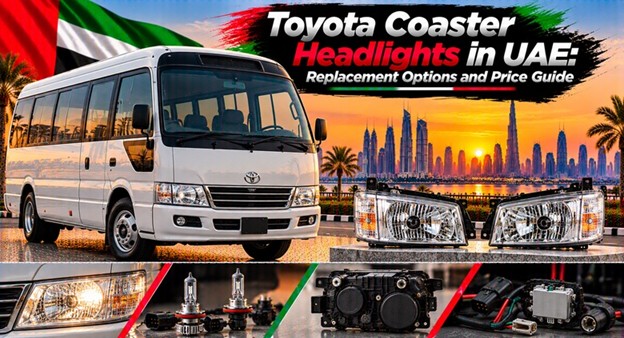
Toyota Coaster Headlights in UAE: Replacement Options and Price Guide
October 23, 2026
A Toyota Coaster carries people, often all day, and a faulty headlight is not a cosmetic nuisance when the vehicle still has school runs, staff transport or passenger journeys to complete. But replacing the lamp in a hurry can be an expensive mistake. Coasters from different production periods use different headlamp arrangements, and a part advertised simply as “Toyota Coaster headlight” may not match your bus at all.
For anyone comparing Toyota Coaster headlights in UAE, the sensible starting point is the chassis code, production period, original part number and lighting specification. The Coaster's commercial role makes the decision even more practical: buy the wrong lamp, and you may lose more than the price of the part. You may lose a working vehicle for another day.
The costliest mistake is ordering by model name alone
Toyota Coaster is not one unchanging vehicle. Older BB42 and HZB50 models, later HZB70 versions and newer configurations can use different headlamp assemblies, bulbs, housings and mounting arrangements. A seller who asks only for the vehicle name has not yet gathered enough information to confirm fitment.
Take a 2006 Coaster. Toyota's parts catalogue identifies separate right-hand and left-hand headlamp assemblies for selected GCC applications, including references 81110-36262, 81130-36182, 81150-36242 and 81170-36162, with applicability varying by production date and specification. These numbers are evidence of specific applications, not a universal set for every 2006 bus.
Before paying, identify your exact vehicle. A few minutes checking the chassis code can prevent the wrong assembly from travelling across the UAE and arriving just when the workshop needs the bus back on the road.
What do Toyota Coaster headlights cost in the UAE?
A reliable, current UAE retail price for a complete Coaster headlamp, tied to a confirmed part number, condition and warranty, could not be established from the available evidence for this article. That limitation is worth stating plainly rather than inventing a market average.
There are still useful reference points. Toyota's Saudi parts website lists a headlamp assembly under reference 8117036660 at SAR 1,919.35 including VAT, for specified 2017 Coaster applications. That is a Saudi retail price, not an AED quotation for the UAE. It also cannot be assumed to fit every 2017 Coaster.
A genuine UAE comparison needs a supplier to confirm the exact part, stock, price and delivery terms. Ask for a quote in AED and establish whether it covers one side or a pair. Until those details are confirmed, any claimed “average UAE Coaster headlight price” would be more guesswork than useful buying advice.
First identify the Coaster generation and chassis code
The chassis code is often more useful than the registration year alone. Toyota catalogues distinguish applications such as BB42, HZB50 and HZB70, alongside further variants and production-period details. Even within a broad model family, the body, seating configuration, destination market and lighting equipment can affect fitment.
Find the vehicle identification or frame number and, where possible, the model code on the vehicle's identification plate. Give those details to the parts supplier. If the old lamp remains fitted, photograph its label and connectors as well.
Don't rely solely on “Coaster 2007” or “Coaster 2017”. A registration year does not always establish the production date or original specification, particularly where the bus has been imported or previously repaired.
The right sequence is simple: identify the vehicle, identify the lamp, then compare prices. Reversing that sequence invites trouble.
The older BB42 and HZB50 models
Older Coasters can have straightforward-looking headlamp arrangements, but their catalogue references still vary by production period and market. Toyota's parts information for selected GCC BB42/HZB50 applications identifies separate right- and left-hand assemblies, with different references listed for different periods and specifications.
For example, 81110-36262 appears as a right-hand headlamp assembly for a specified 2004–2007 application, while 81150-36242 appears for the left side in a corresponding application. Other listed references apply to different configurations. Do not order both numbers as a pair without checking which entries match your bus.
An older Coaster may be a good candidate for a replacement housing or a repair to a smaller lighting part, depending on the fault. But first confirm what has actually failed. The apparent simplicity of an older lamp does not make every version interchangeable.
The 2017-onwards Coaster: don't assume the older lamp fits
The later Coaster range includes HZB70 and other chassis variants, with headlamp arrangements catalogued separately from the earlier BB42/HZB50 family. A parts catalogue for selected 2017–2018 HZB70 models identifies a single-beam headlamp arrangement, while another Toyota catalogue record for a 2017 Coaster identifies a dual-beam headlamp configuration. The difference is a warning against treating all vehicles from the same year as identical.
For a later bus, ask the supplier to match the chassis code and equipment, not just the year. Confirm whether the quoted item is a complete assembly, a housing, a bulb or a smaller internal part.
If your Coaster has already had front-end repairs, the existing lamp may not even be the original specification. Use the VIN or frame number to verify the correct part rather than copying a potentially incorrect reference from the old unit.
Genuine Toyota, aftermarket or used: which is worth buying?
Each option has a place, but the price alone cannot tell you which is best.
| Option | What it offers | What to verify |
|---|---|---|
| New genuine Toyota | Original-brand replacement for a verified application | Correct reference, supply source, price and warranty |
| New aftermarket | Potentially lower purchase cost | Manufacturer, fit, beam performance, supplied parts and returns |
| Used genuine | Original assembly removed from another vehicle | Lens, housing, mounting tabs, condition and tested functions |
| Reconditioned | A repaired or refurbished assembly | What work was performed, how it was tested and what the warranty covers |
| Repair of existing lamp | May avoid replacing serviceable parts | Whether the fault is repairable and the finished light remains safe and properly aimed |
For a bus that operates daily, reliability and delivery time matter alongside the initial price. A used original lamp may be sensible if it is in good condition and carries clear return terms. A new aftermarket lamp may be preferable when its manufacturer and fitment are known.
Avoid paying a premium for vague descriptions such as “original quality”. Ask what the seller is actually supplying.
Why left and right headlamps need separate checks
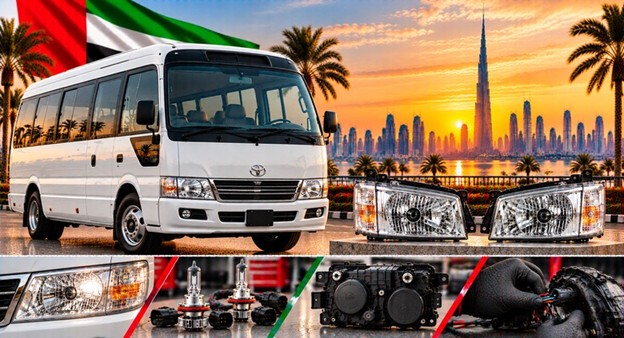
It sounds obvious, but listings can muddy the distinction between the left-hand and right-hand lamp, particularly when a seller uses one product page for several variants.
Toyota's catalogue for selected 2006 Coaster applications lists different part numbers for the right and left headlamp assemblies. For example, 81110-36262 and 81150-36242 are identified for specific sides and applications.
Never assume that the other side uses the same number with a minor suffix change, or that a photograph of the front proves which side the seller is offering. Ask for the complete part number and a clear photograph of the rear label.
If both lamps are damaged, request separate references and a combined quotation. If only one has failed, there is no automatic need to replace both, provided the remaining unit is sound, correctly specified and producing a suitable beam.
The bulb may have failed, not the headlamp assembly
A dark headlight does not necessarily mean the entire assembly needs replacing. The fault could lie with the bulb, fuse, connector, wiring or another part of the electrical circuit.
The correct response is to check the fault before buying a lamp. A technician can inspect the bulb and connector, test the relevant electrical supply and check for heat damage or corrosion. If the bus has suffered an impact, the housing and wiring should be inspected as well.
Toyota's catalogue for selected older Coaster applications lists separate 24-volt headlamp bulbs, including 90981-17008, and sealed-beam units for specified configurations. Those references demonstrate that smaller lighting parts may be listed separately; they do not establish that the same bulb suits every Coaster.
Ask the workshop to identify the failed part. Replacing a complete assembly before checking the basics can turn a modest repair into an unnecessary expense.
Housing, bulb or complete assembly: know what you're buying
A seller may advertise a “headlight” when the item is actually a housing, a sealed-beam unit, a bulb or a complete assembly. The difference affects both price and the work needed to fit it.
Toyota's parts records distinguish headlamp assemblies, housing sub-assemblies, mounting rings, adjusting screws and bulbs for selected Coaster applications. For example, the older catalogue lists housing references 81105-36190 and 81106-36170 for specified applications, separately from complete headlamp assemblies.
That separation is useful. If the housing is intact but a smaller service part has failed, replacing the entire lamp may not be necessary. If the lens or mounting structure is badly damaged, however, a small repair may not be appropriate.
Before paying, ask whether the price includes the housing, lens, bulb, adjusters and any required fittings. A low figure for one part should never be compared directly with the cost of a complete assembly.
What does the Saudi Toyota price tell UAE buyers?
The Saudi Toyota parts website lists 8117036660 as a headlamp assembly at SAR 1,919.35 including VAT, with compatibility information for specified 2017 Coaster configurations. It also states that delivery is within Saudi Arabia, with an estimated two to three business days under the site's listed terms.
That provides a regional reference, but not a UAE retail quotation. The price is in Saudi riyals, the delivery terms are for Saudi Arabia, and the stated fitment still needs to be checked against the buyer's vehicle.
Don't simply convert SAR to AED and assume the result is what a UAE buyer will pay. Local supply arrangements, delivery, VAT treatment, warranty handling and stock can change the final amount.
If you use this reference to negotiate a UAE quote, be transparent about its origin. Ask the local supplier for the correct Toyota part number, current AED price and delivery terms. A regional catalogue is useful evidence; it is not proof of local availability.
Beam pattern and market specification matter
A headlamp must fit the vehicle, but it must also produce a suitable beam pattern. Vehicles built for different markets can have different lighting specifications, so an assembly sourced from another country should not be accepted on appearance alone.
The Toyota Coaster catalogues distinguish vehicle applications by market and configuration, including GCC and other destination codes. That is one reason to check the exact application rather than assume that a part from a visually similar bus is suitable.
Ask the seller which market specification the lamp serves, then have the beam checked after fitting. A headlight that switches on may still be incorrectly aimed or unsuitable for the vehicle.
This is particularly important if the bus is used for passenger transport at night. Poorly directed light can reduce the driver's view and affect other road users. Fitment and beam alignment belong in the same repair, not as an afterthought.
UAE heat, dust and long operating hours
A Coaster may spend hours on the road, sit outdoors between journeys and run through dusty industrial areas or busy urban traffic. Strong sunlight and heat can age exposed plastic, while dust and vibration can aggravate existing damage. None of that proves the headlamp needs replacing, but it makes regular inspection worthwhile.
Look for a cloudy lens, cracks, loose mounting points, moisture inside the housing or a beam that has shifted after a bump. These symptoms point to different possible causes. Surface haze may be repairable; a cracked housing or broken mount may require replacement; a failed bulb or connector needs electrical diagnosis.
Don't blame the climate for every fault. Establish what has failed and why.
For fleet operators, checking lights during routine vehicle inspections can help catch damage before the bus is booked for a full day of work. A small, documented repair is easier to plan around than an unexpected failure before a scheduled run.
Can the existing headlamp be repaired?
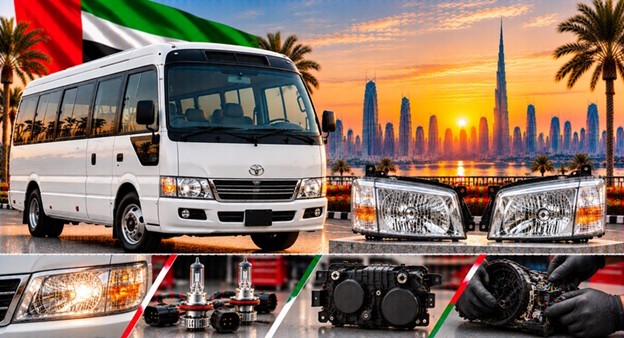
Sometimes, yes. A damaged lens, a failed bulb and a broken mounting bracket are different problems, and the repair should follow the fault rather than a blanket rule that every headlight must be replaced.
If the lens is merely cloudy, a specialist may be able to restore its surface, provided the housing and optics remain in good condition. If the lens is cracked, the housing leaks or the internal reflector has deteriorated, restoration may not be a reliable answer. A broken mount also needs attention because the lamp must remain secure and correctly aligned.
Ask the workshop to inspect the assembly before ordering parts. Have it explain whether the fault is limited to a repairable item or whether the complete lamp is no longer serviceable.
Compare the cost of repair with a correctly specified replacement, including labour and warranty. Don't spend money polishing a lamp that has structural damage, but don't bin a serviceable assembly just because one small part has failed.
Buying a used Coaster headlight without buying trouble
Used genuine parts can be useful for an older bus, especially when a new assembly is difficult to source or expensive relative to the vehicle's value. But a used lamp needs inspection, not wishful thinking.
Ask for photographs of the actual item. Check the lens for cracks and deep scratches, the housing for signs of repair, the mounting tabs for breaks and the electrical connections for corrosion. If the lamp has been removed from a dismantled vehicle, ask whether it was tested before removal and whether the seller knows why that vehicle was taken off the road.
Confirm the part number and ask which items are included. A used housing without the required fittings may not be comparable with a complete assembly.
Get the return conditions in writing before paying. A low-cost lamp that arrives damaged or proves incompatible can leave you paying for delivery twice, with the bus still waiting for a repair.
What a supplier should confirm before taking payment
A proper parts enquiry should produce more than a price and a promise that the item “fits Coaster”.
Ask the supplier to confirm:
- The exact Toyota part number and the side supplied.
- The chassis code, production period and specification covered.
- Whether the item is new genuine, aftermarket, used or reconditioned.
- Whether it is a complete assembly or only a housing, bulb or other part.
- The price in AED, including the stated VAT treatment and delivery.
- Current availability, warranty duration and return conditions.
If the seller cannot confirm the fitment, pause the purchase. A supplier may be perfectly honest and still have the wrong part on the shelf.
For a commercial vehicle, a written confirmation also helps if the item arrives incorrectly described. Keep the quotation and invoice, and retain photographs of the original lamp and the replacement until the installation has been checked.
The hidden cost of broken brackets and accident damage
A headlamp can crack during a minor collision while the surrounding bumper or mounting structure also takes a knock. The visible damage may be limited to the lens, but broken tabs or distorted mounts can stop a replacement sitting correctly.
Have the workshop inspect the surrounding area before ordering the new assembly. If a bracket is damaged, ask whether it is available separately and whether the housing itself remains sound. Toyota's catalogue for selected Coaster applications lists separate housing and adjustment-related parts, illustrating why a damaged lamp does not always mean every associated part must be replaced.
If the vehicle is being repaired through insurance, photograph the damage and follow the insurer's approval process before authorising extra work.
Do not fit a new lamp onto a damaged mount and hope for the best. It may sit crooked, vibrate or lose its alignment, turning a replacement job into a repeat visit.
Fitting a headlight on a working passenger bus
The fitting process depends on the exact Coaster version and the damage involved. Some repairs may be straightforward; others require access around the front bodywork, transfer of fittings or investigation of damaged wiring.
Before work begins, ask the workshop to check the old and new part numbers side by side. It should inspect the connector, mounting points and any reused parts, then test the lighting functions after installation. The beam should be checked and adjusted with suitable equipment.
If the bus has been involved in an impact, include an inspection of the surrounding structure. A correct headlamp cannot compensate for a bent mount or damaged wiring.
For a vehicle carrying passengers, the goal is not merely to make the light switch on. It must be securely installed, function correctly and provide an appropriate beam. Ask for those checks to be included in the job, and have the workshop state any additional work separately.
The price of downtime for fleet operators
A privately owned bus sitting in a workshop is inconvenient. A Coaster used for staff transport, school runs, hotel transfers or passenger services can also disrupt a schedule when the repair takes longer than expected.
That is why the lowest part price may not be the best commercial decision. A cheaper lamp with uncertain availability or a vague return policy can hold up the job, while a correctly identified part available locally may allow the vehicle to return to service sooner.
Before ordering, ask the supplier for a realistic delivery time and confirm that the part is physically available. Do not book the fitting appointment around an unverified promise that an item is “coming soon”.
For fleet managers, record the part number and supplier used for each vehicle. Keep the invoice and fitment notes. That small amount of record-keeping can make the next replacement quicker, although every new order still needs checking against the actual bus.
How to compare new and used prices fairly
A new genuine assembly and a used original lamp should not be compared on price alone. The new part may offer a clearer warranty and known condition, while the used unit may reduce the upfront cost but carry uncertainty about wear and damage.
An aftermarket assembly introduces a different set of questions: who made it, how well it fits, what it includes and what the seller will do if it fails. A repair to the existing lamp may be cheaper still, but only if the fault can be repaired reliably.
Use a like-for-like comparison:
| Check | Why it matters |
|---|---|
| Exact part number | Establishes whether the products are actually comparable |
| Condition | Separates new, used and reconditioned offers |
| Completeness | Identifies missing bulbs, fittings or housings |
| Delivery and VAT | Reveals costs beyond the displayed price |
| Labour and alignment | Shows the likely cost of completing the job |
| Warranty and returns | Establishes your protection if something goes wrong |
| Availability | Helps estimate how long the bus may remain off the road |
If a seller cannot supply the information needed to compare two offers, the cheaper one has not yet proved to be better value.
What if the headlight keeps fogging up?
Moisture inside a headlamp can point to a cracked housing, damaged seal, ventilation issue or a previous repair that has not been sealed properly. The pattern matters: brief condensation and persistent water droplets are not necessarily the same problem.
Inspect the lens and housing for cracks and look for evidence of previous opening or resealing. If the moisture returns repeatedly, have the lamp checked before replacing it. The fault may be repairable, but water that reaches electrical connections or damages the internal reflector can make a complete replacement more sensible.
Don't treat exterior polishing as a cure for water ingress. It may improve a cloudy outer surface while leaving the actual problem untouched.
Ask the workshop to explain the likely cause and the proposed fix. If it recommends a new assembly, confirm whether the old housing can be repaired reliably and whether the cost of doing so makes sense.
Bulb voltage and specification: a detail not to guess
Toyota Coasters use different electrical and lighting arrangements across model variants. The parts catalogue for selected older GCC applications identifies 24V 55/50W headlamp bulbs, including reference 90981-17008. Another catalogue entry for a selected 2017 Coaster application identifies a 12V 60/55W halogen bulb, reference 90981-13058. These are application-specific examples, not a recommendation to swap between them.
The voltage and bulb type must match the vehicle's actual specification. Installing a bulb because its base appears to fit can create electrical or lighting problems if its ratings are wrong.
Check the owner's manual, the existing bulb marking or a reliable parts catalogue linked to the chassis number. If the bus has been modified, have the electrical setup inspected before choosing a replacement.
A small bulb can be an inexpensive fix, but only when it is the correct bulb.
Where can UAE buyers start looking?
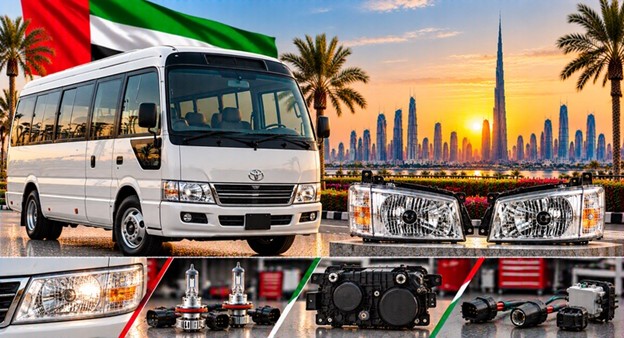
Begin with a Toyota parts counter or a specialist commercial-vehicle parts supplier that can check the chassis number. Used-parts traders may also be worth contacting when you need an original assembly for an older model, but ask them to confirm the exact item before travelling.
Toyota's Saudi online parts catalogue offers a regional reference for selected Coaster parts, including the headlamp assembly 8117036660 at SAR 1,919.35 including VAT for specified 2017 applications. It is not a UAE seller or a confirmed UAE price, but it gives you a part number to discuss with a local supplier if the fitment matches.
For a local enquiry, you can contact Toyota Showroom - Al Wahda Sharjah in Sharjah or ask whether a suitable Toyota parts department can identify the correct assembly. Its listing is for a Toyota showroom, not confirmation that the specific Coaster headlamp is in stock.
Call first. Give the chassis code and part number, and ask for current availability and an itemised price.
Buying from another emirate: check delivery and returns
A supplier in Sharjah may have a part that is difficult to find in Dubai, Abu Dhabi or Al Ain, but the distance is only one part of the decision. You also need to know when the lamp can be delivered and what happens if it is wrong.
Ask whether the item is physically in stock, whether delivery is included and how quickly it can reach your workshop. If it is a used assembly, request photographs of the exact lamp before it is dispatched.
Confirm the return process in writing. Does the seller accept returns for a damaged item? What if the part number supplied does not match the confirmed application? Who pays the return delivery, and is there a restocking charge?
Keep the packaging until the lamp has been checked and fitted. For a working bus, a failed delivery or difficult return can cost more in lost time than the initial price difference between two suppliers.
Reconditioned headlights: ask what has actually been done
“Reconditioned” can mean several things. The lens may have been polished, the housing resealed, a mounting point repaired or an electrical part replaced. Without a description of the work, the word tells you very little.
Ask which parts were repaired or replaced, whether the housing was opened, how the seals were checked and whether the completed lamp was tested. If the seller offers a warranty, find out whether it covers only visible defects or also faults discovered after installation.
A refurbished housing may be a reasonable option if the internal optics and structure remain sound. It is less convincing if the lamp has extensive water damage, broken mounting points or an unexplained electrical fault.
Compare the price with a new aftermarket assembly and a used genuine unit, but include the warranty and the risk of repeat work. The cheapest option on day one is not always the cheapest option by the end of the month.
What should the workshop test after installation?
A replacement headlamp should be checked for more than whether it illuminates. The workshop should confirm that the assembly is secure, the connectors are seated properly and the relevant lighting functions work as intended.
The beam needs attention, too. Incorrect alignment can reduce the driver's view or throw light into the eyes of oncoming traffic. Have the technician check and adjust it with suitable equipment, rather than judging the result by shining the lamp at a nearby wall.
If the original fault involved flickering or intermittent operation, test the circuit after fitting and check for damaged wiring or poor connections. A new lamp will not cure a fault elsewhere in the electrical system.
Ask for the completed work to be recorded on the invoice, including the part number and any additional repairs. That record will help if a warranty claim arises or the same vehicle needs another lighting repair later.
The true cost: parts, labour and lost working time
A useful budget needs to cover the complete repair rather than the lamp alone. For a Coaster, the final cost may include the assembly, delivery, VAT, labour, smaller fittings and beam alignment. If accident damage or an electrical fault is found, there may be additional work.
Downtime deserves a place in the calculation as well. If the bus is used for a scheduled service, an uncertain delivery date can be more disruptive than a modest difference in parts price. That does not justify paying any price a seller asks, but it does make confirmed stock and reliable returns commercially relevant.
Ask the supplier for the part price in AED and the workshop for a separate fitting estimate. Have them identify what is included and what remains provisional.
There is not enough verified UAE price evidence here to give a dependable, universal fitted-cost range for the Toyota Coaster. A quotation based on the actual chassis and part number is the honest way to budget.
A practical sourcing route for Toyota Coaster owners
When comparing suppliers through PartFinder UAE or contacting parts businesses directly, give each seller the same details: chassis code, production period, frame or VIN information, part number and side required. That makes the quotations comparable and reduces the chance of buying a lamp for the wrong Coaster variant.
Ask for the condition, manufacturer, included parts, current availability, warranty, delivery charge and VAT treatment. For used assemblies, request photographs of the actual item and confirmation that the mounting points and housing have been inspected.
If the supplier proposes an alternative part number, ask whether it is a documented replacement for your specific application. A seller's assurance that it “looks the same” is not sufficient evidence.
Keep the written quotation and invoice. If the part arrives damaged or differs from the agreed description, photographs and a clear record of the order will make the dispute easier to handle.
Before you order: the buyer's decision checklist
Use these checks to avoid the most common purchasing mistakes.
- Wrong generation: establish whether your bus is an older BB42/HZB50 or a later variant such as HZB70.
- Wrong side: confirm left or right and obtain the complete part number.
- Wrong item: establish whether the price covers a bulb, housing, sealed-beam unit or complete assembly.
- Wrong electrical specification: verify voltage, bulb type and wattage against the actual vehicle.
- Unclear condition: for used or reconditioned parts, inspect the housing, lens, mounting points and connectors.
- Hidden charges: confirm AED price, VAT, delivery, labour and alignment.
- Unclear availability: ask whether the item is in stock or needs to be ordered.
- Weak return protection: get the warranty and return conditions in writing.
If you cannot answer these questions, hold off on payment. A little checking now is easier than rearranging a workshop job around the wrong part.
UAE Update Reference: October 2026
The evidence checked on 12 October 2026 provides a useful fitment reference and one regional retail price, but it does not establish a verified UAE market average for complete Toyota Coaster headlamps.
| Evidence | Price or reference | What is confirmed |
|---|---|---|
| Toyota Saudi parts listing, headlamp assembly 8117036660 | SAR 1,919.35 including VAT | Listed for specified 2017 Coaster applications; Saudi price and delivery terms |
| Toyota catalogue, selected 2006 GCC Coaster | 81110-36262, 81130-36182, 81150-36242, 81170-36162 | Separate right- and left-hand assemblies for specified applications |
| Toyota catalogue, selected 2017 Coaster | 90981-13058 | Listed 12V 60/55W halogen bulb for a specified configuration |
| UAE retail price for an exact, confirmed Coaster headlamp | Not verified | Current AED price, stock, condition and warranty need supplier confirmation |
The part references and Saudi price come from catalogue and retailer records, not a confirmed UAE workshop quotation.
For a purchase in Dubai, Sharjah, Abu Dhabi or another emirate, request a current quote using the actual chassis code and part number. Confirm the price in AED, the item supplied, availability, VAT, delivery and warranty before treating the quote as comparable with another offer.
Frequently Asked Questions
Categories
- Audi
- BMW
- Car Accessories
- Car Tips
- Ford
- Land Rover
- Mazda
- Range Rover
- Top 10
- UAE Car Parts
- Used Car Parts
- Toyota
- Replacement Engines
- Nissan
- Hyundai
- Mitsubishi
- Volkswagen
- Honda
- Kia
- Chevrolet
- Dodge
- Jeep
- Subaru
- Renault
- Lexus
- Mercedes
- Suzuki
- Hummer
- Porsche
- Infiniti
- Peugeot
- GMC
- Mini
- Volvo
- Replacement Gearboxes
- MG
- Jaguar
- Skoda
- Cadillac
- Daihatsu
- Fiat
- German Car Parts
- Japanese Car Parts
- Aftermarket Car Parts
- Genuine Car Parts
- New Car Parts
- Reconditioned Car Parts
- European Car Parts
- American Car Parts
- Korean Car Parts
- British Car Parts
- Chinese Car Parts
- Sports/Exotic Car Parts
- Luxury Car Parts
- Performance Car Parts
- SUV/4x4 Spare Parts
- Truck Spare Parts
- EV Car Parts
- Hybrid Car Parts
- Auto Spare Parts in UAE
- Tesla
- Isuzu
- Ram
- Ferrari
- Bentley
- Lamborghini
- Genesis
- Maserati
- Lincoln
- Chrysler
- Opel
- Citroen
- SsangYong
- Seat
- McLaren
- Aston Martin
- Rolls Royce
- Maybach
- Alfa Romeo
- Bugatti
- Scion
- Abu Dhabi Car Parts
- Ajman Car Parts
- Al Khan Car Parts
- Al Sajaa Car Parts
- Deira Car Parts
- Dubai Car Parts
- Fujairah Car Parts
- Industrial Area 6 Car Parts
- Mussafah Car Parts
- Ras Al Khaimah Car Parts
- Sharjah Car Parts
- Umm Al Quwain Car Parts
- Acura
- BYD
- Chery
- Dacia
- DS
- Geely Emgrand
- EXEED
- GAC
- GAC Gonow
- Geely
- Gonow
- Great Wall
- Haima
- Haval
- Holden
- Iveco
- JAC
- Jaecoo
- Jetour
- Lotus
- Omoda
- Proton
- Renault Samsung
- Roewe
- Lucid
- Replacement Headlight
- Replacement Bumper