Toyota Hiace Engine Replacement Cost UAE: Managing the Ownership Lifecycle from High Mileage to Long-Term Reliability
June 11, 2026
The ownership story of a Toyota Hiace is often very different from that of most passenger vehicles.
For many owners across Dubai, Abu Dhabi, Sharjah and the wider UAE, a Toyota Hiace is not simply transport.
It is an operational asset.
A business tool.
A daily revenue generator.
A family-support vehicle.
A logistics solution.
A staff transportation platform.
Its value is often measured not only by kilometres travelled but by the work it performs throughout its life.
This is why Toyota Hiace ownership tends to follow a lifecycle rather than a traditional vehicle ownership journey.
The vehicle is purchased.
It enters daily service.
Mileage accumulates.
Operating costs slowly increase.
Maintenance requirements become more frequent.
Eventually the owner reaches a major decision point.
Continue repairing.
Replace the engine.
Or replace the vehicle.
Understanding that lifecycle is essential because an engine replacement is rarely an isolated repair.
It is often the most significant lifecycle-extension decision an owner will make.
A properly managed engine replacement can add years of productive service life.
A poorly managed decision can create unnecessary costs, downtime and operational disruption.
This guide examines the complete ownership lifecycle from high-mileage operation through engine replacement and long-term reliability planning.
The Toyota Hiace Ownership Lifecycle: Understanding How Long-Term Reliability Is Built Over Time
Every Toyota Hiace begins its ownership journey in a similar position.
Strong reliability.
Predictable maintenance.
Low operational risk.
However, lifecycle outcomes vary dramatically.
Some Hiace vehicles remain productive beyond 400,000 kilometres.
Others encounter major financial challenges much earlier.
The difference often lies in ownership decisions made throughout the lifecycle.
Key Lifecycle Stages
Vehicle Acquisition
↓
Routine Operation
↓
Mileage Accumulation
↓
Wear Development
↓
Repair Escalation
↓
Major Mechanical Decisions
↓
Engine Replacement Evaluation
↓
Lifecycle Extension
↓
Long-Term Reliability Management
Lifecycle Influencing Factors
- Maintenance quality
- Operating conditions
- Driver behaviour
- Climate exposure
- Load management
- Repair timing
The engine replacement decision typically occurs near the middle of this lifecycle rather than at the end.
Early Lifecycle Management: Ownership Decisions That Shape Future Engine Health
The first years of ownership often determine how expensive later years become.
Many engine replacement projects begin with maintenance decisions made years earlier.
Early Lifecycle Priorities
✓ Scheduled servicing
✓ Cooling-system maintenance
✓ Oil-quality management
✓ Air-filter replacement
✓ Fuel-system care
✓ Preventive inspections
These actions may appear routine.
Over time they become major contributors to lifecycle durability.
Maintenance Economics Comparison
| Ownership Approach | Long-Term Cost Exposure |
| Preventive Maintenance | Lower |
| Reactive Maintenance | Higher |
| Delayed Maintenance | Significant |
| Neglected Maintenance | Very High |
The cheapest maintenance strategy today rarely becomes the cheapest ownership strategy later.
High-Mileage Reality: How Toyota Hiace Engines Age in UAE Operating Conditions
High mileage is not automatically a problem.
Poorly managed high mileage is.
Across the UAE, many Toyota Hiace vehicles accumulate mileage at rates far above typical passenger vehicles.
Commercial operators often exceed annual mileage levels that private vehicles may take years to reach.
Common High-Mileage Wear Areas
- Cooling systems
- Fuel injectors
- Water pumps
- Engine seals
- Turbo systems (where applicable)
- Sensors
- Mounts
Mileage Risk Assessment
| Mileage Range | Lifecycle Position | Risk Level |
| Under 100,000 km | Early Lifecycle | Low |
| 100,000 – 200,000 km | Developing Lifecycle | Moderate |
| 200,000 – 350,000 km | Mature Lifecycle | Elevated |
| 350,000 km+ | Advanced Lifecycle | High |
Mileage alone does not determine engine health.
Maintenance history remains equally important.
The UAE Climate Lifecycle Effect: How Heat Influences Engine Longevity
The UAE climate accelerates certain stages of the ownership lifecycle.
Heat places additional stress on critical systems.
Systems Most Affected
- Radiators
- Cooling fans
- Water pumps
- Thermostats
- Engine oil
- Hoses
- Seals
Many ownership costs begin with cooling-system deterioration.
When cooling performance declines, additional engine stress often follows.
Climate Exposure Comparison
| Operating Environment | Engine Stress Level |
| Mild Climate | Moderate |
| UAE Winter Operation | Moderate |
| UAE Summer Highway Use | High |
| UAE Urban Stop-Start Operation | Very High |
| Continuous Commercial Operation | Critical |
UAE Summer Failure Patterns
Common workshop observations include:
- Overheating incidents
- Cooling-system failures
- Increased oil consumption
- Hose deterioration
- Seal degradation
Climate management becomes lifecycle management.
Ignoring one often affects the other.
Lifecycle Cost Escalation: Recognising When Routine Maintenance Begins Turning Into Major Repairs
Most Toyota Hiace owners do not suddenly face engine replacement.
Instead, they experience a gradual escalation of repair activity.
Small repairs become more frequent.
Downtime increases.
Operating costs rise.
The lifecycle enters a new phase.
Typical Escalation Pattern
Routine Service
↓
Minor Repairs
↓
Repeated Repairs
↓
Component Failures
↓
Major Mechanical Intervention
↓
Engine Replacement Evaluation
Cost Escalation Timeline
| Lifecycle Stage | Typical Cost Range (AED) |
| Routine Maintenance | 500 – 3,000 |
| Minor Repairs | 1,000 – 5,000 |
| Intermediate Repairs | 5,000 – 12,000 |
| Major Repairs | 12,000 – 30,000 |
| Engine Replacement Project | 15,000 – 80,000+ |
One of the most important ownership skills is recognising when the lifecycle has shifted from maintenance to major investment planning.
The Engine Replacement Threshold: Identifying the Point Where Lifecycle Extension Makes Financial Sense
Eventually every owner faces a fundamental question.
Is the vehicle still worth investing in?
The answer depends on more than repair costs.
It depends on the remaining value of the ownership lifecycle.
Indicators That Engine Replacement May Be Justified
✓ Strong chassis condition
✓ Good maintenance history
✓ Reliable transmission condition
✓ Business continuity requirements
✓ High replacement-vehicle costs
Indicators That Further Evaluation Is Needed
- Multiple major system failures
- Structural deterioration
- Severe accident history
- Escalating downtime
Lifecycle Decision Matrix
| Vehicle Condition | Recommended Evaluation |
| Strong Overall Condition | Engine Replacement Consideration |
| Moderate Condition | Detailed Cost Analysis |
| Weak Overall Condition | Compare Vehicle Replacement |
| Poor Overall Condition | Replacement Evaluation Required |
The correct decision is rarely based solely on today's repair bill.
It is based on future lifecycle value.
Toyota Hiace Engine Cost Comparison UAE
A replacement engine can dramatically alter the remaining lifecycle of a Toyota Hiace.
However, engine selection influences future ownership outcomes.
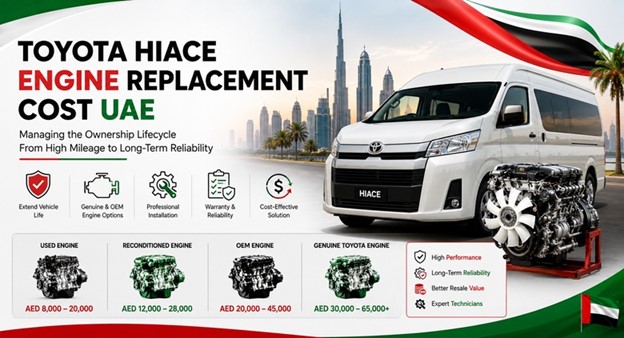
Engine Cost Comparison
| Engine Type | Estimated Engine Cost (AED) |
| Used Engine | 8,000 – 20,000 |
| Reconditioned Engine | 12,000 – 28,000 |
| OEM Engine | 20,000 – 45,000 |
| Genuine Toyota Engine | 30,000 – 65,000+ |
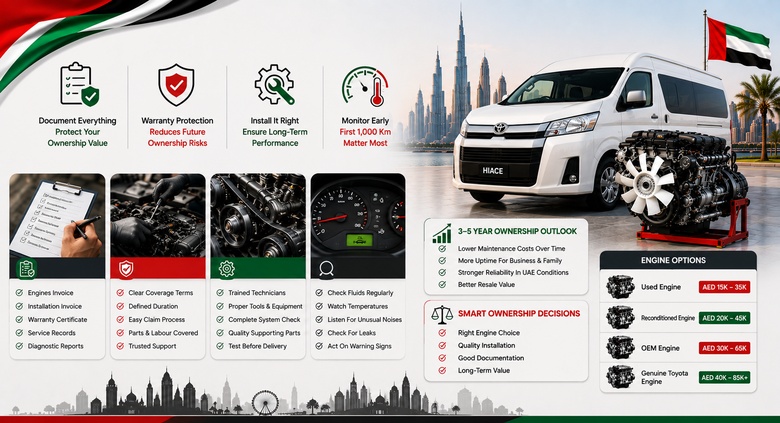
Total Project Cost Comparison
| Engine Type | Estimated Total Project Cost (AED) |
| Used Engine Project | 15,000 – 35,000 |
| Reconditioned Engine Project | 20,000 – 45,000 |
| OEM Engine Project | 30,000 – 65,000 |
| Genuine Engine Project | 40,000 – 85,000+ |
The cheapest engine may extend the lifecycle temporarily.
The most suitable engine often depends on future ownership plans.
UAE Labour Cost Analysis by Emirate
Labour costs become an important lifecycle consideration during major repairs.
Labour Cost Comparison
| Emirate | Typical Labour Cost (AED) |
| Dubai | 5,000 – 18,000 |
| Abu Dhabi | 5,000 – 17,000 |
| Sharjah | 4,000 – 15,000 |
| Ajman | 4,000 – 13,000 |
| Ras Al Khaimah | 4,000 – 12,000 |
| Fujairah | 4,000 – 12,000 |
| Umm Al Quwain | 3,500 – 11,000 |
Labour pricing often reflects:
- Workshop capability
- Technical expertise
- Equipment investment
- Warranty support
- Quality-control procedures
The lowest labour quotation rarely guarantees the strongest lifecycle outcome.
Family and Business Ownership Perspectives
A Toyota Hiace often supports more than one purpose.
Family Ownership Perspective
Owners may prioritise:
- Reliability
- Safety
- Predictable costs
- Long-term value
Business Ownership Perspective
Operators often prioritise:
- Downtime reduction
- Revenue continuity
- Fleet availability
- Lifecycle extension
Both groups ultimately share the same objective:
Maximising value from the ownership lifecycle.
The First Major Lifecycle Conclusion
At this stage, the ownership journey becomes clearer.
A Toyota Hiace engine replacement is not simply a repair project.
It is a lifecycle-management decision.
The most successful ownership outcomes usually result from:
- Early maintenance discipline
- Climate awareness
- High-mileage monitoring
- Cost-escalation recognition
- Timely decision-making
Mileage Evaluation Guide: Assessing Replacement Engine Value Within the Ownership Lifecycle
Mileage plays a unique role in the Toyota Hiace ownership lifecycle.
Unlike many passenger vehicles, a Hiace often accumulates mileage through productive commercial activity.
A vehicle showing 300,000 kilometres may have generated years of operational value.
The question is not simply how much mileage exists.
The more important question is what that mileage represents.
High-Value Mileage Indicators
✓ Consistent servicing
✓ Cooling-system maintenance
✓ Documented repairs
✓ Stable operating temperatures
✓ Strong diagnostic reports
High-Risk Mileage Indicators
✗ Unknown maintenance history
✗ Repeated overheating events
✗ Missing service records
✗ Excessive oil consumption
✗ Poor diagnostic results
Mileage Evaluation Matrix
| Mileage Range | Ownership Risk | Lifecycle Potential |
| Under 150,000 km | Lower | Excellent |
| 150,000 – 300,000 km | Moderate | Strong |
| 300,000 – 450,000 km | Elevated | Requires Analysis |
| Above 450,000 km | High | Requires Detailed Evaluation |
Mileage influences lifecycle planning.
Documentation determines confidence.
Toyota Hiace Engine Replacement Cost UAE: Comparing Lifecycle Extension Strategies
Engine replacement should be viewed as a lifecycle-extension strategy.
Each engine option creates a different future ownership experience.
Used Engine Strategy
Advantages:
- Lowest upfront cost
- Faster sourcing
Potential Risks:
- Unknown operational history
- Higher future uncertainty
Reconditioned Engine Strategy
Advantages:
- Balanced cost structure
- Refreshed internal components
Potential Risks:
- Rebuild quality variation
OEM Engine Strategy
Advantages:
- Strong reliability profile
- Predictable compatibility
Potential Risks:
- Higher investment
Genuine Toyota Engine Strategy
Advantages:
- Maximum lifecycle confidence
- Strongest long-term ownership outlook
Potential Risks:
- Highest purchase cost
Lifecycle Cost Comparison
| Engine Type | Estimated Project Cost (AED) | Lifecycle Outlook |
| Used Engine | 15,000 – 35,000 | Variable |
| Reconditioned Engine | 20,000 – 45,000 | Balanced |
| OEM Engine | 30,000 – 65,000 | Strong |
| Genuine Toyota Engine | 40,000 – 85,000+ | Strongest |
The correct option depends on the owner's future plans.
Supporting Component Lifecycle Management: Parts That Should Be Replaced Alongside the Engine
One of the biggest lifecycle mistakes occurs when owners focus exclusively on the replacement engine.
The engine is only one part of a larger operating system.
Supporting components often determine whether the next ownership phase remains stable.
Supporting Parts Replacement Checklist
✓ Radiator
✓ Water pump
✓ Thermostat
✓ Engine mounts
✓ Cooling hoses
✓ Belts
✓ Tensioners
✓ Sensors
✓ Filters
✓ Fluids
Supporting Component Cost Analysis
| Component | Typical Cost (AED) |
| Radiator | 1,500 – 6,000 |
| Water Pump | 800 – 4,500 |
| Thermostat | 400 – 2,500 |
| Engine Mounts | 1,000 – 5,000 |
| Sensors | 500 – 5,000 |
| Belts & Tensioners | 500 – 3,500 |
| Fluids & Filters | 500 – 2,500 |
Replacing selected supporting components during installation often reduces future labour expenses.
Downtime and Business Continuity: How Engine Decisions Affect Operational Lifecycles
For many Toyota Hiace owners, downtime creates costs that exceed repair expenses.
A vehicle that generates daily revenue becomes financially vulnerable when unavailable.
Business Continuity Considerations
- Passenger transport
- Tourism operations
- Delivery services
- Staff transportation
- Construction support fleets
Downtime Impact Analysis
| Downtime Duration | Operational Impact |
| 1–3 Days | Low |
| 4–7 Days | Moderate |
| 1–2 Weeks | High |
| More Than 2 Weeks | Significant |
Fleet Perspective
A fleet manager often evaluates:
- Lost revenue
- Vehicle utilisation
- Driver productivity
- Customer commitments
This is why engine replacement is frequently viewed as a business-continuity investment rather than a repair expense.
Cost-of-Delay Analysis: The Financial Consequences of Postponing Major Decisions
One of the most expensive ownership habits is delaying decisions after warning signs appear.
Common Warning Signs
- Increasing oil consumption
- Repeated overheating
- Loss of power
- Persistent warning lights
- Rising maintenance frequency
Many owners continue investing in repeated repairs.
Eventually they discover that cumulative spending exceeds the cost of lifecycle extension.
Cost Escalation Example
| Ownership Stage | Typical Cost Exposure (AED) |
| Early Intervention | 2,000 – 8,000 |
| Repeated Repairs | 8,000 – 20,000 |
| Major Mechanical Failure | 20,000 – 40,000 |
| Full Engine Replacement Project | 15,000 – 85,000+ |
Early action often creates the strongest financial outcome.
Documentation Throughout the Lifecycle: Protecting Ownership Value and Vehicle History
Documentation functions as a financial asset throughout the ownership lifecycle.
The longer a vehicle remains in service, the more valuable accurate records become.
Documentation Verification Checklist
✓ Engine purchase invoice
✓ Installation invoice
✓ Warranty certificate
✓ Diagnostic reports
✓ Service records
✓ Compression-test results
✓ Engine identification details
Documentation Value Matrix
| Documentation Status | Ownership Value |
| Complete Records | Highest |
| Strong Records | High |
| Partial Records | Moderate |
| Missing Records | Reduced |
Future buyers often trust documentation more than verbal claims.
Insurance and Registration Considerations
Many owners focus on mechanical work and overlook administrative responsibilities.
Important documents should be retained throughout the lifecycle.
Key Records
- Purchase invoices
- Engine installation records
- Warranty documents
- Maintenance history
These records support:
- Ownership verification
- Future resale discussions
- Warranty claims
- Vehicle-history transparency
Good record management contributes directly to lifecycle value.
Warranty Protection and Lifecycle Stability: Reducing Future Ownership Risks
A replacement engine creates a new phase in the vehicle's lifecycle.
Warranty protection helps stabilise that phase.
Characteristics of Strong Warranty Coverage
✓ Written documentation
✓ Clear coverage terms
✓ Defined duration
✓ Transparent exclusions
✓ Workshop accountability
Warranty Red Flags
✗ Verbal-only promises
✗ Missing documentation
✗ Extremely limited coverage
✗ Unclear claim procedures
✗ Undefined responsibilities
Warranty Comparison
| Warranty Type | Risk Level |
| Comprehensive Written Warranty | Low |
| Standard Written Warranty | Moderate |
| Limited Coverage | Elevated |
| Verbal Warranty Only | High |
Warranty protection often determines whether future ownership remains predictable.
Poor Installation Warning Signs That Threaten Lifecycle Extension
A replacement engine should extend the ownership lifecycle.
Poor installation can shorten it.
Post-Installation Warning Signs
- Fluid leaks
- Warning lights
- Rough idle
- Excessive vibration
- Temperature fluctuations
- Unusual noises
Installation Risk Matrix
| Observation | Risk Level |
| Stable Operation | Low |
| Minor Irregularity | Moderate |
| Persistent Warning Lights | High |
| Continuous Fluid Leaks | High |
| Overheating | Critical |
Early detection protects the next stage of ownership.
The Second Major Lifecycle Conclusion
At this stage, the ownership lifecycle enters a critical transition period.
The replacement engine itself is only one part of the equation.
Long-term success depends on:
- Engine selection
- Supporting components
- Downtime management
- Documentation quality
- Warranty protection
- Installation standards
For owners researching Toyota Hiace engine for sale, the most successful lifecycle-extension projects are usually those that evaluate the entire ownership journey rather than focusing solely on engine price.
The First 1,000 Kilometres After Engine Replacement: Securing the Next Stage of the Lifecycle
An engine replacement does not conclude the ownership lifecycle.
It begins a new chapter.
Many owners focus entirely on installation quality while overlooking the importance of the first post-installation phase.
The first 1,000 kilometres often reveal whether the replacement project has successfully extended the lifecycle.
First 1,000 km Monitoring Checklist
✓ Monitor coolant levels
✓ Check engine oil regularly
✓ Observe operating temperatures
✓ Watch for warning lights
✓ Monitor fuel consumption
✓ Listen for unusual noises
✓ Inspect for fluid leaks
Early Detection Benefits
| Issue Identified Early | Potential Future Cost Avoided |
| Minor Coolant Leak | High |
| Sensor Fault | Moderate |
| Oil Leak | High |
| Calibration Issue | Moderate |
| Cooling-System Problem | Very High |
Small observations during this period often prevent major lifecycle disruptions later.
Resale Value Through the Ownership Lifecycle: How Replacement Decisions Influence Market Appeal
Every ownership lifecycle eventually reaches a resale discussion.
Some owners plan to sell shortly after replacement.
Others intend to keep the vehicle for years.
Regardless of timing, resale value remains important.
Factors That Influence Future Value
- Engine quality
- Installation quality
- Documentation quality
- Maintenance history
- Warranty records
Future buyers rarely evaluate only the engine.
They evaluate the credibility of the ownership story.
Resale Value Comparison
| Ownership Scenario | Buyer Confidence |
| Genuine Engine + Full Documentation | Excellent |
| OEM Engine + Strong Records | Very Good |
| Reconditioned Engine + Records | Good |
| Used Engine + Partial Documentation | Moderate |
| Unknown Engine History | Weak |
The documentation surrounding the replacement often becomes as valuable as the replacement itself.
Three-Year Ownership Forecast After Engine Replacement
Most lifecycle-extension decisions should be evaluated over several years.
A replacement engine may appear expensive initially.
Viewed over a longer period, the economics often change.
Three-Year Ownership Forecast
| Cost Category | Estimated Cost (AED) |
| Scheduled Maintenance | 3,000 – 10,000 |
| Fluids & Filters | 1,500 – 5,000 |
| Diagnostics | 1,000 – 4,000 |
| Preventive Repairs | 2,000 – 10,000 |
| Contingency Repairs | 2,000 – 12,000 |
Ownership Risk Comparison
| Engine Type | Three-Year Risk Profile |
| Used Engine | Higher |
| Reconditioned Engine | Moderate |
| OEM Engine | Lower |
| Genuine Toyota Engine | Lowest |
Short-term cost often differs from long-term value.
Five-Year Ownership Forecast: Measuring the Real Lifecycle Extension Value
A Toyota Hiace is frequently retained far longer than many passenger vehicles.
For that reason, five-year planning becomes important.
Five-Year Ownership Perspective
| Engine Type | Long-Term Lifecycle Outlook |
| Used Engine | Variable |
| Reconditioned Engine | Balanced |
| OEM Engine | Strong |
| Genuine Toyota Engine | Strongest |
Five-Year Cost Exposure Factors
- Annual mileage
- Climate exposure
- Maintenance discipline
- Fleet utilisation
- Driver behaviour
The true success of an engine replacement becomes visible over years rather than months.
Fleet and Commercial Lifecycle Planning: Maximising Operational Service Life
Toyota Hiace ownership in the UAE is heavily connected to commercial use.
For fleet operators, lifecycle management becomes a business strategy.
Fleet Priorities
✓ Maximum uptime
✓ Predictable operating costs
✓ Long service life
✓ Revenue continuity
✓ Reduced downtime
Fleet Lifecycle Economics
| Fleet Strategy | Long-Term Outcome |
| Reactive Repairs | Higher Costs |
| Preventive Maintenance | Lower Costs |
| Planned Lifecycle Extension | Strong Stability |
| Delayed Major Repairs | Elevated Risk |
The most successful fleets manage lifecycle transitions before failures occur.
Family Ownership Perspective: Protecting Reliability for Everyday Use
Not every Toyota Hiace serves a commercial role.
Many families rely on the platform for transportation and long-distance travel.
Family owners often prioritise:
- Reliability
- Safety
- Predictable budgeting
- Reduced stress
An engine replacement can restore confidence when properly managed.
Family Ownership Priorities
| Priority | Importance |
| Reliability | Critical |
| Safety | Critical |
| Cost Predictability | High |
| Resale Protection | Moderate |
For families, lifecycle stability often matters more than maximum profit.
Real UAE Ownership Scenarios
Dubai Fleet Operator
Vehicle:
Toyota Hiace
Situation:
Increasing downtime and rising maintenance frequency.
Decision:
OEM replacement engine with supporting component upgrades.
Outcome:
Improved fleet reliability and reduced operational disruption.
Abu Dhabi Family Owner
Vehicle:
Toyota Hiace
Situation:
Cooling-system failures and escalating repair costs.
Decision:
Replacement engine combined with cooling-system renewal.
Outcome:
Extended lifecycle and improved ownership confidence.
Sharjah Small Business Owner
Vehicle:
Toyota Hiace
Situation:
Revenue-generating vehicle facing major engine wear.
Decision:
Documented reconditioned engine with written warranty.
Outcome:
Balanced investment and restored operational continuity.
These examples demonstrate how lifecycle decisions directly influence ownership outcomes.
Engine Replacement vs Vehicle Replacement: Choosing the Better Lifecycle Strategy
Every owner eventually confronts a difficult question.
Extend the lifecycle.
Or replace the vehicle.
Factors Supporting Engine Replacement
- Strong chassis condition
- Good service history
- Lower total investment
- Long-term ownership plans
Factors Supporting Vehicle Replacement
- Multiple major failures
- Structural deterioration
- Excessive downtime
- Significant future repair exposure
Financial Comparison
| Option | Typical Cost (AED) |
| Used Engine Project | 15,000 – 35,000 |
| Reconditioned Engine Project | 20,000 – 45,000 |
| OEM Engine Project | 30,000 – 65,000 |
| Genuine Engine Project | 40,000 – 85,000+ |
| Replacement Vehicle | 90,000 – 250,000+ |
The correct decision depends on remaining lifecycle value.
Competitor Ownership Comparison
Many owners compare Toyota Hiace lifecycle costs against competing commercial vehicles.
Ownership Comparison
| Vehicle | Engine Replacement Exposure | Ownership Complexity |
| Toyota Hiace | Moderate | Lower |
| Nissan Urvan | Moderate | Moderate |
| Hyundai H-1 | Moderate | Moderate |
| Mercedes Sprinter | Higher | Higher |
Long-term reliability frequently determines lifecycle success more than initial purchase cost.
Common Lifecycle Mistakes That Increase Ownership Costs
Certain ownership habits repeatedly shorten vehicle lifecycles.
Common Mistakes
- Ignoring warning signs
- Delaying diagnostics
- Choosing solely on price
- Ignoring documentation
- Overlooking supporting components
- Accepting weak warranty protection
Cost Impact Matrix
| Mistake | Long-Term Impact |
| Delayed Repairs | High |
| Poor Documentation | Moderate |
| Weak Warranty | High |
| Cheapest Engine Selection | Elevated |
| Ignoring Supporting Parts | Very High |
Most lifecycle failures begin with small decisions rather than major mistakes.
Buyer Decision Matrix
Priority: Lowest Upfront Cost
Recommended Option:
Documented Used Engine
Priority: Balanced Lifecycle Value
Recommended Option:
Reconditioned Engine
Priority: Long-Term Commercial Use
Recommended Option:
OEM Engine
Priority: Maximum Lifecycle Confidence
Recommended Option:
Genuine Toyota Engine
Ownership Decision Matrix
| Ownership Goal | Recommended Path |
| Budget Focus | Used Engine |
| Balanced Value | Reconditioned Engine |
| Long-Term Operation | OEM Engine |
| Maximum Confidence | Genuine Engine |
Insurance, Registration and Documentation Considerations
Administrative preparation remains an important part of lifecycle management.
Essential Records
✓ Engine invoice
✓ Installation invoice
✓ Warranty documentation
✓ Service records
✓ Diagnostic reports
These records assist with:
- Ownership transparency
- Future resale
- Warranty claims
- Vehicle-history verification
Good administration supports long-term value preservation.
Final Ownership Lifecycle Strategy: Building Long-Term Reliability and Value
The ownership lifecycle of a Toyota Hiace is rarely determined by a single repair.
Instead, it is shaped by a sequence of decisions made over many years.
Maintenance decisions.
Repair decisions.
Replacement decisions.
Documentation decisions.
Engine replacement is often the most important lifecycle-extension opportunity available to owners.
For those researching solutions through PartFinder UAE, the strongest outcomes usually come from viewing the vehicle as a long-term asset rather than a short-term expense.
Final Lifecycle Framework
| Ownership Area | Primary Objective |
| Maintenance | Longevity |
| Diagnostics | Early Detection |
| Engine Selection | Reliability |
| Supporting Parts | Stability |
| Warranty Protection | Risk Reduction |
| Documentation | Value Preservation |
| Resale Planning | Future Flexibility |
| Lifecycle Forecasting | Financial Clarity |
The most successful Toyota Hiace owners do not simply ask:
"How much does a replacement engine cost?"
They ask:
"How can this investment extend the next stage of the vehicle's lifecycle while protecting reliability, uptime and long-term value?"
In the UAE's demanding operating environment, that question often determines whether a Toyota Hiace remains a productive asset for years to come.
Frequently Asked Questions
Categories
- Audi
- BMW
- Car Accessories
- Car Tips
- Ford
- Land Rover
- Mazda
- Range Rover
- Top 10
- UAE Car Parts
- Used Car Parts
- Toyota
- Replacement Engines
- Nissan
- Hyundai
- Mitsubishi
- Volkswagen
- Honda
- Kia
- Chevrolet
- Dodge
- Jeep
- Subaru
- Renault
- Lexus
- Mercedes
- Suzuki
- Hummer
- Porsche
- Infiniti
- Peugeot
- GMC
- Mini
- Volvo
- Replacement Gearboxes
- MG
- Jaguar
- Skoda
- Cadillac
- Daihatsu
- Fiat
- German Car Parts
- Japanese Car Parts
- Aftermarket Car Parts
- Genuine Car Parts
- New Car Parts
- Reconditioned Car Parts
- European Car Parts
- American Car Parts
- Korean Car Parts
- British Car Parts
- Chinese Car Parts
- Sports/Exotic Car Parts
- Luxury Car Parts
- Performance Car Parts
- SUV/4x4 Spare Parts
- Truck Spare Parts
- EV Car Parts
- Hybrid Car Parts
- Auto Spare Parts in UAE
- Tesla
- Isuzu
- Ram
- Ferrari
- Bentley
- Lamborghini
- Genesis
- Maserati
- Lincoln
- Chrysler
- Opel
- Citroen
- SsangYong
- Seat
- McLaren
- Aston Martin
- Rolls Royce
- Maybach
- Alfa Romeo
- Bugatti
- Scion
- Abu Dhabi Car Parts
- Ajman Car Parts
- Al Khan Car Parts
- Al Sajaa Car Parts
- Deira Car Parts
- Dubai Car Parts
- Fujairah Car Parts
- Industrial Area 6 Car Parts
- Mussafah Car Parts
- Ras Al Khaimah Car Parts
- Sharjah Car Parts
- Umm Al Quwain Car Parts
- Acura
- BYD
- Chery
- Dacia
- DS
- Geely Emgrand
- EXEED
- GAC
- GAC Gonow
- Geely
- Gonow
- Great Wall
- Haima
- Haval
- Holden
- Iveco
- JAC
- Jaecoo
- Jetour
- Lotus
- Omoda
- Proton
- Renault Samsung
- Roewe
- Lucid