Toyota Supra Engine Replacement Cost UAE: Notes from the Workshop Floor After Years of Diagnosing Major Engine Failures
June 12, 2026
Workshop Entry Notes: How Toyota Supra Owners Usually Arrive at the Engine Replacement Conversation
After years of working on performance vehicles across Dubai, Abu Dhabi, Sharjah and the Northern Emirates, one pattern appears repeatedly.
Owners rarely arrive asking for a replacement engine.
They arrive describing a symptom.
A warning light.
A knocking sound.
Coolant loss.
Reduced power.
Excessive oil consumption.
The engine replacement discussion typically emerges later.
The workshop notebook rarely begins with catastrophic failure. Most cases start with clues that initially appear manageable.
That observation has remained remarkably consistent.
Most Common Customer Complaints Recorded Before Major Engine Work
✓ Increased oil consumption
✓ Engine knocking noises
✓ White exhaust smoke
✓ Persistent warning lights
✓ Overheating episodes
✓ Coolant loss
✓ Rough idle
✓ Reduced boost performance
✓ Power loss during acceleration
✓ Unusual vibrations
The symptom changes.
The diagnostic process begins.
What Experienced Technicians Learn Quickly
The first complaint is not always the real problem.
The first complaint is often the first clue.
Many Toyota Supra owners understandably focus on the symptom they can see. The workshop's responsibility is identifying the fault they cannot.
That distinction often saves thousands of dirhams.
Initial Investigation Cost Comparison
| Inspection Type | Typical UAE Cost (AED) |
| Basic Inspection | 300 – 800 |
| Diagnostic Scan | 500 – 1,500 |
| Compression Test | 800 – 2,000 |
| Leak-Down Test | 1,000 – 2,500 |
| Full Engine Evaluation | 1,500 – 5,000 |
The cheapest diagnostic session often prevents the most expensive repair.
That lesson appears repeatedly throughout workshop records.
Early Diagnostic Clues Recorded Before Most Major Toyota Supra Engine Failures
The notebook contains hundreds of examples where warning signs appeared long before serious engine damage occurred.
The vehicle usually attempted to communicate.
The message simply went unnoticed.
Many engine failures are not sudden.
They are gradual.
The owner notices small changes.
The engine is already documenting a larger story.
Diagnostic Clues Frequently Seen Before Major Failures
✓ Slight oil consumption increase
✓ Occasional misfires
✓ Coolant level fluctuations
✓ Temperature variation
✓ Delayed turbo response
✓ Cold-start roughness
✓ Unusual exhaust odour
✓ Small oil leaks
✓ Boost inconsistencies
None of these symptoms automatically mean replacement is necessary.
Several occurring together deserve immediate investigation.
Warning-Sign Risk Assessment
| Symptom | Workshop Concern Level |
| Minor Oil Consumption | Moderate |
| Coolant Loss | High |
| Repeated Misfires | High |
| White Exhaust Smoke | Very High |
| Engine Knock | Critical |
| Overheating Event | Critical |
Years of workshop observations reveal one consistent truth.
Engines usually provide warnings before they provide invoices.
Technician Notebook Observation
Owners who investigate symptoms early generally spend less.
Owners who wait usually lose options.
Daily UAE Driving Patterns and Their Long-Term Impact on Toyota Supra Engine Health
Toyota Supra engines do not fail in identical ways.
Ownership patterns influence outcomes.
A Supra used primarily for controlled highway cruising between Dubai and Abu Dhabi often presents very different wear characteristics compared with a heavily modified vehicle driven aggressively throughout its life.
The mileage figure may appear similar.
The mechanical condition often does not.
Common UAE Usage Patterns
✓ Daily commuting
✓ Weekend enthusiast driving
✓ Long-distance motorway use
✓ Modified performance driving
✓ Track-day participation
✓ Urban traffic operation
Each pattern creates a unique maintenance profile.
The notebook reflects that repeatedly.
Driving Pattern Impact Comparison
| Usage Type | Long-Term Engine Stress |
| Highway Cruising | Low |
| Mixed Driving | Moderate |
| Urban Traffic | High |
| Spirited Driving | High |
| Aggressive Modified Use | Very High |
| Repeated Track Use | Extreme |
Driving style influences engine life more than many owners realise.
The workshop records support this conclusion repeatedly.
Performance Enthusiast Perspective
Many Supra owners enjoy the vehicle exactly as it was intended.
The challenge appears when performance upgrades outpace supporting maintenance.
That observation appears frequently throughout workshop history.
What UAE Summer Temperatures Reveal About Weaknesses Hidden Inside the Engine System
Heat is often misunderstood.
It rarely creates a problem by itself.
It reveals existing weaknesses.
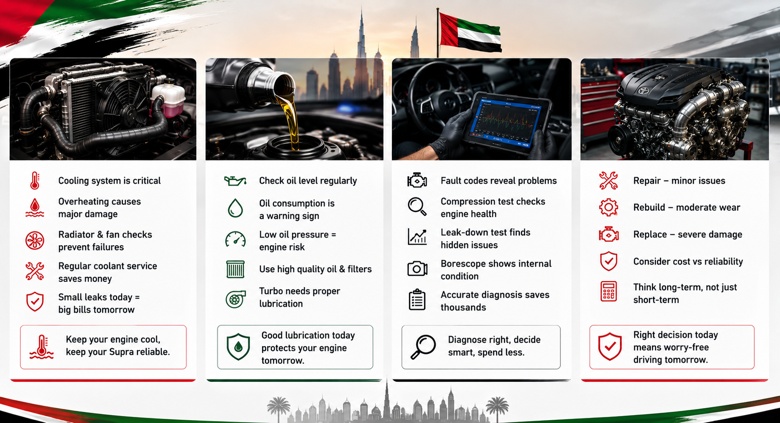
The UAE climate functions almost like a mechanical stress test. Components operating near their limits during winter often reveal their condition during summer.
This applies especially to high-performance vehicles.
The Toyota Supra's performance capabilities generate heat naturally. The UAE environment increases the demands placed on cooling systems, lubricants and electronic components.
Common Heat-Related Findings
✓ Cooling-system inefficiency
✓ Thermostat weakness
✓ Water-pump deterioration
✓ Oil degradation
✓ Sensor failures
✓ Hose deterioration
✓ Intercooler performance reduction
✓ Turbo-related heat stress
Most of these problems begin as maintenance concerns.
Left unresolved, they can become engine concerns.
Summer Climate Risk Matrix
| Operating Condition | Risk Level |
| Winter Highway Driving | Low |
| Mixed Seasonal Use | Moderate |
| Summer Highway Use | High |
| Summer Urban Traffic | Very High |
| Modified High-Performance Use | Extreme |
The UAE climate rewards preventative maintenance.
It punishes neglect.
Workshop Observation
Many expensive engine projects began with cooling-system concerns that initially appeared minor.
The invoices eventually became major.
Cooling-System Notes: The Repeated Cause Behind Many Expensive Workshop Cases
If a senior technician were allowed to circle one system repeatedly inside the notebook, it would often be the cooling system.
Not because every engine failure begins there.
Because many of them pass through it.
Cooling-system deficiencies consistently appear in workshop records involving major engine repairs. The pattern is impossible to ignore.
A small coolant leak becomes overheating.
Overheating becomes internal damage.
Internal damage becomes a replacement-engine conversation.
Components Frequently Appearing in Workshop Reports
✓ Water pump
✓ Thermostat
✓ Radiator
✓ Cooling fan
✓ Expansion tank
✓ Hoses
✓ Temperature sensors
Each component appears relatively affordable in isolation.
Collectively they protect an engine worth tens of thousands of dirhams.
Cooling-System Cost Comparison
| Component | Typical UAE Cost (AED) |
| Coolant Service | 300 – 800 |
| Thermostat | 800 – 2,500 |
| Water Pump | 1,500 – 6,000 |
| Radiator | 2,000 – 8,000 |
| Cooling Fan | 1,500 – 6,000 |
| Head-Gasket Repair | 8,000 – 20,000 |
| Engine Replacement | 20,000 – 60,000+ |
The most expensive repair often began with the least expensive one.
The notebook contains countless examples.
Cost-of-Delay Observation
Cooling-system repairs rarely become cheaper over time.
The opposite is usually true.
Oil Consumption, Lubrication Problems and Other Findings Frequently Written in Technician Reports
Lubrication-related issues occupy a significant portion of workshop documentation.
The reason is simple.
Oil protects everything.
A high-performance engine such as the Toyota Supra depends heavily upon lubrication quality. Small oil-related concerns can develop into major mechanical issues if ignored.
The progression is rarely dramatic.
At first.
Oil consumption increases slightly.
Maintenance intervals stretch.
Temperatures rise.
Wear accelerates.
The damage accumulates.
Lubrication-Related Findings Frequently Recorded
✓ Oil consumption increases
✓ Low oil levels
✓ Oil-pressure fluctuations
✓ Oil contamination
✓ Seal deterioration
✓ Gasket leakage
✓ Turbo lubrication concerns
✓ Extended service intervals
Many of these issues appear manageable initially.
Their long-term consequences often are not.
Lubrication Cost Escalation
| Stage | Typical Cost (AED) |
| Oil Service | 500 – 1,500 |
| Leak Repair | 1,000 – 5,000 |
| Seal Replacement | 2,000 – 8,000 |
| Turbo Repairs | 5,000 – 20,000 |
| Internal Engine Repairs | 10,000 – 35,000 |
| Replacement Engine | 20,000 – 60,000+ |
The notebook repeatedly demonstrates a simple lesson.
Oil-related maintenance is expensive.
Ignoring oil-related maintenance is usually far more expensive.
Family Ownership Perspective
Families often purchase vehicles expecting reliability.
Reliability usually begins with maintenance discipline.
The Customer Said It Was Fine Yesterday: Cases Where Small Symptoms Became Major Repairs
One sentence appears repeatedly in workshop conversations.
"It was driving perfectly fine yesterday."
Experienced technicians learn to treat that statement carefully.
Because most engines do not move directly from healthy operation to catastrophic failure overnight. The symptoms often existed beforehand.
They simply did not appear severe enough to create urgency.
The notebook contains numerous examples.
A slight coolant loss becomes an overheating event.
A minor oil leak becomes lubrication damage.
A misfire becomes internal wear.
The timeline changes.
The pattern rarely does.
Common Escalation Cases Recorded in UAE Workshops
✓ Small coolant leak ignored
✓ Oil consumption accepted as normal
✓ Warning light repeatedly reset
✓ Misfire left unresolved
✓ Overheating incident dismissed
✓ Modified vehicle operated without supporting upgrades
✓ Delayed maintenance intervals
Each case initially appeared manageable.
Many eventually became expensive.
Cost Escalation Timeline
| Original Issue | Early Cost (AED) | Later Cost (AED) |
| Coolant Leak | 500 – 1,500 | 20,000 – 60,000+ |
| Oil Leak | 1,000 – 3,000 | 10,000 – 35,000 |
| Misfire | 500 – 2,000 | 8,000 – 30,000 |
| Sensor Fault | 500 – 2,500 | 5,000 – 20,000 |
| Cooling Fan Issue | 1,000 – 3,000 | 15,000 – 50,000 |
The workshop lesson remains simple.
Small problems rarely stay small indefinitely.
Technician Notebook Observation
Most expensive repair invoices began as inexpensive maintenance opportunities.
The repair bill simply arrived later.
Diagnostic Notebook Entries: What Comprehensive Testing Usually Reveals Before Engine Replacement Is Recommended
A replacement-engine recommendation should never be based on assumptions.
It should be based on evidence.
The notebook repeatedly demonstrates that accurate diagnostics save owners money, even when the final recommendation is replacement.
Knowing the exact condition of the engine prevents unnecessary repairs and unrealistic expectations.
Diagnostic Procedures Frequently Used
✓ Compression testing
✓ Leak-down testing
✓ Borescope inspections
✓ Cooling-system pressure testing
✓ Oil analysis
✓ Turbocharger inspection
✓ ECU fault-code analysis
✓ Cylinder balance testing
These procedures create a mechanical profile.
The technician can then make decisions based on facts.
Typical Diagnostic Findings
| Finding | Technician Concern |
| Low Compression | High |
| Cylinder Damage | Very High |
| Head-Gasket Failure | High |
| Turbo Failure | Moderate to High |
| Severe Oil Contamination | High |
| Repeated Overheating Evidence | Critical |
Accurate diagnostics often answer the most important question.
Can the engine realistically be saved?
Workshop Reality
Owners often ask how much repairs will cost.
Experienced technicians first determine whether repairs make sense.
Repair, Rebuild or Replace: The Decision Framework Experienced Technicians Use
The notebook contains countless cases where owners wanted a simple answer.
Repair it or replace it?
Unfortunately, engines rarely simplify themselves so easily.
The correct recommendation depends upon damage severity, ownership plans, budget and long-term expectations.
When Repairs Usually Make Sense
✓ Isolated component failure
✓ Limited internal wear
✓ No overheating history
✓ Strong compression readings
✓ Low repair risk
When Rebuilding Often Makes Sense
✓ Moderate internal wear
✓ Serviceable engine block
✓ Enthusiast ownership plans
✓ Preservation of original engine
When Replacement Often Makes Sense
✓ Severe internal damage
✓ Repeated overheating history
✓ Multiple system failures
✓ Poor rebuild economics
✓ Long-term reliability priority
Decision Comparison
| Factor | Repair | Rebuild | Replace |
| Upfront Cost | Lowest | Moderate | Highest |
| Downtime | Low | Moderate | Moderate |
| Reliability Confidence | Moderate | Good | Excellent |
| Long-Term Predictability | Moderate | Good | Excellent |
| Resale Confidence | Moderate | High | Very High |
The correct answer depends upon the owner's destination.
Not every ownership journey requires the same route.
Executive Ownership Perspective
Executives often prioritise predictability.
The most predictable solution is not always the cheapest one.
Workshop Records Comparing Used, Reconditioned, OEM and Genuine Toyota Supra Engines
The notebook contains years of observations regarding replacement-engine outcomes.
One lesson appears repeatedly.
Purchase price and ownership value are not the same thing.
A cheaper engine may reduce today's invoice. A better engine may reduce the next several years of ownership costs.
Used Engines
Lowest acquisition cost.
Highest variability.
Reconditioned Engines
Balanced solution.
Frequently chosen by practical enthusiasts.
OEM Engines
Strong long-term reliability profile.
Often preferred by owners planning extended ownership.
Genuine Toyota Engines
Highest confidence.
Highest acquisition cost.
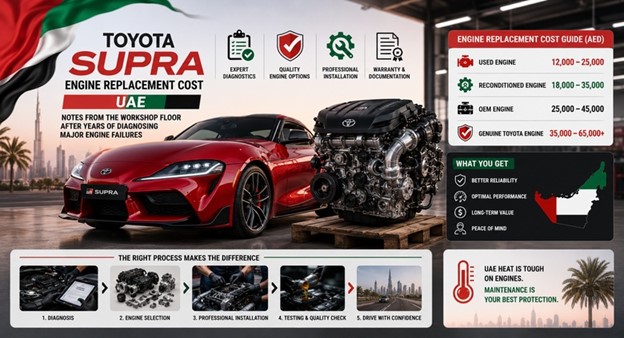
Toyota Supra Engine Cost Comparison UAE
| Engine Type | Typical Cost (AED) |
| Used Engine | 12,000 – 25,000 |
| Reconditioned Engine | 18,000 – 35,000 |
| OEM Engine | 25,000 – 45,000 |
| Genuine Toyota Engine | 35,000 – 65,000+ |
The cheapest option often wins the quotation process.
The most reliable option frequently wins the ownership process.
Reliability Comparison
| Engine Type | Long-Term Confidence |
| Used | Moderate |
| Reconditioned | Good |
| OEM | Very Good |
| Genuine | Excellent |
For owners searching for Toyota Supra replacement engine for sale, workshop records consistently suggest focusing on supplier credibility, testing documentation, warranty coverage and installation support rather than headline pricing alone.
Labour Notes from UAE Workshops: Why Installation Quality Often Determines Future Reliability
A replacement engine inherits the quality of its installation.
The notebook proves this repeatedly.
Excellent engines occasionally produce disappointing ownership outcomes because installation standards were poor. Average engines occasionally perform exceptionally well because installation standards were excellent.
Workmanship matters.
Often more than owners realise.
Common Installation Mistakes Observed
✓ Cooling-system contamination
✓ Incorrect torque procedures
✓ Sensor installation errors
✓ Incomplete testing
✓ Poor fluid management
✓ Wiring issues
✓ Inadequate post-installation inspections
These mistakes may remain invisible initially.
Their consequences often appear later.
Labour Cost Analysis by Emirate
| Emirate | Typical Labour Cost (AED) |
| Dubai | 6,000 – 18,000 |
| Abu Dhabi | 5,500 – 16,000 |
| Sharjah | 4,500 – 14,000 |
| Ajman | 4,000 – 12,000 |
| Ras Al Khaimah | 4,000 – 11,000 |
| Fujairah | 4,000 – 11,000 |
| Umm Al Quwain | 3,500 – 10,000 |
The lowest labour quote is not always the least expensive choice.
The notebook contains several examples proving that point.
Workshop Selection Checklist
✓ Toyota performance experience
✓ Supra-specific knowledge
✓ Diagnostic capability
✓ Warranty support
✓ Cooling-system expertise
✓ Post-installation testing
✓ Detailed documentation
The workshop becomes part of the project.
Choose accordingly.
Supporting Components That Experienced Technicians Rarely Ignore During Engine Replacement Projects
A replacement engine never operates alone.
It depends on everything surrounding it.
Experienced technicians understand this. That is why major engine projects frequently include additional recommendations.
Not because workshops enjoy increasing invoices.
Because history shows the consequences of ignoring supporting systems.
Components Frequently Recommended During Installation
✓ Water pump
✓ Thermostat
✓ Radiator
✓ Cooling hoses
✓ Intercooler inspection
✓ Engine mounts
✓ Sensors
✓ Ignition components
✓ Belts and tensioners
✓ Filters and fluids
Each component influences long-term reliability.
Collectively they influence ownership satisfaction.
Supporting Component Cost Guide
| Component | Typical Cost (AED) |
| Water Pump | 1,500 – 6,000 |
| Thermostat | 800 – 2,500 |
| Radiator | 2,000 – 8,000 |
| Engine Mounts | 1,500 – 7,000 |
| Sensors | 500 – 4,000 |
| Ignition Components | 1,000 – 6,000 |
| Belts and Tensioners | 800 – 4,000 |
These parts rarely receive the attention given to the engine.
The notebook repeatedly suggests they deserve more attention.
Senior Technician Observation
Many successful engine-replacement projects were not defined by the engine itself.
They were defined by the supporting systems that were renewed at the same time.
Mileage Versus Service History: What Usually Predicts Future Reliability More Accurately
One of the most common questions recorded in the notebook appears before a vehicle even enters the workshop.
"How many kilometres are on the engine?"
It is a reasonable question.
It simply is not the most important one.
After years of inspecting Toyota Supra vehicles across the UAE, a consistent pattern emerges. Mileage provides useful context, but maintenance history usually provides the more accurate reliability forecast.
A 220,000 km Supra with complete service records often presents less ownership risk than a 120,000 km example with missing documentation, inconsistent maintenance and unknown modifications.
The odometer records distance.
Service history records behaviour.
The second often reveals more.
Information Experienced Technicians Prioritise
✓ Service records
✓ Oil-change intervals
✓ Cooling-system history
✓ Previous overheating incidents
✓ Modification records
✓ Diagnostic reports
✓ Workshop invoices
✓ Ownership history
These documents tell a story.
The mileage figure is only one chapter.
Mileage Evaluation Guide
| Mileage Range | Technician Assessment |
| Under 60,000 km | Excellent |
| 60,000–120,000 km | Very Good |
| 120,000–180,000 km | Good |
| 180,000–250,000 km | Detailed Review Required |
| Above 250,000 km | Comprehensive Inspection Essential |
Senior Technician Observation
Engines rarely fail because of mileage alone.
They usually fail because maintenance and mechanical realities eventually intersect.
Warranty Claims, Documentation Files and Ownership Records: Lessons Learned From Previous Cases
The notebook contains successful engine-replacement projects.
It also contains disappointing ones.
One of the biggest differences is documentation.
Many owners focus entirely on the engine itself. Future buyers, warranty providers and even workshops frequently focus on the paperwork supporting it.
The replacement engine eventually becomes part of the vehicle's ownership history.
The quality of that history matters.
Essential Documentation Checklist
✓ Engine purchase invoice
✓ Engine serial information
✓ Installation invoice
✓ Diagnostic reports
✓ Warranty certificate
✓ Mileage documentation
✓ Cooling-system inspection records
✓ Post-installation reports
Strong documentation creates confidence.
Confidence influences both ownership and resale value.
Warranty Red Flags Frequently Seen
✓ Verbal warranty promises
✓ Unclear coverage limits
✓ No labour coverage
✓ No written exclusions
✓ Missing claim procedures
✓ Limited supplier accountability
Every missing detail increases risk.
Every documented detail reduces uncertainty.
Warranty Comparison
| Warranty Type | Protection Level |
| Verbal Assurance | Very Low |
| Limited Parts Coverage | Low |
| Parts Warranty | Moderate |
| Parts and Labour Warranty | High |
| Comprehensive Written Warranty | Very High |
Insurance and Registration Perspective
Documentation does more than support warranty claims.
It also strengthens future ownership records, valuation discussions and vehicle-history transparency.
First 1,000 Kilometres After Installation: Notes Recorded During Successful and Unsuccessful Ownership Outcomes
A replacement engine installation is not the finish line.
The notebook repeatedly proves that point.
The first 1,000 kilometres often reveal whether the project has truly succeeded. Systems stabilise, components settle and installation quality begins revealing itself.
This stage deserves patience.
Not neglect.
Monitoring Checklist for the First 1,000 km
✓ Coolant levels
✓ Oil levels
✓ Engine temperature
✓ Fuel consumption
✓ Idle quality
✓ Warning lights
✓ Fluid leaks
✓ Unusual noises
✓ Vibration levels
The objective is confirmation.
The owner is verifying that the vehicle behaves consistently under real-world conditions.
Post-Installation Risk Matrix
| Observation | Concern Level |
| Stable Operation | Low |
| Minor Sensor Fault | Moderate |
| Fluid Leak | Moderate |
| Temperature Variation | High |
| Persistent Warning Lights | High |
| Repeated Overheating | Critical |
Workshop Observation
Most successful projects become boring quickly.
The vehicle simply performs as expected.
That is often the best possible outcome.
Common Signs of Poor Installation
✓ Recurrent warning lights
✓ Fluid leaks
✓ Cooling inefficiencies
✓ Excessive vibration
✓ Electrical irregularities
✓ Inconsistent performance
These signs should never be ignored.
The notebook records numerous cases where early intervention prevented major complications.
Resale Value Observations: What Future Buyers Ask About Replacement Engines
A replacement engine changes the ownership conversation.
It does not automatically reduce value.
What matters is how the replacement story is presented.
Buyers rarely object to professional repairs. They often object to uncertainty.
That distinction appears repeatedly during vehicle inspections.
Questions Future Buyers Usually Ask
✓ Why was the engine replaced?
✓ Who performed the installation?
✓ Which engine was used?
✓ Is warranty documentation available?
✓ Are service records complete?
✓ Were supporting components replaced?
Prepared answers create confidence.
Confidence creates value.
Resale Value Factors
| Factor | Market Impact |
| Full Documentation | Positive |
| Professional Installation | Positive |
| Warranty Coverage | Positive |
| Missing Records | Negative |
| Unknown Engine Source | Negative |
| Poor Installation Evidence | Highly Negative |
The replacement engine becomes part of the vehicle's narrative.
Transparency determines how that narrative is received.
Performance Enthusiast Perspective
Enthusiast buyers often appreciate properly documented engine projects.
Poorly documented projects usually attract scepticism.
Long-Term Ownership Records: What the Best Toyota Supra Engine Replacement Projects Have in Common
The notebook contains many years of ownership outcomes.
Certain patterns appear consistently among successful cases.
These owners are not necessarily wealthier.
They are usually more disciplined.
Habits Commonly Seen in Successful Ownership Cases
✓ Consistent servicing
✓ Prompt diagnostics
✓ Cooling-system maintenance
✓ High-quality fluids
✓ Detailed record keeping
✓ Reputable workshop selection
✓ Preventative maintenance planning
✓ Realistic budgeting
These habits reduce surprises.
Surprises tend to be expensive.
First-Year Ownership Forecast
| Category | Estimated Cost (AED) |
| Maintenance | 2,000–6,000 |
| Diagnostics | 500–2,000 |
| Fluids and Filters | 800–2,500 |
| Unexpected Repairs | 1,500–5,000 |
Three-Year Ownership Forecast
| Category | Estimated Cost (AED) |
| Scheduled Maintenance | 6,000–15,000 |
| Preventative Repairs | 3,000–10,000 |
| Diagnostics | 1,500–5,000 |
Five-Year Ownership Forecast
| Engine Type | Ownership Outlook |
| Used Engine | Variable |
| Reconditioned Engine | Good |
| OEM Engine | Very Good |
| Genuine Engine | Excellent |
The notebook repeatedly demonstrates that reliability is rarely purchased once.
It is maintained repeatedly.
Final Notebook Summary: The Complete Toyota Supra Engine Replacement Roadmap for UAE Owners
After years of workshop observations, a clear roadmap emerges.
Most successful engine-replacement projects follow a similar sequence.
The details differ.
The principles rarely do.
Complete Toyota Supra Replacement Roadmap
✓ Investigate symptoms early
✓ Perform accurate diagnostics
✓ Confirm root causes
✓ Compare repair versus replacement options
✓ Select the correct engine type
✓ Verify supplier credibility
✓ Choose an experienced workshop
✓ Replace critical supporting parts
✓ Preserve documentation
✓ Monitor the first 1,000 km carefully
✓ Follow preventative maintenance schedules
✓ Maintain resale-value records
These actions consistently appear in successful ownership outcomes.
Hidden Costs Frequently Missed by Owners
✓ Recovery charges
✓ Alternative transportation
✓ Diagnostic expenses
✓ Supporting-component replacement
✓ Additional labour requirements
✓ Warranty limitations
✓ Lost driving time
✓ Reduced resale confidence
A replacement engine project often costs more than the invoice alone suggests.
The smartest owners plan accordingly.
Repair vs Replacement Decision Matrix
| Situation | Recommended Direction |
| Minor Mechanical Fault | Repair |
| Moderate Internal Wear | Rebuild |
| Severe Internal Damage | Replace |
| Long-Term Ownership Goal | OEM or Genuine Replacement |
| Budget-Conscious Ownership | Reconditioned Consideration |
The objective is not simply repairing a problem.
The objective is protecting the next stage of ownership.
Final Senior Technician Notebook Entry
The notebook never suggests that every Toyota Supra will require a replacement engine.
What it does show is that major engine failures rarely appear without warning.
The clues usually exist.
The symptoms usually appear.
The maintenance decisions usually matter.
For owners researching solutions through PartFinder UAE, the strongest long-term outcomes consistently come from disciplined maintenance, evidence-based diagnostics, quality installation work and realistic ownership planning rather than reacting only when problems become urgent.
The best workshop stories rarely begin with engine replacement.
They begin with owners paying attention before replacement becomes necessary.
Frequently Asked Questions
Categories
- Audi
- BMW
- Car Accessories
- Car Tips
- Ford
- Land Rover
- Mazda
- Range Rover
- Top 10
- UAE Car Parts
- Used Car Parts
- Toyota
- Replacement Engines
- Nissan
- Hyundai
- Mitsubishi
- Volkswagen
- Honda
- Kia
- Chevrolet
- Dodge
- Jeep
- Subaru
- Renault
- Lexus
- Mercedes
- Suzuki
- Hummer
- Porsche
- Infiniti
- Peugeot
- GMC
- Mini
- Volvo
- Replacement Gearboxes
- MG
- Jaguar
- Skoda
- Cadillac
- Daihatsu
- Fiat
- German Car Parts
- Japanese Car Parts
- Aftermarket Car Parts
- Genuine Car Parts
- New Car Parts
- Reconditioned Car Parts
- European Car Parts
- American Car Parts
- Korean Car Parts
- British Car Parts
- Chinese Car Parts
- Sports/Exotic Car Parts
- Luxury Car Parts
- Performance Car Parts
- SUV/4x4 Spare Parts
- Truck Spare Parts
- EV Car Parts
- Hybrid Car Parts
- Auto Spare Parts in UAE
- Tesla
- Isuzu
- Ram
- Ferrari
- Bentley
- Lamborghini
- Genesis
- Maserati
- Lincoln
- Chrysler
- Opel
- Citroen
- SsangYong
- Seat
- McLaren
- Aston Martin
- Rolls Royce
- Maybach
- Alfa Romeo
- Bugatti
- Scion
- Abu Dhabi Car Parts
- Ajman Car Parts
- Al Khan Car Parts
- Al Sajaa Car Parts
- Deira Car Parts
- Dubai Car Parts
- Fujairah Car Parts
- Industrial Area 6 Car Parts
- Mussafah Car Parts
- Ras Al Khaimah Car Parts
- Sharjah Car Parts
- Umm Al Quwain Car Parts
- Acura
- BYD
- Chery
- Dacia
- DS
- Geely Emgrand
- EXEED
- GAC
- GAC Gonow
- Geely
- Gonow
- Great Wall
- Haima
- Haval
- Holden
- Iveco
- JAC
- Jaecoo
- Jetour
- Lotus
- Omoda
- Proton
- Renault Samsung
- Roewe
- Lucid
- Replacement Headlight