Toyota Tundra Engine Replacement UAE: Understanding Market Timing, Resale Value and Ownership Costs Before Investing in a Replacement Engine
June 12, 2026
The most expensive Toyota Tundra engine replacement decisions in the UAE are not always caused by mechanical failure.
Quite often, they are caused by poor timing.
That may sound unusual.
After all, engines fail because of wear, overheating, lubrication issues, mileage accumulation or neglected maintenance. Market conditions cannot prevent a crankshaft failure. They cannot stop a cooling-system leak.
Yet the financial outcome of an engine replacement project can vary dramatically depending on when the decision is made.
This is where many owners make a critical mistake.
They evaluate the replacement engine.
They evaluate the workshop.
They evaluate the repair bill.
But they fail to evaluate the market around them.
The UAE vehicle market is constantly moving.
Pickup-truck demand changes.
Used-vehicle values rise and fall.
Import availability fluctuates.
Labour costs shift.
Buyer preferences evolve.
The value of a Toyota Tundra today may not be the value it commands twelve months from now.
That reality transforms the replacement-engine decision from a purely mechanical question into a market-timing question.
And for many owners across Dubai, Abu Dhabi, Sharjah, Ajman, Ras Al Khaimah, Fujairah and Umm Al Quwain, understanding that distinction can save tens of thousands of dirhams over the long term.
Why Market Timing Often Matters More Than the Engine Price Itself
Most owners begin by asking:
“How much will a replacement engine cost?”
A more useful question is often:
“What is happening in the market while I am making this decision?”
The answer matters because vehicle values rarely move in isolation.
The replacement engine investment must be evaluated against:
- Current vehicle value
- Future resale prospects
- Market demand
- Supply availability
- Depreciation trends
- Ownership duration
A replacement engine purchased at the right stage of ownership can preserve value.
The same replacement completed at the wrong stage can create a very different financial outcome.
Market Timing Impact Factors
| Factor | Ownership Impact |
| Strong Used-Truck Demand | Positive |
| Limited Vehicle Supply | Positive |
| Stable Resale Values | Positive |
| Oversupplied Market | Negative |
| Accelerating Depreciation | Negative |
The smartest owners evaluate both the engine and the market before committing significant money.
The Position of the Toyota Tundra in Today's UAE Pickup-Truck Market
The Toyota Tundra occupies an interesting position within the UAE market.
It is not as common as some mainstream pickups.
Nor is it a niche vehicle.
Its appeal comes from a combination of:
- Strong reliability reputation
- Large-capacity engines
- Long-distance capability
- Towing performance
- Business utility
- Lifestyle ownership appeal
This combination often helps protect demand.
However, demand is not constant.
Market cycles affect every vehicle category.
Common Tundra Buyer Groups in UAE
- Business owners
- Construction-sector operators
- Off-road enthusiasts
- Long-distance drivers
- Lifestyle pickup buyers
- Fleet operators
Each buyer group influences market demand differently.
Understanding these demand sources helps owners evaluate future resale prospects before investing in a replacement engine.
What Current UAE Used-Vehicle Market Conditions Reveal About Long-Term Ownership Decisions
One observation repeatedly appears across UAE vehicle markets.
Vehicles with predictable ownership costs tend to retain stronger buyer interest.
Vehicles with uncertain ownership costs tend to lose buyer confidence.
This distinction becomes particularly important when major engine work is being considered.
Buyer Confidence Drivers
- Service history
- Mechanical condition
- Documentation
- Engine health
- Workshop reputation
Buyer Confidence Comparison
| Vehicle Condition | Buyer Interest |
| Strong Documentation | Very High |
| Complete Service History | High |
| Recent Professional Engine Work | High |
| Unclear Mechanical History | Moderate |
| Unknown Engine Condition | Low |
The replacement-engine decision therefore affects more than current ownership.
It can influence future marketability as well.
The Early Ownership Signals That Suggest an Engine Decision May Be Approaching
Most replacement projects do not begin with catastrophic failure.
They begin with patterns.
Patterns are important because they often reveal future ownership costs before those costs arrive.
Common Early Signals
- Increased oil consumption
- Rising coolant usage
- Intermittent overheating
- Reduced fuel efficiency
- Rough running
- Repeated workshop visits
None of these issues automatically require engine replacement.
However, they frequently indicate that larger ownership decisions may be approaching.
Warning Sign Evaluation Matrix
| Observation | Potential Future Risk |
| Minor Oil Usage | Moderate |
| Repeated Coolant Loss | Elevated |
| Frequent Overheating | High |
| Persistent Mechanical Noise | Very High |
| Compression-Related Issues | Critical |
The earlier these signals are investigated, the more options typically remain available.
How Delaying an Engine Replacement Can Change the Financial Equation Over Time
One of the most misunderstood aspects of ownership economics is the cost of delay.
Owners often assume postponing a decision automatically saves money.
Sometimes it does.
Sometimes it does the opposite.
What Happens During Delay
- Additional wear accumulates
- Vehicle value may decline
- Repair options narrow
- Future costs become harder to predict
Cost-of-Delay Illustration
| Ownership Stage | Potential Cost Exposure (AED) |
| Early Intervention | 3,000 – 10,000 |
| Moderate Mechanical Issues | 10,000 – 25,000 |
| Major Engine Evaluation | 20,000 – 60,000+ |
| Severe Mechanical Failure | 30,000 – 80,000+ |
The lesson is not that every issue requires immediate replacement.
The lesson is that delaying a decision should be a deliberate strategy rather than an emotional reaction.
Why Some Toyota Tundra Owners Invest During Market Weakness While Others Wait
Interestingly, experienced vehicle owners often view market weakness differently from newer owners.
When used-vehicle values soften, some owners delay investment.
Others see opportunity.
Why?
Because replacement-engine economics are influenced by future ownership plans.
Owners More Likely to Invest
- Long-term owners
- Fleet operators
- Business users
- High-mileage drivers
Owners More Likely to Delay
- Short-term owners
- Planned vehicle upgraders
- Owners expecting vehicle replacement
Ownership Strategy Comparison
| Ownership Objective | Typical Strategy |
| Long-Term Retention | Invest Earlier |
| Medium-Term Ownership | Evaluate Carefully |
| Planned Sale | Market-Dependent |
| Immediate Upgrade | Delay Investment |
This is why identical engine problems can produce completely different ownership decisions.
The market cycle matters.
But so does the owner's future plan.
The Market Observation Many Owners Miss
Perhaps the most important observation in the entire decision-making process is this:
Engine replacement should never be analysed in isolation.
The market matters.
The vehicle's future value matters.
Ownership duration matters.
Future demand matters.
The replacement engine is only one variable inside a much larger equation.
Owners who understand that typically make more informed decisions.
Owners who ignore it often find themselves evaluating the same vehicle twice:
Once before spending the money.
And again after the market has moved around them.
The Engine Replacement Options Available and How Market Conditions Affect Their Value
Once owners decide that a replacement engine may be necessary, attention naturally shifts towards sourcing.
At this stage, many people focus exclusively on engine price.
The market, however, often tells a different story.
A replacement engine is not simply a mechanical purchase.
It is a market-driven asset decision.
The value of an engine option changes depending on:
- Current vehicle demand
- Future resale prospects
- Vehicle age
- Ownership duration
- Market confidence
An engine that appears expensive today may preserve considerably more value over the next five years.
Meanwhile, an apparently cheaper solution may create future costs that erase any short-term savings.
Common Toyota Tundra Engine Options
- Used engine
- Reconditioned engine
- OEM replacement engine
- Genuine factory engine
UAE Market Value Comparison
| Engine Type | Typical Cost (AED) | Market Confidence |
| Used Engine | 8,000 – 20,000 | Moderate |
| Reconditioned Engine | 15,000 – 35,000 | Good |
| OEM Engine | 25,000 – 50,000 | Strong |
| Genuine Engine | 40,000 – 80,000+ | Very Strong |
The objective is not necessarily purchasing the most expensive option.
The objective is aligning the engine choice with future market realities.
The Hidden Costs That Become More Significant During Certain Ownership Cycles
One reason engine replacement budgets frequently exceed expectations is because owners underestimate supporting expenses.
Market conditions influence these costs as well.
Labour rates change.
Parts availability fluctuates.
Supply chains tighten and loosen.
These factors directly affect total project expenditure.
Frequently Overlooked Expenses
- Cooling-system restoration
- Water pump replacement
- Engine mounts
- ECU programming
- Sensors
- Fluids and filters
- Diagnostic testing
Hidden Cost Breakdown
| Item | Typical Cost (AED) |
| Engine Mounts | 1,000 – 5,000 |
| Cooling Components | 2,000 – 10,000 |
| Water Pump | 1,000 – 4,000 |
| ECU Programming | 500 – 3,000 |
| Sensors | 500 – 5,000 |
| Fluids & Filters | 500 – 2,500 |
| Diagnostics | 500 – 2,000 |
A market observer quickly learns that engine pricing represents only part of the financial picture.
The surrounding ecosystem matters just as much.
What Supply and Demand Trends Can Teach Buyers About Engine Sourcing Decisions
Supply and demand affect more than vehicle prices.
They also influence engine availability.
During periods of strong demand:
- Engine prices may rise
- Delivery times may increase
- Sourcing options may narrow
During softer periods:
- Availability may improve
- Negotiation becomes easier
- Alternative options emerge
Supply-Driven Market Conditions
| Market Environment | Buyer Advantage |
| High Supply | Strong |
| Balanced Market | Moderate |
| Restricted Supply | Limited |
| High Demand Cycle | Lower |
Timing therefore influences sourcing flexibility.
Owners who understand market cycles often find themselves making more strategic purchasing decisions.
The Workshop Selection Decisions That Influence Future Marketability
Many articles discuss workshop quality from a reliability perspective.
Few discuss its influence on future market value.
That influence can be substantial.
When future buyers assess a replacement-engine vehicle, they often evaluate:
- Installation quality
- Documentation
- Workshop reputation
- Warranty support
The installation becomes part of the vehicle's market story.
Strong Marketability Indicators
- Specialist installation
- Detailed invoices
- Warranty documentation
- Transparent project records
Weak Marketability Indicators
- Missing paperwork
- Unclear sourcing
- Limited installation records
Marketability Comparison
| Installation Profile | Future Buyer Confidence |
| Fully Documented Specialist Installation | Very High |
| Professional Independent Installation | High |
| Limited Documentation | Moderate |
| Unknown Installation History | Low |
Future buyers purchase confidence as much as they purchase vehicles.
Why Reliability Becomes More Valuable During Uncertain Market Conditions
During periods of market uncertainty, reliability becomes increasingly valuable.
Why?
Because uncertainty already exists externally.
Owners become less willing to tolerate uncertainty internally.
A dependable Toyota Tundra often becomes more attractive when economic conditions become less predictable.
Reliability Benefits
- Reduced downtime
- Lower operational disruption
- More predictable budgeting
- Stronger resale confidence
Reliability Cost Comparison
| Ownership Scenario | Annual Unexpected Costs (AED) |
| Strong Reliability | 2,000 – 8,000 |
| Moderate Reliability | 8,000 – 20,000 |
| Poor Reliability | 20,000 – 50,000+ |
The market rewards predictability.
Owners do as well.
How Resale Value Changes Depending on When the Engine Replacement Is Performed
Timing matters.
Not only when buying.
Also when repairing.
An engine replacement completed before major deterioration often creates a different market perception than one completed after severe failure.
Earlier Replacement Benefits
- Better documentation trail
- Reduced collateral damage
- Stronger buyer confidence
- Improved ownership continuity
Delayed Replacement Risks
- Greater repair exposure
- Additional mechanical wear
- Reduced market confidence
Resale Impact Analysis
| Timing Strategy | Future Resale Impact |
| Early Strategic Replacement | Positive |
| Planned Replacement | Neutral to Positive |
| Delayed Replacement | Variable |
| Post-Failure Recovery | Often Negative |
This is why timing repeatedly appears throughout ownership economics.
Timing affects costs.
Timing affects confidence.
Timing affects value.
The Market Signal Hidden Behind Ownership Decisions
One pattern appears repeatedly throughout the UAE pickup-truck market.
Successful owners rarely focus exclusively on the next repair bill.
Instead, they evaluate the broader ownership cycle.
They ask:
- What will the vehicle be worth in three years?
- How will demand evolve?
- What happens if I keep the vehicle?
- What happens if I sell?
These questions often produce better decisions than focusing solely on today's invoice.
For buyers researching Toyota Tundra replacement engine for sale, the same principle applies.
The best engine choice is not automatically the cheapest.
Nor is it automatically the most expensive.
The best engine choice is the one that aligns most effectively with:
- Future market demand
- Ownership duration
- Reliability objectives
- Resale expectations
- Long-term cost control
The Ownership Equation Starts Changing Here
By this stage, the engine replacement discussion begins evolving into something larger.
It becomes a conversation about:
- Asset preservation
- Market timing
- Capital allocation
- Ownership economics
The replacement engine remains important.
But the vehicle's future position within the UAE market becomes equally important.
The final section of this guide will examine when repairing stops creating value, what future buyers actually look for, first-year ownership costs, replace-engine-versus-replace-vehicle economics, market signals worth monitoring and a complete UAE market-cycle decision framework for Toyota Tundra owners.
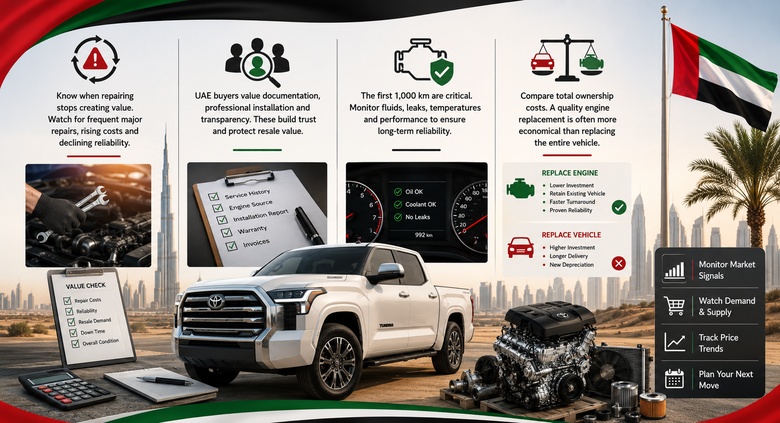
The Ownership-Cycle Point Where Repairing Stops Creating Meaningful Value
Every vehicle eventually reaches a stage where owners must ask a difficult question.
Am I maintaining value?
Or am I simply funding decline?
The answer is rarely emotional.
It is usually mathematical.
The Toyota Tundra has a strong reputation for durability. That reputation often encourages owners to keep investing for longer than they would with other vehicles.
In many cases, that approach makes perfect sense.
In others, the market begins sending warning signals.
Indicators That Value Creation Is Slowing
- Frequent major repairs
- Multiple ageing systems
- Increasing downtime
- Declining resale demand
- Escalating annual maintenance costs
Ownership Value Assessment
| Ownership Situation | Investment Outlook |
| Healthy Vehicle + Engine Issue | Strong |
| Healthy Vehicle + Documented Replacement Engine | Very Strong |
| Multiple Major System Failures | Moderate |
| Significant Mechanical Decline | Weak |
| Repeated High-Cost Repairs | Poor |
The objective is not avoiding expenditure.
The objective is ensuring expenditure continues producing value.
What UAE Buyers Tend to Look for When Evaluating a Toyota Tundra With a Replacement Engine
One misconception persists throughout the market.
Many owners assume buyers automatically avoid vehicles with replacement engines.
That assumption is not always correct.
Experienced buyers often evaluate the quality of the replacement rather than the fact it occurred.
What Buyers Typically Value
- Documentation
- Professional installation
- Warranty support
- Service records
- Transparent ownership history
What Creates Buyer Concern
- Missing paperwork
- Unknown sourcing
- Poor installation records
- Unclear maintenance history
Buyer Confidence Comparison
| Vehicle Profile | Buyer Confidence |
| Fully Documented Engine Project | Very High |
| Professional Installation | High |
| Partial Records | Moderate |
| Unknown History | Low |
The market generally rewards transparency.
And transparency becomes increasingly valuable as vehicles age.
The First 1,000 Kilometres After Installation and Their Influence on Long-Term Ownership Outcomes
Many owners assume the project ends once the replacement engine is installed.
The reality is different.
The first 1,000 kilometres often establish the foundation for future ownership.
Recommended Monitoring Areas
- Engine temperature
- Coolant levels
- Oil levels
- Fluid condition
- Diagnostic scans
- Mount stability
Early Ownership Priorities
| Inspection Area | Priority |
| Cooling System | Very High |
| Oil Management | Very High |
| Diagnostics | High |
| Fluid Monitoring | High |
| Leak Detection | High |
This stage is less about performance.
It is about verification.
The goal is ensuring the project delivers the expected ownership outcome.
How First-Year Ownership Costs Compare Across Different Engine-Replacement Strategies
Many owners evaluate only the acquisition cost.
Market-cycle observers evaluate the first year.
Because that is where ownership economics become visible.
Used Engine Scenario
Potential Benefits:
- Lower acquisition cost
Potential Risks:
- Higher uncertainty
- Increased maintenance exposure
Reconditioned Engine Scenario
Potential Benefits:
- Improved reliability
- Balanced investment profile
OEM or Genuine Engine Scenario
Potential Benefits:
- Greater confidence
- Lower risk profile
- Stronger future marketability
First-Year Cost Comparison
| Engine Strategy | First-Year Ownership Exposure (AED) |
| Used Engine | 10,000 – 30,000+ |
| Reconditioned Engine | 8,000 – 20,000+ |
| OEM Engine | 5,000 – 15,000+ |
| Genuine Engine | 5,000 – 12,000+ |
The cheapest purchase frequently does not produce the cheapest ownership outcome.
The Replace-Engine Versus Replace-Vehicle Question Through a Market-Cycle Lens
This is often the defining ownership decision.
Many owners immediately compare the replacement-engine cost against the vehicle's current value.
A more useful comparison may involve future replacement costs.
Replacement Engine Investment
Typical Range:
AED 15,000 – 80,000+
Potential Benefits:
- Lower capital requirement
- Retain familiar vehicle
- Avoid replacement-market inflation
Vehicle Replacement
Typical Investment:
AED 180,000 – 500,000+
Potential Benefits:
- Newer technology
- Reduced age-related risk
- Different ownership cycle
Capital Allocation Comparison
| Option | Typical Investment (AED) |
| Engine Replacement | 15,000 – 80,000+ |
| Used Vehicle Upgrade | 180,000 – 350,000+ |
| New Vehicle Purchase | 300,000 – 500,000+ |
When viewed through this lens, the replacement-engine decision often appears less dramatic.
The Market Signals Toyota Tundra Owners Should Watch Before Making Their Final Decision
Experienced market observers rarely focus on a single indicator.
Instead, they monitor a collection of signals.
Important Market Indicators
- Used-pickup demand
- Vehicle availability
- Import activity
- Labour-cost trends
- Parts availability
- Fuel-price trends
- Commercial-sector demand
Market Signal Framework
| Market Signal | Decision Influence |
| Rising Demand | Positive |
| Stable Values | Positive |
| Strong Buyer Activity | Positive |
| Oversupply | Negative |
| Accelerating Depreciation | Negative |
These signals rarely predict the future perfectly.
But they often improve decision quality.
The UAE Business and Fleet Perspective
Fleet operators frequently approach replacement-engine decisions differently from private owners.
Their focus is operational continuity.
Not simply resale value.
Fleet Decision Priorities
- Downtime reduction
- Revenue protection
- Predictable budgeting
- Asset utilisation
- Operational reliability
Fleet Cost Comparison
| Scenario | Business Impact |
| Planned Engine Replacement | Controlled |
| Unexpected Failure | Significant |
| Extended Downtime | High |
| Vehicle Replacement Delay | Variable |
For businesses, timing frequently becomes more important than cost alone.
A reliable asset often generates greater value than a cheaper but uncertain asset.
The Final Market-Cycle Decision Framework
The strongest ownership decisions usually emerge when multiple variables are evaluated together.
Not separately.
Key Decision Categories
- Market demand
- Ownership duration
- Vehicle condition
- Reliability outlook
- Documentation quality
- Future resale expectations
- Total ownership cost
Final Decision Matrix
| Factor | Positive Indicator |
| Vehicle Condition | Strong |
| Market Demand | Healthy |
| Engine Quality | Verified |
| Documentation | Complete |
| Ownership Horizon | Long-Term |
| Reliability Outlook | Positive |
The more positive indicators present, the stronger the replacement-engine investment generally becomes.
Final Thoughts: Why Market Awareness Often Separates Good Decisions From Great Ones
The Toyota Tundra replacement-engine conversation is often presented as a mechanical decision.
In reality, it is usually an economic decision.
The engine matters.
The workshop matters.
The cost matters.
But market timing matters as well.
The owners who consistently make the strongest long-term decisions tend to evaluate the wider picture.
They look beyond the invoice.
They consider demand.
They consider depreciation.
They consider future resale prospects.
And they understand that ownership economics rarely exist in isolation.
For buyers researching solutions through PartFinder UAE, the most valuable lesson may be this:
Do not ask only whether the replacement engine is worth buying.
Ask whether the replacement engine strengthens the vehicle's position within the next stage of the UAE market cycle.
That question often produces a far better answer.
Final Ownership and Market Intelligence Summary
| Priority | Strategic Focus |
| Reliability | Verified Engine Quality |
| Cost Control | Total Ownership Costs |
| Resale Value | Documentation & Timing |
| Market Position | Demand Analysis |
| Long-Term Value | Ownership Planning |
| Risk Reduction | Professional Installation |
The most successful Toyota Tundra owners are rarely those who spend the least.
They are usually those who understand when to invest, why to invest and how market conditions influence the value of every dirham spent.
Frequently Asked Questions
Categories
- Audi
- BMW
- Car Accessories
- Car Tips
- Ford
- Land Rover
- Mazda
- Range Rover
- Top 10
- UAE Car Parts
- Used Car Parts
- Toyota
- Replacement Engines
- Nissan
- Hyundai
- Mitsubishi
- Volkswagen
- Honda
- Kia
- Chevrolet
- Dodge
- Jeep
- Subaru
- Renault
- Lexus
- Mercedes
- Suzuki
- Hummer
- Porsche
- Infiniti
- Peugeot
- GMC
- Mini
- Volvo
- Replacement Gearboxes
- MG
- Jaguar
- Skoda
- Cadillac
- Daihatsu
- Fiat
- German Car Parts
- Japanese Car Parts
- Aftermarket Car Parts
- Genuine Car Parts
- New Car Parts
- Reconditioned Car Parts
- European Car Parts
- American Car Parts
- Korean Car Parts
- British Car Parts
- Chinese Car Parts
- Sports/Exotic Car Parts
- Luxury Car Parts
- Performance Car Parts
- SUV/4x4 Spare Parts
- Truck Spare Parts
- EV Car Parts
- Hybrid Car Parts
- Auto Spare Parts in UAE
- Tesla
- Isuzu
- Ram
- Ferrari
- Bentley
- Lamborghini
- Genesis
- Maserati
- Lincoln
- Chrysler
- Opel
- Citroen
- SsangYong
- Seat
- McLaren
- Aston Martin
- Rolls Royce
- Maybach
- Alfa Romeo
- Bugatti
- Scion
- Abu Dhabi Car Parts
- Ajman Car Parts
- Al Khan Car Parts
- Al Sajaa Car Parts
- Deira Car Parts
- Dubai Car Parts
- Fujairah Car Parts
- Industrial Area 6 Car Parts
- Mussafah Car Parts
- Ras Al Khaimah Car Parts
- Sharjah Car Parts
- Umm Al Quwain Car Parts
- Acura
- BYD
- Chery
- Dacia
- DS
- Geely Emgrand
- EXEED
- GAC
- GAC Gonow
- Geely
- Gonow
- Great Wall
- Haima
- Haval
- Holden
- Iveco
- JAC
- Jaecoo
- Jetour
- Lotus
- Omoda
- Proton
- Renault Samsung
- Roewe
- Lucid
- Replacement Headlight
- Replacement Bumper