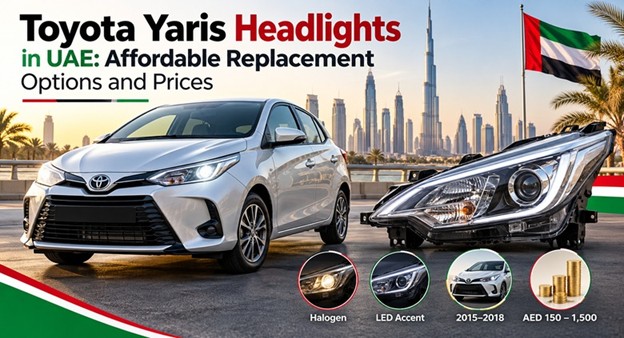
Toyota Yaris Headlights in UAE: Affordable Replacement Options and Prices
October 19, 2026
The broken Toyota Yaris headlights in UAE are one of those repairs that looks easier than it is. The lamp is sitting there in plain sight, after all. You can photograph it, search the number plate or model year, find three prices, and convince yourself that the cheapest one must be the sensible choice.
Then the replacement arrives.
Wrong generation. Wrong side. Different lighting configuration. Different connector. Or, in the more irritating version of events, it physically fits but produces a beam pattern that makes night driving feel like you've installed two decorative fish tanks at the front of the car.
The Yaris is particularly awkward because the name covers several generations and specifications, while the lighting itself has changed between applications. A 2015 Yaris catalogue, for example, shows separate genuine headlamp assemblies with and without LED accent lighting, with different part numbers and prices; another Toyota parts catalogue identifies both halogen multi-reflector and halogen projector configurations for Yaris/related regional applications.
So the sensible UAE buying question is not simply “How much is a Yaris headlight?”
It is:
How much should I spend on the correct headlight for this particular Yaris, and when is a cheaper replacement actually the more expensive decision?
That is where the market becomes interesting.
A Yaris headlight can be cheap — until you buy the wrong one
There are plenty of reasons to like the Yaris as a parts proposition. It is a common Toyota, its mechanical architecture is relatively familiar to the UAE market, and there is a sizeable ecosystem of genuine, aftermarket and used components.
But availability creates another problem: too much choice can make identification worse.
A current UAE used-parts market guide places headlight assemblies broadly around AED 150–1,500, depending on the vehicle and lighting type, while a Dubai-focused Yaris parts guide gives a much narrower indicative range of roughly AED 700–900 for aftermarket and AED 1,100–1,500 for genuine assemblies. Those figures are useful as market context, not as a universal Yaris tariff.
And then genuine international Yaris catalogues show individual assemblies at prices that vary dramatically even within the same model year.
That apparent contradiction is actually useful.
It tells you that the Yaris badge is not enough information to price the lamp.
Start with the Yaris you actually own
Before choosing OEM, aftermarket or used, establish the car.
Model year.
Generation.
Body style.
Market specification.
Lighting type.
Left or right side.
Then, ideally, the VIN or chassis number.
This sounds like administrative fuss when all you want is a headlight, but the parts catalogue makes the reason painfully clear. For the 2015 Yaris, for example, Toyota's catalogue shows 81170-0DA70 and 81130-0DA70 for assemblies without LED accent lighting, while 81170-0DA80 and 81130-0DA80 are associated with versions with LED accent lighting.
Same Yaris.
Same year.
Different lamp.
That one detail is worth more than ten paragraphs telling you that OEM parts are “high quality”.
The 2015–2018 Yaris is a good warning against lazy parts searches
The 2015–2018 Yaris has several genuine headlamp references in current catalogues.
One left-hand assembly, 81170-0DA70, is listed at about US$173.62, while another left-hand unit, 81170-0DA80, is around US$366.04. Both are genuine Toyota assemblies, but they correspond to different equipment configurations.
Converted at roughly AED 3.6725 to the dollar, those are approximately AED 638 and AED 1,344 before UAE shipping and other landed costs.
So when somebody says, “I found a genuine Yaris headlight for AED 650 and another for AED 1,350,” the immediate conclusion should not be that one seller is trying to rob you.
The first question should be:
What is different between the two assemblies?
That is parts buying done properly.
Sometimes the price difference is hiding inside the specification
The cheaper genuine 2015–2018 assembly listed as 81170-0DA70 is specified without LED accent, while 81170-0DA80 is associated with the LED-accent configuration.
That is exactly the sort of distinction a generic marketplace listing can flatten into:
Toyota Yaris Headlight 2015–2018.
The title looks helpful.
It isn't.
The important information has been squeezed out of it.
This is why VIN checking isn't bureaucratic nonsense
A VIN is boring.
Nobody has ever stood in a parts shop thinking, “What an exciting afternoon. I shall now verify my 17-character vehicle identification number.”
Yet it can prevent a remarkably stupid purchase.
Current genuine Yaris catalogues explicitly tell buyers to select the vehicle by VIN to establish accurate fitment.
For a UAE buyer, that becomes even more useful when the car has been imported, changed specification, repaired after an accident or sourced from a market whose equipment differs from the local version.
The VIN turns “looks like mine” into something much closer to evidence.
Used OEM is where the economics get interesting
A used original Yaris headlight can be the cleverest option for an older car.
Not because used parts are automatically better.
Because the original assembly has already proved one very important thing: it was designed for the vehicle family in the first place.
If the donor lamp is clean, undamaged and correctly identified, you can potentially obtain factory-specification hardware for substantially less than a new genuine assembly.
Current UAE used-headlight market information puts the broad category around AED 150–1,500, with actual pricing dependent on make, model, headlight type and condition.
But the word used should immediately trigger another question.
Used from what car?
The donor car matters
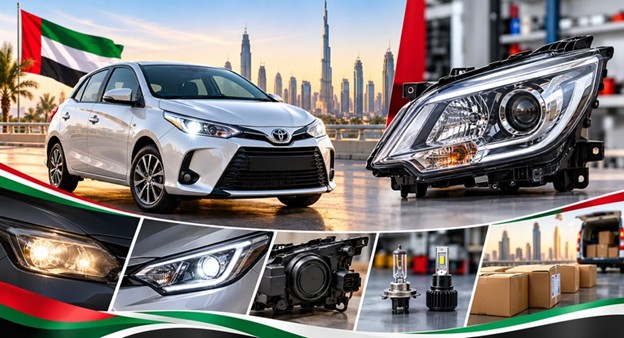
A headlight removed from a Yaris that was hit in the rear is a very different proposition from one removed from a Yaris that suffered a front-end collision.
The second lamp may have:
- broken mounting ears;
- hidden housing cracks;
- damaged adjusters;
- distorted brackets;
- moisture ingress;
- damaged connectors.
It can look beautiful in a photograph because the photograph is showing you the only part that isn't telling the truth.
Ask for the rear.
Ask for the mounts.
Ask for the connector.
Ask for the part number.
If the seller cannot provide those things, the low price is buying uncertainty as much as it is buying a headlight.
The lens can be the most misleading part of the whole thing
A headlight lens can be polished until it looks almost new.
That does not tell you whether the inside of the assembly is healthy.
Check for:
- internal condensation;
- water marks;
- cracks;
- discoloured reflector surfaces;
- broken adjustment mechanisms;
- damaged rear covers;
- corrosion around electrical connections.
The UAE environment gives exterior plastics a hard life, particularly under prolonged sun exposure, but don't use “Dubai heat” as a diagnosis for every cloudy or failed lamp. A lens that has yellowed externally may be a restoration candidate; a housing that has admitted water is a different problem.
Sometimes restoration beats replacement
This is where the cheapest solution may be the one already attached to the car.
If the Yaris headlight is structurally sound and the main problem is surface oxidation, restoration can be dramatically cheaper than buying a complete assembly. A current Dubai restoration service advertises prices starting at AED 149 per pair, while replacement costs vary much more widely depending on whether the lamp is aftermarket or OEM.
That does not mean every cloudy lamp should be restored.
If the lens is cracked, the reflector damaged, the housing leaking or the mounting points broken, polishing the front surface is merely making a damaged component shinier.
A shiny broken headlight is still broken.
The aftermarket option is not automatically the cheap-and-nasty option
There is a lazy assumption in parts discussions that genuine Toyota equals good and aftermarket equals compromise.
Reality is less tidy.
A properly designed aftermarket assembly can be perfectly sensible for an older Yaris, particularly when the vehicle is being kept as inexpensive daily transport rather than restored to factory condition.
The question is quality and application.
Does it fit?
Does the beam pattern look right?
Does the housing seal properly?
Are the mounting points correctly positioned?
Is the connector correct?
Does it include the components the original assembly requires?
And does the seller stand behind it?
The word aftermarket answers none of those questions.
But an aftermarket lamp can save money twice
This sounds backwards, but hear me out.
Suppose the Yaris is ten years old, mechanically sound, and worth keeping for another several years. A new genuine lamp might cost more than you want to spend.
A decent aftermarket assembly could leave enough money in the budget for a suspension repair, a pair of tyres or a proper cooling-system inspection.
That is not penny-pinching.
That is sensible allocation of maintenance money.
A headlight exists to provide safe illumination. It does not exist to demonstrate your devotion to the Toyota parts department.
The trouble begins when the cheap lamp isn't really equivalent
This is where the headline price becomes deceptive.
A replacement advertised for AED 300 may not contain everything you expected. It may be designed around a particular halogen configuration. It may omit a bulb, cover, bracket or other component. Or it may be intended for a different lighting arrangement.
The 2015 Yaris catalogue is a useful illustration: even within that model year, genuine assemblies are split according to lighting equipment, while individual headlamp components such as covers and halogen bulbs are separately catalogued.
So always establish whether you are buying:
the complete assembly
or
a component of the assembly.
That distinction can turn a bargain into a second order.
Halogen and LED should never be treated as interchangeable by appearance
Toyota's Yaris parts data shows both halogen multi-reflector and halogen projector configurations in regional applications, while the current 2026 UAE Yaris Sedan is specified with LED headlamps.
That is a useful reminder that “Yaris headlight” spans considerably more technology than the search phrase suggests.
A 2026 UAE Yaris is not simply an older Yaris with a newer grille.
The lighting architecture matters.
The current UAE Yaris changes the price conversation
Toyota UAE currently lists the 2026 Yaris Sedan from AED 64,900, with the 1.5-litre four-cylinder, CVT and LED headlamps among its published equipment.
For a new car at that price, the calculation around a genuine replacement is obviously different from that of an ageing Yaris whose market value is much lower.
You are protecting a newer vehicle with years of expected use ahead of it.
That makes a factory-equivalent replacement easier to justify.
On an older Yaris, the same spend may be difficult to defend unless the rest of the car is in unusually good condition.
Don't buy a pair simply because the other lamp looks old
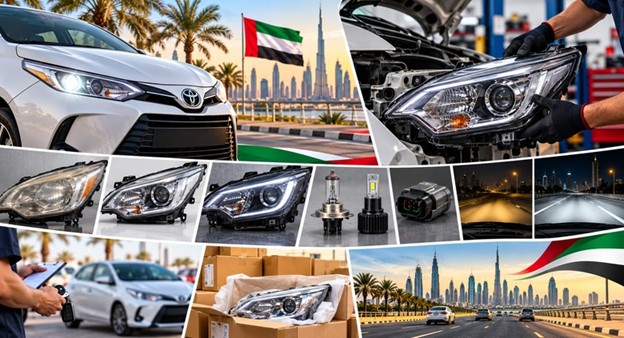
Replacing both headlights can be worthwhile.
It can also be wasteful.
If one lamp has been smashed and the other is clear, correctly aligned and functioning normally, there is no mechanical rule saying both must be replaced.
But if the surviving lamp is heavily yellowed, its optical performance has deteriorated and the replacement looks dramatically clearer, a pair may provide a more consistent result.
This is particularly relevant when moving from old aftermarket lamps to new ones.
The decision should be based on condition and optical consistency, not symmetry for its own sake.
A headlight from the wrong side is still wrong
This sounds ridiculous until you see how many catalogue systems describe parts as “left” and “right” without making it obvious whose perspective is being used.
Toyota's current genuine references distinguish driver-side and passenger-side assemblies separately; for the 2015 Yaris, for example, 81170-0DA70 is identified as the driver-side/left assembly while 81130-0DA70 is the passenger-side/right assembly.
When ordering, provide the part number if you can.
It removes a lot of interpretive nonsense.
A used headlight should be treated like a used gearbox — not a second-hand ornament
Nobody sensible buys a used gearbox because it looks clean in a photograph.
The same mentality should apply here, albeit with less drama.
Ask:
Why was it removed?
What was the donor vehicle?
Was it tested?
Are the mounts intact?
Is the lens clear?
Is there moisture?
Is the connector undamaged?
What exactly is included?
Can I return it if it does not match?
Current UAE used-parts sourcing services explicitly use chassis numbers, condition, mileage, part numbers and fitment when obtaining used headlights from suppliers.
That is the right level of caution.
Accident damage can make the headlight innocent
If the Yaris was involved in a front-end accident, don't automatically blame the lamp because the beam appears wrong.
The mounting structure may have moved.
The bumper support may be distorted.
The radiator support may have shifted.
The wiring may have been pulled.
The fender may be sitting incorrectly.
A replacement lamp can be perfectly good and still appear to fit badly because the vehicle around it has been bent.
This is why accident repair should begin with inspection, not an online shopping cart.
The cheapest replacement can create a labour bill
This is one of the least glamorous parts of parts economics.
Suppose the aftermarket headlight is AED 250 cheaper.
Then it doesn't fit correctly.
The workshop spends additional time removing, adjusting, checking and eventually replacing it.
Suddenly the saving has become labour.
And if the first lamp has to be returned, the car has remained unfinished while you wait for another one.
For a daily driver, that delay has its own cost.
Cheap parts are only cheap when they complete the job.
The real price is the installed price
A proper comparison should therefore look like this:
Part + delivery + VAT + fitting + alignment + any required supporting components = actual repair cost.
Not:
part price = repair cost.
This becomes particularly important with imported genuine assemblies. A genuine overseas Yaris lamp may look inexpensive after currency conversion, but shipping, customs/tax treatment, returns and local labour can move the final figure considerably.
A fragile headlight is also a particularly poor component on which to discover that international returns are complicated.
A useful UAE price ladder
The available evidence supports a broad rather than artificially precise picture:
| Replacement route | Indicative price context | What it means |
|---|---|---|
| Restoration | From about AED 149/pair for one Dubai service | Suitable only when the original assembly is fundamentally sound |
| Used OEM | Broad UAE used-headlight market about AED 150–1,500 | Condition and exact Yaris application become critical |
| Aftermarket | Around AED 700–900 in one current Yaris guide | Market benchmark, not a universal retail quote |
| Genuine OEM | Around AED 638–1,344 for selected 2015–18 international examples before UAE landed costs | Exact reference and equipment can radically change price |
| Newer/current Yaris | 2026 vehicle from AED 64,900 | Higher-value ownership may justify factory-equivalent replacement |
The figures are deliberately labelled as benchmarks and observed examples, because mixing a UAE aftermarket estimate, a broad used-parts range and an overseas genuine-part price into one artificial “Yaris headlight price” would give a false impression of precision.
What should a workshop check after fitting?
The workshop should verify that the assembly is properly mounted, all relevant lighting functions operate, the beam is correctly aimed and there are no obvious electrical or warning-light issues associated with the replacement.
If the vehicle uses a lighting system with additional electronic control or adjustment, those functions should be checked according to the exact vehicle specification.
“Both headlights come on” is a start.
It is not the end of the inspection.
UAE night driving makes beam quality worth paying attention to
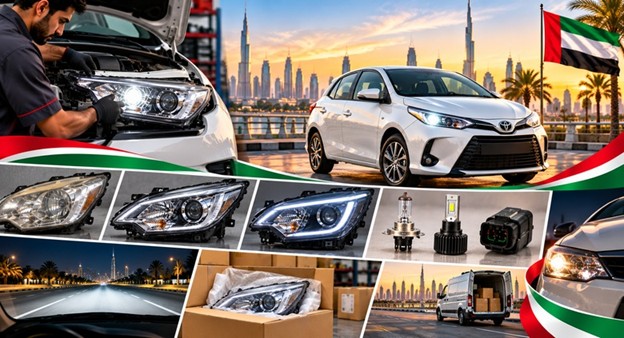
A Yaris is often used precisely because it is inexpensive to run, and that encourages owners to save wherever possible.
Good.
But lighting is one of the places where false economy is particularly unpleasant.
A headlight with a poor beam pattern can leave the driver with inadequate forward illumination while sending excessive light into other traffic. A lamp that sits a few millimetres differently from the original can alter the optical aim.
So the real target isn't simply bright.
It is correctly illuminated.
When genuine Toyota is worth the premium
I'd lean towards genuine when:
- the Yaris is relatively new;
- you intend to keep it for years;
- the exact OEM assembly is reasonably priced;
- the car has a high-specification lighting system;
- you want the lowest possible fitment uncertainty;
- the vehicle is being repaired after a significant accident.
The premium is buying more than a Toyota badge.
It is buying a known specification.
When aftermarket makes more sense
I'd consider quality aftermarket when:
- the Yaris is older;
- the vehicle is mechanically sound but low in market value;
- the original lamp is beyond repair;
- the replacement is correctly matched;
- the manufacturer/seller provides sensible warranty support;
- the price difference versus genuine is substantial.
The important word is quality.
“Aftermarket” is not a quality grade.
When used OEM is the cleverest option
Used original is especially attractive when:
- the vehicle is older but worth keeping;
- genuine replacement cost is high;
- the donor lamp has good optical and physical condition;
- the part number is verified;
- the mounting points are intact;
- the seller provides useful condition information;
- there is some return or warranty protection.
The ideal used lamp is not merely cheap.
It is known enough to be trusted.
What if the original lamp is only cloudy?
Then don't buy anything yet.
Get it inspected.
If the lens can be restored properly and the housing, reflector, seals and mounts are healthy, restoration may leave you with the original optical assembly for a fraction of replacement cost. One current Dubai service advertises restoration from AED 149 per pair, although actual suitability depends on the lamp's condition.
But if the cloudiness is accompanied by cracking, internal deterioration or water ingress, restoration may simply postpone replacement.
The Yaris parts decision becomes easier once you stop asking for “the cheapest”
When comparing Yaris headlights through PartFinder UAE, start with the exact car and part reference, then compare the complete repair cost — new genuine, quality aftermarket, used OEM or restoration — against the vehicle's age, condition and expected remaining ownership. A low advertised price means very little if the lamp is the wrong configuration or creates another fitting problem.
That is the useful distinction.
Not expensive versus cheap.
Known versus uncertain.
Your pre-purchase checklist should be short enough to actually use
Before paying, confirm:
Vehicle
- model year;
- generation;
- body style;
- GCC/import specification;
- VIN/chassis number.
Headlight
- left or right;
- halogen/LED/projector configuration;
- exact OE number;
- complete assembly or component;
- condition;
- mounting points;
- connector;
- included bulbs/modules/covers where relevant.
Purchase
- genuine, aftermarket or used;
- VAT;
- delivery;
- warranty;
- returns;
- fitting;
- beam alignment.
If you have all of that, the price comparison finally becomes meaningful.
Without it, you're mostly comparing photographs.
The sensible Yaris headlight rule
For a newer Yaris, the argument for genuine becomes stronger because the vehicle has more remaining ownership life and the cost of getting the lighting specification wrong is harder to justify.
For an older Yaris, a good aftermarket assembly or clean used OEM unit can be much better economics.
For a cloudy but structurally healthy original lamp, restoration may be the cheapest answer of all.
And for an accident-damaged car, inspect the surrounding structure before blaming the headlight.
The clever buyer doesn't ask:
“Which Yaris headlight is cheapest?”
They ask:
“Which replacement gives this particular Yaris the lowest total cost without creating another problem?”
That question tends to produce a much better part.
UAE Update Reference: October 2026.
Toyota Yaris Headlights in UAE: FAQs
Categories
- Audi
- BMW
- Car Accessories
- Car Tips
- Ford
- Land Rover
- Mazda
- Range Rover
- Top 10
- UAE Car Parts
- Used Car Parts
- Toyota
- Replacement Engines
- Nissan
- Hyundai
- Mitsubishi
- Volkswagen
- Honda
- Kia
- Chevrolet
- Dodge
- Jeep
- Subaru
- Renault
- Lexus
- Mercedes
- Suzuki
- Hummer
- Porsche
- Infiniti
- Peugeot
- GMC
- Mini
- Volvo
- Replacement Gearboxes
- MG
- Jaguar
- Skoda
- Cadillac
- Daihatsu
- Fiat
- German Car Parts
- Japanese Car Parts
- Aftermarket Car Parts
- Genuine Car Parts
- New Car Parts
- Reconditioned Car Parts
- European Car Parts
- American Car Parts
- Korean Car Parts
- British Car Parts
- Chinese Car Parts
- Sports/Exotic Car Parts
- Luxury Car Parts
- Performance Car Parts
- SUV/4x4 Spare Parts
- Truck Spare Parts
- EV Car Parts
- Hybrid Car Parts
- Auto Spare Parts in UAE
- Tesla
- Isuzu
- Ram
- Ferrari
- Bentley
- Lamborghini
- Genesis
- Maserati
- Lincoln
- Chrysler
- Opel
- Citroen
- SsangYong
- Seat
- McLaren
- Aston Martin
- Rolls Royce
- Maybach
- Alfa Romeo
- Bugatti
- Scion
- Abu Dhabi Car Parts
- Ajman Car Parts
- Al Khan Car Parts
- Al Sajaa Car Parts
- Deira Car Parts
- Dubai Car Parts
- Fujairah Car Parts
- Industrial Area 6 Car Parts
- Mussafah Car Parts
- Ras Al Khaimah Car Parts
- Sharjah Car Parts
- Umm Al Quwain Car Parts
- Acura
- BYD
- Chery
- Dacia
- DS
- Geely Emgrand
- EXEED
- GAC
- GAC Gonow
- Geely
- Gonow
- Great Wall
- Haima
- Haval
- Holden
- Iveco
- JAC
- Jaecoo
- Jetour
- Lotus
- Omoda
- Proton
- Renault Samsung
- Roewe
- Lucid
- Replacement Headlight