Truck Spare Parts Prices in UAE: What Affects the Cost?
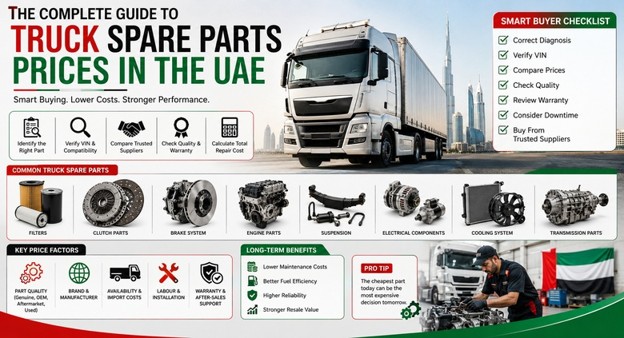
July 31, 2026
Understanding Truck Spare Parts Prices in the UAE
Quick Summary
| Topic | Key Insight |
| Price Differences | Truck spare parts prices vary because of brand, quality, availability, supplier network and vehicle specification. |
| Genuine vs OEM vs Aftermarket | Every option has different pricing, durability and long-term ownership value. |
| Commercial Truck Ownership | Heavy-duty operation naturally increases replacement and maintenance costs. |
| UAE Conditions | Heat, dust and continuous commercial use accelerate wear on many truck components. |
| Buying Strategy | Comparing value instead of simply comparing prices leads to better long-term savings. |
| Smart Buying Rule | The cheapest truck spare part rarely delivers the lowest lifetime ownership cost. |
The first question almost every truck owner asks is surprisingly simple.
"How much does the spare part cost?"
Fair question.
Wrong starting point.
Here's why.
Walk into three different suppliers in Dubai and ask for the same clutch kit.
You might receive three completely different prices.
Drive to Sharjah.
The quote changes again.
Call a supplier in Abu Dhabi.
Another figure appears.
Now it gets even more confusing.
Some suppliers recommend genuine parts.
Others suggest OEM replacements.
A few immediately offer aftermarket alternatives.
And then someone mentions a quality used part that costs half as much.
So...who's right?
Actually, they all might be.
Truck spare parts pricing isn't random.
Behind every quotation sits a long list of factors that most buyers never see.
Understanding those factors is what separates a smart purchase from an expensive mistake.
That's exactly what this guide is about.
Why Truck Spare Parts Prices Vary Across the UAE
No two trucks live the same life.
Think about it.
A refrigerated truck delivering food across Dubai every day experiences different demands from a tipper truck working on construction projects in Abu Dhabi.
Likewise, a long-haul Volvo tractor travelling between emirates places very different loads on its drivetrain compared with a local delivery vehicle operating inside city limits.
Those differences affect how quickly components wear out.
And when demand changes...
Prices usually follow.
Several factors influence truck spare parts prices across the UAE.
These include:
- Vehicle manufacturer.
- Truck model.
- Engine size.
- Payload capacity.
- Availability.
- Import costs.
- Supplier inventory.
- Product quality.
- Warranty coverage.
- Market demand.
Some factors remain outside anyone's control.
Others can save buyers thousands of dirhams over the lifetime of a commercial vehicle.
The Biggest Factors That Influence Truck Spare Parts Costs
Let's look beyond the price tag.
Imagine two identical-looking brake discs sitting on a warehouse shelf.
One costs considerably more.
Why?
Because price often reflects much more than appearance.
Important cost factors include:
Brand Reputation
Manufacturers with proven durability often command higher prices.
Fleet operators usually understand why.
Reliable parts reduce downtime.
Downtime costs money.
Manufacturing Standards
Precision engineering.
Material quality.
Testing procedures.
These all contribute to pricing.
Better manufacturing generally leads to longer service life.
Availability
A commonly replaced air filter may be available immediately.
A specialist transmission control module?
Perhaps not.
Limited stock usually increases prices.
Import Logistics
Many truck spare parts in UAE arrive from overseas manufacturers.
Shipping.
Storage.
Import duties.
Regional demand.
All influence the final selling price.
The customer rarely sees these costs.
They're built into the quotation.
Genuine vs OEM vs Aftermarket vs Used Truck Parts
One topic creates more debate than almost any other.
"Should I buy genuine parts?"
There's no universal answer.
Each option serves a different purpose.
Genuine Parts
Ideal for:
- Maximum compatibility.
- Manufacturer specifications.
- Premium reliability.
- Warranty protection.
They usually carry the highest purchase price.
OEM Parts
OEM components often provide:
- Excellent fitment.
- Factory-level quality.
- Better overall value.
- Strong long-term performance.
Many commercial workshops recommend OEM products for everyday fleet maintenance.
Aftermarket Parts
Some aftermarket brands produce excellent components.
Others...
Not so much.
Quality depends entirely on the manufacturer.
Research matters.
Workshop recommendations matter even more.
Used Parts
Used truck parts can reduce repair costs significantly.
Common examples include:
- Doors.
- Mirrors.
- Fuel tanks.
- Body panels.
- Interior components.
Major mechanical components should always undergo careful inspection before purchase.
Condition matters far more than age.
Why Commercial Trucks Cost More to Maintain Than Passenger Vehicles
A family SUV may cover 20,000 kilometres in a year.
Many commercial trucks exceed that comfortably.
Some cover several times that distance.
Now add:
Heavy payloads.
Frequent idling.
Long operating hours.
Stop-start deliveries.
Industrial environments.
Every one of those conditions accelerates component wear.
Commercial vehicles simply work harder.
Naturally...
Their maintenance budgets reflect that reality.
But here's the interesting part.
Higher maintenance costs don't automatically mean poor value.
Reliable trucks earn income.
Unreliable ones generate invoices.
How UAE Climate and Heavy-Duty Operations Affect Replacement Costs
The UAE presents one of the toughest operating environments for commercial vehicles.
Summer temperatures place enormous stress on:
- Cooling systems.
- Air-conditioning components.
- Batteries.
- Rubber hoses.
- Belts.
- Electrical connectors.
Then comes the dust.
Construction sites.
Industrial zones.
Long desert routes.
Dust finds its way almost everywhere.
Filters clog more quickly.
Cooling efficiency gradually declines.
Suspension components experience additional wear.
These aren't unusual failures.
They're predictable operating conditions.
Professional fleet managers plan for them.
That's one reason successful transport businesses often experience fewer unexpected breakdowns.
Preparation beats reaction.
Every time.
Why Looking Only at Price Can Be Expensive
Let's imagine two water pumps.
One costs considerably less.
Tempting.
The cheaper unit fails after several months.
The replacement requires:
- Another water pump.
- Fresh coolant.
- Additional labour.
- Vehicle downtime.
The original saving disappears.
Sometimes...
The most expensive repair begins with the cheapest spare part.
Smart buyers compare:
- Expected lifespan.
- Warranty.
- Compatibility.
- Supplier reputation.
- Long-term ownership cost.
Price matters.
Value matters more.
Workshop Story
A logistics company operating several Hino trucks noticed one vehicle developing cooling problems during daily deliveries around Dubai.
The fleet supervisor requested quotations from several suppliers.
One offered an unusually cheap radiator.
Another recommended an OEM replacement at a noticeably higher price.
Instead of choosing immediately, the workshop inspected the existing cooling system.
They discovered the radiator wasn't actually the main problem.
A deteriorating water pump and partially blocked thermostat were restricting coolant flow.
Replacing those components restored the truck completely.
The original radiator remained serviceable.
As the fleet supervisor collected the vehicle, he smiled.
"I'm glad we checked everything first."
The workshop manager nodded.
"Anyone can replace expensive parts. Good diagnosis prevents unnecessary spending."
That single inspection saved both money and valuable operating time.
Price Influence Comparison Table
| Cost Factor | Effect on Price | Why It Matters |
| Genuine Parts | Highest | Factory specification and manufacturer support |
| OEM Parts | Moderate | Excellent balance between quality and cost |
| Aftermarket Parts | Varies | Depends heavily on manufacturer reputation |
| Used Parts | Lowest | Best suited to selected repairs after inspection |
| Limited Availability | Higher | Low stock often increases prices |
| Heavy-Duty Specification | Higher | Designed to withstand greater operational demands |
Buyer Decision Matrix
| Your Situation | Recommended Buying Approach |
| Brand-new commercial truck | Genuine parts |
| Daily fleet operation | OEM components |
| Older truck with controlled budget | OEM or carefully inspected used parts |
| Urgent roadside repair | Prioritise availability and compatibility |
| High-mileage truck | Focus on durability instead of purchase price |
| Unsure about the fault | Obtain a professional diagnosis before ordering |
Suggested Visual Callout
"What Determines Truck Spare Parts Prices?"
Create a wide infographic featuring:
- Heavy-duty truck.
- Engine.
- Gearbox.
- Brake components.
- Supplier warehouse.
- UAE skyline.
- Shipping container.
- Warranty icon.
- VIN verification.
- Genuine, OEM, Aftermarket and Used comparison.
Keep wording minimal.
Focus on strong automotive visuals with subtle UAE-inspired red, green, white and black accents.
Smart Buyer's Checklist
Before comparing truck spare parts prices:
- Confirm the VIN.
- Identify the exact fault.
- Compare genuine, OEM and aftermarket options.
- Check warranty coverage.
- Ask about stock availability.
- Compare total repair costs, not just the part price.
- Choose suppliers with commercial vehicle experience.
- Think about the next 100,000 kilometres—not just today's invoice.
The smartest truck owners don't simply ask,
"What's the cheapest option?"
They ask,
"Which option keeps my truck earning money for the longest?"
There's a huge difference.
Key Takeaways
Truck spare parts prices in the UAE are influenced by far more than the label attached to a component. Brand reputation, manufacturing quality, truck specification, supplier networks, availability, import logistics and warranty coverage all play an important role in determining the final cost. Understanding these factors allows truck owners and fleet managers to make informed purchasing decisions instead of chasing the lowest quotation.
The best buying decisions focus on long-term value rather than short-term savings. Accurate diagnosis, careful comparison between genuine, OEM, aftermarket and used parts, and selecting experienced suppliers all contribute to lower operating costs, reduced downtime and improved fleet reliability.
Brand-Wise Truck Spare Parts Price Differences in the UAE
Quick Summary
| Topic | Key Insight |
| European Trucks | Generally have higher spare parts prices but excellent durability and engineering. |
| Japanese Trucks | Often provide a strong balance between affordability, reliability and availability. |
| Premium Components | Advanced technology and specialised engineering usually increase replacement costs. |
| Parts Availability | Widely available parts tend to cost less than components with limited stock. |
| Fleet Ownership | Long-term maintenance costs vary significantly between truck manufacturers. |
| Smart Buying Rule | Choose a truck brand based on lifetime operating costs—not just today's spare parts prices. |
Ask ten fleet managers one question.
"Which truck brand is the cheapest to maintain?"
Don't expect ten identical answers.
Because the answer depends on far more than the badge on the grille.
One company may operate heavy construction vehicles.
Another manages refrigerated transport.
A third spends every day delivering goods around busy city streets.
Different trucks.
Different workloads.
Different maintenance patterns.
Even two trucks from the same manufacturer can produce noticeably different repair bills depending on engine size, transmission type and operating conditions.
That's why comparing brands isn't about finding the cheapest spare part.
It's about understanding the complete ownership picture.
Mercedes-Benz Truck Spare Parts Prices in the UAE
Mercedes-Benz trucks have earned a reputation for engineering excellence.
They're built to handle demanding commercial workloads.
That quality, however, often comes with higher replacement part prices.
Commonly replaced components include:
- Brake assemblies.
- Air suspension parts.
- Turbochargers.
- Cooling system components.
- Electronic control modules.
- Clutch systems.
These trucks contain sophisticated technology.
Precision engineering improves performance.
But it also increases manufacturing complexity.
Many fleet operators still choose Mercedes-Benz because reliability often offsets higher maintenance costs over the vehicle's working life.
Quality rarely arrives by accident.
Volvo Truck Spare Parts Prices in the UAE
Volvo has become a favourite among logistics companies operating long-distance routes.
The brand is known for:
- Driver comfort.
- Fuel efficiency.
- Advanced safety systems.
- Strong drivetrain durability.
Replacement parts commonly include:
- Engine sensors.
- Brake components.
- Transmission parts.
- Suspension systems.
- Cooling assemblies.
Volvo spare parts generally sit within the premium pricing category.
However...
Many transport companies accept those costs because dependable vehicles spend more time on the road and less time inside workshops.
Reliability generates revenue.
Downtime does not.
MAN Truck Spare Parts Prices in the UAE
MAN trucks are widely respected across commercial transport sectors.
Especially for:
- Heavy-duty haulage.
- Construction work.
- Long-distance logistics.
Replacement costs often vary according to vehicle specification.
Popular replacement items include:
- Air compressors.
- Steering components.
- Suspension parts.
- Clutch assemblies.
- Fuel system components.
Some specialist parts may require sourcing through dedicated supplier networks.
Limited availability can influence pricing.
Planning maintenance in advance often helps reduce unexpected expenses.
Scania Truck Spare Parts Prices in the UAE
Scania has built a loyal following among fleet operators who prioritise fuel efficiency and durability.
The trucks are engineered for demanding commercial use.
Naturally...
Many components are manufactured to exceptionally high standards.
Frequently replaced parts include:
- Brake systems.
- Gearbox components.
- Air suspension parts.
- Cooling modules.
- Fuel injectors.
Replacement prices generally reflect the premium engineering involved.
For businesses covering substantial annual mileage, the investment often proves worthwhile.
Isuzu, Hino and Mitsubishi Fuso Spare Parts Price Comparison
Japanese manufacturers remain extremely popular throughout the UAE.
And with good reason.
These trucks combine:
- Strong reliability.
- Competitive pricing.
- Excellent parts availability.
- Straightforward maintenance.
Isuzu
Widely appreciated for:
- Affordable servicing.
- Easily available replacement parts.
- Reliable diesel engines.
Hino
Popular among fleet operators because of:
- Durable drivetrains.
- Competitive ownership costs.
- Strong workshop familiarity.
Mitsubishi Fuso
Frequently chosen for:
- Urban delivery fleets.
- Medium-duty transport.
- Practical maintenance costs.
Across many routine servicing jobs, Japanese truck brands often provide lower spare parts costs than their European competitors.
That doesn't automatically make them better.
It simply makes them different.
Why European Truck Parts Usually Cost More
There's a reason premium trucks often carry premium price tags.
Several reasons, actually.
These include:
- Advanced engineering.
- Sophisticated electronics.
- Lower production volumes for certain components.
- Specialised manufacturing.
- Imported replacement parts.
European manufacturers invest heavily in technology.
That technology improves efficiency.
Yet it also increases replacement costs whenever complex systems require repairs.
It's a trade-off.
Many fleet operators happily accept it.
Why Japanese Truck Parts Often Offer Better Value
Japanese manufacturers have earned their reputation through consistency.
Many workshops praise them because:
- Components are widely available.
- Servicing procedures are familiar.
- Parts prices remain competitive.
- Repairs are often straightforward.
This combination helps businesses control maintenance budgets.
Especially when operating multiple vehicles.
Predictability becomes a financial advantage.
Availability Has a Bigger Impact Than Most Buyers Realise
Imagine two identical sensors.
One is available locally today.
The other must be imported.
Which costs more?
Usually the imported component.
Availability influences:
- Purchase price.
- Delivery time.
- Vehicle downtime.
- Workshop scheduling.
The rarest part isn't always the most complicated.
Sometimes...
It's simply the hardest to find.
Looking Beyond the Purchase Price
Suppose a premium clutch kit costs more than a cheaper alternative.
Should you automatically reject it?
Not necessarily.
Ask yourself:
- How long will it last?
- Will it reduce downtime?
- Does it include a better warranty?
- Will it lower future maintenance costs?
Those questions matter far more than the initial quotation.
Lifetime ownership costs tell the real story.
Workshop Story
A transport company operating both Volvo and Hino trucks noticed increasing maintenance expenses.
Management initially believed the European fleet had become too expensive to justify.
Their workshop analysed three years of maintenance records.
The findings surprised everyone.
Yes, Volvo replacement parts generally cost more.
But the trucks required fewer unscheduled repairs.
Meanwhile, the Hino fleet benefited from lower servicing costs and excellent parts availability.
Both brands proved profitable.
Just in different ways.
The fleet manager laughed.
"We spent years arguing about prices instead of analysing the complete picture."
The workshop supervisor smiled.
"A good spreadsheet usually settles debates faster than opinions."
Sometimes the most expensive part produces the lowest lifetime operating cost.
Brand Comparison Table
| Truck Brand | Spare Parts Cost | Parts Availability | Long-Term Maintenance |
| Mercedes-Benz | High | Very Good | Excellent reliability |
| Volvo | High | Very Good | Excellent for long-distance operations |
| MAN | Moderate to High | Good | Strong for heavy-duty applications |
| Scania | High | Good | Excellent durability |
| Isuzu | Moderate | Excellent | Cost-effective ownership |
| Hino | Moderate | Excellent | Reliable and fleet-friendly |
| Mitsubishi Fuso | Moderate | Excellent | Affordable maintenance |
Buyer Decision Matrix
| Your Business Requirement | Recommended Brand Focus |
| Premium long-haul transport | Volvo or Scania |
| Heavy construction work | Mercedes-Benz or MAN |
| Urban delivery fleet | Isuzu or Mitsubishi Fuso |
| Mixed commercial operations | Hino |
| Lowest routine servicing costs | Japanese truck brands |
| Maximum long-term durability | European premium manufacturers |
Suggested Visual Callout
"Comparing Truck Brands by Spare Parts Costs"
Create a wide infographic featuring:
- European heavy-duty trucks.
- Japanese commercial trucks.
- Brake system.
- Engine.
- Gearbox.
- Warehouse shelves.
- Delivery network.
- Warranty icon.
- VIN verification.
Use minimal wording.
Focus on realistic commercial vehicle visuals with subtle UAE-inspired red, green, white and black accents.
Smart Buyer's Checklist
Before choosing a truck brand based on spare parts prices:
- Compare long-term maintenance costs.
- Ask about local parts availability.
- Consider average annual mileage.
- Check workshop familiarity with the brand.
- Compare warranty support.
- Think about vehicle downtime.
- Review fleet operating conditions.
- Focus on value over purchase price.
The cheapest truck to repair today may not be the cheapest truck to own over the next five years.
That's the comparison successful fleet managers make.
Key Takeaways
Truck spare parts prices vary significantly between manufacturers because every brand follows a different engineering philosophy, supply chain and maintenance strategy. European trucks generally command higher replacement part prices due to advanced technology and premium engineering, while Japanese manufacturers often deliver lower routine maintenance costs through excellent parts availability and straightforward servicing.
Choosing the right truck brand requires looking beyond individual component prices. Reliability, downtime, warranty support, workshop expertise and long-term operating costs all influence the true cost of ownership. Businesses that evaluate the complete maintenance picture rather than focusing on isolated repair bills are far better positioned to maximise fleet efficiency and profitability.
Genuine vs OEM vs Aftermarket vs Used Truck Spare Parts – Which Offers the Best Value?
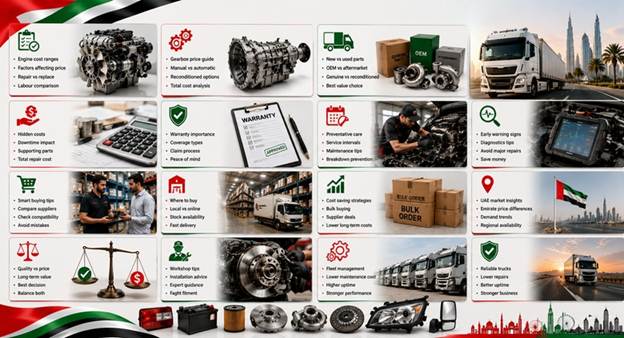
Quick Summary
| Topic | Key Insight |
| Genuine Parts | Highest purchase price but factory-approved quality and compatibility. |
| OEM Parts | Excellent balance between quality, durability and overall cost. |
| Aftermarket Parts | Prices vary widely depending on the manufacturer and quality standards. |
| Used Parts | Can reduce repair costs significantly when purchased carefully. |
| Reconditioned Parts | Ideal for selected major components when professionally rebuilt. |
| Smart Buying Rule | Buy according to the truck's workload, not simply your repair budget. |
Spend five minutes in any commercial vehicle workshop and you'll hear the same conversation.
"Should I buy genuine?"
"The OEM part is cheaper."
"What about aftermarket?"
"Can we use a reconditioned unit instead?"
Everyone has an opinion.
Some swear by genuine parts.
Others won't buy anything except OEM.
Fleet managers often look at the numbers.
Independent truck owners usually look at the invoice.
Neither approach is completely right.
Nor completely wrong.
Because the best choice depends on the truck.
Its workload.
Its age.
Its annual mileage.
And perhaps most importantly...
How long you intend to keep it.
Let's break it all down.
Genuine Truck Spare Parts – Why Are They More Expensive?
Genuine parts come directly through the truck manufacturer's authorised supply chain.
They are designed specifically for the vehicle they were built to support.
That sounds reassuring.
Because it is.
Their biggest strengths include:
- Exact factory fit.
- Manufacturer approval.
- Consistent engineering standards.
- Reliable quality control.
- Strong warranty support.
- Proven compatibility.
There's a reason many transport companies continue choosing genuine parts for newer trucks.
Unexpected downtime costs far more than paying a little extra upfront.
A delayed delivery.
A missed contract.
An idle driver.
Those costs rarely appear on the spare parts invoice.
Yet they are very real.
OEM Truck Parts – The Smart Middle Ground
OEM stands for Original Equipment Manufacturer.
Here's something many buyers don't realise.
The company manufacturing the original truck component is often the same company producing the OEM replacement.
The difference?
Branding.
Distribution.
Packaging.
That's usually it.
OEM parts frequently deliver:
- Excellent fitment.
- High manufacturing standards.
- Reliable durability.
- Better overall value.
Many experienced workshop managers quietly recommend OEM components for routine fleet maintenance.
Not because they're cheaper.
Because they make commercial sense.
Aftermarket Truck Parts – Good or Bad?
Here's where things become interesting.
The word aftermarket covers thousands of manufacturers.
Some produce exceptional products.
Others...
Let's just say they don't.
One aftermarket brake disc might perform brilliantly.
Another could wear prematurely.
That's why judging every aftermarket part the same way makes very little sense.
Before choosing aftermarket components, consider:
- Brand reputation.
- Material quality.
- Independent testing.
- Warranty.
- Workshop recommendations.
- Previous fleet experience.
A trusted aftermarket manufacturer may outperform a poor-quality alternative carrying a familiar name.
Research changes everything.
Used Truck Spare Parts – Can They Really Save Money?
Absolutely.
When used correctly.
Not every truck repair requires a brand-new replacement component.
Used parts often make excellent sense for:
- Doors.
- Mirrors.
- Fuel tanks.
- Cabin trim.
- Body panels.
- Lighting assemblies.
- Storage compartments.
Mechanical parts require a more cautious approach.
Condition should always come before cost.
Ask questions.
Inspect carefully.
Request history where available.
Buying a used component without checking its condition is rather like buying a truck without opening the bonnet.
It might work out.
Or it might not.
Reconditioned Truck Components – Worth Considering?
Reconditioned parts deserve far more attention than they sometimes receive.
A professionally rebuilt component has usually been:
- Completely dismantled.
- Cleaned thoroughly.
- Inspected carefully.
- Repaired where necessary.
- Reassembled.
- Tested before sale.
Popular reconditioned truck components include:
- Gearboxes.
- Turbochargers.
- Alternators.
- Starter motors.
- Steering boxes.
- Fuel pumps.
When rebuilding is carried out properly, reconditioned units can provide impressive reliability at a significantly lower cost than brand-new replacements.
The key word is properly.
Not every rebuild follows the same standards.
Which Option Works Best for Different Trucks?
Imagine two vehicles.
The first is a two-year-old Mercedes-Benz Actros covering international freight routes.
The second is a twelve-year-old Mitsubishi Fuso used for local deliveries.
Would both benefit from identical purchasing decisions?
Probably not.
A newer truck operating under demanding commercial contracts may justify genuine or OEM parts.
An older truck approaching the end of its working life may achieve far better value through carefully selected aftermarket or reconditioned parts.
Context matters.
Always.
Why the Cheapest Option Can Become the Most Expensive
Every workshop has seen it.
A customer arrives carrying an extremely inexpensive replacement component purchased online.
Installation begins.
Something doesn't fit.
Mounting holes differ.
Electrical connectors don't match.
Hours disappear.
Eventually...
The correct part still needs ordering.
The original saving evaporates.
Buying the wrong part costs more than buying the right part the first time.
That's an expensive lesson.
Think About Lifetime Value, Not Today's Invoice
Commercial trucks earn money only when they're moving.
Every repair should support that objective.
Ask yourself:
- Will this component last?
- How quickly can it be replaced if needed?
- Is warranty support available?
- Will downtime increase if it fails?
- Does the supplier have a strong reputation?
Good fleet managers don't simply buy parts.
They buy reliability.
Workshop Story
A transport company operating several Scania trucks needed a replacement turbocharger for one of its vehicles.
Three quotations arrived.
A genuine turbocharger.
An OEM unit.
And a very inexpensive aftermarket alternative.
The cheapest quotation looked attractive.
The workshop, however, recommended the OEM unit after reviewing previous repair records.
Their reasoning was straightforward.
Several identical trucks in the fleet had already completed hundreds of thousands of kilometres using the same OEM component without unexpected failures.
The company accepted the recommendation.
Eighteen months later, the turbocharger continued performing flawlessly.
The operations manager smiled during a routine maintenance meeting.
"That wasn't the cheapest quotation."
The workshop supervisor replied,
"No...but it turned out to be the cheapest decision."
That's the difference between purchase price and ownership cost.
Truck Spare Parts Comparison Table
| Part Type | Purchase Cost | Reliability | Warranty | Best Suited For |
| Genuine | Highest | Excellent | Manufacturer-backed | Newer trucks and critical systems |
| OEM | Moderate | Excellent | Supplier dependent | Daily commercial operations |
| Premium Aftermarket | Moderate | Good to Excellent | Brand dependent | Cost-conscious fleet maintenance |
| Used | Lowest | Depends on condition | Limited | Body parts and selected repairs |
| Reconditioned | Moderate | Good to Excellent | Usually available | Major mechanical components |
Buyer Decision Matrix
| Your Situation | Recommended Choice |
| Brand-new truck | Genuine parts |
| Fleet vehicle covering high mileage | OEM components |
| Older commercial truck | OEM, quality aftermarket or inspected used parts depending on the repair |
| Emergency repair | Prioritise compatibility and availability |
| Major engine or gearbox repair | Professionally reconditioned or OEM components |
| Unsure which option suits your truck | Consult an experienced commercial vehicle workshop before ordering |
Suggested Visual Callout
"Choosing the Right Truck Spare Part"
Create a wide infographic featuring:
- Heavy-duty truck.
- Genuine parts box.
- OEM component.
- Aftermarket replacement.
- Reconditioned gearbox.
- Used body panel.
- Warranty badge.
- VIN verification.
- Mechanic inspecting parts.
Keep wording minimal.
Use realistic commercial vehicle visuals with subtle UAE-inspired red, green, white and black accents.
Smart Buyer's Checklist
Before choosing between genuine, OEM, aftermarket or used truck parts:
- Confirm the VIN.
- Verify the part number.
- Match the component to the truck's workload.
- Compare warranty coverage.
- Research the supplier's reputation.
- Inspect used or reconditioned parts carefully.
- Think about downtime, not just purchase price.
- Always prioritise reliability for safety-critical systems.
Buying truck spare parts isn't about winning today's price comparison.
It's about keeping tomorrow's deliveries on schedule.
That's a very different objective.
Key Takeaways
Every type of truck spare part has its place. Genuine components provide factory-approved quality and complete compatibility, OEM parts offer exceptional value for most commercial operations, premium aftermarket products can reduce costs without compromising reliability when sourced carefully, while used and professionally reconditioned parts remain sensible choices for selected repairs and older vehicles.
The smartest buying decisions are based on how the truck is used rather than simply how much the part costs. Fleet operators and independent truck owners who consider reliability, downtime, warranty support and expected service life alongside the purchase price consistently achieve lower operating costs and better long-term returns.
Truck Spare Parts Prices by Component Category – Which Parts Cost the Most?
Quick Summary
| Component Category | Typical Cost Level | Why Prices Vary |
| Engine Parts | Very High | Precision engineering, internal complexity and availability |
| Gearbox & Transmission | Very High | Heavy-duty construction and specialised components |
| Brake System | Moderate | Safety-critical parts replaced regularly |
| Suspension & Steering | Moderate to High | Load capacity and road conditions affect lifespan |
| Cooling & Electrical | Moderate | UAE heat increases replacement frequency |
| Body & Cabin Parts | Low to Moderate | Availability and condition largely determine pricing |
One truck.
Thousands of components.
Some cost just a few dirhams.
Others?
They can completely reshape a maintenance budget.
That's why experienced fleet managers don't simply ask how much a repair costs.
They ask which component has failed.
Because replacing a mirror isn't remotely comparable to replacing a gearbox.
Likewise, fitting new brake pads bears little resemblance to rebuilding an engine.
Every truck system has its own pricing pattern.
Understanding those patterns helps you budget better, avoid unpleasant surprises and make smarter buying decisions.
Let's start with the biggest expense.
Engine Spare Parts Price Guide
The engine sits at the heart of every commercial truck.
When it performs properly, business keeps moving.
When it doesn't...
Everything slows down.
Engine-related parts are usually among the most expensive truck components because they demand:
- High manufacturing precision.
- Heat resistance.
- Long service life.
- Tight engineering tolerances.
Frequently replaced engine parts include:
- Pistons.
- Cylinder heads.
- Gaskets.
- Oil pumps.
- Injectors.
- Water pumps.
- Timing components.
- Turbochargers.
Some failures involve a single component.
Others trigger a chain reaction.
A neglected cooling issue, for example, may eventually damage the cylinder head, radiator and water pump together.
That's why early diagnosis almost always costs less than delayed repairs.
Gearbox and Transmission Parts Price Guide
Few truck repairs worry owners more than gearbox problems.
And understandably so.
Commercial transmissions are designed to handle enormous torque every single day.
That strength comes at a price.
Replacement components commonly include:
- Clutch assemblies.
- Synchromesh units.
- Bearings.
- Input shafts.
- Output shafts.
- Solenoids.
- Torque converters.
- Gear selector mechanisms.
Modern automatic transmissions contain sophisticated electronic systems alongside heavy-duty mechanical components.
Both influence replacement costs.
One overlooked issue?
Ignoring transmission servicing.
Fresh transmission fluid may not seem exciting.
But it often prevents repairs that cost many times more.
Brake System Components Price Guide
Brakes wear out.
That's normal.
Ignoring them?
That's expensive.
And dangerous.
Truck brake systems experience enormous stress during daily commercial operations.
Especially when carrying heavy loads through busy cities like Dubai or travelling long distances between emirates.
Frequently replaced brake components include:
- Brake pads.
- Brake discs.
- Brake drums.
- Air brake chambers.
- Brake shoes.
- Master cylinders.
- Wheel cylinders.
- ABS sensors.
Brake parts usually fall within the moderate price category.
However...
Replacing worn components before secondary damage develops can reduce total repair costs significantly.
Suspension and Steering Parts Price Guide
Commercial trucks rarely travel on perfectly smooth roads.
Construction sites.
Industrial estates.
Loading yards.
Uneven surfaces.
Every bump transfers stress into the suspension system.
Common replacement parts include:
- Shock absorbers.
- Leaf springs.
- Air suspension bags.
- Bushes.
- Ball joints.
- Tie rod ends.
- Steering pumps.
- Steering racks.
Heavy payloads accelerate wear considerably.
Fleet operators often replace suspension components as preventative maintenance rather than waiting for complete failure.
It's a practical strategy.
Unexpected suspension failures usually happen at the worst possible moment.
Cooling System, Air Conditioning and Electrical Parts Price Guide
Now let's talk about the UAE.
Summer temperatures push cooling systems to their limits.
Engines generate enormous heat.
Air-conditioning runs continuously.
Electrical systems work harder.
Naturally...
Replacement demand increases.
Frequently purchased components include:
- Radiators.
- Cooling fans.
- Thermostats.
- Expansion tanks.
- AC compressors.
- Alternators.
- Starter motors.
- Batteries.
- Wiring harnesses.
- Sensors.
These parts vary considerably in price.
Simple sensors may cost relatively little.
A complete cooling module?
That's a different conversation altogether.
Preventative maintenance makes a noticeable difference here.
Keeping radiators clean and replacing worn hoses before they fail can prevent much larger repair bills.
Body Panels, Lighting and Cabin Parts Price Guide
Not every repair affects the engine.
Accidents happen.
Loading bays become crowded.
Mirrors get clipped.
Doors suffer dents.
Cabin components wear with daily use.
Replacement body parts commonly include:
- Front bumpers.
- Rear bumpers.
- Headlamps.
- Tail lamps.
- Side mirrors.
- Doors.
- Grilles.
- Bonnets.
- Seats.
- Dashboard components.
These repairs often present excellent opportunities to consider quality used parts.
A carefully inspected used door performs exactly the same function as a brand-new one.
The invoice, however, may look very different.
Which Truck Components Usually Cost the Most?
If we ranked truck systems purely by replacement cost, the list would generally look something like this:
- Engine assemblies.
- Gearboxes and transmissions.
- Turbochargers.
- Fuel injection systems.
- Differential assemblies.
- Suspension systems.
- Brake systems.
- Cooling systems.
- Electrical components.
- Body panels and lighting.
Notice something?
The most expensive repairs usually involve the systems that keep the truck moving.
Which makes perfect sense.
Why Labour Can Cost Almost as Much as the Part
Many buyers compare component prices without considering installation.
That's only half the story.
Replacing a mirror takes relatively little time.
Replacing a clutch?
Very different.
Accessing certain components requires:
- Removing surrounding parts.
- Specialist lifting equipment.
- Diagnostic testing.
- Calibration.
- Road testing.
The part might represent only part of the final invoice.
Labour matters too.
Always request an estimate covering both.
Workshop Story
A fleet operator brought a Mitsubishi Fuso into a commercial workshop after noticing coolant loss.
The initial assumption?
A leaking radiator.
Replacement quotations started arriving almost immediately.
Fortunately, one technician suggested carrying out a pressure test before ordering any parts.
The investigation revealed a worn thermostat housing and a damaged hose clamp.
The radiator itself was perfectly healthy.
A repair that could easily have become a costly cooling system replacement ended with only a handful of inexpensive components being fitted.
The fleet owner chuckled while collecting the truck.
"I nearly paid for a radiator I didn't need."
The technician smiled.
"Good diagnosis is usually cheaper than quick assumptions."
It's a lesson every truck owner remembers.
Truck Spare Parts Cost Comparison Table
| Component | Typical Price Level | Replacement Frequency | Budget Priority |
| Engine Parts | Very High | Low to Moderate | Highest |
| Gearbox Components | Very High | Low | Highest |
| Brake Parts | Moderate | High | High |
| Suspension Parts | Moderate to High | Moderate | High |
| Cooling System | Moderate | Moderate | Medium |
| Electrical Parts | Moderate | Moderate | Medium |
| Body Panels | Low to Moderate | Depends on damage | Variable |
Buyer Decision Matrix
| Component Failure | Recommended Buying Strategy |
| Engine internals | Genuine or OEM |
| Gearbox repairs | OEM or professionally reconditioned |
| Brake system | Genuine or premium OEM |
| Suspension | OEM or trusted aftermarket |
| Cooling system | OEM for critical components |
| Body repairs | Genuine, OEM or inspected used parts depending on condition |
Suggested Visual Callout
"Which Truck Spare Parts Cost the Most?"
Create a wide infographic featuring:
- Heavy-duty truck.
- Engine highlighted.
- Gearbox highlighted.
- Brake assembly.
- Suspension.
- Cooling system.
- Electrical system.
- Body panels.
- Price tags showing relative cost levels.
Keep wording minimal.
Use realistic workshop visuals with subtle UAE-inspired red, green, white and black accents.
Smart Buyer's Checklist
Before replacing any major truck component:
- Confirm the exact cause of failure.
- Compare repair and replacement costs.
- Ask whether supporting components also require replacement.
- Compare genuine, OEM and quality aftermarket options.
- Request labour estimates alongside parts pricing.
- Check warranty coverage.
- Verify compatibility using the VIN.
- Think about future reliability rather than today's invoice.
Replacing the right component at the right time is important.
Replacing the wrong one?
That's where repair budgets quickly spiral out of control.
Key Takeaways
Truck spare parts prices vary significantly by component category because every system performs a different role and demands different engineering standards. Engine and gearbox components usually represent the highest repair costs due to their complexity, while brake, suspension, cooling and electrical systems require more frequent maintenance throughout a truck's working life.
Understanding where maintenance budgets are typically spent helps truck owners plan repairs more effectively, avoid unnecessary replacements and reduce unexpected downtime. Accurate diagnosis, selecting quality components and considering labour alongside parts pricing are essential for controlling long-term operating costs.
Where You Buy Truck Spare Parts Matters More Than You Think
Quick Summary
| Topic | Key Insight |
| Dubai | Largest selection of truck spare parts with competitive supplier networks. |
| Abu Dhabi | Strong market for premium and fleet-focused commercial vehicle parts. |
| Sharjah | Popular for affordable OEM, aftermarket and quality used truck parts. |
| Online Suppliers | Easier price comparison, broader stock and faster quotation requests. |
| Wholesale vs Retail | Bulk buyers usually receive better pricing and long-term supply agreements. |
| Smart Buying Rule | The best supplier isn't always the cheapest—it's the one that delivers the right part, on time, every time. |
Here's a question that doesn't get asked often enough.
"Does the same truck spare part cost the same everywhere in the UAE?"
Not even close.
Two identical alternators.
Same manufacturer.
Same part number.
Yet one supplier quotes a noticeably higher figure than another.
Why?
Because you're not only paying for the component.
You're paying for everything behind it.
Inventory.
Warehousing.
Import logistics.
Supplier relationships.
Delivery speed.
Technical support.
Warranty handling.
Even the location of the supplier can influence the final quotation.
That's why experienced fleet managers don't stop after receiving the first price.
They keep digging.
And more often than not, that extra effort pays off.
Truck Spare Parts Prices in Dubai
Dubai has become the country's largest commercial hub for automotive and heavy-duty spare parts.
Walk through the city's industrial areas and you'll find warehouses filled with components for almost every major truck manufacturer.
Need an air compressor for a MAN truck?
A clutch kit for a Mercedes-Benz Actros?
A radiator for a Hino?
There's a good chance someone already has it sitting on a shelf.
The advantages of buying in Dubai include:
- Extensive supplier competition.
- Faster stock availability.
- Large inventories.
- Easier access to genuine, OEM and aftermarket options.
- Strong logistics networks.
- Competitive pricing for commonly replaced parts.
Competition works in the buyer's favour.
When several suppliers offer similar products, prices often become more attractive.
But don't assume every quotation represents the best value.
One supplier may include warranty support.
Another may offer same-day delivery.
Someone else might provide technical advice after the sale.
Those extras matter.
Especially when commercial vehicles are losing money every hour they remain off the road.
Truck Spare Parts Prices in Abu Dhabi
Abu Dhabi's commercial vehicle market looks slightly different.
Many businesses operating here manage:
- Oil and gas transport.
- Government contracts.
- Industrial logistics.
- Construction fleets.
- Long-distance commercial transport.
As a result, demand often focuses on premium heavy-duty components designed for continuous operation.
Suppliers frequently stock:
- Engine assemblies.
- Differential components.
- Heavy-duty suspension.
- Hydraulic systems.
- Brake assemblies.
- Cooling modules.
Pricing can occasionally sit above other regions, particularly for specialist parts.
However...
Many buyers appreciate the technical support and fleet-oriented services offered by established commercial suppliers.
For businesses operating dozens of trucks, dependable supply chains often matter more than chasing the absolute lowest quotation.
Truck Spare Parts Prices in Sharjah
Mention affordable truck spare parts in the UAE and Sharjah almost always enters the conversation.
There's a reason.
Actually...
Several reasons.
The emirate has developed a strong reputation for:
- Competitive supplier pricing.
- Quality OEM components.
- Wide aftermarket selection.
- Large inventories of inspected used parts.
- Experienced commercial vehicle workshops.
Fleet operators often compare quotations between Dubai and Sharjah before making purchasing decisions.
Sometimes the difference is minimal.
Sometimes it's substantial.
It depends entirely on the component.
Body panels and cabin parts frequently offer particularly strong value here.
The same applies to carefully inspected used commercial vehicle components.
Online Truck Spare Parts vs Local Suppliers
Buying habits have changed dramatically over the past few years.
Not long ago, sourcing truck parts usually meant driving from warehouse to warehouse.
Today?
Things happen differently.
A fleet manager can request multiple quotations before finishing a morning coffee.
Online suppliers offer several advantages:
- Faster quotation requests.
- Easier supplier comparisons.
- Broader product availability.
- Access to nationwide inventories.
- Convenient document sharing.
- Simplified VIN verification.
That sounds ideal.
And often it is.
Yet local suppliers still hold important advantages.
You can inspect certain components personally.
Discuss technical issues face-to-face.
Collect urgent parts immediately.
Relationships still count in this industry.
People buy from people.
Especially when expensive commercial vehicles are involved.
Wholesale Suppliers vs Retail Sellers
Not every buyer shops the same way.
An independent owner replacing a single starter motor has very different requirements from a transport company maintaining fifty trucks.
Wholesale suppliers usually focus on:
- Fleet contracts.
- Bulk purchasing.
- Long-term partnerships.
- Scheduled deliveries.
- Consistent stock availability.
Retail suppliers, meanwhile, specialise in:
- Individual purchases.
- Immediate availability.
- Smaller order quantities.
- Walk-in customers.
If you're operating a commercial fleet, establishing a long-term supplier relationship often reduces overall maintenance costs.
Loyal customers frequently receive:
- Better pricing.
- Faster deliveries.
- Priority stock allocation.
- Flexible payment arrangements.
Consistency has value.
How Supplier Networks Affect Pricing and Availability
Here's something many buyers overlook.
The supplier you're speaking to may not actually hold the part.
Instead, they could be sourcing it through another distributor.
Or even several distributors.
Every additional step can influence:
- Purchase price.
- Delivery time.
- Warranty processing.
- Product availability.
Suppliers with direct import channels often reduce delays because they control larger inventories.
That doesn't automatically make them cheaper.
But it does make them more predictable.
And predictability matters when every parked truck represents lost revenue.
Should You Always Buy from the Cheapest Supplier?
Let's imagine two quotations.
Supplier A offers the lowest price.
Supplier B costs slightly more.
Simple decision?
Maybe not.
Ask a few more questions first.
- Does the supplier verify compatibility?
- Is technical support available?
- What happens if the part is incorrect?
- How quickly can replacements be arranged?
- Is warranty handling straightforward?
A small difference in price may disappear completely if the cheaper supplier causes delays, incorrect deliveries or repeated repairs.
That's why experienced fleet operators rarely compare numbers alone.
They compare service.
Workshop Story
A construction company needed a replacement clutch kit for one of its Volvo trucks working near Abu Dhabi.
The purchasing department accepted the cheapest quotation they received online.
Three days later, the delivery arrived.
Wrong specification.
The truck remained parked while another replacement was sourced.
Eventually, the workshop contacted an established supplier that had supported the fleet for years.
The correct clutch kit arrived that afternoon.
Installation began immediately.
As the vehicle returned to work, the transport manager laughed.
"The cheapest quotation ended up being the most expensive one."
The workshop foreman simply nodded.
"Price gets attention. Service keeps trucks moving."
That's a lesson commercial operators rarely forget.
UAE Supplier Comparison Table
| Supplier Type | Price Level | Availability | Best For |
| Dubai Commercial Suppliers | Competitive | Excellent | Genuine, OEM and fast-moving parts |
| Abu Dhabi Fleet Suppliers | Moderate to High | Very Good | Heavy-duty fleet operations |
| Sharjah Suppliers | Competitive | Excellent | OEM, aftermarket and quality used parts |
| Online Suppliers | Varies | Excellent | Comparing quotations and nationwide sourcing |
| Wholesale Suppliers | Lower for bulk orders | Very Good | Fleet operators |
| Retail Suppliers | Moderate | Immediate | Individual truck owners |
Buyer Decision Matrix
| Your Situation | Recommended Supplier |
| One-off emergency repair | Local supplier with immediate stock |
| Large commercial fleet | Wholesale supplier with long-term agreement |
| Looking for the best overall value | Compare multiple online and local quotations |
| Premium European truck | Specialist commercial vehicle supplier |
| Older truck requiring body parts | Experienced supplier of inspected used components |
| Unsure about compatibility | Supplier offering VIN verification and technical support |
Suggested Visual Callout
"Where Should You Buy Truck Spare Parts in the UAE?"
Create a wide infographic featuring:
- UAE map highlighting Dubai, Abu Dhabi and Sharjah.
- Commercial truck.
- Warehouse shelves.
- Delivery vehicle.
- Online ordering screen.
- Genuine, OEM and aftermarket boxes.
- Fleet manager comparing quotations.
- Warranty badge.
- VIN verification icon.
Keep wording minimal.
Focus on realistic logistics and commercial vehicle visuals with subtle UAE-inspired red, green, white and black accents.
Smart Buyer's Checklist
Before choosing a truck spare parts supplier:
- Compare at least three quotations.
- Confirm stock availability.
- Verify the part number using the VIN.
- Ask about warranty terms.
- Compare delivery times.
- Review supplier experience with commercial vehicles.
- Consider after-sales support.
- Calculate the total cost of downtime—not just the purchase price.
Finding the right supplier isn't about chasing the lowest number.
It's about building confidence that every order arrives correctly, on time and ready to keep your trucks working.
That's where real value begins.
Key Takeaways
The supplier you choose has a direct impact on truck spare parts prices, availability and overall ownership costs. Dubai offers extensive competition and broad inventories, Abu Dhabi caters strongly to heavy-duty fleet operations, while Sharjah remains a popular destination for competitively priced OEM, aftermarket and inspected used truck components. Online suppliers simplify price comparison, but trusted local relationships continue to play a vital role when urgent repairs are required.
Successful fleet operators look beyond individual quotations. They evaluate supplier reliability, technical support, warranty handling, delivery performance and stock consistency alongside the purchase price. Choosing a dependable supplier often prevents delays, reduces downtime and lowers long-term maintenance costs far more effectively than simply selecting the cheapest offer.
What Makes One Truck Spare Part More Expensive Than Another?
Quick Summary
| Factor | Impact on Price | Why It Matters |
| Country of Origin | High | Manufacturing standards and import costs influence pricing. |
| Engineering Quality | High | Better materials usually mean longer service life. |
| Truck Compatibility | Moderate to High | Specialist parts often cost more due to lower production volumes. |
| Supply & Demand | High | Limited stock can push prices up quickly. |
| Heavy-Duty Specification | High | Components designed for demanding work are more expensive to produce. |
| Warranty | Moderate | Better warranty support often increases purchase price but lowers ownership risk. |
Here's something worth thinking about.
Two brake discs.
Same size.
Same truck model.
Placed side by side on a workshop bench.
One costs almost twice as much.
At first glance, they appear identical.
Same shape.
Same mounting holes.
Same finish.
So why such a huge difference?
Because what you can't see often determines what you eventually pay.
The quality of the metal.
The manufacturing process.
The testing standards.
The supplier behind it.
Even the route that part travelled before reaching the UAE.
Truck spare parts aren't priced by chance.
Every quotation tells a story.
Let's uncover what sits behind those numbers.
Country of Origin and Manufacturing Standards
Where a truck part is manufactured makes a noticeable difference.
Not because one country is automatically better than another.
Because manufacturing standards vary.
So do production costs.
A component produced in a highly automated factory with strict quality control will usually cost more than one manufactured with less rigorous processes.
That additional cost often reflects:
- Better raw materials.
- Precision machining.
- Consistent tolerances.
- Extensive durability testing.
- Improved corrosion resistance.
Commercial trucks operate under enormous pressure every day.
Manufacturers know that.
A tiny manufacturing defect can eventually become a very expensive mechanical failure.
That's why quality control isn't simply a marketing phrase.
It's engineering insurance.
Brand Reputation and Quality Control
Some manufacturers spend decades building trust.
They don't protect that reputation by cutting corners.
Every component must meet strict internal standards before it reaches customers.
That's one reason recognised brands generally command higher prices.
You're not only paying for the product.
You're also paying for:
- Product development.
- Laboratory testing.
- Material research.
- Quality inspections.
- Technical support.
- Brand accountability.
Think about it this way.
If a fleet operates fifty trucks, reliability becomes far more valuable than saving a small amount on each replacement part.
Consistency saves money.
Unexpected failures rarely do.
Truck Model Compatibility and VIN Matching
Not every truck part fits every truck.
Sounds obvious.
Yet workshops encounter compatibility issues surprisingly often.
Modern commercial vehicles have become increasingly sophisticated.
Even within the same model range, differences may exist in:
- Engine size.
- Gearbox specification.
- Wheelbase.
- Payload capacity.
- Emissions system.
- Production year.
That's exactly why VIN verification matters.
Ordering without confirming compatibility creates unnecessary risks.
The wrong component may:
- Fail to install.
- Affect vehicle performance.
- Delay repairs.
- Increase labour costs.
- Void warranty coverage.
Checking the VIN takes minutes.
Correcting a mistaken order may take days.
Supply, Demand and Import Availability
Sometimes the price changes without the part changing at all.
Strange?
Not really.
Supply and demand influence commercial vehicle parts just as they influence many other industries.
Imagine a particular cooling fan becomes difficult to source internationally.
Demand remains steady.
Supply decreases.
Naturally...
Prices begin to rise.
Other factors also influence availability:
- Shipping delays.
- Manufacturing schedules.
- Seasonal demand.
- Warehouse stock levels.
- Import logistics.
- Global transport costs.
That's why identical quotations received several months apart can look surprisingly different.
Nothing about the truck changed.
The market did.
Heavy-Duty Specifications and Performance Requirements
Commercial trucks perform tasks that ordinary passenger vehicles never experience.
Long-distance transport.
Construction work.
Mining operations.
Heavy towing.
Continuous urban deliveries.
Every one of those jobs places enormous stress on mechanical systems.
Components designed for these environments require:
- Stronger materials.
- Greater heat resistance.
- Increased load capacity.
- Longer fatigue life.
- Enhanced durability.
Naturally...
Manufacturing them costs more.
Higher-quality engineering usually translates into higher purchase prices.
But it also tends to deliver longer service life.
That's an important distinction.
Warranty Coverage and How It Changes the Price
Many buyers focus entirely on the purchase invoice.
They overlook what's included after the sale.
Warranty support has value.
Real value.
A quality supplier often provides:
- Product replacement.
- Technical advice.
- Manufacturing defect protection.
- Claims support.
- Documentation.
- Peace of mind.
Those services cost suppliers money.
Some of that cost appears in the selling price.
Would you rather save a small amount today...
Or know you're protected if something goes wrong six months later?
Most fleet operators already know their answer.
Why Cheap Truck Parts Sometimes Cost More
Let's imagine two water pumps.
The cheaper unit saves money immediately.
Installation goes smoothly.
Everything appears perfect.
Six months later...
The bearing fails.
Coolant leaks.
The engine overheats.
Now the repair involves:
- Another water pump.
- Fresh coolant.
- Labour charges.
- Vehicle downtime.
- Lost deliveries.
That original saving disappears almost instantly.
This happens more often than many buyers realise.
The purchase price represents only one part of the ownership cost.
Reliability writes the rest of the story.
Don't Ignore the Supplier's Reputation
Suppose two suppliers offer exactly the same component.
One simply hands over a box.
The other checks the VIN, confirms compatibility, explains the warranty and follows up after installation.
Which supplier adds more value?
The answer isn't difficult.
Experienced commercial vehicle owners understand that knowledgeable suppliers reduce expensive mistakes.
Good advice doesn't appear on the invoice.
Yet it often saves far more than it costs.
Workshop Story
A logistics company operating several Mercedes-Benz trucks ordered an inexpensive steering pump from an unfamiliar supplier.
The specification looked correct.
The price looked even better.
Installation began the following morning.
Within minutes, the technician noticed subtle differences in the mounting arrangement.
The part simply wouldn't fit.
A replacement had to be sourced from a trusted commercial supplier.
The correct steering pump arrived later that day after the VIN was verified.
As the repair finished, the workshop manager smiled.
"We didn't waste money on the part."
He paused.
"We wasted it on the delay."
The fleet supervisor nodded.
"Next time we'll spend five minutes checking instead of five hours waiting."
That's how expensive mistakes usually begin.
With perfectly good intentions.
What Has the Biggest Influence on Truck Spare Parts Prices?
| Pricing Factor | Impact on Cost | Long-Term Value |
| Manufacturing Quality | Very High | Excellent |
| Country of Origin | High | High |
| Brand Reputation | High | Excellent |
| VIN Compatibility | Moderate | Prevents costly mistakes |
| Supply & Demand | High | Variable |
| Warranty Coverage | Moderate | Strong buyer protection |
| Heavy-Duty Engineering | Very High | Longer service life |
Buyer Decision Matrix
| Buying Situation | Best Approach |
| Critical safety component | Prioritise quality over price |
| Fleet maintenance | Focus on reliability and supplier consistency |
| Specialist truck model | Verify VIN before ordering |
| Imported component | Confirm delivery times and warranty |
| Older commercial truck | Compare OEM, quality aftermarket and reconditioned options carefully |
| Unsure about compatibility | Seek advice from an experienced commercial vehicle supplier |
Suggested Visual Callout
"Why Do Truck Spare Parts Have Different Prices?"
Create a wide infographic featuring:
- Heavy-duty truck.
- Manufacturing factory.
- Shipping container.
- UAE port.
- Warehouse shelves.
- VIN verification.
- Warranty certificate.
- Quality inspection.
- Heavy-duty brake disc and gearbox.
Use minimal wording.
Focus on realistic industrial visuals with subtle UAE-inspired red, green, white and black accents.
Smart Buyer's Checklist
Before accepting any truck spare parts quotation:
- Verify the VIN.
- Compare manufacturing quality—not just the price.
- Ask where the part was produced.
- Review warranty coverage.
- Check supplier reputation.
- Confirm stock availability.
- Consider future downtime costs.
- Think about the truck's workload before making a decision.
A truck spare part isn't expensive simply because the invoice says so.
It's expensive—or inexpensive—because of everything that stands behind it.
Understanding those hidden factors is what separates informed buyers from costly guesswork.
Key Takeaways
Truck spare parts prices are influenced by far more than the component itself. Manufacturing standards, country of origin, engineering quality, compatibility, supply chains, warranty coverage and supplier expertise all contribute to the final quotation. Two parts that appear almost identical can differ significantly in performance, reliability and long-term value because of these underlying factors.
The smartest commercial vehicle owners evaluate every purchase from an ownership perspective rather than focusing solely on the initial price. Selecting quality components, confirming VIN compatibility, working with experienced suppliers and considering lifetime operating costs helps reduce unexpected failures, minimise downtime and improve the overall profitability of truck ownership.
When comparing genuine, OEM, aftermarket and reconditioned truck spare parts, many commercial vehicle owners use PartFinder UAE to compare multiple trusted suppliers before making a purchasing decision.
The Hidden Costs of Truck Spare Parts That Most Buyers Never Calculate
Quick Summary
| Hidden Cost | Why It Matters |
| Labour Charges | Installation often costs more than buyers expect. |
| Supporting Parts | Replacing one component may require several others. |
| Fleet Downtime | Every hour off the road can cost more than the spare part itself. |
| Emergency Sourcing | Urgent deliveries usually increase repair costs. |
| Delayed Repairs | Small faults frequently become major failures. |
| Repair vs Replacement | Choosing the wrong option can waste both time and money. |
Here's a mistake almost every first-time truck owner makes.
They receive a quotation.
They look at one number.
The price of the spare part.
Then they make a decision.
Job done.
Except...
The spare part is rarely the most expensive part of the repair.
That surprises many people.
A commercial truck doesn't simply need a new component.
It needs diagnosis.
Labour.
Consumables.
Testing.
Sometimes calibration.
And if things don't go according to plan?
Well, the bill can grow much faster than expected.
The smartest fleet operators don't ask,
"How much is the part?"
They ask,
"What's this repair actually going to cost me from start to finish?"
There's a world of difference between those two questions.
Labour Costs for Truck Spare Parts Installation
Let's imagine you're replacing a truck alternator.
Straightforward job?
Sometimes.
Now imagine replacing a clutch assembly.
Or rebuilding a transmission.
Very different story.
Some repairs require:
- Specialist diagnostic equipment.
- Heavy lifting equipment.
- Multiple technicians.
- Electronic calibration.
- Road testing.
- Several hours—or even days—of workshop time.
That's why labour costs vary so widely.
A relatively affordable component may require extensive work before the truck is ready to return to service.
Always ask for two figures:
- Cost of the part.
- Cost of fitting it.
Without both numbers, you're only seeing half the picture.
Supporting Parts You May Need to Replace Together
One failed component often brings friends with it.
Think about replacing a clutch.
Would you install a brand-new clutch plate while leaving behind a worn release bearing?
Probably not.
What about fitting a new radiator while keeping cracked coolant hoses?
Again...
Not the best idea.
Truck repairs frequently involve supporting components such as:
- Seals.
- Bearings.
- Gaskets.
- Belts.
- Filters.
- Fluids.
- Mountings.
- Hoses.
- Fasteners.
These parts may seem inexpensive individually.
Together, however, they can noticeably increase the final invoice.
Skipping them rarely saves money.
It simply postpones another workshop visit.
Fleet Downtime Can Cost More Than the Repair
Now let's talk about something that never appears on a spare parts invoice.
Lost income.
A truck parked inside a workshop isn't delivering goods.
It isn't serving customers.
It isn't generating revenue.
Meanwhile...
Drivers still need paying.
Customers still expect deliveries.
Schedules continue moving.
Every extra day of downtime creates costs that stretch well beyond the repair itself.
For many transport companies, downtime becomes the biggest expense of all.
That's why reliable suppliers matter.
Quick diagnosis matters.
Efficient workshops matter.
Time really is money.
Especially in commercial transport.
Delivery Charges and Emergency Parts Sourcing
Nobody plans a roadside breakdown.
Yet they happen.
Usually when it's least convenient.
Emergency sourcing often involves:
- Express shipping.
- Same-day delivery.
- Out-of-hours workshop labour.
- Priority warehouse handling.
- Urgent courier services.
Naturally...
Those services increase costs.
A component ordered during scheduled maintenance is often considerably cheaper than the very same component sourced during an emergency.
Planning ahead isn't exciting.
But it is profitable.
The Cost of Delaying Truck Repairs
Here's a story every workshop has seen countless times.
A driver notices a slight vibration.
"It's probably nothing."
The truck keeps working.
A few weeks later, the vibration becomes worse.
Still ignored.
Eventually...
A minor bearing failure damages the shaft.
The shaft affects the gearbox.
The gearbox creates further problems.
What began as a relatively inexpensive repair now becomes a major mechanical project.
Truck components rarely fail without warning.
Most give subtle clues first.
Ignoring those clues almost always increases costs.
Repair vs Replace: Which Saves More Money?
This question sparks endless debate.
Repair it?
Replace it?
There's no universal answer.
It depends on:
- Vehicle age.
- Overall condition.
- Expected service life.
- Labour requirements.
- Parts availability.
- Future reliability.
Sometimes repairing a component is entirely sensible.
Other times it's throwing good money after bad.
Suppose an ageing turbocharger has already been repaired twice.
Would another repair represent good value?
Or would replacing it reduce future downtime?
That's the calculation experienced workshop managers make every day.
Not every repair should be repaired.
Hidden Costs Nobody Mentions
Let's look beyond the obvious.
Truck repairs may also involve:
- Diagnostic charges.
- Recovery vehicles.
- Workshop storage.
- Fluid replacement.
- Wheel alignment.
- ECU programming.
- Road testing.
- Unexpected secondary damage.
Individually, these items may seem manageable.
Combined?
They can significantly increase the overall repair bill.
That's why detailed quotations matter.
Always ask what's included.
And what's not.
Cheap Repairs Can Become Expensive Repairs
Imagine two suppliers.
Supplier A quotes the lowest price.
Supplier B costs a little more but includes:
- Better warranty.
- Correct supporting parts.
- Technical assistance.
- Faster delivery.
Which quotation actually saves money?
For a private car, the answer may not matter much.
For a commercial truck earning income every day?
It matters enormously.
One delayed delivery contract can outweigh the difference between both quotations.
Value beats price.
Again.
Workshop Story
A logistics company operating a fleet of Isuzu trucks noticed one vehicle producing an unusual grinding noise during deliveries around Sharjah.
The maintenance team suggested replacing a worn wheel bearing immediately.
The repair looked modest.
Management decided to postpone it until the following month.
Two weeks later, the bearing failed completely.
The damaged hub affected the brake assembly and wheel components.
Recovery equipment had to be called out.
The truck remained unavailable for several days.
When the fleet manager reviewed the final invoice, he quietly shook his head.
"We delayed a small repair..."
The workshop foreman finished the sentence.
"And paid for a much bigger one."
That conversation happens more often than many businesses would like to admit.
Hidden Cost Comparison Table
| Cost Element | Initial Impact | Long-Term Financial Effect |
| Spare Part | Visible | Only one part of the total repair |
| Labour | Moderate to High | Essential for correct installation |
| Supporting Components | Moderate | Prevents repeat failures |
| Fleet Downtime | Very High | Lost income and delayed operations |
| Emergency Delivery | High | Increases overall repair costs |
| Delayed Maintenance | Very High | Often multiplies the final invoice |
| Diagnostic Work | Moderate | Prevents unnecessary part replacement |
Buyer Decision Matrix
| Situation | Recommended Approach |
| Minor fault detected early | Repair immediately before secondary damage develops |
| Major mechanical failure | Compare complete repair and replacement costs |
| Fleet vehicle generating daily income | Prioritise faster, more reliable repairs |
| Older truck nearing retirement | Evaluate expected remaining service life before investing heavily |
| Emergency roadside breakdown | Focus on dependable suppliers with immediate availability |
| Unsure about repair costs | Request a detailed quotation including labour, parts and supporting components |
Suggested Visual Callout
"The True Cost of a Truck Repair"
Create a wide infographic featuring:
- Heavy-duty truck inside a commercial workshop.
- Mechanic replacing a gearbox.
- Labour icon.
- Clock representing downtime.
- Delivery truck waiting.
- Diagnostic computer.
- Replacement bearings, clutch and radiator.
- Warranty badge.
- Toolkit.
Keep wording minimal.
Focus on realistic workshop visuals with subtle UAE-inspired red, green, white and black accents.
Smart Buyer's Checklist
Before approving any truck repair:
- Ask for a complete cost breakdown.
- Include labour in your comparison.
- Replace supporting components where necessary.
- Confirm warranty coverage.
- Calculate the cost of downtime.
- Don't ignore early warning signs.
- Compare repair versus replacement honestly.
- Choose long-term reliability over short-term savings.
A repair invoice tells you what you've spent.
A reliable truck tells you whether you spent wisely.
Those aren't always the same thing.
Key Takeaways
The true cost of replacing truck spare parts extends far beyond the price of the component itself. Labour, supporting parts, diagnostic work, emergency sourcing, fleet downtime and delayed maintenance all contribute to the overall financial impact of a repair. Businesses that evaluate these hidden costs before authorising work are far more likely to control maintenance budgets and minimise operational disruption.
Successful truck ownership depends on looking at repairs from a long-term perspective. Addressing faults early, working with experienced workshops, replacing related components when necessary and calculating downtime alongside repair costs consistently lead to better financial outcomes and more reliable fleet performance.
How to Save Money on Truck Spare Parts Without Compromising Quality
Quick Summary
| Strategy | Why It Saves Money |
| Fleet Purchasing | Bulk buying often reduces unit costs. |
| Preventative Maintenance | Small repairs prevent expensive failures. |
| Comparing Suppliers | Multiple quotations usually reveal better value. |
| Buying Quality Parts | Reliable components reduce repeat repairs and downtime. |
| Maintenance Planning | Scheduled servicing avoids emergency purchases. |
| Smart Budgeting | Looking at lifetime costs delivers better returns than chasing the lowest price. |
Everyone likes saving money.
That's obvious.
But here's a better question.
Are you saving money...or simply spending less today?
Those aren't the same thing.
A truck owner who buys the cheapest clutch kit every year may actually spend far more than another owner who installs a quality replacement once and keeps working for years.
It sounds backwards.
Yet workshops across the UAE see this happen all the time.
Smart businesses don't measure savings by today's invoice.
They measure them by how much the truck earns over the next twelve months.
That's where the real calculation begins.
How Fleet Operators Reduce Spare Parts Costs
Large transport companies rarely buy truck parts one repair at a time.
They plan ahead.
Really far ahead.
Fleet managers analyse:
- Service history.
- Failure patterns.
- Seasonal demand.
- Annual mileage.
- Supplier performance.
- Vehicle downtime.
Then they prepare.
Instead of waiting for a truck to break down, they stock commonly used components before they're needed.
Typical fleet inventory includes:
- Oil filters.
- Air filters.
- Fuel filters.
- Brake pads.
- Belts.
- Coolant hoses.
- Batteries.
- Lighting components.
Buying before a failure happens usually costs less than buying during an emergency.
Preparation isn't exciting.
But it works.
Buying in Bulk vs Individual Purchases
Imagine replacing brake pads on one truck.
Now imagine replacing brake pads across thirty trucks.
The purchasing strategy changes completely.
Bulk purchasing often brings advantages such as:
- Lower unit prices.
- Reduced delivery charges.
- Better supplier discounts.
- Priority stock allocation.
- Consistent product quality.
- Simplified inventory management.
Even medium-sized businesses can benefit from planned purchasing.
Not every component should be bought in advance.
Fast-moving service items, however, usually make excellent candidates.
Why order the same filter twenty different times?
Seasonal Discounts and Supplier Promotions
Truck maintenance isn't always unpredictable.
Many businesses know roughly when major servicing will take place.
That's useful.
Because suppliers occasionally offer:
- End-of-year promotions.
- Fleet purchasing discounts.
- Clearance offers.
- Package pricing.
- Trade account incentives.
If major servicing can be planned around those opportunities, maintenance budgets often stretch considerably further.
One important reminder, though.
Never buy a poor-quality component simply because it's discounted.
A bargain isn't always a bargain.
Comparing Multiple Supplier Quotes
Here's a habit worth developing.
Never accept the first quotation unless there's a genuine emergency.
Take a little time.
Call another supplier.
Then another.
Compare:
- Product quality.
- Warranty.
- Delivery time.
- Stock availability.
- Technical support.
- Total repair cost.
Notice what isn't first on that list?
Price.
Because the cheapest quotation isn't automatically the best quotation.
Experienced buyers compare value.
Not just numbers.
Choosing Quality Instead of the Cheapest Option
This conversation happens every day.
Customer:
"That one's cheaper."
Workshop manager:
"Yes...but for how long?"
A quality truck part usually offers:
- Better durability.
- Improved fitment.
- Longer service life.
- Lower failure risk.
- Reduced downtime.
The purchase price may be higher.
The ownership cost often isn't.
There's a difference.
A big one.
Think about tyres.
Few transport companies buy the absolute cheapest tyres available.
They buy tyres that safely complete thousands of kilometres.
Truck spare parts deserve the same thinking.
Smart Budgeting for Long-Term Truck Maintenance
Many truck owners budget only for repairs they can already see.
Successful fleet operators budget for repairs that haven't happened yet.
That's a completely different mindset.
A sensible annual maintenance budget usually includes:
- Routine servicing.
- Wear-and-tear items.
- Emergency repairs.
- Unexpected failures.
- Labour costs.
- Consumables.
- Diagnostic work.
Planning ahead prevents unpleasant financial surprises.
More importantly...
It keeps trucks working.
Preventative Maintenance Is the Cheapest Repair You'll Ever Buy
Let's imagine two identical trucks.
Truck A receives scheduled servicing.
Truck B only visits the workshop when something breaks.
Fast forward two years.
Which one has lower maintenance costs?
Almost always Truck A.
Simple servicing tasks like:
- Changing filters.
- Replacing fluids.
- Inspecting belts.
- Checking bearings.
- Monitoring brake wear.
...often prevent repairs costing many times more.
Preventative maintenance isn't glamorous.
It rarely makes headlines.
It simply saves money.
Again.
And again.
Build Relationships With Good Suppliers
Some buyers chase a different supplier every month.
Others stick with one trusted commercial vehicle specialist.
Who usually benefits more?
Long-term customers often receive:
- Better commercial pricing.
- Faster quotations.
- Priority deliveries.
- Flexible payment terms.
- Technical advice.
- Early notification of stock arrivals.
Relationships matter.
Especially in commercial transport.
When a truck breaks down unexpectedly, trusted suppliers often move mountains to keep long-standing customers on the road.
That's difficult to put a price on.
Workshop Story
A delivery company operating fifteen Isuzu trucks reviewed its maintenance costs after noticing rising repair expenses.
Instead of changing suppliers, the company changed its strategy.
Routine servicing was scheduled more consistently.
Frequently replaced filters and brake components were purchased in bulk.
Workshop inspections became more proactive.
The results surprised everyone.
Breakdowns fell noticeably over the following year.
Emergency parts orders almost disappeared.
The operations manager smiled while reviewing the maintenance report.
"We didn't spend less on maintenance."
The workshop supervisor nodded.
"No."
"We simply spent it at the right time."
That's what good planning looks like.
Cost-Saving Strategy Comparison Table
| Strategy | Initial Investment | Long-Term Savings | Best For |
| Preventative Maintenance | Low | Excellent | All truck owners |
| Bulk Purchasing | Moderate | High | Fleet operators |
| Comparing Suppliers | Low | Moderate to High | Individual owners and fleets |
| Buying Premium OEM Parts | Moderate | High | High-mileage trucks |
| Building Supplier Relationships | Low | High | Regular commercial operators |
| Planned Servicing | Moderate | Excellent | Every commercial vehicle |
Buyer Decision Matrix
| Your Situation | Recommended Strategy |
| Single truck owner | Compare quotations and maintain a regular service schedule |
| Small business fleet | Purchase fast-moving service parts in bulk |
| Large logistics company | Establish long-term supplier agreements |
| Older commercial truck | Prioritise preventative maintenance to avoid major failures |
| New truck | Follow the manufacturer's maintenance schedule closely |
| Tight maintenance budget | Invest in quality parts for critical systems and avoid delaying repairs |
Suggested Visual Callout
"How to Reduce Truck Spare Parts Costs"
Create a wide infographic featuring:
- Fleet of commercial trucks.
- Warehouse shelves stocked with filters and brake parts.
- Mechanic performing preventative maintenance.
- Calendar showing scheduled servicing.
- Bulk purchase boxes.
- Supplier handshake.
- Warranty badge.
- Cost-saving arrows.
Keep wording minimal.
Focus on realistic commercial fleet visuals with subtle UAE-inspired red, green, white and black accents.
Smart Buyer's Checklist
Before spending money on truck spare parts:
- Compare at least three supplier quotations.
- Schedule servicing before faults develop.
- Buy commonly replaced service parts in advance where practical.
- Build relationships with trusted suppliers.
- Focus on long-term reliability instead of short-term savings.
- Include labour and downtime in every repair calculation.
- Replace worn supporting components during major repairs.
- Review maintenance records regularly to identify recurring issues.
Saving money isn't about cutting corners.
It's about avoiding them.
The businesses that understand this usually spend less over the lifetime of every truck they own.
Key Takeaways
Reducing truck spare parts costs is rarely about finding the lowest price. The biggest savings come from preventative maintenance, careful planning, comparing suppliers, purchasing quality components and building long-term relationships with experienced commercial vehicle specialists. These strategies help reduce breakdowns, improve reliability and minimise costly downtime.
Successful fleet operators manage maintenance as an ongoing investment rather than reacting to individual failures. By budgeting ahead, purchasing strategically and prioritising long-term value over short-term discounts, truck owners can significantly lower their overall operating costs while keeping their vehicles productive throughout the year.
The Most Common Truck Spare Parts Pricing Mistakes Buyers Make
Quick Summary
| Common Mistake | Why It Becomes Expensive |
| Buying the Cheapest Part | Low purchase price often leads to higher long-term costs. |
| Ignoring VIN Compatibility | Incorrect parts waste time, labour and money. |
| Choosing Price Over Reliability | Frequent failures increase downtime and repair bills. |
| Buying Counterfeit Parts | Poor-quality products can damage major truck systems. |
| Ignoring Warranty | No protection if the component fails early. |
| Skipping Proper Diagnosis | Replacing the wrong part solves nothing. |
Here's a question.
How do two truck owners buy exactly the same spare part...
...yet one spends twice as much?
Simple.
One pays for the part.
The other pays for the mistake.
Commercial workshops see it every week.
Sometimes every day.
The surprising thing?
Most expensive repairs don't begin with catastrophic engine failures.
They begin with small buying decisions.
A rushed order.
A missing VIN check.
A suspiciously cheap quotation.
A component that looked identical on a website.
One shortcut after another.
Before long...
A routine repair turns into an expensive lesson.
Let's look at the mistakes that quietly drain maintenance budgets across the UAE.
Buying Cheap Parts That Fail Early
Everyone enjoys a bargain.
Nobody enjoys fitting the same component twice.
Imagine finding two brake chambers online.
One costs significantly less.
The specifications look similar.
The photographs even appear identical.
So you buy the cheaper one.
A few months later, it begins to fail.
Now you're paying for:
- Another replacement part.
- Labour.
- Workshop time.
- Vehicle downtime.
- Lost productivity.
Suddenly, the "cheap" purchase becomes the expensive one.
Price and value are not twins.
Sometimes they're complete opposites.
Ignoring VIN Compatibility Before Buying
Modern commercial trucks aren't as simple as they once were.
Different production years.
Different engine options.
Different transmissions.
Different axle configurations.
All of these can influence which spare part actually fits.
Yet some buyers still order components using nothing more than:
"It's a 2021 truck."
That's rarely enough.
VIN verification helps confirm:
- Exact specification.
- Engine configuration.
- Transmission type.
- Factory options.
- Production details.
Five minutes spent checking the VIN can prevent days of unnecessary delays.
That's a pretty good return on investment.
Choosing Price Before Reliability
Let's imagine two clutch kits.
One saves a few hundred dirhams today.
The other promises a much longer service life.
Which represents better value?
The answer depends on how you think.
If you're only considering today's invoice...
The cheaper one wins.
If you're considering the next 200,000 kilometres...
The conversation changes completely.
Reliable components reduce:
- Repeat repairs.
- Emergency breakdowns.
- Labour costs.
- Delivery interruptions.
- Fleet downtime.
That's why experienced fleet managers often buy according to expected lifespan rather than purchase price.
They're investing.
Not simply spending.
Falling for Counterfeit Truck Spare Parts
Counterfeit components remain one of the biggest risks in the commercial vehicle industry.
Unfortunately...
Some imitations look remarkably convincing.
Packaging.
Labels.
Logos.
Even serial numbers.
At first glance, everything appears genuine.
Inside the box?
That's another matter.
Counterfeit parts may suffer from:
- Inferior materials.
- Poor machining.
- Weak quality control.
- Short service life.
- Safety risks.
Imagine fitting counterfeit brake components to a fully loaded truck.
That's not a financial risk.
That's a safety risk.
Always buy from suppliers with established reputations.
Peace of mind matters.
Ignoring Warranty and Return Policies
Many buyers become interested in the warranty only after something goes wrong.
By then...
It's often too late.
Before placing an order, ask:
- How long is the warranty?
- What does it actually cover?
- Is labour included?
- What's the return process?
- Who handles warranty claims?
Clear answers today prevent frustrating conversations tomorrow.
A strong warranty doesn't guarantee perfection.
It demonstrates confidence in the product.
That's worth something.
Buying Without a Professional Diagnosis
This mistake costs businesses thousands every year.
A warning light appears.
Someone assumes the alternator has failed.
A replacement is ordered.
Installation finishes.
The warning light stays on.
The real fault?
A damaged wiring harness.
Or perhaps a faulty sensor.
Or a weak battery.
Replacing the wrong component doesn't repair the truck.
It simply replaces a perfectly good part.
Professional diagnosis almost always costs less than educated guesswork.
Chasing the Lowest Quotation Every Time
Competitive pricing is important.
Blindly chasing the cheapest supplier?
Less so.
A quotation should always be evaluated against:
- Product quality.
- Delivery time.
- Technical support.
- Warranty.
- Stock availability.
- Supplier reputation.
Saving a small amount upfront means very little if the truck remains parked waiting for the correct replacement.
Commercial vehicles earn income only when they're moving.
That's the benchmark.
Forgetting to Compare the Total Repair Cost
Here's a classic example.
Supplier A offers a lower-priced radiator.
Supplier B charges slightly more.
However...
Supplier B includes:
- New seals.
- Fresh coolant.
- Technical advice.
- Warranty support.
The overall repair becomes simpler.
The truck returns to work sooner.
Which quotation really offers better value?
That's why smart buyers compare complete repair costs.
Not isolated component prices.
Workshop Story
A distribution company operating several Mitsubishi Fuso trucks needed replacement brake discs for one vehicle.
An online supplier advertised an unusually low price.
The purchasing department placed the order immediately.
When the components arrived, the workshop noticed subtle machining differences.
The brake discs technically fitted.
But they failed to meet the expected quality standards.
The fleet manager authorised a second purchase from an established supplier.
As the new parts were installed, he sighed.
"We bought the same repair twice."
The senior technician smiled politely.
"No."
"We paid once for the lesson."
Some lessons arrive in cardboard boxes.
Common Buying Mistakes Comparison Table
| Mistake | Immediate Saving | Long-Term Cost |
| Buying the cheapest component | High | Often very high |
| Ignoring VIN verification | Small time saving | Incorrect parts and delays |
| Choosing unreliable suppliers | Moderate | Increased downtime |
| Buying counterfeit products | Lower purchase price | Major repair and safety risks |
| Ignoring warranty | Small saving | Higher replacement costs |
| Skipping professional diagnosis | Saves inspection costs | Wrong repairs and repeated labour |
Buyer Decision Matrix
| Buying Situation | Best Decision |
| Multiple quotations available | Compare value, not just price |
| Unsure about compatibility | Verify the VIN before ordering |
| Safety-critical repair | Choose genuine or trusted OEM components |
| Older commercial truck | Balance reliability with expected remaining service life |
| Unknown supplier | Check reputation before purchasing |
| Dashboard warning light | Diagnose the fault before buying parts |
Suggested Visual Callout
"Avoid These Expensive Truck Spare Parts Mistakes"
Create a wide infographic featuring:
- Heavy-duty truck.
- Counterfeit parts beside genuine components.
- VIN verification.
- Mechanic using a diagnostic scanner.
- Warranty certificate.
- Warning symbol.
- Delivery truck delayed.
- Supplier comparison checklist.
- Brake disc and clutch assembly.
Keep wording minimal.
Focus on realistic commercial workshop visuals with subtle UAE-inspired red, green, white and black accents.
Smart Buyer's Checklist
Before purchasing any truck spare part:
- Verify the VIN.
- Confirm the fault with proper diagnosis.
- Compare at least three suppliers.
- Review warranty terms carefully.
- Buy only from trusted commercial vehicle specialists.
- Calculate downtime alongside purchase price.
- Avoid suspiciously cheap products.
- Think about lifetime value—not today's discount.
Good buying decisions rarely happen by accident.
They're built on patience, careful comparison and asking the right questions before reaching for the wallet.
Key Takeaways
Most expensive truck repairs don't start with major mechanical failures—they begin with poor purchasing decisions. Buying the cheapest components, ignoring VIN compatibility, overlooking warranties, choosing unreliable suppliers, skipping proper diagnosis and falling for counterfeit products all increase maintenance costs, downtime and operational risk over time.
Successful truck owners focus on value rather than headline prices. They verify compatibility, invest in reliable components, work with trusted suppliers and calculate the total cost of ownership instead of chasing the lowest quotation. Those habits consistently lead to lower repair bills, better vehicle reliability and stronger long-term profitability.
Long-Term Truck Ownership Costs – How Smart Maintenance Saves Thousands
Quick Summary
| Topic | Key Insight |
| Preventative Maintenance | The most affordable repair is the one you prevent. |
| High-Mileage Planning | Planning replacements avoids expensive breakdowns. |
| Fleet Maintenance | Consistent servicing reduces downtime and operating costs. |
| Driving Conditions | Daily operating conditions directly affect spare parts lifespan. |
| Fuel Efficiency | Quality components help trucks perform more efficiently. |
| Resale Value | A well-maintained truck usually commands a stronger resale price. |
Buying truck spare parts isn't just about fixing today's problem.
It's about protecting tomorrow's business.
That distinction changes everything.
Some owners think one repair at a time.
Successful fleet operators think five years ahead.
One approach reacts.
The other plans.
Guess which one usually spends less?
Here's the surprising part.
Long-term ownership costs aren't controlled by one expensive repair.
They're controlled by hundreds of small decisions made throughout a truck's working life.
A quality filter here.
A timely bearing replacement there.
Regular servicing.
Correct diagnostics.
Reliable suppliers.
Individually, those decisions don't seem dramatic.
Together?
They can save tens of thousands of dirhams over the life of a commercial truck.
Let's explore how.
Preventative Maintenance That Lowers Spare Parts Costs
Every workshop has two types of customers.
The first arrives after something breaks.
The second arrives before it breaks.
The second customer almost always spends less over time.
Why?
Because preventative maintenance stops small problems from becoming expensive ones.
Routine servicing usually includes:
- Engine oil changes.
- Filter replacement.
- Brake inspections.
- Cooling system checks.
- Belt inspections.
- Fluid monitoring.
- Suspension inspections.
- Battery testing.
None of these jobs feels particularly exciting.
Yet each one quietly protects dozens of expensive components.
A neglected air filter may increase engine wear.
Old coolant can damage the cooling system.
Ignoring brake inspections often leads to larger repair bills.
Small maintenance tasks build long-term reliability.
One service at a time.
High-Mileage Trucks Need a Different Maintenance Strategy
Not every truck covers the same distance.
Some delivery vehicles travel within city limits.
Others spend every week crossing the UAE.
Mileage changes everything.
As commercial trucks accumulate kilometres, components naturally experience more wear.
High-mileage vehicles usually require closer attention to:
- Suspension.
- Steering.
- Wheel bearings.
- Brake systems.
- Cooling components.
- Clutch assemblies.
- Transmission systems.
Waiting for complete failure isn't an effective maintenance strategy.
Monitoring wear allows fleet managers to schedule repairs before unexpected breakdowns occur.
That's a smarter use of both time and money.
Fleet Maintenance Strategies That Reduce Expenses
Large transport businesses rarely depend on luck.
They depend on data.
Maintenance records reveal valuable information such as:
- Frequently replaced parts.
- Vehicle reliability.
- Repair trends.
- Supplier performance.
- Downtime frequency.
- Labour costs.
Once those patterns become clear, smarter decisions follow.
Fleet operators often:
- Standardise servicing intervals.
- Purchase fast-moving components in advance.
- Rotate vehicles strategically.
- Schedule inspections during quieter operating periods.
Consistency reduces surprises.
And surprises are usually expensive.
How Driving Conditions Affect Spare Parts Lifespan
Let's compare two trucks.
Truck A spends most of its life travelling smooth highways between Abu Dhabi and Dubai.
Truck B works daily around construction sites, industrial yards and uneven access roads.
Would both trucks wear components at the same rate?
Of course not.
Operating conditions influence almost every major truck system.
Frequent stop-start driving places extra stress on:
- Brakes.
- Clutch assemblies.
- Cooling systems.
- Suspension.
Dusty environments accelerate wear on:
- Air filters.
- Radiators.
- Turbochargers.
- Electrical connectors.
Heavy payloads increase pressure on:
- Axles.
- Leaf springs.
- Bearings.
- Tyres.
- Steering components.
Understanding how a truck is used helps determine how it should be maintained.
Usage matters just as much as mileage.
Sometimes more.
How Quality Spare Parts Improve Fuel Efficiency and Reliability
Many buyers don't associate spare parts with fuel consumption.
They should.
Think about it.
A partially blocked air filter.
A worn injector.
A failing turbocharger.
A sticking thermostat.
None of these failures may stop the truck immediately.
But they often force the engine to work harder.
Working harder usually means consuming more fuel.
Quality replacement parts help maintain:
- Efficient combustion.
- Proper cooling.
- Smooth power delivery.
- Stable engine performance.
- Reliable emissions systems.
Fuel savings accumulate gradually.
Month after month.
Year after year.
That's another hidden benefit of buying quality rather than simply buying cheaply.
How Proper Maintenance Protects Truck Resale Value
One day every commercial truck reaches a crossroads.
Keep it.
Or sell it.
The condition of the vehicle largely determines which option makes financial sense.
Potential buyers usually ask questions such as:
- Has the truck been serviced regularly?
- Are maintenance records available?
- Were quality parts used?
- Has the engine been rebuilt?
- Have major systems been maintained properly?
A well-documented maintenance history builds confidence.
Confidence influences resale value.
Two similar trucks may appear identical.
The one with complete service records often attracts stronger offers.
Maintenance protects more than reliability.
It protects investment.
Don't Wait for Warning Signs to Become Breakdowns
A truck rarely fails without giving some kind of warning.
Listen carefully.
Grinding noises.
Fluid leaks.
Dashboard alerts.
Unusual vibrations.
Slow starting.
Reduced braking performance.
Those aren't inconveniences.
They're invitations.
The truck is telling you something.
Ignoring those warnings doesn't make them disappear.
It usually makes them more expensive.
Act early.
Future-you will probably be grateful.
Think Beyond the Current Repair
Let's imagine your truck needs new brake discs today.
Fine.
But what about:
- Brake hoses?
- Brake fluid?
- Wheel bearings?
- Suspension bushes?
Could replacing several related components together reduce future labour costs?
Often, yes.
Planning repairs together minimises repeated workshop visits.
It also reduces downtime.
That's exactly how experienced maintenance managers think.
Not one repair ahead.
Several repairs ahead.
Workshop Story
A logistics company running a mixed fleet of Hino and Mercedes-Benz trucks noticed that maintenance costs were increasing every quarter.
Instead of changing suppliers or buying cheaper parts, the company changed its maintenance strategy.
Every truck received scheduled inspections based on mileage rather than waiting for faults to appear.
Minor oil leaks were repaired immediately.
Cooling systems were cleaned before summer.
Brake wear was monitored more closely.
Within twelve months, emergency breakdowns dropped significantly.
Vehicle availability improved.
Fuel consumption became more consistent.
During the annual maintenance review, the fleet manager smiled.
"Interesting."
The workshop supervisor looked up.
"What is?"
"We didn't spend less on servicing."
He paused before continuing.
"We just spent far less fixing emergencies."
That's exactly how preventative maintenance is supposed to work.
Long-Term Cost Comparison Table
| Maintenance Strategy | Initial Cost | Five-Year Ownership Cost | Reliability |
| Reactive Repairs Only | Low | Very High | Unpredictable |
| Scheduled Preventative Maintenance | Moderate | Low | Excellent |
| Cheap Spare Parts Strategy | Low | High | Inconsistent |
| Quality OEM Parts Strategy | Moderate | Lower | Excellent |
| Delayed Maintenance | Low Initially | Extremely High | Poor |
| Planned Fleet Maintenance | Moderate | Lowest | Outstanding |
Buyer Decision Matrix
| Your Situation | Recommended Strategy |
| New commercial truck | Follow scheduled servicing from day one |
| High-mileage fleet | Plan preventative replacement of wear components |
| Older truck | Monitor major systems more frequently |
| Construction vehicle | Increase inspection intervals because of harsh operating conditions |
| Long-distance transport | Prioritise cooling, braking and transmission maintenance |
| Business focused on resale value | Keep detailed service records and use quality replacement parts |
Suggested Visual Callout
"How Smart Maintenance Reduces Truck Ownership Costs"
Create a wide infographic featuring:
- Heavy-duty truck travelling across the UAE.
- Mechanic performing scheduled servicing.
- Calendar showing maintenance intervals.
- Fuel pump icon.
- Cooling system.
- Brake inspection.
- Service history folder.
- Rising resale value graph.
- Fleet manager reviewing maintenance records.
Keep wording minimal.
Focus on realistic fleet maintenance visuals with subtle UAE-inspired red, green, white and black accents.
Smart Buyer's Checklist
To reduce long-term truck ownership costs:
- Service trucks before faults develop.
- Replace wear items at recommended intervals.
- Monitor high-mileage vehicles more closely.
- Use quality replacement parts for critical systems.
- Keep complete maintenance records.
- Budget for preventative maintenance—not just emergency repairs.
- Investigate warning signs immediately.
- Think about five-year ownership costs rather than today's repair invoice.
The trucks that cost the least to own aren't always the ones that cost the least to buy.
They're the ones that are maintained with consistency, patience and good judgement.
That's where real savings live.
Key Takeaways
Long-term truck ownership costs are shaped by consistent maintenance rather than occasional repairs. Preventative servicing, quality spare parts, careful monitoring of high-mileage vehicles and strategic fleet planning all reduce unexpected breakdowns, improve fuel efficiency and extend the service life of major components. Businesses that treat maintenance as an investment rather than an expense consistently achieve lower operating costs over the lifetime of their vehicles.
Protecting resale value, reducing downtime and improving reliability all begin with disciplined maintenance habits. Regular inspections, accurate record-keeping, early diagnosis and timely replacement of worn components help commercial trucks remain productive, dependable and profitable for many years.
The Complete Truck Spare Parts Buying Guide for UAE Truck Owners
Quick Summary
| Final Buying Principle | Why It Matters |
| Verify Compatibility | The correct part saves time, labour and money. |
| Buy From Trusted Suppliers | Reliable suppliers reduce purchasing risks. |
| Compare Total Repair Costs | Look beyond the price of the part itself. |
| Invest in Quality | Better components usually lower long-term ownership costs. |
| Plan Maintenance | Preventative servicing reduces unexpected breakdowns. |
| Think Long-Term | The cheapest purchase isn't always the most economical decision. |
After everything we've covered throughout this guide, one fact becomes very clear.
Buying truck spare parts isn't simply a transaction.
It's a business decision.
Every quotation.
Every supplier.
Every maintenance schedule.
Every replacement component.
Each decision affects reliability, operating costs, vehicle availability and, ultimately, profitability.
Some buyers continue asking,
"Which spare part is cheapest?"
Experienced fleet operators ask something very different.
"Which decision keeps my trucks working for the longest time at the lowest overall cost?"
That's the question that separates successful maintenance strategies from expensive ones.
Let's bring everything together.
A Step-by-Step Truck Spare Parts Buying Process
Whether you're maintaining a single commercial vehicle or managing an entire fleet, the buying process should follow a logical sequence.
Avoid rushing.
Instead, work through each stage carefully.
A smart purchasing process usually looks like this:
Step 1
Identify the fault through proper diagnosis.
Never assume.
Step 2
Verify the VIN and vehicle specifications.
Compatibility comes first.
Step 3
Compare several trusted suppliers.
Don't rely on a single quotation.
Step 4
Evaluate quality, warranty, delivery time and technical support.
Not simply the purchase price.
Step 5
Calculate the complete repair cost, including:
- Labour.
- Supporting components.
- Fluids.
- Downtime.
- Future maintenance.
Step 6
Authorise the repair only after understanding the total financial impact.
Simple.
Methodical.
Effective.
The Questions Every Buyer Should Ask Before Purchasing
Good buyers ask good questions.
Here are some of the most important ones.
- Is this part fully compatible with my truck?
- Is it Genuine, OEM, aftermarket, reconditioned or used?
- What warranty is included?
- Is the component immediately available?
- How long will installation take?
- What additional parts should be replaced at the same time?
- Will this improve long-term reliability?
- Is there a more cost-effective solution?
If a supplier answers these confidently, you're probably dealing with experienced professionals.
Building a Reliable Maintenance Strategy
Buying spare parts is only one piece of the puzzle.
Maintenance planning completes it.
Successful commercial operators usually focus on:
- Scheduled servicing.
- Preventative inspections.
- Accurate maintenance records.
- Reliable suppliers.
- Consistent quality standards.
- Early fault detection.
- Planned replacement schedules.
They don't wait for trucks to fail.
They reduce the chances of failure happening in the first place.
That's a very different mindset.
And a profitable one.
The Role of Trusted Suppliers
A dependable supplier provides far more than inventory.
They provide confidence.
The best suppliers help customers by:
- Verifying compatibility.
- Explaining available options.
- Providing realistic delivery times.
- Supporting warranty claims.
- Advising on supporting components.
- Helping reduce purchasing mistakes.
When commercial vehicles generate income every day, supplier reliability becomes part of the maintenance strategy itself.
Not just the purchasing process.
Why Total Ownership Cost Always Wins
Let's compare two businesses.
Company A consistently buys the cheapest available components.
Company B spends slightly more on quality parts, preventative servicing and reliable suppliers.
Five years later...
Which company has fewer roadside breakdowns?
Lower downtime?
Better resale values?
More predictable maintenance budgets?
In many cases, Company B.
Because long-term ownership costs depend on much more than today's invoice.
They depend on every maintenance decision made along the way.
Workshop Story
A transport company operating twenty-five heavy-duty trucks across Dubai, Abu Dhabi and Sharjah reviewed five years of maintenance records.
Initially, management expected to find that spare parts prices were responsible for rising operating costs.
The results told a different story.
The biggest expenses came from:
- Emergency repairs.
- Unplanned downtime.
- Incorrect parts.
- Repeat labour.
- Delayed maintenance.
The company changed its maintenance policy.
Technicians began verifying every VIN before ordering parts.
Routine inspections became stricter.
Major repairs included supporting components instead of replacing single failed items.
Within eighteen months, the fleet achieved noticeably higher vehicle availability and more predictable maintenance costs.
The operations director looked at the report and smiled.
"Interesting."
The workshop manager replied,
"What surprised you?"
"The parts weren't costing us the most."
He closed the folder.
"Poor decisions were."
Sometimes the biggest savings don't come from spending less.
They come from thinking better.
Complete Truck Spare Parts Decision Matrix
| Situation | Recommended Choice |
| Safety-critical systems | Genuine or high-quality OEM parts |
| Daily commercial operations | Prioritise reliability over the lowest purchase price |
| Older truck nearing replacement | Balance remaining vehicle value with repair investment |
| High-mileage fleet | Schedule preventative replacement before failure |
| Emergency roadside repair | Choose suppliers with immediate stock and technical support |
| Long-term business ownership | Focus on lifetime operating cost rather than initial purchase price |
Real Buyer Questions
"Should I always buy genuine truck spare parts?"
Not necessarily. Genuine parts are often the safest option for critical systems, but reputable OEM components can provide excellent quality and value. The right choice depends on the truck, the application, the available budget and the importance of the component being replaced.
"How many supplier quotations should I compare?"
For planned maintenance, comparing at least three quotations usually provides a clearer understanding of pricing, availability, warranty and service levels. During emergency repairs, however, speed and reliability may be more important than obtaining multiple prices.
"Are used truck spare parts worth buying?"
Quality used components can be an economical solution for certain non-safety-critical applications, particularly when purchased from trusted suppliers who inspect and verify their condition. Critical components should always be evaluated carefully before making a decision.
"How often should commercial trucks be inspected?"
Inspection intervals depend on vehicle usage, mileage, operating conditions and manufacturer recommendations. Trucks working in harsh environments or covering high annual mileage often benefit from more frequent inspections than vehicles used in lighter applications.
"Can delaying a small repair really become expensive?"
Absolutely. Minor faults often create secondary damage if left unresolved. Addressing issues early usually costs significantly less than repairing multiple damaged systems later.
Final Truck Spare Parts Buying Checklist
Before purchasing any truck spare part, make sure you can answer YES to the following questions:
- Has the fault been correctly diagnosed?
- Has the VIN been verified?
- Have multiple suppliers been compared?
- Is the part suitable for the truck's workload?
- Does the quotation include labour and supporting components?
- Have warranty terms been reviewed?
- Is the supplier experienced with commercial vehicles?
- Will this purchase reduce long-term ownership costs?
- Have downtime costs been considered?
- Am I buying value rather than simply chasing the lowest price?
If you answered "yes" to every question, you're far more likely to make a confident purchasing decision.
Suggested Visual Callout
"The Complete Truck Spare Parts Buying Process"
Create a wide infographic showing:
- Heavy-duty truck.
- VIN verification.
- Diagnostic scanner.
- Supplier comparison.
- Genuine, OEM, aftermarket and used parts.
- Mechanic installing components.
- Warranty certificate.
- Preventative maintenance calendar.
- Fleet manager reviewing maintenance records.
- Upward arrow representing improved reliability and lower lifetime costs.
Use minimal text.
Focus on realistic commercial vehicle imagery with subtle UAE-inspired red, green, white and black accents.
Key Takeaways
Truck spare parts purchasing should never be based solely on the lowest quotation. The most successful truck owners and fleet operators evaluate compatibility, quality, warranty, supplier reputation, labour costs, downtime and long-term reliability before making a decision. Every purchasing choice influences operating costs, vehicle availability and overall business performance.
A disciplined maintenance strategy built around preventative servicing, trusted suppliers, accurate diagnosis and quality replacement parts consistently delivers lower ownership costs over the life of a commercial truck. Rather than reacting to breakdowns, successful businesses plan ahead, monitor vehicle condition and invest in decisions that improve reliability, protect resale value and maximise productivity.
Final Conclusion
Commercial trucks are more than machines.
They move businesses.
They support construction projects.
They keep supermarkets stocked.
They deliver essential goods across every emirate.
Keeping those vehicles reliable isn't simply about replacing worn components.
It's about making informed decisions at every stage of ownership.
The right spare part.
The right supplier.
The right maintenance strategy.
The right timing.
Those choices determine whether a truck becomes a dependable business asset or a constant source of unexpected costs.
For truck owners across the UAE, understanding how spare parts prices work—and what truly influences long-term value—is one of the smartest investments they can make.
Because in commercial transport, the goal isn't merely to buy a spare part.
It's to keep the truck working, the business moving and every kilometre delivering value.
Frequently Asked Questions
Categories
- Audi
- BMW
- Car Accessories
- Car Tips
- Ford
- Land Rover
- Mazda
- Range Rover
- Top 10
- UAE Car Parts
- Used Car Parts
- Toyota
- Replacement Engines
- Nissan
- Hyundai
- Mitsubishi
- Volkswagen
- Honda
- Kia
- Chevrolet
- Dodge
- Jeep
- Subaru
- Renault
- Lexus
- Mercedes
- Suzuki
- Hummer
- Porsche
- Infiniti
- Peugeot
- GMC
- Mini
- Volvo
- Replacement Gearboxes
- MG
- Jaguar
- Skoda
- Cadillac
- Daihatsu
- Fiat
- German Car Parts
- Japanese Car Parts
- Aftermarket Car Parts
- Genuine Car Parts
- New Car Parts
- Reconditioned Car Parts
- European Car Parts
- American Car Parts
- Korean Car Parts
- British Car Parts
- Chinese Car Parts
- Sports/Exotic Car Parts
- Luxury Car Parts
- Performance Car Parts
- SUV/4x4 Spare Parts
- Truck Spare Parts
- EV Car Parts
- Hybrid Car Parts
- Auto Spare Parts in UAE
- Tesla
- Isuzu
- Ram
- Ferrari
- Bentley
- Lamborghini
- Genesis
- Maserati
- Lincoln
- Chrysler
- Opel
- Citroen
- SsangYong
- Seat
- McLaren
- Aston Martin
- Rolls Royce
- Maybach
- Alfa Romeo
- Bugatti
- Scion
- Abu Dhabi Car Parts
- Ajman Car Parts
- Al Khan Car Parts
- Al Sajaa Car Parts
- Deira Car Parts
- Dubai Car Parts
- Fujairah Car Parts
- Industrial Area 6 Car Parts
- Mussafah Car Parts
- Ras Al Khaimah Car Parts
- Sharjah Car Parts
- Umm Al Quwain Car Parts
- Acura
- BYD
- Chery
- Dacia
- DS
- Geely Emgrand
- EXEED
- GAC
- GAC Gonow
- Geely
- Gonow
- Great Wall
- Haima
- Haval
- Holden
- Iveco
- JAC
- Jaecoo
- Jetour
- Lotus
- Omoda
- Proton
- Renault Samsung
- Roewe
- Lucid