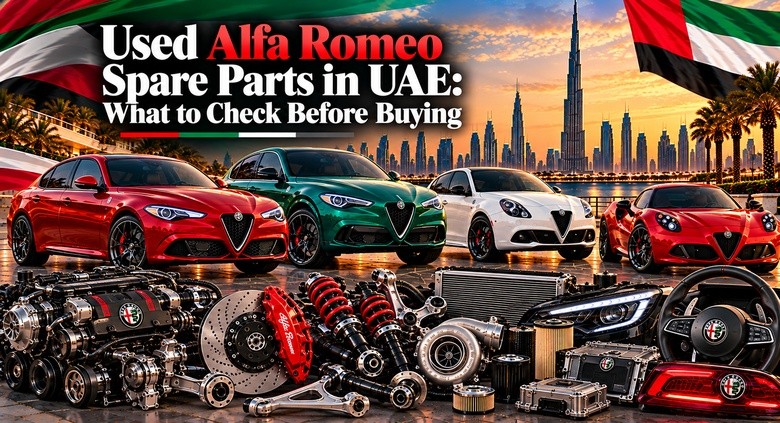
Used Alfa Romeo Spare Parts in UAE: What to Check Before Buying
September 25, 2026
The used Alfa Romeo spare parts in UAE can save a serious amount of money in the UAE, but only when the buyer knows what is actually being bought. “Used genuine” sounds reassuring. It is not a condition report. A part can carry the correct Alfa Romeo branding, come from the correct model family and still be the wrong specification, electrically incompatible, accident-damaged, heat-stressed or simply too worn to justify fitting.
That distinction matters more with Alfa Romeo than a casual parts search suggests. The official technical-information system provides model-specific spare-parts catalogues, VIN-based vehicle identification and access to vehicle-specific structural and optional-component information. In other words, even the manufacturer's own parts infrastructure starts with identification, not a photograph and a guess.
Updated: September 2026. Used-part availability, donor vehicles, warranties and UAE prices change constantly, so any quotation should be treated as a dated market reference rather than a permanent price.
Used does not mean unsuitable — but it does mean you need evidence
There are perfectly sensible reasons to buy a used Alfa Romeo component.
A discontinued body panel may be easier to find used than new. A trim piece might cost far less. A complete lamp, wheel or interior component can sometimes make financial sense when the new replacement is disproportionately expensive.
The catch is simple: the condition of the part becomes part of the specification.
With a new component, the buyer is largely checking fitment and provenance. With a used one, there is another question:
What happened to this part before it reached my car?
Start with the VIN, not the photograph
The Alfa Romeo/Stellantis technical-information system allows vehicle identification through the VIN and can return the vehicle version, structural and optional components, recall information and, where available, service-history information.
That is exactly the kind of information a used-parts buyer needs.
A photograph tells you what the part looks like.
The VIN helps establish what the car actually is.
A model name is not enough
“Used Giulia headlamp” is a weak parts enquiry.
A proper enquiry should identify the model, production specification, engine where relevant, equipment and VIN.
Giulia variants can have different equipment and braking, suspension, lighting and electronic configurations. The current Middle East range itself distinguishes Giulia, Giulia Veloce and Giulia Quadrifoglio.
Giulia Quadrifoglio needs its own parts logic
The Giulia Quadrifoglio uses a 2.9-litre V6 bi-turbo producing 510 HP, with performance-specific suspension, torque-vectoring technology, an eight-speed automatic transmission and, depending on specification, carbon-fibre components.
That matters enormously when buying used.
A suspension arm, brake component, cooling component or body part from an ordinary Giulia should not be assumed to be suitable simply because the body shape looks familiar.
Stelvio is not simply a larger Giulia
The Stelvio uses its own body, suspension and equipment combinations.
The official Middle East specification includes different engines and Q4 all-wheel drive on relevant versions, while the Stelvio Quadrifoglio adds a 2.9-litre V6 bi-turbo, Q4, torque vectoring and performance-specific hardware.
So “same platform” is useful background information, not a permission slip for interchangeable parts.
Giulietta buyers face a different sourcing problem
Giulietta is an older model family, and Alfa Romeo's technical-information portal continues to list Giulietta among the models covered by its technical documentation and parts information.
For an older Giulietta in the UAE, a used component may therefore be attractive when new stock is limited or expensive.
But age makes donor history more important, not less.
The 4C is where careless buying becomes particularly risky
Alfa Romeo's technical records identify separate VIN formats for the 4C and 4C Spider.
That matters because a 4C is not a generic sports-car parts proposition. Body components, specialist trim, suspension pieces and lightweight construction-related components deserve exact identification.
If someone offers a “4C-compatible” used part without asking which vehicle or providing a part reference, slow the transaction down.
The part number should be your second checkpoint
Once the vehicle is identified, obtain the original part number from the old component where possible.
Then have the supplier confirm the number against the vehicle application.
The official Alfa Romeo technical system provides access to genuine spare-parts catalogues and allows catalogue searches by vehicle and component.
That is considerably stronger than matching a photograph.
Photograph the label before the part disappears
If the old component is still fitted or sitting in the workshop, photograph:
- part number
- barcode
- manufacturer marking
- connector arrangement
- mounting points
- left/right designation where applicable
That little record can be remarkably useful when comparing used replacements.
Don't assume a superseded number means the used part is wrong
Manufacturers can revise or supersede catalogue references.
So if the number on your old component differs from the number quoted by a supplier, don't immediately reject it.
Ask whether the newer number supersedes the original and whether the application is confirmed for your VIN.
Used genuine, OEM and aftermarket are different things
These terms get thrown around rather casually in the UAE parts market.
A used genuine Alfa Romeo part is a previously installed component from an original vehicle.
An OEM component may have been manufactured by an original-equipment supplier but supplied outside the manufacturer's GenuineParts programme.
An aftermarket component is produced for the replacement market.
They are different purchasing propositions and should be priced accordingly.
Genuine Parts have a separate official definition
Alfa Romeo Middle East describes its GenuineParts as original Alfa Romeo parts supplied through the Mopar parts structure and says they are developed around the vehicle's specifications and tested against its standards.
That does not mean every used genuine part retains the same condition as a new GenuinePart.
The word genuine describes origin.
It does not describe the remaining life of a used component.
Condition is the real specification of a used part
Imagine two used suspension arms with identical part numbers.
One came from a lightly used car with documented history.
The other came from a heavily damaged donor and has spent months exposed to heat and dust.
The catalogue application is identical.
The buying decision is not.
Ask where the donor vehicle came from
A useful used-part enquiry should establish, where the information is available:
Donor model → year → engine → specification → mileage → reason for dismantling → damage history → part number.
The more expensive the component, the more valuable this information becomes.
Donor mileage matters, but it is not everything
Low mileage is helpful evidence.
It is not proof of good condition.
A vehicle with relatively low mileage may have suffered a serious accident, prolonged storage or environmental damage. Conversely, a higher-mileage donor can sometimes provide a perfectly serviceable non-wear component.
Mileage needs context.
Ask why the donor car was dismantled
This question is often more revealing than asking for another photograph.
Was the vehicle written off after a front-end collision?
Was it flooded?
Was it mechanically failed?
Was it dismantled because of age?
Was it simply being broken for parts?
A used engine or electronic module from a severely damaged donor deserves a different level of scrutiny from an undamaged vehicle being dismantled for unrelated reasons.
Accident damage can travel through apparently unrelated parts
A front-end collision does not only damage the bumper.
Impact can affect brackets, radiators, cooling lines, sensors, wiring, suspension components, steering components and electronic modules.
So if a used component comes from a crashed Alfa Romeo, inspect its surrounding history.
Flood exposure is a major warning sign for electronics
A control module can look clean after drying.
That does not mean it is reliable.
Corrosion inside connectors, terminals and circuit boards may appear later.
For used ECUs, body modules, infotainment units and other electronic assemblies, flood history should be treated as a serious provenance issue.
UAE heat deserves a separate inspection
Used parts entering the UAE may have already spent years in hot climates.
Heat exposure can affect plastics, rubber seals, wiring insulation, batteries and certain electronic components.
Do not turn this into a blanket rule that every used component is unsuitable. Instead, inspect the actual part and its history.
Rubber components need closer attention
Bushes, mounts, seals and hoses can deteriorate with age even when the vehicle has travelled relatively little.
Look for:
- cracking
- hardening
- deformation
- oil contamination
- surface splitting
- separation from metal sleeves
A used rubber component is not automatically a bargain.
Suspension components should be inspected for impact
This is particularly relevant to Giulia and Stelvio.
The Giulia uses Alfa Link suspension, while Stelvio also uses Alfa Link architecture, with the Stelvio employing a double-wishbone front arrangement and four-and-a-half-link rear suspension.
A used arm or link should therefore be checked for bends, damaged bushes, corrosion and evidence of impact.
Don't buy a used suspension part because it “looks straight”
A small deformation may not be obvious in a photograph.
A workshop should inspect the mounting faces and compare the component with the correct specification.
For steering and suspension parts, physical inspection matters more than glossy product photography.
Used brake components need a much higher threshold
Brake discs, pads, callipers and related components are safety-critical.
A used brake disc should not be treated like a used trim panel.
Check thickness, surface condition, corrosion, heat damage and compatibility with the exact braking system.
For pads, a used set is generally a poor proposition; wear components should be evaluated differently from reusable hardware.
Quadrifoglio brakes deserve particular caution
Performance variants can have substantially different braking hardware.
The Giulia Quadrifoglio is a 510 HP performance model with specific performance equipment, while the Stelvio Quadrifoglio also has performance-specific wheel and brake configurations.
Do not assume a standard Giulia or Stelvio brake component is suitable.
Used headlamps should be inspected properly
A used headlamp should be checked for:
- lens damage
- internal condensation
- broken mounting tabs
- water ingress
- connector damage
- ballast/module condition
- left/right application
- exact part number
A lamp can look perfect from the front and still have damaged mounts or electronics.
Moisture inside a lamp is not a small cosmetic issue
Persistent condensation can indicate sealing problems.
On an electronically sophisticated lamp, moisture may also create longer-term electrical issues.
If the seller cannot provide clear photographs of the housing, connectors and lens from several angles, ask why.
Electronic modules require more than physical fitment
A used module can have the correct connector and still require configuration, programming or calibration.
The Alfa Romeo technical-information system includes vehicle-specific diagnostic and ECU-related functions, including VIN-based identification and transaction-based programming/configuration support for qualifying vehicles.
So before buying a used module, ask:
Can this exact module be configured to my vehicle?
Ask for the module's exact hardware number
For an ECU or control module, record the identification markings before ordering.
Depending on the component, you may need more than one reference number.
The workshop should establish which number is relevant to the replacement and whether the software configuration is compatible.
A used ECU is not the same as a used mirror
The risk profile is completely different.
A used mirror may need physical and electrical inspection.
A used ECU may involve vehicle configuration, immobiliser relationships, software and coding.
Price comparisons should reflect that difference.
Infotainment units deserve the same caution
A used screen or infotainment assembly can be physically correct while still having configuration or compatibility issues.
Check the exact hardware version, connector arrangement and vehicle application before buying.
Used engines need evidence, not promises
For a used engine, ask for whatever objective evidence is available:
- donor mileage
- engine identification
- compression results where appropriate
- leak-down results where appropriate
- oil-pressure information where relevant
- visible oil or coolant contamination
- running video where genuinely available
- warranty terms
“Engine tested” is too vague on its own.
Compression testing is useful when the engine can be tested
Compression results can help identify significant differences between cylinders.
They do not prove that an engine is perfect.
A leak-down test can add another layer of information by helping distinguish potential valve, ring or cylinder-sealing issues.
For an expensive used engine, that evidence is far more useful than a photograph of a clean rocker cover.
Turbochargers should be inspected separately
A used turbo should be checked for excessive shaft play, damaged compressor or turbine blades, oil contamination and evidence of previous failure.
On a high-output engine, do not assume that a complete-looking turbo is healthy simply because the impeller turns by hand.
Cooling components can hide previous overheating
A used radiator, oil cooler or heat exchanger may have come from a vehicle that experienced overheating.
Inspect for bent fins, blocked passages, corrosion, impact damage and leakage.
If the donor engine suffered a thermal event, the surrounding cooling hardware deserves extra scrutiny.
Gearbox sourcing starts with the transmission identity
A used gearbox should be identified by the exact transmission application, not merely “Giulia automatic” or “Stelvio gearbox”.
The Giulia and Stelvio ranges include eight-speed automatic transmissions, while performance variants have their own calibration and drivetrain requirements.
Obtain the exact transmission reference before comparing prices.
Ask what was tested on a used gearbox
A useful used gearbox warranty should ideally be backed by some explanation of what was actually checked.
Ask about:
- engagement
- shift quality
- leaks
- casing damage
- abnormal noise
- oil condition
- donor mileage
- warranty
“Good gearbox” is not a test result.
A used gearbox price is not the total repair price
The installed repair may also involve:
- transmission fluid
- seals
- ancillary components
- diagnostics
- adaptation
- programming
- labour
- road testing
Always separate the used gearbox price from the complete installed cost.
Body panels can be excellent used purchases
This is where used parts can make particularly good financial sense.
A door, bonnet, boot lid or bumper can sometimes be sourced in good condition for considerably less than a new replacement plus paint.
But inspect the panel for:
- previous repair
- filler
- distortion
- corrosion
- mounting damage
- sensor openings
- trim mounting points
Paint colour is not enough
A used red Alfa Romeo panel is not necessarily a direct cosmetic match for another red Alfa Romeo.
Paint codes, fading, previous repainting and panel condition matter.
For a premium finish, the buyer should budget separately for preparation and paint blending where necessary.
4C bodywork requires especially careful inspection
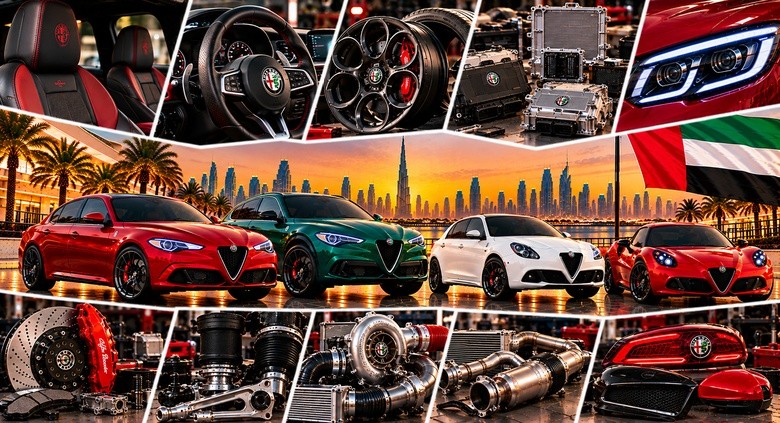
Because the 4C is a specialised, low-volume model, used body components should be checked for exact application and material.
The official technical records separately identify the 4C and 4C Spider, reinforcing the need to distinguish the variants.
A visually similar panel is not enough evidence.
Interior trim can be one of the safer used purchases
Used seats, trim pieces, switches and interior panels can make sense when their condition is clearly documented.
But equipment differences still matter.
A seat module, heated-seat element or electrically adjustable assembly may involve electronics that need separate checking.
Steering wheels and airbags are not ordinary used trim
An airbag-related component should be treated as a safety-critical assembly.
Check provenance, physical condition and exact application.
Do not buy a damaged or previously deployed airbag simply because the steering wheel itself looks attractive.
Wheels need dimensional verification
A used wheel should be checked for:
- diameter
- width
- offset
- bolt pattern
- centre bore
- cracks
- bends
- weld repairs
- corrosion
For Quadrifoglio models, brake clearance and exact wheel specification become particularly important.
Tyres should not be bundled into the decision without inspection
A used wheel may come with tyres.
That does not make the tyres valuable.
Check age, tread, sidewall condition, uneven wear and specification separately.
A cheap used wheel package can become less attractive if the tyres are old or unsuitable.
Ask for the warranty in writing
A used-part warranty should state what is covered and for how long.
Does it cover the component only?
Does it cover labour?
What happens if the part fails immediately after fitting?
Who pays return transport?
These details matter more than a vague “warranty available” message.
Use VIN-led sourcing before buying a used part
For a used Alfa Romeo part in the UAE, the safest buying process starts with identification, not price. Give the seller the complete VIN, confirm the exact model and variant, and match the component’s OEM or manufacturer part number wherever possible. This matters particularly for electronic modules, lighting assemblies, suspension components and drivetrain parts, where visually similar units can have different specifications or require vehicle-specific programming.
When sourcing through PartFinder UAE, treat the VIN and part number as the starting point for the enquiry rather than simply searching by “Alfa Romeo Giulia part” or “Stelvio used parts”. That small distinction can prevent an apparently cheap component from becoming an expensive mismatch once the car reaches the workshop.
The UAE sourcing route matters
Alfa Romeo Middle East currently lists Gargash Motors & General Trading LLC as the UAE dealer, located at City Walk, Al Wasl, Dubai.
For difficult fitment questions, owners therefore have an official UAE route for vehicle identification and service enquiries.
That does not mean every used component must come through the official channel. It means the buyer has a useful reference point when a fitment question becomes unclear.
Older models can require a broader sourcing strategy
Alfa Romeo's technical-information system covers both Euro 5-or-later models and a substantial catalogue of older/vintage models. Its current documentation lists 148 Euro 5-or-later models and 205 vintage models in the spare-parts catalogue coverage.
For an older Giulietta or 4C, that makes precise catalogue identification especially useful before searching the used market.
Before You Click Buy
Pause if the supplier cannot provide the exact part number.
Pause if the donor vehicle is unknown.
Pause if the part has been described only as “original Alfa”.
Pause if an electronic module comes without information about coding or configuration.
Pause if a suspension component has no damage or donor history.
And be especially careful when the seller wants payment immediately because “another buyer is waiting”.
Scarcity is not proof of compatibility.
A proper used-parts verification chain
For a significant Alfa Romeo component, use this sequence:
VIN → model/variant → equipment → catalogue application → original part number → donor vehicle → donor mileage/history → physical inspection → functional testing → warranty → price → installation.
That may sound methodical.
Good. Expensive parts deserve methodical buying.
Buyer Decision Matrix
| Used part | What to verify first | Risk level to investigate | What should support the purchase |
| Body panel | VIN/application + condition | Medium | Clear photographs, donor information, repair history |
| Interior trim | Exact trim/equipment | Low–Medium | Condition photographs, part number |
| Wheel | Size, offset, bolt pattern | Medium | Crack/bend inspection |
| Headlamp | Part number + left/right + electronics | Medium–High | Connector, mounting and moisture inspection |
| Suspension arm | Exact application + damage | High | Physical inspection |
| Brake hardware | Exact brake specification | High | Thickness/condition inspection |
| ECU/module | Hardware number + coding | High | Compatibility and programming confirmation |
| Engine | Donor history + test evidence | High | Compression/leak-down or equivalent evidence where applicable |
| Turbocharger | Exact application + condition | High | Shaft/play and blade inspection |
| Gearbox | Transmission identity | High | Donor information, testing and warranty |
| Airbag | Exact application + provenance | Very high | Documented condition and appropriate safety handling |
FAQs
Categories
- Audi
- BMW
- Car Accessories
- Car Tips
- Ford
- Land Rover
- Mazda
- Range Rover
- Top 10
- UAE Car Parts
- Used Car Parts
- Toyota
- Replacement Engines
- Nissan
- Hyundai
- Mitsubishi
- Volkswagen
- Honda
- Kia
- Chevrolet
- Dodge
- Jeep
- Subaru
- Renault
- Lexus
- Mercedes
- Suzuki
- Hummer
- Porsche
- Infiniti
- Peugeot
- GMC
- Mini
- Volvo
- Replacement Gearboxes
- MG
- Jaguar
- Skoda
- Cadillac
- Daihatsu
- Fiat
- German Car Parts
- Japanese Car Parts
- Aftermarket Car Parts
- Genuine Car Parts
- New Car Parts
- Reconditioned Car Parts
- European Car Parts
- American Car Parts
- Korean Car Parts
- British Car Parts
- Chinese Car Parts
- Sports/Exotic Car Parts
- Luxury Car Parts
- Performance Car Parts
- SUV/4x4 Spare Parts
- Truck Spare Parts
- EV Car Parts
- Hybrid Car Parts
- Auto Spare Parts in UAE
- Tesla
- Isuzu
- Ram
- Ferrari
- Bentley
- Lamborghini
- Genesis
- Maserati
- Lincoln
- Chrysler
- Opel
- Citroen
- SsangYong
- Seat
- McLaren
- Aston Martin
- Rolls Royce
- Maybach
- Alfa Romeo