Used Bentley Spare Parts in UAE: What to Check Before Buying Expensive Parts

September 12, 2026
The used Bentley parts market requires a different buying mindset
The cheapest Bentley part can become the most expensive repair
A used Bentley part is not automatically a bad purchase.
In fact, for an older Continental GT, Flying Spur or Mulsanne, a good used part can be the sensible choice. Body trim, interior pieces, discontinued panels and selected mechanical parts can cost dramatically less than new genuine replacements.
The problem starts when the buyer evaluates the part only by price.
A used air strut with an attractive AED price can already have years of heat exposure in the UAE. A second-hand electronic module can look immaculate while remaining electronically tied to another car. A used compressor can work perfectly on the bench and still have limited life left.
Bentley itself emphasises that genuine parts are engineered for the vehicle, rigorously tested and supplied with a comprehensive two-year warranty, subject to regional variation.
Used parts do not offer that same baseline of certainty.
So the real question is not:
“How cheap is this Bentley part?”
It is:
“What evidence tells me this particular used part is worth fitting?”
Why used parts make sense for some Bentleys
A ten-year-old Bentley is an unusual machine to maintain.
The car may still have excellent leather, a healthy engine and a strong body, while a relatively ordinary plastic, electronic or suspension part has become expensive simply because the vehicle is a Bentley.
That creates a useful gap for the used market.
A good donor vehicle can provide:
- Interior trim
- Door panels
- Body panels
- Exterior mouldings
- Mirrors
- Seats
- Wheels
- Selected suspension hardware
- Cooling parts
- Some mechanical parts
- Discontinued electronic or cosmetic items
For a Mulsanne in particular, availability can matter as much as price because production ended in 2020 and some parts will become increasingly specialist items.
UAE conditions make donor history unusually important
A used Bentley from Europe and one removed from a UAE car have lived very different lives.
Neither is automatically superior.
The UAE donor may have spent years exposed to high temperatures, strong sunlight, dust and long periods of parking. European cars may have seen more moisture, road salt or cold-weather operation.
For rubber-based parts, that history matters.
Think about:
- Air-suspension bellows
- Bushes
- Seals
- Hoses
- Wiring insulation
- Plastic connectors
- Cooling-system plastics
- Door seals
- AC seals
A Bentley specialist in Dubai recently highlighted heat cycling, low usage and dust as important contributors to Bentley deterioration in the UAE, rather than mileage alone.
That is exactly why the donor car matters.
Identify the exact part before discussing price
VIN first, price second
The VIN should be the first piece of information you send to a used-parts seller.
Not a photograph.
Not merely “Bentley Bentayga 2019”.
Not “W12”.
The VIN identifies the particular vehicle specification and gives the seller a much better basis for checking compatibility.
Give the seller:
- VIN
- Model
- Model year
- Engine
- Generation
- Existing part number
- Photograph of the removed part
- Position of the part
- Fault symptoms
A supplier who refuses to verify the part against those details is asking you to take the risk.
Part numbers matter more than photographs
A photograph can establish appearance.
It cannot reliably establish compatibility.
Two used Bentley spare parts in UAE may have almost identical housings while differing in revision, software, connector configuration or internal specification.
This is particularly important for:
- Electronic modules
- Suspension controllers
- Sensors
- Steering parts
- Brake hardware
- Cooling components
- Engine parts
- Transmission parts
Bentley's heritage-parts system itself uses chassis/VIN and part-number information for supported vehicles, which illustrates why identification should go beyond visual similarity.
Check whether the number has been superseded
Do not reject a used part simply because its number is different from the number currently quoted by a workshop.
Manufacturers can supersede part numbers.
The replacement may be a later revision or a consolidated number.
The important question is:
Is the newer number an official replacement for the older number on this vehicle?
Ask the seller or workshop to document the relationship between the two numbers.
A handwritten note saying “same” is not enough for an expensive part.
Left and right can matter
Bentley body and suspension parts are not always interchangeable from side to side.
This sounds obvious until a used part arrives and the buyer discovers that the seller photographed the correct-looking piece from an angle that concealed the mounting arrangement.
Confirm:
- Left/right
- Front/rear
- Upper/lower
- Driver/passenger side where relevant
- Position-specific brackets
- Mounting points
For a costly suspension or body part, ask for photographs of the mounting side, not just the attractive visible side.
Generation is critical
A Continental GT badge covers several generations.
So does Flying Spur.
Bentayga has also evolved substantially.
A used part listed as simply:
“Bentley Continental GT part”
does not tell you enough.
The seller should confirm:
generation + year range + engine + part number + VIN compatibility.
This is especially important with electronics, lighting, body panels and suspension.
GCC specification versus imported specification
A UAE buyer should establish whether the donor and recipient cars share the relevant specification.
Imported Bentleys are common enough that the phrase “same model” does not necessarily mean same specification.
Check:
- Market specification
- Equipment level
- Lighting configuration
- Cooling specification where relevant
- Electronic equipment
- Navigation/infotainment configuration
- Emissions-related hardware
- Suspension configuration
A part can be genuine and still be wrong for the recipient vehicle.
Inspect the used part before paying
Ask for photographs that prove condition
Do not ask for “real pictures”.
Ask for specific photographs.
For a suspension part:
- Bellows
- Mounting points
- Seals
- Electrical connector
- Manufacturer label
- Part number
- Corrosion areas
For an electronic module:
- Label
- Part number
- Connector
- Housing
- Security seals
- Damage or water ingress
For a body panel:
- Outer surface
- Inner surface
- Mounting tabs
- Edges
- Repair marks
- Paint condition
For an engine part:
- Casting number
- Mounting faces
- Oil contamination
- Cracks
- Threads
- Damage
The more expensive the part, the more photographs should be considered normal.
Look for heat damage
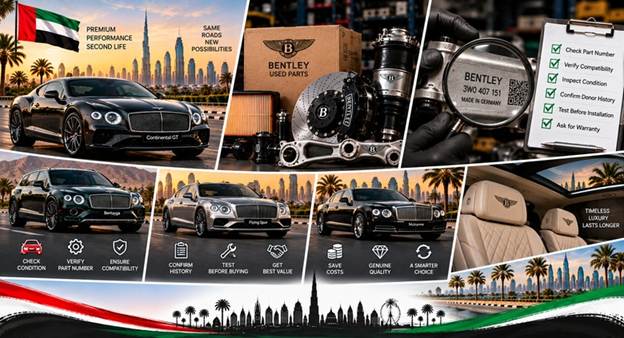
UAE heat does not always leave an obvious burn mark.
It can produce gradual deterioration.
Inspect rubber for:
- Hardening
- Cracking
- Surface glazing
- Brittleness
- Deformation
Inspect plastics for:
- Discolouration
- Warping
- Hairline cracks
- Brittle clips
- Connector damage
Inspect electronics for:
- Oxidation
- Corrosion
- Water marks
- Cracked housings
- Heat-discoloured boards or connectors
This matters particularly when buying parts from cars that spent years outside in Dubai or Abu Dhabi.
Corrosion tells part of the donor's story
Corrosion is not just cosmetic.
Check fasteners, brackets, electrical connectors and mounting surfaces.
A little surface oxidation may be harmless.
Deep corrosion around a connector can become an electrical problem.
Corroded mounting hardware can make installation difficult.
On suspension parts, corrosion around critical mounting areas deserves particular caution.
Check rubber before buying suspension parts
Air suspension is where used Bentley parts can become a gamble.
Look closely at:
- Bellows
- Folding areas
- Lower mounting area
- Upper seal
- Air connection
- Damper body
- Wiring
A clean-looking air strut can still have a slow leak.
One Dubai specialist notes that a leaking air spring can force the compressor to run excessively and eventually turn a relatively contained repair into compressor-related work as well.
That is why condition testing matters more than shiny photographs.
Ask whether the part was tested
“Tested” is meaningless unless the seller explains the test.
Ask:
What exactly was tested?
For an air strut:
- Pressure retention?
- Leak test?
- Movement?
- Damper condition?
For a compressor:
- Output pressure?
- Run time?
- Noise?
- Thermal behaviour?
For a module:
- Communication?
- Fault codes?
- Vehicle pairing?
- Programming status?
For an alternator:
- Charging output?
- Bearing noise?
- Voltage regulation?
A proper answer gives you something measurable.
Donor mileage is useful but incomplete
A donor vehicle with 30,000 km sounds attractive.
But mileage does not tell you:
- How long it sat
- Where it was stored
- Whether it was accident damaged
- Whether it was flooded
- Whether it was maintained
- How hot the environment was
- Whether the part itself was already replaced
A 70,000-km donor with documented maintenance may provide a better part than an abandoned 30,000-km car.
Mileage is evidence.
It is not proof.
Used parts by Bentley model
Continental GT used parts
The Continental GT has one of the broadest used-parts markets among modern Bentleys in the UAE.
That makes sourcing easier, but it also creates a larger range of quality.
Older first-generation cars can be particularly attractive candidates for used parts because the replacement cost of certain genuine items can exceed the vehicle owner's appetite for spending.
Useful used categories include:
- Body panels
- Interior trim
- Wheels
- Mirrors
- Selected suspension hardware
- Cooling parts
- Certain mechanical parts
Exercise greater caution with:
- Air suspension
- Electronic modules
- Safety systems
- Major engine parts
- Transmission electronics
First-generation Continental GT: age changes the equation
The first-generation Continental GT dates from 2003–2011.
These cars are old enough that donor history becomes extremely important.
Common workshop observations in Dubai include ignition-related faults, air-suspension issues and climate-control problems on older Continental GTs.
For used parts, that means a donor of the same age is not automatically ideal.
A used air-suspension part removed from another neglected first-generation GT may simply transfer the ageing problem from one car to another.
Newer Continental GT electronics need more caution
Later Continental GT generations carry increasingly sophisticated electronics.
A used electronic module may require:
- Coding
- Programming
- Adaptation
- Calibration
- Security pairing
Ask before purchasing whether the part can actually be installed into your car.
A module that costs AED 2,000 can become a AED 4,000 repair if installation and failed programming attempts are added afterwards.
Bentayga used parts
The Bentayga is particularly interesting in the UAE because it combines heavy vehicle mass with sophisticated suspension and high daily usability.
Used parts commonly sought include:
- Air-suspension parts
- Wheels
- Body panels
- Interior trim
- Cooling parts
- Brake hardware
- Electronic parts
- Lighting
But air suspension requires a much stricter inspection than a used door trim panel.
A Dubai workshop source reports Bentayga air-suspension faults around the 60,000–80,000-km range in local conditions, although that should not be treated as a universal replacement interval.
Bentayga air suspension: never buy from a photograph alone
The key warning signs are:
- One corner lower overnight
- Slow lifting after starting
- Compressor running unusually often
- Suspension warning
- Uneven ride height
- Harshness
- Repeated suspension faults
Before buying a used strut, ask for a leak test.
A proper inspection should also consider:
- Compressor output
- Valve block
- Air lines
- Height sensors
- Battery voltage
- Ride-height calibration
Replacing a strut without checking the rest of the system can leave the underlying fault untouched.
Flying Spur used parts
Flying Spur parts can be attractive on the used market because the cars share significant engineering relationships with Continental-family models across certain generations.
But rear-cabin equipment, bodywork, trim and model-specific electronics require exact identification.
For chauffeur-driven cars, inspect parts connected with:
- Rear doors
- Soft-close mechanisms
- Rear climate control
- Rear-seat electronics
- Window mechanisms
- Suspension
- Battery systems
A Flying Spur can spend hours idling outside hotels, offices and airports. That usage is very different from a weekend Continental GT.
Mulsanne used parts
The Mulsanne is where used parts can become genuinely valuable.
The model was discontinued in 2020, and its unique 6.75-litre twin-turbo V8 means some parts are not simply interchangeable with Volkswagen Group W12 or V8 hardware. Current specialist parts catalogues also note that Mulsanne-specific parts support will become more important as the model ages.
Used sourcing can therefore make sense for:
- Interior trim
- Body panels
- Decorative pieces
- Certain suspension parts
- Selected electronic equipment
But documentation becomes more important as availability narrows.
The expensive systems need stricter inspection
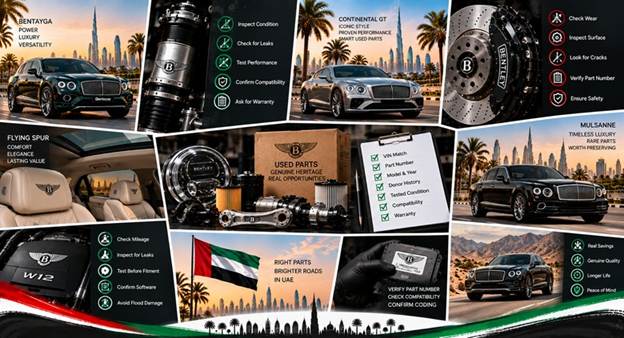
Used Bentley brakes
Brakes are safety-critical.
That does not automatically mean every brake part must be new, but it does mean the acceptable evidence threshold is much higher.
For used brake parts, inspect:
- Disc thickness
- Surface condition
- Cracks
- Heat spots
- Corrosion
- Run-out where applicable
- Pad contact pattern
- Mounting surfaces
Used brake discs from an unknown donor are rarely an attractive proposition when the consequences of poor condition are considered.
Used control arms and suspension links
Control arms are more suitable for used sourcing when:
- The casting is undamaged
- Mounting points are sound
- Ball joints are serviceable
- Bushes are inspected
- There is no accident distortion
Do not assume a straight-looking arm is healthy.
Rubber bushes can deteriorate without obvious external damage.
On a Bentley weighing well over two tonnes, small suspension deterioration can become noticeable through uneven tyre wear, steering wander or knocking.
Used air compressors
A used compressor is one of the parts where the cheapest quote can be misleading.
Ask:
- How many kilometres was it used?
- Was the donor car suspension-functional?
- Was it tested?
- What pressure does it produce?
- Does it overheat?
- Is the dryer included?
- Is the warranty written?
If the original compressor failed because of a leaking air spring, fitting another unknown compressor without repairing the leak is a poor strategy.
Used valve blocks
Valve blocks are particularly difficult to judge visually.
Internal leakage may not be visible.
A proper test should establish whether the valve block can maintain pressure and isolate the relevant circuits.
If a seller cannot demonstrate this, treat the valve block as a risk-priced part, not as a guaranteed replacement.
Used cooling parts
Radiators, condensers, cooling fans and related hardware can be sourced used, but UAE heat makes condition particularly important.
Check:
- Bent fins
- Blocked passages
- Corrosion
- Leaks
- Mounting damage
- Fan operation
- Connector condition
A used radiator that has already been repaired may be a false economy.
Cooling problems are especially unwelcome in a W12 operating through a UAE summer.
Used engine parts
Engine parts need a different level of scrutiny.
For a used turbocharger, ask about:
- Shaft play
- Oil contamination
- Compressor-wheel damage
- Wastegate condition
- Heat damage
- Donor mileage
For cylinder-head parts:
- Compression evidence where applicable
- Warpage
- Cracks
- Valve condition
For major internal engine parts, an unknown donor history should heavily influence the price.
Used transmission parts
Do not buy a used gearbox because:
“It came from the same model.”
Confirm:
- Transmission code
- Model year
- Engine
- Drivetrain
- Software version where relevant
- Mileage
- Donor VIN
- Fluid condition
- Warranty
A transmission may also require adaptation or programming after installation.
That should be included in the repair plan before the part is purchased.
Genuine, OEM, reconditioned and used are not the same thing
Genuine versus used
Genuine means the part is supplied through the manufacturer's genuine-parts channel.
Used means the part has already been installed in another vehicle.
A used Bentley part can itself be genuine.
Those two descriptions are not opposites.
The useful distinction is:
genuine new
versus
genuine used
versus
OEM-equivalent
versus
reconditioned
versus
aftermarket.
OEM claims need verification
The word “OEM” is heavily used in the UAE parts market.
Ask:
Who manufactured it?
If the answer is vague, the label tells you very little.
A credible OEM claim should identify the manufacturer and part number.
For critical Bentley systems, compare the exact OE number rather than trusting a seller's description.
Reconditioned parts can make financial sense
Reconditioning is not inherently inferior.
A professionally rebuilt part can be useful when a new genuine replacement is disproportionately expensive.
The critical issue is what was actually rebuilt.
Ask:
- Which internal parts were replaced?
- Were seals renewed?
- Was the unit pressure-tested?
- Was it electrically tested?
- Was it measured?
- Who rebuilt it?
- What warranty applies?
“Refurbished” should never be the end of the conversation.
It should be the beginning.
Used body panels are often safer purchases
A used door, bonnet or trim piece can make considerably more sense than an unknown electronic module.
The inspection is easier.
You can physically assess:
- Damage
- Alignment
- Mounting points
- Corrosion
- Previous repairs
- Paint
- Clips
- Seals
For expensive exterior panels, matching colour and specification can also save substantial painting costs.
Interior parts are another strong used-market category
Bentley interiors are expensive to replace new.
Used:
- Seats
- Door cards
- Centre consoles
- Trim panels
- Switch packs
- Steering wheels
- Headliners
- Decorative veneers
can offer major savings.
But inspect for sun damage.
A Dubai car's leather can look excellent in photographs and still have hardened or faded surfaces.
Check the part in natural light.
Documentation and donor history
Ask where the donor vehicle came from
A reputable seller should be able to tell you something about the donor.
Useful information includes:
- Model
- Year
- Mileage
- Accident status
- Reason for dismantling
- Country of origin
- Whether the vehicle was flood damaged
- Whether the part was removed before or after an accident
A part from the front of a heavily crashed Bentley is not automatically useless.
But it requires much more inspection.
Flood damage is a major warning sign
Electronic parts from a flood-damaged Bentley should be treated with extreme caution.
Look for:
- Corrosion
- Water marks
- Green oxidation
- Rust on terminals
- Residue
- Moisture inside connectors
- Unusual electrical behaviour
A cleaned module can look surprisingly good.
That does not mean the internal damage has disappeared.
Accident donor parts require structural inspection
Body panels are usually straightforward.
Suspension and steering parts are different.
If a donor Bentley suffered a heavy impact near one wheel, be cautious with:
- Control arms
- Hubs
- Steering racks
- Subframes
- Wheel carriers
- Suspension links
- Sensors
- Electronic modules
Never assume a part is healthy simply because it was removed from a running car.
Ask for the original part label
The label should ideally show:
- Manufacturer
- Part number
- Revision
- Serial number where applicable
- Production information
Photograph it before payment.
Keep that photograph with the invoice.
It gives you evidence if the delivered part later differs from the advertised part.
Keep the invoice
A used-parts invoice should identify the actual item.
Avoid an invoice that merely says:
“Bentley parts – AED 4,000.”
It should say what was supplied.
For example:
Bentley Bentayga front-left air strut — part number XXXXX — used — tested — warranty X days.
Specific documentation reduces arguments later.
Testing before installation
A used part should have an installation plan
Before installing an expensive used part, establish:
What will be checked after installation?
For suspension:
- Ride height
- Leak retention
- Calibration
- Wheel alignment
For electronics:
- Communication
- Fault codes
- Coding
- Function test
For brakes:
- Disc run-out where relevant
- Brake operation
- Bedding
- Road test
For cooling:
- Pressure test
- Operating temperature
- Fan operation
- Leak inspection
A part is not successfully repaired merely because it has been bolted into the car.
Coding can destroy the apparent saving
Imagine:
Used module: AED 2,000.
Installation: AED 500.
Programming attempt: AED 600.
Failed programming because the module is incompatible.
Removal: AED 300.
Replacement module: AED 2,500.
Suddenly the “AED 2,000 bargain” was the expensive option.
Ask about programming before buying.
Suspension calibration is part of the repair
After replacing certain Bentley suspension parts, ride-height calibration may be required.
Alignment may also be necessary.
This is particularly important after replacing:
- Air struts
- Suspension links
- Control arms
- Steering components
A workshop source specifically notes ride-height calibration and four-wheel alignment after relevant Bentley suspension work.
If these steps are missing from the quotation, ask why.
Compression testing for major engine decisions
If you are considering a used engine or major engine assembly, do not rely solely on donor mileage.
Depending on the engine and fault, useful evidence can include:
- Compression testing
- Leak-down testing
- Oil-pressure testing
- Borescope inspection
- Cooling-system pressure testing
- Diagnostic scan
The exact test depends on what is being purchased.
But a major engine part deserves evidence before installation.
Battery voltage can imitate expensive faults
This is particularly relevant to sophisticated Bentley electronics.
Low voltage can create multiple warning messages and communication faults.
Before buying expensive electronic parts, test:
- Battery state of charge
- Battery health
- Charging voltage
- Ground connections
- Relevant fuses
A Dubai Bentley specialist notes that low battery voltage can produce suspension error messages even when the suspension itself is healthy.
That is a perfect example of why diagnostics should precede parts purchasing.
Do not clear the fault code and call it repaired
A warning light disappearing is not proof.
The workshop should establish:
- What caused the fault
- What was replaced
- Whether the fault returns
- Whether live data is normal
- Whether adaptation was completed
- Whether a road test was successful
For complex Bentley systems, evidence after installation is just as important as evidence before installation.
UAE pricing, labour and hidden costs
Used Bentley prices vary wildly
There is no sensible universal “used Bentley part price”.
Current UAE market listings for Bentley parts show large variation by model, part type and condition. UAE parts directories, for example, list body panels from roughly AED 1,000 to AED 8,000 depending on application, while specialist listings put certain air-suspension units substantially higher.
These should be treated as market examples rather than fixed benchmarks.
The exact VIN and part number still decide the real price.
A simple used-versus-new calculation
Suppose a new genuine part costs:
AED 8,000
A used part costs:
AED 3,500
The apparent saving is:
AED 4,500
But then consider:
- Delivery: AED 250
- Inspection: AED 150
- Installation: AED 500
- Coding/calibration: AED 400
- Additional failed diagnostic work: AED 300
The real used-part cost becomes:
AED 5,100
The saving has fallen to AED 2,900.
If the used part fails six months later, the calculation changes again.
UAE labour can alter the decision
Dubai's luxury-specialist labour market is substantially different from a general garage.
Current Dubai market guides place independent labour broadly around AED 80–180 per hour, specialist work around AED 150–350 and dealership rates considerably higher, although actual Bentley quotations vary by workshop and repair.
That means a used part requiring complicated diagnosis may lose its financial advantage quickly.
For simple body trim, labour is less significant.
For electronics, suspension and drivetrain work, it can be substantial.
Landed cost matters when sourcing from outside the UAE
A used Bentley part sourced internationally may appear inexpensive.
Then add:
- International shipping
- Insurance
- Customs-related charges
- VAT where applicable
- Local delivery
- Currency conversion
- Return shipping
Compare the landed price.
Not the seller's headline price.
For a rare Mulsanne part, international sourcing may still be completely sensible.
For a common Continental GT sensor, local stock may be cheaper overall.
Warranty length changes the value equation
A used part with no warranty is not equivalent to a used part with 30, 60 or 90 days of meaningful coverage.
Ask:
- Does the warranty cover the part?
- Does it cover labour?
- Is coding included?
- What voids the warranty?
- Who pays removal and return shipping?
- Does installation have to be performed by a specific workshop?
For expensive parts, warranty conditions should be written down.
Model-specific buying decisions
Continental GT used-parts decision matrix
| Situation | Sensible choice |
| Body panel damaged | Good used panel can be excellent value |
| Interior trim damaged | Used is often worth considering |
| Brake wear | Compare new genuine and quality OE |
| Air strut leaking | Test system before buying |
| Electronic module failed | VIN + part number + coding check |
| Older W12 engine part | Demand technical evidence |
| Rare first-generation item | Used/reconditioned may make sense |
| Unknown donor history | Price should reflect substantial risk |
Bentayga used-parts decision matrix
| Situation | Sensible choice |
| Air suspension fault | Leak/pressure diagnosis first |
| Body damage | Used genuine panel can reduce cost |
| Brake parts | Prioritise tested, specification-correct hardware |
| Electronic module | Confirm programming |
| Cooling issue | Test system before replacing radiator |
| Used compressor | Require output and condition evidence |
| High-mileage donor | Inspect age-sensitive parts carefully |
| 48V-related system | Do not confuse active roll control with air suspension |
The distinction between the Bentayga's air suspension and Bentley Dynamic Ride is particularly important when diagnosing a suspension-related complaint. Specialist diagnostic sources warn against treating every suspension warning as an air-strut failure.
Flying Spur used-parts decision matrix
| Situation | Sensible choice |
| Rear door trim | Used can be highly economical |
| Soft-close issue | Diagnose mechanism before buying |
| Rear AC problem | Test system rather than guessing |
| Suspension sag | Overnight test + pressure testing |
| Electronic fault | Module identification and coding |
| Body damage | Donor panel may make sense |
| Chauffeur-used car | Inspect rear-cabin wear carefully |
| Long-term ownership | Keep detailed documentation |
Mulsanne used-parts decision matrix
| Situation | Sensible choice |
| Discontinued trim | Used is often logical |
| Rare body part | Specialist donor sourcing |
| Air suspension | Condition testing essential |
| Electronic module | Demand testing and compatibility evidence |
| Engine hardware | Strong donor documentation required |
| Reconditioned part | Written rebuild details |
| International sourcing | Compare landed cost |
| Long-term ownership | Buy quality rather than simply cheap |
When a used Bentley part is the right choice
Used is often sensible when:
- The part is cosmetic
- New genuine pricing is disproportionate
- The part is discontinued
- The donor is documented
- The part has been tested
- The warranty is reasonable
- Installation risk is low
- Compatibility is confirmed
It becomes much less attractive when:
- Failure could damage another expensive system
- The part is safety-critical
- The donor history is unknown
- Programming is uncertain
- The part is already heavily heat-aged
- There is no meaningful warranty
When genuine new is worth paying for
Genuine new parts deserve stronger consideration for:
- Critical electronic modules
- Major drivetrain hardware
- Safety-critical systems
- Complex suspension assemblies
- Parts whose failure can cascade
- Parts with strong manufacturer warranty coverage
Bentley states that genuine parts are engineered for the vehicle and subjected to quality testing, with a comprehensive two-year warranty subject to regional variation.
That warranty has economic value.
When reconditioned is the middle ground
Reconditioned parts can sit between expensive new genuine parts and uncertain used parts.
The best candidates are parts that can be:
- Disassembled
- Measured
- Rebuilt
- Pressure-tested
- Electrically tested
- Guaranteed
Air-suspension parts are a common example where specialist rebuilding can sometimes make economic sense, although quality varies considerably between rebuilders.
The first 1,000 km after installing a used Bentley part
Pay attention.
For suspension:
- Check ride height after overnight parking
- Listen for compressor cycling
- Monitor warning messages
- Check steering behaviour
- Watch tyre wear
For brakes:
- Watch for vibration
- Listen for abnormal noise
- Check braking consistency
For cooling:
- Monitor temperature in traffic
- Check coolant level
- Look for leaks
For electronics:
- Check all affected functions
- Watch for intermittent warnings
- Confirm no new communication faults
Keep the invoice and installation mileage.
If the part fails within the warranty period, that documentation matters.
Resale value depends on evidence, not just expensive parts
A Bentley buyer does not necessarily care whether every part fitted to the car was new.
They care whether the car has been properly maintained.
A well-documented used part can therefore be more reassuring than an expensive part with no paperwork.
Keep:
- Part number
- Supplier invoice
- Donor information where available
- Installation invoice
- Mileage
- Warranty
- Diagnostic report
- Calibration report
Bentley itself states that a full service history through a Bentley Service Centre can help maintain vehicle value.
For older Bentleys, good independent documentation can still be valuable evidence.
The final used Bentley parts checklist
Before paying for an expensive used Bentley part, confirm:
- VIN supplied
- Exact part number confirmed
- Supersession checked
- Model generation confirmed
- Engine confirmed
- GCC/import specification checked
- Donor VIN or donor information requested
- Donor mileage known
- Accident/flood history checked
- Real photographs received
- Part label photographed
- Condition inspected
- Testing evidence requested
- Warranty written down
- Return policy understood
- Coding requirement confirmed
- Calibration requirement confirmed
- Labour included in the calculation
- VAT clarified
- Delivery time confirmed
- Complete landed cost calculated
For UAE buyers comparing used Bentley parts across Dubai, Abu Dhabi, Sharjah, Ajman and other emirates, PartFinder UAE can be part of the sourcing process, but the final purchase decision should still rest on VIN, part-number and condition verification.
FAQs
Categories
- Audi
- BMW
- Car Accessories
- Car Tips
- Ford
- Land Rover
- Mazda
- Range Rover
- Top 10
- UAE Car Parts
- Used Car Parts
- Toyota
- Replacement Engines
- Nissan
- Hyundai
- Mitsubishi
- Volkswagen
- Honda
- Kia
- Chevrolet
- Dodge
- Jeep
- Subaru
- Renault
- Lexus
- Mercedes
- Suzuki
- Hummer
- Porsche
- Infiniti
- Peugeot
- GMC
- Mini
- Volvo
- Replacement Gearboxes
- MG
- Jaguar
- Skoda
- Cadillac
- Daihatsu
- Fiat
- German Car Parts
- Japanese Car Parts
- Aftermarket Car Parts
- Genuine Car Parts
- New Car Parts
- Reconditioned Car Parts
- European Car Parts
- American Car Parts
- Korean Car Parts
- British Car Parts
- Chinese Car Parts
- Sports/Exotic Car Parts
- Luxury Car Parts
- Performance Car Parts
- SUV/4x4 Spare Parts
- Truck Spare Parts
- EV Car Parts
- Hybrid Car Parts
- Auto Spare Parts in UAE
- Tesla
- Isuzu
- Ram
- Ferrari
- Bentley
- Lamborghini
- Genesis
- Maserati
- Lincoln
- Chrysler
- Opel
- Citroen
- SsangYong
- Seat
- McLaren
- Aston Martin
- Rolls Royce
- Maybach
- Alfa Romeo
- Bugatti
- Scion
- Abu Dhabi Car Parts
- Ajman Car Parts
- Al Khan Car Parts
- Al Sajaa Car Parts
- Deira Car Parts
- Dubai Car Parts
- Fujairah Car Parts
- Industrial Area 6 Car Parts
- Mussafah Car Parts
- Ras Al Khaimah Car Parts
- Sharjah Car Parts
- Umm Al Quwain Car Parts
- Acura
- BYD
- Chery
- Dacia
- DS
- Geely Emgrand
- EXEED
- GAC
- GAC Gonow
- Geely
- Gonow
- Great Wall
- Haima
- Haval
- Holden
- Iveco
- JAC
- Jaecoo
- Jetour
- Lotus
- Omoda
- Proton
- Renault Samsung
- Roewe
- Lucid
- Replacement Headlight
- Replacement Bumper