Used Car Parts in Dubai, Sharjah and Abu Dhabi: What Buyers Should Check First
July 22, 2026
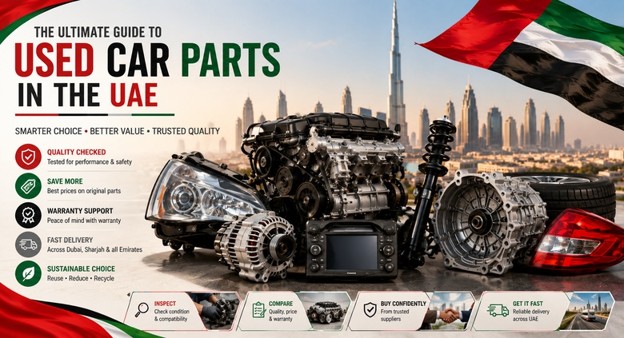
Understanding the Used Car Parts Market in the UAE
Why Used Car Parts Are Popular in the UAE
Walk through almost any busy workshop in Dubai, Sharjah or Abu Dhabi and you'll notice something interesting.
Brand-new parts certainly have their place.
So do used ones.
In fact, plenty of experienced mechanics will happily recommend a carefully inspected used component before suggesting a brand-new replacement. That surprises many first-time buyers, yet it happens every single day.
Why?
Because value matters.
Not everyone wants—or needs—to pay the highest possible price for every repair. If a genuine used headlamp, alternator or door mirror is in excellent condition, why spend considerably more on a new one simply because it's fresh out of a box?
That's the mindset driving the UAE's thriving used parts market.
It's practical.
It's cost-conscious.
And when buyers know what they're doing, it can be remarkably effective.
Of course, there is a catch.
Buying used isn't about finding the cheapest listing online.
It's about finding the right component.
That distinction makes all the difference.
Benefits of Buying Used Car Parts
Let's clear something up straight away.
Used doesn't automatically mean worn out.
Nor does it mean unreliable.
Many components become available because a vehicle has been involved in an accident while perfectly serviceable mechanical and electrical parts remain untouched. Others come from low-mileage vehicles that have reached the end of their economic life for reasons completely unrelated to the condition of individual components.
That creates opportunities.
A genuine factory-fitted part with years of useful life remaining can sometimes cost a fraction of its new equivalent.
That's difficult to ignore.
Some of the biggest advantages include:
- Lower repair costs.
- Access to genuine factory components.
- Better availability for discontinued models.
- Reduced waiting times for certain parts.
- Lower insurance repair costs.
- Environmental benefits through component reuse.
Buying used doesn't mean lowering your standards.
It means shopping more intelligently.
Common Misconceptions About Second-Hand Parts
Mention used car parts and you'll hear plenty of opinions.
Not all of them deserve to be taken seriously.
One common belief is that every second-hand part is close to failure.
Another assumes used components never come with warranties.
Then there's the idea that only old vehicles should use second-hand parts.
None of those statements tells the whole story.
Reality is far more balanced.
Many reputable suppliers inspect, clean and test components before offering them for sale. Some even provide warranty protection for selected parts.
Does that guarantee perfection?
No.
Nothing does.
Even brand-new components occasionally develop faults.
The goal isn't eliminating every possible risk.
It's reducing unnecessary ones through careful inspection and sensible buying decisions.
Which Vehicles Benefit Most from Used Parts
Some vehicles benefit from the used parts market more than others.
Think about popular models.
Toyota Corolla.
Nissan Patrol.
Honda Civic.
BMW 5 Series.
Mercedes-Benz E-Class.
Audi A6.
Because thousands of these vehicles operate across the UAE, replacement parts are generally easier to source.
That larger supply creates healthy competition.
Competition usually benefits buyers.
Owners of older vehicles often gain the greatest advantage because purchasing expensive new components for an ageing car doesn't always make financial sense.
A professionally inspected used replacement can restore reliability without stretching the maintenance budget unnecessarily.
That's simply smart ownership.
Why Dubai, Sharjah and Abu Dhabi Lead the Market
The UAE has several strong automotive hubs.
Three cities stand out.
Dubai.
Sharjah.
Abu Dhabi.
Each contributes something slightly different.
Dubai offers enormous choice, specialist workshops and access to suppliers serving premium, performance and everyday vehicles alike.
Sharjah has built an outstanding reputation for recycled, dismantled and professionally inspected automotive components. Buyers searching for body panels, engines, gearboxes and interior parts often begin here because stock levels tend to be impressive.
Abu Dhabi combines authorised dealerships with experienced independent specialists, giving owners plenty of flexibility when comparing repair options.
Together, these cities shape much of the country's used parts industry.
That doesn't mean opportunities stop there.
Ajman, Ras Al Khaimah, Fujairah and Umm Al Quwain continue expanding their supplier networks, making used parts increasingly accessible throughout the Emirates.
UAE Climate and Its Effect on Used Components
Heat leaves fingerprints.
Not literal ones.
Mechanical ones.
Rubber bushes gradually harden.
Plastic fittings become brittle.
Cooling systems work overtime.
Air-conditioning components rarely enjoy much rest.
Then there's the dust.
Fine desert sand has an uncanny ability to find its way into filters, bearings and moving parts if maintenance has been neglected.
That's why visual inspection alone isn't enough.
A shiny component isn't automatically a healthy component.
Understanding how the UAE's climate affects different materials helps buyers ask better questions before committing to a purchase.
Most Commonly Purchased Used Car Parts
Not every component makes sense to buy second-hand.
Brake pads?
Usually no.
A complete door?
Quite possibly.
Experienced buyers tend to focus on parts that offer meaningful savings without introducing unnecessary risk.
Among the most frequently purchased used components are:
- Engines.
- Gearboxes.
- Alternators.
- Starter motors.
- Alloy wheels.
- Doors.
- Bonnets.
- Tailgates.
- Headlights.
- Rear lights.
- Interior trim.
- Seats.
- Dashboard components.
- Side mirrors.
- Air conditioning compressors.
The key is suitability.
Some parts deserve to be new.
Others perform perfectly well after careful inspection.
Mistakes First-Time Buyers Make
Here's where enthusiasm occasionally gets people into trouble.
They find an attractive price.
Stop researching.
And click "Buy".
Big mistake.
The cheapest listing rarely tells the whole story.
Common errors include:
- Ignoring VIN compatibility.
- Forgetting to verify the exact part number.
- Buying purely on appearance.
- Skipping warranty discussions.
- Failing to inspect for previous repairs.
- Choosing unknown suppliers without checking reviews.
- Assuming every component fits every model from the same year.
A few extra questions today can prevent a very expensive lesson tomorrow.
Who This Guide Is For
This guide has been written for anyone trying to make sensible buying decisions in the UAE.
Private vehicle owners comparing repair quotations.
Families maintaining reliable everyday transport.
Business owners managing fleets.
Classic car enthusiasts searching for discontinued components.
Drivers repairing accident damage.
And increasingly, owners of hybrid and electric vehicles wondering whether used EV battery packs, charging ports, electric motors, inverters, sensors or control modules deserve consideration.
The answer?
Sometimes they do.
But only after careful inspection.
We'll explore those components in detail later because buying high-voltage parts requires a very different approach from purchasing a used bumper or alloy wheel.
Key Takeaways
- The UAE has developed one of the region's strongest markets for professionally sourced used car parts, particularly across Dubai, Sharjah and Abu Dhabi.
- Buying used components can reduce repair costs significantly while providing access to genuine factory parts that still have substantial service life remaining.
- Popular vehicle models generally benefit from stronger parts availability and more competitive pricing.
- The UAE's climate makes careful inspection especially important, as heat, dust and heavy daily use can influence component condition.
- Successful buyers focus on compatibility, inspection quality and supplier reputation rather than simply choosing the lowest price.
- The growing hybrid and electric vehicle market is creating demand for specialised used EV components, making informed buying more important than ever before.
What Buyers Should Check Before Purchasing
Finding a used car part isn't usually the difficult bit.
Finding the right one?
That's where things become interesting.
Spend enough time around experienced mechanics and you'll notice a pattern. They don't rush. They don't buy the first part they see, even if the price looks irresistible. Instead, they inspect. They compare. They ask questions that many first-time buyers never think to ask.
That's why their success rate is so much higher.
Let's walk through the checks that genuinely matter.
Confirm the Vehicle Identification Number (VIN)
If you remember only one thing from this guide, make it this.
Always verify the VIN.
Seriously.
A replacement part that looks identical can still be completely incompatible with your vehicle. Manufacturers often introduce production updates halfway through a model year. Two cars built only a few months apart may use different sensors, wiring connectors or mounting points.
It catches people out all the time.
The VIN removes much of that uncertainty.
Rather than guessing, suppliers can identify the exact specification your vehicle left the factory with.
That's a huge advantage.
Why VIN Verification Matters
- Confirms exact model specification.
- Identifies factory-installed options.
- Prevents ordering incorrect components.
- Reduces installation delays.
- Improves compatibility with electronic systems.
- Saves labour costs caused by incorrect purchases.
Skipping this step might save two minutes today.
It can waste several days later.
Verify the Correct Part Number
Here's another mistake that's surprisingly common.
People compare photographs instead of part numbers.
Don't.
Manufacturers assign specific part numbers for a reason. Even tiny design changes can result in different numbers despite two components appearing almost identical at first glance.
The safest approach?
Match both.
Confirm the VIN.
Then verify the manufacturer's part number.
When those two pieces of information agree, buying confidence increases dramatically.
Check the Manufacturing Date
Age isn't everything.
Condition matters more.
Still, the manufacturing date tells an important story.
Rubber seals, electronic modules and plastic housings naturally age over time, even if they've seen relatively little use. A component removed from a vehicle that's spent years parked outdoors under intense summer temperatures deserves closer inspection than one taken from a carefully maintained, lower-mileage vehicle.
Ask when the donor vehicle was built.
Ask when the part was removed.
Those details help paint a much clearer picture.
Inspect Physical Condition Carefully
This sounds obvious.
Yet plenty of buyers skip it.
A few minutes spent inspecting a used component can reveal far more than any online description ever could.
Look carefully for:
- Cracks.
- Corrosion.
- Excessive wear.
- Broken mounting points.
- Fluid leaks.
- Burn marks.
- Damaged wiring.
- Missing clips or fasteners.
Don't stop there.
Move the component.
Feel it.
Rotate it where appropriate.
Listen for unusual noises.
Sometimes your hands notice problems before your eyes do.
Look for Signs of Previous Repairs
A repaired component isn't automatically a bad component.
But it should never be a surprise.
Look for fresh welds.
Uneven paint.
Replacement fasteners.
Sealant where none should exist.
Different coloured bolts.
These clues don't necessarily mean "walk away."
They simply invite more questions.
Who carried out the repair?
What exactly was repaired?
Was the work professionally completed?
Good suppliers usually know the answers.
If nobody seems certain, proceed cautiously.
Ask About Mileage
Mileage isn't a perfect measure.
It remains a useful one.
A starter motor removed from a vehicle with 60,000 kilometres generally inspires more confidence than one taken from a car that's travelled 320,000 kilometres.
Of course, driving style matters too.
Motorway mileage often places less stress on certain components than constant stop-start city traffic.
The more information you gather, the easier it becomes to judge the true value of the part.
Mileage Guide
| Component | Lower-Risk Mileage Range* |
| Alternator | Up to 100,000 km |
| Starter motor | Up to 120,000 km |
| Engine | Depends heavily on maintenance history |
| Gearbox | Depends on servicing and usage |
| Headlights | Condition generally more important than mileage |
| Interior trim | Inspect for wear rather than distance travelled |
*These are general buying guidelines rather than guarantees.
Maintenance history always carries greater weight than mileage alone.
Check Warranty Availability
Let's be honest.
Buying any used component without asking about the warranty feels risky.
Reputable suppliers understand that.
Many now offer limited warranty periods on selected used engines, gearboxes, alternators, starters and electronic components because they've already inspected and tested them.
Ask straightforward questions.
How long is the warranty?
What's covered?
Are labour costs included?
What documentation should be kept?
A warranty won't prevent faults.
It does reduce financial uncertainty.
That's valuable.
Understand Return and Exchange Policies
Imagine ordering a perfectly good component.
It arrives.
The workshop discovers it isn't compatible because of an unexpected production variation.
Now what?
That's exactly why return policies matter.
Clarify:
- Return period.
- Exchange procedure.
- Packaging requirements.
- Refund conditions.
- Delivery responsibilities.
Sorting these details before purchasing is infinitely easier than arguing about them afterwards.
Compare Genuine, OEM, Used and Reconditioned Options
Not every repair requires the same solution.
Sometimes a genuine part makes complete sense.
Other times, a quality OEM component offers excellent value.
In another situation, a professionally inspected used part becomes the smartest financial decision.
Then there are reconditioned components.
Different repairs call for different approaches.
Blanket rules rarely work.
Replacement Part Comparison
| Type | Main Advantage | Best For |
| Genuine | Factory specification | Newer vehicles and warranty-sensitive repairs |
| OEM | Excellent quality at lower cost | Long-term ownership |
| Used | Significant savings | Body panels, interiors, selected mechanical parts |
| Reconditioned | Balanced cost and reliability | Engines, gearboxes, turbochargers, steering racks |
Choosing well isn't about buying the most expensive option.
It's about buying the most appropriate one.
A Quick Inspection Checklist
Before handing over any money, pause for a moment.
Run through this checklist.
✔ Confirm VIN compatibility.
✔ Match the manufacturer's part number.
✔ Inspect for visible damage.
✔ Ask about mileage.
✔ Check for previous repairs.
✔ Verify warranty availability.
✔ Understand the return policy.
✔ Confirm all fittings and connectors are included.
✔ Compare several suppliers.
✔ Keep the purchase invoice.
It doesn't take long.
Yet it dramatically reduces the likelihood of buying the wrong component.
Real Buyer Questions
These are some of the questions workshop technicians hear every week.
Can two parts with the same appearance still be different?
Absolutely. Manufacturers often revise designs during production without making obvious visual changes. That's why VIN verification and part numbers are essential.
Should I avoid repaired components altogether?
Not necessarily. Professionally repaired components can perform extremely well, provided the work has been completed correctly and documented properly.
Is mileage more important than condition?
No. A well-maintained component from a higher-mileage vehicle can often outperform a neglected part removed from a lower-mileage car.
What's the biggest mistake first-time buyers make?
Buying based solely on price without confirming compatibility, condition and supplier credibility.
Key Takeaways
- VIN verification and manufacturer part numbers remain the most reliable ways to confirm compatibility before purchasing any used car part.
- Careful physical inspection, mileage assessment and checking for previous repairs provide valuable insight into a component's remaining service life.
- Warranty terms and return policies deserve as much attention as the purchase price.
- Genuine, OEM, used and reconditioned parts each have appropriate applications depending on the repair, budget and long-term ownership plans.
- Thorough preparation before buying almost always saves more time, money and frustration than rushing into the first attractive deal.
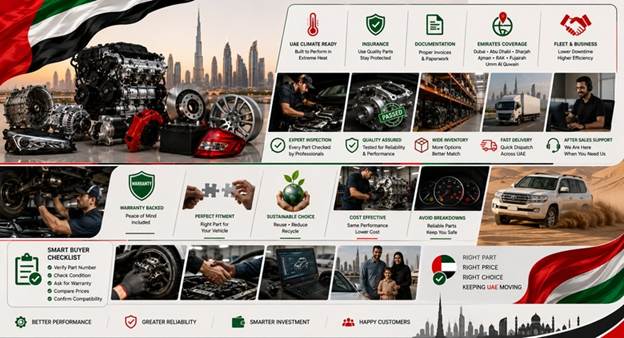
Buying Used Car Parts Across Dubai, Sharjah, Abu Dhabi and the UAE
One supplier says the part costs AED 800.
Another asks for AED 1,450.
A third promises the "same" component for even less.
So, who's right?
Possibly all of them.
That's the reality of buying used car parts in the UAE. Prices can vary dramatically, even for components that appear identical at first glance. The difference usually isn't random. It comes down to condition, mileage, inspection standards, warranty coverage, availability and supplier reputation.
That's why experienced buyers rarely stop after the first quotation.
They compare.
Not just prices.
Everything.
Buying Used Parts in Dubai
Dubai offers one of the widest selections of used car parts anywhere in the Middle East.
Luxury cars.
Performance vehicles.
Family SUVs.
Commercial vans.
City hatchbacks.
Whatever you drive, there's a good chance someone in Dubai has already sourced the replacement component you're looking for.
That level of availability creates healthy competition between suppliers.
Competition is good.
It encourages better pricing, stronger customer service and a broader choice of genuine, OEM and professionally inspected used components.
Still, don't let the size of the market rush your decision.
A supplier with hundreds of parts on the shelf isn't automatically the best option.
Ask questions.
Has the engine been compression tested?
Has the gearbox been inspected?
Does the alternator come with a warranty?
Can the supplier verify the donor vehicle's mileage?
Those conversations often reveal far more than the advertisement itself.
Buying Used Parts in Sharjah
If Dubai offers variety, Sharjah offers volume.
The emirate has become one of the UAE's best-known destinations for recycled automotive components. Workshops, dismantlers and independent suppliers collectively stock an enormous range of engines, gearboxes, body panels, suspension parts and interior components covering everything from economy cars to premium European brands.
There's another advantage too.
Experience.
Many businesses have spent years specialising in dismantling vehicles correctly, cataloguing inventory and matching components accurately.
That expertise matters.
Especially when you're searching for parts for an older vehicle that's no longer supported as strongly by authorised dealerships.
Don't assume every supplier works to the same standard, though.
Inspection quality can differ.
Documentation can differ.
Warranty coverage can differ.
Compare carefully.
Buying Used Parts in Abu Dhabi
Abu Dhabi's market has grown steadily over the years.
Many vehicle owners here balance convenience with long-term reliability, often comparing dealership quotations alongside independent specialists before making a final decision.
It's a sensible approach.
Some repairs genuinely justify brand-new components.
Others don't.
For example, replacing a damaged door mirror with a professionally inspected genuine used unit often makes perfect financial sense. Replacing a critical safety component with an unknown alternative simply because it's cheaper?
That's a different conversation altogether.
Good workshops explain those differences clearly.
The best ones encourage informed decisions rather than rushed ones.
Buying Used Parts in Ajman
Ajman sometimes flies under the radar.
It shouldn't.
The emirate has developed a growing network of suppliers offering competitive prices on used and reconditioned components. Buyers willing to spend a little time comparing quotations can often discover excellent value without compromising quality.
Availability varies depending on the make and model.
Popular Japanese and European vehicles generally present fewer challenges, while rare performance models may require sourcing from neighbouring Emirates.
Patience usually pays off.
Buying Used Parts in Ras Al Khaimah
Drivers in Ras Al Khaimah often depend on their vehicles for longer journeys between Emirates.
Reliability matters.
Quite a lot.
That's why many buyers here place greater emphasis on condition than on securing the absolute lowest price.
A slightly more expensive alternator with a documented warranty often represents much better value than a cheaper unknown unit with no history whatsoever.
It's a simple calculation.
Less risk.
Fewer surprises.
Greater confidence.
Buying Used Parts in Fujairah
Driving conditions in Fujairah are unique.
Mountain roads.
Long coastal routes.
High temperatures.
These conditions influence the way certain vehicle components wear over time.
Cooling systems deserve particular attention.
Suspension components should also be inspected carefully, especially if the donor vehicle regularly travelled uneven terrain.
When purchasing used parts, ask where the donor vehicle spent most of its life.
That information can be surprisingly useful.
Buying Used Parts in Umm Al Quwain
The growth of online automotive marketplaces has transformed buying habits in Umm Al Quwain.
Owners are no longer limited to nearby stock.
Instead, they can compare suppliers across Dubai, Sharjah, Abu Dhabi and the rest of the UAE before deciding where to buy.
That wider reach benefits everyone.
Prices become more competitive.
Availability improves.
Delivery times continue getting shorter.
The key is remembering that convenience should never replace verification.
Always confirm compatibility before placing an order.
Buying Online Across the UAE
Buying used parts online has never been easier.
It's also never required more attention.
A polished advert and professional photographs don't automatically guarantee a high-quality component.
Read the description carefully.
Request additional photographs.
Ask for close-up images of labels, connectors and mounting points.
Confirm the VIN compatibility.
Then ask again if you're unsure.
Online Buying Checklist
- Verify the part number.
- Match the VIN.
- Request recent photographs.
- Confirm warranty terms.
- Read independent customer reviews.
- Understand delivery charges.
- Check the return policy.
- Confirm whether the item has been tested.
Small checks.
Big difference.
Comparing Multiple Suppliers and Local Markets
Here's where experienced buyers quietly save hundreds—sometimes thousands—of dirhams.
They don't compare one quotation.
They compare several.
Imagine you're replacing a gearbox.
Supplier A offers a lower price but no warranty.
Supplier B charges slightly more, includes a six-month warranty and provides documented mileage.
Supplier C offers the lowest price of all, yet can't confirm where the gearbox came from.
Which represents the best value?
For most buyers, it's Supplier B.
Not because it's the cheapest.
Because it reduces risk.
That's the mindset worth developing.
If you're comparing suppliers across multiple Emirates, platforms such as PartFinder UAE make the process considerably easier by allowing motorists to request quotations from several trusted suppliers, compare genuine, OEM, used and reconditioned options, check availability and evaluate pricing before committing to a purchase.
Comparison isn't about finding the lowest number.
It's about finding the strongest overall offer.
What Should You Compare?
| Comparison Point | Why It Matters |
| VIN compatibility | Prevents incorrect purchases |
| Part condition | Indicates remaining service life |
| Donor vehicle mileage | Helps assess wear |
| Warranty | Reduces financial risk |
| Supplier reputation | Improves buying confidence |
| Delivery time | Minimises vehicle downtime |
| Total price | Reflects true overall cost |
The cheapest quotation often changes once hidden costs appear.
Real Buyer Questions
These questions come up repeatedly.
Should I travel to another Emirate if the price is lower?
Sometimes. But factor in delivery costs, travel time, warranty support and the supplier's reputation before deciding.
Can I trust online sellers?
Yes—provided they verify compatibility, supply detailed information and offer transparent warranty and return policies.
How many quotations should I collect?
Three or four detailed quotations usually provide a realistic understanding of the market without becoming overwhelming.
What's more important—price or warranty?
Ideally both. If forced to choose, many experienced buyers place greater value on documented quality and warranty support than on the lowest purchase price.
Key Takeaways
- Dubai, Sharjah and Abu Dhabi remain the UAE's leading destinations for sourcing quality used car parts in UAE, while the other Emirates continue expanding their supplier networks.
- Comparing suppliers should involve condition, mileage, warranty, compatibility and reputation—not simply the advertised price.
- Online purchasing has widened access to used parts across the UAE but makes VIN verification and careful supplier checks even more important.
- Platforms that allow buyers to compare multiple suppliers can reduce both costs and purchasing risks.
- Taking the time to compare properly usually leads to better-quality parts, stronger warranty protection and lower long-term ownership costs.
Inspecting Different Types of Used Parts
Every used car part tells a story.
Some stories are reassuring.
Others should make you walk away without a second thought.
That's why experienced buyers never inspect every component in exactly the same way. A used headlight deserves a different checklist from a gearbox. An engine requires far more attention than a door mirror. Treating every part alike is one of the quickest ways to waste money.
The good news?
Most expensive mistakes are avoidable.
You simply need to know what to look for before reaching for your wallet.
Engine Components
Buying a used engine isn't something you should rush into after scrolling through a few online listings.
Take your time.
A replacement engine can transform an ageing vehicle—or become the beginning of an expensive nightmare.
The difference usually comes down to inspection.
Start with the basics.
Look for oil leaks around the cylinder head, sump and timing cover. Check whether the engine turns over smoothly if possible. Examine coolant passages for corrosion or contamination. Inspect wiring connectors, sensors and mounting points for damage caused during removal.
Then ask the important questions.
Was the engine compression tested?
Has it overheated before?
What was the donor vehicle's mileage?
Does any service history exist?
A supplier who confidently answers those questions usually inspires far more confidence than one relying solely on "It's in good condition."
Engine Inspection Checklist
- Compression test results.
- Oil leaks.
- Coolant contamination.
- Timing components.
- Turbocharger condition where fitted.
- Wiring and sensors.
- Mounting brackets.
- Visible cracks or repairs.
The engine should tell a consistent story.
If it doesn't, keep looking.
Gearboxes and Transmissions
Gearboxes rarely advertise their problems.
At least not immediately.
A used automatic transmission might appear spotless on the outside while hiding expensive internal wear. That's why appearance alone should never determine your decision.
Instead, ask whether the gearbox was tested before removal.
Request documentation if available.
Check the transmission casing for cracks, impact damage or fluid leaks. Inspect electrical connectors carefully because modern automatic gearboxes depend heavily on electronic communication.
Don't forget the transmission fluid.
Its colour and smell often reveal more than many buyers realise.
Dark, burnt fluid?
Proceed cautiously.
Clean, healthy fluid?
That's a much more encouraging sign.
What to Inspect on a Used Gearbox
| Inspection Point | Why It Matters |
| Fluid condition | Indicates internal wear |
| Gearbox casing | Reveals impact damage |
| Wiring connectors | Ensures electronic compatibility |
| Input and output shafts | Checks mechanical condition |
| Mounting points | Prevents installation issues |
| Warranty | Reduces financial risk |
Never buy a gearbox based purely on price.
Suspension Parts
Suspension components spend their lives absorbing punishment.
Speed bumps.
Potholes.
Kerbs.
Heavy braking.
Sharp cornering.
Eventually, wear becomes inevitable.
That doesn't automatically rule out buying used suspension parts.
It simply means inspection becomes even more important.
Check bushes for cracking.
Look at ball joints for excessive movement.
Inspect control arms for bending or previous welding.
Examine shock absorbers for leaks.
Any obvious structural damage should end the conversation immediately.
Suspension keeps the vehicle stable.
Don't compromise it.
Brake System Components
Here's one area where caution deserves extra emphasis.
Some brake components simply make more sense when purchased new.
Brake pads.
Brake shoes.
Hydraulic seals.
These are consumable items.
However, professionally inspected brake calipers, backing plates or certain related components may represent sensible used purchases under the right circumstances.
Inspection remains essential.
Look carefully for:
- Corrosion.
- Damaged pistons.
- Seized guide pins.
- Fluid leaks.
- Cracked housings.
Braking performance depends on every component working together.
One weak link affects the whole system.
Cooling System Parts
The UAE's climate places extraordinary demands on cooling systems.
That makes inspection especially important.
Radiators should be checked for bent fins, corrosion and previous repairs.
Electric cooling fans should rotate smoothly without unusual resistance.
Water pumps deserve close examination for bearing wear and coolant stains around the shaft.
Thermostat housings often reveal cracks that become obvious only under careful lighting.
Tiny defects today can become overheating tomorrow.
Don't ignore them.
Steering Components
Steering should inspire confidence.
Not uncertainty.
Inspect steering racks for fluid leaks, damaged gaiters and excessive play. Tie rods should move smoothly without looseness, while electric steering systems require additional attention to connectors and electronic modules.
Remember this.
Many modern steering components require calibration after installation.
Ask the supplier whether any programming information accompanies the replacement part.
That small question can save hours in the workshop later.
Electrical and Electronic Parts
Electrical components deserve patience.
Lots of it.
Modern vehicles rely on dozens of sensors, modules and electronic control units working together continuously. Replacing one faulty component with another faulty component solves absolutely nothing.
Check connectors carefully.
Look for corrosion.
Inspect wiring for previous repairs.
Ask whether the module has been tested.
For expensive items such as infotainment systems, engine control units or battery management modules, documentation becomes even more valuable.
Guesswork doesn't belong anywhere near modern vehicle electronics.
Body Panels and Exterior Parts
Used body panels remain among the most popular purchases in the UAE.
Understandably so.
A genuine used bonnet or front wing often fits better than many cheaper alternatives.
Even so, inspect carefully.
Look for:
- Rust.
- Previous filler.
- Uneven paint.
- Poor welding.
- Damaged mounting tabs.
- Misaligned edges.
Factory paint usually tells a consistent story.
Repairs often tell a different one.
Good lighting helps enormously during inspection.
Interior Components
Interior parts don't experience the same mechanical stress as engines or gearboxes.
They do reveal how a vehicle has been treated.
Look closely at seat wear.
Dashboard cracking.
Switch operation.
Infotainment displays.
Climate control buttons.
Broken clips.
Missing fasteners.
These details may appear minor.
Together, they reveal the overall condition of the donor vehicle remarkably well.
A well-maintained interior often reflects careful ownership elsewhere too.
Hybrid and Electric Vehicle Components
Now things become more specialised.
Hybrid and electric vehicles introduce entirely different inspection priorities.
Buying a used EV battery pack without proper testing?
That's a risk very few professionals would recommend.
Instead, request battery health reports where available. Confirm charging history. Ask about previous accident damage involving the high-voltage system.
Electric motors should rotate smoothly.
Charging ports should be inspected for heat damage and corrosion.
Inverters, battery management systems (BMS), sensors and control modules should ideally be tested using manufacturer-approved diagnostic equipment before installation.
These aren't ordinary replacement parts.
Treat them with the respect they deserve.
EV Component Inspection Guide
| EV Component | What Buyers Should Check |
| Battery pack | State of health, charging history, physical damage |
| Charging port | Pins, corrosion, heat marks |
| Electric motor | Noise, rotation, mounting condition |
| Inverter | Water damage, diagnostic testing |
| BMS | Software compatibility, fault history |
| Sensors and control modules | Connector condition, testing results |
High-voltage systems demand specialist knowledge.
Never guess.
Real Buyer Questions
These questions come up repeatedly, especially among first-time buyers.
Can a used engine be as reliable as my original one?
Yes, provided it's been sourced from a reputable supplier, inspected properly, tested where appropriate and matched accurately to your vehicle.
Should I buy a used EV battery?
Only after reviewing its state-of-health report, confirming compatibility and ensuring the supplier provides suitable testing documentation and warranty support.
What's the easiest part to inspect?
Body panels often allow straightforward visual inspection, whereas engines, gearboxes and electronic modules require much more detailed evaluation.
Which components should always receive extra scrutiny?
Engines, transmissions, steering systems, braking components and high-voltage EV parts deserve the most thorough inspections because failures can become extremely expensive—or compromise safety.
Key Takeaways
- Every category of used car part requires its own inspection process, with engines, gearboxes and electronic systems demanding the greatest attention.
- Visual appearance alone never confirms condition; testing, documentation and supplier transparency provide far better indicators of reliability.
- Safety-critical systems such as brakes and steering should always be inspected with exceptional care before purchase.
- Hybrid and electric vehicle components require specialist evaluation, particularly battery packs, inverters, charging ports, electric motors and battery management systems.
- Careful inspection before purchasing dramatically reduces the likelihood of costly repairs, installation delays and long-term ownership problems across every type of vehicle in the UAE.
Used Parts for Hybrid and Electric Vehicles (EVs)
Not long ago, if someone mentioned buying used electric vehicle parts in the UAE, many drivers would probably have raised an eyebrow.
Today?
It's becoming an increasingly sensible conversation.
Electric vehicles are appearing in greater numbers across Dubai, Abu Dhabi, Sharjah and the rest of the Emirates. Taxi fleets, business operators, family motorists and private owners are all gradually embracing electric mobility. As more EVs enter the market, naturally, more replacement components become available too.
That creates opportunities.
It also creates new responsibilities.
Buying a used bumper for a petrol car is one thing.
Buying a high-voltage battery pack or inverter is something else entirely.
The principles remain similar—inspect carefully, verify compatibility and buy from trusted suppliers—but the level of technical understanding required is considerably higher.
Let's look at the components that deserve the closest attention.
Should You Buy Used EV Parts?
The short answer?
Sometimes.
The longer answer depends on three things:
- The component itself.
- Its condition.
- The supplier's inspection process.
Not every EV part carries the same level of risk.
Replacing a charging port cover isn't remotely comparable to replacing a battery pack. Likewise, purchasing an electric motor with comprehensive testing documentation is very different from buying an unknown unit with no service history.
Successful EV ownership isn't about avoiding used components altogether.
It's about understanding which ones can represent good value and which demand much greater caution.
Used EV Battery Packs: What to Inspect First
The battery is the heart of every electric vehicle.
It's also the single most expensive component.
That alone makes buying used battery packs both attractive and intimidating.
Before considering any purchase, ask for a battery health report.
This matters far more than age alone.
A five-year-old battery that's been charged sensibly and maintained correctly may outperform a younger pack subjected to repeated rapid charging, extreme temperatures or neglect.
Important questions include:
- What is the battery's State of Health (SoH)?
- Has the battery been repaired?
- Has it experienced collision damage?
- How many charging cycles has it completed?
- Has it been exposed to water ingress?
- Is diagnostic documentation available?
Never rely solely on verbal assurances.
Battery condition should be supported by testing wherever possible.
Battery Inspection Checklist
| Inspection Item | Why It Matters |
| State of Health (SoH) | Indicates remaining capacity |
| Charging history | Helps predict long-term performance |
| Physical casing | Identifies impact damage |
| Cooling system | Prevents overheating |
| Diagnostic report | Confirms battery condition |
| Warranty | Reduces financial risk |
A battery replacement deserves patience.
There's simply too much at stake to rush.
Charging Ports and Charging Hardware
Charging ports don't usually attract much attention.
Until they stop working.
Frequent use, exposure to dust, moisture and accidental damage can gradually affect charging performance.
Inspect carefully for:
- Bent connector pins.
- Heat discolouration.
- Corrosion.
- Loose mounting points.
- Damaged locking mechanisms.
- Water ingress.
A charging port may appear perfectly clean from the outside while hiding damage beneath the housing.
Ask whether charging performance has been tested before removal.
That extra question costs nothing.
Electric Motors and Drive Units
Electric motors contain far fewer moving parts than internal combustion engines.
That certainly helps reliability.
It doesn't eliminate wear altogether.
Bearing condition remains important.
So does the cooling system.
Listen for unusual noises where practical. Rotate shafts carefully if inspection allows. Examine mounting points for impact damage and check electrical connectors for signs of overheating or corrosion.
Ask about the donor vehicle too.
Low mileage is useful.
Consistent maintenance is even better.
A well-documented motor almost always inspires greater confidence than one with little background information.
Inverters and Power Electronics
The inverter quietly performs one of the most critical jobs in an electric vehicle.
Without it, the battery cannot efficiently deliver power to the motor.
Because of that, any replacement inverter deserves detailed inspection.
Check for:
- Water damage.
- Burn marks.
- Damaged connectors.
- Corrosion.
- Previous repairs.
- Software compatibility.
Many modern inverters require coding or programming after installation.
Confirm this before purchasing.
Otherwise, an apparently inexpensive replacement may become unexpectedly costly.
Battery Management Systems (BMS)
Few drivers ever see the Battery Management System.
Yet it constantly monitors battery health, temperature, charging behaviour and safety.
Think of it as the battery's brain.
Replacing a faulty BMS without verifying software compatibility can create significant problems.
Ask whether the module has been tested using manufacturer-approved diagnostic equipment.
Request any available fault history.
Software version information also becomes increasingly important as manufacturers continue releasing updates.
Compatibility matters just as much as condition.
Sensors and Electronic Control Modules
Electric vehicles depend heavily on electronics.
Far more than many people realise.
Sensors monitor temperatures, battery voltage, wheel speeds, charging systems, motor performance and countless other functions every second.
Control modules coordinate those systems continuously.
Before purchasing any electronic module:
- Confirm the exact part number.
- Match VIN compatibility.
- Inspect connectors.
- Request diagnostic testing results.
- Ask whether programming is required.
One incorrect module can generate multiple warning lights and unnecessary workshop visits.
Accuracy matters.
High-Voltage Wiring and Connectors
High-voltage cables deserve respect.
Always.
They carry significant electrical energy and should never be treated like ordinary wiring.
Inspect insulation carefully.
Look for abrasion.
Heat damage.
Previous repairs.
Loose connectors.
Corrosion.
Never purchase damaged high-voltage wiring simply because it's cheaper.
Replacing it later could cost considerably more than buying the correct component from the beginning.
Safety isn't an area for compromise.
Safety Considerations When Buying Used EV Components
Working around electric vehicles requires specialist knowledge.
Many repairs should only be completed by technicians trained to work with high-voltage systems.
That's particularly true when replacing:
- Battery packs.
- Inverters.
- Electric motors.
- High-voltage cables.
- Battery Management Systems.
Choosing experienced workshops reduces installation risks and helps ensure correct system calibration afterwards.
A successful repair doesn't end when the part is fitted.
It ends when every system operates exactly as intended.
EV Components: Risk Comparison
| Component | Buying Risk | Professional Inspection Recommended |
| Battery Pack | Very High | Yes |
| Inverter | High | Yes |
| Electric Motor | Medium | Yes |
| Charging Port | Low to Medium | Recommended |
| BMS | High | Yes |
| High-Voltage Wiring | High | Yes |
| Sensors | Medium | Recommended |
| Control Modules | High | Yes |
Higher-value components almost always justify more comprehensive inspection.
Real Buyer Questions
These are questions increasingly asked by EV owners across the UAE.
Can a used EV battery still be reliable?
Yes, if its State of Health remains strong, diagnostic reports confirm good condition and it comes from a reputable supplier offering appropriate warranty support.
Do electric motors wear out quickly?
Generally, no. Electric motors are remarkably durable, although bearings, cooling systems and surrounding electronics should still be inspected carefully.
Should I install used EV parts myself?
High-voltage components should always be installed by qualified professionals familiar with manufacturer safety procedures.
Can software compatibility cause problems?
Absolutely. Many modern EV modules require coding, programming or calibration before they communicate correctly with the rest of the vehicle.
Key Takeaways
- Used EV parts can provide excellent value when purchased carefully, but high-voltage components require much more detailed inspection than conventional vehicle parts.
- Battery packs should always be assessed using State of Health reports, charging history and diagnostic testing rather than age alone.
- Charging ports, electric motors, inverters, battery management systems, sensors and control modules all require compatibility checks before purchase.
- Professional installation and programming remain essential for many EV components, particularly those connected to high-voltage systems.
- As electric vehicle ownership continues growing across Dubai, Sharjah, Abu Dhabi and the wider UAE, understanding how to evaluate used EV components will become an increasingly valuable skill for motorists.
Price Comparison and Hidden Ownership Costs
Most buyers focus on one number.
The advertised price.
It's understandable.
That's the first figure you see, and it's usually the one that grabs your attention. But ask any workshop owner who's been repairing vehicles in the UAE for years, and you'll hear the same advice.
The purchase price is only part of the story.
Sometimes, it's not even the biggest expense.
Labour, supporting parts, programming, transport, fluids and unexpected repairs can quickly change what initially looked like an excellent bargain.
That's why experienced buyers calculate the total ownership cost—not just the price on the invoice.
What Influences Used Parts Prices?
Ever wondered why one supplier wants AED 450 for a used alternator while another asks AED 900?
There are usually good reasons.
The final price of a used component depends on far more than its appearance.
Several factors influence market value:
- Vehicle make and model.
- Supply and demand.
- Donor vehicle mileage.
- Overall condition.
- Genuine versus aftermarket origin.
- Warranty length.
- Testing and inspection records.
- Availability across the UAE.
- Shipping and logistics.
- Seasonal demand.
Popular vehicles generally benefit from stronger competition.
Rare imports often don't.
That's why two seemingly similar components can carry completely different price tags.
Labour Costs Across the UAE
The part itself may only account for half the repair bill.
Sometimes less.
Labour rates vary between workshops, vehicle complexity and location. Premium European vehicles usually require more specialist knowledge, while hybrid and electric vehicles often involve additional safety procedures and diagnostic work.
The figures below represent typical workshop estimates and may vary depending on vehicle type and repair complexity.
Typical Labour Cost Comparison
| Repair Type | Estimated Labour Cost (AED) |
| Alternator Replacement | 200–500 |
| Starter Motor Replacement | 250–600 |
| Suspension Component Replacement | 300–900 |
| Radiator Replacement | 350–800 |
| Steering Rack Replacement | 600–1,500 |
| Engine Replacement | 2,500–6,500 |
| Gearbox Replacement | 2,000–5,500 |
| EV Battery Replacement Labour | 2,500–7,000 |
Labour often becomes one of the biggest contributors to the final repair bill.
Choosing the correct part first time helps avoid paying twice.
Labour Cost Differences Across the Emirates
Workshop pricing isn't identical throughout the UAE.
Location plays a role.
Premium facilities in central Dubai may charge higher hourly rates than independent specialists elsewhere, while Sharjah often attracts buyers looking for competitive repair costs and broad parts availability.
General Labour Cost Trends
| Emirate | Typical Pricing Trend |
| Dubai | Premium to Mid-Range |
| Abu Dhabi | Mid-Range to Premium |
| Sharjah | Competitive |
| Ajman | Competitive |
| Ras Al Khaimah | Moderate |
| Fujairah | Moderate |
| Umm Al Quwain | Moderate |
The cheapest workshop isn't automatically the best.
Experience, warranty support and workmanship matter just as much.
Installation Costs
Some parts are surprisingly straightforward to fit.
Others require hours of labour, specialist tools and advanced diagnostics.
Replacing a headlight might take less than an hour.
Replacing an engine?
That's an entirely different project.
Installation costs often increase because workshops may also need to:
- Transfer sensors.
- Replace seals.
- Refill fluids.
- Update software.
- Perform calibration.
- Carry out road testing.
These tasks protect reliability.
They also add to the overall bill.
Ignoring them usually proves more expensive later.
Supporting Parts Often Replaced Together
One replacement frequently leads to another.
Not because anyone is trying to increase the invoice.
Because related components naturally wear together.
Replacing an engine, for example, often involves additional items such as:
- Engine mounts.
- Belts.
- Hoses.
- Filters.
- Spark plugs where applicable.
- Fresh engine oil.
- Coolant.
- Transmission fluid.
- Gaskets.
- Seals.
Similarly, gearbox replacement may involve:
- Clutch components for manual vehicles.
- Torque converter inspection for automatics.
- Transmission mounts.
- Fresh transmission fluid.
- New filters.
Replacing everything at the same time often reduces future labour costs.
Hidden Costs Buyers Forget
Here's where budgets quietly begin to drift.
The replacement part arrives exactly as expected.
Then the workshop starts discovering everything else.
Programming.
Calibration.
Damaged connectors.
Missing brackets.
Additional seals.
Unexpected corrosion.
Delivery charges.
None of these costs seemed obvious when the part was advertised.
Yet they're real.
Common Hidden Costs
| Hidden Expense | Why It Appears |
| Diagnostic scanning | Confirms system operation |
| ECU programming | Required after module replacement |
| Calibration | Needed for modern safety systems |
| Fluids | Essential after many repairs |
| Delivery charges | Large components cost more to transport |
| Additional fasteners | Old fittings may not be reusable |
| Workshop consumables | Sealants, clips and small hardware |
Planning for these costs avoids unpleasant surprises.
Repair vs Replacement Comparison
One of the biggest decisions isn't which part to buy.
It's whether to repair the existing one at all.
Sometimes rebuilding a component represents excellent value.
Other times, replacement becomes the smarter financial decision.
Repair vs Replacement
| Situation | Repair | Replacement |
| Minor cosmetic damage | ✔ Usually worthwhile | ✖ Often unnecessary |
| Internal engine failure | ✖ Rarely economical | ✔ Usually preferred |
| Severe gearbox damage | △ Depends on condition | ✔ Often practical |
| Damaged electronic module | △ Case by case | ✔ Frequently recommended |
| EV Battery with significant degradation | ✖ Limited benefit | ✔ Usually preferable |
Every repair deserves individual assessment.
Blanket rules rarely work.
Warranty Value
It's easy to underestimate a warranty.
Until something goes wrong.
A documented warranty doesn't simply protect your money.
It also demonstrates confidence from the supplier.
Before purchasing, ask:
- How long does the warranty last?
- Which faults are covered?
- Are labour costs included?
- Are diagnostic charges covered?
- What conditions could invalidate the warranty?
Good suppliers answer these questions clearly.
If the answers seem vague, consider that a warning sign.
First-Year Ownership Costs
Many buyers think the repair bill ends once the vehicle leaves the workshop.
Not always.
The first year after replacing a major component may include additional maintenance, servicing and inspections.
Example First-Year Cost Estimate
| Item | Estimated Cost (AED) |
| Used Engine | 5,500 |
| Labour | 3,000 |
| Fluids and Filters | 700 |
| Supporting Parts | 1,000 |
| Diagnostic Checks | 350 |
| Unexpected Adjustments | 450 |
| Estimated Total | 11,000 |
Figures naturally vary depending on the vehicle and repair.
The principle remains the same.
Always budget beyond the purchase price.
How to Reduce Overall Repair Costs
Saving money isn't about choosing the cheapest supplier.
It's about making smarter decisions from the beginning.
Some practical strategies include:
- Compare several quotations.
- Verify VIN compatibility.
- Request warranty documentation.
- Replace related wear items together.
- Choose experienced workshops.
- Ask for written estimates.
- Keep maintenance records.
- Avoid delaying necessary repairs.
A little preparation often prevents a much larger bill later.
Real Buyer Questions
These are questions workshops hear every day.
Why do quotations vary so much?
Because suppliers differ in component quality, testing standards, warranty coverage, donor vehicle mileage and availability.
Should I always choose the cheapest part?
Not necessarily. Paying slightly more for a properly inspected component with warranty support often reduces long-term ownership costs.
Can labour cost more than the replacement part?
Absolutely. Major repairs involving engines, gearboxes or EV battery systems frequently involve labour costs that equal—or even exceed—the purchase price of the component itself.
Are hidden costs unavoidable?
Not always. Most can be anticipated by discussing programming, fluids, supporting parts and installation requirements before approving the repair.
Key Takeaways
- The advertised price represents only one part of the overall repair cost; labour, programming, supporting parts and diagnostics often contribute significantly to the final bill.
- Labour costs vary across the UAE depending on repair complexity, workshop expertise and vehicle type, particularly for premium, hybrid and electric vehicles.
- Supporting components, fresh fluids and calibration work should always be included when planning a realistic repair budget.
- Comparing repair and replacement options individually helps owners make better financial decisions rather than relying on general assumptions.
- Careful budgeting, multiple quotations and choosing reputable suppliers can substantially reduce long-term ownership costs while improving reliability and peace of mind.
Common Buying Mistakes and How to Avoid Them
Buying used car parts isn't difficult.
Buying the right used car parts consistently?
That's where experience starts to show.
Speak to technicians who've spent years repairing vehicles across the UAE and you'll hear plenty of stories. Some are impressive. Drivers save thousands of dirhams by choosing the right component from a trusted supplier.
Others aren't nearly as enjoyable.
An engine bought because it was "too cheap to ignore."
A gearbox that looked perfect in photographs but turned out to be incompatible.
An electronic control module that fitted physically but refused to communicate with the rest of the vehicle.
Most expensive mistakes have something in common.
They were avoidable.
Let's look at the ones that appear most often.
Buying Without VIN Verification
This remains the biggest mistake by a considerable margin.
Many buyers assume that if two vehicles share the same make, model and year, the parts must also be identical.
Unfortunately, that's not how modern vehicles work.
Manufacturers regularly update production specifications during a model's lifecycle. Wiring connectors change. Sensors are revised. Mounting brackets move. Software versions evolve.
Visually identical components can perform very differently.
The VIN removes much of that uncertainty.
Always ask the supplier to verify compatibility before making payment.
Five minutes of checking can prevent days of frustration.
Choosing Price Over Quality
Everyone enjoys finding a bargain.
There's nothing wrong with that.
Problems begin when price becomes the only deciding factor.
Imagine two replacement alternators.
The first costs AED 350.
The second costs AED 520.
At first glance, the cheaper option seems obvious.
Then you discover the more expensive unit has documented mileage, inspection records and a six-month warranty, while the cheaper one comes with none of those things.
Which represents better value?
For most buyers, it's the second option.
The cheapest purchase isn't always the least expensive ownership decision.
Ignoring Supplier Reputation
A good supplier sells parts.
A great supplier sells confidence.
Reputation matters because it reflects how a business handles customers after the sale—not just before it.
Before buying, spend a little time researching.
Read independent reviews.
Check how warranty claims are handled.
Look at response times.
See whether the supplier explains component history clearly.
Trust is built through consistency, not marketing.
Skipping Professional Inspection
Some buyers believe a few photographs tell them everything they need to know.
They don't.
Photographs can hide cracks.
Fluid leaks.
Previous repairs.
Damaged mounting points.
Electrical faults.
Professional inspection reveals details that simply don't appear on a screen.
For expensive components such as engines, gearboxes, electric motors and battery packs, independent workshop inspections often prove to be money exceptionally well spent.
Buying Parts Without Warranty
A warranty isn't merely a piece of paper.
It's a statement.
It tells you the supplier has enough confidence in the component to stand behind it for a defined period.
That doesn't guarantee perfection.
Nothing can.
But it does reduce financial uncertainty if problems appear shortly after installation.
Always ask:
- Warranty duration.
- What's included.
- What's excluded.
- Documentation requirements.
- Claim procedure.
Clear answers inspire confidence.
Vague answers should raise questions.
Workshop Red Flags
Not every workshop operates to the same standard.
Most are professional.
Some aren't.
Recognising warning signs early can save significant time and money.
Watch for workshops that:
- Rush inspections.
- Refuse to explain repair recommendations.
- Avoid written quotations.
- Suggest replacing multiple unrelated components without evidence.
- Discourage questions.
- Offer unusually low prices with no warranty.
- Recommend parts before confirming compatibility.
Transparency usually accompanies quality workmanship.
Secrecy rarely does.
Questions Every Buyer Should Ask
Good buyers ask good questions.
Simple as that.
Before purchasing any used component, consider asking:
- What vehicle did this part come from?
- What was the donor vehicle's mileage?
- Has the component been tested?
- Is diagnostic documentation available?
- Has it been repaired previously?
- Does it include all sensors and fittings?
- Is programming required after installation?
- What warranty is included?
- Can the part be returned if compatibility issues arise?
Experienced suppliers won't be surprised by these questions.
They expect them.
Real Buyer Questions
These are genuine concerns raised by motorists across the UAE.
Can a cheap part become expensive later?
Very easily. A lower purchase price means little if the component fails early, requires additional labour or causes further damage.
Should I trust a supplier I've never used before?
Yes, provided you research their reputation, verify warranty terms and confirm compatibility before purchasing.
Is a written quotation really necessary?
Absolutely. It helps avoid misunderstandings regarding pricing, labour, warranty and the scope of the repair.
How many suppliers should I compare?
Collecting three or four detailed quotations generally provides a realistic understanding of pricing and quality across the market.
Expert Buying Checklist
Before confirming your purchase, work through this final checklist.
Compatibility
✔ Verify the VIN.
✔ Match the manufacturer's part number.
✔ Confirm software compatibility where applicable.
Condition
✔ Inspect for physical damage.
✔ Ask about donor vehicle mileage.
✔ Request testing documentation.
✔ Check for previous repairs.
Supplier
✔ Read independent reviews.
✔ Confirm warranty coverage.
✔ Understand the return policy.
✔ Request a written invoice.
Workshop
✔ Obtain a written labour estimate.
✔ Confirm programming requirements.
✔ Replace related wear items where appropriate.
✔ Keep all service records.
A careful buyer rarely regrets asking one extra question.
A rushed buyer often regrets not asking enough.
Building a Long-Term Ownership Mindset
Perhaps the biggest difference between experienced vehicle owners and first-time buyers isn't technical knowledge.
It's patience.
Experienced owners rarely chase the lowest price.
Instead, they focus on long-term reliability.
They understand that a quality used component, professionally installed and supported by a reputable supplier, often costs less over several years than repeatedly replacing cheaper alternatives.
That's a mindset worth adopting.
Especially if you plan to keep your vehicle for years rather than months.
Key Takeaways
- Most expensive used parts mistakes result from poor preparation rather than bad luck.
- VIN verification, supplier reputation and professional inspection remain the strongest safeguards against costly purchasing errors.
- Warranty coverage, written quotations and transparent communication provide valuable protection throughout the buying process.
- Choosing quality over the lowest advertised price often delivers lower ownership costs and greater long-term reliability.
- Asking the right questions before purchasing dramatically increases the chances of a successful repair and a more dependable vehicle.
Complete UAE Buying Guide
By now, you've probably noticed a pattern.
Buying used car parts successfully isn't about luck.
It isn't about finding the cheapest advert.
And it certainly isn't about making a quick decision because someone says, "This is the last one available."
The smartest buyers approach every purchase with the same mindset.
Verify first.
Compare carefully.
Inspect thoroughly.
Then decide.
Whether you're replacing a simple headlamp, a complete engine, a gearbox or a high-voltage EV battery pack, the process should always begin with information rather than assumptions.
Let's finish by answering some of the questions motorists across the UAE ask most often.
How Professionals Inspect Used Car Parts
Ask experienced technicians how they evaluate used components and you'll notice they rarely rely on appearance alone.
Instead, they combine several different checks.
Mechanical Inspection
- Visual examination.
- Wear assessment.
- Leak inspection.
- Mounting condition.
- Corrosion checks.
Electronic Testing
- Diagnostic scanning.
- Fault code verification.
- Software compatibility.
- Sensor operation.
- Module communication.
Documentation Review
- VIN verification.
- Part number confirmation.
- Donor vehicle mileage.
- Service records where available.
- Warranty documentation.
Every layer of verification reduces uncertainty.
That's exactly what buyers should aim for.
Used Parts Buying Checklist
Before completing any purchase, run through this final checklist one last time.
Vehicle Compatibility
✔ Verify the VIN.
✔ Confirm the manufacturer's part number.
✔ Check software compatibility where necessary.
Component Condition
✔ Inspect for cracks, corrosion and damage.
✔ Confirm donor vehicle mileage.
✔ Request testing documentation.
✔ Check for previous repairs.
Supplier Confidence
✔ Read customer reviews.
✔ Confirm warranty coverage.
✔ Understand return procedures.
✔ Obtain a written invoice.
Workshop Preparation
✔ Request a labour estimate.
✔ Ask whether programming is required.
✔ Replace supporting parts where appropriate.
✔ Keep all maintenance records.
A printed checklist may seem old-fashioned.
It still prevents expensive mistakes.
Future of the UAE Used Car Parts Market
The market is changing.
Quite quickly.
Hybrid vehicles continue gaining popularity.
Electric vehicle ownership is expanding across Dubai, Abu Dhabi, Sharjah and the wider Emirates.
Advanced driver assistance systems are becoming increasingly common.
Vehicles now rely on more sensors, more control modules and far more sophisticated electronics than they did only a few years ago.
That means buyers will increasingly need suppliers capable of:
- Accurate VIN matching.
- Diagnostic testing.
- Software verification.
- Hybrid and EV expertise.
- Transparent warranty support.
Technology is changing.
Good buying habits aren't.
Final Expert Buying Advice
If there's one lesson that runs through this entire guide, it's this:
Don't buy with your eyes alone.
Buy with information.
Compare multiple quotations.
Inspect every component properly.
Verify compatibility before making payment.
Choose suppliers who explain rather than simply sell.
Understand the complete repair cost—not just the advertised price.
And don't overlook the growing importance of hybrid and electric vehicle components, because they'll become an increasingly significant part of the UAE automotive market over the coming years.
The best purchase isn't necessarily the cheapest.
Nor is it always the most expensive.
It's the one that provides the right balance of quality, compatibility, warranty, professional installation and long-term reliability.
That's how experienced vehicle owners think.
And, more often than not, that's how they save money.
Real Buyer Questions
Before we finish, here are a few final questions that often come up.
How can I avoid buying the wrong part?
Always verify the VIN, match the manufacturer's part number, compare several suppliers and ask for testing documentation before purchasing.
Should I always buy from the nearest supplier?
Not necessarily. A supplier in another Emirate offering better inspection standards, warranty coverage and transparent documentation may represent the stronger overall choice.
Are used EV parts becoming easier to find?
Yes. As electric vehicle ownership grows across the UAE, professionally inspected battery packs, electric motors, charging ports, inverters and electronic control modules are becoming increasingly available.
What's the single most important habit every buyer should develop?
Never rush. Careful comparison, proper inspection and informed decision-making consistently produce better long-term ownership results than impulse purchases.
Key Takeaways
- A successful used car parts purchase depends on preparation, verification and careful supplier selection rather than simply finding the lowest price.
- Genuine, OEM, used and reconditioned components all have suitable applications depending on the vehicle, repair and ownership goals.
- Hybrid and electric vehicles require additional attention to battery health, software compatibility and high-voltage safety during the purchasing process.
- Maintaining complete records, warranties and professional installation documentation strengthens long-term reliability and can support future resale value.
The UAE's used car parts market continues evolving rapidly, offering motorists greater choice, stronger competition and expanding opportunities to reduce repair costs without compromising quality when purchases are made wisely.
Frequently Asked Questions
Categories
- Audi
- BMW
- Car Accessories
- Car Tips
- Ford
- Land Rover
- Mazda
- Range Rover
- Top 10
- UAE Car Parts
- Used Car Parts
- Toyota
- Replacement Engines
- Nissan
- Hyundai
- Mitsubishi
- Volkswagen
- Honda
- Kia
- Chevrolet
- Dodge
- Jeep
- Subaru
- Renault
- Lexus
- Mercedes
- Suzuki
- Hummer
- Porsche
- Infiniti
- Peugeot
- GMC
- Mini
- Volvo
- Replacement Gearboxes
- MG
- Jaguar
- Skoda
- Cadillac
- Daihatsu
- Fiat
- German Car Parts
- Japanese Car Parts
- Aftermarket Car Parts
- Genuine Car Parts
- New Car Parts
- Reconditioned Car Parts
- European Car Parts
- American Car Parts
- Korean Car Parts
- British Car Parts
- Chinese Car Parts
- Sports/Exotic Car Parts
- Luxury Car Parts
- Performance Car Parts
- SUV/4x4 Spare Parts
- Truck Spare Parts
- EV Car Parts
- Hybrid Car Parts
- Auto Spare Parts in UAE