Used Citroen Spare Parts in UAE: What to Check Before Buying
September 23, 2026
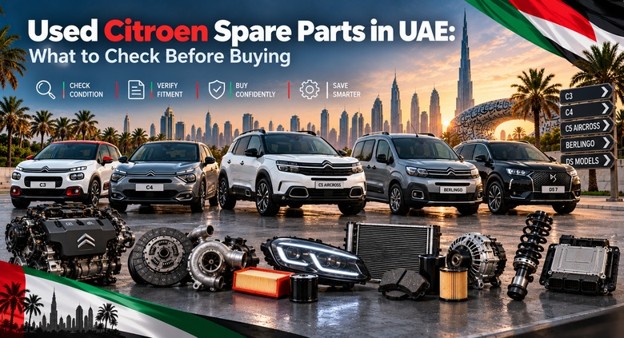
A used Citroen spare part in UAE can save a serious amount of money. It can also turn into an expensive mistake remarkably quickly if the seller gives you only a part name, a photograph and a price.
The important question is not simply “Is this part used?” It is “Do I know exactly what this part came from, what condition it is in, and whether it matches my Citroën?”
Citroën itself recognises second-hand parts as one of the repair options available through its network, alongside original, multi-brand, repaired and remanufactured solutions. Its UAE material also describes selected used parts as coming through partners and being checked for condition before reuse.
That distinction matters in Dubai, Sharjah, Ajman and Abu Dhabi, where the used European-parts market can contain everything from carefully removed low-mileage components to unidentified stock that has been sitting in a warehouse for months.
Used does not automatically mean poor quality
A used Citroën component can be perfectly serviceable.
A headlamp, door mirror, body control module, gearbox casing, interior switch, alloy wheel or complete engine does not necessarily become unusable simply because another vehicle used it first.
The condition and history matter more than the word used.
The first thing to check is your exact Citroën
“Citroën C4” is not enough information for a serious parts purchase.
You need the generation, model year, engine, transmission and preferably the VIN. A C4 from one generation can use substantially different electronics, suspension components, lighting assemblies and drivetrain parts from another.
The current UAE C4 range, for example, includes several PureTech petrol engines, BlueHDi diesel options and EAT8 automatic transmission configurations.
VIN verification should come before payment
The VIN is one of the strongest pieces of fitment information available to a buyer.
Give the seller the full VIN where appropriate and ask them to confirm the exact component against the vehicle specification. Do not accept “looks the same” as a fitment check.
A used part can have the correct shape and still have the wrong connector, calibration, software version or specification.
Part number beats a photograph
Photographs are useful.
They are not enough.
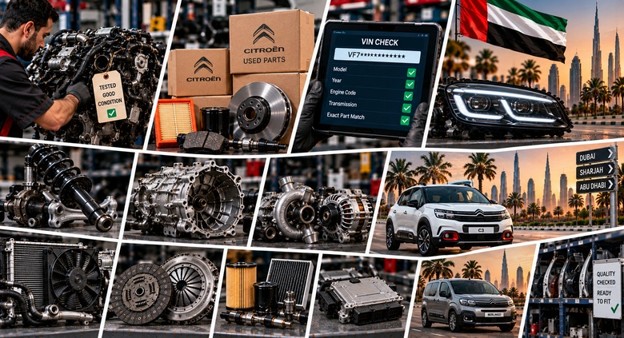
Ask for the manufacturer's part number, supersession number or identification label where one exists. Compare that number with the component already fitted to your car or have a qualified parts specialist verify it against the VIN.
This is particularly important with sensors, control modules, lights, engine accessories and transmission components.
Generation matters more than many buyers realise
A seller may advertise a part simply as “C5 Aircross” or “Berlingo”.
That description leaves too much unanswered.
Facelift changes, engine revisions, electrical architecture and equipment levels can alter component fitment. Citroën's own documentation shows how vehicle configurations and equipment can vary between versions and markets, so model names alone should not be treated as sufficient identification.
Check the engine code
For major mechanical parts, the engine code can be just as important as the model badge.
A used engine, turbocharger, cylinder head, injectors, intake component or engine management component should be matched to the correct engine family and specification.
This becomes especially important when buying older C3, C4, C5 and Berlingo components.
Gearbox identification needs the same discipline
A used gearbox is not simply “a C4 gearbox”.
Manual and automatic units differ, while automatic transmissions can also vary by engine, generation and calibration.
Citroën has used the EAT8 eight-speed automatic across parts of its range since its introduction in 2018, but that does not mean every EAT8 component is interchangeable between every Citroën model.
Ask where the donor vehicle came from
This is one of the most useful questions buyers often skip.
Was the donor vehicle accident-damaged? Flood-damaged? Mechanically failed? Imported after being written off? Dismantled because of age?
A gearbox removed from a rear-end accident vehicle may be an entirely different proposition from one removed from a car with a failed engine.
The reason the donor vehicle was dismantled tells you something about the part's possible history.
Donor mileage is useful evidence
Mileage does not prove condition.
It does, however, give you another piece of evidence.
A used alternator from a low-mileage donor with a traceable vehicle history is easier to evaluate than an alternator whose mileage and origin are unknown.
For engines and gearboxes, ask for the donor mileage in writing where possible.
Ask for photographs of the actual part
Avoid relying entirely on catalogue photographs.
Ask for photographs of the exact component you will receive.
For a mechanical part, useful photographs include mounting points, connectors, casting numbers, labels, seals and obvious damage. For electronics, ask for the module label and connector side as well.
A clean photograph can expose an incorrect connector or damaged mounting ear before the part reaches your workshop.
Used engines require a much deeper inspection
An engine is not something to buy because it looks clean.
Ask what testing has been performed.
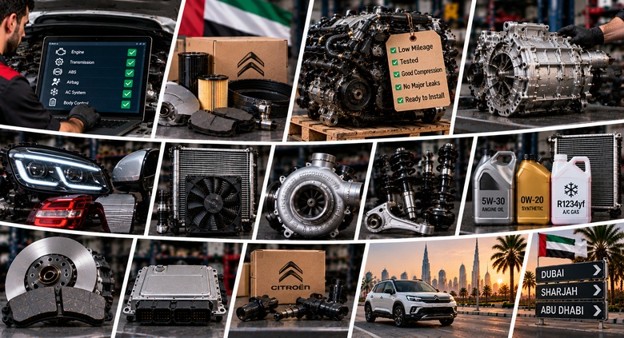
For a complete used engine, useful checks can include compression testing where appropriate, oil-pressure evidence, leak inspection, coolant contamination checks, crankshaft rotation, external oil leaks and inspection of major ancillaries.
The exact test programme depends on the engine and what the seller is actually supplying.
Compression numbers only help when they are meaningful
“Compression tested” sounds reassuring.
But ask how it was tested and whether the seller can provide the results.
A compression test becomes useful when you can compare cylinders and understand the engine's specification. A vague statement that an engine “has good compression” is much weaker evidence than documented readings from the actual donor engine.
Look for oil and coolant contamination
On a used engine, inspect the oil filler area, coolant passages where accessible, external seals and visible oil/coolant traces.
Creamy contamination, unexplained sludge, fresh sealant around major joints or evidence of heavy overheating deserves further investigation.
Do not assume every used engine with a clean exterior has been properly tested internally.
Turbochargers need their own inspection
A used turbocharger should not be assessed merely by checking whether the turbine turns.
Ask about shaft play, oil contamination, housing damage and the condition of the compressor and turbine wheels.
The surrounding cause matters too. If the original turbo failed because of oil starvation, contamination or engine debris, fitting another used turbo without correcting the cause can simply repeat the failure.
Used gearboxes deserve a road-test question
If the transmission was removed from a running donor, ask whether it was road-tested before removal.
For an automatic gearbox, useful observations include engagement into Drive and Reverse, shift quality, abnormal noise, slipping, shudder and warning messages.
A gearbox that has never been tested is a higher-uncertainty purchase.
Ask whether the torque converter is included
For an automatic transmission, this detail can change the economics of the purchase.
One quotation may cover the gearbox only.
Another may include the torque converter.
Another may supply a gearbox with an unknown converter that requires separate inspection or replacement.
Get the exact contents of the package in writing.
Electronics are not always plug-and-play
This is where used Citroën parts can become surprisingly complicated.
A control module may physically fit the vehicle but still require coding, configuration, adaptation or programming.
That applies to certain body, engine, transmission, lighting and comfort-system electronics.
Before buying, ask the workshop whether the replacement module will require programming and whether that service is included in the installation quotation.
A used ECU needs extra caution
An engine control unit is not like a used brake disc.
It may carry vehicle-specific configuration, immobiliser information or software dependencies.
Before buying a used ECU, confirm the exact part number and ask the technician how the replacement will be paired or configured with the vehicle.
If the answer is simply “we will plug it in and see”, stop and get a clearer diagnosis.
Lighting assemblies can hide electronic problems
A used headlamp may look perfect externally.
Inside, however, there can be damaged LED drivers, moisture, broken mounting points or electronic faults.
Check the lens, tabs, mounting brackets, seals, connectors and internal moisture marks.
For advanced lighting systems, also ask whether calibration or coding is required after installation.
Body parts are easier to assess — but not risk-free
Doors, bonnets, wings and some bumper components are generally easier to inspect than electronic modules.
Still, check for repaired cracks, filler, bent mounting points, corrosion, broken clips and previous paintwork.
A used body panel that requires extensive preparation may no longer be cheaper once paint and labour are added.
Bumpers should be checked for sensor equipment
Modern Citroën bumpers can contain parking sensors, radar-related equipment, wiring and other components depending on the vehicle specification.
Before buying a used bumper, determine whether it is the bare bumper cover or a complete assembly.
A cheap bumper that arrives without the sensor brackets or wiring harness may not actually be cheap.
Suspension components need physical inspection
Used suspension parts deserve a closer look because wear is not always visible in a photograph.
Check bushes, ball joints, rubber boots, mounting points and signs of impact.
A used suspension arm with damaged bushings can turn a low part price into a second repair bill.
Shock absorbers are a poor place to ignore condition
If the replacement damper has visible oil leakage, corrosion around the rod or damaged mounting hardware, its low price is not much of a bargain.
For complete used suspension assemblies, ask about donor mileage and whether the assembly was removed from a vehicle that was still driving normally.
Radiators and cooling components matter in UAE conditions
UAE heat places substantial demand on cooling systems, particularly during long periods of idling and slow-moving traffic.
A used radiator should be checked for bent fins, damaged mounting points, corrosion, previous repairs and evidence of leakage.
Do not judge cooling capacity by appearance alone.
Air-conditioning components deserve leak checks
Used compressors, condensers and other air-conditioning components should be inspected for oil contamination, damaged fittings and physical impact.
A compressor that looks clean can still have internal wear.
Where practical, have the installed system pressure-tested and checked for leaks after fitting rather than assuming a used component is healthy because it turns by hand.
Filters are usually not sensible used parts
There are parts where buying used makes little sense.
Filters, belts, certain seals and many consumables are designed to be replaced rather than sourced second-hand.
The saving can be tiny compared with the risk or inconvenience.
Braking components require a stricter standard
Brake pads should normally be treated as consumables.
Used brake discs can also have limited remaining life, uneven wear or corrosion.
For safety-critical components, the question is not merely whether the component fits. It is whether its condition and remaining service life are acceptable for the vehicle.
Compare used with new aftermarket pricing
Never assume used is automatically the cheapest option.
Citroën's UAE network itself offers authorised multi-brand parts for vehicles over three years old, with those parts described as validated by Citroën engineers and carrying a two-year warranty under the stated programme.
If a new authorised or reputable aftermarket component costs only modestly more than an uncertain used part, the economics can change quickly.
Genuine, aftermarket and used are different categories
These terms should never be mixed together.
Genuine: supplied as an original manufacturer's part.
Authorised multi-brand/OE-quality: produced for compatible applications and sold under an approved programme where applicable.
Aftermarket: made by another manufacturer and varying considerably in quality.
Used genuine: an original component removed from another vehicle.
Reconditioned/remanufactured: a component that has undergone a defined repair or rebuilding process.
The cheapest category is not automatically the right category.
Reconditioned can make more sense for major components
A properly reconditioned gearbox, alternator, starter or other rebuildable component can sometimes offer a different risk profile from an untested used unit.
But “reconditioned” needs a definition.
Ask what was replaced, what was tested, who performed the work and what warranty applies.
If nobody can explain the process, treat the word as marketing rather than technical evidence.
UAE used-part prices vary sharply
A published UAE market reference for 2025–2026 places some used Citroën engines roughly in these ranges:
| Component | Indicative used UAE range |
| EB2 1.2L engine | AED 2,500–6,000 |
| EP6 1.6L engine | AED 3,000–7,500 |
| DV6 1.6L HDi | AED 3,500–8,000 |
| DW10 2.0L diesel | AED 4,000–9,500 |
| Used gearbox | AED 2,000–7,000 |
| Cylinder head | AED 700–3,200 |
| Radiator | AED 200–800 |
| Turbocharger | AED 900–3,500 |
| EGR valve | AED 350–1,200 |
These are published UAE market reference ranges for 2025–2026, not guaranteed September 2026 transaction prices. Actual quotations can move considerably according to generation, engine code, donor mileage, condition, warranty and availability.
Part price is not repair cost
This distinction is easy to lose when comparing online quotations.
A used gearbox at AED 3,500 is not a AED 3,500 repair.
You may still have removal and installation, transmission fluid, seals, diagnostics, adaptation, programming, recovery, ancillary parts and potentially a second repair if the underlying fault was misdiagnosed.
Always ask for the installed total.
Ask what warranty actually covers
“Warranty available” is not enough.
Ask:
- How long is the warranty?
- Is it parts-only?
- Is labour included?
- Does it cover overheating or installation-related failure?
- Does it require installation at a specified workshop?
- What happens if the component fails after fitting?
- Is the warranty void if another related component is faulty?
A short written warranty can be more useful than a verbal promise of “tested”.
Get the return conditions before buying
Used electrical and mechanical parts can be difficult to return once installed.
Ask whether the component can be returned if the workshop discovers a fitment mismatch.
Also ask whether damaged connectors, removed labels or opened seals affect the return policy.
Do this before payment, not after the part is on the workshop floor.
Check for accident damage
A donor vehicle involved in a front-end collision may have apparently unrelated damage.
For example, a bumper, radiator, condenser, headlamp, cooling fan or front suspension component may have suffered impact that is not obvious in a quick photograph.
For parts from accident-damaged vehicles, inspect mounting points and structural contact areas particularly carefully.
Flood-damaged parts are another category altogether
Electronics from flood-damaged vehicles deserve serious caution.
Look for corrosion around connectors, water marks, oxidised terminals and contamination inside housings.
A module can function initially and then develop intermittent faults after installation.
The UAE has its own climate and weather conditions, but imported donor vehicles may have histories from completely different environments. Do not assume a locally dismantled part simply because it is being sold in the UAE.
Storage condition matters
A used component can deteriorate while sitting on a shelf.
Rubber seals can harden. Electrical connectors can corrode. Bare metal can oxidise. Fluids can remain where they should not.
Ask how long the part has been stored and whether it was protected appropriately.
This matters especially for engines, compressors, hydraulic components and electronics.
Imported parts need specification checking
A Citroën brought into the UAE from another market may not have exactly the same equipment specification as a GCC-market vehicle.
That can affect lights, emissions-related equipment, cooling components, infotainment, sensors and electronic modules.
A part being genuine does not automatically mean it is correct for your vehicle.
Do not confuse PSA-family compatibility with universal compatibility
Citroën shares technology across wider automotive groups and generations, which can improve parts availability.
But “same engine family” does not mean every surrounding component is interchangeable.
A sensor, ECU, wiring harness, turbocharger or mounting assembly can differ even when the underlying engine family is related.
Cross-reference. Then cross-reference again.
Your workshop should inspect the old part first
This is where a good diagnosis can save more money than a cheap used component.
Ask the technician to establish why the original part failed.
If a used alternator is fitted because the battery is not charging, the workshop should also check the battery, belt drive, wiring, grounds and charging-system control before declaring the alternator guilty.
Replacing the wrong component cheaply is still expensive.
Use PartFinder UAE to make the comparison about fitment, not just price
When sourcing a used Citroën component by PartFinder UAE, the useful comparison is part number + condition + donor history + warranty + installed cost, not simply which seller has the lowest number on the screen.
That approach is particularly valuable for older C3, C4, C5 and Berlingo vehicles where several generations and engine combinations can coexist in the UAE market.
A good used-parts quotation should be specific
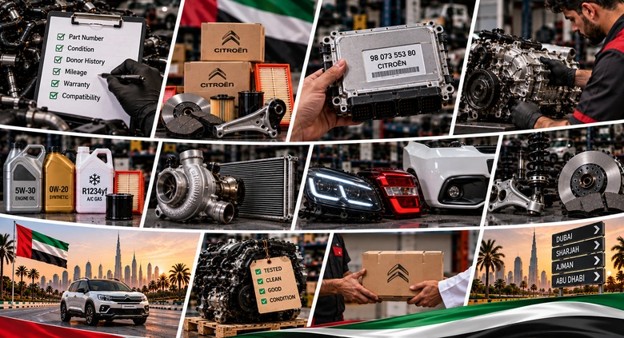
A proper quotation should ideally identify:
Vehicle: model and year
Engine: code/specification
Transmission: type/code where relevant
Part: exact description
Part number: supplied or verified
Condition: used/reconditioned/etc.
Donor: vehicle/model/year if known
Mileage: if available
Warranty: duration and conditions
Price: part-only or installed
Return policy: clearly stated
Anything less leaves too much room for misunderstanding.
Dubai, Sharjah and Ajman can have different sourcing patterns
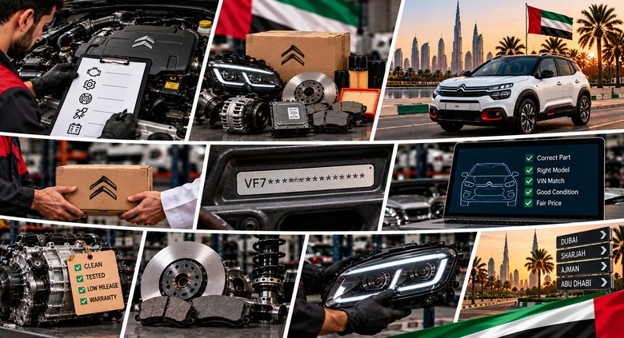
The UAE market is not one single warehouse.
Used European parts are often concentrated around established automotive trading and workshop areas, with Sharjah Industrial Areas, Dubai's Al Quoz and Deira, and Ajman's industrial districts forming important parts of the broader sourcing picture.
Availability changes constantly, though, so a current quotation is more useful than an old claim that a particular area “always has stock”.
When should you buy used?
Used makes particular sense when:
- the vehicle is older;
- the new genuine component is disproportionately expensive;
- the component is structurally simple;
- the donor history is credible;
- the exact part number is confirmed;
- the seller provides a reasonable warranty;
- the workshop can inspect and test the component.
It becomes less attractive when the component is safety-critical, highly electronic, heavily worn or difficult to diagnose after installation.
When should you choose new instead?
Choose new when the price difference is relatively small, the component is a consumable, failure could create a safety problem, or the used component carries too much uncertainty.
For example, spending less on an unknown used belt or filter makes little practical sense.
The same logic can apply to certain sensors and electronic components when a reliable new replacement is readily available.
Repair can beat replacement
Do not automatically assume the only choices are “new” or “used”.
Citroën's own UAE parts programme describes a broader approach involving repair, reuse, remanufacturing and recycling, while its after-sales material also references used and refurbished components.
A repairable original component can sometimes be the more sensible route, particularly when the existing part is known to belong to the vehicle and the fault can be accurately isolated.
Before You Click Buy: ask these questions
Is the exact part number confirmed?
Has the VIN been checked?
What vehicle did the part come from?
What was the donor mileage?
Why was the donor vehicle dismantled?
Has the actual part been tested?
What does “tested” mean?
Is the warranty written down?
Does labour fall under the warranty?
Can I return it if fitment is wrong?
Does the part require coding or calibration?
What is the total installed cost?
If the seller cannot answer several of these, the low price needs to be treated with caution.
Used Citroën buyer decision matrix
| Part type | Used option | What to verify | Buying caution |
| Engine | Often viable | Compression, leaks, mileage, donor history | High |
| Gearbox | Often viable | Code, road test, fluid, engagement, warranty | High |
| Alternator | Viable | Output, bearings, pulley, condition | Medium |
| Starter motor | Viable | Operation, noise, current draw where tested | Medium |
| Headlamp | Viable | Lens, moisture, electronics, mounting | Medium |
| Body panel | Often practical | Damage, alignment, paint condition | Low–Medium |
| ECU/module | Sometimes viable | Exact number, coding, configuration | High |
| Radiator | Viable with inspection | Leaks, fins, mounts | Medium |
| Suspension arm | Depends on wear | Bushes, ball joints, impact | Medium–High |
| Brake pads | Usually avoid used | Remaining material | Very high |
| Filters | Avoid used | Consumable condition | Very high |
| Trim/interior | Often practical | Clips, cracks, colour, condition | Low |
The cheapest used part is not necessarily the cheapest repair
This is the trap.
A gearbox at AED 2,000 that needs additional work, fluid, seals and installation can easily become more expensive than a better-tested unit at AED 3,000.
Likewise, a used headlamp that needs coding, brackets and repair may stop looking like a bargain.
Compare the whole job, not the headline price.
The final inspection should happen before the old part is discarded
Keep the failed component until the workshop has confirmed that the replacement works correctly.
For a major repair, check for warning lights, leaks, abnormal noises, correct electrical operation and proper road-test behaviour before the vehicle is signed off.
For programmed electronics, verify that the relevant functions operate normally after configuration.
That last check sounds obvious. It is also the bit that can prevent a return trip across Dubai or Sharjah because nobody tested the repair properly.
FAQs
Categories
- Audi
- BMW
- Car Accessories
- Car Tips
- Ford
- Land Rover
- Mazda
- Range Rover
- Top 10
- UAE Car Parts
- Used Car Parts
- Toyota
- Replacement Engines
- Nissan
- Hyundai
- Mitsubishi
- Volkswagen
- Honda
- Kia
- Chevrolet
- Dodge
- Jeep
- Subaru
- Renault
- Lexus
- Mercedes
- Suzuki
- Hummer
- Porsche
- Infiniti
- Peugeot
- GMC
- Mini
- Volvo
- Replacement Gearboxes
- MG
- Jaguar
- Skoda
- Cadillac
- Daihatsu
- Fiat
- German Car Parts
- Japanese Car Parts
- Aftermarket Car Parts
- Genuine Car Parts
- New Car Parts
- Reconditioned Car Parts
- European Car Parts
- American Car Parts
- Korean Car Parts
- British Car Parts
- Chinese Car Parts
- Sports/Exotic Car Parts
- Luxury Car Parts
- Performance Car Parts
- SUV/4x4 Spare Parts
- Truck Spare Parts
- EV Car Parts
- Hybrid Car Parts
- Auto Spare Parts in UAE
- Tesla
- Isuzu
- Ram
- Ferrari
- Bentley
- Lamborghini
- Genesis
- Maserati
- Lincoln
- Chrysler
- Opel
- Citroen