Used Daihatsu Spare Parts in UAE: What to Check Before Buying
September 26, 2026
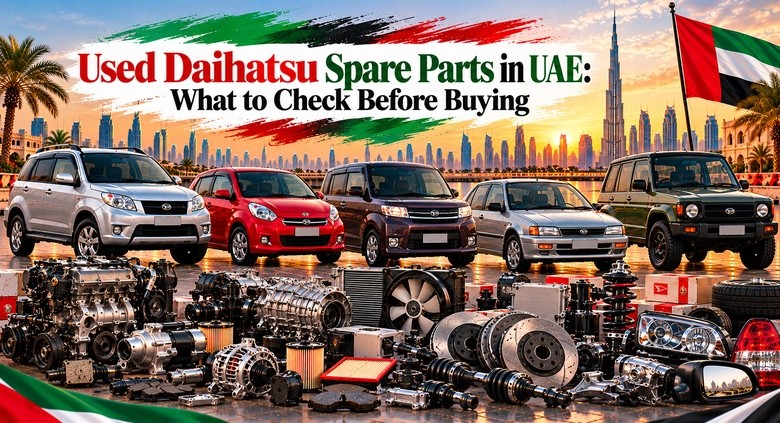
Used Daihatsu spare parts in UAE can make financial sense, particularly for older Terios, Sirion, Materia, Charade and Rocky models where a new replacement is expensive, special-order, or simply awkward to source. But “used” is not a quality grade. It tells you where the part came from, not whether it is actually suitable for your car.
That distinction matters more with Daihatsu than many buyers expect. Daihatsu’s overseas model range spans different markets and production programmes — including Terios, Sirion and Rocky in Indonesia — while older Rocky, Charade, Materia and Terios generations can have very different engines, body configurations and component specifications.
If the seller cannot identify the donor vehicle, part number, application and condition, the apparently cheap part may be nothing more than an expensive guess.
Used Daihatsu parts are not automatically a bargain
The attraction is obvious: an original used component can cost substantially less than a new genuine or imported part.
The trap is buying on appearance alone.
A clean-looking alternator may have worn bearings. A gearbox casing can look perfect while its bearings or synchronisers are tired. A headlamp can be physically correct but have damaged mounting points or moisture inside the housing.
For used Daihatsu parts, condition and compatibility have to be considered together.
Start with the exact Daihatsu, not the part name
“Terios brake calliper” is not enough information.
You need the generation, model code where available, production year, engine, transmission, drivetrain and ideally the VIN or chassis number.
The official Daihatsu model information itself shows why this matters: Terios, Sirion and Rocky appear in different overseas markets and production arrangements.
Terios needs particular attention to generation
Older Terios vehicles are not one universal specification.
The first-generation J1 family and later J2/F7 applications cover different periods and configurations. Current used-parts catalogues distinguish Terios J1 from J2/F7 rather than treating them as a single vehicle.
So if someone offers a “Terios used gearbox” without identifying the generation and gearbox code, stop there.
Sirion parts can cross generations incorrectly
Sirion is another deceptively simple name.
A component advertised simply as “Daihatsu Sirion” could relate to a completely different generation, engine or electrical configuration.
Small hatchbacks often share visually similar components while using different connectors, mounting points or control systems. The part number is much more useful than the photograph.
Materia is an older-car sourcing exercise
The Materia sits in a different ownership category from newer Daihatsu models.
For an older vehicle, availability itself becomes part of the purchasing decision. A used original body panel, lamp, trim piece or control unit may be more realistic to source than waiting for a new imported item.
But age works both ways. Rubber, plastics, electrical connectors and seals have also aged.
Charade requires generation-specific checking
Charade is particularly unsuitable for casual parts matching.
Older Charades were sold with multiple engines and configurations, and some Rocky listings in the UAE market even identify components by their shared Charade/Rocky applications. A current UAE listing, for example, shows a coolant-temperature sensor application covering 1988–1992 Charade and 1990–1992 Rocky.
That is useful evidence of cross-application — but it is not permission to assume every Charade and Rocky component is interchangeable.
Rocky is the classic “check the model code” vehicle
The Rocky name covers very different generations.
Current parts catalogues distinguish newer A200S/A210S Rocky applications from older F7/F8 and F75 versions.
That difference is enormous when you are buying bodywork, suspension, lighting, engine components or drivetrain parts.
Ask for the donor vehicle
A serious used-parts seller should be able to tell you what vehicle the part came from, at least in broad terms.
Ideally you want:
- donor model
- model year
- engine
- transmission
- drivetrain
- mileage
- chassis/VIN information where available
- reason for dismantling
- accident history
- flood exposure
- photographs of the actual component
“Removed from a working car” is useful information.
“Used condition” is not.
Donor mileage matters differently for different parts
Mileage is especially useful for mechanical components.
An alternator from a low-mileage donor is not automatically good, but it gives you a starting point.
For a body mirror or trim panel, mileage matters very little. For an engine, gearbox, differential, steering rack or compressor, it matters considerably more.
The seller should not give identical evidence for every category.
Ask why the donor vehicle was dismantled
This question gets surprisingly little attention.
A donor car written off after rear-end damage may provide an excellent front suspension component.
A flood-damaged donor is another story entirely.
If the vehicle was dismantled because of mechanical failure, you need to know whether the part you are buying was actually tested before removal.
Flood history is a major warning sign
Electrical and electronic parts from flood-damaged vehicles deserve particular caution.
Water can enter connectors, modules, motors, switches and wiring harnesses, then create intermittent problems weeks or months later.
A dry-looking control module does not prove that its connector terminals are healthy.
UAE heat changes the used-parts equation
The UAE climate is not simply “hot”.
Repeated heat exposure can accelerate ageing in rubber, plastics, wiring insulation, seals, hoses, batteries and interior components.
For a used radiator, inspect the core and tanks.
For suspension bushes, inspect cracking and deformation.
For engine hoses, look for hardening, surface cracking and swelling.
For electrical connectors, look for corrosion or heat damage.
Rubber components need closer inspection
Used rubber parts are usually poor candidates when the saving is small.
Bushes, mounts, hoses, seals and suspension boots can deteriorate with age even when the donor vehicle has covered relatively few kilometres.
A five-year-old used rubber component is not necessarily five times better than a ten-year-old one simply because its mileage is lower.
Suspension parts need more than a visual inspection
Used shocks should be checked for oil leakage, damaged rods, corrosion and physical deformation.
Springs should be inspected for cracks, broken ends and corrosion.
Control arms require attention around bushes and ball joints.
For a complete suspension assembly, the workshop should inspect the mating components rather than fitting the part blindly.
Used steering components deserve caution
Steering racks, tie rods, steering knuckles and related components directly affect vehicle control.
A used steering rack should not be purchased simply because there is no visible leak.
Check free play, mounting points, shaft condition and, where appropriate, hydraulic or electronic operation.
Brakes are not a place to chase the cheapest used part
A used brake calliper can sometimes be viable if it is properly inspected, rebuilt where appropriate and confirmed for the exact application.
Used friction material, badly corroded discs or questionable hydraulic components are different.
For safety-critical braking components, the condition and specification should outweigh a small saving.
Used ABS components require diagnostic evidence
ABS sensors and related components can look completely healthy while producing an intermittent signal fault.
If buying a used sensor, confirm the exact application and connector.
After installation, the vehicle should be scanned and road-tested rather than assuming the warning light will stay off.
Headlamps are more complicated than they look
A used Daihatsu headlamp may have:
- broken mounting tabs
- cloudy lenses
- moisture ingress
- damaged adjusters
- corroded connectors
- incorrect bulb configuration
- internal reflector damage
Photographs from the front are not enough.
Ask for photographs of the rear housing and mounting points as well.
Tail lamps should be checked for water ingress
This is particularly relevant to older vehicles.
Look inside the lamp for condensation, staining or corrosion around the bulb holders.
A used lamp that already contains moisture is not a bargain; it is a future electrical problem wearing a red lens.
Engine components need a different buying process
Buying a used engine is not like buying a used door.
Ask for the engine code, donor mileage, compression information where available, oil condition, coolant condition and reason for removal.
If the engine is still accessible before installation, a workshop can perform additional checks rather than relying entirely on the seller's description.
Compression testing can expose a bad engine
For a used petrol engine, compression testing can provide useful evidence about cylinder condition.
It should not be treated as a complete engine-health certificate, though.
Uneven compression can point towards valve, piston, ring or head-gasket problems, while acceptable compression does not automatically rule out oil consumption, cooling problems or bearing wear.
Leak-down testing is even more revealing in some cases
Where an engine is expensive enough to justify deeper testing, a leak-down test can help identify where compression is escaping.
Air heard through the intake, exhaust or crankcase points the investigation in different directions.
That is much more useful than “engine turns freely”.
Check the cooling system before installing a used engine
A replacement engine cannot compensate for a cooling system that is already failing.
Inspect the radiator, thermostat, water pump, hoses, fan operation and expansion system.
A used engine installed into an overheating vehicle can become another casualty.
Turbocharged components need extra scrutiny
If your Daihatsu application uses a turbocharger, inspect shaft play, compressor-wheel condition, oil contamination and housing damage.
Do not buy a turbo purely because the blades appear intact.
A proper assessment should consider lubrication and the condition that caused the original turbocharger to fail.
Gearboxes need evidence, not optimism
A used gearbox should come with more information than “tested”.
Ask:
- gearbox code
- donor mileage
- manual or automatic
- drivetrain
- reason for removal
- whether it was road-tested
- whether there were shift problems
- whether oil was inspected
- whether the casing has been repaired
The gearbox code is often more useful than the vehicle badge.
Inspect the gearbox oil where possible
Metal particles, burnt odour or badly contaminated fluid should trigger questions.
The condition of the oil cannot diagnose every internal fault, but it can provide useful evidence about how the component was being treated before removal.
A used clutch assembly is rarely an obvious win
Clutch components are wear items.
If the gearbox is already being removed, installing a questionable used clutch to save money can make little economic sense once labour is included.
This is a classic case where the cheapest component can become the expensive option.
Alternators and starters should be bench-tested
Do not accept “it came off a running car” as the final test.
A proper electrical bench test can check charging output, current draw and operation.
For an older Daihatsu, this can be particularly worthwhile because the labour involved in accessing the component may exceed the price difference between a questionable used unit and a tested replacement.
Compressors and A/C components need UAE-specific thinking
Air-conditioning systems work hard in the UAE.
A used compressor should be checked for shaft condition, clutch operation where applicable, noise and oil contamination.
The rest of the system matters too. Installing another compressor into a contaminated or incorrectly charged system can simply repeat the failure.
ECU and electronic modules are different again
A used ECU may be physically identical but electronically unsuitable.
Some modules require coding, programming, immobiliser matching or configuration.
That means the seller needs to provide the exact part number and the workshop needs to understand whether the module can be installed directly or requires programming.
Never ignore the connector
Two modules can have similar housings and different connectors.
Even where the connector appears identical, the pin configuration may differ.
Photograph the original connector and compare the actual part number before buying.
Body panels are where used parts can make real sense
Doors, wings, bonnets, tailgates and certain trim pieces can be sensible used purchases when they are straight, rust-free and correctly specified.
The real saving can become meaningful if the panel already carries the correct paint finish.
But check mounting points and previous repairs.
Matching paint in the UAE is not always straightforward
A panel can be the correct colour code and still look slightly different from the rest of an older vehicle.
Sun exposure changes paint over time.
If appearance matters, compare the donor panel with the vehicle under natural daylight rather than judging colour solely from a workshop photograph.
Mirrors need electrical and specification checks
A mirror may contain electric adjustment, folding, heating, indicators or other equipment depending on specification.
A visually identical manual mirror is not necessarily a replacement for an electrically equipped unit.
Compare the connector and equipment before purchase.
Interior parts are often the safest used-parts category
Seats, trims, switches, consoles and some dashboard components generally carry less mechanical risk.
Condition becomes the deciding factor.
Still, airbag-equipped seats and safety-related components require separate scrutiny.
Avoid casually buying used airbags
An airbag is not an ordinary used trim component.
Its history, storage conditions, deployment status and compatibility matter.
For safety restraint components, a workshop should verify the exact specification and condition before installation.
Wheels should be checked for impact damage
A used alloy wheel can look fine while carrying a crack or deformation on the inner rim.
Check for:
- bends
- cracks
- weld repairs
- excessive corrosion
- damaged mounting faces
- incorrect offset
- incorrect diameter or width
Balancing should be part of the post-installation check.
Check the donor's regional specification
A Daihatsu sourced from Japan, Indonesia, Malaysia or another market may not have exactly the same equipment as a UAE-market vehicle.
Daihatsu's own corporate information confirms that models and production arrangements differ between overseas markets.
That makes regional specification a genuine fitment issue rather than a minor paperwork detail.
A UAE listing is not necessarily a UAE-specification part
A component being physically located in Dubai or Sharjah does not prove that it originated from a UAE-spec vehicle.
Ask where the donor came from.
For imported Daihatsu models, this can be just as important as asking the model year.
Current UAE listings show why part-level checking matters
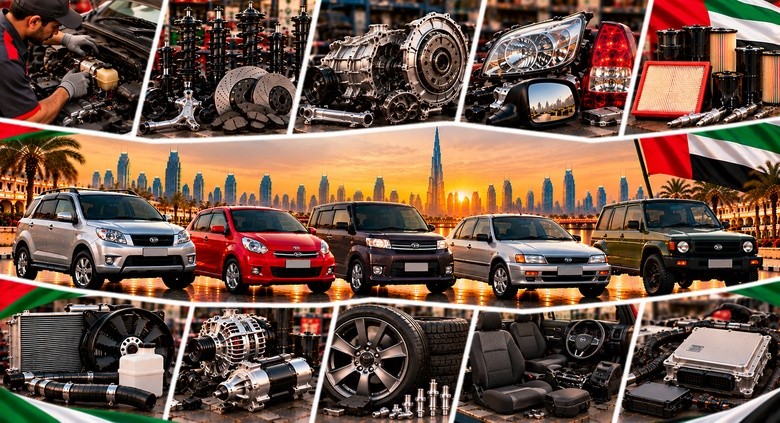
Public UAE listings currently show Daihatsu Rocky components with very different applications and prices — for example, a listed axle bearing at AED 200, cam seal at AED 40, exhaust gasket at AED 30 and a coolant-temperature sensor at AED 310. These are public listing observations checked in September 2026, not fixed UAE market prices or quotations.
The lesson is more important than the numbers: the catalogue identifies applications by model/year, rather than treating “Rocky parts” as one undifferentiated category.
There is also evidence of used Terios inventory internationally
A current used-parts catalogue lists 78 Daihatsu Terios parts and separates J1 from J2/F7 generations, with categories covering electronics, transmission, engine, suspension, brakes, body and cooling components.
That is the sort of categorisation buyers should expect from a serious sourcing process.
Rocky has an especially wide generation spread
Older F75 Rocky/Wildcat applications are entirely different from newer Rocky models.
For example, current catalogued F75 applications include 2.8-litre diesel variants from 1985–1987, while newer Rocky applications include the A200S/A210S generation.
Ordering by “Rocky” alone is asking for trouble.
Used genuine, OEM and aftermarket are not the same
These terms should not be mixed together.
Used genuine: an original manufacturer component removed from another vehicle.
OEM: terminology that can refer to original-equipment manufacturing relationships, but should be verified rather than assumed from a seller's wording.
Aftermarket: made by another manufacturer.
Reconditioned: a previously used component that has been inspected, repaired or rebuilt to a stated process.
A used genuine component can be preferable to an unknown aftermarket part in one application and a poor choice in another.
Reconditioned can be more sensible than used
For components such as alternators, starters, callipers or certain mechanical assemblies, a properly reconditioned unit can offer a different risk profile from an untouched used part.
The important question is what was actually done.
“Reconditioned” without a work description, test result or warranty is too vague.
Warranty changes the real price
Suppose one seller offers a used component at AED 400 with no warranty and another offers a tested unit at AED 550 with a written replacement warranty.
The AED 400 part is not automatically cheaper once fitting, removal and potential return costs are considered.
For expensive or labour-intensive components, warranty terms belong in the quotation.
Ask what happens if the part fails
A useful used-parts warranty should make clear:
- warranty period
- parts covered
- labour coverage or exclusion
- return procedure
- testing requirements
- exclusions
- shipping responsibility
- whether seals or fluids invalidate the warranty
“Warranty available” is not enough.
The workshop should inspect the original failure first
This is one of the easiest ways to waste money.
If the original alternator failed because of a wiring or charging-system problem, replacing it with another used alternator may not solve anything.
If a gearbox failed because of contamination, fitting another gearbox without investigating the cause is asking for a repeat repair.
The replacement part is only half the job.
Use PartFinder UAE as part of a VIN-led sourcing process
For buyers comparing used Daihatsu components at PartFinder UAE, the useful approach is not simply to search for the cheapest listing. A VIN, model code, engine code, gearbox code and original part number can narrow the search dramatically before money changes hands.
That matters particularly for older vehicles where several generations share the same badge but not necessarily the same component.
Before You Click Buy
Run through this quickly:
| Check | What you want |
| Vehicle | Exact model and generation |
| VIN/chassis | Supplied where available |
| Engine | Exact engine code |
| Gearbox | Exact transmission/code |
| Part | Original part number |
| Donor | Vehicle identity and mileage |
| Condition | Actual photographs of the component |
| History | Accident/flood/dismantling reason |
| Testing | Evidence appropriate to the part |
| Warranty | Written terms |
| Return | Clear process |
| Installation | Workshop inspection before fitting |
If several boxes remain blank, the low price is not enough to justify the risk.
The sensible used-parts rule for Daihatsu owners
Use used parts where the component's condition can be established, the fitment can be proven and the saving is meaningful.
Be much more conservative with engines, gearboxes, steering, brakes, airbags and electronic modules.
Daihatsu itself places substantial emphasis on quality processes across purchasing, production, inspection, logistics and service, including supplier assessment and traceability. Its maintenance operations also continue to adopt more systematic inspection processes; in 2026, Daihatsu expanded its DAVIS inspection system to cover the more complex 24-month inspection process at participating sales companies.
That philosophy translates neatly to used-parts buying: identify first, inspect second, price third.
The part is cheap only when it fits, works and survives installation. Otherwise, the bargain disappears remarkably quickly.
UAE Update Reference: September 2026
Daihatsu's overseas model information and UAE public parts listings can change, particularly for older vehicles and imported specifications. Prices mentioned above are dated public-market observations where stated, not fixed quotations. For a specific purchase, the vehicle identification, part number, donor history, condition and warranty should be rechecked before ordering.
FAQs
Categories
- Audi
- BMW
- Car Accessories
- Car Tips
- Ford
- Land Rover
- Mazda
- Range Rover
- Top 10
- UAE Car Parts
- Used Car Parts
- Toyota
- Replacement Engines
- Nissan
- Hyundai
- Mitsubishi
- Volkswagen
- Honda
- Kia
- Chevrolet
- Dodge
- Jeep
- Subaru
- Renault
- Lexus
- Mercedes
- Suzuki
- Hummer
- Porsche
- Infiniti
- Peugeot
- GMC
- Mini
- Volvo
- Replacement Gearboxes
- MG
- Jaguar
- Skoda
- Cadillac
- Daihatsu
- Fiat
- German Car Parts
- Japanese Car Parts
- Aftermarket Car Parts
- Genuine Car Parts
- New Car Parts
- Reconditioned Car Parts
- European Car Parts
- American Car Parts
- Korean Car Parts
- British Car Parts
- Chinese Car Parts
- Sports/Exotic Car Parts
- Luxury Car Parts
- Performance Car Parts
- SUV/4x4 Spare Parts
- Truck Spare Parts
- EV Car Parts
- Hybrid Car Parts
- Auto Spare Parts in UAE
- Tesla
- Isuzu
- Ram
- Ferrari
- Bentley
- Lamborghini
- Genesis
- Maserati
- Lincoln
- Chrysler
- Opel
- Citroen
- SsangYong
- Seat
- McLaren
- Aston Martin
- Rolls Royce
- Maybach
- Alfa Romeo
- Bugatti