Used Genesis Spare Parts in UAE: What Luxury Car Owners Should Check

September 15, 2026
The Used-Part Decision Starts With the Car, Not the Price
A cheap Genesis part can become an expensive mistake
Used Genesis parts can make financial sense in the UAE, particularly when a replacement is no longer economical to buy new. But the attractive number on the quotation is not the decision.
A used G70 headlamp, GV80 suspension part, G80 electronic module or G90 interior assembly may look perfectly clean and still be the wrong part for the vehicle. Genesis specifications vary by model, engine, drivetrain, trim and market, and the manufacturer itself warns that specifications can vary by model and country.
That matters more in the UAE than many buyers expect. A car imported from Korea, North America or another GCC market may have a different specification from a UAE-delivered car even when the badge, body shape and model year look identical.
The sensible approach is therefore simple:
Verify the vehicle first. Verify the part second. Negotiate the price third.
Which Genesis models need the most careful used-part checking
The range covered by the UAE Genesis catalogue includes the G70, G80, G90, GV70 and GV80, alongside other derivatives.
They should not be treated as one generic parts family.
| Model | What deserves particular attention when buying used |
| G70 | Engine specification, brake package, suspension, electronics and drivetrain |
| G80 | Trim-dependent electronics, suspension, lighting and powertrain |
| G90 | Luxury interior equipment, electronic systems, suspension and comfort features |
| GV70 | Engine, AWD configuration, wheels, brakes and electronic equipment |
| GV80 | Engine, AWD, wheel/brake package, suspension and cooling-related parts |
The G70 is especially easy to misidentify because apparently similar cars can have different engine and equipment combinations. The larger G90 is another trap: an interior switch, seat module or suspension-related part can be substantially more complicated than its physical appearance suggests.
The GV70 and GV80 introduce another layer because SUV specification, wheel size, AWD configuration and engine choice can alter the required part.
The first check should be the VIN
Do not begin with a photograph.
Begin with the VIN.
A seller may send a photograph of a headlamp or suspension arm and say it came from a GV80. That tells you almost nothing about whether it belongs on your GV80.
Give the workshop or parts specialist:
- Full VIN
- Model
- Model year
- Engine
- Drivetrain
- Country or market of origin
- Existing part number
- Vehicle registration information where appropriate
- Photograph of the installed part
- Diagnostic information if the part is electronic
Then compare the supplied part number against the vehicle identification information.
This is particularly important for imported Genesis cars. The UAE market may contain GCC-specification vehicles alongside privately imported cars. Treating them as identical simply because they share a model name is asking for trouble.
Why a photograph is not enough
A visual match is useful for the first ten seconds.
It is not a fitment test.
Two headlights can have the same shape while differing in:
- Connector configuration
- Control module
- Software
- Market specification
- Adaptive-lighting capability
- Internal electronics
- Mounting arrangement
- Revision level
The same problem appears with mirrors, infotainment screens, instrument clusters, cameras, parking sensors and body-control modules.
Mechanical parts can fool you too. A suspension arm can physically bolt into place and still be wrong for a particular suspension configuration.
The most reliable used-part transaction is therefore based on identification plus testing, not appearance.
GCC-specification versus imported Genesis cars
A used Genesis in Dubai or Abu Dhabi may have spent its entire life in the Gulf, or it may have arrived from another market after an accident, auction purchase or ownership change.
That history changes the parts conversation.
Ask where the donor vehicle came from. Then ask where your vehicle came from.
A UAE/GCC specification should not automatically be assumed simply because the vehicle is registered in the UAE.
Imported vehicles can carry different:
- Lighting configurations
- Multimedia systems
- Radio specifications
- Sensors
- Emissions equipment
- Cooling arrangements
- Driver-assistance equipment
- Software configurations
Genesis's own regional catalogue and specification material should be treated as the reference point for the relevant market rather than assuming every global specification is interchangeable.
A compact buying checklist
Before paying for used Genesis spare parts in UAE, have these details in front of you:
| Check | What to confirm |
| VIN | Exact vehicle identity |
| Model/year | Correct generation |
| Engine | Correct engine family and specification |
| Drivetrain | RWD/AWD where applicable |
| Part number | Exact number and revision |
| Supersession | Whether the original number has been replaced |
| Donor VIN | Vehicle the used part came from |
| Donor mileage | Prefer documented mileage |
| Condition | Physical and functional condition |
| Testing | Test report or workshop verification |
| Coding | Whether programming/calibration is required |
| Warranty | Written terms, not verbal promises |
| Invoice | Part identification and seller details |
If a seller cannot provide the basic identification information, the discount should not be the thing that persuades you.
Understanding the Donor Part
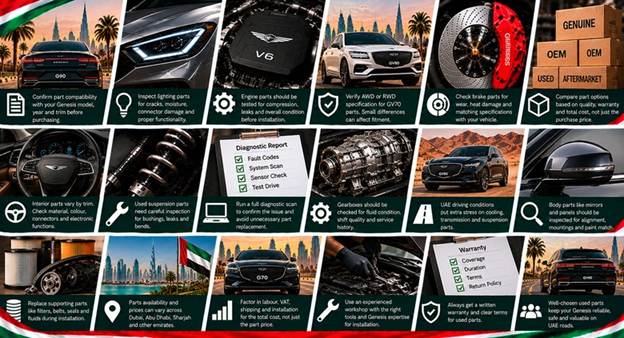
Donor history is more valuable than a shiny casing
A used Genesis part is really a piece of another vehicle's history.
That history should be investigated.
For a mechanical part, ask whether the donor vehicle was:
- Accident damaged
- Flood affected
- Written off
- Mechanically failed
- Dismantled after normal use
- Imported after auction
- Stored for a long period
For electronic parts, the donor history becomes even more important. A module removed from a flood-damaged vehicle can look almost perfect externally while corrosion has already started inside connectors or circuit boards.
The safest donor is not necessarily the lowest-mileage donor.
It is the donor with the clearest history.
Why low mileage can be misleading
“Low mileage” has become one of the most abused phrases in used-parts selling.
A 35,000 km donor vehicle sounds attractive. But what kind of kilometres?
A vehicle used mainly for short urban trips, repeated hot starts and heavy stop-start traffic can place different stresses on some parts than a higher-mileage vehicle that spent much of its life cruising on motorways.
For Genesis parts in the UAE, also ask:
- Was the car parked outdoors?
- Was it exposed to extreme heat?
- Was it accident repaired?
- Was it flood affected?
- Was it maintained properly?
- Was the odometer history documented?
- Was the donor vehicle operational immediately before dismantling?
Mileage should be treated as one evidence point, not a guarantee of condition.
Used engines need a completely different level of proof
An engine is not a headlamp.
Do not buy a used Genesis engine because the seller says it is “tested”.
Ask what tested means.
A meaningful engine inspection can include:
- Compression testing
- Leak-down testing where appropriate
- Oil-pressure verification
- Cooling-system pressure testing
- Inspection for coolant contamination
- Oil-condition assessment
- Cylinder inspection where feasible
- Diagnostic scanning
- External leak inspection
- Turbocharger inspection on turbocharged engines
- Crankcase ventilation checks
- Evidence of abnormal smoke or blow-by
Compression results should be recorded, not merely described as “good”.
The exact acceptable readings depend on the engine and test conditions, so a workshop should compare the results against the appropriate technical specification rather than inventing a universal pass mark.
What compression testing actually tells you
Compression testing is useful because it moves the conversation from appearance to measurable condition.
The workshop should document:
- Engine temperature during testing
- Battery condition
- Throttle position where relevant
- Compression result for each cylinder
- Variation between cylinders
- Any abnormal cranking behaviour
A single low cylinder does not automatically mean the engine is unusable. It means the technician needs to investigate.
A leak-down test can then help distinguish between possible leakage paths through valves, piston rings or the head-gasket area.
For an expensive used Genesis engine, spending money on proper testing before installation is usually far cheaper than discovering a serious internal problem after the engine has been fitted.
Used gearboxes need evidence too
The transmission casing tells you very little.
Ask for:
- Donor VIN
- Donor mileage
- Transmission identification
- Service history
- Fluid condition
- Evidence of previous repair
- Diagnostic scan where available
- Shift-quality assessment
- Confirmation of whether programming or adaptation is required
A gearbox removed from a vehicle with a known drivetrain problem deserves particular suspicion.
The fact that it is physically identical to yours does not prove that it is healthy.
For an electronically managed transmission, the mechanical installation may only be the beginning. Adaptation, calibration or software procedures may be required depending on the vehicle and repair.
Used suspension parts are not all equal
Suspension parts live a difficult life in the UAE.
Heat is only one factor. Speed humps, potholes, kerbs, heavy SUV weights and large wheel packages can all affect suspension wear.
A used control arm with a worn bush is not necessarily a bargain.
Inspect:
- Bushings
- Ball joints
- Mounting points
- Corrosion
- Bent metal
- Accident deformation
- Rubber deterioration
- Electronic or air-suspension connections where applicable
For premium Genesis models, suspension should be assessed as a system rather than buying the cheapest individual part available.
Model-Specific Checks
G70 used parts require specification discipline
The G70 is a relatively compact performance-oriented Genesis, but its parts catalogue is not correspondingly simple.
Genesis's regional specification pages show that the model is available in different engine configurations and equipment combinations.
That makes engine-related and braking parts particularly important to verify.
Before buying a used G70 part, check:
- Engine
- Drivetrain
- Brake package
- Wheel size
- Suspension specification
- Electronic equipment
- Production year
- Market origin
A brake disc that looks correct may not be correct for the particular brake package.
Likewise, an engine-related sensor from one specification should not be assumed to work on another because the connector appears similar.
G80 parts should be checked against equipment level
The G80 sits higher in the range and tends to combine more comfort and electronic equipment.
That changes the used-parts risk.
A simple mechanical bracket is relatively straightforward.
A camera, radar-related part, seat module, lighting assembly, infotainment unit or control module may require much more investigation.
Genesis's official G80 material provides model and specification information but also notes that specifications can vary by model and country.
For an imported G80, therefore, do not let a seller's statement that the part is “for G80” end the discussion.
The useful phrase is:
“For which G80 specification?”
G90 used parts deserve the strictest interior and electronics checks
The G90 is where a casual used-parts inspection becomes particularly risky.
Its luxury equipment means the physical part may be only a small portion of the total system.
Before buying:
- Seat modules should be identified correctly.
- Switch packs should match the trim.
- Screens should be checked for compatibility.
- Cameras should be verified by specification.
- Lighting assemblies should be matched by part number.
- Suspension parts should be confirmed against the vehicle's actual equipment.
- Interior trim should be checked for colour and finish.
A used G90 seat can look immaculate and still contain a failed electronic module.
A used infotainment display can power on and still have compatibility or software issues.
This is precisely why expensive luxury parts should be tested before installation whenever practical.
GV70 parts require engine and drivetrain verification
Genesis's regional GV70 specification information covers multiple configurations, and its specification page explicitly notes that specifications can vary by model or country.
For used GV70 parts, verify:
- Engine
- AWD/RWD configuration where applicable
- Brake package
- Wheel specification
- Suspension
- Sensors
- Lighting
- Cooling system
- Electronic modules
The larger mistake is buying by body style.
The GV70 may look identical from ten metres away. That does not make every part interchangeable.
GV80 parts can become expensive very quickly
The GV80 combines a large SUV platform with substantial electronic and mechanical equipment.
Current Genesis regional material lists 2.5T and 3.5T powertrain configurations for the GV80 family, including AWD applications, and specification can differ by version.
That matters when buying used:
- Engine parts must match the engine.
- Turbo-related parts need exact identification.
- Cooling parts need specification confirmation.
- Brake parts should match wheel/brake package.
- Suspension parts require inspection for accident damage.
- Electronic parts may require coding or calibration.
A GV80 part should therefore be treated as a model-specific purchase, not a generic Hyundai-group spare part.
Model similarity is not proof of interchangeability
One of the most dangerous phrases in a used-parts market is:
“It is from the same family.”
That may be useful background.
It is not fitment evidence.
A part can share a manufacturer, platform relationship or connector and still differ in software, calibration, dimensions or specification.
Use the VIN and part number to establish compatibility. Use physical inspection to establish condition.
Those are two different questions.
Genuine, OEM, Aftermarket, Reconditioned and Used
Genuine does not mean the same thing as used
These terms describe different things.
Genuine generally refers to a part supplied under the vehicle manufacturer's genuine-parts programme.
OEM is commonly used for original-equipment manufacturer or equivalent terminology, although sellers sometimes use the label loosely.
Aftermarket means a part made outside the vehicle manufacturer's branded supply channel.
Reconditioned means a previously used part that has undergone some form of refurbishment or rebuilding.
Used normally means removed from another vehicle and sold in its existing condition, subject to whatever testing the seller actually performed.
Do not allow these terms to blur together.
A used genuine part is still used.
A new aftermarket part is still aftermarket.
A reconditioned gearbox is not automatically equivalent to a new gearbox.
Why reconditioned is not automatically better than used
A professionally rebuilt part can be excellent.
But “reconditioned” needs to be unpacked.
Ask:
- What was replaced?
- What was measured?
- What was machined?
- What was tested?
- Which seals were replaced?
- Which internal parts were inspected?
- Was the part dynamically tested?
- Is there a written test report?
- What warranty is provided?
For a gearbox, “overhauled” should mean something specific.
For an engine, “reconditioned” should come with evidence of what work was performed.
Otherwise the label becomes marketing rather than technical information.
When a used genuine part can be the sensible choice
There are situations where used makes excellent sense.
For example:
- A body panel in matching colour
- A trim piece
- A non-safety bracket
- A discontinued interior item
- A complete wheel
- Certain mechanical assemblies with documented condition
- A hard-to-source original electronic part after proper testing
The calculation changes when the part is critical to safety, reliability or programming.
Used brake-related, steering, airbag or advanced electronic parts deserve a much higher inspection threshold.
A practical quality comparison
| Part option | Main advantage | Main risk | Best use |
| Genuine new | Highest confidence in specification | Higher purchase price | Critical or warranty-sensitive repairs |
| OEM-quality new | Strong balance | Seller terminology can be vague | Appropriate mechanical repairs |
| Aftermarket new | Wider price range | Quality varies substantially | Non-critical parts from reputable makers |
| Reconditioned | Can restore expensive assemblies | Quality depends on rebuilding process | Engines, gearboxes and major assemblies when documented |
| Used genuine | Original fit and potentially lower cost | Unknown history | Selected parts after inspection |
| Unknown used | Lowest entry price | Highest uncertainty | Generally poor choice for critical parts |
The cheapest line in the table is not necessarily the cheapest outcome.
Electronics deserve a separate buying category
Electronic parts are where many used-parts buyers underestimate risk.
A module may require:
- Coding
- Programming
- Configuration
- Calibration
- Security pairing
- Vehicle-network communication
- Sensor calibration
A replacement screen might illuminate but fail to communicate correctly.
A camera might physically fit but require calibration.
A control module might be electrically healthy but not configured for your vehicle.
Therefore ask the workshop before purchasing whether the used part can actually be programmed or configured for your vehicle.
Do not pay a premium for the word “OEM” alone
Ask for evidence.
Useful evidence includes:
- Manufacturer
- Part number
- Packaging
- Manufacturing markings
- Application list
- Test documentation
- Warranty
- Installation instructions
If the seller refuses to identify the manufacturer, “OEM” has very little meaning.
Price, Labour and the Real UAE Repair Bill
Part price is only one line on the invoice
A used Genesis part may appear dramatically cheaper than a new replacement.
Then the rest of the invoice arrives.
The final bill can include:
- Part
- Shipping
- VAT
- Diagnostic time
- Removal
- Installation
- Programming
- Calibration
- Fluids
- Seals
- Fasteners
- Alignment
- Road testing
- Additional supporting parts
The UAE Federal Tax Authority currently identifies VAT at 5%.
That makes it worth asking whether a quoted price is before or after VAT.
Dubai labour rates show why workshop choice matters
Current 2026 Dubai workshop pricing guides show a wide spread between general independent workshops, specialists and dealer-level facilities. One current guide places estimated independent labour around AED 100–180 per billed hour, specialist work around AED 180–300 and dealer-level labour around AED 300–500, while another current UAE repair guide reports similarly wide ranges. These are market estimates, not fixed tariffs.
For a Genesis, the hourly number should not be considered alone.
A workshop with the correct diagnostic equipment may charge more per hour and still produce a lower total bill because the diagnosis is quicker and more accurate.
UAE labour comparison should be read as a market tendency
There is no single national Genesis labour tariff covering every workshop.
| Area | Typical market consideration |
| Dubai | Broadest spread between budget, specialist and dealer-level workshops |
| Abu Dhabi | Luxury and premium vehicle support available, but quote comparison remains important |
| Sharjah | Often competitive independent-workshop pricing; confirm diagnostic capability |
| Ajman | Can be attractive for labour-sensitive repairs; check equipment and Genesis experience |
| Ras Al Khaimah | Fewer specialist choices than Dubai; verify parts sourcing before approval |
| Fujairah | Local convenience can matter; major electronic repairs may require specialist support |
| Umm Al Quwain | Compare total cost and parts availability rather than labour alone |
The point is not that one emirate is “cheap”.
It is that the cheapest hourly rate does not automatically produce the cheapest finished repair.
Ask for labour hours, not just a labour total
Suppose a workshop quotes AED 1,200 labour.
That number tells you little.
Ask:
- What hourly rate?
- How many billed hours?
- Does diagnosis count separately?
- Is programming included?
- Is road testing included?
- Is alignment included?
- Are fluids included?
A current Dubai workshop example publicly lists AED 230 per hour plus 5% VAT, while other independent workshops publish lower rates. The variation illustrates why a buyer should compare the actual job rather than a headline rate.
Landed cost is the figure worth comparing
For an imported used part:
Landed cost = part price + shipping + applicable taxes/charges + delivery + inspection + installation
That calculation can completely change the decision.
A used part advertised at a very low price is not necessarily cheaper once shipping and workshop time are added.
For expensive Genesis electronics or body parts, ask for the all-in installed price before deciding.
A realistic quotation should be itemised
A useful quote should separate:
| Cost line | What you should see |
| Used part | Exact part and part number |
| Shipping | If applicable |
| VAT | Clearly identified |
| Diagnosis | Fixed or estimated hours |
| Labour | Rate and estimated hours |
| Programming | Included or separate |
| Calibration | Included or separate |
| Supporting parts | Seals, fluids, bolts etc. |
| Warranty | Duration and exclusions |
| Total | Final expected amount or approval limit |
If the quotation says simply “Genesis repair — AED X”, ask for a breakdown.
What the Workshop Should Actually Test
Start with a diagnostic scan when the part is electronic
Do not remove a module simply because a warning light appeared.
The technician should first establish whether the suspected part is actually the cause.
That can involve:
- Fault-code scan
- Live data
- Power and ground testing
- Connector inspection
- Communication-network testing
- Sensor readings
- Wiring continuity
- Module communication
- Software/configuration checks
A diagnostic trouble code identifies a system condition. It does not always identify the failed part.
That distinction saves money.
Inspect connectors before blaming the module
UAE heat, dust and repeated temperature cycles can make electrical connections worth checking carefully.
Inspect:
- Connector pins
- Corrosion
- Water ingress
- Loose terminals
- Wiring damage
- Previous repair work
- Non-factory splicing
- Ground connections
If a module is replaced without checking the connector or wiring, the replacement may behave exactly like the original.
That is not a parts problem.
It is a diagnosis problem.
Mechanical parts need physical testing
For suspension:
- Check play
- Check bush condition
- Check leaks
- Check deformation
- Check mounting points
For cooling parts:
- Pressure-test the system where appropriate
- Inspect for leaks
- Check fan operation
- Inspect hoses and connections
For steering:
- Check play
- Check fluid leaks where applicable
- Inspect mounting points
- Scan electronic steering systems where applicable
For brakes:
- Inspect disc thickness
- Check pad condition
- Measure run-out where indicated
- Inspect calipers
- Check hoses and electronic sensors
A used part should not be approved because “it looks clean”.
Engines require more than a compression test
Compression testing is important, but it is only one layer.
A serious inspection should also consider:
- Oil pressure
- Coolant condition
- Leak-down results
- Turbocharger condition
- Oil leaks
- Coolant leaks
- Timing-related condition
- Diagnostic faults
- Abnormal noise
- Smoke
- Service history
The technician should document findings before installation.
Test the replacement after installation
The job is not finished when the engine starts.
The workshop should verify:
- Fault codes
- Fluid levels
- Leaks
- Temperature
- Charging system
- Engine operation
- Transmission operation
- Warning lights
- Sensors
- Cameras where relevant
- Lighting
- Driver-assistance systems
- Alignment where disturbed
For an electronic replacement, programming or calibration should be documented where required.
Keep the old part until the repair is confirmed
This is simple and surprisingly useful.
Do not allow the original part to disappear immediately.
Keep it until:
- The replacement works
- Diagnostic faults are cleared
- The vehicle has been road tested
- No leaks or secondary problems appear
- The invoice is complete
UAE consumer regulations also contain provisions concerning replaced spare parts and their delivery to the consumer before payment, subject to the applicable circumstances.
Warranty, Documentation and Red Flags
Used-part warranty needs to be written down
A seller saying “one month warranty” is not enough.
Ask:
- One month from what date?
- Covers parts only?
- Covers labour?
- Covers installation damage?
- Covers electronic failure?
- Covers overheating?
- Covers leaks?
- Who pays removal labour?
- Who pays return shipping?
- What voids the warranty?
These details can completely change the value of a used part.
Genesis's vehicle warranty is not the same as a used-part warranty
This distinction matters.
Genesis UAE's published warranty information states that new vehicles are generally covered for 60 months from original retail delivery or first use, subject to the stated conditions, while commercial usage is treated differently. It also lists exclusions involving maintenance, wear items, misuse, flooding, improper fluids, modifications and non-genuine Genesis/Hyundai parts.
That is the vehicle manufacturer's warranty.
A used part purchased separately has its own commercial warranty terms.
Do not assume one automatically protects the other.
Watch for warranty red flags
Be cautious when the warranty:
- Exists only verbally
- Has no seller identification
- Excludes installation-related claims
- Requires installation at an unnamed workshop
- Excludes electronics completely
- Has no return procedure
- Says “tested” without defining testing
- Gives no part number
- Gives no donor information
- Makes the buyer pay every return cost
A short written warranty with clear conditions is more useful than a long verbal promise.
Documentation increases resale confidence
Keep:
- Original invoice
- Part number
- Donor information
- Test report
- Installation invoice
- Diagnostic report
- Programming/calibration record
- Warranty document
- Photographs where useful
This is especially valuable when selling a premium Genesis later.
A buyer looking at a G90 or GV80 will naturally ask how a major repair was handled.
“Replaced.”
That is weak documentation.
“Replaced with identified part number, tested, installed on this date, diagnostic report attached.”
Much stronger.
Superseded part numbers matter
Manufacturers can replace an older part number with a newer revision.
That means an old number is not necessarily wrong.
It may simply have been superseded.
Ask the seller or workshop to confirm:
Original number → superseding number → confirmed application
This is particularly useful for older Genesis models and parts that have undergone production revisions.
Never assume a different number means the part is incompatible.
Never assume it means it is compatible either.
Verify it.
Packaging is evidence, not proof
Original-looking packaging can increase confidence.
It does not prove the part is genuine.
Check:
- Part number
- Labels
- Manufacturing markings
- Seller invoice
- Application
- Physical condition
- Test results
A convincing box cannot repair an incorrect part number.
Installation, Supporting Parts and the First 1,000 km
Installation time depends on the part, not just the car
A used Genesis part may arrive tomorrow and still leave the car in the workshop for several days.
Why?
Because installation can involve:
- Diagnosis
- Disassembly
- Cleaning
- Replacement seals
- Fluids
- Programming
- Calibration
- Alignment
- Road testing
- Follow-up diagnostics
A mechanical suspension arm can be relatively straightforward.
An electronic module may require programming.
An engine replacement can involve an entirely different level of supporting work.
Do not forget the supporting parts
A used major assembly may require new:
- Seals
- Gaskets
- Fluids
- Filters
- Coolant
- O-rings
- Fasteners
- Mounts
- Hoses
- Belts where applicable
This is where a low parts price often becomes less impressive.
A used engine installed with old seals, contaminated fluids or questionable mounts is not a complete repair strategy.
First 1,000 km after installation
The first 1,000 km should be treated as a monitoring period, particularly after a major mechanical replacement.
Watch for:
- New warning lights
- Fluid loss
- Overheating
- Oil leaks
- Coolant smell
- Unusual vibration
- Transmission hesitation
- Steering changes
- Suspension noise
- Brake vibration
- Electronic warnings
- Abnormal fuel consumption
The exact monitoring requirements depend on the replaced part.
A replaced headlamp does not need the same observation period as a used engine.
Engine replacement needs a more careful first drive
After an engine installation, the workshop should confirm there are no leaks and that temperatures, charging and diagnostic data are normal before handing the vehicle back.
During early driving:
- Avoid unnecessary hard acceleration.
- Monitor temperature.
- Check fluid levels as instructed.
- Look for warning messages.
- Report unusual noise immediately.
- Return for the agreed inspection.
Do not wait for a small leak to become a large one.
Transmission replacement needs behavioural monitoring
A replacement gearbox should not simply be judged by whether the car moves.
Monitor:
- Engagement from Park
- Reverse selection
- Low-speed shifts
- Upshifts
- Downshifts
- Kickdown
- Highway operation
- Warning messages
- Abnormal vibration
Some transmissions may require adaptation procedures after installation.
If the workshop tells you the gearbox needs a learning or adaptation procedure, ask what was performed and whether the final diagnostic scan was clear.
Suspension replacement needs alignment
Suspension work can alter wheel alignment.
After replacing relevant suspension parts, ask whether alignment was checked and whether the readings are available.
A vehicle that drives straight is not necessarily perfectly aligned.
Incorrect alignment can affect:
- Tyre wear
- Steering feel
- Stability
- Fuel consumption
- Suspension behaviour
The invoice should tell you whether alignment was included or excluded.
Repair, Replace or Replace the Vehicle
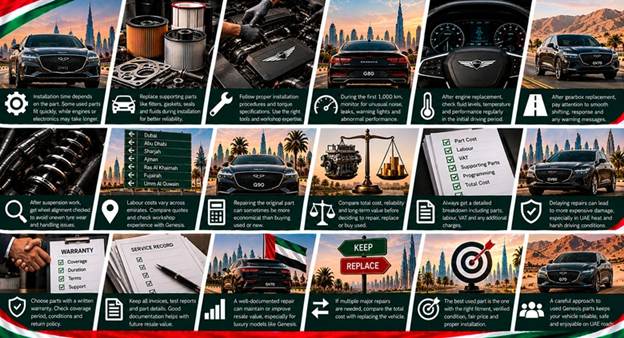
Repairing the original part can sometimes beat buying used
Used replacement is not automatically the best option.
Compare:
Repair original part
versus
Buy used part
versus
Buy new part
The original part has one major advantage: it already belongs to the vehicle.
If the fault is a replaceable seal, connector, wiring issue, sensor or serviceable sub-part, repairing it may preserve the known-good assembly.
But repair should be performed only where the workshop can identify the failed area and provide a reasonable warranty.
A repair-versus-replace decision matrix
| Situation | Repair original | Used replacement | New replacement |
| Minor mechanical fault | Strong option | Possible | Often unnecessary |
| Known failed electronic module | Sometimes | Attractive if tested | Best confidence |
| Unknown electronic fault | Diagnose first | Risky | Risky without diagnosis |
| Major engine failure | Depends on damage | Often considered | Highest confidence |
| Major gearbox failure | Depends on internal damage | Often considered | Highest confidence |
| Cosmetic trim | Usually | Strong option | Depends on availability |
| Safety-critical part | Limited | High inspection threshold | Usually preferred |
| Discontinued original part | May be possible | Often useful | May be unavailable |
The right decision depends on evidence rather than category alone.
When the used part is clearly the better economic choice
Used can be particularly sensible when:
- The part is expensive new.
- The used part is genuinely original.
- Donor history is documented.
- Condition has been tested.
- Warranty is written.
- Installation cost is reasonable.
- The part is not compromised by safety or software uncertainty.
That combination is far more valuable than a 50% discount with no documentation.
When buying used becomes false economy
Walk away when:
- The part number cannot be verified.
- Donor VIN is unavailable for a major assembly.
- The seller cannot explain the testing.
- The warranty is vague.
- The part shows accident damage.
- Electronics show corrosion.
- Engine compression is undocumented.
- Gearbox history is unknown.
- The seller refuses an independent inspection.
The saving is not real if the vehicle returns to the workshop two weeks later.
When replacing the vehicle deserves consideration
This is the uncomfortable calculation.
If a high-mileage Genesis has accumulated several major problems at once, compare:
Expected repair cost over the next 12 months
against
Current vehicle value + likely replacement cost + financing/transfer costs
A single used engine may make sense.
A used engine plus gearbox plus suspension plus multiple electronic modules can change the equation.
Do not decide emotionally because the car has already cost a lot.
Past expenditure is gone.
The question is what the next dirham buys.
First-year ownership cost after a major used-part repair
| Cost | What to estimate |
| Used part | Purchase price |
| Installation | Labour |
| Diagnosis | Before and after repair |
| Supporting parts | Seals, fluids, filters |
| Calibration | Where applicable |
| Follow-up | Inspection after installation |
| Routine service | Manufacturer schedule |
| Unexpected repairs | Based on vehicle age/condition |
| Resale effect | Documentation and condition |
A cheap used engine in a neglected vehicle is a different proposition from a documented used engine in a well-maintained G80.
UAE Ownership Reality
UAE heat should influence the inspection
The UAE climate changes how owners should think about used parts.
High ambient temperatures, intense sun exposure, air-conditioning demand and heavy urban traffic can create a harsher operating environment than a low-temperature market.
That does not mean every Genesis part fails because of heat.
It means inspection priorities should reflect the environment.
Pay particular attention to:
- Cooling systems
- Rubber parts
- Batteries
- Air-conditioning parts
- Electrical connectors
- Plastic trim
- Suspension components
- Tyres
- Fluids
Genesis's warranty information also explicitly excludes certain damage associated with flooding, misuse and environmental exposure, reinforcing the importance of checking vehicle history rather than relying solely on mileage.
Dubai, Abu Dhabi and Sharjah are not identical ownership environments
A Genesis driven mainly around central Dubai experiences a different pattern from one covering long Abu Dhabi motorway distances.
Likewise, a Sharjah commuter may spend substantial time in dense stop-start traffic.
Consider:
- Daily distance
- Traffic duration
- Parking conditions
- Outdoor versus covered parking
- Highway use
- Short-trip frequency
- Desert-road exposure
- Fleet or business use
This information can make donor mileage more meaningful.
The workshop should know the vehicle's history
Tell the technician:
- Where the vehicle was purchased
- Whether it is GCC or imported
- Accident history
- Previous major repairs
- Previous engine/gearbox replacement
- Current mileage
- Warning-light history
- Whether the vehicle was flood exposed
- Whether modifications have been installed
A workshop cannot diagnose accurately if important history is hidden.
This is particularly true with luxury vehicles that have been repaired after imported accident damage.
Cost of delay is often underestimated
A small problem can become a large invoice.
Examples:
A cooling leak ignored in summer can develop into overheating.
A suspension bush ignored long enough can affect associated parts and tyre wear.
An electronic warning ignored can become a larger system problem if the original fault damages another part.
A gearbox symptom ignored can turn an inspection into a major repair.
The answer is not “repair everything immediately”.
It is to identify which faults are safe to monitor and which ones should not be delayed.
Resale value depends on proof
Luxury-car buyers are suspicious for good reason.
A well-documented used-part repair can actually help a sale because it answers the question that matters:
What happened, and what was done about it?
Keep the invoice.
Keep the old part where practical.
Keep diagnostic reports.
Keep test results.
Keep the warranty.
Keep the part number.
This turns a vague repair history into an evidence trail.
For a Genesis G90 or GV80, that can matter considerably more than saving a small amount on the original repair.
The final used Genesis buying decision
The best used Genesis part is not necessarily the newest-looking one, the lowest-priced one or the one with the lowest advertised mileage.
It is the one with the strongest evidence.
A good purchase has:
- Correct VIN match
- Correct model and engine
- Correct market specification
- Verified part number
- Supersession checked
- Known donor vehicle
- Reasonable donor mileage
- Proper inspection
- Test evidence
- Clear warranty
- Professional installation
- Required programming completed
- Supporting parts included
- Complete invoice
That is the standard worth applying whether the vehicle is a G70 commuting between Sharjah and Dubai, a G80 used for business travel in Abu Dhabi, a G90 serving as a family luxury saloon, or a GV70/GV80 covering the mixed city-and-highway driving common across the UAE.
For owners comparing available used and replacement options, PartFinder UAE can be used as part of the wider research process, but the same rule remains: verify the exact vehicle and part before treating any advertised price as a genuine saving.
The cheapest Genesis part is the one that does the job once.
UAE used Genesis buying decision matrix
| Buyer situation | Preferred approach | Why |
| Newer Genesis under warranty | Check warranty position first | Avoid unnecessary warranty risk |
| Older G70 | Tested used/OEM-quality depending on part | More options may be economically sensible |
| G80 electronic fault | Diagnose before purchasing | Prevents unnecessary module replacement |
| G90 luxury electronics | Tested, documented part | Trim and software complexity increase risk |
| GV70 suspension repair | Inspect complete suspension system | One worn part may not be the only issue |
| GV80 engine-related repair | Compression and diagnostic evidence | High replacement cost makes testing worthwhile |
| Major gearbox problem | Compare rebuild, tested used and new | Installation cost makes mistakes expensive |
| Imported Genesis | VIN + market specification first | Global parts are not automatically identical |
| Flood/accident-history vehicle | Extra electrical and structural inspection | Hidden damage can change the economics |
| High-mileage vehicle with several major faults | Compare repair with vehicle replacement | Avoid spending into a declining asset |
Frequently Asked Questions
Categories
- Audi
- BMW
- Car Accessories
- Car Tips
- Ford
- Land Rover
- Mazda
- Range Rover
- Top 10
- UAE Car Parts
- Used Car Parts
- Toyota
- Replacement Engines
- Nissan
- Hyundai
- Mitsubishi
- Volkswagen
- Honda
- Kia
- Chevrolet
- Dodge
- Jeep
- Subaru
- Renault
- Lexus
- Mercedes
- Suzuki
- Hummer
- Porsche
- Infiniti
- Peugeot
- GMC
- Mini
- Volvo
- Replacement Gearboxes
- MG
- Jaguar
- Skoda
- Cadillac
- Daihatsu
- Fiat
- German Car Parts
- Japanese Car Parts
- Aftermarket Car Parts
- Genuine Car Parts
- New Car Parts
- Reconditioned Car Parts
- European Car Parts
- American Car Parts
- Korean Car Parts
- British Car Parts
- Chinese Car Parts
- Sports/Exotic Car Parts
- Luxury Car Parts
- Performance Car Parts
- SUV/4x4 Spare Parts
- Truck Spare Parts
- EV Car Parts
- Hybrid Car Parts
- Auto Spare Parts in UAE
- Tesla
- Isuzu
- Ram
- Ferrari
- Bentley
- Lamborghini
- Genesis
- Maserati