Used, Genuine or Aftermarket Luxury Car Parts in UAE: Which Option Is Best?
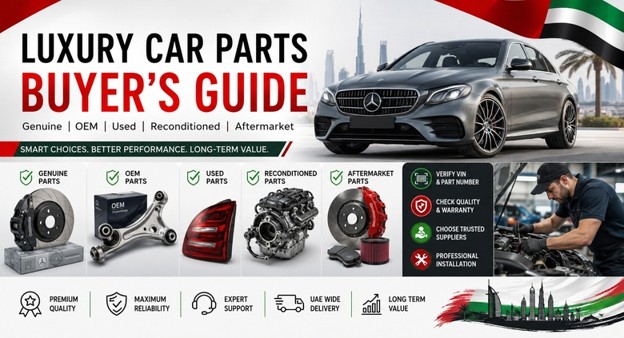
July 30, 2026
Understanding the Four Types of Luxury Car Parts
Quick Summary
| Topic | Key Insight |
| Genuine Parts | Manufactured or approved by the vehicle manufacturer for exact fitment and performance. |
| OEM Parts | Produced by the original manufacturer, often identical to genuine parts but sold under a different brand. |
| Used Parts | Previously installed components removed from another vehicle and sold in their existing condition. |
| Reconditioned Parts | Used parts professionally restored, repaired and tested for reliable operation. |
| Aftermarket Parts | Manufactured by third-party companies, with quality ranging from premium to budget options. |
| Smart Buying Rule | The best choice depends on the component, budget, vehicle age and ownership goals. |
Luxury car ownership is different.
You're not simply maintaining a vehicle.
You're protecting engineering that was designed with extraordinary attention to detail.
Every component.
Every sensor.
Every body panel.
Every suspension arm.
Each plays a role in delivering the performance, comfort and refinement expected from brands such as Mercedes-Benz, BMW, Audi, Porsche, Bentley, Rolls-Royce, Ferrari, Lamborghini and Aston Martin.
Eventually, every luxury vehicle requires replacement parts.
That's unavoidable.
The real question isn't whether you'll buy replacement parts.
It's which type you should buy.
Should you choose genuine parts?
Would OEM components offer the same quality?
Are used parts a sensible way to reduce costs?
Can professionally reconditioned parts deliver excellent value?
Or should you consider premium aftermarket alternatives?
There isn't one answer that suits every repair.
The smartest decision depends on understanding what each option actually offers.
Let's begin with the basics.
What Are Genuine Luxury Car Parts?
Genuine parts are replacement components supplied through the vehicle manufacturer or its authorised network.
These parts are designed to meet the exact engineering standards established during the vehicle's development.
That means:
- Factory specifications.
- Exact dimensions.
- Original materials.
- Consistent quality control.
- Full compatibility.
- Manufacturer-approved performance.
When replacing a critical component such as an adaptive headlight, suspension module or engine sensor, many owners prefer genuine parts because they eliminate much of the uncertainty surrounding compatibility.
They're engineered to fit correctly the first time.
That confidence is often their greatest advantage.
What Are OEM Luxury Car Parts?
OEM stands for Original Equipment Manufacturer.
This is one of the most misunderstood terms in the automotive industry.
Many luxury vehicles contain components produced by specialist manufacturers.
For example, a braking system, lighting unit or electronic sensor may be manufactured by a company that supplies the vehicle manufacturer directly.
That same manufacturer may later sell an identical component under its own brand.
In many cases:
- Materials are identical.
- Manufacturing standards are identical.
- Performance is identical.
The only noticeable difference may be the branding and packaging.
This is why knowledgeable buyers often compare genuine and OEM options before making a purchase.
Understanding the source matters far more than simply recognising the label.
What Are Used Luxury Car Parts?
Used parts are components removed from another vehicle.
Most originate from:
- Accident-damaged vehicles.
- Salvage auctions.
- Insurance write-offs.
- Vehicle dismantlers.
- Fleet disposals.
These parts haven't been rebuilt.
They remain in the condition they were removed.
That doesn't automatically make them poor choices.
Certain used components can provide excellent value.
Examples include:
- Doors.
- Mirrors.
- Interior trim.
- Seats.
- Glass.
- Alloy wheels.
However, every used part should be inspected carefully.
Condition varies considerably.
Mileage matters.
Previous maintenance matters.
Storage conditions matter too.
Buying used isn't simply about paying less.
It's about buying wisely.
What Are Reconditioned Luxury Car Parts?
Reconditioned parts begin life as used components.
The difference lies in what happens next.
Instead of being sold immediately, they're professionally restored.
Depending on the component, the process may include:
- Complete disassembly.
- Cleaning.
- Replacement of worn components.
- Precision machining.
- New seals and bearings.
- Quality testing.
- Performance verification.
The goal isn't merely to make the part usable again.
It's to restore it to a reliable operating condition.
Many luxury car owners choose reconditioned:
- Engines.
- Automatic gearboxes.
- Steering racks.
- Turbochargers.
- Air suspension compressors.
When rebuilt by experienced specialists, these components often provide an excellent balance between cost and reliability.
What Are Aftermarket Luxury Car Parts?
Aftermarket parts are manufactured by companies other than the vehicle manufacturer.
That category is enormous.
Some aftermarket manufacturers are internationally respected engineering companies with decades of experience.
Others focus primarily on producing low-cost alternatives.
That's why the word aftermarket doesn't automatically mean good...
Or bad.
Quality varies enormously.
Premium aftermarket manufacturers often produce outstanding:
- Brake components.
- Suspension systems.
- Filters.
- Cooling components.
- Lighting upgrades.
- Performance accessories.
Lower-quality alternatives, however, may compromise fitment, durability and reliability.
Judging every aftermarket part by the same standard is one of the biggest mistakes buyers make.
Which Type of Luxury Car Part Is Right for Your Vehicle?
This is where many online discussions become misleading.
People often ask,
"Which is better?"
The better question is,
"Better for what?"
A genuine engine control module may be the safest option for preserving electronic compatibility.
A professionally reconditioned gearbox may offer excellent value.
A premium aftermarket brake pad may outperform the factory equivalent in certain driving conditions.
A carefully inspected used door may save a substantial amount of money without affecting reliability.
Every repair deserves its own decision.
The smartest owners avoid absolute rules.
Instead, they evaluate:
- Safety.
- Reliability.
- Cost.
- Warranty.
- Vehicle age.
- Future ownership plans.
That's exactly how experienced workshops approach every repair.
Why Luxury Car Owners in the UAE Need to Choose Carefully
Owning a luxury vehicle in the UAE presents unique challenges.
Extreme summer temperatures.
Heavy traffic.
Long motorway journeys.
Fine desert dust.
High-performance driving.
These conditions place additional stress on:
- Cooling systems.
- Rubber components.
- Suspension.
- Electronic modules.
- Brake systems.
Choosing replacement parts purely on price often becomes expensive later.
A correctly specified component generally performs better under demanding UAE conditions and reduces the likelihood of repeat repairs.
Quality becomes even more valuable when vehicles operate in one of the world's toughest climates.
Workshop Story
A Porsche Cayenne owner in Dubai visited a specialist workshop after receiving two quotations for the same repair.
One workshop recommended a genuine suspension arm.
Another suggested a professionally reconditioned unit from a recognised specialist.
The owner assumed the lower-priced option must be inferior.
Before making a decision, the technician explained the differences.
The genuine component offered factory originality.
The reconditioned unit had been rebuilt with new bushes, tested thoroughly and carried a comprehensive warranty.
After discussing the vehicle's mileage, intended ownership period and budget, the owner selected the reconditioned option.
More than two years later, the suspension continued performing exactly as expected.
When collecting the vehicle, the owner smiled.
"I thought cheaper automatically meant lower quality."
The technician replied,
"Sometimes the smartest decision isn't the most expensive one. It's the most appropriate one."
Luxury Car Parts Comparison
| Part Type | Best For | Main Advantage | Main Consideration |
| Genuine | Critical safety and electronic systems | Factory-approved quality | Higher purchase price |
| OEM | Owners seeking factory-quality alternatives | Excellent compatibility | Verify the manufacturer |
| Used | Cosmetic and non-critical components | Lower initial cost | Condition varies |
| Reconditioned | Major mechanical components | Excellent value when professionally rebuilt | Buy from trusted specialists |
| Aftermarket | Routine servicing and performance upgrades | Wide range of choices | Quality depends on the manufacturer |
Buyer Decision Matrix
| Your Priority | Recommended Choice |
| Maximum factory originality | Genuine parts |
| Factory quality with better value | OEM components |
| Lowest purchase price | Carefully inspected used parts |
| Best balance of value and reliability | Professionally reconditioned parts |
| Performance upgrades | Premium aftermarket manufacturers |
| Long-term ownership | Choose quality over the lowest price |
Suggested Visual Callout
"Five Types of Luxury Car Parts at a Glance"
Create a clean infographic showing five connected panels with simple illustrations for:
- Genuine Part
- OEM Part
- Used Part
- Reconditioned Part
- Aftermarket Part
Under each illustration, include only three short labels:
- Quality
- Cost
- Best Use
Use UAE-inspired red, green, white and black accents with minimal text and clean icons.
Smart Buyer's Checklist
Before purchasing any luxury car part:
- Confirm the VIN.
- Match the OEM part number.
- Understand the difference between genuine, OEM, used, reconditioned and aftermarket.
- Consider how long you plan to keep the vehicle.
- Compare warranty coverage.
- Buy only from trusted suppliers.
- Ask whether professional programming or calibration is required.
- Think beyond today's purchase price and consider long-term ownership costs.
Choosing the right replacement part isn't about finding the cheapest option.
It's about finding the most appropriate solution for your vehicle, your budget and your ownership goals.
Key Takeaways
Luxury car owners have more replacement part options than ever before, but each category serves a different purpose. Genuine parts deliver factory-approved quality, OEM components often provide the same engineering at a different price point, used parts can offer significant savings for selected components, professionally reconditioned parts combine value with reliability, and premium aftermarket products can deliver outstanding performance when sourced from reputable manufacturers.
Understanding these differences is the foundation of every smart purchasing decision. Rather than asking which option is universally best, experienced owners evaluate compatibility, quality, warranty, intended vehicle use and long-term ownership costs before deciding.
Genuine vs Used vs Reconditioned vs Aftermarket Luxury Car Parts – Which One Makes the Most Sense?
Quick Summary
| Topic | Key Insight |
| Genuine vs Used | Factory originality versus cost savings. |
| Genuine vs Aftermarket | Premium engineering compared with wider price choices. |
| Used vs Reconditioned | One is sold as removed, the other is professionally restored. |
| OEM vs Genuine | Often manufactured by the same company but sold through different channels. |
| Choosing the Right Option | Every repair requires a different approach. |
| Biggest Mistake | Assuming one type of part is always better than the others. |
If you've spent even a few minutes searching online for luxury car parts...
You've probably seen hundreds of opinions.
"Always buy genuine."
"Aftermarket is just as good."
"Used parts aren't reliable."
"Reconditioned parts are a waste of money."
Everyone seems certain.
Yet professional workshops rarely think that way.
They don't ask,
"Which type of part is best?"
They ask,
"Which part is being replaced?"
Because replacing a headlight...
Is completely different from replacing an engine.
Changing a door mirror...
Isn't the same as replacing an adaptive suspension module.
Understanding those differences helps buyers make better decisions.
Not more expensive ones.
Genuine vs Used Luxury Car Parts: What's the Difference?
At first glance, this comparison appears simple.
One part is new.
The other has already been used.
But that's only the beginning.
Genuine parts offer:
- Factory originality.
- Zero previous wear.
- Manufacturer specifications.
- Full compatibility.
- Consistent quality.
Used parts offer something different.
They provide:
- Lower purchase costs.
- Original factory manufacturing.
- Availability for discontinued vehicles.
- Cost-effective cosmetic repairs.
The important point is this.
Used doesn't automatically mean poor quality.
A carefully inspected genuine door removed from a low-mileage vehicle may offer outstanding value.
Meanwhile...
A heavily worn mechanical component may become an expensive mistake.
Condition matters far more than assumptions.
Genuine vs Aftermarket Luxury Car Parts Compared
This debate has existed for decades.
And it still creates confusion.
Genuine parts are designed specifically for the vehicle manufacturer.
Premium aftermarket companies design components intended to match—or occasionally improve upon—factory performance.
The difference usually comes down to:
- Engineering.
- Materials.
- Manufacturing standards.
- Testing.
- Quality control.
High-quality aftermarket manufacturers often produce:
- Brake pads.
- Suspension kits.
- Filters.
- Cooling components.
- Lighting upgrades.
At the opposite end of the market...
Very inexpensive alternatives may compromise:
- Fitment.
- Durability.
- Surface finish.
- Electronic compatibility.
The word aftermarket covers an enormous range of quality.
That's why experienced buyers research manufacturers rather than judging the entire category.
Used vs Reconditioned Luxury Car Parts Explained
These two terms are frequently confused.
They're not interchangeable.
A used part is removed from another vehicle and sold largely in its existing condition.
A reconditioned part begins as a used component...
But undergoes professional restoration.
That process may include:
- Complete dismantling.
- Cleaning.
- Machining.
- Replacement of worn internal components.
- Performance testing.
- Quality inspection.
Imagine two automatic gearboxes.
One is removed and sold immediately.
The other is stripped, rebuilt with new bearings and seals, tested thoroughly and supplied with warranty.
Both originated as used components.
Only one has been professionally reconditioned.
That's the difference.
OEM vs Genuine Parts: Are They Really the Same?
Few automotive topics generate as much misunderstanding.
Many luxury vehicle manufacturers don't produce every component themselves.
Instead...
Specialist engineering companies manufacture parts on their behalf.
Those same manufacturers may later sell virtually identical components under their own branding.
In many situations:
- Materials are identical.
- Dimensions are identical.
- Manufacturing facilities are identical.
- Performance is identical.
The branding changes.
Sometimes the packaging changes.
Sometimes the price changes too.
This explains why knowledgeable workshops often compare OEM and genuine options before recommending a repair.
The source matters.
Not simply the label.
Advantages and Disadvantages of Each Option
Every category has strengths.
Every category has limitations.
Understanding both creates smarter buying decisions.
Genuine Parts
Advantages:
- Exact fitment.
- Manufacturer approval.
- Strong warranty confidence.
- Excellent resale appeal.
Limitations:
- Higher purchase price.
OEM Parts
Advantages:
- Factory-quality engineering.
- Competitive pricing.
- Excellent compatibility.
Limitations:
- Buyers should verify the manufacturer.
Used Parts
Advantages:
- Lower initial cost.
- Excellent for body panels and interior trim.
- Useful for discontinued models.
Limitations:
- Previous wear.
- Limited history.
- Condition varies.
Reconditioned Parts
Advantages:
- Excellent value.
- Professionally restored.
- Often supplied with warranty.
Limitations:
- Quality depends entirely on the rebuilding specialist.
Aftermarket Parts
Advantages:
- Wide availability.
- Performance upgrades.
- Competitive pricing.
Limitations:
- Quality varies significantly between manufacturers.
No category wins every comparison.
Each succeeds under different circumstances.
Common Buyer Myths About Luxury Car Parts
Let's separate fact from fiction.
Myth 1
"Aftermarket parts are always poor quality."
Reality:
Some aftermarket manufacturers supply components to vehicle manufacturers themselves.
Quality depends on the company—not the category.
Myth 2
"Used parts are never reliable."
Reality:
A low-mileage genuine body panel may perform perfectly for many years.
Inspection remains essential.
Myth 3
"Reconditioned means second-rate."
Reality:
Professionally rebuilt engines, gearboxes and steering systems often provide excellent reliability when restored by experienced specialists.
Myth 4
"OEM and genuine are completely different."
Reality:
In many cases, they're manufactured by the same company.
Myth 5
"The cheapest quotation always saves money."
Reality:
Repeat labour.
Poor fitment.
Additional repairs.
These costs frequently outweigh the original saving.
Which Option Makes the Most Sense?
Imagine three different owners.
The first owns a nearly new Bentley still covered by manufacturer warranty.
The second drives a ten-year-old BMW as a daily commuter.
The third restores a classic Porsche.
Should all three buy the same type of replacement part?
Of course not.
Their vehicles.
Budgets.
Ownership goals.
Warranty requirements.
And repair priorities...
Are completely different.
The correct answer changes with every repair.
That's why experienced workshops never recommend one solution for every customer.
They recommend the most appropriate solution.
Workshop Story
A Mercedes-Benz S-Class owner from Abu Dhabi required replacement adaptive headlights after accident damage.
The dealership quoted genuine units.
An independent luxury workshop also sourced premium OEM alternatives manufactured by the original supplier.
The owner expected significant compromises.
Instead...
The technician demonstrated that both components shared identical specifications and compatibility.
After confirming the manufacturer's details, the owner selected the OEM option.
Installation was completed successfully.
The lighting system calibrated perfectly.
The owner later admitted,
"I assumed OEM meant lower quality."
The technician smiled.
"Sometimes it's simply the same engineering in different packaging."
Luxury Car Parts Comparison Table
| Part Type | Quality | Cost | Best Application |
| Genuine | Excellent | Highest | Warranty-sensitive and critical systems |
| OEM | Excellent | Moderate to High | Factory-quality repairs |
| Used | Variable | Lowest | Cosmetic and selected non-critical parts |
| Reconditioned | Very Good to Excellent | Moderate | Major mechanical assemblies |
| Premium Aftermarket | Very Good to Excellent | Moderate | Maintenance and performance upgrades |
Buyer Decision Matrix
| Your Priority | Best Choice |
| Factory originality | Genuine |
| Factory engineering with better value | OEM |
| Budget-conscious cosmetic repair | Carefully inspected used part |
| Engine or gearbox replacement | Professionally reconditioned component |
| Performance improvements | Premium aftermarket manufacturer |
| Long-term ownership confidence | Highest-quality option within your budget |
Suggested Visual Callout
"Which Luxury Car Part Should You Choose?"
Create a clean comparison graphic with five illustrated columns:
- Genuine
- OEM
- Used
- Reconditioned
- Aftermarket
Each column should include only three visual indicators:
- Quality
- Cost
- Recommended Use
Use green checkmarks, amber caution symbols and simple icons rather than paragraphs of text.
Maintain UAE-inspired colours with a modern premium appearance.
Smart Buyer's Checklist
Before deciding between genuine, OEM, used, reconditioned or aftermarket parts:
- Identify which component needs replacing.
- Verify the VIN.
- Confirm the OEM part number.
- Compare warranty protection.
- Ask about previous mileage for used parts.
- Confirm how reconditioned parts were rebuilt.
- Research aftermarket manufacturers carefully.
- Include installation and future ownership costs in your decision.
Choosing wisely isn't about following internet opinions.
It's about understanding what your vehicle actually needs.
Key Takeaways
There is no universally perfect replacement part for every luxury vehicle. Genuine, OEM, used, reconditioned and aftermarket components all have legitimate roles depending on the repair, vehicle age, warranty status and ownership goals.
The most successful luxury car owners avoid making decisions based solely on price or brand names. Instead, they compare engineering quality, compatibility, long-term reliability and total ownership cost before committing to a purchase.
Compatibility and Quality Before You Buy – Why the Correct Part Matters More Than the Cheapest One
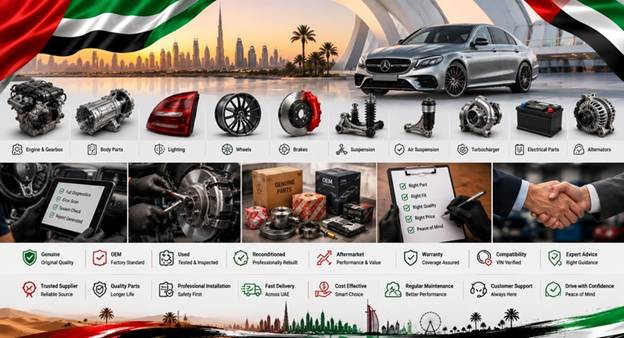
Quick Summary
| Topic | Key Insight |
| VIN Verification | The safest way to identify the correct replacement part. |
| OEM Part Numbers | Prevent ordering errors and compatibility problems. |
| GCC vs Imported Vehicles | Similar-looking cars often use different components. |
| Model Year Differences | Even one production year can change part compatibility. |
| Cheap Parts | Lower prices can result in higher repair costs later. |
| Smart Buying Rule | Always verify compatibility before comparing prices. |
Many luxury car owners spend hours comparing prices.
That's understandable.
Replacement parts for premium vehicles aren't cheap.
But here's something experienced technicians learn very quickly.
The most expensive mistake usually isn't buying the wrong brand.
It's buying the wrong part.
A component can look identical.
Share the same dimensions.
Even carry a similar description.
Yet still be completely incompatible with your vehicle.
Modern luxury cars are incredibly precise.
One incorrect sensor.
One different connector.
One altered mounting point.
That's often all it takes to create warning lights, poor performance or another unexpected workshop visit.
Compatibility always comes before price.
Why VIN Verification Matters
Every vehicle has its own identity.
That identity is the Vehicle Identification Number, more commonly known as the VIN.
Think of it as your luxury car's fingerprint.
No two vehicles share exactly the same VIN.
Manufacturers use it to record important information, including:
- Production date.
- Engine specification.
- Gearbox type.
- Factory-installed options.
- Market destination.
- Electronic configuration.
Providing your VIN allows suppliers to identify the correct replacement component with far greater accuracy than simply asking for the make and model.
Imagine ordering parts for a 2022 Mercedes-Benz S-Class.
That sounds straightforward.
Until you discover there are multiple engines, suspension options, braking systems and electronic packages available within the same model year.
The VIN removes that uncertainty.
OEM Part Numbers and Compatibility Checks
Every genuine component carries a specific OEM part number.
This number isn't random.
It identifies the exact component designed for your vehicle.
Professional suppliers always verify these numbers before confirming an order.
Why?
Because visually identical parts often have different internal specifications.
Examples include:
- Different electrical connectors.
- Alternative software.
- Revised mounting brackets.
- Updated materials.
- Improved internal design.
A part that appears correct in a photograph may still be incompatible.
That's why experienced workshops trust part numbers...
Not appearances.
GCC Specification vs Imported Luxury Vehicles
The UAE has one of the world's largest markets for imported luxury vehicles.
Some were originally built for:
- Europe.
- North America.
- Japan.
- Australia.
- Other Gulf countries.
Many owners assume these vehicles all use identical parts.
In reality...
They often don't.
Differences may include:
- Cooling systems.
- Air-conditioning components.
- Lighting systems.
- Electronic modules.
- Emissions equipment.
- Suspension calibration.
A Porsche built for Germany may require different cooling components compared with a GCC-specification Porsche operating in Dubai.
Likewise, imported American luxury vehicles frequently use different lighting systems and electronic configurations.
Knowing the vehicle's original market helps prevent costly mistakes.
Model Year Differences That Affect Parts Compatibility
Luxury vehicle manufacturers continuously improve their models.
Those improvements don't always wait for a complete redesign.
Sometimes changes happen halfway through a production year.
That means two vehicles built only a few months apart may use:
- Different sensors.
- Revised wiring harnesses.
- Updated control modules.
- Alternative suspension components.
- Modified body panels.
To the average buyer...
They look identical.
To an experienced technician...
They're completely different.
Never assume that every part fits every version of the same model.
Always verify.
Why Cheap Parts Can Become Expensive
We've all experienced the temptation.
Two listings appear online.
Both claim to fit your vehicle.
One costs considerably less.
Choosing the cheaper option feels sensible.
Until installation begins.
The mounting holes don't align.
The electrical connector differs slightly.
A dashboard warning light appears.
The technician pauses.
"This isn't the correct version."
Now additional labour becomes necessary.
A replacement part must be ordered.
The vehicle stays in the workshop longer.
Suddenly...
The cheaper option becomes the more expensive one.
Experienced buyers compare total repair costs.
Not simply purchase prices.
How Professional Suppliers Reduce Compatibility Problems
The best suppliers don't simply process orders.
They ask questions.
Questions such as:
- Can you provide the VIN?
- Is the vehicle GCC specification?
- Which engine does it have?
- Has the part been replaced previously?
- Is software programming required?
Those questions aren't slowing the process.
They're protecting it.
Every answer reduces the chance of ordering the wrong component.
Professional advice saves far more money than rushing a purchase.
Why Accurate Part Selection Improves Reliability
Correct compatibility influences more than installation.
It also affects:
- Vehicle safety.
- Fuel efficiency.
- Engine performance.
- Electronic communication.
- Suspension behaviour.
- Long-term durability.
An incorrectly specified sensor may cause poor fuel economy.
A mismatched suspension arm may alter steering geometry.
An incompatible control module may prevent safety systems from functioning correctly.
One incorrect component can affect several others.
That's why compatibility remains the foundation of every successful repair.
Choosing Trusted Suppliers
Finding the right part becomes much easier when working with suppliers who understand luxury vehicles.
Experienced suppliers invest time in verifying compatibility before recommending a component.
That approach reduces uncertainty and gives buyers greater confidence.
Many UAE owners use PartFinder UAE to compare multiple trusted suppliers, verify part availability and make informed purchasing decisions before committing to a repair.
The best buying experience begins with accurate information.
Not simply the lowest quotation.
Workshop Story
A BMW 7 Series owner from Sharjah needed a replacement adaptive suspension sensor.
After searching online, he found what appeared to be the correct component.
The photographs matched.
The description matched.
The price looked excellent.
Before ordering, he visited a specialist workshop.
The technician entered the VIN into the manufacturer's catalogue.
Within seconds, the problem became obvious.
The advertised sensor belonged to an earlier production revision.
Externally, it looked identical.
Internally, the communication protocol had changed.
Installing it would have triggered suspension faults immediately.
The correct sensor was ordered instead.
Installation took less than an hour.
No warning lights.
No calibration issues.
No repeat workshop visit.
The owner laughed.
"That VIN probably saved me hundreds."
The technician nodded.
"It saved much more than that. It saved the repair."
Compatibility Comparison Table
| Verification Method | Accuracy | Risk Level |
| VIN Verification | Excellent | Very Low |
| OEM Part Number Match | Excellent | Very Low |
| Manufacturer Catalogue | Excellent | Very Low |
| Visual Comparison Only | Limited | High |
| Online Photograph Matching | Poor | Very High |
| Guessing by Vehicle Model | Unreliable | Extremely High |
Buyer Decision Matrix
| Your Situation | Recommended Action |
| Ordering electronic components | Verify VIN and OEM part number first |
| Imported luxury vehicle | Confirm original market specification |
| GCC vehicle | Match GCC-specific components where applicable |
| Model year uncertainty | Check production date before ordering |
| Multiple supplier quotations | Compare compatibility before comparing price |
| Long-term ownership | Choose suppliers who verify every order thoroughly |
Suggested Visual Callout
"How to Buy the Correct Luxury Car Part"
Create a clean horizontal infographic showing this sequence:
VIN → OEM Part Number → Compatibility Check → Trusted Supplier → Correct Part → Professional Installation
Use minimal labels with simple icons for:
- VIN document
- Barcode
- Magnifying glass
- Delivery box
- Gear
- Green shield
Incorporate subtle UAE-inspired red, green, white and black accents without adding large text blocks.
Smart Buyer's Checklist
Before purchasing any luxury car part:
- Locate the VIN.
- Confirm the OEM part number.
- Identify whether the vehicle is GCC or imported.
- Verify the production year.
- Ask whether software programming is required.
- Compare compatibility before comparing prices.
- Buy only from experienced suppliers.
- Keep all invoices and part numbers for future reference.
The right part doesn't simply fit.
It performs exactly as the vehicle's engineers intended.
Key Takeaways
Compatibility is the foundation of every successful luxury car repair. VIN verification, OEM part numbers, production dates and regional vehicle specifications all play a vital role in ensuring replacement components fit correctly and communicate properly with increasingly sophisticated vehicle systems.
Whether you're considering genuine, OEM, used, reconditioned or premium aftermarket parts, selecting the correct specification is always more important than selecting the lowest price. A carefully verified component reduces installation delays, prevents repeat repairs and protects the long-term reliability of your luxury vehicle.
Used Luxury Car Parts – Are They Worth Buying?
Quick Summary
| Topic | Key Insight |
| Safe Used Parts | Certain body, interior and mechanical components can provide excellent value. |
| Parts to Avoid | Safety-critical and heavily worn components should generally be purchased new or professionally reconditioned. |
| Mileage Matters | Lower mileage usually means less wear, but inspection is equally important. |
| Professional Inspection | Visual appearance alone never tells the complete story. |
| Expected Lifespan | Remaining service life varies depending on the component and previous use. |
| Smart Buying Rule | Buy condition—not simply price. |
The phrase luxury car parts in UAE often divides opinion.
Some owners won't even consider them.
Others use them regularly.
So...
Who's right?
Surprisingly...
Both can be.
Used parts have become an important part of luxury car ownership in the UAE.
Not because owners want to cut corners.
But because certain original factory components remain exceptionally valuable long after the vehicle itself reaches the end of its service life.
Imagine a Bentley with accident damage.
The engine is beyond repair.
The suspension, doors, seats, lighting units and interior trim remain almost perfect.
Should those components simply be discarded?
Of course not.
When removed carefully, inspected properly and sold through reputable suppliers, many used luxury car parts continue serving reliably for years.
The secret isn't avoiding used parts.
It's knowing which ones deserve your confidence.
Which Used Luxury Car Parts Are Safe to Buy?
Not every component experiences the same level of stress.
Some parts wear constantly.
Others hardly wear at all.
That's why experienced workshops often recommend selected used components.
Common examples include:
- Doors.
- Bonnets.
- Boot lids.
- Side mirrors.
- Alloy wheels.
- Interior trim.
- Dashboard components.
- Leather seats.
- Window glass.
- Exterior mouldings.
- Headlight housings.
- Tail lamps.
These components usually retain their original factory quality.
Provided they haven't suffered accident damage or poor repairs.
Many buyers actually prefer genuine used body panels over inexpensive aftermarket alternatives because factory fitment tends to be far superior.
Original manufacturing quality often outweighs the benefit of buying an entirely new budget replacement.
Which Used Parts Should You Never Buy?
Some components deserve extra caution.
Especially those responsible for safety or subject to continuous mechanical stress.
Generally, experienced workshops recommend avoiding heavily worn used:
- Brake pads.
- Brake discs.
- Airbags.
- Seat belt assemblies.
- Rubber suspension bushes.
- Timing belts.
- Water pumps.
- Filters.
- Spark plugs.
- Engine bearings.
These components either wear naturally or directly influence vehicle safety.
Replacing them with new or professionally reconditioned alternatives usually represents the wiser long-term investment.
Saving money on critical safety components rarely proves worthwhile.
Mileage and Wear Inspection Guide
Mileage matters.
But mileage never tells the whole story.
Imagine two identical luxury SUVs.
One travelled 45,000 miles on smooth motorway journeys.
The other covered the same distance almost entirely in congested city traffic.
Which experienced greater wear?
The answer isn't obvious.
Driving conditions influence wear just as much as mileage.
When evaluating used parts, consider:
- Total mileage.
- Service history.
- Accident history.
- Corrosion.
- Heat exposure.
- Previous repairs.
- Storage conditions.
A lower-mileage component isn't automatically better.
A well-maintained higher-mileage part may outperform it.
Condition remains king.
How to Inspect Used Parts Before Purchasing
Professional inspections go far beyond appearances.
Experienced technicians examine:
- Cracks.
- Corrosion.
- Impact damage.
- Mounting points.
- Electrical connectors.
- Surface wear.
- Fluid leaks.
- Previous repairs.
Mechanical components may also require:
- Compression testing.
- Pressure testing.
- Bearing inspection.
- End-play measurement.
- Electronic diagnostics.
Photographs alone rarely reveal these details.
That's why buying from trusted suppliers who inspect components properly provides much greater confidence.
Expected Lifespan of Used Luxury Car Parts
One of the most common questions buyers ask is:
"How long will this used part last?"
There isn't a universal answer.
Remaining lifespan depends on:
- Original manufacturing quality.
- Previous maintenance.
- Mileage.
- Environmental conditions.
- Installation quality.
- Future driving style.
For example:
A genuine aluminium door panel may remain serviceable for decades.
A heavily worn suspension arm may require replacement much sooner.
Every component ages differently.
Understanding how that component works helps estimate its remaining life.
Why Genuine Used Parts Often Beat Cheap New Parts
This surprises many first-time buyers.
Imagine comparing:
A genuine Mercedes-Benz front wing removed from a carefully maintained vehicle...
With a very inexpensive aftermarket replacement.
The aftermarket panel is brand new.
The genuine panel has already been used.
Which fits better?
Very often...
The original factory component.
That's because it was manufactured using the exact tooling and engineering specifications intended by Mercedes-Benz.
Many experienced body shops actively search for genuine used panels because they reduce:
- Panel gap adjustments.
- Paint preparation.
- Installation time.
- Fitment problems.
Sometimes originality matters more than newness.
UAE Climate and Its Effect on Used Parts
Luxury vehicles in the UAE operate in demanding conditions.
Summer temperatures regularly exceed 45°C.
Fine desert dust enters small openings.
Humidity affects coastal regions.
These conditions influence certain components more than others.
Pay particular attention to:
- Rubber seals.
- Plastic clips.
- Cooling components.
- Electrical connectors.
- Interior trim exposed to sunlight.
Before purchasing, ask how the part was stored after removal.
A component kept indoors generally remains in much better condition than one exposed to prolonged sunlight or moisture.
Storage is often overlooked.
Yet it significantly affects long-term reliability.
Common Buying Mistakes
After years of workshop experience, the same mistakes appear repeatedly.
Buyers often:
- Purchase using photographs only.
- Ignore the VIN.
- Assume every model year shares identical parts.
- Focus only on price.
- Forget transport damage.
- Ignore warranty conditions.
- Skip professional inspection.
Fortunately...
Every one of these mistakes can be avoided.
A little patience usually saves a considerable amount of money.
Workshop Story
A Range Rover Vogue owner in Dubai required a replacement driver's door after minor collision damage.
One supplier offered an inexpensive aftermarket panel.
Another located a genuine used factory door from a low-mileage donor vehicle.
The prices were surprisingly similar.
The body shop recommended the genuine used option.
Why?
Because the original panel already matched factory dimensions perfectly.
Installation required minimal adjustment.
Paint preparation took less time.
The finished result looked exactly as it should.
When collecting the vehicle, the owner asked,
"You mean the used part actually saved time?"
The technician smiled.
"Factory engineering doesn't stop being accurate simply because the part has been used."
Used Parts Comparison Table
| Component | Used Part Recommended? | Reason |
| Doors and Body Panels | ✔ Yes | Factory fitment and excellent value |
| Interior Trim | ✔ Yes | Low wear when properly maintained |
| Alloy Wheels | ✔ Yes | Inspect carefully for cracks and repairs |
| Headlights and Tail Lamps | ✔ Yes | Verify mounting points and electronics |
| Brake Pads | ✘ No | Safety-critical wear component |
| Timing Belt | ✘ No | Always replace with new |
| Airbags | ✘ No | Safety and legal considerations |
| Suspension Bushes | ✘ Generally No | Rubber deteriorates over time |
Buyer Decision Matrix
| Your Situation | Recommended Choice |
| Cosmetic accident repair | Genuine used body panels |
| Interior refurbishment | Quality inspected used trim |
| Daily luxury vehicle | Mix genuine, used and new where appropriate |
| Safety-critical repair | Genuine new or professionally reconditioned |
| Older luxury vehicle | Carefully inspected used components may offer excellent value |
| Long-term ownership | Prioritise condition and compatibility over purchase price |
Suggested Visual Callout
"Good Used Part vs Bad Used Part"
Create a clean side-by-side comparison showing two identical luxury car components.
The first should display:
- Clean mounting points.
- No corrosion.
- Original labels.
- Smooth finish.
- Green approval icon.
The second should display:
- Rust.
- Cracks.
- Damaged connectors.
- Excessive wear.
- Red warning icon.
Use very little text and allow the visuals to explain the comparison.
Maintain subtle UAE-inspired colours throughout the design.
Smart Buyer's Checklist
Before buying a used luxury car part:
- Verify the VIN.
- Match the OEM part number.
- Ask about the donor vehicle's mileage.
- Inspect for previous accident damage.
- Check mounting points carefully.
- Confirm warranty coverage.
- Buy only from trusted suppliers.
- Have the component inspected before installation.
The smartest used part isn't the cheapest one.
It's the one that offers the greatest confidence every time you drive.
Key Takeaways
Used luxury car parts can provide outstanding value when chosen carefully. Original factory body panels, interior components, lighting units and selected mechanical parts often deliver better fitment and quality than inexpensive new alternatives, particularly when sourced from reputable suppliers and inspected thoroughly.
However, not every used component deserves the same level of confidence. Safety-critical parts and heavily worn service items should generally be replaced with new or professionally reconditioned alternatives. Successful buying decisions depend on condition, compatibility, inspection and supplier reputation—not simply the price shown on the invoice.
Reconditioned Luxury Car Parts – Smart Value or an Unnecessary Risk?
Quick Summary
| Topic | Key Insight |
| Reconditioning Process | Professional rebuilding restores worn components to reliable operating condition. |
| Best Components | Engines, gearboxes, steering racks, turbochargers and suspension systems are among the most suitable. |
| Quality Standards | Proper testing and inspection are more important than appearance. |
| Warranty | Reputable rebuilders normally provide warranty support. |
| Value for Money | Reconditioned parts often deliver the best balance between cost and reliability. |
| Smart Buying Rule | Buy from experienced rebuilders, not simply the lowest bidder. |
Luxury vehicle repairs can become expensive.
Sometimes...
Very expensive.
When an engine develops internal damage.
When an automatic gearbox begins slipping.
When an air suspension compressor fails.
Many owners immediately assume they have only two choices.
Buy an expensive genuine replacement.
Or purchase a used component and hope for the best.
Fortunately...
There's another option.
Professionally reconditioned luxury car parts.
For many experienced workshops across the UAE, reconditioned components have become one of the smartest solutions for restoring performance while keeping repair costs under control.
The important word, however, is professionally.
Not every rebuilt component deserves the same level of confidence.
Understanding the difference is what separates a smart investment from an expensive disappointment.
How Luxury Car Parts Are Professionally Reconditioned
Reconditioning is far more than cleaning a used part.
A proper rebuild follows a structured engineering process.
Although procedures vary depending on the component, the work generally includes:
- Complete dismantling.
- Thorough cleaning.
- Inspection of every internal component.
- Measurement against manufacturer tolerances.
- Replacement of worn bearings, bushes, seals and gaskets.
- Machining where necessary.
- Reassembly using approved procedures.
- Functional testing before release.
Nothing is left to guesswork.
If a component fails inspection...
It is replaced.
If tolerances fall outside specification...
They are corrected before the part leaves the workshop.
That attention to detail is what transforms a used component into a professionally reconditioned one.
Which Components Are Best Purchased Reconditioned?
Not every luxury car part benefits equally from rebuilding.
Some components respond exceptionally well because their major housings remain durable while wearable internal parts can be replaced.
Examples include:
- Petrol engines.
- Diesel engines.
- Automatic gearboxes.
- Transfer cases.
- Steering racks.
- Turbochargers.
- Alternators.
- Starter motors.
- Air suspension compressors.
- Differential assemblies.
These components often achieve excellent long-term reliability when rebuilt by experienced specialists.
Meanwhile, cosmetic items such as body panels or interior trim rarely require reconditioning.
Choosing the right candidate is part of making a cost-effective repair.
Reconditioned Engines, Gearboxes and Suspension Components
Major mechanical assemblies represent the largest repair bills faced by luxury vehicle owners.
Fortunately...
They're also among the best candidates for professional rebuilding.
A reconditioned engine may receive:
- New pistons where required.
- Fresh piston rings.
- Main bearings.
- Big-end bearings.
- Oil seals.
- Timing components.
- Gaskets.
- Precision-machined cylinder head.
A reconditioned automatic gearbox often receives:
- New clutch packs.
- Bearings.
- Bushings.
- Seals.
- Valve body servicing.
- Electronic testing.
Suspension components may include:
- New bushes.
- Ball joints.
- Hydraulic seals.
- Pressure testing.
The result isn't simply a repaired component.
It's a carefully restored assembly prepared for many more miles of dependable service.
Quality Standards to Look For
One of the biggest mistakes buyers make is judging a rebuilt component by its paint.
Fresh paint looks impressive.
It proves very little.
Professional quality is measured differently.
Look for:
- Detailed inspection reports.
- Internal component replacement records.
- Pressure or performance testing.
- Precision machining documentation.
- Warranty coverage.
- Experienced rebuilding specialists.
- Clean workshop practices.
A reputable rebuilder is usually happy to explain the rebuilding process.
Transparency builds confidence.
Reluctance often raises questions.
Warranty Expectations for Reconditioned Parts
Warranty matters.
Especially when replacing expensive luxury vehicle components.
Although coverage differs between suppliers, professional rebuilders frequently provide warranty on:
- Reconditioned engines.
- Automatic gearboxes.
- Steering systems.
- Turbochargers.
- Differential assemblies.
Before purchasing, ask:
- What exactly does the warranty cover?
- Is labour included?
- Are diagnostics included?
- What maintenance is required?
- Are servicing records necessary?
Understanding warranty conditions before installation avoids misunderstandings later.
Good warranty support often reflects confidence in the rebuilding process itself.
When Reconditioned Parts Offer Better Value Than Used Parts
Imagine two identical automatic gearboxes.
The first has been removed from a dismantled vehicle.
Its internal condition remains unknown.
The second has been completely dismantled.
Every worn clutch pack replaced.
Every seal renewed.
Every hydraulic passage cleaned.
Every critical measurement checked.
Both cost less than buying genuine.
Which offers greater confidence?
For most owners...
The professionally reconditioned unit.
That's why workshops frequently recommend reconditioned mechanical assemblies over ordinary used components.
The additional engineering work significantly reduces uncertainty.
Common Misconceptions About Reconditioned Parts
Several myths continue to discourage buyers.
Let's clear them up.
Myth 1
"Reconditioned parts are simply cleaned used parts."
Reality:
Professional rebuilding replaces worn internal components and includes comprehensive inspection and testing.
Myth 2
"They won't last very long."
Reality:
When rebuilt correctly and maintained properly, many reconditioned components deliver years of dependable service.
Myth 3
"Only old vehicles should use reconditioned parts."
Reality:
Many premium workshops install professionally rebuilt components in relatively modern luxury vehicles because they offer excellent value without sacrificing reliability.
Myth 4
"They're always cheaper because they're lower quality."
Reality:
They're usually cheaper because major housings are reused while worn components are replaced, reducing manufacturing costs.
The UAE Climate Makes Quality Even More Important
Luxury vehicles in the UAE experience demanding operating conditions.
Extreme temperatures.
Heavy traffic.
Long motorway journeys.
Occasional desert driving.
All of these increase stress on:
- Cooling systems.
- Gearboxes.
- Turbochargers.
- Suspension.
- Engine lubrication.
A poorly rebuilt component may struggle under these conditions.
A professionally reconditioned unit, assembled with quality replacement parts and tested thoroughly, is far more likely to provide dependable long-term performance.
Climate doesn't forgive shortcuts.
Engineering quality becomes even more important.
Workshop Story
A Maserati Levante owner in Abu Dhabi faced a difficult decision after the automatic gearbox developed internal faults.
The dealership recommended a completely new transmission.
The quotation was substantial.
An independent luxury vehicle specialist offered another solution.
A professionally reconditioned gearbox rebuilt by transmission experts.
The owner hesitated.
"Isn't that just a used gearbox?"
The technician shook his head.
He explained the rebuilding process, showed photographs of the internal overhaul and presented the test results completed before delivery.
The owner approved the repair.
Months later, the gearbox continued shifting smoothly through every gear.
When returning for routine servicing, he admitted,
"I expected compromise. Instead, I got confidence."
The technician replied,
"Good rebuilding isn't about saving money. It's about restoring engineering."
Reconditioned Parts Comparison Table
| Component | Reconditioning Recommended? | Why |
| Engine | ✔ Excellent Choice | Internal wear components can be renewed |
| Automatic Gearbox | ✔ Excellent Choice | Comprehensive rebuilding restores performance |
| Steering Rack | ✔ Very Good | Seals and internal components replaced |
| Turbocharger | ✔ Very Good | Bearings and seals renewed |
| Air Suspension Compressor | ✔ Good | Cost-effective restoration |
| Body Panel | ✘ Not Usually Necessary | Genuine used panels often offer better value |
Buyer Decision Matrix
| Your Situation | Recommended Choice |
| Engine replacement | Professionally reconditioned or genuine depending on budget |
| Gearbox failure | Professionally reconditioned gearbox from a trusted specialist |
| Steering problems | Professionally rebuilt steering rack |
| Older luxury vehicle | Reconditioned mechanical components often provide outstanding value |
| Warranty priority | Choose rebuilders with comprehensive warranty support |
| Long-term ownership | Prioritise rebuild quality over purchase price |
Suggested Visual Callout
"Inside a Professionally Reconditioned Luxury Car Component"
Create a premium cutaway illustration of an engine or automatic gearbox.
Use numbered visual callouts only for:
- Cleaning
- Inspection
- Replacement Parts
- Precision Machining
- Assembly
- Final Testing
Keep text extremely limited.
Focus on the engineering process through clean illustrations, premium metallic colours and subtle UAE-inspired accents.
Smart Buyer's Checklist
Before purchasing a reconditioned luxury car part:
- Confirm exactly what has been replaced.
- Ask whether internal components are new.
- Request details of performance testing.
- Check warranty coverage.
- Verify the rebuilder's experience with your vehicle brand.
- Confirm compatibility using the VIN.
- Ask whether software calibration will be required after installation.
- Choose engineering quality over the cheapest quotation.
A professionally reconditioned component should never leave you wondering what's inside.
You should know exactly what has been rebuilt.
Key Takeaways
Professionally reconditioned luxury car parts occupy an important middle ground between expensive genuine replacements and uncertain used components. When rebuilt by experienced specialists using quality replacement parts, engines, automatic gearboxes, steering systems and turbochargers can provide excellent reliability, strong warranty support and significant cost savings.
The key is understanding that not all reconditioning is equal. The rebuilding process, testing procedures, replacement components and supplier expertise determine whether a reconditioned part becomes a smart investment or an expensive lesson. Buyers who focus on engineering quality rather than appearance are far more likely to enjoy dependable long-term ownership.
Aftermarket Luxury Car Parts Explained – Can They Really Match Genuine Quality?
Quick Summary
| Topic | Key Insight |
| Premium vs Budget Aftermarket | Not all aftermarket parts are manufactured to the same standards. |
| Performance Upgrades | Some aftermarket components improve handling, braking and durability. |
| Trusted Manufacturers | Reputation and engineering matter more than branding alone. |
| Exterior Components | Body panels and lighting require careful quality assessment. |
| Mechanical Parts | Braking, suspension and steering quality directly affect safety. |
| Smart Buying Rule | Judge every aftermarket part individually, not the entire category. |
Mention aftermarket luxury car parts to ten different owners...
You'll probably hear ten different opinions.
Some immediately dismiss them.
Others swear by them.
The truth sits somewhere in the middle.
Aftermarket isn't a single product.
It's an entire industry.
Within that industry are manufacturers producing components that rival original equipment.
There are also companies producing parts designed simply to be inexpensive.
Treating them as identical is one of the biggest buying mistakes luxury car owners make.
The intelligent question isn't,
"Should I buy aftermarket?"
It's,
"Which aftermarket manufacturer produced this particular part?"
That single question changes everything.
Premium Aftermarket vs Cheap Aftermarket Parts
Every aftermarket component begins with a design philosophy.
Premium manufacturers usually invest heavily in:
- Engineering.
- Material research.
- Computer simulation.
- Durability testing.
- Quality control.
- Precision manufacturing.
Budget manufacturers often focus primarily on reducing production costs.
That doesn't automatically make every inexpensive part poor.
Nor does a high price guarantee exceptional quality.
However...
Premium aftermarket companies typically offer:
- Better materials.
- Improved machining.
- More accurate tolerances.
- Better corrosion protection.
- Longer service life.
Luxury vehicles deserve replacement parts engineered with similar precision to the cars themselves.
The closer that engineering matches factory standards...
The better the ownership experience.
Performance Upgrades vs Standard Replacement Parts
One advantage aftermarket manufacturers enjoy is freedom.
They're not always limited to reproducing the original design.
Sometimes...
They improve it.
Performance aftermarket products may include:
- High-performance brake pads.
- Larger brake discs.
- Adjustable suspension systems.
- Performance air filters.
- Upgraded intercoolers.
- Reinforced suspension arms.
These upgrades are particularly popular among enthusiasts who want sharper handling or improved braking performance.
Not every luxury car owner needs these upgrades.
But for some drivers...
They deliver genuine benefits.
Choosing performance parts should always match how the vehicle is actually driven.
Which Aftermarket Brands Can Be Trusted?
Brand reputation matters.
But reputation should be earned.
Professional workshops often evaluate manufacturers based on:
- Engineering quality.
- Consistency.
- Manufacturing standards.
- Product testing.
- Warranty support.
- Industry reputation.
Experienced technicians also consider something else.
Their own workshop experience.
They know which manufacturers consistently produce reliable components.
And which brands frequently return with problems.
That knowledge comes from years of installation.
Not advertising.
Before buying any aftermarket component, ask your supplier why they recommend that particular manufacturer.
A confident answer usually speaks volumes.
Body Panels, Lighting and Exterior Components
Exterior parts deserve careful attention.
Poorly manufactured body panels may create:
- Uneven panel gaps.
- Difficult installation.
- Paint preparation issues.
- Wind noise.
- Water leaks.
Lighting components require even greater care.
Modern luxury vehicles rely on sophisticated systems including:
- Adaptive LED headlights.
- Matrix lighting.
- Laser lighting.
- Automatic levelling.
- Cornering functions.
An incorrectly manufactured lighting unit may affect both performance and vehicle safety.
Appearance alone should never determine quality.
Fitment and functionality matter just as much.
Brake, Suspension and Steering Components
These systems deserve special respect.
They directly influence:
- Vehicle control.
- Passenger safety.
- Ride comfort.
- Handling precision.
High-quality aftermarket manufacturers often produce exceptional:
- Brake discs.
- Brake pads.
- Shock absorbers.
- Suspension arms.
- Ball joints.
- Steering components.
Poor-quality alternatives, however, may introduce:
- Excessive vibration.
- Noise.
- Premature wear.
- Inconsistent braking.
- Reduced steering accuracy.
When replacing safety-related components...
Quality should always take priority over saving a small amount of money.
Engine Sensors, Electronics and Mechanical Components
Modern luxury vehicles contain hundreds of electronic components.
Some communicate with dozens of control modules simultaneously.
That makes electronic compatibility especially important.
Examples include:
- Oxygen sensors.
- Mass airflow sensors.
- ABS sensors.
- Parking sensors.
- Ignition coils.
- Electronic throttle bodies.
A poorly manufactured electronic component may fit perfectly.
Yet still fail to communicate correctly with the vehicle.
That's why experienced workshops frequently recommend purchasing electronics from well-established manufacturers with proven compatibility.
Installation becomes much easier when the component works correctly from the beginning.
When Aftermarket Parts Make Excellent Sense
There are many situations where aftermarket components become an excellent choice.
For example:
Routine servicing.
Brake upgrades.
Suspension improvements.
Cooling system maintenance.
Performance enhancements.
Owners of older luxury vehicles often benefit from premium aftermarket alternatives because they combine dependable quality with sensible pricing.
The key lies in selecting the right component from the right manufacturer.
Not simply choosing the cheapest option available.
Common Myths About Aftermarket Parts
Let's address a few common misunderstandings.
Myth 1
"All aftermarket parts are inferior."
Reality:
Some premium aftermarket manufacturers invest heavily in engineering and testing, producing components that perform exceptionally well.
Myth 2
"Expensive always means better."
Reality:
Price reflects many factors.
Engineering quality, manufacturing consistency and compatibility remain far more important.
Myth 3
"Aftermarket parts never fit properly."
Reality:
Quality manufacturers design components with precise tolerances that often install without difficulty.
Myth 4
"Every aftermarket brake pad performs the same."
Reality:
Different materials, designs and manufacturing standards produce very different driving characteristics.
UAE Driving Conditions and Aftermarket Components
Luxury cars in the UAE experience conditions unlike many other markets.
Extended motorway journeys.
High ambient temperatures.
Stop-start city traffic.
Occasional desert travel.
Premium aftermarket manufacturers frequently design components capable of handling these demanding environments.
Examples include:
- Heat-resistant brake materials.
- Heavy-duty cooling components.
- Reinforced suspension parts.
- Improved filtration systems.
Choosing components suited to local driving conditions often improves both reliability and ownership satisfaction.
Workshop Story
An Audi RS6 owner from Dubai wanted to improve braking performance without compromising everyday drivability.
He assumed genuine replacement discs and pads represented the only sensible choice.
His specialist workshop suggested another option.
Premium aftermarket braking components from a respected manufacturer.
The owner hesitated.
"Will they really perform as well?"
Rather than answering immediately, the technician explained the materials, heat resistance and testing behind the recommended components.
After installation...
The difference became noticeable.
Braking remained consistent during repeated high-speed motorway driving.
Brake fade reduced significantly.
The owner later smiled and admitted,
"I expected compromise. Instead, I gained confidence."
The technician replied,
"Good aftermarket engineering isn't about copying the original. Sometimes it's about improving it."
Aftermarket Parts Comparison Table
| Component | Premium Aftermarket Suitable? | Buying Advice |
| Brake Pads | ✔ Excellent | Choose trusted manufacturers |
| Brake Discs | ✔ Excellent | Verify compatibility and specifications |
| Suspension Components | ✔ Very Good | Prioritise engineering quality |
| Air Filters | ✔ Very Good | Match vehicle requirements |
| Cooling Components | ✔ Good | Confirm heat resistance |
| Electronic Sensors | ✔ Select Carefully | Buy proven brands only |
| Body Panels | ✔ With Caution | Inspect fitment quality before purchase |
| Adaptive Lighting | ✔ With Caution | Verify compatibility and programming requirements |
Buyer Decision Matrix
| Your Priority | Recommended Choice |
| Routine servicing | Premium aftermarket components |
| Performance upgrades | High-quality aftermarket manufacturers |
| Safety-critical repairs | Trusted premium brands or genuine parts |
| Older luxury vehicle | Premium aftermarket where proven reliable |
| Electronic systems | Proven manufacturers with excellent compatibility |
| Lowest purchase price | Avoid sacrificing engineering quality for small savings |
Suggested Visual Callout
"Premium vs Budget Aftermarket Parts"
Create a modern comparison infographic showing two identical luxury car brake assemblies.
The premium side should highlight:
- Precision engineering.
- Quality materials.
- Performance testing.
- Warranty.
The budget side should illustrate:
- Basic construction.
- Limited testing.
- Unknown materials.
- Shorter expected lifespan.
Use clean icons, premium metallic colours and subtle UAE-inspired accents with very little text.
Smart Buyer's Checklist
Before purchasing an aftermarket luxury car part:
- Research the manufacturer's reputation.
- Confirm compatibility using the VIN.
- Verify the OEM part number.
- Check warranty coverage.
- Ask whether the component has been independently tested.
- Confirm programming requirements for electronic parts.
- Buy from experienced suppliers.
- Prioritise engineering quality over the lowest advertised price.
A premium aftermarket component should be chosen because it has earned your confidence—not because it simply costs less.
Key Takeaways
Aftermarket luxury car parts should never be judged as a single category. Premium manufacturers often produce exceptionally engineered components that provide outstanding reliability, improved performance and excellent value, while lower-quality alternatives may compromise fitment, durability and safety.
The smartest buyers focus on manufacturer reputation, engineering standards, compatibility and real-world workshop experience rather than assumptions about the word "aftermarket". When chosen carefully, premium aftermarket parts can become an excellent solution for routine maintenance, performance upgrades and long-term luxury vehicle ownership.
Cost Comparison and Long-Term Ownership – Which Luxury Car Parts Actually Save You Money?
Quick Summary
| Topic | Key Insight |
| Purchase Price | The cheapest part isn't always the least expensive repair. |
| Lifetime Ownership Cost | Reliability and durability determine the true value of a replacement part. |
| Labour Costs | Replacing a poor-quality component twice costs far more than installing a quality one once. |
| Repair vs Replacement | Some components should be repaired, while others are better replaced completely. |
| Resale Value | Higher-quality parts generally help preserve vehicle value. |
| Smart Buying Rule | Calculate the total ownership cost—not just the invoice amount. |
Price attracts attention.
Value earns satisfaction.
There's an important difference between the two.
Many luxury car owners begin shopping by comparing quotations.
That's perfectly sensible.
But experienced technicians often compare something completely different.
The total cost of ownership.
Because buying a replacement part involves far more than the price printed on the invoice.
You must also consider:
- Installation.
- Future maintenance.
- Reliability.
- Downtime.
- Warranty.
- Fuel efficiency.
- Resale value.
Suddenly...
The cheapest quotation doesn't always look like the smartest decision.
Genuine vs Used vs Aftermarket Price Comparison
Every category offers a different financial advantage.
Genuine parts usually represent the highest initial investment.
In return, buyers receive:
- Factory engineering.
- Manufacturer compatibility.
- Strong warranty confidence.
- Excellent resale appeal.
Used parts reduce the purchase price significantly.
However...
Their remaining lifespan varies.
Reconditioned components often sit comfortably in the middle.
They provide:
- Lower purchase costs than genuine.
- Better predictability than ordinary used parts.
- Professional rebuilding.
- Warranty from reputable specialists.
Premium aftermarket components frequently balance affordability with dependable engineering.
The goal isn't to spend the least.
It's to spend wisely.
Purchase Cost vs Lifetime Ownership Cost
Imagine two identical luxury SUVs.
Both require replacement suspension arms.
Owner A chooses the lowest-priced component available.
Owner B selects a premium-quality alternative.
Initially...
Owner A saves money.
Twelve months later...
Premature wear appears.
The suspension requires replacement again.
A second wheel alignment becomes necessary.
Additional labour is charged.
Another day without the vehicle.
Meanwhile...
Owner B continues driving without interruption.
Who actually spent less?
The answer becomes obvious once ownership costs are considered over several years rather than several days.
Labour Costs and Hidden Installation Expenses
Labour is frequently underestimated.
Especially with luxury vehicles.
Many repairs involve:
- Advanced diagnostics.
- Electronic calibration.
- Programming.
- Wheel alignment.
- Road testing.
- Software updates.
If an incorrect or poor-quality component fails during installation...
Those labour charges usually don't disappear.
Instead...
The technician repeats much of the work.
That means paying twice for:
- Removal.
- Installation.
- Diagnostics.
- Calibration.
The part may have been inexpensive.
The repair certainly wasn't.
Repair vs Replacement Cost Analysis
Some components respond well to professional repair.
Others don't.
Understanding the difference prevents unnecessary spending.
Repair is often worthwhile for:
- Alloy wheels.
- Interior trim.
- Minor body damage.
- Selected electronic modules.
Replacement generally makes more sense for:
- Severely damaged suspension.
- Cracked engine blocks.
- Major structural components.
- Extensively worn braking systems.
Professional inspection helps determine which approach delivers better long-term value.
Replacing everything automatically isn't always the smartest solution.
Neither is repairing everything.
How Part Quality Affects Resale Value
Luxury vehicle buyers pay attention to maintenance records.
A complete service history supported by quality replacement parts creates confidence.
Imagine viewing two identical luxury saloons.
Both have covered similar mileage.
One has documentation showing quality repairs using reputable components.
The other contains little information about previous maintenance.
Which inspires greater confidence?
Most buyers already know the answer.
Well-documented repairs often support stronger resale values.
Confidence has financial value.
The Hidden Costs Buyers Often Forget
Purchase price represents only one part of the equation.
Many owners overlook additional expenses such as:
- Vehicle recovery.
- Workshop storage.
- Transport charges.
- Diagnostic fees.
- Programming costs.
- Replacement fluids.
- New seals and gaskets.
- Wheel alignment.
- Time away from work.
When these costs accumulate...
Choosing the right component from the beginning often becomes the less expensive option.
Downtime Costs for Business Owners
For private owners...
Vehicle downtime is inconvenient.
For business owners...
It can become expensive.
Luxury SUVs, executive saloons and premium commercial vehicles frequently support:
- Company directors.
- Property consultants.
- Chauffeur businesses.
- Hotel transport.
- Corporate fleets.
Every extra day in the workshop may affect:
- Client appointments.
- Business reputation.
- Daily income.
- Operational efficiency.
Reliable replacement parts help reduce unexpected downtime.
Sometimes...
The fastest repair becomes the cheapest repair.
Which Option Saves the Most Money Long-Term?
There's no universal answer.
Instead...
Think about ownership goals.
If you plan to keep your luxury vehicle for many years...
Investing in higher-quality components usually makes financial sense.
If you're repairing cosmetic damage before selling...
A carefully inspected genuine used panel may offer excellent value.
If a major mechanical assembly fails...
A professionally reconditioned component often provides the best balance between cost and reliability.
Every repair deserves its own financial calculation.
Experienced owners evaluate the complete picture.
Not simply today's invoice.
Workshop Story
A Lexus LS owner in Abu Dhabi needed replacement front suspension components.
He received two quotations.
The first used budget aftermarket parts.
The second recommended premium components costing slightly more.
The owner almost selected the cheaper option.
Before making a decision, the workshop explained the expected service life, alignment stability and warranty support offered by the premium parts.
He changed his mind.
Three years later...
The suspension remained quiet and stable.
His annual maintenance costs stayed low.
When discussing the repair during routine servicing, he smiled.
"I thought I was spending more."
The technician replied,
"You spent more on the invoice. You spent less on ownership."
Cost Comparison Table
| Part Type | Initial Cost | Expected Reliability | Long-Term Value |
| Genuine | Highest | Excellent | Excellent |
| OEM | High | Excellent | Excellent |
| Used | Lowest | Variable | Depends on condition |
| Reconditioned | Moderate | Very Good | Excellent when professionally rebuilt |
| Premium Aftermarket | Moderate | Very Good to Excellent | Very Good |
Hidden Cost Breakdown
| Expense | Often Overlooked? | Why It Matters |
| Labour | ✔ Yes | Repeat installation increases total costs |
| Diagnostics | ✔ Yes | Luxury vehicles require specialist equipment |
| Software Programming | ✔ Yes | Many components require coding |
| Wheel Alignment | ✔ Yes | Necessary after suspension repairs |
| Replacement Fluids | ✔ Yes | Essential for reliable operation |
| Downtime | ✔ Yes | Lost time affects convenience and business operations |
| Warranty Claims | ✔ Yes | Better suppliers simplify future support |
Buyer Decision Matrix
| Your Situation | Best Financial Choice |
| New luxury vehicle | Genuine or OEM components |
| Daily family vehicle | Premium aftermarket or professional reconditioning where appropriate |
| Cosmetic repair | Genuine used body components |
| Major engine or gearbox repair | Professionally reconditioned assembly |
| Long-term ownership | Highest-quality compatible component within budget |
| Preparing the vehicle for resale | Prioritise documented quality repairs |
Suggested Visual Callout
"The Real Cost of a Luxury Car Part"
Design a circular ownership-cost infographic with the replacement part positioned in the centre.
Around it, place simple icons representing:
- Purchase Price
- Labour
- Diagnostics
- Programming
- Warranty
- Downtime
- Future Repairs
- Resale Value
Keep text to single-word labels only and use clean premium graphics with subtle UAE-inspired colours.
Smart Buyer's Checklist
Before comparing quotations:
- Compare total repair costs—not only purchase prices.
- Include labour in every calculation.
- Ask about programming requirements.
- Check warranty terms.
- Estimate future maintenance costs.
- Consider expected ownership period.
- Think about resale value.
- Invest in quality where reliability matters most.
The smartest purchase is rarely the one with the smallest invoice.
It's the one that costs the least over the entire period you own the vehicle.
Key Takeaways
The true cost of replacing luxury car parts extends far beyond the initial purchase price. Labour, diagnostics, programming, downtime, reliability and future maintenance all influence the overall financial outcome of a repair. Buyers who evaluate these factors together consistently make better long-term decisions.
Whether choosing genuine, OEM, used, reconditioned or premium aftermarket components, the objective should always be maximising long-term value rather than minimising the initial invoice. A slightly higher investment today can often prevent repeated repairs, preserve resale value and reduce overall ownership costs in the years ahead.
Warranty, Reliability and Buyer Protection – How to Buy Luxury Car Parts with Confidence
Quick Summary
| Topic | Key Insight |
| Manufacturer Warranty | Genuine parts usually provide the strongest manufacturer-backed protection. |
| Supplier Warranty | Coverage varies depending on the supplier and the type of part. |
| Used & Reconditioned Parts | Many reputable suppliers provide warranty, but terms differ. |
| Counterfeit Parts | Fake luxury car parts are becoming increasingly sophisticated. |
| Asking the Right Questions | Good suppliers welcome informed buyers. |
| Smart Buying Rule | Warranty should support quality—not replace it. |
Luxury car parts are an investment.
Whether you're replacing a brake caliper.
A turbocharger.
An adaptive headlight.
Or an entire engine.
You want reassurance that your money has been well spent.
That's exactly what warranties and buyer protection are designed to provide.
Unfortunately...
Many buyers assume every warranty offers the same level of protection.
It doesn't.
A two-year warranty from one supplier may offer far better coverage than a three-year warranty from another.
Likewise...
A part without any warranty isn't automatically poor quality.
But it certainly deserves closer examination.
Understanding how warranty works helps you buy with confidence rather than uncertainty.
Manufacturer Warranty vs Supplier Warranty
These two terms are often confused.
They are completely different.
A manufacturer warranty is normally provided when purchasing genuine parts through an authorised dealer or approved distribution network.
Coverage generally reflects the manufacturer's own standards and conditions.
A supplier warranty, on the other hand, is offered by the business selling the replacement part.
This may apply to:
- OEM components.
- Used parts.
- Reconditioned assemblies.
- Premium aftermarket products.
Supplier warranties differ considerably.
Some cover only manufacturing defects.
Others include replacement.
Some even contribute towards labour costs.
Always understand exactly who is providing the warranty before making a decision.
Do Aftermarket Parts Affect Vehicle Warranty?
This question appears regularly.
Especially among owners of newer luxury vehicles.
The answer depends on several factors.
Including:
- Vehicle age.
- Manufacturer policies.
- The specific component installed.
- The cause of any future fault.
Simply fitting a premium aftermarket air filter or brake pad doesn't automatically cancel every aspect of a vehicle warranty.
However...
If an aftermarket component directly causes another failure, warranty claims relating to that damage may become more complicated.
This is why many owners of newer vehicles continue choosing genuine or approved OEM parts for major systems.
When in doubt...
Always discuss warranty implications before installation.
Warranty Coverage for Used and Reconditioned Parts
Many people assume used parts never include warranty.
That assumption is no longer accurate.
Professional suppliers frequently provide warranty on:
- Reconditioned engines.
- Automatic gearboxes.
- Steering racks.
- Turbochargers.
- Air suspension compressors.
Certain carefully inspected used components may also include limited warranty coverage.
The important issue isn't simply the warranty period.
It's what the warranty actually includes.
Ask whether it covers:
- Replacement.
- Repairs.
- Labour.
- Transport.
- Diagnostics.
Clear answers today prevent misunderstandings later.
How to Identify Counterfeit Luxury Car Parts
Counterfeit automotive parts have become increasingly convincing.
Modern packaging.
Professional labels.
Authentic-looking barcodes.
At first glance...
Some copies appear genuine.
Look more closely.
Warning signs often include:
- Poor surface finish.
- Incorrect logos.
- Missing serial numbers.
- Spelling mistakes.
- Low-quality packaging.
- Unusually low prices.
- Missing warranty information.
Counterfeit components aren't simply disappointing.
They may create genuine safety risks.
Particularly when fitted to:
- Braking systems.
- Steering.
- Suspension.
- Electronic safety equipment.
If something feels suspicious...
Trust your instincts.
Questions Every Buyer Should Ask Before Purchasing
Experienced buyers ask questions.
Lots of them.
Good suppliers appreciate informed customers.
Consider asking:
- Is this genuine, OEM, used, reconditioned or aftermarket?
- Can compatibility be confirmed using the VIN?
- What warranty is included?
- What exactly does the warranty cover?
- Has the component been tested?
- Is programming required after installation?
- Are fitting instructions available?
- What happens if compatibility problems arise?
The quality of the answers often reveals as much as the quality of the part itself.
Red Flags When Choosing a Parts Supplier
Not every supplier operates to the same standard.
Certain warning signs deserve attention.
Be cautious if a supplier:
- Refuses VIN verification.
- Cannot explain part origins.
- Offers no documentation.
- Avoids warranty discussions.
- Rushes the purchase.
- Provides inconsistent information.
- Cannot confirm compatibility.
Reliable suppliers rarely pressure buyers.
Instead...
They explain.
They verify.
They help customers make informed decisions.
Professional advice creates long-term trust.
Why Documentation Matters
Documentation protects both buyer and supplier.
Always keep:
- Purchase invoices.
- Warranty documents.
- Part numbers.
- Installation records.
- Diagnostic reports.
- Service invoices.
These records become extremely valuable if:
- Warranty support is required.
- Future servicing takes place.
- The vehicle is sold.
- Insurance claims arise.
Comprehensive records often strengthen resale value as well.
Well-maintained documentation demonstrates responsible ownership.
Reliability Isn't Just About the Part
Many owners blame the replacement part when something goes wrong.
Sometimes they're correct.
Sometimes they aren't.
Reliability also depends on:
- Correct installation.
- Accurate diagnostics.
- Software programming.
- Calibration.
- Supporting component condition.
- Regular maintenance.
A perfectly manufactured component can still fail prematurely if installed incorrectly.
Likewise...
An excellent repair begins long before the new part arrives.
Diagnosis remains the foundation of reliability.
Workshop Story
A Porsche Panamera owner from Dubai purchased an adaptive LED headlight online after finding an unusually attractive price.
The packaging looked convincing.
The photographs appeared identical to the original unit.
After installation...
The lighting system refused to initialise.
Further inspection revealed subtle differences in the internal electronics.
The unit was a counterfeit copy.
The owner then visited a luxury vehicle specialist.
A genuine replacement was sourced from a reputable supplier, installed correctly and programmed to the vehicle.
Everything worked immediately.
The owner sighed.
"I thought I'd found a bargain."
The technician replied,
"The cheapest purchase is often the most expensive lesson."
Warranty Comparison Table
| Part Type | Warranty Availability | Typical Buyer Confidence |
| Genuine | Excellent | Very High |
| OEM | Very Good | High |
| Used | Varies by Supplier | Moderate |
| Reconditioned | Very Good from Reputable Rebuilders | High |
| Premium Aftermarket | Good to Very Good | High when Purchased from Trusted Suppliers |
Buyer Protection Checklist
| Before Buying | Why It Matters |
| Verify the VIN | Confirms compatibility |
| Confirm part type | Prevents misunderstandings |
| Read warranty conditions | Understand exactly what is covered |
| Inspect documentation | Supports future claims |
| Check supplier reputation | Reduces buying risks |
| Keep installation records | Protects long-term ownership |
Buyer Decision Matrix
| Your Situation | Recommended Approach |
| New luxury vehicle | Prioritise genuine or approved OEM parts |
| Older daily-driven luxury vehicle | Balance warranty with long-term value |
| Major engine or gearbox replacement | Choose experienced rebuilders offering comprehensive warranty |
| Cosmetic repairs | Verify condition before focusing on warranty length |
| Online purchase | Request detailed compatibility confirmation before payment |
| Long-term ownership | Value supplier reputation as highly as the replacement part itself |
Suggested Visual Callout
"Buy with Confidence"
Create a premium infographic centred around a luxury car shield icon.
Around the shield, position six simple icons representing:
- VIN Verification
- Warranty
- Genuine Documentation
- Compatibility Check
- Professional Installation
- Trusted Supplier
Keep the design clean with very little text.
Use premium metallic finishes and subtle UAE-inspired colours to reinforce trust and professionalism.
Smart Buyer's Checklist
Before purchasing any luxury car part:
- Confirm exactly which type of part you're buying.
- Verify compatibility using the VIN.
- Read every warranty condition carefully.
- Ask what testing has been completed.
- Request invoices and supporting documentation.
- Avoid deals that appear unrealistically cheap.
- Choose experienced suppliers with a proven reputation.
- Keep all paperwork for future servicing and resale.
Confidence doesn't come from a promise.
It comes from evidence.
Key Takeaways
Warranty and buyer protection are just as important as the replacement part itself. Genuine, OEM, used, reconditioned and premium aftermarket components can all offer dependable solutions when purchased from reputable suppliers who provide clear documentation, transparent warranty terms and accurate compatibility checks.
Luxury car owners should never judge a purchase by warranty length alone. The quality of the supplier, the engineering behind the component, professional installation and comprehensive documentation all contribute to reliable long-term ownership. Buyers who ask informed questions and verify every detail are far less likely to experience unexpected problems.
Buying Luxury Car Parts in the UAE – Where to Buy and How to Avoid Costly Mistakes
Quick Summary
| Topic | Key Insight |
| Where to Buy | The UAE offers dealerships, specialist suppliers, dismantlers and online marketplaces. |
| Online vs Local | Each option has advantages depending on urgency, price and availability. |
| Importing Parts | Imported parts can save money but require careful compatibility checks. |
| Delivery & Availability | Stock levels vary depending on brand, model and supplier network. |
| Choosing Suppliers | Experience, transparency and technical knowledge matter as much as pricing. |
| Smart Buying Rule | Compare suppliers—not just prices. |
Finding the right luxury car part has never been easier.
Finding the right supplier...
That's a different challenge altogether.
The UAE has one of the most active automotive parts markets in the Middle East.
Owners of Mercedes-Benz, BMW, Audi, Porsche, Bentley, Maserati, Ferrari, Lamborghini, Rolls-Royce and other premium brands have access to thousands of replacement components every day.
But having more choice also creates more confusion.
Should you buy directly from a dealership?
Visit an independent supplier?
Order online?
Import from overseas?
Or purchase a carefully inspected used component?
Each route has its advantages.
The smartest buyers understand when each option makes the most sense.
Where to Buy Luxury Car Parts in the UAE
Luxury car owners have several purchasing options.
Each serves a different purpose.
Authorised Dealerships
Best suited for:
- Genuine replacement parts.
- Warranty-sensitive vehicles.
- Brand-new luxury cars.
- Manufacturer-approved repairs.
Advantages include:
- Original factory components.
- Manufacturer support.
- High compatibility confidence.
The main consideration is usually the higher purchase price.
Independent Luxury Car Parts Suppliers
These suppliers often provide:
- Genuine parts.
- OEM components.
- Reconditioned assemblies.
- Premium aftermarket products.
- Carefully inspected used parts.
Many experienced suppliers also assist with:
- VIN verification.
- Part number confirmation.
- Technical advice.
For many owners, they offer an excellent balance between expertise, availability and value.
Vehicle Dismantlers
Professional dismantlers supply genuine used components removed from donor vehicles.
These businesses can be particularly useful when sourcing:
- Body panels.
- Interior trim.
- Lighting units.
- Alloy wheels.
- Mirrors.
Always confirm inspection procedures and warranty before purchasing.
Buying Online vs Local Suppliers
Online shopping continues to grow rapidly.
For good reason.
It offers:
- Greater choice.
- Easy price comparisons.
- Nationwide supplier access.
- Convenient ordering.
Local suppliers offer something equally valuable.
Human expertise.
A knowledgeable specialist can often identify compatibility issues before an order is placed.
That advice alone may prevent expensive mistakes.
The best buying experience frequently combines both.
Research online.
Confirm compatibility with an experienced supplier.
Then make an informed decision.
Importing Luxury Car Parts into the UAE
Some replacement components aren't immediately available within the UAE.
Especially for:
- Rare supercars.
- Classic luxury vehicles.
- Limited-production models.
- Older imported vehicles.
Importing may become necessary.
Before ordering internationally, confirm:
- VIN compatibility.
- OEM part numbers.
- Shipping costs.
- Customs requirements.
- Delivery times.
- Return policies.
A slightly cheaper overseas quotation can quickly become less attractive once transport and delays are included.
Think beyond the purchase price.
Delivery Times and Stock Availability
Luxury vehicle repairs often depend on one simple factor.
Availability.
Some routine maintenance items remain readily available.
Others require special ordering.
Delivery time depends on:
- Vehicle brand.
- Model popularity.
- Production year.
- Part complexity.
- Supplier inventory.
Experienced suppliers usually maintain stronger networks, allowing them to locate difficult components more quickly.
That becomes especially valuable when the vehicle remains off the road.
Choosing Trusted Luxury Car Parts Suppliers
The best suppliers don't simply sell components.
They solve problems.
Look for businesses that willingly provide:
- VIN verification.
- OEM part number matching.
- Warranty information.
- Product photographs.
- Technical advice.
- Transparent pricing.
- Installation recommendations.
Knowledge matters.
A supplier who understands luxury vehicles often prevents costly purchasing mistakes before they happen.
Experience cannot be replaced by a low price.
Mistakes to Avoid When Ordering Parts Online
Online ordering offers convenience.
But convenience should never replace verification.
Common mistakes include:
- Ordering by appearance only.
- Ignoring VIN compatibility.
- Assuming every model year shares identical parts.
- Choosing unknown suppliers.
- Ignoring return conditions.
- Forgetting import costs.
- Purchasing without warranty confirmation.
Every one of these mistakes can delay repairs.
Fortunately...
They're also easy to avoid.
A few additional questions today may save weeks of frustration later.
Why Availability Sometimes Matters More Than Price
Imagine your luxury SUV requires a replacement air suspension compressor.
Supplier A offers the lowest price.
Delivery takes four weeks.
Supplier B charges slightly more.
The component arrives tomorrow.
Which represents better value?
For many owners...
The faster repair.
Particularly if the vehicle supports:
- Family transport.
- Daily commuting.
- Corporate travel.
- Business operations.
Availability has value.
Downtime has cost.
Experienced buyers evaluate both.
UAE Buying Tips for Luxury Car Owners
Luxury vehicle ownership in the UAE presents unique opportunities.
The country's established automotive market provides access to:
- Extensive supplier networks.
- International logistics.
- Specialist workshops.
- Experienced rebuilders.
- Genuine and OEM components.
- Premium aftermarket manufacturers.
That competition benefits buyers.
Provided purchasing decisions remain informed rather than rushed.
Knowledge creates confidence.
Confidence creates better ownership.
Workshop Story
A Bentley Bentayga owner in Dubai required a replacement adaptive cruise control radar module.
An overseas supplier advertised an attractive price.
Delivery was estimated at three weeks.
Before ordering, the owner's workshop contacted several specialist suppliers within the UAE.
One had the identical component available immediately.
Compatibility was confirmed using the VIN.
Installation took place the following morning.
Calibration was completed successfully.
The owner laughed.
"I nearly waited a month to save a small amount."
The technician smiled.
"Sometimes availability is worth more than the discount."
Supplier Comparison Table
| Buying Option | Best For | Main Advantage | Main Consideration |
| Authorised Dealership | Genuine parts | Factory support | Higher purchase cost |
| Independent Specialist Supplier | Genuine, OEM, reconditioned and aftermarket | Technical expertise and wider choice | Compare supplier reputation |
| Professional Vehicle Dismantler | Genuine used components | Excellent value | Inspect condition carefully |
| Online Supplier | Wide product range | Convenience and price comparison | Verify compatibility before ordering |
| Overseas Supplier | Rare components | Greater availability for unusual models | Shipping time and import costs |
Buyer Decision Matrix
| Your Situation | Recommended Buying Route |
| Vehicle still under manufacturer warranty | Authorised dealership or approved supplier |
| Routine maintenance | Trusted independent specialist |
| Accident repairs | Genuine used or OEM components where appropriate |
| Rare luxury vehicle | Specialist supplier with international sourcing capability |
| Older luxury vehicle | Mix of genuine, reconditioned and quality used parts |
| Urgent repair | Prioritise verified local stock availability |
Suggested Visual Callout
"The Smart Buying Journey"
Create a clean horizontal infographic illustrating this sequence:
Identify the Fault → Verify VIN → Compare Suppliers → Check Warranty → Confirm Availability → Buy with Confidence
Represent each stage with simple premium icons rather than large blocks of text.
Maintain a modern luxury design using subtle UAE-inspired red, green, white and black accents.
Smart Buyer's Checklist
Before purchasing luxury car parts in the UAE:
- Confirm the VIN.
- Verify the OEM part number.
- Compare several trusted suppliers.
- Ask about warranty coverage.
- Confirm stock availability.
- Include delivery time in your decision.
- Understand return policies.
- Choose expertise over the cheapest quotation.
Buying the correct part begins long before payment.
It begins with asking the right questions.
Key Takeaways
The UAE offers one of the region's strongest markets for luxury car parts, giving owners access to genuine, OEM, used, reconditioned and premium aftermarket components through dealerships, specialist suppliers, dismantlers and online platforms. Each buying route has distinct advantages depending on the vehicle, repair type and urgency.
Successful buyers focus on compatibility, supplier expertise, warranty support, availability and long-term value rather than price alone. Comparing trusted suppliers, verifying part numbers and planning for delivery times helps reduce delays, avoid costly mistakes and keep luxury vehicles performing at their best.
Professional Installation and Maintenance – Protecting Your Investment After Buying Luxury Car Parts
Quick Summary
| Topic | Key Insight |
| Professional Installation | Correct fitting is just as important as buying the correct replacement part. |
| Supporting Components | Replacing related parts together improves reliability and reduces future labour costs. |
| Calibration & Diagnostics | Modern luxury vehicles often require electronic programming after installation. |
| Post-Installation Inspection | Every repair should be checked before the vehicle returns to daily use. |
| Preventative Maintenance | Routine servicing extends the life of both new and replacement components. |
| UAE Driving Conditions | Heat, dust and traffic demand more frequent inspections than many other markets. |
Buying the right luxury car part is only half the job.
The other half begins inside the workshop.
A genuine component installed incorrectly...
Can fail prematurely.
A premium aftermarket brake system...
Can perform poorly if not calibrated properly.
Even a professionally reconditioned engine may suffer unnecessary wear if supporting components are ignored.
Luxury vehicles are engineered as complete systems.
Every sensor communicates.
Every module exchanges information.
Every mechanical component works alongside another.
That means installation quality directly influences reliability.
Experienced technicians often say,
"The part gets the attention. The installation determines the result."
Why Professional Installation Matters
Luxury vehicles are becoming increasingly sophisticated.
Replacing a simple component today often involves much more than removing bolts and fitting a replacement.
Many repairs require:
- Specialist diagnostic equipment.
- Manufacturer procedures.
- Torque specifications.
- Electronic programming.
- Road testing.
- Software updates.
Professional installation helps ensure:
- Correct fitment.
- Safe operation.
- Reliable electronic communication.
- Maximum component lifespan.
- Warranty compliance.
A high-quality replacement part deserves equally high-quality workmanship.
The two go hand in hand.
Supporting Components You Should Replace Together
One of the biggest mistakes during repairs is replacing only the failed component.
Imagine fitting a new water pump...
While leaving an ageing drive belt that has already travelled thousands of miles.
Or replacing suspension arms without checking worn ball joints and bushes.
Professional workshops frequently recommend replacing related components together.
Examples include:
Engine Repairs
Replace alongside:
- Timing components.
- Drive belts.
- Water pump.
- Gaskets.
- Oil seals.
- Fresh engine oil.
- New coolant.
Brake Repairs
Replace or inspect:
- Brake pads.
- Brake discs.
- Brake fluid.
- Wear sensors.
- Caliper hardware.
Suspension Repairs
Check:
- Ball joints.
- Bushes.
- Shock absorbers.
- Drop links.
- Wheel bearings.
- Wheel alignment.
Doing the complete job once often proves more economical than repeating labour later.
Calibration, Programming and Diagnostics
Modern luxury cars contain dozens of interconnected control modules.
Replacing a component doesn't always complete the repair.
Many systems also require:
- ECU coding.
- Sensor calibration.
- Module programming.
- Software updates.
- System adaptation.
- Diagnostic verification.
Examples include:
- Adaptive headlights.
- Radar sensors.
- Parking assistance.
- Air suspension.
- Steering angle sensors.
- Transmission control modules.
Without proper programming...
The new component may function incorrectly.
Or not function at all.
Correct calibration is no longer optional.
It's an essential part of modern luxury vehicle repairs.
Post-Installation Inspection Checklist
Experienced technicians never assume every repair is complete immediately after installation.
Instead...
They verify everything.
Typical post-installation checks include:
- Torque confirmation.
- Fluid level inspection.
- Leak testing.
- Diagnostic scan.
- Road test.
- Warning light verification.
- Noise inspection.
- Final visual examination.
These final inspections often identify minor adjustments before they become larger problems.
Quality control protects both the vehicle and the owner.
Preventative Maintenance for Luxury Cars in the UAE
Waiting until something fails is rarely the cheapest maintenance strategy.
Preventative servicing helps identify wear before it becomes expensive.
Routine inspections should include:
- Cooling system condition.
- Engine oil quality.
- Brake wear.
- Suspension components.
- Tyre condition.
- Battery health.
- Air filtration.
- Fluid leaks.
Luxury vehicles reward consistent maintenance.
Small inspections today often prevent major repairs tomorrow.
How UAE Heat and Driving Conditions Affect Luxury Car Parts
Driving conditions across the UAE place exceptional demands on luxury vehicles.
Summer temperatures regularly exceed 45°C.
Urban traffic creates prolonged engine heat.
Long motorway journeys increase mechanical stress.
Fine desert dust challenges filtration systems.
These conditions accelerate wear on:
- Cooling systems.
- Batteries.
- Rubber seals.
- Suspension bushes.
- Brake components.
- Air-conditioning systems.
- Tyres.
Owners who follow standard servicing schedules from cooler climates may overlook the additional demands created by the UAE environment.
More frequent inspections often make excellent financial sense.
Common Installation Mistakes That Shorten Component Life
Even premium replacement parts cannot compensate for poor workmanship.
Common workshop mistakes include:
- Incorrect torque settings.
- Reusing worn seals.
- Skipping software calibration.
- Ignoring service bulletins.
- Poor cleaning before installation.
- Failing to replace supporting components.
- Incomplete diagnostic testing.
The result?
Premature wear.
Repeat repairs.
Additional labour costs.
Many of these problems are entirely preventable.
Building a Long-Term Maintenance Strategy
Luxury vehicle ownership becomes much easier when maintenance is planned rather than reactive.
Instead of waiting for warning lights...
Create a servicing schedule.
Monitor:
- Engine oil intervals.
- Brake inspections.
- Cooling system checks.
- Suspension inspections.
- Battery testing.
- Transmission servicing.
- Air-conditioning performance.
Keeping detailed maintenance records also supports stronger resale value.
Future buyers appreciate evidence that a vehicle has been cared for properly.
Workshop Story
A BMW X7 owner from Abu Dhabi purchased premium replacement suspension components after carefully comparing genuine, OEM and aftermarket options.
The parts were excellent.
Unfortunately...
A budget workshop skipped the wheel alignment after installation.
Within a few months...
Uneven tyre wear appeared.
Steering precision deteriorated.
The owner visited a specialist workshop for a second opinion.
The technician immediately identified the issue.
After completing a full alignment, recalibrating the steering angle sensor and performing a road test, the vehicle drove exactly as intended.
The owner admitted,
"I thought buying quality parts was enough."
The technician smiled.
"Quality parts deserve quality installation. One without the other is only half the repair."
Installation and Maintenance Comparison Table
| Service Item | Why It Matters | Recommended Action |
| Professional Installation | Ensures correct fitment and reliability | Always use experienced technicians |
| Supporting Components | Prevents repeat labour | Replace worn related parts together |
| Electronic Calibration | Restores system communication | Complete after installation where required |
| Diagnostic Scan | Identifies hidden faults | Perform before and after repairs |
| Wheel Alignment | Protects tyres and suspension | Essential after steering and suspension work |
| Routine Maintenance | Extends component lifespan | Follow a preventative servicing schedule |
Buyer Decision Matrix
| Your Situation | Best Approach |
| Engine replacement | Replace supporting components and perform full diagnostics |
| Suspension repair | Complete wheel alignment and inspect related parts |
| Electronic component replacement | Ensure programming and calibration are completed |
| Brake system repair | Replace wear items together where appropriate |
| Long-term ownership | Invest in preventative maintenance rather than reactive repairs |
| UAE daily driving | Increase inspection frequency due to climate conditions |
Suggested Visual Callout
"The Complete Luxury Car Repair Process"
Create a clean horizontal workflow using premium illustrations.
Display the following sequence:
Quality Part → Professional Installation → Diagnostics → Calibration → Road Test → Routine Maintenance
Use simple icons for each stage with minimal text.
Incorporate subtle UAE-inspired colours while maintaining a modern luxury appearance.
Smart Buyer's Checklist
After purchasing your luxury car part:
- Choose an experienced workshop.
- Confirm installation follows manufacturer procedures.
- Replace worn supporting components where necessary.
- Complete all required software programming.
- Request a post-installation diagnostic report.
- Carry out a road test before accepting the vehicle.
- Keep all maintenance records.
- Schedule regular inspections to maximise component lifespan.
The best replacement part cannot deliver its full potential without expert installation and ongoing care.
Treat both with equal importance.
Key Takeaways
Professional installation is just as important as selecting the right replacement part. Genuine, OEM, used, reconditioned and premium aftermarket components all depend on correct fitting, accurate diagnostics, electronic calibration and thorough post-installation inspections to deliver reliable long-term performance.
Luxury vehicles operating in the UAE face particularly demanding conditions, making preventative maintenance even more valuable. Regular inspections, timely servicing and attention to supporting components help reduce unexpected failures, protect your investment and ensure every replacement part performs exactly as intended.
Complete Buyer's Guide, FAQs and Final Advice – Choosing the Right Luxury Car Parts with Confidence
Quick Summary
| Topic | Key Insight |
| Buying Checklist | A structured buying process reduces expensive mistakes. |
| Real Workshop Example | Smart decisions are based on information, not assumptions. |
| FAQs | Answers to the questions luxury car owners ask most often. |
| Real Buyer Questions | Practical guidance based on real ownership situations. |
| Key Takeaways | Every part type has its place when chosen correctly. |
| Final Advice | Buy for long-term value rather than short-term savings. |
We've compared every major category of luxury car parts.
We've discussed:
- Genuine parts.
- OEM components.
- Used parts.
- Reconditioned assemblies.
- Premium aftermarket products.
We've explored:
- Compatibility.
- Quality.
- Costs.
- Warranty.
- Installation.
- Maintenance.
- Supplier selection.
Now comes the most important question.
How do you actually decide which option is right for your own vehicle?
The answer isn't found in advertisements.
Or internet forums.
Or the cheapest quotation.
It's found by understanding your vehicle...
Your budget...
And your long-term ownership plans.
Luxury Car Parts Buying Checklist
Before purchasing any replacement component, work through this checklist.
Step 1
Confirm the fault correctly.
Never replace parts based purely on guesswork.
Professional diagnosis often prevents unnecessary spending.
Step 2
Verify the VIN.
Modern luxury vehicles contain countless variations.
Compatibility begins with accurate identification.
Step 3
Confirm the OEM part number.
Never rely solely on photographs.
Or product descriptions.
Step 4
Choose the most suitable category.
Ask yourself:
- Is genuine necessary?
- Would OEM offer the same engineering?
- Is a genuine used part appropriate?
- Would professional reconditioning provide better value?
- Does a premium aftermarket alternative make sense?
Step 5
Compare suppliers.
Don't compare prices alone.
Compare:
- Experience.
- Warranty.
- Technical knowledge.
- Availability.
- Customer support.
Step 6
Plan the installation.
Professional fitting protects the investment you've just made.
Real Workshop Case Study
A Range Rover Sport owner from Dubai experienced automatic gearbox problems.
The dealership recommended a brand-new replacement.
An independent specialist suggested three possible solutions.
Option one:
A genuine gearbox.
Option two:
A professionally reconditioned gearbox.
Option three:
A low-mileage used gearbox.
Rather than recommending the most expensive option...
The workshop asked several questions.
How long would the owner keep the vehicle?
How many kilometres did they drive each year?
Was resale important?
What budget had been allocated?
After reviewing every factor, the owner selected the professionally reconditioned gearbox.
The decision reduced repair costs significantly while maintaining excellent reliability.
Two years later...
The gearbox continued operating smoothly.
Routine servicing revealed no abnormal wear.
The owner later commented,
"I thought I was buying a cheaper solution.
Now I realise I bought the right solution."
That's exactly how experienced workshops approach repairs.
Not with assumptions.
With information.
Real Buyer Questions
"I'm keeping my luxury car for another five years. Which parts should I prioritise?"
Focus on quality and long-term reliability.
Higher-quality components generally reduce repeat repairs and preserve ownership value.
"My vehicle is already ten years old. Is genuine always necessary?"
Not necessarily.
Many owners successfully combine genuine, OEM, professionally reconditioned and premium aftermarket components depending on the repair.
"Can I mix different types of replacement parts?"
Absolutely.
Experienced workshops frequently recommend different solutions for different systems.
For example:
- Genuine electronic modules.
- Reconditioned gearbox.
- Premium aftermarket brake pads.
- Genuine used body panels.
Every repair should be evaluated individually.
"Should I always buy the cheapest available option?"
No.
The lowest purchase price rarely represents the lowest ownership cost.
Think beyond today's invoice.
Luxury Car Parts Decision Guide
| Your Priority | Best Recommendation |
| Maximum originality | Genuine parts |
| Factory-quality with better value | OEM components |
| Lowest purchase cost | Carefully inspected genuine used parts |
| Best value for major repairs | Professionally reconditioned components |
| Performance improvements | Premium aftermarket manufacturers |
| Long-term ownership | Choose quality first, price second |
Complete Ownership Strategy
Successful luxury vehicle ownership isn't based on finding one perfect type of replacement part.
It's about making intelligent decisions every time a repair becomes necessary.
Think about:
- Safety.
- Compatibility.
- Reliability.
- Warranty.
- Installation quality.
- Future maintenance.
- Resale value.
Every one of these factors contributes to the overall ownership experience.
The smartest owners don't automatically choose the cheapest option.
Nor do they automatically choose the most expensive.
They choose the most appropriate.
Final Advice
Luxury cars are engineered to exceptional standards.
Maintaining them requires the same thoughtful approach.
Whether you purchase:
- Genuine parts.
- OEM components.
- Carefully inspected used parts.
- Professionally reconditioned assemblies.
- Premium aftermarket products.
Success depends on choosing the correct component for the correct situation.
Research carefully.
Ask questions.
Verify compatibility.
Choose experienced suppliers.
Invest in professional installation.
Maintain the vehicle properly.
Do those things consistently...
And your luxury vehicle will reward you with years of dependable performance, comfort and driving enjoyment.
Final Comparison Table
| Part Type | Best For | Main Strength | Main Consideration |
| Genuine | Newer luxury vehicles and critical systems | Factory originality | Highest purchase price |
| OEM | Factory-quality repairs | Excellent engineering | Verify the manufacturer |
| Used | Cosmetic repairs and selected components | Outstanding value | Inspect condition carefully |
| Reconditioned | Engines, gearboxes and major assemblies | Excellent balance of value and reliability | Buy from experienced rebuilders |
| Premium Aftermarket | Maintenance and performance upgrades | Strong performance and competitive pricing | Choose reputable manufacturers |
Ultimate Buyer's Checklist
Before purchasing your next luxury car part:
- ✔ Confirm the fault with professional diagnostics.
- ✔ Verify the VIN.
- ✔ Match the OEM part number.
- ✔ Select the most appropriate part category.
- ✔ Compare several trusted suppliers.
- ✔ Read the warranty conditions carefully.
- ✔ Ask about testing and inspection procedures.
- ✔ Confirm installation requirements.
- ✔ Replace supporting components where necessary.
- ✔ Keep all invoices and maintenance records.
A few extra minutes spent verifying these details can save weeks of inconvenience and substantial repair costs later.
Suggested Visual Callout
"Your Luxury Car Parts Buying Roadmap"
Create a premium vertical infographic with connected steps:
Diagnose the Fault → Verify VIN → Match OEM Part Number → Compare Genuine, OEM, Used, Reconditioned & Aftermarket Options → Choose a Trusted Supplier → Professional Installation → Routine Maintenance → Enjoy Reliable Ownership
Use clean icons for each step with minimal wording.
Incorporate premium metallic styling with subtle UAE-inspired red, green, white and black accents.
Key Takeaways
There is no universal winner when comparing genuine, OEM, used, reconditioned and aftermarket luxury car parts. Each category offers distinct advantages depending on the component being replaced, the vehicle's age, your budget and your long-term ownership plans. The smartest decisions are based on compatibility, engineering quality, supplier reputation and professional installation rather than assumptions or price alone.
Luxury car ownership is about protecting both performance and value. Buyers who verify the VIN, confirm OEM part numbers, choose trusted suppliers, insist on quality installation and follow a preventative maintenance schedule consistently enjoy lower ownership costs, fewer unexpected repairs and greater confidence every time they drive.
Frequently Asked Questions
Categories
- Audi
- BMW
- Car Accessories
- Car Tips
- Ford
- Land Rover
- Mazda
- Range Rover
- Top 10
- UAE Car Parts
- Used Car Parts
- Toyota
- Replacement Engines
- Nissan
- Hyundai
- Mitsubishi
- Volkswagen
- Honda
- Kia
- Chevrolet
- Dodge
- Jeep
- Subaru
- Renault
- Lexus
- Mercedes
- Suzuki
- Hummer
- Porsche
- Infiniti
- Peugeot
- GMC
- Mini
- Volvo
- Replacement Gearboxes
- MG
- Jaguar
- Skoda
- Cadillac
- Daihatsu
- Fiat
- German Car Parts
- Japanese Car Parts
- Aftermarket Car Parts
- Genuine Car Parts
- New Car Parts
- Reconditioned Car Parts
- European Car Parts
- American Car Parts
- Korean Car Parts
- British Car Parts
- Chinese Car Parts
- Sports/Exotic Car Parts
- Luxury Car Parts
- Performance Car Parts
- SUV/4x4 Spare Parts
- Truck Spare Parts
- EV Car Parts
- Hybrid Car Parts
- Auto Spare Parts in UAE
- Tesla
- Isuzu
- Ram
- Ferrari
- Bentley
- Lamborghini
- Genesis
- Maserati
- Lincoln
- Chrysler
- Opel
- Citroen
- SsangYong
- Seat
- McLaren
- Aston Martin
- Rolls Royce
- Maybach
- Alfa Romeo
- Bugatti
- Scion
- Abu Dhabi Car Parts
- Ajman Car Parts
- Al Khan Car Parts
- Al Sajaa Car Parts
- Deira Car Parts
- Dubai Car Parts
- Fujairah Car Parts
- Industrial Area 6 Car Parts
- Mussafah Car Parts
- Ras Al Khaimah Car Parts
- Sharjah Car Parts
- Umm Al Quwain Car Parts
- Acura
- BYD
- Chery
- Dacia
- DS
- Geely Emgrand
- EXEED
- GAC
- GAC Gonow
- Geely
- Gonow
- Great Wall
- Haima
- Haval
- Holden
- Iveco
- JAC
- Jaecoo
- Jetour
- Lotus
- Omoda
- Proton
- Renault Samsung
- Roewe
- Lucid