Used Honda Spare Parts in UAE: What to Check Before Buying
August 10, 2026
Buying used Honda spare parts has become one of the smartest ways to reduce vehicle ownership costs across the UAE.
From busy workshops in Dubai to independent garages in Sharjah, Abu Dhabi, Ajman, Ras Al Khaimah, Fujairah and Umm Al Quwain, experienced technicians increasingly recommend professionally inspected used components for suitable repairs. The reason is simple. Many genuine Honda parts continue performing reliably long after the original vehicle has reached the end of its service life.
A carefully inspected genuine Honda engine, gearbox, body panel or suspension component often delivers better fit, durability and long-term value than a low-quality replacement. The key is understanding what to check before buying.
That is where many owners make costly mistakes.
A replacement engine may appear clean externally while suffering internal compression loss.
A gearbox may look identical but carry a different transmission code.
An LED headlamp may fit physically yet fail to communicate correctly with the vehicle's electronic control modules.
Professional workshops avoid these problems by following structured inspection procedures rather than relying on appearance alone.
Throughout this guide, you'll learn how experienced Honda specialists evaluate used spare parts, identify hidden faults, verify compatibility and make confident purchasing decisions for Honda Civic, Accord, CR-V, HR-V, Pilot and City models operating in demanding UAE conditions.
Why Used Honda Spare Parts Are Growing in Popularity Across the UAE
The UAE has developed one of the Middle East's most active automotive spare-parts markets.
Thousands of Honda vehicles remain on the road every day.
Many continue providing dependable transport well beyond 300,000 km when maintained correctly.
As these vehicles age, owners increasingly seek genuine replacement components without paying new-part prices.
Professionally inspected used Honda spare parts meet that demand.
Unlike unknown aftermarket alternatives, genuine used components were originally engineered specifically for Honda vehicles.
That usually means:
Better fit.
Factory-quality materials.
Original mounting points.
Correct electrical connectors.
Consistent long-term durability.
Professional workshops recognise these advantages and often recommend genuine used engines, gearboxes, body panels and selected mechanical assemblies after comprehensive inspection.
Benefits of Professionally Inspected Used Honda Parts
| Benefit | Why It Matters |
| Genuine Factory Fit | Faster installation and fewer compatibility issues |
| Lower Purchase Cost | Reduces overall repair expenditure |
| Original Honda Engineering | Maintains factory specifications |
| Better Availability | Useful for older Honda models |
| Environmentally Responsible | Extends component lifespan and reduces waste |
| Excellent Value | Particularly for engines, gearboxes and body panels |
The quality of the inspection remains more important than the age of the component.
Why Thousands of Honda Owners Choose Used Parts Instead of New Ones
Not every repair requires a brand-new component.
Professional Honda workshops evaluate every repair individually.
Safety-critical components often justify genuine new or OEM replacements.
Large mechanical assemblies may offer excellent value when sourced from carefully inspected donor vehicles.
The decision depends on:
Vehicle age.
Repair cost.
Part availability.
Component condition.
Long-term ownership plans.
Professional inspection results.
A Civic used for daily commuting may benefit from a professionally inspected genuine used gearbox.
An Accord requiring a replacement bonnet after minor accident damage may achieve perfect factory fit using a genuine donor panel.
Owners save money without sacrificing quality when purchases are supported by technical evidence.
Professional Buying Philosophy
| Component Category | Typical Workshop Recommendation |
| Engines | Professionally inspected genuine used or reconditioned after testing |
| Automatic & CVT Gearboxes | Professionally inspected genuine used after hydraulic evaluation |
| Body Panels | Genuine used where structural condition is verified |
| Suspension Components | Genuine or OEM depending on wear and safety |
| Brake Wear Components | New genuine or OEM |
| Electronic Modules | VIN-matched genuine components with compatibility verification |
Every recommendation begins with diagnosis rather than price.
Which Honda Models Generate the Highest Spare Parts Demand in the UAE
Some Honda models appear in UAE workshops more frequently than others.
Popularity naturally increases spare-parts demand.
It also improves the availability of professionally inspected donor vehicles.
The Honda Civic continues to dominate because of its long production history and widespread ownership.
The Accord remains one of the UAE's most respected executive saloons.
The CR-V has become a favourite among families.
The HR-V appeals to urban drivers seeking practicality.
The Pilot serves larger households requiring additional seating capacity.
The Honda City remains popular among commuters and business users thanks to its fuel efficiency and reliability.
Each model develops predictable workshop maintenance patterns over time.
Understanding those patterns helps buyers identify which replacement parts deserve closer inspection.
Most Frequently Requested Honda Spare Parts
| Honda Model | Parts Most Commonly Requested |
| Civic | Engines, CVT gearboxes, suspension parts, ignition components |
| Accord | Automatic gearboxes, cooling-system parts, steering components |
| CR-V | Suspension assemblies, wheel bearings, cooling systems |
| HR-V | CVT components, electronic modules, body panels |
| Pilot | Steering components, suspension parts, air-conditioning systems |
| City | Electrical components, brake systems, engine accessories |
Popular models generally provide more sourcing options across the UAE.
Genuine vs Used Honda Spare Parts: Which Offers Better Value?
This remains one of the most frequently asked questions in professional workshops.
There is no universal answer.
The correct decision depends entirely on the component being replaced.
For example:
Brake pads should generally be purchased new.
A professionally inspected genuine bonnet often provides better fit than a low-cost aftermarket alternative.
An inspected donor engine with documented compression results may represent better long-term value than an unknown replacement of uncertain quality.
Professional Honda technicians evaluate each component separately.
Professional Value Comparison
| Component | Genuine New | OEM | Professionally Inspected Used | Aftermarket | Best Choice |
| Engine | ★★★★★ | ★★★★☆ | ★★★★★ | ★★☆☆☆ | Genuine Used or Genuine New (depending on inspection) |
| Gearbox | ★★★★★ | ★★★★☆ | ★★★★★ | ★★☆☆☆ | Genuine Used after hydraulic testing |
| Brake Pads | ★★★★★ | ★★★★★ | ✖ | ★★★★☆ | Genuine or OEM |
| Body Panels | ★★★★★ | ★★★★☆ | ★★★★★ | ★★★☆☆ | Genuine Used |
| Suspension Arms | ★★★★★ | ★★★★★ | ★★★☆☆ | ★★★☆☆ | Genuine or OEM |
| Electrical Modules | ★★★★★ | ★★★★☆ | ★★★★☆ | ★★☆☆☆ | VIN-Matched Genuine |
Choosing correctly reduces repeat repairs and long-term ownership costs.
Key Takeaways Before Buying Any Used Honda Part
Professional buyers rarely purchase a replacement part immediately after identifying a fault.
Instead, they gather evidence.
They verify compatibility.
Only then do they compare suppliers.
Before ordering any used Honda component, experienced workshops typically confirm:
- Vehicle Identification Number (VIN).
- Honda part number.
- Engine or transmission code where applicable.
- Donor vehicle mileage.
- Compression or hydraulic inspection reports for major mechanical assemblies.
- Warranty documentation.
- Production year compatibility.
- Visual and functional inspection results.
This structured approach dramatically reduces purchasing risk while improving long-term reliability.
Professional Honda Buyer's Checklist Before Searching Online
Buying a used Honda spare part should begin long before opening an online marketplace.
Professional preparation consistently delivers better purchasing decisions.
Professional Pre-Purchase Checklist
| Inspection Item | Workshop Recommendation |
| Verify VIN | Mandatory |
| Confirm Honda Part Number | Mandatory |
| Identify Engine & Transmission Codes | Required |
| Obtain Diagnostic Report | Recommended before purchasing |
| Request Compression or Hydraulic Test | Essential for engines and gearboxes |
| Review Donor Vehicle History | Recommended |
| Compare Multiple Verified Suppliers | Always advisable |
| Budget for Labour, Supporting Parts and Post-Installation Inspection | Essential |
Key Takeaways
Used Honda spare parts in UAE can provide outstanding value when purchased correctly. Professional inspection, VIN verification, Honda part-number confirmation, donor vehicle evaluation and model-specific compatibility checks are far more important than simply finding the lowest price. Owners of Honda Civic, Accord, CR-V, HR-V, Pilot and City models who follow workshop-level purchasing procedures consistently reduce long-term repair costs while maintaining reliability, safety and resale value throughout Dubai, Abu Dhabi, Sharjah and the wider UAE.
How to Inspect a Used Honda Engine Before Buying
A used Honda engine should never be judged by appearance alone.
A clean engine bay.
Fresh paint.
New gaskets.
Recently washed components.
None of these prove that the engine is mechanically healthy.
Professional Honda workshops begin every engine evaluation by inspecting what cannot be seen from the outside.
Internal compression.
Cylinder sealing.
Oil pressure.
Cooling efficiency.
Timing components.
Electronic diagnostics.
Only after completing these inspections do experienced technicians recommend purchasing a replacement engine.
Many Honda engines removed from donor vehicles continue providing excellent reliability after hundreds of thousands of kilometres when they have been maintained correctly.
Others develop hidden internal wear despite looking almost new externally.
The difference becomes obvious only after professional testing.
Professional Used Honda Engine Inspection
| Inspection | Workshop Purpose |
| VIN Verification | Confirm engine compatibility |
| Honda Engine Code Matching | Ensure correct specification |
| Honda Part Number Confirmation | Prevent installation problems |
| Compression Test | Evaluate cylinder condition |
| Leak-Down Test | Detect internal sealing loss |
| Oil Pressure Test | Assess lubrication system |
| Borescope Inspection | Examine cylinder walls and pistons |
| Diagnostic Scan | Review stored DTCs and engine data |
Evidence should always determine whether an engine deserves installation.
Honda Civic, Accord, CR-V, HR-V, Pilot and City Engine Failure Patterns
Every Honda engine develops predictable wear patterns over time.
Professional workshops recognise these trends because they inspect the same models every day.
The Honda Civic frequently arrives with ignition-related complaints, ageing engine mounts and cooling-system wear after years of city commuting.
The Accord commonly develops cooling-system issues and occasional oil leaks as mileage increases.
CR-V engines experience additional cooling and suspension-related stress because of heavier family use.
The HR-V's efficient engines often remain mechanically healthy for high mileages but require careful CVT-related diagnosis when performance complaints arise.
Pilot engines regularly operate under heavier loads, increasing cooling-system and engine-mount wear.
The Honda City typically demonstrates excellent reliability but may require ignition and charging-system attention after extended urban use.
Recognising these workshop patterns helps buyers understand which supporting components deserve inspection before purchasing a used engine.
Common Honda Engine Workshop Observations
| Honda Model | Frequently Observed Engine Issues |
| Civic | Ignition coils, engine mounts, thermostat ageing |
| Accord | Cooling-system wear, valve-cover gasket leaks |
| CR-V | Water pumps, cooling fans, engine mounts |
| HR-V | Cooling components, sensors, intake system |
| Pilot | Engine mounts, cooling-system wear, accessory components |
| City | Ignition components, alternator wear, cooling hoses |
Understanding normal wear patterns improves buying decisions.
Common Honda Engine Fault Codes (DTCs) and Workshop Diagnosis
Modern Honda engines continuously monitor their own performance.
When something changes, the engine control module stores Diagnostic Trouble Codes (DTCs).
These codes provide valuable diagnostic direction.
They do not automatically identify failed components.
Professional Honda specialists combine electronic diagnostics with compression testing, leak-down analysis and live-data monitoring before recommending engine replacement.
Common Honda Engine Diagnostic Trouble Codes
| Common Fault | Typical DTC | Professional Workshop Observation |
| Cylinder Misfire | P0300–P0304 | Ignition, injector or compression evaluation |
| Lean Fuel Mixture | P0171 | Intake leaks, fuel system inspection |
| Oxygen Sensor Performance | P0135 | Sensor and wiring diagnosis |
| Catalyst Efficiency | P0420 | Catalytic converter and engine performance evaluation |
| Engine Coolant Temperature | P0118 | Cooling-system and sensor inspection |
| Engine Overheating | P0217 | Complete cooling-system diagnosis |
Professional technicians investigate the cause.
Not merely the code.
Compression Testing, Leak-Down Testing and Oil Pressure Checks Explained
These three inspections form the foundation of professional engine evaluation.
Compression testing measures each cylinder's ability to seal during combustion.
Leak-down testing identifies precisely where pressure escapes.
Oil-pressure testing confirms that the lubrication system continues protecting internal engine components.
Together, these procedures provide a remarkably accurate picture of engine health.
Professional Honda workshops rarely approve purchasing a used engine without these results.
Professional Engine Health Evaluation
| Test | Purpose |
| Compression Test | Measure cylinder sealing efficiency |
| Leak-Down Test | Identify valve, piston-ring or gasket leakage |
| Oil Pressure Test | Assess lubrication performance |
| Borescope Inspection | Inspect cylinder walls and pistons |
| Coolant Pressure Test | Detect internal cooling-system leaks |
| Live Diagnostic Data | Evaluate electronic engine management |
Mechanical evidence provides confidence.
Engine Repair vs Replacement Decision Matrix
One engine fault does not automatically justify replacing the entire engine.
Professional workshops repair whenever evidence supports repair.
Replacement becomes appropriate only when internal damage significantly affects long-term reliability or repair costs become uneconomical.
The decision depends on inspection results rather than mileage alone.
Professional Engine Decision Matrix
| Engine Condition | Professional Recommendation |
| Healthy Compression | Repair supporting components |
| Minor Oil Leaks | Replace seals and gaskets |
| Ignition Component Failure | Repair |
| Cooling-System Failure | Repair after diagnosis |
| Severe Compression Loss | Replacement may be appropriate |
| Internal Mechanical Damage | Engine replacement generally recommended |
Professional decisions rely upon measurable inspection results.
Real UAE Workshop Case Study — Honda Civic
Mileage: 276,000 km
Customer Complaint: Rough idle, reduced acceleration and increased fuel consumption.
Stored DTCs: P0302 and P0171
Another repair facility recommended replacing the complete engine.
Honda specialists completed:
- Compression testing.
- Leak-down analysis.
- Borescope inspection.
- Fuel-pressure testing.
- Live-data monitoring.
Compression remained consistent across every cylinder.
The engine itself remained mechanically healthy.
The actual problems included one partially restricted fuel injector together with an intake hose allowing unmetered air into the engine.
Replacing those relatively inexpensive components restored full performance.
The original engine remained in service.
Professional diagnosis prevented unnecessary engine replacement.
Real UAE Workshop Case Study — Honda CR-V
Mileage: 241,000 km
Customer Complaint: Coolant loss and intermittent overheating during motorway driving.
Stored DTC: P0217
The owner planned to purchase another used engine.
Before approving that decision, Honda specialists carried out:
- Cooling-system pressure testing.
- Compression testing.
- Leak-down analysis.
- Water-pump inspection.
- Infrared temperature measurements.
The engine demonstrated excellent compression.
The investigation identified a worn water pump and deteriorated coolant hoses rather than internal engine damage.
Replacing those supporting components restored reliable cooling.
The engine never required replacement.
Evidence protected the owner's investment.
UAE Labour Cost Comparison for Engine Inspection and Replacement
| Service | Dubai Specialist (AED) | Sharjah Independent (AED) | Abu Dhabi Specialist (AED) |
| Complete Engine Diagnostic Inspection | 500–1,000 | 350–750 | 550–1,100 |
| Compression Test | 300–600 | 220–450 | 350–650 |
| Leak-Down Test | 350–700 | 250–500 | 400–750 |
| Borescope Inspection | 300–650 | 220–500 | 350–700 |
| Engine Removal & Installation | 4,800–7,800 | 3,800–6,300 | 5,200–8,200 |
| Post-Installation Inspection | 300–600 | 200–450 | 350–650 |
Professional Buyer's Checklist
- Verify the VIN before purchasing a used Honda engine.
- Match the Honda engine code and part number precisely.
- Request compression and leak-down reports.
- Review oil-pressure test results where available.
- Confirm donor vehicle mileage and service history.
- Inspect the cooling system, timing components and engine mounts.
- Compare multiple verified suppliers before making a decision.
- Complete a post-installation inspection and diagnostic scan after fitting.
Key Takeaways
Buying a used Honda engine should always begin with professional inspection rather than visual appearance. Compression testing, leak-down analysis, oil-pressure evaluation, VIN verification, Honda engine-code matching and donor vehicle assessment provide the evidence needed to make confident purchasing decisions. Owners of Honda Civic, Accord, CR-V, HR-V, Pilot and City models who follow workshop-level inspection procedures consistently reduce long-term repair costs while improving reliability and protecting resale value throughout Dubai, Abu Dhabi, Sharjah and the wider UAE.
How to Buy a Used Honda Automatic or CVT Gearbox Safely
A used Honda gearbox can provide outstanding long-term value.
It can also become one of the most expensive purchasing mistakes if selected without proper inspection.
Professional Honda workshops never approve a replacement transmission simply because it is available at an attractive price.
Instead, they investigate compatibility, internal condition and documented inspection history before recommending any purchase.
Whether you are replacing a conventional automatic transmission in an Accord or Pilot, or a CVT transmission in a Civic, HR-V or City, the same principles apply.
Every gearbox should be evaluated as a complete mechanical and hydraulic system.
Professional technicians begin with:
VIN verification.
Honda transmission code confirmation.
Part-number matching.
Hydraulic pressure testing.
Transmission-fluid inspection.
Donor vehicle evaluation.
Only after these checks are complete does price become an important consideration.
Professional Used Gearbox Inspection
| Inspection | Workshop Purpose |
| VIN Verification | Confirm transmission compatibility |
| Honda Transmission Code Matching | Prevent incorrect installation |
| Honda Part Number Confirmation | Verify factory specification |
| Hydraulic Pressure Test | Assess internal clutch and valve-body condition |
| Transmission Fluid Inspection | Identify contamination and wear |
| Donor Vehicle Mileage | Evaluate long-term condition |
| Diagnostic Scan | Review transmission DTCs |
| Road Test (where available) | Confirm shift quality |
Professional evidence reduces expensive transmission mistakes.
Common Honda Transmission Problems and DTCs
Automatic and CVT gearboxes usually provide numerous warning signs before complete failure.
Professional workshops recognise these symptoms early.
Delayed engagement.
Harsh shifting.
Shudder during acceleration.
Transmission warning lights.
Abnormal transmission temperatures.
Rather than replacing the gearbox immediately, experienced Honda specialists investigate the underlying cause.
Many transmission complaints originate from hydraulic pressure loss, contaminated fluid, electronic solenoids or software adaptation rather than catastrophic internal damage.
Common Honda Transmission Diagnostic Trouble Codes
| Common Fault | Typical DTC | Professional Workshop Observation |
| Torque Converter Performance | P0741 | Hydraulic and converter evaluation |
| Shift Solenoid Performance | P0756 | Electrical and hydraulic diagnosis |
| Pressure Control Solenoid | P0962 | Wiring and valve-body inspection |
| Transmission Fluid Pressure | P0847 | Hydraulic pressure testing |
| Incorrect Gear Ratio | P0730 | Internal clutch evaluation |
| CVT Performance (model dependent) | P17F0 | Pulley and belt inspection |
Fault codes identify direction.
Professional testing identifies the actual repair.
Hydraulic Testing, Transmission Codes and Compatibility Checks
External appearance reveals very little about gearbox condition.
Professional workshops rely on measurable inspection procedures instead.
Hydraulic pressure testing confirms clutch performance.
Fluid analysis identifies contamination.
Transmission-code verification confirms compatibility.
VIN matching prevents incorrect specification.
Honda part numbers eliminate installation uncertainty.
Ignoring any one of these steps increases the likelihood of purchasing an incompatible transmission.
Professional preparation consistently produces better long-term reliability.
Professional Compatibility Verification
| Verification | Workshop Requirement |
| VIN Confirmation | Mandatory |
| Honda Part Number | Mandatory |
| Transmission Code | Mandatory |
| Hydraulic Pressure Report | Required |
| Donor Mileage | Recommended |
| Production Year | Confirmed |
| Software Compatibility | Verified |
| Warranty Documentation | Requested |
Correct compatibility begins before installation.
Genuine vs OEM vs Used vs Reconditioned Gearboxes
Honda owners frequently ask which gearbox option represents the best investment.
There is no single answer.
The decision depends on the vehicle, budget, repair objectives and inspection results.
Professionally inspected genuine used gearboxes often provide excellent value because they retain original Honda engineering.
Reconditioned gearboxes can also perform extremely well when rebuilt to a high standard.
OEM replacement options suit certain applications.
Low-quality alternatives with unknown history generally create greater long-term risk.
Professional Gearbox Comparison Matrix
| Gearbox Type | Genuine | OEM | Professionally Inspected Used | Reconditioned |
| Factory Compatibility | ★★★★★ | ★★★★★ | ★★★★★ | ★★★★☆ |
| Reliability | ★★★★★ | ★★★★★ | ★★★★☆ | ★★★★☆ |
| Purchase Cost | Highest | Moderate | Lower | Moderate |
| Availability | Moderate | Good | Excellent | Good |
| Warranty | Excellent | Very Good | Supplier Dependent | Rebuilder Dependent |
| Overall Value | Excellent | Excellent | Very Good | Very Good |
Inspection quality remains more important than gearbox age.
Repair vs Replace Decision Matrix for Honda Gearboxes
Not every transmission complaint requires replacement.
Professional workshops repair whenever reliable evidence supports that decision.
Replacement becomes appropriate only when internal mechanical damage or excessive wear makes repair uneconomical.
Professional diagnosis prevents unnecessary gearbox replacement.
Professional Transmission Decision Matrix
| Transmission Condition | Workshop Recommendation |
| Healthy Hydraulic Pressure | Repair associated components |
| Contaminated Transmission Fluid | Service and reassess |
| Valve-Body Fault | Repair |
| Solenoid Failure | Replace affected solenoid |
| Internal Clutch Damage | Replacement may be appropriate |
| Severe Mechanical Failure | Replace transmission |
Professional diagnosis protects both reliability and budget.
Using PartFinder UAE, buyers can compare quotations from multiple Honda spare-parts suppliers, review available used transmission options, compare warranties and verify compatibility before making a purchase. Comparing several verified suppliers instead of accepting the first offer often leads to better value and greater confidence.
Real UAE Workshop Case Study — Honda Civic CVT
Mileage: 223,000 km
Customer Complaint: Shudder during acceleration together with occasional transmission warning light.
Stored DTC: P17F0 (model dependent)
The owner believed the CVT required immediate replacement.
Honda specialists completed:
- Hydraulic pressure testing.
- CVT fluid analysis.
- Transmission adaptation evaluation.
- Live-data monitoring.
- VIN and transmission-code verification.
The gearbox remained mechanically healthy.
The investigation identified degraded CVT fluid together with outdated software adaptation values.
After replacing the fluid using the correct Honda specification and completing relearning procedures, the transmission operated smoothly.
The original gearbox remained in service.
Professional diagnosis prevented unnecessary replacement.
Real UAE Workshop Case Study — Honda Accord Automatic
Mileage: 247,000 km
Customer Complaint: Delayed engagement selecting Reverse together with harsh downshifts.
Stored DTCs: P0756 and P0847
Another workshop recommended purchasing a replacement gearbox.
Honda specialists instead performed:
- Hydraulic pressure testing.
- Valve-body inspection.
- Solenoid analysis.
- Transmission-fluid evaluation.
Internal clutch performance remained excellent.
The true faults involved one pressure-control solenoid and contaminated transmission fluid.
Replacing the affected solenoid together with fresh Honda-approved transmission fluid restored normal operation.
The gearbox itself never required replacement.
Professional evidence prevented a major expense.
UAE Labour Cost Comparison for Transmission Repairs
| Service | Dubai Specialist (AED) | Sharjah Independent (AED) | Abu Dhabi Specialist (AED) |
| Complete Transmission Diagnostic Inspection | 400–800 | 300–600 | 450–850 |
| Hydraulic Pressure Testing | 350–700 | 250–550 | 400–750 |
| Valve-Body Inspection | 450–850 | 320–650 | 500–900 |
| CVT Diagnostic Evaluation | 450–900 | 320–700 | 500–950 |
| Gearbox Removal & Installation | 4,500–7,200 | 3,500–6,100 | 4,800–7,500 |
| Software Programming & Adaptation | 350–750 | 250–600 | 400–800 |
Professional Buyer's Checklist
- Verify the VIN before purchasing any transmission.
- Match the Honda transmission code and part number.
- Request hydraulic pressure inspection reports.
- Review donor vehicle mileage and service history.
- Confirm production year and software compatibility.
- Compare multiple verified suppliers before purchasing.
- Replace transmission fluid, seals and supporting components during installation.
- Complete post-installation diagnostics and road testing.
Key Takeaways
Buying a used Honda automatic or CVT gearbox safely requires professional diagnosis rather than visual inspection alone. Hydraulic pressure testing, VIN verification, Honda transmission-code matching, part-number confirmation, donor vehicle evaluation and structured compatibility checks help Civic, Accord, CR-V, HR-V, Pilot and City owners avoid unnecessary gearbox replacements while improving reliability and reducing long-term ownership costs throughout Dubai, Abu Dhabi, Sharjah and the wider UAE.
Used Honda Suspension Parts Worth Buying
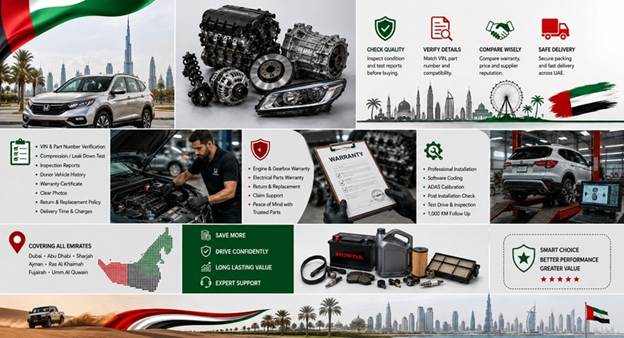
Suspension components are among the most frequently replaced parts on Honda vehicles in the UAE.
Years of driving over speed humps, uneven roads, long motorway journeys and extreme summer temperatures gradually affect rubber bushes, ball joints, shock absorbers and steering components.
Fortunately, not every suspension component needs to be purchased brand new.
Professional Honda workshops carefully assess each part individually before making recommendations.
Certain structural components can provide excellent long-term value when sourced from professionally inspected donor vehicles.
Other safety-critical wear items should always be replaced with new genuine or OEM components.
The decision depends on condition rather than age alone.
Professional Suspension Buying Guide
| Component | Genuine New | OEM | Professionally Inspected Used | Workshop Recommendation |
| Front Control Arm | ★★★★★ | ★★★★★ | ★★★★☆ | Genuine or inspected used after evaluation |
| Rear Control Arm | ★★★★★ | ★★★★★ | ★★★★☆ | Genuine or inspected used |
| Steering Knuckle | ★★★★★ | ★★★★★ | ★★★★★ | Genuine inspected used |
| Suspension Crossmember | ★★★★★ | ★★★★★ | ★★★★★ | Professionally inspected used |
| Shock Absorbers | ★★★★★ | ★★★★★ | ✖ | New genuine or OEM |
| Rubber Bushes | ★★★★★ | ★★★★★ | ✖ | New genuine or OEM |
The component determines the buying strategy.
Steering Rack, Control Arms and Wheel Bearing Inspection Guide
Steering complaints rarely originate from a single worn component.
A vibration through the steering wheel may be caused by worn control-arm bushes.
A humming noise may indicate failing wheel bearings.
Heavy steering may originate from the steering rack, power-steering system or suspension geometry.
Professional Honda specialists therefore inspect the complete steering assembly before recommending replacement parts.
Every inspection normally includes:
Steering rack.
Tie-rod ends.
Inner tie rods.
Ball joints.
Wheel bearings.
Control-arm bushes.
Suspension geometry.
This systematic approach prevents replacing healthy components unnecessarily.
Professional Steering Inspection
| Inspection | Workshop Purpose |
| VIN Verification | Confirm suspension specification |
| Honda Part Number Matching | Ensure correct replacement |
| Steering Rack Inspection | Detect internal wear |
| Wheel Bearing Evaluation | Identify excessive play or noise |
| Ball Joint Inspection | Assess movement under load |
| Control Arm Assessment | Inspect bushes and mounting points |
| Suspension Geometry | Detect alignment issues |
| Final Road Test | Confirm steering precision |
Diagnosis always precedes replacement.
Brake Parts: What Can Be Bought Used and What Should Always Be New?
Professional Honda workshops treat brake components differently from most other vehicle parts.
Some braking components may be suitable for professionally inspected reuse under appropriate conditions.
Others should always be replaced with new genuine or OEM parts.
Brake pads.
Brake discs.
Brake fluid.
Flexible brake hoses.
These are wear items.
They should generally be replaced new.
Brake calipers and certain mounting brackets may be considered for reuse if thoroughly inspected and verified to meet workshop standards.
Safety should always outweigh short-term savings.
Brake Buying Decision Matrix
| Brake Component | Genuine | OEM | Professionally Inspected Used | Workshop Recommendation |
| Brake Pads | ★★★★★ | ★★★★★ | ✖ | New |
| Brake Discs | ★★★★★ | ★★★★★ | ✖ | New |
| Brake Fluid | ★★★★★ | ★★★★★ | ✖ | New |
| Brake Calipers | ★★★★★ | ★★★★☆ | ★★★★☆ | Genuine or professionally inspected |
| ABS Sensors | ★★★★★ | ★★★★☆ | ★★★☆☆ | Genuine preferred |
| Brake Master Cylinder | ★★★★★ | ★★★★☆ | ★★★☆☆ | Inspect carefully before reuse |
Safety-critical components deserve uncompromising standards.
UAE Climate Effects on Suspension Components
The UAE creates unique challenges for suspension systems.
High ambient temperatures accelerate rubber ageing.
Frequent exposure to heat gradually hardens suspension bushes.
Long motorway journeys increase tyre and wheel-bearing loads.
Urban driving introduces repeated braking and constant steering input.
These conditions influence how Honda suspension components wear over time.
Professional technicians understand these climate-related patterns.
Rather than replacing individual components based purely on mileage, they inspect every suspension assembly according to its actual condition.
Common UAE Suspension Wear Patterns
| Component | Climate Effect | Professional Recommendation |
| Rubber Bushes | Heat-related hardening | Inspect annually |
| Ball Joints | Increased wear from rough roads | Check during servicing |
| Wheel Bearings | Heat and mileage related wear | Inspect if humming develops |
| Shock Absorbers | Reduced damping over time | Replace in pairs when worn |
| Steering Rack Boots | Heat-related cracking | Routine inspection |
| Anti-Roll Bar Links | Frequent wear over speed humps | Inspect regularly |
Climate influences maintenance schedules.
Suspension Repair vs Replacement Decision Matrix
Replacing the complete suspension assembly is rarely necessary.
Professional Honda workshops evaluate every component separately.
Evidence determines the repair strategy.
Replacing worn bushes.
Renewing ball joints.
Installing new shock absorbers.
Correcting wheel alignment.
These repairs often restore excellent handling without replacing larger assemblies.
Professional Suspension Decision Matrix
| Suspension Condition | Workshop Recommendation |
| Worn Rubber Bushes | Replace bushes |
| Ball Joint Wear | Replace affected joint |
| Leaking Shock Absorbers | Replace in pairs |
| Healthy Steering Rack | Retain original component |
| Bent Control Arm | Replace complete arm |
| Steering Geometry Incorrect | Wheel alignment and suspension inspection |
Professional inspections reduce unnecessary expenditure.
Real UAE Workshop Case Study — Honda Accord
Mileage: 231,000 km
Customer Complaint: Steering vibration at motorway speeds together with uneven front tyre wear.
The owner believed the steering rack required replacement.
Honda specialists completed:
- Steering-load testing.
- Suspension geometry measurements.
- Wheel-bearing inspection.
- Control-arm evaluation.
- Road testing.
The steering rack remained mechanically healthy.
The true faults included deteriorated control-arm bushes and one noisy wheel bearing.
Replacing those components followed by professional wheel alignment restored smooth steering.
The steering rack remained in service.
Correct diagnosis prevented unnecessary replacement.
Real UAE Workshop Case Study — Honda CR-V
Mileage: 218,000 km
Customer Complaint: Front suspension knocking while driving over uneven roads.
The owner expected new shock absorbers.
Professional inspection revealed:
- Healthy shock absorbers.
- Worn anti-roll bar links.
- One lower ball joint developing excessive movement.
- Ageing suspension bushes.
Replacing those affected components eliminated the noise.
The original shock absorbers continued operating correctly.
Professional evaluation reduced repair costs significantly.
UAE Labour Cost Comparison for Suspension Repairs
| Service | Dubai Specialist (AED) | Sharjah Independent (AED) | Abu Dhabi Specialist (AED) |
| Suspension Diagnostic Inspection | 250–500 | 180–400 | 280–550 |
| Wheel Alignment | 180–350 | 120–250 | 200–380 |
| Control Arm Replacement | 500–1,000 | 350–750 | 550–1,100 |
| Ball Joint Replacement | 300–650 | 220–500 | 350–700 |
| Steering Rack Installation | 1,300–2,600 | 950–2,100 | 1,400–2,800 |
| Complete Suspension Overhaul | 1,500–3,000 | 1,100–2,300 | 1,700–3,200 |
Professional Buyer's Checklist
- Verify the VIN before purchasing suspension components.
- Match the Honda part number precisely.
- Inspect steering racks for leaks and excessive play.
- Check wheel bearings, ball joints and control-arm bushes before ordering parts.
- Replace brake wear components with new genuine or OEM parts.
- Request inspection reports for professionally inspected used structural suspension parts.
- Budget for wheel alignment after suspension repairs.
- Complete a final road test following installation.
Key Takeaways
Buying used Honda suspension parts successfully requires professional inspection rather than visual assessment alone. VIN verification, Honda part-number confirmation, steering-system evaluation, suspension geometry measurements and careful assessment of safety-critical components help Civic, Accord, CR-V, HR-V, Pilot and City owners reduce repair costs while maintaining handling, braking performance and long-term reliability across Dubai, Abu Dhabi, Sharjah and the wider UAE.
Buying Used Honda Radiators, Water Pumps and Cooling Components
The cooling system is one of the hardest-working systems on any Honda operating in the UAE.
During summer, outside temperatures regularly exceed 45°C, while many vehicles spend hours in slow-moving traffic with the air-conditioning running continuously.
Under these conditions, even a small weakness in the cooling system can quickly develop into a major mechanical problem.
Professional Honda workshops therefore inspect every cooling component before recommending a used replacement.
A used radiator may appear perfectly straight externally while being partially blocked internally.
A water pump may rotate smoothly by hand but have worn bearings or reduced coolant circulation under operating conditions.
Experienced technicians evaluate performance rather than appearance.
Professional Cooling Component Inspection
| Inspection | Workshop Purpose |
| VIN Verification | Confirm cooling-system specification |
| Honda Part Number Matching | Ensure compatibility |
| Pressure Testing | Detect internal and external leaks |
| Radiator Flow Test | Evaluate cooling efficiency |
| Water Pump Bearing Inspection | Assess mechanical wear |
| Thermostat Testing | Verify operating temperature |
| Cooling Fan Evaluation | Confirm airflow performance |
| Coolant Condition Assessment | Identify contamination |
Professional testing protects the engine.
How UAE Heat Affects Honda Cooling Systems
Extreme temperatures influence every component of the cooling system.
Radiators operate for longer periods.
Cooling fans cycle more frequently.
Coolant ages faster.
Rubber hoses harden.
Plastic expansion tanks gradually become brittle.
These conditions accelerate normal wear.
Professional Honda specialists recommend preventive cooling-system inspections before each summer rather than waiting for overheating symptoms to appear.
That simple approach frequently prevents major engine repairs.
Common UAE Cooling-System Wear Patterns
| Component | Climate Effect | Professional Recommendation |
| Radiator | Reduced cooling efficiency | Annual inspection |
| Water Pump | Bearing and seal wear | Inspect during major servicing |
| Cooling Fan | Extended operating hours | Functional testing |
| Expansion Tank | Heat-related ageing | Routine inspection |
| Coolant Hoses | Hardening and cracking | Replace when deteriorated |
| Thermostat | Reduced operating accuracy | Test during cooling-system service |
Preventive maintenance remains the most economical solution.
Common Cooling-System Fault Codes and Workshop Diagnosis
Modern Honda engines monitor coolant temperature continuously.
When cooling performance changes, the engine management system records Diagnostic Trouble Codes.
These codes help technicians identify the affected system.
They do not automatically confirm which component has failed.
Professional workshops combine electronic diagnostics with pressure testing, flow analysis and temperature measurements before recommending replacement parts.
Common Honda Cooling-System Diagnostic Trouble Codes
| Common Fault | Typical DTC | Professional Workshop Observation |
| Engine Overheating | P0217 | Complete cooling-system inspection |
| Thermostat Performance | P0128 | Thermostat evaluation |
| Cooling Fan Circuit | P0480 | Electrical and fan diagnosis |
| Coolant Temperature Sensor | P0118 | Sensor and wiring inspection |
| Cooling-System Efficiency | — | Radiator flow evaluation |
| Coolant Leak | — | Pressure testing required |
Fault codes guide the investigation.
Professional testing confirms the repair.
Air-Conditioning Components Worth Buying Used
Air-conditioning systems contain several major components that may provide good value when professionally inspected.
However, not every component deserves the same recommendation.
Professional Honda workshops evaluate each part individually.
Compressors.
Condensers.
Cooling fans.
Blower motors.
Control modules.
Every component receives different inspection procedures before approval.
Wear items and sealing components are generally replaced with new parts during installation.
Air-Conditioning Buying Matrix
| Component | Genuine | Professionally Inspected Used | Aftermarket | Workshop Recommendation |
| Compressor | ★★★★★ | ★★★★☆ | ★★★☆☆ | Genuine or inspected used |
| Condenser | ★★★★★ | ★★★★☆ | ★★★☆☆ | Genuine or inspected used |
| Cooling Fan Assembly | ★★★★★ | ★★★★☆ | ★★★☆☆ | Genuine preferred |
| Blower Motor | ★★★★★ | ★★★★☆ | ★★★☆☆ | Genuine or inspected used |
| Expansion Valve | ★★★★★ | ✖ | ★★★★☆ | New |
| Refrigerant Seals | ★★★★★ | ✖ | ★★★★☆ | New |
Every component deserves its own inspection strategy.
Cooling-System Inspection Procedures Before Purchase
Professional buyers evaluate cooling components systematically.
Visual inspection alone is never sufficient.
Experienced Honda technicians typically complete:
Pressure testing.
Radiator flow analysis.
Thermostat evaluation.
Water-pump inspection.
Cooling-fan testing.
Coolant-quality assessment.
VIN verification.
Honda part-number confirmation.
Only after those inspections do they recommend purchasing a replacement component.
Professional Cooling-System Checklist
| Verification | Workshop Requirement |
| VIN Confirmation | Mandatory |
| Honda Part Number | Mandatory |
| Pressure Test | Required |
| Radiator Flow Test | Recommended |
| Water Pump Inspection | Required |
| Cooling Fan Evaluation | Required |
| Donor Vehicle Information | Recommended |
| Warranty Documentation | Requested |
Preparation prevents expensive repeat repairs.
Real Cooling-System Workshop Case Studies
Case Study – Honda Accord
Mileage: 249,000 km
Customer Complaint: Rising engine temperature during motorway driving with the air-conditioning operating.
Stored DTCs: P0217 and P0128
The owner purchased a used radiator online believing it had failed.
Honda specialists completed:
- Cooling-system pressure testing.
- Radiator flow analysis.
- Thermostat testing.
- Water-pump inspection.
- Infrared temperature measurements.
The radiator remained in excellent condition.
The investigation identified a sticking thermostat together with reduced coolant circulation caused by worn water-pump bearings.
Replacing those components restored stable operating temperatures.
The purchased radiator never required installation.
Professional diagnosis prevented unnecessary labour.
Case Study – Honda Civic
Mileage: 214,000 km
Customer Complaint: Weak air-conditioning while stationary together with occasional overheating in heavy traffic.
Technicians initially inspected the compressor.
It performed normally.
Further investigation identified:
- Reduced cooling-fan performance.
- Restricted condenser airflow.
- Ageing coolant.
Replacing the cooling fan, cleaning the condenser and servicing the cooling system restored normal air-conditioning performance and engine temperatures.
The compressor remained in service.
Evidence prevented unnecessary replacement.
UAE Labour Cost Comparison for Cooling-System Repairs
| Service | Dubai Specialist (AED) | Sharjah Independent (AED) | Abu Dhabi Specialist (AED) |
| Cooling-System Diagnostic Inspection | 250–500 | 180–400 | 280–550 |
| Pressure Testing | 180–350 | 120–250 | 200–380 |
| Radiator Replacement | 550–1,050 | 400–800 | 600–1,150 |
| Water Pump Replacement | 900–1,700 | 650–1,350 | 950–1,800 |
| Air-Conditioning Diagnostic Evaluation | 300–650 | 220–500 | 350–700 |
| Complete Cooling-System Overhaul | 1,700–3,300 | 1,200–2,500 | 1,800–3,500 |
Professional Buyer's Checklist
- Verify the VIN before purchasing used cooling-system parts.
- Match the Honda part number exactly.
- Request pressure-test and radiator-flow reports.
- Inspect the water pump, thermostat and cooling fan together.
- Replace coolant, seals and hoses where necessary during installation.
- Review donor vehicle information before purchasing used components.
- Compare multiple verified suppliers before ordering.
- Complete a final pressure test and road test after installation.
Key Takeaways
Buying used Honda cooling-system and air-conditioning components safely requires professional inspection rather than visual assessment alone. Pressure testing, radiator-flow analysis, water-pump evaluation, VIN verification, Honda part-number confirmation and donor vehicle assessment help Civic, Accord, CR-V, HR-V, Pilot and City owners avoid overheating, reduce repair costs and improve long-term reliability throughout Dubai, Abu Dhabi, Sharjah and the wider UAE.
Buying Used Honda ECUs, Alternators and Starter Motors
Modern Honda vehicles rely heavily on electronic systems.
A Honda Civic may contain more than 30 electronic control modules, while an Accord, CR-V or Pilot can contain considerably more depending on specification.
These systems communicate continuously.
Engine management.
Transmission control.
Climate control.
Safety systems.
Infotainment.
Driver-assistance technology.
Because of this complexity, replacing an electrical component without proper diagnosis frequently creates new problems rather than solving existing ones.
Professional Honda workshops never replace an ECU, alternator or starter motor simply because a warning light appears.
Instead, they confirm the diagnosis through structured testing.
Battery health.
Charging voltage.
CAN communication.
Ground circuits.
Connector condition.
Live sensor data.
Only then do they recommend replacement.
Professional Electrical System Inspection
| Inspection | Workshop Purpose |
| VIN Verification | Confirm electrical specification |
| Honda Part Number Matching | Ensure correct component |
| Diagnostic Scan | Retrieve DTCs and live data |
| Battery Load Test | Assess battery condition |
| Charging System Test | Evaluate alternator output |
| Starter Current Draw Test | Measure starter performance |
| Wiring Continuity Test | Detect damaged circuits |
| Final Functional Test | Confirm successful repair |
Professional diagnosis prevents replacing healthy electronic components.
Common Honda Electrical Fault Codes and Diagnostic Procedures
Diagnostic Trouble Codes provide valuable technical information.
They indicate where technicians should begin investigating.
They do not automatically identify the faulty component.
Professional Honda specialists combine fault-code analysis with multimeter testing, oscilloscope measurements and live-data evaluation before recommending replacement parts.
Common Honda Electrical Diagnostic Trouble Codes
| Common Fault | Typical DTC | Professional Workshop Observation |
| Charging System | P0620 | Alternator performance evaluation |
| Crankshaft Position Sensor | P0335 | Signal verification |
| Camshaft Position Sensor | P0341 | Wiring and sensor inspection |
| Mass Airflow Sensor | P0101 | Live-data analysis |
| Oxygen Sensor Heater | P0135 | Electrical circuit testing |
| Low System Voltage | P0562 | Battery and charging-system diagnosis |
Professional technicians diagnose the cause.
Not simply the warning light.
Battery, Charging System and Wiring Harness Inspection Guide
Many electronic faults begin with poor battery performance.
A weak battery places additional demand on the alternator.
Unstable charging voltage affects electronic control modules.
Corroded wiring creates communication faults.
Professional Honda workshops therefore inspect the complete charging system before replacing expensive electrical components.
Every inspection normally includes:
Battery load testing.
Charging-voltage measurement.
Starter current draw.
Ground-circuit inspection.
Connector evaluation.
Wiring continuity.
This structured approach often prevents unnecessary ECU replacement.
Charging System Evaluation
| Component | Workshop Recommendation |
| Battery | Load test before replacement |
| Alternator | Measure charging voltage |
| Starter Motor | Current draw analysis |
| Ground Circuits | Inspect for corrosion |
| Wiring Harness | Continuity testing |
| Connectors | Check for heat damage and corrosion |
Reliable electrical systems begin with stable voltage.
VIN Matching and Electronic Module Compatibility
Electronic components require precise compatibility.
Two modules may appear identical externally.
Internally, however, software versions, calibration files and communication protocols often differ.
Professional Honda workshops therefore insist on:
VIN verification.
Honda part-number confirmation.
Production year.
Engine specification.
Transmission specification.
Software compatibility.
Ignoring these details frequently leads to warning lights, communication failures or programming problems after installation.
Professional Compatibility Checklist
| Verification | Workshop Requirement |
| VIN Confirmation | Mandatory |
| Honda Part Number | Mandatory |
| Production Year | Required |
| Software Version | Required |
| Engine Specification | Required |
| Transmission Specification | Required |
| Connector Configuration | Required |
| Functional Verification | Required |
Compatibility determines successful installation.
ECU Programming, Coding and Calibration Requirements
Many owners believe replacing an electronic module completes the repair.
Professional workshops know otherwise.
Modern Honda vehicles often require programming, coding or calibration after installing replacement electronic components.
These procedures ensure communication between:
Engine Control Module.
Transmission Control Module.
Body Control Module.
Immobiliser.
Instrument cluster.
Driver-assistance systems.
Skipping programming may create additional warning lights despite installing the correct component.
Electronic Module Programming Guide
| Component | Programming Required |
| Engine Control Module | Usually Yes |
| Transmission Control Module | Usually Yes |
| Body Control Module | Often Yes |
| Instrument Cluster | Usually Yes |
| Smart Key Module | Yes |
| Infotainment System | Model dependent |
Programming completes many electronic repairs.
Real UAE Honda Electrical Repair Case Studies
Case Study – Honda Civic
Mileage: 218,000 km
Customer Complaint: Engine warning light together with difficult starting.
Stored DTCs: P0335 and P0562
The owner believed the Engine Control Module had failed.
Honda specialists completed:
- Battery load testing.
- Alternator output evaluation.
- Wiring continuity testing.
- Oscilloscope measurements.
- Live-data analysis.
The ECU remained fully operational.
The investigation identified a deteriorating crankshaft position sensor together with a weak battery creating unstable voltage.
Replacing those components restored reliable starting.
The ECU remained in service.
Professional diagnosis prevented unnecessary replacement.
Case Study – Honda Accord
Mileage: 226,000 km
Customer Complaint: Battery warning light and intermittent charging failure.
Stored DTC: P0620
Technicians measured charging performance under varying electrical loads.
The battery remained healthy.
Further testing identified failure of the alternator voltage regulator rather than the complete alternator.
Replacing the regulator restored charging performance.
The owner avoided purchasing an unnecessary alternator.
Professional testing reduced repair costs significantly.
UAE Labour Cost Comparison for Electrical Repairs
| Service | Dubai Specialist (AED) | Sharjah Independent (AED) | Abu Dhabi Specialist (AED) |
| Electrical Diagnostic Inspection | 250–500 | 180–400 | 280–550 |
| Battery Load Test | 100–220 | 80–150 | 120–250 |
| Charging System Evaluation | 250–500 | 180–400 | 280–550 |
| Wiring Harness Inspection | 350–700 | 250–550 | 400–750 |
| ECU Programming & Coding | 500–1,200 | 350–900 | 600–1,300 |
| Complete Electronic System Diagnosis | 600–1,300 | 450–950 | 700–1,450 |
Professional Buyer's Checklist
- Verify the VIN before purchasing used electrical components.
- Match the Honda part number precisely.
- Confirm software compatibility before ordering ECUs or control modules.
- Request donor vehicle information where available.
- Test the battery, alternator and starter together before replacing major components.
- Inspect wiring harnesses and connectors for damage or corrosion.
- Budget for programming and calibration after installation.
- Complete a final diagnostic scan to confirm successful repair.
Key Takeaways
Buying used Honda electrical parts successfully depends on professional diagnosis, compatibility verification and careful programming procedures. VIN verification, Honda part-number confirmation, battery and charging-system evaluation, wiring inspections, software compatibility checks and post-installation coding help Civic, Accord, CR-V, HR-V, Pilot and City owners avoid unnecessary electronic component replacements while improving reliability and reducing long-term ownership costs across Dubai, Abu Dhabi, Sharjah and the wider UAE.
Buying Used Honda Bumpers, Bonnets and Doors
Body panels are among the most popular used Honda spare parts purchased across the UAE.
Unlike mechanical components, many exterior panels remain structurally sound even after minor accident damage to the donor vehicle.
For this reason, professionally inspected genuine Honda body panels often provide better factory fit than lower-quality aftermarket alternatives.
However, not every used panel deserves installation.
Professional body shops inspect every replacement component carefully before recommending it.
Panel alignment.
Factory mounting points.
Structural reinforcement.
Hidden corrosion.
Previous repairs.
Paint thickness.
These inspections determine whether the component will restore factory standards.
Appearance alone is never sufficient.
Professional Body Panel Inspection
| Inspection | Workshop Purpose |
| VIN Verification | Confirm body specification |
| Honda Part Number Matching | Ensure compatibility |
| Structural Inspection | Detect hidden accident damage |
| Mounting Point Inspection | Verify factory fit |
| Paint Thickness Measurement | Identify previous repairs |
| Corrosion Inspection | Detect hidden deterioration |
| Panel Alignment Check | Restore original body gaps |
| Final Quality Assessment | Confirm installation suitability |
Professional inspection protects repair quality.
LED Headlights, Tail Lights and Mirror Compatibility Guide
Modern Honda lighting systems are significantly more advanced than earlier generations.
LED headlamps often include electronic control units.
Adaptive lighting functions.
Daytime running lights.
Automatic levelling.
Integrated control modules.
Similarly, exterior mirrors may include:
Blind-spot monitoring.
Electric folding.
Heating.
Integrated indicators.
Cameras.
Although two components may appear identical externally, they may not communicate correctly with the vehicle unless they match the original specification.
Professional workshops always verify compatibility before installation.
Lighting Compatibility Checklist
- Verify VIN.
- Match Honda part number.
- Confirm production year.
- Check connector configuration.
- Verify LED control modules.
- Confirm mirror electronics.
- Test communication with vehicle systems.
- Complete post-installation diagnostics.
Compatibility protects electronic reliability.
ADAS Sensors, Cameras and Radar Calibration Requirements
Advanced Driver Assistance Systems have transformed modern accident repairs.
Replacing a bumper is no longer simply replacing plastic.
Many Honda models position radar sensors behind the front bumper.
Windscreen cameras support lane-keeping assistance.
Blind-spot monitoring uses rear radar modules.
Parking systems rely on ultrasonic sensors.
Professional Honda workshops therefore treat ADAS repairs differently from ordinary body repairs.
Every replacement must be followed by appropriate inspection and calibration where required.
ADAS Component Inspection
| Component | Workshop Requirement |
| Forward Radar | Calibration Required |
| Front Camera | Calibration Required |
| Blind-Spot Radar | Calibration Required |
| Parking Sensors | Functional Testing |
| Rear Camera | Alignment Verification |
| Surround Camera System | Calibration Where Applicable |
Safety systems deserve professional attention.
Paint Code Matching and Body Panel Inspection
A perfectly fitted replacement panel still attracts attention if the paint colour differs slightly.
Professional body shops never rely solely on colour names.
Instead, they verify:
Honda paint code.
VIN.
Production year.
Factory finish.
Paint thickness.
Previous refinishing.
Years of exposure to UAE sunlight naturally alter paint appearance.
Professional colour blending frequently produces a better result than repainting a single panel.
Professional Paint Verification
| Inspection Area | Workshop Standard |
| Honda Paint Code | Mandatory |
| VIN Verification | Mandatory |
| Paint Thickness | Measured |
| Previous Repairs | Identified |
| Colour Matching | Confirmed |
| Final Finish Inspection | Required |
Attention to detail creates factory-quality repairs.
Genuine vs Used Body Parts Decision Matrix
Professional body shops choose replacement panels according to structural importance, repair quality and long-term durability.
Some components provide excellent value when purchased used.
Others deserve genuine new replacement depending on their function.
The decision depends upon evidence rather than price.
Professional Body Panel Comparison
| Component | Genuine New | Professionally Inspected Used | Aftermarket | Workshop Recommendation |
| Bonnet | ★★★★★ | ★★★★★ | ★★★☆☆ | Genuine used or genuine new |
| Front Bumper | ★★★★★ | ★★★★★ | ★★★☆☆ | Genuine used preferred |
| Rear Bumper | ★★★★★ | ★★★★★ | ★★★☆☆ | Genuine used preferred |
| Front Wing | ★★★★★ | ★★★★★ | ★★★★☆ | Genuine or OEM |
| Door Assembly | ★★★★★ | ★★★★★ | ✖ | Genuine used |
| Tailgate | ★★★★★ | ★★★★★ | ✖ | Genuine used |
Correct fit often reduces installation time significantly.
Real Honda Body Repair Workshop Case Studies
Case Study – Honda Civic
Mileage: 172,000 km
Customer Complaint: Front-end accident damaging the bumper, left LED headlamp and radar mounting bracket.
The owner purchased an inexpensive aftermarket bumper before visiting a Honda specialist.
During trial fitting, technicians discovered incorrect radar mounting geometry together with missing reinforcement points.
The radar system could not be calibrated successfully.
Following VIN verification and Honda part-number confirmation, a professionally inspected genuine bumper from a verified donor vehicle was installed.
Radar calibration completed successfully.
All driver-assistance systems operated normally.
Professional compatibility checks prevented repeated repairs.
Case Study – Honda CR-V
Mileage: 187,000 km
Customer Complaint: Driver's door damaged following a low-speed collision.
Technicians inspected:
- Door alignment.
- Paint thickness.
- Wiring harness.
- Blind-spot monitoring connectors.
- Structural reinforcement.
A genuine used door matching the VIN specification and paint code was sourced.
Minimal paint blending restored factory appearance.
The electronic systems communicated correctly without additional modifications.
Preparation reduced installation time considerably.
UAE Labour Cost Comparison for Body Repairs
| Service | Dubai Specialist (AED) | Sharjah Independent (AED) | Abu Dhabi Specialist (AED) |
| Body Panel Inspection | 250–500 | 180–400 | 280–550 |
| Front Bumper Installation | 450–950 | 320–700 | 500–1,000 |
| Door Replacement | 700–1,500 | 500–1,150 | 800–1,600 |
| LED Headlight Installation | 350–750 | 250–550 | 400–800 |
| ADAS Calibration | 700–1,800 | 550–1,350 | 800–1,900 |
| Paint Blending & Panel Alignment | 900–2,200 | 700–1,700 | 1,000–2,300 |
Professional Buyer's Checklist
- Verify the VIN before purchasing body panels.
- Match the Honda part number precisely.
- Confirm the production year and paint code.
- Inspect structural reinforcement and mounting points.
- Measure paint thickness to identify previous repairs.
- Verify ADAS compatibility where applicable.
- Choose professionally inspected genuine used panels whenever appropriate.
- Complete final calibration and quality inspections after installation.
Key Takeaways
Buying used Honda body parts successfully requires much more than matching appearance. VIN verification, Honda part-number confirmation, structural inspection, paint-code matching, ADAS compatibility checks and professional installation help Civic, Accord, CR-V, HR-V, Pilot and City owners achieve factory-quality repairs while maintaining safety, reliability and resale value throughout Dubai, Abu Dhabi, Sharjah and the wider UAE.
Buying Used Honda Dashboard, Seats and Interior Trim
Interior components are among the most overlooked areas when buying used Honda spare parts.
Many owners focus on engines, gearboxes and suspension while forgetting that dashboard assemblies, seats, steering wheels and trim panels contribute significantly to comfort, safety and resale value.
The UAE climate accelerates interior ageing.
Continuous exposure to intense sunlight.
High cabin temperatures.
Frequent air-conditioning use.
Daily commuting.
These conditions gradually affect plastics, leather, fabric, switches and electronic modules.
Professional Honda workshops inspect every interior component before recommending installation.
Appearance alone never confirms suitability.
Professional Interior Inspection
| Inspection | Workshop Purpose |
| VIN Verification | Confirm interior specification |
| Honda Part Number Matching | Ensure correct replacement |
| Trim Colour Verification | Match factory finish |
| Mounting Clip Inspection | Prevent vibration and poor fit |
| Wiring Connector Inspection | Verify compatibility |
| Seat Mechanism Inspection | Check adjustment systems |
| Airbag Compatibility Check | Protect occupant safety |
| Final Functional Test | Confirm complete operation |
Professional preparation restores factory-quality interiors.
Infotainment Systems, Climate Controls and Multimedia Compatibility
Modern Honda infotainment systems are integrated into multiple vehicle functions.
Navigation.
Apple CarPlay.
Android Auto.
Reverse cameras.
Bluetooth.
Climate control.
Steering-wheel controls.
Replacing the multimedia unit without confirming compatibility can affect several systems simultaneously.
Professional Honda specialists verify:
VIN.
Honda part number.
Software generation.
Connector layout.
Production year.
Vehicle specification.
Communication with surrounding control modules.
This structured process reduces programming issues after installation.
Professional Multimedia Checklist
- Verify VIN.
- Match Honda part number.
- Confirm software generation.
- Verify production year.
- Check reverse camera compatibility.
- Confirm climate-control communication.
- Inspect steering-wheel control integration.
- Complete software updates where necessary.
Electronic compatibility protects long-term reliability.
Airbags, Seatbelt Pretensioners and Safety Components
Safety components deserve the highest inspection standards.
Professional workshops treat these parts differently from cosmetic trim.
Driver airbags.
Passenger airbags.
Side airbags.
Seatbelt pretensioners.
Clock springs.
Impact sensors.
These components directly influence occupant protection.
Where legally permitted and fully documented, certain genuine used structural components may be considered after thorough inspection. However, critical restraint-system components should always comply with applicable legal requirements, manufacturer guidance and professional workshop standards.
Safety should never become a compromise based solely on price.
Professional Safety Component Guide
| Component | Genuine | Professionally Verified Used* | Workshop Recommendation |
| Driver Airbag | ★★★★★ | Where legally appropriate and fully verified | Genuine Preferred |
| Passenger Airbag | ★★★★★ | Where legally appropriate and fully verified | Genuine Preferred |
| Seatbelt Pretensioner | ★★★★★ | Where legally appropriate and fully verified | Genuine Preferred |
| Clock Spring | ★★★★★ | ★★★★☆ | Genuine Preferred |
| Steering Column | ★★★★★ | ★★★★★ | Professionally inspected |
| Impact Sensors | ★★★★★ | ★★★★☆ | Genuine Preferred |
*Subject to applicable regulations, documentation and professional inspection.
Interior Electronics Inspection Before Purchase
Many interior electrical faults originate from poor compatibility rather than component failure.
Professional Honda workshops inspect every replacement electronic module before installation.
Switch assemblies.
Climate-control panels.
Instrument clusters.
Seat-control modules.
Window switches.
Mirror controls.
Every component must communicate correctly with the vehicle.
Professional technicians therefore complete:
VIN verification.
Honda part-number confirmation.
Connector inspection.
Software compatibility.
Functional testing.
Only after those procedures do they recommend installation.
Professional Electronics Verification
| Verification | Workshop Requirement |
| VIN Confirmation | Mandatory |
| Honda Part Number | Mandatory |
| Software Version | Required |
| Production Year | Required |
| Connector Configuration | Required |
| Functional Testing | Mandatory |
| Diagnostic Scan | Required |
| Calibration Verification | Where applicable |
Preparation prevents unnecessary programming problems.
Common Interior Wear Patterns in UAE Vehicles
Honda interiors generally age exceptionally well.
Nevertheless, UAE operating conditions create predictable wear patterns.
Professional workshops regularly observe:
Steering-wheel leather becoming smooth.
Dashboard plastics fading.
Seat bolsters compressing.
Centre consoles developing minor wear.
Switch markings fading.
Air-conditioning vents becoming brittle.
Rubber trim hardening.
These issues rarely affect vehicle reliability.
However, they influence comfort and resale value.
Recognising normal wear patterns helps buyers distinguish between genuine ageing and damage requiring replacement.
Typical UAE Interior Wear
| Component | Common Observation | Professional Recommendation |
| Steering Wheel | Leather wear | Replace or professionally restore |
| Driver's Seat | Cushion compression | Inspect frame and adjustment |
| Dashboard | Heat-related ageing | Check mounting integrity |
| Centre Console | Cosmetic wear | Inspect fixing points |
| Door Panels | Sun exposure | Verify clips and trim |
| Switches | Worn markings | Functional testing before replacement |
Inspection should focus on function as well as appearance.
Real Honda Interior Workshop Case Studies
Case Study – Honda Accord
Mileage: 191,000 km
Customer Complaint: Airbag warning light appeared after dashboard replacement following accident repairs.
The replacement dashboard looked identical externally.
Honda specialists completed:
- VIN verification.
- Honda part-number confirmation.
- Wiring continuity testing.
- Airbag diagnostics.
- Connector inspection.
The dashboard wiring harness belonged to a different production specification.
After sourcing the correct VIN-matched dashboard assembly, the airbag system communicated normally.
The warning light disappeared.
Professional compatibility checks prevented unnecessary module replacement.
Case Study – Honda CR-V
Mileage: 204,000 km
Customer Complaint: Infotainment screen freezing together with intermittent reverse camera failure.
Rather than replacing the multimedia unit immediately, technicians inspected:
- Battery voltage.
- Software version.
- Wiring connectors.
- Module communication.
- Diagnostic data.
The problem originated from internal memory failure within the infotainment unit.
A VIN-matched replacement system restored every function following programming.
No wiring modifications became necessary.
Professional diagnosis reduced labour time and prevented unnecessary electrical repairs.
UAE Labour Cost Comparison for Interior Repairs
| Service | Dubai Specialist (AED) | Sharjah Independent (AED) | Abu Dhabi Specialist (AED) |
| Interior Diagnostic Inspection | 250–500 | 180–400 | 280–550 |
| Dashboard Removal & Installation | 900–1,900 | 700–1,500 | 1,000–2,100 |
| Infotainment Programming | 450–950 | 320–700 | 500–1,000 |
| Steering Wheel Replacement | 350–700 | 250–550 | 400–750 |
| Climate-Control Module Installation | 350–750 | 250–600 | 400–800 |
| Airbag System Diagnostic & Verification | 500–1,100 | 350–850 | 600–1,250 |
Professional Buyer's Checklist
- Verify the VIN before purchasing interior components.
- Match the Honda part number exactly.
- Confirm trim colour and production specification.
- Verify software compatibility for multimedia and climate-control systems.
- Inspect wiring connectors, mounting clips and adjustment mechanisms.
- Review donor vehicle information before purchasing used interior components.
- Budget for programming and calibration where required.
- Complete a final diagnostic scan after installation.
Key Takeaways
Buying used Honda interior parts successfully requires careful compatibility checks, professional inspection and attention to safety systems. VIN verification, Honda part-number confirmation, software matching, electronic testing and workshop-level installation procedures help Civic, Accord, CR-V, HR-V, Pilot and City owners maintain factory functionality, improve comfort and protect long-term resale value throughout Dubai, Abu Dhabi, Sharjah and the wider UAE.
Used Honda Spare Parts Price Guide Across the UAE
One of the most common questions Honda owners ask is:
"How much should a used Honda spare part actually cost?"
The answer is rarely straightforward.
Professional Honda workshops calculate the total repair cost, not simply the price of the replacement component.
An inexpensive used engine may require new seals, timing components, engine mounts and fresh fluids before installation.
A used gearbox may also need transmission fluid, software adaptation and new oil seals.
A body panel with a low purchase price may still require paint blending and alignment.
Professional buyers therefore compare complete project costs instead of individual part prices.
That approach consistently produces better long-term value.
What Influences the Cost of Used Honda Spare Parts?
| Factor | Effect on Overall Cost |
| Honda Model | Civic, Accord, CR-V, HR-V, Pilot and City parts vary in demand |
| Engine or Transmission Type | More complex units increase cost |
| Genuine Honda Part Number | Correct specification improves compatibility |
| Donor Vehicle Condition | Better donors usually command higher prices |
| Labour Complexity | Major influence on total repair cost |
| Programming or Calibration | Required for many electronic components |
| Supporting Parts | Frequently replaced during installation |
| Warranty Coverage | Adds long-term value |
The purchase price represents only one part of the investment.
Dubai vs Sharjah vs Abu Dhabi Labour Cost Comparison
Labour charges vary throughout the UAE.
The lowest hourly rate does not necessarily represent the lowest overall repair cost.
Experienced Honda specialists often diagnose faults more accurately during the first inspection, reducing unnecessary parts replacement and repeated labour.
Professional buyers compare workshop experience together with labour pricing.
Labour Cost Comparison by Emirate
| Service | Dubai (AED) | Sharjah (AED) | Abu Dhabi (AED) |
| Vehicle Diagnostic Inspection | 250–500 | 180–400 | 280–550 |
| Engine Compression Test | 300–600 | 220–450 | 350–650 |
| Gearbox Hydraulic Test | 350–700 | 250–550 | 400–750 |
| Suspension Inspection | 250–500 | 180–400 | 280–550 |
| Electrical Diagnostics | 300–650 | 220–500 | 350–700 |
| ADAS Calibration | 700–1,800 | 550–1,350 | 800–1,900 |
Professional diagnosis often reduces overall ownership costs.
Dealer vs Honda Specialist vs Independent Workshop Costs
Choosing the correct workshop influences both repair quality and long-term reliability.
Dealer-level facilities.
Independent workshops.
Honda specialists.
Each serves a different purpose.
Professional buyers select workshops according to technical requirements rather than simply comparing hourly labour rates.
Workshop Comparison Matrix
| Workshop Type | Best Suited For | Advantages | Considerations |
| Independent Workshop | Routine servicing, brakes and suspension | Lower labour costs | Experience varies |
| Honda Specialist | Engines, gearboxes, diagnostics and model-specific repairs | Extensive Honda expertise | Moderate labour rates |
| Dealer-Level Facility | Warranty work, advanced electronics and software updates | Factory procedures and equipment | Highest labour costs |
The correct workshop frequently determines the success of the repair.
Hidden Costs Buyers Often Forget
Professional workshops prepare detailed repair estimates because many additional costs only become apparent after disassembly.
Ignoring these expenses frequently results in incomplete repairs.
Supporting components deserve the same attention as the primary replacement part.
Common Hidden Costs
| Additional Item | Why It Matters |
| Engine Oil & Filter | Required after engine installation |
| Transmission Fluid | Essential after gearbox replacement |
| Coolant | Required during cooling-system work |
| Oil Seals | Prevent future leaks |
| Engine & Gearbox Mounts | Improve long-term reliability |
| Programming & Calibration | Required for electronic components |
| Wheel Alignment | Necessary after suspension repairs |
| Post-Repair Diagnostics | Confirm successful installation |
Complete quotations reduce unexpected expenses.
Supporting Parts You Should Replace Together
Experienced Honda technicians rarely replace one major component in isolation.
Many supporting parts naturally wear at similar rates.
Replacing them together frequently reduces long-term ownership costs.
For example:
Installing a replacement engine while retaining a worn water pump.
Replacing a gearbox without renewing transmission fluid.
Installing new suspension arms without completing wheel alignment.
These decisions often increase future labour costs.
Professional workshops recommend completing the repair properly the first time.
Supporting Parts Matrix
| Major Repair | Supporting Components |
| Engine Replacement | Water pump, thermostat, engine mounts, coolant hoses |
| Gearbox Replacement | Transmission fluid, seals, mounts |
| Radiator Replacement | Thermostat, coolant, hoses |
| Suspension Repairs | Wheel alignment, anti-roll bar links |
| Brake Disc Replacement | Brake pads and brake fluid |
| Steering Rack Replacement | Tie-rod ends and wheel alignment |
Comprehensive repairs usually provide better value.
Five-Year Cost of Ownership Comparison
Professional buyers evaluate repairs over several years rather than focusing only on today's invoice.
A professionally inspected genuine used Honda engine may initially cost more than an unknown alternative.
However, better reliability often reduces repeat repairs.
The same principle applies to gearboxes, body panels and electronic modules.
Long-term thinking usually produces lower ownership costs.
Five-Year Ownership Comparison
| Buying Strategy | Initial Cost | Repeat Repairs | Long-Term Value |
| Genuine New Honda Parts | Highest | Very Low | Excellent |
| OEM Components | Moderate | Low | Excellent |
| Professionally Inspected Used Parts | Lower | Low | Very Good |
| Premium Aftermarket | Moderate | Medium | Good |
| Low-Cost Unknown Parts | Lowest | High | Poor |
Professional planning usually delivers the best financial outcome.
Real UAE Workshop Case Study — Honda Civic
Mileage: 238,000 km
Customer Complaint: Automatic gearbox hesitation and delayed engagement.
The owner located a low-priced used gearbox online.
Before approving the purchase, Honda specialists compared several suppliers.
One transmission lacked:
- VIN verification.
- Hydraulic pressure reports.
- Donor mileage.
- Warranty documentation.
Instead, the workshop recommended a professionally inspected gearbox with documented hydraulic testing, confirmed donor mileage and verified Honda part number.
More than 52,000 km later, the transmission continues operating reliably.
The better purchase proved less expensive over time.
Real UAE Workshop Case Study — Honda Pilot
Mileage: 221,000 km
Customer Complaint: Engine overheating shortly after installing a replacement radiator purchased online.
The radiator functioned correctly.
The supporting components had been ignored.
Professional inspection identified:
- Worn thermostat.
- Deteriorated coolant hoses.
- Water-pump bearing wear.
Replacing those supporting components restored reliable cooling.
The second repair could have been avoided had the complete cooling system been evaluated during the original installation.
Professional planning reduced future labour costs.
UAE Labour Cost Comparison by Workshop Type
| Service | Independent Workshop (AED) | Honda Specialist (AED) | Dealer-Level Facility (AED) |
| Engine Replacement | 4,000–6,800 | 5,200–8,000 | 6,800–9,800 |
| Gearbox Replacement | 3,600–6,200 | 4,600–7,200 | 5,800–8,500 |
| Suspension Overhaul | 800–1,600 | 1,000–2,100 | 1,400–2,700 |
| Cooling-System Overhaul | 1,200–2,500 | 1,600–3,200 | 2,100–4,000 |
| Electrical Diagnostics | 250–550 | 350–700 | 500–950 |
| ADAS Calibration | 550–1,300 | 750–1,800 | 1,200–2,300 |
Professional Buyer's Checklist
- Compare complete repair costs rather than individual part prices.
- Verify the VIN and Honda part number before purchasing.
- Request compression, leak-down or hydraulic inspection reports where applicable.
- Compare warranty documentation from multiple suppliers.
- Budget for supporting parts, programming and calibration.
- Request written quotations before approving repairs.
- Retain all invoices and inspection reports.
- Choose experienced Honda specialists for major repairs.
Key Takeaways
Understanding the true cost of used Honda spare parts requires more than comparing purchase prices. Labour charges, supporting components, programming, calibration, warranty coverage and supplier quality all influence the final investment. Buyers who evaluate complete repair costs rather than individual components consistently achieve better reliability, lower ownership costs and stronger long-term value for Honda Civic, Accord, CR-V, HR-V, Pilot and City vehicles throughout Dubai, Abu Dhabi, Sharjah and the wider UAE.
How Professional Workshops Evaluate Donor Vehicles
The quality of a used Honda spare part begins with the quality of the donor vehicle.
Professional workshops understand this better than anyone.
A carefully maintained donor vehicle with complete service records can provide excellent replacement components even after an accident.
Conversely, a neglected vehicle with poor maintenance history may contain parts that appear clean but have hidden mechanical wear.
For this reason, experienced Honda specialists inspect the donor vehicle before evaluating individual components.
They consider:
Maintenance history.
Mileage.
Accident damage.
Flood exposure.
Engine condition.
Transmission performance.
Electronic health.
Only then do they decide whether a component deserves installation.
Professional Donor Vehicle Evaluation
| Inspection | Workshop Purpose |
| VIN Verification | Confirm exact vehicle specification |
| Honda Part Number Confirmation | Verify component compatibility |
| Odometer Review | Assess expected wear |
| Service History | Evaluate maintenance quality |
| Accident Inspection | Detect structural damage |
| Flood Damage Inspection | Protect electronic reliability |
| Diagnostic Scan | Review stored DTCs |
| Visual Inspection | Assess overall donor condition |
Professional buyers evaluate the entire vehicle.
Not just the part.
VIN Verification and Honda Part Number Matching
Many Honda components look almost identical.
Internally, however, they may differ significantly.
A gearbox from one production year may not communicate correctly with another.
A headlamp may physically fit while using different control electronics.
An ECU may require a completely different software configuration.
Professional workshops therefore insist on verifying:
Vehicle Identification Number.
Honda part number.
Engine code.
Transmission code.
Production year.
Trim specification.
Ignoring these details often leads to expensive compatibility problems after installation.
Professional Compatibility Verification
| Verification | Workshop Requirement |
| VIN | Mandatory |
| Honda Part Number | Mandatory |
| Engine Code | Required where applicable |
| Transmission Code | Required where applicable |
| Production Year | Mandatory |
| Trim Level | Recommended |
| Software Version | Required for electronic modules |
| Functional Verification | Required |
Compatibility begins before purchasing.
Mileage Verification and Service History Checks
Mileage alone never determines component quality.
Professional workshops regularly inspect Honda engines exceeding 300,000 km that remain mechanically healthy.
They also inspect much lower-mileage components suffering premature wear because of poor maintenance.
Service history explains far more than the odometer.
Regular servicing.
Correct fluids.
Cooling-system maintenance.
Transmission servicing.
These records frequently predict long-term reliability more accurately than mileage.
Professional buyers therefore evaluate both together.
Service History Evaluation
| Inspection Area | Professional Recommendation |
| Service Records | Review where available |
| Oil Change History | Confirm regular maintenance |
| Transmission Service History | Particularly important for CVT models |
| Cooling-System Maintenance | Review carefully |
| Major Repairs | Evaluate documentation |
| Previous Diagnostic Reports | Helpful where available |
Documentation strengthens buyer confidence.
Signs of Accident Damage or Flood Damage
Accident repairs do not automatically disqualify a donor vehicle.
Many vehicles suffer only cosmetic damage while mechanical systems remain unaffected.
Professional workshops inspect carefully before making recommendations.
Flood damage deserves even greater attention.
Modern Honda vehicles contain numerous electronic modules positioned throughout the vehicle.
Water exposure may create corrosion that appears months after installation.
Experienced technicians therefore inspect donor vehicles thoroughly.
Professional Damage Inspection Checklist
- Inspect chassis rails.
- Examine suspension mounting points.
- Check body alignment.
- Look for water marks beneath carpets.
- Inspect wiring connectors for corrosion.
- Examine electronic modules.
- Verify airbag deployment history.
- Review diagnostic fault codes.
Professional inspection reduces hidden risks.
Professional Donor Engine and Gearbox Evaluation
Major assemblies deserve the most detailed inspection.
Professional Honda workshops evaluate donor engines and gearboxes before approving them for sale.
Compression.
Leak-down.
Oil pressure.
Hydraulic pressure.
Fluid analysis.
Borescope inspection.
Diagnostic scanning.
VIN verification.
These procedures create confidence before installation begins.
Professional Engine & Gearbox Evaluation
| Inspection | Engine | Gearbox |
| VIN Verification | ✔ | ✔ |
| Honda Part Number | ✔ | ✔ |
| Compression Test | ✔ | — |
| Leak-Down Test | ✔ | — |
| Oil Pressure Test | ✔ | — |
| Hydraulic Pressure Test | — | ✔ |
| Fluid Analysis | ✔ | ✔ |
| Diagnostic Scan | ✔ | ✔ |
Evidence protects buyers from unnecessary risk.
Real Workshop Examples of Good and Bad Donor Vehicles
Professional workshops regularly compare donor vehicles before sourcing replacement components.
Case Study – Good Donor Vehicle
Honda Accord
Mileage: 214,000 km
Inspection revealed:
- Complete service history.
- Excellent compression.
- Stable oil pressure.
- Healthy transmission hydraulic performance.
- Clean diagnostic scan.
- Original Honda part numbers throughout.
The engine and gearbox both passed workshop inspection and were approved for future installation.
Comprehensive documentation increased buyer confidence.
Case Study – Poor Donor Vehicle
Honda Civic
Mileage: 167,000 km
Initially, the vehicle appeared attractive because of its relatively low mileage.
Professional inspection identified:
- Evidence of flood exposure.
- Corroded wiring connectors.
- Moisture beneath carpets.
- Multiple communication-related DTCs.
- Inconsistent service history.
Despite its lower mileage, the vehicle was rejected as a donor.
Condition proved far more important than the odometer reading.
Real UAE Workshop Case Study — Honda CR-V
Mileage: 233,000 km
Customer Complaint: Customer requested a replacement engine sourced from an online supplier.
Before approving the purchase, Honda specialists completed:
- VIN verification.
- Compression testing.
- Leak-down analysis.
- Donor vehicle inspection.
- Diagnostic scanning.
The proposed donor engine demonstrated poor compression on one cylinder.
Another donor engine from a different vehicle showed consistent compression, excellent maintenance history and documented servicing.
The second engine was selected.
Professional evaluation prevented an expensive installation failure.
Real UAE Workshop Case Study — Honda HR-V
Mileage: 205,000 km
Customer Complaint: Used CVT gearbox purchased independently before workshop inspection.
Technicians discovered:
- Incorrect transmission code.
- Different production specification.
- Software incompatibility.
Although externally identical, the transmission could not communicate correctly with the vehicle.
After verifying the VIN and Honda part number, the correct transmission was sourced.
The installation proceeded successfully without further complications.
Preparation prevented repeated labour costs.
UAE Labour Cost Comparison for Donor Vehicle Evaluation
| Service | Dubai Specialist (AED) | Sharjah Independent (AED) | Abu Dhabi Specialist (AED) |
| Complete Donor Vehicle Inspection | 500–1,000 | 350–750 | 550–1,100 |
| Compression & Leak-Down Testing | 500–950 | 350–700 | 550–1,000 |
| Hydraulic Transmission Evaluation | 450–900 | 320–700 | 500–950 |
| Diagnostic Scan | 250–500 | 180–400 | 280–550 |
| Borescope Inspection | 300–650 | 220–500 | 350–700 |
| VIN & Compatibility Verification | 150–350 | 100–250 | 180–380 |
Professional Buyer's Checklist
- Inspect the donor vehicle before evaluating the replacement part.
- Verify the VIN and Honda part number.
- Review mileage together with complete service history.
- Check for accident or flood damage.
- Request compression, leak-down and hydraulic inspection reports.
- Confirm engine, gearbox and production codes.
- Compare several donor vehicles before making a decision.
- Choose professionally documented components over visually attractive alternatives.
Key Takeaways
The best used Honda spare parts come from carefully evaluated donor vehicles rather than simply low-mileage examples. VIN verification, Honda part-number confirmation, service-history reviews, accident and flood inspections, compression testing, hydraulic evaluation and professional workshop procedures help Civic, Accord, CR-V, HR-V, Pilot and City owners purchase reliable components while reducing long-term repair costs throughout Dubai, Abu Dhabi, Sharjah and every emirate across the UAE.
Most Common Mistakes When Buying Used Honda Parts
Buying used Honda spare parts can significantly reduce ownership costs.
However, professional workshops repeatedly encounter avoidable mistakes that ultimately make repairs more expensive.
Many buyers focus exclusively on price.
Others purchase components without confirming compatibility.
Some order replacement parts before obtaining an accurate diagnosis.
These decisions frequently lead to incorrect installations, repeated labour charges and unnecessary downtime.
Professional Honda specialists follow a different approach.
Diagnosis comes first.
Compatibility comes second.
Purchasing comes last.
That sequence consistently delivers better long-term results.
Most Common Buying Mistakes
| Mistake | Possible Consequence |
| Purchasing before diagnosis | Wrong component replaced |
| Ignoring VIN verification | Compatibility problems |
| Not checking Honda part numbers | Incorrect specification |
| Choosing the cheapest supplier only | Reduced long-term reliability |
| Skipping donor vehicle inspection | Hidden mechanical defects |
| Ignoring warranty documentation | Increased financial risk |
| Not budgeting for supporting parts | Higher future labour costs |
| Skipping post-installation inspection | Undetected installation issues |
Professional preparation prevents expensive repairs.
Online Buying Red Flags Every Buyer Should Know
The UAE provides excellent opportunities to purchase used Honda spare parts online.
At the same time, buyers should remain alert to warning signs that indicate increased purchasing risk.
Professional workshops encourage owners to request technical evidence rather than relying solely on descriptions.
Reliable suppliers willingly provide documentation.
Unverified sellers often cannot.
Professional Online Buying Checklist
- VIN compatibility confirmation.
- Honda part number.
- Donor vehicle mileage.
- Service history where available.
- Compression or hydraulic inspection reports.
- Warranty documentation.
- Clear photographs.
- Written quotation.
If important information cannot be provided, professional buyers usually continue comparing suppliers.
Warranty Comparison for Used Honda Spare Parts
Warranty should never be judged by duration alone.
Professional workshops evaluate:
Coverage.
Technical support.
Inspection documentation.
Claim procedures.
Supplier reputation.
A shorter warranty accompanied by detailed inspection reports often provides greater confidence than a longer warranty without technical evidence.
Professional buyers compare warranty quality rather than simply counting months.
Warranty Comparison Matrix
| Component | Typical Warranty Consideration | Professional Recommendation |
| Engine | Inspection reports plus supplier warranty | Excellent when documented |
| Automatic & CVT Gearbox | Hydraulic testing and warranty | Strong value |
| Electrical Modules | Compatibility and programming support | Verify carefully |
| Body Panels | Structural inspection | Review condition |
| Suspension Components | Inspection documentation | Confirm structural integrity |
| Cooling Components | Pressure-test documentation | Verify before installation |
Documentation strengthens every warranty.
Safe Online Payments and Secure Purchasing
Professional buyers protect themselves before transferring any payment.
The purchasing process should remain as structured as the technical inspection.
Written quotations.
Invoices.
Warranty certificates.
Compatibility confirmation.
Delivery documentation.
These records simplify warranty claims while reducing misunderstandings.
Professional workshops also recommend inspecting major components immediately after delivery rather than storing them for extended periods before installation.
Professional Purchasing Checklist
| Verification | Why It Matters |
| Written Quotation | Confirms agreed pricing |
| VIN Verification | Prevents incorrect orders |
| Honda Part Number | Ensures compatibility |
| Warranty Certificate | Protects long-term ownership |
| Secure Payment Method | Reduces financial risk |
| Delivery Confirmation | Documents shipment |
| Inspection Reports | Demonstrate component quality |
| Final Workshop Inspection | Confirms installation suitability |
Preparation protects both the buyer and the investment.
Delivery Across Dubai, Abu Dhabi, Sharjah and Other Emirates
Efficient logistics have transformed the UAE spare-parts market.
Many suppliers now deliver components throughout the Emirates.
Nevertheless, delivery speed should never become more important than inspection quality.
Professional workshops frequently schedule installation only after:
Delivery confirmation.
Visual inspection.
Compatibility verification.
Documentation review.
This planning prevents unnecessary workshop downtime if unexpected issues arise.
Professional Delivery Planning
- Confirm stock availability.
- Verify delivery address.
- Review packaging quality.
- Inspect components immediately upon arrival.
- Confirm VIN compatibility before installation.
- Schedule workshop fitting after inspection.
- Report transport damage promptly.
- Store components correctly before fitting.
Planning improves repair efficiency.
Protecting Your Honda's Resale Value After Major Repairs
Many owners worry that replacing major components will reduce resale value.
Professional experience often demonstrates the opposite.
Well-documented repairs completed using genuine or professionally inspected components frequently increase buyer confidence.
Future owners appreciate evidence.
Compression reports.
Hydraulic testing.
Diagnostic records.
VIN verification.
Honda part-number confirmation.
Invoices.
Warranty certificates.
These documents demonstrate responsible ownership and professional maintenance.
Important Documents to Retain
| Document | Benefit |
| Workshop Invoice | Records professional repairs |
| Warranty Certificate | Supports future claims |
| Compression Test Report | Demonstrates engine condition |
| Hydraulic Inspection Report | Confirms gearbox health |
| Diagnostic Report | Explains original fault |
| VIN Verification Record | Confirms compatibility |
| Calibration Certificate | Verifies electronic systems |
| Complete Service History | Strengthens resale value |
Documentation becomes part of the vehicle's value.
Real UAE Workshop Case Study — Honda Accord
Mileage: 257,000 km
Customer Complaint: Replacement alternator purchased online failed shortly after installation.
Honda specialists investigated:
- VIN compatibility.
- Charging voltage.
- Wiring continuity.
- Battery condition.
- Alternator specification.
The replacement alternator belonged to a different production specification despite appearing identical externally.
Following Honda part-number verification, the correct alternator restored stable charging performance.
The second repair could have been avoided through compatibility checks before purchase.
Real UAE Workshop Case Study — Honda Civic
Mileage: 229,000 km
Customer Complaint: Newly installed front bumper prevented successful radar calibration.
Inspection revealed:
- Incorrect mounting geometry.
- Non-genuine reinforcement brackets.
- Sensor misalignment.
A professionally inspected genuine bumper matching the VIN specification restored factory alignment.
Radar calibration completed successfully.
Professional compatibility prevented repeated body-shop labour.
UAE Labour Cost Comparison for Compatibility and Inspection
| Service | Dubai Specialist (AED) | Sharjah Independent (AED) | Abu Dhabi Specialist (AED) |
| Compatibility Verification | 150–350 | 100–250 | 180–380 |
| Complete Diagnostic Inspection | 250–500 | 180–400 | 280–550 |
| Electrical Programming | 500–1,200 | 350–900 | 600–1,300 |
| Post-Installation Inspection | 250–500 | 180–350 | 300–550 |
| ADAS Calibration | 700–1,800 | 550–1,350 | 800–1,900 |
| Full Vehicle Health Check | 500–1,100 | 350–850 | 600–1,200 |
Professional Buyer's Checklist
- Obtain an accurate diagnosis before purchasing any replacement part.
- Verify the VIN, Honda part number and production specification.
- Compare multiple suppliers using technical documentation rather than price alone.
- Request warranty certificates and inspection reports.
- Inspect components immediately after delivery.
- Budget for supporting parts, programming and calibration.
- Schedule installation with an experienced Honda specialist.
- Keep every invoice, inspection report and warranty document.
Key Takeaways
Avoiding expensive mistakes when buying used Honda spare parts depends on preparation, documentation and professional inspection. Buyers who verify compatibility, review inspection reports, compare trusted suppliers, understand warranty coverage and retain complete repair records consistently achieve lower ownership costs, stronger reliability and improved resale value for Honda Civic, Accord, CR-V, HR-V, Pilot and City vehicles throughout Dubai, Abu Dhabi, Sharjah and the wider UAE.
Complete Professional Workshop Inspection Checklist
Professional Honda workshops do not rely on guesswork.
Every major repair follows a structured inspection process designed to identify the actual cause of the fault before any replacement parts are ordered.
Whether the vehicle requires a used engine, automatic gearbox, suspension component, electrical module or body panel, experienced technicians begin by collecting measurable evidence.
That process reduces unnecessary repairs, improves installation accuracy and protects the owner's budget.
Professional inspections normally include both electronic and mechanical evaluations.
Complete Workshop Inspection Checklist
| Inspection Procedure | Workshop Purpose |
| Customer Interview | Understand symptoms and repair history |
| Visual Inspection | Identify obvious faults |
| Diagnostic Scan | Retrieve DTCs and live data |
| VIN Verification | Confirm vehicle specification |
| Honda Part Number Confirmation | Ensure component compatibility |
| Mechanical Testing | Evaluate affected systems |
| Road Test | Reproduce customer concern |
| Written Repair Report | Support repair recommendations |
Evidence forms the foundation of every professional repair.
Post-Installation Inspection Procedures
Installing a replacement component does not complete the repair.
Professional workshops always perform detailed post-installation inspections before returning the vehicle to the owner.
Many issues become apparent only after the engine reaches operating temperature or the vehicle is driven under real conditions.
Professional technicians therefore inspect:
Fluid levels.
Electrical communication.
Cooling-system performance.
Transmission adaptation.
Steering alignment.
Brake operation.
Electronic control systems.
These final checks confirm that the repair has been completed successfully.
Post-Installation Checklist
| Inspection | Workshop Requirement |
| Diagnostic Scan | Mandatory |
| Fluid-Level Verification | Mandatory |
| Leak Inspection | Required |
| Electrical System Check | Required |
| Cooling-System Evaluation | Required |
| Road Test | Mandatory |
| DTC Confirmation | Required |
| Final Quality Inspection | Mandatory |
Professional repairs extend beyond installation.
First 1,000 km Inspection After Major Repairs
Experienced Honda specialists frequently recommend a follow-up inspection after approximately 1,000 km following major mechanical repairs.
This inspection is preventive rather than corrective.
Engine mounts settle.
Transmission adaptations complete.
Fluid levels stabilise.
Cooling systems naturally purge remaining air.
Wheel alignment may require minor adjustment after suspension work.
A short follow-up inspection helps identify these small changes before they become larger problems.
1,000 km Follow-Up Inspection
| Inspection Item | Workshop Recommendation |
| Engine Oil Level | Verify |
| Coolant Level | Check |
| Transmission Fluid | Inspect |
| Engine Mounts | Recheck |
| Suspension Fasteners | Confirm torque |
| Wheel Alignment | Verify where applicable |
| Diagnostic Scan | Review for new DTCs |
| Road Test | Complete |
Early inspections support long-term reliability.
Preventive Maintenance Strategy for Honda Owners
Preventive maintenance remains significantly less expensive than emergency repairs.
Professional Honda workshops encourage owners to inspect components before symptoms become severe.
Routine inspections identify gradual wear while repairs remain relatively straightforward.
Rather than replacing major assemblies after failure, technicians monitor:
Cooling systems.
Suspension.
Steering.
Electrical charging.
Transmission performance.
Brake systems.
Air-conditioning.
This strategy reduces both repair costs and unexpected vehicle downtime.
Recommended Maintenance Schedule
| Maintenance Item | Professional Recommendation |
| Engine Oil & Filter | Follow Honda service schedule |
| Brake Inspection | Every scheduled service |
| Cooling-System Inspection | Before every UAE summer |
| Suspension Inspection | Every 20,000 km |
| Transmission Inspection | Every 40,000–60,000 km |
| Battery Load Test | Annually |
| Air-Conditioning Evaluation | Annually |
| Full Diagnostic Scan | Annually |
Preventive maintenance protects reliability.
Seasonal UAE Maintenance Checklist
Operating a Honda in the UAE requires preparation for changing seasonal conditions.
Summer places exceptional stress on cooling systems and batteries.
Winter brings fewer extreme demands but remains an ideal opportunity for comprehensive inspections before another year of daily driving.
Professional workshops adjust maintenance priorities according to seasonal conditions.
Seasonal Inspection Checklist
| Season | Recommended Focus |
| Before Summer | Cooling system, battery, air-conditioning |
| During Summer | Coolant levels, tyre pressures, engine temperature |
| Autumn | Suspension and brake inspection |
| Winter | Complete vehicle health check |
| Before Long Journeys | Fluids, tyres, brakes and diagnostics |
| Annual Service | Full mechanical and electronic inspection |
Seasonal preparation reduces unexpected breakdowns.
Fleet and Business Owner Buying Advice
Fleet operators approach spare-parts purchasing differently from private owners.
Every day a vehicle remains unavailable affects productivity.
Professional fleet managers therefore prioritise:
Reliable suppliers.
Consistent quality.
Predictable delivery.
Technical documentation.
Warranty support.
Professional installation.
Although purchase price remains important, overall operating costs receive greater attention.
Reducing downtime frequently delivers greater financial savings than purchasing the least expensive component.
Fleet Purchasing Priorities
- VIN verification.
- Honda part-number confirmation.
- Reliable supplier network.
- Bulk purchasing opportunities.
- Scheduled maintenance planning.
- Professional installation.
- Comprehensive documentation.
- Warranty support.
Planning improves operational efficiency.
Real UAE Workshop Case Study — Honda CR-V
Mileage: 245,000 km
Customer Complaint: Customer requested a replacement engine after noticing increased oil consumption.
Rather than approving the request immediately, Honda specialists completed:
- Compression testing.
- Leak-down analysis.
- Oil-pressure evaluation.
- Borescope inspection.
- Diagnostic scanning.
Compression remained healthy across every cylinder.
The actual issue involved ageing valve-cover seals together with a restricted PCV valve.
Replacing those components restored normal engine performance.
The original engine remained in service.
Professional inspection prevented an unnecessary engine replacement.
Real UAE Workshop Case Study — Honda Pilot
Mileage: 237,000 km
Customer Complaint: Steering vibration following suspension repairs completed elsewhere.
Honda specialists inspected:
- Suspension geometry.
- Wheel alignment.
- Steering rack.
- Control-arm bushes.
- Wheel bearings.
The suspension components had been installed correctly.
The final wheel alignment had never been completed.
After correcting suspension geometry, the vibration disappeared.
No further replacement parts became necessary.
Professional post-installation inspection solved the problem.
UAE Labour Cost Comparison for Professional Inspections
| Service | Dubai Specialist (AED) | Sharjah Independent (AED) | Abu Dhabi Specialist (AED) |
| Complete Workshop Inspection | 500–1,100 | 350–850 | 600–1,200 |
| Compression & Leak-Down Testing | 500–950 | 350–700 | 550–1,000 |
| Transmission Hydraulic Inspection | 450–900 | 320–700 | 500–950 |
| Diagnostic Scan | 250–500 | 180–400 | 280–550 |
| Post-Installation Inspection | 300–550 | 180–350 | 350–650 |
| 1,000 km Follow-Up Inspection | 200–450 | 150–300 | 220–500 |
Professional Buyer's Checklist
- Request a complete diagnostic inspection before purchasing major components.
- Verify the VIN and Honda part number before ordering.
- Review compression, leak-down and hydraulic inspection reports.
- Schedule post-installation inspections after major repairs.
- Return for a 1,000 km follow-up after engine or gearbox replacement.
- Prepare the vehicle for UAE summer with preventative cooling-system maintenance.
- Retain all inspection reports, invoices and warranty documentation.
- Choose experienced Honda specialists for complex repairs and calibrations.
Key Takeaways
Professional workshop procedures remain one of the most effective ways to reduce long-term ownership costs when buying used Honda spare parts. Structured inspections, VIN verification, Honda part-number confirmation, post-installation checks, scheduled follow-up inspections and preventative maintenance help Civic, Accord, CR-V, HR-V, Pilot and City owners maximise reliability while reducing unnecessary repairs across Dubai, Abu Dhabi, Sharjah and every emirate throughout the UAE.
Ultimate Used Honda Spare Parts Buyer's Checklist
Purchasing a used Honda spare part should never begin with comparing prices.
Professional workshops follow a logical sequence that minimises risk and improves long-term reliability.
First, they confirm the fault.
Next, they verify compatibility.
Only then do they compare available replacement parts.
This approach consistently reduces incorrect purchases, unnecessary labour and repeat repairs.
Whether buying an engine, gearbox, suspension component, electrical module or body panel, every decision should be supported by technical evidence.
Ultimate Professional Buyer's Checklist
| Step | Professional Recommendation |
| 1 | Confirm the fault through professional diagnosis |
| 2 | Verify the Vehicle Identification Number (VIN) |
| 3 | Match the Honda part number exactly |
| 4 | Confirm engine and transmission codes |
| 5 | Review donor vehicle history |
| 6 | Request inspection reports |
| 7 | Compare verified suppliers |
| 8 | Review warranty documentation |
| 9 | Budget for labour and supporting parts |
| 10 | Complete post-installation inspection |
Preparation consistently produces better ownership outcomes.
Decision Matrix: Genuine vs OEM vs Used vs Aftermarket Parts
Honda owners often ask which type of replacement part offers the best value.
Professional workshops rarely give a single answer.
Different components require different strategies.
For example, brake pads should normally be purchased new.
Professionally inspected genuine used body panels frequently provide factory fit.
A carefully tested genuine used engine can offer outstanding long-term value.
The correct choice depends on the component, inspection results and ownership objectives.
Professional Parts Comparison Matrix
| Component | Genuine | OEM | Professionally Inspected Used | Aftermarket | Recommended Option |
| Engine | ★★★★★ | ★★★★☆ | ★★★★★ | ★★☆☆☆ | Genuine Used or Genuine New |
| Gearbox | ★★★★★ | ★★★★☆ | ★★★★★ | ★★☆☆☆ | Genuine Used after hydraulic testing |
| Body Panels | ★★★★★ | ★★★★☆ | ★★★★★ | ★★★☆☆ | Genuine Used |
| Suspension Arms | ★★★★★ | ★★★★★ | ★★★★☆ | ★★★☆☆ | Genuine or OEM |
| Brake Components | ★★★★★ | ★★★★★ | ✖ | ★★★★☆ | Genuine or OEM |
| Electronic Modules | ★★★★★ | ★★★★☆ | ★★★★☆ | ★★☆☆☆ | VIN-Matched Genuine |
Professional inspection determines value more effectively than price alone.
When Used Parts Are a Better Investment Than New Parts
Not every repair benefits from purchasing a brand-new component.
Professional workshops frequently recommend professionally inspected used parts when:
Factory compatibility matters.
The donor vehicle has excellent service history.
Inspection reports confirm mechanical health.
Replacement costs remain disproportionately high.
Older Honda models require discontinued components.
A genuine used Honda bonnet may provide superior alignment compared with some lower-cost alternatives.
Similarly, a professionally inspected engine with documented compression results may represent excellent long-term value.
The decision should always follow technical evaluation.
When Used Parts Make Sense
- Genuine body panels.
- Professionally inspected engines.
- Tested automatic gearboxes.
- Steering knuckles.
- Suspension crossmembers.
- Interior trim.
- Door assemblies.
- Exterior mirrors with verified compatibility.
Professional evaluation determines suitability.
Workshop Standards That Build Buyer Confidence
Trust develops through transparency.
Professional Honda workshops support every recommendation with evidence.
Compression reports.
Leak-down analysis.
Hydraulic pressure testing.
Diagnostic scans.
VIN verification.
Honda part-number confirmation.
Road-test observations.
These documents explain precisely why a replacement part has been recommended.
Professional communication reduces uncertainty while improving buyer confidence.
Professional Workshop Standards
| Inspection Standard | Workshop Requirement |
| Diagnostic Scan | Mandatory |
| VIN Verification | Mandatory |
| Honda Part Number Confirmation | Mandatory |
| Compression Testing | Required for replacement engines |
| Hydraulic Testing | Required for transmissions |
| Cooling-System Pressure Testing | Required for overheating complaints |
| Road Test | Required before delivery |
| Final Inspection Report | Mandatory |
Evidence remains the strongest recommendation.
Internal Buying Resources for Honda Models and Part Categories
Owners researching used Honda spare parts frequently continue exploring additional maintenance topics before making purchasing decisions.
Understanding model-specific maintenance patterns improves both buying confidence and long-term ownership.
Useful related resources include:
- Used Honda Civic engine buying guide.
- Honda Accord automatic gearbox guide.
- Honda CR-V suspension component guide.
- Honda HR-V CVT maintenance guide.
- Honda Pilot steering-system inspection.
- Honda City electrical component guide.
- Honda cooling-system maintenance.
- Honda air-conditioning repairs.
- Honda brake system inspections.
- Honda body panel compatibility.
- Honda workshop diagnostic procedures.
- Honda preventive maintenance schedules.
Building technical knowledge reduces purchasing risk.
Final Professional Recommendations Before Purchasing Used Honda Parts
Professional workshops rarely regret spending extra time inspecting a replacement part.
They often regret installing one without sufficient inspection.
Successful purchasing begins with:
Accurate diagnosis.
Compatibility verification.
Professional documentation.
Donor vehicle evaluation.
Inspection reports.
Warranty review.
Post-installation testing.
These procedures reduce long-term ownership costs while improving reliability.
Before purchasing any used Honda component, compare several verified suppliers.
Evaluate documentation rather than appearance.
Choose quality rather than speed.
The correct replacement part should solve the original problem.
It should not create another.
Real UAE Workshop Case Study — Honda Accord
Mileage: 248,000 km
Customer Complaint: Customer planned to replace the complete steering rack after noticing heavy steering.
Honda specialists completed:
- Steering-load analysis.
- Hydraulic inspection.
- Suspension geometry measurements.
- Wheel-bearing evaluation.
- Diagnostic scanning.
The steering rack remained mechanically healthy.
The actual faults involved worn lower control-arm bushes together with incorrect wheel alignment following previous suspension work.
Replacing the bushes and correcting the alignment restored precise steering.
Professional diagnosis avoided an unnecessary steering-rack replacement.
Real UAE Workshop Case Study — Honda HR-V
Mileage: 212,000 km
Customer Complaint: Air-conditioning performance reduced during afternoon driving.
Rather than replacing the compressor immediately, technicians inspected:
- Refrigerant pressure.
- Cooling-fan operation.
- Condenser airflow.
- Compressor clutch performance.
- Cabin temperature sensors.
The compressor remained healthy.
The investigation identified restricted condenser airflow together with a weak cooling fan.
Replacing the fan restored efficient cooling.
Professional inspection prevented unnecessary compressor replacement.
UAE Labour Cost Comparison by Workshop Type
| Service | Independent Workshop (AED) | Honda Specialist (AED) | Dealer-Level Facility (AED) |
| Complete Vehicle Inspection | 350–850 | 500–1,100 | 700–1,300 |
| Compression & Leak-Down Testing | 350–700 | 500–950 | 700–1,300 |
| Hydraulic Transmission Testing | 320–700 | 450–900 | 650–1,200 |
| Electrical Diagnostics | 220–500 | 350–700 | 500–950 |
| ADAS Calibration | 550–1,300 | 750–1,800 | 1,200–2,300 |
| Final Post-Repair Inspection | 180–350 | 300–550 | 450–750 |
Professional Buyer's Checklist
- Confirm the diagnosis before purchasing any replacement component.
- Verify the VIN, Honda part number, engine code and transmission code.
- Request inspection reports for engines, gearboxes and structural components.
- Compare supplier documentation rather than price alone.
- Budget for supporting parts, fluids and calibration.
- Schedule post-installation inspections and road testing.
- Retain invoices, inspection reports and warranty documentation.
- Work with experienced Honda specialists for complex repairs.
Key Takeaways
The smartest way to buy used Honda spare parts is to follow professional workshop procedures rather than making decisions based solely on price. Accurate diagnosis, VIN verification, Honda part-number confirmation, donor vehicle assessment, technical documentation, careful supplier comparison and structured post-installation inspections help Civic, Accord, CR-V, HR-V, Pilot and City owners reduce repair costs, improve long-term reliability and maximise resale value throughout Dubai, Abu Dhabi, Sharjah and every emirate across the UAE.
Final Professional Buying Recommendations
Buying used Honda spare parts successfully is not about finding the lowest advertised price.
It is about making the right technical decision.
Professional Honda workshops begin every repair by confirming the fault rather than replacing parts based on assumptions.
Accurate diagnosis remains the most valuable investment any owner can make.
Before purchasing an engine, verify compression, leak-down results, oil pressure, engine code and donor vehicle history.
Before purchasing a gearbox, review hydraulic pressure testing, transmission code, fluid condition and compatibility reports.
Electrical modules require VIN verification, Honda part-number confirmation, software compatibility and, where necessary, professional programming after installation.
Body panels should be inspected for structural integrity, mounting points, paint-code compatibility and previous repairs.
Cooling-system components deserve pressure testing and flow evaluation rather than visual inspection alone.
Suspension and steering components should always be assessed as complete systems rather than replacing isolated parts without diagnosis.
The same principles apply to every Honda model, whether you own a Civic, Accord, CR-V, HR-V, Pilot or City.
Choosing experienced Honda specialists, comparing multiple verified suppliers and retaining every invoice, inspection report and warranty certificate will reduce long-term ownership costs while strengthening future resale value.
Professional maintenance does not simply keep a Honda on the road.
It helps preserve the engineering quality that has made Honda one of the world's most trusted automotive manufacturers.
Real UAE Workshop Case Study — Honda Civic
Mileage: 281,000 km
Customer Complaint: Customer requested a replacement engine because of increased oil consumption and occasional blue exhaust smoke.
Honda specialists carried out:
- Compression testing.
- Leak-down analysis.
- Borescope inspection.
- Oil-pressure testing.
- PCV system evaluation.
- Diagnostic scanning.
Compression remained healthy.
Cylinder sealing remained consistent.
The actual fault involved a restricted PCV valve together with ageing valve-cover seals allowing excessive oil consumption.
Replacing those relatively inexpensive components restored normal operation.
The original engine remained in service.
Professional diagnosis prevented one of the most expensive repairs possible.
Real UAE Workshop Case Study — Honda Accord
Mileage: 255,000 km
Customer Complaint: Transmission warning light together with delayed shifting after another workshop recommended replacing the automatic gearbox.
Professional Honda technicians completed:
- Hydraulic pressure testing.
- Valve-body inspection.
- Solenoid evaluation.
- Transmission-fluid analysis.
- Live-data monitoring.
The gearbox remained mechanically healthy.
The investigation identified a faulty pressure-control solenoid together with degraded transmission fluid.
Replacing the solenoid, renewing the transmission fluid and completing adaptation procedures restored smooth gear changes.
The original gearbox remained in service.
Professional evidence once again prevented unnecessary replacement.
UAE Labour Cost Comparison for Final Ownership Planning
| Service | Dubai Specialist (AED) | Sharjah Independent (AED) | Abu Dhabi Specialist (AED) |
| Complete Vehicle Inspection | 500–1,100 | 350–850 | 600–1,200 |
| Engine Compression & Leak-Down Testing | 500–950 | 350–700 | 550–1,000 |
| Gearbox Hydraulic Inspection | 450–900 | 320–700 | 500–950 |
| Electrical Diagnostic Evaluation | 350–700 | 220–500 | 400–750 |
| ADAS Calibration | 700–1,800 | 550–1,350 | 800–1,900 |
| Final Post-Repair Inspection | 300–550 | 180–350 | 350–650 |
Professional Buyer's Checklist
- Confirm the fault through professional diagnosis before purchasing parts.
- Verify the VIN, Honda part number, engine code and transmission code.
- Request compression, leak-down, hydraulic and diagnostic reports where applicable.
- Review donor vehicle history, warranty documentation and supplier reputation.
- Compare multiple verified suppliers before making a final decision.
- Replace supporting components and fluids during major repairs.
- Complete post-installation inspections, calibration and road testing.
- Retain invoices, inspection reports and warranty certificates throughout vehicle ownership.
Key Takeaways
Buying used Honda spare parts in the UAE is safest and most cost-effective when every decision is supported by professional diagnosis, VIN verification, Honda part-number confirmation, donor vehicle evaluation and documented workshop inspections. Careful supplier comparison, structured compatibility checks, preventative maintenance and complete repair documentation help Honda Civic, Accord, CR-V, HR-V, Pilot and City owners reduce long-term repair costs, improve reliability and maximise resale value across Dubai, Abu Dhabi, Sharjah and every emirate throughout the UAE.
Frequently Asked Questions
Categories
- Audi
- BMW
- Car Accessories
- Car Tips
- Ford
- Land Rover
- Mazda
- Range Rover
- Top 10
- UAE Car Parts
- Used Car Parts
- Toyota
- Replacement Engines
- Nissan
- Hyundai
- Mitsubishi
- Volkswagen
- Honda
- Kia
- Chevrolet
- Dodge
- Jeep
- Subaru
- Renault
- Lexus
- Mercedes
- Suzuki
- Hummer
- Porsche
- Infiniti
- Peugeot
- GMC
- Mini
- Volvo
- Replacement Gearboxes
- MG
- Jaguar
- Skoda
- Cadillac
- Daihatsu
- Fiat
- German Car Parts
- Japanese Car Parts
- Aftermarket Car Parts
- Genuine Car Parts
- New Car Parts
- Reconditioned Car Parts
- European Car Parts
- American Car Parts
- Korean Car Parts
- British Car Parts
- Chinese Car Parts
- Sports/Exotic Car Parts
- Luxury Car Parts
- Performance Car Parts
- SUV/4x4 Spare Parts
- Truck Spare Parts
- EV Car Parts
- Hybrid Car Parts
- Auto Spare Parts in UAE
- Tesla
- Isuzu
- Ram
- Ferrari
- Bentley
- Lamborghini
- Genesis
- Maserati
- Lincoln
- Chrysler
- Opel
- Citroen
- SsangYong
- Seat
- McLaren
- Aston Martin
- Rolls Royce
- Maybach
- Alfa Romeo
- Bugatti
- Scion
- Abu Dhabi Car Parts
- Ajman Car Parts
- Al Khan Car Parts
- Al Sajaa Car Parts
- Deira Car Parts
- Dubai Car Parts
- Fujairah Car Parts
- Industrial Area 6 Car Parts
- Mussafah Car Parts
- Ras Al Khaimah Car Parts
- Sharjah Car Parts
- Umm Al Quwain Car Parts
- Acura
- BYD
- Chery
- Dacia
- DS
- Geely Emgrand
- EXEED
- GAC
- GAC Gonow
- Geely
- Gonow
- Great Wall
- Haima
- Haval
- Holden
- Iveco
- JAC
- Jaecoo
- Jetour
- Lotus
- Omoda
- Proton
- Renault Samsung
- Roewe
- Lucid