Used Hyundai Spare Parts in UAE: What Buyers Should Check Before Ordering
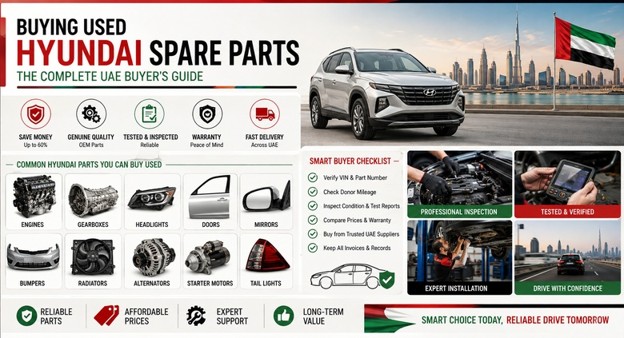
August 7, 2026
Used Hyundai Spare Parts in UAE: Why They Make Sense for Many Owners
Walk into almost any independent Hyundai workshop in Dubai or Sharjah and you'll notice something interesting.
Not every vehicle is being repaired with brand-new parts.
Far from it.
A Tucson with a damaged headlamp after a parking scrape. An Elantra needing a replacement door. A Sonata waiting for an alternator. A Santa Fe requiring a tailgate after a rear-end collision. In many cases, professionally inspected used Hyundai spare parts in UAE solve the problem without turning a routine repair into a financial headache.
That's the bit many first-time buyers miss.
Buying used doesn't automatically mean accepting poor quality.
Buying blindly does.
The UAE has one of the region's busiest automotive parts markets, which means owners often have access to genuine Hyundai parts removed from low-mileage donor vehicles. Some have covered only a fraction of the distance your own car has travelled. Others have been professionally tested before reaching the shelf.
That changes the conversation completely.
Instead of asking, "Is a used part worth buying?", experienced owners ask a better question.
"Has this part been inspected properly?"
That's where smart buying begins.
Used Hyundai Parts: Where Buyers Save the Most
| Hyundai Part | Buying Used Often Makes Sense |
| Doors | ✔ |
| Bonnet | ✔ |
| Tailgate | ✔ |
| Headlights | ✔ |
| Mirrors | ✔ |
| Engine Assemblies (Inspected) | ✔ |
| Gearbox Assemblies (Inspected) | ✔ |
| Interior Trim | ✔ |
Condition matters more than age.
Why Used Hyundai Spare Parts Are Growing in Popularity
There's another reason demand keeps climbing.
Actually, several.
Repair costs have increased.
Vehicle ownership has become more expensive.
Many owners would rather restore a well-maintained Hyundai than replace it with another vehicle carrying higher monthly costs.
Makes sense, doesn't it?
A carefully chosen used radiator, bumper or gearbox can return the vehicle to the road while leaving enough money in the budget for proper servicing and future maintenance.
Fleet managers understand this better than most.
Downtime costs money.
Every extra day waiting for an unavailable new part means another vehicle sitting still instead of earning its keep.
That's why professionally inspected used parts continue gaining attention across Dubai, Abu Dhabi, Ajman, Ras Al Khaimah, Fujairah and Umm Al Quwain.
They're practical.
Not second best.
Benefits of Buying Used Hyundai Spare Parts
Price is only the beginning.
Availability often becomes the bigger advantage.
Some discontinued Hyundai parts simply aren't easy to source new, especially for older Accent, Sonata or Elantra models. A genuine used replacement may arrive faster, fit better and require fewer adjustments than an aftermarket alternative.
Then there's factory fitment.
Original mounting points.
Original connectors.
Original build quality.
Those details matter inside a busy workshop because they reduce installation time and minimise unexpected surprises.
A cheap aftermarket part that needs modification isn't necessarily cheaper once labour has been added.
Funny how that works.
Why Many Owners Choose Used Parts
- Genuine factory fit.
- Better availability.
- Lower repair costs.
- Faster turnaround.
- Suitable for many body and mechanical repairs.
- Helps maintain older Hyundai models economically.
Saving money is good.
Saving time as well is even better.
Challenges Buyers Should Know Before Ordering
Not every used Hyundai part deserves your money.
Let's be honest.
Some should stay exactly where they are.
Poorly stored electrical parts.
Accident-damaged suspension parts.
Unknown airbags.
Untested sensors.
Parts with missing identification.
Walk away.
There will always be another option.
The biggest mistakes usually happen when buyers become fixated on price and forget everything else.
Compatibility disappears.
Warranty gets ignored.
Inspection reports are forgotten.
Eventually, the workshop discovers the problem after the part has already been delivered.
Now the repair has stopped.
Again.
A careful buyer rarely experiences that situation.
Preparation quietly solves problems before they appear.
Genuine vs Used Hyundai Parts
This isn't a battle.
It's a decision.
Genuine new Hyundai parts remain the first choice for many safety-critical repairs, especially where manufacturer specifications leave little room for compromise. Professionally inspected used parts, however, frequently provide outstanding value for engines, gearboxes, body panels, lighting units, mirrors and interior parts when they have been tested properly and matched accurately.
The clever approach isn't choosing one category forever.
It's choosing the right option for the right repair.
That's what experienced workshops do every day.
Decision Matrix: Genuine or Used?
| Situation | Better Choice |
| Airbags | Genuine New |
| Brake Friction Parts | Genuine/OEM |
| Engine Assembly | Professionally Inspected Used |
| Gearbox Assembly | Professionally Inspected Used |
| Door or Bonnet | Genuine Used |
| Interior Trim | Genuine Used |
Experience beats assumptions.
Every time.
Key Things Every Buyer Should Know
Before you spend a single dirham, slow the process down.
Ask questions.
Request photographs.
Confirm the VIN.
Match the Hyundai part number.
Read the warranty.
Understand what has actually been inspected.
Professional workshops rarely rush into ordering replacement parts.
Neither should you.
One careful decision today could easily prevent another workshop visit next month.
That's a far better outcome than chasing the lowest price and hoping everything works out.
Professional Buyer's Checklist:
- Verify the VIN.
- Match the Hyundai part number.
- Confirm donor vehicle details.
- Request inspection photographs.
- Review warranty coverage.
- Compare trusted suppliers.
- Budget for installation and supporting parts.
- Keep every purchase document.
Key Takeaways:
Used Hyundai spare parts aren't simply the cheaper option—they're often the smarter one when purchased carefully. Buyers who verify compatibility, understand the vehicle's history, choose professionally inspected parts and work with experienced suppliers can reduce repair costs without sacrificing reliability. Across the UAE, informed decisions consistently outperform rushed purchases.
How to Identify Genuine Used Hyundai Parts
Here's something experienced workshop technicians rarely say out loud.
Not every used Hyundai part is actually worth fitting.
Two identical-looking alternators can tell completely different stories. One may have come from a low-mileage Tucson involved in a minor rear-end collision. The other could have spent years under brutal heat, skipped servicing and survived an engine failure before ending up on a shelf.
Both look similar.
Only one deserves your money.
That's why reputable suppliers don't rely on appearances. They inspect casting marks, factory labels, connector condition, wear patterns and part numbers before recommending anything. Cosmetic scratches aren't usually a concern.
Structural damage is.
Heat damage is.
Improper repairs are.
Those are the problems that matter.
Inspection Points Before Buying Used Hyundai Parts:
| Hyundai Part | What to Check |
| Engine | Compression, leaks, engine code |
| Gearbox | Smooth operation, oil condition |
| Headlight | Mounting tabs, moisture |
| Door | Rust, hinge alignment |
| Alternator | Charging test |
| Starter Motor | Bench testing |
A clean-looking part isn't always a healthy part.
VIN and Hyundai Part Number Verification
One mistake.
That's all it takes.
Modern Hyundai vehicles may look identical from the outside, yet use completely different parts underneath depending on the engine, gearbox, production year or trim level.
Never order by photographs alone.
Always ask for the VIN.
Then match the Hyundai part number.
Professional workshops follow this routine because guessing wastes time, delays repairs and increases labour costs. Even something as straightforward as a door mirror or cooling fan may have different electrical connections depending on the model specification.
Five minutes spent checking compatibility can save five days waiting for replacements.
That's a trade worth making.
Essential Information Before Ordering:
- Complete VIN.
- Hyundai part number.
- Model year.
- Engine size.
- Gearbox type.
- Trim specification.
- Clear photographs.
- Supplier inspection report.
Good information produces good buying decisions.
Checking Compatibility Before Ordering
Compatibility isn't just about whether the part fits.
It has to work.
Think about an Elantra headlight.
Will it connect correctly?
Does it support the same lighting system?
Will the mounting points line up?
Now consider a Santa Fe gearbox.
Does the transmission code match?
Has the software specification been confirmed?
These questions sound technical.
They are.
That's exactly why experienced workshops verify everything before ordering rather than after delivery.
Decision Matrix: Should You Buy the Part?
| Verification Step | Decision |
| VIN Matches | Proceed |
| Part Number Matches | Proceed |
| Inspection Completed | Proceed |
| Unknown History | Investigate Further |
| Structural Damage Found | Reject |
| Compatibility Unclear | Do Not Order |
Confidence comes from verification.
Not assumptions.
Understanding Hyundai Model Differences
A Tucson isn't an Accent.
A Palisade certainly isn't a Sonata.
Each Hyundai model has its own engineering, electrical systems and production updates. Even within the same model, different engines or trim levels may require different replacement parts.
That's where many online buyers get caught out.
They search by vehicle name.
Professionals search by specification.
A low-mileage Tucson cooling fan may not fit another Tucson built only a year later if Hyundai updated the electrical connector.
Small detail.
Big consequence.
Workshop Tip:
Always compare:
- Production year.
- Engine code.
- Gearbox code.
- Trim level.
- Original Hyundai part number.
- VIN record.
Those six checks eliminate most compatibility problems.
Avoiding Fake and Counterfeit Parts
Counterfeit automotive parts remain a genuine concern.
Especially online.
If the price looks unbelievably low, stop.
Ask yourself why.
Poor packaging.
Missing Hyundai markings.
No warranty.
No inspection report.
Reluctance to answer technical questions.
These warning signs deserve attention.
Experienced suppliers don't become frustrated when customers ask questions.
They expect them.
Because informed buyers make better customers.
Common Counterfeit Warning Signs:
| Warning Sign | Risk Level |
| No Hyundai Identification | High |
| Extremely Low Price | High |
| No Inspection Report | High |
| Poor Packaging | Medium |
| No Warranty | High |
| Seller Avoids Questions | High |
Trust evidence.
Not promises.
Used Hyundai spare parts for sale Buying Guide
Searching online for Used Hyundai spare parts for sale is easy.
Finding the right one takes discipline.
Start with compatibility.
Move to inspection quality.
Then compare warranty, supplier reputation and delivery options across the UAE.
Price comes afterwards.
Professional buyers rarely purchase the first listing they see. They compare donor vehicle mileage, request detailed photographs and ask how the part was tested before approving the order.
Many experienced Hyundai specialists and platforms such as PartFinder UAE also recommend comparing several verified suppliers before making a final decision, particularly for engines, gearboxes and expensive body parts.
A rushed purchase often becomes an expensive lesson.
A careful purchase usually becomes a successful repair.
Professional Buyer's Checklist:
- Verify the VIN before ordering.
- Match the Hyundai part number.
- Confirm donor vehicle mileage.
- Request workshop inspection results.
- Compare trusted UAE suppliers.
- Review warranty conditions.
- Budget for installation and supporting parts.
- Keep every invoice and inspection report.
Key Takeaways:
The best used Hyundai part isn't the cheapest one—it's the one that's been properly inspected, correctly matched and supplied by a trusted source. VIN verification, Hyundai part numbers, compatibility checks, workshop inspections and supplier credibility all matter far more than headline discounts. Buyers who follow a structured process consistently avoid costly mistakes and achieve more reliable repairs across the UAE.
Inspecting Used Engine Parts
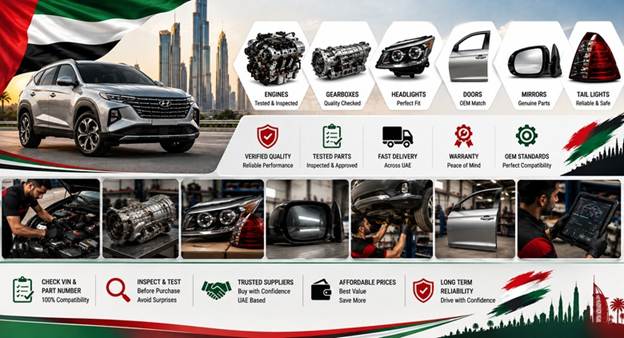
Let's start with the expensive bit.
The engine.
No matter how attractive the price looks, never buy a used Hyundai engine because someone says, "It came out of a running car." That's not evidence. That's a sales line.
Ask better questions.
Has the engine been compression-tested?
Were leak-down results recorded?
Is there any oil contamination?
Can the supplier prove the mileage?
These answers tell you far more than polished photographs ever will.
In workshops across Dubai and Abu Dhabi, technicians usually inspect the cooling passages, timing parts, seals, injectors and turbocharger—where fitted—before recommending an engine. The inspection often decides whether the engine is worth installing or leaving exactly where it is.
Cheap engines become expensive very quickly when hidden faults appear after installation.
Used Engine Inspection Matrix:
| Inspection Area | Workshop Decision |
| Compression Test | Essential |
| Engine Code Match | Essential |
| Oil Condition | High Priority |
| Coolant Contamination | High Priority |
| Timing Parts | Inspect |
| Turbo Condition | Inspect if fitted |
The engine shouldn't be the biggest gamble.
Inspecting Used Gearbox Parts
Gearboxes rarely fail overnight.
Most give plenty of warning.
Delayed shifting.
Harsh engagement.
Fluid leaks.
Unusual noises.
The problem?
Once the gearbox has already been removed from the donor vehicle, some of those symptoms disappear. That's why experienced suppliers rely on testing records, service history and donor vehicle information instead of visual appearance alone.
A clean gearbox casing means very little.
Internal condition means everything.
For automatic Hyundai gearboxes, ask about transmission oil quality, previous servicing and whether the gearbox was removed from a vehicle involved in mechanical failure or accident damage.
That single question can change your buying decision.
Gearbox Inspection Checklist:
- Verify transmission code.
- Inspect oil condition.
- Check casing damage.
- Review donor mileage.
- Confirm warranty.
- Match VIN compatibility.
Never assume.
Always verify.
Inspecting Suspension and Steering Parts
Suspension parts live a difficult life.
Every pothole.
Every speed bump.
Every sharp corner.
Every heavy load.
By the time a Hyundai reaches higher mileage, control arms, steering racks, knuckles, hubs and subframes deserve very careful inspection before they're reused.
Some parts are perfectly suitable after professional inspection.
Others aren't worth the risk.
Look for bent mounting points.
Hairline cracks.
Excessive corrosion.
Previous welding repairs.
If any of those appear, move on.
There will always be another part.
Decision Matrix: Repair or Reject?
| Inspection Result | Decision |
| Straight Mounting Points | Buy |
| Minor Cosmetic Marks | Accept |
| Surface Rust Only | Inspect Further |
| Structural Crack | Reject |
| Bent Suspension Part | Reject |
| Previous Poor Welding | Reject |
Safety always beats savings.
Inspecting Brake Parts
This is where many experienced workshops become particularly cautious.
Brake friction parts such as pads and discs are normally replaced with new items rather than bought used.
Why?
Because their wear history can't always be verified with confidence.
Brake calipers, backing plates and certain hydraulic parts may still offer excellent value if inspected, cleaned and tested correctly, but the decision should always depend on condition rather than price.
Your stopping distance isn't the place to take unnecessary chances.
Brake Parts Guide
| Hyundai Part | Recommendation |
| Brake Pads | Buy New |
| Brake Discs | Buy New |
| Brake Calipers | Professionally Inspected Used |
| ABS Sensors | Test Before Buying |
| Brake Shields | Genuine Used |
| Brake Hoses | Replace New |
Good brakes don't happen by accident.
Inspecting Cooling System Parts
Cooling problems become expensive surprisingly fast.
That's why used cooling parts deserve proper attention before installation.
Inspect radiators for bent fins and internal corrosion.
Check expansion tanks for hairline cracks.
Look closely at thermostat housings.
Examine cooling fans for damaged blades and noisy bearings.
Experienced Hyundai technicians often pressure-test cooling parts before installation because a hidden leak discovered afterwards usually means paying labour twice.
No owner enjoys that phone call.
Cooling Parts Inspection Checklist:
- Pressure-test the radiator.
- Inspect mounting points.
- Check fan operation.
- Examine hose connections.
- Inspect coolant residue.
- Verify Hyundai part number.
One cooling leak can become one overheated engine.
Comparing Trusted Suppliers Across UAE
Not every supplier follows the same standards.
Some provide donor vehicle details, inspection reports and warranty documentation without being asked.
Others avoid technical questions altogether.
That difference matters.
Across Dubai, Sharjah, Abu Dhabi, Ajman, Ras Al Khaimah, Fujairah and Umm Al Quwain, experienced workshops usually build relationships with suppliers who consistently deliver inspected, correctly identified Hyundai parts rather than simply the cheapest stock available.
Price attracts attention.
Trust earns repeat business.
When comparing suppliers through PartFinder UAE, always ask how the part was inspected, whether the donor vehicle mileage is known, what warranty is included and whether the Hyundai part number has been verified. Those answers reveal far more than promotional claims.
Real UAE Workshop Case Study:
A Hyundai Tucson with 128,000 km arrived at a Dubai workshop after developing persistent overheating. The owner had already purchased a used radiator online because it looked clean in the photographs. Pressure testing revealed a hidden internal leak, forcing the workshop to remove the radiator again and repeat the labour. In contrast, a Hyundai Elantra with 142,000 km in Sharjah required a replacement gearbox. The supplier provided VIN verification, donor mileage, inspection records and warranty documentation before delivery. Installation was completed once, the gearbox operated smoothly and the owner avoided unnecessary downtime.
Both buyers purchased used parts.
Only one followed the inspection process properly.
Professional Buyer's Checklist:
- Verify the VIN.
- Match the Hyundai part number.
- Confirm donor vehicle mileage.
- Request workshop inspection reports.
- Compare trusted UAE suppliers.
- Review warranty conditions.
- Replace supporting parts where necessary.
- Keep complete purchase documentation.
Key Takeaways:
Professionally inspected used Hyundai engines, gearboxes, suspension parts, cooling parts and selected brake parts can provide excellent value—but only when they have been thoroughly tested and correctly matched to the vehicle. Buyers who prioritise inspection records, compatibility and trusted suppliers instead of the lowest price consistently achieve safer repairs, lower long-term costs and greater confidence on UAE roads.
Inspecting Used Electrical Parts
Electrical faults have a habit of fooling people.
A dashboard warning light appears and suddenly everyone blames the battery.
Sometimes they're right.
Quite often they aren't.
Used Hyundai electrical parts deserve far more attention than a quick visual inspection. An alternator might look spotless yet fail under load. A starter motor may spin perfectly on the workbench but struggle once installed in a high-compression engine.
Testing changes everything.
Professional workshops rarely approve an electrical part without checking voltage output, resistance values and connector condition first.
That's exactly why some repairs succeed while others come back on a recovery truck.
Electrical Parts Inspection Matrix:
| Hyundai Part | Workshop Check |
| Alternator | Charging output |
| Starter Motor | Bench test |
| ECU | Diagnostic scan |
| Wiring Harness | Connector inspection |
| Fuse Box | Circuit testing |
| Battery | Load test |
Electrical parts should prove themselves before installation.
Inspecting Used Air Conditioning Parts
You don't truly appreciate air conditioning in the UAE until it stops working.
Then every traffic light feels longer.
Compressors, condensers, blower motors and cooling fans all work relentlessly during summer. Buying these parts without proper inspection can become a costly mistake because internal wear isn't always visible.
Ask whether the compressor was pressure-tested.
Ask if the clutch was inspected.
Ask whether the donor vehicle had a functioning air-conditioning system before dismantling.
Those aren't awkward questions.
They're sensible ones.
Decision Matrix: Should You Buy the Used AC Part?
| Inspection Result | Decision |
| Pressure Tested | Buy |
| Clutch Tested | Buy |
| Unknown History | Investigate |
| Physical Damage | Reject |
| Oil Contamination | Reject |
| No Warranty | Compare Other Options |
Comfort begins long before the part is fitted.
Inspecting Used Fuel System Parts
Fuel system parts don't always fail dramatically.
Sometimes the changes are subtle.
Hard starting.
Poor fuel economy.
Sluggish acceleration.
Rough idling.
Those symptoms often point towards injectors, fuel pumps or pressure regulators. Before buying any used fuel-system part, ask how it was tested and whether contamination was found inside the donor vehicle.
A clean injector externally tells you almost nothing.
Its spray pattern tells you far more.
Professional workshops know the difference.
Fuel Parts Buying Checklist:
- Verify part number.
- Inspect injector condition.
- Check fuel pump operation.
- Review donor mileage.
- Confirm warranty.
- Compare supplier inspection reports.
Clean fuel delivery keeps the engine happy.
Inspecting Used Exhaust Parts
Most drivers notice the exhaust only when something sounds different.
A rattle.
A hiss.
A metallic vibration.
Exhaust parts often survive minor accidents surprisingly well, but heat cycles and corrosion eventually take their toll. Catalytic converters, silencers and oxygen sensors should all be inspected carefully before being reused.
Don't overlook mounting brackets either.
They're easy to ignore.
They're equally easy to regret later.
Exhaust Parts Comparison
| Hyundai Part | Recommendation |
| Catalytic Converter | Inspect Thoroughly |
| Silencer | Check Corrosion |
| Exhaust Pipe | Inspect Mounts |
| Oxygen Sensor | Test Before Buying |
| Heat Shield | Inspect |
| Exhaust Brackets | Replace if Damaged |
Heat leaves its mark eventually.
Inspecting Used Interior Parts
Interior parts rarely stop a Hyundai from driving.
They do influence ownership satisfaction.
A cracked dashboard.
A worn steering wheel.
A faulty window switch.
An unresponsive infotainment screen.
None of these create immediate mechanical failure, yet they change how the vehicle feels every single day.
The best used interior parts usually come from low-mileage donor vehicles with clean service histories and minimal sun exposure. Pay close attention to trim colour, connector type and production year because small differences often affect compatibility.
Looks matter.
Fitment matters even more.
Interior Parts Inspection Guide
- Dashboard condition.
- Steering wheel wear.
- Seat adjustment operation.
- Window switch testing.
- Infotainment functionality.
- Interior trim compatibility.
A tidy cabin often reflects careful ownership.
Inspecting Used Exterior Body Parts
Body panels tell their own story.
Sometimes that story isn't a good one.
A freshly painted door may hide previous accident damage. A bumper can appear perfect while mounting brackets underneath have already cracked.
Look deeper.
Inspect panel edges.
Measure alignment.
Check hinge areas.
Examine weld points.
Professionally inspected genuine Hyundai body parts usually provide better factory fitment than poorly manufactured alternatives, especially for older Tucson, Sonata and Accent models where original panel alignment makes a noticeable difference.
Real UAE Workshop Case Study:
A Hyundai Santa Fe with 118,000 km arrived at a workshop in Abu Dhabi after its air-conditioning stopped cooling during peak summer. The owner had already purchased a used compressor from an online marketplace without requesting inspection records. Pressure testing showed internal damage, making the part unusable. Meanwhile, a Hyundai Accent owner in Dubai required a replacement driver's door after a parking accident. The supplier provided donor mileage, inspection photographs, VIN verification and warranty documentation. The door aligned perfectly, required minimal adjustment and the repair finished ahead of schedule.
The difference wasn't luck.
It was preparation.
Professional Buyer's Checklist:
- Verify the VIN before ordering.
- Match the Hyundai part number.
- Request inspection reports.
- Confirm donor vehicle mileage.
- Compare trusted UAE suppliers.
- Review warranty conditions.
- Inspect the part before installation.
- Keep complete purchase documentation.
Key Takeaways:
Used Hyundai electrical, air-conditioning, fuel, exhaust, interior and exterior parts can offer excellent value when they have been professionally inspected and correctly matched to the vehicle. Buyers who verify compatibility, understand the part's history and work with trusted suppliers avoid unnecessary repairs, reduce installation problems and enjoy more dependable ownership throughout the UAE.
Hyundai Tucson Used Parts Buying Guide
The Tucson rarely ends up in a workshop because it's poorly built.
More often, it arrives because life happens.
A motorway stone cracks a headlamp. A careless parking manoeuvre damages the front bumper. High mileage catches up with the suspension. Summer heat begins wearing out the cooling system.
Different stories.
Same outcome.
Replacement parts become part of ownership.
If you're buying used Tucson parts, start by identifying the repair rather than chasing the cheapest advert. A professionally inspected bonnet, tailgate or door from a low-mileage donor vehicle can offer excellent value, while engine and gearbox assemblies deserve far more detailed inspection before money changes hands.
A bargain isn't a bargain if the workshop has to remove the part twice.
Most Common Tucson Used Parts
| Hyundai Part | Workshop Recommendation |
| Front Bumper | Genuine Used |
| Headlight | Genuine Used |
| Radiator | Pressure Test First |
| Engine | Compression Test |
| Gearbox | Inspect & Verify |
| Tailgate | Check Alignment |
Buy the history.
Not just the part.
Hyundai Elantra Used Parts Buying Guide
The Elantra spends much of its life commuting.
Morning traffic.
Evening traffic.
Repeat.
That routine gradually wears brake parts, suspension parts, engine mounts and electrical parts. Cosmetic repairs also become common after years of city parking.
Here's something many buyers overlook.
A used door or mirror from an Elantra with lower mileage may fit better than a brand-new aftermarket alternative.
Factory tolerances matter.
So do original mounting points.
Before ordering, compare the VIN, Hyundai part number and production year. Hyundai has introduced updates across different Elantra generations, and two similar-looking parts aren't always interchangeable.
Hyundai Sonata Used Parts Buying Guide
The Sonata has always appealed to drivers covering long motorway distances.
Comfort comes naturally.
Mileage usually follows.
That's why many used Sonata repairs involve alternators, cooling parts, steering parts and lighting assemblies rather than accident damage alone.
If you're considering a used engine or gearbox, ask about service history.
Oil changes.
Cooling maintenance.
Previous repairs.
Those details often reveal how the donor vehicle was treated long before dismantling began.
Vehicles cared for properly usually leave behind better replacement parts.
It isn't magic.
It's maintenance.
Decision Matrix: Used Sonata Parts
| Hyundai Part | Best Option |
| Alternator | Tested Used |
| Steering Rack | Professionally Inspected |
| Headlight | Genuine Used |
| Engine | Compression Tested |
| Gearbox | Professionally Inspected |
| Cooling Fan | Tested Used |
Evidence should guide every purchase.
Hyundai Santa Fe Used Parts Buying Guide
The Santa Fe works hard.
Family holidays.
Weekend luggage.
School runs.
Long-distance travel.
Extra weight means suspension, brake and cooling parts deserve especially careful inspection when purchased used.
Don't focus only on appearance.
Look underneath.
Inspect mounting points.
Check bushings.
Review donor mileage.
Professional workshops often recommend replacing supporting parts during installation because labour has already been paid for once.
It makes sense.
Financially and mechanically.
Hyundai Accent Used Parts Buying Guide
The Accent has earned its reputation by keeping ownership costs sensible.
Used parts help continue that story.
Doors, mirrors, lighting units, interior trim and selected mechanical assemblies often provide excellent value when sourced from inspected donor vehicles. However, buyers should avoid rushing into purchases simply because prices appear attractive.
Cheap today.
Expensive tomorrow.
That's the pattern nobody wants.
Compatibility, inspection reports and supplier reputation should always come before discounts.
Every single time.
Accent Inspection Checklist
- Verify VIN.
- Confirm Hyundai part number.
- Review donor mileage.
- Check mounting points.
- Request warranty.
- Compare supplier reputation.
The process matters as much as the price.
Hyundai Palisade Used Parts Buying Guide
Premium SUVs deserve premium buying decisions.
The Palisade carries more technology than many smaller Hyundai models, meaning electrical parts, cameras, powered mirrors, infotainment units and driver-assistance systems require extra attention before ordering used replacements.
Ask whether electronic parts were tested.
Ask if programming will be required after installation.
Ask whether calibration forms part of the repair.
Experienced workshops already know these answers.
First-time buyers often don't.
That's perfectly normal.
The important thing is asking before placing the order.
Not afterwards.
Real UAE Workshop Case Study:
A Hyundai Tucson with 146,000 km arrived at a workshop in Sharjah after a minor front-end collision. The owner selected a professionally inspected genuine used bumper and headlight from a low-mileage donor vehicle. Both parts fitted without modification, reducing labour time significantly. A week later, a Palisade owner in Dubai required a replacement powered door mirror. Instead of ordering by appearance alone, the workshop verified the VIN, matched the Hyundai part number and confirmed the electrical specification. Installation was completed successfully on the first attempt, avoiding additional programming delays and unnecessary costs.
Planning solved both repairs.
Guesswork solved neither.
Professional Buyer's Checklist:
- Verify the VIN before ordering.
- Match the Hyundai part number.
- Confirm donor vehicle mileage.
- Request inspection reports.
- Review warranty conditions.
- Compare trusted UAE suppliers.
- Budget for supporting parts and labour.
- Keep complete purchase and service records.
Key Takeaways:
Every Hyundai model has different maintenance priorities, and that means used parts should never be purchased using a one-size-fits-all approach. Whether you're maintaining a Tucson, Elantra, Sonata, Santa Fe, Accent or Palisade, verifying compatibility, understanding the donor vehicle's history and choosing professionally inspected parts will almost always deliver better reliability, lower repair costs and greater peace of mind across the UAE.
Mileage Evaluation Before Buying Used Parts
Mileage tells a story.
Not the whole story.
But enough to make you stop and think.
Two Hyundai gearboxes might look almost identical sitting side by side in a warehouse. One came from a Tucson with 62,000 km. The other spent more than 280,000 km carrying passengers between Dubai and Abu Dhabi every single day.
Which one would you choose?
Exactly.
Mileage shouldn't be treated as the only deciding factor because service history, driving habits and maintenance standards matter just as much. Still, when two professionally inspected parts are available at a similar price, the lower-mileage option usually deserves a closer look.
Don't buy numbers.
Understand what created them.
Mileage Decision Matrix
| Donor Mileage | Buying Confidence | Workshop Advice |
| Under 50,000 km | Excellent | Highly Recommended |
| 50,000–100,000 km | Very Good | Recommended |
| 100,000–150,000 km | Good | Inspect Carefully |
| 150,000–200,000 km | Moderate | Request Testing |
| Over 200,000 km | Low | Buy Only with Complete Inspection |
| Unknown Mileage | Very Low | Avoid if Possible |
Mileage starts the conversation.
Inspection finishes it.
Signs of Hidden Wear
Here's where things become interesting.
Some worn Hyundai parts hide their problems remarkably well.
A steering rack may feel tight until hydraulic pressure builds.
A cooling fan might spin freely but struggle under electrical load.
An alternator can appear spotless while producing inconsistent voltage.
Surface condition doesn't always reveal internal condition.
That's why experienced workshops rely on measurements, diagnostic equipment and testing procedures instead of visual impressions alone.
Good technicians trust data.
Not guesswork.
Hidden Wear Checklist
- Hairline cracks.
- Heat discolouration.
- Oil contamination.
- Uneven wear patterns.
- Loose mounting points.
- Abnormal vibration marks.
The smallest clues often reveal the biggest problems.
Accident Damage Inspection
Not every donor vehicle reaches a dismantling yard because of mechanical failure.
Many arrive after collisions.
That doesn't automatically make the replacement parts unsuitable.
Far from it.
A rear-impact Tucson may still provide an excellent bonnet, engine or front suspension parts. A front-end collision, however, demands much closer inspection before buying anything positioned near the damaged area.
Ask where the impact occurred.
Then inspect accordingly.
That's how experienced buyers think.
Decision Matrix: Should You Buy the Part?
| Donor Vehicle Damage | Buying Decision |
| Rear Collision – Front Part | Usually Suitable |
| Side Collision – Opposite Side | Usually Suitable |
| Minor Cosmetic Damage | Inspect |
| Structural Damage | Avoid |
| Fire Damage | Reject |
| Flood Damage | Reject |
The donor vehicle matters as much as the part itself.
Corrosion and Heat Damage Checks
The UAE climate leaves its mark.
Slowly.
Relentlessly.
Metal expands.
Rubber hardens.
Plastic becomes brittle.
Electrical connectors age.
Heat alone doesn't ruin every Hyundai part, but years of extreme temperatures certainly accelerate wear, especially around engine bays, cooling systems and electrical parts.
Look closely at aluminium corrosion.
Inspect rubber seals.
Check plastic mounting tabs.
Tiny faults today can become expensive repairs tomorrow.
Parts Most Affected by UAE Heat
| Hyundai Part | Heat Sensitivity |
| Radiator | High |
| Battery | High |
| Wiring | High |
| Rubber Hoses | High |
| Cooling Fan | Medium |
| Dashboard Trim | Medium |
The UAE tests every vehicle.
Some parts simply handle it better than others.
Workshop Inspection Process
Walk into a reputable Hyundai workshop and you'll notice something.
Technicians don't rush.
First comes identification.
Then testing.
Only afterwards do they recommend replacement parts.
A proper inspection normally includes VIN verification, Hyundai part number matching, diagnostic scanning, visual examination, mechanical testing and compatibility confirmation before installation begins.
That process isn't there to slow things down.
It's there to stop costly mistakes.
Good workshops follow systems.
Poor ones rely on assumptions.
Professional Inspection Flow
- Verify VIN.
- Match Hyundai part number.
- Inspect visually.
- Perform mechanical testing.
- Confirm compatibility.
- Approve installation.
Every successful repair begins before the tools come out.
Real Buyer Mistakes to Avoid
Some mistakes appear again and again.
Buying purely on price.
Ignoring warranty.
Skipping inspection reports.
Trusting photographs instead of evidence.
Ordering without confirming the VIN.
Sound familiar?
Workshops across the UAE see these problems every week, and the outcome rarely changes. Incorrect parts delay repairs, increase labour costs and frustrate everyone involved.
Slow down.
Think first.
Order second.
You'll rarely regret careful preparation.
Real UAE Workshop Case Study:
A Hyundai Elantra with 174,000 km arrived at a workshop in Dubai after the owner purchased a used steering rack advertised at an exceptionally low price. The photographs looked convincing, but the workshop quickly discovered severe internal wear and mounting damage during inspection. The part couldn't be installed. Meanwhile, a Santa Fe owner in Abu Dhabi requested compression results, donor mileage, VIN verification and detailed inspection records before buying a used engine with 71,000 km. Installation went smoothly, supporting parts were replaced at the same time and the vehicle returned to the road without further issues.
One buyer chased the lowest price.
The other chased the best evidence.
Only one made the right investment.
Professional Buyer's Checklist:
- Verify the VIN.
- Match the Hyundai part number.
- Confirm donor mileage.
- Review accident history.
- Request inspection reports.
- Compare trusted UAE suppliers.
- Replace supporting parts where necessary.
- Keep complete purchase documentation.
Key Takeaways:
Buying used Hyundai parts successfully depends on far more than appearance or price. Donor mileage, hidden wear, accident history, UAE heat exposure and professional workshop inspections all influence long-term reliability. Owners who slow down, ask the right questions and insist on proper testing consistently avoid expensive mistakes while enjoying safer, more dependable repairs across the UAE.
Repair vs Replace Decision Matrix
Every Hyundai owner reaches this moment sooner or later.
The workshop calls.
"The part can be repaired... or replaced."
Now what?
There's no universal answer because every repair tells a different story. A cracked bumper doesn't deserve the same decision as a damaged steering rack. A scratched door isn't in the same league as a worn timing assembly.
Context changes everything.
Here's something experienced technicians know.
Labour costs matter just as much as the replacement part. Repairing a worn alternator might seem cheaper until it fails again six months later. Suddenly you've paid labour twice.
That isn't saving money.
That's postponing the bill.
Repair or Replace Matrix
| Hyundai Part | Repair | Replace |
| Front Bumper | Minor damage | Major cracks |
| Door Mirror | Housing only | Internal electronics |
| Radiator | Rarely | Usually Replace |
| Alternator | Minor rebuild | Severe wear |
| Starter Motor | Rebuild possible | Heavy damage |
| Steering Rack | Minor leak | Internal wear |
The smartest repair is the one you pay for only once.
Genuine vs OEM vs Used vs Reconditioned Comparison
Ask ten Hyundai owners which replacement part is "best" and you'll probably hear ten different answers.
Because the question is wrong.
The better question is...
"Best for which repair?"
A genuine radiator may be perfect for one vehicle, while a professionally inspected used tailgate offers far greater value for another. OEM brake parts often strike an excellent balance between quality and cost, whereas reconditioned steering racks can make financial sense when rebuilt to professional standards.
Experienced workshops rarely think in absolutes.
They compare risk.
Performance.
Cost.
Availability.
Expected lifespan.
That's how sensible decisions are made.
Buying Decision Matrix
| Part Type | Cost | Reliability | Best For |
| Genuine | Highest | Excellent | Safety-critical repairs |
| OEM | Medium | Very Good | Routine maintenance |
| Professionally Inspected Used | Lower | Very Good | Body and major assemblies |
| Reconditioned | Medium | Good | Selected mechanical repairs |
| Aftermarket Premium | Medium | Good | Service-related parts |
| Unknown Quality | Lowest | Unpredictable | Generally Avoid |
Price tells only one part of the story.
When Used Parts Are the Better Choice
Let's be realistic.
Not every repair needs a brand-new Hyundai part.
If a Palisade needs a replacement tailgate after a parking accident, a genuine used panel from a low-mileage donor vehicle may provide factory fitment at a considerably lower cost. The same often applies to doors, bonnets, mirrors, alloy wheels, infotainment screens and many interior parts.
Even professionally inspected engines and gearboxes can represent excellent value when supported by compression testing, warranty documentation and verified donor mileage.
Buying used isn't the risky decision.
Buying without evidence is.
Used Parts That Often Offer Excellent Value
- Doors.
- Bonnets.
- Tailgates.
- Mirrors.
- Headlights.
- Interior trim.
- Alloy wheels.
- Tested engines.
- Tested gearboxes.
Choose evidence before enthusiasm.
When New Parts Are Worth Paying For
There are moments when saving money simply isn't worth the risk.
Brake friction parts.
Airbags.
Seatbelt systems.
Rubber brake hoses.
Certain sensors.
These parts directly influence safety, so genuine or high-quality OEM replacements usually remain the most sensible option.
Professional workshops rarely compromise here.
Neither should you.
Saving a few hundred dirhams means very little if reliability disappears when you need it most.
That's not value.
That's unnecessary risk.
Decision Matrix: Buy New Instead
| Hyundai Part | Workshop Advice |
| Brake Pads | New |
| Brake Discs | New |
| Airbags | Genuine New |
| Seatbelt Parts | Genuine New |
| Rubber Brake Hoses | New |
| Filters | New |
Some parts deserve a fresh start.
Parts That Should Never Be Bought Used
This section often surprises people.
Because it's shorter than expected.
Many Hyundai parts can be purchased used with confidence after professional inspection. Others should simply be removed from the shopping list.
Airbags with unknown history.
Used brake pads.
Brake discs beyond specification.
Oil filters.
Timing belts.
Rubber seals.
Service consumables.
Walk away.
They're inexpensive compared with the consequences of failure.
Experienced technicians rarely debate these decisions.
The answer is already clear.
Parts That Offer Excellent Used Value
Now for the opposite side of the conversation.
Some Hyundai parts remain outstanding used purchases when inspected properly.
Complete doors.
Tailgates.
Headlights.
Mirrors.
Dashboard trim.
Infotainment screens.
Engines.
Gearboxes.
Suspension crossmembers.
Even alloy wheels.
The key isn't what the part is.
The key is how thoroughly it's been tested before reaching your workshop.
That's the difference between a smart purchase and an expensive experiment.
Real UAE Workshop Case Study:
A Hyundai Tucson owner in Dubai required a replacement bonnet after a minor collision. Instead of ordering a new aftermarket panel, the workshop sourced a professionally inspected genuine used bonnet from a donor vehicle with just 48,000 km. Fitment was almost perfect, painting required minimal preparation and the repair finished ahead of schedule. Meanwhile, an Elantra owner purchased second-hand brake pads from an unverified online seller to save money. During inspection, the workshop immediately rejected them because wear levels exceeded safe limits. New OEM brake parts were installed instead, protecting both the vehicle and its occupants.
Both owners wanted to save money.
Only one saved it safely.
Professional Buyer's Checklist:
- Verify the VIN before ordering.
- Match the Hyundai part number.
- Decide whether repair or replacement offers better value.
- Compare genuine, OEM, used and reconditioned options.
- Never buy safety-critical consumables used.
- Request inspection reports.
- Choose trusted UAE suppliers.
- Keep complete service documentation.
Key Takeaways:
Every Hyundai repair deserves its own decision rather than a one-size-fits-all approach. Genuine, OEM, professionally inspected used and reconditioned parts all have their place when chosen wisely. Owners who understand which parts should be repaired, replaced, bought new or purchased used consistently reduce ownership costs while maintaining the reliability and safety expected from their Hyundai across the UAE.
UAE Labour Costs for Used Part Installation
Here's something many buyers overlook.
They spend hours comparing used Hyundai part prices...
...and barely five minutes thinking about labour.
Yet labour can easily become the larger expense, especially when replacing engines, gearboxes or suspension assemblies.
A used engine that saves AED 4,000 isn't much of a bargain if poor compatibility means paying for removal and installation twice.
Experienced workshops know this.
That's why they verify everything before lifting a single spanner.
The part should arrive ready to fit.
Not ready to become another problem.
Typical UAE Labour Cost Guide
| Repair Type | Typical Labour (AED) |
| Headlight Replacement | 100–250 |
| Front Bumper Installation | 250–600 |
| Radiator Replacement | 450–900 |
| Suspension Arm Replacement | 350–800 |
| Engine Replacement | 3,500–7,500 |
| Gearbox Replacement | 2,800–6,500 |
Prices vary by emirate, workshop expertise and vehicle specification.
Hidden Costs Buyers Often Miss
The replacement part is rarely the final invoice.
Not even close.
Fresh coolant.
Transmission fluid.
Programming.
Wheel alignment.
New bolts.
Rubber seals.
Diagnostic scans.
Supporting parts.
The list grows surprisingly quickly.
Good workshops mention these items before the repair begins, not after the vehicle is already on the lift.
That transparency builds confidence.
Unexpected surprises rarely do.
Hidden Cost Planning Matrix
| Additional Cost | Should You Budget? |
| Labour | ✔ Essential |
| Fluids | ✔ Essential |
| Diagnostic Scan | ✔ Recommended |
| Wheel Alignment | ✔ When Required |
| Programming | ✔ Some Models |
| Supporting Parts | ✔ Strongly Recommended |
Budget for the complete repair.
Not just the replacement part.
Supporting Parts to Replace Together
One of the biggest workshop mistakes?
Replacing only the obvious failure.
Imagine fitting a professionally inspected used radiator while leaving brittle coolant hoses that have survived twelve UAE summers.
Or installing a used gearbox without checking the gearbox mount.
It happens.
More often than it should.
Experienced technicians think differently.
If labour has already been paid for, inspect everything nearby while access is available.
It usually saves money later.
Decision Matrix: Replace Together
| Main Hyundai Part | Replace Alongside |
| Radiator | Hoses and coolant |
| Engine | Belts, filters and seals |
| Gearbox | Mounts and transmission fluid |
| Suspension Arm | Ball joints and alignment |
| Alternator | Drive belt inspection |
| Brake Caliper | Brake fluid inspection |
One workshop visit is better than two.
Total Project Cost Planning
The smartest Hyundai owners don't ask...
"How much is the part?"
They ask...
"How much will the complete repair cost?"
That's a completely different calculation.
Replacement part.
Labour.
Fluids.
Supporting parts.
Programming.
Delivery.
VAT.
Only after adding everything together does the real figure appear.
Oddly enough, the supplier with the cheapest part doesn't always provide the lowest total repair cost.
That's why experienced fleet managers calculate projects instead of individual prices.
Estimated Total Repair Costs
| Repair | Typical Total Cost (AED) |
| Used Door Installation | 900–2,200 |
| Used Radiator Replacement | 900–1,800 |
| Used Suspension Repair | 1,000–2,500 |
| Used Engine Installation | 8,000–18,000 |
| Used Gearbox Installation | 6,500–14,000 |
| Used Tailgate Replacement | 1,500–3,800 |
Planning reduces expensive surprises.
Delivery Across Dubai, Sharjah and UAE
A perfectly inspected Hyundai part still needs one final thing.
Safe delivery.
Transport damage creates unnecessary delays, particularly for body panels, lighting units and glass. Reputable suppliers package fragile parts properly, provide tracking information and encourage buyers to inspect deliveries before signing.
Don't leave the inspection until the workshop appointment.
Open the package.
Check the mounting points.
Confirm the Hyundai part number.
Inspect for transport damage.
Five minutes now may save another week later.
Delivery Checklist
- Confirm stock availability.
- Track the shipment.
- Inspect packaging.
- Verify Hyundai part number.
- Check for transport damage.
- Coordinate workshop booking.
Good planning keeps repairs moving.
Warranty Expectations for Used Parts
Let's clear up a common misconception.
Used doesn't mean "no warranty."
In fact, many reputable UAE suppliers provide warranty coverage on professionally inspected engines, gearboxes, electrical parts and selected mechanical assemblies.
Read the terms carefully.
What's covered?
For how long?
Does professional installation matter?
Are inspection reports required?
Strong warranty support usually reflects supplier confidence.
Weak warranty terms often reveal the opposite.
Choose accordingly.
Real UAE Workshop Case Study:
A Hyundai Sonata owner in Abu Dhabi purchased a professionally inspected used gearbox for AED 4,900. The workshop also replaced the transmission fluid, gearbox mount and oil seals during installation, bringing the total project cost to approximately AED 9,100. Six months later, the gearbox continued performing perfectly. Meanwhile, an Accent owner in Dubai selected the cheapest available used radiator without checking delivery condition. A cracked mounting point discovered during installation delayed the repair, increased labour costs and required another shipment before the vehicle could return to the road.
Both buyers saved money on the part.
Only one planned the entire repair.
Professional Buyer's Checklist:
- Calculate the complete repair cost.
- Verify the VIN before ordering.
- Match the Hyundai part number.
- Budget for labour and supporting parts.
- Inspect deliveries before installation.
- Read warranty conditions carefully.
- Choose experienced Hyundai workshops.
- Keep every invoice and inspection report.
Key Takeaways:
Buying a used Hyundai part is only one stage of the repair. Labour costs, supporting parts, delivery, warranty and complete project planning have an equally important impact on the final outcome. Owners who budget for the whole repair rather than focusing solely on the purchase price consistently avoid delays, reduce lifetime costs and enjoy more dependable ownership throughout the UAE.
How Workshops Test Used Hyundai Parts
A good workshop doesn't trust appearances.
It trusts evidence.
That's the difference.
A used Hyundai engine may look immaculate after a thorough clean, yet a compression test could reveal worn piston rings. A gearbox might arrive with spotless casing, while internal clutch packs or synchronisers tell a completely different story.
Professional technicians never skip the testing stage.
They inspect.
They measure.
They verify.
Only then do they recommend installation.
That's one reason experienced workshops have fewer repeat repairs.
They're solving the actual problem instead of hoping for the best.
Professional Workshop Testing Process
| Inspection | Purpose |
| VIN Verification | Confirm compatibility |
| Hyundai Part Number Check | Match specification |
| Visual Inspection | Identify visible damage |
| Mechanical Testing | Assess operating condition |
| Diagnostic Scan | Detect electronic faults |
| Final Approval | Confirm installation readiness |
Evidence creates confidence.
Guesswork creates invoices.
Compression Testing for Used Engines
Compression testing separates healthy engines from expensive mistakes.
Simple as that.
Inside every engine, compression tells a story about piston rings, cylinder walls, valves and overall internal condition. Numbers that remain balanced across all cylinders usually indicate an engine worth considering.
Large differences?
That's where alarm bells start ringing.
Experienced Hyundai specialists don't rely on the phrase...
"The engine was running perfectly before removal."
They ask for compression readings instead.
Those figures speak far louder than advertisements.
Compression Evaluation Matrix
| Test Result | Workshop Recommendation |
| Even Across Cylinders | Excellent Candidate |
| Minor Variation | Inspect Further |
| Significant Difference | Reject |
| No Test Available | Avoid Purchase |
| Oil Contamination | Investigate |
| Coolant Contamination | Reject Until Diagnosed |
Healthy numbers matter more than confident promises.
Gearbox Inspection Procedures
Gearboxes rarely announce every problem.
Some faults stay hidden until the vehicle is back on the road.
That's why professional workshops inspect much more than external condition.
Transmission codes.
Fluid quality.
Input shaft play.
Output shaft movement.
Casing damage.
Electronic connectors.
Every detail contributes to the final decision.
Automatic gearboxes often require additional diagnostic checks after installation to ensure proper communication with the vehicle's electronic systems.
Skipping those steps?
Not worth the risk.
Gearbox Inspection Checklist
- Verify transmission code.
- Inspect fluid condition.
- Check mounting points.
- Test selector operation.
- Review donor mileage.
- Confirm warranty.
One careful inspection can prevent months of frustration.
Electrical System Testing
Electrical parts deserve patience.
Not assumptions.
Modern Hyundai vehicles rely on dozens of sensors and control modules working together every second. Installing an untested alternator, ECU or starter motor can trigger multiple warning lights that have nothing to do with the original repair.
Professional workshops use specialised equipment to measure voltage, resistance and communication before approving electrical parts.
They don't simply plug them in and hope.
Hope isn't a diagnostic tool.
Electrical Testing Guide
| Hyundai Part | Workshop Test |
| Alternator | Charging output |
| Starter Motor | Bench test |
| ECU | Diagnostic communication |
| Battery | Load test |
| Wiring Harness | Continuity test |
| Sensors | Live data verification |
Electricity leaves clues.
Technicians know where to look.
Suspension and Brake Safety Checks
Safety doesn't negotiate.
Neither should you.
Before installing used suspension parts, workshops inspect bushings, ball joints, steering movement, mounting points and structural integrity. Brake calipers receive similar attention because sticking pistons or damaged seals quickly become expensive safety concerns.
Notice something missing?
Brake pads.
Brake discs.
Those usually belong on the new-parts list.
Experienced technicians rarely compromise there.
Decision Matrix: Safety Inspection
| Hyundai Part | Installation Decision |
| Suspension Crossmember | Inspect Thoroughly |
| Steering Rack | Test Before Installation |
| Brake Caliper | Professionally Inspect |
| Brake Pads | Buy New |
| Brake Discs | Buy New |
| Wheel Hub | Inspect Bearings |
Safety should never depend on luck.
Professional Installation Advice
Buying the correct used Hyundai part isn't the finish line.
Installation decides whether the repair succeeds.
Torque settings matter.
Programming matters.
Fluid levels matter.
Post-installation inspections matter.
A professionally inspected gearbox fitted without fresh transmission fluid isn't a complete repair.
Neither is a replacement engine installed without checking cooling hoses, belts or engine mounts.
Experienced workshops think beyond today's repair.
They think about next year's reliability as well.
That's a very different mindset.
Real UAE Workshop Case Study:
A Hyundai Tucson with 163,000 km arrived at a Hyundai specialist workshop in Dubai after the owner sourced a professionally inspected used engine. Before installation, technicians completed compression testing, verified the VIN, matched the Hyundai part number and inspected every cooling hose, engine mount and drive belt. The supporting parts were replaced at the same time, adding approximately AED 1,250 to the repair but preventing future labour costs. During the same month, a Sonata owner in Sharjah installed a used alternator without electrical testing at another garage. Within days, charging problems returned because the alternator itself had an intermittent internal fault that bench testing would have identified before installation.
One workshop relied on procedure.
The other relied on hope.
Only one delivered a lasting repair.
Professional Buyer's Checklist:
- Verify the VIN before ordering.
- Match the Hyundai part number.
- Request compression or mechanical testing results.
- Confirm gearbox inspection records.
- Test electrical parts before installation.
- Replace supporting parts where appropriate.
- Use experienced Hyundai technicians.
- Keep complete inspection and service records.
Key Takeaways:
Professional testing transforms used Hyundai parts from a gamble into a calculated decision. Compression testing, gearbox inspections, electrical diagnostics, suspension safety checks and structured installation procedures all reduce risk while improving reliability. Buyers who insist on workshop-grade inspection processes consistently achieve better repairs, lower lifetime costs and greater confidence on UAE roads.
Family Ownership Considerations
Family vehicles lead demanding lives.
School runs before sunrise.
Weekend shopping.
Holiday road trips.
Late-night airport collections.
The workload never really stops.
If your Hyundai carries children, parents or elderly passengers every day, reliability becomes more important than shaving a few hundred dirhams off the repair bill. That's why experienced family owners think differently when buying used Hyundai parts.
They don't simply ask...
"Will this fit?"
They ask...
"Can I trust this on tomorrow's journey?"
That's a much better question.
Professionally inspected body panels, lighting units, doors, mirrors, engines and gearboxes often make excellent purchases, while safety-related service parts should still be replaced with new genuine or OEM alternatives.
Peace of mind has value too.
Family Vehicle Priority Matrix
| Hyundai Part | Family Recommendation |
| Engine | Professionally Inspected |
| Gearbox | Professionally Inspected |
| Brake Pads | Genuine/OEM New |
| Headlights | Genuine Used |
| Door Mirrors | Genuine Used |
| Child Safety Related Parts | Genuine New |
Family journeys deserve dependable repairs.
Fleet and Commercial Vehicle Advice
Fleet operators think in numbers.
Downtime.
Running costs.
Vehicle availability.
Revenue.
Every hour a vehicle spends waiting for repairs is an hour it isn't working. That's why many UAE fleet managers rely on professionally inspected used Hyundai parts for suitable repairs, particularly for body panels, engines, gearboxes and lighting assemblies.
The goal isn't buying cheaply.
The goal is returning vehicles to the road without compromising reliability.
That's an important distinction.
Professional fleet workshops usually record donor mileage, installation dates, labour hours and warranty details for every major replacement part.
Those records become incredibly valuable later.
Fleet Buying Checklist
- Verify VIN compatibility.
- Record donor mileage.
- Compare supplier warranties.
- Schedule preventive inspections.
- Keep installation records.
- Review lifetime repair costs.
Good records build efficient fleets.
High-Mileage Hyundai Ownership
A Hyundai with 220,000 km isn't automatically approaching the end of its life.
Not even close.
We've seen Tucsons comfortably exceed 300,000 km.
Sonatas travelling even further.
The difference usually isn't luck.
It's maintenance.
High-mileage owners should inspect suspension parts, cooling parts, engine mounts, steering parts and charging systems more frequently because wear becomes cumulative after years of driving.
Ignore one small fault and neighbouring parts often begin wearing faster.
Everything is connected.
That's why preventive maintenance becomes increasingly valuable as mileage climbs.
High-Mileage Inspection Guide
| Mileage | Workshop Focus |
| Up to 100,000 km | Routine servicing |
| 100,000–150,000 km | Cooling and suspension |
| 150,000–200,000 km | Steering and charging system |
| Over 200,000 km | Comprehensive inspection |
| Over 250,000 km | Preventive replacement planning |
| Unknown Mileage | Full workshop evaluation |
Mileage rewards careful owners.
Long-Distance Driving Considerations
Long journeys expose weaknesses.
Quickly.
A cooling system that copes perfectly around town may begin struggling after three hours on the motorway. A worn wheel bearing becomes much easier to hear once road speeds increase.
Before travelling between Dubai, Abu Dhabi, Fujairah or Ras Al Khaimah, inspect the vehicle thoroughly.
Not afterwards.
Check fluid levels.
Test the battery.
Inspect tyres.
Listen for unusual sounds.
The best roadside breakdown is the one that never happens.
Road Trip Preparation Checklist
- Inspect cooling parts.
- Check engine oil.
- Test battery.
- Review brake performance.
- Inspect tyres.
- Confirm lighting operation.
Preparation is always lighter than recovery.
UAE Climate Effects on Used Parts
The UAE doesn't treat vehicles gently.
Summer temperatures climb relentlessly.
Dust settles everywhere.
Traffic keeps engines idling for long periods.
Those conditions influence which used Hyundai parts deserve extra attention before installation.
Cooling fans.
Radiators.
Batteries.
Rubber hoses.
Dashboard trim.
Air-conditioning compressors.
These parts often experience more stress than they would in cooler climates.
A professionally inspected radiator from a low-mileage donor vehicle may still outperform a poorly manufactured new alternative, but only if it has been pressure-tested and inspected thoroughly.
Climate changes the equation.
Workshops know it.
Parts Most Affected by UAE Conditions
| Hyundai Part | Climate Impact |
| Radiator | Very High |
| Battery | Very High |
| Air Conditioning Compressor | High |
| Cooling Fan | High |
| Rubber Hoses | High |
| Dashboard Trim | Medium |
Heat leaves evidence behind.
Learn to recognise it.
Seasonal Maintenance Planning
The calendar matters more than many owners realise.
Before summer arrives, cooling systems deserve careful attention.
Before long motorway holidays, inspect brakes, suspension and tyres.
After periods of heavy dust, replace filters and inspect electrical connectors.
Maintenance shouldn't wait for breakdowns.
It should stay one step ahead of them.
That's exactly how experienced Hyundai specialists approach vehicle ownership.
Not reactively.
Proactively.
Real UAE Workshop Case Study:
A Hyundai Santa Fe with 187,000 km visited a workshop in Al Ain before a family holiday to Muscat. During the inspection, technicians discovered a weakening radiator, ageing upper coolant hose and front brake parts approaching their service limit. Replacing those items before departure cost approximately AED 2,850. Just days later, a fleet-operated Hyundai Tucson in Dubai required emergency recovery after overheating because routine cooling system inspections had been postponed to reduce short-term costs. The resulting repair exceeded AED 8,000 and the vehicle remained out of service for several days.
Both vehicles were used daily.
Only one received preventive attention.
Professional Buyer's Checklist:
- Verify the VIN before ordering.
- Match the Hyundai part number.
- Consider how the vehicle is actually used.
- Inspect cooling parts before summer.
- Replace supporting parts during major repairs.
- Choose professionally inspected used parts where appropriate.
- Keep detailed maintenance records.
- Schedule annual workshop inspections.
Key Takeaways:
The way a Hyundai is driven should influence every buying decision. Family vehicles, fleet cars, high-mileage commuters and long-distance travellers all place different demands on replacement parts. Owners who combine professionally inspected used parts with preventive maintenance, climate-aware servicing and structured workshop inspections consistently enjoy greater reliability, lower operating costs and fewer unexpected breakdowns across the UAE.
Insurance and Documentation Requirements
Paperwork isn't exciting.
Nobody buys a Hyundai because they're looking forward to organising invoices.
Yet those documents quietly become some of the most valuable things you own after a repair.
Imagine selling your Tucson three years from now.
The buyer asks...
"Do you have proof the replacement engine was professionally inspected?"
If your answer is yes, the conversation becomes much easier.
If your answer is no...
Well, confidence starts disappearing.
Insurance companies, warranty providers and future buyers all appreciate clear documentation. The repair itself matters.
The evidence matters just as much.
Documents You Should Always Keep
| Document | Why It Matters |
| Purchase Invoice | Proof of ownership |
| Workshop Invoice | Repair verification |
| Warranty Certificate | Future claims |
| VIN Verification | Compatibility evidence |
| Diagnostic Report | Technical record |
| Inspection Report | Part condition confirmation |
Paperwork protects more than paperwork.
It protects confidence.
Maintaining Resale Value After Repairs
A Hyundai doesn't lose value simply because used parts have been installed.
It loses value when buyers stop trusting the repairs.
There's a difference.
A professionally inspected genuine used door fitted correctly with complete documentation usually worries buyers far less than a poorly aligned aftermarket panel with no history whatsoever.
Presentation matters.
Documentation matters.
Professional workmanship matters.
Together, they create trust.
And trust sells cars.
Decision Matrix: Resale Impact
| Repair Quality | Effect on Resale |
| Professionally Documented | Excellent |
| Genuine Used Parts with Records | Very Good |
| OEM Parts | Very Good |
| Unknown Parts | Low Buyer Confidence |
| Poor Body Repairs | Negative |
| Missing Documentation | Negative |
Confidence has resale value.
Keeping Complete Service Records
Think of your service history as the vehicle's diary.
Every repair adds another chapter.
Every invoice fills another gap.
When records disappear, questions appear instead.
A complete maintenance file should include servicing dates, replacement parts, workshop inspections, diagnostic reports, warranty details and supporting invoices.
That sounds like a lot.
It isn't.
Most of it arrives naturally every time the vehicle visits a reputable workshop.
The important part?
Don't throw it away.
Service Record Checklist
- Service invoices.
- Diagnostic reports.
- Warranty documents.
- Parts invoices.
- Inspection reports.
- Maintenance schedule.
Today's paperwork becomes tomorrow's selling point.
Common Buyer Questions
Experienced Hyundai workshops hear the same questions almost every week.
"Is a used engine reliable?"
It can be.
Provided it has passed compression testing and comes from a trusted supplier.
"Should I choose genuine used or aftermarket?"
For many body parts, genuine used often provides superior factory fitment.
"Can I install the part myself?"
Some repairs are straightforward.
Others involve programming, calibration or specialist tools.
Know the difference.
"Is warranty really important?"
Absolutely.
A warranty doesn't guarantee perfection.
It does demonstrate supplier confidence.
That's worth paying attention to.
Internal Quality Checklist Before Purchase
Before approving any used Hyundai part, experienced workshops quietly work through a mental checklist.
Not because someone told them to.
Because experience taught them.
Compatibility.
Condition.
Mileage.
Inspection.
Warranty.
Supplier reputation.
Supporting parts.
Installation requirements.
Miss one of those steps and the repair can quickly become more expensive than expected.
Follow them all...
...and problems become much less likely.
Professional Quality Matrix
| Inspection Area | Status Before Purchase |
| VIN Verified | Required |
| Hyundai Part Number Matched | Required |
| Donor Mileage Confirmed | Recommended |
| Inspection Report Available | Required |
| Warranty Included | Strongly Recommended |
| Supporting Parts Reviewed | Recommended |
Professionals trust process.
Not luck.
Workshop Red Flags
Some warning signs reveal themselves almost immediately.
Others hide in plain sight.
Be cautious if a workshop refuses diagnostic testing.
Or dismisses VIN verification.
Or cannot explain why a particular replacement part has been recommended.
Transparency should never feel uncomfortable.
Good workshops enjoy explaining repairs because they understand them.
Poor workshops often avoid detailed conversations.
That's usually your signal.
Listen carefully.
Sometimes the workshop tells you everything before a single repair begins.
Real UAE Workshop Case Study:
A Hyundai Elantra owner in Dubai purchased a professionally inspected used engine after receiving full compression results, donor mileage, VIN verification and a written warranty. Every document was stored alongside the service history. Eighteen months later, the owner sold the vehicle with complete confidence because prospective buyers could review every repair. Meanwhile, a Sonata owner in Sharjah accepted a cheaper replacement gearbox without requesting invoices or inspection records. When the vehicle was later advertised for sale, buyers repeatedly questioned the repair history, negotiated aggressively and several walked away altogether.
Both vehicles were repaired successfully.
Only one owner protected the repair properly.
Professional Buyer's Checklist:
- Keep every purchase invoice.
- Store workshop repair records.
- Verify the VIN before ordering.
- Match the Hyundai part number.
- Request inspection reports.
- Review warranty conditions.
- Choose transparent workshops.
- Maintain a complete service history.
Key Takeaways:
Used Hyundai parts don't reduce a vehicle's value—poor documentation and poor workmanship do. Owners who keep detailed records, verify compatibility, work with reputable workshops and insist on proper inspection reports build trust with insurers, future buyers and themselves. In the UAE, organised ownership often becomes one of the strongest investments a Hyundai owner can make.
Real UAE Workshop Case Studies
Nothing teaches better than a real workshop floor.
Not theory.
Not advertisements.
Reality.
Let's start in Dubai.
A Hyundai Tucson with 214,000 km arrived after developing a persistent knocking noise from the front suspension. The owner believed the shock absorber had failed because another garage had suggested replacing both front struts immediately.
The workshop slowed things down.
A proper inspection revealed worn lower control arm bushes and tired ball joints instead. The shock absorbers were still performing within specification. Replacing only the correct parts reduced the repair bill by almost 40%, restored the steering feel and prevented unnecessary labour.
Now move across to Abu Dhabi.
A Hyundai Elantra with approximately 138,000 km required a replacement alternator. The owner had already purchased a cheap used unit online without checking the donor vehicle history or requesting a charging test. Bench testing showed unstable voltage output before installation even began.
The alternator never went on the car.
A professionally tested replacement solved the problem on the first attempt.
That's what diagnosis looks like.
Workshop Lessons
| Vehicle | Problem | Correct Solution |
| Tucson | Suspension knock | Replace control arms and ball joints |
| Elantra | Charging fault | Professionally tested alternator |
| Sonata | Cooling issue | Pressure-tested radiator |
| Santa Fe | Steering vibration | Replace worn steering parts |
| Accent | Hard starting | Tested starter motor |
| Palisade | Mirror fault | Correct VIN-matched mirror |
Evidence beats assumptions.
Every single day.
Expert Buying Strategies
Experienced Hyundai buyers don't rush.
They investigate.
Before approving any used part, ask three questions.
Where did it come from?
How was it tested?
Why should I trust it?
Simple questions.
Powerful answers.
Professional suppliers rarely hesitate because they've already completed the inspection process. They'll explain donor mileage, testing procedures, warranty conditions and compatibility without needing persuasion.
That's usually a very good sign.
Confidence backed by evidence feels different from confidence backed by sales talk.
You'll notice it immediately.
Decision Matrix: Should You Buy?
| Supplier Response | Buying Decision |
| Complete inspection records | Proceed |
| VIN verified | Proceed |
| Warranty included | Proceed |
| Unknown donor history | Investigate |
| Refuses testing information | Avoid |
| No documentation | Reject |
Questions protect your wallet.
Negotiating Better Prices
Negotiation isn't about demanding impossible discounts.
It's about understanding value.
Perhaps the supplier can't reduce the price.
Fair enough.
Can they include delivery?
Can they extend the warranty?
Can they supply supporting parts?
Can they provide fresh inspection photographs?
Those improvements often create more value than a small reduction in price.
Professional buyers negotiate the whole package.
Not just one number.
That's why they usually leave happier.
Avoiding Online Buying Mistakes
Buying Hyundai parts online has become remarkably convenient.
Unfortunately, convenience sometimes encourages shortcuts.
The biggest mistake?
Ordering before verifying compatibility.
The second?
Ignoring the donor vehicle completely.
The third?
Trusting photographs instead of inspection reports.
Images rarely show compression readings.
Or gearbox condition.
Or electrical test results.
That's exactly why professional workshops continue asking technical questions even after receiving detailed photographs.
Pictures tell part of the story.
Testing tells the rest.
Most Common Buying Mistakes
- Ordering without the VIN.
- Ignoring Hyundai part numbers.
- Chasing the cheapest listing.
- Skipping inspection reports.
- Forgetting labour costs.
- Ignoring warranty conditions.
Slow decisions often become smarter decisions.
Supplier Verification Process
Not all suppliers operate to the same standard.
Some inspect every major Hyundai part before advertising it.
Others simply remove the part, clean it and upload photographs.
Spot the difference?
Experienced workshops certainly do.
Before buying, verify:
Business reputation.
Inspection process.
Donor mileage.
Warranty terms.
Delivery procedures.
Response quality.
The supplier's willingness to answer technical questions often reveals as much as the answers themselves.
Professional businesses welcome informed customers.
Supplier Evaluation Matrix
| Evaluation Area | Importance |
| Business Reputation | Essential |
| VIN Verification | Essential |
| Inspection Reports | Essential |
| Warranty | High |
| Technical Support | High |
| Delivery Process | Medium |
Choose the supplier with the strongest process.
Not necessarily the lowest price.
Long-Term Ownership Planning
Think beyond today's repair.
Imagine the next five years.
Will this replacement part still represent good value?
Will supporting parts require attention soon?
How will this repair affect future servicing?
These questions separate experienced Hyundai owners from first-time buyers.
Long-term planning isn't complicated.
It simply requires looking beyond the current invoice.
Vehicles maintained this way usually remain more reliable, easier to sell and significantly less expensive to own over time.
That's exactly why workshops encourage preventive maintenance instead of reactive repairs.
Real UAE Workshop Case Study:
A Hyundai Sonata with 192,000 km visited a workshop in Sharjah after developing gearbox hesitation during motorway driving. Compression testing confirmed the engine remained healthy, while gearbox inspection identified internal wear. Rather than installing only the replacement gearbox, technicians also replaced the transmission mount, fresh fluid, oil seals and inspected the driveshafts. The total repair cost increased by around AED 1,400, yet the owner avoided a second labour charge months later. In contrast, a Hyundai Accent owner in Dubai declined replacing worn supporting parts to reduce the initial invoice. Within eight weeks, a deteriorated gearbox mount caused vibration that required another workshop visit and additional labour.
The first owner invested once.
The second owner paid twice.
Professional Buyer's Checklist:
- Verify the VIN before ordering.
- Match the Hyundai part number.
- Review donor mileage.
- Request workshop inspection reports.
- Compare trusted UAE suppliers.
- Replace supporting parts during major repairs.
- Keep detailed maintenance records.
- Think beyond the current repair.
Key Takeaways:
Successful used Hyundai part purchases rarely happen by chance. They result from careful supplier verification, professional inspections, informed negotiation and long-term planning. Buyers who focus on evidence rather than emotion consistently reduce repair costs, avoid repeat labour and build more reliable Hyundai ownership experiences across the UAE.
Complete Used Hyundai Parts Inspection Checklist
Imagine standing in front of two identical Hyundai engines.
Same model.
Same year.
Almost the same price.
Which one deserves your money?
Not the cleaner one.
Not the one with the better sales pitch.
The one with the better evidence.
Professional workshops don't inspect replacement parts with a quick glance and a hopeful smile. They work methodically because every overlooked detail has the potential to become another repair bill.
That habit saves money.
Again and again.
Complete Inspection Checklist
- Verify the VIN.
- Match the Hyundai part number.
- Confirm donor vehicle mileage.
- Review accident history.
- Check for corrosion.
- Inspect mounting points.
- Examine electrical connectors.
- Request compression or bench-test results.
- Review warranty.
- Compare supplier documentation.
Every check removes another layer of uncertainty.
Pre-Installation Workshop Checklist
The replacement part has arrived.
Excellent.
Don't install it yet.
Experienced Hyundai technicians pause here for a reason. This final inspection often prevents mistakes that would otherwise remain hidden until the vehicle is already back on the road.
Fluid seals.
Mounting brackets.
Electrical connectors.
Torque specifications.
Supporting parts.
Cooling hoses.
They're all inspected before installation begins.
Not halfway through.
Not afterwards.
Preparation isn't wasted time.
It's quality control.
Pre-Installation Matrix
| Inspection Area | Workshop Action |
| VIN Verification | Confirm Again |
| Hyundai Part Number | Recheck |
| Mounting Points | Inspect |
| Electrical Connections | Test |
| Supporting Parts | Replace if Required |
| Fluids | Renew |
The repair begins before the first bolt is tightened.
Post-Installation Inspection Guide
A professional repair doesn't end when the engine starts.
That's merely the beginning.
After installation, technicians inspect for leaks, unusual noises, warning lights, vibration, fluid pressure and system communication. Road testing follows because many faults reveal themselves only once the vehicle is driven under real conditions.
Some workshops rush this stage.
The best ones never do.
Final inspections protect both the customer and the technician.
That's why they matter.
Post-Installation Checklist
- Scan for fault codes.
- Check fluid levels.
- Inspect for leaks.
- Road-test the vehicle.
- Confirm electrical operation.
- Verify normal temperatures.
One final inspection can prevent one final disappointment.
First 1,000 km Monitoring Checklist
Many owners assume the repair is complete once they collect the vehicle.
Not quite.
The first 1,000 kilometres tell you how well everything is settling into place.
Listen for new noises.
Watch the temperature gauge.
Check underneath the vehicle for fluid leaks.
Pay attention to gear changes.
Monitor steering feel.
Notice braking performance.
Nothing complicated.
Just awareness.
Small observations during the first few weeks often prevent much larger repairs later.
First 1,000 km Guide
| Inspection | Owner Action |
| Engine Oil | Check regularly |
| Coolant | Monitor level |
| Gearbox Operation | Observe shifting |
| Steering | Feel for vibration |
| Brakes | Listen for unusual sounds |
| Warning Lights | Investigate Immediately |
The repair continues after leaving the workshop.
Long-Term Cost Saving Strategies
People often ask...
"What's the cheapest way to own a Hyundai?"
Wrong question.
The better one is...
"What's the smartest way?"
Replace worn parts before they damage neighbouring systems.
Use professionally inspected used parts where appropriate.
Follow service schedules.
Keep accurate records.
Work with experienced Hyundai specialists.
Those habits won't eliminate repairs.
Nothing will.
But they'll make those repairs smaller, less frequent and considerably less expensive.
That's how experienced owners quietly save thousands of dirhams over the lifetime of a vehicle.
Not through luck.
Through consistency.
Decision Matrix: Long-Term Value
| Ownership Habit | Long-Term Benefit |
| Preventive Maintenance | Excellent |
| Professional Inspections | Excellent |
| VIN Verification | High |
| Complete Documentation | High |
| Delayed Repairs | Poor |
| Unknown Parts | Very Poor |
Consistency almost always beats shortcuts.
Protecting Vehicle Reliability
Reliability isn't something you buy.
It's something you build.
Service by service.
Inspection by inspection.
Repair by repair.
Every carefully selected Hyundai part contributes to the next journey, the next family holiday, the next business meeting and the next hundred thousand kilometres.
That's why experienced workshops think beyond today's repair.
They're protecting tomorrow's reliability.
One thoughtful decision at a time.
Real UAE Workshop Case Study:
A Hyundai Palisade with 96,000 km visited a workshop in Dubai after suffering front-end accident damage. Before installation, technicians verified the VIN, matched the Hyundai part numbers, inspected the replacement radiator support, headlights and cooling fan assembly, then completed a post-installation diagnostic scan and road test. The vehicle left the workshop without warning lights or alignment issues. A week later, a Hyundai Tucson owner in Abu Dhabi installed a used cooling fan sourced privately without verifying compatibility. Although the fan fitted physically, its electrical connector differed from the original specification, requiring another workshop visit, additional labour and replacement of the incorrect part.
Both repairs involved cooling systems.
Only one followed the complete inspection process.
Professional Buyer's Checklist:
- Verify the VIN before every purchase.
- Match the Hyundai part number.
- Confirm donor mileage.
- Request workshop inspection records.
- Complete pre-installation checks.
- Monitor the vehicle during the first 1,000 km.
- Keep complete maintenance documentation.
- Follow preventive servicing schedules.
Key Takeaways:
Successful Hyundai ownership doesn't end with buying the right used part. It depends on careful inspections before installation, thorough testing afterwards, attentive monitoring during the first 1,000 kilometres and consistent long-term maintenance. Owners who follow this disciplined approach protect reliability, reduce unexpected expenses and maximise the value of every repair throughout the UAE.
Complete Buyer's Checklist
Pause before you place the order.
Seriously.
Those extra five minutes could save you thousands of dirhams, another workshop visit and a great deal of frustration.
By now, you've probably realised something.
Buying a used Hyundai part isn't actually the difficult bit.
Buying the right used Hyundai part is.
The owners who enjoy the fewest problems usually follow the same routine every single time. They verify the VIN, compare the Hyundai part number, review donor mileage, ask for inspection reports, understand the warranty and calculate the complete repair cost before committing.
Nothing complicated.
Just disciplined.
And discipline almost always beats luck.
Final Buying Checklist
- Verify the VIN.
- Match the Hyundai part number.
- Confirm donor vehicle mileage.
- Review workshop inspection reports.
- Compare trusted UAE suppliers.
- Check warranty conditions.
- Budget for labour and supporting parts.
- Inspect the part before installation.
- Keep every invoice.
- Choose experienced Hyundai specialists.
Every successful repair starts long before the workshop.
Final Expert Recommendations
After countless workshop inspections and thousands of replacement parts, experienced Hyundai technicians reach the same conclusion.
The cheapest repair rarely becomes the least expensive one.
The smartest repair usually does.
Verify first.
Inspect thoroughly.
Question everything.
Don't rush because an advert claims "limited stock" or "today only".
Good replacement parts appear every day.
Bad decisions can stay with the vehicle for years.
Choose quality.
Choose evidence.
Choose workshops prepared to explain every recommendation instead of simply asking for approval.
That approach consistently delivers better outcomes.
Long-Term Hyundai Ownership Advice
Here's the truth.
Reliable Hyundai ownership isn't built around one impressive repair.
It's built around hundreds of small decisions.
Changing coolant before overheating.
Replacing worn suspension parts before tyre damage develops.
Choosing professionally inspected used parts instead of unverified alternatives.
Keeping maintenance records.
Returning for follow-up inspections.
One sensible decision doesn't transform a vehicle.
Repeated sensible decisions do.
That's how Tucsons comfortably exceed 300,000 km.
That's how Elantras continue commuting long after many people expected them to retire.
That's how Sonatas, Santa Fes, Accents and Palisades continue serving families across the UAE every single day.
Conclusion
Used Hyundai spare parts can represent outstanding value.
But value doesn't begin with price.
It begins with knowledge.
Throughout this guide, one theme has appeared repeatedly because it deserves repeating.
Verify.
Inspect.
Compare.
Document.
Maintain.
Owners who treat used Hyundai parts as carefully planned investments rather than quick purchases usually experience lower repair costs, stronger reliability and greater confidence every time they start the engine.
That's not marketing.
That's exactly what experienced workshops witness every day across the UAE.
Final Action Plan for Buying Used Hyundai Spare Parts
Before ordering your next used Hyundai part, follow one simple process.
Gather the VIN.
Match the Hyundai part number.
Understand the donor vehicle.
Request inspection results.
Review the warranty.
Compare several trusted suppliers.
Calculate the complete repair cost.
Choose an experienced Hyundai workshop.
Replace supporting parts where appropriate.
Monitor the repair after installation.
Do those things consistently and you'll avoid most of the expensive mistakes that catch other buyers out.
It's a remarkably straightforward system.
Yet it works.
Every single day.
Real UAE Workshop Case Study:
A Hyundai Tucson with 156,000 km entered a specialist workshop in Dubai after developing severe cooling problems. Instead of immediately replacing the engine, technicians completed a full diagnosis, pressure-tested the cooling system, verified compression and discovered the real culprit—a cracked radiator combined with a failing thermostat. A professionally inspected genuine used radiator, new thermostat, fresh coolant and replacement hoses restored the vehicle for less than one-third of the cost of an unnecessary engine replacement. During the same month, an Accent owner ordered an engine online without requesting compression results or workshop testing. Once installed, excessive oil consumption appeared almost immediately, leading to another costly removal and replacement.
The symptoms looked similar.
The diagnosis wasn't.
That's why professional inspections matter.
Professional Buyer's Checklist:
- Verify the VIN before ordering.
- Match the Hyundai part number.
- Confirm donor vehicle mileage.
- Request professional inspection reports.
- Compare trusted UAE suppliers.
- Review warranty terms carefully.
- Replace supporting parts where appropriate.
- Keep complete repair and service documentation.
- Schedule post-installation inspections.
- Follow the manufacturer's maintenance schedule.
Key Takeaways:
Buying used Hyundai spare parts successfully is never about finding the cheapest advert. It's about making informed decisions backed by workshop-grade inspections, compatibility checks, realistic cost planning and long-term maintenance. Owners who prioritise evidence over assumptions, choose trusted suppliers and maintain detailed service records consistently enjoy lower ownership costs, stronger reliability and better resale value throughout the UAE.
Frequently Asked Questions
Categories
- Audi
- BMW
- Car Accessories
- Car Tips
- Ford
- Land Rover
- Mazda
- Range Rover
- Top 10
- UAE Car Parts
- Used Car Parts
- Toyota
- Replacement Engines
- Nissan
- Hyundai
- Mitsubishi
- Volkswagen
- Honda
- Kia
- Chevrolet
- Dodge
- Jeep
- Subaru
- Renault
- Lexus
- Mercedes
- Suzuki
- Hummer
- Porsche
- Infiniti
- Peugeot
- GMC
- Mini
- Volvo
- Replacement Gearboxes
- MG
- Jaguar
- Skoda
- Cadillac
- Daihatsu
- Fiat
- German Car Parts
- Japanese Car Parts
- Aftermarket Car Parts
- Genuine Car Parts
- New Car Parts
- Reconditioned Car Parts
- European Car Parts
- American Car Parts
- Korean Car Parts
- British Car Parts
- Chinese Car Parts
- Sports/Exotic Car Parts
- Luxury Car Parts
- Performance Car Parts
- SUV/4x4 Spare Parts
- Truck Spare Parts
- EV Car Parts
- Hybrid Car Parts
- Auto Spare Parts in UAE
- Tesla
- Isuzu
- Ram
- Ferrari
- Bentley
- Lamborghini
- Genesis
- Maserati
- Lincoln
- Chrysler
- Opel
- Citroen
- SsangYong
- Seat
- McLaren
- Aston Martin
- Rolls Royce
- Maybach
- Alfa Romeo
- Bugatti
- Scion
- Abu Dhabi Car Parts
- Ajman Car Parts
- Al Khan Car Parts
- Al Sajaa Car Parts
- Deira Car Parts
- Dubai Car Parts
- Fujairah Car Parts
- Industrial Area 6 Car Parts
- Mussafah Car Parts
- Ras Al Khaimah Car Parts
- Sharjah Car Parts
- Umm Al Quwain Car Parts
- Acura
- BYD
- Chery
- Dacia
- DS
- Geely Emgrand
- EXEED
- GAC
- GAC Gonow
- Geely
- Gonow
- Great Wall
- Haima
- Haval
- Holden
- Iveco
- JAC
- Jaecoo
- Jetour
- Lotus
- Omoda
- Proton
- Renault Samsung
- Roewe
- Lucid