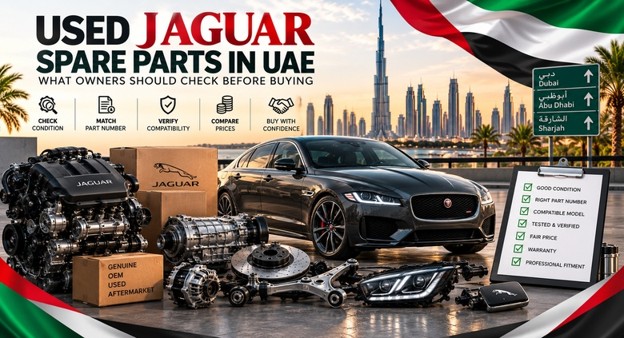
Used Jaguar Spare Parts in UAE: What Owners Should Check Before Buying
September 7, 2026
Used Jaguar Parts and Common Buying Problems
Used Jaguar Spare Parts in UAE: What Should Owners Check Before Buying?
The used Jaguar spare parts in UAE can be a very good buy.
It can also be the most expensive “cheap” part you have ever fitted.
That sounds dramatic, but the problem is usually not the fact that the part is second-hand. The problem is not knowing what you are actually buying. A used original part with a known donor vehicle, sensible mileage, clear photographs and a proper test history can be far more useful than an unknown aftermarket replacement. On the other hand, a used gearbox or engine with no history is a completely different proposition.
Start with the actual Jaguar.
An XE used every day through Dubai traffic will have a different wear pattern from an F-Type that mostly comes out at weekends. An older XJ may have low mileage but years of exposure to UAE heat. An F-Pace might have accumulated substantial motorway kilometres between Abu Dhabi and Dubai. Mileage tells you something. It does not tell you everything.
Before buying, check:
| Check | Why it matters |
| VIN | Confirms the vehicle specification |
| Exact part number | Prevents incorrect fitment |
| Model year | Parts can change between production years |
| Engine specification | Major mechanical parts may differ |
| Gearbox | Transmission parts need exact identification |
| Drivetrain | AWD and other configurations can change fitment |
| Donor vehicle | Gives useful history for a used part |
| Mileage | Helps assess likely wear |
| Physical condition | Reveals cracks, corrosion, leaks or damage |
| Testing evidence | Particularly important for mechanical and electronic parts |
| Warranty | Defines who carries the risk after purchase |
Then look at the part itself.
Don't be satisfied with a catalogue photograph if you're buying second-hand. Ask for photographs of the actual part. A used suspension arm should show its bushes and joints. A used headlight should be checked for moisture, broken mounting points and connector damage. A used gearbox needs much more than a clean casing.
And an engine?
That's where you slow right down.
Ask about compression testing where appropriate, oil condition, coolant contamination, overheating history, donor mileage and whether the engine was running before removal. Find out what comes with it, too. An engine supplied without the supporting parts you expected can change the repair cost considerably.
UAE heat changes the inspection
This deserves more attention than it normally gets.
A Jaguar part can age while the car is parked. Rubber seals, hoses, plastic fittings, wiring insulation and batteries all live through the same summer. Air-conditioning systems work hard. Cooling systems have to deal with high ambient temperatures while the vehicle sits in traffic.
So a used part from a low-mileage UAE car is not automatically healthier than a higher-mileage part from a well-maintained vehicle.
Ask where the donor car came from, how it was used and what happened to it before dismantling.
If nobody can answer those questions, price the risk accordingly.
That is the real used-parts calculation: part price + delivery + labour + testing + supporting parts + possible rework.
If a used part costs less but has to be removed again two weeks later, the saving was never real.
Used Jaguar XE Spare Parts: Which Parts Are Worth Buying Second-Hand?
The XE is a particularly interesting case because some used parts make obvious financial sense, while others need a much harder inspection.
Take a body panel.
If a used XE door is straight, free from serious corrosion, correctly specified and already painted in a suitable colour, it can be a sensible purchase. Why pay the full price for a new body part when the used original does the job perfectly well?
A mirror can work the same way.
But an electronic mirror with power folding, heating, memory or other functions needs its connectors and electrical operation checked. A photograph showing a shiny mirror housing proves very little.
Suspension is somewhere in the middle.
A used original control arm might be perfectly usable, but inspect the bush and ball joint rather than assuming the complete assembly is healthy. If the rubber is cracked or the joint has play, the bargain has already lost its shine.
Brakes need more caution. Engine and gearbox parts need even more.
| XE part | Used buying potential | What to inspect |
| Door/bonnet/fender | Good | Damage, repairs, mounting and alignment |
| Mirror | Good with checks | Glass, motor, connector and functions |
| Headlight | Moderate | Lens, moisture, mounts and electronics |
| Control arm | Moderate | Bushes, ball joint and corrosion |
| Wheel hub | Moderate | Bearing play and noise |
| Brake calliper | Moderate | Pistons, sliders and corrosion |
| Engine | High scrutiny | Compression, oil, coolant and donor history |
| Gearbox | High scrutiny | Identification, testing, leaks and warranty |
| Electronic module | High scrutiny | Part number, connector and programming |
This is why “used Jaguar parts” should never be treated as one category.
There are good used Jaguar spare parts in UAE, tired used parts, damaged used parts and unknown used parts.
The seller's description matters, but your verification matters more.
Watch the labour trap
Here's a situation that happens easily.
You find a used XE suspension part for considerably less than a new replacement. Great. It gets fitted. The mechanic discovers another worn bush, alignment is needed, and the replacement part turns out to have more wear than expected.
Now you're paying additional labour.
If the original part has to come back out, you're paying again.
That is why the workshop should inspect the old part and replacement together before installation where practical. If a related part is already badly worn, deal with the whole repair sensibly rather than pretending each part exists in isolation.
And if you're buying an electronic part, ask about programming before paying.
A module that physically plugs in may still need coding or configuration. The part may be inexpensive; getting the car to recognise it may not be.
Which used XE parts usually make the most sense?
Body panels, mirrors, trim, selected lights and certain non-critical mechanical parts can be attractive when condition is clear.
For engines, gearboxes, steering and safety-critical braking or suspension parts, the threshold should be much higher.
Don't buy because the seller says, “It came off a running car.”
Ask which car, what mileage, what specification, why it was dismantled and how the part was tested.
That is a much better conversation.
Used Jaguar XF and XJ Spare Parts: What Should You Inspect Carefully?
The XF and XJ bring another variable into the equation: age.
A used part from an older Jaguar needs to be judged not only by how many kilometres it has covered, but by how long it has been exposed to heat, storage, road use and previous repairs.
The XJ is particularly unforgiving of lazy assumptions.
A low-mileage suspension part can still have aged rubber. A used cooling-system part can look fine externally while having spent years dealing with heat cycles. An electronic module may work on the donor car but still need correct programming for the recipient vehicle.
And then there are parts that are difficult to judge from photographs.
Wheel hubs. Differentials. Steering parts. Gearboxes.
You need inspection or testing.
XF owners should look closely at the cooling system
If an XF has suffered repeated overheating, don't simply buy a used radiator because the price looks attractive.
Find out why the old system failed.
Check the radiator, hoses, thermostat, water pump, cooling fans and related connections. If the engine has already overheated, assess the engine itself before fitting replacement cooling parts and assuming the problem is finished.
The same principle applies to AC.
A used compressor may be cheaper than a new one, but check why the original compressor failed. Was the system contaminated? Was there a refrigerant leak? Is the condenser damaged? Is the cooling fan operating properly?
Otherwise, the replacement compressor can be fed straight back into the original problem.
XJ buyers need to think about the whole car
With an older XJ, one failed part may not be the only issue.
Imagine the vehicle has suspension faults, cooling problems, an ageing battery, several warning lights and an engine oil leak. Buying one used part at a time may feel economical, but the annual repair bill can quietly become enormous.
Before approving a major repair, ask the workshop to separate the faults into:
must fix now, should fix soon, and can wait.
That changes the decision.
If the XJ has a healthy engine, good gearbox, strong body and decent interior, spending money on a quality used original part can be entirely reasonable. If several major systems are already failing, calculate the first-year ownership cost before committing to another large repair.
Used parts versus reconditioned parts
This distinction matters with major mechanical parts.
A used gearbox is normally an existing unit removed from another vehicle.
A reconditioned gearbox should have undergone some level of rebuilding or refurbishment, but don't assume every seller means the same thing. Ask what was replaced, what was inspected and what was tested.
The same applies to engines.
“Reconditioned” should lead to questions, not instant confidence.
What was rebuilt?
Were internal clearances checked?
Which seals were replaced?
Was the cylinder head inspected?
Was the engine tested after rebuilding?
What warranty is supplied?
The more expensive the Jaguar repair, the more important those answers become.
Used Jaguar F-Pace, F-Type and XK Parts: Which Ones Are Safe to Buy Used?
The F-Pace, F-Type and XK sit at very different points on the Jaguar ownership spectrum, so buying used parts for them requires a little judgement.
The F-Pace is often a daily vehicle. Family trips, commuting, motorway runs, school runs, shopping — it can rack up kilometres quickly. Suspension and brake wear therefore deserve attention, particularly where the vehicle regularly crosses speed humps, rough road edges or poorly surfaced sections.
A used F-Pace body panel can be a straightforward saving.
A used suspension arm? Inspect it.
A used drivetrain part? Get more evidence.
The F-Type needs a sharper mechanical inspection because previous driving style matters. A performance car that has been driven aggressively can have very different brake, tyre, suspension and drivetrain wear from one used gently.
Don't let low mileage make the decision for you.
Look at the actual condition.
Check discs for wear and damage. Inspect callipers. Look for suspension play. Investigate drivetrain noises. If the vehicle has cooling issues, establish whether the problem sits with the radiator, fans, thermostat, pump or another part before buying anything.
Then there is the XK, where age can dominate.
An older XK can be perfectly worth preserving, but used-part buying needs to account for ageing seals, hoses, suspension parts, electrical equipment, trim and body pieces. Availability may also become a concern depending on the exact year and specification.
| Model | Used parts that can make sense | Parts requiring greater caution |
| F-Pace | Body panels, mirrors, selected trim | Suspension, drivetrain, electronics |
| F-Type | Body/trim, selected non-critical parts | Brakes, drivetrain, cooling, suspension |
| XK | Body, trim, selected mechanical parts | Cooling, electronics, suspension, engine/gearbox |
The safest used purchase is generally one where the part's condition can be seen, measured or tested.
That's why a clean used bonnet is easier to judge than a used gearbox.
You can inspect the bonnet.
You can measure the gearbox's fitment and identify it, but its internal condition needs much stronger evidence.
Don't confuse “original” with “good”
This is probably the most important point in the whole used-parts market.
A genuine Jaguar part that has spent years on a heavily used vehicle is still a used, worn part.
Being original does not magically reset the clock.
A used original control arm with cracked bushes is not automatically better than a properly specified new replacement. A used compressor with a damaged bearing is not a bargain. A used electronic module with corrosion can become a diagnostic headache.
So ask three questions:
Is it the right part?
Is it in good enough condition?
What happens if it fails?
If you can answer all three, the purchase starts to make sense.
If you cannot, the low price is doing too much of the selling.
And in the UAE, where workshop labour, delivery time and summer downtime can quickly add up, that matters even more. A Jaguar sitting in a workshop waiting for a replacement part is not merely inconvenient; for a daily commuter, family vehicle or business car, it can interfere with the entire week's routine.
The smart used-parts buyer therefore does something surprisingly simple:
verify the part, inspect the condition, calculate the complete installed cost, and only then decide whether the saving is real.
Used Jaguar Engines, Gearboxes and Mechanical Parts
Used Jaguar Engines in UAE: What Should You Check Before Buying?
A used Jaguar engine is not something to buy from a photograph and a price tag.
Start with the exact engine code. Then check the donor vehicle, recorded mileage, condition and reason for dismantling. If the seller cannot provide basic identification, walk away from the deal rather than trying to make the part fit later.
For an engine that has been removed from a donor Jaguar, ask whether it was running before removal and whether there is evidence of its condition. Where appropriate, a compression test is one of the more useful checks because it gives the buyer measurable information about cylinder condition instead of relying on “good engine” descriptions.
Also inspect:
- Oil condition and signs of contamination
- Coolant condition
- External oil or coolant leaks
- Evidence of previous overheating
- Unusual corrosion or physical damage
- Engine code and part identification
- Donor vehicle and mileage
- Included accessories and supporting parts
- Warranty terms
The UAE climate makes cooling history particularly important. An engine that has repeatedly overheated is a different proposition from one removed from a properly maintained donor.
And don't forget what caused your original engine to fail.
If your Jaguar overheated because of a failed thermostat, water pump, radiator or cooling fan, replacing the engine without addressing that fault is asking the replacement engine to walk straight into the same problem.
Used or reconditioned?
A used engine is an existing unit. A reconditioned engine should have undergone rebuilding work, but the word itself does not tell you what was actually done.
Ask.
Which internal parts were replaced? Were the cylinder head and block inspected? Were seals renewed? Was the engine tested after rebuilding? What exactly does the warranty cover?
For a high-value Jaguar, those answers matter more than a small difference in the initial price.
The final calculation should include engine cost, delivery, removal, installation, fluids, filters, seals, supporting parts, diagnostics and warranty.
Otherwise the “cheap engine” may not remain cheap for long.
Used Jaguar Gearboxes in UAE: How Can You Check a Second-Hand Transmission?
A Jaguar gearbox can fail internally, but don't assume every bad shift means the gearbox needs replacing.
Harsh engagement, hesitation, slipping or a transmission warning can also involve fluid condition, sensors, electrical faults, control systems or software. Diagnose first.
Once replacement is genuinely justified, identify the gearbox precisely.
Transmission code. Part number. Donor vehicle. Mileage.
Those details matter.
A used gearbox should ideally have evidence of testing, and the seller should be able to explain where it came from. Check for leaks, physical damage and signs of overheating. If possible, establish how it behaved before removal.
| Check | Why it matters |
| Transmission code | Confirms the correct gearbox specification |
| Part number | Helps prevent incorrect fitment |
| Donor vehicle | Provides useful history |
| Mileage | Indicates likely wear |
| Fluid condition | Can reveal contamination or overheating |
| Leak inspection | Identifies seal or casing problems |
| Testing | Provides evidence of operating condition |
| Warranty | Limits the buyer's risk |
Then consider the fitting work.
A replacement gearbox may require new fluid, seals or other supporting parts. Diagnostics and adaptation may also be necessary depending on the Jaguar and transmission specification.
Ask the workshop before installation whether coding, calibration or adaptation is required and whether it is included in the quote.
The first road test should not be a quick lap around the workshop.
Check cold operation, normal shifts, pull-away, reversing, downshifts and behaviour once the gearbox reaches operating temperature. If a warning appears, investigate it immediately.
What if the gearbox failed because of heat?
In UAE conditions, don't ignore transmission cooling.
If the old gearbox has evidence of overheating, check the relevant cooling arrangements and fluid condition before installing another unit. Otherwise, the replacement may inherit the same operating problem.
And when comparing a used gearbox with a reconditioned, OEM or genuine unit, compare the complete installed cost, not just the gearbox sitting on the floor.
That is where many quotations change shape.
Used Jaguar Suspension and Brake Parts: Are They Worth Buying Second-Hand?
Some used suspension parts can make financial sense.
Others are false economy.
A used control arm, for example, may look perfectly serviceable until you inspect the bush and ball joint. If the rubber is cracked or the joint has play, you've bought a worn part and paid labour to install it.
Brakes need even more care.
A used brake calliper can potentially be reused when its condition is properly verified, but pistons, seals, sliders and corrosion need inspection. Used brake discs and pads generally deserve much more caution because they are wear items and their remaining life can be difficult to justify economically.
| Used part | Buying approach |
| Control arm | Check bush and ball joint carefully |
| Shock absorber | Check leaks and damping condition |
| Stabiliser link | Inspect joints for play |
| Wheel hub | Check bearing play/noise |
| Brake calliper | Inspect piston, seals, sliders and corrosion |
| Brake disc | Usually compare remaining life against new cost |
| Brake pad | Generally poor value unless condition is clearly known |
The UAE road environment adds another reason to inspect suspension properly. Speed humps, potholes, rough road edges and repeated urban impacts gradually take their toll.
If your Jaguar is knocking, pulling or wearing tyres unevenly, don't simply order the part that appears in a search result.
Find the source of the movement.
A workshop should inspect the suspension while the vehicle is loaded and unloaded as appropriate, check for play and look at tyre wear. If alignment has been performed repeatedly without solving the problem, something else may be moving when it should not.
Used versus new
For a non-critical body or trim part, used can be an easy win.
For a safety-critical brake or steering part, the tolerance for uncertainty should be much lower.
A quality new OEM or aftermarket replacement may cost more initially but can offer a clearer condition baseline. A genuine part can make sense where exact specification and long-term reliability matter most.
The sensible choice depends on the part.
Don't use the same buying rule for a door mirror and a steering joint.
Used Jaguar Electrical Parts: How Do You Know a Module Will Work?
Electrical Jaguar parts are particularly awkward because they can look completely healthy while still refusing to cooperate with the vehicle.
A used module may have no visible damage at all.
That tells you almost nothing.
Start with the exact part number. Check the connector arrangement and vehicle application. Then find out whether the module requires coding, programming or configuration after installation.
This is especially important when dealing with expensive electronic systems. A seller may say, “It works.” Fine — but did it work in the same specification Jaguar?
If the part came from an XE and is being fitted to another XE, that still does not prove compatibility. Model year, equipment level and software configuration can differ.
Before buying, confirm:
- Exact part number
- Superseded or replacement number
- Donor vehicle
- Connector type
- Vehicle specification
- Previous fault history where available
- Whether the module was tested
- Whether coding is required
- Who will perform programming
- Whether programming is included in the quoted cost
- Warranty and return conditions
Battery and charging faults can muddy the diagnosis
A weak battery or charging problem can create a surprising number of electrical warnings.
That is why replacing an expensive Jaguar module before checking the battery, alternator and relevant wiring is poor practice.
Scan the vehicle. Check system voltage. Inspect connectors. Confirm communication faults. Establish which part has actually failed.
Otherwise you may fit a perfectly good used module to a vehicle that still has the original electrical problem.
And then comes the classic argument: “The part doesn't work.”
Maybe it does.
Maybe the car simply hasn't been programmed to recognise it.
That is why used electronic parts should be bought with the installation process already understood. The part price is only one line of the repair.
Add diagnostics. Add programming. Add labour. Add the possibility of a return if the unit fails testing.
For Jaguar owners in the UAE, that extra planning is worthwhile. A replacement module that arrives quickly but sits in a workshop for days waiting for programming is not really a quick repair.
Match the module. Diagnose the vehicle. Confirm the programming. Then pay.
Compatibility, Condition and Jaguar Used-Part Prices
Jaguar Used Spare Parts by VIN: How Can You Check Compatibility?
A used Jaguar part should never be ordered simply because the listing says “XE”, “XF” or “F-Pace”.
That is the shortcut that causes trouble.
Start with the VIN. Match it against the exact part number, then confirm the model year, engine, gearbox and drivetrain. For larger mechanical parts, also check the identification stamped or attached to the actual unit.
This becomes particularly important with Jaguars that have several engine and transmission options. Two XF models can look virtually identical while needing different parts. The same goes for suspension, cooling, electronic modules and drivetrain parts.
Before paying, check:
- Vehicle VIN
- Model and model year
- Engine specification and code
- Gearbox/transmission
- Drivetrain
- Original part number
- Superseded part number, if applicable
- Connector and mounting points
- Programming or calibration requirements
Don't rely on dimensions alone.
A used gearbox can physically resemble the required unit and still have the wrong transmission specification. An electronic module can have the same casing and connector shape but require different programming. A suspension part can bolt into place yet have the wrong specification for the vehicle.
Ask for the actual part number
This is particularly useful when buying from a dismantler or independent seller.
Ask for a photograph of the number on the part. Compare it with the number supplied for your Jaguar. If there is a replacement or superseded number, have that relationship confirmed before ordering.
For an engine, check the engine code.
For a gearbox, check the transmission identification.
For an electronic module, check both the hardware number and whether programming is required.
And if the seller says, “It fits all Jaguar models,” ask for the exact application.
That single sentence can save you from an expensive mismatch.
Jaguar Used Spare Parts Inspection: How Can You Check Condition Before Paying?
A used part should be inspected according to what can actually fail.
That sounds obvious, yet sellers often provide plenty of information about appearance and very little about function.
A clean gearbox casing tells you almost nothing about its internal condition. A shiny control arm can still have worn bushes. An attractive headlight may contain moisture or have broken mounting tabs hidden underneath.
So inspect the part for the failure points that matter.
| Part type | Key condition checks |
| Engine | Compression where appropriate, oil, coolant, leaks, overheating history |
| Gearbox | Testing, leaks, fluid condition, donor and mileage |
| Suspension | Bushes, joints, cracks, corrosion, deformation |
| Brake calliper | Piston, seals, sliders and corrosion |
| Headlight | Lens, moisture, mounts, connectors and electronics |
| Mirror | Glass, motor, folding/heating functions and connector |
| Body panel | Dents, repairs, alignment, corrosion and mounting |
| Electronic module | Part number, connectors, corrosion and testing |
Photographs are useful, but they are not enough for expensive mechanical parts.
If you're buying a used engine, ask for the donor information and whatever test evidence is available. If compression testing is appropriate, ask whether it has been done.
For a used gearbox, ask whether the unit was tested before removal. Find out if it came from a running vehicle. Ask about mileage and leaks.
For suspension, look closely at bushes and joints rather than judging the entire assembly from the outside.
Donor history can tell you more than a sales description
Why was the donor Jaguar dismantled?
Accident?
Mechanical failure?
Export?
End-of-life vehicle?
That answer does not automatically make the part good or bad, but it gives useful context.
An engine from a vehicle dismantled after body damage may be worth investigating. An engine removed because of overheating needs considerably more scrutiny.
Likewise, a gearbox from a car with known transmission problems should not be treated as an ordinary used unit.
Ask questions before the part reaches your workshop.
Once the mechanic has removed the old part and the replacement is sitting beside the vehicle, the pressure to “just fit it” increases. That's exactly when you want the verification already finished.
Condition and price must be considered together
A used Jaguar part costing 40% less than a new one may look attractive.
But what if its remaining life is only half as long?
What if it requires refurbishment?
What if the warranty is shorter?
What if the workshop charges again to remove it?
Used-part buying works best when the lower price is supported by evidence of condition, not when the buyer simply accepts more uncertainty in exchange for a discount.
Jaguar XE vs XF vs XJ vs F-Pace Parts: Which Parts Are Not Interchangeable?
Jaguar's model range shares engineering in places, but that does not turn the parts catalogue into a giant interchangeable box.
XE is not automatically XF.
XF is not automatically XJ.
F-Pace is not simply an SUV-shaped XF.
And F-Type parts need their own scrutiny.
Some parts may share applications across particular years or specifications. Others will not. The only sensible way to establish that is to verify the actual application.
| Part | Why the models can differ |
| Engine | Different engine families and revisions |
| Gearbox | Transmission specification and software |
| Suspension | Vehicle weight, geometry and calibration |
| Brakes | Disc size, calliper and performance package |
| Differential | Ratio and drivetrain configuration |
| Driveshaft | Length and drivetrain layout |
| Cooling system | Engine layout and cooling capacity |
| Electronics | Hardware, software and vehicle configuration |
| Body panels | Generation, dimensions and mounting |
| Lighting | Connectors, sensors and equipment level |
This is especially important when buying used parts because dismantlers may list a part against several applications.
That can be legitimate.
It can also be overly broad.
A part that fits several Jaguars should have an application range that can be verified against your VIN and part number.
Don't confuse physical fit with correct fit
This is one of the easiest mistakes to make.
The part bolts on.
The car starts.
Then a warning appears.
Or the suspension geometry is wrong.
Or the gearbox behaves differently.
Or an electronic module refuses to communicate.
The physical mounting is only one part of compatibility.
For electronic parts, software matters. For driveline parts, ratios matter. For suspension, specification matters. For engines and gearboxes, identification matters.
So if you're buying a used part advertised as fitting XE, XF and F-Pace, don't ask only whether the seller has sold it before.
Ask whether it matches your VIN and exact original part number.
That is a much stronger test.
Jaguar Spare Parts Prices in UAE: Genuine, OEM, Used and Aftermarket
There is no single “Jaguar spare-parts price” in the UAE.
The same model can have dramatically different repair costs depending on the part and the route you choose.
A genuine Jaguar part may carry the highest upfront price. An OEM alternative can reduce the cost while retaining a suitable specification. A used original can bring the price down considerably. A reconditioned engine or gearbox sits somewhere else again, because its value depends heavily on the quality of the rebuilding work.
Aftermarket parts are the wildcard.
Some are perfectly suitable. Some are not worth fitting.
| Option | Cost position | What matters most |
| Genuine | Usually highest | Exact specification and long-term risk |
| OEM | Medium/high | Manufacturer and correct application |
| Used original | Usually lower | Condition, donor and remaining life |
| Reconditioned | Variable | What was rebuilt and how it was tested |
| Aftermarket | Low to medium | Brand, quality and exact specification |
For a body panel, used original can be an easy financial decision.
For a gearbox, it is more complicated.
For an engine, even more so.
For an electronic module, a low price means little if programming adds another charge and the part turns out to be incompatible.
When comparing genuine, OEM, used and aftermarket Jaguar parts in the UAE, PartFinder UAE buyers should compare the complete installed cost rather than focusing only on the advertised part price.
Look at the complete UAE repair bill
A proper comparison should include more than the item price.
Part + delivery + labour + fluids + seals + supporting parts + diagnostics + programming + alignment where required.
Suppose a used suspension assembly saves AED 500 on the part itself. If fitting reveals damaged bushes, alignment is required and the part later has to be removed because it was incorrectly specified, that AED 500 saving can disappear very quickly.
The same problem occurs with major mechanical parts.
A used engine might look dramatically cheaper than a genuine replacement. Then the workshop adds fluids, filters, seals, mounts, hoses, diagnostics and other supporting work.
The difference narrows.
That doesn't mean used is bad.
It means used must be compared on total installed cost.
UAE labour and downtime matter
Workshop labour is not fixed across the UAE. Dubai specialist workshops, independent garages in Sharjah or Ajman, and workshops in Abu Dhabi, Ras Al Khaimah, Fujairah or Umm Al Quwain can quote differently depending on equipment, expertise and the complexity of the Jaguar repair.
Ask what the labour includes.
Does gearbox removal and refitting count?
Is programming included?
Are fluids included?
Is wheel alignment included after suspension work?
What happens if the used part is defective?
And how long will the vehicle actually remain off the road?
That final point gets ignored.
For a daily Jaguar XE used to commute from Sharjah into Dubai, a three-day delay has a practical cost. For an F-Pace used by a family, it can disrupt the entire routine. For an F-Type or XK, the owner may be more willing to wait for the correct part rather than fit something questionable just to get the car moving.
So don't chase the lowest number.
Chase the lowest sensible total cost with a condition, compatibility and warranty position you can live with.
Installation, Hidden Costs and Buying Decisions
Hidden Costs of Used Jaguar Spare Parts in UAE: What Can Increase the Final Bill?
The price written beside a used Jaguar part is rarely the final number.
A used gearbox may look affordable until removal, refitting, transmission fluid, seals, diagnostics and adaptation are added. A used engine can bring the same surprise, particularly if mounts, hoses, filters or other supporting parts need attention while the engine is out.
Then there is delivery.
A large mechanical part arriving from another emirate, or taking longer than expected to source, can leave the Jaguar sitting in a workshop. For a daily XE travelling between Sharjah and Dubai, that downtime has a practical cost. For a family F-Pace, it can disrupt the week's routine. With an older XJ or XK, waiting for the correct part may be preferable to fitting a questionable substitute.
Before agreeing to a used part, ask for the complete repair calculation:
| Cost area | What to check |
| Part | Exact used part and condition |
| Delivery | Transport and expected arrival |
| Labour | Removal and installation |
| Fluids | Oil, coolant, gearbox fluid or refrigerant |
| Seals | Whether replacement seals are required |
| Supporting parts | Hoses, mounts, filters, bushes and related items |
| Diagnostics | Fault scanning before and after installation |
| Programming | Coding or calibration for electronic parts |
| Alignment | Required after relevant suspension work |
| Warranty | Part-only or part-and-labour coverage |
| Rework | What happens if the part fails? |
That last line is the uncomfortable one.
If a used gearbox fails after fitting, will the seller replace only the gearbox, or will someone cover the second removal and installation?
If the answer is “part only”, calculate the risk before buying.
Cheap parts can create expensive labour
Consider a used control arm.
The part is cheaper. Fine.
But the workshop discovers the bush is already worn, fits it anyway, and the Jaguar still knocks. Now you're buying another part and paying labour again.
The saving has vanished.
The same logic applies to electrical modules. A cheap used module may require programming. If it turns out to be incompatible, you may still have paid diagnostic and installation charges before discovering the problem.
This is why total installed cost is more useful than the advertised part price.
A sensible used-part purchase should save money after everything is finished, not merely at the moment you place the order.
Used Jaguar Spare Parts Installation: What Should the Workshop Check?
Don't let the workshop open the box and immediately start fitting.
First, compare the replacement part with the old one.
Check the part number, mounting points, connectors and specification. For engines and gearboxes, verify the identification again. For electronic parts, confirm whether programming or coding is required. If something does not match, stop there.
It is much cheaper to reject an incorrect part before installation than after the car has been taken apart.
Engine installation
For a used Jaguar engine, the workshop should inspect the supporting systems rather than treating the engine as a standalone item.
Check the cooling system. Look at hoses, radiator, thermostat, water pump and cooling fans. Replace appropriate fluids and filters. Inspect mounts and seals. Where relevant, review compression-test results and investigate any evidence of previous overheating.
Most importantly, establish why the original engine failed.
If the old engine overheated because the cooling system was faulty, fitting another engine without fixing that system is not a repair. It is a repeat booking waiting to happen.
Gearbox installation
Verify the transmission identification first.
Then check fluid requirements, seals, mounts and related cooling arrangements. After fitting, scan the vehicle and complete any required adaptation, coding or calibration.
The road test should cover more than a quick trip around the block.
Check pull-away. Check normal upshifts. Check downshifts. Check reverse. Drive until the transmission reaches normal operating temperature. Look for leaks and warning messages.
If anything feels wrong, don't “see how it goes”.
Go back to the workshop.
Suspension and brake installation
Suspension parts should be checked for correct fitment and tightened according to the vehicle's requirements. Once the relevant work is completed, wheel alignment may be necessary.
For brakes, check disc and pad condition, calliper operation and pedal feel. If a used calliper has been installed, inspect its seals, piston and sliders rather than assuming the unit is healthy because it came from another Jaguar.
Electronic parts
This is where the final diagnostic scan matters.
A used module can physically fit and still need coding. Complete the required programming, clear relevant faults and rescan the car afterwards.
Don't accept a warning light simply because “the part is working”.
It isn't finished until the system works correctly.
The first 1,000 km
After major engine, gearbox, cooling or suspension work, the first 1,000 km should be treated as a sensible monitoring period.
Watch for:
- Coolant or oil level changes
- New leaks
- Temperature fluctuations
- Warning lights
- Gearbox hesitation or harsh shifting
- New vibration or knocking
- Steering changes
- Unusual smells or noises
This matters even more in UAE summer conditions. A Jaguar can behave perfectly during a short workshop test and reveal a cooling or AC weakness once it sits in traffic for an extended period.
Keep the invoice and diagnostic paperwork too.
If something changes later, the workshop has a much better starting point.
Used Jaguar Spare Parts Buying Checklist: How Can You Avoid a Bad Purchase?
Before paying for a used Jaguar part, slow the process down.
Not for hours. Just long enough to verify the things that actually matter.
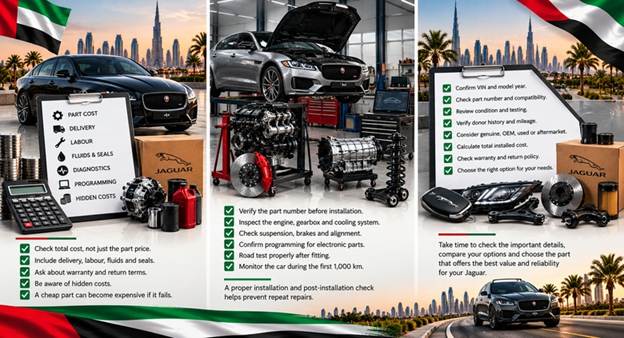
VIN. Part number. Specification. Condition. Testing. Warranty. Total installed cost.
That sequence is far more useful than chasing the lowest quotation.
For an XE, XF, XJ, F-Pace, F-Type or XK, check:
- VIN matches the intended part
- Model year is confirmed
- Engine specification is correct
- Engine code is checked where relevant
- Gearbox/transmission is identified
- Drivetrain is confirmed
- Exact part number is verified
- Any superseded number is confirmed
- Actual used part photographs are supplied
- Donor vehicle is identified where possible
- Mileage is documented where available
- Mechanical parts have appropriate testing evidence
- Used engines are compression-tested where appropriate
- Used gearboxes are checked for leaks and operating condition
- Electronic parts are checked for coding/programming requirements
- Delivery cost is included
- Labour cost is known
- Fluids and seals are accounted for
- Supporting parts have been identified
- Alignment is included where required
- Warranty is written down
- Return conditions are understood
The three-question test
Before buying, ask:
Does it fit?
Is it actually in good condition?
What happens if it fails?
If all three answers are clear, you're in a much stronger position.
If the seller cannot confirm the part number, cannot explain the donor history and offers no meaningful warranty, the discount needs to be very large to justify the uncertainty.
And sometimes even a large discount isn't enough.
Used versus genuine, OEM or aftermarket
There is no universal winner.
A used original body panel can be an excellent buy. A genuine brake part may be the safer choice for a critical repair. A quality OEM suspension part can offer a sensible middle ground. A reconditioned gearbox can work well if the rebuilding process and testing are properly documented.
The part decides the strategy.
Don't buy every Jaguar part the same way.
Think beyond the repair invoice
For a well-maintained Jaguar, replacing one failed major part may be completely sensible. If an older XJ is simultaneously facing engine, gearbox, suspension and electrical problems, however, add the numbers before committing.
Compare the expected first-year ownership cost with the vehicle's condition and value.
Also keep the paperwork. Record replaced engines and gearboxes, retain invoices, keep warranty documents and note major diagnostic findings. Good documentation can support future resale and gives the next owner a much clearer picture of what has actually been done.
For a Jaguar that is otherwise healthy, that history is useful.
For an older car with a complicated repair record, it becomes even more important.
And after the part is fitted, don't forget the first 1,000 km. Watch the car. Listen to it. Check fluids. Pay attention to warning lights and changes in behaviour.
The sensible used-parts decision is therefore not complicated:
Verify the Jaguar. Verify the part. Inspect the condition. Calculate the complete cost. Check the warranty. Then install it properly.
That is how a second-hand Jaguar part becomes a genuine saving rather than a cheap purchase that keeps charging you afterwards.
FAQs
Categories
- Audi
- BMW
- Car Accessories
- Car Tips
- Ford
- Land Rover
- Mazda
- Range Rover
- Top 10
- UAE Car Parts
- Used Car Parts
- Toyota
- Replacement Engines
- Nissan
- Hyundai
- Mitsubishi
- Volkswagen
- Honda
- Kia
- Chevrolet
- Dodge
- Jeep
- Subaru
- Renault
- Lexus
- Mercedes
- Suzuki
- Hummer
- Porsche
- Infiniti
- Peugeot
- GMC
- Mini
- Volvo
- Replacement Gearboxes
- MG
- Jaguar
- Skoda
- Cadillac
- Daihatsu
- Fiat
- German Car Parts
- Japanese Car Parts
- Aftermarket Car Parts
- Genuine Car Parts
- New Car Parts
- Reconditioned Car Parts
- European Car Parts
- American Car Parts
- Korean Car Parts
- British Car Parts
- Chinese Car Parts
- Sports/Exotic Car Parts
- Luxury Car Parts
- Performance Car Parts
- SUV/4x4 Spare Parts
- Truck Spare Parts
- EV Car Parts
- Hybrid Car Parts
- Auto Spare Parts in UAE
- Tesla
- Isuzu
- Ram
- Ferrari
- Bentley
- Lamborghini
- Genesis
- Maserati
- Lincoln
- Chrysler
- Opel
- Citroen
- SsangYong
- Seat
- McLaren
- Aston Martin
- Rolls Royce
- Maybach
- Alfa Romeo
- Bugatti
- Scion
- Abu Dhabi Car Parts
- Ajman Car Parts
- Al Khan Car Parts
- Al Sajaa Car Parts
- Deira Car Parts
- Dubai Car Parts
- Fujairah Car Parts
- Industrial Area 6 Car Parts
- Mussafah Car Parts
- Ras Al Khaimah Car Parts
- Sharjah Car Parts
- Umm Al Quwain Car Parts
- Acura
- BYD
- Chery
- Dacia
- DS
- Geely Emgrand
- EXEED
- GAC
- GAC Gonow
- Geely
- Gonow
- Great Wall
- Haima
- Haval
- Holden
- Iveco
- JAC
- Jaecoo
- Jetour
- Lotus
- Omoda
- Proton
- Renault Samsung
- Roewe
- Lucid
- Replacement Headlight
- Replacement Bumper