Used Kia Spare Parts in UAE: What to Check Before Ordering
August 13, 2026
Understanding Used Kia Spare Parts in UAE
Buying a used Kia spare part in the UAE can save a surprising amount of money. But only if you buy the right used part.
That distinction matters.
A second-hand genuine component removed from a well-maintained Kia can sometimes be a smarter purchase than a cheap new replacement from an unknown manufacturer. On the other hand, a bargain-priced engine, gearbox or electronic module with no proper identification can turn into a very expensive mistake once labour is added.
The UAE market gives Kia owners plenty of choice. Dubai, Abu Dhabi, Sharjah and the other emirates have suppliers dealing in dismantled vehicles, used genuine components, reconditioned assemblies and replacement parts. The difficult bit is separating a genuinely useful component from one that merely looks cheap in an advert.
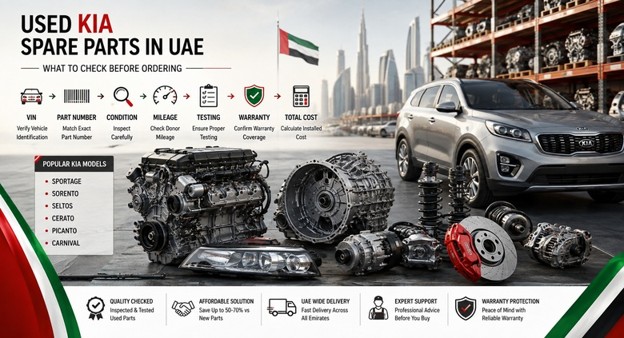
The safest approach is simple: identify the exact part, check its condition, verify compatibility, understand the warranty and calculate the complete repair cost before ordering.
Used Kia Spare Parts Market in the UAE
The used Kia parts market covers far more than engines and gearboxes.
You can find second-hand components for almost every area of a vehicle, including:
- Engines
- Gearboxes
- Suspension arms
- Shock absorbers
- Steering components
- Brake assemblies
- Radiators
- AC compressors
- Alternators
- Starters
- Sensors
- Electronic modules
- Headlights
- Tail lights
- Mirrors
- Doors
- Bumpers
- Bonnet panels
- Interior trim
- Switches
- Door mechanisms
Some are relatively straightforward purchases.
Others need serious checking.
A used door mirror, for instance, is mainly a question of fitment, physical condition and electrical specification. A used automatic gearbox is a completely different proposition. You need the correct transmission code, suitable donor information, evidence of testing, warranty terms and a workshop that knows how to install and set it up.
That is why "used Kia spare parts" should never be treated as one single product category.
The UAE market has several types of used parts
You may encounter:
Used genuine parts:
Original Kia components removed from another vehicle.
Dismantled parts:
Components recovered from vehicles being dismantled for parts.
Reconditioned parts:
Used assemblies that have been rebuilt or repaired before resale.
Exchange components:
Parts supplied under an arrangement where the old component may be returned.
Aftermarket alternatives:
New replacement parts manufactured by companies other than Kia.
These categories can overlap in online listings, which is exactly why buyers need to ask questions rather than assume.
Why UAE buyers often consider used parts
Price is the obvious reason.
But it isn't the only one.
A used genuine headlight, for example, may offer better original fitment than a cheap replacement while costing considerably less than a brand-new dealer component. The same thinking can apply to body panels, mirrors, interior pieces and selected mechanical parts.
Availability matters too.
If a particular component is no longer readily available, a good used part may get an older Kia back on the road far sooner than waiting for a new replacement.
Still, don't rush.
Cheap and available is useful only when the part is actually suitable for the vehicle.
Why Kia Owners Choose Used Spare Parts
The biggest attraction is usually the saving, especially when the original part is expensive.
Imagine an older Kia Sportage needs a headlight assembly. The owner doesn't necessarily need the newest possible component. If a clean, tested genuine used unit is available with the correct part number and suitable warranty, it may make much more sense financially.
The same logic can apply to a bumper, mirror, door assembly or interior component.
For major mechanical parts, however, the calculation becomes more complicated.
A used engine might cost substantially less than a new replacement. Great. But what happens if its history is unclear? What if the mileage is unknown? What if it has not been compression-tested? What if the warranty covers the engine but excludes the labour required to remove it again?
That cheap engine suddenly doesn't look quite so cheap.
The main reasons buyers consider used Kia parts
Lower initial cost:
Used genuine components can reduce the purchase price considerably.
Original fitment:
A used genuine part came from the manufacturer's original vehicle specification.
Better availability:
Older or less common components can sometimes be easier to source second-hand.
Useful for older vehicles:
Owners of older Cerato, Picanto or Sportage models may not want to spend heavily on brand-new components.
Body-repair savings:
Used doors, mirrors, bumpers and lights can make accident repairs more affordable.
Access to discontinued components:
Some older parts may be easier to find through dismantling and used-parts networks.
But there is a trade-off.
Used means previously operated.
That history matters.
Used vs New Kia Spare Parts
The right comparison isn't simply "used is cheaper, new is better".
It depends on what you are buying.
For a cosmetic component, used can be extremely sensible. For a safety-critical or difficult-to-install component, a new or high-confidence alternative may justify the additional expense.
Used and new Kia parts comparison
| Factor | Used genuine | New genuine | Reputable aftermarket |
| Initial price | Usually lower | Usually higher | Variable |
| Original fitment | Strong if correct | Strong | Depends on manufacturer |
| Previous use | Yes | No | No |
| Condition risk | Higher | Lower | Depends on quality |
| Availability | Often good for older models | Can vary | Often good |
| Warranty | Supplier dependent | Usually stronger | Manufacturer dependent |
| Best suited to | Value-focused repairs | Newer/critical applications | Selected cost-conscious repairs |
| Inspection importance | Very high | Moderate | High |
This table isn't a rulebook.
It is a starting point.
A good used genuine component can beat a poor-quality new aftermarket part. Equally, a brand-new reputable aftermarket brake component can be a better purchase than a heavily worn used component.
Judge the actual component, not the category name.
When new makes more sense
Consider a new component more seriously when:
- The part is safety-critical.
- Installation is expensive.
- The vehicle is relatively new.
- Failure would create major downtime.
- The used component's history is uncertain.
- The price difference is relatively small.
- A strong new-part warranty is available.
When used can make more sense
A used part can be particularly attractive when:
- The vehicle is older.
- The component is cosmetic.
- Original fitment matters.
- A new genuine part is disproportionately expensive.
- The used component has been inspected and tested.
- The warranty is reasonable.
- The saving is meaningful.
There's no medal for buying the cheapest part.
There's also no prize for buying the most expensive one.
The objective is sensible value.
Used Genuine vs OEM Kia Parts
This is where many buyers get tangled up.
"Used genuine", "OEM", "genuine", and "aftermarket" are not interchangeable terms.
A used genuine Kia component is an original component that has already been fitted to a Kia and subsequently removed.
An OEM component refers to a part associated with an original equipment manufacturer, although the precise commercial meaning can vary between suppliers and listings.
An aftermarket component is made for replacement use outside the vehicle manufacturer's branded parts channel.
The important question is not what sounds impressive in the advertisement.
Who made the part, what exactly is it, and does it fit this Kia?
Why used genuine can be attractive
Suppose a Kia Carnival needs a particular interior mechanism.
A used genuine component may have the correct mounting points, connectors, finish and dimensions because it originally came from the same vehicle family.
That can be useful.
But don't assume every used genuine part is automatically perfect. It may have been exposed to years of heat, repeated operation, accident damage or moisture.
Check it.
OEM can be a useful middle ground
For certain components, a reputable OEM supplier can offer a balance between price and quality.
But ask for the actual manufacturer.
If a seller simply says, "OEM quality", that doesn't tell you enough.
Ask:
Which manufacturer?
What is the part number?
Is it new or used?
What warranty applies?
Has compatibility been confirmed?
Those four questions can clear up a surprising amount of confusion.
Used vs Reconditioned Kia Parts
Used and reconditioned are also different.
A used gearbox may have been removed from a vehicle and sold in its existing condition.
A reconditioned gearbox should have undergone some form of rebuilding or refurbishment.
But the word "reconditioned" needs checking.
What was actually done?
Were internal components replaced?
Was the assembly tested?
Were seals renewed?
Was it opened at all?
Who carried out the work?
What warranty is provided?
Don't accept a vague answer for a major component.
Used vs reconditioned comparison
| Factor | Used | Reconditioned |
| Previous use | Yes | Yes |
| Internal work | Usually none | Should involve refurbishment/rebuilding |
| Price | Usually lower | Usually higher |
| Condition certainty | Depends on testing | Depends on rebuild quality |
| Warranty | Supplier dependent | Supplier dependent |
| Best for | Suitable lower-risk applications | Major components where rebuild quality is established |
A properly rebuilt engine can be an attractive option.
A poorly rebuilt one is not.
The label isn't enough.
Ask for evidence
For a reconditioned Kia engine or gearbox, ask what was done before it was offered for sale.
A credible answer should be specific.
"Checked and good" is not particularly useful.
"What exactly was checked?" is the better question.
When Used Kia Parts Offer Better Value
Used parts provide the strongest value when the saving is meaningful and the risk is manageable.
That combination is important.
A used bumper that costs half the price of a new one and is already in the correct colour can be an excellent purchase.
A used engine that costs 30% less but has unknown mileage, no testing and weak warranty protection may not be.
Strong candidates for used parts
Used genuine parts can often be worth considering for:
- Bumpers
- Grilles
- Mirrors
- Doors
- Bonnet panels
- Tail lights
- Headlights
- Interior trim
- Seats
- Switches
- Certain suspension components
- Selected mechanical assemblies
The decision becomes more cautious with:
- Engines
- Gearboxes
- ECUs
- Safety modules
- Steering components
- Major braking components
- Driver-assistance electronics
The harder a component is to replace, the more carefully you should evaluate its history.
A simple value test
Before ordering, ask yourself:
How much am I saving?
Then ask:
What happens if this part fails?
And finally:
How much will removal and replacement cost?
That third question is the one buyers often forget.
If replacing a used engine requires many hours of labour, the quality and warranty of the engine deserve far more attention than a few hundred dirhams of initial savings.
Used Kia Spare Parts and UAE Ownership Conditions
The UAE environment changes the way some used components should be evaluated.
Heat matters.
Long periods of AC operation matter.
Traffic matters.
So does the history of the donor vehicle.
A component removed from a lightly used Kia that spent most of its life in controlled conditions may not have experienced the same stresses as one exposed to heavy daily traffic and long-distance driving.
Components particularly worth checking carefully in the UAE
Cooling components:
Radiators, cooling fans, hoses and related parts can experience substantial heat exposure.
AC components:
Compressors, condensers and related assemblies deserve careful inspection.
Batteries and electrical parts:
Heat can be demanding on electrical components.
Rubber components:
Bushes, seals and hoses can deteriorate with age and environmental exposure.
Body and exterior parts:
Paint, plastics and trim can show significant sun exposure.
This doesn't mean a used part from a UAE vehicle is automatically poor.
It means condition matters.
UAE climate should be part of the buying conversation
When ordering a used Kia component, ask about its condition rather than simply asking whether it works.
For example, with an AC compressor, find out whether it has been tested.
With a used radiator, inspect for damage and leaks.
With suspension bushes, look for cracking or deterioration.
With electronic parts, inspect connectors and housings.
The details matter.
Used Kia Spare Parts Buying Rule
There is one principle worth carrying through the entire article:
Never buy a used Kia spare part simply because the listing says it fits.
Verify it.
Check the number.
Check the condition.
Ask about testing.
Confirm the warranty.
Then compare the complete cost.
That approach may take a few extra minutes, but it can save an owner from paying twice — once for the part and again for the labour needed to remove a bad one.
The UAE used-parts market can offer excellent value to Kia owners.
Just don't confuse a low price with a good deal.
A good deal is a suitable component, in acceptable condition, from a supplier who can stand behind what they are selling.
Kia Models and Used-Part Compatibility
Used Kia parts are not interchangeable simply because two vehicles carry the same badge.
That sounds obvious, yet it is one of the easiest mistakes to make when buying second-hand components.
A Kia Sportage can have different engines, transmissions, generations and market specifications. The same goes for the Sorento, Seltos, Cerato, Picanto and Carnival.
Even when two cars look almost identical, a sensor, headlight, gearbox, control module or suspension component may be different.
So, before ordering anything, slow down for a moment.
The model name gets you close. The VIN, engine, transmission and part number get you to the right component.
Used Kia Sportage Spare Parts
The Kia Sportage is one of the models for which buyers should pay particular attention to generation and specification.
A listing that says "Sportage spare part" isn't enough.
The component could have come from a different generation, engine variant or market specification.
This becomes especially important with:
- Engines
- Gearboxes
- Headlights
- Tail lights
- ECUs
- Sensors
- Cooling components
- Suspension assemblies
- Body panels
- Electronic modules
Used Sportage body parts
Body components can sometimes be easier to match visually.
A buyer may compare:
- Headlight shape
- Bumper design
- Grille
- Mirror shape
- Door profile
- Tail-light configuration
But appearance isn't the whole story.
A headlight may look identical while using different connectors or internal electronics.
A bumper may look correct but have different mounting points.
A mirror may fit physically but lack the same electrical functions.
Always check the part number when the component contains electronics or has multiple specification variations.
Used Sportage mechanical parts
For engines and gearboxes, take a stricter approach.
Confirm:
Engine code:
Don't rely only on "Sportage 2.0".
Transmission type:
Manual, automatic or another transmission specification must be established.
Part number:
Match the original or confirmed replacement number.
VIN compatibility:
Have the supplier verify the application.
Condition:
Ask whether the component has been tested.
A used Sportage engine can look perfectly clean externally and still have internal problems.
That is why inspection and testing matter much more than photographs.
Used Kia Sorento Spare Parts
The Sorento is a larger Kia SUV, and used-part buyers often look for suspension, body, drivetrain, cooling and AC components.
Its size and typical family use also mean that some parts may experience substantial operating loads.
Common used Sorento parts buyers look for
- Engines
- Gearboxes
- Suspension components
- Brake assemblies
- Radiators
- AC compressors
- Headlights
- Tail lights
- Bumpers
- Mirrors
- Body panels
- Electronic modules
Again, don't jump from "Sorento" straight to "this part will fit".
Check the exact vehicle.
Used Sorento engine compatibility
Engine replacement is where broad model matching becomes particularly risky.
A supplier may have several Sorento engines that appear similar.
They may not be interchangeable.
Check:
- Engine code
- Displacement
- Fuel type
- Generation
- Transmission relationship
- Electrical connections
- Sensors
- Mounting arrangements
- VIN compatibility
A small difference can create a large installation problem.
Used Sorento suspension parts
Suspension components should be checked for:
- Bending
- Cracks
- Corrosion
- Bush deterioration
- Ball-joint condition
- Damaged mounting points
- Excessive wear
Don't buy a used suspension assembly merely because it came from the same model.
Its condition is just as important as its identity.
Used Kia Seltos Spare Parts
The Seltos has several specification differences across markets and model years, so buyers should avoid generic online matching.
This is particularly important for electronic and drivetrain components.
Used Seltos parts commonly requiring careful verification
- Sensors
- Electronic modules
- Headlights
- Tail lights
- AC components
- Cooling parts
- Suspension components
- Gearbox components
- Engine components
A photograph can help identify the shape of a component.
It cannot always confirm its internal specification.
Used Seltos electrical components
Electrical parts deserve extra caution.
Check:
- Part number
- Connector layout
- Connector condition
- Housing condition
- Vehicle compatibility
- Programming requirements
A used module may physically connect to the vehicle yet still require coding, programming or configuration.
That additional work should be discovered before ordering.
Used Seltos body parts
Body panels can provide good savings when the condition is strong.
Before buying, check:
- Dents
- Scratches
- Rust or corrosion
- Previous repair
- Mounting tabs
- Brackets
- Paint condition
- Correct generation
If the panel is already painted in the right colour, it can sometimes reduce the overall repair cost.
But compare the colour carefully.
UAE sun exposure can cause noticeable differences between an older painted panel and the rest of the vehicle.
Used Kia Cerato Spare Parts
The Cerato can be an attractive candidate for used parts, particularly when owners want to control repair costs on older vehicles.
That doesn't mean every second-hand component is automatically a good buy.
The part still needs to match the vehicle and justify its condition.
Used Cerato parts for older vehicles
Owners may consider used components for:
- Body panels
- Mirrors
- Lights
- Interior trim
- Door mechanisms
- Suspension components
- AC components
- Selected engine accessories
For routine mechanical repairs, reputable aftermarket alternatives may also deserve comparison.
The important thing is to compare like with like.
A used genuine component should not be compared with an unknown aftermarket component as though they are identical products.
Used Cerato engine parts
For engine-related components, identify exactly what has failed.
Don't order an entire assembly when a smaller component is responsible for the problem.
For example, poor engine performance could be connected to:
- Sensors
- Ignition components
- Fuel delivery
- Air intake
- Cooling
- Electrical faults
- Internal engine wear
Diagnosis should come first.
Then order the part.
This is particularly important for older Cerato models, where owners are often trying to keep repair spending under control.
Used Cerato body components
Body parts can be one of the more practical areas for second-hand buying.
A genuine used door, bonnet, mirror or light may offer substantial savings.
Check the mounting points carefully.
A panel that has already been repaired after an accident may look acceptable in a photograph but require additional bodywork before installation.
Used Kia Picanto Spare Parts
The Picanto is smaller, but the same compatibility rules apply.
In fact, owners of older Picanto models may be especially interested in used components because controlling repair costs is often part of the reason for keeping the car.
Used Picanto parts worth comparing
Potential options include:
- Mirrors
- Headlights
- Tail lights
- Bumpers
- Interior switches
- Door components
- Suspension parts
- Selected engine components
- Alternators
- Starters
The condition of the donor component should be established before purchase.
Used Picanto electrical parts
Electrical components can become tricky when several model-year or specification variations exist.
Check:
- Part number
- Connector
- Physical housing
- Vehicle year
- Electrical specification
- Programming requirements where relevant
Don't assume that a component from a visually similar Picanto will work correctly.
Used Picanto engine and gearbox components
For major assemblies, obtain as much information as possible.
Ask:
- What vehicle did the part come from?
- What was its mileage?
- Has it been tested?
- What is the engine or transmission code?
- What is included?
- What warranty is provided?
A small car doesn't automatically mean a small repair bill.
Installation labour can still make a failed used component expensive.
Used Kia Carnival Spare Parts
The Carnival is a larger family vehicle, and its parts can be more expensive simply because of the size and complexity of some assemblies.
Used components can therefore offer meaningful savings.
Potentially useful categories include:
- Body panels
- Sliding-door components
- Lights
- Mirrors
- Interior trim
- Suspension
- Cooling components
- AC components
- Electronic modules
- Engine components
- Gearbox components
Used Carnival sliding-door parts
The sliding-door system deserves careful inspection because it can contain mechanical and electrical components working together.
If a door is sticking, making noise or operating intermittently, don't immediately order the complete mechanism.
The fault could involve:
- Rollers
- Tracks
- Latches
- Motors
- Switches
- Wiring
- Control components
A proper diagnosis can prevent unnecessary spending.
Used Carnival AC components
Family use means AC performance matters.
Before buying a used compressor, condenser or related component, establish the actual fault.
A weak AC system can have several causes.
The problem could involve:
- Refrigerant leakage
- Cooling fans
- Compressor performance
- Condenser condition
- Electrical control
- Airflow
- Other AC components
Replacing a compressor without establishing that the compressor itself has failed is an expensive gamble.
Matching Used Kia Parts Across Model Generations
Generation is one of the most important checks when buying used Kia parts.
A vehicle may retain the same model name while receiving significant mechanical, electrical and body changes.
This is why "same model" does not always mean "same part".
Generation changes can affect
- Engines
- Gearboxes
- Headlights
- Tail lights
- Bumpers
- Grilles
- Suspension
- Wiring
- Sensors
- Electronic modules
- Interior components
A supplier should know which generation the donor vehicle belongs to.
If they don't, ask for more information before ordering.
How to identify the correct generation
Use several pieces of information together:
Model:
Sportage, Sorento, Seltos, Cerato, Picanto or Carnival.
Year:
Confirm the model year.
VIN:
Provide the full vehicle identification number.
Engine:
Identify the exact engine.
Transmission:
Confirm the transmission type and code where applicable.
Part number:
Match the component reference.
This combination gives the supplier a much stronger basis for identifying the correct used part.
Used Kia Parts for GCC-Spec Vehicles
UAE buyers should also consider market specification.
A Kia imported from another country may look almost identical to a GCC-spec vehicle while using different components.
This can affect:
- Lighting
- Sensors
- Cooling
- Electronic modules
- Engine components
- AC systems
- Body equipment
GCC vs imported Kia
Before ordering a used part, tell the supplier if the vehicle is:
- UAE/GCC specification
- Imported from another Gulf country
- Imported from Europe
- Imported from North America
- Imported from another market
Don't leave that information out.
It may be the detail that determines whether the component is correct.
Why this matters for used parts
With a new component, a supplier may have better access to application data.
With used parts, the donor vehicle's specification becomes equally important.
A component from an overseas vehicle may not be the correct match for a UAE-spec Kia.
Used Kia Parts and Donor Vehicle Information
The donor vehicle can tell you a lot about a used component.
Ask for whatever information the supplier can reasonably provide.
Useful details include:
- Donor model
- Donor year
- Engine
- Transmission
- Mileage
- Market specification
- Accident history where known
- Reason for dismantling
- Part number
Not every supplier will have every detail.
But the more expensive the part, the more information you should expect.
Why donor mileage matters
Mileage doesn't tell you everything.
A low-mileage component can still have been damaged.
A higher-mileage component may be in surprisingly good condition.
Still, mileage provides useful context.
For example, a used engine advertised with verified mileage is easier to assess than an engine whose history is completely unknown.
Mileage should therefore be treated as one piece of evidence, not the entire buying decision.
Model Matching Is Not Enough
This is worth repeating because it causes so many problems.
A seller may say:
"Yes, it is for Kia Sportage."
That answer isn't sufficient for an expensive component.
Ask:
Which Sportage?
Which year?
Which engine?
Which transmission?
Which market specification?
What is the part number?
Has the VIN been checked?
Now you are getting somewhere.
The five-point compatibility check
Before ordering a used Kia component, confirm:
Vehicle:
Exact model and generation.
Powertrain:
Engine and transmission.
VIN:
Complete vehicle identification.
Part number:
Original or confirmed replacement number.
Supplier confirmation:
Written or otherwise documented confirmation that the component is suitable.
This is particularly important when purchasing online or from a supplier located in another emirate.
Used Kia Parts and PartFinder UAE
For UAE buyers comparing used components, supplier comparison can make the process more practical.
PartFinder UAE can be useful when the goal is to compare available Kia parts and supplier options rather than accepting the first quotation.
The same rules still apply, though.
A marketplace or search result doesn't replace verification.
Always match the part to the actual Kia before placing the order.
Model-Specific Used Kia Parts Buying Strategy
Each Kia model deserves a slightly different approach.
| Kia model | Used-part priorities |
| Sportage | Generation, engine, gearbox, suspension and electronics |
| Sorento | Drivetrain, suspension, cooling, AC and family-use wear |
| Seltos | Electronics, engine, gearbox and model-year compatibility |
| Cerato | Value-focused mechanical, body and interior parts |
| Picanto | Cost-effective maintenance and correct small-component fitment |
| Carnival | AC, cooling, suspension, doors, electronics and drivetrain |
This isn't a rigid rule.
It is a useful starting point.
The vehicle's actual condition should always override assumptions based on the model.
Real Buyer Questions — Kia Model Compatibility
"Can I use any Kia Sportage part on my Sportage?"
No.
The part may differ according to generation, year, engine, transmission, specification or equipment.
Confirm the VIN and part number before ordering.
"Can I use a used Kia Sorento engine from another year?"
Possibly, but don't assume it.
The engine code, generation, electronics, mounting arrangement and transmission relationship need to be checked.
"Will a used Kia Seltos headlight fit every Seltos?"
Not necessarily.
Different generations and equipment levels can use different lighting assemblies and connectors.
Verify the part number and specification.
"Are used Kia Cerato parts good for an older car?"
They can be.
Used genuine components can make economic sense for older Cerato models, especially for body and interior repairs.
Condition and compatibility still need to be checked.
"Can I buy used Picanto parts without giving the VIN?"
You can sometimes identify simple components without the VIN, but providing it is safer, particularly for electronic, mechanical and specification-sensitive parts.
"Are used Kia Carnival parts expensive?"
Some can be, particularly major mechanical and electronic components.
Used parts can reduce the purchase cost, but compare the complete installed price rather than the component price alone.
Key Takeaways
Used Kia parts can work very well across the UAE, but model identification has to be precise.
A Sportage part is not automatically suitable for every Sportage.
A Sorento engine should be matched by engine code, specification and VIN rather than model name alone.
Seltos electronic components deserve particular attention to part numbers, connectors and programming.
Older Cerato and Picanto models can benefit from carefully selected used genuine components when repair economics matter.
Carnival buyers should pay close attention to AC, cooling, suspension, sliding-door systems and electronic components.
GCC and imported Kia vehicles may require different components even when the vehicles look almost identical.
Donor mileage is useful information, but it should never be the only measure of a used part's quality.
For expensive components, confirm the model, generation, engine, transmission, VIN and part number before ordering.
The used Kia market can save owners a considerable amount of money.
But the real saving comes from getting the correct component the first time.
Match carefully, ask awkward questions when necessary, and don't let a low price hurry you into buying a part that hasn't been properly identified.
Checking Compatibility Before Ordering
Used Kia parts are often advertised with short descriptions.
"Kia Sportage gearbox."
"Kia Sorento headlight."
"Kia Picanto engine."
It sounds straightforward. Sometimes it is.
Often, it isn't.
The same Kia model can have different engines, transmissions, electrical systems and body configurations. Add different model years, generations and market specifications, and a simple model-name search can quickly become unreliable.
That is why compatibility needs to be established before the order is placed, not after the part arrives at the workshop.
A wrong used part can create more than an annoying return. If it has already been installed, you may also have to deal with wasted labour, additional transport, workshop downtime and arguments over who should pay.
For used Kia parts, compatibility is the first quality check.
How to Match a Used Kia Part to Your Vehicle
The safest way to match a used component is to work from several identifiers rather than relying on one.
Start with the vehicle itself.
Confirm:
- Kia model
- Model year
- Generation
- Engine
- Transmission
- VIN
- Market specification
- Existing part number
- Component photographs where useful
Then compare those details with the donor part.
A practical matching example
Suppose you own a 2021 Kia Sportage and need a replacement headlight.
A seller has a used Sportage headlight available.
The seller says it fits.
Don't stop there.
Ask for:
Donor vehicle year:
Was it removed from a 2021 model or a different year?
Part number:
Does the number match your original unit?
Specification:
Is it the same lighting configuration?
Connector:
Does the electrical connection match?
VIN compatibility:
Has the application actually been checked?
Condition:
Are the mounting tabs intact and is there any moisture inside the housing?
Now the decision is based on evidence rather than a broad description.
Physical appearance can mislead you
Two components can look almost identical but differ internally.
This happens with:
- Headlights
- Tail lights
- Mirrors
- Sensors
- Control modules
- Switches
- AC components
- Cooling fans
A photograph is useful.
It isn't proof of compatibility.
Use photographs to identify the component, then use the part number and vehicle information to confirm it.
Using the VIN to Find the Correct Kia Part
The VIN is one of the most useful tools when buying a used Kia spare part.
It identifies the specific vehicle rather than just the model family.
That's important because a Kia model can have several variations within the same broad production period.
A supplier who has your VIN has a much better starting point than someone working only from:
"Kia Sorento 2020."
When VIN verification matters most
Use the VIN whenever possible, especially for:
- Engines
- Gearboxes
- ECUs
- Control modules
- Sensors
- Headlights
- Driver-assistance components
- Cooling assemblies
- Suspension assemblies
- Transmission components
For simple universal items, the VIN may not always be necessary.
For expensive components, there is little reason not to provide it.
What the VIN can help establish
Depending on the supplier's parts information, the VIN may help identify:
- Vehicle specification
- Production information
- Engine application
- Transmission application
- Equipment level
- Market configuration
- Relevant component references
It reduces guesswork.
And with used parts, reducing guesswork is exactly what you want.
Don't hide the VIN from the supplier
Some buyers worry about providing vehicle information.
For a legitimate parts enquiry, the VIN is useful identification data.
Give the supplier the information they need to establish compatibility, particularly when ordering an expensive component.
If a supplier says they can guarantee an expensive used engine or gearbox fits without needing any vehicle information, ask how they established that compatibility.
That simple question can tell you a lot.
Why Kia Part Numbers Matter
The part number can be more useful than the model name.
A Kia Sportage may have several headlights.
Several sensors.
Several electronic modules.
Several suspension components.
The part number narrows the search down.
If the original component has a readable label, photograph it before removing or discarding it.
Capture the complete number where possible.
Don't photograph only half of the label.
What to do when the numbers are different
A different number doesn't automatically mean the replacement is wrong.
Manufacturers can supersede part numbers.
An older component may have been replaced by a newer reference.
But the supplier should be able to explain the relationship.
Ask:
Is this the same part number?
Has the original number been superseded?
Is the new number an approved replacement?
Has compatibility been confirmed for my VIN?
If the supplier cannot explain why two different numbers are considered interchangeable, don't simply take the risk.
Photograph the original part
For many used-parts enquiries, a clear photograph of the old component can save time.
Take photographs of:
- Part-number label
- Connectors
- Mounting points
- Overall shape
- Manufacturer markings
- Damage or wear
Send those photographs alongside the VIN and vehicle details.
The supplier can then compare the available used component against more than just a model name.
Checking Kia Engine Codes Before Buying
Engine purchases require much stricter verification than routine parts.
"Kia Sportage 2.0 engine" is not enough information for a safe purchase.
The engine code should be established.
Depending on the specific Kia, you may also need to confirm:
- Engine displacement
- Fuel type
- Generation
- Production year
- Engine code
- Transmission relationship
- Electrical configuration
- Sensors
- Mounting arrangements
- Market specification
Why engine compatibility matters
A used engine can appear physically similar while still requiring substantial modifications or incompatible electronics.
You could end up with:
- Different sensors
- Different wiring
- Different mounting points
- Different ECU requirements
- Different intake or exhaust arrangements
- Different transmission interfaces
That can turn a supposedly cheaper engine replacement into a complicated workshop project.
Used Kia engine buying checklist
Before ordering, ask for:
Engine code:
Confirm the exact code.
Donor vehicle:
Find out which Kia it came from.
Donor year:
Confirm the production period.
Mileage:
Ask for verified mileage where available.
Testing:
Ask what mechanical tests have been performed.
Included components:
Clarify whether accessories, sensors, manifolds or other components are included.
Warranty:
Read the actual warranty conditions.
VIN confirmation:
Have the supplier verify compatibility.
For a major engine purchase, don't rush.
A few extra questions at the beginning can save days of trouble later.
Checking Kia Gearbox Codes Before Buying
The same principle applies to used Kia gearboxes.
A transmission that physically resembles yours may not be the correct replacement.
Confirm:
- Transmission type
- Transmission code
- Part number
- Engine pairing
- Model year
- Generation
- Drive configuration where relevant
- Electronic configuration
- VIN compatibility
Automatic gearbox compatibility
Automatic transmissions can be especially sensitive to specification differences.
A replacement may require:
- Correct control-unit compatibility
- Software configuration
- Adaptation
- Fluid specification
- Additional components
- Correct torque-converter arrangement
Don't assume that a gearbox from the same model automatically works.
Used gearbox questions
Before ordering, ask:
What vehicle did this gearbox come from?
What was its mileage?
What is the transmission code?
Has it been tested?
Was it removed from a running vehicle?
Is the torque converter included where applicable?
What fluid does it require?
Does installation require programming or adaptation?
What exactly does the warranty cover?
If the seller can't answer basic questions about an expensive gearbox, step back.
GCC-Spec Kia vs Imported Kia Parts
The UAE has a large number of imported vehicles alongside GCC-specification cars.
That makes market specification an important part of used-parts buying.
Two Kia vehicles can look almost identical and still have different components.
Potential differences may involve:
- Lighting
- Sensors
- Cooling systems
- AC components
- Electronic modules
- Engine management
- Body equipment
- Safety systems
Why used parts make this more important
When buying a new component, application information may be readily available.
With a used component, you're often dealing with a part removed from a specific donor vehicle.
That donor's market specification matters.
If your Kia is GCC specification, tell the supplier.
If it is imported, say where it came from if you know.
Don't leave the supplier to guess.
Imported Kia example
Imagine a UAE owner has an imported Kia Seltos.
A supplier has a used Seltos electronic module available.
The module fits the housing and the connector appears identical.
That still doesn't prove compatibility.
The software, equipment specification or vehicle configuration may differ.
The correct process is:
VIN → part number → specification → programming requirement → supplier confirmation.
That's much safer than "it looks the same".
Compatibility Checks for Used Kia Body Parts
Body parts may seem easier to match because you can see them.
Sometimes they are.
But model-year changes can alter:
- Bumper shape
- Grille design
- Headlight shape
- Tail-light shape
- Fender profile
- Door trim
- Mirror design
- Parking-sensor positions
- Camera openings
A used bumper can physically look close enough while requiring additional modification to fit.
Check these before buying a used body panel
- Model generation
- Year
- Left or right side
- Front or rear
- Trim level where relevant
- Sensor openings
- Camera openings
- Mounting brackets
- Colour
- Previous repairs
If the part is painted, remember that colour matching can be tricky.
A white Kia that has spent years under UAE sunlight may no longer match a freshly painted panel exactly.
Compatibility Checks for Used Kia Lights
Headlights and tail lights deserve more attention than a simple body-panel check because they can contain electronics.
Verify:
- Part number
- Connector
- Bulb or LED configuration
- Left/right side
- Generation
- Equipment level
- Market specification
- Mounting points
Check the housing for:
- Cracks
- Broken tabs
- Water ingress
- Condensation
- Clouding
- Previous repairs
Used headlight example
A seller may offer a used Sportage headlight at an attractive price.
Before ordering, ask for a clear photograph of the rear connector and the identification label.
If the connector or part number differs from your original, investigate before buying.
Don't discover the mismatch after the bumper has already been removed.
Compatibility Checks for Used Kia Suspension Parts
Suspension components need both identity and condition checks.
Confirm:
- Model
- Year
- Generation
- Engine where relevant
- Drive configuration where relevant
- Left/right position
- Part number
Then inspect:
- Bushes
- Ball joints
- Mounting points
- Corrosion
- Bends
- Cracks
- Signs of accident damage
A used control arm from a crashed donor vehicle deserves particularly careful inspection.
A visually acceptable component may still have suffered an impact.
Why suspension fitment matters
Incorrect suspension parts can affect:
- Ride height
- Wheel alignment
- Handling
- Tyre wear
- Steering behaviour
This is not an area where "close enough" is a sensible standard.
Compatibility Checks for Used Kia Electronic Parts
Electronic components can be particularly frustrating because physical fitment isn't enough.
A module may plug in but still fail to communicate correctly with the vehicle.
Before buying, check:
- Part number
- Connector configuration
- Vehicle specification
- Software compatibility
- Programming requirements
- Calibration requirements
- Supplier warranty
This applies to selected:
- ECUs
- Body-control modules
- Sensors
- Cameras
- Parking modules
- Lighting modules
- Driver-assistance components
Ask about programming before ordering
This question should be routine:
"Will this used module need programming or coding after installation?"
If the answer is yes, ask:
"Can the workshop perform it?"
And then:
"Is that cost included in the quotation?"
That last question can prevent an unpleasant surprise on the final invoice.
Compatibility Checks for Used Kia AC Parts
AC components can vary according to model, engine and specification.
Before buying a used compressor, condenser or other major AC component, confirm:
- Part number
- Engine
- Model year
- Compressor specification
- Connector
- Mounting arrangement
- Pulley configuration where relevant
But don't forget the diagnosis.
If the Kia's AC isn't cooling properly, the compressor may not actually be the failed component.
The fault could involve:
- Refrigerant leakage
- Condenser
- Cooling fan
- Electrical control
- Pressure sensor
- Expansion component
- Other system faults
Confirm the failed component before ordering its replacement.
Compatibility Checks for Used Kia Brakes
Brake components should be matched carefully.
Check:
- Model
- Year
- Engine
- Brake specification
- Disc dimensions where relevant
- Pad shape
- Caliper configuration
- Part number
For used brake components, condition becomes just as important as fitment.
Look for:
- Excessive wear
- Deep scoring
- Corrosion
- Cracks
- Uneven wear
- Seized components
For many wear items, a reputable new replacement may make more sense than buying used.
That is the sort of decision where condition and price need to be considered together.
A Simple Used Kia Compatibility Formula
Before ordering a significant used component, establish:
Vehicle + VIN + engine + transmission + part number + specification + condition.
If all of these line up, the risk of a compatibility mistake drops considerably.
If one important piece is missing, pause.
Ask for it.
Don't fill the gap with assumptions.
Real Buyer Questions — Kia Compatibility
"Can I order a used Kia part using only the model name?"
For simple components it may sometimes be possible, but it is safer to provide the VIN and part number whenever available.
For engines, gearboxes and electronic components, model-only identification is too broad.
"Why does the seller need my VIN?"
The VIN helps identify the exact vehicle specification and can reduce the chance of supplying an incompatible component.
"What if the used part number is different from mine?"
Ask whether the original number has been superseded and whether the replacement number is confirmed for your VIN.
Don't assume two different numbers are interchangeable.
"Can I use a used Kia part from another model year?"
Sometimes, yes.
But compatibility needs to be confirmed. Model-year changes can affect mechanical, electrical and body components.
"Can a used Kia engine from the same model fit my car?"
Not necessarily.
Engine code, generation, electronics, mounting arrangements and transmission compatibility all need checking.
"Can I use a used Kia gearbox from another vehicle?"
Possibly, but the transmission code, engine pairing, electronics and vehicle specification need to match.
"Does GCC specification matter when buying used Kia parts?"
Yes, particularly for lighting, electronics, sensors, cooling and other specification-sensitive components.
"Is a photograph enough to confirm a used Kia part?"
No.
A photograph can help identify the component, but part number and vehicle compatibility should also be confirmed.
"What should I do if a supplier says a part will fit but cannot provide a part number?"
For an inexpensive, simple component the situation may be manageable.
For an expensive or difficult-to-install component, treat the missing identification as a warning sign and ask for stronger evidence before ordering.
Used Kia Compatibility Checklist
Before paying for a used Kia component, check:
Vehicle:
Exact Kia model and generation.
Year:
Confirm the model year.
VIN:
Provide the complete VIN where possible.
Engine:
Confirm engine type and code where relevant.
Transmission:
Confirm transmission type and code where relevant.
Part number:
Match the original or verified replacement number.
Specification:
Confirm GCC or imported-market configuration.
Side/location:
For components such as lights, mirrors and suspension parts, confirm left/right and front/rear position.
Condition:
Inspect the actual component.
Testing:
Ask for appropriate testing on major mechanical or electronic parts.
Programming:
Confirm whether coding or calibration is required.
Warranty:
Understand what happens if compatibility or functionality becomes an issue.
Key Takeaways
Compatibility is where a good used Kia parts purchase begins.
Don't order an expensive component from the model name alone.
Use the VIN whenever possible, particularly for engines, gearboxes, electronic modules and specification-sensitive components.
Check the original part number and ask the supplier to explain any replacement or superseded number.
Confirm engine and transmission codes before buying major drivetrain components.
Tell the supplier whether the Kia is GCC specification or imported.
Don't assume a part from another model year will fit simply because the vehicle carries the same badge.
Photographs are useful for identification, but they do not replace proper part-number and VIN verification.
Ask about programming and calibration before ordering electronic components.
For used suspension, brake and body parts, check condition as carefully as fitment.
If the supplier cannot clearly explain why an expensive used part fits your Kia, don't rush the order.
A used part can be an excellent purchase.
But the best bargain is the one that arrives, fits, works and stays in service — without sending you back to the workshop for another round of labour.
Verify first. Order second.
Checking the Condition of Used Kia Spare Parts
Finding the correct used Kia part is only half the job.
The next question is harder.
What condition is it actually in?
A part can have the correct number, come from the correct model and still be a poor purchase. It may have hidden corrosion, accident damage, excessive wear, broken mounting points or internal problems that aren't visible in a listing photograph.
This is where used-parts buying gets interesting.
Two identical-looking Kia components can have completely different values because one has been looked after and the other has spent years exposed to heat, moisture, vibration or accident damage.
So don't just ask whether the part fits.
Ask whether it is worth fitting.
How to Inspect a Used Kia Spare Part
Start with the basics.
Look at the complete component rather than focusing on one clean-looking area.
Check its:
- Overall appearance
- Housing
- Mounting points
- Connectors
- Fasteners
- Seals
- Brackets
- Labels
- Part number
- Signs of previous repair
- Corrosion
- Cracks
- Fluid leakage
- Physical wear
If the supplier has the part physically available, ask for recent photographs.
Not an old catalogue image.
The actual component.
What a useful photograph should show
For a used Kia part, ask for:
Front view:
Shows the overall condition.
Rear view:
Useful for connectors, brackets and mounting points.
Identification label:
Shows the part number and manufacturer information.
Close-up photographs:
Useful for cracks, corrosion, scratches and other defects.
Connector area:
Particularly important for electronic components.
Mounting points:
Broken tabs or brackets can turn an apparently cheap part into a poor purchase.
For expensive components, ask for several photographs.
If the seller becomes uncomfortable with a reasonable request, that's worth noticing.
What to Check on a Used Kia Part Before Payment
Don't make the payment first and inspect the component later if you can avoid it.
Check the identity.
Then check the condition.
Then check the warranty.
For a significant purchase, the sequence matters.
A practical inspection sequence
Part number:
Does it match the agreed component?
Physical condition:
Are there cracks, dents or obvious damage?
Mounting points:
Are brackets and tabs intact?
Connectors:
Are pins straight and housings undamaged?
Seals:
Are rubber seals cracked, hardened or missing?
Leaks:
Are there signs of oil, coolant or other fluid leakage?
Corrosion:
Is there excessive rust or oxidation?
Previous repair:
Has the component been welded, glued, patched or modified?
Wear:
Does the component appear excessively worn?
Testing:
Has it been tested where appropriate?
Warranty:
Is there written protection if it fails?
This doesn't take long.
And for a major component, it can save a lot of trouble.
Signs of a Damaged Used Kia Part
Some damage is obvious.
A cracked bumper is easy to spot.
A broken mounting tab is easy to understand.
Other problems are less obvious.
A used electronic module might have water damage inside its housing. A headlight might have moisture trapped behind the lens. A suspension component might have suffered an impact even though the damage isn't immediately visible.
Warning signs to look for
- Fresh paint over damaged areas
- Uneven welds
- Cracked housings
- Broken clips
- Missing brackets
- Bent mounting points
- Heavy corrosion
- Water marks
- Oil residue
- Coolant staining
- Burn marks
- Damaged wiring
- Bent electrical pins
- Excessive surface wear
- Evidence of previous modification
One warning sign doesn't automatically mean the part is unusable.
Several together should make you stop.
Accident damage deserves particular attention
A component removed from an accident-damaged Kia may be perfectly usable.
Or it may have been involved in the same impact.
This is particularly important for:
- Suspension
- Steering
- Wheels
- Cooling components
- Radiators
- Headlights
- Sensors
- Body structures
Ask where the part came from when the history is available.
A donor vehicle's accident location can sometimes provide useful context.
Checking Corrosion and Physical Damage
Corrosion is not just an appearance issue.
Depending on the component, it can affect:
- Electrical connections
- Mounting strength
- Fasteners
- Cooling components
- Suspension components
- Body parts
- Brackets
The UAE's environment brings another consideration.
High temperatures, dust, humidity in coastal areas and repeated exposure to air-conditioning condensation can all contribute to deterioration in different parts of a vehicle.
Check metal components carefully
Look around:
- Bolts
- Mounting brackets
- Seams
- Electrical terminals
- Exposed shafts
- Flanges
- Brake surfaces
- Suspension joints
Light surface oxidation may be manageable.
Deep corrosion is a different matter.
Coastal exposure
A Kia that has spent years in a humid coastal environment may show different corrosion patterns from one used primarily inland.
This doesn't make every coastal donor vehicle unsuitable.
It simply means the buyer should inspect exposed metal components carefully.
Checking Connectors, Mounting Points and Fasteners
These small details are easy to overlook.
They shouldn't be.
A used electronic component may have a perfect housing but damaged connector pins.
A bumper may be in excellent cosmetic condition but have broken mounting tabs.
A suspension component may look clean but have damaged mounting hardware.
Connector inspection
Check for:
- Bent pins
- Missing pins
- Corrosion
- Broken locking tabs
- Water marks
- Cracked plastic
- Damaged wiring
Don't force a connector into place during installation.
If it doesn't line up naturally, stop and investigate.
Mounting-point inspection
Look for:
- Cracks
- Bends
- Missing bolts
- Broken clips
- Distorted brackets
- Previous welding
- Improvised repairs
A component that needs modification before fitting may not be the bargain it first appeared to be.
When a Used Kia Part Should Be Rejected
Sometimes the best buying decision is to walk away.
Yes, even when the price looks excellent.
A used part should be reconsidered or rejected when there is:
- Unexplained structural damage
- Severe corrosion
- Cracked housing
- Broken mounting points
- Water damage
- Heavy oil or coolant leakage
- Bent critical components
- Damaged electrical connectors
- Unknown identity
- Missing part number
- No credible compatibility evidence
- No meaningful warranty for a high-value component
- Signs of major previous repair
- Unclear testing history
The supplier may offer a substantial discount.
Don't let that distract you.
A poor component doesn't become good because it is cheap.
Particularly important for major mechanical parts
Be much more demanding with:
- Engines
- Gearboxes
- Steering assemblies
- Brake components
- Suspension assemblies
- Electronic control modules
- Cooling assemblies
The cost of fitting these components can make a bad purchase expensive very quickly.
Inspecting a Used Kia Engine
A used engine deserves its own inspection process.
Start with identification.
Confirm:
- Engine code
- Part number where applicable
- Donor vehicle
- Donor year
- Mileage where available
- Specification
- Included components
Then inspect the engine externally.
Look for:
- Oil leaks
- Coolant staining
- Cracks
- Damaged housings
- Broken connectors
- Damaged mounting points
- Heavy corrosion
- Signs of overheating
- Unusual sealant
- Missing components
But external inspection has limits.
An engine can look tidy and still have internal wear.
Testing a used Kia engine
Depending on the engine and circumstances, appropriate checks may include:
Compression testing:
Can help assess cylinder sealing.
Leak-down testing:
Can provide additional information about cylinder sealing.
Oil inspection:
Can reveal contamination or unusual debris.
Cooling-system checks:
Can help identify leakage or pressure problems.
Mechanical inspection:
Can identify obvious internal or external concerns.
The precise tests should be selected according to the engine and its condition.
Don't treat a clean engine bay as proof that the engine is healthy.
Inspecting a Used Kia Gearbox
Gearboxes also require more than a visual inspection.
Check:
- Transmission code
- Part number
- Donor vehicle
- Mileage
- Fluid condition where available
- Leaks
- Housing damage
- Mounting points
- Connectors
- Shafts
- Testing information
For automatic transmissions, ask whether the unit was tested before removal or after preparation for sale.
A gearbox that was removed from a running vehicle with documented mileage provides more useful information than one with an entirely unknown history.
Warning signs on a used gearbox
Look for:
- Cracked casing
- Heavy fluid leakage
- Damaged connectors
- Bent shafts
- Broken mounting points
- Severe corrosion
- Evidence of impact
- Unexplained modifications
Again, appearance isn't everything.
Internal transmission condition cannot always be established by looking at the casing.
That's where testing and warranty become critical.
Inspecting Used Kia Suspension Components
Suspension parts can look fine while hiding wear.
Check:
- Bushes
- Ball joints
- Shafts
- Springs
- Mounting points
- Shock absorbers
- Control arms
- Stabiliser links
Look for:
- Cracks
- Leaks
- Bent arms
- Damaged threads
- Split bushes
- Corrosion
- Accident impact
If a used suspension component came from a crashed vehicle, ask where the vehicle was hit.
A component from the opposite end of the vehicle may be perfectly usable.
A component directly involved in the impact deserves much more caution.
Inspecting Used Kia Brake Components
Brakes deserve a conservative approach.
Some used brake components can be inspected and reused depending on their condition and application.
But wear items often make more sense as new replacements.
Check for:
- Excessive wear
- Deep scoring
- Cracks
- Uneven surfaces
- Severe corrosion
- Seized components
- Damaged mounting hardware
If the price difference between a used and reputable new component is small, the new component may provide better overall value.
Don't save AED 100 today and create a larger brake repair tomorrow.
Inspecting Used Kia AC Components
AC components can be difficult to assess visually.
A used compressor, for example, may appear clean but still have internal wear.
Before buying a used AC component, ask whether it has been tested.
For compressors, relevant checks can include:
- Shaft condition
- Pulley operation
- Connector condition
- Visible leakage
- Noise
- Pressure/performance testing where appropriate
For condensers and other components, inspect for:
- Bent fins
- Cracks
- Corrosion
- Leakage
- Damaged connections
Because UAE summers are demanding, AC component condition should not be treated casually.
Inspecting Used Kia Electronic Parts
Electronic parts need a different inspection approach.
Check the housing first.
Then the connector.
Then the part number.
Then compatibility.
Finally, establish whether the component has been tested.
Look for:
- Water damage
- Burn marks
- Corrosion
- Cracked housing
- Bent pins
- Broken connector locks
- Evidence of modification
Used electronic parts can hide problems
A module may look completely normal and still fail internally.
That's why supplier testing and warranty matter so much.
For expensive modules, ask:
Has the unit been tested?
What was it tested for?
Does it require programming?
Is programming included?
What happens if the module doesn't communicate with the vehicle?
Don't leave these questions until installation day.
Inspecting Used Kia Headlights and Tail Lights
Lights are popular used components because genuine replacements can be expensive.
They are also relatively easy to inspect.
Look for:
- Cracks
- Broken tabs
- Moisture
- Condensation
- Clouding
- Scratches
- Damaged connectors
- Missing covers
- Previous repair
Check whether the light contains:
- LED modules
- Ballasts
- Control electronics
- Motors
- Adaptive functions
A basic-looking headlight can contain considerably more electronics than expected.
Moisture is a warning sign
Small amounts of temporary condensation can have different causes, but persistent water or visible pooling inside a light is a serious concern.
Ask why it is there.
Don't simply wipe the outside and assume the problem has disappeared.
Inspecting Used Kia Body Panels
Used body panels can offer some of the best savings.
But condition matters.
Check:
- Dents
- Scratches
- Paint mismatch
- Previous filler
- Welding
- Rust
- Bent edges
- Mounting points
- Clips
- Brackets
A panel that has already been repaired may require further preparation before painting.
That additional bodywork needs to be included in the price comparison.
Same colour doesn't always mean same finish
A used panel may be listed as the same colour as your Kia.
Still, the finish may differ because of:
- Age
- Sun exposure
- Previous repainting
- Paint fading
- Clear-coat deterioration
If the panel is being installed without repainting, ask for clear photographs in natural light.
Inspecting Used Kia Mirrors
Mirrors can contain:
- Electric adjustment
- Folding motors
- Indicators
- Heating elements
- Cameras
- Blind-spot systems
- Memory functions
So don't buy purely by shape.
Check:
- Left/right side
- Housing
- Glass
- Motor
- Connector
- Camera
- Indicator
- Folding mechanism
- Part number
A basic mirror and a feature-rich mirror from the same Kia model may not be interchangeable.
Used Kia Parts and Donor Vehicle History
A donor vehicle's history can help assess a component.
Ask whether the donor was:
- Accident damaged
- Flood damaged
- Mechanically failed
- Written off
- Dismantled for another reason
Flood exposure deserves particular caution.
Water can damage:
- Wiring
- Connectors
- Electronic modules
- Motors
- Bearings
- Sensors
- Interior components
A component can look clean after drying.
That doesn't mean it is reliable.
Flood-Damaged Kia Parts
If there is any suggestion that a donor vehicle has been exposed to significant water, be extremely cautious with:
- ECUs
- Control modules
- Sensors
- Wiring
- Switches
- Motors
- Electronic seats
- Door modules
- Lighting electronics
For these components, water damage can produce intermittent faults that are difficult to diagnose later.
A cheap price doesn't compensate for that uncertainty.
Used Kia Parts and Previous Repairs
Previous repair isn't always a problem.
A professionally repaired component may still be perfectly usable.
But the buyer should know what was repaired.
Ask:
What happened to the part?
What was repaired?
Who repaired it?
Was the repair structural or cosmetic?
Has the component been tested afterwards?
This is particularly important for engines, gearboxes, suspension and electronic components.
Improvised repairs are different
Be cautious with:
- Excessive sealant
- Homemade brackets
- Glued mounting points
- Non-original wiring
- Cut connectors
- Welded components where welding isn't appropriate
- Missing fasteners
If the part needs improvisation to fit, move on.
There are usually better options.
Condition Grades for Used Kia Parts
Suppliers may describe components as:
- Excellent
- Very good
- Good
- Fair
- Tested
- Fully working
- Used
- Reconditioned
These descriptions aren't always standardised.
One seller's "good condition" can be another seller's "fair condition".
So ask for specifics.
Instead of:
"Is it good?"
Ask:
Does it have any cracks?
Are the mounting points intact?
Are the connectors undamaged?
Does it leak?
Has it been tested?
Does it have any previous repair?
Specific questions produce useful answers.
Used Kia Parts Inspection Before Shipping
When buying online or from another emirate, you may not be able to inspect the part personally.
Ask the supplier to photograph it before dispatch.
For a major component, request:
- Identification label
- Part number
- Overall condition
- Mounting points
- Connectors
- Any visible damage
- Testing information
Save those photographs.
If the component arrives in a materially different condition, you have a record of what was shown before purchase.
Real Buyer Questions — Used Kia Part Condition
"How can I tell if a used Kia part is good?"
Check the part number, physical condition, mounting points, connectors, corrosion, previous repairs and testing information.
For major components, also ask about donor history and warranty.
"Is a clean-looking used engine safe to buy?"
Not necessarily.
External appearance doesn't establish internal engine condition.
Ask for appropriate testing and warranty information.
"Should I buy a used gearbox without testing?"
For an expensive gearbox, that is a risky approach.
Testing and meaningful warranty protection can significantly reduce the risk.
"Are used Kia headlights worth buying?"
They can be, particularly when a genuine new unit is expensive.
Check cracks, moisture, mounting tabs, connectors, electronics and part number.
"Can I buy a used suspension arm from a crashed Kia?"
Possibly, but establish whether that particular component was involved in the accident.
Inspect it carefully for bending, cracks and impact damage.
"How do I check a used Kia electronic module?"
Confirm the part number, inspect the housing and connectors, ask whether it has been tested and establish whether programming or coding is required.
"What if the used part has a small amount of corrosion?"
It depends on where the corrosion is and how severe it is.
Light surface oxidation may be manageable.
Corrosion affecting electrical contacts, structural areas, mounting points or moving components deserves much more caution.
"Should I accept a used Kia part with a repaired mounting bracket?"
For a cosmetic component, it may sometimes be acceptable.
For a safety-critical or structurally important component, be considerably more cautious.
Ask how it was repaired and whether the repair affects safe installation.
Used Kia Parts Condition Checklist
Before ordering, confirm:
Identity:
Correct part number and application.
Physical condition:
No unacceptable damage.
Mounting points:
Brackets, tabs and holes are intact.
Connectors:
No corrosion, broken pins or damaged locks.
Seals:
No obvious deterioration where relevant.
Leaks:
No unexplained fluid leakage.
Corrosion:
No serious corrosion affecting function or structure.
Previous repairs:
Any repair history has been disclosed.
Donor history:
Available information has been provided.
Testing:
Major components have appropriate testing evidence.
Photographs:
Actual-part photographs have been reviewed.
Warranty:
Protection is clear before purchase.
Key Takeaways
Condition is where used Kia spare-parts buying becomes a real inspection exercise rather than a simple price comparison.
Check the actual component, not just the listing photograph.
Ask for photographs of the part number, connectors, mounting points and any visible damage.
Look carefully for cracks, corrosion, broken tabs, water damage, leaks and previous repairs.
A clean exterior does not prove that an engine, gearbox or electronic module is mechanically sound.
For major components, ask what testing has been completed and request evidence where available.
Be particularly careful with parts from accident-damaged or flood-damaged donor vehicles.
Don't treat vague descriptions such as "excellent" or "fully working" as technical evidence.
Ask specific questions instead: what was tested, where did it come from, what was repaired and what does the warranty cover?
If a component has questionable mounting points, severe corrosion, unexplained damage or unclear identity, walk away even when the price looks tempting.
A used Kia part doesn't need to look brand new.
It needs to be correct, serviceable, properly identified and suitable for the job.
Inspect the part before you buy it, because once a questionable component has been fitted, the cheapest quotation can become the most expensive decision.
Used Kia Mechanical Parts
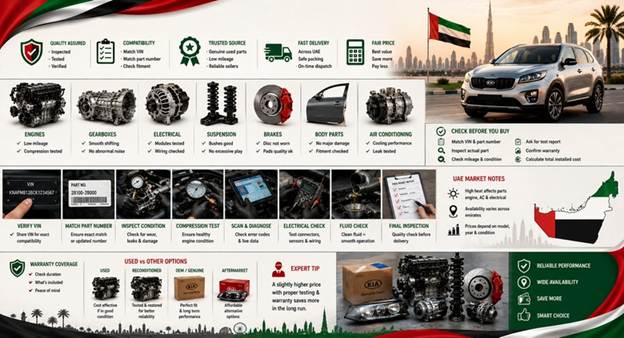
Not every Kia repair needs an engine or gearbox.
In fact, a large share of used-parts buying sits somewhere in between: suspension components, steering parts, cooling-system assemblies, AC components, brake hardware and exhaust parts.
These components can look straightforward. Some are. Others can hide wear that isn't obvious from a photograph.
A used suspension arm may look clean but have a tired bush. A radiator may have no visible crack yet still leak under pressure. An AC compressor can turn freely by hand and still fail once the system is operating under load.
So the same rule applies again.
Check the exact component, check its condition, and then decide whether buying it used actually makes financial sense.
Used Kia Suspension Parts
Suspension components are among the more commonly considered used Kia parts, particularly for older vehicles where owners want to keep repair costs under control.
Potentially available components include:
- Control arms
- Shock absorbers
- Springs
- Steering knuckles
- Stabiliser links
- Subframes
- Wheel hubs
- Strut assemblies
- Bushes and related hardware
But suspension isn't one area where you should buy blindly.
The component has to fit correctly, and it has to be straight, structurally sound and reasonably free from excessive wear.
Why used suspension parts can make sense
Some suspension assemblies are expensive when purchased new, particularly for larger Kia SUVs.
A clean used genuine component can therefore reduce the repair bill.
For example, an older Sorento might need a particular suspension assembly after an accident. If a genuine used component from a suitable donor vehicle is available and has not suffered impact damage, it could be a sensible option.
But inspect it.
Especially if the donor vehicle was involved in a collision.
Used Kia Control Arms
Control arms can suffer from:
- Bush wear
- Ball-joint wear
- Bending
- Corrosion
- Accident damage
- Damaged mounting points
A used control arm should be inspected before installation.
Check the bushings
Rubber bushes can deteriorate with age even when the metal arm looks excellent.
Look for:
- Cracks
- Splitting
- Separation
- Deformation
- Excessive movement
If the bush is already badly deteriorated, a cheap used control arm may not be a genuine saving.
Check for bending
A control arm that has suffered an impact can be slightly distorted without looking dramatically damaged.
That small distortion can contribute to:
- Alignment problems
- Uneven tyre wear
- Steering pull
- Handling changes
If there is any doubt about whether a component has been bent, don't install it simply because it was inexpensive.
Used Kia Shock Absorbers
Used shock absorbers can be tempting because the replacement cost of a complete suspension assembly can add up quickly.
However, shock absorbers are wear components.
Their condition matters.
Look for:
- Oil leakage
- Damaged rods
- Corrosion
- Bent components
- Damaged mounting points
- Uneven wear between left and right
A shock absorber that has already covered substantial mileage may have limited useful life left.
When new makes more sense
If the price difference between a used shock absorber and a reputable new replacement is small, compare the expected remaining service life.
Paying a little more for a new wear component may avoid doing the same labour twice.
This is especially relevant when the workshop is already dismantling the suspension.
Used Kia Springs
Springs can last a long time, but they can also become damaged or lose their original performance.
Inspect for:
- Cracks
- Corrosion
- Broken ends
- Deformation
- Incorrect ride height
- Signs of previous impact
The correct spring specification matters.
A Kia with different engine, trim or suspension configuration may require a different spring.
Don't choose solely by physical appearance.
Used Kia Wheel Hubs and Bearings
Wheel hubs and bearings deserve careful inspection because bearing condition isn't always obvious while the vehicle is stationary.
Listen for:
- Grinding
- Humming
- Growling
- Rough rotation
Check for:
- Excessive play
- Damaged mounting points
- Corrosion
- Sensor-related damage where applicable
If a used bearing has already accumulated significant mileage, ask whether replacing it with a new component would make more sense.
The labour required to access the bearing matters.
Used Kia Steering Parts
Steering components deserve a conservative approach because they directly influence vehicle control.
Potential used components include:
- Steering racks
- Tie rods
- Steering knuckles
- Steering columns
- Selected steering assemblies
Before buying, check:
- Part number
- Model and generation
- Left/right application
- Physical condition
- Accident history
- Mounting points
- Leakage where applicable
- Electronic compatibility where relevant
Used steering racks
A used steering rack can save money compared with a new assembly.
But ask about:
- Fluid leakage
- Shaft condition
- Excessive play
- Mounting points
- Previous repair
- Testing
For electrically assisted steering systems, electronic compatibility also needs consideration.
A physically matching rack may still require additional setup or calibration.
Used Kia Cooling-System Parts
Cooling components are particularly important in the UAE.
High temperatures and heavy AC use mean a cooling-system problem can become serious quickly.
Used components may include:
- Radiators
- Cooling fans
- Fan assemblies
- Expansion tanks
- Water-pump-related components
- Radiator supports
- Coolant pipes
- Housings
- Thermostatic components where appropriate
Not every cooling part is equally suitable for second-hand use.
Used radiators
A used radiator should be inspected for:
- Bent fins
- Cracks
- Corrosion
- Damaged mounting points
- Previous repairs
- Leakage
- Blocked passages
Ask whether it has been pressure-tested where appropriate.
A radiator that looks fine but leaks after installation can create another workshop visit.
UAE heat makes cooling condition important
A cooling system that is just about coping during mild weather may struggle during peak summer traffic.
That's why cooling components should be inspected before extreme heat exposes a weakness.
Used Kia Cooling Fans
Cooling fans can be more complicated than they appear.
Depending on the Kia, the assembly may include:
- Electric motor
- Fan blades
- Shroud
- Wiring
- Control components
- Connectors
Check the complete assembly.
What to test
Where possible, establish whether the fan:
- Runs correctly
- Starts reliably
- Operates at the required speeds
- Has excessive noise
- Has damaged blades
- Has intact wiring
A cracked fan blade should not be ignored.
At operating speed, vibration can become a much bigger problem.
Used Kia Radiator Hoses and Rubber Components
Rubber components require a different buying strategy.
Hoses, seals and certain rubber mounts can deteriorate with age even when they haven't been heavily used.
Look for:
- Cracking
- Hardening
- Swelling
- Soft spots
- Surface deterioration
- Oil contamination
For inexpensive hoses and seals, a new reputable replacement will often make more sense than a used one.
Not every part is worth buying second-hand simply because a used version is available.
That distinction is important throughout the article.
Used Kia Thermostatic and Cooling Components
A cooling-system fault should be diagnosed properly before replacing individual parts.
Overheating can have several causes.
Potential causes include:
- Low coolant
- Coolant leaks
- Radiator restriction
- Fan failure
- Thermostat problems
- Water-pump problems
- Head-gasket issues
- Air trapped in the system
- Sensor or electrical faults
Replacing a used radiator when the real problem is a failed cooling fan won't solve the problem.
Start with diagnosis.
Then buy the component.
Used Kia AC Components
Air conditioning isn't a luxury in the UAE.
For many Kia owners, it is a daily necessity.
That makes AC-component condition particularly important when considering used parts.
Potential components include:
- AC compressors
- Condensers
- Evaporators
- Blower motors
- AC control units
- Pressure sensors
- Expansion components
- AC lines
Used AC compressors
Compressors deserve careful checking.
Ask:
- Was the compressor tested?
- Was it removed from a functioning vehicle?
- Does the shaft rotate smoothly?
- Is there visible leakage?
- Is the pulley damaged?
- Are the connectors intact?
- Does the part number match?
Don't assume that a compressor is good simply because it turns by hand.
The real question is whether it performs correctly under operating conditions.
Used Kia AC Condensers
A condenser can suffer physical damage, especially in a front-end collision.
Check for:
- Bent fins
- Crushed sections
- Cracks
- Corrosion
- Damaged mounting points
- Leakage
- Previous repair
A used condenser from a front-end accident deserves particularly careful inspection.
If the donor vehicle was hit directly around the condenser, find out whether the component was affected.
Used Kia Blower Motors
Blower motors are another component that may be worth considering used, especially when a genuine new assembly is expensive.
Check:
- Fan operation
- Unusual noise
- Vibration
- Connector condition
- Motor housing
- Fan blades
A noisy blower motor can quickly become irritating after installation.
Ask for evidence that it operates smoothly before buying.
Used Kia Brake Components
Brakes need a different purchasing mindset.
Some components can be sourced used.
Others are usually better purchased new.
Components that deserve caution
- Brake pads
- Brake discs
- Brake hoses
- Calipers
- Brake boosters
- ABS components
Wear items such as brake pads are generally poor candidates for second-hand purchasing when suitable new replacements are readily available.
A used caliper, however, may be worth considering if it is in good condition and properly inspected.
Used brake calipers
Check:
- Piston condition
- Leakage
- Corrosion
- Mounting points
- Slide pins
- Bleeder screw
- Brake-line connection
- Previous repair
A seized piston can turn a cheap caliper into a poor investment.
Used Kia ABS Components
ABS-related components can involve both mechanical and electronic systems.
Potential parts include:
- ABS sensors
- ABS modules
- Hydraulic units
- Wiring
- Wheel-speed sensors
Compatibility is important.
Condition is important.
Electronic testing is important.
Used ABS sensors
Inspect:
- Sensor body
- Cable
- Connector
- Mounting point
- Corrosion
- Damage from previous removal
A damaged cable can create intermittent faults that are frustrating to diagnose.
If a new sensor is reasonably priced, compare the cost carefully before buying used.
Used Kia Exhaust and Emissions Parts
Used exhaust components may include:
- Exhaust manifolds
- Catalytic components
- Exhaust pipes
- Heat shields
- Selected sensors
Check for:
- Cracks
- Holes
- Heavy corrosion
- Broken mounting points
- Damaged threads
- Previous welding
- Heat damage
Exhaust repair versus replacement
A used component may make sense when a new original part is expensive.
But if the used part already has significant corrosion, its remaining life may be limited.
Compare the expected lifespan with the price.
Don't pay 70% of the price of a new part for a used component that is already visibly deteriorated.
Used Kia Engine Mounts
Engine mounts sit in an interesting category.
They are mechanical components, but they also contain rubber or hydraulic elements depending on the design.
Check for:
- Cracked rubber
- Separation
- Leakage
- Deformation
- Damaged mounting points
- Excessive movement
An older used mount may look fine while having substantially reduced damping performance.
If access labour is high, a new replacement can sometimes be the more sensible choice.
Used Kia Driveshafts and CV Components
Driveshaft and CV components should be checked for:
- Torn boots
- Grease leakage
- Excessive play
- Bent shafts
- Damaged splines
- Corrosion
- Joint noise
A torn CV boot is a warning sign because dirt and moisture can enter the joint.
If the joint has already suffered contamination and wear, replacing only the boot may not solve the problem.
Used driveshaft decision
Ask:
Is the joint itself healthy?
Is the shaft straight?
Are the splines undamaged?
Are the boots intact?
Was the donor vehicle involved in an accident?
These questions are more useful than simply asking whether the shaft is "working".
Used Kia Alternators
Alternators can be worthwhile used components when the unit has been properly tested.
Check:
- Part number
- Amperage specification
- Connector
- Pulley
- Housing
- Bearings
- Charging performance
A visually clean alternator isn't enough.
Ask for evidence of charging-system testing.
Used alternator versus new
For an older Kia, a tested used genuine alternator may provide useful savings.
For a newer vehicle or one where labour access is expensive, a new reputable unit may be worth comparing.
Calculate the full installed cost.
Used Kia Starters
Starter motors can also be sourced used.
Check:
- Part number
- Voltage
- Connector
- Solenoid
- Gear condition
- Housing
- Testing
A starter that works intermittently is particularly troublesome.
Ask whether it has been bench-tested.
If the answer is no, factor that uncertainty into the price.
Used Kia Sensors
Sensors are often small, which can make them look like easy used-part purchases.
They're not always.
A sensor can look perfect externally while providing inaccurate readings.
Potential examples include:
- Oxygen sensors
- Temperature sensors
- Pressure sensors
- Wheel-speed sensors
- Position sensors
- Parking sensors
When used sensors can make sense
A used genuine sensor may be reasonable where:
- The new genuine replacement is expensive.
- The used part is tested.
- The part number matches.
- The warranty is acceptable.
For inexpensive sensors, however, a new reputable replacement may be the better choice.
The price difference can be too small to justify used-part risk.
Used Kia Mechanical Parts and Labour Costs
This is where the economics become interesting.
A used component isn't automatically economical if fitting it is labour-intensive.
Consider a component costing AED 400.
If installation costs AED 800, the part price is only half of the repair equation.
Now imagine a new component costs AED 600 but comes with stronger warranty protection.
The extra AED 200 may be sensible.
Calculate the installed price
Installed repair cost = part + labour + fluids + supporting components + diagnostics + alignment/calibration where required.
Use this figure when comparing used and new components.
Not the part price alone.
Used Kia Parts and Supporting Components
Replacing one mechanical component can expose other worn parts.
For example:
A suspension repair may reveal worn bushes.
A cooling repair may reveal aged hoses.
An AC repair may reveal damaged seals.
A brake repair may reveal seized slide pins.
This doesn't mean the workshop should replace everything.
It means you should ask what else was found and why it matters.
Ask for evidence
If the workshop recommends an additional part, ask:
What is wrong with it?
Can you show me the problem?
Does it need immediate replacement?
Will delaying it create another issue?
That's a sensible conversation.
Used Kia Mechanical Parts and Preventive Replacement
Sometimes replacing an accessible supporting component during a major repair is sensible.
For example, if a mechanic already has substantial access to a system, replacing a low-cost seal that is known to be deteriorated may prevent another labour-intensive repair.
But preventive replacement should still be justified.
Don't let "while we're here" become an excuse to replace half the vehicle.
Replace supporting parts because there is a sound reason, not simply because the main component is already removed.
Used Kia Parts for High-Mileage Vehicles
Older Kia vehicles can benefit from carefully selected used mechanical components.
The objective is to extend useful vehicle life without throwing money at every problem.
Before a major repair, inspect:
- Engine
- Gearbox
- Suspension
- Cooling
- AC
- Steering
- Brakes
- Electrical systems
- Body
If the vehicle is fundamentally healthy, a used replacement component can be excellent value.
If five major systems are already failing, the decision becomes much harder.
Used Kia Mechanical Parts and UAE Heat
The UAE climate makes certain mechanical systems especially important.
High temperatures can put additional stress on:
- Cooling systems
- AC systems
- Batteries
- Rubber components
- Belts
- Hoses
- Tyres
This doesn't mean used parts should be avoided.
It means age and condition should be considered more carefully.
Example
A used radiator for a Kia Sportage may look clean.
But if its fins are already heavily damaged and the vehicle will spend summer commuting through Dubai traffic, the saving may not justify the risk.
A new reputable radiator could provide greater peace of mind.
That's the sort of practical decision a parts buyer needs to make.
Real Buyer Questions — Used Kia Mechanical Parts
"Are used Kia suspension parts worth buying?"
They can be, particularly for older vehicles and expensive genuine assemblies.
Check for accident damage, wear, corrosion and bush condition before buying.
"Should I buy used shock absorbers?"
Compare the price carefully with new replacements.
Shock absorbers are wear components, so a high-mileage used unit may offer limited remaining life.
"Can I buy a used Kia radiator?"
Yes, provided it is compatible and its condition is established.
Ask about leakage, pressure testing, corrosion and fin damage.
"Is a used AC compressor safe?"
It can be, but testing is important.
Confirm compatibility and ask whether the compressor has been tested for proper operation.
"Should I buy used brake pads?"
Usually, no.
Brake pads are wear items, and suitable new replacements are generally the more sensible choice.
"Can I buy a used brake caliper?"
A used caliper can be worth considering if it is correctly matched and properly inspected for piston, seal, corrosion and mounting condition.
"Are used alternators worth buying?"
A tested used genuine alternator can make sense, particularly for an older Kia.
Compare its price and warranty with a reputable new replacement.
"Should I buy used sensors?"
It depends on the sensor and price difference.
For inexpensive sensors, a new reputable component may make more sense.
For expensive genuine sensors, a tested used unit can sometimes provide useful savings.
"Can a used suspension part from an accident vehicle be safe?"
Possibly, but determine whether the specific component was involved in the impact.
Inspect it carefully before installation.
"Should I buy every mechanical Kia part used to save money?"
No.
Some low-cost wear components are better purchased new.
The objective is sensible value, not maximum use of second-hand parts.
Used Kia Mechanical Parts Buying Checklist
Before ordering, confirm:
Exact part:
Know what component has actually failed.
Compatibility:
Match the part to the Kia's VIN and specification.
Condition:
Inspect the component carefully.
Wear:
Check whether it is a wear item and how much useful life may remain.
Accident history:
Find out whether the donor vehicle was damaged.
Testing:
Ask for testing where appropriate.
Part number:
Confirm the correct reference.
Supporting parts:
Identify anything else genuinely required for installation.
Labour:
Calculate the installation cost.
Warranty:
Check what protection applies.
Total cost:
Compare the complete installed repair rather than the component price.
Key Takeaways
Used mechanical Kia parts can provide substantial savings, but the smartest purchases are selective.
Used suspension components can make sense when condition, fitment and accident history are clear.
Shock absorbers and other wear items deserve a careful price comparison with new replacements.
Cooling components are particularly important in UAE conditions, so don't compromise on radiator, fan or hose condition.
AC components should be properly diagnosed and tested before installation, especially in a climate where reliable cooling is essential.
Used brake components require a conservative approach, and inexpensive wear items are often better purchased new.
Alternators, starters and selected sensors can be good used-part candidates when they have been tested.
Steering, suspension and other safety-related components need stronger inspection than ordinary cosmetic parts.
Always include labour in the calculation because an inexpensive component can become costly if installation is difficult or has to be repeated.
Don't automatically replace every supporting component recommended by a workshop; ask what is actually wrong and why replacement is necessary.
For older, high-mileage Kia vehicles, judge the health of the entire vehicle before committing to a major mechanical repair.
The best used mechanical part is not simply the one with the lowest price.
It's the one that fits properly, has enough useful life left, can be installed confidently and makes financial sense once everything else is added up.
Buy selectively. Inspect properly. And if a new part costs only a little more than a questionable used one, do the maths before taking the gamble.
Used Kia Electrical and Electronic Parts
Used Kia electrical parts can save money, sometimes quite a lot.
But they can also create some of the most irritating faults in the entire vehicle.
A used bumper is easy to look at. You can see whether it is cracked. An electronic module is different. It might look almost perfect and still fail once connected to the vehicle.
Then there is another complication: physical fitment does not always mean electronic compatibility.
A connector can plug in. The Kia can still refuse to communicate with the component.
That is why used electrical parts need three checks rather than one:
Correct part. Correct condition. Correct electronic compatibility.
Used Kia Sensors
Sensors are small, but don't underestimate them.
Modern Kia vehicles rely on numerous sensors to monitor temperature, pressure, position, speed and other operating conditions. A faulty sensor can affect engine performance, transmission behaviour, braking systems, climate control or driver-assistance functions.
Potential used sensor categories include:
- Engine sensors
- Temperature sensors
- Pressure sensors
- Oxygen sensors
- Position sensors
- Wheel-speed sensors
- Parking sensors
- AC pressure sensors
- Other vehicle-system sensors
Some can be sensible used purchases.
Others are cheap enough new that buying second-hand simply adds unnecessary uncertainty.
Check the sensor before buying
Start with the part number.
Then inspect:
- Sensor body
- Connector
- Pins
- Wiring
- Mounting point
- Corrosion
- Physical damage
Ask whether it has been tested.
"Working" isn't particularly helpful.
Ask what was tested.
Used Kia oxygen sensors
Oxygen sensors can be exposed to substantial heat and exhaust conditions.
A used sensor may have considerable previous operating time even if its exterior looks clean.
If a reputable new replacement is reasonably priced, compare it carefully against the used option.
The saving may not justify buying a component whose remaining service life is unknown.
Used Kia parking sensors
Parking sensors can be more practical used purchases.
Check:
- Sensor face
- Mounting clips
- Connector
- Paint condition
- Part number
- Compatibility
A sensor from the wrong bumper configuration may not sit correctly or communicate properly.
Don't order purely from a photograph.
Used Kia Control Modules
Control modules are a different level of risk.
They may control or communicate with important vehicle systems, and their compatibility can depend on more than physical dimensions.
Potential examples include:
- Body-control modules
- Lighting modules
- Transmission modules
- Engine-control components
- Door modules
- Parking-system modules
- Climate-control modules
Before buying, confirm:
- Exact part number
- Vehicle application
- Generation
- Specification
- Connector configuration
- Software compatibility
- Programming requirements
- Supplier testing
- Warranty
Used module versus new module
A used genuine module can offer substantial savings where a new replacement is expensive.
But the supplier should be able to tell you whether the module is:
- Tested
- Reset
- Programmed
- Locked to another vehicle
- Ready to install
- Requiring coding after installation
These details can change the actual cost significantly.
Don't confuse "plug-and-play" with "fits physically"
A supplier may describe a module as plug-and-play.
Ask what that means.
Does it literally operate immediately after connection?
Does the vehicle need coding?
Does the module need adaptation?
Does the workshop need a diagnostic tool?
Is there a security or immobiliser-related procedure?
Get the answer before ordering.
Used Kia ECUs and Electronic Units
An ECU is one of the components where compatibility should be treated very seriously.
The correct ECU may depend on:
- Engine
- Transmission
- Model year
- Vehicle generation
- Market specification
- Hardware number
- Software
- Immobiliser configuration
A used ECU from another Kia can therefore create a complicated installation if the specification isn't correct.
What to check before buying a used ECU
Hardware number:
Compare the identification information.
Software/application:
Establish whether the unit is suitable for your vehicle.
VIN compatibility:
Have the supplier confirm the application.
Programming:
Find out whether coding or programming is required.
Immobiliser:
Ask whether any security-related matching procedure is necessary.
Testing:
Confirm whether the ECU has been tested.
Warranty:
Understand what happens if communication or operation fails.
Used ECU example
Imagine a Kia Cerato develops an ECU-related fault.
A supplier offers a used ECU at a fraction of the cost of a new unit.
It sounds attractive.
But the replacement ECU may need programming or matching before the vehicle starts and operates correctly.
If the owner discovers this only after installation, another workshop charge appears.
The better approach is to ask about the complete process beforehand.
Used Kia Electronic Modules
Electronic modules can be particularly attractive used because new genuine units can be expensive.
However, the buyer needs to distinguish between a component that works electrically and a component that is ready for your specific vehicle.
Those are not always the same thing.
Common used Kia electronic components
You may encounter:
- Door-control modules
- Seat-control modules
- Lighting modules
- Parking modules
- Climate-control units
- Body-control modules
- Camera modules
- Infotainment-related units
- Transmission-control components
Check for water damage
Inspect:
- Housing
- Connectors
- Pins
- Circuit-board areas where visible
- Corrosion
- Water marks
- Discolouration
Water damage can create intermittent electrical faults that appear weeks after installation.
That's why a donor vehicle's history matters.
A module from a flood-damaged vehicle should be approached with extreme caution.
Ask about bench testing
A proper bench test can provide stronger confidence than simply saying the module was removed from a vehicle.
Ask:
What was tested?
Was the unit communicating correctly?
Were fault codes checked?
Was it tested under load where applicable?
Is a test report available?
The exact testing method depends on the module.
Used Kia ECUs and Programming
Programming is one of the most commonly overlooked costs when buying used electronic components.
A used unit may be physically correct but require:
- Coding
- Programming
- Adaptation
- Calibration
- Vehicle configuration
- Security matching
- Diagnostic procedures
The workshop needs to know this before the component is ordered.
Programming costs should be included in the budget
Suppose a used Kia control module costs AED 800.
That looks attractive compared with a much more expensive new unit.
But then add:
- Programming
- Diagnostics
- Installation
- Calibration
- Possible coding
The final cost may be significantly higher.
Still potentially worthwhile.
But now you are comparing the real repair cost, not an advertised component price.
Ask the supplier and workshop the same question
Ask both:
"Will this exact used module work with my Kia after installation, and what programming or coding will it require?"
If their answers don't match, stop.
Clarify the situation before purchasing.
Used Kia Headlights and Tail Lights
Lighting components sit between body parts and electronics.
They can be excellent used-parts candidates when condition and compatibility are right.
A genuine used headlight can sometimes save a substantial amount compared with a new original assembly.
But inspect it carefully.
Used Kia headlight checklist
Check:
- Part number
- Left/right side
- Generation
- Housing
- Lens
- Mounting tabs
- Connector
- Internal electronics
- Moisture
- Condensation
- LED or bulb configuration
- Adaptive functions where applicable
A headlight with a broken mounting tab may require additional repair.
A headlight with moisture inside may develop further problems.
A headlight with a different internal specification may not perform correctly.
Used Kia tail lights
The same principle applies to tail lights.
Check:
- Housing
- Lens
- Connector
- Mounting points
- Part number
- LED configuration
- Damage
- Water ingress
Don't assume left and right units are interchangeable.
Obviously, they aren't.
Yet listings can sometimes be vague enough to cause confusion, especially when photographs are used without detailed descriptions.
Used Kia Cameras and Parking Sensors
Modern Kia vehicles can use cameras and sensors for more than simple parking assistance.
Depending on the vehicle, electronic components can be integrated with:
- Parking systems
- Cameras
- Driver assistance
- Blind-spot monitoring
- Lane-related systems
- Surround-view systems
That makes compatibility particularly important.
Used parking sensors
A used parking sensor should be checked for:
- Correct part number
- Correct connector
- Physical damage
- Mounting arrangement
- Testing
- Paint condition where relevant
A sensor may be mechanically suitable but electronically incompatible.
Used cameras
Cameras can be even more sensitive.
Check:
- Camera part number
- Connector
- Mounting bracket
- Lens
- Water damage
- Image quality
- Calibration requirements
A replacement camera may require calibration after installation.
Ask the workshop about this before ordering.
Calibration is part of the repair
If a camera or sensor requires calibration, include that in the total repair calculation.
Otherwise, the "cheap used part" can become an unfinished repair.
Used Kia Electrical Wiring and Connectors
Wiring is easy to overlook when buying used parts.
It shouldn't be.
A damaged connector can create an intermittent fault that is far more difficult to diagnose than a completely failed component.
Check:
- Connector locks
- Pins
- Wiring insulation
- Cuts
- Repairs
- Splices
- Corrosion
- Water damage
- Broken clips
Previous wiring repairs
Be cautious if you see:
- Twisted wires
- Excessive electrical tape
- Poor-quality connectors
- Unprotected splices
- Cut factory wiring
- Melted insulation
A professional repair can be acceptable.
An improvised repair may create another problem.
Ask what was done and why.
Used Kia Alternators
Alternators are electrical-mechanical components, and used genuine units can sometimes provide good value.
But testing matters.
Check:
- Part number
- Output specification
- Connector
- Pulley
- Housing
- Bearings
- Charging performance
A used alternator should ideally be tested before purchase or installation.
Warning signs
Be cautious about:
- Bearing noise
- Damaged pulley
- Heavy corrosion
- Burn marks
- Broken terminals
- Damaged connector
- Unknown testing history
If the alternator has already covered substantial mileage, compare its cost with a reputable new or reconditioned alternative.
Used Kia Starters
Starter motors can also be purchased used.
Check:
- Correct part number
- Voltage
- Connector
- Solenoid
- Gear condition
- Housing
- Testing
A starter may appear fine but struggle under real starting loads.
That's why bench testing is useful.
Used starter versus new
For an older Kia, a tested used genuine starter can be a sensible choice if the price saving is meaningful.
For a newer vehicle, or where installation access is difficult, a new reputable unit may be worth the additional expense.
Calculate the complete installed cost.
Used Kia Batteries and Charging Components
Batteries are generally poor candidates for second-hand buying.
Why?
Because age and remaining capacity are difficult to justify from appearance alone.
A battery can look perfectly clean and still have little useful life left.
A new battery with appropriate specifications is usually the more sensible comparison.
Charging-system components
Alternators and related electrical components can be different.
They can sometimes be tested and reused successfully.
The key distinction is testability.
If a component's remaining service life can be reasonably assessed, used may be practical.
If its condition is difficult to establish and a new alternative is inexpensive, buying used becomes less attractive.
Used Kia AC Electrical Components
AC systems also contain electrical components that can be sourced used.
Potential examples include:
- Blower motors
- Pressure sensors
- Control units
- Fan motors
- Relays
- Selected switches
Before buying, establish the actual cause of the AC fault.
For example, weak cooling does not automatically mean the AC control unit has failed.
A low refrigerant level, leak, condenser problem, fan issue or compressor fault could be responsible.
Diagnose the system before ordering an electronic component.
Used Kia Electronic Parts and UAE Heat
The UAE climate deserves attention here.
Heat can be particularly demanding on:
- Batteries
- Alternators
- Electronic modules
- Sensors
- Wiring
- Connectors
- AC components
A used electronic component may have already spent years operating in high temperatures.
That doesn't make it unusable.
But age and donor history become more relevant.
Ask about donor conditions
Where possible, establish:
- Donor vehicle age
- Mileage
- Accident history
- Flood exposure
- Storage conditions
- Previous repair
For a module or sensor, this additional information can help you assess risk.
Used Kia Electronic Parts and Water Damage
Water damage is one of the biggest red flags for second-hand electronics.
Look for:
- Green or white corrosion
- Water marks
- Rust around connectors
- Discolouration
- Oxidised pins
- Damaged circuit areas
- Moisture inside housings
Don't assume drying a wet module makes it reliable.
Water can cause corrosion that continues developing after the original exposure.
Be particularly cautious with
- ECUs
- Body-control modules
- Airbag-related electronics
- Camera modules
- Door modules
- Infotainment units
- Sensor assemblies
For safety-related electronic systems, consider new or professionally tested replacement options where appropriate.
Used Kia Electronics and Warranty
A used electronic part should ideally come with meaningful warranty protection.
Ask what happens if:
- The unit doesn't communicate.
- It cannot be programmed.
- It develops an intermittent fault.
- The wrong specification was supplied.
- The component fails shortly after installation.
Labour coverage matters
Suppose a used module costs AED 1,200 and fails after installation.
The part may be replaced under warranty.
But who pays for:
- Removal?
- Reinstallation?
- Diagnostics?
- Programming?
- Calibration?
This is why warranty wording matters more than the word "warranty" itself.
Used Kia Electrical Parts and Diagnostic Testing
A proper diagnostic process should come before component replacement.
For example, a Kia that won't start could have a problem involving:
- Battery
- Starter
- Immobiliser
- ECU
- Sensor
- Wiring
- Fuel system
- Ignition
- Charging system
Replacing an ECU because a diagnostic code appeared can be a costly mistake.
Fault codes identify areas for investigation.
They don't always identify the failed component directly.
Ask the workshop for the diagnosis
Before ordering an expensive electrical component, ask:
What test confirmed this part has failed?
That's a much better question than:
"Are you sure?"
It encourages a technical explanation.
Used Kia Electronic Parts Price Comparison
When comparing electronic components, include all related costs.
| Cost factor | Used unit | New unit | Reconditioned unit |
| Component price | — | — | — |
| Programming | — | — | — |
| Installation | — | — | — |
| Calibration | — | — | — |
| Diagnostics | — | — | — |
| Warranty | — | — | — |
| Expected downtime | — | — | — |
| Total cost | — | — | — |
The cheapest component isn't necessarily the cheapest repair.
A used module that requires repeated programming attempts or replacement may quickly lose its financial advantage.
When Used Kia Electronics Are Worth Buying
A used electronic component can make sense when:
- The exact part number is confirmed.
- Compatibility is established.
- The unit has been tested.
- Donor history is reasonably known.
- There is no evidence of water damage.
- Programming requirements are understood.
- Warranty protection is meaningful.
- The price saving is substantial.
When new may be better
Consider new when:
- The component is inexpensive.
- The used part has unknown history.
- The part is safety-critical.
- Programming is complicated.
- Installation is expensive.
- The used warranty is weak.
- The price difference is small.
The decision should be based on risk versus saving.
Not on the word "used".
Real Buyer Questions — Used Kia Electrical Parts
"Can I buy a used Kia ECU?"
Yes, but verify the exact part number, vehicle compatibility, programming requirements and testing.
"Does a used Kia ECU need programming?"
It can, depending on the vehicle and ECU.
Confirm the requirement with the workshop before ordering.
"Can a used Kia module work immediately after installation?"
Some may, while others require coding, adaptation or programming.
Never assume.
"Are used Kia sensors worth buying?"
It depends on the sensor and price difference.
A tested used genuine sensor can make sense when a new one is expensive, but inexpensive sensors are often more attractive new.
"Can I buy a used Kia headlight?"
Yes.
Check part number, side, generation, connectors, mounting points, moisture and internal electronics.
"Why does a used headlight need a part number?"
Because visually similar headlights can have different connectors, electronics and functions.
"Should I buy a used Kia parking sensor?"
It can be sensible if the sensor is tested and correctly matched.
"Can used Kia cameras require calibration?"
Yes, depending on the vehicle and camera system.
Ask the workshop before purchase.
"How do I know whether a used electronic module has water damage?"
Inspect connectors, pins, housing and visible corrosion or water marks, and ask about donor-vehicle history.
"Is a used alternator better than a new aftermarket alternator?"
Not automatically.
Compare manufacturer quality, testing, warranty and total cost.
"Should I buy a used battery?"
Generally, a new battery is the safer value comparison because remaining battery life is difficult to establish reliably from appearance.
"What is the biggest risk with used Kia electronics?"
Buying a component that physically fits but is electronically incompatible, untested or damaged internally.
Used Kia Electrical Parts Buying Checklist
Before ordering, confirm:
Part number:
Match the exact component reference.
VIN:
Use the vehicle VIN for compatibility verification.
Connector:
Check the connector and pin configuration.
Specification:
Confirm the vehicle's market and equipment configuration.
Testing:
Ask what has actually been tested.
Programming:
Find out whether coding or programming is required.
Calibration:
Confirm whether cameras or sensors need calibration.
Donor history:
Ask whether the component came from an accident- or flood-damaged vehicle.
Condition:
Inspect the housing, connectors and wiring.
Warranty:
Understand whether labour and programming are included.
Return policy:
Know what happens if the component cannot communicate with the vehicle.
Total cost:
Include diagnostics, programming, calibration and installation.
Key Takeaways
Used Kia electrical and electronic components can offer substantial savings, but they require more verification than ordinary mechanical or cosmetic parts.
A module that physically fits isn't necessarily electronically compatible.
Always check the exact part number, VIN, connector and vehicle specification.
Ask whether the component has been tested and find out what the testing actually involved.
ECUs and control modules may require programming, coding or security matching after installation.
Cameras and selected sensors may require calibration, so include that cost before ordering.
Used headlights and tail lights can be good-value purchases, but inspect moisture, connectors, mounting tabs and internal electronics.
Be particularly cautious with electronic components from flood-damaged donor vehicles.
For batteries and inexpensive wear-type electrical components, buying new can often make more financial sense.
For alternators and starters, testing is far more useful than visual inspection alone.
Before replacing an expensive electronic component, establish which diagnostic test actually identified it as the cause of the fault.
A used electronic component can work perfectly.
It can also create an intermittent fault that sends a car back to the workshop again and again.
Get the identification right, confirm the electronics, ask about programming and protect yourself with a clear warranty before you place the order.
Choosing a Reliable Used Kia Spare Parts Supplier in the UAE
Finding a used Kia part is one thing.
Finding a reliable supplier selling the right used Kia part is another.
The UAE market gives buyers plenty of options, from specialist dismantlers and independent parts traders to online suppliers and workshops that source components on request. That variety is useful. It also means the quality of information can vary considerably from one seller to another.
One supplier may give you the exact part number, donor details, photographs, testing information and warranty.
Another may simply say, "Yes, available. AED 900."
Both quotations might appear in the same search.
Don't treat them as equal.
The supplier's information, transparency and after-sales support are part of the value of the used component.
What Makes a Good Used Kia Parts Supplier?
A good supplier doesn't necessarily have the cheapest price.
Instead, look for someone who can answer practical questions without constantly changing the subject.
A reliable supplier should be able to discuss:
- Exact part identification
- Part number
- Donor vehicle
- Vehicle compatibility
- Condition
- Testing
- Mileage where available
- Warranty
- Return conditions
- Delivery
- Installation requirements
For expensive components, the supplier should understand why these details matter.
Transparency is a strong buying signal
Suppose you're looking for a used Kia Sportage gearbox.
Supplier A says:
"Gearbox available, AED 2,800."
Supplier B says:
"Used transmission, exact code confirmed against your VIN, removed from a running vehicle, approximately 96,000 km, tested before removal, AED 3,050, with a 30-day parts warranty. Installation and fluid are separate."
Supplier B is more expensive.
But which quotation gives you something you can actually evaluate?
That's the point.
Information has value.
Questions to Ask a Used Kia Parts Supplier
Don't be afraid to ask several questions before ordering.
For a normal component, you might need only a few.
For an engine, gearbox or electronic module, ask much more.
Useful questions include:
What is the exact part number?
Which Kia did it come from?
What year was the donor vehicle?
What was the donor vehicle's mileage?
Was the donor vehicle running?
Has the component been tested?
What condition is it in?
Does it have any previous repair?
Is it GCC specification?
What warranty is included?
Does the warranty cover labour?
What happens if it doesn't fit?
What happens if it fails after installation?
These questions aren't excessive.
You're buying a previously used component.
You are entitled to understand what you're buying.
Supplier Responses That Should Make You Pause
Not every short answer is a red flag.
Some suppliers are simply busy.
But repeated vagueness is different.
Be cautious when a seller refuses to provide basic information such as:
- Part number
- Compatibility details
- Actual photographs
- Condition information
- Warranty terms
- Donor details for major components
Be especially careful if the seller keeps saying:
"Same model."
"Don't worry."
"It will fit."
"Everyone uses this."
"Guaranteed."
Those statements sound reassuring.
They don't actually prove anything.
Ask for evidence instead
Instead of asking:
"Is this good?"
Ask:
"What was tested?"
Instead of:
"Will it fit?"
Ask:
"Can you confirm compatibility using my VIN and the part number?"
Instead of:
"Is there a warranty?"
Ask:
"What exactly does the warranty cover, and who pays the labour if the component fails?"
Specific questions produce useful answers.
Checking a Supplier's Used Kia Part Photographs
Photographs can reveal quite a lot.
They can also be deliberately unhelpful.
A supplier showing only one distant photograph isn't giving you much information.
For an expensive used Kia component, ask for photographs of the actual part.
Useful photographs include
- Full component
- Part-number label
- Manufacturer markings
- Connectors
- Mounting points
- Damaged areas
- Seals
- Fluid connections
- Visible corrosion
- Previous repairs
For engines and gearboxes, ask for several angles.
For electronic modules, focus on the identification label and connectors.
For headlights, request photographs of the front, rear and mounting tabs.
For body panels, ask about dents, repairs and paint condition.
Why actual photographs matter
Stock images don't show the condition of the component you're purchasing.
A used part is unique.
Its scratches, dents, repairs and wear belong to that specific unit.
You should be evaluating the actual component, not an example of what the component looks like.
Checking the Part Number With the Supplier
Part numbers should form part of the conversation.
Ask the supplier to provide the number rather than simply accepting a model description.
If you have the original component, photograph its label before throwing it away.
When the supplier gives a different number
Don't immediately reject it.
Ask whether it is:
- A superseded number
- A revised component
- An alternative approved reference
- A different specification
- A completely different part
A legitimate supersession can be perfectly acceptable.
But the supplier should be able to explain it.
Never assume similar numbers mean compatibility
A number that differs by one character may represent a different component.
Don't make the decision yourself.
Ask the supplier or workshop to verify it against the vehicle.
Verifying the Donor Vehicle
The donor vehicle can tell you more about a used component's history.
Ask:
- What model was it?
- What year?
- What engine?
- What transmission?
- What market?
- What mileage?
- Why was it dismantled?
Not every supplier will know every answer.
That's fine.
The important thing is to understand what information is known and what isn't.
Why donor information matters
Imagine you're buying a used Kia Sorento radiator.
If it came from a vehicle that was dismantled because of rear-end accident damage, that's useful context.
If it came from a heavily damaged front-end vehicle, you would want to inspect it much more carefully.
The same principle applies to suspension, steering, cooling and electrical components.
Buying From Dismantlers
Vehicle dismantlers can be useful sources of genuine used Kia components because they work with complete donor vehicles.
This can make it easier to establish where a part came from.
Potential advantages
- Genuine original components
- Donor vehicle information
- Large range of parts
- Body panels and interior pieces
- Mechanical assemblies
- Vehicle-specific components
What still needs checking
Dismantler doesn't automatically mean "tested".
Some components may be removed and sold as-is.
Ask whether the part has been tested.
For engines, gearboxes and electronics, that question is particularly important.
Buying Used Kia Parts Online
Online buying can make comparison much easier.
You can quickly check multiple suppliers, prices and availability without driving around different areas.
But there is a trade-off.
You may not physically inspect the part before payment.
Before ordering online
Confirm:
- Exact component
- Part number
- Compatibility
- Actual photographs
- Condition
- Donor information
- Warranty
- Return terms
- Delivery cost
- Expected delivery time
Save the quotation and agreed specifications.
If the supplier confirms compatibility in writing, keep that communication.
It can be useful if there is a dispute later.
Comparing Multiple Used Kia Suppliers
Don't compare suppliers using the component price alone.
Build a simple comparison.
| Factor | Supplier A | Supplier B | Supplier C |
| Part price | — | — | — |
| Part number confirmed | Yes/No | Yes/No | Yes/No |
| VIN checked | Yes/No | Yes/No | Yes/No |
| Donor information | — | — | — |
| Testing | — | — | — |
| Warranty | — | — | — |
| Delivery | — | — | — |
| Return terms | — | — | — |
| Programming | — | — | — |
| Installation support | — | — | — |
| Total cost | — | — | — |
This makes a major difference.
A supplier who charges AED 2,900 with strong warranty protection may actually offer better value than one charging AED 2,500 with no meaningful support.
Used Kia Parts and Warranty Terms
Warranty is one of the most important parts of the transaction.
Yet buyers often ask only:
"How many days warranty?"
That's not enough.
A 30-day warranty can mean very different things depending on the conditions.
Check these warranty details
Duration:
How many days or kilometres?
Coverage:
Which part or components are covered?
Labour:
Is installation labour covered?
Diagnostics:
Who pays diagnostic costs?
Replacement:
Will the supplier replace the component?
Return:
Can the part be returned?
Installation conditions:
Must a specific workshop install it?
Fluids:
Are particular oils or fluids required?
Modification:
Can modifications void the warranty?
Damage:
What types of damage are excluded?
Read the conditions.
Especially for engines and gearboxes.
Used Kia Parts and Return Policies
A return policy can become extremely important if a part turns out to be incompatible.
Before paying, ask:
What happens if the part does not fit my vehicle?
Then ask:
What happens if it fits physically but does not function correctly?
Those are two different situations.
A component can be the wrong specification.
It can also be the correct component but defective.
The supplier's return process should distinguish between them.
Check who pays for return delivery
This small detail can matter.
If the component is wrong because the supplier supplied an incompatible part, the return arrangement may differ from a buyer simply changing their mind.
Know the terms before ordering.
Supplier Warranty vs Manufacturer Warranty
A used Kia part generally won't have the same warranty situation as a brand-new genuine component purchased through a manufacturer-authorised channel.
The used component's protection may come from the supplier instead.
That's not necessarily a problem.
It simply needs to be understood.
Ask who stands behind the part
Is the warranty:
- Supplier-backed?
- Rebuilder-backed?
- Manufacturer-backed?
- Parts-only?
- Parts and labour?
The wording matters.
For a major component, stronger protection can justify paying somewhat more.
Used Kia Parts and Installation Support
Some suppliers also work closely with workshops.
That can be useful.
If the supplier understands the installation requirements, they may be able to clarify:
- What supporting parts are required
- Whether programming is necessary
- Which fluids are needed
- Whether adaptation is required
- Whether the part needs specialist installation
But don't assume the supplier is a substitute for a qualified workshop.
For complicated repairs, the workshop should make the final technical assessment.
Supplier and Workshop Communication
A strong buying process involves both sides.
The supplier knows the available component.
The workshop knows what the vehicle requires.
Bring them together.
Example
Your Kia Carnival needs a used transmission.
The supplier provides:
- Transmission code
- Donor details
- Mileage
- Price
- Warranty
The workshop confirms:
- Code compatibility
- Installation requirements
- Fluid specification
- Programming
- Supporting parts
- Labour cost
Now the purchase decision is based on both supply and technical requirements.
That's far safer than ordering first and asking the workshop later.
Don't Let a Supplier Pressure You
Used parts can be time-sensitive.
A seller might say:
"Only one left."
"Another customer is interested."
"Pay now."
Sometimes that's true.
Sometimes it is simply sales pressure.
If you're buying a cheap trim piece, the risk is limited.
If you're buying a Kia engine or gearbox, don't let urgency replace verification.
A few extra minutes of checking can be worth far more than a rushed discount.
Used Kia Parts and Delivery Across the UAE
If the supplier is in another emirate, delivery becomes part of the buying equation.
Confirm:
- Delivery charge
- Delivery time
- Packaging
- Tracking
- Responsibility for damage
- Inspection on arrival
For large parts such as engines, gearboxes, doors and body panels, delivery arrangements can be more complicated than for small components.
Inspect the package on arrival
If practical, inspect the packaging before accepting delivery.
Look for:
- Crushed boxes
- Broken packaging
- Fluid leakage
- Visible impact damage
- Missing pieces
Photograph obvious damage.
For high-value parts, keep the packaging until the component has been inspected and accepted.
Used Kia Parts and Workshop Delivery
Some suppliers can deliver directly to a workshop.
This can be convenient.
But confirm who is responsible for checking the component.
Ideally:
Supplier → Workshop → Compatibility inspection → Installation
rather than:
Supplier → Owner → Workshop → Discover mismatch
The fewer unnecessary movements, the easier the process becomes.
Used Kia Parts and Payment
Payment arrangements can vary.
Before paying, confirm the quotation includes:
- Correct component
- Part number
- Agreed condition
- Warranty
- Delivery
- Any applicable taxes or fees
- Return terms
For expensive components, avoid vague verbal agreements.
Get the important details documented.
What should appear on the quotation
Where possible, the quotation should identify:
Vehicle:
Kia model and relevant specification.
Component:
Exact part.
Part number:
Reference number.
Condition:
Used, tested, reconditioned or another stated condition.
Price:
Agreed component price.
Warranty:
Duration and key conditions.
Delivery:
Cost and expected timing.
This makes supplier comparison much easier.
Red Flags When Buying Used Kia Parts
There isn't one universal warning sign.
Several small things together can be more meaningful.
Watch for:
- No part number
- No actual photographs
- Refusal to provide compatibility information
- Extremely vague warranty
- Unclear return policy
- Pressure to pay immediately
- Contradictory donor information
- Unexplained price changes
- "Guaranteed fit" without checking the VIN
- Claims that testing is unnecessary
- No information about previous damage
- Suspiciously low price for a major component
One red flag doesn't prove a supplier is unreliable.
But several should make you slow down.
How to Spot an Unrealistically Cheap Used Kia Part
Price matters.
But a very low price needs context.
Ask why it is cheaper.
Possible legitimate reasons include:
- Older model
- High supply
- Cosmetic damage
- Limited demand
- Part has cosmetic wear
- Supplier wants quick stock movement
Other explanations may be less comfortable:
- Unknown history
- No testing
- Damaged component
- Missing accessories
- Weak warranty
- Incorrect specification
A low price is a reason to ask more questions, not fewer.
Used Kia Parts and Price Negotiation
Negotiating can be reasonable, especially when buying several components.
But don't negotiate blindly.
Ask what is included first.
For example, instead of:
"Can you make it AED 2,000?"
Ask:
"If the price is AED 2,200, does that include delivery and the full warranty?"
You might discover that the original quotation was already excluding important costs.
Bundle purchases
If you're buying:
- Headlight
- Bumper
- Grille
- Mirror
from the same supplier, ask whether a combined price is available.
The supplier saves handling and delivery effort.
You may save money too.
Used Kia Parts Supplier Quality Checklist
Before placing the order, evaluate:
Identification:
Exact part number provided.
Compatibility:
VIN or detailed vehicle information checked.
Condition:
Specific condition described.
Photographs:
Actual component shown.
Donor information:
Available for major components.
Testing:
Appropriate testing confirmed.
Warranty:
Clear terms.
Returns:
Clear process.
Delivery:
Cost and timing confirmed.
Installation:
Workshop requirements understood.
Programming:
Confirmed where relevant.
Communication:
Supplier answers technical questions clearly.
Final price:
Complete cost established.
A supplier doesn't need to tick every box for a simple used trim piece.
For an engine, gearbox or electronic module, however, your standards should be much higher.
Real Buyer Questions — Choosing a Used Kia Parts Supplier
"How do I know if a used Kia parts supplier is reliable?"
Look for clear identification, accurate compatibility information, actual-part photographs, testing details, transparent warranty terms and a sensible return process.
"Should I choose the cheapest supplier?"
Not automatically.
Compare condition, testing, warranty, delivery and total installed cost.
"What should I ask before buying a used Kia engine?"
Ask for the engine code, donor vehicle, mileage, testing information, included components, warranty and compatibility confirmation.
"Should a supplier provide the part number?"
For most significant components, yes.
The part number is one of the strongest ways to identify what you are actually buying.
"Can I trust a supplier who says the part fits without checking my VIN?"
Be cautious with expensive or specification-sensitive components.
Ask how compatibility was established.
"Should I ask for photographs before ordering online?"
Yes.
Ask for photographs of the actual part, particularly the part number, connectors, mounting points and visible damage.
"What should a used-parts warranty include?"
At minimum, understand duration, covered components, exclusions, labour responsibility, return conditions and installation requirements.
"What if the supplier says the used part is tested?"
Ask what was tested.
"Tested" without further explanation isn't very informative.
"Can a supplier's warranty cover installation labour?"
It can, depending on the supplier's terms.
Never assume it does.
Ask specifically.
"Should I buy from a supplier in another emirate?"
Distance isn't necessarily a problem.
Confirm delivery, return arrangements, warranty handling and who pays transportation if the part is defective or incompatible.
A Better Used Kia Parts Buying Process
The safest buying process is straightforward.
Identify the failed component.
Don't order before diagnosis.
Confirm the vehicle.
Provide model, year, engine, transmission and VIN.
Identify the part.
Get the part number and specification.
Compare suppliers.
Look beyond price.
Inspect the actual component.
Request photographs or inspect it physically.
Check the donor history.
Particularly for major components.
Confirm testing.
Ask what was actually tested.
Read the warranty.
Don't rely on verbal promises.
Calculate the complete cost.
Include labour, delivery, diagnostics and programming.
Then order.
Not before.
Key Takeaways
Choosing the supplier is almost as important as choosing the used Kia part.
Don't compare suppliers on price alone.
A good supplier should be able to explain the part's identity, compatibility, condition and warranty.
Ask for the actual part number and actual photographs, particularly for expensive components.
For engines and gearboxes, donor vehicle information and testing evidence can make a major difference.
A supplier saying "it will fit" is not a substitute for VIN and part-number verification.
Read the warranty carefully and establish whether labour, diagnostics, programming and return delivery are covered.
Get important agreements in writing before payment.
If the part is being shipped, confirm delivery arrangements and inspect the component as soon as it arrives.
Don't allow sales pressure to push you into ordering a major component before compatibility and condition have been established.
When two suppliers are close in price, the one offering stronger verification, clearer warranty protection and better after-sales support may provide the better value.
The best used Kia supplier isn't necessarily the one who answers fastest or quotes lowest.
It's the one who can tell you what the part is, where it came from, why it fits your Kia, what condition it's in and what happens if something goes wrong.
That's the supplier worth dealing with.
Used Kia Spare Parts Prices, Labour Costs and Total Repair Cost in UAE
Price is usually the first thing a Kia owner checks.
Fair enough.
But with used parts, the number on the quotation is only the beginning. A part advertised for AED 500 can become an AED 1,200 repair once delivery, labour, fluids, diagnostics and supporting components are added. Meanwhile, another supplier might quote AED 700 for a better-tested component with a stronger warranty and lower installation risk.
So the real question isn't:
"Which used Kia part is cheapest?"
It is:
"Which option gives me the lowest sensible total cost without taking an unreasonable risk?"
That distinction can save a lot of money.
How Much Do Used Kia Spare Parts Cost in the UAE?
There isn't one fixed price for a used Kia component.
The price can change according to:
- Kia model
- Model year
- Generation
- Engine
- Transmission
- Part number
- Condition
- Donor mileage
- Availability
- Genuine versus aftermarket
- Used versus reconditioned
- Warranty
- Emirate
- Delivery requirements
A used Sportage bumper and a used Sorento transmission obviously shouldn't be compared using the same pricing logic.
Indicative used Kia parts price ranges
The following ranges are planning estimates rather than fixed quotations. Actual prices can move significantly depending on condition, specification and availability.
| Used Kia component | Indicative UAE price range |
| Mirror assembly | AED 250–900 |
| Tail light | AED 200–800 |
| Headlight assembly | AED 400–1,800+ |
| Bumper | AED 300–1,200+ |
| Door assembly | AED 500–1,500+ |
| Alternator | AED 350–900 |
| Starter motor | AED 300–800 |
| AC compressor | AED 500–1,500+ |
| Radiator | AED 300–900 |
| Suspension assembly | AED 300–1,200+ |
| Electronic module | AED 400–2,500+ |
| Used engine | AED 3,000–12,000+ |
| Used gearbox | AED 2,500–10,000+ |
These figures are broad because the market is broad.
A rare component can cost more than a common one. A clean, tested genuine unit can command a premium. A damaged or incomplete component can be much cheaper.
Don't use a generic online price as proof that your particular Kia part should cost the same.
Why Used Kia Part Prices Vary So Much
Two suppliers can quote completely different prices for what appears to be the same component.
That doesn't automatically mean one supplier is overcharging.
The difference may come from:
- Condition
- Mileage
- Testing
- Donor history
- Completeness
- Warranty
- Storage condition
- Availability
- Genuine status
- Delivery
- Included accessories
Example
Imagine two used Kia Sportage headlights.
One costs AED 550.
The other costs AED 850.
At first glance, the cheaper unit looks better.
Then you discover:
The AED 550 unit has cosmetic scratches, no warranty and unknown donor history.
The AED 850 unit has the correct part number, intact mounting tabs, no moisture, documented donor information and a 30-day warranty.
Suddenly, the AED 300 difference doesn't look quite so dramatic.
Price needs context.
Used Kia Parts Price by Vehicle Type
Different Kia models can have different used-part pricing because of demand, availability and component complexity.
Kia Sportage
Sportage parts can be relatively easy to find because the model has a broad presence in the UAE.
Common components such as:
- Mirrors
- Lights
- Bumpers
- Suspension parts
- Cooling components
may have several used options.
Rare electronic or drivetrain components can still become expensive.
Kia Sorento
Sorento components can cost more because the vehicle is larger and some mechanical assemblies are more substantial.
Expect greater price variation for:
- Engines
- Gearboxes
- Suspension
- AC components
- Electronic modules
Kia Seltos
Seltos parts require careful model-year and specification matching.
Some electronic and body components may have limited interchangeability.
That can affect availability and therefore price.
Kia Cerato
Older Cerato parts can offer strong value through the used market, particularly:
- Body panels
- Lights
- Mirrors
- Interior components
- Mechanical accessories
However, scarcity can push prices up for less common components.
Kia Picanto
The Picanto can be economical to repair because many components are relatively small.
But don't assume every part is cheap.
A specific electronic module or uncommon body component can still carry a surprisingly high price.
Kia Carnival
Large family-vehicle components can be more expensive, particularly:
- Sliding-door assemblies
- AC components
- Electronic systems
- Suspension
- Engines
- Gearboxes
Used parts can therefore provide meaningful savings.
Used Kia Spare Parts Labour Costs in UAE
Labour is the part of the calculation buyers often underestimate.
The same used component can produce very different final bills depending on how difficult it is to install.
Indicative independent-workshop labour ranges can vary roughly as follows:
| Repair type | Indicative labour range |
| Simple sensor replacement | AED 100–300 |
| Mirror or light replacement | AED 100–400 |
| Alternator replacement | AED 200–600 |
| Starter replacement | AED 200–600 |
| Brake component work | AED 150–600 |
| Suspension component replacement | AED 200–800+ |
| AC compressor replacement | AED 400–1,200+ |
| Gearbox replacement | AED 1,000–3,000+ |
| Engine replacement | AED 1,500–4,500+ |
| Electronic programming/calibration | AED 150–800+ |
These are planning ranges, not guaranteed workshop prices.
Luxury or specialist workshops may charge substantially more, while independent garages may quote less.
The exact Kia, engine layout, accessibility and required procedures all affect labour.
Dubai Used Kia Parts Labour Costs
Dubai has a wide range of independent workshops, specialist garages and larger automotive facilities.
That creates a broad labour market.
A simple component may be relatively inexpensive to install.
A major drivetrain repair can become much more costly, particularly when diagnostics, programming and road testing are included.
For Dubai buyers, compare:
- Labour hours
- Workshop hourly rate
- Diagnostic charges
- Programming
- Fluid charges
- Warranty handling
- Road testing
Don't accept a single "labour" figure without understanding what it covers for a major repair.
Abu Dhabi Used Kia Parts Labour Costs
Abu Dhabi buyers may encounter a similarly wide range of workshop pricing.
The important thing is not simply finding the lowest hourly rate.
A workshop that charges slightly more but diagnoses the problem correctly can still produce a lower final bill.
For example, replacing a used AC compressor unnecessarily because the actual problem is a condenser leak is not a saving.
The cheap labour didn't help.
The diagnosis was wrong.
Sharjah Used Kia Parts Labour Costs
Sharjah is particularly relevant to used-parts buyers because the wider automotive market provides many independent repair and parts options.
That can create strong price competition.
It can also create a temptation to choose the cheapest quotation immediately.
Don't.
Compare what each quotation includes.
One workshop may quote labour only.
Another may include:
- Fluid replacement
- Diagnostics
- Road testing
- Basic installation materials
- Programming
The second quotation may look higher while actually being cheaper overall.
Ajman Used Kia Parts Labour Costs
Ajman can also offer competitive independent workshop pricing.
For straightforward repairs, the labour difference between suppliers may be relatively small.
For engines and gearboxes, however, the difference can become significant.
Ask whether the quotation covers:
- Removal
- Installation
- Fluid replacement
- Diagnostics
- Programming
- Testing
- Final inspection
Get the complete scope before approving the job.
Ras Al Khaimah Used Kia Parts Labour Costs
In Ras Al Khaimah, availability can sometimes influence the total cost of a used Kia repair.
If a particular part isn't readily available locally, delivery from another emirate may add:
- Transport
- Waiting time
- Handling
- Additional workshop downtime
A slightly more expensive locally available component can sometimes make more financial sense if it gets the Kia back on the road sooner.
Fujairah Used Kia Parts Labour Costs
Fujairah buyers should consider both component availability and workshop access.
For a simple part, this may not matter much.
For a major engine or gearbox replacement, however, sourcing and transport can influence the total project.
If a supplier has the correct component ready for immediate dispatch, ask for the complete delivered price rather than comparing the advertised part prices alone.
Umm Al Quwain Used Kia Parts Labour Costs
For buyers in Umm Al Quwain, the same principle applies.
A lower component price isn't automatically better if:
- Delivery costs are high.
- The workshop has limited experience with the repair.
- Programming must be arranged separately.
- A second trip is required.
- The part arrives incorrectly identified.
Convenience has a financial value when a vehicle is off the road.
Used Kia Parts — Part Price vs Installed Price
This is one of the most important calculations in the entire buying process.
Suppose:
Used gearbox = AED 3,000
Labour = AED 1,500
Fluid = AED 350
Filter/seals = AED 250
Diagnostics/programming = AED 300
Delivery = AED 150
Total = AED 5,550
Now suppose another supplier offers:
Used gearbox = AED 3,400
But includes:
- Delivery
- Better warranty
- Required supporting components
And your workshop charges the same labour.
The second option may actually be cheaper overall.
Always calculate the complete project
Total repair cost = used part + labour + delivery + fluids + supporting parts + diagnostics + programming + calibration.
Not every repair needs every item.
But every relevant item should be included.
Used Kia Parts and Hidden Costs
Hidden costs don't always mean a supplier is deliberately hiding something.
Often, the buyer simply didn't ask.
Common additional costs include:
- Delivery
- Towing
- Diagnostics
- Programming
- Calibration
- Fluids
- Filters
- Seals
- Gaskets
- Mounts
- Alignment
- Road testing
- Additional labour
- Return transport
Engine replacement example
A used Kia engine might be advertised at AED 5,500.
The final project could become:
| Cost item | Example |
| Used engine | AED 5,500 |
| Delivery | AED 250 |
| Labour | AED 2,500 |
| Fluids and filters | AED 450 |
| Seals/gaskets | AED 300 |
| Diagnostics | AED 250 |
| Miscellaneous supporting parts | AED 400 |
| Estimated project total | AED 9,650 |
The actual figures will vary.
But the example shows why an owner shouldn't budget only AED 5,500.
Used Kia Parts and Towing Costs
A failed Kia may not be driveable.
That makes towing part of the repair equation.
Potential towing expenses can arise when:
- The engine has failed.
- The gearbox cannot engage.
- The vehicle has suffered a serious cooling failure.
- A suspension component has broken.
- An electrical fault prevents starting.
- The vehicle is stranded away from the workshop.
If the supplier is in another emirate, delivery and towing can add further cost.
Cost of delay matters too
If a Kia is used every day for work or family transport, several days of downtime can have a real financial impact.
A cheaper component that arrives late may therefore be more expensive in practical terms.
Used Kia Parts and Workshop Downtime
Downtime is often ignored because it doesn't appear on the parts invoice.
It should still be considered.
A family Kia may be needed for:
- School runs
- Daily commuting
- Shopping
- Long-distance travel
- Business work
A business vehicle may have an even more direct cost.
If the vehicle generates income, every day off the road can affect revenue.
Compare repair time
| Option | Parts availability | Typical project complexity | Downtime risk |
| Local tested used part | Often quicker | Lower if correct | Lower |
| Used part from another emirate | Depends on delivery | Moderate | Moderate |
| Reconditioned component | Depends on stock | Moderate | Moderate |
| New genuine part | May require ordering | Lower installation risk | Variable |
| Rebuild original | Workshop dependent | Higher | Higher |
The fastest option isn't always the cheapest.
But speed has value.
Used Kia Parts vs Reconditioned Parts
This is one of the most important comparisons for major components.
A used engine or gearbox is usually sold in its existing used condition, subject to whatever inspection or testing the supplier performs.
A reconditioned unit should have undergone refurbishment.
That additional work usually raises the price.
Comparison
| Factor | Used | Reconditioned |
| Previous use | Yes | Yes |
| Refurbishment | Usually limited or none | Yes, depending on specification |
| Price | Lower | Higher |
| Condition certainty | Depends on testing | Depends on rebuild quality |
| Remaining life | Variable | Potentially improved |
| Warranty | Supplier dependent | Rebuilder/supplier dependent |
| Best use | Cost-sensitive replacement | Higher-confidence major repair |
Don't assume "reconditioned" automatically means excellent.
Ask what was actually rebuilt.
Used Kia Parts vs OEM Replacement
For certain components, a reputable OEM replacement may sit between used genuine and new genuine options.
The buyer should compare:
- Manufacturer
- Part quality
- Warranty
- Fitment
- Expected lifespan
- Price
An OEM component from a known manufacturer can sometimes make more sense than a used part with uncertain history.
But an OEM replacement isn't automatically superior to every used genuine part.
Again, compare the actual options.
Used Kia Parts vs Genuine New Parts
New genuine components generally offer the highest confidence in condition.
They also tend to carry a higher price.
The decision depends heavily on the component.
New genuine often makes more sense for
- Safety-critical components
- Low-cost sensors
- Wear items
- Components with expensive installation
- Newer Kia vehicles
- Parts where used history is uncertain
Used genuine can make more sense for
- Expensive body components
- Mirrors
- Interior trim
- Older vehicle parts
- Certain electronic modules
- Selected major assemblies with strong testing and warranty
There's no universal answer.
The part determines the risk.
Used Kia Parts vs Aftermarket Parts
Aftermarket parts can be attractive because they're new and often cheaper than genuine components.
But quality varies.
When comparing used genuine with aftermarket, ask:
Who made the aftermarket part?
What warranty does it carry?
How does its quality compare?
Is the fitment confirmed?
What is the price difference?
A reputable new aftermarket component can be an excellent choice.
An unknown low-cost replacement may not be.
Used Kia Parts Repair vs Replacement
Before buying a replacement component, establish whether the original part can be repaired.
This is particularly important for:
- Alternators
- Starters
- AC compressors
- Electronic modules
- Gearboxes
- Steering racks
A repair can sometimes cost less than replacement.
But repair quality matters.
Simple decision matrix
| Situation | More attractive option |
| Minor repairable fault | Repair original |
| Severe internal damage | Tested used replacement |
| Rare component | Used genuine |
| Cheap wear item | New replacement |
| Expensive electronic unit | Tested used or specialist repair |
| Major component with strong used warranty | Used replacement |
| High-risk component with small price difference | New/reconditioned |
The correct choice depends on diagnosis and economics.
First-Year Ownership Cost After a Used Kia Repair
The repair doesn't happen in isolation.
If an older Kia needs one major used component, ask what else may require attention during the following year.
Consider:
- Routine servicing
- Tyres
- Battery
- Brakes
- Suspension
- Cooling
- AC
- Electrical repairs
- Insurance
- Registration-related expenses
- Unexpected breakdowns
Why this matters
Imagine an older Kia requires a AED 8,000 engine replacement.
The owner should ask:
How much is the vehicle worth after the repair?
What other major systems are already showing wear?
How much might normal maintenance cost over the next year?
If the rest of the vehicle is healthy, the engine replacement may be sensible.
If the gearbox, suspension, AC and electrical system are also approaching major repairs, the economics change.
Used Kia Parts and Vehicle Replacement Decisions
At some point, repairing an older Kia stops making financial sense.
That doesn't mean there is a magic percentage.
Instead, consider:
- Current vehicle value
- Repair cost
- Remaining mechanical condition
- Expected future repairs
- Annual running cost
- Replacement vehicle cost
- Financing cost
- Insurance difference
- Downtime
Example
A 12-year-old Kia may need:
- Used engine: AED 6,000
- Labour and supporting work: AED 3,000
- Total: AED 9,000
That could still be sensible if the vehicle is otherwise healthy.
But if the vehicle also needs another AED 8,000 in foreseeable repairs, the owner should compare the combined cost with changing vehicles.
Repair economics are about the next few years, not just today's invoice.
Resale Value After Used Kia Repairs
A properly repaired Kia can remain perfectly usable.
But buyers may ask about major replacement work when the vehicle is sold.
Keep documentation.
Save:
- Supplier invoice
- Part number
- Warranty
- Engine or gearbox details
- Workshop invoice
- Installation date
- Mileage at installation
- Diagnostic records
This creates a useful repair history.
Why documentation helps
Suppose you sell the Kia later.
Being able to show that the engine was professionally replaced, the component was identified correctly and the installation was documented is much better than simply saying:
"Engine changed."
Records build confidence.
Used Kia Parts and Warranty Risk
Warranty is especially important when the used component is expensive.
Think about the worst-case scenario.
A used gearbox costs AED 4,000.
Installation costs AED 1,800.
Two weeks later, the gearbox fails.
If the supplier replaces the gearbox but doesn't cover labour, you may pay another AED 1,800.
The part was technically "under warranty".
The repair still cost you more.
Ask this before ordering
"If this part fails after installation, what exactly will I have to pay?"
That's the question that matters.
Used Kia Parts and Cost of Delay
Sometimes waiting for a cheaper part isn't actually cheaper.
Consider:
- Taxi costs
- Ride-hailing
- Rental vehicle
- Missed work
- Business downtime
- Towing
- Additional workshop storage
- Delayed travel
For a privately owned second car, downtime may be inconvenient.
For a business Kia, it can directly affect revenue.
A simple downtime calculation
If a vehicle costs its owner roughly AED 200 per day in alternative transport and lost productivity, a five-day delay represents about AED 1,000.
That doesn't mean you should overpay for every part.
It means downtime belongs in the decision.
Used Kia Parts for Business and Fleet Vehicles
Fleet owners need a different calculation.
A vehicle that earns money needs to return to service efficiently.
For fleet repairs, compare:
- Part cost
- Labour
- Availability
- Warranty
- Downtime
- Reliability
- Expected remaining life
A fleet manager may reasonably choose a slightly more expensive tested component if it reduces downtime.
Fleet repair decision
For a private owner:
Lowest sensible total cost may be the priority.
For a fleet:
Lowest cost per productive kilometre may matter more.
That distinction changes the buying decision.
A Practical UAE Used Kia Repair Budget
Before approving a significant repair, create three numbers.
Best case:
Expected repair cost if everything goes smoothly.
Realistic case:
Normal labour, fluids, supporting components and diagnostics included.
Worst reasonable case:
Potential additional work, towing, programming or warranty-related complications.
This isn't pessimism.
It's budgeting.
Example budget
| Cost category | Best case | Realistic | Higher-risk case |
| Used part | AED 3,000 | AED 3,500 | AED 4,500 |
| Labour | AED 1,000 | AED 1,500 | AED 2,200 |
| Supporting parts | AED 200 | AED 500 | AED 900 |
| Fluids | AED 150 | AED 300 | AED 450 |
| Diagnostics/programming | AED 100 | AED 300 | AED 700 |
| Delivery/towing | AED 100 | AED 250 | AED 500 |
| Total | AED 4,550 | AED 6,350 | AED 9,250 |
The figures are examples.
The method is what matters.
Real Buyer Questions — Used Kia Spare Parts Prices
"Why is one used Kia part much cheaper than another?"
Condition, mileage, donor history, completeness, warranty, availability and genuine status can all affect the price.
"Should I buy the cheapest used Kia part?"
Not automatically.
Compare the complete installed cost and the risk attached to each component.
"How much labour should I budget for a used Kia engine?"
A broad independent-workshop planning range may be around AED 1,500–4,500+, depending heavily on the Kia, engine layout, workshop and additional work required.
"How much does gearbox installation cost?"
A rough planning range can be around AED 1,000–3,000+, but complex transmissions, diagnostics, programming and additional work can push the final figure higher.
"Is a used Kia part cheaper after installation?"
Not necessarily.
A low component price can be offset by high labour, delivery, programming or supporting-part costs.
"Is a reconditioned Kia engine worth paying more for?"
It can be, particularly when the rebuilding work is clearly documented and the warranty is stronger.
Compare the actual rebuild scope rather than relying on the word "reconditioned".
"Should I buy used genuine or new aftermarket?"
It depends on the component.
Compare manufacturer quality, warranty, compatibility, price and expected lifespan.
"How do I know whether repairing the original part is cheaper?"
Get a proper diagnosis and a repair quotation, then compare it with the complete installed cost of the replacement.
"Does warranty make a more expensive used part worthwhile?"
Sometimes.
A stronger warranty can reduce financial risk, particularly when labour costs are high.
"Should I repair an old Kia or replace the vehicle?"
Look at the vehicle's total mechanical condition, current value, expected future repairs and replacement cost rather than judging the decision from one repair bill.
Used Kia Spare Parts Cost Checklist
Before approving the purchase, calculate:
Part price:
Exact component cost.
Condition:
Used, tested or reconditioned.
Warranty:
Duration and actual coverage.
Delivery:
Transport cost.
Labour:
Removal and installation.
Fluids:
Oil, coolant or transmission fluid where applicable.
Supporting parts:
Filters, seals, gaskets, mounts and other required items.
Diagnostics:
Fault scanning and post-installation checks.
Programming:
Coding, adaptation or calibration where required.
Towing:
If the Kia isn't driveable.
Downtime:
Potential alternative transport or business costs.
Future repairs:
Likely additional expenditure over the next 12 months.
Resale:
Effect of a documented major repair on future buyer confidence.
Key Takeaways
The cheapest used Kia part isn't necessarily the cheapest repair.
Always compare the complete installed cost rather than the advertised component price.
A used part with a stronger warranty can be worth more than a cheaper unit with unknown history.
Labour can materially change the economics of engines, gearboxes, AC systems and suspension repairs.
Include delivery, towing, fluids, supporting parts, diagnostics, programming and calibration where applicable.
Compare used, reconditioned, OEM, genuine and aftermarket options according to the actual component rather than using one rule for every Kia part.
For older Kia vehicles, calculate the likely first-year ownership cost after a major repair.
If several major systems are already deteriorating, compare the repair investment with the cost of replacing the vehicle.
Keep invoices, part numbers, warranty documents and installation mileage because they can support future resale confidence.
For fleet and business vehicles, downtime can be as important as the component price.
The right used Kia part isn't necessarily the cheapest one on the market.
It's the one that gives you the best balance of price, condition, compatibility, warranty, installation cost and remaining service life.
That's the number worth chasing.
Ordering, Receiving and Installing Used Kia Spare Parts
You can do all the right research and still run into trouble at the final stage.
The part is compatible. The price looks good. The supplier seems genuine. Then the component arrives at the workshop and something doesn't match.
Wrong connector.
Missing bracket.
Different specification.
Unexpected damage.
Or, worse, the part is correct but nobody checked what else was required for installation.
This is why ordering used Kia spare parts in UAE needs a proper process from quotation to fitting. Don't treat the purchase as finished when the payment goes through.
The job is finished when the correct component has been received, inspected, installed and verified.
What to Confirm Before Ordering a Used Kia Part
Before making payment, go back through the quotation.
It should be clear what you are actually buying.
Check:
- Kia model
- Model year
- Generation
- Engine
- Transmission
- VIN
- Part number
- Component description
- Condition
- Donor information
- Mileage where relevant
- Testing
- Included accessories
- Warranty
- Return terms
- Delivery
- Installation requirements
This may sound like a lot for a simple component.
It isn't.
For a used engine or gearbox, it is essential.
Confirm the exact component
Avoid vague descriptions.
"Kia Sportage engine" is too broad.
"Kia Sportage engine, exact engine code confirmed against VIN, used, tested, donor mileage documented" is much more useful.
The more precise the description, the fewer unpleasant surprises later.
Get the Final Used Kia Parts Price in Writing
A verbal quotation can change.
Sometimes accidentally.
Sometimes because additional costs appear later.
Before paying, ask for the final price in writing.
It should make clear whether the amount includes:
- Part
- Delivery
- Applicable charges
- Warranty
- Accessories
- Testing
- Any agreed preparation
For workshop repairs, also get the installation quotation separately.
Why written quotations matter
Imagine you agree verbally on AED 4,000 for a used Kia gearbox.
After delivery, you discover that:
- Torque converter isn't included.
- Delivery costs AED 200.
- Programming costs AED 300.
- Fluid costs AED 250.
The gearbox wasn't necessarily overpriced.
The quotation simply wasn't complete.
Clarity before payment is much cheaper than arguments afterwards.
Confirm What Is Included With a Used Kia Engine
Engine descriptions can be particularly confusing.
Ask whether the quoted unit is:
- Complete engine
- Long block
- Bare engine
- Engine with accessories
- Engine without accessories
- Engine with injectors
- Engine without injectors
Don't assume.
Accessories can change the final cost
A used engine may require you to transfer components from your existing unit.
Potentially transferable components can include:
- Alternator
- Starter
- AC compressor
- Intake components
- Exhaust components
- Sensors
- Wiring
- Fuel-system components
Whether those components can actually be reused depends on the specific Kia and engine.
The workshop should confirm this before the order is finalised.
Confirm What Is Included With a Used Kia Gearbox
The same problem appears with transmissions.
Ask whether the quotation includes:
- Gearbox
- Torque converter where applicable
- Transmission control components
- Mounts
- Sensors
- Associated brackets
- Other required parts
A seller may quote only the transmission assembly.
That's fine.
You just need to know.
Don't compare incomplete quotations
Supplier A:
Gearbox — AED 3,000.
Supplier B:
Gearbox — AED 3,400 including torque converter and delivery.
Supplier A appears cheaper.
It may not be.
Always compare equivalent specifications.
Used Kia Parts and Delivery Time
Availability and delivery time matter, especially when the vehicle is already in a workshop.
Ask:
Is the part physically in stock?
Where is it located?
When can it be dispatched?
When should the workshop expect it?
Is delivery included?
For a vehicle needed every day, this isn't a minor detail.
A part that costs AED 200 less but takes five additional days to arrive may create more expense than it saves.
Used Kia Parts From Another Emirate
The UAE's geography makes cross-emirate sourcing relatively practical.
A correct part can often be moved from one emirate to another.
But confirm the delivery arrangements.
Ask about:
- Transport cost
- Delivery timing
- Packaging
- Tracking
- Damage responsibility
- Return transportation
For large components such as engines, gearboxes and body panels, transportation needs more care.
Packaging Used Kia Parts for Transport
Not every used component requires elaborate packaging.
Some do.
Electronic modules should be protected against:
- Moisture
- Impact
- Static-related handling where appropriate
- Connector damage
Body panels need protection against:
- Scratches
- Bending
- Dents
- Paint damage
Engines and gearboxes require secure handling because of their weight and residual fluids.
What to do when the part arrives
Inspect the package before installation.
Look for:
- Crushed packaging
- Broken mounting points
- Fluid leakage
- Visible impact damage
- Missing components
Take photographs if damage is visible.
Keep the packaging until the component has been accepted.
Inspect the Used Kia Part Immediately After Delivery
Don't leave the inspection for next week.
Open the package as soon as reasonably possible.
Compare the received component with the quotation.
Check:
- Part number
- Physical appearance
- Connectors
- Mounting points
- Included components
- Condition
- Damage from transportation
If something looks wrong, contact the supplier before installation.
Why installation should wait
Once a questionable component has been fitted, the situation becomes more complicated.
The supplier may argue:
"That damage happened during installation."
The workshop may argue:
"The component arrived that way."
The owner gets stuck in the middle.
Inspect first. Install second.
Photograph the Used Kia Part Before Installation
This is a simple habit that can save headaches.
Take photographs of:
- Part number
- Overall condition
- Connectors
- Mounting points
- Existing damage
- Packaging
- Serial or identification markings where applicable
For an engine or gearbox, photograph the complete assembly from several angles.
Keep the images with the quotation.
Now you have a basic record of what arrived.
What to Do if the Wrong Used Kia Part Arrives
Don't install it.
Contact the supplier immediately.
Provide:
- Order details
- Vehicle information
- Part number
- Photographs
- Explanation of the mismatch
Ask for a written confirmation of the next step.
Don't modify the component to make it fit
This is especially important.
If a mounting point doesn't line up, don't immediately drill it.
If a connector doesn't match, don't cut the wiring.
If a bracket is different, don't weld it.
The part may simply be wrong.
Modification can also complicate a future warranty or return claim.
What to Do if a Used Kia Part Arrives Damaged
Document the damage.
Take photographs before moving or installing the component where practical.
Show:
- Packaging damage
- Component damage
- Part number
- Delivery condition
Then contact the supplier.
Ask whether the component should be returned or inspected.
Don't throw away the packaging
If the supplier needs the component returned, the original packaging may be useful.
It can also help establish whether transportation caused the damage.
Keep everything until the issue is resolved.
Used Kia Parts and Return Conditions
Return policies matter more with used components because each part may be unique.
Ask:
Can the part be returned if it is incompatible?
What if the supplier confirms the wrong specification?
What if the part arrives damaged?
What if it is defective?
How long do I have to report the issue?
Who pays return delivery?
These aren't awkward questions.
They're sensible.
Used Kia Parts and Restocking Charges
Some suppliers may apply conditions or charges when a customer changes their mind.
That may be different from a supplier sending the wrong part or a defective component.
Read the terms carefully.
Before paying, understand whether:
- Incorrect fitment is covered
- Defective components are covered
- Customer cancellation is covered
- Return transport is charged
- Restocking charges apply
For expensive parts, this can make a significant difference.
Installation of Used Kia Mechanical Parts
Once the component has passed inspection, installation begins.
The workshop should already know:
- Exact component
- Compatibility
- Required fluids
- Supporting parts
- Torque specifications
- Programming requirements
- Calibration requirements
- Post-installation checks
The mechanic shouldn't be discovering these things halfway through the repair.
Installation preparation matters
For a used engine or gearbox, prepare:
- Required fluids
- Filters
- Seals
- Gaskets
- Mounts where needed
- Diagnostic equipment
- Programming equipment
- Correct tools
Good preparation reduces downtime.
Used Kia Engine Installation Process
The exact process varies by model, but an engine replacement generally involves more than physically removing one engine and installing another.
Potential stages include:
- Vehicle inspection
- Battery disconnection
- Fluid removal
- Old engine removal
- Component transfer where appropriate
- Replacement-engine inspection
- Installation
- Fluid filling
- Electrical reconnection
- Diagnostic checks
- Initial start
- Leak inspection
- Temperature monitoring
- Road testing
The workshop should follow the Kia-specific technical requirements for the vehicle.
Don't rush the first start
After installation, the first start deserves attention.
Check for:
- Oil leaks
- Coolant leaks
- Abnormal noise
- Warning lights
- Unusual vibration
- Incorrect temperature behaviour
- Electrical faults
If something isn't right, investigate before handing the vehicle back to the owner.
Used Kia Gearbox Installation Process
Transmission installation can also require several stages.
Potentially:
- Remove old gearbox
- Inspect surrounding components
- Install replacement
- Replace required seals
- Refill correct fluid
- Connect wiring
- Perform diagnostic procedures
- Complete adaptation/programming where required
- Road test
- Check for leaks
- Recheck fluid level
The exact process depends on the transmission.
Don't ignore the fluid specification
Using the wrong transmission fluid can create serious problems.
The workshop should use the specification appropriate to the exact Kia transmission.
Don't assume one automatic transmission fluid is suitable for every Kia gearbox.
Used Kia Parts and Workshop Inspection
A workshop should inspect the replacement component before fitting it.
This is particularly important for:
- Engines
- Gearboxes
- Steering racks
- Suspension assemblies
- Electronic modules
The technician should confirm that the part received matches the component ordered.
Two checks are better than one
Supplier:
"Part matches the customer's Kia."
Workshop:
"Part number and specification match the vehicle."
Now you have two layers of verification.
That is much safer.
Used Kia Parts and Diagnostic Scanning
Modern Kia vehicles can require diagnostic scanning after component replacement.
The scan can help identify:
- Communication problems
- Sensor faults
- Stored codes
- Configuration issues
- Electronic faults
But remember:
A diagnostic scan is part of the process, not a substitute for mechanical inspection.
Both matter.
Used Kia Parts and Programming
Programming may be required for certain:
- ECUs
- Control modules
- Cameras
- Sensors
- Transmission-related electronics
- Security-related components
Ask the workshop before ordering.
Programming should be included in the timeline
If the part arrives Monday but the specialist programmer is available Thursday, the Kia may remain off the road for several extra days.
That matters.
Especially for business vehicles.
Used Kia Parts and Calibration
Calibration can apply to certain cameras, sensors and driver-assistance systems.
After installation, the vehicle may require specific procedures to ensure the system operates correctly.
Don't assume:
"Sensor installed = repair finished."
It may not be.
Why calibration matters
An incorrectly calibrated camera or sensor can affect system operation.
The workshop should confirm whether calibration is required for the specific Kia and component.
Used Kia Parts and Wheel Alignment
Some repairs can affect alignment.
This may include:
- Suspension arms
- Steering components
- Knuckles
- Subframes
- Certain accident repairs
If suspension or steering work has been carried out, ask whether wheel alignment is required.
Alignment is part of the repair cost
A used control arm might cost AED 300.
Installation might cost AED 300.
Alignment might add another AED 150–300.
Now the real repair cost is considerably higher than the component price.
Include it from the beginning.
Used Kia Parts and Fluid Replacement
Major mechanical repairs often involve fluids.
Potential examples include:
- Engine oil
- Coolant
- Transmission fluid
- Brake fluid
- Power-steering fluid where applicable
- AC refrigerant
The correct fluid matters.
So does the correct quantity.
Don't automatically reuse old fluid
If a major component is being replaced, ask the workshop whether the relevant fluid should be renewed.
For engines and gearboxes, fresh fluid can form part of proper installation.
The workshop should follow the correct specification for the vehicle.
Used Kia Parts and Supporting Parts During Installation
Sometimes another component is accessible only because the main repair is already underway.
This creates an opportunity.
But it can also create unnecessary spending.
Good supporting-part decisions
Replacing a visibly damaged seal while the assembly is already removed can make sense.
Replacing an unrelated component simply because "everything is open" may not.
Ask:
Is this part actually worn?
How difficult is it to replace later?
What is the additional cost now?
Could failure create another expensive labour job?
That gives you a rational basis for deciding.
Used Kia Parts and Workshop Red Flags
Be cautious when a workshop:
- Refuses to inspect the replacement part
- Cannot explain what is being installed
- Doesn't check the part number
- Wants to modify an incompatible component
- Skips diagnostic checks
- Uses unspecified fluids
- Won't explain additional charges
- Cannot provide an installation warranty
- Insists on replacing unrelated parts without explanation
A good workshop should be willing to explain its recommendations.
You don't need to understand every technical detail.
You do need to understand what is being done and why.
Used Kia Parts and Installation Warranty
Ask whether the workshop provides its own installation warranty.
This is separate from the supplier's parts warranty.
That distinction matters.
Supplier warranty
May cover the used component.
Workshop warranty
May cover installation workmanship.
You may need both.
For example, if a gearbox is correctly supplied but installed incorrectly, the supplier may not be responsible for the resulting problem.
Clarify responsibilities before the repair starts.
Used Kia Parts and Failed Installation
Sometimes a replacement part fails to solve the original problem.
That doesn't automatically mean the replacement part was defective.
The original diagnosis may have been incomplete.
For example, a Kia has an overheating problem.
The workshop replaces a used radiator.
The vehicle still overheats.
The real cause may have been:
- Cooling fan
- Thermostat
- Water pump
- Head-gasket issue
- Electrical control
- Air trapped in the system
This is why diagnosis matters before ordering.
Used Kia Parts and Post-Installation Road Testing
A vehicle shouldn't simply leave the workshop immediately after a major repair.
Appropriate testing may include:
- Initial stationary checks
- Diagnostic scan
- Leak inspection
- Temperature monitoring
- Road test
- Reinspection
For a gearbox, different driving conditions may be useful.
For an engine, temperature and load behaviour matter.
For suspension work, steering and handling need checking.
Used Kia Engine Post-Installation Checks
During the first few drives, monitor:
- Oil level
- Coolant
- Temperature
- Warning lights
- Engine noise
- Vibration
- Starting
- Idle quality
- Performance
- Fluid leaks
Keep an eye on the vehicle.
Don't wait for a serious warning before reporting something unusual.
Used Kia Gearbox Post-Installation Checks
Monitor:
- Engagement
- Shifting
- Reverse operation
- Delayed engagement
- Slipping
- Jerking
- Unusual sounds
- Fluid leaks
- Warning lights
If the gearbox behaves differently once fully warmed up, tell the workshop.
Some transmission problems are more noticeable at operating temperature.
Used Kia Parts and the First 1,000 km
The first 1,000 km after a major component replacement should be treated as an observation period.
Not because every used part will fail.
Because this is the time when installation-related issues or early component problems may become apparent.
Keep simple records
Record:
- Date of installation
- Vehicle mileage
- Part number
- Supplier
- Workshop
- Warranty period
- Any unusual symptoms
If something goes wrong, this information becomes extremely useful.
Used Kia Parts and Warranty Claims
If a component develops a problem, act quickly.
Don't continue driving for weeks while hoping it disappears.
Contact:
- Workshop
- Supplier
- Warranty provider where applicable
Explain the symptoms clearly.
Provide:
- Invoice
- Part number
- Installation date
- Mileage
- Diagnostic report
- Photographs
- Video where useful
Documentation can make the claim much easier to assess.
What Can Void a Used Kia Parts Warranty
Warranty terms vary, but potential exclusions may involve:
- Incorrect installation
- Unauthorised modification
- Incorrect fluids
- Continued operation after warning signs
- Overheating
- Racing or abnormal use
- Failure to follow installation instructions
- Unapproved workshop installation
Don't assume a warranty covers everything.
Read the conditions before installation.
Used Kia Parts and Documentation
Keep all records together.
A useful repair file can contain:
- Original diagnostic report
- Supplier quotation
- Part number
- Donor information
- Invoice
- Warranty
- Delivery record
- Installation invoice
- Programming report
- Calibration record
- Alignment report where applicable
- Final diagnostic scan
This might seem excessive for a small repair.
It isn't for a major engine, gearbox or electronic replacement.
Used Kia Parts and Resale Documentation
Good documentation can also help when you sell the vehicle.
A future buyer may ask:
"What happened to the original engine?"
"Where did the replacement come from?"
"Was the gearbox replaced?"
"Was the module programmed?"
Being able to provide proper paperwork creates confidence.
A vague verbal explanation doesn't carry the same weight.
Used Kia Parts and Insurance Documentation
If a used Kia part is installed as part of an accident repair, keep the relevant repair documentation.
Depending on the circumstances, records may include:
- Repair invoice
- Parts invoice
- Component identification
- Workshop details
- Accident-related documentation
- Photographs
Insurance requirements can vary according to the policy and claim circumstances.
For an accident-related repair, ask the insurer or relevant claims representative what documentation they require before proceeding.
Used Kia Parts and Vehicle Inspection
After a major repair, consider a final independent inspection if the repair was substantial or the vehicle is being prepared for sale.
This can be particularly useful after:
- Engine replacement
- Gearbox replacement
- Major suspension repair
- Accident repair
- Significant electrical work
An independent inspection can provide another perspective.
Used Kia Parts and Installation Timeline
The actual timeline depends on the component.
A rough planning framework might look like this:
| Repair | Possible workshop timeline |
| Simple sensor | Same day |
| Mirror/light | Same day |
| Alternator | Same day |
| Suspension component | Same day to 2 days |
| AC compressor | Same day to 2 days |
| Electronic module | Same day to several days |
| Gearbox replacement | 1–3+ days |
| Engine replacement | 2–5+ days |
| Reconditioned major assembly | Depends on availability |
These are broad planning estimates.
Parts availability, workshop workload, programming and unexpected issues can extend the timeline.
Ask for two dates
Ask:
When will the part arrive?
And:
When can the Kia realistically be collected?
They aren't necessarily the same date.
Used Kia Parts and Business Downtime
For business vehicles, ask for a realistic completion date rather than simply "two days".
If the vehicle is essential to operations, calculate the cost of each additional day.
This can influence the choice between:
- Locally available used part
- Imported used part
- Reconditioned unit
- New genuine component
- Repair of the original part
The best option may be the one that gets the vehicle back into productive use reliably.
Real Buyer Questions — Ordering and Installation
"Should I install a used Kia part immediately after delivery?"
Not before checking the part number, condition, connectors, mounting points and completeness.
"What if the part doesn't match?"
Do not modify or install it.
Contact the supplier and document the mismatch.
"Should I photograph a used part before installation?"
Yes.
Photograph the identification label, condition, connectors, mounting points and any existing damage.
"What should I do if the part arrives damaged?"
Document the packaging and component damage and contact the supplier before installation.
"Can I return a used Kia part after fitting it?"
That depends on the supplier's terms.
Ask about compatibility, defects, installation and return conditions before purchase.
"Does a used Kia engine need new fluids?"
The exact requirements depend on the engine and installation, but major replacement work commonly involves fresh appropriate fluids and filters.
The workshop should confirm what is required.
"Does a used gearbox need programming?"
Some transmissions or associated electronics may require programming, adaptation or calibration.
Confirm this before installation.
"Should I get wheel alignment after suspension work?"
If the repair affects suspension or steering geometry, alignment may be appropriate.
Ask the workshop.
"How long should I monitor a used engine after installation?"
Pay particular attention during the first few hundred kilometres and continue monitoring through the first 1,000 km.
Follow the workshop's specific instructions.
"What documents should I keep?"
Keep the supplier invoice, part number, warranty, donor information where available, workshop invoice and any diagnostic, programming or calibration records.
Used Kia Parts Final Installation Checklist
Before collecting the Kia, confirm:
Part identity:
Correct component and part number.
Physical installation:
All mounting points and connections secure.
Fluids:
Correct fluids filled to the appropriate levels.
Diagnostics:
Vehicle scanned after installation where appropriate.
Programming:
Completed where required.
Calibration:
Completed where required.
Leaks:
No abnormal fluid leakage.
Warning lights:
No unexplained warning lights.
Road test:
Completed where appropriate.
Alignment:
Checked where relevant.
Warranty:
Supplier and workshop warranty documents received.
Invoices:
All paperwork retained.
Mileage:
Installation mileage recorded.
This final check takes minutes.
A failed major repair can cost thousands.
It is worth doing.
Key Takeaways
Ordering a used Kia part isn't finished when you transfer the money.
Confirm the exact component, part number, condition, warranty and included accessories before payment.
Get the final quotation in writing so delivery, supporting components and other charges don't appear unexpectedly later.
Inspect the actual component immediately after delivery and photograph it before installation.
If the wrong part arrives, don't modify it to make it fit.
For engines and gearboxes, confirm exactly what is included before comparing supplier prices.
Ask the workshop about fluids, programming, calibration, alignment and supporting parts before installation begins.
Keep supplier and workshop warranties separate in your mind because they may cover different problems.
After a major repair, complete appropriate diagnostics, leak checks and road testing before treating the job as finished.
Monitor a replacement engine or gearbox carefully during the first 1,000 km.
Keep every invoice, part number, warranty and installation record because good documentation can help with future warranty claims and resale.
A used Kia part can arrive in perfect condition and still create trouble if the installation process is rushed.
The reverse is also true.
A carefully selected component, properly inspected and professionally installed, can give an older Kia many more useful kilometres.
Don't just buy the part. Manage the whole repair from quotation to road test.
Used Kia Spare Parts by Model: Sportage, Sorento, Seltos, Cerato, Picanto and Carnival
Kia's model range is broad, and that changes the used-parts equation.
A Sportage buyer may have plenty of replacement options because the model is common in the UAE. A less common Carnival component can take more effort to source. Meanwhile, a Seltos electronic module may look almost identical to another Kia unit but still have a different specification.
So don't search only by the Kia badge.
Search by model, generation, year, engine, transmission and exact part number.
That extra detail can save you from ordering the wrong component.
Used Kia Sportage Parts in the UAE
The Sportage is one of the Kia models for which owners can often find a broad selection of used components.
Commonly available parts can include:
- Body panels
- Bumpers
- Headlights
- Tail lights
- Mirrors
- Suspension components
- Radiators
- AC components
- Engines
- Gearboxes
- Interior trim
- Electronic modules
Availability still varies by generation.
A 2012 Sportage and a much newer Sportage shouldn't be treated as the same vehicle simply because the badge says Sportage.
Sportage body parts
Used body components can make financial sense, particularly when a genuine new panel or lamp assembly is expensive.
Check:
- Generation
- Model year
- Left or right side
- Colour
- Mounting points
- Parking-sensor holes
- Camera openings
- Trim specification
A bumper from a similar-looking Sportage may not have the same sensor or grille configuration.
Sportage engines and gearboxes
For major components, verify:
Engine code.
Transmission code.
Production year.
Drive configuration.
VIN compatibility.
Part number.
Don't accept "Sportage gearbox" as enough information.
It isn't.
Sportage suspension parts
Used suspension components can offer useful savings, particularly for older models.
Inspect control arms, knuckles, hubs and strut assemblies for accident damage.
This matters because suspension parts can be distorted by an impact without looking obviously broken.
Used Kia Sorento Parts in the UAE
The Sorento is a larger SUV, so some replacement components can carry higher prices than comparable parts for smaller Kia models.
Used parts can therefore provide meaningful savings.
Potential categories include:
- Engines
- Gearboxes
- Transfer-related components where applicable
- Suspension
- Steering components
- Cooling assemblies
- AC components
- Body panels
- Interior components
- Electronic modules
Sorento engine buying
The engine specification needs particular attention.
Confirm:
- Engine code
- Displacement
- Fuel type
- Model year
- Generation
- VIN
- Donor vehicle
A Sorento engine from another generation isn't automatically suitable simply because the displacement looks the same.
Sorento gearbox buying
Transmission identification is equally important.
Ask for:
- Transmission code
- Donor model
- Donor year
- Mileage
- Testing information
- Warranty
If electronic control or programming is involved, ask the workshop about it before ordering.
Sorento suspension
The Sorento's size and weight make suspension condition particularly important.
Inspect:
- Control arms
- Bushes
- Shock absorbers
- Springs
- Hubs
- Knuckles
- Stabiliser components
If the donor vehicle was involved in a serious accident, pay extra attention to structural and suspension components.
Used Kia Seltos Parts in the UAE
Seltos buyers need to pay close attention to specification because apparently similar vehicles can have different equipment and component configurations.
Used parts can include:
- Headlights
- Tail lights
- Mirrors
- Bumpers
- Sensors
- AC components
- Suspension parts
- Electronic modules
- Interior trim
Seltos electronic parts
This is an area where part-number verification becomes especially useful.
Before buying a used:
- Sensor
- Camera
- Module
- Control unit
- Lighting assembly
check the identification number and connector configuration.
Don't rely on photographs alone.
Seltos body parts
For bumpers and trim, check whether the vehicle has:
- Parking sensors
- Camera openings
- Different grille configuration
- Different trim
- Different lighting arrangement
A physically similar bumper may still require modification.
Avoid that situation.
Used Kia Cerato Parts in the UAE
Cerato owners can often benefit from the used-parts market, particularly when maintaining an older vehicle economically.
Potentially useful used components include:
- Headlights
- Tail lights
- Mirrors
- Doors
- Bumpers
- Interior trim
- Suspension
- Alternators
- Starters
- AC components
- Engine assemblies
- Gearboxes
Cerato body panels
Body panels can be strong candidates for used purchasing.
A genuine used door or bonnet in good condition can sometimes provide better value than an expensive new replacement.
Check:
- Dents
- Paint
- Previous repairs
- Rust
- Mounting points
- Glass
- Hinges
- Trim
Cerato mechanical parts
For mechanical components, focus on remaining service life.
A used alternator or starter that has been properly tested may be a sensible purchase.
A badly worn suspension component may not be.
The difference is condition.
Used Kia Picanto Parts in the UAE
The Picanto is a smaller city-focused Kia, and owners often choose used parts because they want to keep the total repair bill proportionate to the vehicle's value.
That can make sense.
But don't over-save on inexpensive components.
Picanto body parts
Used:
- Mirrors
- Lamps
- Bumpers
- Doors
- Interior trim
can be attractive purchases.
Check the exact generation.
Picanto styling changed substantially between generations, so visual similarity isn't enough.
Picanto mechanical parts
For:
- Alternators
- Starters
- AC components
- Suspension
- Cooling parts
compare used and new prices carefully.
If a new reputable component costs only slightly more, the additional warranty and remaining service life may justify buying new.
Picanto electronics
Sensors and modules need the same compatibility checks as larger Kia models.
Small vehicle doesn't mean simple electronics.
Used Kia Carnival Parts in the UAE
The Carnival presents a different ownership situation.
It is a larger family vehicle, and many owners depend heavily on it for daily transport.
That makes downtime particularly inconvenient.
Potential used components include:
- Sliding-door assemblies
- Door motors
- Interior trim
- Seats
- AC components
- Cooling components
- Suspension
- Engines
- Gearboxes
- Electronic modules
- Lighting assemblies
Carnival sliding-door components
Power sliding doors contain several moving and electronic components.
A used assembly should be checked for:
- Motor operation
- Cables
- Rails
- Rollers
- Sensors
- Wiring
- Connectors
- Mounting points
A cheap door mechanism isn't useful if the motor or control system is already failing.
Carnival AC components
The Carnival's cabin size makes AC performance particularly important in UAE summer.
A used AC component should therefore be properly identified and tested.
Check whether the replacement is compatible with the vehicle's exact climate-control configuration.
Used Kia Parts by Model Year
Model year can be just as important as model name.
A supplier may have:
"Kia Sportage 2018 parts."
But even that may not be enough.
Equipment can vary by:
- Engine
- Transmission
- Trim
- Market
- Facelift
- Production period
Facelift models need extra attention
A facelift can change:
- Headlights
- Bumpers
- Grilles
- Tail lights
- Sensors
- Wiring
- Electronic modules
Two vehicles can share the same general model name but use different parts.
Check the VIN and part number.
Used Kia Parts by Engine Type
Engine specification can affect much more than the engine itself.
It can influence:
- Radiator
- Alternator
- Starter
- Exhaust
- Engine mounts
- ECU
- Cooling components
- Transmission pairing
- Sensors
- Intake components
This is why giving the supplier the engine code can dramatically improve the accuracy of a parts search.
Don't say only "2.0 Kia"
Tell the supplier:
- Model
- Year
- Generation
- Engine code
- Transmission
- VIN
That gives them something concrete to work with.
Used Kia Parts by Transmission Type
The same Kia model may be sold with different transmissions.
This can affect:
- Gearbox
- Transmission mounts
- Driveshafts
- ECU/TCU-related components
- Sensors
- Wiring
- Fluid requirements
Before ordering a transmission-related part, confirm the exact transmission specification.
Automatic gearbox compatibility
Don't assume that two automatic transmissions are interchangeable because both are six-speed units.
Gear ratios, electronics, mounting arrangements and control systems can differ.
The transmission code matters.
Used Kia Parts for Petrol Models
Petrol Kia models have their own set of component considerations.
Used parts can include:
- Injectors
- Intake assemblies
- Exhaust components
- Ignition components
- Sensors
- Alternators
- Starters
- AC compressors
For engine-related components, match the exact engine specification.
Petrol engine electronics
Sensors and control modules should be matched carefully.
A sensor from another petrol Kia may look identical and still produce incorrect readings if the specification differs.
Used Kia Parts for Diesel Models
Diesel Kia vehicles can have additional components that require careful inspection.
Potentially expensive systems include:
- Injectors
- Turbochargers
- EGR-related components
- Sensors
- Fuel-system components
- Exhaust-emissions components
Used diesel components should ideally come with meaningful testing information.
Used Kia diesel injectors
Don't buy injectors simply because they came from the same model.
Check:
- Part number
- Engine code
- Testing
- Condition
- Return policy
- Calibration requirements where applicable
A set of cheap injectors can become an expensive mistake if they aren't suitable or require additional work.
Used Kia Turbocharger Parts
A turbocharger should be inspected carefully.
Look for:
- Shaft play
- Oil leakage
- Damaged blades
- Cracks
- Housing damage
- Wastegate-related issues where applicable
Ask whether the turbocharger was tested.
Used turbo versus reconditioned turbo
A tested used turbo can cost less.
A professionally reconditioned turbo may offer greater confidence, depending on the rebuilding standard.
Compare:
- Price
- Testing
- Rebuild scope
- Warranty
- Expected service life
Don't assume either option is automatically better.
Used Kia AC Parts by Model
AC components can vary significantly between models and equipment levels.
Before ordering:
- Compressor
- Condenser
- Blower motor
- Control unit
- Pressure sensor
- Evaporator
confirm the exact vehicle specification.
UAE-specific AC consideration
A Kia used in Dubai, Abu Dhabi or another UAE emirate can spend long periods operating with the AC system under heavy load.
That makes compressor and cooling-system condition particularly important.
A used AC component with unknown history deserves more scrutiny than a cosmetic interior trim piece.
Used Kia Cooling Parts by Model
Cooling systems should be assessed according to the vehicle and engine configuration.
Check:
- Radiator
- Cooling fan
- Fan shroud
- Hoses
- Thermostat-related components
- Expansion tank
- Water-pump-related parts
Used radiator compatibility
Even when a radiator appears to fit physically, differences in:
- Hose position
- Cooling capacity
- Mounting points
- Transmission cooler arrangement
- Sensor configuration
can matter.
Use the correct part number wherever possible.
Used Kia Suspension Parts by Model
Suspension components can differ according to:
- Engine
- Body style
- Trim
- Drive configuration
- Suspension package
- Generation
This is particularly important when buying:
- Springs
- Shock absorbers
- Control arms
- Knuckles
- Hubs
Left and right matter
It sounds obvious.
Yet used-parts listings can be surprisingly vague.
Always confirm:
Front or rear.
Left or right.
Driver or passenger side where relevant.
Exact vehicle application.
It takes seconds.
It can prevent an unnecessary return.
Used Kia Steering Parts by Model
Steering racks and related components should be matched carefully.
Potential differences can involve:
- Hydraulic versus electric assistance
- Mounting
- Connectors
- Software
- Calibration
- Vehicle generation
A used steering rack should be inspected for leakage, excessive play and damage.
For electronically assisted systems, ask whether calibration or programming is required.
Used Kia Brake Parts by Model
Brake components can vary according to engine, trim and brake package.
Before ordering:
- Calipers
- Discs
- Brake assemblies
- ABS sensors
confirm the exact specification.
Used brake discs
Used brake discs are generally less attractive than new replacements because they are wear components.
Measure condition and remaining usable thickness if considering reuse.
In many cases, the price of a new reputable disc makes more sense.
Used calipers
Used calipers can be more reasonable.
Inspect:
- Pistons
- Seals
- Slide pins
- Mounting points
- Corrosion
- Bleeder screws
A tested, clean genuine caliper can be a sensible used purchase.
Used Kia Lighting Parts by Model
Lighting assemblies can vary dramatically between trims.
A Kia may have:
- Halogen lamps
- LED lamps
- Projector systems
- Adaptive functions
- Different daytime-running-light arrangements
Don't order a headlight based on appearance alone.
Check lighting specifications
Confirm:
- Part number
- Left/right
- Generation
- Lamp type
- Connector
- Control module
- Mounting points
For advanced lighting systems, programming or calibration may also be relevant.
Used Kia Interior Parts by Model
Interior parts can be some of the safest used purchases.
Potential examples include:
- Seats
- Door cards
- Centre consoles
- Dashboard trim
- Switches
- Steering wheels
- Infotainment screens
- Roof trim
Interior parts still need specification checks
A seat may physically fit but have different:
- Airbag configuration
- Heating
- Ventilation
- Electrical adjustment
- Occupancy sensors
- Wiring
A steering wheel may have different controls.
An infotainment unit may require coding.
So even interior parts aren't always plug-and-play.
Used Kia Infotainment Components
Infotainment systems can be particularly specification-sensitive.
Before buying a used:
- Head unit
- Display
- Navigation unit
- Amplifier
- Camera
- Control panel
check:
- Part number
- Screen size
- Connector
- Vehicle generation
- Software
- Market specification
- Programming requirements
Used infotainment screen
A screen with no visible cracks may still have:
- Dead pixels
- Touch problems
- Backlight issues
- Connector damage
- Software incompatibility
Ask whether it has been tested.
Used Kia Airbag-Related Parts
Airbag components require a much more cautious approach.
Potential components can include:
- Airbag modules
- Control units
- Clocksprings
- Sensors
- Related wiring
Because these systems are safety-critical, compatibility and condition must be established precisely.
Don't buy airbag components casually
Ask:
- Exact part number
- Vehicle compatibility
- Crash history
- Testing
- Storage condition
- Installation requirements
For safety-critical components, a qualified workshop should determine the correct replacement procedure.
Used Kia Parts After an Accident
Accident-damaged Kia vehicles can provide useful donor components.
But the type of accident matters.
Rear-end donor
Potentially useful components may include:
- Engine
- Gearbox
- Front suspension
- Front lights
- Front cooling components
assuming those areas weren't damaged.
Front-end donor
Be much more cautious with:
- Radiator
- Condenser
- Headlights
- Cooling fan
- Front suspension
- Steering components
The donor vehicle's damage location matters.
Used Kia Parts From Flood-Damaged Vehicles
Flood exposure should raise a major warning.
Be particularly careful with:
- ECUs
- Modules
- Sensors
- Wiring
- Alternators
- Starters
- Infotainment
- Cameras
Water-related electrical damage can remain hidden.
For safety-critical or expensive electronic components, another source may be the wiser choice.
Used Kia Parts and GCC Specification
Specification matters in the UAE.
Ask whether the part is appropriate for the vehicle's actual market configuration.
This can matter for:
- Cooling systems
- AC components
- Lighting
- Electronics
- Body trim
- Software
- Sensors
A part from another market may physically fit while having different equipment or calibration.
Don't assume "same model" means "same specification"
The Kia badge is only the starting point.
The VIN and part number provide much stronger identification.
Used Kia Parts for High-Mileage Sportage and Sorento
High-mileage SUVs need a broader assessment before major repair.
If the engine fails, don't inspect only the engine.
Look at:
- Gearbox
- Cooling
- Suspension
- Steering
- AC
- Brakes
- Electrical system
A major repair makes more sense when the rest of the vehicle remains healthy.
High-mileage repair example
A Sorento with a failed engine may need AED 8,000–12,000 in total repair expenditure.
That could be sensible if:
- Gearbox is healthy
- AC works
- Suspension is good
- Body is sound
- Electrical system is reliable
If all those systems are also deteriorating, replacing the vehicle may deserve consideration.
Used Kia Parts for Older Cerato and Picanto
Older vehicles can be excellent candidates for carefully selected used parts.
The aim isn't to make them "as new".
It is to keep them reliable without spending disproportionately.
Prioritise important systems
For an older Cerato or Picanto, prioritise:
- Brakes
- Steering
- Suspension
- Cooling
- Engine reliability
- Transmission
- Tyres
Cosmetic components can usually wait.
This helps control the repair budget.
Used Kia Parts for Family-Owned Carnival
A Carnival used for family transport deserves particular attention to:
- AC
- Sliding doors
- Brakes
- Suspension
- Cooling
- Electrical systems
A minor inconvenience on a second car can become a serious daily problem when the Kia carries children or a large family.
For major repairs, downtime should therefore form part of the decision.
Model-Specific Used Kia Parts Compatibility Matrix
| Kia model | Parts often worth considering used | Parts requiring extra caution |
| Sportage | Body panels, lights, suspension, selected electronics | Engines, gearboxes, ADAS-related electronics |
| Sorento | Body parts, suspension, interior, selected mechanical assemblies | Engines, transmissions, steering, electronics |
| Seltos | Body trim, lights, mirrors, selected mechanical parts | Modules, cameras, sensors |
| Cerato | Body panels, lights, interior, alternators, starters | ECUs, transmission electronics |
| Picanto | Body parts, mirrors, lamps, selected mechanical parts | Safety electronics, high-wear suspension |
| Carnival | Interior, doors, lighting, selected mechanical components | Sliding-door electronics, AC, engines, gearboxes |
This is a general buying framework.
The exact vehicle specification still determines compatibility.
Real Buyer Questions — Kia Model Compatibility
"Can I use a Sportage part from another year?"
Sometimes.
But confirm generation, facelift, part number and VIN compatibility before buying.
"Can I use a Sorento engine from another model year?"
Possibly, but only after confirming the engine code, mounting, electronics and vehicle specification.
"Are Seltos parts interchangeable between trims?"
Not necessarily.
Lighting, electronics, body trim and sensors can vary by specification.
"Can I use a used Cerato headlight from another generation?"
Usually not without confirming the exact part application.
Similar styling does not guarantee compatibility.
"Are Picanto parts cheaper than Sportage parts?"
Often smaller parts can cost less, but availability and specification still determine the actual price.
"Can I buy a used Carnival sliding-door motor?"
Yes, potentially, but test the motor and confirm compatibility with the complete door-control system.
"Can a used Kia part from another market work in the UAE?"
Sometimes.
But check specification, electronics, cooling, lighting and other market-dependent differences first.
"How do I make sure a used Kia part fits my model?"
Provide the supplier with the VIN and exact vehicle details, then confirm the part number before ordering.
"Should I buy used parts for an older Kia?"
Used parts can be very effective for keeping an older Kia economical, particularly for expensive genuine components where condition can be verified.
"Which Kia parts should I avoid buying used?"
There isn't one universal list, but be especially cautious with safety-critical, high-wear or difficult-to-test components when a new reputable alternative is reasonably priced.
Model-Specific Used Kia Parts Checklist
Before ordering any Kia component, confirm:
Model:
Sportage, Sorento, Seltos, Cerato, Picanto, Carnival or the exact Kia model.
Generation:
Confirm the correct generation.
Year:
Check model year and production period.
Engine:
Confirm engine code.
Transmission:
Confirm transmission type and code where relevant.
VIN:
Use the vehicle VIN for final compatibility verification.
Part number:
Match the exact component reference.
Specification:
Confirm trim and equipment level.
Side/location:
Front, rear, left, right or other exact position.
Condition:
Inspect the actual used component.
Testing:
Confirm testing where appropriate.
Warranty:
Understand the supplier's coverage.
Installation:
Ask about programming, calibration, alignment or specialist fitting.
Key Takeaways
Kia model names are not enough to identify a used spare part.
Sportage, Sorento, Seltos, Cerato, Picanto and Carnival parts can vary substantially by generation, engine, transmission, trim and production period.
Always use the VIN and part number when verifying expensive or specification-sensitive components.
Sportage and Sorento buyers should be particularly careful with engines, gearboxes, steering and electronic systems.
Seltos buyers should pay close attention to electronic modules, cameras, sensors and trim-specific body parts.
Older Cerato and Picanto vehicles can benefit significantly from carefully selected used components, particularly where the rest of the vehicle remains mechanically sound.
Carnival owners should consider AC, sliding-door systems, cooling and family-use reliability when evaluating used components.
Accident-damaged donor vehicles can provide excellent parts, but the donor's impact location must be considered before buying structural, suspension or cooling components.
Flood-damaged donor vehicles deserve particular caution, especially for electronic components.
A part from another market may look identical while having a different specification.
Never assume two Kia parts are interchangeable simply because they share the same model name.
The smartest model-specific buying decision starts with one simple move:
Stop searching by Kia name alone. Start searching by exact vehicle specification.
That is where used-parts buying becomes much more accurate — and much less risky.
Used Kia Spare Parts: Compatibility, Inspection, Mileage and Quality Checks
Buying a used Kia part becomes much easier once you know what to inspect.
That sounds obvious, but it changes the whole process.
Instead of looking at a photograph and thinking, "That seems right," you start checking the details that actually determine whether the part is worth buying. Part number. Vehicle specification. Donor history. Wear. Damage. Testing. Warranty.
And for major components, mileage becomes another piece of the puzzle.
Not the whole puzzle.
A used Kia part should pass three tests: it must be the right part, it must be in acceptable condition, and the price must make sense for the remaining useful life.
Why Used Kia Part Compatibility Matters
Compatibility is the first filter.
If the component isn't correct for your Kia, its condition and price become irrelevant.
This sounds straightforward with a mirror or tail light.
It gets much more complicated with:
- Engines
- Gearboxes
- ECUs
- Control modules
- Steering racks
- Suspension assemblies
- Cameras
- Sensors
- Infotainment units
A component can look almost identical to the original and still have a different specification.
What should be matched?
Check:
Kia model:
Confirm the exact vehicle.
Generation:
Don't rely on the badge alone.
Production year:
Check the relevant model-year range.
Engine:
Confirm the engine code where applicable.
Transmission:
Confirm the gearbox specification.
VIN:
Use the VIN for final compatibility verification.
Part number:
Match the component reference.
Trim:
Check equipment level where relevant.
Market specification:
Confirm the part is suitable for the vehicle's specification.
This is particularly important for electronic and drivetrain components.
VIN Checking for Used Kia Parts
The VIN provides a much stronger starting point than simply saying:
"Kia Sportage 2020."
The VIN can help a supplier or workshop establish the vehicle's exact configuration.
Before ordering an expensive part, provide the complete VIN where appropriate and ask the supplier to confirm compatibility.
Don't rely on a model-name search
A search such as:
"Kia Sorento gearbox"
can produce dozens of possibilities.
A VIN-based search narrows the application considerably.
That's exactly what you want.
Keep the VIN handy
When contacting multiple suppliers, use the same vehicle information each time.
This makes quotations easier to compare because each supplier is working from the same specification.
Used Kia Part Number Verification
The part number is one of your best tools when buying used components.
Look for the manufacturer's identification label or stamped reference.
Then compare it with:
- Original component
- Workshop information
- Supplier quotation
- VIN-based compatibility information
What if the numbers don't match?
Don't automatically assume the replacement is wrong.
It could be:
- A superseded number
- A revised part
- An approved replacement reference
- A market-specific variation
- A completely different component
Ask the supplier to explain the difference.
If they cannot explain it, don't guess.
Used Kia Parts and Superseded Part Numbers
Manufacturers sometimes revise components during a vehicle's production life.
A newer part number can sometimes replace an older one.
That doesn't mean every different number is interchangeable.
The supplier or workshop should establish whether the numbers are officially compatible for the vehicle.
Keep both references
If the original part shows one number and the replacement shows another, record both.
That creates a useful repair record.
It can also make future parts searches easier.
Used Kia Part Physical Inspection
Once compatibility is established, inspect the actual part.
Look at:
- Housing
- Mounting points
- Connectors
- Fasteners
- Seals
- Rubber components
- Surfaces
- Threads
- Wiring
- Previous repairs
The exact inspection depends on the component.
Look beyond the obvious
A used part may have a clean exterior while hiding:
- Cracked mounting points
- Damaged threads
- Internal corrosion
- Worn bushes
- Oil leakage
- Water damage
- Previous welding
- Broken clips
Turn it over.
Look underneath.
Check the edges.
Inspect the areas that normally get ignored.
Used Kia Parts and Accident Damage
Accident history is particularly important for mechanical components.
A donor vehicle involved in an accident can still provide excellent parts.
But you need to know where the impact occurred.
Rear impact
Potentially useful:
- Engine
- Gearbox
- Front suspension
- Front lights
- Cooling components
assuming those areas were unaffected.
Front impact
Be much more careful with:
- Radiator
- Condenser
- Cooling fan
- Headlights
- Front suspension
- Steering components
- Front body assemblies
Side impact
Inspect:
- Doors
- Mirrors
- Suspension
- Hubs
- Steering components
- Wiring
- Electronic modules
The accident location gives you useful context.
It doesn't automatically condemn the entire donor vehicle.
Used Kia Parts and Flood Damage
Flood exposure is another major consideration.
Water can damage components even when there is no obvious external sign.
Be particularly careful with:
- ECUs
- Body modules
- Sensors
- Wiring
- Alternators
- Starters
- Cameras
- Infotainment
- Switch assemblies
Signs of possible water exposure
Look for:
- Corroded connectors
- Green or white deposits
- Rust
- Water marks
- Discolouration
- Mud or residue
- Dampness inside housings
For expensive electronic parts, unknown flood history should be treated as a serious uncertainty.
Used Kia Parts and Corrosion
Corrosion doesn't affect every part equally.
Surface corrosion on a non-critical metal bracket may be manageable.
Heavy corrosion around:
- Mounting points
- Electrical connectors
- Brake components
- Steering components
- Structural areas
is much more concerning.
UAE conditions and corrosion
The UAE isn't uniformly humid, but coastal environments can expose vehicles to salty air and moisture.
A component's storage history also matters.
A used part kept outdoors for a long period may deteriorate differently from one stored properly indoors.
Used Kia Parts and Rubber Condition
Rubber ages.
That's true even when a vehicle isn't driven heavily.
Inspect:
- Bushes
- Hoses
- Seals
- Mounts
- Boots
- Grommets
Look for:
- Cracking
- Hardening
- Swelling
- Splitting
- Deformation
- Oil contamination
When a used rubber component isn't worth buying
If the used component is already showing obvious deterioration and a new replacement is inexpensive, choose the new part.
There is little value in saving AED 100 on a component that may need replacement again soon.
Used Kia Parts and Wear Assessment
Not all used components have the same remaining life.
Think about the part's job.
A body panel may remain useful for years if it is structurally sound.
A shock absorber has a finite service life.
A bearing wears.
A sensor can deteriorate.
A gearbox has internal wear.
Ask how much life is realistically left
You may not get an exact answer.
But you can estimate risk by considering:
- Mileage
- Age
- Condition
- Testing
- Service history
- Donor use
- Price
- Warranty
This gives you a more realistic picture.
Used Kia Parts Mileage Evaluation Guide
Mileage is useful, but it needs context.
A used component advertised at 70,000 km isn't automatically better than one listed at 100,000 km.
The lower-mileage component may have:
- Poor maintenance
- Heavy towing history
- Long periods of neglect
- Accident damage
- Unknown storage conditions
The higher-mileage component may have come from a well-maintained vehicle.
How to assess mileage credibility
Ask:
What was the donor vehicle's mileage?
How was the mileage established?
Is the donor vehicle known?
Was the component removed from a running vehicle?
Is there any supporting documentation?
If the supplier cannot verify the mileage, treat it as an estimate.
Don't pay a premium simply because someone wrote "low mileage" in a listing.
Used Kia Engine Mileage Assessment
For engines, mileage can be useful when combined with mechanical testing.
Consider:
- Compression
- Leak-down results where appropriate
- Oil condition
- Coolant condition
- External leakage
- Unusual noise
- Donor history
Low mileage isn't enough
An engine with 60,000 km can still have problems.
An engine with 120,000 km can potentially be a perfectly usable replacement if it has been maintained properly and passes appropriate checks.
The numbers provide context.
They don't provide certainty.
Used Kia Gearbox Mileage Assessment
The same principle applies to transmissions.
Ask about:
- Donor mileage
- Fluid history
- Driving conditions
- Towing
- Testing
- Previous repair
A transmission that has experienced severe use may have greater wear than its mileage suggests.
Towing matters
If the donor Kia regularly towed heavy loads, transmission stress may have been greater.
Ask where the information is available.
You don't need a perfect history.
You need enough information to understand the risk.
Used Kia Parts and Compression Testing
Compression testing is particularly relevant when considering a used engine.
It can help identify differences between cylinders and possible sealing issues.
The exact expected values depend on the engine.
What to request
Don't settle for:
"Engine compression tested."
Ask:
Were all cylinders tested?
What were the readings?
Were the readings reasonably consistent?
Was the test performed correctly for this engine?
This gives you something concrete to evaluate.
Used Kia Engine Leak-Down Testing
A leak-down test can provide additional information about cylinder sealing.
It can help investigate potential leakage through:
- Valves
- Piston rings
- Cylinder sealing areas
It isn't necessary for every used engine purchase.
For a high-value engine with uncertain history, however, additional testing can be worthwhile.
More evidence is valuable for expensive components
If you're spending several thousand dirhams on an engine, paying for appropriate inspection before installation can be far cheaper than discovering a major fault afterwards.
That's a sensible trade.
Used Kia Gearbox Testing
Transmission testing depends on the gearbox.
Potential checks can involve:
- Gear engagement
- Pressure
- Solenoid operation
- Electronic communication
- Noise
- Fluid condition
- Leakage
Ask what the supplier means when they say "tested".
Don't accept a vague test claim
A gearbox that was visually inspected hasn't necessarily been mechanically tested.
A module that was connected to power hasn't necessarily been tested in vehicle operation.
Ask for specifics.
Used Kia Electronic Part Testing
Electronic components can require:
- Bench testing
- Diagnostic communication
- Functional testing
- Vehicle testing
- Coding verification
The appropriate test depends on the component.
ECU example
A supplier may say:
"ECU tested."
Ask:
Does it communicate correctly?
Was it checked for fault codes?
Is it ready for programming?
Does it require immobiliser matching?
Now you have useful information.
Used Kia Headlight Inspection
A used headlight should be checked carefully.
Look at:
- Lens
- Housing
- Mounting tabs
- Connectors
- Moisture
- Internal damage
- Control modules
- Bulb or LED configuration
Condensation matters
A little temporary condensation can have different implications from persistent moisture.
If there is visible water inside the assembly, investigate before buying.
A headlight can become an expensive replacement if moisture damages the internal electronics.
Used Kia Mirror Inspection
Mirrors may include more technology than expected.
Depending on the Kia, a mirror can contain:
- Electric adjustment
- Folding motor
- Heating
- Indicator
- Blind-spot-related components
- Camera
- Memory functions
Check the exact specification.
A basic mirror isn't necessarily interchangeable with a fully equipped one.
Used Kia Bumper Inspection
A bumper should be checked for:
- Cracks
- Broken clips
- Previous repairs
- Deformation
- Paint condition
- Sensor openings
- Camera openings
- Grille compatibility
Repair versus replacement
A used bumper with minor cosmetic damage may still be worthwhile if the damage can be repaired economically.
A heavily distorted bumper with broken mounting points may not be.
Compare the repair cost with another used example.
Used Kia Door Inspection
For a used door assembly, inspect:
- Outer panel
- Inner structure
- Hinges
- Lock mechanism
- Window regulator
- Wiring
- Mirror mounting
- Glass
- Trim
- Weather seals
A door that looks good externally may contain damaged internal components.
Ask what is included.
Used Kia Engine Bay Component Inspection
When buying a used engine-bay component, inspect for:
- Oil contamination
- Coolant staining
- Heat damage
- Cracked plastics
- Broken connectors
- Corrosion
- Missing brackets
- Previous repairs
Heat-related deterioration
The UAE's high temperatures can accelerate deterioration of some rubber and plastic components.
This matters for older donor vehicles.
A component that has spent years in a hot engine bay may have less remaining life than its appearance suggests.
Used Kia Parts and Storage Condition
The part's life doesn't stop when it leaves the vehicle.
Storage matters.
A component stored:
- Indoors
- Dry
- Protected
- Properly packaged
may remain in better condition than one left outside exposed to heat, dust and moisture.
Ask how long the part has been in storage
This is especially useful for:
- Electronic modules
- Rubber components
- AC parts
- Engines
- Gearboxes
- Body panels
Storage history isn't everything.
But it adds another piece of evidence.
Used Kia Parts and Cleaning
A clean component can look more attractive.
That's fine.
But don't confuse cleaning with restoration.
A supplier may clean an engine externally before selling it.
That doesn't prove anything about internal condition.
Similarly, a polished body panel can still have previous repairs.
Look underneath the presentation
Check labels.
Inspect mounting points.
Look at connectors.
Examine seams.
Ask questions.
The objective is to understand the component, not simply admire its appearance.
Used Kia Parts and Previous Repairs
Previous repair isn't automatically a deal-breaker.
A professionally repaired component can still be useful.
But you need to know what was repaired.
Look for:
- Welding
- Sealant
- Paint differences
- Replacement brackets
- Repaired wiring
- Non-factory fasteners
- Fresh gaskets
Ask why it was repaired
If the supplier can explain:
"Mounting bracket was replaced after removal."
That's useful.
If the explanation is:
"Don't know."
Then factor the uncertainty into your decision.
Used Kia Parts and Originality
A used genuine Kia component can sometimes offer better fitment confidence than an unknown replacement.
But don't assume every used part is genuine.
Check:
- Manufacturer markings
- Part number
- Labels
- Casting marks
- Connector design
- Packaging where applicable
For major components, ask the supplier to identify the manufacturer.
Used Kia Parts and OEM Quality
OEM and genuine aren't terms that should simply be thrown around.
A supplier should be able to explain what they mean.
Ask:
Is this the original Kia component?
Who manufactured it?
Is it a replacement/OEM component?
Is it aftermarket?
The terminology can vary between sellers.
The important thing is knowing what you're actually receiving.
Used Kia Parts Quality Grading
Some suppliers describe used components as:
- Grade A
- Grade B
- Excellent
- Good
- Average
These descriptions aren't universally standardised.
"Grade A" from one supplier may not mean exactly the same thing as "Grade A" from another.
Ask what the grade means
For example:
Does Grade A mean no visible damage?
Does it mean mechanically tested?
Does it include warranty?
Does it indicate mileage?
A label isn't useful unless you know its criteria.
Used Kia Parts and Supplier Inspection Reports
For expensive components, ask whether an inspection report is available.
Useful information may include:
- Part number
- Mileage
- Compression readings
- Leak-down results
- Diagnostic results
- Visual inspection
- Test date
- Donor information
A report doesn't guarantee perfection.
But it gives you evidence.
Used Kia Parts and Pre-Purchase Inspection
For expensive components, independent inspection can make sense.
This is particularly relevant for:
- Engines
- Gearboxes
- Steering racks
- Electronic modules
- Turbochargers
- Major suspension assemblies
Why independent inspection helps
The supplier wants to sell the component.
The buyer wants confidence that it is suitable.
An independent workshop can provide another technical perspective.
This is especially useful when the price difference between a good and bad decision is several thousand dirhams.
Used Kia Parts and Risk by Component
Not all used components carry the same risk.
| Component | Used-purchase risk | What matters most |
| Body panel | Low–moderate | Damage, fitment, corrosion |
| Mirror | Low–moderate | Functions, specification |
| Headlight | Moderate | Electronics, moisture, part number |
| Radiator | Moderate | Leakage, corrosion, testing |
| Alternator | Moderate | Output testing |
| Starter | Moderate | Load testing |
| Suspension arm | Moderate | Straightness, bushes, ball joint |
| Steering rack | High | Leakage, play, compatibility |
| Engine | High | Testing, history, compression |
| Gearbox | High | Testing, code, history |
| ECU/module | High | Compatibility, testing, programming |
| Safety electronics | Very high | Exact specification, testing, installation |
This isn't a guarantee of failure or success.
It is a buying-risk framework.
Used Kia Parts and the Price-to-Risk Ratio
A useful way to evaluate a used component is to compare the saving against the potential downside.
Suppose:
New component = AED 1,000
Used component = AED 700
Saving = AED 300
If installation costs AED 600, the potential saving is relatively modest compared with the labour exposure.
Now consider:
New component = AED 4,000
Used tested component = AED 1,800
Saving = AED 2,200
If the used unit has a strong warranty and credible testing, the risk may be much easier to justify.
The larger the saving, the more useful proper verification becomes
Don't spend AED 2,000 to save AED 2,200 without checking the component properly.
That defeats the purpose.
Used Kia Parts and Remaining Service Life
The best used-part question isn't:
"Is it working?"
Ask:
"How much useful life can I reasonably expect from this component?"
Nobody can always provide an exact number.
But you can estimate based on:
- Age
- Mileage
- Condition
- Testing
- Service history
- Donor use
- Warranty
That is a much more useful conversation.
Used Kia Parts and First-Year Reliability
A used component should be evaluated against the vehicle's expected use.
If you drive 10,000 km a year, a component with uncertain remaining life may be acceptable for a low-risk application.
If you drive 40,000 km a year, particularly for work, the calculation changes.
Usage matters
Ask:
How much will this Kia be driven?
Will it spend long hours in traffic?
Will it carry heavy loads?
Will it travel between emirates regularly?
Will it operate during peak summer?
The right answer depends partly on how hard you use the vehicle.
Used Kia Parts and Family Reliability
For a family vehicle, reliability has a practical value.
A cheap used AC compressor that fails during summer is more than an inconvenience.
A used starter that fails before a school run is frustrating.
A questionable gearbox can leave the entire vehicle unusable.
This doesn't mean families should always buy new.
It means risk tolerance should be part of the calculation.
Used Kia Parts and Fleet Reliability
Fleet vehicles usually accumulate mileage quickly.
A component with uncertain remaining life can therefore become a poor choice even if its purchase price looks attractive.
Fleet operators should consider:
- Expected mileage
- Downtime
- Warranty
- Failure probability
- Repair turnaround
- Cost per kilometre
A tested used component with a strong warranty may still be excellent value.
But the decision should be based on operational cost rather than purchase price alone.
Used Kia Parts Quality-Control Checklist
Before approving a used Kia component, check:
Identification:
Correct model and part number.
VIN:
Compatibility verified.
Mileage:
Known or reasonably supported.
Donor:
Vehicle history understood where available.
Condition:
Physical inspection completed.
Damage:
Accident or flood exposure considered.
Testing:
Appropriate testing completed.
Wear:
Remaining useful life considered.
Previous repairs:
Identified and understood.
Storage:
Condition and storage history considered where relevant.
Warranty:
Written terms reviewed.
Installation:
Workshop requirements confirmed.
Total cost:
Complete repair cost calculated.
Real Buyer Questions — Used Kia Compatibility and Inspection
"Is the VIN more important than the model name?"
For many parts, especially complex or expensive ones, VIN-based verification provides much stronger compatibility information than the model name alone.
"Should I ask for the part number?"
Yes.
For major, electronic and specification-sensitive components, the part number is one of the most useful identification checks.
"Does low mileage guarantee a better used part?"
No.
Mileage should be considered alongside condition, maintenance, donor history and testing.
"How can I check whether a used engine is healthy?"
Review donor information and request appropriate mechanical testing, such as compression testing and, where justified, leak-down testing.
"Can I trust a used gearbox described as 'tested'?"
Ask what was actually tested.
The word "tested" is only useful when you know what the test involved.
"Should I buy a used component that has been repaired?"
Not necessarily a problem.
Find out what was repaired, why it was repaired and whether the repair was professionally completed.
"Is corrosion on a used Kia part always bad?"
No.
Minor surface corrosion may be acceptable on some components.
Heavy corrosion around structural, steering, braking or electrical areas is much more concerning.
"Should I avoid parts from accident-damaged vehicles?"
Not automatically.
Identify where the vehicle was damaged and determine whether that area affected the component you're buying.
"Are flood-damaged Kia parts safe?"
Flood exposure is particularly concerning for electronics and wiring.
For expensive or safety-related electronic components, avoid unnecessary uncertainty.
"What if a used part looks perfect?"
Still check the part number and compatibility.
Appearance cannot prove internal condition.
"Should I buy a used part without testing?"
For inexpensive, low-risk cosmetic components, the risk may be manageable.
For engines, gearboxes, steering components and electronic modules, testing becomes much more important.
Used Kia Parts Final Verification Checklist
Before you say "yes" to the purchase, ask yourself:
Is this definitely the right part?
Does the part number match or has a valid supersession been confirmed?
Has the supplier checked the VIN?
Do I know the donor vehicle?
Is the mileage credible?
Has the component been tested appropriately?
Do I know about previous accident or flood exposure?
Have I inspected the actual component?
Do I understand its remaining wear?
Does the warranty provide meaningful protection?
Do I know the complete installation cost?
Could a new or reconditioned alternative provide better value?
If you cannot answer several of these questions, don't rush the purchase.
Ask for the missing information first.
Key Takeaways
Used Kia parts become much easier to evaluate once compatibility and condition are treated separately.
First establish that the component is correct. Then establish whether it is good enough.
Use the VIN and exact part number rather than relying on the Kia model name alone.
Mileage is useful evidence, but it doesn't prove condition or remaining service life.
For used engines, compression testing and appropriate additional inspection can provide valuable evidence.
For gearboxes, ask exactly what was tested instead of accepting a generic "tested" description.
Inspect used electronic components for water damage, corrosion and connector problems.
Accident-damaged donor vehicles can still provide excellent parts, but the impact location must be considered.
Treat flood-damaged electronic components with particular caution.
A previous repair isn't automatically a reason to reject a component, but you should understand what was repaired and why.
For expensive components, compare the saving against the financial risk of installation failure.
A low-cost used part isn't good value if its remaining service life is uncertain and the labour to replace it again is expensive.
The best inspection isn't about finding a perfect used part.
Perfect rarely exists.
It's about finding a component whose identity, condition, history, testing, warranty and price all make sense together.
That's the standard worth using before ordering any significant Kia spare part.
Used Kia Spare Parts: Repair, Replacement, Warranty, Insurance and Long-Term Ownership
A used Kia part can solve the immediate problem.
But what happens afterwards?
That is where many buying decisions go wrong.
The owner finds a cheaper component, gets the Kia running again and moves on. Six months later, another major component fails. The warranty paperwork is nowhere to be found. The repair invoice is vague. Nobody remembers the exact part number. When the vehicle is finally offered for sale, the buyer asks what was replaced and there is little evidence to show.
You can avoid much of that.
A good used-parts decision should make sense today and still look sensible six months or a year later.
Repair or Replace a Kia Part?
Before ordering a used replacement, establish whether the original component is actually beyond repair.
This is especially relevant for:
- Alternators
- Starters
- AC compressors
- Steering racks
- Gearboxes
- Electronic modules
- Certain suspension components
Sometimes a relatively small fault has made an expensive component appear completely failed.
Ask the workshop one simple question
"What exactly has failed inside or on this component?"
That question can change the repair decision.
If the answer is a damaged sensor or seal, replacing the entire assembly may not make sense.
If the component has severe internal damage, a used replacement could be the better route.
Repairing the Original Kia Component
Keeping the original component has one obvious advantage.
You know its history.
It has already been operating in your vehicle.
You know how it behaved before the failure.
That can be valuable, especially with complex assemblies.
Repairing the original may make sense when
- The main casing is sound.
- Internal damage is limited.
- Replacement parts are available.
- A reputable specialist can rebuild it.
- The original component has known history.
- The repair comes with meaningful warranty protection.
Repairing may not make sense when
- The component has severe internal damage.
- The casing is cracked.
- Multiple major components have failed.
- Rebuild costs approach replacement cost.
- A properly tested replacement is readily available.
Don't decide from price alone.
Compare the complete repair.
Used Kia Replacement vs Rebuilding
For major components, build a simple comparison.
| Option | Purchase cost | Condition certainty | Downtime | Warranty |
| Repair original | Variable | Depends on inspection | Moderate–high | Rebuilder dependent |
| Used replacement | Lower | Donor/testing dependent | Often lower | Supplier dependent |
| Reconditioned replacement | Moderate | Depends on rebuild scope | Moderate | Often stronger |
| New genuine | Highest | Highest | Availability dependent | Usually stronger |
| New reputable aftermarket | Moderate | Manufacturer dependent | Variable | Manufacturer dependent |
The right option changes from one Kia to another.
A 15-year-old Picanto and a newer Carnival don't necessarily deserve the same repair strategy.
When a Used Kia Part Is the Sensible Choice
Used can be particularly attractive when:
- The new genuine component is expensive.
- The part is no longer readily available.
- A genuine used component is easy to source.
- The used part has been tested.
- Donor history is reasonably clear.
- The warranty is acceptable.
- Installation cost is manageable.
Body components are a good example.
A genuine used Kia door or headlight in excellent condition can provide substantial value compared with buying a new original assembly.
When a Used Kia Part Is the Wrong Choice
Used isn't automatically smart.
Think twice when:
- The component is heavily worn.
- Testing is impossible.
- The part is safety-critical.
- A new reputable alternative is inexpensive.
- Installation labour is very high.
- The used warranty is weak.
- The price saving is small.
- The donor history is questionable.
A simple rule
If the saving is small but the potential failure cost is large, buying new can be the more economical decision.
That's especially true when the same labour would have to be paid twice.
Used Kia Parts and Warranty Risk
Warranty isn't simply a selling point.
It changes the financial risk of the purchase.
Suppose a used gearbox costs AED 4,000 and comes with a parts-only warranty.
If it fails after installation, you may receive another gearbox.
But you might still have to pay:
- Removal labour
- Reinstallation labour
- Fluid
- Diagnostics
- Programming
- Towing
That can become expensive.
Ask about warranty labour
Before buying a major component, ask:
"If this part fails during the warranty period, who pays to remove and reinstall it?"
Then ask:
"Who pays for diagnostics and programming?"
You want clear answers before installation.
Used Kia Parts and Warranty Duration
A warranty can be based on:
- Calendar days
- Kilometres
- Whichever comes first
- Installation conditions
Read the actual terms.
A 30-day warranty on a car driven 5,000 km a month is very different from the same warranty on a vehicle driven 500 km.
Record the installation date and mileage
Write both down.
Keep them with the invoice.
This makes warranty eligibility much easier to establish.
Used Kia Parts and Warranty Exclusions
Potential exclusions can include:
- Incorrect installation
- Incorrect fluids
- Overheating
- Modification
- Racing
- Continued driving after warning signs
- Failure to follow installation requirements
- Damage caused by another component
The exact terms depend on the supplier.
Don't assume.
Read them.
Used Kia Parts and Workshop Warranty
There can be two separate warranties.
Supplier warranty:
Usually relates to the used component.
Workshop warranty:
Usually relates to installation workmanship.
They aren't necessarily interchangeable.
Why the distinction matters
Imagine a used engine is supplied correctly.
The workshop installs it incorrectly and a problem develops.
The supplier may argue that the component itself wasn't defective.
The workshop may need to address the installation.
Knowing who covers what before the repair begins can save a lot of frustration.
Used Kia Parts and Diagnostic Evidence
If a warranty claim occurs, diagnostic evidence can become important.
Keep:
- Fault-code reports
- Diagnostic scans
- Workshop findings
- Installation records
- Photographs
- Mileage records
Don't simply tell the supplier:
"The engine is bad."
Explain what happened.
For example:
"After installation, coolant temperature rose abnormally during the road test, and the workshop recorded the following diagnostic findings."
That's much more useful.
Used Kia Parts and Insurance
Insurance considerations depend on the circumstances and the policy.
This becomes particularly relevant when the replacement part is being installed following an accident.
Before approving an accident-related repair, clarify what documentation the insurer requires.
Potential records may include:
- Repair estimate
- Parts invoice
- Workshop invoice
- Photographs
- Accident information
- Replacement-component details
Don't assume every insurance policy treats used parts identically
The insurer's requirements and policy conditions should determine what is acceptable.
If the repair is being claimed through insurance, ask before purchasing the component rather than after.
Used Kia Parts After an Accident
Accident repairs need more than cosmetic attention.
A Kia involved in a significant collision may require inspection of:
- Suspension
- Steering
- Cooling system
- Subframe
- Wiring
- Sensors
- Cameras
- Airbag-related systems
- Wheel alignment
Replacing the damaged visible component may not be enough.
Example
A front-end impact damages a Kia Sportage bumper.
The owner finds a cheap used bumper.
Good.
But the workshop should still check:
- Headlight mounting
- Radiator support
- Cooling components
- Parking sensors
- Camera
- Wiring
- Alignment-related components
The bumper is only one part of the repair.
Used Kia Parts and Safety-Critical Repairs
Some parts deserve much more caution than others.
These include:
- Steering components
- Brake components
- Suspension components
- Airbag-related components
- Certain electronic safety systems
For these parts, the cheapest available used option shouldn't automatically win.
Ask for professional inspection
A qualified workshop should assess safety-related components before the vehicle returns to normal road use.
If the component's condition cannot be established confidently, choose a lower-risk replacement option.
Used Kia Parts and Driver-Assistance Systems
Modern Kia vehicles can contain cameras, radar-related systems and sensors that support driver-assistance features.
A replacement component may require:
- Correct part number
- Programming
- Calibration
- Alignment
- Diagnostic verification
Don't ignore warning messages
If a driver-assistance warning remains after installation, don't simply clear the warning and continue driving.
Find out why it appeared.
The system needs to be functioning correctly, not merely showing a clean dashboard.
Used Kia Parts and UAE Climate
The UAE environment can influence how you judge certain used components.
Summer temperatures can put substantial demands on:
- Cooling systems
- AC systems
- Batteries
- Rubber components
- Electrical systems
Heavy traffic adds another layer.
A Kia commuting through Dubai or Abu Dhabi in summer can spend long periods operating at low road speeds while the AC and cooling systems work hard.
Choose condition over appearance
A used radiator with perfect-looking fins isn't necessarily better than another radiator with minor cosmetic marks but proven pressure-test results.
The functional evidence matters more.
Used Kia Parts and Coastal Conditions
Vehicles operated in coastal environments can encounter additional exposure to humid, salty air.
This can matter for:
- Connectors
- Fasteners
- Metal brackets
- Body panels
- Suspension components
- Electrical components
Inspect corrosion rather than assuming every used part is equally affected.
Used Kia Parts Across Dubai
Dubai buyers often have access to a wide range of used and replacement components.
That can make comparison easier.
It can also create a price trap.
If five suppliers quote the same part, don't immediately select the lowest number.
Compare:
- Exact part number
- Condition
- Warranty
- Testing
- Delivery
- Installation requirements
A difference of AED 200 can be insignificant if the more expensive supplier provides much stronger protection.
Used Kia Parts Across Abu Dhabi
For Abu Dhabi owners, the same principle applies.
A workshop that understands Kia-specific diagnostics can be valuable when replacing electronic or drivetrain components.
For major repairs, ask whether the workshop can:
- Verify compatibility
- Diagnose the original fault
- Install the component correctly
- Program where required
- Complete post-installation checks
The supplier provides the component.
The workshop needs to make the repair work.
Used Kia Parts Across Sharjah
Sharjah's competitive automotive market can make it attractive for used-parts sourcing.
The buyer's advantage is choice.
Use that choice properly.
Compare several quotations and ask each supplier the same core questions.
This gives you a much clearer picture of the market.
Used Kia Parts Across Ajman
Ajman buyers can also compare local availability with components sourced from elsewhere in the UAE.
Before choosing a distant supplier solely because the part is cheaper, calculate:
- Delivery
- Waiting time
- Return transport
- Warranty handling
A local component that costs slightly more may still produce the lower total cost.
Used Kia Parts Across Ras Al Khaimah
For owners in Ras Al Khaimah, availability can influence the decision more strongly for uncommon components.
If the correct part is already available nearby, faster installation can reduce downtime.
For a rarely used second vehicle, this may matter less.
For a daily commuter, it matters considerably more.
Used Kia Parts Across Fujairah
Fujairah owners should consider delivery and workshop access when sourcing less common Kia components.
For larger parts, confirm transport arrangements before payment.
For engines and gearboxes, ask exactly how the component will be secured and delivered.
Used Kia Parts Across Umm Al Quwain
For owners in Umm Al Quwain, compare local workshop labour with the total cost of sourcing a component from another emirate.
Don't look at the component price in isolation.
A AED 300 saving can disappear quickly if transport, waiting time and additional workshop visits are required.
Used Kia Parts and Fleet Ownership
Fleet operators need another layer of calculation.
A fleet vehicle isn't just transportation.
It is an operating asset.
If a Kia Carnival is used for business transport, several days off the road may cost more than the difference between two used gearboxes.
Fleet decision factors
Consider:
- Component price
- Warranty
- Reliability
- Downtime
- Installation time
- Expected remaining life
- Availability
- Cost per kilometre
A slightly more expensive tested component can therefore be the financially stronger choice.
Used Kia Parts and Family Ownership
Family vehicles have their own priorities.
Reliability matters.
So does convenience.
A cheap used component that fails repeatedly can create:
- School-run disruption
- Missed appointments
- Alternative transport costs
- Workshop visits
- Unexpected stress
That doesn't mean every family vehicle needs new genuine parts.
It means the owner's tolerance for repeat failures should influence the decision.
Used Kia Parts and High-Mileage Ownership
For an older Kia, the most important question may be:
"How much longer do I realistically want to keep this vehicle?"
If the answer is another two or three years, investing in a good used component can make excellent sense.
If the owner is already considering replacement within a few months, a large repair may need much closer financial analysis.
Build a one-year repair forecast
Consider likely expenses for:
- Brakes
- Tyres
- Suspension
- AC
- Cooling
- Battery
- Engine
- Gearbox
- Electrical systems
You don't need to predict everything.
Just identify the obvious upcoming risks.
Used Kia Parts and First-Year Ownership Cost
A major repair should be judged against the next 12 months.
For example:
Used engine and installation = AED 9,000
Expected routine repairs = AED 2,500
Tyres = AED 1,800
AC work = AED 1,200
Potential first-year expenditure = AED 14,500
Now compare that with the cost of replacing the vehicle.
The answer may still favour keeping the Kia.
But at least the decision is based on reality.
Used Kia Parts and Vehicle Replacement
Sometimes replacement makes more sense.
Warning signs include:
- Multiple major mechanical failures
- Serious structural damage
- Poor overall condition
- Very high annual repair spending
- Expensive drivetrain problems combined with other failures
- Significant upcoming suspension and AC work
- Declining reliability
Don't use one repair bill as the only deciding factor
A AED 7,000 repair isn't automatically too expensive.
A AED 3,000 repair isn't automatically affordable.
Look at the vehicle as a whole.
Used Kia Parts and Resale Value
A documented major repair doesn't necessarily destroy a Kia's resale value.
Poorly documented repairs can create more concern.
If you replace an engine or gearbox, keep:
- Old component information
- Replacement part number
- Supplier invoice
- Warranty
- Workshop invoice
- Installation mileage
- Date of installation
Documentation tells the story
A future buyer can understand:
"What happened?"
"Why was it replaced?"
"What component was installed?"
"Who installed it?"
"Is there warranty coverage?"
That's much better than:
"Don't worry, everything has been changed."
Used Kia Parts and Buyer Confidence
When selling a Kia after major repairs, honesty helps.
If the vehicle has a replacement engine, say so.
If the gearbox was replaced, document it.
If the vehicle had an accident repair, retain the relevant records.
Trying to hide major repair history can create bigger problems during inspection.
Used Kia Parts and Resale Inspection
A buyer may have the vehicle inspected before purchase.
The inspection can identify:
- Oil leaks
- Cooling problems
- Suspension wear
- Accident repairs
- Warning lights
- Diagnostic issues
- Alignment problems
Good repair documentation won't hide a bad repair.
It simply shows that the owner dealt with the problem properly.
Used Kia Parts and Cost of Delay
Delaying a repair can sometimes turn a manageable problem into a larger one.
Examples include:
- Small coolant leak becoming overheating
- Worn suspension component damaging tyres
- Weak battery causing repeated electrical issues
- Transmission leak causing low fluid
- Brake problem worsening through continued use
Not every warning requires immediate replacement.
But every warning deserves diagnosis.
Ask about urgency
A workshop should be able to explain:
Can I drive the Kia?
For how long?
What could happen if I wait?
Is this an immediate safety issue?
That gives you a better basis for deciding.
Used Kia Parts and Workshop Red Flags
Be cautious if a workshop:
- Recommends major replacement without diagnosis
- Cannot explain the failure
- Refuses to show damaged components
- Won't provide an itemised quotation
- Uses unspecified fluids
- Installs a component without checking the part number
- Doesn't road-test a major repair
- Ignores warning lights
- Refuses to explain warranty responsibility
A professional repair process should be explainable.
You don't need a mechanical engineering degree to ask reasonable questions.
Used Kia Parts and Supplier Red Flags
Likewise, be cautious if a supplier:
- Won't identify the component
- Avoids part-number questions
- Cannot explain donor history
- Offers no meaningful warranty
- Pressures you to pay immediately
- Refuses to provide actual photographs
- Changes the specification after payment
- Says programming isn't needed without checking
- Won't explain return conditions
Slow down.
A rushed major purchase rarely gets better after payment.
Used Kia Parts and Keeping the Old Component
When a major component is replaced, ask whether the original component can be retained temporarily.
For example, after an engine or gearbox replacement, keeping the old unit until the repair is accepted can sometimes be useful for warranty or diagnostic discussions.
The exact arrangement depends on the workshop and supplier.
But ask before it is discarded.
Used Kia Parts and Repair Records
Create one folder for the vehicle.
Keep:
- Purchase invoices
- Service records
- Used-part invoices
- Warranty documents
- Diagnostic reports
- Installation records
- Alignment reports
- Programming records
Digital copies are useful too.
Take photographs.
Keep them organised by date.
It takes very little effort.
Later, it can be invaluable.
Used Kia Parts and Long-Term Reliability
The goal isn't simply to get the Kia running today.
The goal is to restore reliable operation at a sensible cost.
That means considering:
- Component quality
- Remaining service life
- Installation quality
- Maintenance
- Driving conditions
- Warranty
- Future repairs
A properly selected used component can provide years of useful service.
A poorly selected one can become an expensive repeat job.
Real Buyer Questions — Repair and Long-Term Ownership
"Should I repair my original Kia part or buy used?"
Compare the repair quotation, replacement cost, warranty, downtime and expected remaining life.
"Is a used Kia engine better than rebuilding my original?"
Not automatically.
A tested used engine can be faster and cheaper, while rebuilding the original can provide better knowledge of internal condition.
"Should I buy a used part without a warranty?"
For inexpensive cosmetic parts, the risk may be acceptable.
For engines, gearboxes, electronics and other expensive components, meaningful warranty protection is much more valuable.
"Does insurance cover used Kia parts?"
That depends on the policy and repair circumstances.
For accident-related work, confirm the insurer's requirements before proceeding.
"Will a replacement engine reduce my Kia's resale value?"
It can affect buyer perception, but proper documentation, quality installation and transparent disclosure can make the situation much easier to explain.
"Should I keep the old engine or gearbox?"
For major repairs, ask the workshop and supplier about retaining the old component until the replacement has been accepted and any warranty requirements are satisfied.
"When should I stop repairing an old Kia?"
When repeated major repairs, vehicle condition, downtime and future ownership costs make replacement financially more sensible.
"Is a more expensive used part sometimes better?"
Absolutely.
If it has better condition, testing, compatibility evidence and warranty protection, the additional cost may reduce the overall risk.
Used Kia Long-Term Ownership Checklist
Before committing to a major used-parts repair, ask:
Vehicle condition:
Is the rest of the Kia healthy?
Repair scope:
What exactly has failed?
Repair option:
Can the original component be repaired?
Replacement option:
Is a tested used component available?
Alternative:
Would reconditioned or new make more sense?
Warranty:
Who covers the part?
Labour:
Who covers installation if the part fails?
Insurance:
Are there any claim-related requirements?
Documentation:
Have all records been retained?
Future cost:
What other repairs are likely within 12 months?
Resale:
Will the repair be properly documented?
Downtime:
How long will the Kia be unavailable?
Final decision:
Does the repair make sense for the vehicle's overall value and condition?
Key Takeaways
Used Kia parts should be judged as part of the vehicle's long-term ownership plan, not as isolated purchases.
Always diagnose the original problem before buying a replacement component.
Repairing the original part can sometimes make more sense when its history is known and the damage is limited.
A tested used component can be a strong alternative when a new genuine part is expensive and the used unit has meaningful warranty protection.
For safety-critical systems, prioritise correct specification, inspection and professional installation over the lowest possible price.
Ask exactly what the supplier's warranty covers, including labour, diagnostics and programming.
Keep insurance documentation requirements in mind when replacing parts after an accident.
Dubai, Abu Dhabi, Sharjah, Ajman, Ras Al Khaimah, Fujairah and Umm Al Quwain buyers should all compare total repair costs rather than component prices alone.
For family and fleet vehicles, downtime can be financially important and should form part of the decision.
For older Kia vehicles, calculate likely first-year repair expenditure before approving a major engine or gearbox replacement.
Keep invoices, part numbers, warranty records and installation details because they can strengthen future resale confidence.
A used Kia part can be a very smart purchase.
But the smartest owners don't stop thinking once the part is found.
They ask whether the repair will remain financially sensible, whether the vehicle will stay reliable, and whether they will still be happy with the decision a year from now.
That's the real test of value.
Used Kia Spare Parts: Final Buying Guide, Supplier Questions, Installation Checks and FAQs
By this point, the picture should be much clearer.
Buying used Kia spare parts isn't simply about finding a cheaper component. It is about matching the right part to the right vehicle, judging its condition, checking the supplier's terms and then working out whether the complete repair still makes financial sense.
That sounds like a lot.
In practice, it becomes fairly straightforward once you have a repeatable process.
Identify. Verify. Inspect. Compare. Confirm. Install. Test. Document.
That's the sequence worth following.
The Final Used Kia Parts Buying Process
Start with the problem, not the part.
If your Kia is overheating, don't immediately search for a radiator.
If the transmission is slipping, don't automatically order a gearbox.
If an electronic warning appears, don't assume the module has failed.
First establish the fault.
Then identify the component that actually needs attention.
The process should look like this
Diagnose the fault:
Find out what has actually failed.
Identify the vehicle:
Confirm model, year, generation, engine and transmission.
Verify compatibility:
Use the VIN and part number.
Compare options:
Look at used, reconditioned, OEM, genuine and reputable aftermarket alternatives.
Inspect the used component:
Check condition, damage, mileage and testing.
Review warranty:
Understand exactly what is covered.
Calculate total cost:
Include delivery, labour, fluids, supporting parts, diagnostics and programming where applicable.
Confirm installation:
Make sure the workshop knows exactly what is being fitted.
Test afterwards:
Complete appropriate diagnostics and road testing.
Keep records:
Save invoices, part numbers and warranty information.
Simple enough.
And it removes a surprising amount of risk.
How to Compare Two Used Kia Parts
Suppose two suppliers offer the same-looking Kia component.
Supplier A:
AED 700.
Supplier B:
AED 950.
Don't choose immediately.
Build a quick comparison.
| Factor | Supplier A | Supplier B |
| Part number confirmed | Yes | Yes |
| Donor information | Limited | Available |
| Testing | Basic | Documented |
| Mileage | Unknown | 82,000 km |
| Warranty | 7 days | 30 days |
| Delivery | Extra | Included |
| Condition | Good | Very good |
| Installation support | No | Available |
| Price | AED 700 | AED 950 |
Suddenly the AED 250 difference looks different.
Supplier B may provide considerably more confidence.
That's why the cheapest quotation isn't automatically the best quotation.
Ask the Used Kia Parts Supplier These Questions
Before paying, ask clear questions.
Don't worry about sounding too technical.
You can simply ask:
"What is the exact part number?"
"Can you confirm it fits my VIN?"
"What is the donor vehicle?"
"What was its mileage?"
"Has the component been tested?"
"What exactly did the test cover?"
"Is there any accident or flood history?"
"What does the warranty cover?"
"Does the warranty include labour?"
"Is delivery included?"
"What happens if the part doesn't fit?"
"What happens if it fails after installation?"
A good supplier should be able to answer these questions without making the conversation unnecessarily complicated.
Ask the Kia Workshop These Questions
The workshop has a different responsibility.
Ask:
"Have you confirmed the original fault?"
"Have you checked the replacement part number?"
"Does this component require programming?"
"Does it require calibration?"
"What supporting parts should be replaced?"
"Which fluids are required?"
"Will wheel alignment be necessary?"
"How long should installation take?"
"What will the complete labour cost be?"
"What installation warranty do you provide?"
These questions can prevent unexpected costs.
Don't Let a Workshop Order a Part Without Diagnosis
This deserves emphasis.
A workshop saying:
"Your gearbox is finished. Buy another one."
isn't enough.
Ask what evidence supports the diagnosis.
There could be:
- Low fluid
- Electrical fault
- Sensor problem
- Solenoid issue
- Software issue
- Mechanical failure
- Internal wear
The same applies to engines, AC systems and electronic modules.
Diagnosis comes first
A used replacement part should solve a confirmed problem.
It shouldn't become an expensive experiment.
Don't Order From a Photograph Alone
Photographs are useful.
They aren't enough.
A picture can show:
- Shape
- Colour
- General condition
- Visible damage
- Part label
It may not show:
- Internal wear
- Electronic faults
- Hidden cracks
- Water damage
- Mechanical play
- Previous internal repair
For high-value parts, request actual identification details and testing information.
Don't Ignore Part Numbers
This is one of the simplest ways to reduce compatibility problems.
A Kia part number provides a much more precise reference than:
"Kia Sportage headlight."
Even when two components look identical, the part number can reveal a specification difference.
When numbers differ
Don't automatically reject the part.
Ask whether the newer number supersedes the original.
If the supplier cannot establish compatibility, don't take the risk.
Don't Assume Used Means Poor Quality
A used component isn't automatically inferior.
Some used genuine Kia parts can be excellent purchases.
Consider a body panel removed from a lightly damaged vehicle.
It may have:
- Original fitment
- Original mounting points
- Genuine construction
- Good remaining condition
A new aftermarket alternative might actually provide less certainty about fit or finish.
The condition is what matters
Used isn't a quality grade.
It's simply a description of previous use.
The real questions are:
How was it used?
How was it tested?
How was it stored?
How much life remains?
Don't Assume New Means Best Value
New genuine components can be excellent.
But the price difference can become difficult to justify on older vehicles.
Imagine:
New genuine headlight = AED 3,200
Tested used genuine headlight = AED 900
If the used unit is clean, compatible and covered by a meaningful warranty, the saving is substantial.
Now compare that with:
New sensor = AED 180
Used sensor = AED 100
Here, the AED 80 saving may not justify the additional uncertainty.
The economics depend on the component.
Used Kia Parts and the "Save Twice" Principle
A good used part can save you twice.
First, you save on the component itself.
Second, you avoid paying the same installation labour again if the component performs properly.
A poor used part does the opposite.
You save AED 500 on the purchase.
Then you spend AED 1,000 removing and reinstalling it.
That isn't saving money.
It's shifting the cost.
Used Kia Parts and Installation Labour
Always ask for labour before ordering the part.
This is particularly important for:
- Engines
- Gearboxes
- AC compressors
- Steering racks
- Suspension assemblies
- Dashboard components
A part may be cheap but difficult to install.
Example
Used AC compressor:
AED 600.
Installation:
AED 500.
Refrigerant and related work:
AED 250.
Total:
AED 1,350.
A new compressor costing AED 1,000 may suddenly look more competitive if installation risk and warranty are better.
Do the complete calculation.
Used Kia Parts and Supporting Components
Major repairs often expose other parts that may need attention.
For example, an engine replacement may reveal:
- Worn mounts
- Old hoses
- Damaged seals
- Weak belts
- Contaminated fluids
That doesn't mean you should replace everything.
Ask the workshop to separate recommendations into:
Required:
The vehicle shouldn't be returned to service without it.
Recommended:
Worth doing while access is available.
Optional:
Can reasonably wait.
This makes the quotation much easier to understand.
Used Kia Parts and the 12-Month Ownership Test
Before spending heavily, ask:
"If I repair this Kia today, am I prepared to keep it for another year?"
If the answer is yes, the repair may make good sense.
If the answer is no, stop and calculate.
You may be spending heavily on a vehicle you were already planning to replace.
Check the next 12 months
Look at:
- Engine
- Gearbox
- Suspension
- AC
- Cooling
- Brakes
- Tyres
- Battery
- Electrical systems
You don't need to replace everything.
Just identify the obvious upcoming expenses.
Used Kia Parts and the Repair-versus-Replace Decision
A practical decision table can help.
| Situation | More sensible direction |
| Vehicle otherwise healthy | Repair |
| Expensive part but strong used option available | Compare used |
| Original component repairable | Compare rebuild |
| Several major systems failing | Consider replacement |
| Safety-critical part with uncertain used condition | Prefer lower-risk option |
| Vehicle has strong resale and service history | Repair may make sense |
| Vehicle has extensive unresolved problems | Replacement may make more sense |
| Repair cost is manageable relative to vehicle value | Repair |
| Repair plus likely upcoming work becomes excessive | Reconsider ownership |
There is no universal percentage that tells you when to stop repairing.
The vehicle's overall condition matters more.
Used Kia Parts and Resale Preparation
If you've completed a major repair and intend to sell the Kia later, prepare the paperwork.
Create a simple record containing:
- Date
- Mileage
- Part replaced
- Part number
- Supplier
- Workshop
- Warranty
- Invoice
- Diagnostic report
This can answer a future buyer's questions quickly.
Be transparent
If the engine was replaced, disclose it.
If the gearbox was replaced, disclose it.
If major accident repairs were completed, retain the records.
A documented repair is easier to explain than an undocumented one.
Used Kia Parts and Buyer Confidence
Imagine two similar Kia vehicles.
Vehicle A:
"Engine replaced. No paperwork."
Vehicle B:
"Engine replaced at 118,000 km. Supplier invoice available. Part number documented. Installation invoice available. Warranty provided."
Which one would you feel more comfortable inspecting?
Exactly.
Documentation doesn't magically make a replacement component perfect.
But it reduces uncertainty.
Used Kia Parts and UAE Summer Preparation
If you've replaced an important mechanical component before summer, don't wait until temperatures climb to discover another weakness.
Check:
- Coolant level
- Cooling system
- Radiator
- Fans
- AC performance
- Battery
- Belts
- Hoses
- Tyres
This is particularly relevant for Kia vehicles used heavily in Dubai, Abu Dhabi, Sharjah and other UAE areas during long periods of high heat.
Heat exposes weak systems
A marginal cooling system may behave acceptably on a mild day.
Then traffic, high ambient temperature and heavy AC use expose the weakness.
That is why post-repair testing matters.
Used Kia Parts and Long-Distance UAE Driving
If your Kia regularly travels between emirates, reliability matters even more.
A component that seems acceptable for short local trips may become a concern when the vehicle is expected to cover long distances repeatedly.
Before a long trip after major repair:
- Check fluids
- Check warning lights
- Check tyre pressures
- Look for leaks
- Confirm temperature behaviour
- Listen for unusual noises
It takes little time.
Used Kia Parts and Desert or Rough-Road Use
If the Kia is used on rough roads, construction routes or desert tracks, suspension and underbody components deserve closer attention.
Check:
- Control arms
- Bushes
- Shock absorbers
- Ball joints
- Wheel bearings
- Underbody shields
- Steering components
A used suspension component should be inspected for impact damage.
Don't install a questionable part simply because it is cheap.
Used Kia Parts and Towing
Towing can place additional demands on:
- Gearbox
- Cooling system
- Brakes
- Suspension
- Engine
If you're buying a used transmission or engine from a donor vehicle, ask whether heavy towing was part of its previous use where that information is available.
It isn't always possible to know.
But when you can know, ask.
Used Kia Parts and Driving Style
The donor vehicle's usage matters.
A component from a vehicle that spent most of its life cruising on motorways may have experienced different stresses from one used for:
- Heavy traffic
- Short trips
- Towing
- Frequent stop-start driving
- Rough roads
- High annual mileage
This doesn't give you a precise wear measurement.
It simply helps you judge the risk.
Used Kia Parts and Supplier Comparison
Don't contact suppliers with vague questions.
Give each supplier the same information:
- Kia model
- Year
- Engine
- Transmission
- VIN
- Part required
- Part number if known
- Required quantity
- Your emirate
Then compare the responses.
Compare like for like
Ask each supplier for:
Part price:
Exact component.
Condition:
Used/tested/reconditioned.
Mileage:
Where available.
Warranty:
Duration and terms.
Delivery:
Included or additional.
Availability:
In stock or ordered.
Now you're comparing properly.
Used Kia Parts and the Final Cost Worksheet
Before paying for an expensive component, write down the complete figure.
| Cost | Amount |
| Used Kia part | AED ____ |
| Delivery | AED ____ |
| Labour | AED ____ |
| Fluids | AED ____ |
| Filters/seals/gaskets | AED ____ |
| Supporting components | AED ____ |
| Diagnostics | AED ____ |
| Programming/calibration | AED ____ |
| Alignment | AED ____ |
| Towing | AED ____ |
| Total repair cost | AED ____ |
Then add one more figure:
Expected additional repairs over the next 12 months: AED ____
Now you have a much more useful ownership number.
Used Kia Parts — Final Supplier Checklist
Before ordering, confirm:
Vehicle details:
Model, year, generation, engine and transmission.
VIN:
Provided for compatibility verification.
Part number:
Confirmed.
Condition:
Clearly described.
Mileage:
Known where relevant.
Donor history:
Available where possible.
Testing:
Explained rather than simply labelled "tested".
Warranty:
Written and understood.
Return policy:
Clear.
Delivery:
Cost and timing confirmed.
Included components:
Clearly listed.
Installation:
Workshop requirements understood.
Programming:
Confirmed where applicable.
Calibration:
Confirmed where applicable.
Final price:
Complete cost understood.
Used Kia Parts — Final Workshop Checklist
Before collecting the vehicle, confirm:
Correct component:
Part number and specification checked.
Installation:
Completed correctly.
Fluids:
Correct specification and level.
Leaks:
Checked.
Diagnostics:
Completed where appropriate.
Programming:
Completed where required.
Calibration:
Completed where required.
Alignment:
Checked where relevant.
Road test:
Completed.
Warning lights:
No unexplained warnings.
Warranty:
Supplier and workshop paperwork received.
Mileage:
Installation mileage recorded.
Used Kia Parts — First 1,000 km Checklist
After a major replacement, pay attention to the vehicle.
Check regularly:
Engine temperature:
Should remain within its normal operating range.
Fluid levels:
Monitor according to workshop instructions.
Leaks:
Look underneath the vehicle after parking.
Noise:
Report new or unusual sounds.
Vibration:
Don't ignore new vibration.
Gear changes:
Monitor shift quality after gearbox work.
Warning lights:
Don't simply clear them and carry on.
Performance:
Note changes in acceleration, starting or idle behaviour.
AC:
Confirm cooling performance, particularly in UAE summer conditions.
If something feels wrong, report it early.
Used Kia Parts — What Not to Do
Don't:
Buy solely on price.
Order without checking the VIN.
Assume visual similarity means compatibility.
Ignore the part number.
Accept vague "tested" claims without asking what was tested.
Install a questionable part and hope it works.
Modify an incompatible component just to make it fit.
Ignore warning lights after installation.
Discard warranty paperwork.
Forget installation mileage.
Keep driving a vehicle that develops serious symptoms after a major repair.
These mistakes can turn a sensible used-parts purchase into a very expensive one.
Used Kia Parts — The Smart Buying Formula
A useful way to think about the decision is:
Value = Compatibility + Condition + Testing + Warranty + Remaining Life − Total Repair Risk
Price still matters.
Of course it does.
But price is only one part of the equation.
A AED 500 component with unknown history isn't necessarily better value than an AED 800 component with proper testing and warranty.
Likewise, a AED 3,500 used gearbox isn't automatically better than a AED 4,000 reconditioned unit.
Compare the entire package.
Used Kia Parts — Final Decision Matrix
| Buying situation | Recommended approach |
| Cheap cosmetic component | Used can be excellent value |
| Expensive genuine body component | Compare used carefully |
| Sensor with small price difference | Consider new |
| Engine | Demand strong compatibility and testing |
| Gearbox | Verify code, testing and warranty |
| Electronic module | Confirm part number and programming |
| Safety-critical component | Prioritise condition and professional verification |
| Older Kia with healthy overall condition | Used can extend ownership economically |
| Older Kia with repeated major failures | Compare repair against replacement |
| Fleet vehicle | Include downtime and operating cost |
| Family vehicle | Give reliability and downtime greater weight |
Final Buyer Questions — Used Kia Spare Parts
"What is the single most important thing to check before buying a used Kia part?"
Compatibility.
Confirm the exact vehicle specification, VIN and part number before worrying about price.
"Is the cheapest used Kia part usually the best deal?"
No.
Compare condition, testing, warranty, delivery, labour and expected remaining life.
"Should I buy a used engine without a compression test?"
For a high-value engine, requesting appropriate mechanical testing can materially reduce uncertainty.
"How should I compare used and reconditioned Kia parts?"
Compare the actual rebuild work, testing, warranty, price and expected service life.
"What should I do if two suppliers offer different part numbers?"
Ask both suppliers to verify compatibility against the VIN and explain whether one number supersedes the other.
"Should I trust a supplier who won't provide the part number?"
Be cautious.
For important components, refusing to provide basic identification information is a warning sign.
"Can a used Kia part be better than a cheap aftermarket part?"
Yes.
A genuine used component in excellent condition can sometimes offer better fitment and quality than an unknown low-cost aftermarket replacement.
"Should I buy used electronic Kia parts?"
They can be suitable, but compatibility, testing, water damage, programming and warranty need particularly careful checking.
"What if the used part works but the warning light remains?"
Return to the workshop for diagnosis.
The component may need programming, calibration or further investigation.
"How long should I keep the warranty paperwork?"
Keep it for at least the full warranty period and preferably with the vehicle's permanent service records.
For major components, keeping the records for the life of the vehicle is sensible.
"Can used Kia parts help extend the life of an older vehicle?"
Yes.
When the rest of the vehicle is healthy, carefully selected used components can make continued ownership considerably more economical.
"When should I stop buying used parts?"
When the risk, downtime and repeated repair costs become disproportionate to the vehicle's value and expected remaining life.
"Should I use the same supplier for every Kia part?"
Not necessarily.
Different suppliers may specialise in different models or components. Compare each purchase on its own merits.
"Is a used Kia part suitable for UAE conditions?"
It can be, provided it is correctly specified and in suitable condition. Cooling, AC, rubber, electrical and heat-exposed components deserve particular attention because of the local operating environment.
"What should I check after a major Kia repair?"
Check for leaks, warning lights, unusual noises, temperature issues, vibration and abnormal performance, then follow the workshop's recommended post-installation checks.
Used Kia Spare Parts — Final Takeaways
The smartest used-parts purchase isn't the one that gives you the lowest invoice.
It is the one that gives you the right component, at the right condition, with acceptable risk, at a sensible total cost.
Verify the VIN.
Match the part number.
Check the donor information.
Inspect the actual component.
Ask what testing was performed.
Understand the warranty.
Calculate labour and supporting costs.
Check programming and calibration requirements.
Use a workshop that can diagnose and install the component properly.
Monitor the Kia after installation.
Keep the paperwork.
And perhaps most importantly, step back before approving a major repair.
Ask yourself:
"If I spend this money today, will this Kia still make sense for me over the next year or two?"
If the answer is yes, a carefully selected used component can be a remarkably sensible way to keep the vehicle going.
If the answer is no, don't throw good money after bad simply because the replacement part looks cheap.
The best decision is the one that works for the vehicle, the repair, the UAE driving environment and your actual ownership plans.
FAQs — Used Kia Spare Parts in UAE
Categories
- Audi
- BMW
- Car Accessories
- Car Tips
- Ford
- Land Rover
- Mazda
- Range Rover
- Top 10
- UAE Car Parts
- Used Car Parts
- Toyota
- Replacement Engines
- Nissan
- Hyundai
- Mitsubishi
- Volkswagen
- Honda
- Kia
- Chevrolet
- Dodge
- Jeep
- Subaru
- Renault
- Lexus
- Mercedes
- Suzuki
- Hummer
- Porsche
- Infiniti
- Peugeot
- GMC
- Mini
- Volvo
- Replacement Gearboxes
- MG
- Jaguar
- Skoda
- Cadillac
- Daihatsu
- Fiat
- German Car Parts
- Japanese Car Parts
- Aftermarket Car Parts
- Genuine Car Parts
- New Car Parts
- Reconditioned Car Parts
- European Car Parts
- American Car Parts
- Korean Car Parts
- British Car Parts
- Chinese Car Parts
- Sports/Exotic Car Parts
- Luxury Car Parts
- Performance Car Parts
- SUV/4x4 Spare Parts
- Truck Spare Parts
- EV Car Parts
- Hybrid Car Parts
- Auto Spare Parts in UAE
- Tesla
- Isuzu
- Ram
- Ferrari
- Bentley
- Lamborghini
- Genesis
- Maserati
- Lincoln
- Chrysler
- Opel
- Citroen
- SsangYong
- Seat
- McLaren
- Aston Martin
- Rolls Royce
- Maybach
- Alfa Romeo
- Bugatti
- Scion
- Abu Dhabi Car Parts
- Ajman Car Parts
- Al Khan Car Parts
- Al Sajaa Car Parts
- Deira Car Parts
- Dubai Car Parts
- Fujairah Car Parts
- Industrial Area 6 Car Parts
- Mussafah Car Parts
- Ras Al Khaimah Car Parts
- Sharjah Car Parts
- Umm Al Quwain Car Parts
- Acura
- BYD
- Chery
- Dacia
- DS
- Geely Emgrand
- EXEED
- GAC
- GAC Gonow
- Geely
- Gonow
- Great Wall
- Haima
- Haval
- Holden
- Iveco
- JAC
- Jaecoo
- Jetour
- Lotus
- Omoda
- Proton
- Renault Samsung
- Roewe
- Lucid