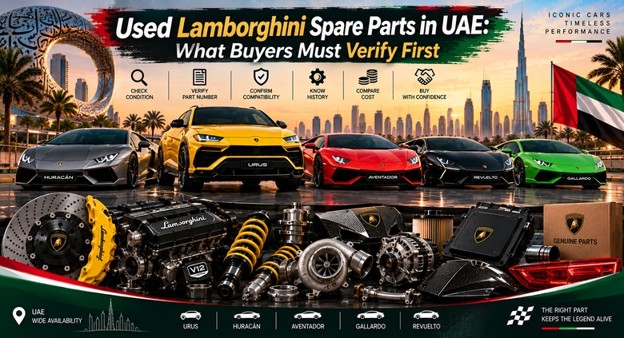
Used Lamborghini Spare Parts in UAE: What Buyers Must Verify First
September 14, 2026
The Used-Part Question
A cheap Lamborghini part can become an expensive mistake
Used Lamborghini parts can make sense in the UAE. That is the first thing to establish.
A Gallardo is no longer a new-car proposition, an Aventador can contain parts whose replacement cost is uncomfortable even for a wealthy owner, and certain Urus, Huracán and Revuelto parts can carry a serious premium when supplied new. Lamborghini itself maintains an original-parts programme for both current and classic vehicles, with classic coverage extending across a large proportion of its historical range.
But “used” is not a quality grade.
It merely tells you the part has already lived somewhere else.
The real questions are where it lived, how hard it worked, why it was removed, how it was stored, whether it was tested and whether it actually matches your Lamborghini.
The verification checklist should come before the price
Before transferring money for a used Lamborghini part, establish:
- Exact Lamborghini model
- Model year
- VIN
- Engine specification
- Transmission type
- Exact part number
- Donor vehicle
- Donor mileage
- Removal reason
- Actual photographs
- Test evidence
- Warranty terms
- Return conditions
- Installation requirements
If the seller can answer all of those without becoming vague, the conversation is already more useful.
If the answer is simply, “It fits Lamborghini,” stop there.
That is not compatibility information.
Why the VIN comes before the part number
The VIN identifies the vehicle.
The part number identifies the replacement.
You need both.
A used part may have been superseded by another number, fitted only to a particular production period or associated with a specific equipment package. This becomes particularly important when buying electronics, suspension assemblies, transmission parts and model-specific body or trim pieces.
The sensible chain is:
VIN → vehicle specification → original part number → replacement part number → compatibility confirmation
A photograph should come after this process, not replace it.
UAE heat makes donor history more important
A used part that spent years in a climate-controlled European garage is not necessarily equivalent to one that sat in an unconditioned storage facility in Gulf summer temperatures.
Rubber, plastics, seals, wiring insulation, batteries and certain electronic parts can age without accumulating many kilometres.
Then there is the opposite situation.
A Lamborghini may have covered considerable mileage but received regular servicing and careful indoor storage.
That is why donor history matters more than a shiny photograph.
Mileage is evidence, not a guarantee
A seller advertising a 30,000-km used engine sounds reassuring.
It is not enough.
Ask for evidence supporting the mileage:
- Service invoices
- Vehicle history
- Inspection records
- Donor VIN where disclosure is possible
- Diagnostic information
- Removal photographs
- Maintenance history
A 30,000-km engine from an abused or poorly maintained car may be a worse purchase than a higher-mileage engine with documented maintenance.
The same principle applies to gearboxes, suspension assemblies, alternators, compressors and electronic modules.
The donor vehicle can tell you more than the part
Ask what happened to the donor Lamborghini.
Was it:
- Accident damaged?
- Flood affected?
- Fire damaged?
- Mechanically failed?
- Written off?
- Dismantled after normal service?
- Modified?
- Track used?
A transmission removed from a crashed car is not automatically bad.
A transmission removed from a car with an unknown drivetrain failure is a different proposition.
The reason for dismantling is part of the part's history.
Model-Specific Verification
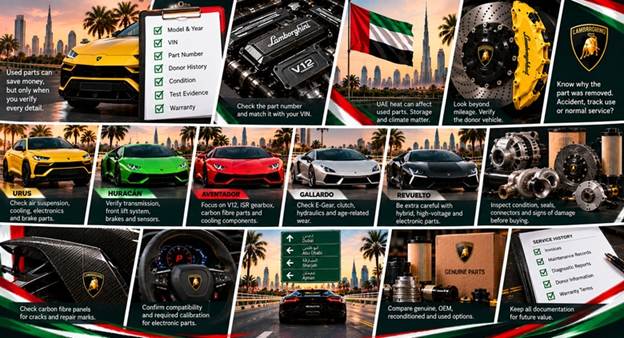
Used Urus parts
The Urus needs a slightly different approach because it combines Lamborghini performance with SUV usage.
Current Urus variants include high-output turbocharged and hybridised powertrains, with the 2026 Urus SE Performante using a 4.0-litre twin-turbo V8 paired with a permanent-magnet electric motor.
For used parts, pay particular attention to:
- Air suspension
- Cooling systems
- Brake assemblies
- Control modules
- Sensors
- Gearbox-related parts
- Differential parts
- AC components
- Battery systems
- Body and interior electronics
The part may look straightforward.
The system around it may not be.
Used Urus air-suspension parts
A used air strut should not be bought simply because it holds air when tested once.
Ask:
- How long was it stored?
- Was it removed from a functioning vehicle?
- Was leakage measured?
- Are the seals intact?
- Is the ride-height sensor included?
- Does the assembly require calibration?
- Is the opposite side showing similar wear?
A replacement strut may solve the immediate problem while exposing a compressor or valve-block weakness.
That is why the original failure needs diagnosis before the used part is ordered.
Used Huracán parts
The Huracán's naturally aspirated V10 and seven-speed Lamborghini Doppia Frizione dual-clutch transmission create a different parts environment from the Urus. Lamborghini's technical documentation identifies the 5.2-litre V10 and seven-speed LDF transmission.
Used-part buyers should pay particular attention to:
- LDF transmission parts
- Front-lift hardware
- Brake components
- Cooling parts
- Suspension
- Sensors
- Electronic modules
- Carbon-fibre panels
- AWD-related parts on applicable versions
A visually perfect part can still be electronically incompatible.
Used Huracán front-lift parts
The front-lift system is one area where diagnosis matters more than appearance.
Before buying a used replacement, establish whether the fault comes from:
- Hydraulic pressure
- Pump
- Lines
- Actuator
- Sensor
- Electrical connection
- Control system
- Calibration
A used hydraulic assembly with an unknown history can create another fault after installation.
The correct question is not “Can you supply the lift part?”
It is “Which part of the lift system has actually failed?”
Used Aventador parts
The Aventador's V12 architecture and carbon-fibre construction make its used-parts market particularly interesting.
Lamborghini identifies the Aventador as a V12 model introduced in 2011, with a carbon-fibre chassis and a mid-mounted rear V12.
Look closely at:
- ISR transmission parts
- Clutch-related parts
- Carbon-fibre pieces
- Cooling components
- Suspension
- Brake assemblies
- Electronic modules
- Exhaust parts
- Engine ancillaries
For carbon-fibre parts, inspect not only the visible surface but also mounting areas and evidence of impact.
Used Gallardo parts
The Gallardo requires patience.
Production ran from 2003 to 2013, with 14,022 cars produced, making it one of Lamborghini's most significant modern models.
That production history creates an unusual situation.
There are enough cars for a substantial used-parts market, but age means condition becomes increasingly important.
Check:
- E-Gear systems
- Clutches
- Hydraulic components
- Cooling systems
- Sensors
- Interior trim
- Rubber parts
- Body panels
- Wheels
- Exhaust components
For an older Lamborghini, “used” can sometimes be more practical than chasing an expensive new replacement.
Used Gallardo E-Gear parts
Do not buy an E-Gear actuator or clutch-related part without understanding the fault.
Ask for:
- Clutch wear information
- Hydraulic-system condition
- Actuator test results
- Gear-selection behaviour
- Diagnostic fault history
- Calibration requirements
- Donor mileage
A used actuator with no testing may simply transfer the problem from one Gallardo to another.
Used Revuelto parts
The Revuelto changes the rules again.
It combines a V12 with three electric motors and a dual-clutch gearbox, producing a combined 1,015 CV according to Lamborghini's current technical information.
Used parts therefore need to be separated into ordinary mechanical hardware and high-voltage/hybrid-related hardware.
For:
- Battery-related systems
- Electric motors
- Power electronics
- Hybrid control units
- High-voltage cooling
- Hybrid wiring
the verification standard should be extremely high.
A used Revuelto electronic part should never be treated like a used trim piece.
Model comparison
| Lamborghini | Used-part priority | What to verify first |
| Urus | Suspension and electronics | VIN, system fault, calibration |
| Huracán | Transmission, brakes, lift | Part number and diagnostic evidence |
| Aventador | V12, ISR, carbon fibre | Donor history and condition |
| Gallardo | E-Gear, clutch, ageing parts | Mileage, maintenance, hydraulic condition |
| Revuelto | Hybrid and electronics | Exact specification and diagnostic evidence |
Condition Verification
Demand actual photographs
A catalogue photograph proves almost nothing about used Lamborghini spare parts in UAE.
Request photographs of the actual item showing:
- Part number
- Serial number where present
- Connectors
- Mounting points
- Seals
- Surface condition
- Damage
- Corrosion
- Wear areas
For body panels, ask for close-ups of edges and mounting points.
For mechanical assemblies, ask for photographs before cleaning if possible.
Cleaning can make a damaged used part look surprisingly convincing.
Check the part number yourself
Do not rely solely on the seller typing a number into a message.
Compare the physical marking on the part with the quoted number.
Then confirm whether the number is:
- Current
- Superseded
- Applicable to your model
- Applicable to your production year
- Applicable to your vehicle specification
A small character difference can matter.
Inspect connectors on electronic parts
Used Lamborghini electronic modules deserve particular suspicion around their connectors.
Look for:
- Bent pins
- Corrosion
- Water marks
- Broken locking tabs
- Damaged wiring
- Oil contamination
- Heat damage
If a module has been exposed to moisture, the outside may look perfectly clean while the connector tells another story.
Check rubber, seals and hoses
Rubber ages.
Inspect:
- Bushes
- O-rings
- Gaskets
- Hoses
- Dust boots
- Suspension mounts
- Wiring insulation
This matters even more for Gallardo parts because some examples are now more than twenty years old.
A used mechanical part may have plenty of life left while its surrounding rubber does not.
Look for accident damage
A body part removed from a damaged Lamborghini needs careful inspection.
Check for:
- Uneven mounting holes
- Cracked brackets
- Repaired carbon fibre
- Filler
- Uneven panel edges
- Paint overspray
- Heat distortion
- Broken clips
Carbon-fibre damage deserves particular caution because an apparently minor crack can be structurally significant depending on the location and construction.
Check corrosion even in the UAE
The UAE is dry, but corrosion is not impossible.
Imported vehicles, coastal exposure, condensation, poor storage and previous water exposure can all change the picture.
Inspect:
- Electrical connectors
- Fasteners
- Aluminium housings
- Brake hardware
- Underbody parts
- Cooling connections
A small amount of surface oxidation is not the same as deep corrosion.
The important thing is identifying which one you are looking at.
Flood and water exposure
Water damage is one of the worst histories for used electronic parts.
Look for:
- Water lines
- Green corrosion
- Oxidised connectors
- Mud residue
- Unusual cleaning
- Corroded fasteners
- Moisture inside housings
If the donor vehicle has been flood damaged, be extremely cautious with modules, wiring, sensors and electrical assemblies.
Mechanical Testing
A used engine needs evidence
A used Lamborghini engine should come with more than an odometer number.
Where appropriate, ask for:
- Compression results
- Leak-down results
- Oil-pressure information
- Cold-start video
- Running video
- Fault-code history
- Service records
- Oil condition
- Coolant condition
- Donor VIN or identifying information
For a V10 or V12, testing before purchase is far cheaper than discovering internal damage after installation.
Compression testing
Compression testing is particularly useful when the engine itself is the purchase.
The goal is not to chase a magical universal number.
Compare cylinders using the correct test procedure and manufacturer's reference data where available.
Large variation deserves investigation.
A compression test can also be paired with:
- Leak-down testing
- Borescope inspection
- Oil-pressure testing
- Diagnostic scanning
A used engine should be treated as a mechanical asset with evidence attached to it.
Leak-down testing
Leak-down testing can help determine where cylinder pressure is escaping.
Air heard through the intake can suggest an intake-valve issue.
Air through the exhaust can point towards exhaust-valve leakage.
Air through the crankcase can indicate piston-ring or cylinder-related leakage.
For an expensive Lamborghini engine, that information is considerably more useful than “engine tested OK”.
Used gearbox inspection
For a used transmission, establish:
- Donor mileage
- Removal reason
- Fluid condition
- Fault history
- Shift behaviour
- Clutch condition
- Hydraulic condition
- Actuator condition
- Calibration requirements
A gearbox that came from a car with an unresolved transmission fault should be treated cautiously.
Used brake parts
Brakes are not an area for blind bargain hunting.
Inspect:
- Rotor surface
- Rotor thickness or applicable wear measurement
- Pad condition
- Calipers
- Pistons
- Brake lines
- Mounting hardware
- Heat damage
Carbon-ceramic brake parts are particularly expensive, making accurate inspection even more important.
A rotor that looks good in a photograph still requires proper measurement.
Used suspension parts
For suspension assemblies, inspect:
- Bushes
- Ball joints
- Dampers
- Air struts
- Mounts
- Hydraulic lines
- Sensors
- Corrosion
- Leakage
Then check the vehicle's alignment after installation.
If the replacement part changes geometry or the original failure was caused by impact, alignment becomes part of the repair rather than an optional extra.
Cooling parts
Used cooling components should be inspected for:
- Cracks
- Blockage
- Corrosion
- Leaks
- Bent fins
- Damaged mounting points
- Hose deterioration
A used radiator or cooler can appear serviceable while having reduced airflow or a slow leak.
Pressure testing is worthwhile where applicable.
Batteries and electrical components
A used battery is usually a very different proposition from a used mechanical bracket.
Battery age matters.
So does storage.
So does the vehicle's charging history.
For electronic components, establish whether the part is:
- Plug-and-play
- Coded
- VIN-linked
- Adapted to the vehicle
- Reset before installation
- Calibrated after installation
Never assume because the connector fits, the vehicle will accept the module.
UAE Cost Reality
The advertised used-part price is not the repair price
Suppose a used transmission costs AED 20,000.
That is not necessarily a AED 20,000 repair.
Add:
- Shipping
- VAT/import charges where applicable
- Diagnosis
- Removal
- Installation
- Fluids
- Seals
- Programming
- Calibration
- Alignment
- Warranty risk
The total may be dramatically higher.
Always compare the installed cost.
Indicative UAE labour planning
These figures are budgeting ranges rather than fixed Lamborghini tariffs.
| Work | Approximate planning range |
| Diagnostic scan | AED 300–800+ |
| General inspection | AED 300–1,000+ |
| Suspension diagnosis | AED 300–800+ |
| Brake inspection | AED 300–700+ |
| Major mechanical labour | AED 2,000–8,000+ |
| Transmission removal/installation | AED 3,000–10,000+ |
| Engine removal/installation | AED 6,000–15,000+ |
| Specialist coding/calibration | AED 500–2,500+ |
Dubai specialist labour can vary considerably according to model and job complexity.
The point is not to predict an invoice.
It is to stop a buyer from comparing two used parts solely on purchase price.
Dubai, Abu Dhabi and Sharjah workshop considerations
A cheaper workshop is not automatically a cheaper repair.
For a used Lamborghini part, prioritise:
- Diagnostic capability
- Lamborghini experience
- Programming capability
- Written warranty
- Installation documentation
- Parts inspection
- Ability to test the completed repair
Dubai may offer greater specialist choice, while owners elsewhere in the UAE may factor transport and specialist availability into the total cost.
34. Imported used parts
An overseas used part may initially look attractive.
Then calculate:
Part + freight + insurance + import charges + VAT + local delivery + return risk
If the part is defective, the original saving may disappear rapidly.
For a rare Gallardo or Aventador part, importing can still be sensible.
Just calculate the entire transaction first.
Warranty changes the value
AED 18,000 with written warranty is not automatically worse than AED 15,000 without one.
Ask:
- How long is the warranty?
- Does it cover the part only?
- Does it cover labour?
- What installation conditions apply?
- Who pays return shipping?
- Is coding required?
- What failures are excluded?
A warranty that excludes the most likely failure is not particularly useful.
Repair versus used replacement
Sometimes repairing your original part is smarter.
| Situation | Better starting point |
| Original part structurally sound | Repair |
| Rare discontinued part | Repair or documented used |
| Unknown used electronic module | Avoid until tested |
| Major internal gearbox damage | Compare rebuild with replacement |
| Damaged carbon-fibre part | Specialist assessment |
| Old Gallardo trim | Good used part can make sense |
| High-voltage Revuelto part | Specialist diagnosis first |
Do not assume “used” automatically beats “repair”.
Donor Vehicle Investigation
Ask for the donor VIN where possible
A donor VIN can help establish:
- Model
- Production period
- Specification
- Accident history where records are available
- Mileage evidence
- Part compatibility
The seller may not always disclose the full VIN.
If they cannot, ask for enough identifying information to demonstrate that the donor is genuinely compatible.
Ask why the donor was dismantled
This is one of the most revealing questions.
If the answer is:
“Vehicle was accident damaged, drivetrain unaffected.”
That is useful.
If the answer is:
“Engine failed, but this gearbox should be fine.”
You need considerably more evidence.
If the answer is:
“Unknown.”
The price should not magically compensate for the uncertainty.
Accident-damaged donors
Accident-damaged Lamborghini parts can still be excellent.
A rear-end collision may leave front suspension and engine parts untouched.
A front impact makes front structural and suspension parts more questionable.
A rollover changes the entire assessment.
Always consider where the donor was damaged.
Track-used donors
Track use does not automatically make a part bad.
It does change the wear profile.
Pay closer attention to:
- Brakes
- Clutch
- Transmission
- Suspension
- Cooling
- Tyres
- Wheel bearings
- Engine cooling history
A carefully maintained track car may have better records than a neglected road car.
Again, evidence beats assumptions.
Storage conditions
Ask how the part was stored after removal.
Was it:
- Indoors?
- Climate-controlled?
- Exposed to sunlight?
- Exposed to dust?
- Wrapped?
- Plugged or capped?
- Stored with fluids?
- Stored for months or years?
A removed engine part sitting open in a dusty warehouse is not equivalent to a sealed part stored properly.
Actual photographs should match the delivered part
Keep the listing photographs.
When the part arrives, compare:
- Markings
- Condition
- Serial numbers
- Connectors
- Hardware
- Physical shape
If the received part differs materially from the photographs, do not install it simply because the seller says it is equivalent.
Stop.
Resolve the discrepancy first.
Genuine, OEM, Reconditioned and Used
Genuine Lamborghini parts
Lamborghini states that its official network uses original spare parts and manufacturer instructions for certified repairs. It also says original parts are matched to the technical specifications of each model.
That gives genuine parts an obvious advantage where:
- Fitment is critical
- Safety is involved
- Electronics require integration
- The vehicle is highly original
- Warranty matters
It does not mean every used part is a bad purchase.
It means the risk calculation changes when you leave the original supply chain.
OEM parts
“OEM” should be treated as a description requiring verification, not as a magic word.
Ask:
- Who manufactured it?
- What is the manufacturer's part number?
- Is it actually the original equipment manufacturer?
- What warranty is offered?
- Does it match the VIN?
- Is the specification documented?
“Same factory” is not enough evidence.
Reconditioned parts
A properly reconditioned part can be a very sensible choice.
But ask what reconditioning involved.
Was it:
- Cleaned?
- Tested?
- Rebuilt?
- Calibrated?
- Pressure-tested?
- Internally inspected?
- Fitted with new seals?
- Given a written warranty?
A polished used part and a professionally rebuilt part are not the same thing.
Aftermarket alternatives
Some aftermarket parts are engineered extremely well.
Others are simply cheaper.
Use greater caution with:
- Brakes
- Suspension
- Sensors
- Electronic modules
- Cooling parts
- Hybrid systems
- Engine internals
For cosmetic items, the risk calculation can be different.
The correct standard depends on the part's consequences if it fails.
Why “Tijari” needs context
In UAE automotive conversations, “Tijari” may be used loosely for commercial replacement parts.
The word itself does not tell you whether the part is good.
Ask who manufactured it, what specification it follows, what warranty exists and whether the workshop is comfortable installing it.
Judge the engineering and evidence.
Not the label.
Used versus reconditioned
| Factor | Used | Reconditioned |
| Previous history | Important | Important |
| Internal inspection | May be limited | Usually expected |
| Price | Often lower | Usually higher |
| Warranty | Varies | Often stronger |
| Risk | Highly variable | Potentially lower |
| Best use | Suitable documented parts | Complex repairable assemblies |
A documented used part can beat a badly reconditioned one.
The word “reconditioned” does not eliminate the need for questions.
UAE Driving and Climate
Heat exposure
Dubai, Abu Dhabi and other UAE emirates expose vehicles to high ambient temperatures for long periods.
Used-part inspection should therefore pay particular attention to:
- Rubber
- Cooling systems
- AC parts
- Batteries
- Wiring
- Electronics
- Adhesives
- Interior plastics
This is especially relevant when a donor vehicle has spent years outside.
Dust and cooling systems
Dust is not merely cosmetic.
Cooling surfaces can become contaminated, reducing airflow.
Before fitting a used cooling part, inspect:
- Fins
- Ducts
- Fans
- Mounts
- Debris
- Corrosion
If the replacement part is already compromised, the UAE climate will not be forgiving.
Short journeys and low-use Lamborghinis
A Lamborghini that travels only a few hundred kilometres a month can still develop problems.
Long periods parked affect:
- Battery condition
- Tyres
- Seals
- Fluids
- Brakes
- Fuel systems
- AC systems
Low mileage is therefore not enough evidence when assessing a used part.
Desert and performance use
If the donor Lamborghini was used aggressively, look for evidence in:
- Brake condition
- Tyre wear
- Suspension wear
- Cooling-system condition
- Underbody damage
- Clutch condition
- Transmission history
A Urus used for long-distance road driving has a different wear pattern from one frequently driven on desert tracks.
Underbody inspection
Low sports cars can suffer damage from:
- Speed humps
- Ramps
- Kerbs
- Road debris
- Parking entrances
Inspect underbody parts for:
- Scrapes
- Cracks
- Missing fasteners
- Bent brackets
- Carbon-fibre damage
- Exhaust damage
A used undertray may look perfect from above.
The underside tells another story.
UAE specification versus imported specification
Do not assume an imported Lamborghini uses exactly the same part configuration as a GCC-market car.
Confirm:
- VIN
- Market specification
- Engine
- Emissions configuration where relevant
- Cooling configuration
- Lighting
- Electronics
- Part number
The seller's statement that “it fits the same model” is not enough.
Installation and Post-Purchase Checks
Inspect before the workshop installs it
Do not wait until the mechanic is halfway through the job.
Inspect the part while it is still accessible.
Compare it against the removed unit.
Check:
- Dimensions
- Mounting points
- Connectors
- Part numbers
- Included hardware
- Physical condition
Photograph both.
Replace supporting parts where necessary
A used part can be perfectly healthy and still fail because another old part damages it.
Examples:
Suspension: check alignment, mounts and bushes.
Cooling: check hoses, fans and pumps.
Transmission: check clutch, fluid and actuator.
Engine: check cooling, lubrication and ignition systems.
Brakes: check pads, fluid, calipers and tyres.
The original failure should always be understood before the replacement is installed.
Coding and calibration
Modern Lamborghini electronics may require more than physical installation.
Depending on the part, confirm whether the job includes:
- Coding
- Programming
- Adaptation
- Calibration
- Fault-code clearing
- System reset
If a seller says “plug and play”, verify that claim with the workshop.
First 1,000 km after installation
The first 1,000 km are useful observation time.
Watch for:
- Warning lights
- Fluid loss
- New noises
- Vibration
- Gearbox behaviour
- Suspension changes
- Brake vibration
- Cooling problems
- Electrical faults
- AC changes
Keep the repair invoice and diagnostic report.
If the part fails under warranty, documentation makes the conversation much simpler.
Documentation for future resale
Keep:
- VIN
- Part number
- Donor information
- Purchase invoice
- Warranty
- Installation invoice
- Diagnostic report
- Calibration report
- Alignment report
- Test results
- Photographs
For older Lamborghinis, this paperwork can be surprisingly valuable.
A future buyer is far more comfortable with a documented used gearbox than an unexplained “replacement gearbox”.
The final used-parts decision
A good used Lamborghini part should pass four tests:
Identity: You know exactly what it is.
History: You know where it came from.
Condition: You have evidence that it is usable.
Economics: The complete installed cost makes sense.
That is the standard worth applying whether the car is a daily-driven Urus in Dubai, a weekend Huracán in Abu Dhabi, an Aventador kept indoors in Sharjah or a twenty-year-old Gallardo being carefully preserved.
A used Lamborghini part does not need to be perfect.
It needs to be known.
Unknown mileage can be investigated. Unknown condition can be tested. Unknown compatibility can sometimes be established through the VIN and part number.
Unknown history is the difficult one.
That is where the supposed bargain usually starts becoming expensive.
Buyer Decision Matrix
| Situation | Sensible choice |
| Documented used cosmetic part | Used |
| Rare Gallardo trim | Good used part |
| Tested Aventador mechanical assembly | Used or reconditioned |
| Unknown electronic module | Avoid until tested |
| Safety-critical brake part | Genuine/new preferred |
| Used Urus air suspension | Test before purchase |
| Used V10/V12 engine | Compression + leak-down + history |
| Revuelto hybrid component | Specialist verification |
| Unknown donor transmission | High caution |
| Rare discontinued original part | Genuine or documented used |
Used Lamborghini Parts Buying Checklist
- Confirm the VIN.
- Match the exact part number.
- Confirm the model year.
- Establish the market specification.
- Ask for donor information.
- Ask why the donor was dismantled.
- Confirm donor mileage.
- Request actual photographs.
- Check connectors and seals.
- Inspect for accident damage.
- Check for flood exposure.
- Ask for test results.
- Calculate shipping and taxes.
- Include labour and calibration.
- Obtain warranty terms in writing.
- Photograph the delivered part.
- Compare it with the removed part.
- Keep every invoice and diagnostic report.
This is where PartFinder UAE can be useful as part of a broader sourcing process: the buyer should still compare fitment, condition, documentation and total cost rather than choosing a part simply because it appears in a search result.
FAQs
Categories
- Audi
- BMW
- Car Accessories
- Car Tips
- Ford
- Land Rover
- Mazda
- Range Rover
- Top 10
- UAE Car Parts
- Used Car Parts
- Toyota
- Replacement Engines
- Nissan
- Hyundai
- Mitsubishi
- Volkswagen
- Honda
- Kia
- Chevrolet
- Dodge
- Jeep
- Subaru
- Renault
- Lexus
- Mercedes
- Suzuki
- Hummer
- Porsche
- Infiniti
- Peugeot
- GMC
- Mini
- Volvo
- Replacement Gearboxes
- MG
- Jaguar
- Skoda
- Cadillac
- Daihatsu
- Fiat
- German Car Parts
- Japanese Car Parts
- Aftermarket Car Parts
- Genuine Car Parts
- New Car Parts
- Reconditioned Car Parts
- European Car Parts
- American Car Parts
- Korean Car Parts
- British Car Parts
- Chinese Car Parts
- Sports/Exotic Car Parts
- Luxury Car Parts
- Performance Car Parts
- SUV/4x4 Spare Parts
- Truck Spare Parts
- EV Car Parts
- Hybrid Car Parts
- Auto Spare Parts in UAE
- Tesla
- Isuzu
- Ram
- Ferrari
- Bentley
- Lamborghini