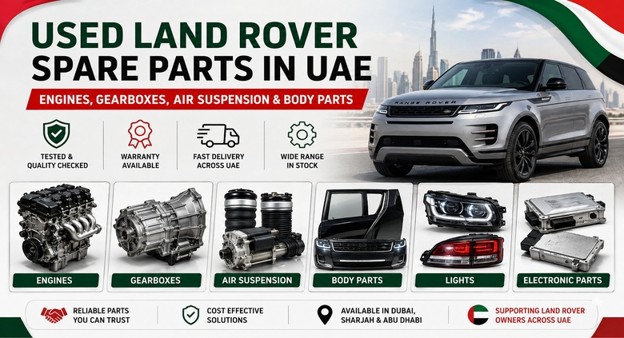
Used Land Rover Spare Parts in UAE: Engines, Gearboxes, Air Suspension and Body Parts
August 24, 2026
Used Land Rover Parts Owners Search for Most
Used Land Rover Spare Parts in UAE: What Can You Buy Second-Hand?
Buying used Land Rover spare parts in UAE is not simply about finding something cheaper. Sometimes it is the sensible choice; sometimes, especially with a complex electronic or high-labour component, the saving can disappear the moment the part fails.
The key is knowing which parts tolerate second-hand buying well and which ones deserve much more scrutiny.
Used Land Rover engines:
Complete used engines are widely considered for older Defender, Discovery and Range Rover models where a new replacement would make little financial sense.
But don't buy an engine because the supplier says it is “tested”. Ask what was actually tested, where it came from, what mileage it covered and what warranty comes with it.
Used Land Rover gearboxes:
Gearboxes can be expensive to replace, which makes tested used units attractive.
Check the transmission code, donor vehicle, mileage, testing procedure, fluid condition and warranty before agreeing to the purchase.
A gearbox that fits physically but has the wrong specification is still the wrong gearbox.
Used air-suspension parts:
Compressors, air springs, valve blocks and selected sensors can sometimes be sourced used.
However, these components have already lived a working life, so condition and testing matter enormously.
Used suspension parts:
Control arms, hubs, steering components and other suspension hardware may be available second-hand.
For heavily worn items, however, the price difference between used and reputable new aftermarket or OEM components may not justify taking the risk.
Used body parts:
This is one category where used genuine parts can be particularly attractive.
Doors, bumpers, mirrors, wings, tailgates, grilles and lights can often cost considerably less than buying new, especially when the vehicle is older.
Used headlights and tail lights:
These can be good candidates for second-hand sourcing, but modern Land Rover lighting can contain electronics, sensors and other integrated components.
Check the exact specification.
Used electrical modules:
Proceed carefully.
A used control module may physically fit your Defender, Discovery or Range Rover yet still require programming, coding or configuration before it works correctly.
Used cooling parts:
Radiators, expansion tanks, cooling fans and some related components can be sourced used.
But inspect them closely for leaks, cracks, corrosion and previous repairs.
Used AC components:
Compressors, condensers, blower components and other AC parts are available second-hand.
Ask whether the component was tested before removal or dispatch.
Used drivetrain components:
Differentials, driveshafts, transfer-case components and related parts can be expensive new, making used units worth investigating.
Donor vehicle and mileage become particularly useful here.
Used interior parts:
Seats, dashboards, trim, switches, screens and other interior components can make sense as used purchases when condition is good.
Check colour, trim specification, connectors and mounting points.
What should you be cautious about?
Be particularly careful with components where failure means substantial labour, programming or downtime.
A cheap component isn't really cheap if the workshop has to remove it again next week.
A simple used-parts rule:
Low purchase price + unknown condition = high uncertainty.
Instead, look for:
Correct part number + known donor + sensible mileage + actual photographs + testing + warranty.
That combination is far more useful than a low price on its own.
Used Land Rover Engines in UAE: What to Check Before Buying
A used engine can rescue an older Land Rover from an otherwise difficult repair decision.
But an engine sitting on a workshop floor tells you almost nothing about its real condition.
Start with the engine code:
The engine code should match your vehicle's specification.
Don't rely solely on the model name.
A Discovery with one engine specification may require different components from another Discovery of the same model year.
Ask for donor information:
Find out which vehicle the engine came from.
Ideally, the supplier should be able to provide the donor model, year, engine specification and mileage where known.
Mileage matters:
Mileage does not tell the entire story, but it is still useful.
An engine with documented lower mileage may be more attractive than one with an unknown history.
Look for leaks:
Inspect around seals, covers, oil passages and coolant areas.
Fresh cleaning can hide evidence temporarily, so ask whether the engine was cleaned before sale.
Check oil condition:
Unusual contamination can raise questions.
Oil and coolant should be checked carefully for signs that point towards previous internal problems.
Compression testing:
Where appropriate, compression testing can provide useful information about cylinder condition.
For a major engine purchase, independent testing is worth considering.
Ask what “tested” means:
This question is surprisingly important.
Does “tested” mean the engine was started? Compression-tested? Run under load? Inspected visually?
Get the actual answer.
Check supporting components:
The engine itself may not include every component needed for installation.
Ask whether the quotation includes:
- Turbocharger
- Injectors
- Alternator
- Starter
- Sensors
- Engine mounts
- Wiring
- Ancillary components
Don't assume.
Warranty:
Ask how long the engine is covered and what the warranty requires.
Some suppliers may require professional installation and specific fluids or procedures.
Installation cost:
The engine price is only part of the project.
Add removal, installation, fluids, filters, seals, diagnostics and any programming or adaptation required.
Used vs reconditioned engine:
A tested used engine can be attractive when the donor history is strong.
A properly rebuilt engine may make more sense where internal wear is a concern.
Compare the complete project cost, not simply the engine quotation.
Before paying:
Engine code → donor vehicle → mileage → testing → condition → included components → warranty → installation cost.
Then decide.
Used Land Rover Gearboxes in UAE: How to Choose the Right One
Gearbox replacement is where buying purely on price can become painful.
The unit might be cheaper than a rebuild, yet installation, fluids, diagnostics and adaptation can push the final cost much higher than expected.
Confirm the transmission code:
This should be one of your first checks.
The gearbox code helps establish whether the unit is actually designed for your vehicle.
Confirm the donor vehicle:
Ask where the gearbox came from.
The donor's model, year, engine and drivetrain configuration can reveal compatibility information that a generic online listing won't.
Ask about mileage:
Lower mileage can be attractive, but documented mileage is much more useful than a supplier simply saying “low mileage”.
Ask whether it was tested:
Find out how.
Was it bench-tested? Was it removed from a running vehicle? Were gears and hydraulic functions checked?
Inspect the casing:
Look for cracks, damage, excessive corrosion and signs of previous repair.
A clean casing does not automatically mean a healthy gearbox.
Check fluid condition:
Where inspection is possible, fluid condition can provide useful clues.
Metal debris, unusual contamination or burning smells deserve further investigation.
Ask about torque converter components:
For automatic transmissions, confirm what is included.
A “gearbox” quotation may not include every related component required for installation.
Ask about programming:
Modern Land Rover transmissions can involve electronic control and adaptation.
A used gearbox may require coding, programming or calibration after installation.
Warranty:
Get warranty terms in writing.
Ask specifically whether labour is covered if the gearbox fails shortly after installation.
Installation costs:
Include:
Gearbox + removal + installation + fluids + seals + diagnostics + programming/adaptation.
That is your real figure.
Used vs reconditioned gearbox:
A tested used unit may be sensible for an older Land Rover.
A properly rebuilt gearbox may offer greater confidence where the used unit's history is unclear.
Before buying:
Never order based solely on “Land Rover Discovery gearbox”.
Provide the VIN and transmission code and get compatibility confirmed first.
Used Land Rover Air Suspension Parts: Compressors, Air Springs and Valve Blocks
Air suspension can be expensive to repair, which is why used components attract so much attention.
But there is a catch.
You need to know what actually failed.
Used air compressors:
A used compressor can be worthwhile for an older Land Rover if it has been tested properly.
Ask whether it was tested for pressure output, operating time and general condition.
Used air springs:
Air springs contain flexible rubber components that age.
Inspect them for cracking, surface deterioration and signs of leakage.
Used valve blocks:
Valve blocks control air distribution across the suspension system.
A faulty unit can create uneven ride height or slow suspension response.
Used height sensors:
Sensors can be sourced used, but compatibility matters.
Check the exact part number and ask whether calibration will be required.
Vehicle dropping overnight:
If the Land Rover sinks after being parked, don't immediately blame the compressor.
An air spring, line or valve-related leak could be causing the system to lose pressure.
Compressor running too often:
This is another useful clue.
A compressor that constantly runs may be compensating for a leak elsewhere.
Replace the leak, and you may prevent a second compressor failure.
Testing matters:
Ask the supplier exactly how the component was tested.
A photograph isn't a test.
A clean component isn't a test either.
Used vs reconditioned compressor:
A tested used compressor may cost less.
A properly reconditioned unit may offer greater confidence if the rebuild process and warranty are clearly documented.
Warranty:
Ask whether the warranty covers the component only or also installation-related labour.
That distinction matters when the part is difficult to access.
Before buying:
Fault diagnosis → exact component → part number → testing → condition → warranty.
Do not buy a compressor simply because the suspension warning says there is a fault.
Used Land Rover Body Parts in UAE: Bumpers, Doors, Mirrors, Lights and Panels
Used body parts are often where Land Rover owners can make meaningful savings without compromising the vehicle mechanically.
A good used genuine door or mirror can be far more attractive than an expensive new replacement.
Bumpers:
Inspect the bumper itself and all mounting points.
A bumper can look fine from the front while hidden brackets are cracked or damaged.
Doors:
Check hinges, locks, wiring, window mechanisms and internal mounting points.
Paint condition matters too, particularly when the replacement is meant to match the existing vehicle.
Mirrors:
Modern Land Rover mirrors can contain cameras, indicators, sensors and electrically adjustable mechanisms.
Confirm exactly what is included.
Headlights:
Don't compare only the outer lens.
Check the internal electronics, connectors, mounting brackets and exact lighting specification.
Tail lights:
The same principle applies.
A used light may be visually correct but electronically incompatible.
Wings and panels:
Used genuine panels can be excellent value.
Inspect for previous repairs, dents, corrosion and distorted mounting points.
Tailgates:
Check hinges, locks, wiring, trim and cameras where fitted.
A bare panel may not include the hardware you need.
Grilles and trim:
These are often easier used purchases because the mechanical risk is lower.
Still, check clips and mounting tabs.
Colour matching:
A used panel in the correct colour is convenient, but paint can fade differently over time.
Check the panel in natural light before assuming it will match perfectly.
Accident damage:
Ask whether the part came from a damaged donor vehicle.
If so, inspect the area around the component carefully.
A door removed from a badly damaged vehicle may carry hidden distortion that isn't obvious in a single photograph.
The sensible body-parts approach:
Ask for actual photographs, mounting-point details, included hardware, condition, donor information and return terms.
Then compare the delivered price against a new genuine or aftermarket alternative.
Sometimes the used part wins easily.
Sometimes the new one is only slightly more expensive, and that changes the calculation.
Model-Specific Used Land Rover Parts
Used Land Rover Defender Parts in UAE: What Owners Commonly Buy
The Defender has a loyal following in the UAE, and used parts can make older or heavily used examples much easier to keep on the road.
The trick is separating sensible second-hand purchases from components where a low price could create another repair.
Used Defender engines:
A used Defender engine can be a practical option when internal damage makes rebuilding too expensive.
Check the engine code, donor vehicle, mileage, compression or other available testing, leaks and warranty before committing.
Used Defender gearboxes:
Gearboxes, transfer-case components and drivetrain parts can be expensive new, so tested used units attract plenty of interest.
Confirm the transmission code and drivetrain specification rather than relying on “fits Defender” in an online listing.
Used Defender suspension:
Control arms, bushes, ball joints, dampers and related components are commonly searched as used replacements.
If the Defender has spent plenty of time off-road, inspect the component history more carefully.
Used Defender air suspension:
Where fitted, compressors, air springs, valve blocks and height sensors can sometimes be sourced second-hand.
Ask how each component was tested before it was removed or shipped.
Used Defender differentials and drivetrain parts:
Differentials, driveshafts and transfer-case components can see serious loads, especially when towing or driving across rough terrain.
Listen for whining, clunking and vibration before assuming a used replacement is the answer.
Used Defender body parts:
Doors, bumpers, grilles, mirrors, wings, lights and trim are often sensible candidates for used genuine parts.
Check mounting points, wiring and hidden damage rather than judging condition from the paint alone.
Used Defender headlights:
Modern lighting assemblies can contain electronics, so exact specification matters.
Ask whether the light includes modules, brackets and other required hardware.
Used Defender electrical parts:
Batteries and alternators are relatively straightforward compared with electronic control modules.
For modules, ask whether programming or coding will be needed after installation.
Used Defender interior parts:
Seats, trim, switches, screens and other interior components can be sourced second-hand when colour and specification match.
A cheap panel in the wrong trim is still the wrong panel.
Buying Defender parts online:
When comparing suppliers such as PartFinder UAE, send the VIN and exact part number rather than simply searching “used Defender parts”.
Then compare donor details, condition, testing, warranty and delivery.
Defender buying checklist:
VIN → generation → engine → transmission → part number → donor → mileage → testing → warranty.
That sequence removes much of the guesswork.
Used Land Rover Discovery Parts in UAE: Common Components Available Second-Hand
Discovery models can be expensive to repair when major components fail, which is why tested used parts remain attractive to owners trying to control the bill.
But Discovery generations are not interchangeable.
Used Discovery engines:
A complete used engine can make financial sense where rebuilding the existing unit would be disproportionately expensive.
Ask for the engine code, donor information, mileage and testing details.
Used Discovery gearboxes:
Transmission replacement is another area where used sourcing can reduce the initial parts bill.
Confirm the transmission code, engine pairing and drivetrain specification before paying.
Used Discovery air suspension:
Compressors, air springs, valve blocks and height sensors can be found second-hand.
If the Discovery is dropping overnight, diagnose the leak first rather than buying a compressor blindly.
Used Discovery suspension:
Control arms, bushes, ball joints, links and dampers are common replacement categories.
Uneven tyre wear and knocking over speed humps can point towards suspension wear.
Used Discovery drivetrain parts:
Transfer cases, differentials and driveshafts can be costly new.
A tested used component may therefore be worth considering, especially for an older Discovery.
Used Discovery cooling parts:
Radiators, expansion tanks, cooling fans and selected pumps can sometimes be sourced used.
Inspect carefully for cracks, leaks and signs of previous overheating.
Used Discovery AC parts:
Compressors, condensers, blowers and other climate-control components are available second-hand.
Ask whether the component was tested and whether any supporting hardware is included.
Used Discovery electrical modules:
This is where caution increases.
A used module may need programming, coding or configuration, and compatibility should be confirmed before installation.
Used Discovery body parts:
Doors, bumpers, mirrors, headlights, tail lights and panels can offer worthwhile savings.
Request photographs of the actual component, especially if the part has visible cosmetic damage.
Used Discovery interior parts:
Seats, screens, switches, trim and other cabin components can often be sourced second-hand.
Check trim colour, connector type and specification.
Used Discovery parts and donor history:
A donor vehicle tells you more than a generic listing.
Ask where the component came from and, where possible, how many kilometres it had covered.
Before buying:
Confirm VIN, part number, donor vehicle, condition, testing, warranty and return terms.
Then calculate the complete repair rather than looking only at the used-part price.
Used Range Rover Parts in UAE: Which Components Are Worth Buying Used?
Range Rover parts can become expensive quickly, particularly when suspension, electronics or major drivetrain components are involved.
That makes used genuine parts tempting.
Some are genuinely good buys.
Others require a much harder look.
Used Range Rover body parts:
Doors, bumpers, wings, mirrors, grilles and selected trim are often among the easier used purchases.
Inspect brackets, wiring, sensors and previous accident repairs before accepting the part.
Used Range Rover headlights:
A used headlight can save money, but modern assemblies may include complex electronics.
Confirm the exact lighting specification and whether the required control modules are included.
Used Range Rover air suspension:
Air springs, compressors and valve blocks can sometimes be sourced used.
Ask for testing information and find out whether the component came from a vehicle with similar mileage and specification.
Used Range Rover engines:
A used engine can be attractive when the original has suffered serious internal damage.
But check engine code, donor history, mileage, testing, warranty and included ancillaries.
Used Range Rover gearboxes:
A tested gearbox may cost substantially less than a new replacement.
Confirm the transmission code and ask whether programming, adaptation or calibration will be required.
Used Range Rover differentials:
Differentials and other drivetrain components can be expensive, making used sourcing worthwhile in some cases.
Noise, vibration and donor mileage should be investigated.
Used Range Rover suspension arms:
Control arms and related components can be sourced second-hand, although heavily worn suspension parts may not offer enough saving over reputable new alternatives.
Do the maths.
Used Range Rover electrical modules:
This category needs caution because compatibility and software configuration can become just as important as physical fitment.
Ask whether the module has been tested and whether it can be programmed to your vehicle.
Used Range Rover cooling parts:
Radiators, cooling fans, expansion tanks and selected pumps can sometimes be sourced used.
For any cooling component, inspect for previous leaks and overheating damage.
Used Range Rover interior parts:
Seats, screens, switches, trim and other cabin components can be useful second-hand purchases.
Match the specification carefully.
When used makes sense:
Used genuine body parts and selected mechanical components can provide substantial savings on an older Range Rover.
For high-labour or software-dependent repairs, however, warranty and reliability may outweigh the initial saving.
The Range Rover rule:
Compare the total repair cost, not the advertised part price.
A AED saving on the component means little if the workshop has to remove and refit it twice.
Used Range Rover Evoque Parts in UAE: What Should You Check?
Evoque parts can look deceptively simple online.
Two components may appear identical in photographs while carrying different part numbers, connectors or specifications.
Used Evoque engines:
Check the engine code and donor vehicle first.
Mileage, testing, leaks and warranty should then be assessed before discussing installation.
Used Evoque gearboxes:
Transmission specification matters.
Confirm the gearbox code, engine pairing and drivetrain configuration before buying a used unit.
Used Evoque suspension:
Control arms, bushes, links, dampers and hubs can be sourced used.
However, suspension wear is exactly why donor mileage matters.
Used Evoque air-suspension components:
Where applicable, compressors, air springs, valve-related components and sensors require careful testing.
Don't confuse a suspension warning with proof that one particular part has failed.
Used Evoque brakes:
Used brake pads and heavily worn discs are poor areas for second-hand savings.
Reusable components such as certain calipers may be considered if their condition is properly inspected.
Used Evoque cooling parts:
Radiators, cooling fans, expansion tanks and selected pumps can be sourced second-hand.
Inspect for cracks and previous overheating.
Used Evoque AC components:
Compressors and condensers can be expensive, making used sourcing attractive.
Ask whether the component was tested before removal.
Used Evoque headlights and lights:
Check the exact lighting specification, connectors, mounting points and included electronics.
A visually similar light may not be a direct replacement.
Used Evoque body parts:
Bumpers, doors, mirrors, wings, tailgates and trim can be excellent used purchases when the condition is good.
Paint matching should still be checked under natural light.
Used Evoque electronic modules:
Ask whether the component has been tested and whether programming or coding will be required.
This is particularly important when buying online.
Before payment:
Provide the VIN and original part number and ask the supplier to confirm compatibility in writing.
Then check warranty and return conditions.
Used Range Rover Velar Parts in UAE: Common Second-Hand Replacement Parts
Velar repairs can involve ordinary wear components, expensive electronic hardware or bodywork that costs considerably more than expected.
Used parts can help, but the buying process needs to be precise.
Used Velar suspension parts:
Control arms, bushes, links and dampers may be available second-hand.
Inspect for wear and compare the donor vehicle's mileage.
Used Velar air suspension:
Where fitted, compressors, air springs, valve blocks and related components need proper testing.
A clean-looking compressor does not prove that it can maintain pressure correctly.
Used Velar brake components:
Calipers may sometimes be considered used, while worn pads and discs are generally better replaced with new components.
Safety-critical wear items are not where I'd chase the biggest discount.
Used Velar cooling parts:
Radiators, expansion tanks, cooling fans and other selected components can be sourced used.
Look carefully for leaks and signs of previous heat damage.
Used Velar AC components:
Compressors, condensers and selected climate-control parts may be available second-hand.
Ask whether the part was tested and whether the warranty covers failure after installation.
Used Velar electrical modules:
This is one of the trickier categories.
Compatibility, software, coding and calibration can all matter, so confirm these requirements before purchasing.
Used Velar headlights:
Check the exact lighting package.
A headlight that physically fits may still have the wrong electronics or specification.
Used Velar body parts:
Doors, bumpers, mirrors, panels, grilles and tailgates can provide meaningful savings when sourced in good condition.
Inspect hidden brackets and wiring, not just the outer surface.
Used Velar interior parts:
Screens, seats, trim, switches and other cabin components can be sourced second-hand.
Check colour, trim level, connectors and specification.
Used Velar drivetrain parts:
Differentials, driveshafts and other drivetrain components can be expensive new.
A tested used unit may make financial sense if the donor information and warranty are credible.
What should you ask the supplier?
Keep it simple:
What vehicle did it come from?
What mileage did it cover?
Was it tested?
What exactly is included?
Does it match my VIN and part number?
What warranty do I get?
Those answers tell you far more than a polished product description.
Final Velar check:
Before paying, compare the used part + delivery + labour + programming + supporting parts + warranty risk.
That's the real number.
And once you have it, the decision between used, reconditioned, OEM and genuine becomes much easier.
Inspection, Compatibility and Quality
How to Check a Used Land Rover Engine Before Buying
A used Land Rover engine should never be bought on appearance alone.
A freshly cleaned engine can look surprisingly convincing. That tells you very little about what happens inside it.
Start with the engine code:
Confirm the exact engine code against your vehicle.
Don't rely on “Defender engine” or “Range Rover engine” as enough information. Different engines, generations and specifications can require different supporting components and electronics.
Check the donor vehicle:
Ask where the engine came from.
Ideally, obtain the donor model, year, engine specification and mileage. If the supplier cannot provide even basic donor information, ask why.
Verify mileage:
Known mileage is useful, although it should not be treated as proof of perfect condition.
A lower-mileage engine with credible donor information is generally easier to evaluate than an engine with completely unknown history.
Inspect for leaks:
Look around covers, seals, joints, oil passages and coolant areas.
Oil residue or coolant staining deserves an explanation before purchase.
Check oil condition:
Look for unusual contamination and signs of coolant mixing.
If there are concerns about the engine's internal condition, don't simply accept a verbal assurance that it is fine.
Compression testing:
Where appropriate, compression testing can provide useful information about cylinder condition.
For a major engine purchase, independent testing can be money well spent.
Ask what “tested” means:
This question is worth asking word for word.
Was it started?
Was compression checked?
Was it run under load?
Were leaks inspected?
“Tested” needs a meaning.
Check supporting components:
Find out exactly what comes with the engine.
It may be supplied as a long block or complete assembly, and those are very different propositions when the workshop starts fitting it.
Check whether the quotation includes components such as:
- Turbocharger
- Injectors
- Alternator
- Starter
- Sensors
- Wiring
- Engine mounts
- Ancillaries
Look at the warranty:
Ask how long the warranty lasts and what conditions apply.
Some warranties require professional installation or particular fluids and procedures.
Calculate installation costs:
The used engine itself is only one line on the quotation.
Add removal, installation, fluids, filters, seals, diagnostics, programming and any supporting components.
Ask about returns:
Find out what happens if the engine is discovered to be incompatible or defective after delivery.
That's particularly important when the part has been specially sourced.
The pre-payment check:
Engine code → donor → mileage → testing → condition → included components → warranty → installation cost.
If those details are clear, the purchase becomes much easier to judge.
How to Check a Used Land Rover Gearbox Before Installation
A used gearbox is not something you want to discover is wrong after the workshop has already spent hours installing it.
That is when a bargain starts looking rather less attractive.
Confirm the transmission code:
This is the first serious compatibility check.
The gearbox needs to match the vehicle's engine, drivetrain and transmission specification.
Check the donor vehicle:
Ask for the donor model, year, engine and drivetrain information.
If available, the donor VIN can provide another useful verification point.
Ask about mileage:
Find out how many kilometres the gearbox covered.
“Low mileage” is vague. A documented figure is much more useful.
Ask how it was tested:
Was it removed from a running vehicle?
Was it bench-tested?
Were gear selections checked?
Were hydraulic or electronic functions inspected?
Get specific.
Inspect the casing:
Look for cracks, impact marks, excessive corrosion and evidence of previous repair.
Don't confuse a clean exterior with proof of good internal condition.
Check fluid condition:
Where inspection is possible, fluid condition can reveal useful clues.
Metal particles, unusual contamination or burnt-smelling fluid should prompt further investigation.
Check for noise and wear:
Ask whether the supplier has information about previous symptoms.
A gearbox removed because of a serious fault is obviously a different proposition from one removed from a vehicle being dismantled after an accident.
Confirm included components:
Ask whether the unit includes the torque converter, transfer-related components, sensors, mounts or other associated hardware where applicable.
A “complete gearbox” needs a clear definition.
Electronic compatibility:
Modern Land Rover transmissions can involve electronic controls and adaptation.
Ask whether programming, coding or calibration will be required after installation.
Warranty:
Get the warranty in writing.
Then ask the uncomfortable question:
If it fails after installation, who pays for removal and refitting?
That answer matters.
Check the installation requirements:
Some transmissions require specific fluids, seals, adaptation procedures or diagnostic work.
The workshop should know these requirements before installation begins.
Final gearbox check:
Transmission code → donor → mileage → testing → condition → included components → programming → warranty.
Only then compare the price against a reconditioned or new alternative.
How to Check Used Land Rover Air Suspension Parts
Used air-suspension components can reduce repair costs, but this is not a category where “looks good” carries much weight.
Air suspension needs to hold pressure and communicate accurately with the vehicle's control system.
Used air compressors:
Ask whether the compressor was tested for pressure output and operating performance.
A compressor that runs is not necessarily a compressor that works properly.
Air springs:
Inspect the rubber sections for cracking, deterioration, surface damage and signs of leakage.
Age matters here because rubber does not become younger in storage.
Valve blocks:
Ask whether the valve block was tested for proper air distribution and sealing.
A faulty valve block can create symptoms that look like other suspension problems.
Air lines:
If the issue involves an air leak, inspect the lines and connections before ordering a replacement component.
Otherwise, you may repair the wrong part.
Height sensors:
Check the exact part number.
Ask whether calibration is required after installation.
Vehicle dropping overnight:
This is one of the most useful clues.
If the Land Rover sits lower after several hours, the system may be losing air while parked.
The compressor may not be the original problem.
Compressor running continuously:
If the compressor keeps running, investigate why.
A leaking air spring or line can force the compressor to work excessively, eventually causing a second failure.
Ask about testing:
Don't accept a vague answer such as “fully checked”.
Ask:
What was checked? How was it tested? What was the result?
Check donor information:
For used components, donor model and mileage can help establish previous use.
This is particularly useful for older vehicles where several replacement versions may exist.
Warranty:
Ask whether the warranty covers the component only or whether labour is included if it fails shortly after fitting.
Used vs reconditioned:
A tested used compressor may be cheaper.
A properly rebuilt compressor may offer more predictable performance.
Compare the warranty and testing rather than assuming one category is always superior.
Before buying:
Fault diagnosis → component identification → part number → testing → donor → condition → warranty.
That order matters.
How to Check Used Land Rover Body Parts Before Payment
Used body parts are often easier to source than mechanical components, but that doesn't mean every second-hand panel is a good purchase.
A door can look excellent in a photograph and still have damaged hinges, wiring or mounting points.
Bumpers:
Check for cracks, previous repairs, distorted mounting points and missing brackets.
If parking sensors or cameras are integrated, confirm that the relevant hardware is included.
Doors:
Inspect hinges, locks, wiring, window mechanisms and internal mounting points.
Ask whether the door is being supplied complete or as a bare shell.
That distinction can change the price considerably.
Mirrors:
Check the exact specification.
A mirror may include electric adjustment, heating, indicators, cameras or other electronics.
Confirm what comes with it.
Headlights:
Inspect the lens, housing, mounting brackets, connectors and electronic modules.
A used headlight should match the vehicle's exact lighting specification.
Tail lights:
Check connectors, mounting points and internal electronics.
Don't buy based on shape alone.
Wings and panels:
Look for dents, repaired areas, corrosion and distorted edges.
If the panel has been repaired before, ask what work was carried out.
Tailgates:
Check hinges, locks, wiring, cameras, trim and opening mechanisms where fitted.
Colour matching:
A panel described as the “same colour” may still look different on the vehicle.
Paint fades.
Metallic finishes vary.
Inspect the actual panel in good natural light where possible.
Accident history:
Ask whether the donor vehicle was involved in an accident.
If the component came from the damaged side, inspect it particularly carefully.
Actual photographs:
Request photographs of the exact part rather than relying on stock images.
This is especially important for visible bodywork.
Included hardware:
Ask whether brackets, clips, sensors, trim, wiring and mounting hardware are included.
A cheap bare panel can become expensive once all the missing pieces are added.
Return policy:
Check the return conditions before paying, especially for painted or special-order parts.
Body-part checklist:
Exact part → actual photographs → condition → mounting points → electronics → included hardware → colour → warranty/returns.
Simple.
But it prevents plenty of avoidable headaches.
Land Rover Used Parts Compatibility: Why VIN and Part Number Matter
This is probably the most important buying check in the entire article.
A used Land Rover part can be genuine, clean, tested and still be wrong for your vehicle.
That's the awkward bit.
Model name isn't enough:
“Range Rover 2018” does not identify every possible component.
Neither does “Discovery 2020”.
Engine, gearbox, suspension, trim and factory options can all change the required part.
VIN verification:
The VIN gives the supplier a much stronger starting point for identifying the vehicle specification.
Provide the complete VIN whenever possible.
Part-number matching:
If you can find the number on your original component, provide it to the supplier.
Then ask them to confirm whether their used part carries the same reference or an approved replacement number.
Engine specification:
Different engines can require different mounts, cooling components, sensors, turbo-related parts and other hardware.
Transmission specification:
This is crucial for used gearboxes, transfer-case components, mounts and related electronic parts.
Suspension specification:
A vehicle with air suspension can require completely different components from one with conventional suspension.
Brake specification:
Brake packages can vary by engine, trim and vehicle configuration.
Never assume that every component listed for the same model year will fit.
Factory options:
Cameras, advanced lighting, parking systems, electronic suspension and other options can change compatibility.
Generation and facelift:
A facelift can introduce different lights, bumpers, sensors, modules and body components.
Two vehicles that look almost identical can still require different parts.
Used electronic modules:
This is where compatibility becomes even more important.
The module may need programming or coding after installation, and some units may have restrictions depending on the vehicle system.
Ask before purchasing.
Donor vehicle information:
For a used component, ask for the donor vehicle details.
If the supplier can provide the donor VIN, even better.
A practical compatibility sequence:
VIN → generation → engine → transmission → factory options → original part number → replacement part number → programming requirement.
Before payment:
Ask the supplier to confirm compatibility using the information you have provided.
Get that confirmation before the transaction, not after the part arrives.
Because when you're dealing with a used Land Rover gearbox, engine or electronic module, “it looked the same online” is not much of a recovery strategy.
Price, Value and Buying Decisions
Used Land Rover Spare Parts Prices in UAE: What Should You Expect to Pay?
Used Land Rover parts don't have one fixed price. That's the first thing to understand.
Two engines can carry the same model description yet command very different prices because one has documented mileage, proper testing and a warranty, while the other has an uncertain history and little supporting information.
Used engines:
Engine prices vary according to model, generation, engine code, mileage, completeness and condition.
A complete tested engine with useful donor information should not be compared directly with a bare or partially stripped unit.
Used gearboxes:
Transmission prices depend on gearbox code, donor mileage, testing, condition and what is included.
Check whether the torque converter, related components or other required hardware are part of the quotation.
Used air-suspension compressors:
Compressor prices can vary considerably depending on whether the unit is used, tested, rebuilt or supplied with a warranty.
A cheaper compressor isn't necessarily the better buy if nobody can explain how it was tested.
Used air springs:
The price depends on model, specification, condition and whether the component is genuinely suitable for the vehicle.
Remember that labour matters too.
Used body panels:
Doors, bumpers, mirrors, wings and tailgates can be considerably cheaper second-hand, especially when a genuine new replacement is expensive.
But check whether brackets, trim, sensors and wiring are included.
Used headlights:
The price can vary sharply depending on the lighting technology and electronic specification.
A basic-looking listing may not represent a complete lighting assembly.
Used electronic modules:
These can appear inexpensive until programming, coding or diagnostics enter the quotation.
Ask about compatibility and programming before buying.
Why one supplier charges more:
The difference may come from:
- Lower verified mileage
- Better donor history
- Complete assembly
- Testing
- Warranty
- Genuine manufacturer part
- Local UAE stock
- Faster delivery
- Included accessories or hardware
Don't compare the headline price:
Compare the delivered and installed cost.
For example:
Used gearbox + delivery + fluid + seals + labour + programming
is the number that matters.
Not merely the gearbox price.
Used vs reconditioned:
A reconditioned component may cost more than a basic used unit but provide better confidence and a stronger warranty.
That extra money can be worthwhile when installation is labour-intensive.
Used vs genuine new:
For a simple body component, the used option may be an obvious financial winner.
For a complex electronic module or component requiring several hours of installation, the calculation changes.
UAE ownership reality:
If a Land Rover is already sitting at a workshop, every day of downtime has a cost.
A part that arrives quickly with a proper warranty may therefore be worth more than a slightly cheaper component that takes much longer to source.
The right comparison:
Part price + delivery + labour + supporting components + diagnostics + warranty risk = actual cost.
That is the number to use.
Used vs Reconditioned Land Rover Parts: Which Is Better?
This isn't really a question of which category wins.
It depends on the component.
A used engine and a reconditioned engine should not be judged by the same rules as a used mirror and a reconditioned compressor.
Used parts:
A used component is generally sold in its existing condition after removal from another vehicle.
Its history matters.
So does the donor.
Reconditioned parts:
A reconditioned component should have undergone some form of inspection, repair or rebuilding.
The problem is that the word itself can be used rather loosely.
Ask what work was actually completed.
For engines:
A tested used engine may be attractive where the donor history is strong.
A properly rebuilt engine can make more sense where internal wear or previous damage makes an ordinary used unit less reassuring.
For gearboxes:
A used gearbox can save money, particularly for an older Land Rover.
A reconditioned unit may offer greater confidence if the rebuild work is properly documented and backed by a meaningful warranty.
For air compressors:
A tested used compressor can be the lower-cost option.
A properly rebuilt compressor can provide a better balance where internal wear is a concern.
For air springs:
Used air springs require careful inspection because the rubber component has already experienced age and heat cycles.
A new replacement may be more sensible when the price difference is modest.
For body panels:
Used genuine body parts often make excellent sense.
Reconditioning a door or bumper may not provide the same value because the used genuine component could already be perfectly serviceable.
For electronic modules:
This gets complicated.
A used module may be perfectly functional but still require programming.
A repaired or reconditioned module might solve the problem, but ask exactly what was repaired and tested.
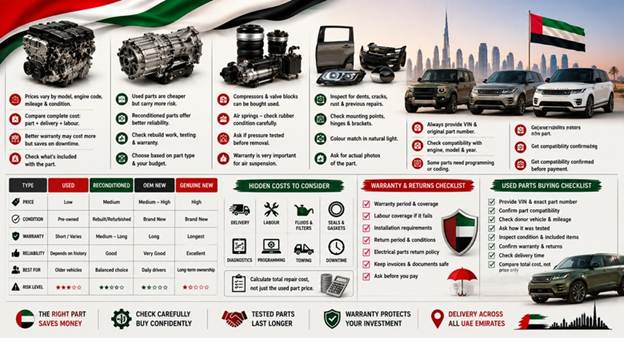
Warranty comparison:
| Factor | Used | Reconditioned |
| Initial price | Usually lower | Usually higher |
| Previous use | Yes | Yes |
| Internal work | Usually none | Should have documented work |
| Testing | Varies | Should be specified |
| Warranty | Varies | Often stronger |
| Risk | Depends on history | Depends on rebuild quality |
The crucial question:
What am I actually getting for the extra money?
If the reconditioned component has documented work, testing and a stronger warranty, the premium may be justified.
If the supplier cannot explain what was rebuilt, it may not be.
Before deciding:
Compare:
Purchase price + warranty + expected lifespan + labour exposure + downtime.
That gives you a much better answer than simply asking whether “used” or “reconditioned” is better.
Used vs Genuine Land Rover Parts: When Is the Saving Worth It?
There is a point where saving money becomes sensible.
There is also a point where saving money becomes false economy.
Finding that line is the real job.
Used body parts:
This is often where used genuine components make strong financial sense.
A clean genuine door, mirror or bumper can replace a damaged component without requiring you to buy a brand-new assembly.
Used lights:
Used headlights and tail lights can also be worthwhile, provided the specification and electronics are correct.
Check the actual component.
Used suspension components:
This depends on the part.
A used suspension arm with plenty of remaining life may be sensible for an older vehicle. A heavily worn component is not.
Used air-suspension parts:
A tested compressor or valve block can make sense, particularly on an older Land Rover.
For air springs, however, age and rubber condition deserve greater attention.
Used engines:
A used engine can offer a substantial saving compared with a new genuine replacement.
But the saving needs to be weighed against donor history, testing and warranty.
Used gearboxes:
The same applies to transmissions.
The cost of installation means a defective used gearbox can turn a parts saving into a much larger loss.
Electronic modules:
Be cautious.
A new genuine module can be expensive, but a used module may require programming or may not be compatible with the vehicle's software configuration.
Warranty makes a difference:
A used part with a clear warranty is easier to consider than an almost identical component sold with no meaningful protection.
Vehicle age matters:
For a high-mileage older Discovery, used genuine parts can be a sensible ownership strategy.
For a newer Velar still being kept long-term, the balance may lean towards new genuine or reputable OEM components for certain repairs.
Repair labour matters too:
If a part takes ten minutes to replace, experimenting with a used component may carry limited labour risk.
If the workshop needs half a day to access it, the equation changes.
A useful rule:
The more labour, programming and downtime involved, the more valuable a strong warranty becomes.
That's often more important than saving a few hundred dirhams on the component.
Used OEM vs Genuine Land Rover Parts: What Is the Difference?
This is one of those areas where online listings can make things unnecessarily confusing.
“Genuine”, “OEM”, “original”, “OEM quality” and “used genuine” are not interchangeable descriptions.
Genuine Land Rover part:
A genuine part is supplied under the vehicle manufacturer's parts system or branding.
It is generally the clearest route when exact specification and manufacturer-backed sourcing are priorities.
OEM part:
OEM means the component is associated with an original-equipment manufacturer, but the term needs context.
Ask who actually manufactured it.
That question cuts through a lot of vague advertising.
Used genuine part:
This means a genuine Land Rover component that has previously been installed on another vehicle.
It can be an excellent value proposition if the part is suitable and properly inspected.
Used OEM part:
A used component from an original equipment supplier can also be worthwhile.
Again, verify the manufacturer, part number and vehicle application.
“OEM quality”:
Be careful here.
It is a marketing description unless the supplier can identify the manufacturer and specification.
Price differences:
A used genuine part may cost less than a new OEM replacement.
A new aftermarket component may cost even less.
The right decision depends on the component and the risk involved.
For bodywork:
Used genuine body parts can be very attractive because fitment and finish may be closer to the original vehicle.
For brakes:
A reputable OEM or aftermarket manufacturer may offer a sensible new alternative.
Used brake wear components are generally not worth pursuing.
For suspension:
New OEM can be attractive where a used component's remaining life is uncertain.
For air suspension:
Used genuine or properly reconditioned components can make sense for older vehicles, but testing and warranty should be taken seriously.
For electronics:
Exact compatibility is critical.
A genuine used module may still need programming.
A new OEM component may offer a cleaner installation path.
Simple comparison:
| Option | Condition | Main attraction | Main concern |
| Genuine new | New | Exact manufacturer specification | Higher price |
| OEM new | New | Quality/value balance | Verify manufacturer |
| Used genuine | Previously used | Genuine at lower cost | Previous wear |
| Used OEM | Previously used | Lower price | Donor/history |
| Aftermarket | New | Broad choice | Quality varies |
The buying rule:
Don't ask only, “Is it OEM?”
Ask:
Who made it? What is the exact part number? Is it new or used? Does it match my VIN? What warranty comes with it?
Those questions tell you something useful.
Used Land Rover Parts Buying Checklist: What to Ask the Supplier
A good used-parts purchase should feel slightly boring.
That's a compliment.
There should be no mystery left by the time you pay.
1. Confirm the VIN:
Send the complete VIN, particularly for engines, gearboxes, electronic modules and suspension components.
2. Confirm the exact part number:
Ask the supplier to match the component against the original number or an approved replacement reference.
3. Ask about the donor vehicle:
Find out the model, year, engine, transmission and specification of the donor where possible.
4. Ask about mileage:
For engines, gearboxes and major mechanical components, donor mileage is useful information.
5. Ask how the part was tested:
Don't settle for “tested”.
Ask what was actually done.
6. Request actual photographs:
For body parts and visible components, ask for photographs of the exact item.
Not a catalogue picture.
7. Check condition:
Look for:
- Cracks
- Corrosion
- Leaks
- Previous repairs
- Damaged connectors
- Worn mounting points
- Missing hardware
8. Check what is included:
A used engine, gearbox, headlight or bumper may not include every component you expect.
Ask.
9. Confirm programming requirements:
For electronic modules, cameras, lights and some drivetrain components, coding or programming may be necessary.
10. Check the warranty:
Ask for the warranty period and exclusions.
11. Ask about installation requirements:
Some warranties require professional installation.
Know that before fitting.
12. Check the return policy:
Especially important for electrical and special-order parts.
13. Confirm delivery:
Ask whether the part is physically in the UAE and when it can actually be dispatched.
14. Calculate the complete cost:
Use:
Used part + delivery + labour + fluids + seals + programming + supporting parts.
That's the figure that matters.
15. Get compatibility confirmed:
Ask the supplier to confirm that the part matches the VIN and part number you provided.
Get it in writing where possible.
The final supplier test:
Before payment, you should be able to answer five simple questions:
What exactly am I buying?
Where did it come from?
Was it tested?
Will it fit my Land Rover?
What happens if it fails?
If the answers are vague, slow down.
There is no prize for ordering the wrong gearbox fastest.
UAE Online Buying, Suppliers and Final Checks
Where to Buy Used Land Rover Spare Parts Online in UAE
Buying used Land Rover parts online can be convenient. Very convenient, actually, when the vehicle is already sitting at a workshop and the mechanic is waiting for one particular engine, gearbox component, compressor or body panel.
But online buying removes one useful thing: you cannot physically walk around the part before paying.
So ask better questions.
Start with the VIN:
Send the complete VIN before discussing compatibility.
For major components, also provide the original part number if available.
Ask whether the part is actually in UAE stock:
“Available online” and “ready to dispatch from Dubai” are not necessarily the same thing.
Ask where the component is located and when it can realistically arrive.
For used engines:
Ask for:
Engine code + donor vehicle + mileage + testing + included components + warranty.
If the supplier cannot explain the engine's history, be cautious.
For used gearboxes:
Confirm:
Transmission code + donor vehicle + mileage + testing + fluid condition + warranty.
Also ask whether programming or adaptation will be required.
For air suspension:
Ask whether compressors, air springs or valve blocks were pressure-tested.
A clean photograph is nice.
It isn't evidence of good performance.
For body parts:
Request photographs of the actual component.
Check mounting points, colour, cracks, previous repairs, wiring and included hardware.
For electronic modules:
Ask whether the component has been tested and whether it can be programmed to your vehicle.
This question can save a very frustrating installation.
Check the warranty:
Find out how long the warranty lasts and what it covers.
Then ask whether professional installation is required.
Check returns:
Electrical and special-order parts can have different return conditions.
Read those conditions before payment, not after discovering the module is incompatible.
Check delivery:
If your Land Rover is off the road, delivery time matters.
A slightly cheaper part that takes a week longer may cost more once workshop downtime enters the picture.
Compare suppliers properly:
Send the same VIN, part number and specification to several suppliers.
Then compare their answers.
That gives you a genuine comparison rather than five different guesses.
Used Land Rover Parts in Dubai, Sharjah and Abu Dhabi: Where Should You Look?
The UAE is not a single parts market in practical terms.
Dubai, Sharjah and Abu Dhabi have different supplier mixes, while owners in Ajman, Ras Al Khaimah, Fujairah and Umm Al Quwain may benefit from searching across the wider country.
Dubai:
Dubai can offer a broad choice of used genuine, OEM and replacement Land Rover components.
The bigger choice is useful for uncommon Defender, Discovery and Range Rover parts, but it also means you should compare suppliers rather than accepting the first quotation.
Sharjah:
Sharjah can be useful when looking for used genuine components and value-focused replacement parts.
For second-hand items, ask for actual photographs and donor information.
Abu Dhabi:
Abu Dhabi owners can compare local availability against UAE-wide suppliers.
If a vehicle is already at a workshop, delivery time and stock location should form part of the decision.
Ajman:
Don't restrict yourself to suppliers physically based in Ajman.
A UAE-wide supplier may have the correct component already available and deliver it at a competitive total cost.
Ras Al Khaimah:
For RAK owners, delivery and warranty support become particularly important when sourcing unusual or high-value used components.
Fujairah:
A wider supplier search can be useful when local availability is limited.
Ask for realistic delivery timing.
Umm Al Quwain:
Again, compare the complete delivered price rather than choosing based purely on location.
What should you compare across the Emirates?
Not just the component.
Compare:
Part condition + donor history + testing + warranty + delivery + returns.
Example:
Supplier A may offer a used gearbox for less.
Supplier B may charge slightly more but provide documented mileage, testing, a longer warranty and next-day UAE delivery.
Supplier B may actually be the cheaper repair.
That's the sort of comparison worth making.
Used Land Rover Engines and Gearboxes: Hidden Costs Buyers Forget
The advertised price of a used engine or gearbox can look surprisingly attractive.
Then the workshop starts dismantling the vehicle.
That's when the second bill appears.
Engine removal:
Removing the original engine can involve significant labour, depending on model and access.
Engine installation:
The replacement unit then needs fitting, connection and testing.
That labour needs to be included when comparing used against reconditioned or new options.
Fluids and filters:
New oil, coolant, filters and other required fluids should normally be included in the repair calculation.
Seals and supporting parts:
Some seals, gaskets, hoses, mounts or related components may be sensible to replace while access is available.
Ignoring them can create another workshop visit later.
Programming and diagnostics:
Modern Land Rovers contain extensive electronic systems.
A major component replacement may require diagnostics, coding, adaptation or calibration.
Gearbox adaptation:
A replacement transmission may need specific procedures after installation.
Ask the workshop what is required before buying the unit.
Towing:
If the Land Rover cannot move under its own power, towing adds another cost.
That becomes particularly relevant when sourcing parts from another Emirate.
Delivery:
A used engine or gearbox is not exactly a small parcel.
Delivery charges can therefore affect the final figure.
Downtime:
This one gets overlooked.
If the vehicle is used for work, family transport or daily commuting, every additional day off the road has a practical cost.
Warranty-related labour:
Suppose the gearbox fails under warranty.
Who pays for removing it?
Who pays for installing the replacement?
Don't assume the answer.
Programming equipment:
Some repairs may require specialist diagnostic equipment or software access.
That can add to workshop charges.
Supporting components:
A used engine may require additional ancillaries.
A used gearbox may require seals or fluid.
A used headlight may need programming.
The advertised part rarely tells the whole story.
Complete-cost formula:
Used component + delivery + removal + installation + fluids + seals + diagnostics/programming + supporting parts + downtime.
Now compare it with the reconditioned or genuine option.
That's a proper decision.
Used Land Rover Parts Warranty and Returns: What Should Buyers Confirm?
Warranty is not a decorative sentence at the bottom of an invoice.
For a used engine, gearbox or air-suspension component, it can materially change the financial risk.
Warranty length:
Ask exactly how long the part is covered.
Don't assume “warranty included” means three months, six months or one year.
Get the actual period.
What does it cover?
Does the warranty cover complete component failure?
Does it cover leaks?
Does it cover electronic faults?
The wording matters.
Installation requirements:
Some suppliers require professional installation.
Others may specify particular fluids, filters or procedures.
Ignoring those requirements can affect the warranty.
Labour coverage:
This is a big one.
If a used gearbox fails after installation, the replacement part may be covered while the removal and refitting labour is not.
Ask.
Testing requirements:
Some warranties may require diagnostic evidence or inspection before a claim is accepted.
Understand the process in advance.
Returns period:
Find out how quickly an incorrect or defective part must be reported.
Special-order components can have different conditions.
Electrical components:
Ask specifically about electronic modules, lights, sensors and other electrical parts.
Some suppliers have stricter return policies once an electronic component has been installed or programmed.
Body parts:
Check whether painted or modified body panels can be returned.
A part that has been cut, painted or altered may fall outside normal returns.
Used engines:
Ask what caused the donor vehicle to be dismantled where that information is available.
Then check whether the warranty covers internal mechanical failure and what installation conditions apply.
Used gearboxes:
Confirm whether the warranty covers internal failure and whether fluid replacement, installation and adaptation must follow specified procedures.
Air-suspension components:
Ask whether the warranty covers air leaks, compressor performance or component failure.
A vague “tested” statement isn't enough.
Get everything documented:
Keep:
Quotation + invoice + part number + photographs + warranty terms + supplier messages.
If something goes wrong, documentation makes the conversation much easier.
Final Used Land Rover Buying Check
Before you pay for a used Land Rover engine, gearbox, air-suspension component or body part, stop for a minute.
Check the VIN.
Check the part number.
Check the donor.
Check the mileage.
Ask how it was tested.
Confirm exactly what is included.
Read the warranty.
Read the returns policy.
Then calculate delivery, labour, programming and supporting parts.
Only after that should you compare the used component with a reconditioned, OEM or genuine alternative.
Because a cheap Land Rover part is easy to find.
A correct, tested, properly warranted part that arrives on time and solves the problem first time is the thing worth paying for.
FAQs
Categories
- Audi
- BMW
- Car Accessories
- Car Tips
- Ford
- Land Rover
- Mazda
- Range Rover
- Top 10
- UAE Car Parts
- Used Car Parts
- Toyota
- Replacement Engines
- Nissan
- Hyundai
- Mitsubishi
- Volkswagen
- Honda
- Kia
- Chevrolet
- Dodge
- Jeep
- Subaru
- Renault
- Lexus
- Mercedes
- Suzuki
- Hummer
- Porsche
- Infiniti
- Peugeot
- GMC
- Mini
- Volvo
- Replacement Gearboxes
- MG
- Jaguar
- Skoda
- Cadillac
- Daihatsu
- Fiat
- German Car Parts
- Japanese Car Parts
- Aftermarket Car Parts
- Genuine Car Parts
- New Car Parts
- Reconditioned Car Parts
- European Car Parts
- American Car Parts
- Korean Car Parts
- British Car Parts
- Chinese Car Parts
- Sports/Exotic Car Parts
- Luxury Car Parts
- Performance Car Parts
- SUV/4x4 Spare Parts
- Truck Spare Parts
- EV Car Parts
- Hybrid Car Parts
- Auto Spare Parts in UAE
- Tesla
- Isuzu
- Ram
- Ferrari
- Bentley
- Lamborghini
- Genesis
- Maserati
- Lincoln
- Chrysler
- Opel
- Citroen
- SsangYong
- Seat
- McLaren
- Aston Martin
- Rolls Royce
- Maybach
- Alfa Romeo
- Bugatti
- Scion
- Abu Dhabi Car Parts
- Ajman Car Parts
- Al Khan Car Parts
- Al Sajaa Car Parts
- Deira Car Parts
- Dubai Car Parts
- Fujairah Car Parts
- Industrial Area 6 Car Parts
- Mussafah Car Parts
- Ras Al Khaimah Car Parts
- Sharjah Car Parts
- Umm Al Quwain Car Parts
- Acura
- BYD
- Chery
- Dacia
- DS
- Geely Emgrand
- EXEED
- GAC
- GAC Gonow
- Geely
- Gonow
- Great Wall
- Haima
- Haval
- Holden
- Iveco