Used Maserati Spare Parts in UAE: What Buyers Must Check Before Ordering
September 15, 2026
The Checks That Matter Before You Pay
A cheap used Maserati part can become an expensive mistake
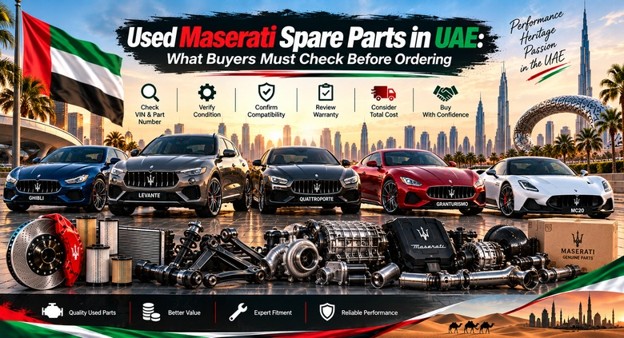
Used Maserati parts can make financial sense in the UAE. They can also turn into a rather ugly invoice when the wrong specification is fitted, an electronic part needs coding, a supposedly low-mileage engine turns out to have an unclear history, or the replacement fails because the original fault was never diagnosed properly.
That is the central problem.
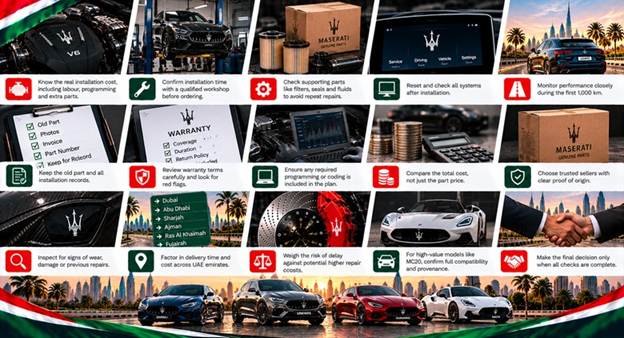
The price shown beside a used part is only the beginning. Before ordering, match the VIN, exact model, model year, engine, drivetrain, trim, transmission and original part number. Then establish where the part came from, what mileage the donor vehicle had, whether it was accident-damaged, whether it was tested, and what happens if it fails after installation.
Maserati itself describes its Genuine Parts as being manufactured to original technical qualifications and designed for integration, safety and performance. That does not automatically make every used part bad, but it does explain why fitment should never be treated as a casual visual comparison.
The buying checklist should be short
Before sending payment, have these details ready:
- VIN
- exact Maserati model
- model year
- engine specification
- transmission
- left- or right-hand-drive specification where relevant
- GCC or imported vehicle status
- original part number
- replacement or superseded number, if applicable
- donor vehicle mileage
- donor accident history
- photographs of the actual part
- test evidence for mechanical parts
- warranty terms
- return conditions
- delivery charge
- installation and programming requirements
If a seller cannot answer basic questions about a high-value used engine, gearbox, ECU, turbocharger or electronic module, do not let a low price rush the decision.
Identify the Maserati before identifying the part
“Levante” is not enough.
Neither is “Ghibli V6”.
The used Maserati spare parts in UAE may vary according to production year, engine, trim, transmission, drivetrain, brake package, suspension configuration or electronic specification. Maserati's UAE catalogue structure itself separates models such as Ghibli, Levante and Quattroporte, with dedicated model documentation.
The workshop should therefore decode the VIN and compare the vehicle's build specification with the donor part.
This is especially important when buying online from Dubai for installation in Abu Dhabi, Sharjah or another emirate. Distance changes nothing about compatibility.
VIN beats a photograph
Two parts can look almost identical and still be wrong for each other.
A photograph can show the housing, connector, colour and general shape. It cannot reliably establish the complete electronic calibration, internal specification or supersession history.
Give the seller the VIN and ask for written confirmation that the part number matches that vehicle.
For expensive items, keep that confirmation.
If the seller later says, “It looked the same in the picture,” you have already learned something useful about the quality of the transaction.
Check the part number twice
Maserati part numbers can be more useful than model names when identifying a used part.
Look at the number physically printed or stamped on the part where possible. Compare it with the number in the vehicle's parts documentation or the workshop's catalogue lookup. Then ask whether the number has been superseded.
A superseded number is not automatically a problem. Manufacturers can replace an older part number with a revised one. The important question is whether the new number is officially applicable to your vehicle.
Do not accept “same model, so it fits” as technical evidence.
Ghibli, Levante and Quattroporte Need Different Thinking
Used Ghibli parts
The Ghibli is particularly easy to misidentify because buyers often search simply for “Ghibli parts” when the actual requirement is much narrower.
Engine family, model year, trim and equipment can alter fitment. A brake part, cooling part, electronic module or suspension item should be matched to the exact vehicle rather than the badge.
Maserati describes the Ghibli as a luxury sport sedan, and its UAE documentation remains organised around the specific Ghibli range rather than one universal specification.
For a used Ghibli part, ask for:
- donor year
- donor engine
- part number
- donor mileage
- accident location
- photographs
- testing information
- warranty duration
That little bundle of information is far more useful than “excellent condition”.
Used Levante parts
The Levante introduces another wrinkle: SUV-related wear.
Suspension parts, steering parts, cooling equipment, wheels and underbody items may have lived a harder life than an equivalent-looking component from a lightly driven sedan. Dubai kerbs, rough access roads, construction areas and long highway use all leave different clues.
Maserati identifies Levante as its SUV range, with separate model documentation and ownership material.
For used suspension parts, inspect mounting points, bushes, threads, bends, corrosion and evidence of previous impact.
A low odometer reading does not cancel a hard accident.
Used Quattroporte parts
The Quattroporte is another model where model-year identification matters.
Engine, transmission, electrical and interior parts can differ across generations. The right-looking dashboard module, lamp, control unit or suspension part may still require exact specification matching.
If the donor car was involved in a front-end collision, be especially cautious with:
- steering parts
- cooling parts
- wiring
- radar/sensor equipment
- headlamps
- engine accessories
- front suspension
- structural mounting hardware
A donor vehicle's accident history is not background information. It is part of the technical history of the part you are buying.
GranTurismo and GranCabrio considerations
GranTurismo parts deserve their own identification process because Maserati has produced substantially different generations and powertrain configurations.
Do not order a used engine-related, electronic, body or braking part using only “GranTurismo” as the search description.
The current Maserati range also includes petrol and electric variants, making powertrain identification even more important for newer vehicles.
For older GranTurismo cars, age itself becomes a buying factor. Rubber seals, hoses, wiring insulation, connectors, mounts and cooling-system parts can deteriorate even when mileage is modest.
MC20 is not a normal used-parts purchase
The MC20 requires considerably more caution.
Maserati's UAE specification identifies the MC20 with a 3.0-litre V6, 630 hp and 730 Nm, a dry-sump lubrication system, rear-wheel drive and a carbon-fibre monocoque.
That combination changes the risk calculation.
A used engine, carbon-fibre body part, electronic control unit, suspension part or performance braking item should have traceable provenance. For a high-value MC20 part, saving AED on the purchase price means very little if installation reveals damage or incompatibility.
This is one place where “used” and “cheap” should never be treated as synonyms.
Genuine, OEM, Used and Reconditioned Are Not the Same
What “genuine” means
Genuine Maserati parts are designed to the manufacturer's original technical requirements. Maserati specifically says its Genuine Parts are developed for correct integration, safety, performance and reliability.
That is a technical category, not simply a marketing adjective.
If a seller describes a used part as genuine, ask whether it is actually a previously installed Maserati original part, rather than an aftermarket reproduction being described loosely.
OEM needs a little caution
OEM is often used casually in the UAE parts market.
The term can mean an original-equipment manufacturer supplying a part to the vehicle manufacturer, but sellers sometimes use “OEM” simply to make an aftermarket item sound more authoritative.
Ask:
- Who manufactured it?
- What is the manufacturer's part number?
- Is it new or used?
- Does it carry its own manufacturer identification?
- Is the part number applicable to the vehicle?
The label alone is not enough.
Used versus reconditioned
A used part is generally a previously installed part sold again.
A reconditioned part has usually been inspected, cleaned, repaired or rebuilt to some defined standard.
Those are different propositions.
A used turbocharger with unknown shaft condition is not equivalent to a professionally rebuilt turbocharger with documented inspection. Likewise, a used gearbox pulled from a donor vehicle is not equivalent to a transmission rebuilt with measured clearances and replacement wear items.
Ask what “reconditioned” actually involved.
Aftermarket parts can be sensible in the right place
Aftermarket does not automatically mean poor quality.
For simple service items, there may be reputable alternatives. The risk rises when the part controls safety, electronics, calibration, thermal management or a highly specific mechanical interface.
For a Maserati, I would be particularly conservative with:
- braking electronics
- airbags and restraint parts
- ECUs
- immobiliser-related modules
- complex sensors
- steering electronics
- high-performance suspension parts
- carbon-fibre structural parts
The cheaper option is not automatically the cheaper repair.
A practical comparison
| Option | Main advantage | Main risk | Best use |
| Genuine new | Strongest specification confidence | Highest purchase price | Critical/high-value repairs |
| OEM new | Potentially good quality | Terminology can be abused | Verified manufacturer |
| Used genuine | Lower cost, original fitment | Unknown history | Suitable mechanical/body parts |
| Reconditioned | Can restore expensive parts | Quality depends on rebuild standard | Turbo, gearbox and selected assemblies |
| Aftermarket | Price and availability | Quality/fitment variation | Appropriate non-critical applications |
Donor History Is the Missing Question
Ask where the donor car came from
“Removed from a running vehicle” sounds reassuring.
It is not enough.
Find out whether the donor car was:
- accident damaged
- flood damaged
- mechanically failed
- exported after a write-off
- dismantled because of insurance damage
- maintained regularly
- stored outdoors
- dismantled recently or years ago
A part can be original and still be unsuitable.
Accident position matters
Suppose you are buying a front cooling pack from a Levante.
If the donor suffered a rear collision, that history may be relatively reassuring.
If the donor suffered a severe frontal impact, the same cooling pack deserves much closer examination.
Look for bent fins, damaged mounts, crushed connections, coolant staining, repaired brackets and broken sensor mounts.
The accident map of the donor vehicle can tell you more than a seller's adjective.
Flood history deserves immediate caution
Flood-damaged Maserati electronics are a particularly uncomfortable proposition.
Water can enter connectors, modules, wiring channels and hidden areas. The car may initially operate and develop faults later.
Be extremely cautious with used:
- ECUs
- body-control modules
- infotainment units
- instrument clusters
- wiring harnesses
- seat modules
- lighting modules
- sensor assemblies
If the donor has flood history, walk away from electronic parts unless the testing and provenance are exceptionally strong.
Donor mileage is useful, but incomplete
A donor odometer reading gives you one clue.
It does not tell you:
- how the car was driven
- whether it was maintained
- whether it overheated
- whether it spent years parked
- whether it was modified
- whether the donor's mileage is documented
A 45,000-km Levante driven aggressively around Dubai can have a different mechanical history from a 90,000-km vehicle that was carefully maintained.
Mileage is evidence. It is not a verdict.
Ask for photographs of the actual part
Stock photographs are almost useless for expensive used parts.
Request photographs showing:
- part-number label
- connector faces
- mounting points
- casting marks
- seals
- plugs
- visible wear
- damage
- corrosion
- fluid contamination where relevant
For body panels, ask for close-ups of repair marks and mounting tabs.
For electronics, photograph the complete label rather than cropping away the identifying information.
Mechanical Testing Before Ordering
Used engines need more than an odometer
If you are buying a used Maserati engine, the seller should be able to provide more than “low mileage”.
Ideally, establish:
- donor VIN or traceable donor information
- engine identification
- mileage evidence
- compression results
- leak-down results where practical
- oil-pressure information where available
- cooling-system history
- reason for dismantling
- photographs before removal
- warranty terms
If the engine was removed from an accident-damaged car, establish whether it was running before dismantling.
Compression testing can expose a weak engine
Compression testing is not a magic certificate, but it can identify a cylinder that is behaving differently from the others.
For a used engine, the important question is not simply “Did it pass?”
Look for consistency between cylinders and investigate any meaningful imbalance according to the engine's specification and test method.
A low cylinder can point towards valve sealing, piston-ring or other internal problems. A wet compression test can sometimes help distinguish ring-related leakage from valve-related leakage, but diagnosis should be performed by a competent technician rather than inferred from one number.
Do not accept a seller's handwritten “compression good” note as a full engine inspection.
Leak-down testing tells a different story
Leak-down testing introduces compressed air into a cylinder and assesses where the pressure is escaping.
Air heard at the intake can indicate intake-valve leakage. Air at the exhaust suggests exhaust-valve leakage. Air movement through the crankcase can point towards piston-ring or cylinder-related leakage.
For an expensive used Maserati engine, this additional test can be worth far more than another superficial photograph.
The exact acceptable figures depend on the engine, test equipment and procedure, so the workshop should record the readings rather than simply declaring the engine healthy.
Used gearboxes require their own inspection
A gearbox should not be bought merely because the donor vehicle had a similar engine.
Check:
- exact transmission identification
- donor mileage
- fluid condition
- external leakage
- casing damage
- mounting points
- input/output shaft condition
- mechatronic or electronic identification
- diagnostic history
- reason for removal
If the gearbox has electronics or calibration requirements, include programming in the repair plan before ordering.
Test turbochargers before trusting them
A used turbocharger deserves careful inspection.
Look for shaft play, blade damage, oil contamination, cracked housings, wastegate or actuator issues and evidence of overheating.
Do not treat minor external dirt as the decisive factor. The internal condition matters more.
For a performance Maserati, turbocharger matching also needs to account for the exact engine configuration and calibration.
Electronics Are Where Cheap Parts Become Expensive
An ECU is not just a box
A used electronic control unit may physically plug into the vehicle and still not be ready to operate.
Depending on the system, there may be coding, programming, configuration, immobiliser pairing or software requirements.
That means the true cost is:
part + delivery + diagnostic scan + programming + installation + possible additional calibration
Ask the workshop before ordering whether the specific module can be installed and configured.
Infotainment and display modules
Interior electronics can look simple while hiding complicated software relationships.
A used screen, control module or infotainment unit may need coding or configuration after installation. Some faults may also originate upstream in wiring, power supply or communication networks.
Do not order a replacement screen merely because the screen is blank.
First establish whether the screen itself is faulty.
Headlamps can be surprisingly complicated
Modern Maserati lighting systems can incorporate control electronics, sensors and vehicle-specific configuration.
Before ordering a used headlamp, check:
- left/right side
- exact model
- model year
- lamp technology
- connector arrangement
- control module
- mounting points
- previous repair
- condensation or water ingress
A visually perfect lamp can still contain an electronic fault.
Sensors need exact application matching
A sensor should be identified by its application, not merely its connector.
Engine sensors, pressure sensors, parking sensors, wheel-speed sensors and other devices can have different calibrations or physical specifications.
When the diagnostic fault code points to a sensor, test the wiring and power supply first.
Otherwise you can spend money replacing the innocent part.
Programming must be priced before purchase
This is one of the easiest hidden costs to overlook.
Ask the workshop:
“If I bring this used module, what exactly has to happen before the car is ready to drive?”
The answer might include programming, coding, calibration, diagnostic clearing or adaptation.
Put those costs into the buying decision before comparing a used part with a new one.
UAE Heat Changes the Conversation
Heat is hard on cooling systems
The UAE climate places unusual demands on cooling and air-conditioning systems.
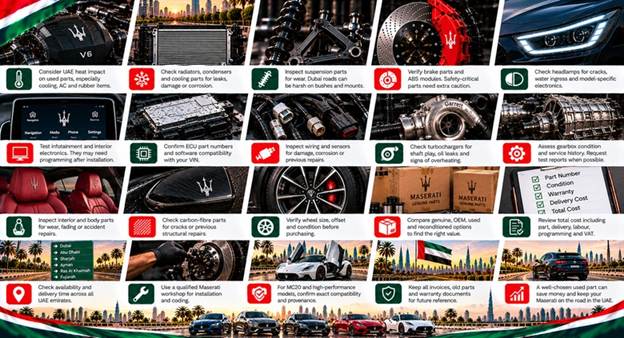
Long periods of high ambient temperature, traffic queues and prolonged air-conditioning use mean that cooling efficiency matters. A used radiator with damaged fins may appear acceptable on the workbench and become a problem under load.
Inspect:
- fins
- tanks
- mounting points
- hoses
- connectors
- coolant staining
- fan condition
- condenser condition
A replacement radiator should not be judged only by whether it physically fits.
Dubai traffic is different from open-road mileage
A Maserati showing 60,000 km may have accumulated many hours of idling, crawling and repeated heat cycles.
Another car showing 80,000 km may have spent much of its life on open highways.
That distinction matters for:
- cooling systems
- brakes
- suspension
- air-conditioning
- transmission
- engine mounts
- battery systems
Mileage alone cannot tell the whole UAE story.
Storage matters too
A low-mileage Maserati that spent years parked outside can have ageing rubber, seals, batteries, plastics and electrical connections.
Look for:
- cracked rubber
- brittle connectors
- corrosion
- tyre ageing
- battery history
- fluid contamination
- sun damage
- perished seals
“Only 30,000 km” is not enough information.
GCC specification versus imported vehicles
A GCC-specification car may have different equipment, calibration or market-specific configurations from an imported example.
Imported Maseratis are not automatically bad buys. They simply require more identification work.
Before ordering a used part, confirm whether the donor and recipient are both GCC specification or whether the difference affects the specific part.
For electronic, cooling, lighting and body-related parts, this check is particularly worthwhile.
UAE-wide delivery changes the landed cost
A part advertised cheaply in Dubai may not be the cheapest installed in Abu Dhabi.
Calculate:
Part price + delivery + VAT where applicable + inspection + labour + programming + consumables + possible return shipping
The same logic applies to Sharjah, Ajman, Ras Al Khaimah, Fujairah and Umm Al Quwain.
The cheapest listing is not necessarily the cheapest repair.
What Should You Pay?
Part price and repair cost are different numbers
A used Maserati part might cost AED 2,500.
That does not mean the repair costs AED 2,500.
If installation requires several hours of labour, programming, fluids, seals, diagnostic work or additional supporting parts, the final bill can be substantially higher.
Keep these figures separate when comparing offers.
UAE labour should be quoted separately
A useful quotation should distinguish:
| Cost item | What to ask |
| Used part | Exact condition and part number |
| Delivery | Door-to-workshop or collection |
| Inspection | Included or separate |
| Labour | Hours or fixed job price |
| Diagnostics | Before/after installation |
| Programming | Required or not |
| Consumables | Fluids, seals, clips, fasteners |
| Warranty | Part only or labour too |
| VAT | Included or excluded |
This makes two quotations genuinely comparable.
Indicative labour logic by emirate
Labour varies significantly by workshop, equipment and technician skill, so avoid treating a single UAE-wide rate as a fact.
| Area | Practical comparison |
| Dubai | Wide range; specialist European workshops can charge a premium |
| Abu Dhabi | Specialist labour can be higher for complex diagnostic work |
| Sharjah | Often more competitive for mechanical work |
| Ajman | Can be competitive, but specialist capability varies |
| Ras Al Khaimah | Fewer specialist options for unusual Maserati systems |
| Fujairah | Transport and specialist access can affect total cost |
For a complicated Maserati repair, technician capability is usually more important than saving a small amount on the hourly rate.
Use real market references carefully
Maserati's UAE 2025 ownership-services material provides useful evidence of how expensive official ownership can become. For example, the published Levante range shows maintenance and brake-package pricing that varies by model and package, while GranTurismo and other models have their own published service-programme prices. These are not used-Maserati-part prices, but they demonstrate why a low-cost replacement part should be assessed against the complete repair rather than viewed in isolation.
That distinction matters.
An official service package is not a benchmark for a used part. It is context for the scale of ownership costs.
VAT and small extras can move the final figure
UAE quotations sometimes differ because one includes VAT and another does not.
Then there are the annoying little additions:
- coolant
- oil
- seals
- clips
- bolts
- diagnostic time
- programming
- delivery
- return shipping
- inspection
- disposal charges
None is dramatic individually.
Together, they can change the decision.
Repair, Replace or Walk Away?
Repair the original part when the failure is narrow
If the original Maserati part can be professionally repaired and its underlying structure remains sound, repair may beat replacement.
This can apply to selected mechanical assemblies, wiring faults, connectors and certain electronic problems.
But diagnosis must come first.
Replacing a module because a warning light appeared is not diagnosis.
Replace the used part when the original is beyond sensible repair
A used genuine part can make sense when:
- the original is physically destroyed
- repair cost is disproportionate
- the donor history is credible
- the part has been tested
- the part number matches
- the warranty is clear
This is particularly attractive for older Maseratis where the value of the car does not justify replacing every part with a brand-new item.
Walk away when the history is vague
There are certain phrases that should slow you down:
“Removed from a good car.”
“Should fit.”
“Never tested.”
“No returns on electrical parts.”
“Mileage unknown but looks clean.”
“Same engine, so compatible.”
One phrase may be harmless.
Several together? Find another part.
Engine replacement versus replacing the vehicle
For an older Ghibli, Quattroporte or Levante, engine replacement needs a broader calculation.
Compare:
| Question | Replace engine | Replace vehicle |
| Current car body | Excellent | Irrelevant |
| Transmission | Healthy | Unknown |
| Suspension | Healthy | New vehicle may reset wear |
| Electronics | Stable | New vehicle may still have issues |
| Known history | Strong | Replacement car may have hidden history |
| Repair cost | High | Purchase cost higher |
| Future resale | Depends on documentation | Depends on replacement car |
| Emotional value | Often retained | Lost |
If the existing car is structurally good and the rest of the drivetrain is healthy, an engine replacement can still be rational.
If the engine, gearbox, suspension, electronics and cooling system are all approaching major expenditure, the arithmetic changes quickly.
Cost of delay is not always dramatic — until it is
A noisy wheel bearing is one thing.
A cooling-system warning, oil-pressure issue, overheating event or transmission fault is different.
Continuing to drive a car with a developing mechanical problem can turn a replaceable part into a damaged assembly.
For a Maserati, the sensible approach is not “repair everything immediately”. It is “understand which faults become more expensive if ignored”.
Ordering, Installation and Aftercare
Installation time depends on the part
A simple service part can be fitted quickly.
A gearbox, engine, major suspension assembly or electronic system can take considerably longer because the job may involve diagnosis, removal, fluid replacement, programming, calibration and road testing.
Ask for an estimated timeline before ordering.
Supporting parts can make or break the repair
Replacing one failed part without checking the parts around it is often false economy.
Examples:
A cooling problem may require hoses, clamps, coolant and inspection of the fan system.
A suspension repair may require checking adjacent bushes, mounts and alignment.
An engine replacement should prompt inspection of mounts, hoses, belts, cooling parts, fluids and other accessible service items.
Do not automatically replace everything.
Check everything that could reasonably affect the new part.
The first 1,000 km matters
After a major used-part installation, the first period of driving should be treated as a monitoring phase.
For an engine:
- check fluid levels
- monitor temperature
- watch for warning lights
- listen for abnormal noises
- inspect for leaks
For a gearbox:
- monitor shift quality
- check for leaks
- note warning messages
- watch for abnormal vibration
For suspension:
- listen for knocks
- check steering behaviour
- confirm alignment
- inspect fasteners after the workshop's recommended interval
For electronics:
- test every related function
- confirm warning lights stay off
- check whether intermittent faults return
Keep the old part
Do not let the old part disappear immediately.
For a warranty dispute, the failed part can be useful evidence. It also helps establish what was actually replaced.
Ask the workshop to identify the removed part on the invoice.
Keep photographs where appropriate.
Documentation protects resale value
A future buyer is much more comfortable with:
- VIN
- invoice
- part number
- mileage at installation
- donor information
- workshop details
- diagnostic report
- warranty
- installation date
than with:
“Engine replaced, trust me.”
The difference is substantial.
Warranty red flags
Read the warranty carefully.
Watch for:
- part-only warranty
- no labour coverage
- no return after installation
- no coverage if programming is required
- very short inspection window
- no coverage for overheating
- exclusions for incorrect installation
- exclusions for modified vehicles
- no written donor information
Maserati's own warranty material shows why the distinction between part warranty, installation and maintenance matters. Its published programmes can also impose eligibility and maintenance requirements, and regional terms vary.
A used-part seller will naturally have different terms, so read those terms rather than assuming the vehicle's manufacturer warranty covers the used part.
A warranty is not a substitute for testing
This is worth saying twice.
A 30-day warranty does not make an untested engine a good purchase.
A 90-day electronic warranty does not make a flood-damaged module sensible.
A six-month gearbox warranty does not remove the need to confirm the exact transmission specification.
Warranty is a safety net.
Testing is the first line of defence.
When an authorised route is worth considering
For high-value, technically complicated or warranty-sensitive repairs, an authorised Maserati route may be financially sensible even when its initial quote is higher.
Maserati states that its warranty and maintenance programmes use trained technicians and Genuine Parts, while its UAE warranty-extension process asks for VIN and current mileage before determining the relevant service request.
That does not mean every used part should be rejected.
It means the buyer should understand what level of support is being sacrificed when choosing the cheaper route.
When an independent specialist makes sense
A competent independent Maserati specialist can be particularly useful for older cars, diagnostic work and repairs outside dealer warranty structures.
The important word is competent.
Look for evidence of:
- Maserati diagnostic capability
- experience with the relevant model
- proper lifting equipment
- electronic programming capability
- documented quotations
- written warranty terms
- willingness to diagnose before replacing parts
A cheap workshop that guesses can become more expensive than a specialist very quickly.
Buying online requires more discipline
Online ordering removes some of the physical inspection process.
So replace that missing inspection with documentation.
Ask for the exact part number, photographs, donor information, mileage, testing evidence, warranty and return terms before payment.
If the seller refuses to provide basic identification, the convenience of online buying has already disappeared.
Fitment support should be specific
Good fitment support sounds like:
“Your VIN corresponds to this part number, and the superseded number is also compatible.”
Weak fitment support sounds like:
“Yes, it is for Maserati.”
That difference matters.
When buying through PartFinder UAE, the same principle applies: provide the complete vehicle information rather than relying on the model badge alone.
A used part should be evaluated by risk, not just price
Think about the consequence of failure.
A used door handle failing is irritating.
A used brake-related part failing is a safety issue.
A used ECU failing can leave the vehicle immobilised.
A used engine failing can create another major repair bill.
This is why the acceptable discount should increase with confidence, not simply with the age of the part.
First-year ownership cost after a major used-part repair
Do not stop the calculation when the vehicle leaves the workshop.
For a major repair, consider:
Initial repair + follow-up servicing + likely supporting parts + warranty risk + downtime + resale effect
A used engine may save a substantial amount initially while increasing the importance of documentation and future maintenance.
Conversely, a properly tested used gearbox with clear provenance can provide excellent value if the rest of the vehicle is sound.
Resale value depends heavily on the story
Luxury-car buyers are suspicious of unexplained major repairs.
That is understandable.
A Maserati with a documented replacement engine, invoices, compression results, donor details and professional installation can be easier to sell than one with an undocumented engine swap.
The repair itself is not always the biggest problem.
The missing paperwork often is.
The final ordering decision
Before ordering a used Maserati spare part in the UAE, the buyer should be able to answer five questions without hesitation:
Is it the correct part?
Where did it come from?
Has it actually been tested?
What is the complete installed cost?
What happens if it fails?
If the answer to one of those is vague, stop.
Get the VIN checked again. Ask for the part number. Request the donor history. Get the workshop to explain the installation and programming requirements. Then compare the total cost with a new, genuine, OEM or professionally reconditioned alternative.
That is the sensible way to buy used Maserati parts in Dubai, Abu Dhabi, Sharjah or elsewhere in the UAE. The objective is not to find the cheapest part sitting on a shelf. It is to find the lowest-risk part at a sensible total cost.
Buyer Decision Matrix
| Situation | Used part | Reconditioned | New/Genuine |
| Cosmetic body part | Strong option | Usually unnecessary | Depends on rarity |
| Simple non-critical service part | Possible | Rarely needed | Strong option |
| Suspension part | With inspection | Often attractive | Best confidence |
| Turbocharger | Only with testing | Strong alternative | Lowest uncertainty |
| Gearbox | Only with history/testing | Often worth comparing | Highest confidence |
| ECU/module | Risky without programming support | Specialist-dependent | Usually safer |
| Engine | Only with extensive testing | Strong alternative | Best but costly |
| Safety-critical part | Conservative choice | Depends on certification | Preferred |
Workshop Questions to Ask Before Payment
- What is the exact part number?
- Does the number supersede another number?
- Has the part been tested?
- What was the donor vehicle?
- What was the donor mileage?
- Was the donor accident damaged?
- Was it exposed to flood or water damage?
- Is the part electronically coded?
- Does it require programming?
- Does installation require additional parts?
- What is the warranty period?
- Does the warranty cover labour?
- How long is the return window?
- Who pays return shipping?
- Is VAT included?
- What is the expected delivery time?
FAQs
Categories
- Audi
- BMW
- Car Accessories
- Car Tips
- Ford
- Land Rover
- Mazda
- Range Rover
- Top 10
- UAE Car Parts
- Used Car Parts
- Toyota
- Replacement Engines
- Nissan
- Hyundai
- Mitsubishi
- Volkswagen
- Honda
- Kia
- Chevrolet
- Dodge
- Jeep
- Subaru
- Renault
- Lexus
- Mercedes
- Suzuki
- Hummer
- Porsche
- Infiniti
- Peugeot
- GMC
- Mini
- Volvo
- Replacement Gearboxes
- MG
- Jaguar
- Skoda
- Cadillac
- Daihatsu
- Fiat
- German Car Parts
- Japanese Car Parts
- Aftermarket Car Parts
- Genuine Car Parts
- New Car Parts
- Reconditioned Car Parts
- European Car Parts
- American Car Parts
- Korean Car Parts
- British Car Parts
- Chinese Car Parts
- Sports/Exotic Car Parts
- Luxury Car Parts
- Performance Car Parts
- SUV/4x4 Spare Parts
- Truck Spare Parts
- EV Car Parts
- Hybrid Car Parts
- Auto Spare Parts in UAE
- Tesla
- Isuzu
- Ram
- Ferrari
- Bentley
- Lamborghini
- Genesis
- Maserati