Used Mazda Spare Parts in UAE: What Owners Should Check Before Buying
August 25, 2026
Identifying the Correct Used Mazda Part
How to Check a Used Mazda Spare Part Before Buying
The used Mazda spare parts in UAE can look perfectly respectable on a shelf and still be the wrong purchase.
That is the first trap.
Don't start with the price. Start with identification.
A Mazda 3, Mazda 6, CX-3, CX-5, CX-9 and MX-5 can have parts that look remarkably similar across different years or specifications, yet the mounting points, connectors, dimensions, software requirements or internal specification may differ.
Start with the vehicle
Give the supplier the full VIN.
Then provide the model, model year, engine and transmission.
If you're buying an electrical module, gearbox, engine assembly or body part with integrated electronics, add a photograph of the original part.
More information at the beginning usually means fewer problems at the end.
Check the actual part
Don't rely entirely on a catalogue photograph.
Ask for photographs of the actual used part, particularly when the item is expensive.
Look at:
Casting marks + labels + connectors + mounting points + physical damage + corrosion + cracks + previous repairs.
A clean photograph can reveal far more than a generic listing.
Ask where it came from
For a used engine or gearbox, ask about the donor vehicle.
For a body panel, ask whether the donor vehicle suffered impact damage in the same area.
For an electronic module, ask whether it came from a running vehicle and whether it was tested before removal.
The history doesn't need to be perfect.
It needs to be understandable.
Check for previous repairs
A used part may have already been repaired.
That isn't necessarily a reason to reject it.
But you should know.
Look for weld marks, replacement housings, repaired mounting tabs, fresh paint, sealant or other signs that the part has been worked on.
Inspect mounting points
This sounds boring.
It isn't.
A used bumper with a perfect painted surface but broken mounting tabs can become a frustrating purchase.
The same applies to suspension parts, lights, mirrors and engine accessories.
Check connectors and wiring
Electrical connectors should not be cracked, burnt or heavily corroded.
If wiring is included, inspect the terminals.
A replacement sensor is useless if the connector on the vehicle is damaged.
Ask what is included
A photograph can make a used engine appear complete when the quotation actually covers only the long block.
Likewise, a used mirror may not include the motor, indicator or wiring.
Confirm: Complete assembly or bare part?
That single question can change the final price.
Ask about testing
Testing should match the part.
A used engine needs different checks from a used headlight.
A gearbox needs different evidence from a door.
Don't accept the same vague statement — “tested and working” — for everything.
Check the warranty
Used-part warranties vary widely.
Ask exactly what is covered and for how long.
For major mechanical parts, ask whether labour is included if the replacement fails.
That detail matters because removing and reinstalling an engine or gearbox can cost a substantial amount.
Calculate the installed cost
A used part priced at AED 500 isn't necessarily cheaper than a new part priced at AED 800.
If the used unit requires extra preparation, fitting or repeated labour, the saving can disappear.
Compare: Part + delivery + labour + diagnostics + programming + supporting parts + warranty.
That's the number worth making the decision on.
Mazda VIN Verification: How to Confirm the Correct Part
The VIN is not just paperwork.
For used Mazda parts, it can be one of the most useful ways to narrow down compatibility.
But it has limits.
The VIN helps identify the vehicle.
It does not diagnose the failed part.
Give the complete VIN
Don't send a partial VIN when the supplier asks for the complete number.
A partial identifier may not provide enough information to distinguish specifications.
For an expensive part, don't guess.
Match the model
Confirm whether the vehicle is a Mazda 3, Mazda 6, CX-3, CX-5, CX-9 or MX-5.
Then confirm the generation and model year.
“CX-5” alone is not enough information for every part.
Confirm the engine
Engine specification can affect filters, sensors, cooling components, accessories and other engine-related parts.
If you're buying an engine assembly, this becomes critical.
Confirm the transmission
Transmission specification matters when purchasing a gearbox, transmission-related sensor, mount or control unit.
Two vehicles from the same model family can still require different transmission parts.
VIN and body parts
VIN verification can also help with bumpers, lights and other body-related parts where equipment levels differ.
Parking sensors, cameras and lighting hardware can change what is actually required.
VIN and electronic modules
For modules, VIN verification becomes even more important.
The part may physically connect and still require programming or may not be compatible with the vehicle's software configuration.
Ask the supplier to confirm
Don't simply send the VIN and assume the seller has checked it.
Ask for explicit confirmation.
Ask: Does this exact used part match my VIN, model year, engine and transmission?
For expensive parts, keep the confirmation.
VIN isn't enough by itself
A supplier can identify the correct application and still sell you a damaged used part.
That's why identification and condition must be treated as separate checks.
First establish that the part is correct.
Then establish that the part is worth buying.
How to Check a Mazda Part Number Before Ordering
The part number is often the fastest route to eliminating compatibility confusion.
Not always.
But often.
Photograph the original number
If the original part has a label or stamped reference, take a clear photograph.
Include the entire label rather than typing a few characters manually.
One misplaced letter or digit can send the search in the wrong direction.
Compare the complete reference
Don't compare only the first few characters.
Check the complete number where possible.
For used electronic parts, this is particularly important.
Superseded numbers
Sometimes the original Mazda part number has been replaced by a newer reference.
That doesn't automatically mean the supplier has given you the wrong part.
Ask whether the newer number supersedes the original and whether it is confirmed for your vehicle.
Part number versus appearance
Two parts can look identical and still have different specifications.
This happens frequently enough that visual similarity should never be your final compatibility test.
Electronic components
For sensors, modules and control units, compare the exact reference.
Then ask about programming.
A matching number is useful.
It still doesn't eliminate every installation requirement.
Gearbox identification
For a used transmission, check the transmission code in addition to the general Mazda model.
A gearbox from another Mazda isn't automatically suitable because it bolts into a similar-looking vehicle.
Engine components
For engine parts, compare the original reference against the supplier's number and the vehicle VIN.
If the seller says the part has been superseded, ask for the replacement reference.
Used body parts
Part numbers can be useful for lights, mirrors and other equipment-heavy body parts.
For a bare bumper or door shell, physical specification and included hardware become equally important.
Before ordering
Check: Original part number + supplier part number + VIN compatibility + condition + included hardware.
Then confirm the final price.
Used Mazda Spare Parts by Model: Mazda 3, Mazda 6, CX-3, CX-5, CX-9 and MX-5
The phrase “used Mazda spare parts” covers six very different ownership profiles in this article.
A Mazda 3 commuter.
A Mazda 6 family sedan.
A CX-3 used mainly around town.
A CX-5 doing daily family duty.
A larger CX-9 carrying passengers and luggage.
An MX-5 owned because driving matters more than boot space.
Their parts-buying priorities aren't identical.
Mazda 3
Used body panels, mirrors, lights and selected mechanical parts can be attractive for older examples.
For wear items, buy new.
For engines and gearboxes, demand testing and compatibility evidence.
Mazda 6
The Mazda 6 can make good use of clean used body parts and selected mechanical assemblies, particularly when the vehicle itself remains in good condition.
Check suspension, cooling and transmission-related parts carefully before buying.
Mazda CX-3
For the CX-3, used bodywork and selected electrical parts can reduce repair costs.
Check the exact specification because compact doesn't mean interchangeable.
Mazda CX-5
The CX-5 has a broad parts market, but that doesn't make every used listing safe.
Check engine, transmission, electronic and cooling parts particularly carefully.
Mazda CX-9
Because of the vehicle's size and value, a tested used engine, gearbox or major body assembly can sometimes make financial sense.
But installation labour needs to be included in the calculation.
Mazda MX-5
The MX-5 deserves more careful attention to suspension, brakes, steering and drivetrain parts.
Owners often notice small changes in handling that a normal commuter might simply ignore.
Cross-model compatibility
Never assume that a part from one Mazda model fits another just because the connector or housing looks similar.
Some parts may share applications.
Others won't.
Verify.
Model year
The model name is only the beginning.
Generation and year can change the correct part.
Specification
Equipment level, engine, transmission and electronics can all affect compatibility.
This becomes particularly important with headlights, modules, cameras, sensors and transmission components.
How to Tell If a Used Mazda Part Is Genuine
“Genuine used” is a useful description only when there is some evidence behind it.
A seller can call almost anything genuine.
You still need to inspect it.
Look for markings
Check manufacturer markings, labels, casting numbers and part references.
A genuine part may carry identifiers that help establish its origin.
Compare construction
Look at:
Casting quality + connector design + fasteners + labels + moulding marks + finish.
An obvious mismatch between the claimed manufacturer and the physical construction should raise questions.
Check the part number
The part number should correspond with the vehicle application.
If the seller can't explain the reference, slow down.
Inspect the label
Labels can reveal manufacturing information, part numbers and other identifiers.
A damaged or missing label isn't automatic proof of a counterfeit part, particularly on an older used component.
It simply means you need more evidence.
Genuine doesn't mean perfect
This is important.
A genuine used Mazda part can still be worn.
It can have scratches.
It can have faded plastic.
It can have a damaged mounting clip.
It can have high mileage.
The Mazda badge doesn't restore used-part condition.
Engine authenticity
For used engines, physical identification should be supported by engine-code information and donor details.
Don't buy a supposed genuine Mazda engine solely because it is painted or labelled in a particular way.
Gearbox authenticity
Check transmission identification and part numbers.
Ask where it came from.
Ask how it was tested.
Body parts
A genuine used bumper or door can be valuable, but inspect previous repairs and paintwork.
A genuine part that has been badly repaired may be less attractive than a good-quality new alternative.
Electronic modules
Check the manufacturer's marking and part number.
Then confirm compatibility.
A genuine module from the wrong Mazda specification is still the wrong module.
Ask for actual photographs
Stock images are useful for showing shape.
They don't show the condition of the part you're buying.
For expensive used parts, ask for photographs of the actual item.
The final check
Before buying: Verify the VIN + part number + manufacturer markings + physical condition + testing + warranty.
That combination is much harder to fake than a reassuring product description.
Inspecting Mechanical and Wear Parts
Used Mazda Engine Parts in UAE: What to Inspect First
A used engine part is not something to judge from a photograph and a price tag.
The engine bay can look tidy while the actual problem sits somewhere you cannot see.
Start with the part itself, then work backwards through its history.
Check the engine code
The engine code should match the vehicle application.
Don't accept “Mazda 3 engine part” or “CX-5 engine part” as sufficient identification.
Confirm the exact engine specification.
Inspect physical condition
Look for:
Cracks + oil residue + coolant staining + corrosion + damaged threads + broken mounting points + impact marks.
None of these automatically proves failure, but each deserves an explanation.
Check mating surfaces
Gaskets and seals may hide the condition of mating surfaces.
Look for deep scoring, distortion or obvious damage.
A replacement gasket cannot compensate for a damaged sealing surface.
Inspect threaded holes
Threads can become damaged during removal or previous repairs.
This matters particularly for mounting brackets, sensors and other components that need to be tightened correctly.
Check oil contamination
If the used component has been removed from a donor engine, ask whether there was any abnormal oil contamination.
Milky residue, excessive sludge or metal particles can change the risk calculation considerably.
Cooling-system evidence
For water pumps, thermostats, radiators and related engine parts, inspect for:
Coolant residue + corrosion + damaged housings + leaking seals + cracked plastic.
A used cooling part has already lived through heat cycles.
That matters.
Belts and pulleys
A used pulley may look fine while its bearing is noisy.
Spin and inspect where appropriate.
For belts, replacement with a new item is usually the more sensible route.
Sensors
If a used sensor is being offered, ask whether it was tested.
A sensor removed from a donor vehicle isn't automatically a tested sensor.
Engine accessories
When buying a used engine assembly, find out whether accessories are included.
Alternator.
Starter.
Intake components.
Exhaust-related hardware.
Injectors.
Sensors.
The quotation needs to specify what comes with the engine.
Used engine parts and UAE heat
High ambient temperatures don't automatically destroy engine parts, but repeated heat exposure can accelerate deterioration of some rubber, plastic and sealing materials.
Inspect rather than assume.
Ask for evidence
For a low-value bracket, a photograph may be enough.
For a high-value engine assembly, it isn't.
Ask for testing records where available.
Installation opportunity
Some supporting parts are much easier to replace while the engine is already being removed or installed.
Discuss that with the workshop before the engine goes back in.
The engine-part rule
Before buying: Confirm the engine code + part number + physical condition + testing + included accessories + warranty.
That sequence keeps a cheap-looking engine part from becoming an expensive surprise.
Used Mazda Engines: Compression Testing, Mileage and Donor History
This is where buyers should become slightly suspicious.
Not paranoid.
Just careful.
A used engine is a major mechanical purchase, and the description “low mileage, excellent condition” isn't evidence by itself.
Donor vehicle
Start with the donor.
Ask what Mazda the engine came from.
Then ask for the donor year, engine specification and mileage where available.
Why donor history matters
An engine removed from a vehicle involved in an accident can be perfectly usable.
In fact, accident-damaged vehicles can provide good donor engines.
But you still want to know what happened to the vehicle.
Mileage
Mileage is useful.
It isn't everything.
A well-maintained higher-mileage engine may be a better proposition than an abused low-mileage engine.
Ask about maintenance history where it is available.
Compression testing
For applicable petrol engines, compression testing can provide useful evidence about cylinder sealing.
Ask for the actual readings.
Not:
“Compression tested.”
Instead:
Ask: What were the compression readings for each cylinder?
That gives you something concrete to discuss with the workshop.
Leak-down testing
Where appropriate, a leak-down test can provide additional information about internal sealing.
It can help distinguish certain mechanical conditions that a simple visual inspection cannot reveal.
Oil inspection
Ask whether the engine was checked for abnormal sludge, contamination or metal particles.
A photograph of the outside of the engine won't tell you what's happening inside.
Coolant inspection
Check for evidence of previous overheating or coolant contamination.
If the donor engine had serious cooling problems, the risk profile changes.
Crankshaft and rotating assembly
Where inspection is possible, the condition of the rotating assembly and related areas matters.
A used engine should not be treated as a sealed mystery box if meaningful testing can be performed before installation.
Included parts
Clarify whether you're buying:
Long block + cylinder head + intake + exhaust-related parts + injectors + alternator + starter + sensors + other ancillaries.
Different suppliers define “complete engine” differently.
Warranty
A used engine warranty should be read before payment.
Ask:
What failures are covered?
How long is the coverage?
Does professional installation apply?
Is labour covered if the engine fails?
Installation
The workshop should inspect supporting components before installation.
This can include mounts, seals, hoses, belts, fluids and other accessible items depending on the engine and repair.
Engine replacement timeline
The engine itself may be available immediately, yet the vehicle can remain in the workshop because of diagnostics, parts sourcing, installation and testing.
Ask for a realistic timeline.
Used engine decision
If the used engine has a known donor, reasonable mileage, documented testing, correct specification and meaningful warranty, it may be a sensible repair.
If the seller cannot answer basic questions, the low price should make you more cautious, not more excited.
Used Mazda Gearboxes: What to Check Before Installation
A used gearbox can look almost new.
That's not particularly reassuring.
Transmission housings are good at hiding what's happening inside.
Confirm the transmission code
This comes first.
The Mazda model alone is not enough.
Confirm the transmission code and match it against the vehicle specification.
Check donor information
Ask where the gearbox came from.
A donor vehicle with known mileage is preferable to an anonymous transmission.
Inspect the casing
Look for:
Cracks + impact damage + oil leaks + damaged mounting points + corrosion + repaired areas.
Pay particular attention around mounting and sealing areas.
Check fluid condition
If the gearbox still contains fluid, its condition may provide useful clues.
Heavy contamination or unusual debris deserves investigation.
Inspect seals
Oil around seals can indicate leakage.
Don't assume a small leak is harmless.
A gearbox that needs resealing before installation should be priced accordingly.
Manual gearbox
For manual Mazdas, don't confuse clutch problems with gearbox failure.
A slipping clutch may require clutch work while the transmission itself remains usable.
Automatic gearbox
Harsh shifts, delayed engagement and slipping can have different causes.
Electronic controls, fluid condition and mechanical wear all need consideration.
Testing
Ask what testing was performed.
A gearbox described as “tested” should come with some explanation of what that means.
Transmission mileage
Mileage helps establish expected wear.
It does not prove the transmission is healthy.
Electronic compatibility
Some transmission-related systems communicate with the vehicle's electronics.
Confirm whether adaptation, coding or other procedures are required after installation.
Supporting parts
Ask whether the quotation includes:
Mounts + seals + filters where applicable + fluid + related hardware.
A cheap gearbox without the necessary supporting parts can become less attractive quickly.
Installation risk
This is the big one.
Gearbox replacement involves labour.
If the used unit fails after installation, you may face another removal and installation job.
That is why warranty matters so much.
Warranty
Ask whether the warranty covers:
Mechanical failure + labour + replacement unit + return transport.
Don't assume all four are included.
Before installation
Inspect the used gearbox before it goes into the Mazda.
If the workshop identifies a problem while the transmission is still on the floor, resolving it is much easier than removing it again later.
Used Mazda Suspension Parts: Control Arms, Bushes, Hubs and Dampers
Suspension parts are awkward because “used” means different things depending on the component.
A used aluminium control arm may be perfectly serviceable.
A used rubber bush with an unknown history is harder to justify.
Control arms
Inspect the arm for bending, cracks, impact damage and worn mounting points.
A used arm from a vehicle that suffered a major collision may not be worth buying even if it looks clean.
Bushes
Rubber deteriorates with age.
Heat and repeated movement don't help.
For an older Mazda, a new bush or complete new arm can sometimes provide more predictable value than a used one.
Ball joints
Check for excessive play and physical damage.
If the ball joint is integrated into the assembly, establish whether the replacement part is being supplied complete.
Stabiliser links
These are relatively small parts but can create noticeable knocking when worn.
Used links are usually less attractive when new replacements are affordable.
Dampers
A used damper needs more than a clean exterior.
Ask whether it was tested for leakage and operating condition.
A shiny damper isn't necessarily a healthy damper.
Wheel hubs and bearings
Wheel bearings are wear items.
A used hub assembly may make sense in some cases, but check the bearing condition carefully.
If a new reputable replacement is reasonably priced, the new option may be the smarter choice.
Physical inspection
Look for:
Bent metal + corrosion + damaged threads + cracked rubber + leaking dampers + impact marks.
Mileage
Ask how many kilometres the donor vehicle had covered.
Again, mileage isn't the only factor.
A vehicle used extensively on rough roads may have a very different suspension history from one driven mainly on smooth highways.
UAE road conditions
Mazdas encounter a mixture of smooth motorways, speed bumps, rough access roads, construction zones and occasionally desert tracks.
That variety affects suspension wear.
Tell the workshop how the vehicle is actually used.
Alignment
After replacing steering or suspension parts, wheel alignment may be necessary.
Don't leave it out of the repair calculation.
Used versus new
For an older Mazda, a used genuine metal suspension assembly can sometimes be economical.
For bushes, links and other inexpensive wear parts, new is usually easier to justify.
Suspension buying calculation
Compare: Used part + inspection + fitting + alignment against the price of a new reputable replacement.
The difference may be much smaller than expected.
Used Mazda Brake Parts: Which Parts Should Never Be Bought Second-Hand
This section needs a hard line.
Some savings simply aren't worth chasing.
Brakes are one of those areas.
Brake pads
Buy new.
Brake pads are friction components with a finite remaining life.
You don't know how much usable material a used set has left, how it was stored or how evenly it wore.
Brake discs
Used discs are also generally poor candidates for cost-cutting.
Thickness, scoring, corrosion and previous heat exposure all matter.
A new disc from a reputable manufacturer provides much more predictable starting condition.
Brake fluid
Don't buy or reuse questionable fluid.
Use the correct specification and have the system serviced appropriately.
Calipers
Calipers are different.
A used genuine caliper can sometimes be a sensible purchase if it has been inspected, rebuilt where necessary and supplied with appropriate assurance.
But inspect pistons, seals and sliding mechanisms.
Caliper brackets
A used bracket can be viable if it is undamaged and correct for the application.
Check mounting threads and physical condition.
Brake hoses
Used flexible brake hoses are not an attractive saving.
Rubber ages.
Buy new.
ABS sensors
Used ABS sensors can be considered in some circumstances, but only after compatibility and condition are confirmed.
Inspect the wiring and connector too.
Brake-related electronic parts
Modules require even greater care.
Check the exact part number, vehicle compatibility and programming requirements where applicable.
Brake vibration
If the Mazda vibrates while braking, don't simply buy discs.
Inspect the braking system and related wheel and suspension areas.
Uneven wear
If one pad is much thinner than another, find out why.
Caliper operation, slider movement and other mechanical factors can cause uneven wear.
Used brake buying rule
Avoid second-hand: Brake pads + flexible brake hoses + heavily worn discs + other friction/consumable items.
For other brake-related parts, condition, compatibility and testing should determine whether used is sensible.
The money-saving perspective
A used body panel can save hundreds.
A used brake pad can save very little.
That's the difference between a useful saving and a false economy.
For safety-critical wear parts, predictable condition is worth paying for.
Electrical, Cooling and AC Components
Used Mazda Electrical Parts: Batteries, Alternators and Starters
Electrical parts are a strange category in the used market.
Some are perfectly sensible purchases. Others can waste an afternoon, a diagnostic fee and eventually another parts bill.
Start with the simplest question: what actually failed?
A slow-starting Mazda doesn't automatically need a starter motor. A warning light doesn't automatically mean an alternator. And a battery that keeps going flat may be the victim, not the cause.
Battery condition
A used battery is generally a poor purchase.
Its remaining life is difficult to establish, especially in the UAE where high temperatures can be hard on batteries.
Buy new and confirm the correct specification.
Alternators
A used genuine alternator can make sense for an older Mazda if it has been properly tested.
Ask what was tested.
Output voltage?
Charging performance?
Bearing noise?
Pulley condition?
A clean-looking alternator isn't enough.
Starter motors
Used starter motors can also be viable when condition is known.
Inspect the electrical connections, mounting points and operating condition.
If the seller cannot explain whether it was bench-tested, ask before paying.
Charging-system diagnosis
Before buying an alternator, test the battery and charging circuit.
A weak connection, damaged cable or another electrical fault can create symptoms that look like alternator failure.
Battery drain
If a new battery repeatedly loses charge, don't keep replacing batteries.
Find the parasitic drain.
Modern vehicles have enough electronics that an unexplained drain deserves proper diagnosis.
Connectors and terminals
Inspect connectors for:
Corrosion + looseness + damaged pins + heat damage + broken locking tabs.
A replacement electrical part won't solve a damaged vehicle-side connector.
Used electrical components
Ask for the actual part photograph.
Check the label.
Check the part number.
Then verify compatibility against the VIN.
Alternator pulley and bearings
A used alternator can have internal wear that isn't visible from the outside.
Ask whether the pulley and bearings were checked.
Starter engagement
A starter that turns but doesn't engage correctly has a different problem from one that doesn't operate at all.
The diagnosis should identify which situation you're dealing with.
Warranty
For used alternators and starters, ask how long the warranty lasts and whether installation conditions apply.
A part warranty is more useful when the supplier clearly explains what it covers.
New versus used
For batteries, buy new.
For alternators and starters, compare a tested used genuine unit with a reputable new OEM or aftermarket replacement.
For an older Mazda, the used option can make sense if the price difference is meaningful.
The electrical rule
Test first: Battery + charging system + wiring + ground connections + original component.
Then buy the part that the evidence actually points towards.
Used Mazda Sensors and Electronic Modules: Compatibility and Testing
Electronic parts can be among the most frustrating used Mazda purchases because physical fitment and electronic compatibility aren't always the same thing.
A module can bolt into place.
The car can still refuse to accept it.
Sensors
Used sensors can sometimes work perfectly well, particularly when the part is expensive and the donor history is known.
But the sensor should be tested or at least sourced from a credible donor.
Oxygen sensors
Don't replace an oxygen sensor simply because an engine fault code mentions the oxygen-sensor circuit.
The wiring, connector, exhaust condition and related systems can also cause the code.
Temperature sensors
A faulty temperature reading can affect engine operation and cooling behaviour.
Check the sensor and its wiring before ordering.
ABS sensors
Used wheel-speed sensors can be considered when the part number matches and the condition is known.
Inspect the cable carefully.
A damaged wire can be the actual fault.
Parking sensors
Parking sensors are vulnerable to physical damage because they sit in exposed bodywork.
Before buying one, inspect the connector and bumper wiring.
Electronic control modules
Modules require more caution.
Check the exact part number.
Check the VIN compatibility.
Ask whether programming is required.
Then confirm who will perform it.
Used module testing
“Removed from a running car” is useful information.
It isn't the same as a documented bench test.
For expensive modules, ask what was actually checked.
Programming
Depending on the Mazda and the particular module, installation may involve programming, configuration or calibration.
That cost should be known before buying.
Module location
Some modules live in areas exposed to heat, moisture, dust or accidental damage.
Inspect the used unit for:
Burn marks + corrosion + water damage + cracked casing + damaged connectors.
Part-number matching
Don't assume a visually identical module is compatible.
Compare the complete part number.
If the supplier says a different number is a supersession, ask for confirmation.
Warranty
Ask whether the warranty remains valid after programming.
This can matter.
If a module fails after installation and programming, you don't want an argument about whether the warranty still applies.
Used versus new
For a low-cost sensor, a new reputable replacement may be more sensible than a used one.
For a costly module, a tested used genuine part can provide substantial savings.
The calculation changes with the component.
Before ordering
Confirm: VIN + original part number + supplier part number + testing + programming requirement + warranty.
That is a much safer approach than buying from a photograph.
Used Mazda Cooling Parts: Radiators, Water Pumps, Thermostats and Fans
Cooling parts deserve more suspicion than their simple appearance suggests.
A radiator is just a radiator — until it leaks in August.
A thermostat looks tiny — until the engine starts running outside its normal temperature range.
Used radiators
A used radiator can be considered if the unit is clean, undamaged and properly inspected.
Look for:
Bent fins + damaged tanks + corrosion + repaired leaks + cracked mounting points.
A radiator that has already been repaired deserves careful scrutiny.
Radiator condition
Don't judge the radiator only from the front.
Inspect the tanks, connections and mounting areas.
Ask whether pressure testing was performed.
Water pumps
A used water pump is generally less attractive than a new reputable replacement.
The pump contains moving and sealing parts, and remaining life can be difficult to establish from appearance.
If the price difference is modest, new can be the better calculation.
Thermostats
Buy new.
A thermostat is relatively inexpensive compared with the labour and inconvenience involved if the replacement fails.
Cooling fans
Used fans can make sense if the motor and assembly have been tested.
Ask whether the fan was tested under operating load.
Fan motors
A fan that spins freely by hand isn't necessarily a healthy electric motor.
Electrical operation matters.
Expansion tanks
Used expansion tanks can develop brittleness and cracking.
Inspect the plastic carefully.
If the part is inexpensive new, the saving from buying used may not justify the uncertainty.
Cooling hoses
Buy new.
Rubber hoses age, and their remaining life isn't easy to establish on a used part.
Coolant contamination
Ask whether the donor cooling system showed evidence of contamination.
Unusual residue or corrosion can indicate wider problems.
Overheating symptoms
Watch for:
Temperature warning + coolant loss + steam + unusual fan behaviour + repeated overheating.
Don't keep driving while waiting to see whether the problem disappears.
UAE traffic
A cooling problem can become obvious in slow Dubai or Abu Dhabi traffic because airflow changes dramatically compared with motorway driving.
Tell the workshop exactly when the overheating occurs.
That detail can be diagnostically useful.
AC and cooling connection
If the Mazda also has weak AC performance, mention it.
Cooling fans and airflow can influence both systems.
One symptom may provide context for another.
Used versus new
For radiators and tested fan assemblies, used can sometimes work.
For thermostats, hoses and many sealing items, new is generally the more predictable choice.
Installation opportunity
If the workshop is already replacing a water pump or another major cooling part, ask whether nearby seals, hoses or related items should be renewed while access is available.
Don't replace everything blindly.
Inspect intelligently.
Cooling-part buying rule
Compare: Used radiator/fan cost + testing + installation against a new reputable replacement, then include the risk of doing the labour twice.
That last part is often forgotten.
Used Mazda AC Parts: Compressors, Condensers and Blowers
A used AC compressor can look like an attractive bargain.
Then it gets installed.
The system still doesn't cool.
Now you've paid for the compressor, labour, refrigerant and another diagnosis.
Avoid that sequence.
Diagnose the AC first
Weak cooling can result from:
Refrigerant loss + leaks + compressor problems + condenser damage + fan issues + electrical faults + airflow restrictions.
The compressor is only one possibility.
Used compressors
If testing confirms compressor failure, a used genuine unit can be considered for an older Mazda.
But ask whether the compressor was tested before removal or after removal.
Compressor noise
Unusual noise can indicate mechanical problems, but noise should be evaluated alongside system pressure and other diagnostic evidence.
Condenser
A used condenser can make sense when it is straight, clean and pressure-tested.
Inspect for bent fins, damaged connections and signs of previous leakage.
AC fans
A fan that isn't operating correctly can affect cooling performance.
Test the electrical circuit and fan itself.
Blower motor
Weak airflow isn't necessarily a refrigerant problem.
The cabin filter, blower motor, resistor/control system and airflow path should be considered.
Cabin filter
This is a cheap item.
Buy it new.
A restricted cabin filter can reduce airflow and make the AC feel weaker.
AC hoses
Used hoses are less attractive because seals and rubber components age.
A new hose may be a better long-term choice where available.
Refrigerant
The refrigerant itself isn't something to buy second-hand.
If the system needs repeated recharging, find the leak.
Used compressor warranty
Ask whether the warranty covers only the compressor or whether it has conditions relating to system flushing, refrigerant, oil quantity and professional installation.
Those details can matter when a replacement compressor fails.
UAE heat
The UAE climate puts AC systems under heavy daily demand.
That doesn't mean every weak AC system needs a major part.
It means diagnosis should be thorough because the system is too important to guess at.
Before buying a compressor
Check: System pressures + leak condition + electrical operation + condenser + fan + compressor diagnosis + replacement warranty.
Then compare the used compressor with a reputable new alternative.
Used Mazda Lights and Electronic Body Parts: What to Inspect
A used headlight or tail light can save a surprising amount of money.
It can also hide broken mounting tabs, water ingress or missing electronics.
Look beyond the lens.
Headlight housing
Inspect for cracks, clouding and moisture.
Water inside a light assembly is an obvious warning sign.
Mounting tabs
This is easy to miss.
A headlight with broken mounting tabs may require repair or replacement hardware.
Ask for photographs of the rear of the assembly.
Connectors
Check the electrical connectors for:
Broken pins + corrosion + heat damage + damaged locking clips.
Electronic control units
Some lighting assemblies may include electronic components.
Confirm whether the quoted price includes them.
A bare housing isn't equivalent to a complete functioning assembly.
LED and advanced lighting
More sophisticated lighting systems can have more expensive electronic hardware.
Verify the exact specification before buying.
Tail lights
Check for cracks, water ingress and damaged mounting points.
A used tail light should be tested before installation where practical.
Mirrors with indicators
If the Mazda mirror includes an indicator or other electrical functions, confirm exactly what is included.
Don't compare a bare mirror shell with a complete assembly.
Parking sensors
When buying a used bumper or light-related body assembly, check whether sensors and wiring are included.
This is especially important after accident repairs.
Cameras
Where a Mazda has a camera integrated into or near the bodywork, verify compatibility and calibration requirements.
A camera that physically fits may still need additional setup.
Body-control electronics
Used electronic body modules should be treated like other control units.
Check the part number.
Verify the VIN.
Ask about programming.
Water damage
Used electronic body parts should be inspected carefully for moisture or corrosion.
A clean exterior doesn't guarantee a dry internal circuit board.
Genuine used lighting
A genuine used lamp can be a good purchase if the condition is documented.
It may be preferable to a cheap replacement that doesn't match the original fit or lighting performance.
Used versus new
For a simple reflector or trim piece, used can be excellent value.
For an electronic lighting assembly, the price saving needs to justify the additional compatibility and condition risk.
The inspection rule
Before payment: See the actual light + inspect the rear housing + verify the part number + check connectors + confirm included electronics + ask about warranty.
That takes only a few minutes.
It can save a much longer argument after installation.
Body Parts, Prices and Supplier Checks
Used Mazda Body Parts in UAE: Bumpers, Doors, Mirrors and Grilles
Body parts are where the used Mazda market can become genuinely useful.
A damaged bumper doesn't always justify a new genuine replacement. A clean used door may already have the correct shape, mounting points and factory finish. A used mirror can save money too — provided it is actually complete.
The catch?
Condition.
Bumpers
Inspect the bumper from both sides if possible.
Look for:
Cracks + repaired areas + broken tabs + distorted mounting points + sensor holes + wiring damage.
A bumper can look excellent from the front while being damaged underneath.
Doors
Ask whether you're buying the shell only or a complete door assembly.
A complete used door may include:
Glass + regulator + lock + wiring + trim + mirror where applicable.
Those inclusions can make a major difference to the final price.
Mirrors
Don't compare a bare mirror housing with a complete electrically operated mirror.
Check whether the assembly includes the glass, adjustment motor, indicator, wiring and other equipment fitted to your Mazda.
Grilles
Grilles are usually easier to inspect, but mounting clips and brackets still matter.
A cracked grille can become an irritating installation problem.
Headlights
Confirm the exact specification.
Check the lens, housing, connectors, mounting tabs and electronic hardware.
If the light assembly has been exposed to moisture, be cautious.
Tail lights
Inspect for:
Cracks + water ingress + damaged connectors + broken mounts.
A used tail light should be tested where practical before installation.
Fenders and panels
A used genuine panel can be worthwhile, particularly on an older Mazda.
But check for previous accident repair.
Fresh paint isn't automatically bad.
It simply means you should ask why it was painted.
Colour matching
The panel may be factory-correct yet still look different after years of sunlight.
A door from another Mazda can have slightly different paint fade from your vehicle.
Budget for paintwork if necessary.
Parking sensors
A replacement bumper with parking-sensor holes isn't necessarily ready to install.
Ask whether the sensors, brackets and wiring are included.
Cameras
If the vehicle uses a camera integrated into the bumper, mirror or another body area, confirm compatibility and calibration requirements.
Used genuine bodywork
This is often one of the stronger used-part categories.
A straight genuine Mazda door or bumper can offer substantial savings over a new genuine part.
But inspect the actual item.
Body-part calculation
Compare: Used genuine panel + transport + paintwork + fitting against a new replacement panel and installation.
The cheaper listing isn't necessarily the cheaper repair.
Used Mazda Spare Parts Prices in UAE: What Should You Pay?
There isn't one correct price for a used Mazda part.
That's precisely why comparing listings without comparing condition can be misleading.
A used CX-5 headlight with complete electronics is not equivalent to a housing-only unit. A used engine with compression results and a documented donor isn't equivalent to an anonymous engine sitting in a warehouse.
Start with the part condition
Separate the quotation into:
Used genuine + reconditioned + OEM new + aftermarket new + genuine new.
Don't put all five into one price column.
Body panels
Used genuine doors, bumpers, mirrors and grilles can offer substantial savings when the condition is good.
The biggest variables are completeness, damage, paint condition and transport.
Engines
Used engines need a much deeper comparison.
Consider:
Mileage + donor history + compression testing + included ancillaries + warranty + installation.
A low headline price means little if the engine needs several additional parts.
Gearboxes
The same principle applies to used transmissions.
Compare the gearbox itself, then add removal, fitting, fluid, seals, diagnostics and any adaptation or programming requirements.
Electrical modules
A used module can be considerably cheaper than a new genuine unit.
But programming and compatibility can change the final cost.
Suspension parts
For a used control arm or hub, compare the used price against a new reputable replacement.
If the difference is small, new may be easier to justify.
Wear parts
Brake pads, filters and many rubber consumables should generally be bought new.
There is little reason to chase a used bargain when the part's remaining life is uncertain.
UAE labour
A used part isn't truly cheaper until the complete repair is cheaper.
Labour rates can vary between workshops and emirates, while complex jobs require considerably more time than simple replacement work.
Delivery
A part sitting in another emirate can add delivery time and cost.
For a vehicle already occupying a workshop bay, downtime has a financial value too.
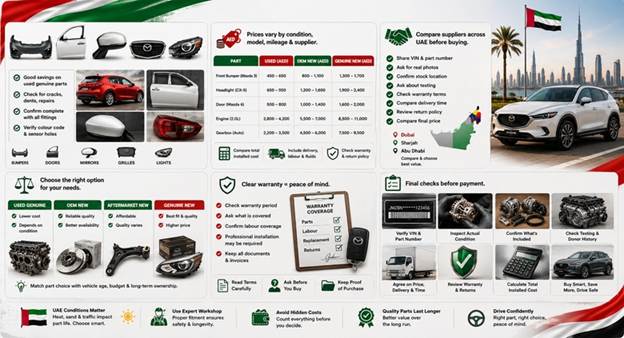
Price comparison table
| Part type | Used can make sense? | Main price variable | Main risk |
| Bumper | Yes | Condition/completeness | Hidden damage |
| Door | Yes | Shell vs complete assembly | Paint/repair history |
| Mirror | Yes | Electronics included | Wrong specification |
| Headlight | Yes | Electronics/condition | Water damage |
| Engine | Yes* | Testing/donor/mileage | Internal condition |
| Gearbox | Yes* | Testing/code/warranty | Installation risk |
| Control arm | Sometimes | Remaining life | Wear |
| Brake pads | No | — | Safety/remaining life |
| Cabin filter | No | — | Used condition |
| Electronic module | Sometimes | Compatibility/testing | Programming |
*Only where the unit is properly identified, tested and supported by meaningful warranty.
What does a fair price actually mean?
A fair used-part price isn't necessarily the lowest one.
It is the price that reflects condition + specification + remaining life + warranty + installation risk.
That's the comparison worth making.
Used vs Genuine vs OEM Mazda Parts: Which Offers Better Value?
The answer changes according to the part.
That's why blanket advice such as “always buy genuine” or “used is always cheaper” isn't particularly helpful.
Used genuine
Strong option for selected body parts and some major mechanical assemblies.
Best when condition is documented.
Genuine new
Strongest route for owners who prioritise manufacturer specification and long-term ownership, particularly on newer vehicles.
The drawback is price.
OEM new
A reputable OEM manufacturer can offer a useful balance.
But identify the manufacturer.
Don't accept an anonymous “OEM quality” label.
Aftermarket new
Quality varies widely.
A reputable aftermarket manufacturer may produce a perfectly sensible replacement.
The unknown manufacturer is the problem.
Reconditioned
Reconditioned engines and gearboxes can make sense when the rebuild work is properly documented.
Ask what was replaced.
Ask what was measured.
Ask what was tested.
Part-by-part decision
| Part | Used genuine | OEM/new | Genuine new | Preferred approach |
| Bumper | ✓ | ✓ | ✓ | Condition first |
| Door | ✓ | ✓ | ✓ | Compare complete cost |
| Mirror | ✓ | ✓ | ✓ | Check electronics |
| Brake pads | ✗ | ✓ | ✓ | Buy new |
| Cabin filter | ✗ | ✓ | ✓ | Buy new |
| Control arm | Sometimes | ✓ | ✓ | Compare remaining life |
| Engine | ✓* | ✓ | ✓ | Testing first |
| Gearbox | ✓* | ✓ | ✓ | Testing + warranty |
| Module | ✓* | ✓ | ✓ | Compatibility first |
When used is better
If a clean used genuine body part costs substantially less and its condition is obvious, buying used can be entirely sensible.
When genuine is better
If the Mazda is relatively new and the part is critical, complex or difficult to replace, the higher upfront price may be easier to justify.
When OEM is better
For routine mechanical parts where a reputable manufacturer offers the required specification, OEM can provide a useful balance between price and quality.
When aftermarket is better
For certain straightforward service and mechanical parts, reputable aftermarket products can reduce costs without creating unnecessary risk.
The value test
Ask: If this part fails early, how much will I pay for labour, downtime and another replacement?
That question often changes the answer.
How to Compare Used Mazda Spare Parts Suppliers in Dubai, Sharjah and Abu Dhabi
Supplier comparison becomes much easier when every seller receives the same information.
Otherwise, you're comparing five different quotations for five slightly different products.
Send identical vehicle information
Give every supplier:
VIN + model + year + engine + transmission + part number where available.
Then ask each supplier to confirm compatibility.
Compare condition
Write down whether each quotation is:
Used genuine + reconditioned + OEM + aftermarket + genuine new.
Don't allow vague terminology to blur the comparison.
Ask for the actual part
For used components, request photographs of the actual item.
Especially for:
Engines + gearboxes + headlights + doors + bumpers + electronic modules.
Ask about testing
A used engine should have different testing evidence from a used bumper.
Ask what was actually checked.
Ask about donor history
For engines and gearboxes, donor information can be valuable.
Mileage.
Vehicle.
Reason for dismantling.
Testing.
The more evidence available, the easier it is to assess the risk.
Check stock location
Ask whether the part is physically available in Dubai, Sharjah, Abu Dhabi or elsewhere.
“Available” can sometimes mean “we can source it”.
Those aren't the same thing.
Delivery time
If your Mazda is already at a workshop, delivery time matters.
A slightly more expensive part that arrives today may be more useful than a cheaper one arriving several days later.
Warranty
Compare:
Warranty duration + exclusions + installation conditions + labour coverage + replacement process.
Returns
Ask what happens if the part arrives damaged or doesn't match the confirmed specification.
Find out who pays return delivery.
Programming
For modules, ask whether programming is included.
If not, ask who will perform it and what that service costs.
Supplier comparison table
| Check | Supplier A | Supplier B | Supplier C |
| VIN confirmed | ✓ | ✓ | ? |
| Part number confirmed | ✓ | ✓ | ? |
| Actual photographs | ✓ | ✓ | ? |
| Donor information | ✓ | — | ? |
| Testing explained | ✓ | ✓ | ? |
| Warranty clear | ✓ | ✓ | ? |
| Delivery confirmed | ✓ | ✓ | ? |
| Returns explained | ✓ | ? | ? |
| Programming clarified | ✓ | ✓ | ? |
| Complete price | ✓ | ✓ | ? |
PartFinder UAE comparison
When comparing used Mazda parts, PartFinder UAE can be included in the supplier comparison while checking the exact part number, condition, compatibility, warranty, delivery and complete installed cost alongside the other available options.
Don't compare only the emirate
A supplier's location isn't the most important factor.
A Dubai buyer may find the correct tested part in Sharjah.
An Abu Dhabi owner may source the required component from another emirate.
What matters is getting the correct part, in acceptable condition, with transparent warranty and delivery terms.
The supplier rule
Compare: Part condition + manufacturer + testing + compatibility + delivery + warranty + returns + installed cost.
Only then compare the final price.
Used Mazda Parts Warranty: What Should the Seller Guarantee?
Warranty wording matters more with used parts because condition varies.
“Warranty available” is not enough.
You need to know what happens when something goes wrong.
Warranty period
Ask how long the coverage lasts.
Then ask when it begins.
Some warranties may begin from delivery.
Others may be tied to installation.
Part-only warranty
A part-only warranty can be useful, but understand its limitation.
If a used gearbox fails after installation, the part may be replaced while the labour remains your responsibility.
That can be expensive.
Labour coverage
For engines and gearboxes, ask specifically whether labour is covered.
Ask: If the replacement fails, who pays for removal and reinstallation?
Don't leave that question until the failure occurs.
Installation conditions
Some suppliers require professional installation.
Others may require proof of installation or specific procedures.
Read those requirements before purchasing.
Warranty exclusions
Look for exclusions involving:
Overheating + incorrect installation + contamination + electrical damage + modified vehicles + misuse.
The exclusions can be just as important as the headline warranty period.
Engine warranty
For a used engine, ask whether the warranty covers internal mechanical failure and what evidence is required.
Clarify whether ancillary parts are covered.
Gearbox warranty
For a used transmission, ask whether internal mechanical failure is covered and whether labour is included.
Also ask whether the gearbox must be installed by an approved workshop.
Electronic-module warranty
Modules can have special conditions relating to programming, installation and compatibility.
Ask whether programming must be performed by a particular technician.
Body-part warranty
Body panels usually involve different risks.
A warranty may cover incorrect specification or undisclosed damage rather than ordinary cosmetic imperfections.
Clarify what you're actually receiving.
Return period
A return period isn't necessarily the same as a warranty.
One may allow an incorrect or damaged part to be returned shortly after delivery.
The other may cover failure later.
Damaged delivery
Take photographs when receiving an expensive used component.
If packaging is damaged, document it before installation.
Written confirmation
Get the warranty conditions in writing.
A verbal promise can become surprisingly difficult to reconstruct when the part fails weeks later.
Warranty comparison
| Warranty point | What to ask |
| Duration | How long is coverage? |
| Start date | When does it begin? |
| Parts | What exactly is covered? |
| Labour | Is fitting/removal covered? |
| Installation | Are there workshop requirements? |
| Returns | What is the return window? |
| Delivery damage | Who handles transport claims? |
| Programming | Does programming affect coverage? |
| Failure process | How is the claim handled? |
The warranty rule
Before paying: Read the warranty + confirm exclusions + ask about labour + confirm installation requirements + keep the written quotation.
That paperwork may seem tedious when everything is working.
If the used part fails, you'll be glad you kept it.
Buying Decisions, Hidden Costs and Long-Term Value
Hidden Costs When Buying Used Mazda Spare Parts
The used-part price is only the beginning.
This is where many apparently good deals fall apart. A used Mazda gearbox may be AED 2,000 cheaper than another option, yet if it needs extra seals, fluid, diagnostics and another round of labour, the saving starts shrinking.
Then there is downtime.
That matters too.
Delivery costs
Ask whether delivery is included.
A part coming from another emirate may carry a separate transport charge, particularly when the item is large or requires careful handling.
Inspection costs
Some used mechanical parts deserve independent inspection before installation.
An engine or gearbox inspection may cost money, but that expense can be tiny compared with removing a failed replacement later.
Diagnostics
Electronic modules, sensors and transmission faults may require scanning and testing.
Don't assume the replacement part will solve the warning light simply because its description matches the symptom.
Programming
A used module may need programming, coding or calibration.
That service can add another charge after the part has already been purchased.
Fluids
Engines, gearboxes and cooling-system parts can require new fluids.
Include them.
Otherwise, the quotation isn't complete.
Seals and gaskets
A used mechanical assembly may be functional but still require new seals or gaskets before installation.
Replacing an inexpensive seal while the part is accessible can make more sense than paying for the same labour later.
Supporting parts
A used engine might need:
Hoses + belts + filters + mounts + seals + fluids + other accessible service parts.
The exact list depends on the vehicle and repair.
Don't replace everything automatically.
Inspect first.
Workshop labour
Labour becomes particularly important with engines and gearboxes.
A small difference in purchase price can disappear if one option takes substantially more preparation or fitting work.
Alignment
Suspension and steering repairs may require wheel alignment.
Include it in the final calculation.
Paintwork
A used body panel can be cheap and still require preparation and repainting.
A door that costs AED 500 may not remain an AED 500 repair.
Calibration
Cameras, sensors and some electronic systems can require calibration after body or component replacement.
Ask before buying.
Return transport
If the part arrives damaged or incorrect, who pays to send it back?
That question becomes more important with large body panels and heavy mechanical assemblies.
Downtime
A Mazda sitting in a workshop is not earning its keep.
For a daily commuter, family vehicle or business vehicle, several days of delay can have a real practical cost.
Hidden-cost calculation
Calculate: Part + delivery + inspection + labour + fluids + seals + programming + calibration + paintwork + alignment + possible return costs.
That gives you the repair cost rather than the listing price.
Used Mazda Parts: Delivery, Installation and Workshop Labour Costs
A used part doesn't become useful until it reaches the vehicle and works correctly.
That sounds obvious.
Yet delivery and installation are often treated as separate problems instead of part of the purchase decision.
Delivery time
Ask whether the part is physically in stock.
Not:
“Can you arrange it?”
Ask:
Is the exact part available now?
That distinction matters when the Mazda is already in a workshop.
Dubai deliveries
For a Dubai vehicle, a supplier in Sharjah or another nearby location may still be perfectly practical if the correct part can be delivered quickly.
Don't reject a supplier simply because the warehouse isn't in the same emirate.
Sharjah and Abu Dhabi
The same logic applies in reverse.
Compare availability and delivery time rather than assuming the nearest seller will have the best option.
Heavy parts
Engines and gearboxes require different transport considerations from sensors or filters.
Ask whether the quoted delivery price includes safe handling.
Installation labour
Get the workshop to quote fitting separately.
Then combine the figure with the part price.
Engine installation
Engine replacement can involve removal, installation, fluids, diagnostics and supporting parts.
Depending on the vehicle and condition of the replacement, the workshop may also recommend renewing accessible items while the engine is out.
Gearbox installation
Transmission replacement can similarly involve removal, fitting, fluid and diagnostics.
Ask whether adaptation or other post-installation procedures are required.
Suspension installation
Suspension work can require wheel alignment afterwards.
Include that in the final number.
Body-part installation
Bodywork can involve fitting, adjustment, clips, brackets and paintwork.
A used bumper that requires extensive preparation isn't necessarily a bargain.
Electrical installation
Electronic parts may require diagnosis before installation and testing afterwards.
For modules, programming can be part of the job.
Installation timeline
Don't ask only:
“How much?”
Ask:
How long will the vehicle remain in the workshop?
A cheaper part that delays the vehicle for several days may be less useful for someone who relies on the Mazda every day.
First-start and post-installation checks
For major mechanical replacements, the workshop should verify operation after installation.
Engine temperature.
Leaks.
Warning lights.
Transmission behaviour.
Fluid levels.
The exact checks depend on the repair.
Post-installation warranty
Keep the invoice and installation documentation.
If a warranty claim later becomes necessary, those records may matter.
When Should You Buy Used Mazda Parts Instead of New?
Used isn't automatically better.
New isn't automatically better.
The sensible choice depends heavily on the part, the Mazda's age and how long you intend to keep the vehicle.
Buy used body parts when
The original-style genuine part is expensive, the used item is straight and complete, and the difference in price is meaningful.
Doors, bumpers, mirrors, grilles and selected lights can fit this category.
Buy new wear parts when
The part has a predictable service life and relatively low replacement cost.
Think:
Brake pads + filters + hoses + many rubber consumables.
Saving a small amount isn't worthwhile when you're buying something already partly worn.
Consider a used engine when
The Mazda has significant remaining value, the replacement engine has a known specification and donor history, testing is available, and the warranty is meaningful.
Consider a reconditioned engine when
A properly documented rebuild offers a better risk balance than an unknown used engine and a new genuine assembly is financially difficult to justify.
Consider a used gearbox when
The transmission code is confirmed, the unit has been tested, donor information is available and the warranty addresses the installation risk.
Buy new OEM when
The part is relatively affordable, widely available and the used saving is small.
A new reputable OEM suspension or cooling part can make more sense than a worn used equivalent.
Buy genuine when
The vehicle is newer, the part is complex or critical, and long-term reliability matters more than the lowest initial price.
Consider used electronics when
The exact part number is confirmed, the module has been tested and any programming requirement is understood.
Think about vehicle value
Don't spend AED 8,000 replacing major assemblies on a Mazda worth AED 12,000 without looking at the wider picture.
The repair may still be sensible.
But compare it with the vehicle's condition and likely future maintenance.
Repair versus replace the vehicle
Ask:
If I spend this money, what condition will the Mazda be in afterwards?
A vehicle with a healthy body, good interior, sound transmission and documented maintenance may justify a major repair.
A vehicle already needing several expensive systems may not.
First-year ownership cost
A used part that saves AED 2,000 today but creates another AED 3,000 repair six months later isn't good value.
Look beyond the purchase moment.
Decision matrix
| Situation | Better direction |
| Cheap consumable | New |
| Brake friction part | New |
| Clean genuine bumper | Used can make sense |
| Complete genuine door | Used can make sense |
| Expensive electronic module | Tested used or genuine |
| High-mileage engine | Evidence required |
| Tested donor engine | Used can make sense |
| Unknown gearbox | Avoid |
| Tested gearbox with warranty | Consider |
| Cheap unknown aftermarket part | Be cautious |
The practical answer
Used makes the most sense when the saving is substantial, the condition is measurable and the consequence of failure is manageable.
If all three disappear, buy new.
Used Mazda Spare Parts Buying Checklist: What to Verify Before Payment
Before money changes hands, slow down.
This is the moment when a few minutes of checking can prevent days of repair trouble.
Vehicle identification
Confirm:
VIN + model + year + engine + transmission.
Part identification
Confirm:
Original part number + replacement part number + manufacturer where applicable.
Condition
Inspect:
Cracks + corrosion + leaks + impact damage + broken mounts + damaged connectors + previous repairs.
Actual photographs
For used parts, ask for photographs of the exact item.
Especially for expensive assemblies.
Testing
Ask what was tested and how.
For an engine, that might include compression testing where applicable.
For a gearbox, operational or inspection evidence.
For electronics, appropriate testing and compatibility checks.
Donor information
For engines and gearboxes, ask for donor vehicle information and mileage where available.
Completeness
Confirm whether the part is:
Complete assembly or bare unit.
Then establish which additional parts you'll need.
Warranty
Confirm the duration and exclusions.
For major mechanical parts, ask about labour.
Returns
Find out what happens if:
The wrong part arrives + the part arrives damaged + the part fails after installation.
Delivery
Confirm:
Stock availability + delivery time + delivery charge.
Programming
For electronic components, ask whether programming, coding or calibration is required.
Installation
Get the workshop's labour estimate before ordering.
Final cost
Calculate the entire repair.
Part + delivery + labour + diagnostics + supporting parts + fluids + programming + alignment/paintwork where applicable.
Only then compare it with new.
Keep the paperwork
Save the quotation, invoice, warranty terms and compatibility confirmation.
For an expensive used part, documentation is part of the purchase.
FAQs
Categories
- Audi
- BMW
- Car Accessories
- Car Tips
- Ford
- Land Rover
- Mazda
- Range Rover
- Top 10
- UAE Car Parts
- Used Car Parts
- Toyota
- Replacement Engines
- Nissan
- Hyundai
- Mitsubishi
- Volkswagen
- Honda
- Kia
- Chevrolet
- Dodge
- Jeep
- Subaru
- Renault
- Lexus
- Mercedes
- Suzuki
- Hummer
- Porsche
- Infiniti
- Peugeot
- GMC
- Mini
- Volvo
- Replacement Gearboxes
- MG
- Jaguar
- Skoda
- Cadillac
- Daihatsu
- Fiat
- German Car Parts
- Japanese Car Parts
- Aftermarket Car Parts
- Genuine Car Parts
- New Car Parts
- Reconditioned Car Parts
- European Car Parts
- American Car Parts
- Korean Car Parts
- British Car Parts
- Chinese Car Parts
- Sports/Exotic Car Parts
- Luxury Car Parts
- Performance Car Parts
- SUV/4x4 Spare Parts
- Truck Spare Parts
- EV Car Parts
- Hybrid Car Parts
- Auto Spare Parts in UAE
- Tesla
- Isuzu
- Ram
- Ferrari
- Bentley
- Lamborghini
- Genesis
- Maserati
- Lincoln
- Chrysler
- Opel
- Citroen
- SsangYong
- Seat
- McLaren
- Aston Martin
- Rolls Royce
- Maybach
- Alfa Romeo
- Bugatti
- Scion
- Abu Dhabi Car Parts
- Ajman Car Parts
- Al Khan Car Parts
- Al Sajaa Car Parts
- Deira Car Parts
- Dubai Car Parts
- Fujairah Car Parts
- Industrial Area 6 Car Parts
- Mussafah Car Parts
- Ras Al Khaimah Car Parts
- Sharjah Car Parts
- Umm Al Quwain Car Parts
- Acura
- BYD
- Chery
- Dacia
- DS
- Geely Emgrand
- EXEED
- GAC
- GAC Gonow
- Geely
- Gonow
- Great Wall
- Haima
- Haval
- Holden
- Iveco