Used Mini Cooper Spare Parts in UAE: What Buyers Should Check
September 9, 2026
Understanding Used MINI Cooper Parts
Used MINI Cooper Spare Parts in UAE: Are They Worth Buying?
Yes — sometimes they are the smartest option. Sometimes they are exactly where you should not try to save money.
That distinction matters with a MINI because the price gap between a new genuine part and a good used original part can be sizeable, particularly on older Coopers. A clean used mirror, headlight, interior trim piece or body panel can get the car back on the road without making the repair bill look ridiculous. If the MINI is already several years old, paying full dealer-level pricing for every cosmetic item simply may not stack up.
Mechanical parts need a different attitude.
A used Mini Cooper spare parts in UAE, engine, turbocharger, gearbox, alternator or electronic module has a history. You may not know how hard the donor car was driven, whether it overheated, how many kilometres it covered or why it was dismantled in the first place. The part can look tidy on the outside and still be tired inside. That's the annoying bit.
UAE driving conditions make this more important. A MINI that spends hours crawling through Dubai traffic, running the air conditioning through summer or commuting between Sharjah and Dubai every day can put serious mileage on its parts.
So, are used MINI Cooper spare parts worth buying?
For the right part, from the right source, with proper identification and a usable warranty — absolutely.
Used vs Genuine MINI Cooper Parts: Which Is Better?
There is no universal winner here.
A new genuine MINI part gives you the cleanest route when exact specification, reliability and long-term ownership are the priority. You know what you are buying, and for safety-critical or highly integrated parts, that peace of mind can be worth paying for.
But consider an older MINI with a damaged wing mirror. The car runs perfectly. The interior is good. The owner simply needs one exterior part replaced. Buying a new genuine mirror at a premium may be hard to justify when a properly matched used original unit is available in good condition.
That is where used parts come into their own.
| Buying option | Main advantage | Main concern |
| New genuine | Exact specification and new condition | Higher purchase price |
| Used genuine | Original fit at a lower cost | Previous wear and unknown history |
| OEM-quality aftermarket | Often good value | Quality varies between manufacturers |
| Reconditioned | Can reduce cost on selected parts | Rebuild quality must be verified |
| Unknown used part | Lowest upfront price | Highest uncertainty |
Don't confuse used genuine with cheap.
A genuine used MINI part still needs to be identified properly. Its part number should match, its mounting points should be intact, electrical connectors should be checked, and its condition should make sense for the price.
For a daily MINI, I would rather see an owner buy a known, tested used original part than an unbranded new replacement simply because the latter comes in a shiny box.
The box isn't what keeps the car running.
How Much Do Used MINI Cooper Spare Parts Cost in UAE?
This is one of those questions where a single “average price” is almost useless.
A used MINI Cooper part could cost a few hundred dirhams, while larger assemblies or scarce electronic and mechanical parts can run into much higher figures. The difference comes down to the exact part, MINI generation, condition, donor mileage, availability and whether the item has been tested.
Take two headlights. Both may be advertised for the same MINI model, yet one could have damaged mounting tabs, cloudy lenses or missing wiring, while the other is a clean original unit ready to install. They aren't really the same purchase.
The same thing happens with suspension and engine-related parts. A seller quoting a low figure may be offering the part as-is, with no meaningful testing or warranty. Another supplier may charge more because the unit has been inspected and carries some form of replacement guarantee.
Before comparing prices, ask:
- Is the part genuine MINI or aftermarket?
- Is it new, used or reconditioned?
- What vehicle did it come from?
- What was the donor vehicle's mileage?
- Has the part been tested?
- Does the quoted price include VAT or delivery?
- Is installation included?
- Is programming or coding required?
- What warranty is provided?
And don't forget labour.
A used part that saves AED 500 but takes several hours to install may not deliver the saving you expected. If the mechanic discovers another worn seal, bracket, fastener or related part while fitting it, the final invoice moves again.
Compare the fitted repair, not the sticker price.
Which MINI Cooper Parts Are Safe to Buy Used?
Some used MINI parts are relatively straightforward purchases. Others are a gamble unless the seller can prove what you're getting.
Body and cosmetic parts are usually the easier category. A genuine bonnet, door, wing, mirror housing, interior trim, wheel or certain lighting parts can be excellent used purchases when they are undamaged and correctly matched. Colour and specification still matter, of course. A bargain door in the wrong colour isn't much of a bargain once repainting enters the conversation.
Then there are mechanical parts.
Used suspension parts, cooling-system parts, alternators, starter motors and similar items require closer inspection because previous wear matters. You need to know what condition they are actually in, rather than trusting a photograph.
For major assemblies such as engines and gearboxes, the checks should become much stricter. Mileage, donor vehicle, identification, leaks, compression where appropriate, diagnostic faults and warranty all deserve attention before money changes hands.
Generally easier used purchases
- Body panels
- Mirrors
- Interior trim
- Selected lights
- Wheels
- Non-wear cosmetic items
- Certain switches and trim pieces
Higher-risk used purchases
- Engines
- Gearboxes
- Turbochargers
- Electronic control units
- Heavily worn suspension parts
- Cooling-system parts with uncertain history
- Safety-critical braking parts
The rule is fairly simple: if the remaining life of the part is difficult to judge, demand more evidence before buying it.
That is especially important with an older MINI. Saving money on a visible cosmetic part is one thing. Saving money on a part that fails three weeks later — after you've already paid the workshop to install it — is a completely different story.
Checking Condition and Compatibility
How to Check a Used MINI Cooper Part Before Buying
Don't buy a used MINI part because it looks clean in a photograph.
Photos hide things. Cracks around mounting points. Brittle plastic. Scratched connectors. Previous repairs. Bent brackets. Oil seepage. You name it.
If you're buying in person, turn the part over and look at the bits sellers don't usually photograph. Check every mounting tab, bolt hole and electrical connector. On body parts, look for uneven paint, filler, repaired plastic and differences in colour. A panel can look perfect from three metres away and reveal a rather obvious repair once you're standing beside it.
Mechanical parts need a deeper inspection.
For a used alternator or starter motor, ask whether it has been tested. With suspension parts, inspect bushes, joints, corrosion and signs of impact. A used radiator should be checked for damaged fins, leaks and broken mounts. If you're considering a larger engine-related part, ask for evidence of testing rather than accepting “working condition” as the whole explanation.
A useful inspection follows the part itself:
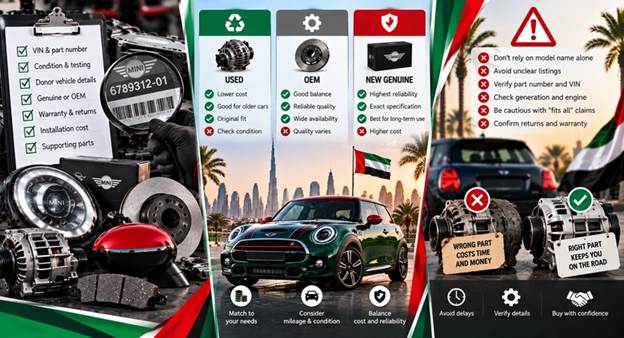
- Check the part number.
- Inspect mounting points.
- Look for cracks or repaired areas.
- Examine electrical connectors and wiring.
- Check for oil, coolant or fluid leakage.
- Look for corrosion.
- Ask about testing.
- Ask where the part came from.
- Confirm donor-vehicle details.
- Establish the warranty before installation.
And take your time.
There is rarely a prize for buying the used part five minutes faster.
How to Check MINI Cooper Spare Part Compatibility Using VIN
The VIN is your safety net.
When buying used MINI Cooper spare parts, give the supplier the full VIN/chassis number, not just “MINI Cooper 2016”. That small difference can prevent a surprisingly expensive mistake because the same model name can cover different generations, engines, transmissions and equipment levels.
A seller may have three apparently identical headlights sitting on a shelf. One might have a different connector. Another could belong to a different generation. The third might physically fit but lack the electrical specification your MINI requires.
Then the workshop discovers the problem.
Now the car is already dismantled, the technician has spent time fitting the part, and you're back on the phone trying to arrange an exchange.
The VIN should be checked alongside the original part number. If the number has changed because of a manufacturer revision or supersession, confirm that the newer number is officially applicable rather than assuming it is interchangeable.
For a proper compatibility check, provide:
- VIN/chassis number
- MINI model
- Generation
- Production year
- Engine
- Transmission
- Body style
- Trim or performance version
- Original part number
- Left/right position where relevant
This matters even more with Cooper S and JCW versions. Brakes, suspension, cooling and engine-related parts can differ substantially.
If the seller won't verify the part against the VIN, don't guess.
Does MINI Cooper Year Matter When Buying Used Parts?
Yes. But the year by itself isn't enough.
This is one of the easiest mistakes to make when searching for used MINI Cooper parts in the UAE. You enter the model and year, find something that looks right, and order it.
Then it doesn't fit.
MINI has gone through several generations, and individual generations can also have facelift changes, engine variations and equipment differences. A part listed broadly for a particular year range may therefore cover several applications rather loosely.
Imagine you own a MINI Cooper built near a model changeover. The registration year says one thing, while the production date and actual vehicle specification point towards another version. If you shop purely by registration year, you can end up with the wrong part.
Production timing matters.
So does the engine.
So does the body style.
And sometimes even a seemingly minor equipment option.
| Identification detail | Why it matters |
| Model year | Establishes a broad application |
| Production date | Helps identify generation or revision |
| Generation | Determines major design differences |
| Engine | Can change mechanical and electronic parts |
| Transmission | Important for drivetrain-related parts |
| Body style | Affects body and trim parts |
| Trim/version | Can change brakes, suspension and electronics |
| VIN | Provides the most precise vehicle identification |
For used parts, this matters twice because the supplier is normally matching an existing item from another vehicle to yours.
“Same year” is helpful.
Same VIN application and matching part number are much better.
How to Check the Mileage and Donor Vehicle of a Used MINI Part
A used part has a past.
Find out what that past was.
If you're buying a used door mirror, donor mileage may not matter much if the mirror is in excellent condition and all electrical functions work. If you're buying an engine, gearbox, turbocharger or alternator, mileage becomes much more important because internal wear cannot be judged from appearance alone.
Ask the supplier for the donor vehicle details where available. What model was it? Which engine did it have? What was its mileage? Was it running when dismantled? Was the vehicle involved in an accident? If so, where was the impact?
That last question is easy to overlook.
A rear-end accident might leave a front mechanical part untouched. A heavy frontal collision could tell you to inspect front-end parts extremely carefully, even if they look surprisingly tidy.
For major mechanical parts, ask for evidence rather than relying on a verbal mileage claim. Service records, dismantling information, test results or diagnostic reports can provide much more confidence.
Mileage matters differently for different parts
| Used part | Importance of donor mileage |
| Interior trim | Low |
| Body panel | Low |
| Mirror housing | Low to moderate |
| Headlight | Moderate |
| Wheel | Moderate; inspect impact damage |
| Suspension part | High |
| Alternator | High |
| Turbocharger | High |
| Engine | Very high |
| Gearbox | Very high |
Be suspicious of wonderfully precise claims with no supporting information.
“Only 48,000 km” sounds reassuring. But where did that number come from?
For a major MINI repair, the donor vehicle's history is part of the product. You're not merely buying metal, plastic and wiring. You're buying whatever useful life is left in that particular part.
And if the seller can explain that history clearly, that's a good sign. If the answers become vague when you start asking questions, walk away.
MINI Maintenance, Faults and Repair Decisions
Common MINI Spare Parts That Need Replacement in UAE
MINI owners in the UAE tend to encounter a familiar pattern: the car may feel perfectly normal one week, then a collection of small warning signs starts showing up. A slight knock from the front. A battery that takes longer to crank. Brake dust everywhere. A temperature warning that appears at exactly the wrong moment.
Some parts simply wear out. Others fail because an earlier problem was left to run on.
Brakes and suspension parts are among the more obvious replacement areas. Pads, discs, wear sensors, control arms, bushes and related hardware all deal with repeated heat, braking and road impacts. UAE traffic makes that harder on the car because a vehicle can spend a surprising amount of time crawling rather than cruising.
Then there are the less visible parts.
Filters become dirty. Spark plugs wear. Ignition coils can develop faults. Engine mounts lose their ability to control vibration. Cooling-system parts can deteriorate, and electrical sensors can produce faults that initially look far more serious than they actually are.
| Replacement area | Typical warning signs | What to check first |
| Brake pads | Squealing, grinding, reduced braking feel | Pad thickness and disc condition |
| Brake discs | Vibration under braking | Disc thickness and run-out |
| Suspension | Knocking, uneven tyre wear | Bushes, control arms, dampers |
| Battery | Slow starting, electrical warnings | Battery health and charging voltage |
| Ignition | Rough idle, hesitation | Plugs, coils and fault codes |
| Cooling system | Temperature rise, coolant loss | Leaks, thermostat, pump and hoses |
| Engine mounts | Excessive vibration | Mount condition and surrounding parts |
| Sensors | Warning lights, poor running | Diagnostic scan and live data |
Don't build a shopping list from symptoms alone. A knocking noise does not automatically mean “replace the control arm”. A warning light does not automatically mean “replace the sensor”.
Diagnosis first. Parts second.
That one habit can save a MINI owner a surprisingly large amount of money.
MINI Warning Signs: Which Symptoms Mean a Part Needs Replacing?
A MINI can be quite communicative when something isn't right. The problem is that its warning signs don't always identify the failed part directly.
Take an overheating warning. The underlying problem might involve the thermostat, water pump, radiator, hose, coolant leak or another part of the cooling system. Replacing whichever part is easiest to reach isn't diagnosis; it is guesswork.
The same applies to electrical faults. A battery warning might involve the battery itself, but it can also point towards a charging problem. A dashboard warning can therefore be the beginning of an investigation rather than the end of it.
Some warning signs deserve quicker attention than others.
Don't keep driving and hope these symptoms disappear
- Engine temperature rising above normal
- Coolant disappearing repeatedly
- Grinding brakes
- Strong vibration under braking
- Steering becoming unusually heavy or loose
- Persistent engine misfire
- Burning smell from the engine bay
- Oil or coolant leaking underneath the car
- Sudden loss of engine power
- Repeated electrical warnings
A strange noise that appears only when turning is useful information. So is a vibration that arrives at a particular speed. Tell the technician when the symptom occurs, not merely that “the car feels bad”.
That detail can narrow down the diagnosis.
And UAE driving conditions make timing important. If a cooling-system warning appears while you're stuck in summer traffic in Dubai, continuing the journey because the workshop is “only 20 minutes away” can turn a manageable repair into engine damage.
Stop when the car tells you to stop.
MINI Spare Parts Repair vs Replacement: Which Option Is Cheaper?
The cheapest repair is not necessarily the one with the lowest invoice today.
Imagine an older MINI with a worn suspension arrangement. One bush is damaged, another is showing cracking and the control arm has significant mileage behind it. Replacing only the visibly failed part may reduce today's bill, but if the remaining parts fail shortly afterwards, you pay for labour and alignment again.
Now reverse the situation.
If a good-quality used part is available for a non-safety-critical item and the car is nearing the end of its ownership, paying dealer-level pricing may make little financial sense.
That is the real repair-versus-replacement question: what is the condition of the car, what is the condition of the surrounding parts, and how long are you planning to keep it?
| Situation | More sensible approach |
| Newer MINI, long-term ownership | Genuine or quality OEM-equivalent |
| Older MINI, expensive cosmetic part | Good used genuine part |
| Common service item | Reputable aftermarket or OEM-quality |
| Safety-critical brake part | Quality new replacement |
| Rare body/trim part | Used genuine can be attractive |
| Major repair with several worn parts | Compare complete repair cost |
| Unknown-quality bargain part | Usually poor risk/reward |
Labour can change the calculation dramatically.
A part that costs AED 250 may require several hours of work, coding or calibration. Another part costing AED 600 might take minutes to replace. Looking only at the parts counter price misses the bigger picture.
The hidden costs are where the bargain can disappear
Consider:
- Additional diagnostic charges
- Programming or coding
- Fluids and consumables
- New fasteners or seals
- Wheel alignment
- Towing
- Repeat workshop labour
- Return shipping
- Lost use of the vehicle
- Related worn parts discovered during installation
For a MINI used every day between Sharjah and Dubai, downtime has a value too. Missing work or arranging another car because a cheap replacement failed is not normally written on the garage invoice, but you still pay for it in one way or another.
So compare installed cost, expected life and warranty, not just the number printed beside the part name.
Buying Decision and Avoiding Expensive Mistakes
Used MINI Cooper Parts Buying Checklist: What to Verify Before Paying
Found the part. Price looks good. Seller says it fits.
Hold on.
Before paying, run through the details properly. A used MINI Cooper part should never be bought on appearance and price alone, particularly when the part is going inside the engine bay, connecting to the car's electronics or affecting braking, steering or suspension.
Keep this checklist beside you when speaking to a supplier:
- VIN/chassis number — give the complete vehicle identification number.
- Exact part number — compare the original number with the replacement.
- MINI generation — don't rely only on the registration year.
- Engine and transmission — confirm the exact application.
- Body style — Cooper, Clubman, Countryman, Convertible and other versions can differ.
- Donor vehicle — ask what MINI the part came from.
- Donor mileage — particularly important for mechanical parts.
- Physical condition — inspect cracks, leaks, corrosion, damage and mounting points.
- Testing — ask whether the part has actually been tested.
- Genuine/OEM status — establish exactly what you are buying.
- Warranty — get the duration and coverage in writing.
- Return policy — clarify what happens if the part is incorrect.
- Coding/programming — check whether electronic parts need configuration.
- Installation cost — find out the labour charge before approving the repair.
- Supporting parts — ask whether seals, fluids, fasteners or related items are needed.
There is another useful trick: ask for photographs of the actual part, not catalogue images.
You want to see the part that will be shipped or handed over. The casting number. The connector. The mounting points. The wear. All of it.
For an expensive engine, gearbox or electronic module, ask for whatever test information is available. If the seller can't provide meaningful details, that uncertainty should be reflected in the price — or it should be enough reason to walk away.
When Should You Buy Used, OEM or New MINI Cooper Parts?
This decision becomes much easier when you stop asking, “Which type is cheapest?” and start asking, “Which option makes sense for this particular car and this particular part?”
An older MINI with 180,000 km on the clock does not necessarily need every replacement part to be brand-new genuine. Nor does a newer Cooper that you intend to keep for five more years make a good candidate for unknown used mechanical parts simply because they are cheaper.
Think in categories.
A used genuine mirror? Sensible, if it works and fits.
A reputable aftermarket brake pad? Potentially sensible, provided the specification and manufacturer are trustworthy.
A mystery-condition used turbocharger? Much more questionable.
A new genuine part for a critical repair on a relatively new MINI? Often easier to justify.
| Situation | Better starting point |
| Newer MINI kept long term | New genuine or reputable OEM-quality |
| Older MINI in strong condition | Genuine or quality aftermarket |
| High-mileage daily driver | Compare quality aftermarket and verified used |
| Expensive cosmetic part | Used genuine often makes sense |
| Rare body or trim item | Good used original part |
| Brake or steering part | Quality new replacement |
| Engine or gearbox | Tested used/reconditioned vs new, with warranty |
| Electronic control module | Verified compatible part with programming support |
| MINI nearing replacement | Calculate total repair cost before spending |
Mileage changes the calculation, too.
If the MINI is mechanically excellent and you plan to keep it, paying more for a quality replacement can protect that investment. If the car already needs tyres, suspension work, cooling repairs and electrical attention, another expensive genuine part may push the total repair bill into uncomfortable territory.
That's when you need to step back.
Don't repair the car one invoice at a time.
Add up the likely repairs.
How to Avoid Buying the Wrong Used MINI Cooper Spare Part in UAE
Most expensive used-parts mistakes are not dramatic. They're small decisions made too quickly.
The buyer sees a photograph.
The part looks identical.
The seller says, “Yes, MINI Cooper.”
Done.
Then the mechanic opens the box and says, “This isn't the one.”
Now the car is sitting on the lift, the old part is already removed, labour has started, and everyone is trying to work out who is going to pay for the wasted time.
The easiest way around this is to slow the process down before the purchase.
Never rely on the model name alone. Verify the VIN and part number. Check the generation and engine. For body parts, confirm the exact body style and mounting arrangement. For electrical parts, establish whether coding or programming will be needed.
For UAE buyers, including those comparing available parts through PartFinder UAE, the better approach is simple: verify the part first and negotiate the price second.
Be particularly cautious with listings using broad phrases such as:
- “Fits all MINI Cooper models”
- “Universal MINI part”
- “Same as original”
- “Low-mileage part” without evidence
- “OEM quality” without a manufacturer name
- “Tested” without explaining how
- “No return” on an expensive part
None of those phrases automatically means the part is bad. They simply aren't enough information.
The cost-of-delay problem
There is also a UAE-specific issue that doesn't get enough attention: waiting.
If the wrong used part arrives and the MINI is already dismantled, you may lose several days while the correct item is sourced. For someone commuting daily between Sharjah and Dubai, that means taxis, ride-hailing, borrowing another car or rearranging work.
The part itself may have cost less.
The repair did not.
A simple buyer decision
Before buying a used MINI Cooper part, ask yourself:
Does it fit?
VIN and part number should answer that.
Do I know its condition?
Inspection or testing should answer that.
Do I know its history?
Donor vehicle and mileage help here.
What happens if it fails?
That's the warranty question.
What will the complete repair cost?
Add labour, programming, consumables and related parts.
If those answers are clear, a used part can be a very sensible way to keep an older MINI on the road without throwing unnecessary money at it.
If the answers are vague, the low price is probably doing too much of the selling.
And that's the trap.
A cheap used MINI Cooper spare part is only a bargain when you know what you're getting, it actually fits, and it survives long enough to justify the money and labour spent installing it.
FAQs
Categories
- Audi
- BMW
- Car Accessories
- Car Tips
- Ford
- Land Rover
- Mazda
- Range Rover
- Top 10
- UAE Car Parts
- Used Car Parts
- Toyota
- Replacement Engines
- Nissan
- Hyundai
- Mitsubishi
- Volkswagen
- Honda
- Kia
- Chevrolet
- Dodge
- Jeep
- Subaru
- Renault
- Lexus
- Mercedes
- Suzuki
- Hummer
- Porsche
- Infiniti
- Peugeot
- GMC
- Mini
- Volvo
- Replacement Gearboxes
- MG
- Jaguar
- Skoda
- Cadillac
- Daihatsu
- Fiat
- German Car Parts
- Japanese Car Parts
- Aftermarket Car Parts
- Genuine Car Parts
- New Car Parts
- Reconditioned Car Parts
- European Car Parts
- American Car Parts
- Korean Car Parts
- British Car Parts
- Chinese Car Parts
- Sports/Exotic Car Parts
- Luxury Car Parts
- Performance Car Parts
- SUV/4x4 Spare Parts
- Truck Spare Parts
- EV Car Parts
- Hybrid Car Parts
- Auto Spare Parts in UAE
- Tesla
- Isuzu
- Ram
- Ferrari
- Bentley
- Lamborghini
- Genesis
- Maserati
- Lincoln
- Chrysler
- Opel
- Citroen
- SsangYong
- Seat
- McLaren
- Aston Martin
- Rolls Royce
- Maybach
- Alfa Romeo
- Bugatti
- Scion
- Abu Dhabi Car Parts
- Ajman Car Parts
- Al Khan Car Parts
- Al Sajaa Car Parts
- Deira Car Parts
- Dubai Car Parts
- Fujairah Car Parts
- Industrial Area 6 Car Parts
- Mussafah Car Parts
- Ras Al Khaimah Car Parts
- Sharjah Car Parts
- Umm Al Quwain Car Parts
- Acura
- BYD
- Chery
- Dacia
- DS
- Geely Emgrand
- EXEED
- GAC
- GAC Gonow
- Geely
- Gonow
- Great Wall
- Haima
- Haval
- Holden
- Iveco
- JAC
- Jaecoo
- Jetour
- Lotus
- Omoda
- Proton
- Renault Samsung
- Roewe
- Lucid
- Replacement Headlight
- Replacement Bumper