Used Mitsubishi Spare Parts in UAE: Engines, Gearboxes, AC Parts and Body Panels
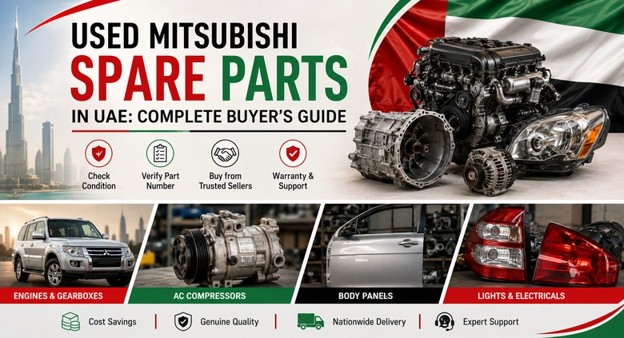
August 20, 2026
Finding and Verifying Used Mitsubishi Spare Parts
Where to Buy Used Mitsubishi Spare Parts in UAE: What Buyers Should Check First
Buying a used Mitsubishi spare part in UAE can be surprisingly straightforward — right up until the wrong Pajero gearbox turns up at the workshop, the Lancer headlight has a broken mounting tab, or an apparently cheap Outlander part turns out to be from another generation.
That is the bit worth avoiding.
The sensible approach is to identify the vehicle properly before comparing prices. Model, generation, year, engine, gearbox, drivetrain and VIN should come into the conversation early, because “used Pajero part” is far too broad to make a confident purchase.
Start with the Mitsubishi, not the listing:
Tell the supplier exactly what you drive.
A Pajero owner should ideally provide the model year, generation, 3-door or 5-door configuration, engine and drivetrain. A Lancer owner may need to identify the generation and engine. For an Outlander, the engine and drivetrain can become particularly important when buying mechanical parts.
It sounds like extra paperwork.
It is not. It is five minutes of prevention.
Used genuine parts can offer serious value:
A used genuine Mitsubishi part can be a very sensible option for an older vehicle, particularly when a new genuine replacement costs a large percentage of the car's current value.
Think of a Pajero headlight, Lancer mirror, Outlander body panel or interior trim. If the original part is clean, undamaged and correctly identified, why automatically pay new-part money?
But there is a catch.
Genuine does not mean unworn.
A used original part has already lived another life.
Ask about the donor vehicle:
For a valuable used part, find out where it came from.
The supplier may be able to provide the donor model, year, engine, gearbox and mileage. They may also know why the vehicle was dismantled.
You will not always get a perfect history. That is fine.
What matters is whether the seller can give you enough information to judge the part rather than asking you to take a blind punt.
Actual photographs are worth asking for:
If you are buying a used bumper, door, mirror, headlight or bonnet, request photographs of the actual item.
Not a catalogue picture.
Not a shiny stock photograph of a Mitsubishi.
The real part.
Look for cracked mounting points, repaired areas, corrosion, dents, moisture inside lights, damaged connectors and anything else that could turn a bargain into another workshop visit.
Dubai, Sharjah and Abu Dhabi can produce different deals:
There is no fixed rule that says Dubai will always be cheaper, or Sharjah will always have the better used part.
A Dubai supplier might have the exact Pajero gearbox in stock. A Sharjah seller might have a cleaner used Lancer body panel. An Abu Dhabi owner might find that buying from another Emirate still works out cheaper after delivery.
So compare the part, condition, warranty and delivered price, not merely the location.
What about Ajman and the other Emirates?
Owners in Ajman, Ras Al Khaimah, Fujairah and Umm Al Quwain may sometimes need to bring in an unusual Mitsubishi part from elsewhere in the UAE.
That is not necessarily a problem.
If the supplier has the correct part, can verify compatibility and can provide reasonable delivery and warranty terms, travelling across an Emirate is hardly the point. Getting the right part is.
Online buying can work very well — if the identification is right:
Online suppliers make it much easier to compare several prices without driving from one industrial area to another.
That is particularly handy when hunting down an older Lancer electrical part or a hard-to-find Pajero trim piece.
But online listings can flatten important differences.
Two adverts may both say “Outlander gearbox”.
One might be correct for your vehicle.
The other might be completely wrong.
Physical inspection still has its place:
A local supplier gives you the opportunity to inspect a used part before committing, which is especially useful for bodywork and visible parts.
For a used engine or gearbox, though, simply looking at the casing does not tell you enough.
Testing, donor information, part number, specification and warranty matter far more.
What makes a used Mitsubishi supplier worth considering:
| Check | Why it matters |
| VIN verification | Helps confirm the application |
| Exact part number | Reduces compatibility mistakes |
| Actual photographs | Shows the real condition |
| Donor information | Provides useful background |
| Testing details | Gives evidence about condition |
| Warranty | Limits financial exposure |
| Return policy | Helps if the part is wrong |
| UAE stock | Reduces waiting time |
| Clear quotation | Makes cost comparison easier |
When comparing UAE suppliers, PartFinder UAE can be one option to consider, but the same checks still apply: verify the VIN, part number, condition, warranty, delivery and complete repair cost before paying.
Do not confuse “available” with “ready for your car”:
A seller saying, “Pajero gearbox available,” has answered only one small part of the question.
Which Pajero?
Which engine?
Which transmission?
Which drivetrain?
What part number?
What donor vehicle?
What mileage?
Was it tested?
What warranty comes with it?
The more expensive the part, the more important those questions become.
The type of part changes the risk:
A used interior trim panel is not the same purchase as a used engine.
If the trim is slightly marked, you may live with it.
If the engine has poor compression, you certainly will not.
That is why used-part buying should become more cautious as installation cost and failure risk increase.
How to Find the Correct Used Mitsubishi Part by VIN and Part Number
A search for “used Mitsubishi parts” gets you into the market.
A VIN and part-number search gets you much closer to the thing you actually need.
That distinction matters because Mitsubishi has sold multiple generations, engines, transmissions and equipment specifications across the models covered by this guide.
Use the VIN when the application is uncertain:
The VIN gives the supplier a much stronger reference than a loose description such as “2017 Pajero”.
It can help narrow down the exact vehicle specification, particularly where several variants share the same badge.
For an engine, gearbox, electronic unit or drivetrain part, VIN verification should be treated as basic due diligence.
Find the original part number:
If the old part is still in the workshop, photograph its label before it disappears into a scrap pile.
Look for the part number, manufacturer marking, suffix, revision and any other identification printed or stamped on the part.
One clear photograph can save a surprising amount of back-and-forth.
A different number does not always mean the replacement is wrong:
Manufacturers sometimes supersede an older reference with a newer one.
So if your original part carries reference A and the supplier offers reference B, do not immediately reject it.
Ask:
“Does this part number supersede the original reference for my VIN?”
That is the useful question.
Engine parts need tighter identification:
For an engine-related part, give the supplier the engine code where available.
Engine capacity by itself may not be enough.
A listing that says “Mitsubishi 2.4 engine sensor” is not necessarily precise enough to identify the correct application.
Gearbox parts need transmission identification:
This becomes even more important with used gearboxes.
Confirm the transmission specification, engine pairing, drivetrain and original part number before buying.
A gearbox removed from another Pajero is not automatically suitable for yours.
It might be.
It might not.
Check it.
Body parts have their own compatibility traps:
A used Mitsubishi headlight may need to match the generation, facelift, side, equipment specification and connector arrangement.
The same applies to tail lights, mirrors, bumpers and certain interior parts.
A photograph can make two versions look almost identical.
The mounting points can tell a different story.
Electronic parts may need programming:
Some replacement electronic parts cannot simply be plugged in and forgotten.
Depending on the vehicle and part, coding, programming, adaptation or calibration may be required.
Ask the workshop before purchasing.
There is little joy in receiving the correct-looking module and then discovering that the vehicle still refuses to cooperate.
VIN plus part number is the stronger combination:
Think of the two checks separately.
The VIN identifies the vehicle.
The part number identifies the item.
When both are verified together, the chance of ordering an unsuitable used part drops considerably.
Information worth sending to the supplier:
| Information | Importance |
| VIN | Very high |
| Mitsubishi model | High |
| Model year | High |
| Generation | High |
| Engine/code | High for engine-related parts |
| Gearbox/code | High for transmission parts |
| Drivetrain | Important for 4WD parts |
| Original part number | Very high |
| Left/right side | Important where applicable |
| Actual-part photograph | Useful |
| Vehicle modifications | Important if applicable |
Do not let a broad catalogue description make the decision:
“Fits Pajero” is not a technical confirmation.
“Fits Lancer” is not a technical confirmation.
“Fits Outlander” is not a technical confirmation.
For an inexpensive filter, the risk may be relatively small.
For a gearbox or electronic module, it is simply not enough.
Used Mitsubishi Spare Parts Prices in UAE: How Much Should You Pay?
There is no single UAE price for a used Mitsubishi part.
The condition, donor vehicle, mileage, part number, manufacturer, availability, warranty and demand can all move the price around. And then there is the little matter of labour.
That is where owners sometimes get caught out.
Compare the same specification:
A used genuine Pajero headlight at AED 800 should not be compared directly with a new aftermarket headlight at AED 1,100 as though the AED 300 difference tells you which one is better.
They are different products.
One is used and original.
The other is new and aftermarket.
The sensible question is what you receive for the money.
Illustrative price comparison:
| Option | Illustrative price | Main issue to investigate |
| Used genuine | AED 800 | Condition + warranty |
| Reconditioned | AED 1,000 | What was rebuilt? |
| New aftermarket | AED 1,150 | Manufacturer |
| New OEM | AED 1,450 | Exact OEM source |
| New genuine | AED 1,750 | Whether premium is justified |
These figures are illustrative examples, not fixed UAE market prices.
Actual prices vary considerably by model, generation, part, supplier and availability.
Why the cheapest used part can become expensive:
Imagine a used AC compressor at AED 550.
Another supplier offers a tested unit at AED 800 with a warranty.
The first one looks like the obvious bargain.
Then it fails.
Now you are looking at removal, diagnosis, refrigerant work, another compressor and more labour.
The original AED 250 saving has evaporated.
Calculate the repair, not just the part:
Use:
Part price + delivery + labour + fluids + seals/gaskets + diagnostics + coding/programming + supporting parts.
Not every repair needs all of these, obviously.
But if yours does, include them.
Labour exposure matters:
A used mirror might take a short time to replace.
A gearbox will not.
An engine certainly will not.
The more labour-intensive the installation, the more you should value testing and warranty when comparing used parts.
Older Mitsubishi owners have a different calculation:
A high-mileage Lancer may not justify a brand-new genuine body part costing a large portion of the vehicle's current value.
A clean used genuine panel could be the smarter route.
Likewise, an older Pajero owner may sensibly compare used genuine, reconditioned and reputable aftermarket options before paying genuine-new prices.
Newer vehicles may shift the balance:
For a newer Outlander, ASX or Attrage that you intend to keep, a reputable OEM or genuine replacement may make more financial sense, especially when the part is difficult to install or electronically integrated.
The age of the vehicle matters.
So does how long you intend to keep it.
Price by part type:
| Used part | Main buying concern |
| Body panel | Damage + fitment |
| Headlight | Cracks + moisture + electronics |
| AC compressor | Testing + warranty |
| Radiator | Leakage + condition |
| Suspension part | Wear + donor history |
| Electronic module | Compatibility + testing |
| Gearbox | Specification + testing |
| Engine | Testing + history + warranty |
Delivery can quietly change the result:
Supplier A might quote AED 700.
Supplier B might quote AED 800 with delivery included.
If Supplier A charges AED 150 to deliver, the supposedly cheaper option is now more expensive.
Always ask for the delivered price.
The useful target is not the lowest number:
You want the lowest sensible total cost.
That usually means balancing purchase price against condition, compatibility, warranty, labour exposure and the likelihood that the part will do its job properly.
Used Genuine vs Reconditioned vs OEM vs Aftermarket Mitsubishi Parts
Used parts are not one giant bucket.
Once you start comparing alternatives, the choice becomes much clearer because each option carries a different combination of price, condition, risk and expected service life.
Used genuine Mitsubishi parts:
These are original Mitsubishi parts that have already been fitted to another vehicle.
For older Pajero and Lancer vehicles, they can be particularly attractive for body panels, lights, mirrors, interior parts and selected mechanical parts where original fitment is valuable.
The catch is obvious: they have already been used.
Reconditioned parts:
A genuinely reconditioned part should have been inspected, rebuilt or refurbished in a meaningful way.
Ask what was replaced.
Ask what was tested.
Ask what warranty is provided.
If nobody can explain the work, “reconditioned” may simply be a nicer word for used.
OEM parts:
A reputable OEM manufacturer can provide a middle path between genuine pricing and the enormous spread found across the aftermarket.
But identify the manufacturer.
“OEM quality” sounds impressive while telling you very little.
Aftermarket parts:
Aftermarket does not mean poor quality.
There are excellent aftermarket manufacturers.
There are also products that should make you pause before buying.
Look for a traceable manufacturer, correct application, proper reference and useful warranty.
Which option fits which situation?
| Situation | Option worth considering |
| Older Pajero body panel | Used genuine |
| Older Lancer mirror | Used genuine |
| Routine maintenance | Reputable aftermarket/OEM |
| Difficult gearbox installation | Tested used/reconditioned/new |
| Electronic module | Genuine/OEM/tested used |
| Newer Mitsubishi | Genuine/OEM |
| Major engine replacement | Tested used/reconditioned/new |
Used genuine is not automatically the winner:
Take a used genuine AC compressor with unknown mileage and no warranty.
Now compare it with a new aftermarket compressor from a recognised manufacturer that carries a proper warranty.
The new aftermarket part may be the safer purchase.
The badge on the box does not remove the need to assess risk.
New genuine can make sense for:
- Newer Mitsubishi vehicles
- Difficult-to-install parts
- Safety-critical parts
- High-labour repairs
- Parts where failure creates major downtime
- Owners planning long-term ownership
Used parts can make sense for:
- Older Mitsubishi vehicles
- Body panels
- Mirrors
- Interior trim
- Selected lighting
- Certain mechanical parts
- Repairs where a new genuine part is disproportionately expensive
Installation difficulty should influence the decision:
A used part that takes fifteen minutes to replace is one thing.
A used gearbox that requires substantial workshop labour is another.
If the expensive part fails, you may pay for the installation twice.
That is why warranty becomes more valuable as installation becomes more involved.
Your ownership plan matters too:
If you have a well-maintained Pajero and plan to keep it for years, spending a little more on a proven solution may pay off.
If you have an old Lancer that you intend to run for another year while keeping expenditure tightly controlled, a properly inspected used part may be entirely reasonable.
The “best” option depends on the actual vehicle sitting in front of you.
How to Check a Used Mitsubishi Spare Part Before Buying Online
The photograph looks clean.
The price looks tempting.
The seller says it fits.
Stop there for a moment.
A used Mitsubishi part deserves a proper check before the payment goes through.
Check the actual item first:
Ask for photographs of the physical part.
For a bumper or door, inspect dents, cracks, mounting points, repairs and paint condition.
For a headlight, look for broken tabs, moisture and connector damage.
For an engine or gearbox, ask for clear identification markings and photographs of the casing and relevant areas.
Check the part number:
Compare the original reference with the replacement.
If they differ, ask whether the new number supersedes the old one for your vehicle.
Do not rely on “same model” as the only evidence.
Check the donor vehicle:
Ask what Mitsubishi the part came from.
For major mechanical parts, donor information can be particularly valuable.
A used engine from one specification may not be the correct application for another vehicle that happens to carry the same model badge.
Check what “tested” actually means:
This word gets thrown around.
Ask for specifics.
Was the gearbox tested for operation?
Was the engine assessed mechanically?
Was the AC compressor checked for operation and noise?
Was the electronic module tested?
The answer should tell you something concrete.
Check the warranty before installation:
Do not wait until the part fails.
Ask:
How long is the warranty?
What does it cover?
Is labour included?
Who pays return delivery?
Are there installation conditions?
What happens if the replacement fails?
A three-month warranty with heavy exclusions is not equivalent to a straightforward warranty with clear protection.
Check whether the part is actually in UAE stock:
“Available” can mean several things.
It might be in a Dubai warehouse.
It might be sitting with another supplier.
It might need to be imported.
If your Mitsubishi is already at a workshop, ask for a realistic delivery date.
Check for coding and calibration:
Electronic parts may need programming after installation.
Ask the workshop first.
Otherwise, you could buy the correct-looking part and still have an incomplete repair.
Used Mitsubishi buying checklist:
| Check | Confirm before payment |
| VIN | ✓ |
| Model/generation | ✓ |
| Original part number | ✓ |
| Replacement number | ✓ |
| Donor vehicle | ✓ |
| Condition | ✓ |
| Actual photographs | ✓ |
| Testing | ✓ |
| Warranty | ✓ |
| Return terms | ✓ |
| UAE stock | ✓ |
| Delivery | ✓ |
| Coding/programming | Where applicable |
Do not let workshop urgency rush the decision:
This is where a lot of unnecessary risk creeps in.
The Mitsubishi is already on the lift. The mechanic wants the replacement. The supplier says, “Send payment and we will dispatch.”
Fair enough.
But take a few minutes.
Check the number.
Check the warranty.
Check the actual photographs.
Check the compatibility.
That small pause can save you from turning a one-day repair into a week-long headache.
Keep a record of what you bought:
Save the quotation, photographs, part number, warranty terms, compatibility confirmation and payment details.
If the used part turns out to be incorrect or defective, you then have a clear record of what the supplier promised.
The safer sequence is simple:
Identify the Mitsubishi → verify the VIN and part number → inspect the actual used part → check donor information → assess testing → compare the complete cost → confirm warranty and delivery → then pay.
Used parts can save a substantial amount of money.
They can also create a substantial mess when bought casually.
The difference usually comes down to how carefully the buyer checks the part before it reaches the workshop.
Used Mitsubishi Engines and Gearboxes
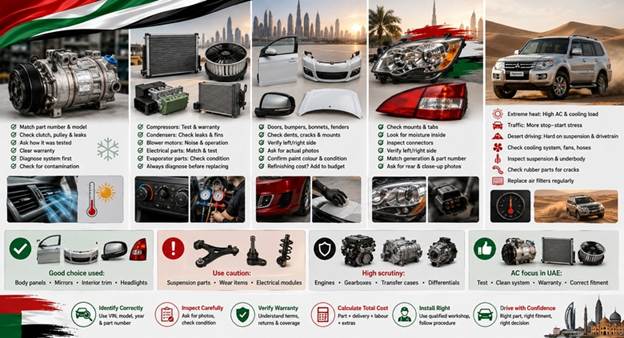
Used Mitsubishi Engines for Sale in UAE: What Buyers Must Check
A used Mitsubishi engine is not a normal spare-parts purchase. The engine may be cheaper than rebuilding your original unit, but installation is expensive enough that a bad decision can quickly become a much bigger bill.
Before comparing prices, identify the engine code, vehicle generation, transmission pairing and VIN application.
That is the foundation.
Engine code comes before engine capacity:
“2.4-litre Mitsubishi engine” is not precise enough for a serious purchase.
Ask for the exact engine code and confirm that the proposed engine is suitable for your vehicle. This matters across Pajero, Lancer, Outlander, Attrage and ASX applications because similar capacities do not guarantee identical specifications.
Ask about the donor vehicle:
A credible used-engine supplier should be able to provide useful donor information where available.
Ask for the donor model, model year, engine code and mileage.
If the engine came from a damaged vehicle, ask whether the damage could have affected the engine itself.
A front-end accident and a severe overheating incident are very different donor histories.
Mileage matters, but it is not the whole story:
A lower-mileage engine is attractive.
Still, mileage without supporting information tells you only part of the story.
A well-maintained higher-mileage engine may be preferable to a low-mileage unit with unknown history, overheating damage or long-term storage problems.
Compression testing gives you something concrete:
Where appropriate, ask whether compression has been checked and whether the supplier can provide the results.
Uneven compression across cylinders deserves investigation.
Do not accept “engine tested” as sufficient information if nobody can explain what was tested.
Check for oil and coolant contamination:
The engine should be inspected for signs of oil contamination, coolant contamination, excessive leakage and other visible problems.
The workshop should also assess the engine before installation rather than treating the supplier's description as a complete mechanical inspection.
Ask what comes with the engine:
This is an easy place to get caught out.
Is the engine supplied as a complete assembly?
Does it include:
- Intake parts?
- Exhaust-related parts?
- Alternator?
- Starter?
- AC compressor?
- Sensors?
- Wiring?
- Injectors?
- Engine mounts?
The answer can change the effective price considerably.
Bare engine versus complete engine:
Two suppliers can quote different prices for apparently identical engines.
One may be selling a long block.
The other may include several external parts.
Compare what is physically included before deciding which quotation is cheaper.
Installation creates additional costs:
An engine replacement can involve fluids, seals, gaskets, filters, mounts, hoses, diagnostics and other supporting work.
There may also be coding or adaptation requirements depending on the vehicle and replacement arrangement.
So the engine price is only the starting figure.
Illustrative used-engine cost comparison:
| Cost item | Example |
| Used engine | AED 7,000 |
| Delivery | AED 300 |
| Labour | AED 2,500 |
| Fluids and filters | AED 600 |
| Seals/gaskets/supporting parts | AED 500 |
| Diagnostics | AED 300 |
| Illustrative total | AED 11,200 |
These figures are illustrative only, not fixed UAE prices.
The actual total depends heavily on the Mitsubishi model, engine, workshop and condition of the replacement.
Ask about warranty before the engine goes in:
This is critical.
A warranty that covers the engine but excludes labour can still leave you with a substantial bill if the unit fails after installation.
Ask exactly what is covered, how long the warranty lasts and whether installation conditions apply.
Engine replacement decision:
For a high-mileage Pajero, a properly tested used engine with a meaningful warranty can make financial sense.
For a newer Outlander or ASX, compare the used engine against a reconditioned or new alternative and consider the vehicle's remaining value and expected ownership period.
Do not decide on engine price alone.
How to Check a Used Mitsubishi Engine Before Buying
The seller says the engine is “good”.
That is a starting point, not a mechanical inspection.
Check the identification first:
Match the engine code with the vehicle specification.
Then compare the proposed engine against the VIN and original engine application.
If the engine code differs, ask why.
Sometimes there is a valid replacement application. Sometimes there is not.
Ask for cold-start evidence where possible:
If the supplier can demonstrate the engine running before removal or provide credible running footage, that is useful.
Listen for abnormal knocking, excessive ticking, unstable idle and other obvious symptoms.
A video cannot replace a proper inspection, but it can reveal things that a clean photograph will not.
Look for excessive smoke:
Smoke colour and behaviour can provide clues, although diagnosis should be left to someone qualified.
Persistent abnormal smoke should not simply be dismissed because the engine is being sold cheaply.
Check blow-by and breathing-system condition:
Excessive crankcase pressure can indicate internal wear.
A workshop should assess this properly rather than relying on a quick visual judgement.
Compression results:
Where applicable, ask for cylinder compression readings.
The important point is not merely the highest number.
Consistency between cylinders matters.
If one cylinder is significantly different from the others, investigate before buying.
Inspect the oil:
Look for obvious signs of contamination or abnormal condition.
Milky contamination can raise concerns about coolant entering the oil system, while excessive sludge can indicate poor maintenance.
These observations do not establish a diagnosis on their own, but they are useful warning signs.
Inspect coolant passages where possible:
Signs of contamination, corrosion or overheating should be investigated.
An engine that has suffered serious overheating is a very different proposition from one removed from a healthy donor vehicle.
Check for external leaks:
Inspect seals, gaskets, the sump area and visible joints for oil or coolant leakage.
A used engine does not need to be cosmetically perfect.
It does need to be mechanically credible.
Ask what was replaced before sale:
If the supplier says the engine was serviced or prepared, ask exactly what was done.
Were seals replaced?
Was the oil changed?
Were gaskets replaced?
Was the engine opened internally?
“Checked and serviced” is too vague to carry much weight.
Used-engine inspection points:
| Check | What it tells you |
| Engine code | Application |
| VIN compatibility | Vehicle fitment |
| Donor vehicle | Background |
| Mileage | Useful history |
| Compression | Cylinder condition |
| Oil | Possible contamination/wear clues |
| Coolant | Possible cooling-system concerns |
| Smoke | Possible combustion/oil issues |
| External leaks | Seal/gasket condition |
| Running evidence | Useful operational evidence |
| Warranty | Financial protection |
Do not buy a used engine without considering installation risk:
This is the part owners sometimes underestimate.
If the engine is wrong, defective or incompatible, removing it from the vehicle and fitting another one can create another major labour bill.
The more expensive the installation, the stronger your reason to demand evidence before buying.
Ask whether the replacement should receive preventive parts during installation:
The workshop may recommend replacing accessible seals, filters, fluids, belts, hoses or other service items while the engine is already out.
Not every recommendation is automatically necessary.
Ask why each item is needed.
That keeps the repair focused rather than allowing the bill to grow without explanation.
Used Mitsubishi Engine Prices in UAE: Engine Cost vs Complete Replacement Cost
The advertised engine price is rarely the final figure.
This matters because owners comparing used engines can become fixated on the first number they see.
Separate the engine price from the replacement project:
A used engine might be advertised at AED 6,000.
That does not mean the vehicle will be back on the road for AED 6,000.
Installation, fluids, seals, filters, diagnostics and supporting work can add considerably more.
Illustrative project comparison:
| Option | Engine/major part | Labour and supporting work | Illustrative project total |
| Used engine | AED 6,000 | AED 3,500 | AED 9,500 |
| Reconditioned engine | AED 8,000 | AED 3,500 | AED 11,500 |
| New aftermarket/replacement | AED 10,000 | AED 3,500 | AED 13,500 |
| New genuine | AED 13,000 | AED 3,500 | AED 16,500 |
Again, these are illustrative examples, not current fixed UAE quotations.
Why a cheap engine can still produce an expensive repair:
Suppose Engine A costs AED 5,500.
Engine B costs AED 7,000 but includes a stronger warranty and more complete supporting equipment.
If Engine A requires additional seals, sensors, hoses and repeated diagnostics, the original AED 1,500 saving can disappear.
Look at the project.
Not the advert.
Check what the workshop expects to replace:
Ask for a written estimate covering the installation.
That can include:
- Labour
- Engine oil
- Coolant
- Filters
- Seals
- Gaskets
- Hoses
- Mounts
- Belts where appropriate
- Diagnostics
- Coding or adaptation where applicable
The exact list depends on the Mitsubishi.
Vehicle value matters:
If your old Lancer is worth AED 12,000 and the engine replacement project approaches AED 10,000, stop and think.
The repair may still make sense if the vehicle is otherwise excellent and you know its history.
But if the car also needs suspension, AC, tyres and transmission work, replacement may deserve serious consideration.
Long-term ownership changes the equation:
A Pajero that you have maintained carefully for years may justify a major engine replacement.
You already know the vehicle's history.
Buying another used car means buying another set of unknowns.
That has a value too.
Downtime has a cost:
If the Mitsubishi is a daily family car or business vehicle, every day off the road matters.
A slightly more expensive engine that is physically available in the UAE may sometimes be preferable to a cheaper unit with an uncertain delivery date.
Engine project checklist:
| Question | Why it matters |
| Exact engine code? | Fitment |
| VIN confirmed? | Application |
| Donor details? | History |
| Mileage known? | Risk assessment |
| Compression tested? | Mechanical evidence |
| Complete or bare engine? | Price comparison |
| Warranty? | Failure protection |
| Labour quotation? | True project cost |
| Supporting parts? | Avoid surprises |
| Delivery time? | Downtime |
Used Mitsubishi Gearboxes in UAE: How to Choose the Correct Transmission
Buying a used gearbox is where “it came from the same model” becomes a particularly dangerous sentence.
The transmission needs to match the vehicle's exact specification, not merely its badge.
Identify the gearbox code first:
Ask the supplier for the gearbox or transmission identification.
Then compare it with the original unit.
If the reference is different, ask whether the proposed gearbox is a confirmed replacement for your vehicle.
Engine pairing matters:
The transmission must be compatible with the engine application.
A gearbox from another Mitsubishi with a similar engine capacity is not automatically suitable.
Automatic and manual are obvious differences — but not the only ones:
Even within automatic transmissions, different specifications can exist.
Gear ratios, electronic control, mounting arrangements and drivetrain configuration can all matter.
That is why VIN and transmission-code verification should happen before payment.
Drivetrain matters for Pajero:
For a 4WD Pajero, check the drivetrain configuration carefully.
A used transmission, transfer-case part or related drivetrain assembly should be matched to the exact vehicle specification.
The consequences of getting it wrong are too expensive to leave to guesswork.
Ask about donor mileage:
Mileage can help you compare two used gearboxes.
But again, it is not the whole story.
Ask how the gearbox was removed, whether the donor vehicle was running and whether the transmission was tested before being offered for sale.
Fluid condition can provide clues:
Ask whether the fluid was inspected and whether there were signs of contamination, burnt odour or unusual debris.
These observations are not a substitute for proper testing.
They are simply useful evidence.
Ask about testing:
A gearbox described as “tested” should come with some explanation.
Was it tested in the donor vehicle?
Bench-tested?
Inspected internally?
Checked for abnormal noise?
The more expensive the gearbox, the more detail you should expect.
Used gearbox warranty matters enormously:
A gearbox can be relatively inexpensive to buy and expensive to install.
That makes warranty coverage particularly important.
Ask whether the warranty covers the unit only or whether installation labour is included if the replacement fails.
Gearbox purchase comparison:
| Check | Why it matters |
| Gearbox code | Exact identification |
| VIN | Vehicle compatibility |
| Engine pairing | Transmission application |
| Drivetrain | 2WD/4WD requirements |
| Donor vehicle | Background |
| Donor mileage | Useful comparison |
| Fluid condition | Possible wear clues |
| Testing | Evidence of operation |
| Warranty | Major risk protection |
| Installation labour | Total cost |
Do not buy the cheapest gearbox simply because it is available:
If one gearbox costs AED 3,500 and another costs AED 4,200 with better testing and warranty, the AED 700 difference may be money well spent.
Especially if fitting either gearbox costs thousands.
Check whether additional work is expected:
A gearbox replacement may require fluids, seals, mounts, diagnostics, adaptation or other supporting work.
Ask the workshop for the complete installation estimate before comparing supplier prices.
How to Check a Used Mitsubishi Gearbox Before Buying
A clean gearbox casing tells you very little.
The important questions concern identification, internal condition, testing and warranty.
Match the transmission code:
Start here.
If the code does not match the original unit, ask for documented confirmation that it is a compatible replacement.
Do not rely on appearance.
Inspect the casing:
Look for cracks, severe impact marks, damaged mounting points, oil leakage and signs that the casing has previously been repaired.
A used gearbox can have cosmetic wear.
Structural damage is another matter.
Check the fluid where available:
Abnormal fluid condition, burnt smell or excessive metallic debris can raise concerns.
The inspection method depends on the transmission, so let the workshop assess it properly.
Ask about shifting behaviour:
If the donor vehicle was operational, ask whether the gearbox was tested while running.
For an automatic transmission, evidence of engagement and shifting behaviour can be particularly useful.
For a manual gearbox, ask about gear selection and abnormal noise.
Listen for noise:
Unusual whining, grinding or rumbling should not be brushed aside.
The precise source requires proper diagnosis, but obvious abnormal noise is enough reason to investigate further.
Check shaft and mounting areas:
Where relevant, inspect seals, shafts, mounting points and other visible areas for damage or excessive wear.
The exact inspection depends on the gearbox design.
Ask whether the gearbox was opened:
If the supplier says it has been rebuilt or inspected internally, ask what was done.
Which parts were replaced?
What was measured?
Was it reassembled and tested?
Details matter.
Used gearbox inspection checklist:
| Inspection point | What to establish |
| Transmission code | Correct application |
| VIN | Vehicle fitment |
| Casing | Cracks or impact damage |
| Mounts | Damage |
| Fluid | Condition |
| Seals | Leakage |
| Donor vehicle | Background |
| Mileage | Useful history |
| Testing | Operational evidence |
| Internal work | If rebuilt |
| Warranty | Protection |
| Installation cost | Total project price |
Do not confuse “fits” with “works properly”:
A gearbox can bolt into a vehicle and still be the wrong specification.
It can also be the correct specification and still be worn.
Those are two separate risks.
You need to address both.
Ask for warranty terms in writing:
For a major transmission repair, verbal assurances are not enough.
Keep the quotation, gearbox reference, photographs, warranty conditions and compatibility confirmation.
If something goes wrong later, you will know exactly what was promised.
The gearbox decision should include the installation risk:
A used gearbox is attractive because it can cut the purchase cost substantially.
But if the workshop charges heavily for removal and installation, the cheapest gearbox is not necessarily the cheapest solution.
Match the gearbox. Test the gearbox. Understand the warranty. Calculate the complete repair. Then buy.
Model-Specific Used Mitsubishi Parts
Used Mitsubishi Pajero Spare Parts in UAE: Engines, Gearboxes, Suspension and 4WD Parts
A Pajero is not one single parts catalogue.
That matters more than it sounds. The UAE has a healthy mix of older and newer Pajeros, different engines, 3-door and 5-door versions, and vehicles that have spent their lives doing very different jobs. One has been commuting around Dubai. Another has been dragged through the dunes every weekend. Same badge. Very different wear patterns.
That is why buying a used Pajero part should begin with generation, engine, drivetrain and exact part number.
Used Pajero engines need stronger checks:
For an engine, ask for the engine code, donor vehicle details, mileage where known and evidence of testing.
Compression results are particularly useful where available. So are checks for overheating history, oil contamination, coolant contamination and obvious external leaks.
Do not buy simply because the seller says, “Good engine, low mileage.”
That description is too thin for an expensive installation.
Used Pajero gearboxes need exact matching:
A Pajero gearbox should be matched to the correct engine and drivetrain configuration.
For 4WD vehicles, the transmission and associated drivetrain specification can matter considerably.
Ask for the gearbox identification and compare it with the original unit before paying.
Pajero suspension parts face a different kind of risk:
Suspension parts can be attractive used purchases when the donor vehicle is known and the parts are in good condition.
But desert use changes the picture.
Repeated sand driving, uneven surfaces, hard landings and heavy off-road use can accelerate wear in bushes, arms, dampers and related parts.
A used suspension part from a heavily abused donor is not necessarily a bargain.
Used 4WD parts require more than visual inspection:
Transfer-case and differential parts should be matched by exact specification.
Gear ratios, drivetrain configuration and compatibility matter.
If a supplier cannot identify the donor unit properly, move on.
There are plenty of things worth taking a chance on in life. An incorrectly matched 4WD drivetrain is not one of them.
Pajero body parts can be easier to source used:
Doors, bonnets, bumpers, mirrors and some interior parts can make particularly good candidates for used genuine replacement.
Inspect the actual part for dents, cracks, broken mounting points, previous repairs and corrosion.
For painted panels, also consider whether the colour and paint condition will make the apparent saving disappear once refinishing is required.
Pajero headlights and lights:
Check the lens, mounting tabs, connectors and internal moisture.
A used headlight that looks fine from two metres away can have a cracked mounting point hidden behind the housing.
Ask for close photographs.
Pajero AC parts in UAE:
The UAE climate makes air-conditioning a serious ownership concern.
A used AC compressor can save money, but ask how it was tested, whether it turns freely, whether abnormal noise was detected and what warranty comes with it.
If the original compressor failed catastrophically, the workshop should also check whether contamination has spread through the system before simply installing another compressor.
Pajero parts worth considering used:
| Part type | Used-buying potential | Main check |
| Body panels | High | Damage + fitment |
| Mirrors | High | Motors/electronics |
| Interior trim | High | Condition |
| Headlights | Moderate | Mounts + moisture |
| Suspension | Moderate | Wear + donor use |
| AC compressor | Moderate | Testing + warranty |
| Gearbox | Higher risk | Code + testing |
| Engine | Higher risk | Testing + history |
| Transfer case | Higher risk | Exact specification |
Pajero owners should think about how the vehicle is used:
A family Pajero doing daily motorway kilometres has one maintenance profile.
A modified Pajero running dunes every weekend has another.
If the vehicle has larger tyres, suspension modifications or other drivetrain changes, tell the supplier and workshop before ordering replacement parts.
That information can affect what actually fits and what is sensible to install.
Used Mitsubishi Pajero Parts by Generation, Engine, 3-Door and 5-Door Version
Searching for a “used Pajero part” without identifying the generation is asking the supplier to guess.
And guesses become expensive when the part is already on its way.
Generation comes first:
Pajero parts can change between generations, facelifts and equipment specifications.
The same-looking vehicle name does not guarantee the same headlight, bumper, suspension part, electronic module or drivetrain assembly.
Give the supplier the exact model year and VIN wherever possible.
3-door and 5-door versions can differ:
Body panels are the obvious example.
A door, interior trim, rear body part or other panel should not be ordered simply because the listing says “Pajero”.
Confirm the body configuration.
Engine specification matters:
Engine-related parts need particularly careful matching.
A seller may have several Pajero engines or engine-related parts in stock, yet only one may suit your exact vehicle.
Engine code is much more useful than simply saying “3.0” or “3.5”.
Facelift vehicles create another trap:
Lights, bumpers, grilles and some exterior trim can change during a facelift.
Two vehicles from nearby model years can look similar enough in a photograph to fool a buyer.
The part number settles the argument.
Use photographs intelligently:
If buying a used body part, compare the seller's photograph with your original part.
Look at:
- Mounting points
- Connector positions
- Shape
- Brackets
- Fixing holes
- Trim attachment points
A five-minute comparison is cheap insurance.
Pajero part identification checklist:
| Identification | Why it matters |
| Model year | Generation/variant |
| VIN | Exact vehicle |
| 3-door/5-door | Body compatibility |
| Engine | Mechanical application |
| Engine code | Precise identification |
| Gearbox | Drivetrain compatibility |
| 4WD specification | Major mechanical parts |
| Part number | Exact item |
| Facelift status | Exterior parts |
Do not assume Montero solves the compatibility question:
Pajero and Montero names can refer to the same broader Mitsubishi model family in different markets, but the name alone is not enough to confirm compatibility.
Use the VIN and part number.
That is much safer than relying on the badge.
Used Mitsubishi Lancer Spare Parts in UAE: Affordable Parts for Older Models
The Lancer is exactly the kind of Mitsubishi where used parts can make financial sense.
Many owners are maintaining older vehicles, and a new genuine replacement is not always proportionate to the car's current value.
But “cheap” should still have boundaries.
Body panels can be strong used candidates:
Doors, bumpers, bonnets, mirrors and certain trim pieces are often worth comparing used.
The main concerns are physical condition and fitment.
For a painted panel, add refinishing to your calculation.
A cheap red door that needs a complete repaint may not be cheaper than a correctly coloured used door.
Used Lancer headlights:
Check the lens, mounting tabs, connector and moisture.
Also verify the exact generation and facelift.
Lighting assemblies can change between versions, and a photograph alone may not reveal the differences.
Suspension and steering parts:
Used suspension parts require more caution because wear is not always visible.
A used control arm may look perfectly acceptable while its bushes are already tired.
For wear-related parts, a reputable new aftermarket or OEM option can sometimes make more sense than a used original part.
Engine-related Lancer parts:
Sensors, intake parts, alternators and other engine-related items should be matched using the correct application and part number.
For a complete used engine, step up the inspection standard: engine code, donor mileage, compression where appropriate, history and warranty.
Lancer AC parts:
Older Lancers are common in the UAE, and AC repairs are unavoidable for many high-mileage examples.
A used compressor can be economical if properly tested.
Do not skip diagnosis, though.
If the compressor failed because of another fault, simply installing another compressor may not solve the problem.
Electrical parts:
Control modules, switches and other electrical items need exact identification.
A physically similar module may have a different specification or require coding.
Ask before ordering.
Used Lancer parts: value by category:
| Part | Used option | Why |
| Door | Often sensible | Original fitment |
| Bumper | Often sensible | Cost saving |
| Mirror | Often sensible | Used genuine value |
| Headlight | Often sensible | Check condition |
| Suspension wear part | More caution | Hidden wear |
| AC compressor | Moderate | Testing essential |
| Electronic module | More caution | Compatibility |
| Engine | Higher risk | Testing + warranty |
Older does not mean disposable:
A well-maintained Lancer can still be a practical daily car.
If the engine, transmission, cooling system and body are fundamentally sound, replacing one failed part with a properly selected used unit may be much cheaper than replacing the whole vehicle.
That calculation is especially relevant when the owner knows the car's history.
Used Mitsubishi Outlander Spare Parts in UAE: What Parts Are Worth Buying Used?
The Outlander covers several generations and specifications, so this is another model where “used Outlander part” is not precise enough.
Start with the VIN.
Then decide whether the particular part is actually a good candidate for used replacement.
Body parts are usually easier decisions:
A used door, bumper, bonnet, mirror or other body part can make financial sense when the condition is good and the paint match is acceptable.
Check mounting points.
Check damage.
Check the exact generation.
Lighting parts need specification checks:
Headlights and tail lights can differ by generation, facelift and equipment level.
Ask for the actual part number and compare connectors and mounting arrangements.
Do not order from a photograph that merely looks similar.
Used Outlander suspension parts:
A used suspension arm or other mechanical part may be suitable if condition is known.
For wear-sensitive parts, however, compare the cost of a reputable new aftermarket or OEM replacement.
Sometimes the price gap is small enough that buying new removes unnecessary uncertainty.
AC parts matter in the UAE:
Outlander owners rely heavily on the AC system during summer.
A used compressor can be considered, but proper testing and warranty should influence the decision.
If the original compressor has failed internally, the workshop should investigate system contamination before installing the replacement.
Electronic parts need more care:
Control modules and other electronically integrated parts should be checked against the exact vehicle specification.
Ask whether programming or adaptation is required.
A cheap used module can become an expensive purchase if it arrives without the necessary configuration.
Used engine and transmission parts:
These are higher-risk purchases.
For an engine, confirm engine code, donor history and mechanical condition.
For a transmission, confirm transmission identification, engine pairing and drivetrain.
Do not let a supplier reduce a complex compatibility question to “same Outlander”.
Which Outlander parts make more sense used?
| Part | General suitability |
| Body panel | Often good |
| Mirror | Often good |
| Interior trim | Often good |
| Headlight | Good if condition is strong |
| AC compressor | Moderate |
| Suspension assembly | Moderate |
| Electronic module | More caution |
| Gearbox | High scrutiny |
| Engine | High scrutiny |
The Outlander is a good example of why part type matters as much as vehicle model.
A used door and used gearbox may both be “Outlander spare parts”, but the buying risks are nowhere near the same.
Used Mitsubishi Montero, Attrage and ASX Parts in UAE: Compatibility and Availability
These three models attract different buyers, different budgets and different parts requirements.
Treating them as one generic Mitsubishi category would make the guide less useful.
Used Montero parts:
First establish exactly which Montero you have.
Market naming can create confusion, particularly when owners search using Pajero and Montero terminology interchangeably.
Use the VIN and original part number to settle the application.
For major drivetrain, engine and transmission parts, be especially careful about specification.
Used Attrage parts:
Attrage owners are often looking for practical, cost-conscious repairs.
That makes used parts attractive for certain body, lighting, interior and selected mechanical applications.
For routine wear parts, however, compare used prices with reputable new aftermarket or OEM alternatives.
If the difference is small, buying new can remove unnecessary wear-related uncertainty.
Used ASX parts:
ASX parts should likewise be matched by generation, engine, drivetrain and part number.
Body and lighting parts can be good used candidates when condition is strong.
Electronic and mechanical parts deserve more careful compatibility checks.
Availability can depend on age and demand:
A common Mitsubishi part may be easy to find in the UAE.
A less common ASX or older Montero part may take more searching.
That is where online comparison can help.
But do not confuse rarity with permission to skip verification.
Montero, Attrage and ASX comparison:
| Model | Used-part opportunity | Main caution |
| Montero | Body + mechanical parts | Exact specification |
| Attrage | Body + selected mechanical parts | Compare used vs new |
| ASX | Body + lighting + selected mechanical parts | Generation/engine |
| All three | Electronic parts | VIN + part number |
Imported vehicles need extra attention:
If the Mitsubishi was imported from another market, tell the supplier.
A vehicle may carry a specification that differs from the UAE-market version.
This can affect lighting, electrical equipment, body parts, emissions-related equipment and other applications.
Availability should never override compatibility:
You may find the exact-looking ASX part today.
You may find the correct part next week.
Waiting for the correct item is usually better than buying an immediately available part that does not properly match the vehicle.
The practical buying order:
Identify the model and generation → verify the VIN → confirm the part number → check condition → compare used and new alternatives → confirm warranty → then order.
That sequence works for a Pajero.
It works for a Lancer.
And it still works when the part is harder to find for an Attrage, ASX or Montero.
The badge gets you into the search.
The VIN and part number get you to the right part.
Used AC Parts, Body Panels and UAE Conditions
Used Mitsubishi AC Compressors in UAE: What Should You Check Before Buying?
A used AC compressor can look like an easy saving.
It is not always one.
In the UAE, the air-conditioning system works hard for much of the year, so a compressor that has already spent years in another vehicle deserves proper checking before it goes into yours. The part may be cheap. The labour and refrigerant work are not necessarily cheap.
Check the exact compressor first:
Confirm the Mitsubishi model, generation, engine and original compressor part number.
A compressor that physically looks right may have different mounting points, pulley arrangements, electrical connections or specifications.
For an Outlander, Pajero, Lancer, Attrage or ASX, use the VIN and part number rather than relying on a broad model description.
Ask how the compressor was tested:
“Tested” needs an explanation.
Ask whether the compressor was checked for operation, unusual noise, pulley or clutch behaviour and visible leakage.
If the supplier cannot explain what was tested, treat the description cautiously.
Look at the compressor itself:
Check for:
- Cracks
- Heavy corrosion
- Damaged mounting points
- Oil leakage
- Damaged pulley
- Connector damage
- Broken brackets
- Signs of previous repair
Cosmetic dirt is not the concern.
Structural or mechanical damage is.
Ask about the donor vehicle:
If the compressor came from a vehicle with known AC operation, that information is useful.
Ask for the donor model, year and engine where available.
A compressor from another Mitsubishi is not automatically compatible simply because the mounting arrangement looks similar.
UAE heat changes the risk calculation:
A Mitsubishi used through Dubai summer traffic with the AC running heavily has a different operating history from a vehicle used in a cooler climate.
That does not mean every UAE-used compressor is poor.
It means condition and testing deserve more attention.
Do not blame the compressor too quickly:
Weak AC does not automatically mean compressor failure.
The system could have:
- Refrigerant leakage
- Condenser problems
- Electrical faults
- Blower-related faults
- Pressure-control problems
- Blockages
- Other system issues
Have the workshop diagnose the system first.
Otherwise, you could install a perfectly good used compressor and still have weak AC.
If the old compressor failed internally, investigate contamination:
This is particularly important.
If the original compressor suffered an internal failure, debris or contamination may have moved through the AC system.
Simply fitting another compressor without addressing the underlying problem can put the replacement at risk.
The workshop should determine what additional cleaning, flushing or supporting work is appropriate for the specific system.
Warranty matters more than the price difference:
A used compressor at AED 600 with unclear testing is not automatically better than one at AED 850 with documented testing and a useful warranty.
If installation requires substantial labour, that AED 250 saving can disappear very quickly after a failure.
Used AC compressor checklist:
| Check | Why it matters |
| Part number | Correct application |
| VIN | Vehicle compatibility |
| Engine | Compressor specification |
| Donor vehicle | Background |
| Pulley/clutch | Visible condition |
| Leakage | Potential failure |
| Testing | Operational evidence |
| Warranty | Protection |
| Installation | Labour exposure |
| AC system diagnosis | Avoids replacing the wrong part |
When a used compressor can make sense:
A tested genuine compressor with a known application and reasonable warranty can be a sensible choice for an older Mitsubishi where a new genuine unit is disproportionately expensive.
For a newer vehicle or a high-labour installation, compare the used compressor with a reputable new OEM or aftermarket alternative before deciding.
Used Mitsubishi AC Parts: Compressor, Condenser, Blower and Other Replacement Options
The compressor gets most of the attention, but it is only one part of the Mitsubishi AC system.
If the cabin is not cooling properly, the failed item needs to be identified before buying anything.
Used condensers:
A used condenser can be considered if it is in good physical condition and properly identified.
Check for bent fins, impact damage, corrosion and signs of leakage.
A condenser that has been damaged by a front-end accident deserves extra scrutiny.
Used blower parts:
A blower motor or related part can sometimes be a practical used purchase.
Listen for abnormal noise and check operation where possible.
A noisy blower may have worn bearings or other internal wear that is difficult to see from the outside.
Used AC electrical parts:
Switches, control units, resistors and other electrical parts require exact identification.
Some are simple.
Others interact with the vehicle's wider electrical system.
Check the original part number and ask whether programming or configuration is required.
Used evaporator-related parts:
These deserve more caution because access can be labour-intensive.
If replacing the part requires substantial dashboard removal, the quality and condition of the replacement become particularly important.
A cheap used part is less attractive when the workshop may have to dismantle the same area again.
Do not buy an AC part based only on the symptom:
“AC is not cold” is a symptom.
It is not a part number.
Get the system diagnosed.
Then source the failed part.
AC part buying guide:
| AC part | Used-buying consideration |
| Compressor | Testing + warranty |
| Condenser | Leakage + physical damage |
| Blower motor | Noise + operation |
| Electrical control part | Compatibility + testing |
| Evaporator-related part | Condition + installation labour |
| Fan-related part | Operation + electrical condition |
UAE summer makes downtime particularly unpleasant:
A Mitsubishi with weak AC is inconvenient in winter.
In peak UAE summer, it becomes a daily problem.
That is why owners sometimes rush the purchase.
Don't.
A rushed compressor purchase can turn a one-part repair into a repeated AC job.
Used Mitsubishi Body Panels in UAE: Doors, Bumpers, Bonnet, Mirrors and Fenders
Body panels are often where used genuine Mitsubishi parts make the most obvious financial sense.
Why pay new-part pricing for a door or bonnet when a clean original panel is already available?
Because condition still matters.
Used doors:
Check the door shell, hinges, mounting points, internal brackets, window mechanism and visible damage.
If the door is being purchased as a complete assembly, find out exactly what is included.
A bare door shell and a complete door with glass, regulator, trim and electronics are two very different quotations.
Used bumpers:
Inspect cracks, broken clips, mounting points and previous repairs.
Also check whether the bumper includes grilles, brackets, sensors or other attached parts.
A cheap bumper may become less cheap when half the supporting hardware has to be purchased separately.
Used bonnet panels:
Look for dents, repaired areas, corrosion and damage around mounting points.
Paint matching also matters.
A panel in excellent structural condition may still require repainting to match the vehicle.
Include that cost.
Used fenders:
Check the exact side.
It sounds obvious.
Yet left/right mistakes still happen when parts are sourced quickly.
Compare mounting holes and shape with the original panel.
Used mirrors:
A mirror can contain much more than a piece of glass.
Depending on the Mitsubishi specification, it may include electrical adjustment, folding, heating, indicators or other equipment.
Confirm the exact specification before ordering.
Used body-panel inspection:
| Part | Main checks |
| Door | Shell + hinges + equipment |
| Bumper | Cracks + mounts + clips |
| Bonnet | Dents + mounts + corrosion |
| Fender | Side + shape + mounting |
| Mirror | Electronics + glass + housing |
| Grille | Mounts + clips + specification |
Paint colour can erase the apparent saving:
Imagine a used bonnet costs AED 500.
Then you discover that it needs preparation and repainting for AED 800.
The panel itself was cheap.
The repair was not.
A correctly coloured used panel in good condition may therefore be worth more than a cheaper damaged one.
Ask for photographs of the actual panel:
Request close images.
Look at the edges.
Look underneath.
Check mounting points.
Ask whether the panel has previously been repaired.
A photograph taken from across the workshop is not enough.
Used genuine body panels can be particularly useful for older Mitsubishi models:
Pajero and Lancer owners may find that a good used original panel gives them the correct shape and mounting arrangement without paying new genuine prices.
For newer vehicles, compare the used price with OEM and new replacement options before deciding.
Used Mitsubishi Headlights and Tail Lights in UAE: What Buyers Should Check
Lighting parts are another area where used genuine can be tempting.
The fit may be excellent.
The price may be attractive.
But inspect the housing before ordering.
Check the mounting tabs:
Broken mounting tabs are easy to miss in a front-facing photograph.
Ask for photographs from the rear and side.
If a mounting point has been repaired, find out how.
Look for moisture inside the housing:
Condensation or visible water ingress can indicate a sealing problem.
A used light should not be purchased purely because the outer lens looks clean.
Check the connector:
Inspect the electrical connector for damage, corrosion or missing pins.
For electronically integrated lighting, compatibility becomes even more important.
Left and right are not interchangeable:
Confirm the side.
Then confirm the exact generation and specification.
It sounds basic, but when several versions look similar online, it is worth making explicit.
Headlight specification can vary:
Different Mitsubishi versions can use different lighting arrangements or equipment.
If your vehicle has additional lighting functions or different electrical equipment, confirm the replacement matches.
Tail lights need the same attention:
Check:
- Lens condition
- Mounting points
- Connectors
- Water ingress
- Cracks
- Side
- Part number
- Generation
Used lighting inspection guide:
| Check | Why it matters |
| Part number | Exact application |
| Side | Left/right fitment |
| Generation | Design compatibility |
| Mounting tabs | Installation |
| Lens | Damage |
| Moisture | Sealing condition |
| Connector | Electrical operation |
| Actual photographs | Physical inspection |
| Warranty | Protection |
A clean lens does not prove a good light:
The housing can look excellent while a mounting tab is broken or an electrical connection is damaged.
Ask to see the rear.
That one request can save a return.
Used Mitsubishi Parts for UAE Heat, Traffic and Desert Driving
A Mitsubishi operating in the UAE does not live an easy mechanical life.
High ambient temperatures, heavy AC use, stop-start traffic and, for some owners, desert driving all shape the way certain parts age.
But do not turn this into an excuse to replace everything.
Use the conditions to decide what deserves closer inspection.
Cooling-system parts deserve attention:
Radiators, cooling fans, hoses, expansion tanks and related parts have an important job in high ambient temperatures.
If the vehicle is overheating, diagnose the cause before ordering a used replacement.
A new radiator will not fix a faulty fan control system.
AC parts face heavy demand:
The UAE's long hot season means the AC system can operate for extended periods.
Used compressors, condensers and blower parts therefore deserve proper testing.
Do not buy the cheapest available unit simply because the vehicle needs cold air immediately.
Rubber and plastic parts age under heat:
Hoses, seals, mounts and other rubber or plastic items can deteriorate with age and heat exposure.
Look for cracking, hardening, swelling or leakage.
For these parts, compare the price of used against new aftermarket or OEM alternatives.
A new wear-related item may be cheap enough that used makes little sense.
Traffic changes the workload:
A Mitsubishi sitting in Dubai traffic with the AC running is operating differently from one cruising steadily on an open road.
Cooling and AC systems have to deal with prolonged low-speed operation and high ambient temperatures.
That context matters when assessing symptoms.
Desert use adds another layer:
Pajero owners who regularly drive dunes should pay closer attention to suspension, drivetrain, cooling and underbody parts.
Sand and rough terrain can expose weaknesses that ordinary road driving does not.
Check suspension after demanding off-road use:
Look for:
- Worn bushes
- Damaged arms
- Leaking dampers
- Uneven tyre wear
- Loose mounts
- Underbody impact damage
A used suspension part from a heavily used donor may not be the bargain it appears to be.
Air filtration matters too:
Frequent dusty or sandy driving makes the air-filtering system particularly important.
A quality new filter is usually a better choice than a questionable used one.
Some parts simply should not be bought used.
UAE-condition inspection guide:
| Area | What to inspect |
| Cooling system | Radiator, fans, hoses |
| AC | Compressor, condenser, blower |
| Rubber parts | Cracks, hardening, leaks |
| Battery/electrical | Heat-related deterioration |
| Suspension | Wear + off-road damage |
| Drivetrain | Noise + vibration |
| Underbody | Impact damage |
| Air filtration | Filter + intake condition |
Do not overpay for a “UAE-used” label:
A part being removed from a UAE vehicle does not automatically make it better or worse.
Condition matters.
Testing matters.
Donor history matters.
The climate simply tells you where to look more carefully.
The smart UAE approach:
Use the vehicle's actual operating conditions to guide the inspection.
A Dubai commuter may need greater attention to cooling and AC.
A high-mileage Lancer may need a different balance of suspension, electrical and body-part checks.
A Pajero used in the dunes deserves closer scrutiny of drivetrain, suspension and underbody parts.
The Mitsubishi model tells you where to start.
The vehicle's real life tells you where to look next.
Price, Warranty, Compatibility and Buying Decisions
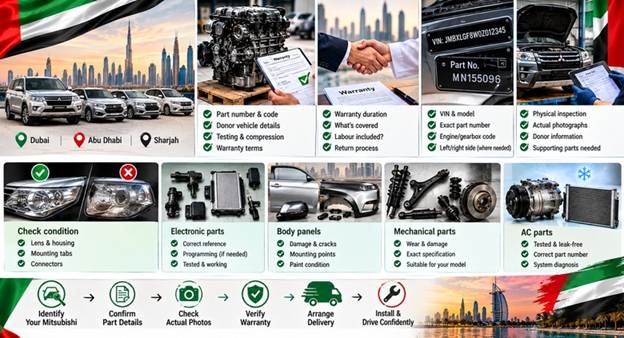
Used Mitsubishi Spare Parts in Dubai, Abu Dhabi and Sharjah: Where Should You Buy?
The best supplier is not necessarily the one with the lowest advertised price.
For a used Mitsubishi part, location affects stock, inspection, delivery and sometimes labour arrangements, but the part itself still comes first.
A Dubai supplier may have a Pajero gearbox ready for dispatch. A Sharjah supplier may have the same reference at a lower price. An Abu Dhabi owner may find that either option works once delivery is added.
So compare the complete deal.
Dubai:
Dubai can be useful when you need a broad choice of used Mitsubishi parts and want to compare several suppliers.
For older Pajero, Lancer and Outlander parts, availability can matter almost as much as price.
Ask whether the advertised item is physically in stock or has to be sourced after you place the order.
Sharjah:
Sharjah can be worth checking for used parts, particularly where several suppliers offer different condition and pricing options.
For body panels and other visible parts, ask for photographs of the actual item before travelling or paying.
A cheap bumper with broken mounting points is not a bargain.
Abu Dhabi:
An Abu Dhabi owner does not necessarily need to buy locally.
If a supplier elsewhere in the UAE has the correct used engine, gearbox, AC compressor or body panel, delivery may still make financial sense.
Calculate the delivered price.
Then compare it with the local option.
Ajman and the other Emirates:
Owners in Ajman, Ras Al Khaimah, Fujairah and Umm Al Quwain may need to source less common Mitsubishi parts from another Emirate.
That is perfectly workable when the supplier can verify compatibility and provide reliable delivery.
Distance should not outweigh part quality.
Physical inspection versus online buying:
A local purchase has one major advantage: you can inspect the part before accepting it.
That is useful for:
- Doors
- Bumpers
- Bonnet panels
- Mirrors
- Headlights
- Interior trim
For an engine or gearbox, however, visual inspection only goes so far.
Testing and warranty become much more important.
Ask these questions before travelling:
Is this the actual part in the photograph?
What is the exact part number?
Is it physically in UAE stock?
Has it been tested?
What warranty is included?
Can I return it if the part number is incorrect?
These questions can save a wasted trip.
Compare the complete price:
| Cost | Supplier A | Supplier B |
| Used part | AED 1,000 | AED 1,150 |
| Delivery | AED 150 | Included |
| Warranty | Limited | Included |
| Total before installation | AED 1,150 | AED 1,150 |
The cheaper listing is not actually cheaper.
That is why headline prices can be misleading.
Do not forget workshop compatibility:
If your mechanic has already identified the exact part number, send that information to the supplier.
If the workshop has not confirmed the diagnosis, do that first.
Buying a part before identifying the failure is one of the easiest ways to waste money.
Used Mitsubishi Spare Parts Warranty in UAE: What Does the Buyer Actually Get?
A warranty sounds reassuring.
But “warranty available” is not enough.
For a used Mitsubishi engine, gearbox or AC compressor, you need to know what happens when the part does not perform as expected.
Check the warranty period:
Ask for the exact duration.
Do not rely on vague phrases such as “short warranty” or “seller warranty”.
The period should be clear before payment.
Find out what is actually covered:
A warranty may cover the part itself but exclude labour.
That distinction matters enormously.
If a used gearbox costs AED 3,000 and installation costs AED 1,500, replacing the gearbox under warranty may still leave you facing another labour bill.
Ask about installation conditions:
Some suppliers may require installation by a qualified workshop or particular procedures to remain eligible for warranty protection.
Find this out beforehand.
Not after the part fails.
Ask who pays return delivery:
If the used part is defective, who sends it back?
You?
The supplier?
Is collection arranged?
Small detail, perhaps.
But it matters when a large gearbox or engine is involved.
Ask whether diagnostic evidence is required:
A supplier may need workshop evidence showing that the part itself failed.
Ask what documentation is required.
A written workshop diagnosis can be useful.
Warranty checklist:
| Question | Why it matters |
| Warranty duration? | Defines protection |
| What failures are covered? | Avoids assumptions |
| Labour included? | Major cost difference |
| Return delivery? | Potential extra cost |
| Installation conditions? | May affect eligibility |
| Testing required? | Claim evidence |
| Replacement or refund? | Understand outcome |
| Supporting documents? | Speeds up claim |
A longer warranty is not automatically better:
Read the conditions.
A six-month warranty with numerous exclusions may provide less practical protection than a shorter warranty with straightforward coverage.
What matters is what the warranty actually does.
Used engine warranty deserves special attention:
Ask whether the warranty covers internal mechanical failure and whether specific installation procedures apply.
If fluids, filters or other supporting parts must be replaced during installation, establish that before the engine goes in.
Used gearbox warranty deserves the same scrutiny:
Because gearbox installation can be labour-intensive, clarify whether the warranty covers only the gearbox or also any applicable installation-related cost.
Do not assume.
Ask.
Keep all purchase records:
Save the quotation, invoice, part number, photographs, warranty terms and compatibility confirmation.
If the supplier and workshop have exchanged important information by message, keep those records too.
When something goes wrong, evidence becomes useful very quickly.
Used Mitsubishi Parts Compatibility Checklist Before Payment
This is the final pause before money changes hands.
You have found the part.
The price looks reasonable.
Now verify it.
Confirm the vehicle:
Check:
- VIN
- Model
- Model year
- Generation
- Engine
- Engine code where relevant
- Gearbox
- Drivetrain
- Body configuration
You may not need every item for a mirror.
You certainly want more information for an engine or gearbox.
Confirm the part:
Check:
Original part number
Replacement part number
Manufacturer
Revision or suffix
Left/right side where applicable
Exact condition
If the supplier proposes a different reference, ask whether it is a confirmed supersession.
Check the actual photographs:
For used parts, request clear images of the actual item.
Look at mounting points, connectors, cracks, corrosion, dents and previous repairs.
For mechanical parts, ask for photographs of identification markings as well.
Check the donor vehicle:
This is especially useful for engines, gearboxes and drivetrain parts.
Ask:
- Which Mitsubishi?
- Which year?
- Which engine?
- Which gearbox?
- What mileage?
- Why was it dismantled?
- Was the vehicle running?
The supplier may not have every answer.
But the more information available, the better the buying decision.
Check whether coding is required:
For electronic parts, ask the workshop whether programming, coding, calibration or adaptation will be necessary.
The part can be physically correct and still require additional work.
Check whether supporting parts are needed:
A used AC compressor may require additional system work.
A used engine may need seals, fluids and filters.
A used gearbox may need fluid and related service items.
Get the workshop's view before ordering.
Pre-payment checklist:
| Check | Confirm |
| VIN | ☐ |
| Generation | ☐ |
| Engine | ☐ |
| Gearbox | ☐ |
| Part number | ☐ |
| Replacement reference | ☐ |
| Donor details | ☐ |
| Actual photographs | ☐ |
| Testing | ☐ |
| Warranty | ☐ |
| Return terms | ☐ |
| Delivery | ☐ |
| Coding/programming | ☐ |
| Supporting parts | ☐ |
| Complete repair cost | ☐ |
Do not rush because the vehicle is already dismantled:
This is exactly when buyers can make poor decisions.
The Mitsubishi is sitting at the workshop.
The mechanic needs the part.
The supplier has one available.
Paying immediately feels like progress.
Sometimes it is.
Sometimes it is the start of a second repair.
Take the extra few minutes and verify the part number.
Used Mitsubishi Part vs New Part: When Is Saving Money Worth the Risk?
Used is not automatically cheaper once everything is included.
New is not automatically better either.
The sensible choice depends on the part, vehicle age, installation difficulty, warranty and expected ownership period.
Used can make strong financial sense for body parts:
A clean genuine Pajero door or Lancer mirror may provide original fitment at a substantially lower price than buying new.
If the condition is good and the colour matches, the saving can be meaningful.
Used is more complicated for wear-related parts:
Consider a suspension arm.
If a new reputable aftermarket replacement costs only slightly more than a used original part, buying used may not offer enough financial benefit.
Why accept unknown wear when the price gap is small?
Major mechanical parts need a different calculation:
For an engine or gearbox, installation labour changes the equation.
A used unit might save several thousand dirhams.
But if it fails and requires removal and replacement again, the labour exposure can swallow much of that saving.
Electronic parts can sit somewhere in between:
A used control module can be attractive if it is correctly identified and tested.
But if programming is required, include that cost.
Also ask what happens if the module fails after installation.
Decision matrix:
| Situation | Used may make sense | New may make more sense |
| Body panel | ✓ | |
| Mirror | ✓ | |
| Interior trim | ✓ | |
| Headlight | ✓ if tested | ✓ if electronics are complex |
| AC compressor | ✓ if tested | ✓ for high-confidence repair |
| Suspension wear part | Sometimes | Often worth comparing |
| Electronic module | ✓ if verified | ✓ when programming/risk is high |
| Gearbox | ✓ if tested + warranted | ✓ for high-value repair |
| Engine | ✓ if thoroughly checked | ✓ when long-term reliability is priority |
Vehicle value matters:
A used part can be an excellent financial decision for an older Mitsubishi that is otherwise healthy.
If the vehicle has several major problems at the same time, however, keep adding up the numbers.
An AED 5,000 engine repair looks different when the car also needs AED 4,000 of transmission work and another AED 3,000 of suspension and AC repairs.
Ownership plans matter too:
If you plan to keep the Pajero for several more years, a higher-confidence repair can be worth paying for.
If you are maintaining an older Lancer for short-term use, a properly inspected used part may be the more rational choice.
Neither approach is universally right.
Consider failure consequences:
A cheap used mirror fails?
Annoying.
A cheap used gearbox fails after installation?
Expensive.
That difference should influence how much risk you are willing to accept.
The real calculation is:
Purchase saving − additional risk − potential repeat labour − supporting costs = actual value of the used part.
It does not need to be mathematically perfect.
It just needs to be more realistic than comparing two stickers.
Used Mitsubishi Spare Parts Buying Checklist for UAE Owners
Before paying for a used Mitsubishi part, run through the purchase one last time.
Not because buying a used part is inherently risky.
Because the wrong part is risky.
Identify the Mitsubishi:
Confirm the model, year, generation, engine, gearbox and VIN.
For Pajero, also confirm body configuration and drivetrain where relevant.
For imported vehicles, tell the supplier that the vehicle is imported.
Identify the part:
Confirm the original part number and replacement reference.
For side-specific parts, confirm left or right.
For engines and gearboxes, confirm the exact code.
Check the condition:
For used body parts, inspect damage and mounting points.
For engines, ask about testing, compression where appropriate and donor history.
For gearboxes, ask about testing, fluid condition and operational evidence.
For AC parts, ask how the unit was tested.
Check the supplier:
You should know:
- Where the part is
- Whether it is physically available
- What testing was performed
- What warranty applies
- What the return process is
- When it can be delivered
Calculate the complete cost:
Include:
Part + delivery + labour + fluids + seals/gaskets + diagnostics + coding/programming + necessary supporting work.
Do not automatically add every item to every repair.
Only include what your particular job requires.
Check the workshop's requirements:
Before ordering an electronic, engine, gearbox or AC part, ask the workshop whether additional installation or calibration work is expected.
This can prevent an unpleasant surprise after the part arrives.
Final buying checklist:
| Question | Done |
| Correct model and generation? | ☐ |
| VIN checked? | ☐ |
| Engine/gearbox identified? | ☐ |
| Exact part number confirmed? | ☐ |
| Actual used-part photos seen? | ☐ |
| Donor information checked? | ☐ |
| Testing explained? | ☐ |
| Warranty understood? | ☐ |
| Return terms understood? | ☐ |
| Delivery confirmed? | ☐ |
| Installation requirements checked? | ☐ |
| Complete repair cost calculated? | ☐ |
FAQs
Categories
- Audi
- BMW
- Car Accessories
- Car Tips
- Ford
- Land Rover
- Mazda
- Range Rover
- Top 10
- UAE Car Parts
- Used Car Parts
- Toyota
- Replacement Engines
- Nissan
- Hyundai
- Mitsubishi
- Volkswagen
- Honda
- Kia
- Chevrolet
- Dodge
- Jeep
- Subaru
- Renault
- Lexus
- Mercedes
- Suzuki
- Hummer
- Porsche
- Infiniti
- Peugeot
- GMC
- Mini
- Volvo
- Replacement Gearboxes
- MG
- Jaguar
- Skoda
- Cadillac
- Daihatsu
- Fiat
- German Car Parts
- Japanese Car Parts
- Aftermarket Car Parts
- Genuine Car Parts
- New Car Parts
- Reconditioned Car Parts
- European Car Parts
- American Car Parts
- Korean Car Parts
- British Car Parts
- Chinese Car Parts
- Sports/Exotic Car Parts
- Luxury Car Parts
- Performance Car Parts
- SUV/4x4 Spare Parts
- Truck Spare Parts
- EV Car Parts
- Hybrid Car Parts
- Auto Spare Parts in UAE
- Tesla
- Isuzu
- Ram
- Ferrari
- Bentley
- Lamborghini
- Genesis
- Maserati
- Lincoln
- Chrysler
- Opel
- Citroen
- SsangYong
- Seat
- McLaren
- Aston Martin
- Rolls Royce
- Maybach
- Alfa Romeo
- Bugatti
- Scion
- Abu Dhabi Car Parts
- Ajman Car Parts
- Al Khan Car Parts
- Al Sajaa Car Parts
- Deira Car Parts
- Dubai Car Parts
- Fujairah Car Parts
- Industrial Area 6 Car Parts
- Mussafah Car Parts
- Ras Al Khaimah Car Parts
- Sharjah Car Parts
- Umm Al Quwain Car Parts
- Acura
- BYD
- Chery
- Dacia
- DS
- Geely Emgrand
- EXEED
- GAC
- GAC Gonow
- Geely
- Gonow
- Great Wall
- Haima
- Haval
- Holden
- Iveco
- JAC
- Jaecoo
- Jetour
- Lotus
- Omoda
- Proton
- Renault Samsung
- Roewe
- Lucid
- Replacement Headlight
- Replacement Bumper