Used Nissan Spare Parts in UAE: What Buyers Should Check Before Ordering
August 1, 2026
Understanding the Used Nissan Spare Parts Market
Key Takeaways
Before purchasing any used Nissan spare part in the UAE, buyers should understand how the market operates, how used parts differ from genuine, OEM and aftermarket alternatives, and why inspection matters far more than price alone. A well-chosen used component can deliver excellent value, but only when compatibility, condition, supplier reputation and installation quality are carefully considered.
For owners of the Nissan Patrol, Altima, Sunny, Maxima, X-Trail, Pathfinder, Navara and other popular models, informed buying decisions reduce repair costs while maintaining reliability. Throughout this guide, we'll explore how to identify quality used parts, avoid expensive mistakes and maximise long-term ownership value in the UAE.
Used Nissan Spare Parts at a Glance
| Buying Factor | Why It Matters |
| Vehicle Compatibility | Ensures the part fits and functions correctly. |
| Component Condition | Determines reliability and remaining service life. |
| Supplier Reputation | Reduces the risk of purchasing poor-quality parts. |
| Warranty Availability | Provides reassurance after installation. |
| Professional Inspection | Identifies hidden defects before purchase. |
| Long-Term Value | Balances upfront savings with future maintenance costs. |
A used Nissan spare parts in UAE are not simply a cheaper alternative.
It's a buying decision.
And like every important buying decision...
The outcome depends on the information available before money changes hands.
Across the UAE, thousands of Nissan owners search for replacement components every week.
Some are responding to unexpected breakdowns.
Others are carrying out preventative maintenance.
Fleet operators replace high-mileage wear items.
Off-road enthusiasts prepare their Patrols for another desert season.
Families simply want reliable transport without overspending.
Despite those different reasons, almost every buyer asks the same question.
"Can I trust a used part?"
The answer isn't a simple yes or no.
It depends on what you buy.
Where you buy it.
How carefully it's inspected.
And whether it's genuinely suitable for your vehicle.
Buying used successfully isn't about taking risks.
It's about removing them.
Why Used Nissan Spare Parts Are in High Demand Across the UAE
Few automotive brands enjoy the widespread popularity that Nissan has earned across the Emirates.
From busy city streets in Dubai and Abu Dhabi to long-distance highways connecting Sharjah, Ajman, Ras Al Khaimah, Fujairah and Umm Al Quwain, Nissan vehicles have become part of everyday life.
That popularity naturally creates consistent demand for replacement components.
Several factors continue driving the used parts market.
These include:
- Large numbers of Nissan vehicles on UAE roads.
- Increasing ownership of older vehicles.
- Rising demand for cost-effective repairs.
- Commercial fleet maintenance.
- Growing availability of professionally dismantled vehicles.
- Better online access to suppliers.
The result is a mature marketplace where buyers have considerably more choice than they did only a few years ago.
Choice, however, creates another challenge.
Knowing which option represents genuine value.
Understanding the UAE Used Auto Parts Industry
The UAE's automotive aftermarket has developed into one of the region's most active sectors.
Vehicles arrive from multiple international markets.
Insurance write-offs.
End-of-life vehicles.
Fleet replacements.
Imported vehicles.
Professional dismantlers recover thousands of reusable components every year.
These components often include:
- Engines.
- Gearboxes.
- Alternators.
- Starter motors.
- Suspension assemblies.
- Body panels.
- Lighting units.
- Interior trim.
- Wheels.
- Electronic modules.
Not every recovered component is automatically suitable for resale.
Professional suppliers inspect, clean and assess components before offering them to buyers.
Responsible businesses understand that reputation depends upon supplying parts that perform reliably.
The best suppliers don't simply sell components.
They reduce uncertainty.
Benefits of Buying Used Nissan Spare Parts Instead of New
Price is usually the first advantage buyers notice.
It isn't the only one.
Used parts can also provide:
- Faster availability for discontinued models.
- Original factory-manufactured components.
- Environmentally responsible vehicle recycling.
- Reduced repair costs.
- Greater availability for older Nissan models.
- Practical solutions for insurance-approved repairs.
For vehicles approaching higher mileage, purchasing a carefully inspected used component may represent the most sensible financial decision.
Especially when replacing cosmetic or non-critical items.
However...
Savings should never become the only objective.
Long-term reliability always deserves equal attention.
Genuine vs Used vs OEM vs Aftermarket Nissan Parts Explained
Many buyers use these terms interchangeably.
They shouldn't.
Each category offers different advantages depending on the repair.
| Part Type | Description | Best For |
| Genuine Nissan Parts | Manufactured and supplied through Nissan-approved channels. | Safety-critical systems, electronic modules and long-term ownership. |
| OEM Parts | Produced by the original equipment manufacturer without Nissan branding. | Buyers seeking factory-level quality at a lower cost. |
| Used Nissan Parts | Previously installed original components removed from another vehicle. | Budget-conscious repairs where condition has been verified. |
| Aftermarket Parts | Manufactured by third-party companies. | Routine servicing when sourced from reputable manufacturers. |
The correct choice depends upon:
- The component being replaced.
- Your budget.
- Future ownership plans.
- Warranty expectations.
- Vehicle age.
There's no universal answer.
Only the most appropriate solution for a particular situation.
Common Myths About Used Nissan Spare Parts
The used parts market has attracted several misconceptions over the years.
Many of them simply aren't true.
Myth: Used parts always fail quickly.
Reality:
A professionally inspected used Nissan component can provide many years of dependable service when correctly installed.
Myth: Used parts come only from accident-damaged vehicles.
Reality:
Many originate from vehicles dismantled for reasons unrelated to mechanical failure, including insurance settlements, exports and fleet renewals.
Myth: Every used part has unknown mileage.
Reality:
While complete accuracy isn't always possible, experienced suppliers frequently provide vehicle history, condition assessments and inspection reports where available.
Myth: New automatically means better.
Reality:
A genuine used factory component may outperform a low-quality replacement manufactured without equivalent engineering standards.
The important lesson is simple.
Judge the component.
Not the label.
Workshop Story
A Nissan Altima owner from Sharjah visited an independent workshop after being quoted for a brand-new air-conditioning compressor.
The estimate exceeded the budget available for the repair.
Rather than recommending the cheapest alternative, the workshop sourced a professionally inspected genuine used compressor from a trusted supplier.
Before installation, technicians checked:
- Pulley condition.
- Bearing movement.
- Clutch operation.
- Housing integrity.
- Refrigerant connections.
Everything met the workshop's standards.
Several months later, the owner returned for routine servicing.
The air-conditioning system continued operating perfectly despite another demanding UAE summer.
As the owner collected the vehicle, he smiled and said,
"I thought used meant taking a chance."
The technician replied,
"Only when nobody checks it first."
That single inspection transformed uncertainty into confidence.
Used Nissan Spare Parts Comparison Table
| Buying Priority | Genuine | OEM | Used | Aftermarket |
| Initial Cost | Highest | Moderate | Lowest to Moderate | Moderate |
| Original Factory Component | Yes | Yes | Yes | No |
| Availability for Older Models | Moderate | Moderate | Excellent | Good |
| Warranty Options | Excellent | Good | Varies | Good |
| Long-Term Value | Excellent | Excellent | Good when properly inspected | Depends on manufacturer |
Buyer Decision Matrix
| Your Situation | Recommended Choice |
| Daily commuter | OEM or carefully inspected genuine used parts |
| Older Nissan with high mileage | Quality used or professionally reconditioned components |
| Safety-critical repair | Genuine Nissan or trusted OEM parts |
| Cosmetic repairs | Used original factory components often provide excellent value |
| Limited budget | Prioritise condition and compatibility over the lowest price |
| Long-term ownership | Focus on quality, documentation and supplier reputation |
Suggested Blog Visual
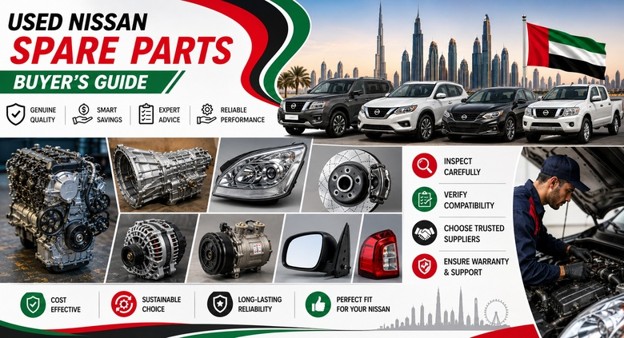
Infographic Theme: Used Nissan Spare Parts Buying Essentials
Include:
- Nissan SUV and saloon silhouettes.
- Engine.
- Gearbox.
- Brake disc.
- Suspension.
- Headlight.
- Battery.
- Air filter.
- VIN tag.
- Inspection checklist.
- Warranty document.
- UAE skyline.
- Subtle UAE flag-inspired red, green, white and black accents.
Keep text minimal.
Allow high-quality automotive visuals to communicate the buying journey.
Smart Buyer's Checklist
Before ordering any used Nissan spare part:
- Confirm your VIN.
- Verify the exact model and production year.
- Check the part number where possible.
- Inspect the component carefully.
- Ask about previous usage.
- Understand warranty terms.
- Buy from experienced suppliers.
- Arrange professional installation where appropriate.
- Keep invoices and service records.
- Think about long-term reliability rather than immediate savings.
The most successful buyers rarely purchase the cheapest component.
They purchase the most suitable one.
Key Takeaways
The UAE's used Nissan spare parts market offers outstanding opportunities for buyers who approach purchasing with knowledge rather than urgency. A carefully inspected used component can provide excellent reliability, preserve original factory engineering and significantly reduce repair costs, particularly for older Nissan models and high-mileage vehicles. Success depends on compatibility, condition, supplier credibility and proper installation—not simply the advertised price.
Understanding the differences between genuine, OEM, aftermarket and used Nissan parts provides the foundation for making informed decisions. Buyers who verify VIN compatibility, inspect components thoroughly and work with reputable suppliers consistently achieve better long-term ownership outcomes while avoiding many of the costly mistakes associated with uninformed purchasing.
Most Common Used Nissan Spare Parts Buyers Search For
Quick Summary
| Component Category | Buying Advice |
| Engine Parts | Inspect carefully for wear, overheating and oil leaks. |
| Gearbox Components | Verify mileage, shifting condition and service history where available. |
| Suspension & Brakes | Replace worn safety components without delay. |
| Electrical Parts | Match part numbers and test functionality before installation. |
| Body & Interior Parts | Check for accident damage, colour matching and mounting points. |
| Best Value Used Parts | Original factory components often outperform low-quality replacements. |
When people search for used Nissan spare parts in the UAE, they rarely begin with a complete shopping list.
They begin with a problem.
A warning light appears.
The gearbox hesitates.
The air-conditioning stops cooling during the hottest week of summer.
A minor parking accident damages a bumper.
A suspension noise grows louder every morning.
Every repair starts somewhere.
The difference between an expensive repair and a sensible one often comes down to choosing the right replacement component.
Some used parts represent excellent value.
Others require extremely careful inspection before purchase.
Understanding that difference helps buyers spend wisely rather than simply spending less.
Used Nissan Engine Parts Buyers Commonly Need
The engine remains the heart of every Nissan.
Fortunately, not every engine problem requires replacing the complete unit.
Many buyers search for individual engine components including:
- Cylinder heads.
- Turbochargers.
- Fuel injectors.
- Intake manifolds.
- Engine mounts.
- Oil pumps.
- Water pumps.
- Alternators.
- Starter motors.
Complete used engines also remain popular for vehicles suffering catastrophic mechanical failure.
Before purchasing any engine-related component, buyers should inspect:
- Oil contamination.
- Coolant residue.
- Mounting points.
- Cracks.
- Corrosion.
- Signs of overheating.
Professional compression testing provides additional confidence when purchasing complete used engines.
An engine may look clean externally.
Internal condition tells the real story.
Used Nissan Gearboxes and Transmission Components
Transmission replacement represents one of the largest expenses many vehicle owners face.
This explains why used gearboxes remain among the most searched Nissan components in the UAE.
Popular transmission-related purchases include:
- Automatic gearboxes.
- Manual gearboxes.
- Transfer cases.
- Torque converters.
- Gear selectors.
- Transmission control modules.
- Driveshafts.
A quality used gearbox can provide many years of dependable operation.
Only when it has been inspected properly.
Buyers should ask about:
- Previous mileage.
- Fluid condition.
- Shift performance before removal.
- Warranty availability.
- Compatibility with their specific model.
Small production differences can affect electronic communication between the gearbox and engine.
Matching the VIN significantly reduces compatibility problems.
Used Suspension, Steering and Brake Components
UAE roads vary enormously.
Daily city traffic.
Long motorway journeys.
Construction areas.
Occasional desert driving.
These conditions gradually wear suspension components.
Common searches include:
- Shock absorbers.
- Coil springs.
- Control arms.
- Steering racks.
- Steering pumps.
- Wheel hubs.
- Brake calipers.
- Brake carriers.
Some suspension parts may perform well as quality used components.
However, consumable braking items such as brake pads and brake discs are generally better purchased new.
Safety should always outweigh short-term savings.
A reliable suspension improves more than comfort.
It protects tyres, steering precision and braking performance.
Used Electrical and Electronic Nissan Parts
Modern Nissan vehicles rely heavily upon electronics.
Consequently, electrical components are frequently requested by buyers.
Popular searches include:
- Alternators.
- Starter motors.
- Headlight control modules.
- Engine control units.
- Instrument clusters.
- Electric window motors.
- Door lock actuators.
- Sensors.
- Infotainment systems.
Electronic parts demand particular attention.
Always confirm:
- Part numbers.
- Software compatibility where applicable.
- Connector design.
- Model compatibility.
A visually identical module may operate differently between production years.
Accuracy prevents unnecessary diagnostic costs later.
Used Body Panels, Lights and Interior Components
Cosmetic repairs account for a substantial proportion of used parts sales.
These components include:
- Front bumpers.
- Rear bumpers.
- Bonnets.
- Doors.
- Wings.
- Tailgates.
- Headlights.
- Tail lights.
- Mirrors.
- Seats.
- Dashboard trim.
- Centre consoles.
Body panels should be inspected for:
- Rust.
- Previous repairs.
- Paint condition.
- Alignment.
- Mounting brackets.
Original factory panels frequently offer better fitment than inexpensive replacement alternatives.
Colour matching remains important.
Panel alignment matters even more.
Which Used Nissan Parts Offer the Best Long-Term Value?
Not every used component delivers the same return on investment.
Some consistently provide excellent value.
Others should be approached with greater caution.
Generally strong candidates include:
- Alternators.
- Starter motors.
- Doors.
- Bonnets.
- Mirrors.
- Interior trim.
- Wheels.
- Air-conditioning compressors after inspection.
Components requiring greater scrutiny include:
- Engines.
- Automatic gearboxes.
- Steering systems.
- Electronic control units.
The more technically complex the component becomes...
The more valuable professional inspection becomes.
Knowledge reduces risk.
Inspection reduces uncertainty.
Together they create confident buying decisions.
Understanding Wear Patterns Before You Buy
Experienced technicians often identify a component's condition within minutes.
Not because of guesswork.
Because wear leaves evidence.
Look for:
- Uneven surface wear.
- Heat discolouration.
- Oil staining.
- Cracked rubber.
- Damaged threads.
- Broken clips.
- Corrosion.
- Excessive movement in joints.
These small details reveal far more than polished sales photographs.
A clean component isn't automatically a healthy one.
Inspection should always extend beneath the surface.
Why Original Factory Components Still Matter
One advantage of buying used Nissan spare parts is access to original factory engineering.
Many used components were manufactured to Nissan's original production standards.
That often results in:
- Better fitment.
- More precise tolerances.
- Improved durability.
- Consistent performance.
This explains why many experienced workshops prefer inspected genuine used components over unknown low-cost replacements.
Original engineering frequently retains its value long after the vehicle has been dismantled.
Workshop Story
A Nissan X-Trail owner from Abu Dhabi needed a replacement headlamp after a minor collision.
Several inexpensive replacement units were available online.
Instead, the workshop sourced an original genuine used headlamp removed from a low-mileage donor vehicle.
Both lights were compared before installation.
The genuine unit aligned perfectly.
The beam pattern matched factory specifications.
The mounting points required no adjustment.
As the technician completed the repair, the owner commented,
"I expected a used part to feel like a compromise."
The technician smiled.
"A genuine factory part doesn't stop being genuine simply because it has already served another vehicle."
That single decision produced better fitment while keeping repair costs under control.
Used Nissan Spare Parts Comparison Table
| Component | Buying Recommendation | Inspection Priority |
| Engine | Suitable after detailed inspection and testing | Very High |
| Gearbox | Excellent value when professionally assessed | Very High |
| Alternator | Strong used purchase option | High |
| Starter Motor | Good long-term value | High |
| Suspension Arms | Inspect bushes and joints carefully | High |
| Headlights | Excellent original factory alternative | Medium |
| Body Panels | Check alignment and previous repairs | Medium |
| Interior Trim | Usually a safe used purchase | Low |
Buyer Decision Matrix
| Your Requirement | Recommended Approach |
| Major mechanical repair | Choose professionally inspected components with warranty where possible |
| Routine replacement | Compare genuine used and OEM alternatives |
| Cosmetic damage | Original used body panels often provide the best fit |
| Electronic component replacement | Match VIN and part number before ordering |
| Limited budget | Prioritise original factory quality over the cheapest advertised option |
| Long-term ownership | Focus on documented condition rather than purchase price alone |
Suggested Blog Visual
Infographic Theme: Most Popular Used Nissan Spare Parts in the UAE
Include realistic visuals of:
- Engine.
- Gearbox.
- Suspension.
- Brake caliper.
- Alternator.
- Starter motor.
- Headlight.
- Door.
- Wheel.
- Air-conditioning compressor.
- VIN label.
- Inspection checklist.
- UAE skyline with subtle red, green, white and black accents.
Keep text minimal and allow the component imagery to explain the buying journey visually.
Smart Buyer's Checklist
Before ordering any used Nissan component:
- Verify compatibility using the VIN.
- Confirm the manufacturer part number.
- Inspect for damage and excessive wear.
- Ask about previous vehicle mileage where available.
- Request warranty information.
- Compare several suppliers.
- Avoid buying complex components without inspection.
- Replace supporting service items if recommended.
- Arrange professional installation.
- Keep records of every purchase.
The right used Nissan spare part isn't simply the one that costs less.
It's the one that continues performing long after the repair has been forgotten.
Key Takeaways
Used Nissan engines, gearboxes, suspension components, electrical parts and body panels remain among the most commonly purchased replacement components in the UAE because they offer significant savings while preserving original factory engineering. However, every category requires a different level of inspection. Complex mechanical and electronic parts should always be verified for compatibility, condition and previous usage before purchase, while cosmetic components primarily require careful checks for structural integrity and fitment.
Successful buyers focus on quality, documentation and supplier credibility rather than the lowest advertised price. Choosing professionally inspected used Nissan parts with confirmed compatibility and appropriate warranties provides the strongest balance between affordability, reliability and long-term ownership value
Used Spare Parts for Popular Nissan Models in the UAE
Quick Summary
| Nissan Model | Most Common Used Spare Parts |
| Nissan Patrol | Suspension, cooling system, drivetrain, body panels, steering components |
| Nissan Altima | Engine accessories, CVT components, electrical parts, headlights |
| Nissan Sunny | Suspension, brakes, alternator, starter motor, doors |
| Nissan X-Trail | Suspension, transmission, air-conditioning, sensors |
| Nissan Pathfinder | Gearbox, steering, cooling, suspension and body components |
| Nissan Navara | Clutch, suspension, differential, leaf springs and lighting |
Every Nissan model develops its own ownership pattern.
Not because Nissan builds vehicles differently.
But because owners use them differently.
A Patrol may spend weekends crossing desert dunes before returning to city traffic on Monday.
An Altima often serves as a reliable family saloon covering thousands of motorway kilometres each month.
A Sunny frequently becomes an economical commuter.
The Navara works hard carrying equipment across construction sites.
Those different driving conditions naturally influence which components wear first.
Understanding model-specific demand helps buyers purchase more confidently.
Instead of treating every Nissan the same...
Experienced buyers understand the strengths and weaknesses of each model.
Used Nissan Patrol Spare Parts Buying Guide
Few vehicles enjoy the reputation of the Nissan Patrol throughout the UAE.
Its popularity means used Patrol spare parts remain widely available.
Frequently purchased components include:
- Front suspension arms.
- Shock absorbers.
- Steering racks.
- Transfer cases.
- Differential assemblies.
- Radiators.
- Cooling fans.
- Headlights.
- Doors.
- Tailgates.
Patrol owners should inspect suspension and steering components particularly carefully.
Vehicles used regularly for off-road driving may experience greater wear than those driven mainly on highways.
Cooling system components also deserve attention.
The UAE climate places significant demands on large-capacity engines.
Used Nissan Altima Spare Parts Checklist
The Nissan Altima has earned a strong reputation as a dependable family vehicle.
As mileage increases, buyers commonly search for:
- CVT transmission components.
- Alternators.
- Starter motors.
- Air-conditioning compressors.
- Radiators.
- Engine mounts.
- Front bumpers.
- Headlamp assemblies.
- Electric mirrors.
Before purchasing transmission-related components, confirm:
- Production year.
- Engine specification.
- VIN compatibility.
Small specification differences may affect installation.
Accurate identification always saves time later.
Used Nissan Sunny Spare Parts Guide
The Nissan Sunny remains one of the UAE's most popular everyday vehicles.
Its affordability makes used spare parts particularly attractive.
Common purchases include:
- Brake calipers.
- Steering pumps.
- Suspension arms.
- Alternators.
- Starter motors.
- Wheel hubs.
- Bonnets.
- Doors.
- Tail lamps.
Because many Sunnys operate as high-mileage commuter vehicles, buyers should inspect mechanical wear carefully.
Mileage often matters more than appearance.
A well-maintained component generally performs better than one that simply looks newer.
Used Nissan X-Trail and Pathfinder Parts Comparison
Both SUVs remain popular among families seeking practicality and comfort.
Although they share certain engineering characteristics, buyers should never assume components are interchangeable.
Frequently requested parts include:
- Gearboxes.
- Transfer cases.
- Air-conditioning compressors.
- Suspension assemblies.
- Electronic sensors.
- Radiators.
- Steering systems.
- Interior trim.
Before ordering:
- Verify VIN details.
- Match part numbers.
- Confirm production year.
Professional suppliers perform these checks routinely.
Buyers should do the same.
Used Nissan Navara and Pickup Parts in the UAE
Commercial use creates different maintenance priorities.
Navara owners frequently require:
- Leaf springs.
- Shock absorbers.
- Clutch assemblies.
- Differentials.
- Driveshafts.
- Tail lights.
- Tailgates.
- Front bumpers.
Working vehicles often accumulate high mileage quickly.
Inspection should therefore focus on structural condition rather than cosmetic appearance.
Strength matters more than surface finish.
Why VIN Matching Is Essential
Many buyers assume that identical-looking parts automatically fit every Nissan.
Unfortunately...
That assumption regularly causes expensive mistakes.
Production changes may affect:
- Mounting brackets.
- Wiring connectors.
- Electronic programming.
- Cooling capacity.
- Gear ratios.
- Sensor calibration.
The Vehicle Identification Number removes uncertainty.
Matching the VIN helps confirm that the component belongs to your exact vehicle specification.
Professional workshops rarely order major parts without checking it first.
Neither should buyers.
Choosing the Right Supplier for Model-Specific Parts
Availability varies significantly between Nissan models.
Popular vehicles usually enjoy a broad supply of used components.
Less common variants may require additional sourcing.
Working with experienced suppliers offers several advantages:
- Better compatibility advice.
- More accurate stock identification.
- Improved warranty support.
- Greater technical knowledge.
- Faster sourcing of difficult components.
Many experienced buyers compare several suppliers before placing an order.
When researching availability through marketplaces and specialist sourcing services such as PartFinder UAE, they still verify compatibility independently before completing the purchase.
Knowledge remains the strongest protection against ordering errors.
Common Model-Specific Buying Mistakes
Several mistakes appear repeatedly across workshops.
These include:
- Ordering parts using photographs alone.
- Ignoring production year changes.
- Assuming all Patrol or Altima parts interchange.
- Forgetting to verify transmission type.
- Buying electronic modules without matching part numbers.
- Prioritising price instead of compatibility.
Each mistake usually creates the same result.
Additional labour.
Delayed repairs.
Unnecessary expense.
Careful preparation prevents all three.
Workshop Story
A Nissan Pathfinder owner from Dubai required a replacement steering rack after noticing increasing steering play.
An online listing advertised what appeared to be an identical component.
Before completing the purchase, the workshop compared the VIN with the supplier's inventory.
The steering rack belonged to a different production revision.
Although visually similar, the mounting arrangement differed slightly.
The correct component was sourced instead.
Installation proceeded without modification.
As the owner collected the vehicle, he remarked,
"I never realised such a small difference could stop the repair."
The technician smiled.
"The smallest numbers often make the biggest difference."
Popular Nissan Models Comparison Table
| Nissan Model | Common Used Parts | Inspection Priority |
| Patrol | Suspension, cooling, drivetrain | Very High |
| Altima | CVT components, engine accessories | Very High |
| Sunny | Brakes, suspension, alternator | High |
| X-Trail | Suspension, gearbox, sensors | High |
| Pathfinder | Steering, gearbox, cooling | Very High |
| Navara | Clutch, differential, leaf springs | High |
Buyer Decision Matrix
| Your Vehicle | Recommended Buying Strategy |
| Patrol | Prioritise suspension, steering and cooling inspections |
| Altima | Verify transmission compatibility before ordering |
| Sunny | Focus on mechanical condition rather than cosmetic appearance |
| X-Trail | Match VIN and electronic components carefully |
| Pathfinder | Inspect drivetrain and steering assemblies thoroughly |
| Navara | Evaluate structural wear caused by commercial use |
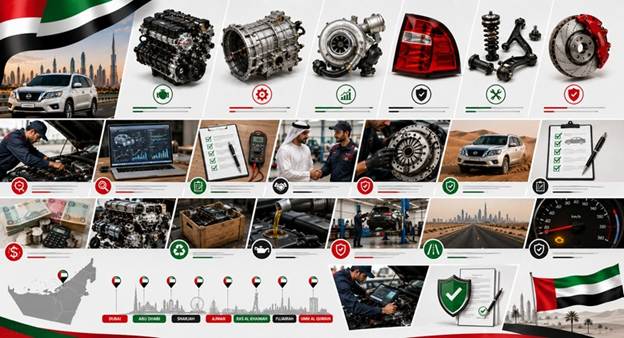
Suggested Blog Visual
Infographic Theme: Popular Used Nissan Spare Parts by Model
Include realistic visuals of:
- Nissan Patrol.
- Nissan Altima.
- Nissan Sunny.
- Nissan X-Trail.
- Nissan Pathfinder.
- Nissan Navara.
- Engine.
- Gearbox.
- Suspension.
- Steering rack.
- Headlamp.
- VIN label.
- UAE skyline with subtle red, green, white and black accents.
Use minimal text with clear icons identifying the most commonly replaced components for each model.
Smart Buyer's Checklist
Before purchasing model-specific used Nissan parts:
- Confirm the exact Nissan model.
- Verify the production year.
- Match the VIN.
- Check manufacturer part numbers.
- Inspect wear and structural condition.
- Confirm warranty availability.
- Compare several suppliers.
- Replace supporting components where recommended.
- Arrange professional installation.
- Keep all purchase documentation.
Choosing the correct part begins long before installation.
It begins with confirming that the component truly belongs to your vehicle.
Key Takeaways
Each Nissan model has its own maintenance profile, meaning the most frequently replaced used spare parts differ between the Patrol, Altima, Sunny, X-Trail, Pathfinder and Navara. Buyers who understand these model-specific patterns can focus their inspections on the components most likely to experience wear while avoiding costly compatibility mistakes caused by production changes or incorrect part selection.
Successful purchasing depends on accurate VIN verification, careful inspection, supplier expertise and matching manufacturer part numbers rather than relying on appearance alone. Taking these steps improves reliability, reduces installation delays and ensures used Nissan spare parts continue delivering dependable performance in demanding UAE driving conditions.
How to Inspect Used Nissan Spare Parts Before Buying
Quick Summary
| Inspection Area | Why It Matters |
| Visual Inspection | Reveals obvious damage and previous repairs. |
| Corrosion Check | Identifies parts weakened by rust or moisture. |
| Mileage Assessment | Helps estimate the remaining service life. |
| Accident Damage | Prevents purchasing structurally compromised components. |
| Seller Questions | Verifies the history and condition of the part. |
| Warning Signs | Helps buyers avoid expensive purchasing mistakes. |
The biggest mistake buyers make isn't purchasing a used Nissan spare part.
It's purchasing one they haven't inspected properly.
Price often attracts attention.
Condition determines value.
Two identical-looking components can have completely different service lives.
One may continue operating reliably for years.
The other may fail within weeks.
The difference usually isn't luck.
It's inspection.
Professional workshops rarely buy important used components without checking them thoroughly.
Private buyers should follow the same approach.
Every minute spent inspecting a component before purchase can prevent hours of inconvenience later.
Visual Inspection Checklist for Used Nissan Parts
Every inspection begins with the obvious.
Although appearance never tells the complete story, it often reveals important clues.
Carefully examine:
- Cracks.
- Bent mounting brackets.
- Missing bolts.
- Broken clips.
- Damaged electrical connectors.
- Oil leaks.
- Coolant stains.
- Excessive dirt trapped inside moving components.
- Poor-quality previous repairs.
- Signs of impact damage.
Pay particular attention to mounting points.
Even a small crack may affect installation.
Original factory welds should appear consistent.
Uneven welding often suggests previous repair work.
Visual inspection provides the first impression.
Never allow it to become the final decision.
Checking Wear, Corrosion and Hidden Damage
Some problems remain invisible until buyers look more closely.
Wear develops gradually.
Corrosion develops quietly.
Together they shorten component lifespan considerably.
Inspect carefully for:
- Rust around structural areas.
- Surface corrosion.
- Heat discolouration.
- Rubber deterioration.
- Bush wear.
- Damaged seals.
- Fluid contamination.
- Excessive play in moving joints.
Surface corrosion may not always create concern.
Deep corrosion affecting structural integrity certainly should.
Rubber components deserve equal attention.
The UAE's high temperatures gradually harden bushes, seals and hoses.
Heat often ages rubber long before metal begins to weaken.
Mileage Assessment for Used Mechanical Components
Mileage doesn't automatically determine quality.
Maintenance does.
However, mileage still provides valuable context.
Lower mileage generally suggests:
- Reduced mechanical wear.
- Longer remaining service life.
- Lower fatigue on moving parts.
Higher mileage doesn't necessarily mean poor quality.
Many well-maintained Nissan vehicles exceed impressive distances without major mechanical problems.
When available, ask about:
- Previous vehicle mileage.
- Service history.
- Maintenance records.
- Previous repairs.
- Driving conditions.
Highway kilometres often place less stress on components than repeated city traffic.
Numbers alone rarely tell the complete story.
The vehicle's history matters just as much.
How to Identify Accident-Damaged Parts
Not every used component comes from an accident-damaged vehicle.
Many originate from insurance auctions, fleet renewals or end-of-life vehicles.
Nevertheless, accident damage should always be investigated carefully.
Look for:
- Distorted metal.
- Uneven panel gaps.
- Fresh welding.
- Misaligned brackets.
- Paint overspray.
- Cracked plastic mounting tabs.
- Repaired mounting holes.
Body panels deserve particularly close inspection.
A perfectly painted panel may still hide structural distortion.
Appearance should never replace measurement.
Questions Every Buyer Should Ask Before Ordering
Experienced buyers ask questions before discussing price.
Important questions include:
- Which Nissan model did the part come from?
- What was the production year?
- Is VIN compatibility confirmed?
- Has the component been tested?
- Is any warranty included?
- Why was the donor vehicle dismantled?
- Has the part been repaired previously?
- Are additional photographs available?
Professional suppliers usually welcome these questions.
Reluctance to answer them often deserves attention.
Transparency builds confidence.
Avoid suppliers who avoid information.
Warning Signs That Should Never Be Ignored
Some buying decisions should end immediately.
Regardless of price.
Walk away if you discover:
- Cracked structural components.
- Heavy corrosion.
- Burnt electrical connectors.
- Broken mounting points.
- Oil mixed with coolant.
- Excessive gearbox contamination.
- Missing identification labels.
- Obvious modifications.
- Unwillingness to provide inspection details.
A bargain that creates another repair bill rarely remains a bargain.
Good buyers know when not to buy.
Understanding Factory Labels and Identification Marks
Most genuine Nissan components include factory identification.
These markings often help confirm authenticity and compatibility.
Check for:
- Manufacturer markings.
- Part numbers.
- Casting numbers.
- Production labels.
- Quality-control markings.
Labels should appear consistent with the component.
Signs of removal or alteration deserve further investigation.
Professional suppliers normally help buyers verify identification before purchase.
Authenticity begins with accurate identification.
Why Professional Testing Adds Confidence
Some components cannot be evaluated through visual inspection alone.
Examples include:
- Alternators.
- Starter motors.
- Air-conditioning compressors.
- Electronic control units.
- Fuel injectors.
- Automatic gearboxes.
Testing may include:
- Electrical output checks.
- Compression testing.
- Pressure testing.
- Diagnostic scanning.
- Functional operation.
Professional testing reduces uncertainty considerably.
Inspection tells buyers what a component looks like.
Testing reveals how it performs.
The combination creates the strongest buying confidence.
Workshop Story
A Nissan Sunny owner from Ajman needed a replacement alternator after experiencing repeated charging problems.
An inexpensive used unit appeared to be in excellent cosmetic condition.
Before installation, the workshop tested its charging output.
The alternator produced inconsistent voltage.
Externally, it looked almost new.
Internally, it was approaching failure.
Another inspected alternator passed every test and was installed instead.
As the technician explained the difference, the owner laughed.
"So the cleaner one wasn't the better one?"
The technician nodded.
"Good components prove themselves with performance, not appearance."
That brief inspection prevented another unexpected breakdown only weeks later.
Used Nissan Parts Inspection Comparison Table
| Inspection Item | What to Check | Priority |
| Engine Components | Leaks, cracks, overheating signs | Very High |
| Gearbox | Fluid condition, casing damage, compatibility | Very High |
| Suspension | Bush wear, corrosion, joint movement | High |
| Brake Components | Structural condition and corrosion | Very High |
| Electrical Parts | Connectors, testing results, part numbers | High |
| Body Panels | Alignment, dents, mounting brackets | Medium |
| Interior Parts | Damage, broken clips, excessive wear | Low |
Buyer Decision Matrix
| Your Situation | Recommended Inspection Approach |
| Buying an engine | Request testing, compression results and service history where available |
| Purchasing a gearbox | Confirm VIN compatibility and inspect fluid condition |
| Cosmetic repair | Prioritise structural integrity and mounting alignment |
| Electrical replacement | Match part numbers and request functionality testing |
| Suspension repairs | Inspect bushes, joints and corrosion carefully |
| Unsure about condition | Seek an independent workshop inspection before purchase |
Suggested Blog Visual
Infographic Theme: Professional Used Nissan Spare Parts Inspection Checklist
Include realistic visuals of:
- Magnifying glass inspecting a Nissan component.
- Engine.
- Gearbox.
- Brake caliper.
- Suspension arm.
- Electrical connector.
- VIN label.
- Factory part number.
- Checklist clipboard.
- Warning symbol.
- Professional mechanic.
- UAE skyline with subtle UAE flag-inspired red, green, white and black accents.
Keep wording minimal.
Allow icons and realistic component imagery to demonstrate the inspection process.
Smart Buyer's Checklist
Before approving any used Nissan spare part:
- Inspect every mounting point.
- Check for corrosion and hidden damage.
- Verify the manufacturer part number.
- Match the VIN.
- Ask about mileage and previous maintenance.
- Request testing results for complex components.
- Confirm warranty coverage.
- Compare several suppliers.
- Keep inspection photographs and invoices.
- Never allow price alone to influence the final decision.
Successful buyers don't simply purchase parts.
They purchase confidence.
Key Takeaways
Inspecting used Nissan spare parts thoroughly before purchase is one of the most effective ways to reduce repair costs and avoid future mechanical problems. Careful visual examination, checking for corrosion, assessing wear patterns, verifying mileage history and confirming VIN compatibility all contribute to selecting components with dependable remaining service life. Complex items such as engines, gearboxes and electrical modules benefit significantly from professional testing in addition to physical inspection.
Buyers who ask detailed questions, recognise warning signs and work with transparent suppliers consistently make better purchasing decisions than those who focus only on price. A disciplined inspection process transforms used Nissan spare parts from an uncertain purchase into a reliable long-term investment.
Where to Buy Used Nissan Spare Parts in the UAE
Quick Summary
| Buying Source | Advantages | Things to Watch |
| Professional Used Parts Suppliers | Inspected stock, warranty options, expert advice | Compare pricing and warranty terms |
| Online Spare Parts Platforms | Large selection and easy comparison | Always verify compatibility before ordering |
| Auto Dismantlers | Access to genuine factory components | Confirm inspection and testing procedures |
| Salvage Yards | Competitive prices | Inspect parts carefully before purchase |
| Independent Workshops | Professional sourcing assistance | Ask whether labour warranty is included |
| Private Sellers | Lower prices | Higher buying risk without inspection |
Finding the right used Nissan spare part is only half the challenge.
Finding the right supplier is equally important.
A high-quality component sold by an experienced supplier often delivers years of dependable service.
The very same component purchased without proper checks may create repeated repairs, unnecessary labour costs and considerable frustration.
Successful buyers understand that the cheapest supplier rarely becomes the least expensive in the long run.
Trust.
Inspection.
Technical knowledge.
After-sales support.
These factors frequently matter far more than the advertised price.
Online vs Local Used Nissan Spare Parts Suppliers
The UAE gives buyers more purchasing options than ever before.
Some prefer visiting suppliers in person.
Others compare hundreds of listings online before making a decision.
Each approach offers different advantages.
Online Suppliers
Benefits include:
- Wider product availability.
- Easy quotation comparisons.
- Faster stock searches.
- Convenient ordering.
- Access to suppliers across multiple Emirates.
Potential disadvantages include:
- Limited physical inspection before purchase.
- Dependence on photographs.
- Shipping times for certain components.
Local Suppliers
Advantages include:
- Physical inspection.
- Immediate collection.
- Direct communication with technicians.
- Easier warranty discussions.
- Faster problem resolution.
Many experienced buyers combine both approaches.
They research online before completing the purchase through a trusted supplier.
How to Choose a Trusted Used Parts Supplier
Not every supplier operates to the same standard.
Professional suppliers usually demonstrate several characteristics.
Look for businesses that:
- Clearly identify vehicle compatibility.
- Provide detailed photographs.
- Explain the condition honestly.
- Offer reasonable warranty terms.
- Answer technical questions confidently.
- Maintain organised inventory systems.
Trust develops through transparency.
Reliable suppliers rarely avoid detailed questions.
Instead, they encourage them.
Their confidence usually reflects confidence in the components they supply.
Salvage Yards vs Professional Auto Dismantlers
Many buyers assume these businesses are identical.
They are not.
Traditional salvage yards often focus primarily on dismantling vehicles.
Professional auto dismantlers usually follow structured inspection procedures before offering components for sale.
The difference can influence:
- Part quality.
- Cleaning standards.
- Testing procedures.
- Documentation.
- Warranty availability.
Professionally dismantled components generally provide greater buying confidence.
Especially for complex mechanical or electronic parts.
Inspection transforms recovered components into reliable replacement solutions.
Buying Used Nissan Parts from Verified Sellers
Verification provides reassurance.
Experienced buyers often prefer suppliers who can demonstrate:
- Accurate vehicle identification.
- Documented inventory.
- Clear warranty policies.
- Technical product knowledge.
- Established reputation.
Professional suppliers usually explain exactly:
- Which Nissan model supplied the part.
- Production year.
- Engine specification.
- Compatibility details.
- Previous usage where known.
Good documentation reduces uncertainty before installation begins.
How Warranty Changes the Buying Decision
Warranty should never be treated as an afterthought.
It forms part of the buying decision itself.
Warranty coverage demonstrates confidence.
Although terms vary between suppliers, buyers should understand:
- Warranty duration.
- Covered failures.
- Exclusions.
- Return procedures.
- Labour policy.
- Inspection requirements before installation.
The strongest warranty cannot compensate for poor compatibility.
However, it provides valuable reassurance when purchasing major mechanical components.
Mistakes Buyers Make When Ordering Used Parts
Many workshop delays originate long before the repair begins.
Common mistakes include:
- Ordering by appearance alone.
- Ignoring VIN verification.
- Choosing price instead of condition.
- Assuming identical parts fit every production year.
- Failing to inspect photographs carefully.
- Overlooking warranty conditions.
- Purchasing without comparing suppliers.
Each mistake increases the likelihood of:
- Delayed repairs.
- Additional labour.
- Repeat purchases.
- Vehicle downtime.
Preparation remains considerably less expensive than correction.
Why Professional Workshops Source Parts Differently
Experienced workshops rarely order the first component they find.
Instead, they compare several factors simultaneously.
These include:
- Compatibility.
- Previous vehicle usage.
- Supplier reliability.
- Testing history.
- Delivery times.
- Customer warranty expectations.
This systematic approach reduces installation problems.
Professional workshops understand that replacing an incorrect component costs considerably more than spending extra time confirming compatibility.
Their buying process focuses on certainty rather than speed.
Workshop Story
A Nissan Patrol owner from Ras Al Khaimah required a replacement transfer case following extensive off-road use.
Two suppliers offered apparently identical units.
One supplier advertised the lowest price.
The second provided detailed photographs, confirmed VIN compatibility, explained inspection procedures and included warranty documentation.
The workshop recommended the second option.
Installation proceeded smoothly without modification.
Months later the Patrol continued performing reliably during regular desert trips.
The owner later admitted,
"I almost bought the cheaper one."
The workshop manager replied,
"The best value isn't always the lowest number on the quotation."
That simple decision prevented significant additional labour and downtime.
Used Nissan Spare Parts Supplier Comparison Table
| Buying Source | Best For | Risk Level |
| Professional Used Parts Supplier | Major mechanical and electrical components | Low |
| Online Specialist Platform | Comparing availability and quotations | Low to Medium |
| Professional Auto Dismantler | Genuine factory components | Low |
| Salvage Yard | Older vehicles and body panels | Medium |
| Independent Workshop | Complete repair solutions | Low |
| Private Seller | Rare components | High |
Buyer Decision Matrix
| Buying Priority | Recommended Source |
| Lowest risk | Professional inspected used parts supplier |
| Fast availability | Local supplier with stocked inventory |
| Rare Nissan component | Specialist dismantler |
| Major engine or gearbox purchase | Supplier offering testing and warranty |
| Cosmetic repair | Local supplier allowing physical inspection |
| First-time buyer | Workshop-assisted sourcing |
Suggested Blog Visual
Infographic Theme: Where to Buy Used Nissan Spare Parts in the UAE
Include realistic visuals of:
- Professional parts warehouse.
- Organised shelving.
- Nissan engine.
- Gearbox.
- Headlight.
- Suspension arm.
- Warranty certificate.
- VIN verification.
- Mechanic inspecting components.
- Delivery vehicle.
- UAE skyline featuring Dubai, Abu Dhabi and other Emirates with subtle UAE flag-inspired colours.
Use minimal wording.
Allow the visuals to communicate the buying journey from supplier selection to successful installation.
Smart Buyer's Checklist
Before placing an order:
- Compare multiple suppliers.
- Verify VIN compatibility.
- Confirm the exact part number.
- Review warranty conditions.
- Ask about testing procedures.
- Request additional photographs if necessary.
- Understand return policies.
- Compare delivery times.
- Arrange professional installation.
- Keep invoices and warranty documentation.
A careful purchasing process begins long before payment.
It begins with choosing the right supplier.
Key Takeaways
The quality of the supplier often determines the quality of the buying experience. Professional used parts suppliers, reputable online specialists, experienced auto dismantlers and trusted independent workshops provide significantly greater confidence than purchasing solely on price. Buyers who verify compatibility, understand warranty terms and compare multiple suppliers consistently reduce the risk of installation problems, repeat repairs and unexpected costs.
Choosing where to buy used Nissan spare parts should never be based solely on convenience or the lowest quotation. Transparency, technical expertise, documented inspections and reliable after-sales support provide long-term value that extends well beyond the initial purchase price.
Used Nissan Spare Parts Prices in the UAE
Quick Summary
| Cost Factor | Impact on Final Price |
| Type of Part | Engines and gearboxes cost significantly more than body or interior parts. |
| Vehicle Model | Popular Nissan models usually have better parts availability and competitive pricing. |
| Part Condition | Low-mileage, professionally inspected parts generally command higher prices. |
| Warranty | Warranty-backed parts often cost more but reduce long-term financial risk. |
| Labour Charges | Installation costs vary depending on the component and the Emirate. |
| Hidden Expenses | Fluids, seals, programming and additional components can increase the overall repair bill. |
Many buyers focus entirely on one figure.
The price of the replacement part.
In reality, that figure tells only part of the story.
The true cost of repairing a Nissan includes much more than the advertised component.
Labour.
Supporting parts.
Diagnostic work.
Programming.
Fluids.
Unexpected discoveries during installation.
These additional costs often determine whether a repair remains affordable.
Experienced vehicle owners don't ask,
"How much does the part cost?"
They ask,
"What will this repair cost from beginning to end?"
That single question usually leads to much better financial decisions.
Average Prices of Popular Used Nissan Spare Parts
Prices vary according to:
- Vehicle model.
- Production year.
- Availability.
- Component condition.
- Mileage.
- Warranty.
- Market demand.
The following ranges provide a realistic overview of typical UAE pricing.
| Used Nissan Spare Part | Typical UAE Price (AED) |
| Engine | 4,500–14,000 |
| Automatic Gearbox | 3,500–10,500 |
| Manual Gearbox | 2,000–6,000 |
| Alternator | 250–900 |
| Starter Motor | 250–850 |
| Air Conditioning Compressor | 600–2,000 |
| Radiator | 300–1,200 |
| Steering Rack | 700–2,800 |
| Headlight Assembly | 350–2,000 |
| Door Assembly | 600–2,500 |
| Front Bumper | 500–2,000 |
| Tailgate | 900–3,500 |
These figures should be viewed as guidance rather than fixed quotations.
Condition frequently influences value more than age.
A carefully maintained original factory component often justifies a higher purchase price than an unknown alternative.
Labour Costs Across the UAE
The cost of installation varies considerably depending on both the repair and the workshop carrying out the work.
Independent specialists generally charge differently from dealership workshops.
Labour rates may also vary between Emirates due to operating costs and workshop specialisation.
Typical Labour Cost Comparison
| Repair Type | Typical Labour Cost (AED) |
| Alternator Replacement | 200–500 |
| Starter Motor Replacement | 200–450 |
| Suspension Arm Replacement | 250–600 |
| Steering Rack Replacement | 700–1,500 |
| Air Conditioning Compressor | 600–1,400 |
| Gearbox Replacement | 2,000–4,500 |
| Engine Replacement | 3,500–7,500 |
Workshops in Dubai and Abu Dhabi often command higher labour rates than those in Sharjah, Ajman, Ras Al Khaimah, Fujairah or Umm Al Quwain.
However...
Lower labour charges should never become the only deciding factor.
Experience frequently saves more money than lower hourly rates.
Hidden Costs Buyers Often Forget
Many repair budgets fail because buyers overlook the smaller expenses.
Unfortunately...
These smaller expenses rarely remain small.
Common hidden costs include:
- Engine oil.
- Transmission fluid.
- Coolant.
- Filters.
- Seals and gaskets.
- Mounting bushes.
- Diagnostic scanning.
- ECU programming.
- Wheel alignment.
- Fasteners and clips.
Individually these items appear inexpensive.
Collectively they can add several hundred or even several thousand dirhams to a repair.
Planning for them prevents unpleasant surprises.
Used vs Reconditioned vs New Cost Comparison
Every buyer eventually faces the same decision.
Should you purchase used, reconditioned or brand-new components?
The answer depends upon your priorities.
| Option | Initial Cost | Reliability Potential | Best For |
| Used | Lowest | High when professionally inspected | Budget-conscious owners |
| Reconditioned | Medium | Very High when rebuilt correctly | Long-term ownership |
| New Genuine | Highest | Excellent | Newer vehicles and critical repairs |
| OEM | Medium to High | Excellent | Factory-quality repairs without genuine branding |
The cheapest option doesn't always represent the lowest lifetime cost.
Reliability influences value just as much as purchase price.
When Cheap Used Parts Become Expensive
A remarkably low price often attracts attention.
It should also raise questions.
Extremely cheap components sometimes indicate:
- Unknown history.
- High mileage.
- Hidden damage.
- Missing parts.
- Lack of testing.
- No warranty.
- Compatibility uncertainty.
If replacing the component requires extensive labour, repeating that labour because of premature failure becomes considerably more expensive than buying a better-quality part initially.
Price matters.
Overall ownership cost matters far more.
Cost-Saving Tips Without Sacrificing Quality
Reducing repair costs doesn't require lowering standards.
Experienced buyers usually achieve savings by making smarter decisions.
Practical strategies include:
- Compare quotations from several suppliers.
- Match VIN details before ordering.
- Buy inspected original factory components.
- Replace related service items during the same repair.
- Schedule preventative maintenance before failure occurs.
- Use experienced workshops for complex installations.
Saving money begins with reducing risk.
Unexpected repairs remain the most expensive repairs.
Repair Project Cost Examples
Looking only at component prices provides an incomplete picture.
The complete repair budget should include labour and supporting materials.
Example 1 – Alternator Replacement
| Item | Typical Cost (AED) |
| Used Alternator | 450 |
| Labour | 300 |
| Battery Check | 100 |
| Total Estimated Cost | 850 |
Example 2 – Gearbox Replacement
| Item | Typical Cost (AED) |
| Used Automatic Gearbox | 6,000 |
| Labour | 3,000 |
| Transmission Fluid | 700 |
| Programming & Diagnostics | 500 |
| Total Estimated Cost | 10,200 |
These examples demonstrate why buyers should always request complete repair quotations.
Component price alone rarely reflects the final invoice.
Workshop Story
A Nissan Altima owner from Abu Dhabi received two quotations for a gearbox replacement.
The first appeared significantly cheaper.
Only the gearbox price had been included.
The second quotation looked higher.
However, it covered:
- Installation.
- New transmission fluid.
- Diagnostic calibration.
- Road testing.
- Warranty.
After comparing both estimates carefully, the owner selected the second workshop.
The repair was completed without additional charges.
Reflecting on the experience, the owner admitted,
"The expensive quotation actually turned out to be the cheaper repair."
The workshop adviser smiled.
"Always compare the complete project, not just the first number."
Complete Cost Comparison Table
| Buying Option | Initial Cost | Expected Long-Term Value | Overall Recommendation |
| Used Genuine Part | Low to Medium | High when inspected | Excellent |
| Reconditioned Component | Medium | Very High | Excellent |
| OEM Replacement | Medium to High | Excellent | Excellent |
| New Genuine Nissan Part | Highest | Excellent | Ideal for newer vehicles |
| Unknown Low-Cost Part | Lowest | Uncertain | High Risk |
Buyer Decision Matrix
| Your Budget | Recommended Strategy |
| Limited | Buy inspected used genuine components with warranty |
| Moderate | Compare used and professionally reconditioned options |
| Long-term ownership | Prioritise OEM or reconditioned components where appropriate |
| Critical safety repair | Never compromise on quality or compatibility |
| Older Nissan | Balance repair cost against remaining vehicle value |
| Fleet vehicle | Consider total downtime cost, not only component price |
Suggested Blog Visual
Infographic Theme: Understanding the Real Cost of Used Nissan Spare Parts in the UAE
Include realistic visuals of:
- Nissan engine.
- Gearbox.
- Alternator.
- Headlight.
- Labour invoice.
- AED currency icons.
- Mechanic carrying out installation.
- Warranty document.
- Diagnostic scanner.
- Oil and coolant containers.
- UAE skyline with subtle national colours.
Keep text minimal and allow the graphics to explain the relationship between component price, labour costs and total repair expenditure.
Smart Buyer's Checklist
Before agreeing to any repair quotation:
- Compare complete repair costs rather than component prices alone.
- Request an itemised quotation.
- Confirm labour charges.
- Check warranty coverage.
- Ask about diagnostic and programming costs.
- Budget for fluids, seals and supporting parts.
- Compare several suppliers and workshops.
- Verify VIN compatibility.
- Retain all invoices and warranty documentation.
- Focus on long-term value instead of the lowest initial price.
The most economical repair is rarely the cheapest quotation.
It's the one that delivers reliable performance without creating another repair bill a few months later.
Key Takeaways
The cost of replacing used Nissan spare parts in the UAE extends far beyond the advertised price of the component. Labour, diagnostic work, fluids, programming, seals and supporting parts all contribute to the final repair bill, making it essential to evaluate the complete project rather than a single quotation line. Buyers who request itemised estimates and compare total repair costs make more informed financial decisions.
Used, reconditioned, OEM and genuine Nissan parts each have their place depending on vehicle age, ownership plans and budget. Choosing professionally inspected components, experienced workshops and transparent suppliers consistently provides better long-term value than selecting the lowest-priced option without considering reliability, compatibility or future maintenance costs.
Compatibility and Installation Guide for Used Nissan Spare Parts
Quick Summary
| Compatibility Factor | Why It Is Important |
| VIN Verification | Confirms the correct component for your exact Nissan. |
| Nissan Part Number | Eliminates compatibility guesswork. |
| Cross-Model Compatibility | Prevents incorrect purchases. |
| Professional Installation | Improves reliability and reduces repair risks. |
| Supporting Parts | Prevents premature failure of the replacement component. |
| First 1,000 km | Allows early detection of installation issues. |
Many used Nissan spare parts are returned for one simple reason.
They were never incorrect.
They were simply incompatible.
To the untrained eye, two parts may appear identical.
The mounting points look the same.
The dimensions appear correct.
Even the electrical connectors seem identical.
Yet after installation...
The warning light remains illuminated.
The gearbox refuses to communicate.
The engine management system detects an error.
The repair stops.
Compatibility is far more than physical fitment.
It includes electronics.
Software.
Calibration.
Production revisions.
Vehicle specification.
Experienced workshops understand this before ordering any component.
Private buyers should adopt exactly the same approach.
Why VIN Verification Matters Before Ordering
Every Nissan carries its own identity.
That identity is the Vehicle Identification Number.
Often referred to simply as the VIN.
This unique code allows suppliers to identify the exact vehicle specification, including:
- Production year.
- Engine type.
- Transmission type.
- Factory-installed options.
- Regional specification.
- Original equipment details.
Checking the VIN before purchasing a used component removes much of the uncertainty.
A single incorrect digit can result in ordering a completely unsuitable part.
Professional suppliers almost always request the VIN before confirming availability.
If they do not...
Buyers should provide it anyway.
Understanding Nissan Part Numbers
Every genuine Nissan component carries its own part number.
Although many parts appear visually identical, their part numbers often reveal important differences.
These differences may relate to:
- Production revisions.
- Engine capacity.
- Transmission type.
- Emissions specification.
- Electronic calibration.
- Market region.
Never rely solely on photographs.
Always compare:
- Original Nissan part number.
- Replacement component number.
- Supplier records.
Matching part numbers provides one of the strongest compatibility checks available.
Cross-Model Compatibility Explained
Many buyers assume that components from one Nissan model automatically fit another.
Occasionally they do.
Frequently they do not.
Some components may be shared between:
- Patrol variants.
- Altima production years.
- X-Trail generations.
- Pathfinder models.
- Navara derivatives.
However, small engineering changes often affect:
- Mounting brackets.
- Sensor locations.
- Wiring harnesses.
- Gear ratios.
- Cooling capacity.
- Software programming.
Similarity should never replace confirmation.
Compatibility must always be verified before purchase.
Professional Installation vs DIY Repairs
Modern Nissan vehicles contain increasingly sophisticated mechanical and electronic systems.
Simple cosmetic repairs may suit experienced enthusiasts.
Major mechanical repairs deserve professional attention.
Professional installation provides several advantages:
- Correct torque settings.
- Manufacturer repair procedures.
- Diagnostic equipment.
- Software programming.
- Road testing.
- Warranty support.
DIY installation can appear cost-effective.
Until an incorrectly fitted component creates another repair.
Complex systems reward professional expertise.
Supporting Parts You Should Replace Together
Replacing only the failed component sometimes creates additional problems.
Experienced workshops frequently recommend renewing related service items during the same repair.
Examples include:
Engine Repairs
- Oil filter.
- Engine oil.
- Coolant.
- Belts.
- Hoses.
- Gaskets.
Gearbox Installation
- Transmission fluid.
- Oil seals.
- Mountings.
- Filters where applicable.
Suspension Repairs
- Bushes.
- Ball joints.
- Fasteners.
- Wheel alignment.
Although these additional items increase the initial invoice slightly, they often reduce future repair costs considerably.
Preventative maintenance remains cheaper than repeated labour.
First 1,000 Kilometres After Installing Used Nissan Parts
Installation does not conclude the repair.
The first few weeks of driving remain equally important.
Owners should monitor:
- Fluid levels.
- Warning lights.
- Unusual noises.
- Gear changes.
- Steering feel.
- Braking performance.
- Engine temperature.
- Suspension behaviour.
Minor adjustments occasionally become necessary after installation.
Early detection prevents larger problems from developing.
Successful repairs continue long after leaving the workshop.
Common Compatibility Mistakes Buyers Make
Several installation delays occur repeatedly across independent workshops.
Typical mistakes include:
- Ordering by appearance alone.
- Ignoring VIN verification.
- Using incorrect part numbers.
- Assuming all model years are identical.
- Forgetting software compatibility.
- Reusing worn supporting components.
- Skipping post-installation inspections.
Every mistake increases both repair costs and vehicle downtime.
Most are entirely avoidable.
Preparation remains the best form of prevention.
Why Electronic Compatibility Has Become More Important
Modern Nissan vehicles communicate continuously.
Engine control modules exchange information with:
- Automatic gearboxes.
- ABS systems.
- Steering modules.
- Air-conditioning systems.
- Instrument clusters.
- Safety systems.
Installing the correct mechanical component no longer guarantees a successful repair.
Electronic compatibility now plays an equally important role.
Professional diagnostic equipment often confirms successful integration before the vehicle returns to the owner.
Technology has transformed vehicle repairs.
Accuracy has become more valuable than ever.
Workshop Story
A Nissan X-Trail owner from Fujairah required a replacement automatic gearbox after experiencing repeated transmission faults.
The gearbox looked identical to the original unit.
The supplier confirmed the dimensions matched.
Before installation, the workshop checked the VIN and Nissan part number.
A production update had introduced a different transmission control calibration.
Although both gearboxes appeared identical externally, the internal electronics differed.
The correct unit was sourced instead.
Installation proceeded smoothly.
After the final road test, the owner remarked,
"It looked exactly the same."
The technician smiled.
"The parts you cannot see are often the ones that matter most."
That additional compatibility check prevented days of unnecessary diagnosis and repeat labour.
Compatibility Comparison Table
| Compatibility Check | Importance | Recommended Action |
| VIN Verification | Very High | Always complete before ordering |
| Nissan Part Number | Very High | Match exactly whenever possible |
| Production Year | High | Confirm with supplier |
| Engine Specification | High | Compare with donor vehicle |
| Transmission Type | Very High | Verify before purchase |
| Electronic Programming | High | Perform diagnostic confirmation after installation |
Buyer Decision Matrix
| Buying Situation | Recommended Approach |
| Engine replacement | Match VIN, part number and engine code |
| Gearbox replacement | Confirm VIN, transmission code and software compatibility |
| Electrical module | Verify part number and programming requirements |
| Suspension repair | Replace supporting bushes and align wheels afterwards |
| Cosmetic repair | Confirm mounting points and colour compatibility |
| Unsure about compatibility | Ask a professional workshop to verify before ordering |
Suggested Blog Visual
Infographic Theme: How to Ensure Used Nissan Spare Parts Are Compatible
Include realistic visuals of:
- VIN plate.
- Nissan part number label.
- Engine.
- Gearbox.
- Diagnostic scanner.
- ECU.
- Suspension arm.
- Mechanic checking components.
- Installation tools.
- Road test vehicle.
- UAE skyline with subtle red, green, white and black accents.
Keep text minimal and allow icons to illustrate the complete compatibility and installation process.
Smart Buyer's Checklist
Before installing any used Nissan spare part:
- Verify the VIN.
- Match the Nissan part number.
- Confirm production year.
- Check engine and transmission specifications.
- Replace recommended supporting components.
- Use experienced technicians for complex repairs.
- Perform diagnostic scanning after installation.
- Test-drive the vehicle.
- Recheck fluid levels after several days.
- Inspect the repair during the first 1,000 kilometres.
Correct installation begins long before the mechanic picks up a tool.
It begins with choosing a component that genuinely belongs to your Nissan.
Key Takeaways
Successful repairs depend on much more than purchasing the correct-looking component. Accurate VIN verification, matching Nissan part numbers, confirming production specifications and understanding electronic compatibility all play essential roles in ensuring used spare parts function exactly as intended. These checks dramatically reduce installation delays, diagnostic problems and unnecessary repeat repairs.
Professional installation, replacing supporting service items and monitoring vehicle performance during the first 1,000 kilometres provide the strongest foundation for long-term reliability. Buyers who treat compatibility as seriously as price consistently enjoy smoother repairs, lower ownership costs and greater confidence in their used Nissan spare parts.
Long-Term Ownership and Reliability After Installing Used Nissan Spare Parts
Quick Summary
| Ownership Factor | Why It Matters |
| Component Lifespan | Determines long-term repair value. |
| Regular Maintenance | Extends the service life of used parts. |
| UAE Climate | Extreme temperatures accelerate wear. |
| Repair vs Replacement | Prevents unnecessary spending. |
| Resale Value | Proper maintenance protects future vehicle value. |
| Service Records | Build buyer confidence during resale. |
Installing a used Nissan spare part is not the end of the journey.
It's the beginning of the next chapter in your vehicle's life.
Many buyers judge a replacement component by how well it performs during the first few days.
Experienced workshops think differently.
They judge it after thousands of kilometres.
Long-term reliability depends upon far more than the quality of the component itself.
Installation quality.
Routine servicing.
Driving habits.
Climate.
Preventative maintenance.
Together, these factors determine whether a used Nissan part delivers excellent value or becomes another unexpected expense.
A successful repair should disappear into the background.
The driver should simply enjoy using the vehicle without thinking about the component again.
How Long Do Used Nissan Spare Parts Last?
There is no universal lifespan for a used Nissan component.
Every part has its own operating environment.
Every vehicle has its own maintenance history.
Every driver has different habits.
Generally speaking, professionally inspected genuine used components can provide many additional years of dependable service when:
- Correctly matched to the vehicle.
- Professionally installed.
- Properly maintained.
- Not already close to the end of their service life.
Several factors influence longevity:
- Previous mileage.
- Maintenance history.
- Driving conditions.
- Heat exposure.
- Load carried by the vehicle.
- Quality of installation.
The remaining lifespan often depends more on previous care than chronological age.
Extending the Life of Used Nissan Components
Owners have more control over component lifespan than many realise.
Simple maintenance habits often make a remarkable difference.
Recommended practices include:
- Follow scheduled servicing.
- Replace fluids on time.
- Investigate unusual noises immediately.
- Repair small faults before they become major failures.
- Keep cooling systems operating efficiently.
- Inspect suspension regularly.
- Replace worn rubber components promptly.
Mechanical parts rarely fail without warning.
They usually provide small signs first.
Successful owners recognise those signs early.
UAE Weather and Its Impact on Used Parts
The UAE presents one of the world's most demanding automotive environments.
Summer temperatures.
Heavy traffic.
Fine desert dust.
Long motorway journeys.
Occasional off-road driving.
Each condition places additional stress on vehicle components.
High temperatures particularly affect:
- Cooling systems.
- Rubber bushes.
- Engine seals.
- Air-conditioning systems.
- Batteries.
- Plastic connectors.
Dust also accelerates wear when filters are neglected.
Vehicles maintained according to UAE operating conditions generally experience fewer unexpected repairs than those following maintenance schedules designed for milder climates.
Local conditions always matter.
Preventative Maintenance After Installation
Many owners relax once the repair has been completed.
Professional technicians remain alert.
The period immediately following installation deserves careful observation.
Recommended maintenance includes:
- Check engine oil regularly.
- Monitor coolant levels.
- Inspect transmission fluid where applicable.
- Listen for unusual sounds.
- Observe dashboard warning lights.
- Recheck mounting bolts after major repairs.
- Inspect for leaks.
Minor adjustments performed early often prevent major repairs later.
Maintenance should remain proactive rather than reactive.
Repair or Replace? Making the Right Decision
Not every worn component requires immediate replacement.
Likewise...
Not every repair represents good value.
Several questions help guide the decision.
Consider:
- Repair cost.
- Replacement cost.
- Remaining vehicle value.
- Reliability expectations.
- Labour requirements.
- Future maintenance needs.
If repeated repairs continue affecting the same component, replacement may prove more economical.
Conversely, replacing an otherwise serviceable component simply because it has accumulated mileage may waste money unnecessarily.
Good decisions rely upon evidence.
Not assumptions.
Protecting Your Nissan's Resale Value
Many buyers overlook an important fact.
Today's repair becomes tomorrow's selling point.
Well-maintained vehicles usually attract stronger resale values because buyers appreciate evidence of responsible ownership.
Helpful practices include:
- Keeping service invoices.
- Retaining warranty documents.
- Recording replacement dates.
- Following scheduled maintenance.
- Using quality replacement components.
- Repairing cosmetic damage promptly.
Documentation often increases buyer confidence as much as the repair itself.
Trust creates value.
First-Year Ownership Cost Analysis
Many vehicle owners focus only on the initial repair bill.
A more useful approach considers ownership throughout the following twelve months.
Example comparison:
| Ownership Scenario | Estimated First-Year Cost |
| Quality Used Genuine Part | Lower overall maintenance expenditure |
| Professionally Reconditioned Part | Moderate cost with excellent reliability |
| Low-Quality Unknown Component | Higher repeat repair costs despite lower purchase price |
The first invoice rarely represents the total financial commitment.
Reliability always influences long-term affordability.
Replace the Component or Replace the Vehicle?
Owners of older Nissan vehicles occasionally ask a larger question.
Is the vehicle still worth repairing?
The answer depends upon several considerations.
Repairing often remains sensible when:
- The vehicle has been well maintained.
- The body structure remains sound.
- The engine and transmission are fundamentally healthy.
- Repair costs remain significantly below replacement costs.
Replacing the vehicle may deserve consideration when:
- Multiple major systems require simultaneous repair.
- Structural corrosion becomes severe.
- Repair costs approach the vehicle's market value.
- Reliability continues declining despite repeated maintenance.
Every situation deserves individual assessment.
Emotion should never become the only deciding factor.
Neither should age.
Common Ownership Mistakes That Reduce Reliability
Several habits shorten component lifespan unnecessarily.
Avoid:
- Ignoring warning lights.
- Delaying routine servicing.
- Using incorrect lubricants.
- Overloading the vehicle.
- Continuing to drive after overheating.
- Ignoring suspension noises.
- Postponing small repairs.
Minor faults rarely remain minor.
Addressing them early consistently costs less.
Workshop Story
A Nissan Patrol owner from Al Ain installed a professionally inspected used radiator after the original unit developed a leak.
The replacement performed perfectly.
Six months later, the owner noticed the coolant level dropping slightly.
Instead of ignoring it, he returned to the workshop immediately.
Technicians discovered a worn radiator hose rather than a faulty radiator.
The inexpensive hose was replaced before it failed completely.
The cooling system continued operating reliably throughout another UAE summer.
The technician explained,
"The radiator wasn't the problem.
Regular inspection prevented it from becoming one."
Small maintenance decisions often produce the greatest long-term savings.
Long-Term Reliability Comparison Table
| Ownership Habit | Long-Term Result |
| Scheduled servicing | Maximum component lifespan |
| Regular fluid inspections | Lower mechanical wear |
| Immediate fault diagnosis | Reduced repair costs |
| Professional installation | Improved reliability |
| Quality used genuine parts | Better long-term value |
| Ignoring warning signs | Increased breakdown risk |
Buyer Decision Matrix
| Your Ownership Goal | Recommended Strategy |
| Daily commuting | Prioritise preventative maintenance |
| Family vehicle | Replace supporting components during repairs |
| Long-distance driving | Inspect cooling and suspension systems regularly |
| Off-road use | Increase inspection frequency after demanding trips |
| High-mileage ownership | Maintain complete service documentation |
| Preparing for resale | Preserve invoices and repair history |
Suggested Blog Visual
Infographic Theme: Keeping Used Nissan Spare Parts Reliable for Years
Include realistic visuals of:
- Nissan vehicle on a UAE highway.
- Mechanic performing routine maintenance.
- Cooling system.
- Engine.
- Suspension.
- Service record booklet.
- Warning light icons.
- Temperature gauge.
- Oil bottle.
- Air filter.
- Calendar representing scheduled servicing.
- UAE skyline with subtle national colours.
Keep wording minimal and allow the illustrations to explain the maintenance journey visually.
Smart Buyer's Checklist
To maximise the lifespan of used Nissan spare parts:
- Follow the recommended service schedule.
- Monitor fluid levels regularly.
- Replace filters on time.
- Investigate unusual noises immediately.
- Keep the cooling system in excellent condition.
- Record every repair and service.
- Replace supporting components when required.
- Use experienced workshops for complex maintenance.
- Inspect the vehicle before long journeys.
- Never ignore dashboard warning lights.
Owning a reliable Nissan isn't about avoiding repairs.
It's about preventing avoidable ones.
Key Takeaways
Professionally inspected used Nissan spare parts can provide excellent long-term reliability when they are correctly matched, expertly installed and maintained according to the demands of UAE driving conditions. Factors such as extreme summer temperatures, heavy traffic, dust and long-distance travel make preventative maintenance especially important. Owners who monitor their vehicles regularly and address minor issues early consistently experience lower running costs and fewer unexpected breakdowns.
Long-term ownership value extends beyond the replacement component itself. Keeping accurate service records, using quality replacement parts, maintaining supporting systems and making evidence-based repair decisions all contribute to improved reliability, stronger resale value and a lower total cost of ownership over the life of the vehicle.
Smart Buying Strategy for Used Nissan Spare Parts
Quick Summary
| Buying Step | Why It Matters |
| Complete Buying Checklist | Reduces purchasing mistakes. |
| Essential Documents | Confirms authenticity and ownership history where available. |
| Counterfeit Detection | Prevents expensive compatibility and reliability issues. |
| Comparing Suppliers | Helps identify the best overall value rather than the lowest price. |
| Negotiating Smartly | Saves money without sacrificing quality. |
| Service Records | Protect future maintenance and resale value. |
Buying used Nissan spare parts isn't simply about finding a component.
It's about making an informed decision.
Every successful purchase follows a process.
Professional workshops rarely rely on instinct alone.
They verify compatibility.
Inspect condition.
Compare suppliers.
Review documentation.
Only then do they approve the purchase.
Private buyers benefit from adopting exactly the same approach.
Preparation reduces uncertainty.
Information reduces risk.
Together, they create confident purchasing decisions.
Complete Used Nissan Spare Parts Buying Checklist
Every buyer should complete the same essential checks before placing an order.
Vehicle Verification
- Confirm the VIN.
- Verify the exact Nissan model.
- Confirm the production year.
- Check engine specification.
- Verify transmission type.
Component Verification
- Match the original Nissan part number.
- Inspect photographs carefully.
- Request additional images where necessary.
- Check for visible damage.
- Confirm previous testing where applicable.
Supplier Verification
- Review business reputation.
- Confirm warranty terms.
- Understand return procedures.
- Ask technical questions.
- Request compatibility confirmation.
Following this process dramatically reduces ordering mistakes.
Professional buyers treat every purchase like an inspection.
Not a gamble.
Documents Buyers Should Always Request
Documentation provides confidence.
It also creates accountability.
Where available, buyers should request:
- Purchase invoice.
- Warranty documentation.
- Compatibility confirmation.
- Inspection report.
- Testing certificate for complex components.
- Vehicle identification details of the donor vehicle where appropriate.
Not every supplier will provide every document.
Professional suppliers usually provide considerably more information than casual sellers.
Documentation protects both buyer and supplier.
How to Avoid Counterfeit and Misrepresented Parts
Counterfeit automotive components continue to affect vehicle owners worldwide.
Used parts present additional challenges because buyers cannot always compare them with factory packaging.
Warning signs include:
- Missing identification labels.
- Ground-off part numbers.
- Poor casting quality.
- Unusual welds.
- Inconsistent finish.
- Incorrect dimensions.
- Suspiciously low prices.
- Refusal to provide additional photographs.
Original Nissan factory components usually display consistent manufacturing quality.
Poor workmanship often reveals itself during close inspection.
Authenticity begins with careful observation.
Comparing Multiple Supplier Quotations
The first quotation rarely represents the best value.
Experienced buyers compare several suppliers before making a decision.
Important comparison points include:
- Component condition.
- Mileage where available.
- Warranty duration.
- Delivery times.
- Inspection procedures.
- Return policy.
- Technical support.
- Total purchase cost.
Price should remain one consideration.
Not the only consideration.
The strongest quotation often combines quality, transparency and reliable after-sales support.
Negotiating Better Prices Without Compromising Quality
Negotiation remains common throughout the UAE automotive market.
However...
Successful negotiation involves more than requesting a discount.
Buyers often achieve better value by discussing:
- Warranty inclusion.
- Faster delivery.
- Additional inspection.
- Bundled purchases.
- Supporting components.
- Installation recommendations.
Professional suppliers appreciate informed buyers.
Knowledge creates stronger conversations than aggressive bargaining.
The objective should always be better value.
Not simply a lower invoice.
Building a Reliable Service and Parts History
Every repair contributes to the vehicle's future.
Maintaining organised records benefits both current ownership and eventual resale.
Keep:
- Purchase invoices.
- Warranty documents.
- Installation dates.
- Workshop invoices.
- Service schedules.
- Diagnostic reports.
When the time comes to sell the vehicle, complete documentation demonstrates responsible ownership.
Buyers value evidence.
Not promises.
Why Long-Term Thinking Saves More Money
Many purchasing mistakes originate from short-term thinking.
Choosing the cheapest component often appears sensible.
Until:
- Labour must be repeated.
- The replacement fails early.
- Compatibility issues delay repairs.
- Supporting systems suffer additional damage.
Long-term thinking asks different questions.
Will this component remain reliable?
Will the supplier provide support?
Will the repair increase future ownership confidence?
These questions frequently produce better buying decisions.
Understanding Total Value Rather Than Purchase Price
Value includes more than money.
It also includes:
- Reliability.
- Compatibility.
- Technical support.
- Warranty.
- Professional advice.
- Reduced downtime.
- Future maintenance savings.
A component costing slightly more initially may reduce ownership costs substantially over the following years.
Experienced workshops understand this principle well.
Successful buyers eventually do too.
Workshop Story
A Nissan Sunny owner from Sharjah needed a replacement steering rack.
Three quotations arrived.
The cheapest supplier provided only a price.
The second offered warranty but limited technical information.
The third supplier explained compatibility, confirmed VIN matching, supplied detailed photographs and recommended replacing the steering rack bushes during installation.
Although the quotation was slightly higher, the owner selected the third supplier.
The repair proceeded without complications.
Several months later the steering remained perfectly responsive.
The workshop manager reflected,
"The best purchases usually begin with the best questions."
The owner agreed.
"I wasn't buying a steering rack.
I was buying peace of mind."
Used Nissan Spare Parts Buying Comparison Table
| Buying Factor | Excellent Choice | High-Risk Choice |
| Compatibility | VIN and part number verified | Visual comparison only |
| Documentation | Invoice and warranty included | No paperwork |
| Inspection | Professionally assessed | Unknown condition |
| Supplier Support | Technical assistance available | Limited communication |
| Pricing | Fair market value | Unrealistically cheap |
| Installation | Professional workshop | Unverified installation |
Buyer Decision Matrix
| Your Situation | Recommended Buying Strategy |
| First-time buyer | Work with an experienced supplier and workshop |
| Major engine or gearbox purchase | Prioritise testing, documentation and warranty |
| Cosmetic repair | Compare condition before comparing price |
| Limited budget | Choose inspected original components over unknown alternatives |
| Long-term ownership | Maintain complete service documentation |
| Preparing for resale | Preserve invoices and replacement records |
Suggested Blog Visual
Infographic Theme: The Smart Buyer's Used Nissan Spare Parts Checklist
Include realistic visuals of:
- VIN plate.
- Nissan part number label.
- Checklist clipboard.
- Warranty certificate.
- Invoice.
- Magnifying glass inspecting a component.
- Engine.
- Gearbox.
- Headlight.
- Mechanic discussing options with a customer.
- UAE skyline with subtle red, green, white and black accents.
Keep text minimal and let the illustrations explain the buying process from research to successful installation.
Smart Buyer's Checklist
Before confirming your purchase:
- Verify the VIN.
- Match the Nissan part number.
- Compare at least three suppliers.
- Request inspection photographs.
- Review warranty terms.
- Confirm return policies.
- Ask about testing procedures.
- Obtain a written invoice.
- Arrange professional installation.
- Store every document for future reference.
Successful buyers rarely make rushed decisions.
They make informed ones.
Key Takeaways
Purchasing used Nissan spare parts successfully requires a structured approach that extends well beyond comparing prices. Verifying VIN compatibility, matching part numbers, reviewing documentation, comparing supplier quotations and understanding warranty terms all contribute to a safer, more reliable purchase. Buyers who follow a consistent checklist significantly reduce the risk of ordering incorrect, counterfeit or poorly maintained components.
Long-term value comes from choosing quality, transparency and professional support rather than the lowest advertised price. Maintaining organised service records and replacement documentation also strengthens future resale value while providing clear evidence of responsible vehicle ownership.
Expert Advice for Nissan Owners in the UAE
Quick Summary
| Expert Advice | Long-Term Benefit |
| Follow Preventative Maintenance | Fewer unexpected repairs. |
| Buy Quality Used Parts | Better reliability and lower ownership costs. |
| Monitor Seasonal Changes | Protects components during extreme weather. |
| Keep Complete Service Records | Improves resale value and buyer confidence. |
| Work with Experienced Workshops | Reduces installation and diagnostic errors. |
| Think Long-Term | Saves significantly more than short-term cost cutting. |
The most reliable Nissan vehicles aren't always the newest.
Nor are they always the ones fitted with brand-new components.
They are usually owned by people who understand one simple principle.
Maintenance is an investment.
Not an expense.
Professional workshops see this every day.
Two identical Nissan vehicles can arrive with similar mileage.
One continues operating smoothly after hundreds of thousands of kilometres.
The other requires repeated repairs.
The difference is rarely luck.
It is usually ownership.
The decisions made every month determine the reliability experienced every year.
Workshop Tips for Buying Used Nissan Spare Parts
Experienced technicians follow a routine before approving any used component.
They never rely on appearance alone.
Their process normally includes:
- Confirming VIN compatibility.
- Matching Nissan part numbers.
- Inspecting mounting points.
- Looking for previous repairs.
- Assessing wear patterns.
- Verifying electronic compatibility.
- Reviewing supplier documentation.
These checks require only a little additional time.
They frequently prevent weeks of unnecessary repairs.
Good workshops reduce uncertainty before installation begins.
Fleet Operators' Approach to Used Parts
Fleet managers think differently from private owners.
Downtime costs money.
Every vehicle waiting for repairs affects productivity.
Because of this, experienced fleet operators usually:
- Purchase from established suppliers.
- Maintain replacement part records.
- Replace wear items proactively.
- Monitor service intervals carefully.
- Standardise maintenance procedures.
- Keep emergency replacement components available.
Fleet management focuses on consistency rather than reacting to breakdowns.
This strategy often reduces overall maintenance expenditure.
Preparing Your Nissan for Long UAE Journeys
Long-distance travel across the Emirates places continuous demands on every vehicle.
Before travelling between Dubai, Abu Dhabi, Sharjah, Fujairah, Ras Al Khaimah, Ajman or Umm Al Quwain, owners should inspect:
- Engine oil.
- Coolant.
- Brake fluid.
- Transmission fluid.
- Tyre condition.
- Battery performance.
- Air-conditioning operation.
- Lighting.
- Suspension.
- Wiper blades.
Preventative inspections require considerably less time than roadside repairs.
Reliability begins before the journey starts.
Seasonal Maintenance for Nissan Vehicles
Although the UAE enjoys sunshine throughout most of the year, seasonal maintenance remains essential.
Summer places particular pressure on:
- Cooling systems.
- Air-conditioning compressors.
- Radiators.
- Batteries.
- Rubber hoses.
- Engine seals.
Winter usually presents fewer mechanical challenges.
However, cooler temperatures provide an excellent opportunity to:
- Complete overdue servicing.
- Replace worn suspension components.
- Inspect brake systems.
- Prepare for increased holiday travel.
Maintenance should follow operating conditions.
Not simply the calendar.
Common Ownership Mistakes That Increase Costs
Professional technicians repeatedly encounter the same avoidable problems.
These include:
- Ignoring warning lights.
- Delaying oil changes.
- Continuing to drive after overheating.
- Using incorrect replacement fluids.
- Buying incompatible parts.
- Choosing price over quality.
- Postponing suspension repairs.
Each decision appears minor.
Collectively they create expensive ownership.
Preventative maintenance consistently costs less than emergency repairs.
Expert Maintenance Habits That Maximise Reliability
Owners who achieve exceptional reliability usually share similar habits.
They:
- Service their vehicles on time.
- Replace worn parts before complete failure.
- Keep tyres correctly inflated.
- Monitor fluid levels regularly.
- Wash underbody components after demanding conditions.
- Investigate unusual sounds immediately.
- Maintain complete service documentation.
Reliability develops gradually.
Just like neglect.
Every small maintenance decision contributes to future performance.
First-Year Ownership Strategy After Major Repairs
Replacing a major component should change the owner's maintenance routine.
The first twelve months deserve additional attention.
Recommended inspections include:
After One Week
- Fluid level check.
- Leak inspection.
- Visual examination.
After One Month
- Fastener inspection.
- Road test.
- Diagnostic scan if required.
After Six Months
- Cooling system inspection.
- Suspension check.
- Battery assessment.
After One Year
- Complete service.
- Record maintenance history.
- Evaluate overall vehicle condition.
Structured follow-up maintenance helps identify minor concerns before they develop into major repairs.
When Professional Advice Becomes Essential
Certain repairs should never rely entirely on online opinions.
Professional diagnosis becomes particularly valuable when dealing with:
- Automatic gearbox faults.
- Engine management warnings.
- Electrical communication errors.
- Persistent overheating.
- Steering abnormalities.
- Brake performance issues.
Modern Nissan vehicles combine mechanical engineering with sophisticated electronics.
Accurate diagnosis prevents unnecessary parts replacement.
Replacing the wrong component rarely solves the original problem.
Workshop Story
A Nissan Navara owner from Fujairah planned a long commercial journey across several Emirates.
The vehicle had recently received a professionally inspected used alternator.
Before departure, the workshop carried out a routine inspection.
Technicians noticed the auxiliary drive belt showing early signs of cracking.
Replacing the inexpensive belt prevented a charging system failure during the journey.
When collecting the vehicle, the owner smiled.
"I came in because of the alternator.
I left with a belt I didn't even know needed replacing."
The technician replied,
"The best repairs are the ones that prevent the next breakdown."
Preventative maintenance often produces invisible success.
The journey simply continues without interruption.
Ownership Strategy Comparison Table
| Ownership Habit | Long-Term Result |
| Preventative servicing | Lower repair costs |
| Professional inspections | Earlier fault detection |
| Quality used genuine parts | Better reliability |
| Accurate service records | Higher resale value |
| Seasonal maintenance | Improved performance in UAE conditions |
| Ignoring small faults | Increased long-term expenditure |
Buyer Decision Matrix
| Ownership Goal | Recommended Strategy |
| Daily commuting | Maintain regular servicing and fluid inspections |
| Family vehicle | Prioritise reliability over short-term savings |
| Commercial use | Replace wear items proactively to reduce downtime |
| Off-road driving | Increase inspection frequency after demanding trips |
| High-mileage ownership | Keep detailed maintenance records |
| Preparing for resale | Preserve invoices, warranties and workshop reports |
Suggested Blog Visual
Infographic Theme: Expert Nissan Ownership Tips for UAE Drivers
Include realistic visuals of:
- Nissan Patrol.
- Nissan Altima.
- Nissan Sunny.
- Mechanic performing routine servicing.
- Engine.
- Cooling system.
- Battery.
- Air-conditioning compressor.
- Service booklet.
- Diagnostic scanner.
- UAE highway and skyline with subtle UAE flag-inspired colours.
Use very little text.
Allow the icons and illustrations to demonstrate preventative maintenance and long-term ownership.
Smart Buyer's Checklist
To maximise the value of used Nissan spare parts:
- Follow the manufacturer's service schedule.
- Inspect fluids regularly.
- Replace supporting components when recommended.
- Keep complete maintenance records.
- Respond immediately to warning lights.
- Use experienced workshops for complex repairs.
- Schedule seasonal inspections.
- Compare repair costs before authorising work.
- Protect the vehicle from unnecessary heat-related stress.
- Think about total ownership cost rather than today's invoice.
The most economical Nissan to own is rarely the one with the lowest repair bill.
It is the one that spends the least time needing repairs.
Key Takeaways
Long-term Nissan ownership in the UAE depends on consistent maintenance, informed purchasing decisions and timely inspections rather than reacting only when problems arise. Owners who use professionally inspected used spare parts, follow scheduled servicing and address minor faults early enjoy greater reliability, lower running costs and fewer unexpected breakdowns despite the demanding local climate.
Experienced workshops, complete service documentation and preventative maintenance strategies provide lasting value that extends well beyond individual repairs. By viewing maintenance as an ongoing investment rather than a series of isolated expenses, Nissan owners can maximise component lifespan, reduce downtime and protect the vehicle's resale value for years to come.
Frequently Asked Questions and Final Buyer's Verdict
Quick Summary
| Final Consideration | Why It Matters |
| Real Buyer Questions | Addresses the concerns most Nissan owners actually have. |
| Frequently Asked Questions | Provides quick answers before purchasing. |
| Future Market Outlook | Helps buyers understand long-term availability. |
| Complete Comparison | Makes choosing the right type of part easier. |
| Ultimate Checklist | Summarises every important buying step. |
| Final Verdict | Brings together everything discussed throughout this guide. |
After understanding the market...
Learning how to inspect parts...
Comparing suppliers...
Managing repair costs...
And understanding long-term ownership...
One final question remains.
"How do I know I'm making the right decision?"
Professional technicians answer this question every day.
The answer rarely depends upon a single component.
Instead, it depends upon the buying process.
Successful Nissan owners don't simply purchase replacement parts.
They purchase confidence.
That confidence comes from preparation.
Knowledge.
Inspection.
Compatibility.
And choosing quality over impulse.
Those principles remain the foundation of every successful repair.
Real Buyer Questions
"Are used Nissan spare parts reliable?"
Yes—provided they have been professionally inspected, correctly matched to the vehicle and installed properly.
Many genuine factory components continue performing reliably long after being removed from their original vehicle.
Condition always matters more than age.
"Should I always buy the cheapest available part?"
No.
A lower purchase price often becomes more expensive if compatibility problems, repeat labour or premature failure occur.
Overall ownership cost should always take priority over the lowest quotation.
"Can I install used Nissan parts myself?"
Simple cosmetic components may be suitable for experienced enthusiasts.
Complex mechanical and electronic systems should normally be installed by qualified technicians using appropriate tools and diagnostic equipment.
"How important is VIN verification?"
It is one of the most important checks buyers can perform.
The VIN confirms that the component matches your Nissan's production specification and significantly reduces compatibility problems.
"Do genuine used parts outperform cheap replacement parts?"
In many cases, yes.
Original factory engineering often provides superior fitment, durability and reliability compared with low-quality replacement components of uncertain origin.
"Should I keep records after replacing used parts?"
Absolutely.
Invoices, warranty documents and service records improve future maintenance planning and strengthen resale value.
Future Outlook for the Used Nissan Spare Parts Market in the UAE
The UAE automotive market continues evolving.
Demand for quality used Nissan spare parts is expected to remain strong because:
- Nissan vehicles continue to enjoy widespread popularity.
- Owners increasingly focus on cost-effective maintenance.
- Professional dismantling operations continue expanding.
- Online inventory management has improved parts availability.
- Buyers have become better informed.
Technology is also transforming the buying experience.
Improved inventory systems.
Digital VIN verification.
Better logistics.
More detailed inspection reporting.
These developments are making used parts purchasing increasingly transparent.
The future belongs to informed buyers.
Complete Used Nissan Spare Parts Comparison Table
| Buying Option | Initial Cost | Reliability | Availability | Best For |
| Genuine New Nissan Parts | Highest | Excellent | Good | Newer vehicles and safety-critical repairs |
| OEM Parts | Medium to High | Excellent | Good | Factory-quality repairs |
| Professionally Reconditioned Parts | Medium | Very High | Good | Long-term ownership |
| Professionally Inspected Used Parts | Low to Medium | High | Excellent | Cost-effective repairs |
| Unknown Unverified Components | Lowest | Uncertain | Varies | Generally not recommended |
The comparison highlights an important principle.
Price alone never defines value.
Reliability, compatibility and supplier credibility should always form part of the decision.
Ultimate Used Nissan Spare Parts Buyer's Checklist
Before placing any order, complete every step below.
Vehicle Verification
- Confirm VIN.
- Verify production year.
- Check engine specification.
- Confirm transmission type.
Component Verification
- Match Nissan part numbers.
- Inspect photographs.
- Check for wear.
- Confirm testing where applicable.
- Review warranty terms.
Supplier Verification
- Compare multiple quotations.
- Confirm business reputation.
- Understand return procedures.
- Request documentation.
- Ask technical questions.
Installation
- Use experienced technicians.
- Replace supporting service items.
- Complete diagnostic scanning where required.
- Carry out post-installation inspections.
- Retain all service records.
A systematic approach consistently produces better ownership outcomes.
The Five Principles Every Nissan Owner Should Remember
Throughout this guide, one message has appeared repeatedly.
Successful repairs depend upon informed decisions.
Remember these principles:
- Compatibility always comes before price.
- Inspection prevents expensive surprises.
- Professional installation protects long-term reliability.
- Preventative maintenance costs less than emergency repairs.
- Complete documentation protects both ownership and resale value.
Whether replacing a headlight, gearbox or complete engine, these principles remain unchanged.
Workshop Story
A Nissan Patrol owner from Dubai visited an independent workshop after owning the vehicle for more than ten years.
Over time, several professionally inspected used components had been fitted, including a steering rack, alternator and air-conditioning compressor.
Every repair had been documented.
Every service completed on schedule.
When the owner eventually decided to sell the vehicle, the prospective buyer examined the service file before inspecting the Nissan itself.
After reading through the records, the buyer smiled.
"I can see exactly how this vehicle has been maintained."
The workshop manager later reflected,
"People often believe they're collecting invoices.
In reality, they're collecting trust."
That organised history helped the vehicle sell quickly and confidently.
Final Buyer Decision Matrix
| Your Priority | Recommended Approach |
| Lowest ownership cost | Choose professionally inspected genuine used parts with documented history |
| Maximum reliability | Prioritise OEM or genuine components with expert installation |
| Older high-mileage Nissan | Balance repair costs against long-term ownership plans |
| Family vehicle | Focus on safety, compatibility and preventative maintenance |
| Commercial or fleet use | Minimise downtime through proactive servicing |
| Preparing for resale | Maintain complete service and repair documentation |
Suggested Blog Visual
Infographic Theme: The Complete Used Nissan Spare Parts Buying Journey
Include realistic visuals of:
- Nissan Patrol.
- Nissan Altima.
- Nissan Sunny.
- Nissan X-Trail.
- Engine.
- Gearbox.
- VIN plate.
- Warranty document.
- Inspection checklist.
- Mechanic handing keys to a satisfied owner.
- Service history file.
- UAE skyline with subtle UAE flag colours.
Keep text extremely limited.
Allow the illustrations to represent the complete journey from research to long-term ownership.
Final Buyer's Checklist
Before purchasing any used Nissan spare part in the UAE, remember to:
- Verify your VIN.
- Match the Nissan part number.
- Confirm compatibility.
- Inspect the component carefully.
- Compare several trusted suppliers.
- Review warranty conditions.
- Request supporting documentation.
- Replace related service items when necessary.
- Choose professional installation for complex repairs.
- Keep every invoice and maintenance record.
The right buying process is just as important as the right component.
Final Expert Verdict
Used Nissan spare parts have become an essential part of vehicle ownership in the UAE, offering a practical balance between affordability and reliability when selected carefully. The most successful buyers understand that value is created through informed decision-making rather than simply finding the lowest price. Compatibility, inspection, supplier reputation, professional installation and ongoing maintenance all contribute to the long-term success of a repair.
Whether you own a Nissan Patrol tackling desert terrain, an Altima covering daily motorway commutes, a Sunny serving as an economical city car, or an X-Trail, Pathfinder or Navara supporting family or business responsibilities, the same principles apply. Choose components based on verified condition rather than appearance, confirm every technical detail before ordering, maintain complete service documentation and invest in preventative maintenance throughout the vehicle's life. By following these practices, used Nissan spare parts can deliver dependable performance, lower ownership costs and lasting confidence for many years of driving across the UAE.
Frequently Asked Questions
Categories
- Audi
- BMW
- Car Accessories
- Car Tips
- Ford
- Land Rover
- Mazda
- Range Rover
- Top 10
- UAE Car Parts
- Used Car Parts
- Toyota
- Replacement Engines
- Nissan
- Hyundai
- Mitsubishi
- Volkswagen
- Honda
- Kia
- Chevrolet
- Dodge
- Jeep
- Subaru
- Renault
- Lexus
- Mercedes
- Suzuki
- Hummer
- Porsche
- Infiniti
- Peugeot
- GMC
- Mini
- Volvo
- Replacement Gearboxes
- MG
- Jaguar
- Skoda
- Cadillac
- Daihatsu
- Fiat
- German Car Parts
- Japanese Car Parts
- Aftermarket Car Parts
- Genuine Car Parts
- New Car Parts
- Reconditioned Car Parts
- European Car Parts
- American Car Parts
- Korean Car Parts
- British Car Parts
- Chinese Car Parts
- Sports/Exotic Car Parts
- Luxury Car Parts
- Performance Car Parts
- SUV/4x4 Spare Parts
- Truck Spare Parts
- EV Car Parts
- Hybrid Car Parts
- Auto Spare Parts in UAE
- Tesla
- Isuzu
- Ram
- Ferrari
- Bentley
- Lamborghini
- Genesis
- Maserati
- Lincoln
- Chrysler
- Opel
- Citroen
- SsangYong
- Seat
- McLaren
- Aston Martin
- Rolls Royce
- Maybach
- Alfa Romeo
- Bugatti
- Scion
- Abu Dhabi Car Parts
- Ajman Car Parts
- Al Khan Car Parts
- Al Sajaa Car Parts
- Deira Car Parts
- Dubai Car Parts
- Fujairah Car Parts
- Industrial Area 6 Car Parts
- Mussafah Car Parts
- Ras Al Khaimah Car Parts
- Sharjah Car Parts
- Umm Al Quwain Car Parts
- Acura
- BYD
- Chery
- Dacia
- DS
- Geely Emgrand
- EXEED
- GAC
- GAC Gonow
- Geely
- Gonow
- Great Wall
- Haima
- Haval
- Holden
- Iveco
- JAC
- Jaecoo
- Jetour
- Lotus
- Omoda
- Proton
- Renault Samsung
- Roewe
- Lucid
- Replacement Headlight
- Replacement Bumper