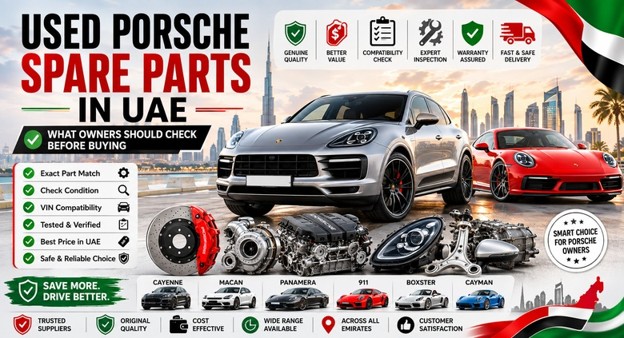
Used Porsche Spare Parts in UAE: What Owners Should Check Before Buying
August 21, 2026
Used Porsche Parts by Model
Used Porsche Cayenne Spare Parts in UAE: What Owners Commonly Buy
Used Porsche Cayenne parts can make financial sense when the vehicle is older, the replacement is hard to source new, or the price gap is simply too large to ignore. The most searched categories include engines, gearboxes, air-suspension components, control arms, brake parts, radiators, AC components, sensors, headlights and body panels.
Cayenne engine parts:
Used engines, engine mounts, cooling components, sensors, pulleys, seals and other ancillaries are commonly considered when repair costs start climbing. Before buying a complete engine, establish whether the fault is actually limited to a smaller replaceable component.
Cayenne gearbox parts:
A used gearbox can reduce the upfront bill, but transmission removal and installation make warranty especially important. Ask for the transmission code, donor information, testing details and mileage where known before treating the quotation as a bargain.
Cayenne air-suspension parts:
Air springs, compressors, valve blocks and related sensors can become expensive replacement items. Don't assume a Cayenne sitting low needs a new compressor; a leak elsewhere in the system can produce almost the same symptom.
Cayenne body parts:
Used genuine bumpers, doors, bonnet panels, fenders, mirrors and lights can offer strong savings when the actual component is clean and undamaged. Request photographs of the exact part and inspect mounting points, cracks, previous repairs and missing trim.
Cayenne electronics:
ECUs, control modules, sensors, alternators and other electrical components require more than a visual inspection. Confirm the part number and ask whether coding, programming or calibration will be required after installation.
Cayenne used-part decision:
Part condition + exact compatibility + testing + warranty + complete installed cost = genuine used-part value.
A cheap component with uncertain history is not necessarily cheaper once workshop labour and possible replacement are included.
Cayenne UAE buying factors:
UAE heat, heavy traffic and long-distance driving can put additional demands on cooling, AC and suspension systems. For a used Cayenne component, therefore, previous service history and testing can matter just as much as the advertised AED price.
Used Porsche Macan Spare Parts in UAE: Common Parts and Buying Risks
The Macan has a wide range of replacement components, but the correct used Porsche spare parts in UAE still depends on generation, engine, transmission and equipment specification. Buyers commonly search for suspension parts, brakes, AC components, cooling parts, turbo-related components, electronics, lights and body panels.
Macan suspension parts:
Control arms, bushes, ball joints, dampers and related components can be sourced used, but wear is difficult to judge from a photograph alone. Ask how the part was inspected and whether any testing or warranty is provided.
Macan brake parts:
Used genuine calipers and selected hardware may be considered when their condition is clearly established. Brake pads and heavily worn friction components are a different matter because previous service life can be difficult to verify.
Macan cooling parts:
Radiators, water pumps, thermostats, cooling fans and related components should be matched to the exact engine application. A cooling-system fault should also be diagnosed before buying a replacement part, otherwise the wrong component may be replaced.
Macan AC parts:
Used compressors, condensers and blower components can reduce the initial purchase cost. However, ask whether the compressor was tested and whether the wider AC system was checked for contamination or another underlying fault.
Macan electrical parts:
Sensors, modules, starters and alternators can be cheaper used, yet compatibility remains critical. A visually identical electronic component may still require different coding or belong to another vehicle specification.
Macan body parts:
Used genuine bumpers, mirrors, fenders, doors and lights can be attractive for older vehicles. Check paint condition, mounting points, electrical functions and included hardware before comparing the part with a new alternative.
Macan turbo-related components:
Turbochargers and associated components deserve particularly careful inspection because previous heat and lubrication conditions can affect their service life. Ask about testing, shaft condition where applicable, donor information and warranty before buying.
Macan used-part risk matrix:
| Part category | Used option | Main concern |
| Body panels | Strong option | Damage + paint |
| Mirrors | Good if tested | Electrical functions |
| Headlights | Good if inspected | Electronics + moisture |
| Control arms | Possible | Previous wear |
| Calipers | Possible | Condition + corrosion |
| Compressor | Possible | Testing |
| Turbocharger | Higher caution | Wear + lubrication history |
| ECU/module | Higher caution | Coding + compatibility |
| Gearbox | Possible | Testing + warranty |
| Brake pads | Poor choice | Unknown wear |
The Macan rule:
Don't buy a used part simply because it is described as “genuine”. Genuine used tells you who made the component, not how much life remains in it.
Used Porsche Panamera Spare Parts in UAE: Which Parts Are Worth Buying Used?
The Panamera combines complex mechanical, electronic and comfort systems, so used parts need to be selected carefully rather than treated as a universal money-saving solution. Suspension components, transmission parts, electrical modules, cooling components, AC parts, body panels and selected engine components are common areas for comparison.
Panamera suspension:
Used control arms, mounts and selected suspension assemblies may provide value when condition and mileage are known. If the part is heavily worn, however, the saving can disappear after another installation becomes necessary.
Panamera air suspension:
Air springs, compressors and associated components should be tested before purchase. A Panamera that sits unevenly or loses ride height needs system diagnosis first, not an automatic order for the most expensive component.
Panamera transmission:
A used transmission can be attractive when the vehicle's existing gearbox has suffered major damage. Confirm the exact transmission specification, donor information, testing, included components and warranty before comparing it with a reconditioned or new unit.
Panamera electrical modules:
Control modules, sensors, alternators and starters can be sourced used, but electronic compatibility should be established before payment. Ask whether programming or adaptation is required because the component price may not include the final workshop procedure.
Panamera cooling parts:
Radiators, water pumps, thermostats, cooling fans and related components can be expensive when bought new. A properly identified used component may reduce the purchase price, but inspect it for leaks, damage and previous repairs.
Panamera AC components:
Used compressors and condensers can be considered when they have credible testing evidence. For a compressor, ask whether it was checked for noise, seizure, leakage and other relevant faults before dispatch.
Panamera bodywork:
Used genuine doors, bumpers, mirrors, lights and panels can work particularly well when the vehicle needs cosmetic repair. The real cost still includes paint, preparation, fitting and any missing trim or electrical hardware.
Panamera engine components:
Used engine assemblies and ancillaries should be evaluated according to engine code, donor vehicle, mileage where known and testing. Don't let a low-priced engine overshadow the removal, installation, fluids and diagnostic costs that follow.
Which Panamera parts are better used?
Body panels, mirrors and selected tested components generally offer a clearer used-parts case than heavily worn or safety-critical components.
The harder the component is to inspect and the more expensive it is to install, the stronger the evidence and warranty should be.
Used Porsche 911 Spare Parts in UAE: What Should You Check First?
A used 911 part needs especially careful identification because Carrera, Turbo, GTS and GT variants can have different braking, suspension, engine and body specifications. Start with the VIN, generation, variant and exact part number before asking whether the used price is attractive.
911 brake parts:
Used calipers and selected brake hardware can sometimes be considered after proper inspection. Friction components with uncertain remaining life are a much weaker proposition, particularly when the vehicle is driven hard.
911 suspension parts:
Control arms, dampers, bushes and mounts may be available used, but previous track use or aggressive driving can alter their condition. Ask whether the donor vehicle's history is known before relying on mileage alone.
911 engine parts:
Used engines and major engine assemblies require detailed checking because installation labour is substantial. Engine code, donor information, testing, compression where appropriate, oil leaks, included components and warranty should all be established.
911 transmission parts:
Used manual and PDK components should never be purchased from a generic model description alone. Confirm the transmission code and vehicle application, then compare testing, warranty and installation cost.
911 body panels:
A used genuine bonnet, bumper, fender, door or mirror can save money when the component is straight and properly preserved. Ask for photographs of the actual part and look closely at mounting tabs, previous repairs and paint damage.
911 headlights and tail lights:
Lighting assemblies can contain electronics that make compatibility more complicated than the physical fit suggests. Confirm the generation, side, connector and functions before paying for a used unit.
911 electronics:
Used ECUs, modules, sensors and other electronic components need exact matching and may require programming. A cheap module that cannot be coded to the vehicle is not a saving.
911 performance variants:
A used part from a standard Carrera should not automatically be treated as suitable for a Turbo, GTS or GT variant. Exact specification beats model-name matching every time.
911 used-part checklist:
| Check | Why it matters |
| VIN | Confirms vehicle |
| Generation | Prevents wrong application |
| Variant | Confirms specification |
| Part number | Identifies exact component |
| Donor vehicle | Adds history |
| Mileage | Useful but not decisive |
| Testing | Evidence of condition |
| Photographs | Shows actual component |
| Warranty | Limits financial risk |
| Installation cost | Reveals complete cost |
Used Porsche Boxster and Cayman Parts in UAE: Best-Selling Replacement Components
Boxster and Cayman buyers should identify the generation before comparing used parts because component designs can change substantially between model eras. Common searches include suspension, brakes, cooling, engine parts, AC components, body panels, lights and electrical modules.
Boxster and Cayman suspension:
Used control arms, mounts and selected suspension components can offer savings when properly inspected. Ask about corrosion, bush condition, previous impact damage and donor mileage before ordering.
Brakes:
Used genuine calipers can be considered when they are clean, functional and properly inspected. Used pads and heavily worn discs are generally less attractive because their remaining service life is uncertain.
Cooling system:
Radiators, water pumps, thermostats, cooling fans and related components can be compared between used and new options. Check for leaks, bent fins, corrosion and damaged mounting points before accepting a used cooling component.
Engine parts:
Engine mounts, sensors, cooling components, seals and other ancillaries can sometimes be sourced used, while complete engine assemblies need considerably stronger inspection. Confirm the engine code and donor application before discussing price.
AC components:
A used compressor or condenser may provide a useful saving if it has been properly tested. Ask what testing was performed and whether the supplier provides meaningful warranty coverage.
Body parts:
Used genuine bumpers, doors, fenders, bonnets, mirrors and lights can be particularly useful for accident repairs. Check the actual part rather than relying on a generic photograph, and include paint and fitting in your budget.
Electrical components:
Alternators, starters and selected modules can be considered after testing. Electronic control units need additional caution because programming and compatibility can determine whether the component works at all.
Boxster and Cayman comparison:
| Part | Used suitability | What to check |
| Bumper | High | Damage + mounts |
| Door | High | Alignment + trim |
| Mirror | High | Functions |
| Headlight | Medium/High | Electronics + moisture |
| Caliper | Medium | Corrosion + operation |
| Control arm | Medium | Bush + ball joint |
| Radiator | Medium | Leaks + fins |
| AC compressor | Medium | Testing |
| Engine assembly | Higher caution | Code + testing |
| ECU/module | Higher caution | Compatibility + coding |
A used Porsche part is not automatically a bargain:
A component that costs half as much but lasts half as long, or requires another expensive installation, may deliver little real saving. Compare purchase price, condition, warranty, installation cost and expected service life before making the call.
The safest starting point:
Identify the Porsche → confirm the exact part → inspect the actual component → verify testing → check warranty → calculate the complete repair cost.
That sequence keeps the buying decision grounded in the part's real condition rather than the attractive number shown in an online listing.
Condition, Inspection and Compatibility
How to Check Used Porsche Spare Parts Before Buying
A used Porsche part should be judged by condition, compatibility, testing and warranty, not by the price tag alone. Ask for clear photographs of the actual component, its part number, visible wear, previous repairs and any available testing information.
Check the actual part:
Generic catalogue photographs are not enough for expensive used components. Look for cracks, corrosion, dents, broken mounts, oil leaks, damaged connectors and signs of previous repairs.
Check for missing hardware:
A used bumper, mirror, light or mechanical assembly may arrive without brackets, sensors, fasteners or trim. Confirm exactly what is included before comparing two apparently similar quotations.
Ask about previous use:
For engines, gearboxes, suspension components and electronic parts, donor information can provide useful context. Mileage is helpful, but it should support the condition assessment rather than replace it.
Testing matters:
Ask what was actually tested and how the result was established. “Tested” is too vague if the supplier cannot explain whether the component was electrically checked, pressure-tested, mechanically inspected or run before removal.
Check corrosion and heat damage:
UAE conditions can be demanding, while imported donor vehicles may have experienced completely different climates. Inspect metal components, connectors, seals and cooling parts for corrosion, oxidation or heat-related deterioration.
Used Porsche inspection checklist:
| Check | What to look for |
| Part number | Exact match |
| Photographs | Actual component |
| Cracks | Structural damage |
| Corrosion | Metal + connectors |
| Leaks | Engine, gearbox, cooling |
| Mounts | Broken or repaired |
| Connectors | Damage or oxidation |
| Wear | Remaining service life |
| Testing | Evidence provided |
| Warranty | Written terms |
Don't confuse clean appearance with good condition:
A polished gearbox casing can look excellent while hiding internal wear. For expensive assemblies, testing and warranty carry much more weight than appearance.
How to Check a Used Porsche Part Number and VIN Compatibility
Porsche parts should be matched using the VIN, generation, engine or variant and exact part number wherever possible. Searching only “used Porsche Cayenne part” or “used Porsche 911 part” leaves too much room for an incorrect application.
Start with the VIN:
Give the complete VIN to the supplier when compatibility is uncertain. This helps narrow down the vehicle's exact specification before the supplier confirms a replacement.
Compare the part number:
Check the number printed or stamped on the original component where accessible. If the supplier provides a different reference, ask why and confirm whether it is a valid replacement or superseding number.
Check left and right sides:
This sounds obvious, yet it causes avoidable mistakes with mirrors, lights, suspension components and body parts. Always state the required side before payment.
Check the generation:
A Porsche model name can cover several generations and specifications. A used Macan, Cayenne, Panamera, Boxster, Cayman or 911 component should therefore never be ordered solely from the badge.
Check engine and transmission:
Engine and gearbox components require especially precise matching. Confirm the engine code, transmission type and relevant variant before accepting a used assembly.
VIN compatibility checklist:
VIN → model → generation → engine → transmission → variant → part number → side/application.
If one of these remains unclear, pause the purchase and get confirmation before the part leaves the supplier.
Physical fit is not enough:
A component can bolt into place and still be electrically or electronically incompatible. This is particularly important for ECUs, sensors, lighting assemblies, control modules and other Porsche electronic parts.
Used Porsche Engine Parts in UAE: Mileage, Testing and Condition Checks
Used Porsche engines require much deeper checking than an ordinary replacement component because installation can be expensive. Ask for the engine code, donor vehicle, mileage where known, testing evidence, oil condition where available and warranty before agreeing to the purchase.
Engine code:
Confirm the exact engine code first. A “Porsche engine” description is far too broad for a serious comparison.
Mileage:
Known mileage can help establish the engine's history, but it should never be treated as proof of condition. A higher-mileage engine with credible testing may be a safer purchase than a supposedly low-mileage unit with no supporting evidence.
Compression testing:
Where appropriate, compression testing can provide useful information about cylinder condition. Ask for the results rather than accepting a simple statement that the engine was “checked”.
Leak inspection:
Check for visible oil or coolant leakage and ask whether the engine was inspected for previous damage. External cleanliness alone does not establish internal condition.
Donor information:
A known donor vehicle gives the buyer additional context around specification and previous use. Ask whether the engine came from an accident-damaged vehicle, a mechanically failed vehicle or another known source where this information is available.
Included components:
Clarify whether the price covers a long block, complete engine or engine with selected ancillaries. Two engines can have similar prices while containing very different amounts of usable hardware.
Engine warranty:
Warranty is particularly important because removing and installing a Porsche engine can be costly. Ask what the warranty covers and whether professional installation or specific testing conditions apply.
Used engine checklist:
| Check | Buyer question |
| Engine code | Is it the exact application? |
| Mileage | Is it known or estimated? |
| Compression | Was it tested where appropriate? |
| Leaks | Was the engine inspected? |
| Donor | Where did it come from? |
| Components | What is included? |
| Testing | What was actually tested? |
| Warranty | What does it cover? |
| Installation | What will the complete job cost? |
Calculate the engine project, not just the engine price:
Engine + delivery + removal + installation + fluids + seals/gaskets + supporting parts + diagnostics = realistic engine replacement cost.
That figure should be compared with repairing the existing engine before the final decision is made.
Used Porsche Gearboxes and PDK Parts: What Should Buyers Check?
A used Porsche gearbox can save money, but transmission installation is too labour-intensive for guesswork. Confirm the transmission code, donor vehicle, mileage where known, testing, fluid requirements, included components and warranty before ordering.
Transmission code:
Start with the exact gearbox or PDK identification. Model-name matching alone is not sufficient because Porsche transmissions can vary between generations and specifications.
Donor information:
Ask about the vehicle from which the transmission was removed. A known donor history can help establish mileage, specification and potential previous damage.
Testing:
Ask what was tested before the gearbox was offered for sale. Where appropriate, request evidence of functional testing, inspection or fault-code checks rather than accepting an unexplained “tested” label.
PDK components:
A PDK-related fault does not automatically mean the complete transmission needs replacement. Sensors, mechatronic components, fluid-related issues and electronic faults can produce symptoms that require a different repair.
Fluid and supporting parts:
Check the required fluid, seals, filters and other installation materials before comparing prices. A gearbox quotation that excludes these items is not a complete repair quotation.
Used gearbox warranty:
Ask whether the warranty covers the transmission only or provides any protection if the replacement fails after installation. This distinction matters because removing and refitting a gearbox can be expensive.
Used transmission comparison:
| Check | Why it matters |
| Transmission code | Exact application |
| VIN compatibility | Prevents wrong specification |
| Donor vehicle | Adds history |
| Mileage | Useful condition clue |
| Testing | Reduces uncertainty |
| Fault history | Identifies previous issues |
| Included parts | Prevents price confusion |
| Warranty | Limits replacement risk |
| Installation | Reveals true project cost |
Don't buy a gearbox from a generic listing:
Exact transmission + confirmed compatibility + testing + warranty + installation cost should form the buying decision.
A cheaper gearbox without credible testing can become the expensive option after installation.
Used Porsche Electrical Parts: ECUs, Sensors, Modules and Alternators
Used electrical parts can offer useful savings, but compatibility is often more complicated than physical fitment. ECUs, control modules, sensors, alternators, starters and other components should be matched by exact part number and vehicle application.
ECUs and control modules:
Confirm whether the module can be programmed or adapted to the Porsche before buying. A used unit that cannot be correctly configured may provide no practical saving.
Sensors:
Sensors should match the correct part number and specification. Do not assume that two sensors with identical connectors will provide the same readings or calibration.
Alternators:
A used alternator should ideally have its output and operating condition checked before purchase. Ask whether it was tested under load rather than relying on a visual inspection.
Starters:
Starting problems can originate from the battery, wiring, charging system or starter itself. Diagnose the fault first, then decide whether a used starter is actually required.
Electronic modules:
Ask whether the module is ready to install or requires coding. Also confirm whether the supplier accepts returns if the Porsche's diagnostic system identifies a compatibility problem.
Used electrical-part checklist:
Part number + VIN compatibility + connector specification + testing + coding requirement + warranty + return policy.
That sequence is especially useful for Porsche owners because the cheapest electronic component is worthless if it cannot communicate correctly with the vehicle.
Used electronics cost calculation:
Component + delivery + diagnostics + coding/programming + installation = realistic repair cost.
The advertised AED price should never be treated as the finished electrical-repair cost.
Which Used Porsche Parts Make Sense?
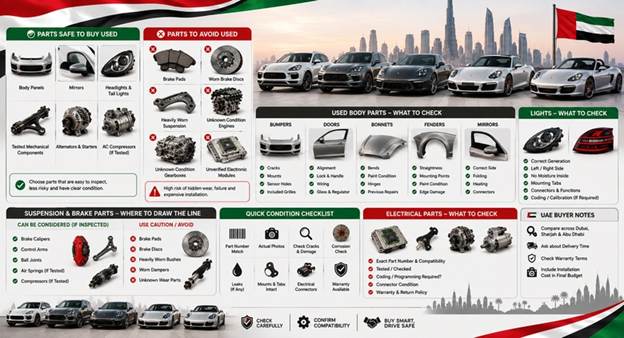
Which Porsche Spare Parts Are Safe to Buy Used?
Used Porsche parts can be a sensible way to control repair costs, but the safest categories are generally components whose condition can be inspected clearly and whose failure does not create a disproportionate installation risk. Body panels, mirrors, selected lighting assemblies and properly tested mechanical components are often easier to assess than heavily worn or internally complex parts.
Used body panels:
Bumpers, doors, bonnets and fenders can be good candidates when the actual component is straight and free from serious previous damage. Check mounting points, cracks, repairs, paint condition and included trim before comparing the price with a new alternative.
Used mirrors:
A used genuine mirror can save money, particularly when the housing is clean and the electrical functions are confirmed. Check heating, folding, adjustment, memory functions where applicable and the connector before buying.
Used headlights and tail lights:
Lighting assemblies can work well as used replacements when they are dry, undamaged and electronically compatible. Inspect for moisture, cracked lenses, broken mounts and previous repairs.
Selected mechanical components:
Some tested mechanical assemblies can make sense when the donor history and condition are reasonably clear. The more expensive the installation, however, the more important testing and warranty become.
Used parts worth considering:
| Part category | Used potential | Main check |
| Bumper | High | Damage + mounts |
| Bonnet | High | Alignment + repairs |
| Door | High | Structure + hardware |
| Mirror | High | Electrical functions |
| Headlight | Medium/High | Electronics + moisture |
| Tail light | Medium/High | Connector + condition |
| Caliper | Medium | Operation + corrosion |
| Alternator | Medium | Output testing |
| Engine | Higher caution | Testing + warranty |
| PDK/gearbox | Higher caution | Testing + compatibility |
The useful rule:
Buy used when the condition can be established, the specification is confirmed and the potential saving still matters after installation.
A large discount means little if the component's remaining life is impossible to judge.
Which Porsche Parts Should You Avoid Buying Used?
Not every Porsche part deserves the same buying strategy. Components with unknown wear, hidden internal damage or expensive installation can turn a seemingly clever purchase into a second repair bill.
Brake friction components:
Used brake pads are generally a poor place to save money because remaining life and previous heat exposure are difficult to establish. Brake discs also require careful measurement and inspection rather than a simple visual price comparison.
Heavily worn suspension components:
Old bushes, ball joints and worn dampers carry previous service history that may be impossible to verify. If the labour to replace them is substantial, a quality new component can be the more sensible route.
Unknown-condition engines:
A used Porsche engine without credible testing, engine-code confirmation or warranty carries considerable risk. Installation costs make this even more important because discovering a fault after fitting is expensive.
Unknown-condition gearboxes:
A transmission should not be bought merely because it is available cheaply. Confirm the transmission specification, testing, donor information and warranty before considering the saving.
Unverified electronic modules:
Used ECUs and control modules can create compatibility and programming problems. If the supplier cannot explain whether the module was tested or can be adapted to the vehicle, pause the purchase.
Parts to approach cautiously:
Unknown history + difficult inspection + expensive installation = high-risk used purchase.
In those situations, compare genuine, OEM, reconditioned and reputable new alternatives before committing.
Used Porsche Body Parts in UAE: Bumpers, Doors, Bonnet, Fenders and Mirrors
Used genuine Porsche body parts can offer some of the clearest savings, particularly after accident damage. The catch? Condition varies enormously, so the buyer should inspect the actual panel rather than rely on a generic listing photograph.
Bumpers:
Check cracks, previous plastic repairs, mounting tabs and sensor openings before buying. Confirm whether grilles, trims, sensors and brackets are included because a “bumper” can mean different things to different suppliers.
Doors:
Ask whether the door includes the glass, regulator, lock, mirror, wiring, trim and other hardware. A cheaper bare shell may become more expensive once all the missing components are added.
Bonnet:
Inspect the bonnet for bends, repaired impact points and damaged hinges or mounting areas. Paint condition also matters because a colour mismatch can add a body-shop bill after purchase.
Fenders:
Used genuine fenders can be attractive when straight and undamaged. Check the edges, mounting points and previous bodywork before comparing the panel with an aftermarket alternative.
Mirrors:
Confirm the correct side and electrical specification. A Porsche mirror may include heating, power adjustment, folding, memory functions or other equipment that makes apparently similar assemblies incompatible.
Body-part price calculation:
Used panel + delivery + paint + preparation + fitting + missing hardware = realistic finished cost.
That number is more useful than comparing two bare-panel prices.
Used bodywork checklist:
| Check | Why it matters |
| Actual photographs | Confirms condition |
| Mounting points | Prevents fitting problems |
| Previous repairs | Reveals hidden work |
| Paint | Determines refinishing cost |
| Trim | Avoids missing components |
| Sensors | Confirms equipment |
| Side | Prevents wrong-part order |
| Delivery | Adds to purchase cost |
Used Porsche Headlights and Tail Lights: What to Check Before Paying
Used Porsche lighting assemblies can save a considerable amount, particularly when a new replacement is expensive. However, the physical housing is only part of the story because modern lighting units can contain electronics and vehicle-specific functions.
Check the generation:
Confirm the exact Porsche generation before ordering. A headlight from another model year may look similar while using different electronics, mounting points or connectors.
Check left or right side:
Always confirm the required side. This simple check can prevent an otherwise avoidable return.
Inspect for moisture:
Look inside the lens and housing for condensation or water marks. Previous moisture exposure can cause electronic problems even when the exterior looks clean.
Check mounting tabs:
Broken mounting points can make an apparently cheap headlight difficult to install correctly. Ask for close photographs of the rear housing and mounting areas.
Check electronics:
Confirm whether the lamp includes the required control units, modules or other hardware. A bare housing may not represent the same value as a complete ready-to-install assembly.
Check functions:
Where applicable, verify lighting functions, adjustment, indicators, DRLs and other equipment. For adaptive or electronically controlled lighting, ask whether calibration may be required after installation.
Used lighting checklist:
Part number + generation + side + connector + electronics + moisture check + mounting points + functions + warranty.
That sequence makes a much safer comparison than simply searching for the cheapest Porsche headlight.
Used Porsche Suspension and Brake Parts: Where Should You Draw the Line?
Suspension and braking components sit in different risk categories, even though both can appear in the same used-parts search. A used genuine caliper or certain suspension hardware may be reasonable after inspection, while unknown-condition friction or heavily worn components deserve much more caution.
Used brake calipers:
A used caliper can be considered if it is inspected for corrosion, piston condition, leaks and damage. Confirm the exact brake-system application before ordering.
Brake pads:
Used pads are generally difficult to justify because their remaining thickness and previous heat exposure are uncertain. A new quality replacement is usually the more straightforward comparison.
Brake discs:
A used disc requires proper measurement and inspection for thickness, scoring, cracking and heat damage. If the remaining usable life is unclear, the apparent saving may not be worthwhile.
Suspension control arms:
Used control arms can sometimes work when the bush and ball-joint condition is established. However, if the rubber components are already aged, buying a used assembly may simply postpone the same repair.
Dampers:
Used dampers need particular caution because internal wear is not always visible. A clean exterior does not prove that the damper still performs correctly.
Air-suspension components:
Used air springs and compressors can be considered when properly tested and backed by warranty. Check for leaks, pressure performance and previous repair history before installation.
Risk comparison:
| Component | Used suitability | Main concern |
| Caliper | Medium | Corrosion + operation |
| Brake pad | Low | Unknown wear |
| Brake disc | Low/Medium | Thickness + heat damage |
| Control arm | Medium | Bush + ball joint |
| Ball joint | Low/Medium | Hidden wear |
| Damper | Low/Medium | Internal wear |
| Air spring | Medium | Leaks |
| Compressor | Medium | Testing |
| Mounting hardware | Medium/High | Condition |
Where should the buyer draw the line?
If condition is difficult to establish and installation is expensive, don't let the discount make the decision for you.
For Porsche suspension and braking repairs, the sensible comparison is used price + expected remaining life + warranty + installation cost, not used price alone.
Price, Genuine vs Used and UAE Market Buying
Used Porsche Spare Parts Prices in UAE: What Determines the AED Cost?
Used Porsche parts do not follow one fixed pricing ladder because availability, generation, condition and rarity can shift the AED price quickly. A common Macan body panel may be easy to source, while a specific 911 electronic module can command a much higher figure simply because fewer suitable units are available.
Model and generation:
A Cayenne part from one generation should not be used as a price benchmark for another. The same applies to the Panamera, Macan, 911, Boxster and Cayman.
Part number:
The exact part number is one of the strongest price filters. Two components that look almost identical may have different specifications, applications and therefore completely different market values.
Condition:
A clean, tested used genuine component should not automatically be compared with a damaged or untested unit. Ask what has actually been inspected before deciding that the cheaper quotation is better.
Mileage and previous use:
Mileage can help with engines, gearboxes and selected mechanical components, but it is not proof of condition. A lower-mileage component with no testing history can be a weaker purchase than a higher-mileage unit with credible inspection and warranty.
Rarity and availability:
Rare Porsche components can become expensive when local stock is limited. Sometimes paying slightly more for a correctly matched part already available in the UAE makes more sense than waiting weeks for a cheaper overseas unit.
Warranty:
Warranty can explain a noticeable price difference between two used components. For engines, transmissions, electronic modules and air-suspension parts, compare what the warranty actually covers before judging the AED difference.
Delivery:
Part price + delivery = actual purchase price.
A supplier offering a cheaper component may no longer be cheaper once delivery is added.
Labour:
Installation can dominate the final bill for engines, PDK transmissions, air suspension and difficult electrical components. A used part that saves AED 1,000 but requires another expensive installation after failure is hardly a bargain.
Used Porsche price factors:
| Factor | Effect on price |
| Porsche model | Changes demand |
| Generation | Changes compatibility |
| Part number | Defines application |
| Condition | Changes risk |
| Mileage | Useful condition indicator |
| Rarity | Can increase price |
| UAE stock | Affects availability |
| Testing | Adds confidence |
| Warranty | Reduces risk |
| Delivery | Adds direct cost |
| Labour | Changes complete repair cost |
Use the complete-cost formula:
Used part + delivery + labour + supporting parts + diagnostics + fluids/materials = realistic repair cost.
That is the figure a UAE Porsche owner should compare, not the number printed beside the used component.
When comparing used Porsche suppliers across the Emirates, PartFinder UAE can be considered alongside the exact part number, condition, testing, warranty, delivery and complete installation cost.
Used vs Genuine Porsche Parts in UAE: Which Gives Better Value?
Used genuine Porsche parts can offer substantial savings, but genuine new parts provide a different level of certainty and expected service life. The right choice depends on the component, vehicle age, repair risk and how long the owner intends to keep the Porsche.
Genuine Porsche parts:
New genuine parts are often easier to justify for newer vehicles, complex electronics and specialised components. They can also make sense when installation is expensive because reducing repeat-work risk has genuine value.
Used genuine parts:
A used genuine component can be attractive when the part is expensive new but relatively easy to inspect. Body panels, mirrors, selected lights and some tested assemblies can fall into this category.
Compare the real saving:
A used component costing AED 2,000 against a new genuine component at AED 4,000 appears to save AED 2,000. If the used component has unknown wear and requires another AED 1,500 installation later, the calculation changes sharply.
Warranty difference:
Check warranty length, exclusions and installation requirements for both options. A higher-priced genuine part with stronger coverage may be preferable when failure would involve substantial workshop labour.
Expected service life:
Used parts already have a history, even when the seller cannot provide every detail. For wear-sensitive components, expected remaining life should therefore be part of the comparison.
Used vs genuine comparison:
| Factor | Used genuine | New genuine |
| Purchase price | Lower | Higher |
| Previous use | Yes | No |
| Condition certainty | Variable | Higher |
| Warranty | Supplier-dependent | Usually stronger |
| Availability | Can be excellent | Can vary |
| Best use | Older/value-focused repairs | Newer/complex repairs |
| Installation risk | Depends on part | Generally lower |
When used genuine makes sense:
Older Porsche + suitable component + verified condition + meaningful saving + acceptable warranty = strong used-parts case.
For a new Porsche or a difficult-to-install component, the calculation may lean towards a new genuine replacement.
Used vs OEM vs Aftermarket Porsche Parts: Which Should You Choose?
There are four broad buying routes, but they are not interchangeable. Used genuine focuses on previous-use value, OEM focuses on manufacturer supply, aftermarket covers a wide quality range, and new genuine prioritises the Porsche-branded route.
Used genuine:
The component was originally made for Porsche but has already been used. Its value depends heavily on condition, donor history, testing and remaining service life.
OEM:
A reputable OEM component can provide a middle-ground option where the manufacturer and specification are clear. Do not accept “OEM quality” as proof on its own; ask who actually manufactured the component.
Aftermarket:
Aftermarket parts range from excellent specialist products to very cheap components with questionable durability. Manufacturer reputation, specification and warranty should determine the comparison.
New genuine:
New genuine parts provide the clearest route when exact original specification and reduced previous-use uncertainty are priorities. The downside is usually the higher purchase price.
Four-way comparison:
| Option | Price | Condition risk | Best suited to |
| Used genuine | Lower | Medium/High | Older Porsche + suitable parts |
| OEM | Medium | Low/Medium | Value-focused repairs |
| Aftermarket | Low–Medium | Manufacturer-dependent | Suitable routine components |
| New genuine | Higher | Lowest previous-use risk | Newer/complex Porsche |
Which should you choose?
For bodywork, used genuine can be excellent value; for routine components, reputable OEM or aftermarket options may reduce costs; and for specialised or difficult-to-install components, new genuine can justify its premium. There is no single winner.
Compare like with like:
Same part number + same application + comparable condition + warranty + delivered price + installation cost.
Without those checks, a four-way price table can create a false sense of value.
Used Porsche Spare Parts in Dubai, Sharjah and Abu Dhabi: Where Should You Compare?
Porsche owners do not necessarily need to buy from the nearest supplier. Comparing used stock across Dubai, Sharjah and Abu Dhabi can widen the choice, particularly when a specific Cayenne, Panamera, Macan, 911, Boxster or Cayman component is difficult to source.
Dubai:
Dubai can be useful for buyers looking for a broad range of Porsche components and supplier options. Compare the exact part number, actual condition, warranty and delivered price rather than choosing based on location alone.
Sharjah:
Used parts can be worth investigating when repairing older Porsche models or sourcing body panels and selected mechanical components. Ask for photographs of the actual component and confirm whether the quoted price includes all relevant hardware.
Abu Dhabi:
Abu Dhabi buyers can compare local availability with suppliers elsewhere in the UAE. A part sourced from another Emirate may still be the better option if it is correctly matched, tested and available sooner.
Ajman, Ras Al Khaimah, Fujairah and Umm Al Quwain:
Buyers outside the largest automotive markets can compare UAE-wide stock rather than limiting the search to nearby suppliers. Delivery time, shipping cost, warranty and return arrangements should be included in that decision.
Compare suppliers using the same information:
VIN + part number + condition + warranty + delivery + installation requirement.
This prevents a common mistake: comparing one supplier's bare component price with another supplier's complete delivered quotation.
UAE location comparison:
| Buyer location | What to prioritise |
| Dubai | Stock + supplier choice |
| Sharjah | Used availability + condition |
| Abu Dhabi | Local + UAE-wide sourcing |
| Ajman | Delivered cost |
| Ras Al Khaimah | Delivery + warranty |
| Fujairah | Availability + shipping |
| Umm Al Quwain | Delivered total |
Don't assume one Emirate is always cheaper:
Used Porsche stock changes constantly, and rare components can move in price quickly. The stronger quotation is the one offering the correct part, acceptable condition, useful warranty and sensible complete repair cost.
How Much Can You Save with Used Porsche Spare Parts in UAE?
There is no honest fixed percentage that applies to every Porsche part. The potential saving depends on the new-part price, used availability, condition, rarity, warranty and the labour required to install it.
Body parts:
Used genuine bumpers, doors, bonnets, fenders and mirrors can sometimes provide meaningful savings. The final saving should include paint, preparation, fitting and any missing trim or hardware.
Lighting:
Used headlights and tail lights can reduce the component price considerably when the unit is clean and compatible. Check electronics, moisture and mounting points first because replacing a defective used lamp can erase the saving.
Engines:
A used engine can cost substantially less than a new replacement route, but testing and installation are critical. Compare the complete engine project rather than celebrating the difference between two component prices.
Gearboxes and PDK:
A tested used transmission can reduce the initial expenditure. However, repeat removal and installation can quickly consume the saving if the replacement unit has an undisclosed fault.
Suspension:
Used suspension components can be cheaper, but previous wear needs careful consideration. For parts such as bushes, ball joints and dampers, a new quality replacement may offer better value over the full ownership period.
Electronics:
Used modules can provide strong savings where compatibility and programming are confirmed. An untested module, however, can create diagnostic and coding costs that make the original saving disappear.
Calculate the actual saving:
New complete repair cost − used complete repair cost = genuine saving.
Not new part price − used part price.
Used-parts saving matrix:
| Category | Potential saving | Main risk |
| Body panels | Often attractive | Condition + paint |
| Mirrors | Often attractive | Electronics |
| Lights | Can be attractive | Moisture + coding |
| Suspension | Variable | Previous wear |
| AC compressor | Variable | Internal condition |
| Engine | Potentially large | Testing + installation |
| Gearbox/PDK | Potentially large | Repeat labour |
| ECU/module | Potentially large | Compatibility |
The smart-money approach:
If a used Porsche component saves a meaningful amount after delivery, labour and supporting costs, it deserves serious consideration. If the saving is tiny, a new OEM or genuine part may provide the better long-term deal simply because the buyer is taking less risk.
Warranty, Installation and Final Buying Decisions
Used Porsche Spare Parts Warranty in UAE: What Buyers Should Ask
Warranty can make the difference between a sensible used-part purchase and an expensive gamble. Before paying, ask exactly how long the warranty lasts, what component is covered, what conditions apply and whether professional installation is required.
What does the warranty cover?
A supplier may cover the component itself without covering labour, removal or installation. That distinction matters enormously for engines, gearboxes, PDK units, air-suspension components and electronic modules.
How long is the warranty?
Confirm the warranty period in writing rather than relying on a verbal promise. A short warranty may be acceptable for a low-cost body component but deserves more scrutiny when the replacement is expensive.
Does installation affect the warranty?
Some suppliers may require installation by a qualified workshop or compliance with particular fitting procedures. Ask before installation because discovering the condition afterwards can create an avoidable dispute.
What happens if the part fails?
Ask whether the supplier provides a replacement, refund or repair. Also clarify who pays for removal and refitting if the replacement component turns out to be defective.
Are used electronic parts covered?
For ECUs, control modules and sensors, ask whether compatibility and programming are covered. A module can be electrically functional yet unsuitable for a particular Porsche specification.
Warranty checklist:
Duration + covered component + installation conditions + testing requirements + return procedure + labour responsibility.
A used Porsche part with a clear warranty can be worth more than a cheaper component sold with vague promises.
Don't treat warranty as decoration:
Read the terms before payment, especially for expensive assemblies. If the warranty is unclear, factor that uncertainty into the price rather than assuming everything will be fine.
Used Porsche Parts Installation Cost in UAE: The Hidden Expense
The purchase price is only one part of the repair. Removal, fitting, diagnostics, fluids, programming, calibration and supporting components can turn a cheap used Porsche part into a surprisingly large workshop bill.
Engine installation:
Replacing an engine involves considerably more than lifting one unit out and another in. Fluids, seals, gaskets, transferred components, diagnostics and post-installation checks can all add to the project.
Gearbox installation:
Transmission removal and fitting can represent a substantial share of the total repair. That is why warranty becomes so important when comparing used and new gearbox options.
Air suspension:
Air springs, compressors and associated components may require diagnosis and calibration after installation. Confirm these requirements before comparing supplier prices.
AC components:
A used compressor may require refrigerant service, system inspection, cleaning and additional components. If the original failure contaminated the system, replacing only the compressor may not be enough.
Electronic modules:
A used ECU or control module may need coding, programming or adaptation. Ask for the complete installation procedure before treating the component's advertised price as the repair cost.
Body panels:
A used bumper or door may require paint, preparation, fitting and transfer of trim or sensors. The cheapest panel is not necessarily the cheapest finished repair.
Hidden-cost calculation:
Used part + delivery + removal + installation + fluids/materials + diagnostics + coding/calibration + supporting parts = complete repair cost.
That is the figure worth comparing between used, OEM and genuine options.
Installation-cost comparison:
| Part | Potential hidden costs |
| Engine | Fluids, seals, diagnostics, labour |
| Gearbox/PDK | Fluid, seals, removal/refitting |
| Air suspension | Diagnosis, calibration, labour |
| AC compressor | Refrigerant, cleaning, labour |
| ECU/module | Coding + diagnostics |
| Headlight | Coding/calibration where applicable |
| Bumper | Paint + fitting + trim |
| Suspension | Alignment + supporting components |
Used Porsche Spare Parts Buying Checklist: What to Confirm Before Payment
Don't place the order until the essential details are settled. A five-minute compatibility check can save days of workshop delay and the headache of returning a wrongly supplied component.
Confirm the vehicle:
VIN + model + generation + engine + transmission + variant.
This is the foundation of the purchase, particularly for 911, Cayenne, Panamera and Macan parts.
Confirm the component:
Check the exact part number, side where applicable and physical application. If the supplier proposes another reference, ask for compatibility confirmation before accepting the substitution.
Confirm condition:
Ask whether the part is used genuine, reconditioned, OEM or aftermarket. For used components, request the actual condition and any known previous repairs.
Confirm testing:
Find out what was tested and what evidence is available. “Tested” should mean something specific, particularly for engines, gearboxes, electrical modules and air-suspension components.
Confirm photographs:
Request photographs of the actual used component. Look for cracks, corrosion, leaks, damaged connectors, broken mounts and missing hardware.
Confirm warranty:
Ask how long it lasts, what it covers and whether installation conditions apply. Don't wait until the part fails to discover that labour was excluded.
Confirm delivery:
Ask whether the part is physically available in the UAE and when it can reach the workshop. For an immobilised Porsche, downtime can become a genuine ownership cost.
Confirm returns:
Understand what happens if the wrong part arrives or the component proves defective. Also ask whether installed parts can be returned because policies can differ.
Confirm installation:
Ask the workshop for labour and supporting-material costs before ordering. Include fluids, seals, diagnostics, programming, calibration and alignment where relevant.
The final checklist:
VIN → part number → condition → testing → photographs → compatibility → warranty → delivery → returns → installation → complete repair cost.
If a supplier cannot answer several of these questions, the lower price deserves a second look.
Used Porsche Parts Buying Guide for Cayenne, Macan, Panamera, 911, Boxster and Cayman
Different Porsche models create different used-parts opportunities. The same buying rule cannot sensibly be applied to a Cayenne air compressor and a 911 performance brake component.
Cayenne:
Used body panels, mirrors, lights and selected tested mechanical components can provide useful value. Engines, gearboxes and air-suspension components require stronger testing and warranty because installation costs can be substantial.
Macan:
Macan buyers can compare used suspension, cooling, AC, body and electrical components. Engine, turbocharger and transmission parts deserve closer inspection because previous heat, lubrication and operating conditions may affect remaining life.
Panamera:
Used bodywork and selected mechanical parts can make sense when condition is established. Air suspension, transmission and electronic modules should be approached with greater caution because diagnosis and installation can add significant cost.
911:
Specification is everything on the 911. Carrera, Turbo, GTS and GT variants can use different components, so VIN, generation, variant and part number should be confirmed before discussing price.
Boxster and Cayman:
Used genuine body panels, lights and selected mechanical components can offer sensible savings. Suspension, engine and electronic parts need closer inspection because previous use and exact specification can be difficult to establish.
Model decision matrix:
| Porsche model | Used parts worth considering | Higher-risk categories |
| Cayenne | Body, lights, selected mechanical | Engine, gearbox, air suspension |
| Macan | Body, suspension, AC | Turbo, gearbox, electronics |
| Panamera | Body, selected suspension | PDK, air suspension, modules |
| 911 | Body, selected tested parts | Performance brakes, engine, PDK |
| Boxster | Body, lights, selected parts | Engine, suspension, electronics |
| Cayman | Body, lights, selected parts | Engine, suspension, transmission |
Choose according to ownership plans:
An older Porsche that is being kept as a practical daily vehicle may justify a different parts strategy from a newer 911 being preserved long term. Consider vehicle value, expected ownership period, annual mileage and the consequence of repeat repairs before choosing used.
The final buying rule:
Buy the condition, not merely the discount.
A properly identified, tested used Porsche part with a sensible warranty can be an excellent UAE buying decision, while an unidentified bargain can become the most expensive option once delivery, workshop labour and repeat repairs are added.
FAQs About Used Porsche Spare Parts in UAE
Categories
- Audi
- BMW
- Car Accessories
- Car Tips
- Ford
- Land Rover
- Mazda
- Range Rover
- Top 10
- UAE Car Parts
- Used Car Parts
- Toyota
- Replacement Engines
- Nissan
- Hyundai
- Mitsubishi
- Volkswagen
- Honda
- Kia
- Chevrolet
- Dodge
- Jeep
- Subaru
- Renault
- Lexus
- Mercedes
- Suzuki
- Hummer
- Porsche
- Infiniti
- Peugeot
- GMC
- Mini
- Volvo
- Replacement Gearboxes
- MG
- Jaguar
- Skoda
- Cadillac
- Daihatsu
- Fiat
- German Car Parts
- Japanese Car Parts
- Aftermarket Car Parts
- Genuine Car Parts
- New Car Parts
- Reconditioned Car Parts
- European Car Parts
- American Car Parts
- Korean Car Parts
- British Car Parts
- Chinese Car Parts
- Sports/Exotic Car Parts
- Luxury Car Parts
- Performance Car Parts
- SUV/4x4 Spare Parts
- Truck Spare Parts
- EV Car Parts
- Hybrid Car Parts
- Auto Spare Parts in UAE
- Tesla
- Isuzu
- Ram
- Ferrari
- Bentley
- Lamborghini
- Genesis
- Maserati
- Lincoln
- Chrysler
- Opel
- Citroen
- SsangYong
- Seat
- McLaren
- Aston Martin
- Rolls Royce
- Maybach
- Alfa Romeo
- Bugatti
- Scion
- Abu Dhabi Car Parts
- Ajman Car Parts
- Al Khan Car Parts
- Al Sajaa Car Parts
- Deira Car Parts
- Dubai Car Parts
- Fujairah Car Parts
- Industrial Area 6 Car Parts
- Mussafah Car Parts
- Ras Al Khaimah Car Parts
- Sharjah Car Parts
- Umm Al Quwain Car Parts
- Acura
- BYD
- Chery
- Dacia
- DS
- Geely Emgrand
- EXEED
- GAC
- GAC Gonow
- Geely
- Gonow
- Great Wall
- Haima
- Haval
- Holden
- Iveco
- JAC
- Jaecoo
- Jetour
- Lotus
- Omoda
- Proton
- Renault Samsung
- Roewe
- Lucid
- Replacement Headlight
- Replacement Bumper