Used Range Rover Spare Parts in UAE: Engines, Gearboxes, Air Suspension and Body Parts
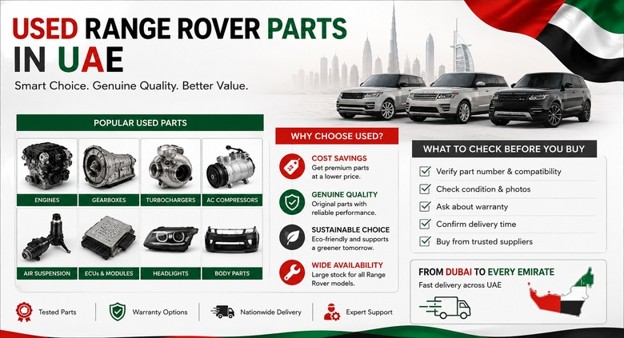
August 18, 2026
Buying Used Range Rover Parts in UAE
Where to Buy Used Range Rover Spare Parts in UAE
Buying a used Range Rover spare parts in UAE can be surprisingly sensible. The vehicle may be several years old, the original replacement might carry a painful price tag, and yet a properly identified used genuine component can sometimes bring the repair bill back down to earth.
But there is a catch.
Used doesn't mean automatically cheap, and cheap doesn't mean good value.
The UAE has a large market for dismantled, second-hand and previously fitted Range Rover components. You can find engines, automatic gearboxes, air-suspension assemblies, headlights, bumpers, doors, mirrors, electronic modules, interior parts and plenty of smaller mechanical components. Availability, however, changes quickly. A part that is sitting in stock today might be gone tomorrow, particularly when it belongs to a popular Range Rover Sport or older L322.
So don't begin with:
“What is the cheapest Range Rover part?”
Begin with:
“Who has the correct used part, what condition is it in, and what evidence do I have before buying it?”
That's a much better question.
For a routine trim piece, you may only need photographs and the correct part number. For an engine or gearbox, the conversation should go much deeper — donor vehicle, mileage where known, testing, included components, warranty and installation implications all need to come into play.
And if your Range Rover is already sitting inside a workshop, availability matters too. Paying slightly more for a correctly identified component that reaches the workshop tomorrow can sometimes save more money than chasing the lowest quotation for a part that takes several days to source.
How to Find the Right Used Range Rover Part for Your Vehicle
This is where buyers need to slow down.
A supplier may have a shelf full of Range Rover components, but that doesn't mean every similar-looking part belongs on your vehicle.
Give them the VIN.
Give them the model year.
Give them the engine specification.
If you have it, provide the original part number.
Then explain exactly what you're trying to replace.
For example:
Range Rover Sport, 2018, petrol, VIN available. Front-left air-suspension strut required. Please confirm the original and replacement part numbers, condition, mileage if known, warranty and final delivered price.
That's a proper parts enquiry.
Compare that with:
“Range Rover Sport suspension part price?”
The second message leaves the supplier guessing.
And guessing is exactly what you don't want when buying a used component.
Why the Range Rover Model Name Isn't Enough
“Range Rover Vogue” can refer to a specification rather than one single mechanical configuration. “Autobiography” can do the same thing. Range Rover Sport, Evoque and Velar have also passed through different generations, engines and equipment combinations.
So, two vehicles carrying a familiar badge can require completely different components.
An L322 gearbox isn't automatically an L405 gearbox.
A Range Rover Sport air-suspension component isn't automatically suitable for every Sport.
A headlight from one specification may have different electronic equipment from another.
The photograph might look almost identical.
The part number tells a different story.
Match the component to the vehicle, not merely to the badge.
Used Range Rover Parts Online vs Local UAE Suppliers
Buying online makes comparison much easier.
You can contact several suppliers, send the same vehicle details, request photographs of the actual part and compare the answers without spending half the day driving around.
That's useful.
Very useful, actually.
But online buying has one obvious weakness: you don't physically see the component until it reaches you.
For a used bumper, that might be manageable if the supplier sends detailed photographs.
For a used gearbox, you need considerably more confidence.
For an engine, more still.
A local supplier may allow you to inspect the physical component, check identification markings and discuss the condition directly. An online supplier may instead offer faster comparison, wider stock access or easier delivery.
Neither route automatically wins.
Use online enquiries to widen your options. Use VIN verification, part-number matching, photographs, testing evidence and warranty terms to narrow them down.
What to Ask an Online Used-Parts Supplier
Don't send twenty disconnected WhatsApp messages.
Put the important questions together.
Ask:
Is this the actual part in stock?
What is the part number?
Is it genuine, aftermarket or reconditioned?
What vehicle did the part come from?
What mileage is known?
Has it been tested?
What does the warranty cover?
What is the final delivered price?
For an expensive component, also ask for photographs of the actual item.
If the supplier answers clearly, good.
If the answers keep coming back as “original condition”, “excellent”, “guaranteed” and “fits all Range Rover”, without any supporting detail, pause.
Those words sound reassuring.
They aren't evidence.
What to Check Before Buying Used Range Rover Parts
A used part needs a little detective work.
Not the dramatic kind. Just sensible checking.
Start with identity.
Does the part number match?
If not, has the supplier explained why?
Then check condition.
Is the photograph of the actual component?
Are there cracks, damaged connectors, broken mounting points, corrosion, oil leaks or signs of previous repair?
Then consider history.
For an engine or gearbox, where did it come from? Is the donor vehicle known? Is mileage available? Has the component been tested?
Then look at warranty.
How long?
What does it cover?
Does it cover labour?
What happens if the component fails after installation?
Finally, calculate the real repair cost.
A used gearbox at AED 4,500 isn't necessarily a AED 4,500 repair.
You may also have removal, installation, fluids, seals, programming, adaptation and other supporting work.
That's where buyers sometimes get caught out.
They celebrate the cheap component and forget the expensive workshop bill waiting behind it.
How to Verify a Used Range Rover Part Before Payment
Before you transfer money, build a small chain of evidence.
Vehicle VIN → original part number → supplier's replacement number → actual component → condition → warranty → final price.
If all those pieces line up, you're in a much stronger position.
For a used body panel, inspect photographs closely. Ask for the edges and mounting points as well as the painted surface.
For a headlight, ask for the identification label, connectors, brackets and lens.
For an air-suspension compressor, ask whether the actual unit has been tested.
For an engine, ask for identification details, donor information and testing evidence where available.
For a gearbox, establish the transmission identification before payment.
And don't accept “tested” as a complete answer.
Ask:
“What exactly was tested?”
That one question can expose a huge difference between suppliers.
One may have simply checked the component visually.
Another may have removed it from a running vehicle and carried out meaningful testing.
Those aren't the same thing.
The Five-Minute VIN Check That Can Save Thousands
For major components, send the VIN before the supplier prepares the final quotation.
Then ask them to confirm the exact part number in writing.
If the proposed number differs from the number on your original component, ask why.
Maybe the manufacturer superseded the old number.
Maybe the supplier has an equivalent replacement.
Maybe your original component belongs to a different specification.
Or, yes, maybe someone has simply picked the wrong part.
Better to discover that while the component is still sitting on a supplier's shelf.
Not after your workshop has removed half the vehicle.
Used Doesn't Mean “Take Whatever Is Available”
This is probably the most important point in the opening section.
A used Range Rover component can be an excellent purchase when the price, condition, compatibility and warranty make sense together.
It can also be a terrible purchase when one of those pieces is missing.
A cheap engine with no meaningful history?
Be careful.
A used gearbox with the wrong transmission identification?
Walk away.
A genuine headlight with clear photographs, correct part number and useful warranty?
Now you're looking at something different.
A used body panel with minor cosmetic marks that can be repaired cheaply?
Potentially excellent value.
The point isn't to avoid used parts.
Quite the opposite.
Use the used market intelligently.
That's how an older Range Rover can remain economically repairable without turning every maintenance job into a new-car-sized expense.
Used Range Rover Engines
Used Range Rover Engines for Sale in UAE
A used Range Rover engine can make financial sense when the original engine has reached the point where repair costs are becoming difficult to justify.
But this isn't a component you buy casually.
An engine sitting on a pallet can look reassuringly complete. Clean casing. No obvious cracks. Maybe even a handwritten mileage figure on a label.
Fine.
But what happened before it reached that pallet?
That's the question.
For a used Range Rover engine, I'd want the engine code, donor vehicle information, mileage where known, identification markings, testing evidence, included components and warranty before making a serious comparison.
The engine must also be matched to the actual vehicle. A Range Rover Sport, Vogue, Evoque or Velar can have multiple engine applications across different generations, and even engines with similar descriptions can differ in specification.
So don't search only by:
“Used Range Rover engine UAE.”
Narrow it down.
Model + year + engine + VIN + engine code.
Then ask suppliers what they actually have.
What Does a Used Range Rover Engine Usually Include?
This is an easy detail to overlook when comparing prices.
One supplier may quote for a bare engine or long block.
Another may offer a more complete assembly with accessories.
The difference can be substantial.
Ask whether the quoted engine includes items such as:
Turbocharger
Injectors
Intake and exhaust components
Alternator
Starter
Engine mounts
Sensors
Ancillary equipment
The exact contents depend on the engine and supplier, so don't assume.
A quotation saying “complete engine” still needs clarification.
If one engine costs AED 8,000 and another costs AED 10,000, the AED 8,000 unit isn't automatically cheaper once you discover that several expensive components have been removed.
Compare the contents, not just the headline price.
How to Choose the Right Used Range Rover Engine
Start with the failed engine.
What is its exact identification?
What engine code does it carry?
What model and year is the vehicle?
What transmission is paired with it?
Has the workshop confirmed that replacement is genuinely necessary?
Then match the proposed replacement.
A good supplier should be able to tell you why the engine they are offering is suitable.
If the replacement engine has a different number from the original, ask for an explanation.
There may be a legitimate supersession or compatible replacement.
Or there may be a specification difference that matters.
Don't rely on:
“Same Range Rover, sir. It fits.”
That's not enough for an engine.
Engine Code vs Model Name
The engine code is particularly useful because the model name can cover several mechanical configurations.
A Range Rover Sport badge doesn't identify one engine.
Neither does “Vogue”.
Neither does “Autobiography”.
That's why the engine code should become part of the buying conversation.
If the supplier can't identify the engine properly, don't let the conversation drift straight towards payment.
Get the identification sorted first.
Used Range Rover Engine Mileage: What Is Acceptable?
There isn't one magical mileage number that separates a good used engine from a bad one.
A 90,000-kilometre engine with a documented history and sensible testing can be a more attractive purchase than a supposedly “low-mileage” engine with no evidence whatsoever.
That distinction matters.
Mileage is evidence, not a guarantee.
Ask where the mileage figure came from.
Was it recorded from the donor vehicle?
Is there documentation?
Is the donor vehicle known?
Does the engine identification correspond with the stated vehicle?
If the supplier says the engine has 60,000 km, don't treat that number as established fact simply because it appears in the advertisement.
Ask for supporting information where available.
And consider how the engine was used.
A vehicle spending years in heavy stop-start traffic and extreme heat has experienced a different workload from one that mainly covered long motorway journeys.
You may not always be able to establish that history.
That's okay.
The point is to understand what you know, what you don't know, and how much you're paying for the uncertainty.
Low-Mileage vs Tested Used Range Rover Engine
Buyers often chase the lowest mileage.
Understandably.
But I'd rather have a properly identified, sensibly tested engine with credible history than an ultra-low-mileage engine supported by nothing more than a seller's message.
Imagine two options.
Engine A: 55,000 km claimed, no donor details, no meaningful testing information.
Engine B: 85,000 km, identifiable donor vehicle, documented mileage where available, inspection evidence and a clear warranty.
Which would you choose?
The second one may actually be the safer purchase.
That's because the extra 30,000 km isn't the only variable.
Condition, history and evidence matter too.
How to Check a Used Range Rover Engine Before Buying
A visual inspection should come first.
Look for obvious damage, cracks, broken connectors, missing components, signs of severe oil contamination and evidence of previous repairs.
Then inspect the identification markings.
The engine number or code should correspond with the supplier's description.
Where practical, ask the workshop to assess the engine before installation.
Depending on the engine and circumstances, useful checks can include:
Compression testing
Leak-down testing where appropriate
Visual inspection
Oil and coolant contamination checks
Borescope inspection where justified
Crankshaft and internal condition assessment
Not every used engine requires every test.
The appropriate inspection depends on the engine, symptoms, availability and cost.
But if the supplier says:
“Engine tested.”
don't leave it there.
Ask:
“Tested how?”
That answer tells you far more.
Compression Testing a Used Range Rover Engine
Compression testing can provide useful information about cylinder condition, although the exact testing method and acceptable figures depend on the engine.
The important point for a buyer is not to demand one universal number.
Instead, ask whether compression testing was performed and, where available, whether the individual cylinder readings can be provided.
Why individual readings?
Because consistency matters.
If one cylinder behaves very differently from the others, that deserves investigation.
The workshop should interpret the results alongside other evidence rather than treating a compression test as a complete health certificate.
And remember: a compression test doesn't magically reveal every possible engine fault.
It is one piece of the puzzle.
Used Range Rover Engine Warranty, Testing and Installation Costs
Warranty can completely change the value calculation.
Suppose a used engine costs AED 7,500.
The supplier offers a warranty.
Good.
Now ask what that warranty actually means.
Does it cover internal mechanical failure?
Does it cover labour?
Does it cover removal and refitting?
Are fluids excluded?
Are installation conditions imposed?
Does the supplier require specific supporting components to be replaced?
What happens if the replacement engine fails after installation?
These questions aren't being difficult.
They're necessary.
An engine replacement is labour-intensive, and the financial exposure doesn't stop at the component price.
Engine Warranty vs Labour Warranty
This distinction deserves attention.
A supplier might offer a replacement engine under warranty but cover only the engine.
If it fails, you may still face:
Removal labour + transport + diagnostic work + refitting + fluids + additional workshop time.
So when comparing two engines, don't simply write:
AED 7,500 vs AED 8,500.
Write:
AED 7,500 + limited component warranty
against
AED 8,500 + stronger warranty + clearer testing + documented history.
Suddenly the AED 1,000 difference looks rather different.
Used Range Rover Engine Installation in UAE
Once the engine arrives, don't rush the installation just because the workshop has finally received it.
Compare the replacement against the original first.
Check the identification.
Check the mounting points.
Check the included components.
Check sensors and connectors.
Confirm whether accessories need to be transferred from the original engine.
Then establish what should be replaced while access is available.
Depending on the vehicle and engine, that might include seals, hoses, belts, fluids, mounts or other supporting components.
This doesn't mean throwing a giant parts list at the owner.
It means avoiding the situation where a small, inexpensive component fails three weeks later because it was already badly worn and buried underneath the engine assembly.
Access has a cost. Use it wisely.
Used Range Rover Engine: When Is It Better Than Rebuilding?
Sometimes rebuilding the original engine is the better route.
Sometimes a used replacement makes more financial sense.
The decision depends on the damage, availability of replacement components, workshop capability, engine condition and overall vehicle value.
A rebuild may be attractive when the original engine is identifiable, repairable and has a known history.
A used replacement can make more sense when the original has suffered major internal damage and a suitable replacement is readily available.
Then there is the age of the vehicle.
Putting a very expensive rebuild into an older Range Rover that already needs a gearbox, suspension work and multiple electronic repairs may require a broader financial decision.
Don't look at the engine in isolation. Look at the vehicle around it.
Used Range Rover Engine vs Reconditioned Engine
| Option | Main attraction | Main risk |
| Used genuine engine | Usually lower upfront cost | Unknown remaining life |
| Low-mileage used engine | Potentially attractive condition | Mileage needs evidence |
| Reconditioned engine | Rebuilt components can reduce uncertainty | Quality depends on rebuilding process |
| Rebuilt original engine | Keeps known engine identity | Can become expensive |
| New genuine engine | Highest specification confidence | Often the largest financial commitment |
This is a decision matrix, not a ranking.
A properly reconditioned engine may be a better purchase than a poorly documented used unit.
A good used engine may beat an unnecessarily expensive new replacement on an older vehicle.
And sometimes rebuilding the original is simply the most logical option.
The numbers should decide it.
The UAE Heat Factor
Engine replacement decisions in the UAE also need to account for operating conditions.
High ambient temperatures, long periods of air-conditioning use, heavy traffic and extended motorway driving all affect the workload placed on a vehicle.
That doesn't mean every used engine has been damaged by heat.
It means the engine's previous environment is relevant when assessing its history.
If the supplier knows the donor vehicle and its usage, that's useful information.
If they don't, don't invent a story around it.
Just recognise the uncertainty.
A used engine with solid identification, credible testing and a sensible warranty can still be an excellent purchase.
The Smart Used-Engine Buying Rule
Don't buy a Range Rover engine because it is:
Cheap.
Low mileage.
Clean-looking.
Or because the seller says it is “perfect”.
Buy it when the important pieces line up:
Correct engine code.
Correct vehicle application.
Credible mileage information where available.
Useful inspection or testing evidence.
Clear list of included components.
Reasonable warranty.
Workshop confirmation.
Complete installation cost.
Then compare the alternative.
Maybe your original engine can be rebuilt.
Maybe another used engine is better documented.
Maybe a reconditioned unit gives you more protection for slightly more money.
That's the real decision.
And when the engine is going to spend hours being fitted into a Range Rover in a UAE workshop, a little more certainty upfront can be worth considerably more than a little more discount.
Used Range Rover Parts Suppliers in UAE
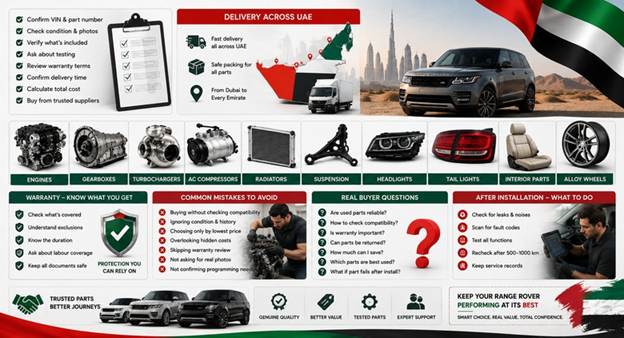
How to Choose a Used Range Rover Parts Supplier in UAE
The supplier matters almost as much as the part.
That sounds obvious, but when a Range Rover is sitting in a workshop and the repair bill is already climbing, buyers tend to move quickly. One seller answers the phone. Another promises delivery today. Someone else sends a photograph and says, “Last piece available.”
Suddenly, the cheapest quotation starts looking irresistible.
Don't rush.
A decent used-parts supplier should be able to tell you what the component is, where it came from where that information is available, what condition it is in, how it was checked, what number identifies it and what warranty applies.
They don't need to know every answer instantly. They do need to make an effort to find them.
That's the difference.
If you ask for a used Range Rover gearbox and the reply is simply, “Yes, available, AED 4,500,” you've got a price.
You don't yet have enough information to make a purchase.
How to Compare Used Range Rover Parts Prices from Different Suppliers
Never compare used components by price alone.
Instead, put the quotations side by side.
| Supplier | Condition | Part identification | Testing | Warranty | Delivery |
| Supplier A | Used genuine | Confirmed | Documented | 6 months | UAE stock |
| Supplier B | Used genuine | To be confirmed | Limited information | 3 months | Available to order |
| Supplier C | Reconditioned | Confirmed | Rebuilding/testing stated | 12 months | UAE stock |
This is an illustrative comparison, not a live UAE supplier quotation.
Look at the difference.
Supplier B might initially appear cheaper, but if the part number hasn't been properly confirmed and testing information is vague, the lower price carries more uncertainty.
Supplier C costs more, yet the longer warranty and reconditioning may make the extra money worthwhile.
Supplier A could be the middle ground.
That's why the right question isn't:
“Who is cheapest?”
It's:
“Which quotation gives me the strongest combination of correct fitment, condition, evidence, warranty and final cost?”
That takes a little longer.
It's worth it.
PartFinder UAE and Comparing Used Range Rover Parts Options
PartFinder UAE can be useful when you're trying to compare available used Range Rover components rather than contacting one supplier and accepting the first quotation.
But comparison works properly only when the enquiries are equivalent.
Give suppliers the same:
VIN + model year + engine + part number + component description.
Then compare what comes back.
One supplier may offer a used genuine component.
Another may have a reconditioned unit.
A third might quote an aftermarket replacement.
If you don't distinguish those categories, the price table becomes almost meaningless.
A used genuine gearbox at AED 5,000 isn't directly comparable with a reconditioned gearbox at AED 6,500 simply because both are described as “Range Rover gearbox”.
The condition is different.
The warranty may be different.
The expected remaining service life may be different.
And the installation risk may be different.
How to Tell If a Used Range Rover Parts Seller Is Reliable
There isn't a magic certificate that makes every seller trustworthy.
Look at the details instead.
Does the supplier ask for the VIN?
Do they provide the part number?
Can they show the actual component?
Do they explain whether it is used, reconditioned or new?
Can they tell you where it came from, when that information is available?
Do they explain what testing has been performed?
Do they put warranty conditions in writing?
Can they tell you when the part can actually be delivered?
A seller who answers these questions clearly is giving you something valuable: traceability.
A seller who repeatedly avoids them is giving you uncertainty.
And uncertainty has a price.
You may not see it on the quotation, but it can appear later as a return, additional labour, delayed installation or another replacement.
Questions to Ask a Supplier Before Buying a Used Range Rover Part
For a small interior trim piece, you don't need an interrogation.
For an engine, gearbox or air-suspension assembly, you absolutely should ask more.
A useful message could be:
Please confirm the exact part number, vehicle application, condition, donor vehicle if known, mileage where available, testing performed, actual-stock photographs, warranty, physical stock location and final delivered price.
Then add one more question where relevant:
“Does this component require programming, coding or calibration?”
That's especially important for electronic modules, lighting systems and some vehicle control components.
If the supplier can answer everything clearly, you've got a proper basis for comparison.
If the response is vague, don't fill in the missing information yourself.
Ask again.
Or move on.
Does “Genuine Used” Mean the Part Is Good?
No.
It means the component is being represented as an original manufacturer component.
That's useful, but it doesn't tell you how much life remains in it.
A genuine used gearbox can be worn.
A genuine used compressor can be tired.
A genuine used headlight can have damaged electronics.
A genuine used engine can have an unknown history.
The word genuine tells you about origin.
It doesn't automatically tell you about condition.
That's why used-parts buyers need two separate checks:
Is it the right original component?
and
Is this particular used component worth buying?
Don't combine those questions.
How Important Is the Donor Vehicle?
For major used Range Rover components, donor information can be very useful.
If the supplier knows the vehicle the component came from, ask for whatever information can reasonably be provided.
For an engine:
Model + year + engine specification + mileage where known.
For a gearbox:
Vehicle + transmission identification + mileage where known.
For body parts:
Vehicle generation + specification where relevant.
For electronic modules:
Vehicle application + part number.
The donor history doesn't guarantee that the component is perfect.
But it gives you another piece of evidence.
If the seller has no donor information, that's not automatically a reason to walk away.
It simply means you have less history and should place greater emphasis on testing, inspection and warranty.
What Does “Tested” Mean for a Used Range Rover Part?
This word gets used far too casually.
A supplier may say:
“Tested and working.”
Good.
Now ask what that means.
For a gearbox, was it tested in a vehicle or inspected after removal?
For an engine, were compression readings taken?
For an AC compressor, was operation checked?
For an electronic module, was its function verified?
For an air-suspension compressor, was pressure performance checked?
The appropriate test depends on the component.
You don't need a laboratory report for a used door mirror.
You should expect considerably more information for a used engine.
The principle is simple:
The more expensive and installation-intensive the component, the stronger the evidence should be.
Should You Ask for Actual Photographs?
Yes.
Always for expensive used parts.
And make the request specific.
Don't simply say:
“Send pictures.”
Ask for:
Part-number label
Overall component
Mounting points
Connectors
Visible damage
Condition of critical surfaces
For an engine, request identification and overall photographs.
For a gearbox, show the casing, identification marking and connections.
For air-suspension components, show the actual assembly and rubber sections.
For headlights, show the lens, brackets and connectors.
For body panels, request close-ups of dents, scratches, cracks and mounting tabs.
A supplier who has the actual component should normally be able to show it.
How to Compare Used Range Rover Parts from Different Conditions
You might receive three quotations for what appears to be the same part.
One is used.
One is reconditioned.
One is aftermarket.
Don't turn that into a simple price contest.
Use a decision matrix.
| Factor | Used genuine | Reconditioned | Aftermarket |
| Original component | Usually | Depends on rebuild | Depends on manufacturer |
| Condition certainty | Varies | Depends on rebuilding quality | New component, quality varies |
| Price | Often lower | Mid-range | Wide range |
| Warranty | Supplier-dependent | Often important | Manufacturer/supplier-dependent |
| Installation risk | Can be higher | Depends on quality | Depends on compatibility |
| Best use | Older vehicles, selected parts | Major repairable assemblies | Selected new replacement parts |
Again, these are categories, not guarantees.
A well-documented used genuine part can beat a poor-quality aftermarket component.
A professionally reconditioned gearbox can be more attractive than a tired used gearbox.
A reputable aftermarket component can be better value than a very expensive genuine replacement.
The evidence decides.
What If a Supplier Says the Part Is “Like New”?
Ask what that means.
Seriously.
“Like new” can mean the component looks clean.
It can mean it has very low mileage.
It can mean it was refurbished.
It can also mean absolutely nothing technical.
Ask for something measurable instead.
What is the mileage?
What was tested?
What was replaced?
What is the warranty?
Is the photograph of the actual component?
Specific questions produce useful answers.
Descriptions don't.
How Much Should You Trust a Very Low Price?
Be curious, not suspicious.
A low price may have a perfectly reasonable explanation.
Perhaps the supplier bought a large batch.
Perhaps the vehicle was dismantled recently.
Perhaps the component has cosmetic damage.
Perhaps it's missing accessories.
Perhaps it's older stock.
Perhaps it simply isn't the same product as the more expensive quotations.
Ask.
If one used Range Rover gearbox is AED 4,000 and another is AED 6,000, find out why.
Maybe the cheaper unit is a bare transmission.
Maybe the more expensive one includes associated components and a stronger warranty.
Maybe the mileage is different.
Maybe the condition is different.
Or perhaps one supplier simply has a better deal.
You won't know until you ask.
Used Range Rover Parts Supplier Red Flags
Watch for a cluster of warning signs rather than one isolated issue.
No VIN requested.
No part number provided.
Generic photographs only.
No explanation of testing.
No clear warranty terms.
No actual stock confirmation.
Pressure to pay immediately.
Vague descriptions such as “original quality”.
Price changes after payment or delivery discussions.
No clear return process.
Any one of these might have an innocent explanation.
Several together?
Slow down.
For a AED 150 trim piece, the risk is limited.
For a AED 7,000 engine, it isn't.
What If the Supplier Has the Right Part but No Warranty?
That doesn't automatically make the component unusable.
But the price should reflect the additional risk.
A used headlight without warranty may be a manageable decision if the component is inexpensive and can be thoroughly inspected.
A used gearbox without meaningful warranty is a different proposition.
The installation cost alone can make the risk uncomfortable.
So ask yourself:
“If this component fails next month, can I afford to pay the labour again?”
If the answer is no, stronger warranty protection becomes much more valuable.
This is why the cheapest component isn't necessarily the cheapest decision.
Should You Buy a Used Range Rover Part Directly From a Dismantler?
It can work well.
Dismantlers may have access to a wide range of genuine used components, particularly body parts, engines, gearboxes, interior pieces and electrical components.
But the same checks apply.
Don't assume dismantler stock is automatically good because it came from a genuine vehicle.
Ask what is known about the donor.
Check the part number.
Inspect the actual component.
Ask about testing.
Understand the warranty.
For a body panel, condition can often be assessed from photographs.
For an engine or gearbox, you'll need considerably stronger evidence.
The source of the component matters.
Its actual condition matters more.
UAE Delivery and Workshop Timing
Supplier selection should also consider where the vehicle is being repaired.
If your Range Rover is at a workshop in Dubai and the part is in Sharjah, next-day delivery may be straightforward.
If the component needs to be sourced from elsewhere, the timeline changes.
Ask for the actual stock location.
Not simply:
“Available.”
Ask:
“Is this exact component physically in UAE stock today?”
Then ask when it can reach the workshop.
For an engine or gearbox, delivery isn't the end of the process.
The workshop still needs time to inspect, install, fill fluids, programme where necessary and test-drive the vehicle.
A realistic repair timeline is therefore:
Part availability → delivery → inspection → installation → programming/calibration where required → testing.
That sequence helps prevent unrealistic expectations.
The Supplier Should Make You Feel More Certain, Not More Confused
This is perhaps the easiest test.
After speaking with the supplier, do you understand:
What you're buying?
Why it fits?
What condition it's in?
What evidence supports that condition?
What warranty applies?
What you'll pay in total?
If yes, you're moving in the right direction.
If you've had ten messages and still don't know whether the gearbox is used, reconditioned, tested or even physically in the UAE, don't send the money simply because the price looks attractive.
Step back.
Get the details straight.
Then compare again.
A good used Range Rover supplier isn't merely someone with a pile of parts.
It's someone who can give you enough information to make a sensible decision about one particular part for one particular vehicle.
Used Range Rover Gearboxes in UAE
Used Range Rover Gearboxes for Sale in UAE
A used Range Rover gearbox can be one of the more sensible ways to bring a major transmission repair back under control.
It can also be one of the costliest mistakes if the wrong unit is ordered.
That's the awkward bit.
A gearbox may look almost identical to another transmission from the same Range Rover family, yet the identification, calibration, drivetrain or application can be different. And once you've paid for removal and installation, discovering that mismatch becomes a very expensive way to learn a simple lesson.
Identify first. Buy second.
Before comparing prices, give the supplier the VIN, model year, engine specification and original transmission information where available.
Then ask for the exact gearbox identification and part number.
If you're searching for a Make model gearbox for sale, don't stop at the first listing that says “Range Rover gearbox”. Narrow the search down to the precise vehicle and transmission.
For a used unit, also ask:
Where did it come from?
What mileage is known?
Was it tested?
What does the warranty cover?
Is it physically in UAE stock?
Those answers matter considerably more than a glossy photograph.
How to Identify the Correct Used Range Rover Gearbox
Start with the transmission fitted to your vehicle.
Your workshop should ideally confirm the fault and identify the transmission before you approach suppliers.
Then provide:
VIN + model year + engine + drivetrain + transmission identification + original part number where available.
If the supplier proposes a different part number, ask why.
It could be a legitimate superseded number.
It could be an equivalent replacement.
Or it could be the wrong transmission.
Don't guess.
And don't let the supplier guess either.
A gearbox is simply too labour-intensive to install twice because somebody relied on a model badge instead of checking the transmission properly.
Used Range Rover Gearbox Mileage: Does It Matter?
Yes, but mileage shouldn't be treated as a standalone health certificate.
A gearbox advertised with 70,000 km may sound far more attractive than one showing 120,000 km.
Fair enough.
But where did those figures come from?
Is the donor vehicle known?
Was the mileage recorded before dismantling?
Is there documentation?
Was the transmission removed from a running vehicle?
Has it been tested?
A higher-mileage gearbox with credible history and testing can sometimes be a safer purchase than a supposedly low-mileage unit with no supporting information.
Think about it this way:
Mileage tells you how much the component has travelled. It doesn't tell you everything about how it has been treated.
Heavy stop-start driving, towing, heat and neglected servicing can all affect transmission condition.
You may not be able to reconstruct the donor vehicle's entire life.
That's okay.
Just don't pay a premium for an unsupported mileage claim.
How to Check a Used Range Rover Gearbox Before Buying
Start with identification.
The transmission number should correspond with the supplier's description.
Then inspect the physical casing.
Look for cracks, severe impact damage, damaged connectors, missing components and signs of obvious leakage.
Ask whether the gearbox has been tested.
Then ask how.
Was it tested in the donor vehicle?
Was it inspected after removal?
Was it bench-tested?
Was the transmission opened or reconditioned?
The answer depends on the supplier and the type of gearbox, but you want something more useful than:
“Tested, perfect condition.”
If the supplier makes that claim, ask for the testing details.
For a major transmission purchase, a little questioning now can save a remarkable amount of trouble later.
Used vs Reconditioned Range Rover Gearbox
This is one of the most important comparisons in the article.
A used gearbox is generally being sold in its existing condition, subject to whatever inspection and warranty the supplier provides.
A reconditioned gearbox has undergone some form of rebuilding or refurbishment, but the exact work can vary considerably.
Don't assume every “reconditioned” gearbox has been rebuilt to the same standard.
Ask:
What was replaced?
Were internal wear components inspected?
Were seals renewed?
Was the valve body checked where relevant?
Was the unit tested after rebuilding?
What warranty is provided?
A reconditioned gearbox costing more isn't automatically better.
But if the additional money buys documented rebuilding, testing and stronger warranty protection, the difference may be entirely reasonable.
| Option | Potential benefit | Main concern |
| Used genuine | Lower upfront cost | Remaining service life |
| Low-mileage used | Potentially attractive | Mileage needs evidence |
| Reconditioned | Reduced uncertainty if properly rebuilt | Quality of rebuilding |
| New genuine | Highest specification confidence | Much higher purchase cost |
The correct choice depends on the vehicle, repair budget and installation risk.
Used Range Rover Gearbox Warranty
Warranty becomes particularly important when fitting a used transmission.
Why?
Because the gearbox itself may not be the most expensive part of the repair.
The labour can hurt.
Removal and installation take time. Fluids may need replacing. Programming or adaptation may be required on some vehicles. Supporting components may also be involved.
So ask the supplier:
Does the warranty cover the gearbox only?
Does it cover labour?
Who pays removal if the gearbox fails?
Who pays refitting?
Are fluids excluded?
Are installation conditions attached to the warranty?
Get the answers before payment.
A six-month component warranty sounds reassuring until you discover that a failure in month two leaves you paying the workshop again.
That doesn't make the warranty useless.
It simply means you need to understand its real financial value.
Why a Cheap Used Range Rover Gearbox Can Become Expensive
Imagine two quotations.
Gearbox A — AED 4,500
Gearbox B — AED 5,500
At first glance, A wins.
Now add the details.
Gearbox A has no clear mileage, limited testing information and a short component-only warranty.
Gearbox B has documented donor information, clearer testing, better warranty protection and all the required associated components.
Suddenly the AED 1,000 difference isn't looking quite so dramatic.
And if A fails after installation, the original saving can disappear in one workshop visit.
This is why total project cost matters.
Calculate:
Gearbox + delivery + removal + installation + fluid/filter requirements + programming/adaptation + supporting parts + possible repeat labour.
That's the real number.
Range Rover Gearbox Fluid and Supporting Parts
Don't treat the transmission as an isolated box.
During replacement, the workshop should inspect the associated system and identify anything that needs attention.
Depending on the vehicle and transmission, that can include filters, seals, cooler lines, mounts, fluid and other related components.
The exact requirements vary, so don't create a universal shopping list.
Instead, ask the technician:
“What should we replace while the gearbox is already out?”
Some parts may be inexpensive compared with the labour required to access them later.
But don't let that become an excuse for replacing everything.
Replace what inspection and vehicle requirements justify.
That's the sensible middle ground.
Can a Used Range Rover Gearbox Be Installed Straight Away?
Sometimes.
But don't assume it.
The workshop should compare the replacement unit against the original before installation.
Check:
Transmission identification
Part number
Mounting points
Connectors
Associated components
Vehicle application
If the gearbox involves electronic controls, ask whether programming, coding or adaptation is required after installation.
The transmission may physically fit while still needing additional configuration.
That's another reason to discuss the complete job with the workshop before buying.
Used Range Rover Gearbox Installation in UAE
If the vehicle is already in a workshop, delivery timing becomes part of the buying decision.
A gearbox that is physically available in the UAE can be more useful than one that is cheaper but requires additional sourcing time.
Ask the supplier:
“Is this exact gearbox physically in UAE stock?”
Then:
“When can it reach my workshop?”
And finally:
“What happens if my workshop finds a compatibility issue before installation?”
That last question is important.
A clear return or exchange procedure gives you more protection than a vague promise that the supplier will “sort it out”.
For an expensive transmission, get the agreement in writing.
Should You Buy a Used Range Rover Gearbox Without Testing Evidence?
I'd be cautious.
The amount of risk depends on the price and installation cost, but a gearbox is one of those components where testing information is valuable.
A used gearbox with no testing evidence isn't necessarily defective.
It simply carries more uncertainty.
If the supplier is offering a very low price, you might decide the risk is acceptable — particularly if the component has a strong warranty and your workshop can inspect it.
But don't pretend the risk isn't there.
Price is often a reflection of uncertainty.
Sometimes you're paying more for a better gearbox.
Sometimes you're paying more for better evidence.
And sometimes you're simply paying more because one supplier has a higher margin.
Your job is to find out which one it is.
Used Range Rover Gearbox Buyer Checklist
Before paying for a used transmission, confirm:
Exact Range Rover model and year
VIN
Engine specification
Transmission identification
Part number
Donor vehicle where known
Mileage where known
Testing information
Physical condition
Included components
Warranty
Return/exchange terms
Delivery time
Installation requirements
Programming or adaptation requirements
Complete installed cost
It looks like a lot.
For a gearbox, it isn't.
The questions take minutes.
A second gearbox installation can take much longer.
When Is a Used Range Rover Gearbox the Sensible Choice?
A used gearbox can make particular sense when:
The vehicle is older.
A suitable genuine unit is readily available.
The replacement has credible identification and condition information.
The price is substantially below a new replacement.
The warranty is meaningful.
The workshop has confirmed compatibility.
And the complete repair remains sensible relative to the vehicle's value.
If those pieces line up, there is no reason to dismiss a used transmission simply because it has already been installed in another vehicle.
After all, used doesn't mean unusable.
It means you need to know what you're buying.
And with a Range Rover gearbox, that means looking beyond the casing, beyond the photograph and certainly beyond the cheapest number on the screen.
Used Range Rover Air Suspension Parts in UAE
Air suspension is one of those Range Rover systems that can leave an owner staring at the dashboard and wondering what on earth has happened.
The vehicle sits lower than usual.
One corner drops after parking.
The compressor seems to run for ages.
Then a warning appears.
And suddenly the search begins: used Range Rover air suspension parts in UAE.
That's where you need to resist the temptation to order the first compressor you find.
A suspension warning doesn't automatically mean the compressor has failed. It could be an air spring, leak, valve block, height sensor, air line, wiring problem or another part of the system. Sometimes the compressor is simply working too hard because another component has already developed a fault.
So diagnose first.
Then buy.
For an older Range Rover, a good used genuine component can sometimes save a substantial amount compared with buying everything new. But the saving only makes sense when the replacement part is correctly identified, reasonably inspected and backed by sensible warranty protection.
Used Range Rover Air Suspension Compressor: What to Check
The compressor is probably the component most buyers search for when the suspension starts behaving badly.
Don't assume it's the culprit.
If the workshop has confirmed compressor failure, then the buying process becomes much clearer.
Ask the supplier for the exact part number, then provide the VIN so the application can be checked.
For a used compressor, ask:
Is this the actual unit in stock?
What vehicle did it come from?
What mileage is known?
Has it been tested?
What was tested?
Does the warranty cover the compressor itself only, or labour as well?
And ask for photographs.
A clean photograph of the housing isn't enough to establish mechanical condition, but it can help you confirm the identification, connectors, mounting arrangement and visible condition.
If the supplier says the compressor is “fully tested”, ask what that actually involved.
The phrase sounds reassuring.
The detail behind it is what matters.
How to Know If a Used Range Rover Air Compressor Is Good
There isn't a visual test that can certify a compressor as healthy.
A photograph can show damage.
It cannot prove pressure performance.
That's why testing information matters.
Depending on the compressor and the workshop's equipment, the assessment may involve checking operation, pressure performance, electrical function and general condition.
The precise procedure varies.
Don't demand one universal test from every supplier.
Instead, ask:
“What checks have been carried out on this exact compressor?”
If the answer is clear and specific, useful.
If the response is:
“Don't worry, sir. Perfect.”
You've learned very little.
And for a component that may require substantial labour to install, that's not enough evidence.
Used Range Rover Air Struts and Air Springs
Air struts and air springs deserve the same attention.
A used genuine assembly may be considerably cheaper than a new replacement, especially on an older Range Rover. But rubber components age, and their previous operating conditions aren't always obvious from a photograph.
Inspect the actual component.
Look for:
Cracks
Visible deterioration
Damage around mounting areas
Corrosion
Signs of leakage
Damaged connectors or fittings
The workshop should also inspect the remaining suspension components.
Why?
Because if one air spring has failed after years of service, the others aren't necessarily new either.
That doesn't mean replacing all four automatically.
It means checking the complete system before deciding what to spend.
If the other components are healthy, replace only what is actually required.
Used Range Rover Valve Blocks and Suspension Sensors
Not every air-suspension fault is a compressor or air spring problem.
Valve blocks and height sensors can also cause trouble.
A faulty height sensor, for example, can produce suspension warnings and abnormal vehicle height. Replacing the compressor won't fix a sensor problem.
That's why the diagnostic stage matters so much.
If the workshop identifies a valve block or sensor as the failed component, confirm the exact part number before ordering.
For used electronic or electro-mechanical components, ask whether the actual unit has been tested.
And if calibration is required after installation, establish that before buying.
The component might cost AED 500.
The complete repair may be considerably more.
How to Check a Used Range Rover Suspension Component
Think of the inspection in layers.
First: identity.
Is it the correct component?
Second: physical condition.
Does it have visible damage, corrosion, cracks or broken mounting points?
Third: functional evidence.
Has it been tested?
Fourth: history.
Is the donor vehicle known? Is mileage available?
Fifth: warranty.
What happens if it fails?
This method works surprisingly well.
You don't need to become a suspension engineer.
You simply need to stop treating a used component as an anonymous object with a price sticker.
A used air spring at AED 900 with photographs, correct identification and useful warranty information can be a far better purchase than an AED 650 component with no history and no return protection.
Used vs New Range Rover Air Suspension Parts
| Option | Main attraction | What needs checking |
| New genuine | Strong specification confidence | Purchase price |
| New aftermarket | Potentially lower cost | Manufacturer and quality |
| Used genuine | Often substantial saving | Age, condition and remaining life |
| Reconditioned | Can reduce uncertainty | What was rebuilt and tested |
There is no automatic winner.
For an older L322, used genuine suspension components can make financial sense.
For a newer, high-value Range Rover, new genuine or established aftermarket equipment may be easier to justify.
A reconditioned compressor can sit somewhere between the two, but only if the rebuilding work is properly explained.
And if a seller can't tell you what “reconditioned” means, don't pay extra merely because the word sounds better than “used”.
Used Range Rover Air Suspension Parts for L322
The L322 has a long history in the UAE, which means owners can encounter a wide range of replacement-part choices.
For an older vehicle, used genuine suspension components may be attractive because new replacement costs can become disproportionate to the vehicle's overall market value.
But age matters.
If you're buying a used compressor for an older L322, ask about its donor vehicle and condition.
If you're buying an air spring, inspect the rubber section carefully.
If you're buying a valve block, confirm the exact application.
And if you're replacing a major suspension component, ask the workshop to inspect the complete system while the vehicle is raised.
The objective isn't to spend more.
It's to avoid fixing one fault while leaving another one quietly waiting underneath the vehicle.
Used Range Rover Sport Air Suspension Parts
Range Rover Sport owners have a similar decision to make, although the correct component depends heavily on generation and specification.
Don't search only by:
“Range Rover Sport compressor.”
Add the model year.
Then confirm the VIN.
Then verify the part number.
For used Sport suspension components, photographs of the actual unit are particularly useful because they can reveal the identification label and physical condition.
If the supplier says a component fits several Sport generations, ask for the exact applications.
Broad compatibility claims should be narrowed down before payment.
A component that fits one Sport doesn't automatically belong on another simply because the body shape looks familiar.
Used Range Rover Vogue and Autobiography Air Suspension
The terms Vogue and Autobiography can make parts searches confusing because they describe specifications within particular Range Rover generations.
The underlying model, year and suspension system still matter.
So give the supplier the VIN.
If you're buying a compressor, strut, valve block or sensor, provide the original part number where possible.
For an Autobiography, don't assume a higher specification means every suspension component is unique.
Some equipment may be specification-specific.
Other components depend primarily on the underlying vehicle platform.
That's why a VIN-based check is more reliable than a badge-based search.
UAE Heat and Range Rover Air Suspension
The UAE climate deserves consideration here.
High temperatures don't mean that every suspension component will fail prematurely. But heat, long periods of vehicle use, heavy traffic and age can all become part of the ownership equation.
Rubber components deserve particular attention as a vehicle gets older.
So do compressors that have been operating repeatedly because of an underlying leak.
If your Range Rover takes longer to rise than it used to, or the compressor seems to be running more frequently, tell the workshop.
Don't wait until the vehicle is sitting on its bump stops.
A small air-system fault can become a larger repair when another component is forced to work harder for too long.
How Much Should You Pay for a Used Range Rover Air Suspension Part?
There isn't one honest UAE-wide price.
The exact cost depends on the model, generation, component, manufacturer, condition, supplier, stock availability and warranty.
A used compressor and a used air spring aren't comparable products.
Neither are a used valve block and a used complete strut.
When comparing quotations, record:
Part price + condition + part number + warranty + delivery + installation.
Then look at the complete repair.
For example, an AED 1,200 compressor with a clear warranty may make more sense than an AED 900 compressor without one if installation is expensive and the risk of repeat labour is significant.
The extra AED 300 isn't simply buying a part.
It may be buying better protection against another workshop visit.
Should You Replace One Air Suspension Component or More?
This depends on diagnosis.
If one height sensor has failed and the rest of the system is healthy, replacing everything would be wasteful.
If an air spring has developed a leak but the compressor and other components are functioning correctly, deal with the failed component.
However, if the workshop finds multiple ageing components, ask for a complete assessment and quotation.
That gives you a choice.
You might repair everything now.
You might replace the urgent failure and monitor the rest.
Or you might decide that a larger suspension overhaul makes financial sense because the vehicle is already dismantled.
There is no universal rule.
Fix what has failed, inspect what surrounds it, then decide what the evidence justifies.
Used Range Rover Air Suspension Warranty
Warranty terms are especially important with suspension parts because installation can involve significant labour.
Ask:
How long is the warranty?
What exactly is covered?
Does it cover leaks?
Does it cover mechanical failure?
Does it cover labour?
Are there installation requirements?
Does another system fault invalidate the warranty?
That last question is easy to miss.
Suppose a compressor warranty requires the vehicle's air system to be checked for leaks.
If a leak remains and the compressor fails again, the supplier may argue that the original installation conditions weren't met.
That's why the workshop should understand the warranty requirements before fitting the component.
When Is a Used Range Rover Air Suspension Part Worth Buying?
A used suspension component is worth considering when several things line up:
The diagnosis is confirmed.
The part number is correct.
The actual component can be identified.
Its condition is reasonably documented.
Testing has been carried out where appropriate.
The warranty is clear.
The total repair remains financially sensible.
Miss one of those and the risk increases.
Miss several and the cheap part may become a false economy.
For an older Range Rover, though, used suspension parts can be a very practical route.
You don't necessarily need to replace an ageing vehicle simply because one air-suspension component has failed.
Nor do you need to buy the most expensive new component available.
There is a middle ground.
Find the correct used part, verify it properly, fit it correctly and make sure the underlying suspension fault has actually been dealt with.
That is where the saving becomes real rather than merely attractive on the first quotation.
Used Range Rover Body Parts in UAE
Used Range Rover Body Parts in UAE
Used body parts are often where Range Rover ownership gets a little more interesting.
A damaged door, cracked bumper, scratched bonnet or broken mirror doesn't necessarily justify buying a brand-new genuine replacement. If the vehicle is older, a good used original panel can sometimes do the job for substantially less money.
But there is a difference between cheap bodywork and good-value bodywork.
A used bonnet with a few light scratches may be excellent value if you're already planning to repaint it.
A dented door with damaged mounting points isn't.
A used headlight with a clean lens can look fantastic in photographs while hiding a cracked bracket or faulty electronics.
So inspect the part, not the advertisement.
Ask for photographs of the actual item. Get the part number where applicable. Check the specification, colour, mounting points and condition, and then ask the body shop what preparation will be required.
Only then does the price become meaningful.
Used Range Rover Bumpers, Bonnet and Doors
Body panels are usually easier to assess than engines or gearboxes because much of their condition is visible.
Still, look beyond the obvious.
For a used Range Rover bumper, check:
Cracks + mounting tabs + parking-sensor holes + camera openings + previous repairs + paint condition.
For a bonnet, inspect:
Edges + hinges/mounting areas + dents + previous repair work + underside condition.
For a door, look at:
Hinges + mounting points + inner frame + window mechanism areas + wiring connectors + external skin.
A photograph from the front doesn't tell you much about the back.
Ask for both.
And if the supplier says the bumper is “complete”, ask what complete actually means.
Are the grilles included?
Are parking sensors included?
Are brackets present?
Is the wiring there?
Those small omissions can add up.
Used Range Rover Headlights and Tail Lights
Lighting assemblies deserve more care than ordinary body panels because they're not merely cosmetic.
A Range Rover headlight may contain sophisticated electronic equipment, depending on the model and specification.
So don't buy one simply because the lens looks clean.
Ask for the part number and identification label.
Then inspect:
Lens
Housing
Mounting brackets
Connectors
Electronic components
Signs of water ingress
Cracks or previous repairs
A used headlight with a damaged mounting tab can become a nuisance during installation.
Worse, a component that physically fits may still need programming, coding or calibration.
That's why the workshop should confirm the complete requirement before you pay.
Used Range Rover Headlights: Genuine vs Aftermarket
For an older Range Rover, a good used genuine headlight can be an attractive option.
The original assembly may fit correctly, match the vehicle's design and retain the appropriate equipment.
A new aftermarket headlight can also make sense if it comes from a reputable manufacturer and is properly matched.
The decision comes down to more than the word genuine.
Compare:
Condition + manufacturer + part number + electronic compatibility + warranty + finished installation cost.
A used genuine headlight at AED 1,500 isn't automatically better than a reputable new alternative at AED 2,000.
But if the used original is in excellent condition, carries useful warranty protection and requires no additional complications, the saving could be substantial.
Used Range Rover Mirrors and Exterior Trim
Mirrors are another area where used genuine components can offer good value.
But modern Range Rover mirrors may contain far more than a piece of glass and a painted shell.
Depending on the vehicle, a mirror assembly may include:
Electric adjustment + folding mechanism + indicators + heating + cameras + sensors + memory-related equipment.
So tell the supplier exactly what your original mirror contains.
Don't order a basic mirror because the housing looks identical.
Ask for photographs of the connectors and the complete assembly.
If your original mirror has a camera or additional equipment, make sure the replacement includes the required hardware.
Otherwise, that cheap quotation can turn into another parts search.
How to Inspect Used Range Rover Body Panels Before Buying
Here's the practical bit.
Don't inspect a used panel only from the angle that makes it look best.
Ask for photographs from several directions.
For a bonnet:
Front + rear + underside + corners.
For a door:
Outer skin + inner frame + hinges + lower edge.
For a bumper:
Front + rear + lower section + mounting points.
For a wing or fender:
Outer surface + edges + mounting areas.
Look for differences in texture.
A repaired panel may have slightly different reflections.
Fresh paint can hide previous damage.
Filler can hide a dent.
A broken mounting tab can be almost invisible from the front.
If you're uncertain, send the photographs to the body shop.
The technician may notice something that isn't obvious to you.
Used Range Rover Body Panels: Does Colour Matter?
Very much.
A panel can be the correct shape and still be the wrong colour.
Even when the supplier says, “same colour,” the finish may not match perfectly because of age, fading, previous paintwork and differences in paint batches.
That doesn't necessarily make the panel unusable.
It simply means the body shop may need to repaint or blend it.
This is why the cheapest used panel isn't necessarily the cheapest completed repair.
Calculate:
Panel + delivery + preparation + paint + blending + fitting.
If the panel is already in good condition and the colour is close enough for your repair strategy, excellent.
If it needs extensive preparation, the apparent saving becomes smaller.
Used Range Rover Doors: What Is Included?
This question can save an awkward surprise.
A supplier may advertise a “complete door”.
But does that mean the bare door shell?
Or does it include:
Glass?
Window regulator?
Lock mechanism?
Wiring?
Speaker?
Trim panel?
Mirror?
Door handle?
There is no universal definition of “complete”.
Ask for a photograph of the actual door and request a written list of what is included.
If your workshop needs only the outer shell, you may not care about the missing interior components.
If you need a fully assembled replacement, those missing pieces suddenly matter.
Used Range Rover Bumpers: Sensors, Cameras and Grilles
Modern Range Rover bumpers can carry plenty of equipment.
Parking sensors.
Cameras.
Radar-related equipment on some configurations.
Grilles.
Trim pieces.
Wiring.
Brackets.
That means a used bumper can be structurally correct but incomplete.
Before buying, compare the old bumper with the replacement photograph.
Count the openings.
Check the mounting points.
Check the sensor locations.
Ask whether the grille and other trim pieces are included.
If the vehicle has camera or sensor equipment, ask the workshop whether calibration will be required after the repair.
A bumper replacement can therefore become more than a simple bodywork job.
Plan for the whole thing.
Used Range Rover Body Parts for Older L322 Models
The L322 remains a particularly interesting case for used body parts because many owners are trying to keep an older luxury vehicle presentable without spending new-car money on every panel.
A genuine used bonnet, door, mirror or bumper can make sense.
But condition varies dramatically.
An older panel may have been repaired more than once.
It may have been exposed to the UAE sun for years.
Plastic components can become brittle.
Paint can fade.
Mounting clips can break.
So inspect carefully.
For an L322, a used genuine panel in decent condition can be a smart purchase, especially when the new replacement cost is disproportionate to the vehicle's current value.
But don't buy purely because the panel is genuine.
Age and condition still win the argument.
Used Range Rover Sport Body Parts
Range Rover Sport body parts can also be found through used-parts channels, particularly for common exterior components.
The same checks apply.
Confirm the generation.
Confirm the specification.
Ask for the actual photographs.
Check the mounting points.
For bumpers, confirm sensor and grille arrangements.
For headlights, confirm electronic equipment and part number.
For doors and wings, inspect previous repairs.
If the panel needs repainting, get the body shop's estimate before deciding.
An AED 700 used bumper may look brilliant.
Then the body shop says it needs AED 1,500 of preparation and paint.
Now the calculation has changed.
Used Range Rover Evoque and Velar Body Parts
Evoque and Velar body parts should be matched particularly carefully by generation.
A component that looks similar may belong to another model year or specification.
This is especially important for:
Headlights + bumpers + grilles + mirrors + tail lights + trim pieces.
For used parts, ask the supplier to confirm the exact application.
For headlights and electronically equipped components, provide the VIN and original part number.
For bumpers, check sensor and camera openings.
For interior or exterior trim, confirm the colour and finish.
The more specific the part, the less useful a generic “fits Evoque” or “fits Velar” description becomes.
Used Range Rover Body Parts vs New Aftermarket
This comparison can be surprisingly close.
| Option | Potential advantage | What to watch |
| Used genuine | Original fit and potentially lower cost | Damage, age and paint |
| New genuine | Strong specification confidence | Higher price |
| New aftermarket | Lower purchase cost | Fit, finish and manufacturer |
| Repaired original | Keeps the original component | Quality of repair |
There isn't one answer.
A used genuine door may be ideal.
A reputable aftermarket bumper may be perfectly reasonable.
Repairing the original panel might be cheaper if the damage is minor.
A badly damaged used panel with hidden repairs may be the worst option despite looking cheap.
This is why the body shop should be involved before you place the order when the damage is significant.
How to Avoid Buying a Previously Damaged Used Range Rover Panel
Look closely at the reflections.
It sounds overly simple.
It isn't.
A repaired panel may show uneven reflections or subtle surface changes. Edges can be slightly different. Gaps around mounting areas can reveal previous work once the panel is fitted.
Ask whether the supplier knows if the panel has been repaired.
They may not.
That's fine.
Don't expect perfect history from every used body component.
Instead, inspect what you can see and price the risk accordingly.
For a heavily damaged or repainted panel, the saving needs to be large enough to justify additional preparation.
For an exceptionally clean panel, you may have found a very good purchase.
Delivery and Handling of Used Range Rover Body Parts
Large body panels need sensible transport.
A door can be scratched.
A bumper can crack.
A bonnet can be bent.
A headlight can suffer damage if it isn't packed properly.
Ask how the component will be transported.
If the part is valuable, photograph the packaging when it arrives.
Then inspect the component before the workshop begins fitting it.
If you discover transport damage after installation, proving what happened becomes considerably harder.
This is particularly important for expensive headlights and large painted panels.
Inspect first. Fit later.
When Are Used Range Rover Body Parts Worth Buying?
Usually when the part is:
Correctly identified.
Structurally sound.
Clearly photographed.
Free from serious hidden damage.
Appropriate for the vehicle specification.
Priced sensibly after paint and fitting costs.
Covered by a reasonable return or warranty arrangement where applicable.
For an older Range Rover, that can be an excellent way to control repair costs.
You don't need a brand-new bonnet because the old one has a dent.
You don't necessarily need a brand-new headlight because the original assembly is damaged.
You don't need to replace an entire interior simply because one trim piece has broken.
Sometimes the right used original part is sitting somewhere in the UAE already.
Find it.
Check it.
Price the finished repair.
Then make the call.
Used Range Rover Parts by Model
Used Range Rover Sport Spare Parts in UAE
Range Rover Sport is one of the models where used parts can make a particularly noticeable difference to ownership costs.
There are plenty of vehicles on UAE roads, different generations remain in circulation, and suppliers may have everything from engines and gearboxes to headlights, suspension components and interior trim.
But don't make the mistake of treating “Range Rover Sport” as one specification.
It isn't.
The generation, model year, engine, drivetrain and equipment all matter.
A used gearbox from one Sport may not be the right transmission for another. A headlight can look almost identical while carrying different electronic equipment. Suspension components can also vary.
So when you're contacting a supplier, give them the VIN.
Then give them the part number.
If you've got both, you're already several steps ahead of the buyer who simply types “used Range Rover Sport parts” into a search box and chooses the first photograph that looks familiar.
Popular Used Range Rover Sport Parts
Depending on generation and specification, buyers commonly look for:
Engines
Gearboxes
Air-suspension compressors
Air struts
Control arms
Headlights
Tail lights
Bumpers
Doors
Mirrors
Electronic modules
AC and cooling components
But don't interpret a list of common parts as a diagnosis.
If the Sport is overheating, for example, that doesn't automatically mean you need a radiator.
If the suspension warning appears, it doesn't automatically mean the compressor has failed.
If the gearbox is behaving badly, don't order a transmission before the workshop has established what is actually wrong.
The parts market can provide the component.
The diagnosis should decide which component you buy.
Used Range Rover Vogue and L322 Spare Parts
The L322 is a different proposition.
It's an older platform, and that changes the economics.
A new genuine component can sometimes feel disproportionate to the vehicle's current value, particularly when the Range Rover already needs attention in several areas.
That is where used genuine parts can become very useful.
A used L322 headlight, door, mirror, body panel, suspension component or gearbox may keep the repair financially realistic.
But age works both ways.
A used component has already lived a life.
A compressor has already been used.
A rubber suspension component has already aged.
An electronic module has already experienced years of heat cycles.
So ask about condition rather than assuming that “genuine” means “good”.
For an older L322, I would put particular emphasis on part identification, physical condition, testing where relevant and warranty.
You may be buying used.
You don't have to buy blindly.
Used Range Rover L405 Spare Parts
The L405 brings another set of considerations.
Its newer architecture means there can be more electronically controlled equipment and more specification-sensitive components.
Used L405 parts can still provide excellent value, especially for bodywork, suspension assemblies and selected mechanical components.
But electronic compatibility deserves attention.
Before buying a used module, headlight or other electronically integrated component, confirm the exact part number.
Then ask whether coding, programming or calibration is required.
If the supplier says:
“Same L405, fits.”
ask for confirmation against your VIN.
It takes a few extra minutes.
A compatibility mistake can cost considerably more.
Used L405 Engine and Gearbox Parts
For an L405 engine, establish the engine code and donor information where available.
For a gearbox, establish the transmission identification.
Then ask for testing evidence.
Don't let the fact that the supplier has an L405 engine sitting in stock become the reason you decide it must be the correct engine.
Stock availability is useful.
Correct specification is essential.
The order should follow the second, not the first.
Used Range Rover Evoque Spare Parts
The Evoque can be an attractive candidate for used parts because the vehicle's value, age and repair costs can create situations where a new genuine component isn't always the most economical choice.
Used genuine bodywork is an obvious example.
A replacement mirror, door, bonnet or headlight may cost considerably less when sourced used.
Mechanical parts require more scrutiny.
For a used engine, check the engine code and history where available.
For a gearbox, verify the transmission identification.
For suspension components, confirm the exact generation and specification.
For electronic modules, check programming requirements.
And remember that Evoque generations can differ significantly.
“Evoque” is not enough information.
Give the year.
Give the VIN.
Give the part number.
Then compare.
Used Range Rover Velar Spare Parts
Velar buyers need to be especially careful with electronically integrated components.
A used Velar headlight, control module, suspension component or other electronic assembly can sometimes be a sensible way to reduce repair costs.
But the component needs to be properly matched.
Ask for the exact part number.
Ask whether the component has been tested.
Ask whether it needs programming.
Ask whether calibration is required.
And ask whether the supplier has the actual unit in stock.
For body parts, photographs become particularly useful.
A used bumper can be a great purchase if the mounting points and sensor openings are intact.
A used headlight can be attractive if the lens, brackets, electronics and connectors are healthy.
But if the component arrives incomplete, the original saving can disappear.
Used Range Rover Autobiography Parts
Autobiography models can make used-part searches slightly more complicated because buyers sometimes assume every component is specific to the trim level.
That's not necessarily the case.
Some mechanical components depend on the underlying Range Rover generation and engine.
Other equipment may be specification-specific.
Interior trim is an obvious example.
So if you're searching for a used Autobiography seat, steering wheel, door trim or exterior detail, provide the exact vehicle specification and photographs of your existing component.
Colour and finish matter.
So does equipment.
A visually similar seat may not have the same electrical functions.
A trim panel may look identical while using a different finish.
A steering wheel may have different controls.
Don't buy purely from a photograph.
Used Range Rover Parts for Older Models: Is It Worth It?
This is where used parts can really change the economics of ownership.
An older Range Rover may still be mechanically sound and enjoyable, but some new genuine components can cost a substantial amount.
Used genuine parts can keep the vehicle on the road without turning every repair into a major financial event.
But there is a limit.
If the vehicle simultaneously needs:
Engine work + gearbox + air suspension + major electronics + body repairs
then replacing each failed component one at a time without considering the vehicle's overall value can become difficult to justify.
That's when you need a wider ownership calculation.
What is the vehicle worth?
What will the next 12 months of repairs likely cost?
How reliable is the rest of the vehicle?
Would a major used component restore the vehicle to a sensible condition?
Or are you simply delaying a larger decision?
Used parts can reduce repair costs.
They cannot make an economically unsuitable vehicle suddenly sensible.
Which Range Rover Models Are Better Candidates for Used Parts?
There isn't a fixed ranking.
The component matters more than the badge.
For an older L322, used bodywork and mechanical components can be particularly useful.
For a Range Rover Sport, there may be a broad used-parts market across several generations.
For an Evoque, bodywork and selected mechanical components can offer worthwhile savings.
For a Velar, exact electronic compatibility becomes more important.
For a newer Autobiography, the vehicle's value may justify spending more on certain critical components.
The better question is:
“Which parts on my particular Range Rover make financial sense to buy used?”
That's much more useful than asking whether the entire model is “good for used parts”.
Can Used Parts Be Shared Between Range Rover Models?
Sometimes components may share applications.
But never assume interchangeability from the vehicle family alone.
A part may appear across multiple Land Rover or Range Rover applications while carrying different specifications.
Check:
Part number
Vehicle generation
Engine
Transmission
Equipment level
VIN compatibility
If a supplier says a part from one Range Rover model will work on another, ask them to confirm the application.
If the numbers differ, ask why.
There may be a legitimate replacement number.
Or there may be no relationship at all.
This is particularly important for electronic components and major drivetrain parts.
Used Range Rover Parts and UAE Climate
The UAE environment belongs in the conversation.
A Range Rover used around Dubai in heavy traffic has a different operating pattern from one covering long-distance motorway journeys between Emirates.
Then there is summer.
High temperatures.
Long AC operation.
Traffic queues.
Repeated heat cycles.
Those conditions don't automatically condemn a used part, but they are relevant when thinking about the condition of rubber, cooling, AC, electrical and suspension components.
If a used compressor has already spent years working in a vehicle with an unresolved air leak, that's worth knowing.
If a cooling component comes from an unknown donor, inspect it carefully.
If an electronic module has been exposed to heat and moisture damage, the photographs may reveal something useful.
Again, don't invent a history.
Ask what is known.
Then price the uncertainty.
How to Choose Used Parts for a High-Value Range Rover
A newer or high-value Range Rover changes the calculation.
Saving AED 500 on a critical electronic module may not be worth taking a significant compatibility risk.
On the other hand, spending several thousand dirhams extra on a brand-new genuine body panel might be difficult to justify if an excellent used original is available.
Use a risk-based approach.
Low installation risk + easily inspected part = used can be attractive.
High installation cost + difficult-to-test component = stronger evidence and warranty become more important.
Complex electronic component = compatibility comes first.
Major engine or gearbox = testing, history and warranty become critical.
That gives you a much better framework than simply saying:
“Buy genuine.”
or:
“Always buy used.”
Neither rule survives real-world Range Rover ownership.
Range Rover Model-by-Model Used Parts Strategy
| Range Rover model | Used parts can be particularly useful for | Main caution |
| Range Rover Sport | Gearboxes, suspension, bodywork, lighting | Generation and drivetrain |
| L322/Vogue | Bodywork, suspension, mechanical components | Age and remaining life |
| L405 | Mechanical, body and selected electronic parts | Exact specification |
| Evoque | Bodywork, suspension and selected mechanical parts | Generation/engine |
| Velar | Bodywork and selected assemblies | Electronics and programming |
| Autobiography | Trim, body and selected mechanical components | Specification-specific equipment |
This is a buying framework, not a statement that every used component from these models is suitable.
The same vehicle can need completely different decisions depending on the part.
The Best Used-Part Choice Depends on the Repair
That's the thread running through this entire guide.
If you're replacing a bonnet on an older L322, a clean used genuine panel may be an easy decision.
If you're replacing an L405 electronic module, you need much stronger compatibility evidence.
If you're buying a Sport gearbox, testing and warranty deserve serious attention.
If you're replacing an Evoque mirror, the electrical specification matters.
If you're buying a Velar headlight, part number and electronic equipment matter.
And if you're dealing with an Autobiography interior component, colour, trim finish and equipment level can become just as important as physical fit.
So don't ask:
“Is used better?”
Ask:
“Is used sensible for this particular part, on this particular Range Rover, at this particular price?”
That's the question that keeps the buying decision grounded.
Because once you stop treating every Range Rover as one generic vehicle, the used-parts market becomes much easier to navigate — and, in the right circumstances, much easier on the wallet.
Used Range Rover Mechanical and Electrical Parts
Used Range Rover Engine Parts and Turbochargers
Not every engine problem calls for a complete replacement engine.
Sometimes the damaged component is much more specific.
A turbocharger fails. An injector becomes problematic. A starter motor gives up. A cooling component develops a leak. A sensor starts throwing misleading fault codes. Replacing the entire engine in those situations would be like replacing the whole kitchen because one tap has started leaking.
Start with diagnosis.
For used Range Rover engine components, confirm the engine code, part number and exact vehicle application before buying. This becomes especially important with turbochargers, injectors and electronically controlled components because similar-looking parts can have different specifications.
A used turbocharger should be checked for obvious physical damage, excessive shaft play where applicable, oil contamination and signs of previous repair. The workshop should also investigate why the original turbo failed.
That's the bit people sometimes skip.
If the underlying lubrication, intake, exhaust or oil-contamination problem remains, installing another turbocharger may simply reset the clock.
The same principle applies to injectors.
Don't buy four used injectors merely because one injector is showing a fault. Have the system properly diagnosed first, then decide whether one component, a matched set or another repair is actually required.
For older Range Rovers, a good used genuine engine component can be a sensible middle ground between an expensive new replacement and a questionable bargain.
Used Range Rover AC Compressors, Radiators and Cooling Parts
The UAE climate makes cooling and air-conditioning components especially important.
Summer traffic. Long journeys. Heavy AC use. High ambient temperatures.
The cooling system doesn't get much of a holiday.
If a Range Rover is overheating, don't immediately order a used radiator. The actual problem could involve a hose, thermostat, water pump, fan, coolant leak, sensor or another component.
Likewise, an AC problem doesn't automatically mean the compressor has failed.
Have the system checked first.
When buying a used AC compressor, confirm the exact part number and ask whether its operation has been tested. Inspect the pulley, housing, fittings and electrical connections, then ask the workshop whether the system needs flushing or additional work before installation.
For a used radiator, inspect the core, tanks, mounting points and signs of previous repair or corrosion.
And don't forget the supporting system.
A replacement cooling component cannot compensate for a separate fault elsewhere in the cooling circuit.
Used Range Rover Cooling Parts: A Simple Buying Rule
If the component is difficult to access, make the diagnosis especially carefully.
Why?
Because the labour can cost more than the component itself.
Replacing a cheap part twice isn't cheap anymore.
Used Range Rover Brakes, Suspension and Steering Parts
Used mechanical components need a slightly different approach from used bodywork.
For safety-critical parts, condition should take priority over price.
A used alloy wheel with no structural damage may be worth considering.
A used suspension arm can sometimes make financial sense if its condition is properly assessed.
A used steering component, however, deserves considerably more scrutiny.
Inspect for:
Cracks + deformation + corrosion + worn joints + damaged mounting points + signs of previous repair.
Brake components also need sensible judgement.
Some items, such as brake discs and pads, are generally better purchased new because they are wear components. A used brake caliper may be a different proposition if it has been properly inspected and is suitable for the vehicle.
The point isn't to make every part “used” simply because used parts are cheaper.
That's backwards.
Use used components where their condition and risk make sense.
For critical safety systems, the threshold should be higher.
Used Range Rover ECUs, Control Modules and Electrical Parts
Electronic components can be deceptively tricky.
The module may look perfect.
No cracks.
No corrosion.
Clean connector.
Great.
And it still might not work correctly in your Range Rover without programming or configuration.
That's why used ECUs and control modules should be matched using the exact part number and vehicle information.
Ask the supplier:
Has the module been tested?
Is it locked to another vehicle?
Does it require programming?
Does it require coding or calibration?
Can the workshop configure it after installation?
Those questions need answering before payment.
A used electronic module can save a considerable amount compared with a new replacement, particularly on an older vehicle.
But compatibility isn't optional.
A module that is physically correct but electronically incompatible is not a bargain.
It's a problem waiting on a parcel delivery.
Water Damage and Corrosion
Ask about the condition of electrical connectors and housings, especially where the component has come from an unknown donor.
Look for corrosion.
Look for moisture marks.
Look for damaged pins.
If the module has been stored poorly, that history matters.
Again, the photograph isn't proof of function.
Testing is.
Used Range Rover Interior Parts and Seats
Interior components are often among the easiest used parts to justify.
A damaged seat, steering wheel, dashboard trim, centre console or door panel doesn't necessarily need to be replaced with a brand-new component.
A good used genuine interior piece can restore the vehicle's appearance without an enormous bill.
But specification matters.
A powered seat can contain motors, heating, ventilation, memory functions and wiring.
A steering wheel can contain switches, paddles and other controls.
A door trim can carry speakers, ambient lighting and electrical equipment.
So don't buy based on colour alone.
Check:
Trim colour + material + model year + equipment + connectors + mounting points.
For leather seats, inspect the bolsters carefully. A photograph taken from ten feet away can make tired leather look surprisingly good.
Ask for close-ups.
Look at the driver's seat first.
It's usually where wear tells the story.
Used Range Rover Parts: Mechanical vs Electrical Buying Risk
The type of component should influence how cautious you are.
| Component | Main thing to verify |
| Engine part | Engine code and mechanical condition |
| Turbocharger | Physical condition and cause of original failure |
| AC compressor | Correct application and functional testing |
| Radiator | Leaks, damage and core condition |
| Suspension component | Structural condition and wear |
| Steering component | Safety and mechanical integrity |
| ECU/module | Part number and programming compatibility |
| Interior part | Specification, condition and equipment |
This is why one universal “buy used and save money” strategy doesn't work.
A used interior trim panel is one thing.
A used steering component is another.
An ECU is another again.
Think about failure consequences, not simply purchase price.
If the component fails, how much labour is involved? Could it create a safety issue? Does it need programming? Is it difficult to inspect before installation?
The more difficult those questions become, the stronger your evidence should be.
When Used Mechanical and Electrical Parts Make Sense
Used Range Rover mechanical and electrical parts can work extremely well when the component is correctly identified, reasonably inspected and priced against its actual risk.
For an older vehicle, that can be a very practical ownership strategy.
Don't replace an entire engine because of one repairable component.
Don't replace an entire cooling system because one part failed.
Don't buy an ECU simply because the casing looks identical.
And don't choose a used steering or suspension component purely because it is half the price of a new one.
Diagnose first. Match second. Inspect third. Buy fourth.
That order may sound slower.
In practice, it is often the quicker route back to a Range Rover that actually works.
Used Range Rover Parts Prices, Value, Delivery and Warranty
How Much Do Used Range Rover Spare Parts Cost in UAE?
There isn't a single useful answer to “How much are used Range Rover spare parts in UAE?”
The question is too broad.
A used door mirror and a used gearbox don't belong in the same price conversation. Neither do a tail light and a complete engine. Even two used gearboxes can be priced very differently depending on generation, mileage, testing, condition, donor history and warranty.
So when you're comparing prices, don't collect numbers without collecting the information behind them.
A useful quotation should tell you:
What part is it?
Which part number?
What condition?
Which vehicle does it fit?
What is known about its history?
What warranty applies?
What does delivery cost?
Then, and only then, does the price start to mean something.
A used genuine Range Rover component can be expensive because it's a sought-after original part. Another can be surprisingly cheap because it's older stock, cosmetically imperfect or simply more readily available.
That's the used market.
It moves around.
What Changes the Price of a Used Range Rover Part?
Several things can push the price up or down.
Vehicle generation matters.
Component type matters even more.
Mileage can matter, particularly for engines and gearboxes, although the evidence behind the mileage is important.
Condition matters.
Testing matters.
Availability matters.
Warranty matters.
And, oddly enough, the condition of the wider market matters too. If a particular Range Rover component is suddenly difficult to source, prices can move upwards because suppliers know buyers have fewer alternatives.
That doesn't mean you should accept the first quotation.
Get two or three comparable options.
But make sure they are actually comparable.
Used vs Genuine Range Rover Parts: Price and Value Comparison
“Used” and “genuine” aren't opposites.
A used part can itself be genuine original equipment. What you're really comparing is often:
New genuine vs used genuine vs reputable aftermarket vs reconditioned.
That's a much more useful distinction.
| Option | Typical financial position | Best question to ask |
| New genuine | Usually highest | Is the premium justified? |
| Used genuine | Often considerably lower | What condition is this actual part in? |
| Reconditioned | Middle-ground | What was rebuilt and tested? |
| Reputable aftermarket | Variable | Who manufactured it and what is the warranty? |
These are categories rather than fixed UAE prices.
Don't insert a made-up AED figure simply to make a comparison table look complete. If you use live prices in the finished article, record the actual quotation and date checked.
That keeps the content useful rather than creating a fake sense of precision.
When Is a Used Genuine Part Better Value?
Imagine an older L322 needs a headlight.
A new genuine assembly may cost substantially more than a used original.
If the used headlight has:
Correct part number + clean lens + intact brackets + working electronics + useful warranty
then the used component could be an excellent purchase.
Now change the example.
The used headlight has a cracked mounting bracket, unknown electronics and no return protection.
Suddenly the saving looks much less attractive.
Same model.
Same general component.
Completely different buying decision.
That's why condition-adjusted price is more useful than the sticker price.
Used Range Rover Parts Prices in Dubai, Abu Dhabi and Sharjah
UAE buyers often want to know which Emirate offers the lowest price.
There's no reliable permanent answer.
Supplier stock changes.
Availability changes.
Delivery costs change.
And a supplier with the exact component already in stock may beat a theoretically cheaper quotation simply because the part can reach your workshop immediately.
For Dubai buyers, compare the delivered price, especially when purchasing larger body components, engines or gearboxes.
For Abu Dhabi owners, ask whether the quoted component is physically nearby or needs to be moved from another Emirate.
For Sharjah buyers, particularly when comparing used dismantled components, inspect the actual condition and included parts rather than relying on the supplier's headline description.
And the same principle applies across Ajman, Ras Al Khaimah, Fujairah and Umm Al Quwain.
Location can affect logistics.
It doesn't automatically determine quality or price.
Dubai: Don't Confuse Availability With Value
A supplier saying “available today” has an advantage when your Range Rover is already in a workshop.
But speed shouldn't make you stop checking the part.
Ask for the part number.
Ask for photographs.
Ask about warranty.
Then ask when it can actually reach the workshop.
If the vehicle is sitting on a ramp and labour is already accumulating, a component that arrives tomorrow may be worth more than one that saves AED 200 but takes another four days to source.
That's not paying extra for convenience.
That's accounting for downtime.
Abu Dhabi and Sharjah: Compare the Delivered Cost
A used component can look cheaper until transportation is added.
So don't compare:
Part A — AED X
against
Part B — AED Y
Compare:
Part + delivery + installation implications + warranty.
For body panels, delivery can also introduce another risk.
A bumper that leaves the supplier in perfect condition isn't much use if it arrives cracked.
Ask how larger components are packed and transported.
Inspect them before fitting.
Used Range Rover Parts Delivery Across the UAE
Delivery becomes much more important when you're buying something large or when the vehicle is already immobilised.
Ask the supplier:
Is the exact component physically in UAE stock?
Where is it?
When can it be dispatched?
When should it reach my workshop?
Is delivery included in the quoted price?
Don't accept “available” as the end of the conversation.
Available where?
Available now?
Available to order?
Available through another supplier?
Those are completely different situations.
For a used engine or gearbox, physical stock can be especially valuable.
For a used bumper or bonnet, safe transport matters.
For a small sensor or module, delivery speed may be the deciding factor.
Same-Day Delivery: Is It Really Necessary?
Sometimes.
If the vehicle is already dismantled and the workshop is waiting for one small component, quick delivery can prevent a repair from stretching unnecessarily.
But same-day delivery doesn't mean same-day completion.
The workshop still needs to:
Receive → inspect → install → programme/calibrate where required → test.
For a gearbox or engine, the process can be much longer.
So don't promise yourself the vehicle back simply because the supplier says, “We'll deliver today.”
Get the workshop's timeline too.
What Warranty Should You Get With Used Range Rover Parts?
Warranty is where a cheap used part can suddenly become a very different financial proposition.
Ask about the duration, but don't stop there.
You need to understand the coverage.
Does the warranty cover the component only?
Does it cover labour?
What happens if the component fails after installation?
Who pays to remove it?
Who pays to install the replacement?
Are fluids excluded?
Are programming costs excluded?
Does the supplier require installation by a particular type of workshop?
Those details can completely change the value of the quotation.
A used gearbox with a six-month component-only warranty isn't equivalent to a used gearbox with a six-month warranty that also provides a clear replacement procedure.
Read the conditions.
Don't rely on the word “guaranteed”.
Used Range Rover Engine Warranty
Engine warranties deserve particular attention because installation is expensive.
Imagine you've bought a used engine and the supplier says it has a six-month warranty.
Before fitting it, ask what happens if it develops an internal mechanical problem.
Does the supplier replace the engine?
Do they contribute towards labour?
Is removal covered?
What about transport?
What happens if the replacement engine also fails?
These aren't awkward questions.
They're part of the purchase.
If the supplier won't explain the warranty before payment, don't assume the situation will become clearer after a failure.
It probably won't.
Engine Warranty Conditions
Some warranties can depend on installation requirements.
The supplier may require specific fluids, filters or supporting components to be replaced.
There may also be exclusions relating to overheating, incorrect installation or modifications.
That doesn't automatically make the warranty unreasonable.
It means you need to know the conditions.
Give the warranty terms to the workshop before fitting the engine.
Then both sides understand what is expected.
Used Range Rover Gearbox Warranty
Gearboxes create a similar problem, with one additional headache: repeat labour.
If the transmission fails after installation, you may need to pay for removal again.
That can turn a modest component failure into a serious financial inconvenience.
So ask the supplier:
What exactly is covered?
Is internal mechanical failure covered?
Are electrical components included?
Does the warranty require specific fluid or filter replacement?
Is labour covered?
What is the return procedure?
Get the answer in writing.
Then compare it against another supplier.
A gearbox that costs AED 500 more but offers much clearer protection may actually be the more economical choice.
Used Range Rover Air Suspension Warranty
Air-suspension components have their own complications.
A compressor might be replaced, but if an air leak remains somewhere else in the system, the new compressor can be forced to work excessively.
Some suppliers may therefore impose conditions around diagnosis or installation.
Ask about them.
For a used compressor:
Is the unit tested?
What exactly does the warranty cover?
Are leaks elsewhere in the system excluded?
Is labour covered?
For an air strut:
Does the warranty cover leakage?
Is the complete assembly covered?
Are mounting or installation issues excluded?
Again, the answer matters more than the word “warranty”.
Used Range Rover Body Parts and Return Risk
Body parts have a different problem.
A used bumper may be structurally fine but arrive with cosmetic damage.
A door may have a different colour.
A headlight may have a broken mounting point.
A mirror may lack an electronic component that wasn't visible in the original advertisement.
That's why photographs are your friend.
Before payment, ask for the actual part.
After delivery, inspect it before painting or installation.
If there's a problem, document it immediately.
Take photographs.
Keep the packaging.
Keep the quotation.
Keep the supplier's messages.
Then contact the seller.
Once the body shop has painted, drilled, modified or installed the component, resolving a dispute can become much harder.
Why the Cheapest Used Range Rover Part Isn't Always the Cheapest Repair
This deserves repeating because it catches experienced buyers too.
Suppose:
Used gearbox: AED 4,000
Sounds good.
Then:
Delivery: AED 200
Removal and installation: AED 2,500
Fluids and associated parts: AED 500
Programming/adaptation: AED 400
Now you're around AED 7,600 before dealing with any unexpected issue.
The gearbox wasn't a AED 4,000 repair.
It was a project.
That's how you should compare major used Range Rover parts.
For a body panel, the calculation might be:
Panel + transport + preparation + paint + fitting.
For an engine:
Engine + delivery + fluids + supporting parts + labour + diagnostics.
For suspension:
Component + fitting + system inspection + calibration where required.
The part is only the first line.
Cost of Delay When Buying Used Range Rover Parts
Price isn't the only financial consideration.
Imagine your Range Rover is your daily family vehicle.
It sits in a workshop for three extra days because a supplier has to source a supposedly “available” gearbox.
Now you're arranging taxis, another vehicle or alternative transport.
For a business owner or fleet operator, the consequences can be larger still.
So when comparing two suppliers, include:
Part price + delivery speed + workshop availability + warranty + probability of repeat work.
The slightly more expensive supplier may win.
Not because their part is automatically better, but because the complete ownership cost is lower.
That's the calculation worth making.
How to Record Used Range Rover Parts Prices Properly
If you're creating or updating a buyer's guide, don't present an undated price as though it will remain accurate forever.
Record:
Part
Condition
Supplier quotation
Price
Warranty
Availability
Date checked
For example:
Price checked: 17 August 2026
Then update it later when the market changes.
This is particularly important in automotive content because used-part prices move with stock, demand and vehicle age.
A number without a date can quickly become misleading.
A dated quotation is much more useful.
The Best Value Used Range Rover Part Is the One That Survives Installation
That's the real test.
A used component can look brilliant on a supplier's shelf.
What matters is what happens after it reaches your Range Rover.
Does it fit?
Does it function?
Does it require unexpected programming?
Does it create another fault?
Does the warranty protect you?
Does it last?
A part that costs AED 800 less but fails shortly after installation isn't good value.
A component that costs a little more, arrives correctly, works properly and comes with clear warranty protection can be the better purchase.
Cheap is a price. Value is an outcome.
That's the distinction UAE Range Rover owners should keep in mind when comparing used parts.
Part 10 — Used Range Rover Parts: Inspection, Warranty, Installation and Buyer Questions
Common Mistakes When Buying Used Range Rover Parts
Most used Range Rover parts mistakes don't happen because buyers are careless.
They happen because the purchase moves too quickly.
The vehicle is already in a workshop. The owner needs it back. A supplier says a gearbox is available. Someone finds an engine for a surprisingly attractive price. The photographs look alright.
Done.
Except it isn't.
The first common mistake is buying by model name rather than exact application. “Range Rover Sport” isn't enough for a gearbox, engine, electronic module or suspension assembly. Year, generation, engine, drivetrain and part number can all change the answer.
The second is accepting “tested” without asking what was tested.
The third is comparing only the part price while ignoring delivery, installation, fluids, programming and repeat labour.
Then there's mileage.
A low-mileage used engine sounds wonderful, but if nobody can explain where that mileage came from, it's simply a claim.
And finally, buyers sometimes forget the warranty until something fails.
Don't.
Ask about the warranty before payment, while everyone is still being helpful.
Used Range Rover Parts Inspection and Compatibility Checklist
Before paying for a major used component, run through the basics.
VIN: Has the supplier checked the exact vehicle?
Part number: Does the original number match, or has a legitimate supersession been explained?
Condition: Is the actual component being sold used, reconditioned or new?
Photographs: Are you looking at the real part?
Donor: Is the donor vehicle known?
Mileage: Is there credible mileage information where relevant?
Testing: What was actually tested?
Warranty: What does it cover?
Delivery: Is the exact component physically in UAE stock?
Installation: What labour will be involved?
Programming: Does the component need coding or calibration?
Return: What happens if the component is incompatible or defective?
That's the checklist.
It isn't complicated.
For a £50-equivalent trim component, you might not need every answer. For a Range Rover engine or gearbox costing thousands of dirhams, skipping these checks is difficult to justify.
What to Do If a Used Range Rover Part Fails After Installation
Don't immediately blame the supplier.
And don't immediately blame the workshop either.
First establish what has actually failed.
Was the replacement component defective?
Was it incorrectly installed?
Does it need programming?
Was the original diagnosis wrong?
Is another component causing the same symptom?
Take a gearbox replacement as an example.
The vehicle still has a transmission warning after the used gearbox has been installed.
That doesn't automatically prove the gearbox is faulty.
The workshop should diagnose the new fault and document what it finds.
For an electronic module, check whether programming was completed.
For air suspension, check whether there is another leak or system fault.
For an AC compressor, check whether the underlying refrigerant or contamination problem has been addressed.
Once the technical position is clear, contact the supplier with the evidence.
Keep:
Invoice + quotation + photographs + part number + warranty terms + workshop diagnosis + installation record.
Don't rely on a vague phone conversation from three weeks ago.
Paperwork helps.
What Happens If a Used Range Rover Part Is the Wrong One?
Stop before installation if you can.
This is important.
If the workshop discovers that the gearbox, engine, headlight, module or suspension component doesn't match the vehicle, don't modify the component just to make it work.
Contact the supplier.
Show the part number.
Show the original part.
Show the VIN.
Explain the mismatch.
If the supplier previously confirmed that exact component against the VIN, keep that communication.
This is why written confirmation is useful.
A message saying:
“Confirmed, this part number is correct for your VIN.”
can be much more valuable later than a vague verbal promise that it “should fit”.
And if the wrong component has already been installed, ask the workshop to document what was done before removal.
That creates a clear record.
Used Range Rover Parts: Installation Should Be Part of the Buying Decision
This is one of the easiest things to overlook.
A used component doesn't exist in isolation.
It has to become part of a functioning vehicle.
For a simple body trim piece, installation may be straightforward.
For an engine, gearbox or air-suspension assembly, the situation is completely different.
The workshop may need to:
Remove the old component
Transfer supporting parts
Install the replacement
Fill fluids
Carry out programming or calibration
Clear faults
Test the vehicle
Recheck for leaks or abnormal operation
That entire process costs money.
So before buying, ask the workshop for an approximate installation plan.
Then use that information when comparing suppliers.
If Supplier A saves AED 800 on the part but has a questionable warranty, while Supplier B costs AED 600 more and has a better-documented component, Supplier B may be the smarter choice once installation risk is considered.
Used Range Rover Parts and the First 1,000 km
After a major used component has been installed, don't simply collect the vehicle and forget about it.
The first period of driving is useful.
For an engine replacement, watch for:
Coolant loss + oil leaks + warning lights + unusual smoke + overheating + abnormal noises.
For a gearbox:
Harsh shifts + slipping + delayed engagement + warning messages + unusual noises.
For air suspension:
Vehicle height changes + compressor running time + overnight lowering + warning messages.
For cooling and AC components:
Temperature stability + coolant loss + cooling performance + unusual compressor behaviour.
Not every unusual sensation means the replacement component has failed.
But if something feels wrong, report it early.
Don't wait until the problem becomes severe.
For major work, a sensible workshop may also recheck fluid levels, fault codes and the installed component after an initial period of use.
How Long Should a Used Range Rover Part Last?
There is no honest universal lifespan.
It depends on the component, its previous use, condition, age, installation quality and how the vehicle is driven.
A used body panel can last indefinitely if it's structurally sound and properly protected.
A used electronic module may work for years — or fail unexpectedly.
A used gearbox may provide substantial service life, but its remaining life is impossible to guarantee purely from mileage.
An air-suspension compressor's future performance depends partly on the condition of the wider air system.
That's why a supplier shouldn't promise:
“This used gearbox will definitely last another 100,000 km.”
Nobody can know that with certainty from a photograph and a mileage figure.
A more honest answer is:
“Here is what we know about the component, here is what has been tested, and here is the warranty.”
That's much more useful.
Used Range Rover Spare Parts Buyer’s Checklist
Before you send payment, stop for a minute.
Ask yourself:
Have I confirmed the VIN?
Do I know the exact part number?
Is the supplier offering the actual component shown?
Do I know whether it is genuine, aftermarket or reconditioned?
Do I know its condition?
Is the mileage credible where relevant?
Has the component actually been tested?
Do I understand what “tested” means?
Do I know what is included?
Have I read the warranty conditions?
Do I know who pays if it fails?
Is the part physically available in the UAE?
Have I included delivery?
Have I asked the workshop about installation?
Could programming or calibration be required?
Have I calculated the complete repair cost?
And one final question:
If this part fails shortly after installation, will the money I saved still look like a saving?
If the answer is no, go back and reassess the quotation.
That little pause can save a lot.
The Smart Way to Buy Used Range Rover Parts in UAE
A used Range Rover part shouldn't be judged simply by whether it is cheap.
It should be judged by what you're getting, what you know about it, how confidently it fits, how much protection comes with it and what the finished repair will actually cost.
That's particularly important with engines, gearboxes and air suspension because installation can be expensive enough to wipe out a seemingly attractive saving.
For body parts, the calculation is slightly different. Condition, colour, mounting points and paint preparation become the big questions.
For electronics, compatibility comes first.
For older L322 and Sport models, used genuine components can sometimes keep ownership surprisingly affordable.
For newer L405, Evoque and Velar vehicles, the same used-parts strategy can work, but exact specification and electronic compatibility deserve more attention.
There is no single rule.
And that's actually good news.
You don't have to buy every part new. You don't have to buy everything used either.
Buy according to risk.
Use evidence where you can get it.
Ask awkward questions before the money changes hands.
Have the workshop verify major components.
And when two suppliers give you different prices, don't immediately choose the cheaper one.
Find out why.
Because the best used Range Rover part isn't the one that looks cheapest on a phone screen.
It's the one that arrives correctly, fits properly, works as expected, carries sensible protection and gets the vehicle back on the road without dragging another expensive problem behind it.
Real Buyer Questions About Used Range Rover Parts
Categories
- Audi
- BMW
- Car Accessories
- Car Tips
- Ford
- Land Rover
- Mazda
- Range Rover
- Top 10
- UAE Car Parts
- Used Car Parts
- Toyota
- Replacement Engines
- Nissan
- Hyundai
- Mitsubishi
- Volkswagen
- Honda
- Kia
- Chevrolet
- Dodge
- Jeep
- Subaru
- Renault
- Lexus
- Mercedes
- Suzuki
- Hummer
- Porsche
- Infiniti
- Peugeot
- GMC
- Mini
- Volvo
- Replacement Gearboxes
- MG
- Jaguar
- Skoda
- Cadillac
- Daihatsu
- Fiat
- German Car Parts
- Japanese Car Parts
- Aftermarket Car Parts
- Genuine Car Parts
- New Car Parts
- Reconditioned Car Parts
- European Car Parts
- American Car Parts
- Korean Car Parts
- British Car Parts
- Chinese Car Parts
- Sports/Exotic Car Parts
- Luxury Car Parts
- Performance Car Parts
- SUV/4x4 Spare Parts
- Truck Spare Parts
- EV Car Parts
- Hybrid Car Parts
- Auto Spare Parts in UAE
- Tesla
- Isuzu
- Ram
- Ferrari
- Bentley
- Lamborghini
- Genesis
- Maserati
- Lincoln
- Chrysler
- Opel
- Citroen
- SsangYong
- Seat
- McLaren
- Aston Martin
- Rolls Royce
- Maybach
- Alfa Romeo
- Bugatti
- Scion
- Abu Dhabi Car Parts
- Ajman Car Parts
- Al Khan Car Parts
- Al Sajaa Car Parts
- Deira Car Parts
- Dubai Car Parts
- Fujairah Car Parts
- Industrial Area 6 Car Parts
- Mussafah Car Parts
- Ras Al Khaimah Car Parts
- Sharjah Car Parts
- Umm Al Quwain Car Parts
- Acura
- BYD
- Chery
- Dacia
- DS
- Geely Emgrand
- EXEED
- GAC
- GAC Gonow
- Geely
- Gonow
- Great Wall
- Haima
- Haval
- Holden
- Iveco
- JAC
- Jaecoo
- Jetour
- Lotus
- Omoda
- Proton
- Renault Samsung
- Roewe
- Lucid
- Replacement Headlight
- Replacement Bumper