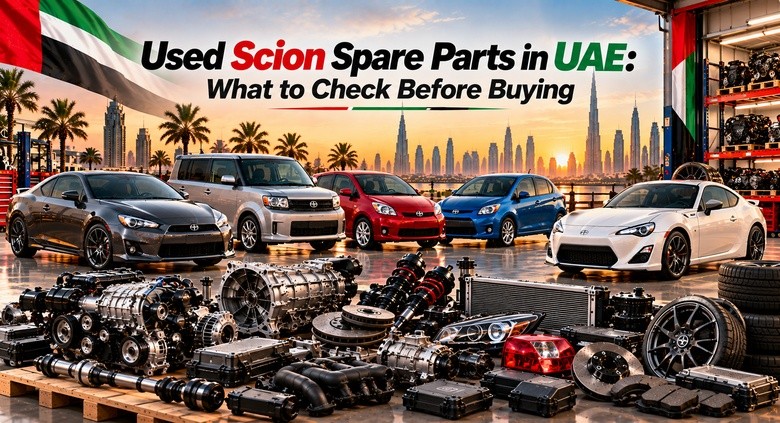
Used Scion Spare Parts in UAE: What to Check Before Buying
September 28, 2026
The used Scion spare parts in UAE can be a sensible purchase in the UAE. It can also become one of those repairs that looked cheap on the quotation and somehow becomes expensive by the time the car is back on the road.
The difference is rarely the word used.
It is the history behind the part.
Scion disappeared as a standalone brand years ago, but its cars did not disappear with it. Toyota's own records show more than 1 million Scion vehicles sold from 2003 to 2015, including substantial numbers of tC and xB models, while the FR-S continued into 2016 before becoming the Toyota 86 for the 2017 model year. The xA, xD, xB, tC, iA and FR-S therefore sit across several generations, drivetrains and production periods rather than representing one interchangeable parts family.
For a UAE owner buying a used engine component, gearbox assembly, suspension part, electronic module, body panel or even a seemingly ordinary wheel hub, that history matters.
A used part is not simply a cheaper new part.
It is a component with a past that you need to investigate.
Start With the Exact Scion, Not the Part
“Used Scion suspension part” is nowhere near enough information for a serious purchase.
Start with:
Model → model year → engine → transmission → drivetrain → trim → VIN → original part number.
The reason is obvious once the Scion range is laid out. The tC was a sports coupe, the xB a larger box-shaped hatchback, the xD replaced the xA, the iA was a small sedan and the FR-S was a rear-wheel-drive sports coupe. Toyota's historical model information also confirms that these vehicles left production at different times.
A supplier should not have to guess which one you own.
Used Does Not Mean One Thing
Two used Scion parts can carry completely different levels of risk.
One may come from a low-mileage donor with clear history, dry storage, intact connectors, an identifiable part number and a functional warranty.
Another may have been removed from an accident-damaged vehicle, stored outdoors, exposed to moisture and sold simply because “it was working when removed”.
Both are technically used.
They are not equivalent purchases.
That distinction should sit at the centre of the buying decision.
The Donor Vehicle Is Part of the Part
When buying a used component, investigate the donor wherever possible.
Ask for:
- donor model
- donor year
- engine
- transmission
- VIN or chassis information where available
- recorded mileage
- accident history
- flood or water exposure
- reason for dismantling
- location and storage conditions
- removal date
- testing performed
- warranty and return conditions
A photograph of the component tells you what it looks like.
The donor history tells you why it might look that way.
Why Scion's Discontinued Status Matters
Scion ended as a brand, with Toyota announcing that its models would transition back into the Toyota line-up. Beginning in August 2016, model-year 2017 vehicles were to be badged as Toyotas.
That creates an unusual used-parts situation.
Some components remain relatively straightforward to identify because of Toyota's wider parts ecosystem or platform relationships. Other Scion-specific trim, electronics, body pieces and older components can require more searching.
For the UAE buyer, that can make a tested used genuine component attractive.
But scarcity is not proof of quality.
Check the VIN Before Buying Expensive Parts
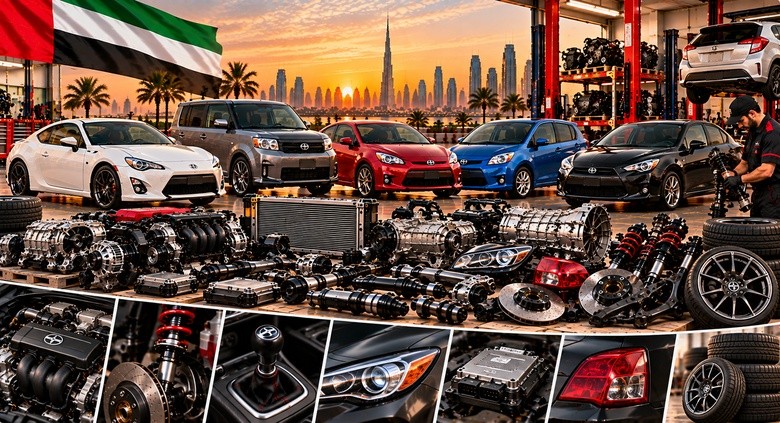
For a bumper bracket, a generic service component may be relatively straightforward.
For a control module, transmission component, engine assembly, safety component or generation-sensitive electronic part, VIN confirmation becomes far more important.
The VIN can help establish the actual vehicle application rather than relying on a seller's generic catalogue description.
If the seller refuses to consider the VIN and simply says, “It fits all Scions”, that should trigger another question:
Which exact Scions?
The Original Part Number Is Often Even More Useful
If the old component is still available, photograph its identification label before disposal.
Record:
- part number
- suffix
- revision
- manufacturer marking
- connector configuration
- casting number where relevant
- barcode or identification label
A used component can look identical to another component while carrying a different internal specification.
That is especially relevant for electronics, sensors, modules and drivetrain parts.
Scion tC Used Parts
The tC deserves separate treatment because it was Scion's biggest-selling model, with Toyota recording 418,235 sales through 2015. Production ended in August 2016.
The later tC used a 2.5-litre four-cylinder engine and six-speed manual or automatic transmission. Toyota's 2016 information lists 179 hp and 172 lb-ft, while the automatic received Dynamic Rev Management.
For used tC parts, pay particular attention to:
- engine accessories
- cooling components
- suspension assemblies
- steering components
- wheel hubs
- transmission hardware
- A/C components
- electronic modules
- body and interior trim
The model's age now makes donor history increasingly useful.
Used tC Suspension Parts
Do not buy a complete used suspension assembly merely because the car has a suspension noise.
The 2016 tC used MacPherson struts at the front and a double-wishbone rear arrangement.
If the fault is actually a bush, stabiliser component, ball joint, bearing or mount, replacing an entire used assembly may simply transfer another unknown into the car.
A workshop should identify the failed component first.
Then compare repair, new replacement and tested used options.
Scion xB Used Parts
The xB has a different mechanical identity.
Toyota's historical information shows the first-generation xB arriving in 2003, a second generation in 2008 and production ending in December 2015. The model accumulated 392,632 US sales through 2015.
That means “xB part” still isn't sufficiently precise.
Generation matters.
Body hardware, interior trim, suspension components, electrical parts and engine-related components should be matched to the actual vehicle rather than simply the badge.
Used xB Body Parts Need Physical Inspection
A used bumper, bonnet, tailgate, lamp, mirror or interior panel can look perfectly acceptable in a photograph.
Then it arrives with:
- broken mounting tabs
- repaired plastic
- hidden cracks
- distorted brackets
- missing clips
- incorrect colour
- previous paintwork
- water damage
For body parts, ask for photographs of the rear and mounting points, not just the visible surface.
The hidden side is often where the real story sits.
Scion xA Used Parts
The xA was sold from 2003 to 2008, making it one of the older Scion applications now likely to appear in the UAE used market.
Age therefore becomes a major variable.
A used alternator, starter, compressor, engine mount or suspension component may have spent years exposed to heat cycles before being removed.
Low asking price does not compensate for unknown remaining life.
For older xA components, condition evidence is often more valuable than a small difference in purchase price.
Scion xD Used Parts
The xD replaced the xA in August 2008 and was discontinued in 2014.
That makes the xD a particularly good example of why generation and transmission need to be recorded before ordering.
A manual-transmission component should not be treated as equivalent to an automatic-transmission component merely because both came from an xD.
For used drivetrain parts, confirm the transmission application before discussing price.
Scion iA Used Parts
The iA arrived near the end of the Scion era and was subsequently absorbed into Toyota's range under the Yaris iA name for 2017. Toyota's transition announcement explicitly identifies the Toyota Yaris iA as one of the Scion models receiving a new Toyota designation.
This matters enormously when searching for used parts.
A supplier's database may identify the same vehicle differently.
Searching only “Scion iA” can therefore miss relevant inventory, while searching only “Toyota Yaris iA” without confirming the exact application can introduce another fitment problem.
Use the VIN and part number to connect the two.
Scion FR-S Used Parts
The FR-S needs a more cautious approach because enthusiast ownership introduces another variable: modification.
The factory FR-S used a 2.0-litre horizontally opposed four-cylinder engine, D-4S injection, six-speed manual or six-speed automatic transmission, rear-wheel drive and a Torsen limited-slip differential. Toyota's published specifications also list MacPherson struts at the front, double wishbones at the rear and ventilated discs front and rear.
That is not the specification of an ordinary front-wheel-drive Scion.
A used FR-S component therefore needs proper application checking.
Check Whether the FR-S Has Been Modified
This deserves its own inspection.
Look for:
- aftermarket suspension
- coilovers
- altered exhaust
- intake modifications
- aftermarket brakes
- wheels with different specifications
- clutch changes
- differential modifications
- ECU tuning
- replacement engine components
A used part can be perfectly correct for a factory FR-S and still be wrong for the modified vehicle in front of you.
FR-S and Toyota 86 Cross-References Need Verification
Toyota announced that the former Scion FR-S would become the Toyota 86 for the 2017 model year, with changes including revised suspension and powertrain elements.
That makes Toyota 86 references useful when searching for parts.
It does not mean every FR-S and 86 component should be assumed interchangeable.
Use the model year, application, VIN and part number to establish the relationship.
Inspect Used Electronics Differently
Mechanical wear can sometimes be visible.
Electronic wear often cannot.
For used Scion:
- ECUs
- body control modules
- instrument clusters
- audio units
- cameras
- sensors
- steering electronics
- ABS-related modules
should be assessed for compatibility, connector condition and programming requirements.
A module that powers on is not necessarily a module that works correctly in another vehicle.
Look Closely at Connectors
Connectors deserve more attention than they normally receive.
Inspect for:
- bent terminals
- corrosion
- broken locking tabs
- water marks
- damaged wiring
- oil contamination
- heat damage
- previous repair work
A clean electronic housing does not guarantee clean terminals inside the connector.
Used Engines Require a Much Higher Evidence Standard
A used engine should never be bought on mileage alone.
Ask:
What was the donor vehicle? Why was it dismantled? Did the engine run before removal? What mileage was recorded? Was compression checked? Was oil pressure checked? Was coolant contamination assessed? What is included with the assembly?
“Complete engine” can mean very different things.
One seller may include intake, exhaust, injectors, sensors and accessories.
Another may provide only the long block.
Those are not comparable prices.
Do Not Assume a Low-Mileage Engine Is Healthy
Mileage is useful evidence.
It is not a health certificate.
A low-mileage donor can still have:
- overheating history
- poor storage
- oil contamination
- corrosion
- accident damage
- long periods without proper preservation
- internal mechanical problems
If the engine is expensive enough to justify shipping and installation, testing is worth more than a persuasive seller description.
Used Gearboxes Need More Than a Visual Check
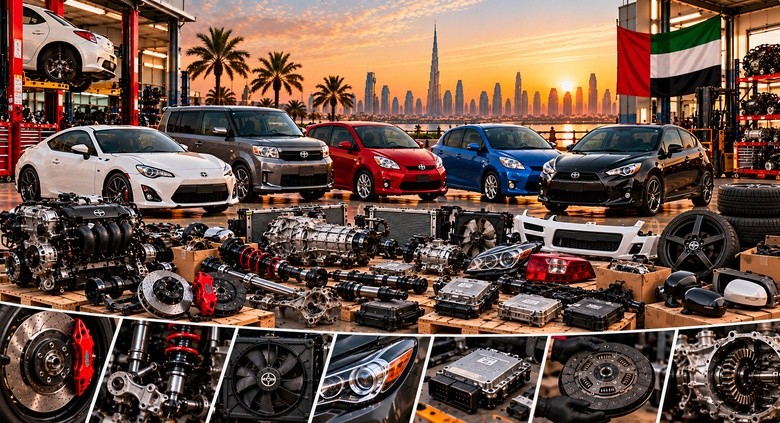
A gearbox housing can look excellent and still contain worn internal components.
Ask what has been tested.
Depending on the transmission, useful checks can include:
- fluid condition
- shaft play
- bearing noise
- engagement condition
- leakage
- external damage
- electronic actuator condition
- adaptation or programming requirements
- road-test evidence where available
For a manual gearbox, clutch-related components also need separate consideration.
For an automatic, the specification and control system matter even more.
Cooling Components Are Important in UAE Conditions
Heat changes the consequences of a marginal cooling system.
A used radiator, fan assembly, condenser, water pump or cooling module should therefore be inspected rather than judged by appearance.
Look for:
- bent fins
- corrosion
- damaged mounting points
- previous repairs
- leaks
- blocked passages
- damaged electrical connections
- fan-motor condition
A radiator that “looks clean” may still have reduced efficiency.
A/C Components Need Their Own Inspection
The UAE climate makes A/C performance particularly important, but an A/C problem does not automatically mean the compressor has failed.
For a used compressor or condenser, establish:
- why the donor component was removed
- whether the system was contaminated
- whether the compressor seized
- whether metal debris entered the refrigerant circuit
- whether the replacement part was stored correctly
- whether associated components also need cleaning or replacement
Installing a used compressor into a contaminated system can simply move the problem downstream.
Used Suspension Parts Can Hide Wear
Suspension components are exposed to impact, heat and repeated movement.
Inspect:
- bushings
- ball joints
- shock bodies
- seals
- springs
- mounting points
- corrosion
- bent arms
- damaged threads
For a used shock absorber, look for leakage and physical damage, but remember that a clean exterior does not prove proper damping performance.
Brakes Need Measurement Where Possible
A used brake component should not be accepted because it “looks good”.
For discs, inspect thickness and surface condition.
For callipers, inspect piston and seal condition.
For used ABS-related hardware, check sensors, wiring and mounting.
For FR-S applications, also confirm whether the car retains factory braking hardware or has been modified.
The component must match the vehicle and the actual configuration.
Body Parts Need a Different Buying Method
For a used bonnet, door, wing, bumper or tailgate, mechanical history may matter less than:
- mounting integrity
- accident repair
- distortion
- corrosion
- paint condition
- colour code
- sensor openings
- trim holes
- brackets
- clips
A cheap body panel that needs extensive correction and repainting may cost more than a better-condition panel.
Headlights and Tail Lamps Need More Than Glass Inspection
Look at:
- lens condition
- mounting tabs
- internal moisture
- ballast where applicable
- LED function
- wiring
- connector condition
- previous repair
- condensation
For electronic lighting assemblies, ask whether coding or configuration is required.
A visually clean lamp can still contain an electrical fault.
Flood Damage Is a Major Used-Part Warning
Water damage deserves special attention in used electrical components.
Look for:
- corrosion around connectors
- staining
- mud residue
- unusual oxidation
- moisture marks
- damaged insulation
- inconsistent corrosion between components
A seller may not know the donor's history.
That is precisely why inspection matters.
Accident Damage Can Affect More Than the Obvious Part
A donor vehicle involved in a front-end collision may still have usable interior components.
But a component mounted near the impact zone needs closer examination.
Look for:
- bent brackets
- distorted mounting points
- cracked housings
- stress marks
- broken tabs
- misalignment
- repaired castings
Do not treat “removed from a running car” as proof that every component escaped accident damage.
Ask Why the Donor Was Dismantled
This is one of the simplest questions and one of the most useful.
Was the donor:
- accident damaged?
- mechanically failed?
- flooded?
- imported for dismantling?
- scrapped because of age?
- dismantled for parts after an insurance loss?
The answer changes how the component should be inspected.
A rear suspension arm from a rear-end accident deserves different scrutiny from one removed from a vehicle being dismantled because of an unrelated engine failure.
Storage Conditions Matter
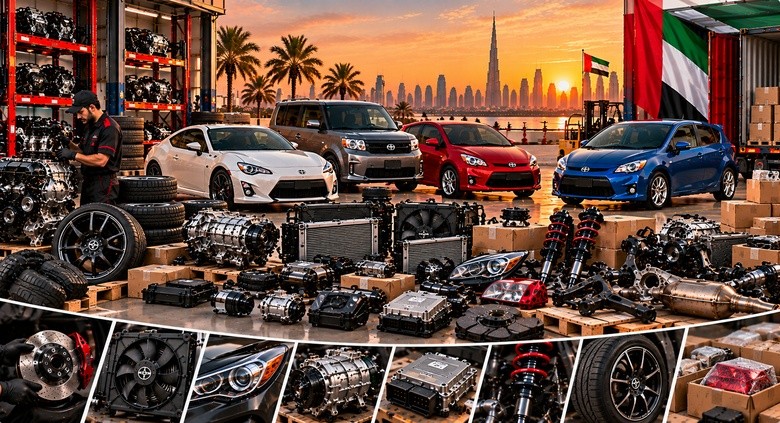
Used parts can spend months or years sitting in warehouses, yards or shipping containers.
For metal components, inspect corrosion.
For rubber components, consider age and deterioration.
For electronics, check moisture exposure.
For engines and transmissions, ask whether openings were sealed and whether preservation procedures were used.
Storage is part of component history.
Warranty Is More Valuable Than a Verbal Promise
A seller saying “tested, no problem” is not the same as a written functional warranty.
Ask:
- How long is the warranty?
- What exactly is covered?
- Does it cover labour?
- Is testing evidence available?
- What happens if the part is incompatible?
- Who pays return delivery?
- Are electrical parts excluded?
- Are special-order parts non-returnable?
The terms matter before the money changes hands.
Returns Matter Particularly for Imported Scions
If a component has travelled across the UAE or been specially sourced from another country, returning it may not be simple.
Before buying, establish the return process.
A part that cannot be returned because the buyer supplied the wrong specification is a very different risk from a part that can be exchanged after documented fitment verification.
Compare Total Installed Cost
Never compare a used part against a new part using purchase price alone.
Use:
Used part + delivery + diagnosis + labour + installation materials + programming/calibration + alignment/testing + possible return cost
versus
New part + delivery + labour + installation + warranty
The cheaper component can lose its advantage very quickly if it fails during installation or requires removal and replacement again.
A Practical Used-Part Decision Matrix
| Option | Best suited to | Main advantage | Main risk | What to verify |
| Used genuine | Older/discontinued components | Original specification | Unknown history | Donor, part number, condition |
| New genuine | Critical/high-value components | Strong fitment confidence | Higher cost/availability | VIN, price, warranty |
| Quality aftermarket | Routine wear items | Availability | Quality variation | Manufacturer/application |
| Reconditioned | Repairable assemblies | Potential saving | Rebuild quality varies | What was replaced/tested |
| Specialist imported used | Rare components | Wider sourcing pool | Shipping/returns | Compatibility and warranty |
The correct answer changes by component.
Before You Click Buy
For a used Scion part, have these details ready:
Vehicle: model and year
VIN: complete vehicle identification
Engine: exact application
Transmission: manual or automatic
Drivetrain: FWD or RWD where relevant
Part: description and original number
Donor: year, model and mileage
History: accident, flood and reason for dismantling
Condition: photographs and inspection evidence
Testing: what was actually tested
Warranty: written terms
Returns: compatibility and failure policy
Installation: labour, programming, calibration and additional parts
If the seller cannot answer basic questions about a high-value component, pause before paying.
Evidence Hierarchy for Used Scion Parts
Not every piece of evidence carries the same weight.
| Evidence | Practical confidence |
| VIN/application confirmation | Very high |
| Original part-number match | Very high |
| Manufacturer specification | Very high |
| Physical comparison | High |
| Documented donor information | High |
| Supplier catalogue | Useful |
| Seller photographs | Useful but limited |
| “Fits Scion” listing title alone | Weak |
The strongest purchase normally combines several forms of evidence rather than relying on one.
UAE Evidence: What Is Actually Verified?
For this guide, the model-history and technical distinctions are supported by Toyota's published Scion material. Toyota records the production periods of the xA, xB, xD and tC and documents the transition from Scion to Toyota; its FR-S material confirms the rear-wheel-drive layout, 2.0-litre boxer engine, six-speed transmission choices and Torsen limited-slip differential.
What should not be presented as verified without a dated local source is a universal UAE used-part price, a specific supplier's current stock, a particular donor's mileage or a workshop failure rate.
Those are changing market facts.
They need fresh evidence when quoted.
The UAE Heat Makes Condition More Important
A used Scion component entering service in Dubai, Abu Dhabi, Sharjah or another UAE location may face substantial thermal load, heavy A/C demand, dust and stop-start traffic.
That does not mean every used part is unsuitable.
It means the buyer should be particularly careful with:
- cooling components
- A/C components
- batteries and charging components
- rubber parts
- electrical connectors
- engine accessories
- suspension components
- sensors and electronics
Condition should be established rather than assumed.
The Safest Rule for Buying Used Scion Parts
Do not ask only:
“How much is the used part?”
Ask:
“What exactly is this part, what vehicle did it come from, what happened to that vehicle, how was the component tested, and what happens if it is wrong?”
That sequence changes the purchase completely.
For an older Scion in the UAE, a correctly identified used genuine component with documented donor history, sensible testing and a usable warranty can be a perfectly rational solution. A cheap component with unknown application and no return route is something else entirely.
The badge gets you to the search.
The evidence gets you to the purchase.
And when sourcing used Scion components, PartFinder UAE should be treated as part of a wider verification process rather than a substitute for checking the vehicle, component and donor history.
UAE Update Reference: September 2026. Scion is a discontinued marque, so availability, supplier stock, delivery times, used inventory, warranty terms and UAE market pricing can change. The stable technical and historical information in this guide should be retained, while changing market observations should be refreshed with dated evidence during future reviews.
FAQs
Categories
- Audi
- BMW
- Car Accessories
- Car Tips
- Ford
- Land Rover
- Mazda
- Range Rover
- Top 10
- UAE Car Parts
- Used Car Parts
- Toyota
- Replacement Engines
- Nissan
- Hyundai
- Mitsubishi
- Volkswagen
- Honda
- Kia
- Chevrolet
- Dodge
- Jeep
- Subaru
- Renault
- Lexus
- Mercedes
- Suzuki
- Hummer
- Porsche
- Infiniti
- Peugeot
- GMC
- Mini
- Volvo
- Replacement Gearboxes
- MG
- Jaguar
- Skoda
- Cadillac
- Daihatsu
- Fiat
- German Car Parts
- Japanese Car Parts
- Aftermarket Car Parts
- Genuine Car Parts
- New Car Parts
- Reconditioned Car Parts
- European Car Parts
- American Car Parts
- Korean Car Parts
- British Car Parts
- Chinese Car Parts
- Sports/Exotic Car Parts
- Luxury Car Parts
- Performance Car Parts
- SUV/4x4 Spare Parts
- Truck Spare Parts
- EV Car Parts
- Hybrid Car Parts
- Auto Spare Parts in UAE
- Tesla
- Isuzu
- Ram
- Ferrari
- Bentley
- Lamborghini
- Genesis
- Maserati
- Lincoln
- Chrysler
- Opel
- Citroen
- SsangYong
- Seat
- McLaren
- Aston Martin
- Rolls Royce
- Maybach
- Alfa Romeo
- Bugatti
- Scion
- Abu Dhabi Car Parts
- Ajman Car Parts
- Al Khan Car Parts
- Al Sajaa Car Parts
- Deira Car Parts
- Dubai Car Parts