Used Skoda Spare Parts in UAE: What Owners Should Check Before Buying
September 21, 2026
The used-part decision starts before the search
A used Skoda part is only cheap when it fits
That sounds obvious. It is not.
A used Octavia gearbox that costs less than a new replacement can become an expensive mistake if its transmission code, engine pairing or electronic configuration does not match the car sitting outside the workshop. The same goes for a Kodiaq headlamp, Superb control module, Karoq suspension assembly or Fabia engine.
Used Skoda spare parts in UAE reward precision. They punish guesswork rather efficiently.
The five Skodas need different buying logic
Octavia, Superb, Kodiaq, Karoq and Fabia may sit under the same badge, but their parts requirements are far from interchangeable. The UAE range currently includes these models, with different engines, trims, transmissions and equipment depending on model and version.
| Model | Used-part areas needing extra care | Why |
| Octavia | DSG, suspension, electronics, cooling | Wide range of generations and specifications |
| Superb | Electronics, suspension, body trim, drivetrain | Larger vehicle with more equipment on newer versions |
| Kodiaq | 4x4 parts, DSG, brakes, cooling | Heavier SUV and multiple drivetrain configurations |
| Karoq | Engine ancillaries, DSG, suspension | Different engine and drivetrain combinations |
| Fabia | Engine, suspension, electrical parts | Older examples can make used parts financially attractive |
The badge gets you into the catalogue. The VIN gets you to the correct shelf.
Why the VIN should be your first message
If you are contacting a parts seller, send the VIN before sending the question "Do you have an Octavia gearbox?"
The VIN can help establish the exact vehicle specification, while the engine code, gearbox code and existing part number narrow it further. This matters particularly for expensive mechanical assemblies and electronic modules.
Model year can quietly change everything
A facelift can alter headlights, bumpers, sensors, wiring, infotainment equipment or control modules. A generation change can go much further.
That is why a photograph showing two nearly identical Karoqs does not prove that their front radar, headlamp, bumper bracket or electronic module is interchangeable.
GCC specification deserves its own check
UAE buyers regularly encounter imported vehicles alongside GCC-market cars.
A European-market Skoda may have different equipment, calibration, lighting or powertrain specifications from a vehicle originally supplied for the Gulf. If the car has been imported, tell the seller that immediately.
Build a parts identity sheet
For a major used part, keep these details together:
| Detail | What it tells the seller |
| VIN | Exact vehicle identity |
| Model | Octavia, Superb, Kodiaq, Karoq or Fabia |
| Model year | Generation and revision |
| Engine code | Exact powertrain |
| Gearbox code | Transmission identification |
| Part number | Direct catalogue reference |
| Drivetrain | FWD or AWD |
| Photos | Physical confirmation |
| Existing fault | Helps avoid replacing the wrong part |
This small sheet can save a surprising amount of back-and-forth.
What used actually means
Used does not automatically mean worn out
A used part might have spent 30,000 km in a relatively gentle car or 180,000 km in one that lived its entire life in heavy traffic.
The word "used" tells you where the part came from. It does not tell you its remaining life.
Donor history matters
Ask where the part came from.
A dismantled vehicle with known mileage, documented running condition and a traceable model specification gives you something to work with. "Imported used" without further information gives you almost nothing.
This is particularly important for engines, gearboxes, turbochargers, steering racks and electronic modules.
Low mileage is evidence, not a magic spell
A seller claiming 60,000 km may be telling the truth. The problem is proving it.
Look for donor documentation, service records, vehicle history, dashboard evidence where available and physical wear that broadly matches the claimed mileage. A steering wheel worn smooth, heavily polished pedals and badly tired seat bolsters are not conclusive proof of high mileage, but they are useful clues when the seller is making a very precise mileage claim.
High mileage does not automatically kill a part
This is where used-part buying gets interesting.
A 140,000 km alternator with clean bearings, stable charging output and a clear donor history may be a safer purchase than a supposedly 70,000 km unit with no testing evidence.
Condition beats the number on the advert.
Salvage history changes the conversation
A donor car may have been dismantled after a collision.
That does not make every part unusable. But collision damage can affect suspension arms, steering parts, sensors, wiring, body brackets, radiators, cooling assemblies and even engine or gearbox mountings.
For safety-critical parts, ask what happened to the donor vehicle.
Water exposure is a serious warning
Flood or water-damaged donor vehicles deserve particular suspicion for electronics.
A control module can look immaculate from the outside while corrosion is developing around connectors, terminals or circuit-board areas. The same caution applies to wiring harnesses, infotainment units, instrument clusters and electrical switches.
Heat matters in the UAE
A used part arriving from another climate has an unknown operating history.
A part removed from a vehicle that spent years in Gulf heat and traffic may have experienced substantial thermal stress. Rubber seals, hoses, plastic connectors, cooling-system parts, batteries and air-conditioning hardware deserve close inspection rather than an automatic assumption that used means ready to fit.
Storage can damage a perfectly good part
A gearbox left open in a dusty yard is not equivalent to a gearbox removed carefully and stored properly.
Look at ports, seals, electrical connectors and exposed machined surfaces. Dust and moisture have a habit of getting into places buyers cannot see until the part is already installed.
Ask what "tested" actually means
"Tested" is one of those words that can mean almost anything.
Ask whether the part was tested on a running vehicle, bench-tested, electrically tested, pressure-tested or simply inspected visually. The difference is enormous.
Engines and major mechanical parts
Used Skoda engines need more than a clean photograph
A polished engine photograph proves that someone cleaned an engine.
It does not prove compression, oil pressure, cooling integrity, turbocharger condition or the health of its ancillaries. For an engine replacement, the paperwork and test evidence matter far more than the shine.
Match the engine code
Do not order an engine based only on "1.5 TSI" or "2.0 TDI".
The engine code, generation, market specification and ancillary configuration can affect compatibility. Skoda's current UAE models already show how different powertrains can sit within the same model family; the Kodiaq, for example, is currently offered with 1.4 TSI and 2.0 TSI options paired with seven-speed DSG transmissions.
Ask whether the engine is complete
"Complete engine" is not a universal definition.
One seller may supply the long block. Another may include turbocharger, intake, injectors, alternator, starter, wiring, sensors and accessories.
Get the included parts written down before comparing prices.
Compression testing deserves attention
For a petrol engine, compression testing can reveal uneven cylinder performance and obvious mechanical problems.
But it is not a complete health certificate. A good compression result does not prove the turbocharger, oil-control system, cooling system or electronics are healthy.
The useful question is not simply, "Did you test compression?" It is, "What were the readings, and were they reasonably consistent?"
Leak-down testing can answer a different question
Compression tells you that a cylinder can build pressure.
Leak-down testing can help investigate where pressure is escaping, depending on the fault. For an expensive used engine, additional mechanical evidence can make the buying decision much less speculative.
Inspect the turbocharger separately
On turbocharged Skoda engines, poor performance can come from several places.
A turbocharger may be blamed when the real problem involves boost control, intake leaks, sensors, exhaust restrictions or engine-management faults. If the used engine includes a turbo, ask whether the turbo itself has been inspected.
Cooling-system history matters
If the donor engine overheated, walk carefully.
Ask why. A cracked cooling system, failed thermostat, water-pump issue, blocked radiator or fan problem may have contributed to the original engine failure. Installing another engine without investigating the cause can simply move the problem from one engine to the next.
Used gearbox buying is even less forgiving
Gearboxes contain moving parts, hydraulic systems, clutches, bearings and, on modern automated transmissions, significant electronic control.
A casing that looks perfect does not tell you whether the transmission shifts properly.
DSG code before price
If you are comparing two used DSG units, establish the transmission code before looking at the price difference.
Current Skoda UAE vehicles such as the Octavia, Superb and Kodiaq use seven-speed DSG configurations in specified variants, but that does not make every seven-speed DSG unit interchangeable.
Used gearbox warranty needs careful reading
Ask whether the warranty covers the part only or the installed repair.
Those are not the same thing.
If the gearbox fails after installation, who pays for removal, diagnosis, refitting and fluid? If the warranty excludes labour, a cheap transmission can suddenly become a much less attractive proposition.
AWD parts need exact identification
Kodiaq and some other Skoda variants can use all-wheel-drive hardware that is not shared with front-wheel-drive versions.
Transfer cases, rear differentials, driveshafts and related components need matching by specification. Current UAE Kodiaq documentation confirms that both front-wheel-drive and 4x4 configurations are offered, depending on version.
Brakes, suspension and steering
Brake discs are not just round pieces of metal
Diameter, thickness, hub dimensions, ventilation and axle application can vary.
A used brake disc should be assessed for corrosion, scoring, thickness and distortion. For many owners, buying used friction parts is difficult to justify when the safety implications and relatively accessible cost of new equivalents are considered.
Used brake pads need a different conversation
Old friction material is rarely where I would start looking for savings.
If pads have been removed from another vehicle, their remaining thickness, condition and contamination need checking, but the more sensible route for many repairs is a correctly specified new pad set.
Suspension arms deserve a physical inspection
Look for bent metal, damaged bushes, corrosion, cracked rubber and impact marks.
A used suspension arm from a crash-damaged donor may look acceptable in a photograph while carrying damage that becomes obvious only after fitting.
Shock absorbers can hide their condition
A used damper should be checked for oil leakage, rod condition, mounting damage and general physical integrity.
If the vehicle has persistent bouncing, uneven ride height or instability, replacing one unknown used shock absorber simply because it is cheap may not solve the underlying problem.
Wheel bearings are condition-sensitive
Listen for bearing noise, check play where appropriate and inspect the hub assembly.
A bearing is not a great candidate for blind buying because its remaining life cannot be established reliably from a photograph.
Steering racks need evidence
A used steering rack should be checked for leakage, physical damage, mounting condition and correct electronic or mechanical specification where applicable.
Electric steering systems add another layer because compatibility may involve electronics as well as physical fitment.
Electrical and electronic parts
A used control module is not plug-and-play by default
This is where modern Skoda ownership becomes less forgiving.
An electronic module can require coding, adaptation or configuration after installation. The physical connector may fit while the software does not.
ECU buying needs more than the label
Before buying an ECU, compare the exact part number and revision.
Ask whether it is virgin, coded, locked to another vehicle, cloned, repaired or ready for programming. Those descriptions have practical consequences for installation.
Infotainment units need particular caution
A used infotainment system can look like a bargain until it refuses to communicate properly with the vehicle.
Check screen version, head-unit reference, connector arrangement, software generation and whether component protection or other configuration procedures apply.
Headlights can contain electronics
Modern lighting assemblies may include LED modules, control electronics, adaptive functions or integrated sensors.
A used headlamp should therefore be matched by exact part number and specification, not merely by the shape of the housing.
Radar and camera parts are not ordinary used parts
Driver-assistance systems can involve calibration after replacement.
Manufacturer guidance notes that more complex repairs and calibration of radars and sensors may require specialised equipment and trained technicians.
That means the part price is only one part of the calculation.
Battery condition is easy to underestimate
A used battery is generally a poor candidate for long-term value unless its age and test condition are known.
The UAE's heat is particularly relevant to battery life, so an old battery with an uncertain history deserves more suspicion than a freshly tested unit with documented capacity.
Body, interior and cooling parts
Used body panels can make sense
A clean used bonnet, door, wing or bumper can save money, especially on an older car.
The trick is finding out whether it is original, repaired, straight, rust-free and correctly mounted. Paint colour is another matter entirely. Even the same factory colour can look different after years of Gulf sun.
Check bumper mounting points
A bumper can look fine from the front and still have broken tabs, damaged brackets or previous repair work.
Ask for photographs of the rear and underside, not just the shiny front surface.
Mirrors need more checking than glass
A used mirror assembly may contain electric adjustment, heating, folding, indicators, blind-spot-related hardware or other equipment depending on specification.
Match the full assembly, not simply "left mirror".
Interior electronics can be costly mistakes
Switch packs, instrument clusters, steering controls and infotainment parts can be deceptively difficult.
Check connectors and part numbers. For used electronic interior parts, ask whether coding or vehicle configuration is required.
Radiators should be pressure-tested where appropriate
A radiator can look almost new externally while leaking internally or around its tanks.
For cooling-system parts, the workshop should inspect the complete system rather than treating the radiator as an isolated object. In UAE summer conditions, cooling failures have little patience.
Air-conditioning parts deserve diagnosis first
A weak air conditioner does not automatically mean the compressor has failed.
Condenser condition, refrigerant charge, pressure sensors, expansion components, blower operation and electrical controls can all affect performance. Replacing a compressor without establishing the actual fault is a costly way to guess.
How the UAE changes used-part buying
Dubai traffic is hard on cars in a very specific way
Long periods of idling, repeated acceleration, high ambient temperatures and heavy air-conditioning use create a very different operating pattern from an open-road European journey.
That matters when judging used cooling, electrical and air-conditioning parts.
Abu Dhabi motorway mileage tells another story
A Superb or Octavia doing long-distance motorway work may accumulate high mileage without the same stop-start pattern as a city commuter.
High mileage alone therefore does not provide enough information about the donor part's condition.
Sharjah and Ajman buyers often face a different repair equation
For older Skodas, the question is frequently not "Can I buy a new genuine part?" but "Does spending that much on this particular car make sense?"
That is where a properly tested used part can become useful. Not because used is inherently better. Because the economics can change with vehicle age and market value.
Desert use changes what you inspect
Dust can affect filters, cooling surfaces, electrical connectors and moving mechanisms.
A donor vehicle that spent substantial time in dusty conditions should not be judged solely from its odometer. Physical inspection matters.
Family cars need a different risk threshold
A used Kodiaq carrying children every day is not the place to make blind compromises on brakes, tyres, steering, suspension or safety electronics.
There are parts where saving money makes sense. There are parts where saving AED 300 can become a rather silly victory.
Fleet owners should price downtime
For a business-owned Octavia, Karoq or other Skoda, the repair calculation includes lost working time.
A questionable used gearbox that requires repeated removal and diagnosis may cost more than a better documented unit that is installed correctly the first time.
How to verify a used part before payment
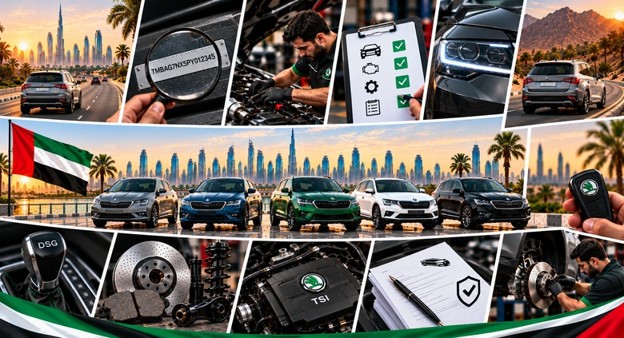
Ask for photographs that actually prove something
For a used engine, request photographs of the engine code and major mating surfaces.
For a gearbox, ask for the transmission code, casing, connectors and mounting points.
For electronic parts, request the label and connector side.
For body panels, ask for mounting tabs and damaged areas.
A stock photograph is marketing. A photograph of the actual part is evidence.
Ask for the part number
The number should be readable.
If a seller says, "It is definitely for your Kodiaq", but refuses to provide the part number, slow down. Verification should not be treated as an inconvenience.
Check superseded numbers
A manufacturer's part number can change during production.
A newer reference may replace an older number without meaning that the underlying application is completely different. Ask the seller or workshop to verify whether the number has been superseded rather than assuming a mismatch.
Confirm what comes with the part
This is particularly important with engines.
| Used part | Ask whether these are included |
| Engine | Turbo, injectors, manifolds, sensors, alternator, starter |
| Gearbox | Mounts, mechatronics, clutch-related parts, sensors |
| Headlamp | Control module, LED unit, ballast or wiring |
| Steering rack | Motor, control unit, tie rods |
| Radiator assembly | Fans, shroud, hoses, related fittings |
| Door | Glass, regulator, wiring, mirror, trim |
Two listings can appear to have wildly different prices simply because they contain different amounts of hardware.
Get the warranty in writing
A warranty should specify duration and coverage.
For used engines and gearboxes, ask what constitutes a valid claim, whether installation must follow particular procedures and whether labour is covered. Also ask what happens if the part is found incompatible.
Do not pay before fitment is reasonably established
A refund dispute is far more unpleasant than a fitment check.
Before payment, have the seller confirm the VIN, part number, specification and warranty terms in writing. For an expensive part, keep the messages.
The workshop test before installation
Diagnosis should happen before ordering the part
A fault code is not automatically a failed part.
The workshop should investigate the system, confirm the fault and establish whether another part is causing the symptom. This is particularly important with sensors, ECUs, cooling systems, DSG faults and turbocharging problems.
Installation should include supporting checks
If a used gearbox is installed, inspect mounts, fluid, seals, cooling where relevant and related drivetrain parts.
If an engine is installed, inspect cooling, hoses, belts, fluids, mounts, wiring and the reason the original engine failed.
If an electronic module is replaced, confirm coding and system communication.
Watch the first 1,000 km
After a major used-part installation, pay attention.
Leaks. Strange vibration. New warning lights. Harsh shifting. Temperature changes. Unusual smells. A new noise that was not there before.
The first few hundred kilometres are not a ceremonial period in which the owner waits for problems to become obvious. They are useful evidence.
Keep the paperwork
This sounds dull until you sell the car.
Keep the invoice, part number, donor information, warranty, diagnostic report and installation details. For a major engine or gearbox replacement, that documentation can explain the repair far better than a future owner hearing, "Yes, it was changed a while ago."
The buyer's final decision
Where should you search?
The sensible search route depends on the part.
Routine used trim or body parts can be relatively straightforward. A used engine, DSG gearbox, ECU or radar-related module needs much tighter verification.
For UAE buyers comparing availability, condition and fitment, PartFinder UAE can provide a useful starting point for identifying available replacement parts before the workshop confirms the exact application.
Which used part should you actually choose?
Use the condition of the part and the risk attached to its failure, not just the price.
| Part | Used purchase logic |
| Bonnet or door | Often reasonable if straight and undamaged |
| Interior trim | Usually reasonable with correct fitment |
| Alternator | Buy only with testing evidence |
| Suspension arm | Inspect for impact and bush condition |
| Brake disc | New is generally the cleaner comparison |
| Engine | Require strong testing and donor evidence |
| Gearbox | Require code matching and meaningful warranty |
| ECU | Verify part number and programming requirements |
| Radar/camera | Confirm calibration requirements |
| Headlamp | Match exact specification and electronics |
What will the complete repair cost?
Never compare a used-part price against the price of a new part and stop there.
The real calculation is:
part + delivery + labour + fluids + seals + diagnostics + coding/calibration + supporting parts + possible downtime
That is the number worth comparing.
Used versus reconditioned
A tested reconditioned unit may cost more than a used unit, but it can also provide a clearer understanding of what has been replaced or inspected.
Ask what was actually rebuilt. "Reconditioned" should describe work performed, not merely a more attractive label.
Used versus genuine
Manufacturer guidance distinguishes genuine parts from reconditioned exchange parts and economy parts, with different choices depending on vehicle age and owner requirements.
For a newer Skoda with complex electronics, exact compatibility may matter more than squeezing the last few hundred dirhams from the purchase price. For an older Fabia or Octavia, the economics can point in another direction.
When the cheap part becomes expensive
Imagine buying a used gearbox for less than the alternatives, only to discover that the code is wrong.
Now there is removal, transport, workshop time, diagnosis, another gearbox and another installation.
The first price was cheap. The repair was not.
The used-part red flags
Be wary when the seller refuses to show the actual part, cannot provide a number, cannot identify the donor vehicle, gives an unexplained mileage claim, offers no written warranty or insists that VIN verification is unnecessary.
None of those things proves the part is bad.
Together, they make the purchase harder to justify.
The installation red flags
After installation, persistent warning lights, overheating, fluid leaks, vibration, poor shifting or new electrical faults should not simply be brushed aside.
The phrase "it needs to settle" is not a diagnosis.
A sensible ownership calculation
For an older Skoda, compare the repair with the entire condition of the vehicle.
| Question | Why it matters |
| Current vehicle value | Sets the repair context |
| Tyre condition | Another near-term cost |
| Suspension | May require work alongside the main repair |
| Cooling system | Important after engine problems |
| Gearbox condition | Avoid replacing one major unit while another is failing |
| Air conditioning | Especially important in UAE |
| Service history | Helps estimate future exposure |
| Registration/insurance | Part of keeping the vehicle |
| Expected ownership period | Changes how much repair investment makes sense |
The final check before handing over the money
Before buying a used Skoda spare part in the UAE, you should be able to answer a surprisingly short set of questions: Does it fit my exact VIN? What is the part number? Where did it come from? What mileage or condition evidence exists? What has actually been tested? What exactly is included? What does the warranty cover? What will the complete installed repair cost?
If the seller can answer those questions clearly, you have something solid to work with.
If the answer to most of them is "don't worry, it will fit", keep your wallet in your pocket for another minute.
FAQs About Used Skoda Spare Parts in UAE
Categories
- Audi
- BMW
- Car Accessories
- Car Tips
- Ford
- Land Rover
- Mazda
- Range Rover
- Top 10
- UAE Car Parts
- Used Car Parts
- Toyota
- Replacement Engines
- Nissan
- Hyundai
- Mitsubishi
- Volkswagen
- Honda
- Kia
- Chevrolet
- Dodge
- Jeep
- Subaru
- Renault
- Lexus
- Mercedes
- Suzuki
- Hummer
- Porsche
- Infiniti
- Peugeot
- GMC
- Mini
- Volvo
- Replacement Gearboxes
- MG
- Jaguar
- Skoda
- Cadillac
- Daihatsu
- Fiat
- German Car Parts
- Japanese Car Parts
- Aftermarket Car Parts
- Genuine Car Parts
- New Car Parts
- Reconditioned Car Parts
- European Car Parts
- American Car Parts
- Korean Car Parts
- British Car Parts
- Chinese Car Parts
- Sports/Exotic Car Parts
- Luxury Car Parts
- Performance Car Parts
- SUV/4x4 Spare Parts
- Truck Spare Parts
- EV Car Parts
- Hybrid Car Parts
- Auto Spare Parts in UAE
- Tesla
- Isuzu
- Ram
- Ferrari
- Bentley
- Lamborghini
- Genesis
- Maserati
- Lincoln
- Chrysler