Used Subaru Spare Parts in UAE: What Owners Should Check Before Buying
September 10, 2026
Buying Used Subaru Spare Parts in UAE
Used Subaru Spare Parts in UAE: What Owners Should Check Before Buying
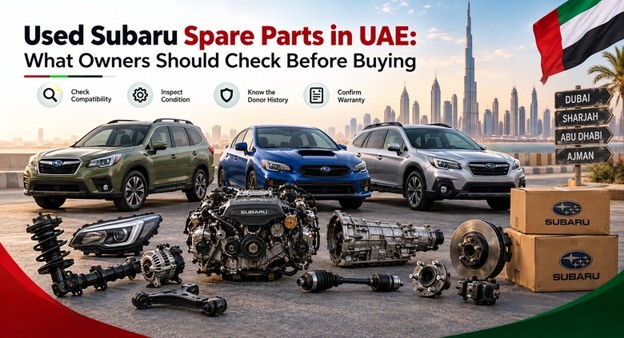
Buying used Subaru spare parts in UAE is not simply about finding the lowest price. The real job is matching the right part to the right car, then deciding whether its previous life makes the saving worthwhile.
A Forester, Outback, Impreza, Legacy, WRX or BRZ can have several different specifications across generations. Engine code, transmission, drivetrain, production period and equipment can all change the part you need. Even a part that looks identical in a photograph may have a different connector, mounting point or internal specification.
Start with the VIN.
Then confirm the original part number where possible, ask for photographs of the actual item, establish the donor vehicle and find out its mileage and reason for dismantling. For engines, gearboxes and other labour-intensive parts, ask whether the unit has been tested and what the warranty actually covers.
UAE conditions add another layer. Heat, dust, stop-start traffic, speed humps and long motorway journeys can accelerate wear in rubber, plastics, cooling parts, suspension and electrical systems.
The cheapest used Subaru part is therefore not automatically the cheapest repair.
What to check before paying
- VIN and exact model specification
- Generation and production period
- Engine and transmission
- Original part number
- Donor vehicle and mileage
- Accident or flood history
- Actual photographs
- Physical condition
- Testing where appropriate
- Included brackets, sensors, wiring and hardware
- Warranty and return conditions
- Installation labour
- Fluids, seals and supporting parts
- Coding or programming requirements
That small checklist can prevent a surprisingly expensive mistake.
Where to Buy Used Subaru Spare Parts in UAE
The UAE used-parts market is broad, but not every source offers the same level of information or accountability.
A specialist Subaru dismantler may know exactly which Forester generation an engine came from. A general used-parts seller may simply recognise the model name. A workshop may already have a suitable donor part because it has seen the same failure before. Online sellers can offer more choice, but the buyer has to do more of the verification.
Sharjah is particularly important for used automotive parts, while Dubai and Abu Dhabi also have independent workshops and parts businesses dealing with Japanese vehicles. For owners elsewhere in the UAE, delivery can make sourcing easier, but it also makes the actual-item inspection more important because you may not see the part before it arrives.
For an expensive engine, gearbox or differential, ask for the donor details before discussing payment.
For a bumper, door or interior trim piece, photographs and measurements may be enough.
Different part. Different level of due diligence.
Ask the seller these questions
- Which Subaru did this part come from?
- What year was the donor?
- What engine did it have?
- What transmission did it use?
- How many kilometres had it covered?
- Why was the vehicle dismantled?
- Was it involved in an accident?
- Was it exposed to flooding?
- Has the part been tested?
- What is included?
- What is the warranty period?
If the answers become vague when you ask about the donor, slow down.
How Much Do Used Subaru Spare Parts Cost in the UAE?
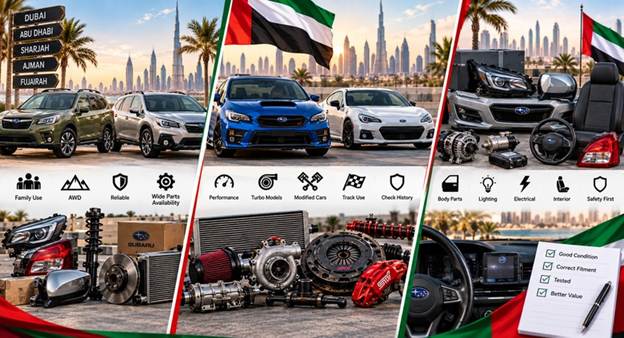
There is no single “used Subaru parts price” in the UAE because condition, model, generation and part type can change the figure dramatically.
A door mirror and a complete boxer engine are obviously not comparable purchases. Even two engines can have very different values depending on mileage, engine code, included ancillaries, testing and warranty.
The better way to judge price is by replacement cost versus risk.
| Used Subaru part | What mainly affects the price | What to check before buying |
| Engine | Code, mileage, completeness | Compression, leaks, donor history |
| Gearbox/CVT | Type, code, condition | Testing, fluid, donor specification |
| Differential | Ratio, condition | Identification, noise, leakage |
| CV axle | Model and condition | Joint play, boots, corrosion |
| Alternator | Output and specification | Bench testing |
| Starter | Specification and condition | Engagement/current draw |
| Suspension arm | Condition and bushes | Bushes, ball joint, damage |
| Headlight | Generation and equipment | Lens, connectors, electronics |
| Bumper | Condition and specification | Brackets, cracks, mounting points |
| Mirror | Features and connector | Power/heated/folding functions |
| Interior trim | Colour and condition | Clips, cracks, matching |
The purchase price is only the first number.
For major mechanical repairs, calculate the part + delivery + labour + fluids + seals + supporting parts + coding + possible return cost.
That is the figure worth comparing.
Used vs Genuine vs OEM vs Aftermarket Subaru Parts: Which Is Better?
There is no universal winner.
For an older Legacy needing an exterior trim piece, a clean used original part can be the obvious choice. For a brake pad, belt or battery, buying new usually makes much more sense. For a gearbox, a properly tested reconditioned unit may deserve consideration alongside a used original.
The part's function matters.
| Part type | Used original | Genuine new | OEM | Aftermarket |
| Body panel | Excellent option | Often costly | Good | Quality varies |
| Interior trim | Excellent option | Costly if available | Limited | Limited |
| Headlight | Good if tested | Strong choice | Good | Quality varies |
| Suspension | Good if inspected | Strong choice | Good | Depends on manufacturer |
| Alternator | Good if tested | Strong choice | Good | Depends on quality |
| Sensor | More risky | Strong choice | Good | Quality varies |
| Engine | Possible with evidence | Lowest uncertainty | Depends on availability | Limited comparison |
| Gearbox | Possible with testing | Expensive | Limited | Limited |
| Battery | Usually poor choice | Good | Good | New preferred |
The mistake is treating all used parts as one category.
They are not.
A used original body panel can be a very low-risk purchase. A used electronic module with unknown history can be considerably more troublesome. A used engine sits somewhere else again, because the installation labour makes failure expensive.
The smartest choice is the one that gives the right balance of condition, compatibility, remaining life and total repair cost.
Compatibility and Condition Checks
How to Check Used Subaru Part Compatibility Using VIN
The VIN is the safest starting point when buying a used Subaru spare part. Not the badge. Not a seller's photograph. Not “this came from a Forester, so it should fit your Forester”.
Subaru models changed across generations, and imported UAE vehicles can have specifications that differ from another car carrying the same model name. Engine, transmission, drivetrain, production period and equipment can all affect compatibility.
For a used part, work through the identification in this order:
VIN → model → generation → engine → transmission → production period → original part number → equipment
For mechanical parts, go further. An engine needs its exact engine code checked. A gearbox needs its transmission identification. A differential needs the correct drivetrain specification and, where applicable, ratio.
Electrical parts deserve the same caution. A module can physically plug in and still require coding, programming or configuration before the vehicle will operate correctly.
This is particularly important with WRX and BRZ cars, where previous owners may have changed suspension, drivetrain, turbo, clutch or electrical equipment.
If the seller asks only, “Which model is your Subaru?”, that is not enough for a major used part.
How to Check a Used Subaru Part Number Before Buying
A Subaru part number can save you from a surprisingly frustrating conversation.
Take the number from the original part whenever it is accessible and send a clear photograph along with it. Do not rely on typing a number from memory. A single digit or letter can change the application.
The number should then be considered alongside the vehicle VIN and specification.
This matters because Subaru parts can be revised during production. A replacement number may supersede an older number, while visually similar parts can have different connectors, brackets or internal specifications.
For larger parts, photograph the identification markings before removing the old unit if possible.
Useful photographs include:
- Part-number label
- Stamped identification
- Electrical connector
- Mounting brackets
- Bolt-hole arrangement
- Hose connections
- Flanges
- Sensors
- Overall shape
This is especially valuable when buying remotely from another emirate.
A seller may tell you that two parts are “the same”. A photograph of the identification label can settle the question much faster.
And if there is no part number, do not panic—but increase the level of verification. Use the VIN, donor information, dimensions and actual photographs instead.
How to Check the Condition of a Used Subaru Spare Part
Condition should be judged according to what the part actually does.
A scratch on a used interior panel is mostly cosmetic. A crack around an engine mounting point is a completely different matter.
Start with the obvious physical checks:
- Cracks
- Broken mounting points
- Bent brackets
- Corrosion
- Oil leakage
- Coolant residue
- Damaged threads
- Worn bushes
- Torn rubber
- Heat damage
- Water marks
- Previous repairs
- Missing hardware
Then consider the part's operating history.
A used suspension arm may look clean while its bushes are hardened. A used alternator can have a perfect casing but worn internal parts. A gearbox may have no external damage while containing worn bearings or synchronisers.
For that reason, inspection and testing are not the same thing.
An inspection tells you what can be seen.
A proper test provides evidence about whether the part actually works.
The more expensive the installation, the more important that distinction becomes.
Condition checks by part type
| Used part | Main condition concern | Useful verification |
| Engine | Internal wear/overheating | Compression and inspection |
| Gearbox | Internal wear | Functional testing |
| Alternator | Charging performance | Bench test |
| Starter | Motor/solenoid operation | Bench test |
| Headlight | Electronics/moisture | Function test |
| Suspension arm | Bushes/ball joint | Physical inspection |
| Differential | Gear/bearing wear | Inspection and testing |
| Body panel | Impact/repair | Actual-item inspection |
| Mirror | Motor/electronics | Function test |
| Interior trim | Cracks/clips | Physical inspection |
How to Check the Donor Vehicle Before Buying Used Subaru Parts
The donor vehicle tells you the story behind the used part.
Ask why it was dismantled.
That question is often more useful than asking whether the part is “in good condition”.
If the donor Subaru was involved in a rear-end accident, many front mechanical parts may have remained untouched. If it suffered severe flood damage, however, electrical modules, wiring, bearings, lubricated assemblies and interior electronics deserve much greater suspicion.
The donor's mileage also matters, although it should never be treated as an absolute measurement of condition. A high-mileage Subaru with regular servicing may have a more useful transmission than a lower-mileage car that was abused or neglected.
Ask for:
- Donor model
- Production year
- Engine
- Transmission
- Mileage
- Reason for dismantling
- Accident location
- Flood exposure
- Modification history
- Whether the vehicle was running
- Whether the part was tested before removal
Donor history and risk
| Donor history | Used-part confidence |
| Known vehicle, documented mileage, mechanical failure elsewhere | Higher |
| Accident-damaged with unaffected part area | Potentially good |
| High mileage but documented maintenance | Requires inspection |
| Heavy performance use | Higher mechanical risk |
| Modified WRX/BRZ | Requires specification verification |
| Unknown accident history | Caution |
| Flood-damaged vehicle | High caution |
| Unknown donor and no testing | Poor buying position |
The donor does not have to be perfect.
It needs to be understood.
Used Subaru Engines, Gearboxes and Major Parts
Buying a Used Subaru Engine in UAE: What to Check
A used Subaru engine can save a substantial amount of money, but it is also one of the worst places to buy on appearance alone.
A clean engine sitting on a workshop floor tells you very little about what happened inside it.
Start with the exact engine code. Then establish the donor model, production year, mileage and reason the vehicle was dismantled. Ask whether the engine was running before removal and whether compression testing has been carried out where appropriate.
Look closely for oil leaks, coolant residue, damaged threads, cracked housings, broken mounting points and evidence of previous overheating. Heavy sludge or unusual coolant contamination deserves attention rather than a quick wipe and a “looks fine” verdict.
The phrase complete engine also needs clarification. Does the price include the turbocharger, intake, injectors, alternator, starter, sensors, wiring, manifolds and other ancillaries? Sometimes it means almost everything. Sometimes it means the long block and very little else.
That difference can become expensive once the engine is on the workshop floor.
Used Subaru engine checks
- Exact engine code
- Donor model and year
- Donor mileage
- Compression results where appropriate
- Oil condition
- Coolant condition
- External leaks
- Signs of overheating
- Turbo condition where fitted
- Included ancillaries
- Mounting points
- Sensors and connectors
- Warranty and return conditions
For a WRX, ask one more question: was the donor modified or tuned?
A performance engine's previous life matters.
Buying a Used Subaru Gearbox or CVT: What Owners Must Check
A used Subaru gearbox is not something to buy because the casing looks identical.
Manual transmissions, automatic transmissions and CVT units have different requirements, and even units serving closely related Subaru models can differ in identification, ratios, controls and drivetrain compatibility.
Before buying, obtain the transmission identification and compare it with the unit fitted to the vehicle.
For a manual gearbox, inspect or ask about gear engagement, synchro behaviour, bearing noise, casing damage, shaft condition and oil contamination. A gearbox that was removed because of internal noise should not be sold as an ordinary “used gearbox” without that history being disclosed.
For a CVT, compatibility becomes even more important because electronic control and fluid requirements form part of the repair.
Do not forget the supporting parts.
A gearbox replacement may also expose a worn clutch, damaged seals, tired mounts or other parts that are sensible to replace while access is available.
What to confirm before buying
| Check | Why it matters |
| Transmission identification | Confirms the correct unit |
| Donor vehicle | Establishes application |
| Donor mileage | Helps assess previous use |
| Testing | Provides evidence of operation |
| Fluid condition | Can reveal contamination or wear |
| Casing and mounts | Identifies physical damage |
| Warranty | Protects against hidden internal faults |
| Included parts | Prevents unexpected additional costs |
For a gearbox, installation labour makes the warranty particularly important. A failed used unit does not just mean buying another part; it can mean paying for removal and refitting all over again.
Used Subaru AWD, Differential, CV Axle and Driveshaft Parts
Subaru's AWD system makes drivetrain matching more important than it first appears.
A differential, CV axle or driveshaft has to work with the rest of the drivetrain. The fact that a shaft physically bolts onto the car does not automatically mean it is the correct specification.
Before buying a used differential, confirm its position, donor vehicle, transmission pairing, identification and ratio where applicable. Check the casing for cracks, mounting damage and oil leakage, and listen for any history of whining or bearing noise.
CV axles need their own inspection. Torn boots, excessive joint play, corrosion and signs of running without proper lubrication are all warning signs. A shaft may look serviceable until it is loaded on the road.
Tyres also matter more here than many buyers realise. Significant differences in tyre size or rolling circumference can place additional stress on an AWD drivetrain.
For modified WRX and BRZ cars, check the actual drivetrain configuration rather than assuming the factory specification remains untouched.
When sourcing these parts in the UAE, PartFinder UAE can be useful as part of the search process, but the exact vehicle specification still needs to be confirmed before ordering.
AWD part checks
- Differential position
- Identification code
- Ratio where applicable
- Transmission pairing
- Donor model
- Donor mileage
- CV-joint condition
- Boot condition
- Driveshaft condition
- Flange configuration
- Mounting points
- Oil leakage
- Tyre compatibility
A drivetrain part that is slightly more expensive but correctly matched is usually a better purchase than a cheaper unit that leaves compatibility uncertain.
Used Subaru Suspension, Brake and Steering Parts: What to Inspect
Suspension and steering parts are among the used Subaru parts where physical inspection makes a major difference.
UAE roads can be demanding. Speed humps, kerb strikes, uneven road transitions and constant heat exposure gradually affect bushes, joints and dampers. A used control arm might have a perfectly clean metal surface while its rubber bush has hardened or cracked.
Inspect control arms, bushes, ball joints, drop links, shocks, struts, springs, tie rods, steering links and wheel hubs carefully.
Wheel bearings deserve particular attention. A bearing can feel acceptable by hand and still produce noise once the vehicle is moving at speed.
Brakes need a slightly different approach. Used brake pads are rarely an attractive saving because they are wear items. Used calipers, however, can make sense when the pistons, sliders, mounting points and corrosion are properly checked.
For WRX and BRZ models, establish whether the suspension and brakes are factory standard. A modified donor vehicle can contain springs, dampers, arms or brake assemblies that do not match the configuration of your car.
Used chassis parts: sensible or risky?
| Part | Used purchase | Main inspection |
| Control arm | Often sensible | Bushes and ball joint |
| Drop link | Possible | Play and joint condition |
| Shock/strut | Caution | Leakage and damping |
| Spring | Possible | Cracks and specification |
| Wheel hub | Possible | Bearing noise/play |
| Caliper | Good if inspected | Pistons, sliders, corrosion |
| Brake pad | Usually avoid | Remaining thickness |
| Brake disc | Condition dependent | Thickness and surface |
| Steering link | Possible | Play and damage |
The right used part should reduce the repair bill without transferring an invisible wear problem from one Subaru to another.
Model-Specific Buying Guide and Final Decision
Used Subaru Forester and Outback Parts: What Owners Commonly Buy
Forester and Outback owners in the UAE tend to approach used parts differently from performance-car owners. These are often daily family vehicles, long-distance commuters and practical AWD cars, so keeping the repair sensible matters.
For an older Forester, used suspension parts, wheel hubs, body panels, headlights, mirrors, interior trim, cooling parts and selected drivetrain parts can make financial sense. Engine and gearbox purchases require considerably more scrutiny because installation costs can quickly outweigh the initial saving.
The Outback has a similar pattern, although higher-mileage examples can bring additional attention to suspension, cooling, drivetrain and transmission-related parts.
Do not assume Forester and Outback parts are interchangeable simply because both are Subaru AWD vehicles.
Check the generation, engine, transmission, production period and original part number.
Common used-part opportunities
| Part | Forester | Outback | Buying consideration |
| Body panels | Good | Good | Check damage and paint cost |
| Mirrors | Good | Good | Match electrical features |
| Headlights | Possible | Possible | Check generation and connectors |
| Suspension | Possible | Possible | Inspect bushes and dampers |
| Wheel hubs | Possible | Possible | Check bearing condition |
| Engine | High caution | High caution | Code, testing and warranty |
| Gearbox/CVT | High caution | High caution | Exact transmission identification |
| Differential | Possible | Possible | Confirm drivetrain specification |
| Interior trim | Good | Good | Match colour and fittings |
For both models, the vehicle's age changes the calculation. A used original part can be an excellent solution when a new replacement is disproportionately expensive, particularly for body and interior repairs.
Used Subaru Impreza, WRX and BRZ Parts: Extra Checks for Performance Models
This is where buying used Subaru parts gets more complicated.
An Impreza, WRX or BRZ may have lived a much harder life than its odometer suggests. A low-mileage performance car can have experienced aggressive launches, hard braking, track use or extensive modifications. Conversely, a carefully maintained enthusiast-owned car can be an excellent donor.
The badge tells you less than the vehicle's actual configuration.
For a WRX, ask whether the engine has been tuned, whether the turbocharger has been changed, whether the clutch or flywheel has been upgraded and whether the suspension or differential setup remains factory specification.
For a BRZ, pay particular attention to suspension, brakes, clutch, gearbox, differential and bodywork if the car has been used for track driving.
Impreza needs the same caution where performance variants are involved.
Performance Subaru checks
- Original or modified engine
- Turbocharger specification
- ECU tuning
- Intake and exhaust changes
- Clutch and flywheel
- Gearbox specification
- Differential
- Suspension
- Brake setup
- Wheel and tyre configuration
- Track or competition use
- Accident history
A used performance part from a modified donor is not automatically bad.
It simply needs to be identified correctly.
Used Subaru Body, Headlight, Electrical and Interior Parts: What Is Safe to Buy Used?
Not every Subaru part deserves the same level of caution.
For many owners, body and interior parts are where used components offer the clearest financial advantage. A clean original door, bonnet, bumper, mirror, seat trim or dashboard panel can restore an older vehicle without the cost of sourcing everything new.
Electrical and electronic parts are more complicated because appearance does not tell you whether the part works.
A used alternator or starter can be sensible if tested. A used headlight can also be worthwhile when its lens, electronics, connectors and mounting points are sound. Sensors and control modules deserve more caution because intermittent faults can be difficult to identify before installation.
Safety-related parts should be treated separately. Airbags, seat belts and other restraint-system parts should not be purchased casually simply because the price is attractive.
Which parts are better used?
| Category | Used buying position |
| Doors, bonnet and wings | Generally good if undamaged |
| Bumpers and exterior trim | Good after mounting inspection |
| Mirrors | Good if features match |
| Interior trim | Often excellent value |
| Headlights | Good if tested and compatible |
| Alternators | Good if tested |
| Starters | Good if tested |
| Compressors | Buy only after proper checking |
| Sensors | More cautious |
| Control modules | Verify compatibility and programming |
| Brake pads | Prefer new |
| Filters and belts | Prefer new |
| Battery | Prefer new |
| Safety-system parts | Avoid unknown history |
The key is not simply whether a part is second-hand.
It is whether its remaining useful life can be reasonably established.
Used Subaru Spare Parts Buying Checklist: When to Buy and When to Walk Away
Before buying, put the part through a simple test.
Does it match the car?
Do you know where it came from?
Do you know enough about its condition?
Is the saving still worthwhile after fitting?
If the answer to any of these is unclear, pause before paying.
| Check | Good sign | Warning sign |
| VIN | Compatibility confirmed | Seller guesses |
| Part number | Matching number | “Looks the same” |
| Donor | Identified | Unknown |
| Mileage | Documented | Not disclosed |
| History | Accident location known | Flood/unknown history |
| Condition | Actual photos/inspection | Stock photos only |
| Testing | Evidence available | Seller refuses |
| Warranty | Written terms | Verbal promise |
| Included parts | Clearly listed | “Everything shown” |
| Labour | Fitted cost understood | Installation unknown |
| Coding | Requirement confirmed | Discovered afterwards |
| Return | Clear process | No return arrangement |
For a cheap interior trim piece, you may accept slightly more uncertainty.
For an engine, gearbox, differential or electronic module, you should not.
The smartest used Subaru purchase is rarely the part with the lowest sticker price. It is the part with confirmed compatibility, believable history, suitable condition and enough warranty protection to make the risk acceptable.
That is particularly important in the UAE, where workshop labour, vehicle downtime and summer operating conditions can turn a small purchasing mistake into a much larger repair bill.
FAQs
Categories
- Audi
- BMW
- Car Accessories
- Car Tips
- Ford
- Land Rover
- Mazda
- Range Rover
- Top 10
- UAE Car Parts
- Used Car Parts
- Toyota
- Replacement Engines
- Nissan
- Hyundai
- Mitsubishi
- Volkswagen
- Honda
- Kia
- Chevrolet
- Dodge
- Jeep
- Subaru
- Renault
- Lexus
- Mercedes
- Suzuki
- Hummer
- Porsche
- Infiniti
- Peugeot
- GMC
- Mini
- Volvo
- Replacement Gearboxes
- MG
- Jaguar
- Skoda
- Cadillac
- Daihatsu
- Fiat
- German Car Parts
- Japanese Car Parts
- Aftermarket Car Parts
- Genuine Car Parts
- New Car Parts
- Reconditioned Car Parts
- European Car Parts
- American Car Parts
- Korean Car Parts
- British Car Parts
- Chinese Car Parts
- Sports/Exotic Car Parts
- Luxury Car Parts
- Performance Car Parts
- SUV/4x4 Spare Parts
- Truck Spare Parts
- EV Car Parts
- Hybrid Car Parts
- Auto Spare Parts in UAE
- Tesla
- Isuzu
- Ram
- Ferrari
- Bentley
- Lamborghini
- Genesis
- Maserati
- Lincoln
- Chrysler
- Opel
- Citroen
- SsangYong
- Seat
- McLaren
- Aston Martin
- Rolls Royce
- Maybach
- Alfa Romeo
- Bugatti
- Scion
- Abu Dhabi Car Parts
- Ajman Car Parts
- Al Khan Car Parts
- Al Sajaa Car Parts
- Deira Car Parts
- Dubai Car Parts
- Fujairah Car Parts
- Industrial Area 6 Car Parts
- Mussafah Car Parts
- Ras Al Khaimah Car Parts
- Sharjah Car Parts
- Umm Al Quwain Car Parts
- Acura
- BYD
- Chery
- Dacia
- DS
- Geely Emgrand
- EXEED
- GAC
- GAC Gonow
- Geely
- Gonow
- Great Wall
- Haima
- Haval
- Holden
- Iveco
- JAC
- Jaecoo
- Jetour
- Lotus
- Omoda
- Proton
- Renault Samsung
- Roewe
- Lucid
- Replacement Headlight
- Replacement Bumper