Used Suzuki Spare Parts in UAE: What Buyers Should Check Before Ordering
August 31, 2026
Finding and Identifying the Right Used Suzuki Part
Used Suzuki Spare Parts in UAE: What Can You Safely Buy Second-Hand?
Used doesn't automatically mean risky.
Sometimes it is the sensible choice, particularly when a Suzuki needs a body part that has become expensive or difficult to source new. A clean used mirror, door, bonnet, fender, bumper or interior trim can often do the job perfectly well, provided the mounting points haven't been damaged and the part actually belongs to the right vehicle.
Then there are parts where the bargain deserves more suspicion.
Brakes, steering parts, heavily worn suspension parts and critical electronic modules need much closer inspection. A used brake disc with an unknown history isn't comparable to a used door shell. Nor is a second-hand ECU comparable to a plastic interior trim panel just because both appear in the same search results.
For Swift, Jimny, Vitara, Baleno, Ciaz and Ertiga, the sensible approach is to divide used parts into risk levels.
| Used part category | Buying second-hand |
| Bumpers and body panels | Often sensible after inspection |
| Mirrors and exterior trim | Usually worth considering |
| Interior trim | Generally lower risk |
| Lights | Check lenses, moisture and connectors |
| Suspension parts | Inspect carefully |
| Brake parts | Prefer verified, quality replacements |
| Electrical modules | Require exact identification and testing |
| Engines | Buy only with strong evidence |
| Gearboxes | Testing and warranty are important |
| Safety-related parts | Use a much stricter standard |
This is where PartFinder UAE can be useful as part of the search process, but don't let a good-looking photograph make the decision for you.
Look behind the photograph.
Check the actual part.
Used Suzuki Parts by Model: Swift, Jimny, Vitara, Baleno, Ciaz and Ertiga
Six Suzuki models. Six rather different used-parts situations.
A Swift is likely to generate searches around brakes, suspension, lights, mirrors, AC parts, service items and ordinary bodywork. For an older example, small repairs can pile up, so a good used genuine part may keep the overall bill under control.
The Jimny is trickier. Off-road use changes everything. A suspension part may have lived through sand, rocks and hard impacts, while drivetrain and steering parts can carry wear that isn't obvious from a quick glance. Check underneath, not just around the shiny exterior.
With the Vitara, condition and generation become particularly important. A used suspension or body part needs to match the specific vehicle rather than simply being advertised as “Vitara”.
The Baleno and Ciaz tend to bring more conventional searches—brakes, suspension, cooling, AC, electrical and body parts—but model year and engine specification still matter.
Then there's the Ertiga, often used as a family or fleet vehicle. Passenger loads, constant AC operation and high daily mileage can make donor-vehicle history surprisingly useful.
Same brand.
Different lives.
How to Check a Used Suzuki Spare Part Before Ordering
Don't order first and investigate later.
Start with the actual part.
Ask for clear photographs from several angles, including the rear, mounting points, connectors, labels and any casting or identification marks. If the part has an electronic connector, get a close photograph of it. If it has a part number, ask for a photograph where the number can be read rather than relying on somebody typing it into a message.
Then check condition.
Cracks? Corrosion? Bent mounting points? Broken clips? Oil leakage? Heat damage? Previous repairs? Excessive wear?
A used bumper with a few scratches might be perfectly acceptable.
A used bumper with broken mounting brackets is another matter.
For mechanical parts, ask what testing has been done. For an engine or gearbox, go further and request donor information, mileage where known and warranty terms.
And here's the part buyers often skip: ask what exactly is included.
A photograph might show an assembly with brackets, sensors and fittings, while the quoted price covers only the main housing.
That little misunderstanding can become expensive once the workshop has already started the installation.
Suzuki VIN and Part Number Verification: Why Both Matter
The VIN is your safety net.
The part number is your second safety net.
Use both where possible.
A Suzuki model name alone can be far too broad because model year, engine, transmission, trim and market specification can change the correct replacement. Even two cars carrying the same badge may use different versions of a part.
Before ordering used Suzuki spare parts in UAE, provide:
VIN + model year + engine + transmission + exact part number + photograph of the original part.
For an engine or gearbox, include the relevant identification code where available.
For body parts, check generation and specification.
For electrical parts, compare connector arrangement and identification numbers.
For suspension and brake parts, confirm the exact application rather than trusting a generic compatibility statement.
And don't be embarrassed about asking twice.
If a seller says, “Yes, it fits,” ask them to confirm it against your VIN or exact part number.
That's a much stronger answer than a casual “yes”.
Used Suzuki Parts: Why a Matching Photograph Isn't Enough
Two parts can look almost identical and still differ where it matters.
The connector may change.
The mounting bracket may differ.
The dimensions may be slightly different.
The internal specification may not match.
This happens most often when buyers search visually and then choose the cheapest result that resembles the original.
It looks right.
It may even bolt on.
And then the warning light appears.
For used Suzuki electrical, engine, transmission, suspension and braking parts, visual similarity should never be treated as proof of compatibility.
Check the identification.
Check the application.
Check the VIN.
Then order.
Condition, Testing and High-Value Used Suzuki Parts
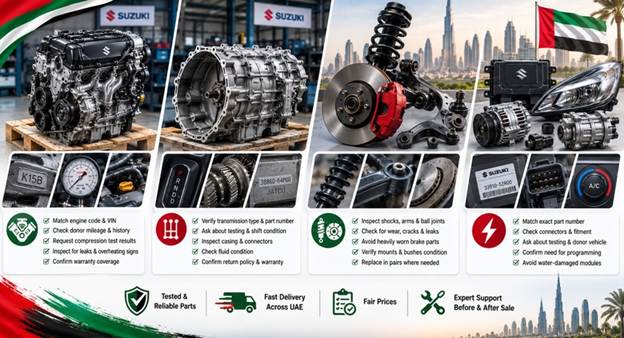
Used Suzuki Engine in UAE: What Should You Check Before Buying?
A used Suzuki engine can save a vehicle from being written off financially.
It can also create a second problem if the buyer focuses only on the price.
Engine condition isn't something you can judge properly from a clean photograph or a seller saying, “Good running engine.” You need evidence. Ideally, the donor vehicle, engine code, mileage, removal reason and available test results should all line up.
Start with the engine code and VIN compatibility. Then look at the donor history.
Was the engine removed after an accident?
Was the donor vehicle overheated?
Was it dismantled because of a drivetrain failure?
Has the engine been sitting for months?
Those details matter.
For a used Swift, Baleno, Ciaz, Vitara or Ertiga engine, ask whether compression testing was carried out. Where possible, compression figures across the cylinders give you something tangible to discuss with the workshop rather than relying on a verbal assurance.
Look for obvious signs too: oil leaks, damaged wiring, cracked housings, corrosion, broken mounts and signs of overheating.
And don't forget the accessories.
A quoted “used engine” may be a long block or bare engine, while another seller may include the intake, alternator, starter, sensors or other attached parts. Compare what is actually being supplied.
That difference can completely change the final repair bill.
Used Suzuki Engine Mileage in UAE: Is Lower Always Better?
Not necessarily.
A 70,000-km engine sounds attractive, but what happened during those 70,000 kilometres?
A well-maintained engine that spent its life on normal roads can be a better bet than a lower-mileage unit that suffered overheating, neglected oil changes or severe operating conditions.
For UAE vehicles, also consider how the donor car was used. Long periods in traffic with heavy AC demand, frequent short trips and poor maintenance can all tell a different story from steady highway driving.
When comparing two used Suzuki engines, look beyond the odometer.
Check:
Mileage + maintenance history + compression + oil condition + cooling-system history + donor vehicle + testing + warranty.
If the seller cannot establish most of these, the lower price should come with caution.
Used Suzuki Engine Compression Testing: Why It Matters
Compression testing won't tell you everything about an engine.
It does, however, give you a useful window into cylinder condition.
For a petrol Suzuki engine, the important thing isn't simply seeing one compression number. The cylinders should be considered together, because a noticeable difference between cylinders can point towards an underlying mechanical issue.
A workshop can use the results alongside other checks such as oil condition, leak-down testing where appropriate, cooling-system inspection and general engine condition.
Ask for the actual results if testing has already been performed.
Don't settle for:
“Compression is good.”
Good compared with what?
Written figures are much more useful.
If a used engine is expensive enough to justify a major installation, spending a little time verifying its mechanical condition before it goes into the car can save a painful second removal later.
Used Suzuki Gearbox in UAE: How to Check a Second-Hand Transmission
Gearboxes are awkward purchases because much of the important stuff is hidden inside.
The casing can look excellent.
The internal condition may be another story.
Before buying a used Suzuki gearbox, verify the transmission type, exact part number, donor vehicle, mileage where known, testing procedure and warranty.
For a manual gearbox, ask about gear engagement, bearing noise and previous clutch-related problems.
For an automatic transmission, the checking process should be more demanding because internal wear can be expensive to diagnose after installation.
Ask whether the gearbox was tested before removal or after removal.
That's an important distinction.
Also check whether the quoted unit includes the required fittings, sensors, mounts or other associated parts. One seller may offer a bare gearbox while another supplies a more complete assembly.
If the price difference looks surprisingly large, find out what has been left out.
Used Suzuki Automatic Gearbox: Don't Buy From the Model Name Alone
“Ertiga automatic gearbox” isn't enough information.
Neither is “Ciaz gearbox”.
Confirm the exact transmission specification and part number.
Different versions can have different internal and external arrangements, and a gearbox that physically resembles yours may still be unsuitable.
Before payment, send the supplier:
VIN + model year + engine + transmission type + original gearbox number where available.
Then ask for confirmation in writing.
It is much easier to correct a compatibility problem before the gearbox is shipped than after the workshop has removed the original unit and discovered that the replacement doesn't match.
Used Suzuki Gearbox Testing: What Evidence Should You Ask For?
A serious seller should be able to explain how the gearbox was assessed.
That might include road testing before removal, bench testing, inspection of fluid condition, checking for abnormal noise and verification of gear operation, depending on the gearbox type and circumstances.
For an automatic unit, ask specifically about shift behaviour and warning symptoms.
For a manual transmission, ask whether all gears engaged properly and whether there were bearing or synchro noises.
You don't need a ten-page laboratory report for every used gearbox.
You do need something better than guesswork.
And if the gearbox comes with a warranty, read the conditions before installation.
Some warranties cover the supplied assembly but exclude labour, fluids or related parts.
That can turn a cheap gearbox into an expensive lesson.
Used Suzuki Suspension and Brake Parts: Which Ones Are Worth Buying?
This is where buyers need to separate visible condition from hidden wear.
A used door can be inspected.
A used bumper can be inspected.
A suspension arm can be examined, but its bushes and joints may still have considerable wear that isn't obvious in a photograph.
Brake parts deserve even more caution.
Used brake discs, pads and other safety-critical items are not an area where the lowest possible price should drive the decision. A quality new replacement is often the more sensible route, particularly when the saving from buying used is small.
For suspension, inspect:
Shock absorbers + bushes + ball joints + control arms + stabiliser links + mounts + wheel hubs.
Look for leakage, corrosion, bent metal, damaged threads and cracked rubber.
And ask how the donor vehicle was used.
A suspension part removed from a Suzuki that spent years on rough roads has a different story from one taken from a lightly used urban car.
Used Suzuki Jimny Suspension Parts: Off-Road History Changes Everything
The Jimny needs extra scrutiny.
A used Jimny suspension part may have spent its life on smooth UAE roads—or it may have been repeatedly dragged through sand, ruts and rocky tracks.
You won't always see that history immediately.
Check for impact marks, bent hardware, damaged mounts, leaking shocks, worn bushes and abnormal play.
Ask whether the vehicle had a lift kit or suspension modification. Modified vehicles can leave behind parts that look standard but have experienced very different loads.
For a Jimny, donor history isn't a nice extra.
It's useful evidence.
Used Suzuki Electrical Parts in UAE: How to Avoid Buying a Faulty Module
Electrical parts are deceptive.
They can look brand new.
They can also fail five minutes after installation.
Used electrical parts therefore need a different inspection method. Check the exact part number, connector design, visible damage, corrosion, donor vehicle and testing evidence.
This applies to:
ECUs + sensors + alternators + starters + switches + lighting modules + control units.
Never assume two modules are interchangeable because their housings look identical.
Connector pins may differ.
Software or vehicle configuration may differ.
The part may require programming after installation.
Ask the workshop whether the replacement needs coding, programming, calibration or configuration before you buy it.
Otherwise, you might save money on the part and immediately spend it again on troubleshooting.
Used Suzuki Headlights and Tail Lights: Inspect More Than the Lens
Lights are popular used parts because new assemblies can be costly.
But inspect the complete unit.
Look for:
Cracked housing + moisture + broken mounting tabs + damaged connectors + cloudy lenses + previous repairs.
Water inside a lamp is an obvious warning sign, but hidden mounting damage can be just as irritating because the part may not sit correctly once installed.
For modern lighting assemblies, confirm whether the unit contains electronic modules or other equipment that must match the vehicle.
Again, part number first.
Photograph second.
Price third.
Used Suzuki Body Parts: Check the Hidden Side
A used fender can look perfect from ten feet away.
Then the workshop turns it around.
Bent mounting points.
Repair marks.
Extra holes.
Cracked clips.
Different paint shade.
That's why body-part inspection should include the areas nobody photographs for advertisements.
For bumpers, doors, bonnets, fenders and tailgates, ask for photographs of both the visible and rear sides.
Check whether brackets are intact.
Check whether sensors or wiring are included.
Check whether the panel is already painted or requires paint matching.
A cheaper used body panel can stop being cheap once preparation and repainting are added.
Used Suzuki Mirrors: A Simple Part With Hidden Costs
A mirror seems straightforward.
Sometimes it is.
But modern assemblies can contain electric adjustment, folding mechanisms, indicators, heating elements or other electrical features.
So confirm the exact specification.
A basic manual mirror isn't equivalent to an electrically folding assembly simply because both fit the same door.
Ask:
Is the mirror complete?
Are the electrical functions working?
Is the connector intact?
Are the mounting points undamaged?
Does the colour match, or will painting be required?
The last question matters in the UAE because a supposedly inexpensive used mirror can become considerably more expensive after paint and installation.
Used Suzuki AC Parts: What Should Be Tested?
AC parts require patience.
A compressor, condenser, fan or related component may be removed from a donor vehicle without any obvious external damage, yet its operating condition can still be uncertain.
For used AC parts, ask what testing was carried out.
If you're buying a compressor, establish whether it was tested for operation, abnormal noise, leakage and general condition.
For condensers and radiators, inspect for bent fins, corrosion, impact damage and leakage.
And remember the UAE climate.
AC systems work hard here. A vehicle that spends hours in Dubai traffic during summer places considerably more demand on its cooling and air-conditioning systems than a car used only occasionally in cooler conditions.
Used Suzuki Radiators and Cooling Parts: Don't Ignore Heat Damage
Cooling parts deserve a careful look on older Suzuki vehicles.
Inspect the radiator, hoses, expansion tank, fan assembly and related fittings where applicable.
Plastic tanks and connectors can become brittle with age and heat exposure. A radiator that looks acceptable externally can still have internal problems.
If the original engine overheated, don't simply replace the damaged radiator and move on.
Find out why it overheated.
Otherwise, the replacement part may be fitted into the same unresolved problem.
That's particularly important when buying a used engine after an overheating incident.
Used Suzuki Parts: Donor Vehicle History Is Valuable
Ask where the part came from.
A donor vehicle that was dismantled after a collision can be a perfectly reasonable source for many parts, provided the relevant area wasn't damaged.
But if the donor itself suffered an engine, gearbox, flood or electrical problem, certain parts deserve much more scrutiny.
For example, a body panel from a rear-damaged car may be fine.
An electronic module from a water-damaged vehicle?
Different story.
The donor's history can help you understand the risk before you spend anything.
Used Suzuki Parts: Flood and Water Damage Should Raise a Red Flag
Water damage isn't always obvious.
Look around electrical connectors, terminals, carpets, module housings, wiring and metal brackets for corrosion or staining.
A clean exterior doesn't prove that an electronic part has lived a clean life.
If a used part comes from a vehicle with a questionable history, ask directly.
Was the donor flood-damaged?
If the answer isn't clear, be cautious with electrical and electronic parts.
This is one area where saving AED 100 today can become a much larger diagnostic bill tomorrow.
Used Suzuki Spare Parts: The Three-Level Risk Test
A useful way to approach second-hand Suzuki parts is to think in three groups.
Low-risk parts are generally easier to inspect: body panels, mirrors, interior trim and some non-critical exterior parts.
Medium-risk parts include selected suspension, cooling and lighting assemblies where physical inspection and testing can establish condition.
High-risk parts include major electronic modules, engines, gearboxes and safety-critical components where hidden defects can be expensive.
The higher the risk, the stronger the evidence you should demand.
Simple.
But very useful.
Used Suzuki Parts Buying Rule: The Bigger the Part, the Bigger the Questions
Don't spend thousands of dirhams on an engine or gearbox using the same buying process you would use for a used mirror.
For expensive assemblies, ask for identity, history, mileage, testing, condition, compatibility and warranty.
For smaller body parts, focus more heavily on condition, fitment and whether extra paint or hardware is needed.
The price should reflect the evidence.
A tested used engine with documented mileage and warranty deserves a different price from an unknown engine pulled from an unidentified donor.
That's the difference between buying a used part and simply buying someone's old part.
Used Suzuki Spare Parts Prices, Quality and Warranty
Used Suzuki Spare Parts Prices in UAE: What Should You Actually Pay?
There is no sensible single answer to “How much is a used Suzuki spare part in the UAE?”
A used Swift bumper, a Jimny differential, a Ciaz headlight and an Ertiga engine are completely different purchases. Even within one category, the price can swing depending on the donor vehicle, mileage, condition, rarity, exact part number and whether the item has already been tested.
So don't compare two numbers until you know what those numbers represent.
A seller offering a bare used bumper and another offering a complete bumper with brackets, sensors and fittings are not really competing on the same product. The same thing happens with engines and gearboxes: one quotation might cover a bare assembly, while another includes accessories or a warranty.
For UAE buyers, the useful calculation is:
Used part + delivery + VAT + required hardware + labour + testing/programming where applicable.
That's the number worth comparing.
Used Suzuki Spare Parts Price: What Makes One Part More Expensive?
Condition comes first.
Then availability.
A common Swift body panel sitting in UAE stock can behave very differently in price from a rare Jimny drivetrain part that has to be sourced from elsewhere.
Other factors include:
Model year + engine + transmission + donor mileage + genuine/OEM status + physical condition + testing + warranty.
And there is another little wrinkle: colour.
A used painted door that matches your Suzuki reasonably well may still need blending. A cheaper unpainted panel may require preparation and repainting before it looks right.
So when someone says, “I found the cheaper part,” ask:
Cheaper before what?
Paint?
Delivery?
Installation?
Extra fittings?
Warranty?
That's where the real comparison begins.
Used Suzuki Swift Parts in UAE: Where the Saving Can Make Sense
The Swift is often a good candidate for sensible second-hand sourcing because many replacement parts can be inspected quite easily.
Think mirrors, bumpers, lights, body panels, interior trim and selected mechanical parts.
A clean used mirror with an intact connector and mounting base can be far more attractive than buying a complete new assembly when the price difference is large.
But don't let the Swift's relatively compact size fool you into treating every part as low-risk.
A used suspension arm is not the same proposition as a used door trim.
A used electronic module isn't the same proposition as a bumper.
The part category changes the buying rules.
Used Suzuki Jimny Parts: Why Donor History Matters More
Jimny parts can be wonderfully useful second-hand.
They can also carry stories.
A donor Jimny that spent its life on paved roads is one thing. A donor that spent weekends climbing through sand, crossing rocky tracks and hitting rough terrain has put very different loads through its suspension, steering, drivetrain and underbody parts.
Ask about the donor.
Then inspect the part.
Look for impact marks, bent hardware, damaged mounts, leaks, worn bushes and corrosion.
If you're buying a used differential, transfer-case assembly or other major drivetrain part, demand considerably more information than you would for a plastic trim panel.
And if the seller cannot explain the donor vehicle's history, price that uncertainty into your decision.
Used Suzuki Vitara Parts: Older Vehicles Need a Wider Check
With an older Vitara, the part you're replacing may not be the only ageing item nearby.
A suspension repair can uncover another tired bush.
An AC repair can expose a leak elsewhere.
A cooling-system repair may reveal brittle hoses or old plastic fittings.
This doesn't mean the workshop should replace everything.
It means the owner should understand what else is being inspected while access is available.
For used Vitara parts, check the generation, engine, transmission and exact application before ordering. Older model names can cover several specifications, and a photograph alone isn't enough to establish fitment.
Used Suzuki Baleno Parts: Don't Let the Low Price Decide
Baleno parts can be relatively affordable, which creates a temptation to buy quickly.
That's precisely when mistakes creep in.
A used headlight might be inexpensive until you discover a cracked mounting tab.
A used suspension part may look clean but have tired rubber.
A body panel may require more paintwork than expected.
Before buying, ask what condition the part is actually in and what comes with it.
Bare part or complete assembly?
Original or aftermarket?
Tested or visually inspected?
Warranty or no warranty?
The answers tell you much more than the headline price.
Used Suzuki Ciaz Parts: Watch the Complete Repair Cost
The Ciaz is particularly worth considering from a total-cost perspective because a relatively affordable used part can still require substantial workshop labour.
A suspension assembly, for example, isn't finished when the box arrives.
There may be removal, installation, alignment and inspection of associated parts.
The same applies to AC and electrical work. Diagnosis can take longer than the actual replacement.
So compare the installed price.
If a new replacement costs only slightly more than a used part, the new part may make more sense once labour and downtime are included.
If the used unit is substantially cheaper and properly verified, the balance changes.
Used Suzuki Ertiga Parts: Family and Fleet Cars Need Reliability
Ertiga owners often have one extra concern: downtime.
The vehicle may be carrying children, luggage or a full family. It may also be used commercially or as part of a fleet.
That makes a cheap but questionable replacement less attractive.
A used Ertiga bumper can be a sensible purchase.
A used engine with unknown history?
That's a much bigger decision.
For high-mileage Ertigas, look at the vehicle as a whole before committing to a major repair. If suspension, cooling, AC and transmission work are already approaching the horizon, calculate the combined cost instead of viewing one replacement in isolation.
Used vs New Suzuki Spare Parts: Which Option Saves More?
“Used is cheaper” sounds obvious.
It isn't always true after installation.
| Factor | Used part | New part |
| Purchase price | Usually lower | Usually higher |
| Known wear | Varies | Usually easier to establish |
| Warranty | Often limited | Often stronger |
| Availability | Can be excellent | Depends on stock |
| Installation risk | Depends on condition | Usually lower |
| Cosmetic condition | Varies widely | Typically predictable |
| Major assemblies | Can save substantially | Higher initial cost |
| Long-term confidence | Depends on evidence | Usually stronger |
For a body panel, the used option may win comfortably.
For a brake component, new is often the more sensible route.
For an engine or gearbox, the answer requires proper testing and a wider cost comparison.
Used vs Reconditioned Suzuki Engines and Gearboxes
A reconditioned assembly should not simply be treated as a “better used part”.
It depends on what was actually done.
Ask the seller:
What was replaced?
What was measured?
What was tested?
Was the assembly opened?
What warranty is included?
For an engine, useful evidence can include compression testing, cylinder inspection, seals and gasket replacement information and cooling-system checks.
For a gearbox, ask about internal inspection, seals, bearings, shift operation and testing where applicable.
If nobody can explain the reconditioning work, the label itself doesn't tell you much.
Used Suzuki Engine vs Reconditioned Engine: Which Is Better?
A tested used engine can sometimes be the quickest and most economical route.
A properly rebuilt engine may provide greater certainty about the internal parts that were renewed.
But the price difference can be significant.
For a high-mileage Swift, Ciaz, Vitara or Ertiga, compare:
Purchase price + installation + fluids + supporting parts + warranty + expected remaining service life.
For a Jimny, include its actual usage. A vehicle used hard off-road should not be evaluated exactly like a lightly driven commuter.
Used Suzuki Gearbox vs Reconditioned Gearbox
The gearbox decision is similar, but testing becomes particularly important.
A used gearbox with documented donor mileage and testing can be attractive.
A reconditioned gearbox with clear rebuilding records and warranty can provide another route.
A rebuild of the original gearbox may be worthwhile if the housing and major internal parts remain usable.
Ask the workshop to explain why one option is being recommended.
Don't accept “replace gearbox” as the end of the diagnosis.
Find out what failed first.
Used Suzuki Spare Parts Warranty in UAE: What Does It Really Cover?
Warranty wording can make an inexpensive part sound safer than it actually is.
Ask exactly:
How long is the warranty?
What failure does it cover?
Does it cover the complete part?
Does installation have to be performed by a specified workshop?
Is labour included if the part fails?
Can the part be returned?
Are consumables excluded?
For an engine or gearbox, these questions matter enormously.
A supplier may replace the faulty assembly but leave you responsible for removing and reinstalling it.
That means the original saving can shrink quickly.
Used Suzuki Engine Warranty: Read the Exclusions
Engine warranties often come with conditions.
Check whether the warranty covers:
Internal mechanical failure + compression loss + major oil consumption + overheating-related failure + installation-related issues.
Some warranties cover the engine assembly but exclude attached components.
That's not necessarily unreasonable.
It just needs to be clear.
Ask whether the warranty requires specific oil, coolant, installation procedures or supporting parts to be replaced.
Get the terms before the engine goes into the car.
Used Suzuki Gearbox Warranty: Labour Can Become the Hidden Cost
Suppose the used gearbox costs considerably less than a reconditioned unit.
Good.
Then it fails.
The supplier replaces the gearbox, but the workshop charges again for removal and installation.
Suddenly the price difference isn't nearly as impressive.
For any expensive used assembly, calculate:
First installation + potential second installation + fluids + additional parts + downtime.
A strong warranty doesn't necessarily eliminate all costs.
But knowing the terms lets you judge the risk properly.
Used Suzuki Parts Online in UAE: Check Whether the Part Is Actually in Stock
An online listing can say available.
Ask where.
Dubai? Sharjah? Abu Dhabi? Another UAE emirate? Outside the UAE?
That distinction affects delivery time.
If the car is already sitting on a workshop lift, three days can matter.
If the part is for routine future maintenance, they may not.
Also ask whether the photographed part is the actual unit you will receive. This is particularly useful for used bodywork, lights and engines where condition varies from one donor part to another.
A stock photograph isn't evidence of the actual part's condition.
Used Suzuki Parts Delivery Time: Don't Forget Workshop Downtime
The cheapest part can become the most expensive choice when the vehicle cannot move.
For a family-owned Ertiga, downtime creates transport problems.
For a Jimny used as a daily vehicle, it disrupts commuting.
For a business vehicle, every idle day has a potential operating cost.
So ask for:
Part availability + dispatch date + expected delivery + installation time.
If a locally available part costs slightly more but gets the car back on the road several days earlier, calculate that difference.
Sometimes paying more is cheaper.
Used Suzuki Spare Parts and UAE Labour: Compare Apples With Apples
One workshop may quote AED 300 labour and another AED 450, making the first look obviously cheaper.
But what does each include?
Maybe the AED 300 quotation excludes diagnosis.
Maybe alignment is separate.
Maybe one workshop includes testing.
Maybe one includes fluid replacement.
That's why labour comparisons should use the same job description.
Ask both workshops to quote:
Diagnosis + removal + installation + testing + alignment/programming where applicable + consumables.
Now you're comparing something meaningful.
Used Suzuki Spare Parts: Hidden Costs to Add Before Buying
Keep these in the calculation:
Delivery + VAT + clips + seals + fluids + paint + alignment + diagnostics + programming + installation.
Body parts may need paint.
Suspension work may need alignment.
Engine replacement may require filters, fluids and other supporting parts.
Gearbox replacement may require fluid and seals.
Electronic parts may require configuration.
The used-part price is only the starting line.
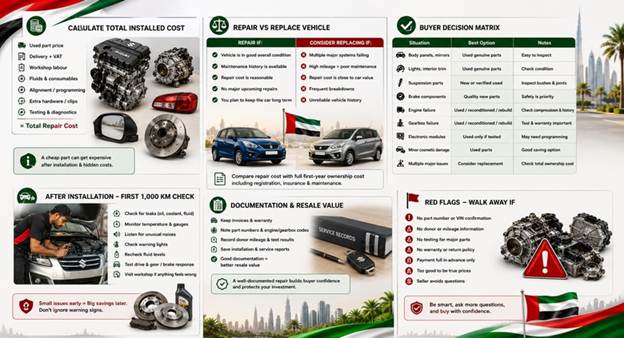
Used Suzuki Parts Buyer Decision Matrix
| Situation | Preferred starting point |
| Door, fender or bonnet damage | Used genuine |
| Good used bumper available | Compare against repair/new |
| Interior trim damaged | Used genuine |
| Headlight replacement | Used if tested and intact |
| Brake wear | Quality new replacement |
| Suspension failure | New vs verified used |
| Electronic module fault | Diagnose and test first |
| Engine failure | Used vs reconditioned vs rebuild |
| Gearbox failure | Test, then compare replacement routes |
| Multiple major faults | Repair vs vehicle replacement |
The matrix isn't a substitute for diagnosis.
It simply stops every repair from becoming a “buy new” decision by default.
Used Suzuki Parts and Installation Timeline: Get the Date in Writing
If the part is already in UAE stock, installation may be straightforward.
If it needs to be sourced, the timetable can stretch.
Major repairs can also reveal additional problems after dismantling.
So ask:
When will the part arrive?
When will installation begin?
When is testing expected to finish?
When should the vehicle be ready?
For an engine or gearbox replacement, allow some flexibility because the workshop may discover supporting parts that need attention.
A realistic timeline is better than a confident promise that collapses halfway through the repair.
Used Suzuki Spare Parts Documentation: Keep the Evidence
Keep the purchase invoice.
Keep the part number.
Record the vehicle mileage.
For engines and gearboxes, keep the donor information.
Save test reports.
Save warranty terms.
Save the installation invoice.
This becomes particularly useful later when another workshop needs to diagnose the vehicle.
It can also help during resale because the next buyer can see what was replaced rather than hearing a vague story about “some engine work”.
Used Suzuki Spare Parts and Resale Value
A used replacement doesn't automatically damage resale value.
Poorly documented major repairs can.
Consider an Ertiga with a replacement gearbox.
One owner has the gearbox part number, donor mileage, installation invoice and warranty.
Another simply says, “Gearbox was changed.”
The physical repair may be similar.
The buyer's confidence won't be.
Documentation reduces uncertainty.
And with older Suzuki vehicles, reducing uncertainty can be surprisingly valuable.
Used Suzuki Parts: When Should You Walk Away From the Cheap Option?
Walk away when the evidence doesn't support the risk.
If the part number cannot be confirmed, stop.
If the donor history is suspicious, stop.
If an expensive engine has no meaningful test evidence, stop.
If an electronic module has no testing information and no return protection, stop.
If the saving compared with a new part is tiny, stop and compare again.
The cheapest used Suzuki part isn't necessarily the bargain.
The better bargain is the part that remains economical after fitment, installation, warranty, downtime and the possibility of doing the job twice are all counted.
Ordering Used Suzuki Parts, Installation and Final Buying Decisions
Where to Buy Used Suzuki Spare Parts in UAE: What Should Buyers Verify?
Finding a used Suzuki part isn't particularly difficult.
Finding the right used Suzuki part is.
That's the difference.
Before paying, establish who is actually supplying the part, where it is located, whether the photographed item is the one you will receive and what happens if it arrives damaged or turns out to be incompatible. A seller with clear answers is easier to deal with than someone who keeps replying with a vague “available, sir” while avoiding every useful question.
For buyers in Dubai, Abu Dhabi, Sharjah, Ajman or other UAE emirates, check:
Actual UAE stock + part number + donor vehicle + condition + testing + warranty + return terms + delivery time.
If the part is already inside the UAE, ask where it is.
Why?
Because “available in UAE” and “available tomorrow” are not necessarily the same thing.
Used Suzuki Parts Online in UAE: Is the Photograph Showing the Actual Part?
This sounds minor.
It isn't.
A used part isn't manufactured to identical condition like a new boxed replacement. One headlight may have clear mounting tabs; another from the same model might have a repaired bracket. One bumper could be clean and straight while another carries old impact marks underneath.
Ask whether the photograph shows the exact unit being sold.
For engines and gearboxes, request photographs of:
Identification number + casing + mounting points + connectors + visible condition.
For body parts, ask for both sides.
For electrical modules, get a close photograph of the connector and label.
If the seller only provides a polished catalogue image, don't treat it as proof of condition.
Used Suzuki Spare Parts Ordering Checklist: What to Confirm Before Payment
Keep the process simple.
Before paying, confirm:
| Check | What to verify |
| VIN | Vehicle identity |
| Model/year | Exact generation |
| Engine | Engine specification |
| Transmission | Manual/automatic and type |
| Part number | Exact application |
| Condition | Damage, wear and corrosion |
| Donor | Vehicle source and history |
| Mileage | Especially for major assemblies |
| Testing | What was actually tested |
| Warranty | Duration and coverage |
| Delivery | UAE location and expected arrival |
| Installation | Labour and additional work |
| Return | Conditions if incompatible |
If several boxes remain unanswered, don't rush.
A good deal can wait ten minutes.
A wrong engine cannot.
Used Suzuki Parts Delivery Across UAE: Why Location Matters
A Dubai buyer may find a used part in Sharjah within easy reach.
An Abu Dhabi owner may need it transported from another emirate.
An owner in Ajman, Ras Al Khaimah, Fujairah or Umm Al Quwain may have fewer immediately available choices for uncommon parts.
That doesn't mean local is always cheaper.
It means delivery time becomes part of the buying decision.
Ask whether the quoted price includes delivery.
Then ask when the part will actually arrive.
For a routine mirror, waiting a couple of days may not matter.
For a Suzuki sitting dismantled in a workshop because its engine or gearbox has already been removed, every additional day becomes more annoying—and potentially more expensive.
Used Suzuki Spare Parts and Workshop Labour: Calculate the Installed Cost
A used part costing AED 500 isn't necessarily a AED 500 repair.
The workshop may charge for:
Diagnosis + removal + installation + fluids + alignment + programming + additional hardware.
Some repairs are simple.
Others are labour-heavy.
Replacing a mirror may be straightforward.
Replacing a gearbox is not.
Installing a used engine may also involve changing fluids, filters, seals or other supporting items while the vehicle is already apart.
So ask for the complete installed estimate.
That's the number you should compare between used and new options.
Used Suzuki Engine Replacement: What Additional Parts May Be Needed?
A used engine rarely goes into the car as though someone simply swaps one box for another.
Depending on its condition and what is supplied, the workshop may recommend or require gaskets, seals, fluids, filters, belts, hoses, spark plugs and other supporting parts.
Some accessories may also be transferred from the original engine.
This is why two sellers can quote dramatically different engine prices.
One may offer a bare engine.
Another may supply a more complete assembly.
Ask exactly what you are buying.
Then ask the workshop what must be transferred or replaced during installation.
Otherwise, the initial price comparison isn't really comparing the same thing.
Used Suzuki Gearbox Replacement: What Should Be Checked During Installation?
When the gearbox is out, access improves.
That can be useful.
The workshop can inspect related seals, mounts, fluid condition and other surrounding areas rather than putting everything back together and hoping for the best.
For automatic transmissions, use the correct fluid specification and follow the manufacturer's or transmission specialist's requirements.
For manual gearboxes, inspect the clutch system where appropriate, particularly if the clutch has already shown signs of wear.
Nobody wants to pay gearbox labour twice because an ageing related part was ignored while everything was already apart.
Used Suzuki Suspension Parts: Replace in Pairs or Individually?
It depends on the part.
For some suspension items, replacing one failed part may be entirely reasonable.
For others, replacing components in pairs can provide more balanced behaviour, particularly where both sides have similar mileage and wear.
Ask the workshop to explain the recommendation.
Don't accept:
“You have to change both.”
Ask why.
Is the second side worn?
Is balanced performance important?
Is the manufacturer recommendation relevant?
Would replacing one side create a significant difference?
A proper answer should be based on condition and application, not simply on increasing the parts bill.
Used Suzuki Brake Parts: Where Saving Money Can Go Wrong
Brakes are not the place for creative shortcuts.
A used bumper can have a scratch.
A used brake part can affect how the vehicle stops.
For pads, discs and other safety-critical braking parts, quality new replacements are generally the safer starting point unless a used part has a very specific, professionally verified application and condition.
Inspect the entire braking system rather than replacing whatever part looks cheapest online.
If the vehicle pulls under braking, vibrates through the steering wheel or produces unusual noise, get the system inspected.
Don't turn a brake repair into an experiment.
Used Suzuki Electrical Parts: Programming and Compatibility Costs
An electronic module can be inexpensive compared with the labour required to diagnose why it isn't communicating with the car.
Before buying a used ECU, control module or other electronic part, ask whether it is:
Plug-and-play + coded + programmed + calibrated + vehicle-specific.
Some parts may need additional setup after installation.
If the seller says the module is compatible, ask whether that means physically compatible or fully operational after installation.
Those aren't always the same thing.
A used module that fits the connector but requires programming isn't necessarily a bad purchase.
You simply need to include the programming cost in the calculation.
Used Suzuki Parts Warranty: What Should Be Written on the Invoice?
Don't rely on a verbal promise.
The invoice or warranty documentation should identify the part, warranty period and relevant conditions.
For major parts, also keep:
Part number + donor details + mileage + test information + installation date.
If a used engine has a 30-day warranty, find out when the period begins.
At purchase?
At delivery?
At installation?
Those details can matter if the workshop has a queue.
Used Suzuki Spare Parts Return Policy: What If the Part Doesn't Fit?
Compatibility should be confirmed before ordering.
Still, mistakes happen.
Ask what happens if the part arrives and the workshop determines that it doesn't match the vehicle.
Find out whether the supplier accepts returns for:
Incorrect application + damaged delivery + defective part + mismatch with confirmed part number.
Also ask whether the part must remain uninstalled.
This is especially important for electronic parts and engines because installation can complicate return claims.
A clear return policy is worth more than a slightly cheaper listing with no protection.
Used Suzuki Spare Parts: What Counts as a Red Flag?
Be cautious when you hear:
“No need for VIN.”
“Same model, it will fit.”
“Engine is perfect, no testing needed.”
“Warranty? Don't worry about it.”
“Picture is only for reference.”
“Pay first, we will check later.”
One of these statements alone may not prove anything.
Several together?
Walk away.
The used-parts market is too broad to justify taking unnecessary risks when the seller cannot provide basic information.
Used Suzuki Spare Parts: How to Compare Three Quotations Properly
Suppose you receive three prices for the same Swift suspension part.
Don't immediately choose the lowest.
Put the quotations side by side.
| Check | Supplier A | Supplier B | Supplier C |
| Exact part number | Confirmed | Confirmed | Unknown |
| Condition | Used | Used | Used |
| Donor information | Available | Unknown | Available |
| Testing | Yes | No | Yes |
| Warranty | Included | None | Included |
| UAE stock | Yes | Unclear | Yes |
| Delivery | Same/next day | Several days | Same day |
| Installation | Separate | Separate | Included |
Suddenly, the cheapest quotation may not look cheapest anymore.
That's the point.
Compare equivalent offers, not isolated numbers.
Used Suzuki Parts and First-Year Ownership Cost: Look Beyond the Immediate Repair
An older Suzuki can remain remarkably economical even after a significant repair.
But only if the rest of the vehicle is reasonably healthy.
Before spending heavily on a used engine or gearbox, look at:
Tyres + brakes + suspension + AC + cooling system + battery + electrical condition + upcoming maintenance.
If all of those are already in good shape, a major repair can make financial sense.
If several are failing at the same time, the repair bill may only be the beginning.
Don't judge the vehicle by one broken part.
Judge the next twelve months.
Used Suzuki Repair vs Replace Vehicle: When Does the Maths Change?
Imagine a 12-year-old Ciaz with a failed gearbox.
If the body is straight, engine is healthy, AC works, suspension is good and the maintenance history is solid, replacing the gearbox may be perfectly rational.
Now change the scenario.
The same Ciaz needs a gearbox, AC compressor, suspension, tyres and major cooling-system work.
That's different.
The repair-versus-replace calculation should include current repair cost + likely near-term repairs + downtime + vehicle condition + replacement-car cost.
Don't compare a repair bill with the purchase price of a completely different car and stop there.
A replacement vehicle also brings registration, insurance, financing where applicable, immediate maintenance and depreciation.
Used Suzuki Spare Parts: Repair or Replace Decision Matrix
| Vehicle condition | More sensible approach |
| Healthy car, one failed part | Repair |
| Minor body damage | Used body part |
| Good vehicle, worn suspension | Replace worn parts |
| Engine failed, rest of car healthy | Compare used/reconditioned engine |
| Gearbox failed, strong maintenance history | Compare rebuild/used/reconditioned |
| Several major systems failing | Calculate vehicle replacement |
| Unknown maintenance history | Inspect entire vehicle first |
| Frequent workshop downtime | Consider replacement economics |
The objective isn't to spend less today.
It is to avoid spending badly.
Used Suzuki Spare Parts: How Mileage Should Affect Your Decision
Mileage becomes increasingly useful when the part itself is mileage-sensitive.
For a used engine or gearbox, donor mileage matters.
For suspension, brakes and wheel hubs, wear history matters.
For a body panel, mileage is almost irrelevant compared with accident or cosmetic history.
That's why “low mileage” should never be treated as a universal quality stamp.
A 50,000-km engine with poor maintenance can be a worse purchase than a 100,000-km engine with strong service history and good test results.
Context beats the odometer.
Used Suzuki Parts After Installation: Check the First 1,000 km
Don't disappear from the workshop after collecting the car.
The first few hundred kilometres can reveal whether something needs attention.
After a suspension repair, watch for new knocking, steering pull, vibration or uneven tyre wear.
After brake work, watch for pulling, unusual noise or vibration.
After engine installation, monitor coolant level, oil level, leaks, warning lights and engine temperature.
After gearbox replacement, pay attention to shift quality, fluid leaks, abnormal noise and warning messages.
If something feels wrong, return to the workshop early.
Small symptoms are easier to investigate than major failures.
Used Suzuki Spare Parts Documentation: Protect the Vehicle's History
Keep everything.
Invoice. Part number. Donor information. Mileage. Test results. Warranty. Installation date. Workshop invoice.
For an engine replacement, keep the compression-test results if available.
For a gearbox, retain the transmission identification and test information.
For bodywork, keep photographs if the repair was substantial.
This creates a proper repair trail.
And later, when you sell the Suzuki, you won't have to rely on memory to explain what happened.
Used Suzuki Parts and Resale Value: Does Second-Hand Mean Lower Value?
Not automatically.
A buyer is more likely to worry about unknown repairs than the simple fact that a used part was installed.
A documented used engine from a known donor, supported by testing and warranty, is easier to explain than an undocumented engine replacement.
Likewise, a genuine used body panel fitted correctly can be preferable to a poor-quality aftermarket panel that never quite matches the car.
Quality of work matters.
Documentation matters.
Fitment matters.
Used Suzuki Spare Parts Buying Checklist: Before You Press Pay
Keep this beside you while ordering:
VIN confirmed?
Exact part number confirmed?
Correct engine and transmission?
Actual used part photographed?
Condition checked?
Donor identified?
Mileage known where relevant?
Testing completed?
Warranty written down?
Return terms understood?
Delivery date confirmed?
Installation cost known?
Additional parts included or excluded?
Total repair cost calculated?
If the answer is yes across the board, you're no longer buying blindly.
You're making a considered purchase.
The Best Used Suzuki Part Is the One That Still Makes Sense After Installation
The cheapest listing can look fantastic on a phone screen.
Then the workshop gets involved.
Delivery. Labour. Fluids. Alignment. Programming. Additional hardware. Warranty conditions. Downtime.
Suddenly, the “cheap” part has a much less impressive price tag.
For Swift, Jimny, Vitara, Baleno, Ciaz and Ertiga, used parts can absolutely make financial sense in the UAE—but the smart buyer checks the whole chain from vehicle identification to installation and warranty, rather than stopping at the first attractive number.
Check the VIN.
Match the part number.
Question the condition.
Ask what was tested.
Read the warranty.
Then calculate the complete repair.
That's how a second-hand Suzuki part becomes a calculated purchase instead of a gamble.
FAQs — Used Suzuki Spare Parts in UAE
Categories
- Audi
- BMW
- Car Accessories
- Car Tips
- Ford
- Land Rover
- Mazda
- Range Rover
- Top 10
- UAE Car Parts
- Used Car Parts
- Toyota
- Replacement Engines
- Nissan
- Hyundai
- Mitsubishi
- Volkswagen
- Honda
- Kia
- Chevrolet
- Dodge
- Jeep
- Subaru
- Renault
- Lexus
- Mercedes
- Suzuki
- Hummer
- Porsche
- Infiniti
- Peugeot
- GMC
- Mini
- Volvo
- Replacement Gearboxes
- MG
- Jaguar
- Skoda
- Cadillac
- Daihatsu
- Fiat
- German Car Parts
- Japanese Car Parts
- Aftermarket Car Parts
- Genuine Car Parts
- New Car Parts
- Reconditioned Car Parts
- European Car Parts
- American Car Parts
- Korean Car Parts
- British Car Parts
- Chinese Car Parts
- Sports/Exotic Car Parts
- Luxury Car Parts
- Performance Car Parts
- SUV/4x4 Spare Parts
- Truck Spare Parts
- EV Car Parts
- Hybrid Car Parts
- Auto Spare Parts in UAE
- Tesla
- Isuzu
- Ram
- Ferrari
- Bentley
- Lamborghini
- Genesis
- Maserati
- Lincoln
- Chrysler
- Opel
- Citroen
- SsangYong
- Seat
- McLaren
- Aston Martin
- Rolls Royce
- Maybach
- Alfa Romeo
- Bugatti
- Scion
- Abu Dhabi Car Parts
- Ajman Car Parts
- Al Khan Car Parts
- Al Sajaa Car Parts
- Deira Car Parts
- Dubai Car Parts
- Fujairah Car Parts
- Industrial Area 6 Car Parts
- Mussafah Car Parts
- Ras Al Khaimah Car Parts
- Sharjah Car Parts
- Umm Al Quwain Car Parts
- Acura
- BYD
- Chery
- Dacia
- DS
- Geely Emgrand
- EXEED
- GAC
- GAC Gonow
- Geely
- Gonow
- Great Wall
- Haima
- Haval
- Holden
- Iveco
- JAC
- Jaecoo
- Jetour
- Lotus
- Omoda
- Proton
- Renault Samsung
- Roewe
- Lucid
- Replacement Headlight