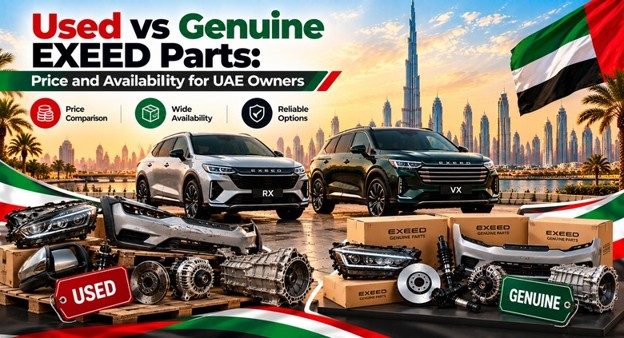
Used vs Genuine EXEED Parts: Price and Availability for UAE Owners
October 2, 2026
The cheapest EXEED part is often the easiest one to quote and the hardest one to judge.
A supplier says “used”. Another says “genuine EXEED parts in UAE”. A third offers an aftermarket replacement at a noticeably different price. All three may fit the same search box on a UAE parts website. That does not make them equivalent purchases.
For an EXEED owner, the real decision is more practical: what are you buying, where did it come from, does it actually match the car, and what happens if it fails or turns out to be wrong?
That question has become more relevant as the EXEED fleet in the UAE expands. The official UAE operation now supports petrol models including the RX and VX alongside newer electrified models, and EXEED launched a regional spare-parts distribution centre in 2025. In July 2026, the brand also opened its first Sharjah 3S facility, taking its UAE network to six locations.
There is more choice now.
Choice, unfortunately, also creates more ways to buy the wrong thing.
UAE Update Reference: September 2026
Used and genuine answer different questions
A genuine EXEED part answers a provenance question: it is supplied through the manufacturer's authorised parts channel and is intended to meet EXEED's specified application.
A used part answers a history question.
It tells you that the component has already been installed in another vehicle.
That distinction matters.
A used genuine headlight may be preferable to an unknown aftermarket headlight in one repair. A new genuine bumper may make little economic sense for an older vehicle where a straight, undamaged used panel is readily available. A used electronic module, meanwhile, can introduce compatibility and programming issues that do not exist with a simple body trim piece.
There is no universal winner.
The part decides the argument.
What does “genuine EXEED” actually mean in the UAE?
EXEED UAE states that genuine EXEED parts and accessories are available through authorised Al Ghurair Mobility service centres and parts departments. Its service information also says authorised repairs use manufacturer-approved genuine components.
That gives genuine parts a traceable supply route.
It also means a buyer has a clearer starting point if the vehicle is still within warranty.
But “genuine” does not mean every genuine part is automatically the economically sensible purchase for every vehicle. A ten-year-old car and a nearly new car present very different repair calculations.
The important thing is to understand what the genuine quotation buys you.
Used does not mean poor quality
There is a bad habit in parts buying: treating “used” as a synonym for “damaged”.
It isn't.
A used component can have come from a vehicle that was dismantled for reasons unrelated to that particular part. A body panel might be straight and undamaged. A mirror may have intact motors and wiring. A gearbox may have a documented donor history.
But the opposite is also true.
A used component can have an unknown history, hidden damage, corrosion, flood exposure, excessive wear or an electrical fault that is not visible on a supplier's photograph.
Used describes history, not quality.
That should be printed on every used-parts quotation in large letters.
Why genuine parts can cost more without the difference being “markup”
A genuine part may carry costs associated with manufacturer distribution, inventory, packaging, application control, warranty administration and authorised supply.
There can also be a simpler reason: the component is manufactured to the vehicle manufacturer's specification and supplied through the official parts chain.
That does not prove that the price difference is justified in every repair.
It does explain why comparing a genuine component with a used one as if they were identical products is misleading.
They are different propositions.
The UAE has a genuine parts route that did not exist at the same scale a few years ago
EXEED's Middle East Regional Parts Center was announced in April/May 2025 as a spare-parts distribution hub intended to improve parts availability and aftersales support across the region.
For UAE owners, that matters.
A parts market becomes easier to navigate when there is a manufacturer-backed supply route alongside independent suppliers, used dismantling channels and aftermarket sellers.
It does not guarantee immediate stock of every component.
A regional distribution centre is infrastructure, not a magic warehouse containing every bumper, module and headlight.
Genuine availability is strongest where the official network already supports the model
EXEED UAE currently lists the RX and VX as part of its UAE range and supports them through its authorised aftersales network. The official service operation states that genuine parts are used at authorised service centres.
That makes genuine sourcing relatively straightforward in principle.
The complication comes when the requested part is unusual, discontinued, temporarily out of stock or specific to a less common configuration.
That is where independent sourcing starts to become more interesting.
Independent UAE suppliers can offer used, genuine and aftermarket choices
The independent market is not limited to one type of part.
UAE-facing suppliers currently advertise used, genuine, non-genuine and aftermarket EXEED components, with categories covering mechanical parts, body parts, lights, electrical components, air-conditioning parts and maintenance items.
That broader menu is useful.
But it shifts more responsibility to the buyer.
When a supplier gives you three choices, ask what actually separates them:
condition, provenance, warranty, manufacturer, application, stock location, delivery time and return terms.
“New” alone does not answer all of those questions.
Used parts can be particularly useful for bodywork
Body panels are one of the easier areas in which used parts can make financial sense.
A bonnet, fender, door shell, grille or bumper cover can often be inspected physically.
You can check:
dents, cracks, mounting points, corrosion, previous repairs, distortion and obvious accident damage.
Paint condition is another matter. A used panel in the correct colour may reduce painting requirements, but colour matching can still vary because of age, exposure and previous refinishing.
The important point is that a used body panel is relatively easy to inspect compared with a hidden electronic module.
The RX illustrates why a panel price is only the beginning
A current UAE-facing parts listing puts an EXEED RX front fender at AED 550, while a front-door assembly is listed at AED 4,500. These are supplier listing prices, not universal UAE transaction prices.
Those two figures also demonstrate why “used versus genuine” cannot be discussed sensibly without knowing the component.
A used fender might be an attractive option if it is straight, undamaged and correctly specified.
A complete door assembly deserves more scrutiny because “complete” can mean different things: shell, trim, glass, wiring, switches, mechanisms and other hardware may or may not be included.
Ask what is physically in the box.
RX bumpers show the same problem from another angle
A UAE-facing supplier currently lists an RX front bumper at AED 1,950, while a front bumper support is listed at AED 750 for a specified application.
That is useful market evidence, but it is not an installed accident-repair price.
A used bumper may appear dramatically cheaper until you discover that the supplied cover has broken mounts, needs extensive repair or does not include the grille and associated hardware.
Conversely, a new genuine bumper may look expensive until you compare the complete job rather than the plastic component alone.
Price needs context.
Headlights are where the used-versus-genuine decision gets more technical
A body panel can be judged largely by sight.
A modern headlight cannot.
Depending on specification, the assembly can contain LED hardware, control electronics, motors, sensors or other vehicle-specific components.
UAE-facing EXEED parts marketplaces currently advertise both used and new lighting options, with left- and right-side applications.
That does not mean every used headlight is a poor purchase.
It means you need more information before buying one.
Ask whether the assembly is complete, whether mounting tabs are intact, whether the lens has moisture or damage, whether the control electronics are included and whether any calibration or programming is required.
A used headlight needs a condition report, not just a photograph
Ask the supplier for:
Lens condition: cracks, chips, fogging or moisture
Housing: broken mounting tabs or repaired areas
Connectors: intact and undamaged
Electronics: included or excluded
Side: left or right
Application: exact model and year
Condition: tested or simply removed
Warranty: duration and coverage
Return: conditions after fitting
A photograph can reveal a cracked lens.
It cannot prove that an electronic control unit will communicate correctly with the vehicle.
Brake parts are a different calculation
Used brake pads are usually a poor fit for ordinary replacement logic because they are wear items.
Used calipers, however, are a different proposition.
A used caliper can potentially be inspected for corrosion, piston condition, mounting damage and leakage, subject to proper workshop inspection. A new pad set can then be installed alongside it.
The same principle applies to other brake hardware: distinguish the wear item from the reusable assembly.
For safety-critical components, condition and testing matter more than the simple word “used”.
Suspension parts sit somewhere in the middle
A used suspension arm may look perfectly healthy.
The problem is that bushes and joints can deteriorate without producing obvious external damage.
A used shock absorber may have no dramatic visual defect but still have degraded damping or leakage.
For that reason, used suspension components need more scrutiny than a used bonnet or grille.
Ask about donor mileage, condition, visible leakage, joint play where applicable and warranty.
If the labour to replace the part is significant, the cost of discovering a poor used component after installation becomes part of the decision.
Gearboxes are not ordinary used parts
A used gearbox can save substantial money compared with a new assembly.
It can also create a second repair if its history is unknown.
Before buying a used EXEED transmission, establish:
- donor model
- donor year
- transmission type
- donor mileage
- reason for dismantling
- accident or flood history
- oil/fluid condition where inspectable
- testing evidence
- exact part reference
- warranty
- return terms
A supplier saying “same gearbox” is not enough.
For an RX Super Hybrid, the transmission architecture is also different from the conventional petrol RX, which EXEED identifies separately from the hybrid model.
That is exactly the sort of distinction a VIN check is designed to catch.
Electronic modules are where cheap used parts can become expensive
An ECU, body-control module, parking-control unit, camera module or other electronic controller can be physically identical to the eye and still be wrong for the vehicle.
Hardware version matters.
Software can matter.
Coding can matter.
Vehicle configuration can matter.
Security pairing can matter.
So can calibration.
A used module should therefore be treated as a technical component, not a generic second-hand item.
The supplier's part number matters — but it is not magic
A visible number on an EXEED component can be useful.
It can also be misunderstood.
The number may be a manufacturer reference, supplier reference, moulding number, production identifier or another marking. Some parts are superseded by later references.
The safest process is:
VIN → model/year → powertrain → component application → part reference → supplier confirmation.
For expensive components, add a photograph of the existing label.
That gives the supplier more information than “I need an RX headlight”.
Why VIN becomes more important as the part gets more expensive
You probably do not need a full VIN investigation to buy a generic cabin filter.
You absolutely want stronger identification before buying:
a gearbox, electronic module, adaptive headlight, major suspension assembly, hybrid component or expensive body assembly.
The reason is simple.
The cost of being wrong rises with the cost and complexity of the part.
A mismatched filter wastes a small amount of money.
A mismatched transmission can involve delivery, workshop labour, fluids, diagnostic work, removal and refitting.
Genuine does not automatically mean “the right economic decision”
Suppose an older EXEED needs a body panel.
The genuine component costs considerably more than a straight used panel.
If the used panel has known provenance, intact mounts, suitable condition and a workable return arrangement, the used option may be financially sensible.
Now change the part to a sophisticated electronic module.
The calculation changes.
The used module may require programming, may not be compatible, or may have an unknown internal fault.
The same price principle cannot sensibly be applied to both.
Aftermarket belongs in the comparison too
Used versus genuine is not actually a two-way choice.
For many components, the real market offers at least four routes:
new genuine, new aftermarket, used genuine, reconditioned.
Each answers a different buyer need.
A new aftermarket component can provide a lower purchase price while retaining new-component condition.
A used genuine component can provide original manufacture at a lower entry cost.
A reconditioned component depends heavily on what was actually rebuilt and tested.
And a new genuine component offers the clearest manufacturer-backed supply route.
The label alone does not settle the question.
“OEM” is one of the most abused words in parts trading
A supplier may describe a component as OEM when they mean original-equipment manufacture.
Another may use the term to mean a non-genuine replacement made to a similar specification.
A third may simply use it as a quality signal.
Do not buy on the word.
Ask:
Who manufactured it?
What is the exact part reference?
Is it genuine EXEED packaging?
What warranty applies?
What evidence supports the stated origin?
That is a much more useful conversation.
The UAE warranty changes the calculation for newer EXEEDs
EXEED UAE currently advertises a 7-year / 200,000 km manufacturer warranty, subject to its terms and conditions. Its service information states that authorised repairs use genuine or manufacturer-approved components.
The warranty position should therefore be checked before independently sourcing a major replacement part for a vehicle still within coverage.
This matters particularly for engine, transmission and electrical-system repairs.
The apparent saving from a used component may not be meaningful if the vehicle could instead be assessed through the authorised warranty route.
Newer EXEEDs have a particularly important sourcing advantage
The current UAE EXEED fleet is relatively young.
That means many used components may come from relatively recent donor vehicles, but it also means the used-parts history for some models is still developing.
The official certified pre-owned programme, for example, currently lists two VX vehicles: one 2026 VX FL2 Prestige at AED 120,000 with 2,444 km and another listed at AED 135,000 with 28,591 km. Both are described as under warranty and GCC specification.
These are vehicle listings, not parts prices.
But they tell us something useful about the donor ecosystem: relatively young EXEED vehicles are already entering the UAE used market.
That may gradually increase the availability of dismantled components.
Why donor mileage matters
Imagine two used EXEED headlight assemblies.
One came from a vehicle with 4,000 km.
The other came from a vehicle with 180,000 km.
You cannot assume the first is perfect and the second is unusable. But the mileage is useful evidence.
For mechanical assemblies, mileage can be particularly relevant.
For electronic parts, it is one piece of the history rather than a complete condition report.
For body panels, mileage may matter much less than accident history.
Again, the component decides what evidence matters.
Accident-damaged donors require extra caution
A dismantled vehicle can contain many usable components.
It can also contain parts damaged by the same accident.
This is particularly important when buying:
front suspension, steering components, headlights, bumper structures, radiators, cooling assemblies, wheels, sensors and electronic modules.
A donor vehicle written off after a rear-end collision may offer a useful front headlight.
The same vehicle's rear electronics deserve much more scrutiny.
Ask why the donor was dismantled.
That single question can change the value of the part.
Flood-damaged donors are a different category again
Water exposure can be particularly troublesome for electronic components, connectors, wiring and control modules.
A part can dry out and still develop problems later.
For used EXEED electronics, ask whether the donor vehicle had flood or water damage.
If the seller cannot provide a credible answer, the uncertainty itself has a cost.
This is especially relevant in UAE sourcing when parts are imported from outside the country and donor history may be incomplete.
Used genuine lights can make more sense than cheap new alternatives — sometimes
Consider an accident-damaged RX headlight.
Option A: new genuine assembly.
Option B: used genuine assembly from a documented donor.
Option C: unknown aftermarket assembly.
The sensible decision depends on the evidence.
If the used genuine lamp is complete, undamaged, tested, correctly matched and backed by a meaningful return policy, it may be a reasonable route.
If the used lamp has broken mounts or unknown electronics, the apparent saving disappears.
If the aftermarket unit has clear manufacturer information, correct application and a credible warranty, it deserves a proper comparison rather than automatic dismissal.
This is not about choosing a category.
It is about choosing a known component.
Used body panels are easier to inspect than used electronics
This sounds almost too obvious, but it changes how much risk you should accept.
For a used fender:
look at the shape, mounting holes, edge condition, corrosion and previous repair.
For a used control module:
you need identification, software compatibility, donor information, testing and possibly programming.
The inspection burden rises sharply as the part becomes more electronic.
That should influence how much price discount you expect before accepting used.
Availability can be worth paying for
Suppose a genuine part is available through the UAE network but costs more.
A used part is cheaper but needs to be sourced from another emirate or imported and has uncertain delivery.
If the vehicle is occupying a workshop bay, downtime has a cost.
A part that arrives tomorrow may produce a lower total repair cost than a cheaper component that arrives next week.
This is especially relevant after accidents.
The cheapest listing is not necessarily the cheapest repair.
Genuine parts availability is becoming easier to support locally
EXEED's regional parts centre and expanding UAE network are relevant here. The brand's July 2026 announcement said the new Sharjah 3S facility brought the UAE network to six locations and included service support for the current EXEED lineup and New Energy Vehicles.
That creates another question for the buyer:
Have you checked the official route before assuming the genuine part is unavailable?
The independent market can still be useful, particularly for price comparison, older vehicles, used components and non-warranty repairs.
But “the dealer doesn't have it” should ideally mean the dealer or authorised parts department has actually checked the application and stock position.
Public price evidence: what can we actually say in September 2026?
A few UAE-facing listing observations are useful as reference points.
| EXEED component | Public UAE listing observation | What it means |
| RX front bumper | AED 1,950 | Listed component price |
| RX front bumper support | AED 750 | Listed component price for specified application |
| RX front fender | AED 550 | Listed component price |
| RX front door assembly | AED 4,500 | Listed assembly price |
| VX front brake pads | AED 420 | Tax-inclusive supplier listing |
| VX rear brake pads | AED 385 | Tax-inclusive supplier listing |
These are public supplier listing observations, not universal UAE market prices. Genuine EXEED retail prices for equivalent components were not consistently published in the sources reviewed, so a direct “used costs X, genuine costs Y” table would create false precision.
That distinction is important enough to keep.
Why there is no honest universal “used parts discount”
People often ask:
“How much cheaper are used EXEED parts?”
There is no defensible single percentage.
A used bonnet may be dramatically cheaper than a new genuine one.
A used electronic module might not be much cheaper once programming and testing are included.
A used gearbox can show a substantial price difference while carrying considerably more condition risk.
A used bumper may be cheap but require painting.
The discount depends on the component, donor, condition, provenance and supply situation.
The hidden cost of a cheap used part
The calculation should include more than the purchase price.
Used component
- delivery
- inspection
- labour
- supporting parts
- programming/calibration where applicable
- return risk
- possible repeat labour
- downtime
= real repair cost
That is why a used part priced AED 800 below a new component does not necessarily save AED 800.
If installation fails and the vehicle has to return to the workshop, the saving may vanish.
What a supplier should tell you before you buy a used EXEED part
For a serious used-parts purchase, ask for:
Part: exact component
Vehicle: model and year
Donor: model/year where known
Mileage: donor mileage
Condition: tested, inspected or untested
History: accident/flood information
Reference: part number or application reference
Photos: actual part, not catalogue image
Warranty: written duration
Returns: conditions
Delivery: timing and cost
VAT: included or separate
If the seller cannot answer most of those questions, the low price needs to compensate for a substantial amount of uncertainty.
What should a workshop inspect before fitting a used part?
That depends on the component.
For a body panel: mounting points, distortion and previous repair.
For suspension: joints, bushes, leakage and damage.
For a gearbox: identification, condition, fluid where applicable and compatibility.
For a headlight: mounting tabs, lens, connector, electronics and application.
For a control module: part reference, hardware/software compatibility and programming requirements.
For a used engine: compression and leak-down testing may be appropriate where relevant, alongside oil condition, cooling-system checks and other engine-specific inspection.
The workshop should inspect the thing that can actually fail.
A buyer decision matrix for EXEED parts
| Situation | Route to investigate | Main evidence required |
| New vehicle under warranty | Genuine/authorised route | Warranty eligibility and diagnosis |
| Older vehicle, cosmetic damage | Used genuine or new aftermarket | Physical condition and fitment |
| Expensive headlight | Genuine vs tested used | Part reference, electronics, warranty |
| RX bumper accident | New, used or repair | Hidden damage, supports, sensors, paint |
| Suspension assembly | New or tested used | Donor mileage, joints, bushes, leakage |
| Gearbox problem | Diagnose first | Fault evidence, transmission identification |
| Electronic module | Genuine or verified used | Hardware/software compatibility |
| Rare/discontinued part | Used/reconditioned/new alternative | Provenance, supersession, returns |
| High-voltage component | Specialist diagnosis first | Vehicle architecture, fault evidence, safety |
This is deliberately not a ranking.
The appropriate route changes with the part and the vehicle.
Before You Click Buy: the five-minute EXEED parts check
Before sending payment, confirm:
1. Exact vehicle
RX, VX, LX, TXL or an electrified model.
2. Exact year and variant
Do not rely on the badge alone.
3. VIN or application confirmation
Especially for expensive components.
4. Exact condition
New genuine, new aftermarket, used genuine, reconditioned.
5. Actual photographs
For used parts.
6. Part reference
Where available.
7. Warranty
Get it in writing.
8. Return policy
Especially before electrical installation.
9. Delivery
Ask whether the component is physically in the UAE.
10. Complete cost
Include labour, paint, programming, calibration, delivery and VAT where applicable.
Ten minutes of checking can be worth considerably more than another round of price bargaining.
The “cheapest” quote can hide three different risks
There are three common traps.
Fitment risk: the part does not match the vehicle.
Condition risk: the part fits but is already worn or damaged.
Support risk: the part works initially but there is no meaningful warranty or return route.
Genuine parts tend to reduce some of these uncertainties through the authorised supply chain.
Used parts can reduce purchase price while increasing the amount of history you need to investigate.
Aftermarket parts can reduce cost while shifting more responsibility towards manufacturer quality and application verification.
That is the real trade-off.
How PartFinder UAE fits into the sourcing decision
PartFinder UAE can be useful when an owner wants to compare sourcing possibilities rather than automatically defaulting to one category.
But the same discipline applies there as it does with a dealer or independent supplier:
identify the vehicle, specify the part, establish the condition, confirm fitment and ask what happens if the component is wrong.
The website or supplier channel is not the evidence.
The part information is the evidence.
The practical rule: buy certainty where certainty matters
There are EXEED parts for which paying more for a genuine component can make the sourcing process simpler.
There are others where a properly inspected used component can make perfectly good economic sense.
A used bonnet is not the same decision as a used ECU.
A used bumper is not the same decision as a used gearbox.
A new aftermarket brake component is not the same decision as a used suspension assembly.
And a high-voltage electronic component deserves an entirely different level of scrutiny again.
For UAE owners, the sensible approach is therefore not used versus genuine as a blanket argument.
It is:
What failed?
What exactly fits?
What is the part's history?
What evidence supports its condition?
What will the complete repair cost?
What happens if it fails?
Answer those questions before paying.
The lowest number on the quotation is then just one piece of information — which is exactly what it should have been all along.
FAQs
Categories
- Audi
- BMW
- Car Accessories
- Car Tips
- Ford
- Land Rover
- Mazda
- Range Rover
- Top 10
- UAE Car Parts
- Used Car Parts
- Toyota
- Replacement Engines
- Nissan
- Hyundai
- Mitsubishi
- Volkswagen
- Honda
- Kia
- Chevrolet
- Dodge
- Jeep
- Subaru
- Renault
- Lexus
- Mercedes
- Suzuki
- Hummer
- Porsche
- Infiniti
- Peugeot
- GMC
- Mini
- Volvo
- Replacement Gearboxes
- MG
- Jaguar
- Skoda
- Cadillac
- Daihatsu
- Fiat
- German Car Parts
- Japanese Car Parts
- Aftermarket Car Parts
- Genuine Car Parts
- New Car Parts
- Reconditioned Car Parts
- European Car Parts
- American Car Parts
- Korean Car Parts
- British Car Parts
- Chinese Car Parts
- Sports/Exotic Car Parts
- Luxury Car Parts
- Performance Car Parts
- SUV/4x4 Spare Parts
- Truck Spare Parts
- EV Car Parts
- Hybrid Car Parts
- Auto Spare Parts in UAE
- Tesla
- Isuzu
- Ram
- Ferrari
- Bentley
- Lamborghini
- Genesis
- Maserati
- Lincoln
- Chrysler
- Opel
- Citroen
- SsangYong
- Seat
- McLaren
- Aston Martin
- Rolls Royce
- Maybach
- Alfa Romeo
- Bugatti
- Scion
- Abu Dhabi Car Parts
- Ajman Car Parts
- Al Khan Car Parts
- Al Sajaa Car Parts
- Deira Car Parts
- Dubai Car Parts
- Fujairah Car Parts
- Industrial Area 6 Car Parts
- Mussafah Car Parts
- Ras Al Khaimah Car Parts
- Sharjah Car Parts
- Umm Al Quwain Car Parts
- Acura
- BYD
- Chery
- Dacia
- DS
- Geely Emgrand
- EXEED