Used vs Genuine Geely Parts in UAE: Which Replacement Option Makes More Sense?
October 5, 2026
A used Geely part can look like the obvious bargain until the saving disappears inside diagnosis, fitting, programming, return delays and the second repair you never budgeted for. The new genuine Geely spare parts in UAE can go the other way: technically straightforward, but sometimes expensive enough to make an older Coolray, Monjaro, Emgrand or another Geely owner question the economics.
That is the real decision.
Not “used or genuine?” in the abstract. The useful question is: what part is being replaced, what exactly is wrong with the vehicle, how well can the used component be verified, and what does failure cost after installation?
That matters particularly in the UAE because Geely’s current local range includes vehicles with very different levels of mechanical and electronic complexity. The current Coolray uses a 1.5TD engine and 7DCT transmission, while the current Monjaro combines a 2.0TD engine, 8AT transmission, 4WD and electronically controlled suspension.
A used exterior trim piece and a used electronically controlled suspension component should not be judged by the same rule.
Neither should a brake pad, turbocharger, headlamp, gearbox control component or engine assembly.
UAE Update Reference: September 2026
Used and genuine are not opposites
The first mistake is treating “used” and “genuine” as two competing quality grades.
They describe different things.
Used describes history. A used part has previously been installed on another vehicle, although its exact history may be unknown. It might have come from a low-mileage donor, an accident-damaged vehicle, a dismantled car with a mechanical fault, or a vehicle that simply reached the end of its useful life.
Genuine describes origin and intended manufacturer application. A genuine Geely replacement part supplied through the proper parts channel is intended for the relevant vehicle application.
A part can therefore be both used and genuine.
That distinction changes the buying conversation immediately. A used genuine headlight, for example, is still a used component. Its advantage may be correct application and original construction, but it can still have damaged mounting tabs, moisture intrusion, previous repair work, internal faults or a different specification from the buyer's vehicle.
Conversely, a new part is not automatically genuine simply because it is new.
That is why the first question should be: What exactly am I buying?
What Geely UAE currently says about original parts
Geely UAE maintains a dedicated spare-parts section where owners can select their vehicle model and check parts information, while its local site directs spare-parts enquiries towards its parts team for availability and pricing.
That is useful because it establishes something important about the official route: a genuine-part decision is not supposed to be made from a photograph alone.
The vehicle application matters.
For a current Geely, that can mean model, model year, drivetrain, engine/transmission configuration, trim and sometimes the vehicle identification number. The more electronically complicated the component, the more important that identification becomes.
The official UAE warranty information also states that authorised Geely dealers perform diagnostics, repairs and adjustments using original Geely parts for covered warranty work. Geely UAE currently advertises a vehicle warranty of up to seven years or 250,000 km, whichever comes first, subject to its warranty terms and exclusions.
So if a vehicle is still within warranty, the economics of using a used part are not simply about the price printed on a dismantler's shelf.
Why a used part can be dramatically cheaper
Used parts can be cheaper for a straightforward reason: the manufacturing cost has already been paid.
A dismantler is recovering value from an existing vehicle rather than selling a newly manufactured component.
There is another factor. Demand for some individual parts is uneven.
A dismantler might have several usable body panels, mirrors, lamps or suspension components because those vehicles are being broken for parts, while a new replacement from the official channel may carry a substantially higher retail price.
This creates genuine opportunities.
A used body mirror with intact housing, correct electrical connections and a known donor vehicle can make economic sense. So can a body bracket, trim component or certain mechanical assembly where the replacement is difficult to justify financially.
But the cheap purchase price is only the first number.
A buyer should ask what happens if the part fails after installation.
The UAE price evidence needs a little caution
Public UAE listings show why price comparisons can be misleading.
For example, a current public Chinese Car Parts UAE listing shows a Geely Coolray front brake pad at AED 340, rear brake pad at AED 260, engine mount at AED 420, and front wheel hub bearing at AED 300. The same supplier lists a Coolray radiator at an advertised AED 750 on one current listing, while another page shows an earlier AED 1,312.50 price.
Those figures are useful market observations, but they are not official Geely UAE dealer quotations.
The supplier's pages also contain its own claims about parts quality and originality, which should be treated as the seller's claims rather than independent verification.
That distinction matters.
A serious comparison should therefore label a number as:
- official Geely UAE price;
- independent UAE advertised price;
- used-part asking price;
- workshop quotation;
- installed repair estimate.
Mixing all five together produces a meaningless “average”.
The real cost is the installed cost
Suppose a used component costs AED 500 and a new genuine component costs AED 1,300.
At first glance, the used component saves AED 800.
But now add diagnosis, fitting, fluid replacement, coding, calibration, delivery, return handling or a second workshop visit.
The saving may shrink quickly.
For some components, the difference is even more awkward. A technician may need to remove surrounding parts to reach the failed component. If the used replacement is faulty, the labour can effectively be paid twice.
That is why the relevant calculation is:
Part price + diagnosis + labour + supporting parts + programming/calibration + downtime + warranty/return risk = real repair cost.
The part itself is only one line.
When a used genuine Geely part makes strong economic sense
Used parts become more attractive when four things line up.
The component is expensive when bought new.
Its condition can be inspected.
Its function can be tested before or after installation.
And a replacement failure does not create disproportionate labour or safety risk.
That makes certain body and interior components natural candidates.
A door mirror housing, interior trim, non-critical bracket, boot trim, certain switches or a body panel may be easier to evaluate than a control module or transmission assembly.
A used original component can also make sense for an older Geely where the new-part price is disproportionate to the vehicle's current market value.
The trick is not finding “used”.
It is finding known, compatible and testable used.
When new genuine is easier to justify
New genuine parts become much easier to justify when failure has serious consequences.
Think braking, steering, engine management, advanced driver-assistance hardware, major transmission electronics, electronically controlled suspension or components that require precise calibration.
The argument is not that every used component in these categories is unsafe.
It is that the evidence burden is higher.
A new genuine component gives the buyer a much cleaner chain of identification and supply. There is still a fitting and diagnosis process, but the unknown history of a donor vehicle largely disappears.
For a relatively low-cost component, the extra price may be small enough that gambling on an unknown used unit simply makes little financial sense.
Coolray owners face a different equation from Monjaro owners
The current UAE Coolray is built around a 1.5TD turbocharged engine and 7DCT transmission, with Geely UAE listing 174 hp and 290 Nm for the current model.
The Monjaro is more complex in several respects. The current UAE model uses a 2.0TD engine, 8AT transmission, 4WD and CCD adaptive suspension, with Geely UAE listing 238 hp and 350 Nm.
That does not mean every Monjaro part must be genuine.
It means the consequences of buying the wrong part can be greater.
A used bumper is still mostly a fitment and condition problem.
A used electronic suspension component may become a fitment, diagnostic, calibration and software problem.
That is a completely different purchase.
Used Coolray parts: where the numbers become interesting
The public UAE Coolray market provides several examples.
A current listing shows a front brake pad at AED 340 and rear brake pad at AED 260. An engine mount is listed at AED 420, while a front shock absorber is listed at AED 714 and a front lower arm at AED 504.
There are also much more expensive body and lighting components.
A Coolray headlamp is publicly listed at AED 1,984.50 per side, while a daytime running light is listed at AED 724.50. A rear centre light appears at AED 2,047.50 on another listing.
That is where a used genuine component can become commercially interesting.
Saving a few hundred dirhams on a cheap service item may not justify uncertainty.
Saving a meaningful amount on a complete lighting assembly might.
But only if the used lamp is actually tested.
A used Coolray headlight needs more than a visual inspection
A headlight can look perfect in a photograph and still be a poor purchase.
Check the lens.
Then the housing.
Then the mounting points.
Then the connectors.
Then evidence of condensation.
Then signs of opening, resealing or repair.
Then whether the internal lighting functions match the vehicle specification.
If the unit includes electronically controlled functions, the workshop should also confirm communication and operation after installation.
A lamp that physically bolts into place is not necessarily a fully compatible lamp.
This is exactly where “same model” becomes too vague.
Model year and specification can matter.
Monjaro parts deserve a higher evidence threshold
The Monjaro's equipment makes this especially relevant.
Geely UAE lists features including 4WD, advanced driver assistance, a 540-degree camera system and CCD adaptive suspension on current Monjaro information.
That means certain components are not simply mechanical objects.
A sensor may feed another control system.
A camera may require calibration.
A suspension component may interact with electronic control.
A replacement module may require configuration.
A used component can therefore be perfectly healthy and still be unsuitable for the specific vehicle if its hardware, software or application differs.
The price difference alone tells you very little.
Used Monjaro brake parts: cheaper does not automatically mean better value
Public UAE listings show Monjaro front brake pads at AED 275 on one listing, rear pads at AED 245, and another front-pad listing at AED 485.
That spread is enough to prove the problem with simplistic price comparisons.
Which exact part?
Which supplier?
Which specification?
Is the listing current?
Is VAT included?
Is it actually in stock?
Is it new, used, aftermarket or original?
Are you comparing a pair, an axle set or an individual component?
Before deciding that one option is cheaper, the buyer needs to establish what is actually being sold.
Body parts are where used parts can become particularly attractive
Accident repair changes the economics.
A bumper, fender, grille, mirror, tail lamp or certain trim pieces may be expensive enough when purchased new that a good used original component becomes attractive.
Public UAE listings currently show a Coolray front bumper lower body at AED 829.50, rear bumper lower body at AED 1,029 and front bumper support at AED 514.50.
For accident repairs, condition becomes everything.
A used bumper with broken clips may require additional brackets.
A repaired panel may need more preparation before painting.
A lamp may have hidden mounting damage.
A used mirror may contain a damaged motor or camera.
The cheapest visible part is rarely the same thing as the cheapest completed repair.
Ask where the used part came from
This question gets skipped far too often.
A dismantler should be able to tell you something about the donor vehicle.
At minimum, ask:
- model and year;
- engine and transmission;
- drivetrain;
- mileage where known;
- reason for dismantling;
- accident location;
- flood or water exposure;
- whether the component was tested;
- whether it was removed from a running vehicle;
- storage conditions;
- return or exchange terms.
A donor vehicle that was rear-ended is a different proposition from one that suffered a front-end fire.
A vehicle exposed to flood water is a particularly poor source for electronic parts unless their condition has been established independently.
“Taken from a working car” is useful information, but it is not a complete inspection report.
Mileage matters differently for different components
Mileage is not a universal quality measurement.
A used body panel does not become mechanically worn because the donor travelled 150,000 km.
A gearbox does.
A turbocharger does.
A suspension damper does.
A wheel bearing does.
A starter motor or alternator may.
An electronic module may have relatively little mechanical wear but can still suffer from heat, moisture, electrical faults or previous damage.
So asking only “How many kilometres?” is not enough.
Ask what kind of wear applies to this particular part?
A used gearbox is not just a cheaper gearbox
This is one of the places where a cheap purchase can become an expensive mistake.
The current Coolray uses a 7DCT transmission, while the Monjaro uses an 8AT configuration in the UAE.
A used gearbox must therefore be matched to the exact vehicle application.
Then investigate donor mileage, fluid condition, previous symptoms, accident history and storage.
The workshop should also establish why the original gearbox failed.
If the original failed because of an external cooling, lubrication or electrical problem, simply installing another gearbox without correcting the underlying fault can produce the same expensive outcome again.
That is the cost of getting the diagnosis wrong.
Engine assemblies need even more scrutiny
A used engine can be financially sensible, especially for an older vehicle whose replacement value does not justify a brand-new assembly.
But “engine assembly” can mean different things.
Is it a complete dressed engine?
Long block?
Short block?
Does it include turbocharger?
Injectors?
Ancillaries?
Alternator?
Starter?
Intake?
Wiring?
ECU?
What is actually included in the advertised price?
This needs to be written down before purchase.
A used engine that looks cheap because major supporting components are excluded may not be cheap after all.
Compression testing is useful, but it is not magic
For a used engine, compression testing can provide valuable evidence about cylinder sealing.
It can identify significant differences between cylinders and support further diagnosis.
But it does not certify an engine as “good”.
Compression results should be interpreted against the manufacturer's specifications and test procedure. If results are questionable, a leak-down test can help distinguish certain leakage paths.
Oil pressure, cooling-system condition, turbocharger condition, abnormal noises and scan data may also matter.
A seller saying “compression is good” without showing how it was measured, what the readings were and what specification they were compared against is weak evidence.
Electronic parts change the used-versus-genuine equation
Modern Geely vehicles contain considerably more electronics than older cars.
The Monjaro, for example, includes advanced driver assistance, multiple cameras and electronic suspension-related equipment.
A used electronic module therefore needs more than a matching connector.
The workshop may need to confirm:
hardware → software → vehicle application → communication → coding → calibration → final function.
That sequence is especially important for control modules, cameras, radar-related components, electronic steering, ABS-related electronics and other safety or control systems.
A used module that cannot be configured correctly may turn a cheap purchase into a stranded vehicle.
Genuine does not mean “fit it and forget it”
There is a temptation to assume that a genuine part eliminates diagnosis.
It does not.
A genuine replacement cannot repair a fault that was misdiagnosed.
If a Coolray has poor acceleration, for example, the cause could involve air supply, fuel delivery, ignition, boost control, transmission behaviour, sensors or other systems. Replacing a turbocharger simply because boost is low would be poor diagnosis.
The same principle applies to cooling.
An overheating vehicle does not automatically need a radiator.
A warning light does not automatically mean the named component is defective.
Correct parts still need correct diagnosis.
When aftermarket should enter the conversation
The choice is not always:
used vs genuine.
Sometimes the sensible comparison is:
used genuine vs new genuine vs reputable aftermarket vs reconditioned.
That is particularly relevant for service and wear components.
The aftermarket part needs its own evidence, though.
Ask who manufactured it, what application it covers, whether the specification is documented, what warranty applies and whether the workshop is comfortable fitting it.
“Aftermarket” is not a synonym for poor quality.
It is simply too broad a category to tell you much by itself.
Warranty can change the calculation
Geely UAE currently states that its authorised dealers perform warranty diagnostics and repairs using original Geely parts. The local warranty page currently describes coverage of up to seven years or 250,000 km, subject to the stated terms and exclusions.
That makes warranty status one of the first questions to ask before sourcing a used replacement.
If the vehicle is covered and the repair qualifies, the owner should establish the warranty position before buying a part independently.
Otherwise, the buyer may save money on the component while creating a completely unnecessary dispute over the repair route.
Do not assume warranty coverage or exclusion from a generic internet statement. Check the actual warranty documentation applicable to the vehicle.
What about an older Geely?
This is where used genuine parts become increasingly relevant.
As vehicles age, some components become harder to source quickly. A used original part from a dismantled vehicle can provide a practical route when the new replacement is expensive, delayed or no longer readily available.
But older vehicles need stronger identification discipline, not weaker.
The longer a model has been on the market, the more likely you are to encounter revisions, facelift differences, regional specifications and superseded components.
A photograph of the old part beside a photograph of the replacement is not enough.
Use the vehicle identification information and verify the application.
VIN comes before price
For a high-value or complicated Geely component, the correct order is:
VIN → vehicle application → component reference → physical comparison → installation confirmation.
Not:
cheap listing → photograph → order.
This is especially important when a supplier's catalogue contains multiple versions of a part.
A VIN-based confirmation can reveal differences that are invisible in photographs.
The buyer should keep the VIN available when requesting a quotation for expensive components.
If the seller refuses to verify compatibility and simply says “this fits Coolray”, that is not enough evidence for a high-value purchase.
How to inspect a used part before paying
The inspection should be specific to the component.
For mechanical parts, look for:
- cracks;
- corrosion;
- oil contamination;
- impact marks;
- damaged threads;
- abnormal play;
- bent shafts;
- worn bushes;
- leaks;
- broken mounts.
For electrical parts:
- connector damage;
- corrosion;
- water intrusion;
- damaged pins;
- housing cracks;
- signs of overheating;
- evidence of previous opening or repair.
For body parts:
- repaired fractures;
- distorted mounting points;
- missing clips;
- overspray;
- filler;
- inconsistent panel gaps;
- repaired tabs.
For lights:
- moisture;
- broken mounts;
- lens damage;
- internal contamination;
- connector condition;
- operation of all relevant functions.
The inspection should answer a question, not simply create the impression that someone “checked it”.
Ask for a return policy before asking for a discount
A return policy can be worth more than a small discount.
Suppose a used module costs AED 700 rather than AED 1,200.
Saving AED 500 looks attractive.
But if the module arrives, fails programming, and the seller refuses returns, the saving disappears.
For used mechanical components, ask whether the seller accepts returns for proven incompatibility or confirmed failure.
For electronic components, ask specifically what happens if the part communicates incorrectly, cannot be coded or fails after installation.
Get the answer in writing where possible.
“Warranty available” is too vague.
Ask what is covered, for how long, and under what proof of failure?
The workshop should diagnose before you buy
A good workshop should be able to explain why the component needs replacing.
That sounds obvious. It is surprisingly valuable.
Ask:
What test proved this part failed?
The answer might involve scan data, voltage measurement, pressure testing, physical inspection, play measurement, road testing, compression testing, leak-down testing or another relevant diagnostic procedure.
If the answer is simply “the computer says so”, ask for the actual fault code and supporting diagnosis.
A diagnostic trouble code can identify a system or circuit and point the technician towards a fault. It does not automatically prove that the most expensive component connected to that circuit needs replacing.
Compare options using the cost-of-failure test
Here is a practical way to decide.
Used is more defensible when:
- the part is expensive new;
- the donor history is credible;
- condition can be inspected;
- compatibility is confirmed;
- the part can be tested;
- return terms are clear;
- installation is straightforward;
- failure would not create major safety or calibration concerns.
New genuine is easier to justify when:
- the part is safety-critical;
- the part is electronically integrated;
- coding or calibration is involved;
- labour is high;
- the component is difficult to access;
- failure could damage another system;
- the vehicle is still under warranty;
- the price difference is modest compared with total repair cost.
That is a more useful framework than saying “always buy genuine”.
A simple Geely buyer decision matrix
| Part type | Used genuine | New genuine | Main concern |
| Body trim | Often practical | Useful if readily affordable | Condition and fitment |
| Mirror housing | Often practical | Better for integrated electronics | Motors/camera/sensors |
| Bumper | Often practical | Straightforward option | Mounts, cracks, clips |
| Headlight | Possible with testing | Easier to justify | Electronics, moisture, calibration |
| Brake components | Requires careful sourcing | Often easier for wear items | Specification and safety |
| Suspension arm | Possible | Useful where labour is high | Bush wear, geometry |
| Shock absorber | Needs condition evidence | Often preferable | Internal wear/leaks |
| Engine mount | Possible | Compare carefully | Rubber deterioration |
| Radiator | Possible | Compare price and warranty | Cooling performance |
| Turbocharger | High evidence required | Often easier to justify | Wear, oiling, boost |
| Gearbox | High evidence required | Stronger case for new/rebuilt | Donor history and diagnosis |
| ECU/module | High risk | Usually easier to justify | Coding and compatibility |
| Camera/radar-related component | High verification burden | Stronger case for correct new unit | Calibration |
| Engine assembly | Possible | Depends on economics | Compression, history, included parts |
The table is not a universal rulebook. It is a way of identifying where the evidence burden rises.
What should a UAE Geely owner do before buying?
Start with the diagnosis.
Then identify the vehicle precisely.
Then ask for the part reference or application confirmation.
Then obtain at least two price points where practical.
One can be the official route. Another can be a credible independent source.
For a used part, add donor information and return terms.
For a new genuine part, ask whether the quoted price includes VAT, whether the part is physically available, whether programming or calibration is extra, and whether fitting is included.
For either option, ask what else should be replaced during the repair.
A brake job may involve discs, pads, wear hardware and inspection.
A cooling-system repair may involve coolant, hoses, seals or related components.
A transmission replacement may involve fluids, adaptation or additional hardware.
The quotation needs to describe the whole job.
How public UAE prices should be used in a quotation
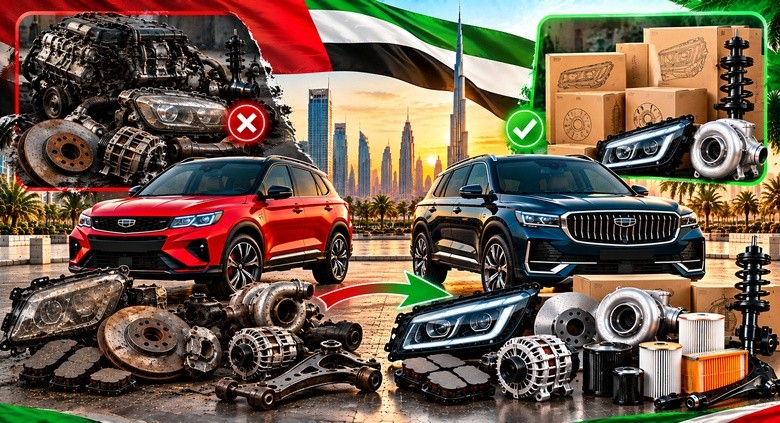
Public listings are useful as reference points, not as automatic workshop quotations.
For example, a current UAE Coolray listing shows an engine mount at AED 420, a front hub bearing at AED 300 and a front shock absorber at AED 714.
Those numbers can help an owner recognise an obviously unusual quotation.
They cannot tell you the final repair bill.
Installation labour, diagnosis, alignment, fluids, supporting hardware and workshop overhead may all change the total.
The same applies to the advertised Coolray headlight price of AED 1,984.50. That is a component listing, not an installed accident-repair estimate.
A buyer should never take a retail component price and present it as a complete UAE repair cost.
Monjaro's complexity makes installation evidence more important
A Monjaro is not simply a larger Coolray.
The current UAE Monjaro includes 4WD, an 8-speed automatic transmission and CCD adaptive suspension, alongside a broad set of electronic driver-assistance and camera functions.
That increases the number of situations where “the part fits” is an inadequate answer.
After installation, the workshop may need to check fault codes, live data, system communication, calibration and road-test behaviour.
This does not mean used Monjaro parts should be rejected automatically.
It means the buyer should spend more effort proving compatibility before paying.
Why the cheapest part can become the most expensive repair
Imagine two scenarios.
A used component costs AED 600.
A new genuine component costs AED 1,200.
The owner chooses the used part.
Installation costs AED 300.
The part fails.
Removal and refitting costs another AED 300.
The owner now needs another replacement.
The apparent AED 600 saving has vanished before considering downtime.
That example is deliberately simple. Actual labour and parts vary by vehicle and workshop.
The principle does not.
A low purchase price is not a low repair cost if failure is expensive to reverse.
The strongest case for used parts is not always price
Used original parts can solve availability problems.
They can preserve factory fitment.
They can be particularly useful for older or less common Geely models.
They can also make accident repairs economically viable when new body or lighting components are disproportionately expensive.
In those situations, the value is not merely “cheap”.
It is access to a suitable original component at a sensible total cost.
That is a much stronger argument.
The strongest case for genuine parts is certainty
New genuine parts remove one major unknown: previous vehicle history.
They do not eliminate every possible failure.
They do, however, simplify the provenance question.
For complicated electronic, safety-related or high-labour components, that reduction in uncertainty can be worth paying for.
The calculation becomes particularly persuasive when the difference between used and new is relatively small compared with installation cost.
Paying an additional amount for the component may be cheaper than paying for the same labour twice.
A UAE sourcing strategy that avoids the usual mistakes
A sensible sourcing sequence is:
First: diagnose the vehicle.
Second: identify the exact application.
Third: check the official Geely UAE route for availability and pricing. Geely UAE provides a dedicated spare-parts enquiry route and currently lists Coolray and Monjaro among its supported models.
Fourth: check credible independent UAE suppliers.
Fifth: compare the actual part specification, not just the photograph.
Sixth: if buying used, investigate donor history and return conditions.
Seventh: calculate installed cost.
Eighth: confirm any coding, calibration, adaptation or post-installation testing.
Only then does the price comparison become meaningful.
Where PartFinder UAE fits into the buying decision
For buyers comparing available replacement routes, the useful objective is not simply to locate the lowest advertised number. The better approach is to establish the vehicle application, compare the available part condition and source, and then assess the total repair cost before committing.
That is particularly important for Geely vehicles with expensive electronic, lighting, drivetrain or suspension components.
PartFinder UAE can help with discovery.
It cannot replace diagnosis.
The buyer still needs the correct vehicle information and a workshop capable of confirming the part before installation.
What not to believe when buying a used Geely part
Be cautious with statements such as:
“Same model, so it fits.”
“Taken from a working car.”
“Original part.”
“Plug and play.”
“No coding needed.”
“Low mileage.”
“Tested.”
“Best quality.”
None of these statements is useless.
None is enough on its own.
Ask for evidence.
What model year?
What specification?
What donor?
What mileage?
What test?
What fault was the donor vehicle suffering from?
What is included?
What happens if it does not work?
That conversation is far more valuable than another AED 50 discount.
Used vs genuine: the decision in plain English
If the component is inexpensive, critical to safety or difficult to access, the argument often shifts towards a new, correctly specified part.
If the component is expensive, mechanically simple, easily inspected and available from a credible donor, a used original part can be financially sensible.
If the component contains software, sensors, cameras, control electronics or calibration-sensitive functions, raise the evidence standard.
If the vehicle is under warranty, establish the warranty position before buying anything independently.
And if the repair is for an older Geely, consider used genuine parts as one option rather than treating them as a last resort.
There is no universal winner.
There is only a better-supported purchase.
The final check before you hand over the money
Before buying a used Geely part, ask yourself five questions:
Do I know exactly which vehicle this came from?
Do I know exactly which version of my vehicle it is going onto?
Do I have evidence that the part actually works?
Do I know what happens if it fails?
Have I compared the total installed cost with a new genuine alternative?
If the answer to several of those questions is no, the apparent bargain is carrying too much uncertainty.
The smarter comparison is not used versus genuine.
It is known condition versus unknown condition, verified compatibility versus assumed compatibility, and lower purchase price versus lower total repair risk.
For a UAE Geely owner, that is the distinction that can save money without turning a parts purchase into another repair.
Frequently Asked Questions
Categories
- Audi
- BMW
- Car Accessories
- Car Tips
- Ford
- Land Rover
- Mazda
- Range Rover
- Top 10
- UAE Car Parts
- Used Car Parts
- Toyota
- Replacement Engines
- Nissan
- Hyundai
- Mitsubishi
- Volkswagen
- Honda
- Kia
- Chevrolet
- Dodge
- Jeep
- Subaru
- Renault
- Lexus
- Mercedes
- Suzuki
- Hummer
- Porsche
- Infiniti
- Peugeot
- GMC
- Mini
- Volvo
- Replacement Gearboxes
- MG
- Jaguar
- Skoda
- Cadillac
- Daihatsu
- Fiat
- German Car Parts
- Japanese Car Parts
- Aftermarket Car Parts
- Genuine Car Parts
- New Car Parts
- Reconditioned Car Parts
- European Car Parts
- American Car Parts
- Korean Car Parts
- British Car Parts
- Chinese Car Parts
- Sports/Exotic Car Parts
- Luxury Car Parts
- Performance Car Parts
- SUV/4x4 Spare Parts
- Truck Spare Parts
- EV Car Parts
- Hybrid Car Parts
- Auto Spare Parts in UAE
- Tesla
- Isuzu
- Ram
- Ferrari
- Bentley
- Lamborghini
- Genesis
- Maserati
- Lincoln
- Chrysler
- Opel
- Citroen
- SsangYong
- Seat
- McLaren
- Aston Martin
- Rolls Royce
- Maybach
- Alfa Romeo
- Bugatti
- Scion
- Abu Dhabi Car Parts
- Ajman Car Parts
- Al Khan Car Parts
- Al Sajaa Car Parts
- Deira Car Parts
- Dubai Car Parts
- Fujairah Car Parts
- Industrial Area 6 Car Parts
- Mussafah Car Parts
- Ras Al Khaimah Car Parts
- Sharjah Car Parts
- Umm Al Quwain Car Parts
- Acura
- BYD
- Chery
- Dacia
- DS
- Geely Emgrand
- EXEED
- GAC
- GAC Gonow
- Geely