Used vs Genuine Japanese Car Parts in UAE: Which Should You Choose?
July 27, 2026
Understanding Japanese Car Parts
Japanese vehicles have earned a reputation that few manufacturers can match.
Whether it's a Toyota Land Cruiser tackling long desert journeys, a Nissan Patrol serving families across the Emirates, a Honda Accord commuting through Dubai traffic or a Mazda CX-5 covering daily motorway miles, Japanese cars are widely recognised for reliability, durability and sensible running costs.
That reputation is one of the reasons Japanese brands remain among the most popular vehicles on UAE roads.
Eventually, however, even the most dependable vehicle requires replacement parts.
A suspension component wears out.
A headlamp is damaged.
An alternator fails.
A gearbox develops a fault.
An engine cooling component reaches the end of its service life.
When that moment arrives, owners are usually faced with an important decision.
Should you buy a used Japanese car part?
Or should you invest in a genuine replacement?
The answer depends on far more than price.
Compatibility, condition, warranty, intended ownership period and the quality of the supplier all influence the right decision.
Throughout this guide, we'll examine those factors in detail to help you make informed buying decisions for Japanese vehicles across the UAE.
Why Japanese Car Parts Are in High Demand Across the UAE
Japanese vehicles dominate many roads throughout the Emirates.
Private owners appreciate their reliability.
Businesses value predictable maintenance costs.
Fleet operators depend on their durability.
Taxi companies often choose them because of their long service lives.
Popular Japanese brands found across Dubai, Abu Dhabi, Sharjah, Ajman, Ras Al Khaimah, Fujairah and Umm Al Quwain include:
- Toyota.
- Nissan.
- Honda.
- Mitsubishi.
- Mazda.
- Suzuki.
- Lexus.
- Infiniti.
- Subaru.
- Isuzu.
The large number of vehicles on the road naturally creates consistent demand for quality replacement parts.
As vehicles age, owners increasingly compare used and genuine components to balance repair costs with long-term reliability.
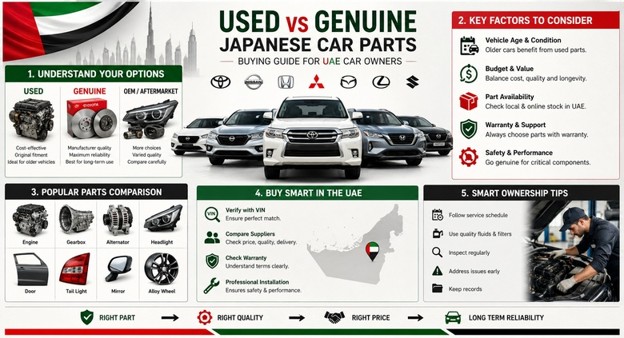
Used vs Genuine Japanese Car Parts: Understanding the Difference
Before comparing prices, it's important to understand what each option actually means.
Used Japanese Car Parts
Used parts are original components removed from donor vehicles before being inspected and prepared for resale.
Depending on the supplier, these parts may undergo cleaning, inspection and testing before being offered for sale.
Quality varies, making supplier reputation particularly important.
Genuine Japanese Car Parts
Genuine parts are supplied through the vehicle manufacturer's authorised parts network.
They are produced to the manufacturer's exact specifications and designed specifically for the vehicle.
Although genuine parts generally cost more, many owners value the reassurance that comes with factory-approved compatibility.
Understanding these distinctions makes it easier to compare overall value rather than focusing solely on the purchase price.
Why More UAE Drivers Compare Used and Genuine Parts Before Buying
Vehicle ownership costs continue to influence buying decisions.
Rather than automatically choosing the cheapest or most expensive option, many UAE motorists compare every available alternative before approving repairs.
Reasons include:
- Managing repair budgets.
- Maintaining older vehicles economically.
- Preserving resale value.
- Reducing vehicle downtime.
- Finding discontinued components.
- Choosing original factory parts at lower cost.
A carefully inspected used component may provide outstanding value for one repair.
A genuine replacement may prove the wiser investment for another.
Successful purchasing depends on understanding where each option performs best.
Common Japanese Car Parts That Require Replacement
Even reliable vehicles experience normal wear over time.
The components most commonly replaced include:
- Engines.
- Gearboxes.
- Alternators.
- Starter motors.
- Suspension arms.
- Shock absorbers.
- Brake components.
- Radiators.
- Air-conditioning compressors.
- Steering racks.
- Headlights.
- Tail lights.
- Mirrors.
- Body panels.
- Interior trim.
Some of these items are consumable components.
Others may require replacement because of accident damage, age or mechanical failure.
Knowing the purpose of each component helps buyers choose the most suitable replacement option.
Genuine, OEM, Used and Aftermarket Japanese Parts Explained
Many buyers encounter several different terms while comparing suppliers.
Understanding the differences helps avoid confusion.
Genuine Parts
Manufactured to the vehicle manufacturer's specifications and supplied through authorised distribution channels.
These parts generally provide excellent compatibility and consistent quality.
OEM Parts
Original Equipment Manufacturer components are produced by companies that supply manufacturers during vehicle production.
Many OEM parts offer factory-level quality while often costing less than genuine alternatives.
Used Parts
Original factory components previously installed on another vehicle.
Their suitability depends on inspection, condition, mileage where relevant and supplier quality.
Aftermarket Parts
Produced independently by third-party manufacturers.
Quality varies considerably.
Well-established aftermarket brands can offer dependable performance, while lower-quality products may compromise durability or fitment.
Understanding these categories allows buyers to compare value more confidently.
How to Choose the Right Japanese Parts Supplier
The supplier often determines whether a repair proceeds smoothly.
Experienced specialists do more than simply sell components.
They also help confirm compatibility before an order is placed.
Look for suppliers that can:
- Verify compatibility using the VIN.
- Explain the differences between genuine, OEM and used parts.
- Offer warranty support.
- Provide technical guidance.
- Arrange delivery across the UAE.
- Source difficult-to-find Japanese vehicle components.
A knowledgeable supplier reduces ordering mistakes while improving the overall buying experience.
Workshop Story: A Genuine Part Wasn't the Only Solution
A Nissan X-Trail owner visited a specialist workshop after sustaining minor front-end damage.
The initial quotation included several brand-new genuine body panels, resulting in a repair cost that exceeded the owner's budget.
Before proceeding, the workshop sourced professionally inspected original used panels from the same model and production year.
Each panel matched the factory specification and required only minor paint preparation before installation.
The completed repair restored the vehicle's appearance while significantly reducing overall costs.
The owner achieved an excellent result without compromising fitment or quality.
The lesson was simple.
The best solution depends on the component, not just the label attached to it.
Why Accurate Diagnosis Comes Before Buying Parts
One of the most expensive mistakes vehicle owners make is purchasing replacement parts before identifying the actual fault.
A warning light may indicate:
- A faulty sensor.
- A damaged wiring connection.
- A worn mechanical component.
- A software issue.
- A cooling system problem.
- An electrical fault.
Replacing major assemblies before confirming the cause often leads to unnecessary expense.
Professional diagnostics help identify the correct repair from the beginning.
Key Takeaways
Before moving to the next section, remember these important points:
- Japanese vehicles remain among the most reliable and widely owned cars in the UAE.
- Used and genuine parts both have important advantages depending on the repair.
- Supplier expertise is just as important as the component itself.
- Understanding the differences between genuine, OEM, used and aftermarket parts leads to better purchasing decisions.
- VIN verification and professional diagnostics help prevent costly compatibility mistakes.
- The most economical repair is often the one based on accurate diagnosis rather than assumptions.
Engine Components
Ask any experienced technician which part has the greatest influence on a vehicle's performance, and the answer is likely to be immediate.
The engine.
Whether it's powering a Toyota Land Cruiser across long desert highways, moving a Nissan Patrol through demanding off-road terrain or handling everyday commuting in a Honda Civic or Mazda 6, the engine remains the centre of every journey.
Fortunately, Japanese engines have earned a worldwide reputation for longevity.
Regular servicing, quality lubricants and proper maintenance allow many of them to cover hundreds of thousands of kilometres with remarkable reliability.
Even so, no engine lasts forever.
Overheating.
Poor maintenance.
Oil starvation.
Mechanical wear.
Accident damage.
Cooling system failures.
Each can eventually lead to expensive repairs or complete engine replacement.
When that happens, owners are usually faced with a familiar question.
Should you buy a used engine?
Or invest in a genuine replacement?
The answer depends on much more than the purchase price.
Used vs Genuine Japanese Engines
A used Japanese engine is typically removed from a donor vehicle before being inspected and prepared for resale.
Many owners choose this option because it can significantly reduce repair costs, particularly for older vehicles whose market value may not justify the expense of a brand-new engine.
A genuine engine, on the other hand, is supplied through the manufacturer's official parts network and built to factory specifications.
Both options have clear advantages.
| Feature | Used Engine | Genuine Engine |
| Purchase price | Lower | Highest |
| Original factory component | Yes | Yes |
| Expected service life | Depends on condition | Maximum potential |
| Warranty | Varies by supplier | Usually more comprehensive |
| Best suited for | Cost-conscious repairs | Long-term ownership |
The correct decision depends on the vehicle, the condition of the replacement engine and the owner's future plans.
Engine Internal Components: Which Option Is Better?
Not every engine problem requires replacing the complete unit.
Many internal components can be repaired or replaced individually.
Common engine components include:
- Pistons.
- Connecting rods.
- Crankshafts.
- Camshafts.
- Cylinder heads.
- Timing components.
- Valves.
- Bearings.
Some of these parts are routinely replaced during professional engine rebuilding.
Others are generally sourced as new or genuine components because of the precision required.
Accurate diagnosis should always determine whether repair or replacement offers better value.
Turbochargers, Fuel Systems and Intake Components
Many Japanese petrol and diesel vehicles rely on turbochargers to improve efficiency and performance.
Alongside the turbocharger itself, several supporting components influence engine operation.
These include:
- Turbochargers.
- Intercoolers.
- Fuel injectors.
- High-pressure fuel pumps.
- Intake manifolds.
- Throttle bodies.
- Air intake pipes.
- Mass airflow sensors.
Professionally inspected used turbochargers may provide excellent value in some situations.
However, worn or poorly maintained units can introduce further reliability issues if purchased without proper inspection.
Engine Cooling Components Compared
Cooling systems protect every engine.
Without effective temperature control, even the most reliable Japanese engine can suffer severe damage.
Key cooling components include:
- Radiators.
- Water pumps.
- Thermostats.
- Cooling fans.
- Expansion tanks.
- Coolant hoses.
- Temperature sensors.
- Heater control valves.
Rubber hoses, thermostats and water pumps are generally considered routine service items and are commonly replaced with new components.
Professionally inspected radiators or cooling fan assemblies may sometimes represent sensible used alternatives where appropriate.
Signs Your Engine Parts Need Replacement
Japanese engines often provide warning signs before serious mechanical failure develops.
Owners should investigate symptoms such as:
- Excessive oil consumption.
- White or blue exhaust smoke.
- Persistent overheating.
- Knocking noises.
- Reduced acceleration.
- Poor fuel economy.
- Engine warning lights.
- Coolant loss.
- Difficult starting.
- Rough idling.
Ignoring these symptoms frequently allows relatively minor faults to develop into major repairs.
Prompt diagnosis almost always proves less expensive than delayed action.
Which Engine Components Should Always Be Genuine?
This is one of the most common questions workshops receive.
Although many used components perform exceptionally well, certain engine parts are generally better sourced as genuine or high-quality OEM replacements.
These commonly include:
- Head gaskets.
- Timing chains and timing belts.
- Oil seals.
- Water pumps.
- Thermostats.
- Engine sensors.
- Critical bearings.
- Fasteners specified for one-time use.
These relatively modest investments often help protect much larger and more expensive engine assemblies.
Used Engine or Rebuilt Engine?
A used engine and a professionally rebuilt engine should never be considered identical.
A used engine is normally installed largely as removed from the donor vehicle after inspection.
A rebuilt engine usually undergoes comprehensive restoration involving:
- Component inspection.
- Machining where required.
- Replacement of worn internal parts.
- New seals and gaskets.
- Compression testing.
- Final quality checks.
Both options have their place.
The appropriate choice depends on budget, availability and the vehicle's remaining service life.
Workshop Story: The Engine That Didn't Need Replacing
A Mitsubishi Pajero owner arrived at a specialist workshop after another repair centre recommended replacing the complete engine because of intermittent overheating.
Before approving such a significant repair, technicians carried out a detailed inspection.
Compression remained excellent across every cylinder.
Oil pressure met manufacturer specifications.
The real problem turned out to be a partially blocked radiator combined with a thermostat that was no longer opening fully.
Replacing those cooling components restored normal operating temperatures immediately.
The original engine continued performing perfectly.
Careful diagnosis saved the owner a substantial amount of money while preventing an unnecessary engine replacement.
Practical Advice Before Buying Engine Components
Before requesting quotations, prepare the following information:
- VIN.
- Vehicle model.
- Production year.
- Engine code.
- Existing part number where available.
- Diagnostic report.
- Compression test results if available.
- Photographs where relevant.
Providing accurate information allows suppliers to recommend compatible components more confidently.
Buyer Checklist Before Ordering an Engine
Before completing any purchase, ask:
- Has the engine been compression tested?
- Is the mileage known?
- Has VIN compatibility been confirmed?
- Is warranty protection included?
- Has the engine been inspected internally?
- Are service records available?
- Have cooling components been checked?
- Does the supplier specialise in Japanese engines?
The quality of the answers often reflects the quality of the supplier.
Key Takeaways
Before moving to the next section, remember these important points:
- Used Japanese engines can provide excellent value when professionally inspected.
- Genuine engines remain the preferred option for many long-term ownership situations.
- Not every engine fault requires complete replacement.
- Cooling system failures frequently imitate more serious mechanical problems.
- Compression testing and accurate diagnostics should always come before purchasing replacement engines.
- Compatibility, condition and supplier expertise matter more than price alone.
Transmission and Drivetrain Parts
An engine may produce the power.
The transmission decides how effectively that power reaches the road.
Whether you're driving a Toyota Hilux through demanding work sites, a Nissan Patrol across desert terrain, a Honda Accord on daily city commutes or a Mazda CX-5 on long motorway journeys, the drivetrain works continuously behind the scenes to deliver smooth, controlled performance.
Japanese manufacturers have built an outstanding reputation for producing dependable gearboxes and drivetrain systems.
Even so, every mechanical component experiences wear over time.
High mileage.
Heavy towing.
Poor maintenance.
Low transmission fluid.
Aggressive driving.
Off-road use.
Each can shorten the lifespan of even the most reliable transmission.
When problems develop, owners often ask the same question.
Should I buy a used gearbox?
Or should I invest in a genuine replacement?
The answer depends on the condition of the vehicle, the nature of the fault and how long the owner intends to keep the vehicle.
Used vs Genuine Gearboxes
Used Japanese gearboxes are among the most frequently purchased replacement components in the UAE.
For many older vehicles, they provide an economical alternative to purchasing a brand-new genuine transmission.
A professionally inspected used gearbox may offer excellent reliability when sourced from a reputable supplier.
A genuine gearbox, meanwhile, offers factory specifications, maximum compatibility and greater confidence for long-term ownership.
Here's a practical comparison.
| Feature | Used Gearbox | Genuine Gearbox |
| Purchase price | Lower | Highest |
| Factory original component | Yes | Yes |
| Warranty | Depends on supplier | Usually more comprehensive |
| Availability | Varies by model | Good for supported models |
| Best suited for | Budget-conscious repairs | Long-term ownership |
The correct choice depends on more than the initial purchase price.
Compatibility and condition remain equally important.
Automatic, CVT and Manual Transmission Components
Japanese manufacturers produce several transmission types.
Each has different maintenance requirements and replacement considerations.
Common transmission systems include:
- Automatic gearboxes.
- CVT transmissions.
- Manual gearboxes.
- Transfer cases for four-wheel-drive models.
Within these assemblies are components such as:
- Valve bodies.
- Torque converters.
- Gear sets.
- Bearings.
- Hydraulic pumps.
- Solenoids.
Not every transmission fault requires replacing the complete gearbox.
Many individual components can be repaired or replaced after proper diagnosis.
Clutch Systems and Flywheel Components
Manual transmission vehicles rely heavily on clutch assemblies.
These naturally wear with regular use.
Typical replacement components include:
- Clutch plates.
- Pressure plates.
- Release bearings.
- Flywheels.
- Hydraulic master cylinders.
- Slave cylinders.
Because these components wear gradually, many workshops recommend replacing them with genuine or high-quality OEM alternatives.
Used clutch friction components are rarely considered a practical long-term solution.
Drive Shafts, CV Joints and Differentials
The drivetrain continues beyond the gearbox.
Power must still reach the wheels efficiently.
Important drivetrain components include:
- Drive shafts.
- Constant velocity joints.
- Differential assemblies.
- Propeller shafts.
- Universal joints.
- Axle shafts.
These components often tolerate high mileage remarkably well.
Professionally inspected used assemblies can therefore provide excellent value for many repairs.
Inspection should always include:
- Excessive play.
- Bearing condition.
- Oil leaks.
- Physical damage.
- Corrosion.
- Smooth rotational movement.
Transfer Cases and Four-Wheel Drive Components
Many Toyota, Nissan and Mitsubishi models operating throughout the UAE feature four-wheel-drive systems.
These include transfer cases responsible for distributing power between the front and rear axles.
Replacement components may include:
- Transfer case assemblies.
- Shift motors.
- Bearings.
- Oil seals.
- Chain drives.
- Electronic actuators.
Vehicles frequently used for desert driving or towing may experience additional stress on these components.
Routine servicing helps extend their operational life considerably.
Which Drivetrain Parts Can Be Bought Used?
This is one of the most practical questions owners ask.
Generally speaking, many workshops consider professionally inspected used replacements suitable for:
- Gearboxes.
- Differentials.
- Drive shafts.
- Transfer cases.
- Propeller shafts.
- Axle assemblies.
Greater caution is usually recommended for:
- Clutch friction materials.
- Bearings showing wear.
- Oil seals.
- Hydraulic clutch components.
- Electronic transmission sensors.
- Safety-related components.
Condition should always take priority over cost.
The Importance of Transmission Fluid
Many transmission problems begin with something surprisingly simple.
Fluid condition.
Old or contaminated transmission fluid may contribute to:
- Delayed gear changes.
- Transmission overheating.
- Increased internal wear.
- Hydraulic pressure loss.
- Reduced fuel efficiency.
- Premature component failure.
Routine fluid servicing often prevents significantly more expensive repairs later.
Ignoring maintenance rarely saves money in the long run.
Workshop Story: A Gearbox That Wasn't Actually Faulty
A Honda CR-V owner reported harsh gear changes and occasional hesitation while accelerating.
Another workshop recommended replacing the automatic transmission.
Before approving such a costly repair, a specialist carried out a detailed diagnostic inspection.
The gearbox itself showed no internal mechanical faults.
Instead, the problem originated from deteriorated transmission fluid combined with a faulty shift solenoid.
After replacing the solenoid and servicing the transmission, smooth gear changes returned immediately.
The original gearbox remained perfectly serviceable.
Accurate diagnosis once again prevented unnecessary replacement of an expensive component.
Practical Advice Before Buying Drivetrain Components
Before requesting quotations, prepare:
- VIN.
- Vehicle model.
- Production year.
- Transmission type.
- Engine specification.
- Existing part number where available.
- Diagnostic report.
- Fault codes if applicable.
These details help suppliers identify compatible components quickly and accurately.
Buyer Checklist Before Ordering a Gearbox or Drivetrain Component
Before placing an order, ask:
- Has the gearbox been inspected?
- Is the mileage known?
- Has compatibility been confirmed using the VIN?
- Does the supplier provide warranty?
- Has the transmission been tested?
- Are fluid leaks visible?
- Is technical support available?
- Are return conditions clearly explained?
The more information provided before purchase, the lower the risk of costly installation delays.
Key Takeaways
Before moving to the next section, remember these important points:
- Used Japanese gearboxes often provide excellent value when professionally inspected.
- Genuine transmissions remain attractive for owners planning long-term vehicle ownership.
- Many drivetrain faults originate from individual components rather than complete gearbox failure.
- Routine transmission servicing significantly extends drivetrain life.
- Compatibility verification remains essential before purchasing any transmission component.
- Professional diagnostics almost always reduce unnecessary repair costs.
Electrical and Electronic Components
Modern Japanese vehicles are no longer defined solely by their engines and transmissions.
Today's Toyota, Nissan, Honda, Mitsubishi, Mazda, Lexus and Suzuki models rely on sophisticated electrical and electronic systems to control everything from engine performance to fuel efficiency, climate control and advanced safety features.
A single electronic fault can sometimes trigger multiple warning lights across the dashboard.
That doesn't necessarily mean several components have failed.
In many cases, one faulty sensor or control module can affect numerous vehicle systems simultaneously.
For owners comparing replacement options, electrical parts often create the biggest dilemma.
Should you choose a professionally tested used component?
Or is a genuine replacement the safer investment?
The answer depends on the type of component, its function and the consequences of failure.
ECUs and Engine Control Modules
The Engine Control Unit (ECU) acts as the vehicle's central computer.
It continuously processes information from dozens of sensors before adjusting fuel delivery, ignition timing, emissions and engine performance.
Common electronic control modules include:
- Engine Control Units.
- Transmission Control Modules.
- Body Control Modules.
- Powertrain Control Modules.
- ABS Control Units.
- Airbag Control Modules.
Because these units are expensive, many UAE workshops source professionally tested used modules for suitable repairs.
However, compatibility is critical.
Part numbers, software versions and VIN programming should always be verified before installation.
An incorrect ECU may communicate poorly with other onboard systems, resulting in additional faults.
Sensors and Electronic Modules Compared
Modern Japanese vehicles contain dozens of sensors working together every second.
These components constantly monitor operating conditions and provide information to various control modules.
Frequently replaced sensors include:
- Oxygen sensors.
- Mass airflow sensors.
- Crankshaft position sensors.
- Camshaft position sensors.
- Knock sensors.
- Coolant temperature sensors.
- Wheel speed sensors.
- Throttle position sensors.
- Parking sensors.
Some sensors remain highly reliable for many years.
Others gradually lose accuracy without completely failing, affecting fuel economy and drivability long before a warning light appears.
High-quality genuine or reputable OEM sensors often deliver the most consistent long-term performance for critical engine management systems.
Alternators, Starter Motors and Wiring Harnesses
Without a dependable charging and starting system, even the healthiest engine becomes unusable.
Important electrical components include:
- Alternators.
- Starter motors.
- Wiring harnesses.
- Battery cables.
- Fuse boxes.
- Relays.
Alternators and starter motors are frequently available as professionally inspected used units or reconditioned assemblies.
Before purchase, technicians normally assess:
- Charging output.
- Bearing condition.
- Internal wear.
- Electrical continuity.
- Physical damage.
- Connector integrity.
A damaged wiring harness, meanwhile, can create intermittent faults that are notoriously difficult to diagnose.
Replacing the wrong component without identifying wiring issues often wastes both time and money.
Air Conditioning Electrical Components
Air conditioning is far more than a comfort feature in the UAE.
During the hottest months of the year, it becomes an essential part of everyday driving.
Electrical components supporting the air conditioning system include:
- Compressor clutches.
- Cooling fan motors.
- Blower motors.
- Climate control modules.
- Pressure switches.
- Cabin temperature sensors.
- Resistor packs.
Failure of one relatively inexpensive electrical component can sometimes prevent the entire climate control system from operating correctly.
Professional diagnosis remains essential before replacing larger assemblies.
Lighting Systems and Electrical Accessories
Vehicle lighting performs both practical and safety functions.
Common replacement items include:
- Headlamp assemblies.
- Tail lamp units.
- Fog lights.
- LED control modules.
- Daytime running lights.
- Indicator assemblies.
- Interior lighting modules.
Electrical accessories may also require replacement over time, including:
- Power window motors.
- Door lock actuators.
- Electric mirror motors.
- Seat adjustment motors.
- Multimedia control units.
- Reverse cameras.
Many body-mounted accessories can be sourced as quality used parts, provided connectors and mounting points remain undamaged.
Which Electronic Parts Are Safe to Buy Used?
There is no universal answer.
Every component should be assessed individually.
Professionally tested used components often represent good value for:
- Alternators.
- Starter motors.
- Window motors.
- Door lock actuators.
- Multimedia units.
- Mirror assemblies.
- Lighting housings.
Greater caution is generally recommended when purchasing:
- Airbag modules.
- Critical engine sensors.
- Immobiliser systems.
- Electronic steering components.
- Safety-related control modules.
Where vehicle safety or software compatibility is involved, genuine or high-quality OEM replacements often provide greater long-term confidence.
Common Signs of Electrical Problems
Electrical faults rarely appear without warning.
Owners should investigate symptoms such as:
- Dashboard warning lights.
- Slow engine cranking.
- Battery repeatedly discharging.
- Flickering headlights.
- Electrical accessories operating intermittently.
- Power windows failing.
- Air conditioning controls becoming unresponsive.
- Random warning messages.
- Starting difficulties.
- Unexplained battery drain.
Prompt diagnosis usually prevents relatively minor electrical faults from developing into more complicated repairs.
Workshop Story: The Dashboard That Lit Up Overnight
A Lexus RX owner arrived at a workshop after multiple warning lights appeared simultaneously.
The owner feared the vehicle required several expensive electronic modules.
Rather than replacing components immediately, technicians performed a systematic diagnostic inspection.
The real cause proved far simpler.
A failing battery was producing unstable voltage, confusing several electronic control systems.
After replacing the battery and resetting the fault codes, every warning light disappeared.
No control modules required replacement.
The experience highlighted an important lesson.
Electrical symptoms often point towards one underlying fault rather than multiple failed components.
Practical Advice Before Buying Electrical Components
Before ordering electronic parts, gather as much technical information as possible.
This should include:
- VIN.
- Vehicle model.
- Production year.
- Engine specification.
- Original part number.
- Diagnostic fault codes.
- Photographs of connectors where appropriate.
- Details of any previous repairs.
Providing complete information reduces compatibility problems and avoids unnecessary returns.
Buyer Checklist Before Ordering Electronic Parts
Before completing your purchase, ask the supplier:
- Has the component been fully tested?
- Does the part number match exactly?
- Will programming or coding be required?
- Is warranty included?
- Have all connectors been inspected?
- Is the component free from water damage?
- Has compatibility been confirmed using the VIN?
- Can technical support be provided after installation?
These questions help separate experienced suppliers from those simply selling parts without proper verification.
Key Takeaways
Before moving to the next section, remember these important points:
- Modern Japanese vehicles rely heavily on sophisticated electronic systems.
- Accurate diagnostics are essential before replacing expensive electrical components.
- Professionally tested used alternators, starter motors and many accessories can offer excellent value.
- Genuine or high-quality OEM components are often the better choice for critical sensors and safety-related electronics.
- Exact part number matching and VIN verification help prevent costly compatibility issues.
- Electrical faults are frequently caused by a single underlying issue rather than multiple failed components.
Body, Interior and Exterior Components
Not every repair begins beneath the bonnet.
Some of the most common replacement parts fitted to Japanese vehicles are those people notice first.
A scratched bumper after a supermarket car park incident.
A cracked headlight caused by road debris.
A damaged wing mirror following a narrow parking manoeuvre.
A worn steering wheel after years of daily commuting.
Unlike engine or transmission repairs, body and interior replacements often involve balancing appearance, functionality and budget rather than restoring mechanical performance alone.
For many owners across Dubai, Abu Dhabi, Sharjah, Ajman, Ras Al Khaimah, Fujairah and Umm Al Quwain, professionally inspected used body components offer significant savings without sacrificing factory fitment.
The key is knowing which parts are suitable to buy used and which are worth purchasing as genuine replacements.
Body Panels: Used vs Genuine
Body panels are among the safest categories of used vehicle parts when sourced from reputable suppliers.
Unlike complex mechanical components, they generally experience minimal wear during normal use.
Common replacement panels include:
- Front bumpers.
- Rear bumpers.
- Bonnets.
- Front wings.
- Doors.
- Tailgates.
- Boot lids.
- Roof panels.
A genuine body panel provides factory-fresh condition and manufacturer packaging.
A professionally inspected used panel, however, often offers exactly the same factory dimensions at a considerably lower cost.
When colour matching and structural condition are satisfactory, many workshops recommend quality used panels as a practical solution.
Doors, Bonnets, Bumpers and Tailgates
Large exterior panels frequently become damaged during relatively low-speed accidents.
Replacing these components does not always require buying brand-new parts.
Professionally sourced used panels often retain:
- Original factory steel or aluminium construction.
- Manufacturer mounting points.
- Correct panel gaps.
- Factory reinforcement sections.
- Compatible hinge locations.
Before purchase, technicians usually inspect:
- Corrosion.
- Previous repairs.
- Weld quality.
- Panel straightness.
- Mounting brackets.
- Hidden structural damage.
A thorough inspection ensures the replacement component performs as intended after installation.
Headlights, Tail Lights and Mirrors
Lighting and visibility directly influence road safety.
Popular replacement components include:
- Headlamp assemblies.
- Tail lamps.
- Daytime running lights.
- Fog lamps.
- Door mirrors.
- Mirror indicator units.
Many owners successfully choose professionally inspected used lighting assemblies, particularly where original manufacturer quality is preferred over lower-grade aftermarket alternatives.
Before fitting, workshops normally confirm:
- Lens clarity.
- Mounting integrity.
- Electrical connectors.
- Water ingress.
- Internal reflector condition.
- Adjustment mechanisms.
Replacing damaged lighting promptly also helps maintain compliance with UAE roadworthiness standards.
Interior Trim and Dashboard Components
The cabin reflects how a vehicle has been treated over time.
Daily use naturally creates wear.
Frequently replaced interior components include:
- Dashboard panels.
- Centre consoles.
- Instrument clusters.
- Air vents.
- Door trims.
- Glove boxes.
- Cup holders.
- Gear selector surrounds.
Professionally removed used interior components often remain in excellent condition, particularly when sourced from lower-mileage donor vehicles.
Matching trim colour, specification and production year helps achieve a factory-finished appearance.
Seats, Steering Wheels and Cabin Accessories
Comfort influences every journey.
Over time, frequently touched surfaces begin to show signs of use.
Popular replacement items include:
- Front seats.
- Rear seats.
- Steering wheels.
- Seat adjustment switches.
- Centre armrests.
- Sun visors.
- Roof lining panels.
- Interior handles.
Many owners choose quality used cabin components because they retain original materials and manufacturer craftsmanship.
However, components containing airbags or integrated safety systems should always be inspected carefully and installed according to manufacturer recommendations.
Cosmetic Parts That Offer Excellent Value Used
Certain replacement parts rarely justify the additional expense of purchasing new.
These commonly include:
- Grilles.
- Exterior mouldings.
- Wheel arch trims.
- Door handles.
- Boot trims.
- Interior plastic panels.
- Parcel shelves.
- Floor panels.
- Storage compartments.
Provided these components remain undamaged and compatible, professionally inspected used examples often deliver outstanding value while preserving the original factory appearance.
Paint Matching and Colour Consistency
Body repairs involve more than replacing damaged panels.
Achieving a consistent finish is equally important.
Even genuine replacement panels frequently require painting before installation.
A professionally sourced used panel in the correct factory colour may reduce:
- Paint preparation.
- Labour time.
- Material costs.
- Vehicle downtime.
Nevertheless, slight colour variations caused by age, sunlight exposure and previous repairs should always be expected.
Experienced body shops can advise whether blending adjacent panels will produce the best visual result.
Workshop Story: A Minor Accident with a Major Saving
A Mazda CX-5 owner visited a repair centre after reversing into a concrete pillar, damaging the rear bumper and left tail lamp.
The first quotation specified brand-new genuine replacement components.
Although the repair would have restored the vehicle perfectly, the total cost exceeded the owner's budget.
The workshop instead located professionally inspected original used components from a vehicle of the same model year and specification.
After careful inspection and refinishing, both parts fitted precisely.
Panel alignment remained factory accurate.
Electrical connections worked immediately.
The completed repair reduced costs substantially while preserving the vehicle's original appearance.
For cosmetic repairs, quality used components often provide exceptional value.
Practical Advice Before Buying Body or Interior Components
Before placing an order, collect:
- VIN.
- Vehicle model.
- Production year.
- Exterior paint code.
- Interior trim code where available.
- Photographs of the damaged area.
- Existing part number if known.
Providing detailed information helps suppliers identify compatible components and reduces the risk of ordering incorrect parts.
Buyer Checklist Before Ordering Body Components
Before making a purchase, ask:
- Is the panel free from structural damage?
- Has corrosion been inspected?
- Are all mounting points intact?
- Has the paint condition been assessed?
- Does the colour match the factory paint code?
- Are electrical connectors included where applicable?
- Has compatibility been confirmed using the VIN?
- Is warranty available?
Clear answers to these questions significantly improve the chances of a successful repair.
Key Takeaways
Before moving to the next section, remember these important points:
- Body and interior components are often excellent candidates for professionally inspected used replacements.
- Factory fitment and original manufacturer quality frequently make used panels a better choice than lower-grade aftermarket alternatives.
- Paint condition, structural integrity and compatibility should always be checked before purchase.
- Lighting assemblies and mirrors require careful inspection to ensure safe operation.
- Interior components can restore a vehicle's appearance while keeping repair costs under control.
- Choosing an experienced supplier helps avoid fitment issues and unnecessary delays.
Cost Comparison and Long-Term Value
Price is often the first figure drivers notice.
It is rarely the most important one.
A replacement part that costs less today can sometimes become the most expensive choice over the next few years.
Equally, paying the highest price does not always guarantee the best value.
The smartest buyers across the UAE look beyond the invoice.
They compare reliability.
Expected lifespan.
Installation costs.
Warranty protection.
Vehicle age.
Future maintenance.
Resale value.
Taken together, these factors determine the true cost of ownership rather than the purchase price alone.
Whether you drive a Toyota Corolla, Nissan Patrol, Honda Civic, Mitsubishi Pajero, Mazda CX-9, Lexus RX or Suzuki Swift, understanding long-term value helps you make decisions that protect both your vehicle and your budget.
Used vs Genuine Japanese Parts Price Comparison
One of the biggest advantages of professionally inspected used parts is affordability.
For older vehicles, the savings can be substantial.
Typical pricing trends are shown below.
| Component | Professionally Inspected Used | Genuine |
| Engine | Lower | Highest |
| Gearbox | Lower | Highest |
| Alternator | Lower | Higher |
| Starter Motor | Lower | Higher |
| Door Assembly | Lower | Higher |
| Headlamp Assembly | Lower | Higher |
| Tail Lamp | Lower | Higher |
| Interior Trim | Lower | Higher |
| Mirror Assembly | Lower | Higher |
| Suspension Arm | Lower | Higher |
While used components usually reduce upfront costs, they should always be evaluated alongside condition, warranty and expected service life.
The cheapest quotation is not automatically the best purchase.
Labour Costs Across the UAE
The cost of fitting a replacement part varies according to the complexity of the repair, workshop experience and vehicle model.
Labour charges may also differ between Emirates.
General trends include:
| Emirate | Typical Labour Trend |
| Dubai | Premium pricing with wide workshop choice |
| Abu Dhabi | Competitive pricing for specialist repairs |
| Sharjah | Strong value for independent workshops |
| Ajman | Cost-effective repair options |
| Ras Al Khaimah | Competitive labour for routine repairs |
| Fujairah | Moderate pricing with growing specialist support |
| Umm Al Quwain | Smaller market with independent garages |
Labour costs should never be considered separately from workshop quality.
An experienced technician who installs the correct component first time may ultimately save far more than a lower hourly rate combined with repeat repairs.
Long-Term Ownership Cost Analysis
Many buyers focus entirely on today's repair bill.
Experienced vehicle owners think further ahead.
Questions worth asking include:
- How long will I keep the vehicle?
- How many kilometres do I drive each year?
- Is resale value important?
- Will this component affect future maintenance?
- Does warranty coverage matter?
- Is the vehicle used for family transport or commercial work?
For vehicles expected to remain in service for several years, investing in genuine or premium-quality OEM components may reduce future repair costs.
Older vehicles approaching the end of their ownership cycle often benefit from carefully selected used original parts.
Matching the repair strategy to the vehicle's remaining lifespan usually produces the best financial outcome.
Repair vs Replacement Decisions
Replacing an entire assembly is not always necessary.
In many situations, repairing an existing component provides excellent value.
Examples include:
- Rebuilding alternators.
- Repairing starter motors.
- Refurbishing alloy wheels.
- Reconditioning steering racks.
- Restoring interior trim.
- Repairing wiring faults.
However, replacement often becomes the more practical option when:
- Structural damage is extensive.
- Internal wear is severe.
- Safety is compromised.
- Replacement parts are readily available.
- Labour costs exceed repair costs.
A professional inspection helps determine which approach offers the strongest long-term value.
Hidden Costs Buyers Often Ignore
Some expenses never appear on the initial quotation.
They emerge later.
Common hidden costs include:
- Incorrectly ordered parts.
- Repeat labour charges.
- Vehicle downtime.
- Additional diagnostic work.
- Fluid replacement.
- Programming electronic modules.
- Wheel alignment after suspension repairs.
- Paint blending for body panels.
- Unexpected fasteners and seals.
- Lost working time while the vehicle remains off the road.
Considering these costs before approving repairs provides a far more realistic picture of overall expenditure.
Which Japanese Parts Offer the Best Value?
Certain components consistently deliver excellent value when purchased as professionally inspected used parts.
These commonly include:
- Doors.
- Bonnets.
- Tailgates.
- Mirrors.
- Headlamp housings.
- Alternators.
- Starter motors.
- Interior trim.
- Dashboard components.
- Wheels.
Meanwhile, genuine or premium OEM replacements are frequently preferred for:
- Timing systems.
- Safety sensors.
- Airbag components.
- Brake hydraulic parts.
- Critical engine seals.
- Electronic immobiliser systems.
Balancing cost against risk remains the most sensible approach.
Depreciation and Repair Spending
Every vehicle reaches a point where repair decisions become closely linked to market value.
For example, spending a large proportion of an older vehicle's resale value on brand-new components may not always represent the wisest investment.
Instead, many owners choose professionally inspected original used parts to restore reliability while keeping overall ownership costs under control.
Conversely, newer vehicles with strong resale values often justify higher investment in genuine components.
The objective is not simply to reduce repair costs.
It is to maintain sensible financial balance throughout the vehicle's ownership.
Workshop Story: Looking Beyond the Lowest Quote
A Toyota Prado owner received three quotations after a minor collision damaged the front bumper, one headlamp and a suspension arm.
The cheapest estimate relied heavily on low-cost aftermarket components.
The most expensive quotation specified only genuine parts.
A specialist workshop proposed a different approach.
The suspension arm and safety-related hardware were replaced with genuine components.
The bumper and headlamp were sourced as professionally inspected original used parts.
The final repair reduced overall costs while maintaining factory fitment where it mattered most.
Several years later, the vehicle continued to perform reliably without additional issues linked to the repair.
The lowest quotation would not necessarily have delivered the best value.
Nor would the most expensive.
A balanced approach proved the smarter investment.
Practical Advice Before Comparing Prices
When requesting quotations, ask every supplier exactly the same questions.
This creates a fair comparison.
Include:
- Component condition.
- Warranty length.
- VIN verification.
- Labour estimate.
- Delivery times.
- Return policy.
- Availability of technical support.
- Additional parts required for installation.
Comparable information makes it much easier to identify genuine value rather than simply the lowest advertised price.
Buyer Checklist Before Approving a Repair
Before authorising any repair, consider:
- Does the repair suit the vehicle's age?
- Will the replacement improve resale value?
- Is the quoted part fully compatible?
- Has the workshop explained every cost?
- Are hidden expenses likely?
- Is warranty included?
- Have future maintenance requirements been considered?
- Does the proposed solution represent the best long-term investment?
These questions help prevent rushed decisions that later become expensive mistakes.
Key Takeaways
Before moving to the next section, remember these important points:
- True value is measured over the life of the repair, not simply by the purchase price.
- Professionally inspected used parts often provide outstanding savings for suitable repairs.
- Genuine components remain worthwhile for many safety-critical and long-term ownership situations.
- Labour quality is just as important as labour cost.
- Hidden expenses can significantly influence the final repair bill.
- Matching the repair strategy to the vehicle's age, condition and future use produces the strongest overall value.
Buying Japanese Car Parts Across the UAE
Finding the right replacement part is no longer as simple as walking into the nearest workshop.
Today's buyers compare prices online, request multiple quotations, verify compatibility using the VIN and look for suppliers that can deliver quickly across the Emirates.
That change has transformed the way Japanese vehicle owners purchase replacement components.
Whether you're maintaining a Toyota Camry, repairing a Nissan Patrol, restoring a Honda Accord, servicing a Mitsubishi L200, upgrading a Mazda CX-5, maintaining a Lexus ES or sourcing parts for a Suzuki Jimny, choosing the right supplier is just as important as choosing the right part.
A dependable supplier helps reduce delays, avoids compatibility issues and improves the overall repair experience.
Buying Japanese Car Parts in Dubai
Dubai remains one of the largest automotive parts markets in the Middle East.
The city's extensive network of workshops, distributors and specialist suppliers makes it possible to source parts for almost every Japanese vehicle.
Owners commonly search for:
- Engine components.
- Gearboxes.
- Suspension parts.
- Brake systems.
- Body panels.
- Interior trim.
- Electrical components.
- Cooling system parts.
The sheer number of suppliers creates healthy competition, allowing buyers to compare availability, pricing and warranty options before making a decision.
For higher-value components, requesting more than one quotation is always worthwhile.
Buying Parts Across Abu Dhabi, Sharjah and Other Emirates
Although Dubai is a major automotive hub, quality suppliers operate throughout the UAE.
Vehicle owners in Abu Dhabi often rely on specialist workshops experienced in Japanese brands.
Sharjah has built a strong reputation for replacement parts and independent automotive businesses.
Ajman, Ras Al Khaimah, Fujairah and Umm Al Quwain also offer growing access to quality suppliers serving both private owners and commercial fleets.
Many businesses now provide nationwide delivery, allowing customers to source the right component regardless of location.
This wider availability has made comparing suppliers far easier than it was only a few years ago.
Finding Parts for Toyota, Nissan, Honda, Mitsubishi, Mazda, Lexus and Suzuki
Each manufacturer produces numerous models across different production years.
Even vehicles that appear identical may use different components.
Popular Japanese vehicles requiring regular replacement parts include:
- Toyota Corolla.
- Toyota Land Cruiser.
- Toyota Hilux.
- Nissan Patrol.
- Nissan Sunny.
- Nissan X-Trail.
- Honda Civic.
- Honda Accord.
- Mitsubishi Pajero.
- Mitsubishi Outlander.
- Mazda 3.
- Mazda CX-5.
- Lexus RX.
- Lexus ES.
- Suzuki Swift.
- Suzuki Jimny.
Engine size, trim level, transmission type and production year all influence compatibility.
Checking these details before ordering helps prevent costly mistakes.
Comparing Local and Online Japanese Parts Suppliers
Online purchasing has become increasingly popular because it allows buyers to compare multiple suppliers without leaving home.
However, convenience should never replace careful verification.
Before choosing any supplier, compare:
- Product condition.
- Warranty.
- Delivery times.
- Return policy.
- Technical support.
- Customer communication.
- Compatibility verification.
- Availability of additional installation components.
A reputable supplier should be willing to answer technical questions rather than simply processing an order.
Knowledge and transparency often distinguish experienced specialists from ordinary sellers.
VIN Matching and Compatibility Checks
One of the most important steps before ordering any replacement component is confirming compatibility.
The Vehicle Identification Number (VIN) provides accurate information about:
- Production year.
- Engine specification.
- Transmission type.
- Manufacturing plant.
- Factory equipment.
- Original component specifications.
Using the VIN significantly reduces the likelihood of receiving incorrect parts.
Even small differences between production batches can affect fitment.
Professional suppliers routinely verify compatibility before dispatching expensive components.
Delivery Options Across the UAE
Fast delivery has become an important factor for both private owners and businesses.
Many suppliers now provide delivery services covering:
- Dubai.
- Abu Dhabi.
- Sharjah.
- Ajman.
- Ras Al Khaimah.
- Fujairah.
- Umm Al Quwain.
Commercial operators often require urgent replacement parts to minimise vehicle downtime.
Reliable delivery services help workshops complete repairs more quickly while allowing businesses to return vehicles to operation sooner.
Before ordering, buyers should confirm:
- Estimated delivery time.
- Packaging quality.
- Shipping insurance where applicable.
- Inspection procedure upon arrival.
- Return arrangements if compatibility issues arise.
Common Mistakes Buyers Make
Many purchasing problems are entirely avoidable.
Some of the most common mistakes include:
- Ordering without checking the VIN.
- Comparing price instead of overall value.
- Ignoring warranty terms.
- Buying purely from photographs.
- Assuming similar models use identical parts.
- Overlooking labour costs.
- Choosing suppliers who cannot provide technical support.
- Failing to inspect components before installation.
Taking a little extra time before ordering usually prevents far more expensive problems later.
Workshop Story: The Wrong Part That Looked Perfect
A Nissan X-Trail owner ordered a replacement headlamp after comparing only photographs and the vehicle's model name.
The part appeared identical.
Unfortunately, the connector configuration differed because the vehicle belonged to a later production year.
Installation proved impossible.
The workshop eventually sourced the correct component after verifying the VIN and original part number.
Although the mistake delayed the repair by only a few days, it resulted in additional shipping costs and unnecessary downtime.
The experience reinforced an important lesson.
Visual similarity should never replace proper compatibility checks.
Practical Advice Before Choosing a Supplier
Before placing an order, ask the supplier:
- Can compatibility be verified using the VIN?
- Is the part professionally inspected?
- What warranty is included?
- How quickly can delivery be arranged?
- Is technical assistance available?
- What happens if the part is unsuitable?
- Are additional installation components required?
- Has the component been photographed from multiple angles?
Experienced suppliers answer these questions confidently and transparently.
Buyer Checklist Before Ordering Parts
Before confirming your purchase, make sure you have:
- Verified the VIN.
- Confirmed the exact part number where possible.
- Compared more than one quotation.
- Reviewed warranty conditions.
- Understood delivery arrangements.
- Confirmed return procedures.
- Considered total repair costs.
- Chosen a supplier with proven experience in Japanese vehicles.
These simple checks reduce risk and improve the likelihood of a successful repair.
Key Takeaways
Before moving to the next section, remember these important points:
- The quality of the supplier is just as important as the quality of the replacement part.
- VIN verification remains the most reliable way to confirm compatibility.
- Buyers should compare warranty, technical support and delivery—not just price.
- Online purchasing provides greater choice when supported by careful research.
- Delivery services now make quality Japanese parts accessible throughout the UAE.
- Careful preparation before ordering saves time, money and unnecessary frustration.
Making the Right Buying Decision
By this stage, one fact should be clear.
There is no single answer that suits every repair.
The right replacement part depends on the vehicle, the failed component, your budget and how long you intend to keep the car.
A five-year-old Lexus driven daily between Dubai and Abu Dhabi may justify a very different purchasing decision from a fifteen-year-old Toyota Corolla used for short local journeys.
Likewise, a family SUV relied upon for weekend trips requires a different approach from a commercial pickup that spends every day transporting equipment across construction sites.
Successful buyers rarely ask only one question.
They don't simply ask, "Which part is cheaper?"
Instead, they ask a series of practical questions.
Will it last?
Is it compatible?
Does it offer good value?
Will it affect reliability?
Those questions almost always lead to better decisions.
When Used Japanese Car Parts Make Sense
Professionally inspected used components are often the most sensible option when the replacement part has already demonstrated its durability as an original factory component.
They are particularly attractive when:
- The vehicle has high mileage.
- Repair costs need to remain within budget.
- The component is difficult to source new.
- Original factory fitment is preferred.
- Cosmetic appearance matters more than mechanical wear.
- The vehicle's market value no longer justifies premium repair costs.
Many workshops regularly recommend professionally inspected used:
- Doors.
- Bonnets.
- Tailgates.
- Mirrors.
- Interior trim.
- Alloy wheels.
- Alternators.
- Starter motors.
- Gearboxes.
- Differential assemblies.
Choosing a reputable supplier remains essential, as the condition of the component determines its true value.
When Genuine Japanese Parts Are Worth the Investment
Some repairs deserve a different approach.
Genuine parts are often the preferred choice when maximum reliability and manufacturer specifications are the priority.
Owners commonly choose genuine components when:
- The vehicle is relatively new.
- Factory warranty considerations remain important.
- The repair involves critical engine components.
- Safety systems are being repaired.
- Long-term ownership is planned.
- Maximum resale value is desired.
Typical examples include:
- Timing components.
- Engine seals.
- Brake hydraulic parts.
- Airbag systems.
- Electronic safety modules.
- Critical engine sensors.
Although the initial investment is higher, these components may provide additional confidence over many years of ownership.
Genuine vs OEM vs Used vs Aftermarket Comparison
Every replacement category serves a different purpose.
Understanding their strengths makes the buying process considerably easier.
| Replacement Type | Best For | Main Advantage | Main Consideration |
| Genuine | Long-term ownership | Manufacturer specification | Highest purchase price |
| OEM | Balanced ownership | Factory-quality performance | Availability varies |
| Professionally Inspected Used | Older vehicles and value-focused repairs | Excellent cost savings | Condition must be verified |
| Aftermarket | Selected routine repairs | Wide availability | Quality varies significantly |
Rather than automatically favouring one category, experienced buyers match the component to the repair itself.
Warranty Considerations Before Buying
Warranty protection often reveals how much confidence a supplier has in the parts they sell.
Before completing any purchase, clarify:
- Warranty duration.
- Coverage limitations.
- Inspection requirements.
- Return conditions.
- Installation recommendations.
- Claims procedure.
Understanding these details before installation prevents misunderstandings later.
A slightly higher purchase price accompanied by reliable warranty support can often represent better overall value.
Avoiding Counterfeit Japanese Car Parts
Counterfeit automotive components continue to appear in many markets around the world.
While they may resemble genuine parts externally, their quality can differ dramatically.
Warning signs include:
- Prices that appear unrealistically low.
- Missing manufacturer markings.
- Poor packaging quality.
- Incorrect labels.
- Inferior casting or finishing.
- Missing documentation.
Buying from established suppliers significantly reduces the risk of receiving counterfeit components.
When uncertainty exists, requesting additional photographs and part number verification is always worthwhile.
Complete Buyer Checklist Before Ordering Parts
Before approving any purchase, work through the following checklist.
Confirm:
- VIN compatibility.
- Correct part number.
- Vehicle specification.
- Supplier reputation.
- Component condition.
- Warranty terms.
- Delivery arrangements.
- Installation requirements.
- Expected labour costs.
- Return policy.
A few extra minutes spent checking these details may prevent days of unnecessary delays later.
Thinking Beyond Today's Repair
Every replacement part becomes part of a larger ownership story.
Ask yourself:
Will this repair still represent good value two years from now?
If the answer is yes, you've probably chosen wisely.
Long-term thinking often separates experienced vehicle owners from those who repeatedly face unexpected repair bills.
The objective should always be sustainable ownership rather than simply reducing today's invoice.
Workshop Story: Choosing the Right Option Instead of the Cheapest
A Honda Accord owner required replacement front suspension components after several years of daily commuting.
One quotation relied almost entirely on inexpensive aftermarket parts.
Another specified genuine replacements for every component.
After discussing the vehicle's age, mileage and intended future use, the workshop recommended a balanced solution.
Safety-critical bushes and ball joints were replaced with genuine components.
The suspension arms themselves were sourced as professionally inspected original used parts in excellent condition.
The repair restored handling, reduced costs and maintained long-term reliability.
The owner paid less than the all-genuine quotation while avoiding the compromises associated with lower-quality alternatives.
Matching the replacement strategy to the repair proved far more important than simply selecting the lowest price.
Practical Advice Before Making Your Final Decision
Before placing an order, ask yourself:
- How long will I keep the vehicle?
- Is the repair safety-related?
- What is the vehicle currently worth?
- Would a genuine part improve long-term value?
- Is a professionally inspected used component sufficient?
- Have I compared more than one supplier?
- Has compatibility been verified?
- Am I considering the total cost rather than only the purchase price?
Honest answers to these questions usually lead to sensible purchasing decisions.
Key Takeaways
Before moving to the final sections, remember these important points:
- There is no universal answer when choosing between used and genuine Japanese car parts in UAE.
- Vehicle age, component type and ownership plans should guide every purchasing decision.
- Professionally inspected used parts can provide exceptional value for many repairs.
- Genuine components remain the preferred choice for numerous safety-critical and long-term applications.
- Careful supplier selection is just as important as the component itself.
- Looking beyond the purchase price helps reduce overall ownership costs.
Smart Japanese Car Ownership
Buying the right replacement part is only one side of the equation.
Looking after it is equally important.
Japanese vehicles have earned their reputation because they combine dependable engineering with sensible maintenance requirements. Whether you own a Toyota Land Cruiser, Nissan Patrol, Honda CR-V, Mitsubishi Outlander, Mazda CX-5, Lexus GX or Suzuki Vitara, the way you maintain the vehicle after a repair has a direct impact on reliability, running costs and resale value.
Many major mechanical failures do not happen overnight.
They develop gradually.
Small warning signs are ignored.
Routine servicing is delayed.
Minor faults become expensive repairs.
Owners who recognise problems early usually spend far less over the lifetime of the vehicle than those who wait until complete failure occurs.
Good maintenance is not simply about preventing breakdowns.
It is about protecting your investment.
Preventive Maintenance for Japanese Vehicles
Preventive maintenance remains the most cost-effective repair strategy available.
Replacing worn service items before they fail reduces the likelihood of expensive secondary damage.
A well-planned maintenance schedule should include regular inspection of:
- Engine oil and filters.
- Transmission fluid.
- Coolant condition.
- Brake fluid.
- Power steering fluid where applicable.
- Air filters.
- Spark plugs.
- Drive belts.
- Suspension bushes.
- Battery condition.
Following the manufacturer's recommended service intervals helps maximise component life while maintaining predictable ownership costs.
For drivers covering high annual mileage across the UAE, more frequent inspections are often worthwhile because of the demanding climate.
Protecting Engine and Transmission Reliability
The engine and gearbox represent two of the most valuable assemblies fitted to any vehicle.
Fortunately, many common failures can be prevented through consistent servicing.
Owners should pay close attention to:
- Engine operating temperature.
- Oil consumption.
- Fluid leaks.
- Gear change quality.
- Cooling system performance.
- Transmission fluid condition.
- Warning lights.
- Unusual noises.
Ignoring these early symptoms frequently allows relatively inexpensive repairs to develop into major mechanical work.
Prompt investigation almost always proves the more economical approach.
Choosing a Specialist Japanese Car Workshop
The workshop performing the repair is just as important as the replacement component.
Experienced Japanese vehicle specialists understand common model-specific issues and can often identify faults much more quickly than general repair centres.
When selecting a workshop, consider:
- Experience with Japanese brands.
- Diagnostic equipment.
- Technician qualifications.
- Transparent quotations.
- Warranty on workmanship.
- Customer reviews.
- Availability of genuine and OEM parts.
- Clear communication throughout the repair.
A knowledgeable workshop not only completes repairs correctly but also helps owners avoid unnecessary replacement of perfectly serviceable components.
Reducing Long-Term Repair Costs
Keeping ownership costs under control requires planning rather than reacting.
Simple habits make a considerable difference over time.
These include:
- Servicing the vehicle on schedule.
- Investigating warning lights immediately.
- Replacing worn components before they affect neighbouring parts.
- Maintaining correct tyre pressures.
- Using recommended lubricants.
- Keeping service records.
- Washing the underside after coastal driving where appropriate.
- Inspecting suspension components during routine servicing.
Each small decision contributes to improved reliability and lower repair expenditure over the years.
Common Owner Mistakes to Avoid
Workshops across the UAE frequently encounter avoidable problems.
Among the most common are:
- Delaying routine servicing.
- Choosing parts based solely on price.
- Ignoring minor fluid leaks.
- Continuing to drive with warning lights illuminated.
- Mixing incompatible replacement parts.
- Failing to confirm VIN compatibility.
- Neglecting transmission servicing.
- Overlooking cooling system maintenance.
- Using inexperienced installers.
- Ignoring unusual noises.
Avoiding these mistakes dramatically improves long-term ownership satisfaction.
Maintaining Japanese Vehicles in the UAE Climate
The UAE presents challenges that many vehicles never experience elsewhere.
Summer temperatures place continuous stress on engines, cooling systems, batteries and air conditioning components.
Fine desert dust accelerates filter contamination.
Heavy urban traffic increases transmission temperatures.
Long motorway journeys demand sustained cooling efficiency.
To protect the vehicle in these conditions:
- Check coolant levels regularly.
- Replace air filters when required.
- Monitor battery performance.
- Inspect tyres frequently.
- Service the air conditioning system.
- Ensure radiator fins remain free from excessive debris.
- Watch for overheating during peak summer temperatures.
- Follow severe-service maintenance schedules where appropriate.
Adapting maintenance to local conditions helps preserve reliability throughout the year.
Building a Complete Service History
A documented maintenance record offers benefits beyond routine servicing.
Comprehensive records help:
- Demonstrate responsible ownership.
- Increase buyer confidence.
- Support higher resale values.
- Track recurring faults.
- Plan future maintenance.
- Verify previous repairs.
Even older vehicles benefit from organised documentation.
Future owners often value a well-maintained vehicle more highly than one with incomplete repair records.
Workshop Story: A Service That Prevented a Major Repair
A Toyota Prado owner booked a routine service before setting off on a family journey across the Emirates.
The vehicle appeared to be operating normally.
During the inspection, technicians discovered early signs of coolant leakage from the water pump together with a drive belt showing significant wear.
Neither issue had yet produced warning lights or noticeable symptoms.
Replacing both components during scheduled maintenance prevented what could have become a serious overheating incident on a long summer journey.
The repair cost remained modest.
The inconvenience of an unexpected roadside breakdown was avoided entirely.
Preventive maintenance once again proved considerably less expensive than emergency repairs.
Practical Advice for Everyday Ownership
Simple habits often deliver the greatest rewards.
Owners should:
- Listen for unusual sounds.
- Inspect the vehicle regularly.
- Check fluid levels monthly.
- Keep tyres correctly inflated.
- Address warning lights promptly.
- Use trusted workshops.
- Retain invoices for every repair.
- Replace worn components before complete failure occurs.
These straightforward practices contribute to years of dependable service.
Smart Ownership Checklist
Use this checklist to keep your Japanese vehicle performing at its best:
- Follow the manufacturer's maintenance schedule.
- Verify replacement parts before installation.
- Choose experienced Japanese vehicle specialists.
- Monitor engine and transmission performance.
- Service cooling systems regularly.
- Maintain detailed repair records.
- Respond quickly to warning signs.
- Balance repair costs with long-term ownership goals.
Consistent attention to these areas reduces unexpected expenses while improving reliability.
Key Takeaways
Before moving to the final section, remember these important points:
- Preventive maintenance remains the most effective way to reduce long-term ownership costs.
- Early diagnosis prevents many major mechanical failures.
- Specialist workshops often deliver better results through experience with Japanese vehicles.
- The UAE's climate makes regular cooling system and air conditioning maintenance particularly important.
- Complete service records strengthen resale value and simplify future maintenance planning.
- Smart ownership decisions extend the life of both used and genuine replacement parts.
Complete Japanese Car Parts Buying Guide
Choosing between used and genuine Japanese car parts is rarely as straightforward as many buyers expect.
The right answer depends on the vehicle sitting in your driveway.
Its age.
Its condition.
Its future.
A ten-year-old Nissan Sunny used for everyday commuting may benefit from professionally inspected original used components that keep ownership costs under control.
A nearly new Lexus RX intended for long-term family ownership may justify genuine replacement parts for major repairs.
Neither approach is automatically correct.
The smartest buyers simply match the replacement part to the repair itself.
That balanced mindset consistently produces the best long-term results.
Future Trends in the UAE Japanese Parts Market
The UAE automotive industry continues to evolve rapidly.
Several trends are shaping the future of Japanese vehicle ownership.
These include:
- Greater demand for professionally inspected original used parts.
- Faster nationwide delivery services.
- Improved VIN-based compatibility systems.
- Better access to OEM components.
- Growing availability of specialist Japanese workshops.
- Increased digital parts catalogues.
- Higher demand for environmentally responsible vehicle repairs.
- More transparent supplier comparisons.
These developments make it easier than ever for owners to compare options before committing to a purchase.
As competition increases, buyers are likely to benefit from improved service, wider availability and more competitive pricing.
Why Comparing Multiple Suppliers Saves Money
One quotation rarely tells the full story.
Different suppliers may offer:
- Different warranty periods.
- Different component conditions.
- Different delivery times.
- Different inspection standards.
- Different levels of technical support.
- Different installation advice.
Comparing several reputable suppliers often reveals better overall value rather than simply a lower advertised price.
A supplier willing to explain compatibility, inspection procedures and warranty terms usually provides greater confidence throughout the repair process.
Complete Japanese Car Parts Buying Checklist
Before ordering any replacement component, work through this checklist.
Confirm:
- VIN compatibility.
- Correct part number.
- Vehicle model and production year.
- Engine and transmission specifications.
- Component condition.
- Warranty coverage.
- Return policy.
- Supplier reputation.
- Estimated delivery time.
- Installation requirements.
- Labour costs.
- Availability of related seals, fasteners or fluids.
- Whether programming or coding is required.
- Diagnostic confirmation of the original fault.
- Total repair cost rather than only the purchase price.
Following this process significantly reduces the likelihood of expensive mistakes.
Key Takeaways for Japanese Vehicle Owners
Throughout this guide, several themes have remained consistent.
- There is no universal answer when choosing between used and genuine Japanese car parts.
- The age, value and intended future of the vehicle should influence every purchasing decision.
- Accurate diagnosis should always come before ordering replacement parts.
- VIN verification dramatically reduces compatibility issues.
- Professionally inspected original used parts often provide excellent value for suitable repairs.
- Genuine and premium OEM components remain the preferred choice for many safety-critical applications.
- Experienced workshops and knowledgeable suppliers reduce costly mistakes.
- Preventive maintenance protects both the vehicle and your long-term budget.
- Looking beyond today's repair bill usually leads to better ownership decisions.
Making informed decisions rather than rushed ones is the simplest way to reduce unexpected costs while keeping a Japanese vehicle dependable for many years.
Final Thoughts on Choosing Used vs Genuine Japanese Car Parts in the UAE
Whether you're maintaining a Toyota, Nissan, Honda, Mitsubishi, Mazda, Lexus or Suzuki, the most successful repairs begin long before any part is fitted.
They begin with careful diagnosis, thoughtful planning and choosing components that match both the vehicle and your ownership goals.
A professionally inspected used part may be the smartest financial decision for one repair, while a genuine replacement may provide greater confidence for another.
There is no need to choose one approach for every situation.
Instead, assess the repair individually, compare reputable suppliers, verify compatibility through the VIN and work with experienced technicians who understand Japanese vehicles.
That balanced approach delivers dependable performance, protects resale value and helps keep ownership costs under control throughout the life of the vehicle.
For owners looking to compare multiple trusted suppliers across the Emirates before making a purchase, PartFinder UAE can simplify the process by helping you explore suitable replacement options with greater confidence.
Frequently Asked Questions
Categories
- Audi
- BMW
- Car Accessories
- Car Tips
- Ford
- Land Rover
- Mazda
- Range Rover
- Top 10
- UAE Car Parts
- Used Car Parts
- Toyota
- Replacement Engines
- Nissan
- Hyundai
- Mitsubishi
- Volkswagen
- Honda
- Kia
- Chevrolet
- Dodge
- Jeep
- Subaru
- Renault
- Lexus
- Mercedes
- Suzuki
- Hummer
- Porsche
- Infiniti
- Peugeot
- GMC
- Mini
- Volvo
- Replacement Gearboxes
- MG
- Jaguar
- Skoda
- Cadillac
- Daihatsu
- Fiat
- German Car Parts
- Japanese Car Parts
- Aftermarket Car Parts
- Genuine Car Parts
- New Car Parts
- Reconditioned Car Parts
- European Car Parts
- American Car Parts
- Korean Car Parts
- British Car Parts
- Chinese Car Parts
- Sports/Exotic Car Parts
- Luxury Car Parts
- Performance Car Parts
- SUV/4x4 Spare Parts
- Truck Spare Parts
- EV Car Parts
- Hybrid Car Parts
- Auto Spare Parts in UAE
- Tesla
- Isuzu
- Ram
- Ferrari
- Bentley
- Lamborghini
- Genesis
- Maserati
- Lincoln
- Chrysler
- Opel
- Citroen
- SsangYong
- Seat
- McLaren
- Aston Martin
- Rolls Royce
- Maybach
- Alfa Romeo
- Bugatti
- Scion
- Abu Dhabi Car Parts
- Ajman Car Parts
- Al Khan Car Parts
- Al Sajaa Car Parts
- Deira Car Parts
- Dubai Car Parts
- Fujairah Car Parts
- Industrial Area 6 Car Parts
- Mussafah Car Parts
- Ras Al Khaimah Car Parts
- Sharjah Car Parts
- Umm Al Quwain Car Parts
- Acura
- BYD
- Chery
- Dacia
- DS
- Geely Emgrand
- EXEED
- GAC
- GAC Gonow
- Geely
- Gonow
- Great Wall
- Haima
- Haval
- Holden
- Iveco