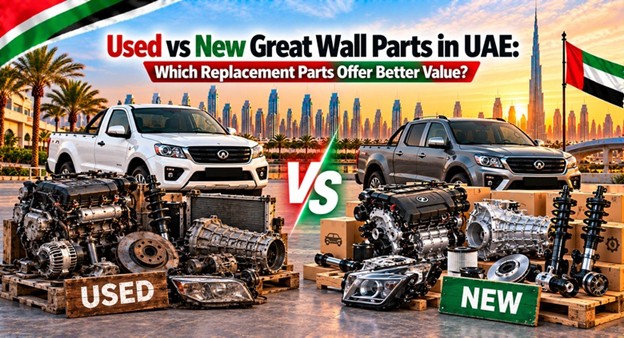
Used vs New Great Wall Parts in UAE: Which Replacement Parts Offer Better Value?
October 9, 2026
The cheapest new Great Wall spare part in UAE is not necessarily the one with the lowest price tag. Sometimes it is a properly checked used component that costs substantially less than new. Sometimes the new part is the better buy because fitting the wrong used component twice turns a saving into another workshop bill.
That is the awkward bit about buying parts.
The word used tells you the component has a history. It tells you almost nothing about the quality of that history. And new tells you the component has not previously been installed, but it does not by itself prove that the part is correctly specified for your vehicle.
Great Wall's UAE range makes the distinction particularly relevant. The current local line- up includes Wingle 5, Wingle 7 and Poer, while the Wingle family itself covers different engines, body configurations and drivetrains. GWM UAE lists the Wingle 5 as a 2.4- litre petrol 4x2 pickup, while the Wingle 7 is offered with 2.4- litre petrol and 2.0- litre turbo diesel powertrains and 4x2/4x4 configurations. The current Poer is a newer, more electronically equipped pickup, with petrol and diesel versions listed by GWM UAE.
So the real question is not:
"Should I buy used or new?"
It is:
"For this particular Great Wall part, where does the extra money actually buy useful certainty?"
UAE Update Reference: September 2026
Used vs New Great Wall Parts: The Short Answer
Neither category wins every time.
Used parts can make strong financial sense for older Great Wall vehicles, discontinued components, body panels, trim, mirrors, lamps and some mechanical assemblies where a suitable donor part can be properly identified and inspected.
New parts generally become more attractive where the component has a predictable wear life, is difficult to inspect internally, carries significant failure consequences, or involves electronics, calibration or safety systems.
Then there is a third category that gets overlooked: new aftermarket.
It can sit between used and new genuine parts, sometimes offering a useful price compromise. But aftermarket quality varies, so the brand, specification, warranty and application need checking rather than assuming "new" means equivalent to factory supply.
The part determines the sensible comparison.
Why the Great Wall Model Matters Before Price
A Wingle 5 part search is not the same thing as a Wingle 7 part search.
The current UAE Wingle 5 specification identifies a 2.4- litre petrol engine, 4x2 drive and five- speed manual transmission. GWM's published specification identifies the engine as the 4G69S4N.
The Wingle 7 has a broader configuration range. GWM UAE lists a 2.4- litre petrol engine and a 2.0- litre GW4D20D turbo- diesel, alongside 4x2 and 4x4 versions. Its 4WD system is described as an electronic part- time BorgWarner system.
The Poer is a different proposition again. The current UAE model is listed as a lifestyle pickup with petrol and diesel versions, 4x4 capability and considerably more electronic equipment, including Bosch ESP, adaptive driver- assistance systems, camera systems and tyre- pressure monitoring.
So a supplier asking for the VIN is not being awkward.
They are trying to avoid selling you the wrong part.
What "Better Value" Actually Means
Value is not the same as low purchase price.
A useful parts comparison should consider:
- purchase price
- exact fitment
- condition
- expected remaining life
- warranty
- return policy
- installation cost
- diagnostic cost
- programming or calibration
- delivery time
- downtime
- likelihood of another failure
- availability of supporting parts
A used component costing AED 400 may look attractive beside a new one at AED 900.
But if the used part fails after installation and the workshop charges again to remove and replace it, the calculation changes.
Equally, if a new component costs AED 900 but the vehicle is an older Wingle being used for basic commercial work, paying the full new- part premium may not always make financial sense.
That is why the word value needs more work than the word cheap.
When a Used Great Wall Part Can Be a Sensible Purchase
Used parts are often most compelling when the original component is expensive, durable and reasonably inspectable.
Think body panels.
Mirrors.
Certain lamps.
Interior trim.
Some suspension components, subject to condition.
Some mechanical assemblies, where donor history and testing are credible.
A used original component can also be attractive when a new genuine part is difficult to source or disproportionately expensive for an older vehicle.
But the part needs an identifiable history.
A dismantler who can tell you the donor vehicle, specification, mileage where known and reason for dismantling is giving you useful information.
"Used, good condition" is not.
When Buying New Usually Makes More Sense
New becomes easier to justify when the component is a service item or a wear component whose remaining life is difficult to establish.
Examples include:
- filters
- belts
- many hoses
- seals
- certain bearings
- clutch- related consumables
- brake friction components
- some cooling- system components
- ignition and service components
The exact recommendation depends on the vehicle and component, but the principle is straightforward.
If you cannot meaningfully inspect how much useful life remains in a used component, the discount has to compensate for that uncertainty.
A small saving may not be enough.
Used Does Not Mean Poor Quality
This distinction matters.
A used genuine Great Wall component removed from a functioning vehicle can be more useful than a badly specified new aftermarket component.
That does not make used parts automatically superior.
It simply means condition and provenance matter more than the new/used label alone.
A used original body mirror with intact mounting points, undamaged wiring and good glass may be perfectly serviceable.
A brand- new mirror with the wrong electrical configuration is still the wrong mirror.
New Does Not Automatically Mean Better
The word "new" has an almost magical effect on online shopping.
It should not.
A new aftermarket component can vary in materials, tolerances, electrical characteristics, sealing quality and durability.
For straightforward components, this may be less significant.
For sensors, electronic modules, drivetrain components and components exposed to heat or pressure, specification becomes much more important.
Ask who manufactured it.
Ask for the application.
Ask whether the part number has been verified.
Ask about warranty.
Newness is a condition.
It is not a quality certificate.
Genuine, OEM, Aftermarket and Used Are Four Different Things
These categories are often mixed together in UAE parts advertising.
Genuine generally refers to the vehicle manufacturer's branded supply route.
OEM is more ambiguous in marketplace language and should be clarified with the actual manufacturer and part reference.
Aftermarket means the component is produced outside the vehicle manufacturer's branded supply channel. It can range from very good to poor.
Used means previously installed.
Reconditioned means a previously used component has been processed or rebuilt, but the quality depends on exactly what was done.
A supplier describing something as "OEM quality" is not enough evidence.
Ask what the component actually is.
The Wingle 5 Is a Good Example of Why Fitment Matters
The current UAE Wingle 5 is a relatively straightforward specification: 2.4- litre petrol, 4x2 and five- speed manual. GWM UAE also identifies Bosch components within the engine- related equipment, including the ECU, sensors, electric throttle and fuel- system components.
That does not mean every Wingle 5 part can be ordered simply from the model name.
A sensor may depend on the exact engine application.
A throttle- related component can involve electrical compatibility.
An ECU can involve vehicle configuration and programming.
A used part needs to be identified against the vehicle rather than selected because its casing looks familiar.
Wingle 7 Creates a Bigger Used-vs-New Decision
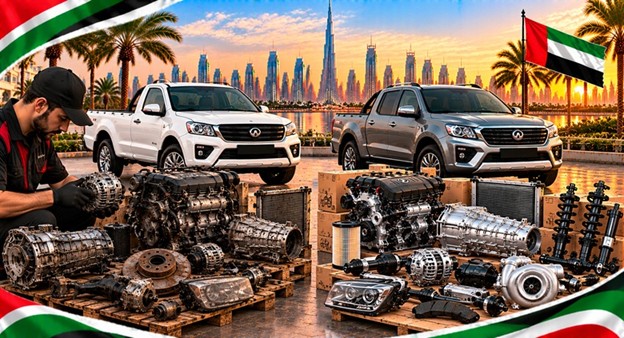
Wingle 7 parts require more care because the vehicle has been offered with different engines and drivetrain configurations.
A used 4x4 component is not interchangeable with a 4x2 component simply because both vehicles are called Wingle 7.
The same goes for petrol and diesel engine components.
GWM UAE currently identifies the 2.0- litre GW4D20D diesel and 2.4- litre petrol engines for the Wingle 7, with 4x2 and 4x4 specifications available.
For these vehicles, the used- part discount only matters after application has been established.
Poer Parts Are a Different Risk Calculation
The newer Poer brings more electronics into the equation.
GWM UAE's current Poer specification includes systems such as Bosch Generation 9.3 ESP, adaptive cruise control, autonomous emergency braking, lane- keeping assistance, blind- spot monitoring, camera systems and TPMS.
That does not mean used electronic parts are automatically unsuitable.
It does mean that a used electronic component should be treated differently from a used bumper bracket.
Hardware compatibility may not be enough.
Software, coding, calibration and vehicle- network compatibility can matter too.
Used Body Panels Are Often Easier to Assess
Body panels are one of the clearest cases where used can offer useful value.
A used bonnet, door, wing or bumper may be visually inspected before purchase.
Look at:
- dents
- cracks
- corrosion
- previous repairs
- mounting points
- clips
- alignment surfaces
- paint condition
- deformation around fixing points
For a cosmetic component, a buyer can often assess much more of its condition than they can with a gearbox.
That changes the risk calculation.
Used Headlights and Tail Lights Need More Than a Visual Check
Lighting assemblies sit between body parts and electronics.
A lens may look perfect while the internal mounting points are damaged.
A used lamp may have a different connector.
The specification may differ.
A high- spec or electronically controlled lamp can contain components that are not obvious from outside.
So ask for the exact part reference and connector arrangement.
For a basic lamp assembly, used may be sensible.
For a sophisticated electronically controlled unit, the case for a verified new component can become stronger.
Used Mirrors: A Small Part With Hidden Variables
A mirror seems simple until it has:
- electric adjustment
- heating
- folding
- indicators
- cameras
- blind- spot sensors
- memory functions
The physical housing may look identical across variants while the wiring and electronics differ.
This is exactly why photographs should support identification rather than replace it.
For a basic manual mirror, condition may dominate the decision.
For a high- spec electronic mirror, application becomes much more important.
Used Suspension Parts: Cheap Is Not the Same as Economical
Suspension components are exposed to wear, road impact and load.
A used control arm may be fine if the structural component is sound and the associated bushes or ball joints are separately serviceable.
A used damper is harder to evaluate.
You cannot reliably establish its remaining service life merely by looking at it.
That makes new replacement more attractive in some suspension applications, especially where labour access is significant.
The workshop should diagnose the failed component rather than replacing an entire assembly because it is convenient.
Used Springs and Leaf Springs Need Careful Inspection
Great Wall pickups can spend their lives carrying loads.
That matters.
A used leaf spring from a donor vehicle may have had an entirely different working life from the vehicle receiving it.
Inspect:
- cracks
- deformation
- sag
- corrosion
- bush condition
- mounting eyes
- matching side- spring specification
A visually similar spring is not automatically an appropriate replacement.
Load capacity and application matter.
Used Gearboxes Can Save Money — But Installation Changes the Calculation
Gearboxes are where used parts can become financially interesting.
A complete used transmission can cost substantially less than a new replacement assembly, particularly for an older vehicle.
But gearbox replacement involves labour.
If the used gearbox fails shortly after installation, the saving can disappear rapidly.
So ask:
What is the warranty?
Not just:
What is the price?
A six- month or one- year warranty means something only if the terms are clear, but a bare component with no meaningful return route carries much more buyer risk.
Used Engines Need Donor History
A used engine should never be treated like a box of interchangeable metal.
Find out:
- donor model
- donor year
- engine application
- mileage where known
- reason for dismantling
- accident history
- flood exposure
- whether the engine was running
- what ancillaries are included
- testing performed
- warranty
A low- mileage claim without evidence is not enough.
Nor is a photograph of a clean engine bay.
A Used Engine Can Be Better Value Than a Rebuild — Sometimes
Engine replacement versus rebuilding is a separate economic question.
If the existing engine has a badly damaged block, extensive internal wear or other major failure, a suitable used replacement may offer a simpler repair path.
But if the engine's core is healthy and the problem is limited to a repairable component, replacing the complete engine may destroy value rather than create it.
Compression testing, leak- down testing, oil- pressure testing and inspection of cooling and lubrication systems can help establish the condition before a major replacement decision.
Testing should support the recommendation.
Used ECUs and Electronic Modules Are a Different Category
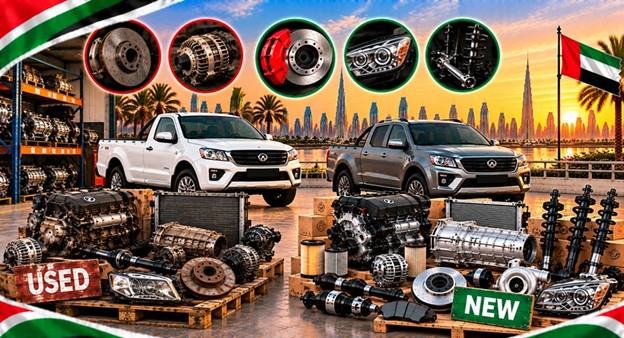
This is where buyers should slow down.
A used ECU may have the correct housing and connector and still require programming or configuration.
The same principle can apply to:
- BCMs
- ABS modules
- instrument clusters
- steering modules
- transmission controllers
- body- control electronics
- advanced driver- assistance components
Ask whether the replacement requires coding, programming, calibration or component matching.
If the seller cannot explain the procedure, the apparent saving may not be the real saving.
Why a New Sensor Can Be Worth the Extra Money
Sensors are often relatively small and inexpensive compared with the systems they influence.
A questionable used sensor creates an awkward problem: if the fault remains, was the original diagnosis wrong, or is the replacement sensor also faulty?
A new, correctly specified sensor can remove one layer of uncertainty.
That does not mean every sensor must be bought new.
It means the price difference should be considered against the diagnostic time and consequences of a questionable used component.
Brakes Are Not the Place to Chase Every AED
Brake pads, discs and related wear components are safety- critical.
There are cases where used components have a legitimate role, particularly for non- wear hardware such as certain calliper brackets or other recoverable assemblies.
But friction material should be assessed according to its condition, specification and remaining service life.
A small saving is not especially meaningful if the component is already near the end of its useful life.
The buyer needs to know what they are actually purchasing.
Cooling-System Parts: New Versus Used
Radiators, condensers, fans, hoses, thermostats and water- pump components have different risk profiles.
A used radiator may be acceptable if it is properly inspected for leaks, damage and contamination.
A used hose is another matter.
Rubber ages.
A used component that looks fine externally can still have reduced remaining life.
For cooling components, the cost of another overheating event should be part of the calculation.
A cheap component that creates a second repair is not cheap.
Air-Conditioning Parts Need Diagnosis Before Shopping
A weak air conditioner can tempt an owner into buying a compressor.
That is exactly backwards.
The workshop should establish refrigerant pressure, compressor operation, condenser airflow, electrical control and system behaviour before condemning the compressor.
If the compressor genuinely needs replacement, then used versus new can be considered.
If it does not, neither option is good value.
The best spare part is occasionally the one you discover you did not need to buy.
4x4 Components Deserve Extra Caution
Wingle 7 and Poer buyers may encounter used transfer cases, differentials, driveshafts, hubs and related four- wheel- drive components.
These are not generic mechanical lumps.
Ratios, mounting arrangements, electronic controls and drivetrain configurations can differ.
GWM UAE describes the Wingle 7's four- wheel- drive system as electronic part- time 4WD, while the current Poer also has selectable 2WD/4WD functionality.
For a used 4x4 component, the donor vehicle matters almost as much as the component itself.
The Donor Vehicle Is Part of the Product
This is an underrated point.
When buying used, you are not simply buying a part.
You are buying a part plus its history.
Ask where it came from.
A component removed from a vehicle dismantled after an accident may have an entirely different history from one removed from a mechanically healthy vehicle.
Flood exposure deserves particular caution with electrical components.
Heavy commercial use matters for engines, gearboxes, suspension and driveline components.
The donor's history can explain the discount.
It can also explain the risk.
What a Used-Part Supplier Should Be Able to Tell You
For a significant component, ask for:
- donor make and model
- donor model year
- engine
- transmission
- drivetrain
- mileage if known
- reason for dismantling
- condition
- testing performed
- original part number
- warranty
- return conditions
- current location
A seller does not need to know every detail for every minor component.
But the more expensive the part, the more information you should expect.
Why VIN Verification Is More Important Than a Photograph
A photograph is useful.
A VIN is useful in a different way.
The photograph can show whether the connector, casing, mounting points or physical arrangement appear similar.
The VIN helps establish the vehicle application.
For expensive Great Wall parts, the safest sequence is:
VIN -> vehicle specification -> original part reference -> supplier confirmation -> physical comparison -> installation.
Do not reverse that sequence because a marketplace photograph happens to look convincing.
PartFinder UAE and the Search for the Right Value
For UAE buyers comparing new and used Great Wall components, PartFinder UAE can form part of the sourcing process, but the same buyer discipline still applies: identify the vehicle precisely, confirm the component reference and compare the complete cost rather than choosing from a headline price alone.
The useful enquiry includes:
- VIN or chassis information
- Great Wall model
- model year
- engine
- transmission
- 4x2 or 4x4
- exact component
- original part number where available
That makes the comparison much more meaningful.
You are not really comparing "used" with "new".
You are comparing two specific repair routes.
New Genuine Parts: What Are You Actually Paying For?
The premium attached to a new genuine part may buy several things at once:
- known specification
- new condition
- manufacturer-branded supply
- clearer application
- potentially stronger support
- predictable installation requirements
- potentially better warranty arrangements
But none of these should be assumed blindly.
Check the actual warranty.
Check the actual part number.
Check whether the price includes VAT.
Check whether installation is included.
Check whether coding or calibration costs extra.
The invoice needs to be understood, not admired.
New Aftermarket Parts Can Change the Calculation
There is another route between used and genuine.
A new aftermarket part can offer a lower purchase price while avoiding the unknown service history of a used component.
But the manufacturer matters.
So does the component.
A new aftermarket air filter and a new aftermarket electronic control module should not be judged using the same standard.
For critical or electronically complex components, supplier reputation, specification and warranty become increasingly important.
Warranty Is Part of the Price
Suppose one used component costs AED 500 with no meaningful return arrangement.
A new component costs AED 800 with a clearly documented warranty.
The difference is AED 300.
But the real comparison is not AED 500 versus AED 800.
It is:
AED 500 + failure exposure
versus
AED 800 + warranty protection
That does not automatically make the new component the right choice.
It simply puts the warranty where it belongs: inside the value calculation.
Return Policies Matter Even More With Fitment-Sensitive Parts
A return policy can be particularly valuable for:
- ECUs
- sensors
- lamps
- mirrors
- body fittings
- transmission components
- electronic modules
But read the conditions.
Some suppliers will not accept returns once a component has been installed, programmed or modified.
Others may require the buyer to demonstrate that the part was incorrectly supplied.
"Returns accepted" is not enough information.
Ask under what circumstances.
Installation Cost Can Destroy a Parts Saving
Imagine a used component costs AED 600 less than a new one.
Sounds excellent.
Now imagine fitting it requires several hours of labour.
If the component fails and must be removed, the workshop cost is incurred again.
This is why used- versus- new decisions are especially sensitive for:
- gearboxes
- engines
- transfer cases
- differentials
- clutch assemblies
- difficult-to-access cooling components
- certain suspension assemblies
For easily swapped body trim, labour exposure may be much smaller.
The part's installation time changes its economic risk.
New or Used? Compare the Total Repair, Not the Component
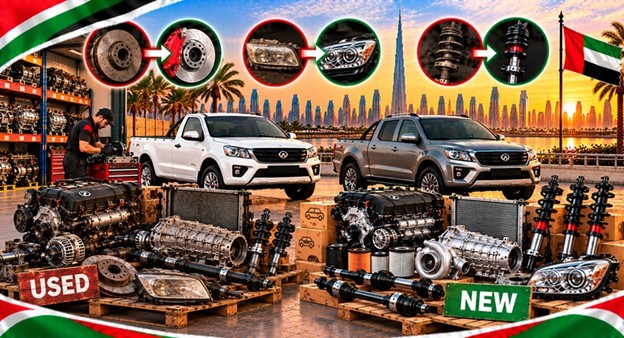
A useful quotation should separate:
| Cost item | Used part | New part |
|---|---|---|
| Component | AED | AED |
| VAT | AED | AED |
| Delivery | AED | AED |
| Labour | AED | AED |
| Fluids/seals | AED | AED |
| Programming/ calibration | AED | AED |
The blank spaces matter.
Do not invent a total simply because a comparison table looks better with numbers in every box.
A supplier quotation should establish the actual figure.
The Great Wall Parts Where Used Can Often Be Considered
The following categories can sometimes make sense as used purchases, subject to exact application and condition:
| Part category | Used option | Main thing to verify |
|---|---|---|
| Exterior panels | Often practical | Damage, corrosion, fitment |
| Mirrors | Possible | Electrical specification |
| Lamps | Possible | Housing, connector, electronics |
| Interior trim | Often practical | Mountings and condition |
| Certain suspension hardware | Case-by-case | Wear and structural condition |
| Gearbox assemblies | Possible | Donor history, testing, warranty |
| Engine assemblies | Possible | Compression/history/warranty |
| Differential assemblies | Possible | Ratio and application |
| Transfer-case components | Possible | Drivetrain configuration |
| Electronic modules | High caution | Programming and compatibility |
This is not a ranking.
It is a reminder that different components carry different uncertainties.
The Great Wall Parts Where New Usually Deserves Serious Consideration
New becomes particularly attractive when the component is:
- a consumable
- a friction component
- a rubber component
- a seal
- a critical sensor
- a safety- related component
- difficult to inspect internally
- expensive to install
- likely to cause secondary damage if it fails
Again, the actual vehicle and part matter.
A used original component can still be perfectly appropriate in some of these categories if it is properly tested and the saving is substantial.
The point is to understand what you are buying.
The "Same Part Number" Trap
A matching part number is strong evidence.
It is not a substitute for checking the entire application.
Confirm:
- supersession
- production period
- market specification
- software version where relevant
- connector arrangement
- associated components
A seller may quote an old number that has been superseded.
That does not necessarily mean the part is wrong.
It means the buyer needs confirmation of the replacement relationship.
The "Looks Identical" Trap
This one catches experienced owners too.
Two components can look identical and still differ internally.
That matters particularly with:
- sensors
- control modules
- injectors
- pumps
- actuators
- lighting assemblies
- switches
- electronic throttle components
Physical similarity is supporting evidence.
It is not proof of compatibility.
How the UAE Climate Changes the Value Calculation
The UAE environment can influence component life, but it should not be used as a lazy explanation for every failure.
Heat exposure, high ambient temperatures, dust, traffic and long periods of air- conditioning use can affect certain systems.
Rubber components, cooling systems, batteries, air- conditioning components and some electronics can face demanding operating conditions.
But a failed part still needs diagnosis.
"UAE heat" is context.
It is not a test result.
Older Wingle Owners Have a Different Economic Equation
A newer Poer and an older Wingle 5 should not necessarily be repaired using the same purchasing philosophy.
An older commercial pickup may have a lower market value but still be economically useful if it performs its job reliably.
That can make used original components attractive.
The key is to avoid spending repeatedly on low- quality replacements.
A vehicle does not become financially sensible simply because every individual part is cheap.
Repeated repairs matter.
When the Cheapest Used Part Becomes False Economy
There are warning signs.
Be cautious when:
- donor history is unknown
- mileage is unknown
- the part cannot be tested
- warranty is absent
- return conditions are unclear
- the seller refuses VIN verification
- the part number is missing
- the component has obvious corrosion
- electrical connectors are damaged
- mounting points are bent
- the price is suspiciously low without explanation
The problem is not that the component is used.
The problem is that its condition is unknown.
When Paying More for New Can Be Rational
Paying more can make sense when the additional money buys meaningful reduction in uncertainty.
That might mean:
- new component
- known specification
- warranty
- better availability
- clear return route
- reduced installation risk
- manufacturer-backed supply
But do not pay a premium simply because the advert says "genuine".
Verify what is actually being sold.
A Practical Decision Matrix for Great Wall Owners
Table is deliberately uneven.
| Situation | Main question to ask |
|---|---|
| Exterior body panel | Is the used part straight and correctly specified? |
| Mirror | Does the electrical specification match? |
| Headlamp | Does the exact connector and equipment level match? |
| Sensor | What proves the used sensor is healthy? |
| ECU/module | Can it be programmed to this vehicle? |
| Brake component | What is the remaining usable life? |
| Radiator | Has it been pressure-tested and inspected? |
| Compressor | Has the A/C system actually diagnosed compressor failure? |
| Gearbox | What is the donor history and warranty? |
| Engine | What testing proves its condition? |
| Differential | Does the ratio/application match? |
| Transfer case | Does the drivetrain specification match? |
| Suspension | Which component has actually failed? |
The table is deliberately uneven.
Because the decision should be.
What a Workshop Should Check Before You Buy
If a workshop recommends an expensive replacement, ask for the evidence behind the recommendation.
Depending on the problem, that may include:
- diagnostic scan
- fault- code analysis
- live- data readings
- visual inspection
- pressure testing
- electrical continuity checks
- current draw
- charging voltage
- compression testing
- leak- down testing
- oil- pressure testing
- cooling- system testing
- road test
- vibration assessment
- fluid inspection
Not every test belongs on every repair.
But a major component should not be condemned merely because its name appears on a fault code.
A code can identify a circuit, condition or system.
It does not always identify the failed component.
Used-Part Inspection Should Happen Before Installation
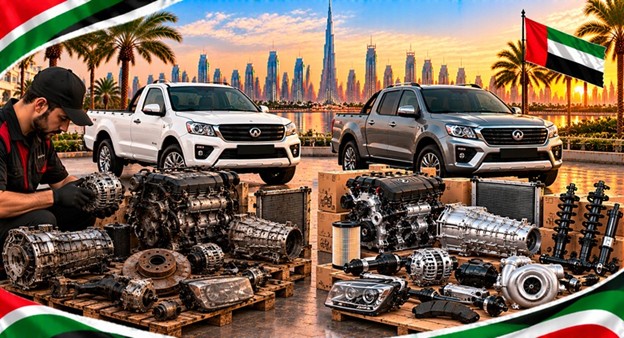
If possible, inspect the used component before it goes onto the vehicle.
Check:
- labels
- part number
- connectors
- mounting points
- cracks
- corrosion
- fluid contamination
- seals
- shaft play where relevant
- physical damage
- signs of overheating
- evidence of previous repair
For electronic components, avoid damaging or altering the unit before compatibility is established.
A return policy is less useful after the buyer has modified the part.
What "Tested" Should Mean
The word tested is too vague on its own.
Ask:
Tested for what?
A used starter motor may have been bench- tested for operation.
A gearbox may have been inspected but never road- tested.
An ECU may have been powered up without being tested in the vehicle.
A radiator may have been visually inspected without pressure testing.
The test should relate to the actual failure mode.
New vs Used for Accident Repairs
Accident repairs often create the strongest case for used body parts.
A door, bonnet, wing, mirror or trim piece may be available from a donor vehicle in the correct colour or specification.
But structural and safety components require a higher standard.
Do not use a low price to justify a component with hidden deformation.
The external appearance of an accident- damaged component tells only part of the story.
New vs Used for Commercial Wingle Repairs
A Wingle used for daily commercial work has a different cost of downtime from a vehicle driven occasionally.
If the pickup earns money every day, a cheap part that delays the repair can be more expensive than a slightly costlier component that is available immediately and carries a usable warranty.
This is where delivery time belongs in the calculation.
So does workshop availability.
The cheapest component is not always the cheapest way back to work.
Availability Is Part of Value in the UAE
GWM's current UAE network includes Wingle models and Poer, with service and showroom coverage listed across several emirates.
At the same time, used- parts marketplaces in the UAE advertise Great Wall components by exact model, year and chassis information, showing why availability can vary by specific vehicle rather than simply by brand.
For an older Wingle, a used component physically available in the UAE may therefore solve a problem that a new component ordered from another market cannot solve quickly.
But verify the part before paying.
Speed is useful.
A wrong part delivered quickly is not.
How to Ask for a Better Great Wall Parts Quote
Do not send:
"Need Wingle gearbox price."
Send the supplier enough information to make the enquiry meaningful:
Great Wall Wingle 7, model year __, 2.0 diesel, 4x4, VIN __, manual/automatic __, looking for complete gearbox assembly. Please confirm original part number, condition, donor mileage if used, warranty, return terms, VAT and delivery.
That single message removes much of the ambiguity.
It also makes competing quotations easier to compare.
The Five Questions That Matter Most
Before buying a used Great Wall component, ask:
Does it definitely fit my VIN/application?
What is its history?
How was it tested?
What warranty or return protection do I have?
What will the complete installed repair cost?
Before buying a new component, ask almost the same questions.
The difference is that "history" becomes less important and specification becomes more important.
That is revealing.
The buying process is surprisingly similar.
Used vs New: Think in Terms of Risk, Not Labels
A sensible buyer is not really choosing between two boxes labelled USED and NEW.
They are choosing between two levels of uncertainty.
Used may carry uncertainty about remaining life.
New aftermarket may carry uncertainty about manufacturing quality.
New genuine may carry less uncertainty about specification but involve a higher initial cost.
Reconditioned may carry uncertainty about the rebuilding process.
Every category has a question attached to it.
Find that question before paying.
The Best Value Can Change With the Age of the Vehicle
For a newer Great Wall under manufacturer warranty, the calculation may be different from that of an older Wingle used for commercial work.
GWM UAE currently publishes a three- year/100,000 km warranty for the Wingle 5.
A vehicle still covered by applicable warranty terms should not be treated in the same way as an older vehicle outside warranty.
For the latter, used genuine components, aftermarket alternatives and reconditioned assemblies may deserve closer comparison.
The vehicle's remaining useful life matters too.
Do Not Spend New-Car Money on an Old Repair Without Doing the Maths
An older Wingle can still be an extremely useful working vehicle.
But major repairs should be considered as a package.
If the engine, gearbox, suspension, cooling system and electrical systems are all approaching the end of their useful life, one apparently attractive used component may only postpone the next repair.
Look at the vehicle as a whole.
That does not mean abandoning an older pickup.
It means knowing what you are actually buying into.
A Simple Great Wall Parts Buying Formula
For any significant replacement, think:
True cost = part price + VAT + delivery + labour + supporting parts + programming/calibration + failure risk + downtime
It is not a literal accounting formula for every repair.
It is a decision- making framework.
The purpose is to stop the purchase price from becoming the only number that matters.
Before You Click Buy
Have these details ready:
- Vehicle
- Great Wall model
- model year
- VIN
- engine
- transmission
- drivetrain
- market specification
- Part
- exact component
- original part number
- replacement/supersession reference
- new/used/reconditioned status
- photographs
- condition
- Supplier
- testing evidence
- donor details if used
- warranty
- return terms
- UAE stock status
- Repair
- labour
- fluids
- seals
- programming
- calibration
- total installed price
If a supplier cannot answer the important questions, the price should not be the only reason to proceed.
The practical rule is simple: buy used when the component's history and condition can be established and the saving is meaningful; buy new when the remaining life is difficult to judge, the installation cost is high, or the consequences of failure make uncertainty too expensive.
Frequently Asked Questions
Categories
- Audi
- BMW
- Car Accessories
- Car Tips
- Ford
- Land Rover
- Mazda
- Range Rover
- Top 10
- UAE Car Parts
- Used Car Parts
- Toyota
- Replacement Engines
- Nissan
- Hyundai
- Mitsubishi
- Volkswagen
- Honda
- Kia
- Chevrolet
- Dodge
- Jeep
- Subaru
- Renault
- Lexus
- Mercedes
- Suzuki
- Hummer
- Porsche
- Infiniti
- Peugeot
- GMC
- Mini
- Volvo
- Replacement Gearboxes
- MG
- Jaguar
- Skoda
- Cadillac
- Daihatsu
- Fiat
- German Car Parts
- Japanese Car Parts
- Aftermarket Car Parts
- Genuine Car Parts
- New Car Parts
- Reconditioned Car Parts
- European Car Parts
- American Car Parts
- Korean Car Parts
- British Car Parts
- Chinese Car Parts
- Sports/Exotic Car Parts
- Luxury Car Parts
- Performance Car Parts
- SUV/4x4 Spare Parts
- Truck Spare Parts
- EV Car Parts
- Hybrid Car Parts
- Auto Spare Parts in UAE
- Tesla
- Isuzu
- Ram
- Ferrari
- Bentley
- Lamborghini
- Genesis
- Maserati
- Lincoln
- Chrysler
- Opel
- Citroen
- SsangYong
- Seat
- McLaren
- Aston Martin
- Rolls Royce
- Maybach
- Alfa Romeo
- Bugatti
- Scion
- Abu Dhabi Car Parts
- Ajman Car Parts
- Al Khan Car Parts
- Al Sajaa Car Parts
- Deira Car Parts
- Dubai Car Parts
- Fujairah Car Parts
- Industrial Area 6 Car Parts
- Mussafah Car Parts
- Ras Al Khaimah Car Parts
- Sharjah Car Parts
- Umm Al Quwain Car Parts
- Acura
- BYD
- Chery
- Dacia
- DS
- Geely Emgrand
- EXEED
- GAC
- GAC Gonow
- Geely
- Gonow
- Great Wall
- Haima
- Haval
- Holden
- Iveco