Used vs New Hybrid Car Parts in UAE: What Should You Choose?
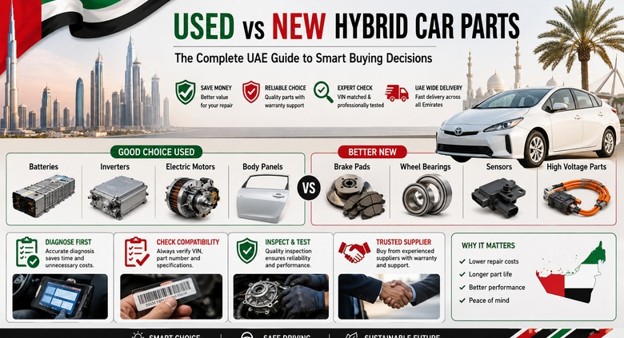
July 27, 2026
Understanding Hybrid Car Parts and Buyer Choices
Hybrid vehicles have become a familiar sight across the UAE.
From Toyota Prius taxis and Corolla Hybrids to Lexus luxury models, Honda hybrids and Hyundai Ioniq vehicles, more drivers are embracing hybrid technology for its balance of fuel efficiency, lower emissions and everyday practicality.
That popularity has created another rapidly growing market.
New Hybrid car parts in UAE or replacement parts.
Sooner or later, every hybrid owner faces the same question.
Should you buy a new part?
Or is a used replacement the smarter choice?
There isn't a universal answer.
Some components are perfectly suitable when purchased used from a reputable supplier.
Others should almost always be bought new.
Understanding the difference can save thousands of dirhams while helping you avoid expensive mistakes.
This guide explores those choices in detail, beginning with the fundamentals every hybrid owner should know before purchasing replacement parts.
Why Hybrid Car Parts Require Careful Buying Decisions
Hybrid vehicles combine two different technologies.
A conventional petrol engine.
An electric drive system.
Those systems work together through sophisticated electronics, battery management software and carefully engineered mechanical components.
That complexity means replacement parts deserve careful consideration.
Choosing the wrong component may affect:
- Fuel efficiency.
- Battery performance.
- Electrical reliability.
- Engine operation.
- Vehicle safety.
- Long-term ownership costs.
Buying purely on price often proves to be a false economy.
The correct part, matched accurately to the vehicle, nearly always delivers better value over time.
How Hybrid Vehicles Differ from Conventional Cars
At first glance, a hybrid car appears no different from any other vehicle.
Underneath, however, the engineering tells a different story.
Alongside the petrol engine, most hybrids include:
- High-voltage battery packs.
- Electric motors.
- Inverters.
- Power control units.
- Battery cooling systems.
- Regenerative braking technology.
- Electronic control modules.
These additional systems improve efficiency while introducing specialised components that require accurate diagnosis and precise compatibility.
That's why buying hybrid parts involves considerations that conventional vehicle owners rarely encounter.
The Most Common Hybrid Car Parts That Need Replacement
Hybrid vehicles have an excellent reputation for reliability.
Even so, wear is inevitable.
The parts most frequently replaced include:
- Hybrid batteries.
- Battery cooling fans.
- Electric water pumps.
- Inverters.
- Power control modules.
- Oxygen sensors.
- Suspension components.
- Brake pads.
- Brake discs.
- Wheel bearings.
- Engine mounts.
- Electronic sensors.
- ECUs.
- Body panels.
- Lighting assemblies.
Some of these components naturally wear with age.
Others may require replacement following accident damage, electrical faults or high mileage.
Knowing which category a part belongs to helps determine whether buying used or new makes the most sense.
Why More UAE Drivers Compare Used and New Hybrid Parts
Vehicle ownership costs matter.
Especially when replacing specialist hybrid components.
Many UAE drivers compare used and new parts because they want the best balance between quality and affordability.
There are several reasons why used components continue growing in popularity:
- Lower purchase prices.
- Availability for older models.
- Faster sourcing for discontinued parts.
- Suitable options for cosmetic repairs.
- Reduced repair costs.
- Environmentally responsible reuse.
At the same time, many owners still prefer new parts for critical electrical and safety-related systems.
The smartest choice depends on the component—not simply the price.
Understanding Genuine, OEM, Used and Aftermarket Hybrid Parts
One of the biggest sources of confusion is the different types of replacement parts available.
Let's simplify them.
Genuine Hybrid Parts
These parts are supplied through the vehicle manufacturer's official network.
They are built to the manufacturer's specifications and generally offer excellent compatibility and reliability.
They also tend to be the most expensive option.
OEM Hybrid Parts
Original Equipment Manufacturer parts are produced by companies that manufacture components used during vehicle production.
Many provide factory-quality performance while costing less than genuine alternatives.
For many hybrid owners, OEM parts offer an excellent balance of quality and value.
Used Hybrid Parts
Used components are removed from donor vehicles before being inspected and prepared for resale.
When purchased from reputable suppliers, they can provide excellent value for:
- Body panels.
- Interior trim.
- Lighting units.
- Wheels.
- Certain mechanical assemblies.
However, not every used component is an equally sensible purchase.
We'll explore those differences throughout this guide.
Aftermarket Hybrid Parts
Aftermarket manufacturers produce compatible replacement parts independently of the original vehicle manufacturer.
Quality varies considerably.
Well-established brands often perform exceptionally well.
Poor-quality alternatives may compromise reliability and durability.
Choosing reputable manufacturers remains essential.
How to Choose the Right Hybrid Parts Supplier
The supplier is just as important as the part itself.
An experienced hybrid specialist should do more than simply process an order.
They should also help verify compatibility before the purchase is completed.
Look for suppliers that can:
- Match parts using the VIN.
- Explain the differences between genuine, OEM and used options.
- Offer warranty coverage.
- Provide technical guidance.
- Arrange delivery across the UAE.
- Source difficult-to-find hybrid components.
Knowledgeable suppliers reduce the likelihood of ordering errors while making the purchasing process considerably less stressful.
Workshop Story: A Battery That Didn't Need Replacing
A Toyota Corolla Hybrid owner visited a specialist workshop after noticing reduced fuel economy and an intermittent hybrid warning light.
The owner had already been advised to replace the complete hybrid battery.
Before approving such a costly repair, the workshop carried out a detailed inspection.
The diagnosis revealed that the battery itself remained in good condition.
Instead, the battery cooling fan had become heavily restricted by accumulated dust, reducing airflow and causing higher operating temperatures.
After cleaning the system and replacing a worn sensor, the warning light disappeared and vehicle performance returned to normal.
The battery had never been the problem.
Accurate diagnosis prevented an unnecessary repair worth several thousand dirhams.
Why Diagnosis Should Always Come Before Buying Parts
Replacing components without identifying the actual fault is one of the most expensive mistakes hybrid owners make.
Many warning symptoms can have multiple causes.
Reduced fuel economy, for example, may result from:
- Battery cooling issues.
- Sensor faults.
- Inverter problems.
- Engine-related concerns.
- Software issues.
- Low-voltage battery faults.
Professional diagnostic testing identifies the real cause before money is spent on replacement parts.
That approach saves both time and unnecessary expense.
Key Takeaways
Before moving to the next section, remember these important points:
- Hybrid vehicles combine petrol and electric systems, making accurate part selection especially important.
- Not every replacement component should automatically be bought new.
- Used parts can offer excellent value when chosen carefully and sourced from reputable suppliers.
- Genuine, OEM, used and aftermarket parts each have advantages depending on the repair.
- VIN verification remains one of the best ways to ensure compatibility.
- Accurate diagnostics should always come before purchasing replacement components.
Hybrid Battery Systems
Mention hybrid cars, and one component almost always dominates the conversation.
The battery.
For many buyers, it's also the most intimidating.
Questions about lifespan, replacement costs, reliability and whether a used battery is worth considering appear again and again.
Some drivers assume every battery fault means replacing the entire pack.
Others believe buying a used battery is always a risky decision.
Neither assumption tells the whole story.
Modern hybrid battery systems are remarkably durable, but like every engineered component, they eventually experience wear. The important question isn't simply whether a battery is old or new.
It's whether it's healthy.
That's where informed buying decisions begin.
New Hybrid Batteries vs Used Hybrid Batteries
There is no single answer that suits every owner.
A brand-new battery offers maximum expected lifespan, manufacturer specifications and the reassurance of unused components.
For drivers planning to keep their hybrid for many years, it can be an excellent long-term investment.
Used batteries appeal for different reasons.
They usually cost considerably less and can be a practical solution for older vehicles where controlling repair costs is an important priority.
Let's compare them.
| Feature | New Hybrid Battery | Used Hybrid Battery |
| Purchase price | Highest | Lower |
| Expected lifespan | Longest | Depends on condition |
| Warranty | Usually longer | Varies by supplier |
| Availability | Good for popular models | Depends on stock |
| Best suited for | Long-term ownership | Budget-conscious repairs |
The decision should always be based on battery condition rather than price alone.
Battery Modules and Cell Replacement Options
Not every battery problem requires replacing the complete battery pack.
Most hybrid batteries are made up of individual modules containing multiple cells.
If diagnostics identify a limited number of weak modules, technicians may recommend replacing only those sections instead of installing a completely new battery.
Depending on the vehicle, replacement work may involve:
- Battery modules.
- Individual cells where appropriate.
- Module connectors.
- Voltage sensing components.
- Internal bus bars.
- Protective covers.
This targeted approach often reduces repair costs while restoring normal battery performance.
Proper testing remains essential before deciding which route to take.
Hybrid Battery Cooling Components
Heat is one of the biggest enemies of battery performance.
Every hybrid battery relies on a cooling system to maintain safe operating temperatures.
Common cooling components include:
- Cooling fans.
- Air ducts.
- Electric cooling pumps where applicable.
- Air filters.
- Temperature sensors.
- Cooling vents.
Dust accumulation is a common issue in the UAE, particularly for vehicles operating in busy urban environments.
Restricted airflow may increase battery temperatures and reduce efficiency.
Routine inspection of the cooling system helps extend battery life.
Battery Management Systems Explained
The Battery Management System, often referred to as the BMS, constantly monitors battery health.
Think of it as the battery's control centre.
Its responsibilities include:
- Monitoring voltage.
- Balancing battery modules.
- Controlling charging behaviour.
- Measuring temperature.
- Protecting against overcharging.
- Communicating with other control modules.
When faults develop, the vehicle may display:
- Hybrid system warnings.
- Reduced fuel economy.
- Lower battery performance.
- Irregular charging behaviour.
- Dashboard alerts.
- Diagnostic fault codes.
A BMS fault doesn't automatically mean the battery itself has failed.
Sometimes the problem lies with sensors or communication hardware.
Accurate diagnostics reveal the difference.
Signs Your Hybrid Battery Parts Need Replacement
Hybrid batteries usually provide warning signs before complete failure.
Owners should pay attention to:
- Reduced fuel efficiency.
- Rapid battery charge fluctuations.
- Engine running more frequently than normal.
- Hybrid warning lights.
- Reduced electric-only operation.
- Sluggish acceleration.
- Battery cooling fan operating continuously.
- Diagnostic fault codes.
These symptoms simply indicate that further investigation is required.
They should never be ignored.
Which Battery Components Should Always Be New?
One of the most common questions buyers ask is:
"Which hybrid battery parts should never be purchased used?"
The answer depends on the supplier, testing standards and the specific component.
Generally, many workshops recommend purchasing new components for:
- High-voltage safety devices.
- Certain battery sensors.
- Protective seals.
- Safety connectors.
- Damaged wiring.
- Manufacturer-specified service parts.
These relatively small components play an important role in battery safety and reliability.
Attempting to save a small amount on critical safety parts rarely proves worthwhile.
Used Battery or Reconditioned Battery?
Another important distinction deserves attention.
A used battery and a professionally reconditioned battery are not the same thing.
A used battery is typically removed from another vehicle and sold after inspection.
A reconditioned battery usually undergoes additional processes such as:
- Capacity testing.
- Module balancing.
- Faulty module replacement.
- Performance verification.
- Electrical testing.
- Safety inspection.
Quality depends heavily on the expertise of the refurbishment process.
Always ask suppliers exactly what work has been completed before making a purchase.
Workshop Story: The Battery Everyone Wanted to Replace
A Lexus hybrid owner visited a workshop after experiencing noticeable reductions in fuel economy.
Another repair centre had already recommended replacing the complete battery pack.
Before approving such a significant expense, the hybrid specialist performed a detailed battery analysis.
The results told a different story.
Most battery modules remained in excellent condition.
The problem originated from two weakened modules that were affecting the overall balance of the battery pack.
Replacing those modules, followed by recalibration of the battery management system, restored normal performance.
The owner avoided replacing an otherwise healthy battery.
Careful diagnosis once again proved more valuable than assumptions.
Practical Advice Before Buying Any Hybrid Battery Component
Before ordering battery-related parts, gather as much information as possible.
Ideally provide:
- VIN.
- Vehicle model.
- Production year.
- Battery part number.
- Diagnostic report.
- Fault codes.
- Battery health assessment.
- Photographs where relevant.
This information helps suppliers recommend compatible components while reducing the likelihood of ordering errors.
Buyer Checklist for Battery Components
Before completing your purchase, confirm:
- Has the battery been tested?
- Are individual modules balanced?
- What warranty is included?
- Is installation support available?
- Has compatibility been verified?
- Does the supplier specialise in hybrid batteries?
- Is the battery new, used or professionally reconditioned?
- Are test results available?
Clear answers to these questions usually indicate a knowledgeable supplier.
Key Takeaways
Before moving to the next section, remember these important points:
- New and used hybrid batteries each have advantages depending on budget, vehicle age and ownership plans.
- Battery modules can often be replaced individually rather than replacing the complete battery pack.
- Cooling systems and battery management components play a vital role in battery health.
- Hybrid warning lights do not automatically mean the battery has failed.
- Professionally reconditioned batteries differ significantly from untreated used batteries.
- Detailed diagnostics should always guide battery replacement decisions.
Hybrid Engines and Drivetrain Components
Hybrid vehicles don't rely on a single source of power.
That's what makes them unique.
Every journey involves a carefully coordinated partnership between a petrol engine, an electric motor, sophisticated power electronics and a transmission designed specifically for hybrid technology.
When everything works together, the result is impressive.
Smooth acceleration.
Lower fuel consumption.
Reduced emissions.
Quiet operation.
When one component begins to fail, however, buying the correct replacement part becomes far more important than simply choosing the cheapest option.
Some drivetrain components are excellent candidates for carefully inspected used replacements.
Others are usually better purchased new.
Knowing the difference helps owners spend wisely without compromising reliability.
Hybrid Petrol Engines: Used vs New
The petrol engine remains a vital part of most hybrid vehicles.
Although it doesn't work as continuously as the engine in a conventional car, it still experiences wear over time.
Common reasons for engine replacement include:
- Severe overheating.
- Internal mechanical damage.
- Poor maintenance history.
- Oil starvation.
- Accident damage.
- Excessive mileage.
For many owners, a professionally inspected used engine offers excellent value, particularly when replacing the engine in an older hybrid vehicle.
Before purchasing a used engine, confirm:
- Compression test results.
- Service history where available.
- Mileage.
- VIN compatibility.
- Visual inspection.
- Warranty coverage.
A new engine provides maximum peace of mind but usually comes with a significantly higher purchase cost.
The decision often depends on the vehicle's age, market value and long-term ownership plans.
Hybrid Electric Motors Compared
Electric motors are among the most reliable components fitted to hybrid vehicles.
Unlike conventional engines, they contain relatively few moving parts.
Even so, faults can still develop due to:
- Bearing wear.
- Water ingress.
- Electrical damage.
- Collision impact.
- Excessive heat.
- Manufacturing defects.
When replacement becomes necessary, owners typically choose between:
- New electric motors.
- Professionally inspected used motors.
- Reconditioned electric motors where available.
Because electric motors generally have long service lives, quality used units from reputable suppliers often provide excellent value.
Proper testing remains essential before installation.
Inverters and Power Control Units
The inverter is one of the most sophisticated components in any hybrid vehicle.
It manages the flow of electricity between the battery and electric motor while coordinating power delivery with the petrol engine.
Power control units also oversee multiple electrical functions throughout the hybrid system.
Typical symptoms of inverter-related problems include:
- Hybrid warning lights.
- Reduced electric assistance.
- Poor fuel economy.
- Power loss.
- Fault codes.
- Irregular system behaviour.
Should you buy a used inverter?
Sometimes.
If it has been professionally tested, matched to the VIN and supplied with warranty protection, a used inverter can be a sensible solution for certain repairs.
For vehicles still under manufacturer warranty or intended for long-term ownership, many buyers continue to prefer new or OEM alternatives.
Hybrid Transmissions and e-CVT Systems
Many hybrid vehicles use electronically controlled continuously variable transmissions rather than conventional automatic gearboxes.
These systems are designed specifically to work alongside electric motors.
Replacement options include:
- Brand-new transmissions.
- Used transmissions.
- Professionally reconditioned units.
Before purchasing any transmission, confirm:
- Exact model compatibility.
- Production year.
- Software version where applicable.
- Vehicle specification.
- Warranty terms.
- Inspection history.
Installing an incompatible transmission often results in additional labour costs and unnecessary delays.
Drive Shafts, Bearings and Couplings
Power must still reach the wheels efficiently.
Hybrid drivetrains rely on mechanical components such as:
- Drive shafts.
- CV joints.
- Wheel bearings.
- Flexible couplings.
- Differential assemblies.
- Output shafts.
Unlike complex electronic components, these parts are often suitable candidates for quality used replacements, provided they have been thoroughly inspected.
Watch for signs such as:
- Clicking noises.
- Vibration.
- Oil leaks.
- Excessive play.
- Knocking sounds.
- Uneven power delivery.
Early replacement of worn drivetrain parts often prevents damage spreading to neighbouring components.
Which Drivetrain Parts Can Be Bought Used?
This is one of the most common questions hybrid owners ask.
The answer depends on the component's condition rather than its age alone.
Many workshops are comfortable recommending carefully inspected used parts for:
- Engines.
- Electric motors.
- Drive shafts.
- Differential assemblies.
- Engine brackets.
- Mounting hardware.
Greater caution is generally advised when purchasing:
- High-voltage electronics.
- Sensitive control modules.
- Safety-related electrical components.
- Damaged wiring.
- Unverified electronic assemblies.
Every buying decision should balance cost, condition and long-term reliability.
Workshop Story: A Transmission That Wasn't Actually Failing
A Toyota Camry Hybrid owner visited a workshop after noticing hesitation during acceleration.
Another garage had already suggested replacing the hybrid transmission.
Before ordering a replacement, technicians carried out a complete drivetrain inspection.
The transmission itself performed exactly as expected.
Instead, a deteriorating engine mount was allowing excessive movement during acceleration, creating the impression of transmission problems.
Replacing the worn mount restored smooth performance immediately.
A careful diagnosis prevented the unnecessary replacement of one of the vehicle's most expensive mechanical assemblies.
Practical Advice Before Buying Drivetrain Components
Before requesting quotations, gather:
- VIN.
- Vehicle model.
- Production year.
- Engine specification.
- Hybrid system version.
- Existing part number where available.
- Diagnostic report.
- Clear photographs if applicable.
Providing detailed information helps suppliers recommend compatible components with far greater confidence.
Buyer Checklist Before Ordering Engines or Drivetrain Parts
Before confirming any purchase, ask:
- Has the component been inspected?
- Has compatibility been verified using the VIN?
- Is the mileage known?
- Is a compression or performance test available where relevant?
- Does the supplier provide warranty coverage?
- Has the part been cleaned and inspected?
- Is technical support available if required?
- Are return conditions clearly explained?
These simple questions often reveal the quality of both the supplier and the component.
Key Takeaways
Before moving to the next section, remember these important points:
- Used hybrid engines and electric motors can offer excellent value when professionally inspected.
- Inverters and power control units require particularly careful compatibility checks.
- Hybrid transmissions should always be matched precisely to the vehicle specification.
- Many drivetrain components are suitable candidates for quality used replacements.
- Accurate diagnostics remain essential before replacing expensive mechanical assemblies.
- Supplier expertise and warranty support are just as important as purchase price.
Cooling Systems and Thermal Management
Hybrid technology depends on more than batteries and electric motors.
It also depends on temperature.
Every major hybrid component performs best within a carefully controlled operating range. Whether it's the petrol engine working through Dubai's stop-start traffic, the inverter managing high-voltage electricity on a motorway journey to Abu Dhabi or the battery assisting during daily commutes across Sharjah, heat is constantly being generated.
Managing that heat is one of the most important jobs inside a hybrid vehicle.
When cooling systems begin to fail, the effects can spread quickly.
Reduced battery efficiency.
Lower fuel economy.
Unexpected warning lights.
Poor electrical performance.
Engine overheating.
In severe cases, expensive damage to major hybrid components.
That's why cooling system parts deserve the same careful attention as batteries and engines when deciding between used and new replacements.
Hybrid Engine Cooling Components
Although hybrid vehicles rely on electric assistance, the petrol engine still produces significant heat.
Its cooling system usually includes:
- Radiator.
- Electric cooling fan.
- Thermostat.
- Coolant hoses.
- Expansion tank.
- Water pump.
- Temperature sensors.
- Coolant pipes.
Many of these parts naturally wear with age rather than mileage alone.
Rubber hoses gradually harden.
Plastic tanks become brittle.
Electric fans lose efficiency.
Ignoring these early signs often results in more expensive repairs later.
Battery Cooling Fans and Pumps
One of the biggest misconceptions about hybrid batteries is that they simply operate without needing cooling.
In reality, battery temperature has a direct impact on efficiency and lifespan.
Depending on the vehicle, battery cooling may involve:
- Cooling fans.
- Air ducts.
- Electric coolant pumps.
- Cooling filters.
- Ventilation channels.
- Temperature monitoring sensors.
The UAE climate places additional demands on these systems.
Long periods of extreme summer temperatures combined with heavy traffic mean battery cooling systems often work much harder than they would in milder climates.
Regular inspection helps prevent overheating before it develops into a costly repair.
Radiators and Heat Exchangers
Radiators perform a familiar role.
Heat exchangers often receive far less attention.
Both are essential.
The radiator removes excess engine heat while various heat exchangers help regulate temperatures across different hybrid systems.
Common causes of replacement include:
- Internal corrosion.
- External impact damage.
- Coolant contamination.
- Blocked cooling passages.
- Leaks.
- Age-related deterioration.
A professionally inspected used radiator can sometimes provide excellent value, particularly for older vehicles.
However, heavily corroded or damaged cooling components should never be considered simply because they are inexpensive.
Electric Water Pumps Compared
Many modern hybrid vehicles use electric water pumps instead of conventional belt-driven pumps.
These pumps continue operating independently whenever cooling is required.
Symptoms of failure may include:
- Engine temperature warnings.
- Hybrid system alerts.
- Reduced heating performance.
- Coolant circulation faults.
- Unusual pump noise.
- Fault codes.
When replacing an electric water pump, many workshops recommend new or OEM units because reliability plays such a critical role in protecting the engine and hybrid electronics.
A failed pump can quickly create far more expensive problems elsewhere.
Cooling Sensors and Valves
Hybrid cooling systems rely on continuous monitoring.
Temperature sensors and electronically controlled valves constantly communicate with the vehicle's control modules.
These small components help regulate:
- Battery temperature.
- Engine coolant flow.
- Inverter cooling.
- Cabin heating efficiency.
- Thermal balancing.
- System protection strategies.
Sensor failures often produce symptoms that resemble larger mechanical faults.
Replacing expensive components before checking the sensors can result in unnecessary costs.
Professional diagnostics remain essential.
Used vs New Cooling System Parts
Some cooling components are well suited to quality used replacements.
Others are generally better purchased new.
Here's a practical comparison.
| Component | Used Option | New Option |
| Radiator | Suitable if professionally pressure tested | Excellent for maximum reliability |
| Cooling fan assembly | Suitable after inspection and testing | Recommended for long-term ownership |
| Expansion tank | Possible if free from cracks | Preferred where ageing plastic is a concern |
| Coolant pipes | Suitable when corrosion-free | Ideal where heavy wear exists |
| Electric water pump | Generally new or OEM recommended | Best choice |
| Temperature sensors | Usually new recommended | Best choice |
The right decision depends on both the component and its condition.
Price should never be the only consideration.
Why UAE Driving Conditions Accelerate Cooling System Wear
Hybrid vehicles operating in the UAE experience unique environmental challenges.
Daily conditions may include:
- Ambient temperatures exceeding 45°C.
- Heavy traffic congestion.
- Long motorway journeys.
- Frequent air-conditioning use.
- Desert dust.
- Stop-start commuting.
Together, these factors increase thermal loads throughout the vehicle.
Cooling systems work harder for longer periods than they might in many other countries.
Routine maintenance therefore becomes even more valuable.
Workshop Story: An Overheating Hybrid That Didn't Need a New Battery
A Hyundai Ioniq Hybrid owner noticed repeated hybrid warning messages during the hottest weeks of summer.
Initial advice suggested replacing the battery because warning lights appeared whenever outside temperatures increased.
A specialist workshop carried out a complete thermal management inspection before recommending replacement parts.
The battery itself performed normally.
The real problem was a partially blocked battery cooling fan combined with dust restricting airflow through the ventilation ducts.
After cleaning the cooling system and replacing a worn temperature sensor, operating temperatures returned to normal.
Battery performance immediately improved.
Once again, careful diagnosis prevented an unnecessary high-cost repair.
Practical Advice Before Buying Cooling System Parts
Before purchasing any cooling-related component, collect as much vehicle information as possible.
Useful details include:
- VIN.
- Vehicle model.
- Production year.
- Engine specification.
- Hybrid system version.
- Diagnostic report.
- Fault codes.
- Existing part number where available.
Providing accurate information significantly improves compatibility checks and reduces ordering mistakes.
Cooling System Buying Checklist
Before completing your purchase, confirm:
- Has the component been pressure tested where appropriate?
- Are electrical parts fully functional?
- Is the radiator free from corrosion?
- Are mounting points undamaged?
- Has compatibility been confirmed using the VIN?
- Is warranty protection included?
- Has the supplier inspected the component?
- Are installation recommendations available?
Taking a few extra minutes before ordering often saves days of inconvenience later.
Key Takeaways
Before moving to the next section, remember these important points:
- Effective cooling protects every major hybrid component.
- Battery cooling systems are particularly important in the UAE's hot climate.
- Electric water pumps and sensors play a vital role in system reliability.
- Some cooling components are suitable for professionally inspected used replacements, while others are better purchased new.
- Accurate diagnostics frequently identify inexpensive cooling faults before they become major repairs.
- Preventive maintenance remains one of the most cost-effective ways to extend hybrid vehicle life.
Electrical and Electronic Components
If the hybrid battery is the heart of a hybrid vehicle, the electronics are its nervous system.
Every decision the vehicle makes happens in milliseconds.
How much assistance should the electric motor provide?
When should the petrol engine start?
How should charging be managed?
Is every high-voltage component operating safely?
The answers come from dozens of electronic modules communicating continuously with one another.
Unlike conventional vehicles, hybrid cars depend heavily on software, sensors and electronic control units to achieve their remarkable efficiency.
That also means electronic faults can sometimes appear far more complicated than they actually are.
A dashboard warning light doesn't necessarily point towards a failed battery.
Nor does reduced performance always indicate a major electrical failure.
Quite often, the cause is a single sensor, communication fault or control module that requires careful diagnosis before any replacement decision is made.
Hybrid ECUs and Control Modules
Electronic Control Units, commonly known as ECUs, act as the brains of the vehicle.
Rather than relying on one central computer, modern hybrids use multiple specialised modules that manage different systems simultaneously.
These may include:
- Hybrid Control ECU.
- Engine Control Module.
- Battery Management Controller.
- Transmission Control Module.
- Brake Control Module.
- Power Steering Module.
- Airbag Control Unit.
- Body Control Module.
Each communicates constantly through the vehicle's network.
If one module develops a fault, several seemingly unrelated warning lights may appear at the same time.
This is why professional diagnostics remain essential before replacing any electronic component.
Sensors and Electronic Components
Hybrid vehicles contain hundreds of sensors.
Most are small.
Many are inexpensive.
Yet they influence almost every aspect of vehicle performance.
Common examples include:
- Battery temperature sensors.
- Coolant temperature sensors.
- Oxygen sensors.
- Wheel speed sensors.
- Crankshaft position sensors.
- Camshaft sensors.
- Voltage sensors.
- Pressure sensors.
- Knock sensors.
- Accelerator pedal sensors.
A faulty sensor may cause symptoms that closely resemble failures in much more expensive components.
Replacing an inverter when the real issue is a defective sensor can lead to unnecessary repair bills.
Wiring Harnesses and High-Voltage Cables
Electricity must travel safely between every hybrid component.
That responsibility falls to the wiring harnesses and high-voltage cables.
Unlike ordinary vehicle wiring, hybrid systems carry significantly higher voltages.
Damage can result from:
- Accident repairs.
- Rodent activity.
- Heat exposure.
- Water ingress.
- Poor previous repairs.
- Age-related deterioration.
When replacing these components, careful inspection is critical.
Even minor damage to insulation or connectors can create future reliability and safety concerns.
Hybrid Charging Components Where Applicable
Not every hybrid plugs into an external charger.
However, plug-in hybrid vehicles include additional charging hardware that deserves careful inspection when replacement becomes necessary.
Common charging-related components include:
- Charging ports.
- Charging control modules.
- On-board chargers.
- High-voltage connectors.
- Charging relays.
- Protective fuses.
These systems operate under demanding electrical conditions.
Many workshops recommend new or OEM replacements for critical charging components because long-term reliability and electrical safety remain the highest priorities.
Dashboard Displays and Infotainment Units
Modern hybrid vehicles present large amounts of information through digital displays.
Drivers monitor:
- Battery charge levels.
- Energy flow.
- Fuel economy.
- Regenerative braking.
- Warning messages.
- Vehicle settings.
Infotainment systems also integrate navigation, reversing cameras, climate controls and smartphone connectivity.
Unlike high-voltage electronics, many display units and infotainment components can often be sourced as professionally inspected used parts, particularly when replacing damaged screens or cosmetic components.
Compatibility should always be verified before installation.
Should Electronic Modules Be Bought Used?
This is perhaps one of the most debated questions among hybrid owners.
The answer depends entirely on the component.
Many workshops are comfortable recommending professionally tested used modules when:
- The exact part number matches.
- VIN compatibility is confirmed.
- Software requirements are understood.
- Warranty is included.
- The supplier specialises in hybrid electronics.
However, caution is always advised with safety-critical or high-voltage electrical components.
A small saving at the time of purchase may become expensive if compatibility problems arise later.
Software Programming Matters as Much as the Hardware
Replacing an electronic module isn't always as simple as swapping one unit for another.
Many hybrid components require:
- Coding.
- Software calibration.
- Security matching.
- Vehicle configuration.
- Diagnostic registration.
- System relearning procedures.
Without these steps, even a perfectly functioning replacement module may fail to communicate correctly with the rest of the vehicle.
Owners should therefore confirm whether programming is required before purchasing any electronic component.
Used vs New Electronic Components
Different electronic parts require different buying strategies.
The table below provides a practical overview.
| Component | Used Option | New Option |
| Infotainment display | Often suitable after testing | Excellent |
| Body Control Module | Suitable if correctly programmed | Excellent |
| ECU | Possible with exact compatibility | Recommended for long-term ownership |
| Wiring harness | Suitable only if undamaged | Preferred where deterioration exists |
| High-voltage connectors | New generally recommended | Best choice |
| Charging modules | Depends on testing and programming | Usually preferred |
| Battery sensors | New generally recommended | Best choice |
Professional inspection always outweighs assumptions based on price alone.
Workshop Story: An ECU That Was Never Faulty
A Toyota Prius owner arrived at a hybrid workshop after another garage advised replacing the Engine Control Module.
The vehicle occasionally lost power and displayed intermittent warning lights.
Rather than ordering an expensive ECU immediately, technicians carried out a detailed electrical diagnosis.
The investigation revealed corrosion inside a wiring connector located close to the engine compartment.
That poor electrical connection disrupted communication between several control modules.
After repairing the connector and cleaning the affected wiring, every warning light disappeared.
The original ECU continued operating perfectly.
A relatively inexpensive repair prevented the unnecessary replacement of one of the vehicle's most costly electronic components.
Practical Advice Before Buying Electronic Parts
Before requesting quotations, gather the following information:
- VIN.
- Vehicle model.
- Production year.
- Existing part number.
- Diagnostic report.
- Fault codes.
- Software version where available.
- Photographs of identification labels.
These details greatly improve compatibility checks and reduce the risk of ordering incorrect components.
Buyer Checklist Before Ordering Electronic Modules
Before completing your purchase, ask:
- Has the module been tested?
- Does the part number match exactly?
- Will software programming be required?
- Has VIN compatibility been verified?
- Is warranty protection included?
- Has the supplier inspected the connectors?
- Is technical support available after purchase?
- Are return conditions clearly explained?
Clear answers to these questions usually indicate an experienced supplier with specialist hybrid knowledge.
Key Takeaways
Before moving to the next section, remember these important points:
- Electronic systems control almost every aspect of hybrid vehicle operation.
- Faulty sensors frequently imitate much larger mechanical or electrical failures.
- Wiring condition is just as important as the electronic module itself.
- Many used electronic components can provide excellent value when professionally tested and correctly programmed.
- High-voltage and safety-related electrical components deserve additional caution.
- Accurate diagnostics remain the foundation of every successful hybrid repair.
Suspension, Brakes and Body Components
Hybrid vehicles may be powered differently, but many of their maintenance needs remain surprisingly familiar.
Every journey still depends on reliable brakes.
Stable suspension.
Precise steering.
Strong wheel bearings.
Well-aligned body panels.
Safe lighting.
Comfortable interiors.
These conventional components don't receive as much attention as hybrid batteries or inverters, yet they account for a significant percentage of replacement part enquiries across workshops throughout the UAE.
The encouraging news is that many of these components are excellent candidates for carefully inspected used replacements.
Others, particularly those that directly affect safety, deserve a more cautious approach.
Understanding the difference can help reduce ownership costs without compromising reliability.
Hybrid Brake Components Compared
Braking systems on hybrid vehicles work differently from those on conventional cars.
Regenerative braking allows the electric motor to recover energy while slowing the vehicle.
As a result, traditional brake pads and discs often experience less wear.
However, they do not last forever.
Common brake components requiring replacement include:
- Brake pads.
- Brake discs.
- Brake callipers.
- Brake hoses.
- Brake master cylinders.
- ABS sensors.
- Brake boosters.
- Parking brake components.
Should you buy these parts used?
It depends.
Metal components such as callipers may be suitable when professionally inspected and refurbished.
Consumable items including brake pads, brake discs and brake hoses are generally best purchased new because they directly affect stopping performance.
Safety should always outweigh short-term savings.
Suspension Parts: Used or New?
Road conditions, speed humps, kerbs and everyday driving gradually wear suspension components.
In the UAE, suspension systems also cope with high ambient temperatures and long-distance motorway travel between emirates.
Frequently replaced suspension parts include:
- Shock absorbers.
- Struts.
- Coil springs.
- Control arms.
- Suspension bushes.
- Stabiliser links.
- Ball joints.
- Top mounts.
Used control arms or springs may represent good value if thoroughly inspected.
By contrast, shock absorbers and rubber bushes are usually better replaced with new components because wear often develops internally before obvious symptoms appear.
Steering System Components
Accurate steering contributes to both safety and driving confidence.
Modern hybrid vehicles commonly use electric power steering systems that combine mechanical and electronic components.
Replacement parts may include:
- Steering racks.
- Electric steering motors.
- Steering columns.
- Tie rods.
- Steering knuckles.
- Rack mounts.
Symptoms suggesting steering wear include:
- Loose steering feel.
- Knocking noises.
- Uneven tyre wear.
- Pulling to one side.
- Steering vibration.
- Warning lights on electrically assisted systems.
Professional inspection helps determine whether repair, refurbishment or complete replacement offers the best solution.
Wheels, Bearings and Hub Assemblies
Wheel assemblies experience constant stress.
Even though hybrid vehicles often brake more gently because of regenerative systems, bearings and hubs continue rotating every kilometre the vehicle travels.
Common replacement parts include:
- Wheel bearings.
- Hub assemblies.
- Wheel studs.
- Wheel nuts.
- Alloy wheels.
- Centre caps.
Used alloy wheels from reputable suppliers frequently provide an economical solution following kerb damage or minor accidents.
Wheel bearings, however, are precision components that are generally replaced with new units to ensure long-term reliability.
Body Panels and Lighting Components
Accidents happen.
Even careful drivers occasionally require cosmetic repairs.
Fortunately, body components are among the safest categories for quality used replacements.
Popular replacement parts include:
- Front bumpers.
- Rear bumpers.
- Bonnets.
- Front wings.
- Doors.
- Tailgates.
- Headlamps.
- Rear lamps.
- Side mirrors.
- Grilles.
Professionally inspected used body panels often provide excellent value while maintaining original factory fit.
Colour matching may still require repainting, but the overall repair cost is usually considerably lower than purchasing new panels.
Lighting units should always be inspected carefully for:
- Cracks.
- Moisture ingress.
- Broken mounting points.
- Lens damage.
- Electrical faults.
- Poor previous repairs.
Interior Parts and Cabin Accessories
Hybrid owners also replace interior components over time.
These parts rarely affect vehicle safety, making them suitable candidates for used replacements in many cases.
Frequently sourced items include:
- Dashboard trim.
- Centre consoles.
- Door cards.
- Seat assemblies.
- Steering wheels.
- Gear selectors.
- Air vents.
- Interior switches.
- Roof lining.
- Boot trim.
Choosing original used interior components often provides a closer colour and material match than lower-quality aftermarket alternatives.
Which Conventional Parts Are Usually Safe to Buy Used?
While every component should be inspected individually, many workshops consider the following parts suitable for professionally checked used replacements:
- Doors.
- Bonnets.
- Tailgates.
- Mirrors.
- Alloy wheels.
- Seats.
- Interior trim.
- Dashboard components.
- Suspension control arms.
- Steering columns.
On the other hand, greater caution is usually advised for:
- Brake pads.
- Brake discs.
- Brake hoses.
- Wheel bearings.
- Rubber bushes.
- Airbags.
- Seat belt assemblies.
- Safety sensors.
These components either wear naturally or play a direct role in occupant protection.
Workshop Story: A Minor Suspension Noise That Saved Thousands
A Lexus RX Hybrid owner reported a knocking noise when driving over speed humps.
After a quick inspection elsewhere, the owner was advised to replace almost the entire front suspension assembly.
Wanting a second opinion, they visited a hybrid specialist.
A detailed examination revealed the real culprit.
One worn stabiliser link.
Every other suspension component remained in excellent condition.
Replacing a single inexpensive part restored quiet operation and precise handling.
The original control arms, springs and steering components required no replacement whatsoever.
Once again, accurate diagnosis proved far more valuable than replacing multiple parts unnecessarily.
Practical Advice Before Buying Suspension or Body Parts
Before requesting quotations, prepare:
- VIN.
- Vehicle model.
- Production year.
- Side affected by damage where relevant.
- Existing part number if available.
- Photographs.
- Diagnostic report for steering or braking faults.
- Wheel size where applicable.
These details help suppliers identify the correct component quickly while avoiding compatibility issues.
Buyer Checklist Before Ordering Conventional Parts
Before purchasing, confirm:
- Has the component been inspected?
- Are mounting points undamaged?
- Does the part match the vehicle specification?
- Is corrosion present?
- Is warranty included?
- Has compatibility been verified using the VIN?
- Are photographs available before dispatch?
- Does the supplier specialise in hybrid vehicle parts?
These straightforward checks often prevent delays, unnecessary returns and unexpected installation problems.
Key Takeaways
Before moving to the next section, remember these important points:
- Many suspension, body and interior parts are excellent candidates for professionally inspected used replacements.
- Safety-critical braking components should usually be purchased new.
- Wheel bearings and rubber wear components are generally better replaced rather than reused.
- Original used body panels often provide superior fit compared with lower-quality aftermarket alternatives.
- Suspension noises should always be diagnosed properly before replacing multiple components.
- Compatibility, condition and supplier expertise remain more important than purchase price alone.
Cost Comparison and Long-Term Value
For many hybrid owners, the final decision doesn't come down to technology.
It comes down to money.
A replacement part may appear inexpensive at first glance, yet cost considerably more over the following two or three years.
Another component may seem expensive today but prove to be the better financial decision over the vehicle's remaining lifespan.
This is why experienced workshops rarely recommend replacement parts based on price alone.
They consider reliability.
Expected service life.
Labour costs.
Warranty.
Vehicle age.
Future maintenance.
Resale value.
Only then can owners understand the true cost of ownership.
Used vs New Hybrid Parts Price Comparison
The difference between used and new components can be substantial.
However, lower purchase prices do not always translate into lower overall ownership costs.
The table below provides a general comparison.
| Component | Used Part | New Part |
| Hybrid battery | Lower purchase cost | Highest purchase cost |
| Electric motor | Often significantly cheaper | Premium pricing |
| Inverter | Moderate savings possible | Higher investment |
| Suspension control arm | Good value | Higher initial cost |
| Body panel | Excellent savings | Usually the most expensive option |
| Interior trim | Cost-effective | Premium pricing |
| Brake pads | Rarely recommended | Best choice |
| Wheel bearing | Usually replaced new | Best long-term option |
These comparisons vary by manufacturer, vehicle age and market availability.
Condition remains more important than price.
Labour Costs Across the UAE
Replacement costs involve more than the component itself.
Labour often represents a significant portion of the total repair bill.
Several factors influence workshop pricing:
- Vehicle complexity.
- Hybrid system accessibility.
- Required diagnostic procedures.
- Software programming.
- Calibration requirements.
- Time needed for installation.
In general, specialist hybrid repairs involving batteries, inverters or electronic modules require considerably more expertise than replacing conventional suspension or body components.
Choosing an experienced hybrid workshop often reduces repeat repairs and unnecessary labour costs.
Long-Term Ownership Cost Analysis
Imagine two hybrid owners facing the same repair.
One purchases the cheapest available component without checking its condition.
The other invests slightly more in a professionally inspected replacement backed by warranty.
The first owner may initially spend less.
However, repeated labour charges, replacement costs and unexpected downtime can quickly exceed the original saving.
The second owner benefits from:
- Better reliability.
- Longer service life.
- Reduced repeat repairs.
- Greater confidence.
- More predictable maintenance costs.
Thinking beyond the initial purchase price often produces better financial outcomes.
Repair vs Replacement Decisions
Not every faulty component requires replacement.
Some hybrid parts can be repaired, refurbished or recalibrated instead.
Possible alternatives include:
- Battery module replacement.
- Inverter repair where appropriate.
- ECU programming.
- Wiring repairs.
- Cooling system servicing.
- Sensor replacement.
A detailed diagnostic assessment should always come before ordering expensive replacement parts.
Repairing a healthy component is impossible.
Replacing one unnecessarily is equally costly.
Hidden Costs Buyers Often Miss
Many owners compare only the advertised price of the part itself.
Several additional expenses may also apply.
These include:
- Labour.
- Diagnostic charges.
- Programming fees.
- Coolant replacement.
- Consumable materials.
- Shipping.
- Vehicle recovery.
- Repeat installation if incorrect parts are supplied.
A slightly more expensive component with guaranteed compatibility may ultimately cost less overall.
Which Hybrid Parts Offer the Best Value?
Different components provide value in different ways.
Generally speaking:
Often Good Candidates for Used Parts
- Body panels.
- Interior trim.
- Doors.
- Mirrors.
- Wheels.
- Certain engines.
- Electric motors.
- Suspension control arms.
Usually Better Purchased New
- Brake pads.
- Brake discs.
- Wheel bearings.
- High-voltage safety components.
- Battery sensors.
- Rubber bushes.
- Cooling seals.
- Safety-related electronics.
This isn't a fixed rule.
Professional inspection should always guide the final decision.
The Cost of Delaying Repairs
Many owners postpone repairs hoping to save money.
Sometimes the opposite happens.
Consider a worn electric water pump.
Ignoring the issue may eventually contribute to overheating, placing additional strain on the engine, inverter or hybrid battery.
Likewise:
- A damaged wheel bearing can affect the hub assembly.
- Suspension wear can increase tyre replacement costs.
- Cooling system faults may shorten battery life.
- Faulty sensors can reduce fuel efficiency.
- Electrical problems can spread to neighbouring control modules.
Addressing faults early often reduces the total repair bill.
Workshop Story: The Cheapest Option Became the Most Expensive
A Honda Accord Hybrid owner needed an inverter replacement after an electrical fault.
The owner chose the lowest-priced unit available from an unknown source.
Installation required several hours of specialist labour.
Within weeks, similar warning lights returned.
Further investigation revealed internal faults inside the replacement inverter.
The vehicle required another removal, additional diagnostics and a second installation using a properly tested component.
The initial saving disappeared entirely.
The total repair bill ultimately exceeded what the owner would have paid by choosing a quality-tested replacement from the beginning.
Financial Questions Worth Asking Before Buying
Before approving any repair, ask the supplier or workshop:
- Is the component professionally tested?
- What warranty is included?
- Will software programming be required?
- Are additional consumables needed?
- Has compatibility been confirmed using the VIN?
- Is installation support available?
- What is the expected service life?
- Are there alternative repair options?
Clear answers help owners compare value rather than simply comparing prices.
Simple Cost Comparison Checklist
Before deciding between used and new hybrid parts, consider:
- Purchase price.
- Labour costs.
- Warranty period.
- Expected lifespan.
- Vehicle age.
- Future resale plans.
- Availability of replacement parts.
- Workshop recommendation.
Evaluating every factor together usually results in a more informed decision.
Key Takeaways
Before moving to the next section, remember these important points:
- The cheapest component is not always the most economical choice.
- Labour, programming and compatibility often influence total ownership costs more than purchase price.
- Many hybrid components can be repaired rather than replaced.
- Delaying relatively small repairs frequently leads to significantly larger expenses.
- Warranty and supplier expertise should always be included when comparing value.
- Long-term thinking almost always produces better financial outcomes for hybrid owners.
Buying Hybrid Parts Across the UAE
By the time most hybrid owners begin searching for replacement parts, they already have one important goal.
Get the vehicle back on the road quickly.
Whether the repair involves a battery cooling fan, inverter, engine component, suspension arm or electronic module, delays can become expensive. Daily commuting, family responsibilities and business operations often depend on a reliable vehicle.
Fortunately, the UAE has developed a mature automotive parts market capable of supplying components for many popular hybrid models.
The challenge is no longer simply finding a part.
It's finding the right part.
Purchased from the right supplier.
Verified before installation.
Supported after the sale.
Those differences often determine whether a repair is completed successfully the first time.
Buying Hybrid Parts in Dubai
Dubai remains one of the largest automotive parts markets in the region.
Because of its large vehicle population, suppliers commonly stock components for:
- Toyota Prius.
- Toyota Corolla Hybrid.
- Toyota Camry Hybrid.
- Lexus RX Hybrid.
- Lexus ES Hybrid.
- Hyundai Ioniq Hybrid.
- Kia Niro Hybrid.
- Honda Accord Hybrid.
- Honda Insight.
- Other popular hybrid models.
Many buyers appreciate the ability to compare several suppliers before making a decision.
That comparison often leads to better pricing, wider availability and more informed purchasing decisions.
Buying Hybrid Parts Across Abu Dhabi, Sharjah and Other Emirates
Hybrid ownership continues growing well beyond Dubai.
Drivers across Abu Dhabi, Sharjah, Ajman, Ras Al Khaimah, Fujairah and Umm Al Quwain increasingly require specialist replacement components.
Reliable suppliers now arrange deliveries throughout the UAE, reducing the need for owners to travel long distances simply to source a particular part.
This wider availability benefits:
- Private owners.
- Independent workshops.
- Fleet operators.
- Taxi companies.
- Government organisations.
- Vehicle restoration specialists.
Faster logistics also reduce vehicle downtime, which is especially valuable for businesses operating multiple vehicles.
Finding Parts for Toyota, Lexus, Honda, Hyundai and Kia Hybrid Models
One reason hybrid buyers should avoid ordering purely by appearance is that many components look almost identical while differing internally.
Manufacturers frequently update:
- Connectors.
- Software.
- Mounting points.
- Sensor specifications.
- Cooling layouts.
- Electrical calibration.
Two vehicles produced in consecutive years may require different components despite sharing the same model name.
Always provide:
- VIN.
- Production year.
- Engine specification.
- Existing part number where available.
These details help suppliers confirm compatibility before dispatch.
Comparing Local and Online Hybrid Parts Suppliers
Today's buyers have more options than ever before.
Traditional walk-in suppliers continue serving many customers.
Online suppliers provide additional convenience, particularly when comparing availability across multiple businesses.
When evaluating suppliers, consider:
- Hybrid vehicle experience.
- Technical knowledge.
- Warranty support.
- Availability.
- Delivery speed.
- Communication quality.
- Inspection procedures.
- Return policy.
Price should never be the only deciding factor.
A knowledgeable supplier who verifies compatibility can often prevent expensive installation mistakes.
VIN Matching and Compatibility Checks
The Vehicle Identification Number remains one of the most valuable tools when purchasing replacement parts.
A VIN allows suppliers to confirm:
- Vehicle specification.
- Production date.
- Engine type.
- Hybrid system configuration.
- Factory-installed options.
- Original component numbers.
Ordering without VIN verification increases the risk of receiving incompatible parts.
Compatibility problems often lead to:
- Installation delays.
- Additional labour charges.
- Repeat deliveries.
- Vehicle downtime.
- Workshop scheduling issues.
Taking a few minutes to verify the VIN before ordering can save days of unnecessary inconvenience.
Delivery Options Across the UAE
Modern logistics have transformed the automotive parts industry.
Many suppliers now offer delivery throughout:
- Dubai.
- Abu Dhabi.
- Sharjah.
- Ajman.
- Ras Al Khaimah.
- Fujairah.
- Umm Al Quwain.
This allows owners and workshops to receive replacement parts without interrupting busy schedules.
For fleet operators, rapid delivery can significantly reduce the financial impact of vehicle downtime.
Questions Every Buyer Should Ask Before Ordering
A professional supplier should welcome informed questions.
Before placing an order, ask:
- Has the component been inspected?
- Is the part new, used, OEM or genuine?
- Has VIN compatibility been confirmed?
- What warranty is included?
- Is software programming required?
- Are photographs available?
- Has testing been completed?
- What is the estimated delivery time?
Clear answers demonstrate confidence and technical expertise.
Workshop Story: The Right VIN Prevented the Wrong Inverter
A Toyota Corolla Hybrid owner ordered an inverter based solely on the vehicle model listed online.
Although the part appeared identical, the workshop quickly discovered that the electrical connectors differed from the original unit.
Installation stopped immediately.
After checking the VIN, technicians identified the correct specification and sourced the appropriate inverter.
The replacement fitted perfectly without modification.
A few minutes spent verifying compatibility prevented unnecessary labour costs, return shipping and additional downtime.
Common Buying Mistakes to Avoid
Even experienced vehicle owners occasionally make avoidable mistakes.
The most common include:
- Ordering by appearance alone.
- Ignoring VIN verification.
- Buying solely on price.
- Assuming all hybrid components are interchangeable.
- Overlooking warranty terms.
- Skipping diagnostic reports before ordering.
Avoiding these mistakes usually results in a smoother repair process.
Buyer Checklist Before Choosing a Supplier
Before confirming your purchase, ensure the supplier can provide:
- VIN verification.
- Technical advice.
- Warranty coverage.
- Clear inspection information.
- Delivery across the UAE.
- Hybrid vehicle expertise.
- Transparent pricing.
- Responsive customer support.
Suppliers who consistently provide these services often build stronger long-term relationships with both vehicle owners and professional workshops.
Key Takeaways
Before moving to the next section, remember these important points:
- Buying from an experienced hybrid parts supplier reduces compatibility risks.
- VIN matching remains the safest way to confirm replacement parts.
- Online comparison allows buyers to evaluate availability, pricing and warranty before purchasing.
- Delivery services across all emirates help minimise vehicle downtime.
- Supplier expertise often proves more valuable than choosing the lowest advertised price.
- Careful preparation before ordering leads to faster and more successful repairs.
Making the Right Buying Decision
By now, one thing should be clear.
Choosing between a used and a new hybrid car part is rarely a simple yes-or-no decision.
Every repair is different.
Every vehicle has a different history.
Every owner has different priorities.
A five-year-old Toyota Corolla Hybrid used primarily for daily commuting will often require a different approach from a newer Lexus RX Hybrid still expected to provide years of premium ownership.
Likewise, a family car driven only on weekends may justify a different purchasing strategy from a hybrid taxi covering thousands of kilometres every month.
The smartest buying decisions consider the complete picture rather than focusing on a single factor such as purchase price.
When Used Hybrid Parts Make Sense
Used hybrid components can provide outstanding value when selected carefully and supplied by experienced specialists.
They are often particularly suitable when:
- The vehicle has high mileage.
- The repair involves cosmetic body components.
- Original parts are difficult to source new.
- Budget is an important consideration.
- The component has been professionally tested.
- Warranty protection is available.
- VIN compatibility has been confirmed.
Many workshops regularly install quality used parts with excellent long-term results.
Success depends far more on condition than age.
When New Hybrid Parts Are Worth the Investment
Some situations clearly favour new components.
These include:
- Long-term vehicle ownership.
- Safety-critical systems.
- High-voltage electrical protection.
- Frequently wearing consumable parts.
- Components requiring maximum reliability.
- Manufacturer-recommended replacement items.
Although the initial investment may be higher, new parts often provide:
- Longer expected service life.
- Greater warranty protection.
- Improved reliability.
- Lower future maintenance risk.
- Better resale confidence.
Looking beyond today's repair bill often leads to better long-term value.
Genuine vs OEM vs Used vs Aftermarket Comparison
Every replacement option offers different advantages.
The most suitable choice depends on both the vehicle and the component involved.
| Option | Advantages | Considerations |
| Genuine | Manufacturer specification, excellent compatibility | Highest purchase cost |
| OEM | Factory-level quality with competitive pricing | Availability varies |
| Used | Lower purchase price, original factory components | Condition must be verified |
| Aftermarket | Wide availability and pricing options | Quality differs between manufacturers |
Rather than assuming one category is always best, experienced buyers evaluate the individual component, supplier reputation and intended ownership period.
Warranty Considerations Before Buying
Warranty should never be treated as an afterthought.
It often reflects the supplier's confidence in the component being sold.
Before completing any purchase, ask:
- What does the warranty cover?
- How long does it last?
- Are labour costs included?
- What conditions apply?
- Is technical support available?
- How are warranty claims handled?
Clear warranty information provides reassurance long after installation has been completed.
Avoiding Counterfeit Hybrid Components
Counterfeit automotive parts remain a challenge throughout many global markets.
Hybrid vehicles are no exception.
Poor-quality imitation components may resemble genuine products while offering significantly lower reliability.
Warning signs include:
- Prices that appear unusually low.
- Missing identification labels.
- Poor packaging quality.
- Unclear supplier information.
- No warranty.
- Limited technical knowledge.
Choosing reputable suppliers significantly reduces these risks.
Buyer Checklist Before Ordering Hybrid Parts
Before confirming your purchase, work through this simple checklist.
Vehicle Information
- VIN available.
- Production year confirmed.
- Existing part number recorded.
- Diagnostic report completed.
Supplier Verification
- Hybrid vehicle experience.
- Warranty offered.
- Technical advice available.
- Inspection procedures explained.
Component Assessment
- New, OEM, genuine or used clearly identified.
- Testing completed where applicable.
- Compatibility verified.
- Delivery arrangements confirmed.
Completing these simple checks usually prevents the majority of ordering mistakes.
Matching the Part to the Vehicle's Future
Every buying decision should reflect how long the vehicle is expected to remain in service.
For example:
Short-Term Ownership
Owners planning to sell within the next year may prioritise:
- Cost control.
- Reliable used components.
- Professionally inspected replacement parts.
- Practical repairs.
Long-Term Ownership
Owners intending to keep the vehicle for many years often benefit from:
- New components.
- OEM alternatives.
- Extended warranty coverage.
- Preventive maintenance.
- Higher-quality replacement parts.
Neither approach is automatically correct.
The best decision depends entirely on future ownership plans.
Workshop Story: Two Owners, Two Different Decisions
A workshop received two Toyota Prius vehicles requiring similar suspension repairs.
The first owner intended to keep the vehicle for another six months before upgrading.
Professionally inspected used control arms provided an economical solution that matched the owner's short-term plans.
The second owner planned to keep the vehicle for many more years.
New suspension components were recommended to maximise reliability and minimise future maintenance.
Both repairs were successful.
The difference lay not in the vehicles.
It lay in the owners' objectives.
Understanding those priorities allowed the workshop to recommend the most appropriate solution in each case.
Mistakes That Often Lead to Expensive Repairs
Many costly repairs begin with simple buying mistakes.
Examples include:
- Purchasing without diagnostics.
- Ordering purely by appearance.
- Ignoring VIN verification.
- Choosing unknown suppliers.
- Focusing only on price.
- Overlooking programming requirements.
- Skipping warranty information.
- Delaying essential repairs.
Most of these problems are entirely avoidable with careful planning.
Questions Worth Asking Before Every Purchase
Whether buying a battery, inverter, suspension component or body panel, ask yourself:
- Is this the correct part?
- Has compatibility been confirmed?
- Does the supplier specialise in hybrid vehicles?
- Is warranty included?
- Is installation likely to require programming?
- Does this purchase suit my long-term ownership plans?
- Has the vehicle been properly diagnosed?
- Am I comparing value rather than simply comparing prices?
These questions help transform a routine purchase into a well-informed investment.
Key Takeaways
Before moving to the final sections of this guide, remember these important points:
- Used parts can provide excellent value when professionally inspected and matched correctly.
- New components remain the preferred choice for many safety-critical and long-term ownership situations.
- Warranty, compatibility and supplier expertise should always influence purchasing decisions.
- Vehicle age and future ownership plans play a major role in selecting the right replacement parts.
- Counterfeit components can create significant reliability and safety risks.
- Careful planning before purchasing almost always results in lower ownership costs over time.
Smart Hybrid Ownership
Buying the right replacement part is only one part of owning a hybrid vehicle successfully.
How the vehicle is maintained afterwards matters just as much.
Many hybrid owners focus heavily on repair costs while overlooking the habits that help prevent those repairs in the first place.
Routine inspections.
Careful driving.
Timely servicing.
Professional diagnostics.
Small maintenance decisions made throughout the year often determine whether major repairs arrive unexpectedly or are postponed for many thousands of kilometres.
For owners across the UAE, where vehicles regularly operate in high temperatures, preventative maintenance becomes even more valuable.
Looking after a hybrid properly protects both performance and long-term ownership costs.
Preventive Maintenance for Hybrid Vehicles
Hybrid systems are designed to be dependable.
However, reliability still depends on regular maintenance.
Important routine checks include:
- Inspecting battery cooling systems.
- Monitoring coolant levels.
- Checking engine oil condition.
- Examining suspension components.
- Inspecting brake systems.
- Scanning for diagnostic fault codes.
- Monitoring tyre condition.
- Testing the 12-volt auxiliary battery.
Small issues discovered during routine servicing are often inexpensive to resolve.
Waiting until warning lights appear usually results in more complicated repairs.
Protecting Hybrid Battery Life
The hybrid battery is one of the most valuable components fitted to the vehicle.
Fortunately, owners can influence how well it performs over time.
Practical ways to support battery health include:
- Keeping battery cooling vents unobstructed.
- Cleaning cooling filters where applicable.
- Maintaining the cooling fan.
- Following recommended service schedules.
- Avoiding prolonged overheating.
- Investigating warning lights promptly.
- Using experienced hybrid technicians.
These simple habits help maintain battery efficiency throughout its service life.
Choosing a Specialist Hybrid Workshop
Not every garage regularly repairs hybrid vehicles.
While many routine maintenance procedures are similar, diagnosing hybrid systems requires specialist equipment and technical knowledge.
An experienced hybrid workshop should be able to:
- Read manufacturer-specific fault codes.
- Test battery performance.
- Assess inverter operation.
- Inspect high-voltage components safely.
- Verify replacement part compatibility.
- Carry out software programming where required.
Selecting the right workshop often prevents unnecessary replacement of expensive components.
Reducing Long-Term Repair Costs
Hybrid ownership becomes more affordable when repairs are approached strategically.
Experienced owners often reduce long-term costs by:
- Addressing faults early.
- Comparing replacement options.
- Choosing quality-tested components.
- Keeping service records.
- Performing routine inspections.
- Replacing worn consumables before they affect surrounding parts.
Consistent maintenance usually costs considerably less than repeated major repairs.
Common Hybrid Owner Mistakes to Avoid
Most expensive workshop visits begin with relatively small problems.
Common mistakes include:
- Ignoring warning lights.
- Delaying cooling system repairs.
- Purchasing parts without diagnostics.
- Choosing components solely because they are cheaper.
- Overlooking warranty protection.
- Skipping compatibility checks.
- Continuing to drive despite unusual noises.
- Neglecting routine servicing.
Avoiding these mistakes significantly improves long-term reliability.
Maintaining Hybrid Performance in the UAE Climate
Hybrid vehicles operating in the Emirates face demanding conditions throughout much of the year.
High temperatures place additional strain on:
- Hybrid batteries.
- Cooling systems.
- Electronic modules.
- Engine components.
- Air-conditioning systems.
- Electrical connectors.
Drivers covering long motorway distances between Dubai, Abu Dhabi, Sharjah, Ajman, Ras Al Khaimah, Fujairah and Umm Al Quwain should pay particular attention to routine inspections before and after extended journeys.
Keeping cooling systems clean and maintaining the correct coolant level becomes especially important during the hottest months.
Building a Long-Term Maintenance Plan
Rather than reacting to faults as they occur, experienced hybrid owners usually follow a structured maintenance routine.
A sensible ownership plan includes:
Every Month
- Check coolant levels.
- Inspect tyres.
- Listen for unusual noises.
- Watch for dashboard warnings.
Every Service
- Scan diagnostic systems.
- Inspect battery cooling components.
- Examine suspension and steering.
- Check braking performance.
- Assess fluid condition.
Every Year
- Review service records.
- Inspect electrical connectors.
- Check underbody components.
- Reassess any ageing replacement parts.
This proactive approach helps identify developing problems before they become expensive repairs.
Workshop Story: Preventive Maintenance That Avoided a Major Repair
A Kia Niro Hybrid owner booked the vehicle in for routine servicing before a planned family journey across the UAE.
The vehicle showed no warning lights.
During inspection, technicians noticed reduced airflow through the battery cooling system caused by accumulated dust and debris.
The owner agreed to clean the system and replace a worn cooling fan filter.
Several weeks later, temperatures across the country rose significantly.
Because the cooling system had already been serviced, the battery continued operating within its normal temperature range.
A relatively inexpensive maintenance visit helped prevent overheating and avoided the possibility of a much more costly battery-related repair.
Questions Every Hybrid Owner Should Ask During Servicing
Each workshop visit presents an opportunity to understand the vehicle better.
Useful questions include:
- Is the hybrid battery performing normally?
- Are any fault codes stored?
- Does the cooling system require attention?
- Are suspension components beginning to wear?
- Is software updating recommended?
- Are any replacement parts likely to be needed soon?
- Which items should be monitored before the next service?
- Is the vehicle suitable for continued long-distance driving?
These conversations often provide valuable insight into future maintenance planning.
Smart Ownership Checklist
Successful hybrid ownership is rarely accidental.
Before leaving the workshop, confirm:
- Service records are updated.
- Any diagnostic reports have been explained.
- Cooling systems have been inspected.
- Battery condition has been assessed where appropriate.
- Future maintenance recommendations are understood.
- Replacement parts have been documented.
- Warranty information has been retained.
- The next service interval has been planned.
Small organisational habits make long-term ownership considerably easier.
Key Takeaways
Before moving to the final part of this guide, remember these important points:
- Preventive maintenance remains the most effective way to reduce long-term repair costs.
- Routine inspections frequently identify inexpensive faults before they develop into major failures.
- Specialist hybrid workshops offer valuable diagnostic expertise that general repairs may overlook.
- Maintaining cooling systems is particularly important in the UAE's demanding climate.
- Service records, compatibility checks and early repairs all contribute to stronger resale value and improved reliability.
- Smart ownership combines careful maintenance with informed purchasing decisions.
Complete Hybrid Parts Buying Guide
By now, one conclusion should stand out clearly.
There is no universally "best" replacement part for every hybrid vehicle.
The right decision depends on the component.
The condition.
The supplier.
The vehicle's age.
Your ownership plans.
And, above all, the quality of the diagnosis before any money is spent.
A carefully selected used component can deliver years of dependable service.
Likewise, a poorly chosen new component that isn't compatible with the vehicle may create unnecessary costs and delays.
Successful hybrid ownership is rarely about spending the most.
It's about making informed decisions.
Future Trends in the UAE Hybrid Parts Market
Hybrid vehicles continue to grow in popularity across the Emirates.
As that ownership base expands, the replacement parts market is evolving alongside it.
Several trends are becoming increasingly noticeable:
- Greater availability of hybrid-specific components.
- Larger inventories for popular Toyota, Lexus, Honda, Hyundai and Kia hybrid models.
- Faster nationwide delivery services.
- Improved diagnostic technology.
- More specialist hybrid workshops.
- Increased availability of professionally tested used components.
- Better warranty support.
- Growing demand for sustainable vehicle repairs.
These developments are making hybrid ownership more practical and more affordable than ever before.
Why Buyers Compare Multiple Suppliers Before Purchasing
Experienced vehicle owners rarely purchase the first component they find.
Instead, they compare suppliers carefully.
This allows them to evaluate:
- Availability.
- Warranty.
- Condition.
- Technical support.
- Delivery times.
- Pricing.
- Inspection standards.
- Customer service.
The lowest quotation isn't always the strongest offer.
A supplier with better technical knowledge and accurate compatibility checks often saves considerably more money over the life of the repair.
Complete Hybrid Parts Buying Checklist
Before ordering any hybrid replacement part, work through this checklist.
Vehicle Information
- VIN confirmed.
- Production year verified.
- Model and engine specification recorded.
- Existing part number available.
- Diagnostic report completed.
- Fault codes identified.
Supplier Assessment
- Hybrid vehicle expertise.
- Transparent communication.
- Warranty available.
- Testing procedures explained.
- Delivery across the UAE.
- Technical assistance provided.
Component Verification
- New, OEM, genuine, used or reconditioned clearly identified.
- Compatibility confirmed.
- Physical condition inspected.
- Programming requirements explained.
- Installation advice available.
- Return policy understood.
Completing these checks significantly reduces the likelihood of ordering the wrong component.
Key Takeaways
If you remember only a handful of lessons from this guide, let them be these:
- Always diagnose the fault before purchasing replacement parts.
- Compare used, OEM, genuine and new components based on value rather than price alone.
- Verify compatibility using the VIN whenever possible.
- Buy from experienced hybrid parts suppliers who understand the technology.
- Prioritise safety-critical components over short-term savings.
- Maintain cooling systems carefully, particularly in the UAE climate.
- Keep accurate service records and repair documentation.
- Preventive maintenance almost always costs less than major repairs.
Final Thoughts
Hybrid vehicles have transformed everyday motoring by combining fuel efficiency with dependable performance.
They also require thoughtful maintenance and informed purchasing decisions.
Whether you're replacing a battery cooling fan, inverter, engine component, electronic module, suspension arm or body panel, taking time to compare options carefully will almost always produce better long-term results.
A professionally tested used component may prove to be the ideal solution for one repair.
A brand-new replacement may be the wiser investment for another.
The key is understanding the difference.
By working with knowledgeable suppliers, confirming compatibility before ordering and relying on accurate workshop diagnostics, hybrid owners can enjoy lower running costs, improved reliability and greater confidence throughout the life of their vehicle.
When you're ready to compare trusted suppliers, request multiple quotations and source compatible hybrid replacement parts across Dubai and the wider UAE, PartFinder UAE provides a practical way to connect with verified sellers while helping you make better-informed purchasing decisions.
Frequently Asked Questions
Categories
- Audi
- BMW
- Car Accessories
- Car Tips
- Ford
- Land Rover
- Mazda
- Range Rover
- Top 10
- UAE Car Parts
- Used Car Parts
- Toyota
- Replacement Engines
- Nissan
- Hyundai
- Mitsubishi
- Volkswagen
- Honda
- Kia
- Chevrolet
- Dodge
- Jeep
- Subaru
- Renault
- Lexus
- Mercedes
- Suzuki
- Hummer
- Porsche
- Infiniti
- Peugeot
- GMC
- Mini
- Volvo
- Replacement Gearboxes
- MG
- Jaguar
- Skoda
- Cadillac
- Daihatsu
- Fiat
- German Car Parts
- Japanese Car Parts
- Aftermarket Car Parts
- Genuine Car Parts
- New Car Parts
- Reconditioned Car Parts
- European Car Parts
- American Car Parts
- Korean Car Parts
- British Car Parts
- Chinese Car Parts
- Sports/Exotic Car Parts
- Luxury Car Parts
- Performance Car Parts
- SUV/4x4 Spare Parts
- Truck Spare Parts
- EV Car Parts
- Hybrid Car Parts
- Auto Spare Parts in UAE
- Tesla
- Isuzu
- Ram
- Ferrari
- Bentley
- Lamborghini
- Genesis
- Maserati
- Lincoln
- Chrysler
- Opel
- Citroen
- SsangYong
- Seat
- McLaren
- Aston Martin
- Rolls Royce
- Maybach
- Alfa Romeo
- Bugatti
- Scion
- Abu Dhabi Car Parts
- Ajman Car Parts
- Al Khan Car Parts
- Al Sajaa Car Parts
- Deira Car Parts
- Dubai Car Parts
- Fujairah Car Parts
- Industrial Area 6 Car Parts
- Mussafah Car Parts
- Ras Al Khaimah Car Parts
- Sharjah Car Parts
- Umm Al Quwain Car Parts
- Acura
- BYD
- Chery
- Dacia
- DS
- Geely Emgrand
- EXEED
- GAC
- GAC Gonow
- Geely
- Gonow
- Great Wall
- Haima
- Haval
- Holden
- Iveco
- JAC
- Jaecoo
- Jetour
- Lotus
- Omoda
- Proton
- Renault Samsung
- Roewe
- Lucid