Used vs Reconditioned Car Parts in UAE: What Is the Real Difference?
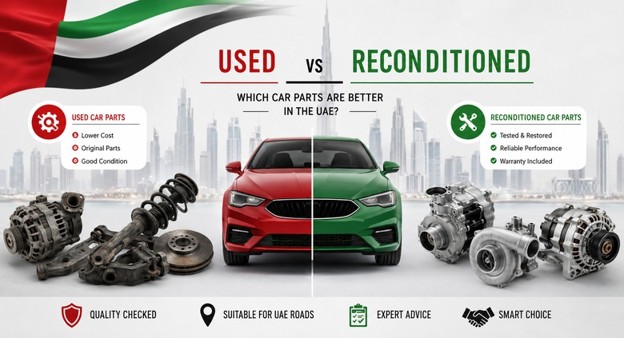
July 22, 2026
Understanding the Basics of Used and Reconditioned Car Parts
Replacing a worn car part sounds simple.
Until someone asks a question that most vehicle owners struggle to answer.
"Would you like a used part or a reconditioned one?"
For many people, the two sound almost identical.
Both are alternatives to buying a brand-new component.
Both can reduce repair costs.
Both are widely available throughout the UAE.
Yet they are not the same.
In fact, confusing one with the other is one of the most common reasons buyers end up purchasing a replacement part that doesn't match their expectations.
A used engine may still have years of reliable service remaining.
A professionally reconditioned gearbox may perform remarkably close to factory standards.
Another component, however, may have received little more than a basic cleaning before being advertised for sale.
Understanding the difference is therefore more than an interesting piece of automotive knowledge.
It is one of the smartest ways to make better buying decisions, avoid unnecessary expenses and keep your vehicle performing reliably for years to come.
Why This Comparison Matters
Every vehicle eventually needs replacement parts.
Whether it's a family saloon travelling across Dubai every day, a Toyota Land Cruiser exploring desert tracks, a commercial van delivering goods throughout Abu Dhabi or a luxury SUV cruising along Sheikh Zayed Road, wear is inevitable.
The real decision begins when replacement becomes necessary.
Should you buy new?
Should you choose a used component?
Would a professionally reconditioned part offer better value?
The answer depends on several factors.
The type of repair.
The age of the vehicle.
Your ownership plans.
Your budget.
The importance of the component being replaced.
Experienced workshops don't recommend the same solution for every customer because every vehicle has different requirements.
Understanding the strengths and limitations of both used and reconditioned parts helps owners make decisions based on facts rather than assumptions.
Growing Demand for Affordable Car Parts in the UAE
Vehicle ownership across the Emirates continues to grow.
With that growth comes increasing demand for affordable, dependable replacement components.
Owners are looking for ways to control maintenance costs without sacrificing reliability.
This trend has encouraged significant growth in the market for both used and reconditioned car parts in UAE.
Across Dubai, Abu Dhabi, Sharjah, Ajman, Ras Al Khaimah, Fujairah and Umm Al Quwain, buyers now have access to:
- Independent automotive specialists.
- Vehicle dismantlers.
- Professional reconditioning workshops.
- Online parts suppliers.
- Regional distributors.
- Automotive trading centres.
Having more options is beneficial.
It also means buyers need a clearer understanding of exactly what they are purchasing.
Not every affordable component offers the same level of quality or preparation.
Knowing the difference can prevent expensive mistakes.
What Are Used Car Parts?
A used car part is exactly what the name suggests.
It has previously been installed on another vehicle and removed before being offered for resale.
Most used components originate from:
- Accident-damaged vehicles.
- Insurance write-offs.
- End-of-life vehicles.
- Fleet replacements.
- Vehicle dismantling operations.
Importantly, a used part has not necessarily failed.
Many components remain in excellent working condition even after the original vehicle reaches the end of its service life.
Examples include:
- Doors.
- Bonnets.
- Mirrors.
- Headlights.
- Seats.
- Alloy wheels.
- Engine assemblies.
- Gearboxes.
The condition of used parts can vary considerably.
Some may have covered relatively low mileage.
Others may have experienced years of heavy use.
For this reason, inspection and supplier reputation are extremely important when purchasing used components.
What Are Reconditioned Car Parts?
A reconditioned part begins life as a used component.
The difference lies in what happens next.
Rather than being sold immediately after removal, it undergoes a structured restoration process carried out by trained technicians.
Depending on the type of component, reconditioning may involve:
- Complete disassembly.
- Thorough cleaning.
- Detailed inspection.
- Replacement of worn internal components.
- Precision machining.
- Reassembly.
- Functional testing.
The objective is not to create a brand-new component.
Instead, the aim is to restore reliable performance while extending the service life of the original part.
Engines, gearboxes, steering racks, turbochargers, alternators and starter motors are among the components most commonly reconditioned.
The quality of the work, however, depends entirely on the standards followed by the workshop carrying out the process.
Professional reconditioning requires skill, experience and rigorous testing.
Used vs Reconditioned: The Key Differences
Although both options can reduce repair costs, they are fundamentally different products.
The following comparison illustrates the distinction.
| Feature | Used Car Parts | Reconditioned Car Parts |
| Previous Use | Removed from another vehicle | Previously used, then professionally restored |
| Internal Repairs | Usually none | Worn components replaced where necessary |
| Testing | Limited, depending on supplier | Comprehensive inspection and testing |
| Expected Service Life | Varies according to previous use | Generally longer when properly reconditioned |
| Purchase Price | Usually lower | Typically higher due to restoration work |
| Best Suited For | Cost-conscious repairs and cosmetic components | Major mechanical systems and long-term ownership |
Neither option is automatically better.
Each serves a different purpose.
The correct choice depends on the repair and the expectations of the owner.
Common Misconceptions Buyers Should Avoid
The used and reconditioned parts market is surrounded by several persistent myths.
Let's separate fact from fiction.
Myth: Used parts are always unreliable.
Reality: Many used components come from low-mileage vehicles and continue performing reliably when inspected properly.
Myth: Every reconditioned part is virtually brand new.
Reality: Reconditioning restores performance, but the quality depends heavily on the expertise of the workshop and the replacement components used during the process.
Myth: Reconditioned parts are always too expensive.
Reality: Although they generally cost more than used parts, they often remain significantly more affordable than purchasing brand-new manufacturer components.
Myth: Appearance tells you everything.
Reality: Two parts may look identical externally while having completely different internal conditions.
Professional testing reveals far more than visual inspection alone.
A Workshop Story from Dubai
A Nissan X-Trail owner required a replacement alternator after repeated charging problems.
The owner initially planned to purchase the least expensive used unit available.
Before ordering, the workshop explained the difference between a used alternator and a professionally reconditioned one.
The used unit had unknown mileage and service history.
The reconditioned alternator had received new bearings, brushes, voltage regulation components and performance testing before sale.
The owner chose the reconditioned option.
More than two years later, the alternator continued operating without fault.
The decision was not based solely on price.
It was based on understanding the level of preparation behind the component.
Why Understanding the Difference Saves Money
Many buyers assume the cheapest option automatically offers the best value.
Experienced technicians see things differently.
The true cost of any replacement part includes:
- Installation labour.
- Vehicle downtime.
- Reliability.
- Future maintenance.
- Compatibility.
- Expected service life.
Choosing the correct replacement part the first time often costs less than replacing an unsuitable component again a few months later.
That's why understanding the difference between used and reconditioned parts is such an important first step.
Building Confidence Before You Buy
The UAE offers one of the region's most active automotive parts markets.
That creates opportunity.
It also creates responsibility.
Buyers who understand how used and reconditioned parts differ are far better equipped to compare suppliers, evaluate quality and choose components that genuinely match their vehicle and ownership goals.
Knowledge reduces uncertainty.
And confident buyers almost always make better long-term decisions.
Key Takeaways
- Used and reconditioned car parts are not the same, despite often being grouped together.
- Used parts are removed from another vehicle, while reconditioned parts undergo professional restoration and testing before resale.
- The right choice depends on the repair, vehicle age, ownership plans and long-term reliability expectations.
- Professional inspection and supplier reputation are essential when purchasing either type of replacement component.
- Understanding these differences helps reduce repair costs, avoid compatibility problems and make more informed buying decisions.
Comparing Performance and Reliability
Here's the thing.
People often compare used and reconditioned car parts by looking at one figure alone.
The price.
That's understandable. Repairs aren't cheap, and nobody enjoys spending more than they have to. But here's the catch. The cheapest option on the day you buy it isn't always the cheapest six months later.
A used gearbox that keeps going for another 100,000 kilometres can be a brilliant purchase.
A poorly reconditioned alternator can fail within weeks.
The opposite can happen too.
That's exactly why experienced workshops never make recommendations based on labels alone. They look at the condition of the component, the quality of the restoration, the reputation of the supplier and, perhaps most importantly, how the vehicle is actually used.
A family car driving around Sharjah has different demands from a Toyota Land Cruiser tackling desert tracks every other weekend. And a delivery van covering hundreds of kilometres every day? That's another story altogether.
Performance and reliability aren't fixed. They're influenced by the part, the vehicle and the people behind the repair.
Which Option Lasts Longer?
This is probably the question workshops hear more than any other.
"Will the reconditioned one last longer?"
Sometimes yes.
Sometimes no.
It depends.
A genuine low-mileage used engine removed from a lightly driven accident-damaged vehicle may outlast a poorly rebuilt engine that has been reconditioned using low-quality internal components.
On the other hand, a professionally reconditioned transmission fitted with new bearings, seals, clutches and tested before leaving the workshop can deliver years of dependable service.
That's why it's risky to make sweeping statements.
Instead, ask questions.
How was the part sourced?
Who rebuilt it?
What was replaced?
Was it tested?
Those answers tell you far more than the words used or reconditioned ever will.
Safety Should Never Be an Afterthought
Let's be honest.
Some parts simply carry more responsibility than others.
A replacement interior trim panel isn't going to determine whether you stop safely at a busy junction.
Brake components might.
Steering parts certainly can.
Airbag modules? Absolutely.
When safety-critical systems are involved, experienced technicians become much more cautious.
They want to know:
- Where the component came from.
- Whether it has been inspected.
- If internal wear has been measured.
- Whether testing has been completed.
- If warranty support is available.
Saving a little money doesn't feel like much of a victory if the replacement part doesn't perform when it really matters.
Safety has a habit of making every other consideration seem much smaller.
Quality Inspection Standards
Not all suppliers inspect parts in the same way.
That's one of the biggest differences buyers overlook.
A reputable supplier usually follows a structured process.
It might include:
- Visual examination.
- Dimensional measurements.
- Internal inspection.
- Cleaning.
- Functional testing.
- Documentation.
Less experienced sellers may simply remove a component, wipe it clean and list it for sale.
The two products might look almost identical in a photograph.
Inside?
That's where the real differences often appear.
Professional inspection reduces uncertainty.
Guesswork rarely does.
Performance in UAE Driving Conditions
The UAE asks a lot from every vehicle.
Engines work harder in summer.
Cooling systems run almost continuously.
Air-conditioning rarely gets a day off.
Traffic builds up.
Motorways stretch on for kilometres.
Desert driving adds yet another layer of stress.
These conditions expose weaknesses surprisingly quickly.
Take an ageing radiator.
It may appear perfectly serviceable during a mild winter morning.
Place it in slow-moving Dubai traffic during August with the air-conditioning running at full power and the story can change completely.
That's why workshops often recommend looking beyond appearance.
The component has to cope with real operating conditions, not just pass a visual inspection.
A replacement part that holds up in the UAE has genuinely earned its place.
Which Option Works Best for Daily Drivers?
Daily commuting creates predictable wear.
Cold starts.
Traffic lights.
Frequent braking.
Hours spent in congestion.
Repeat.
Again and again.
Vehicles used every day benefit from consistency.
Owners usually want reliability more than anything else.
For many daily drivers, professionally reconditioned mechanical components can offer an excellent balance between affordability and dependable performance, particularly when supplied by experienced specialists.
Used parts also have their place.
Items such as mirrors, doors, interior trim, alloy wheels and body panels often provide excellent value when sourced in good condition.
Choosing the right part matters more than choosing a category.
Best Choice for Commercial Vehicles
Commercial vehicles don't have the luxury of sitting idle.
If a delivery van breaks down, deliveries stop.
If a pickup is off the road, work slows down.
Downtime quickly becomes expensive.
Fleet managers understand this better than anyone.
They tend to focus on:
- Proven reliability.
- Consistent availability.
- Predictable maintenance.
- Warranty support.
- Reduced downtime.
- Trusted supplier relationships.
For major mechanical systems, professionally reconditioned components often become the preferred option because they combine lower purchase costs with greater confidence than many unknown-history used parts.
Keeping vehicles moving is the real objective.
Everything else follows.
A Workshop Story from Abu Dhabi
A small logistics company brought in two identical Ford Transit vans for gearbox repairs.
One owner wanted the cheapest used gearbox available.
The second asked the workshop to source a professionally reconditioned unit from a specialist.
Twelve months later, the difference was clear.
The reconditioned gearbox continued shifting smoothly without issue.
The used gearbox developed bearing noise and eventually required another replacement.
Was every used gearbox bad?
Of course not.
Was every reconditioned gearbox perfect?
No.
But in this case, careful rebuilding and proper testing made all the difference.
It's a reminder that preparation often matters just as much as the part itself.
Reliability Isn't Just About the Part
People often blame the replacement component when something goes wrong.
Sometimes they're right.
Sometimes they aren't.
Installation quality plays a huge role.
So does maintenance.
Correct fluids.
Proper torque settings.
Software calibration where required.
Routine servicing afterwards.
Even the highest-quality component can wear out prematurely if it's installed incorrectly or neglected afterwards.
Reliable ownership comes from looking at the whole picture rather than one individual repair.
Think Beyond Today's Invoice
It's tempting to focus on today's bill.
Everyone does it.
But pause for a moment.
Ask yourself another question.
"How long do I expect to keep this vehicle?"
If the answer is several years, spending slightly more on a dependable replacement often makes perfect sense.
If the vehicle is nearing the end of its life, your priorities may be completely different.
Neither approach is wrong.
The important thing is making a decision that fits your circumstances instead of someone else's.
Key Takeaways
- Neither used nor reconditioned parts are automatically superior; quality depends on sourcing, inspection and workmanship.
- Safety-critical systems deserve careful evaluation and should only use components with proven quality and compatibility.
- UAE driving conditions place extra stress on replacement parts, making durability especially important.
- Daily drivers, commercial vehicles and high-mileage cars each require different purchasing strategies.
- Looking beyond the purchase price and considering long-term reliability often leads to better ownership value.
Cost and Value Comparison
Money influences almost every repair decision.
That's reality.
Even owners who insist they only buy the very best replacement parts eventually look at the invoice and think, "Could I have saved a bit there?"
There's nothing wrong with that.
The mistake comes when price becomes the only thing that matters.
A used starter motor might save you a few hundred dirhams today. Brilliant. But if it gives up six months later and you're paying for another replacement, another installation and another day without your car, was it really the cheaper option?
Maybe.
Maybe not.
That's why experienced workshops don't stop at the price tag. They dig deeper. They weigh up reliability, expected lifespan, labour costs and the simple inconvenience of having to do the same repair twice.
Value isn't measured at the checkout.
It's measured over the months and years that follow.
Price Comparison
Let's start with the obvious.
Used parts usually cost less.
That's one of their biggest attractions.
Since they are removed from another vehicle and sold without extensive rebuilding, the purchase price is often significantly lower than a professionally reconditioned alternative.
Reconditioned parts cost more because someone has already invested time, expertise and replacement components into restoring them.
That process often includes:
- Complete dismantling.
- Cleaning.
- Internal inspection.
- Replacing worn components.
- Precision machining where required.
- Testing before sale.
Naturally, all of that adds to the final price.
But it also adds something else.
Confidence.
Sometimes that confidence is worth far more than the extra money spent.
Looking Beyond the Purchase Price
Here's a question that rarely gets asked.
"What will this repair cost me next year?"
It's a much better question than simply asking how much the replacement part costs today.
The true ownership cost may include:
- Installation labour.
- Future servicing.
- Vehicle downtime.
- Recovery charges if a breakdown occurs.
- Additional diagnostics.
- Replacement fluids.
- Lost business income.
Suddenly, a component that looked like a bargain starts becoming rather expensive.
Professional technicians often say they have never seen a customer complain about paying for a quality repair once.
They have, however, seen plenty complain about paying for the same repair twice.
Warranty Differences
Warranty doesn't guarantee perfection.
It does provide reassurance.
And reassurance matters.
Most used parts are sold with either a limited warranty or, in some cases, no meaningful warranty at all.
That's not necessarily a problem if the component has been inspected carefully and comes from a trusted supplier.
Reconditioned parts, however, are often supplied with more comprehensive warranty support because the restoration process has already included inspection and testing.
Before buying, always ask:
- How long is the warranty?
- What exactly does it cover?
- Are labour costs included?
- What situations are excluded?
- Is proof of professional installation required?
A warranty only becomes valuable when you understand how it works.
Don't wait until something goes wrong to read the small print.
Availability Across the UAE
One advantage of living in the UAE is access.
The automotive parts market is extensive.
Whether you're searching in Dubai, Abu Dhabi, Sharjah, Ajman, Ras Al Khaimah, Fujairah or Umm Al Quwain, replacement components are generally easier to source than many buyers expect.
Availability varies according to:
- Vehicle popularity.
- Production year.
- Engine specification.
- Import demand.
- Supplier inventory.
- Market conditions.
Used parts for high-volume vehicles such as the Toyota Corolla, Nissan Sunny and Honda Civic are often readily available.
Finding a reconditioned transmission for a specialist European model may take a little longer.
Patience sometimes leads to a much better repair.
Comparing Multiple Suppliers
Here's something experienced buyers do almost automatically.
They compare.
Not just prices.
Everything.
A professional comparison should include:
- Product condition.
- Warranty.
- Supplier experience.
- VIN verification.
- Delivery times.
- Technical support.
- Return policy.
A quotation only tells part of the story.
The people behind that quotation tell the rest.
Some suppliers simply sell components.
Others solve problems.
You'll notice the difference within the first few minutes of the conversation.
When Used Parts Offer Better Value
Used parts often make excellent financial sense for components that experience relatively little internal wear.
Examples include:
- Doors.
- Tailgates.
- Bumpers.
- Mirrors.
- Interior trim.
- Alloy wheels.
- Window glass.
These parts generally don't require complex rebuilding.
If they are in good condition, they can provide outstanding value while restoring the vehicle to its original appearance and function.
Many workshops recommend quality used body and cosmetic parts without hesitation.
When Reconditioned Parts Become the Smarter Investment
Mechanical systems tell a different story.
Engines.
Gearboxes.
Turbochargers.
Alternators.
Steering racks.
These components contain numerous moving parts operating under continuous load.
Professional rebuilding can significantly improve reliability by replacing worn internal components before the part is returned to service.
For owners planning to keep their vehicle for several years, the additional investment often makes practical and financial sense.
A well-reconditioned component doesn't just replace the failed part.
It helps restore confidence every time you drive.
A Workshop Story from Sharjah
A Lexus ES owner needed a replacement steering rack after developing excessive steering play.
The owner received two quotations.
The first was for a lower-priced used steering rack with no meaningful warranty.
The second was for a professionally reconditioned unit that had been stripped, rebuilt with new seals, pressure-tested and supplied with warranty coverage.
Initially, the used option looked tempting.
After discussing labour costs involved in replacing the steering rack, the workshop recommended the reconditioned unit.
Why?
Because replacing the same component twice would have cost considerably more than choosing the better-prepared part in the first place.
Two years later, the steering remained smooth and fault-free.
Sometimes the better value isn't the lower number on the quotation.
Thinking Like a Long-Term Owner
The best buying decisions usually come from changing one habit.
Stop asking,
"What's the cheapest option?"
Start asking,
"Which option gives me the best overall value?"
Those two questions often lead to completely different answers.
Reliable ownership isn't built around chasing bargains.
It's built around making sensible decisions, one repair at a time.
Value Comes from Confidence
Every replacement part carries a degree of uncertainty.
Good suppliers reduce that uncertainty.
Professional workshops reduce it even further.
When buyers understand what they're paying for, compare suppliers properly and think beyond the immediate repair, choosing between used and reconditioned parts becomes far less confusing.
The smartest purchase isn't always the least expensive.
It's the one that keeps the vehicle on the road with the fewest surprises.
Key Takeaways
- Used parts generally have a lower purchase price, while reconditioned parts usually offer greater preparation and testing.
- The true cost of a repair includes labour, downtime, future maintenance and long-term reliability.
- Warranty coverage should always be understood before purchasing any replacement component.
- Comparing suppliers on expertise, support and compatibility is just as important as comparing prices.
- Choosing the option that provides the best overall ownership value often proves more economical than simply selecting the cheapest part.
Which Parts Should Be Used or Reconditioned?
This is where things become interesting.
Ask five mechanics whether you should buy a used or a reconditioned part and you probably won't hear five identical answers. Not because they're guessing. Quite the opposite. They're looking at the vehicle in front of them.
How old is it?
How many kilometres has it covered?
How is it driven?
Will the owner keep it for another six months or another six years?
Those questions matter.
A used door from a low-mileage vehicle can be a fantastic purchase. A worn turbocharger with an unknown history? That's a completely different conversation.
The smartest workshops don't think in black and white. They weigh up the risks, the repair costs and the owner's expectations before making a recommendation.
Let's look at the major vehicle systems one by one.
Engines
Few repairs generate more discussion than replacing an engine.
And understandably so.
An engine is one of the most expensive components in any vehicle, so getting the decision right is essential.
A quality used engine can be excellent if it comes from a verified low-mileage donor vehicle with a documented service history.
On the other hand, a professionally reconditioned engine offers something many buyers appreciate.
A fresh start.
During reconditioning, technicians may replace worn components such as:
- Pistons.
- Bearings.
- Timing components.
- Gaskets.
- Oil seals.
- Water pumps where required.
Everything is inspected carefully before the engine is reassembled.
If you're planning to keep the vehicle for years, a properly reconditioned engine often makes excellent long-term sense.
If you're repairing an older car with limited resale value, a carefully selected used engine may be the more practical route.
It depends on the bigger picture.
Gearboxes
Automatic gearboxes live a demanding life.
They cope with constant heat, hydraulic pressure and thousands of gear changes every single day.
That's why gearbox condition isn't always obvious from the outside.
A used gearbox might shift beautifully during a brief inspection.
After installation? Only then does its true condition become apparent.
Professionally reconditioned gearboxes are usually stripped down completely.
Technicians inspect gears, bearings, seals, clutch packs and valve bodies before rebuilding the unit.
Many specialists also carry out functional testing before releasing it for sale.
For vehicles expected to remain on the road for several more years, workshops frequently favour reconditioned gearboxes because replacing one twice is a repair nobody wants to pay for.
Suspension Components
Suspension parts don't all follow the same rules.
Some components work perfectly well as quality used parts.
Others deserve much closer attention.
Items commonly considered suitable as used parts include:
- Control arms in excellent condition.
- Subframes.
- Crossmembers.
- Upright assemblies.
However, wear items such as bushes, ball joints and shock absorbers generally receive much more scrutiny.
Professional workshops often recommend replacing these with new or professionally rebuilt alternatives because they naturally deteriorate over time.
After all, suspension doesn't simply support comfort.
It influences handling, braking and tyre wear too.
Steering Parts
Steering isn't an area where experienced technicians enjoy taking chances.
Every movement of the steering wheel relies on precise mechanical operation.
Common steering components include:
- Steering racks.
- Tie rods.
- Steering pumps.
- Steering columns.
A professionally reconditioned steering rack typically receives new seals, internal inspection, machining where necessary and pressure testing before installation.
A used steering rack can certainly work well if sourced carefully.
But without proper inspection, predicting its remaining lifespan becomes far more difficult.
That's why many workshops lean towards reconditioned steering systems whenever possible.
Confidence behind the wheel is difficult to put a price on.
Brake Components
Here's one area where caution always wins.
Brake systems protect lives.
Not just yours.
Everyone else's too.
Some brake-related items, such as brake callipers, can often be professionally reconditioned to an excellent standard.
Internal seals, pistons and sliding mechanisms are renewed before testing.
Other braking components deserve a different approach.
Technicians generally recommend replacing items such as:
- Brake pads.
- Brake discs.
- Flexible brake hoses.
- Brake fluid.
These components are wear items.
Reusing them simply doesn't make sense.
When braking performance is involved, reliability should always outweigh short-term savings.
Electrical Components
Modern vehicles rely heavily on electronics.
One faulty component can trigger multiple warning lights across several systems.
That's why electrical repairs deserve careful planning.
Common electrical components include:
- Alternators.
- Starter motors.
- Electronic throttle bodies.
- Window motors.
- Air-conditioning compressors.
- Engine control sensors.
Alternators and starter motors are among the most successfully reconditioned automotive components.
Replacing bearings, brushes, voltage regulators and worn internal parts often restores dependable performance.
Sensitive electronic modules, however, usually require more caution because compatibility and programming play a significant role.
Every electrical repair should begin with accurate diagnosis.
Guesswork rarely ends well.
A Workshop Story from Dubai
A Toyota Prado owner arrived at a specialist workshop after noticing noisy steering during parking.
Inspection confirmed excessive wear inside the steering rack.
The owner had already found a very cheap used replacement online.
The workshop suggested looking into a professionally reconditioned rack instead.
Why?
Because removing and refitting a steering rack requires significant labour.
If the used unit developed the same fault a few months later, the labour costs alone would outweigh the original saving.
The owner agreed.
The rebuilt steering rack was installed, aligned and road-tested.
Months later, the vehicle was still driving exactly as it should.
Sometimes the labour attached to a repair is just as important as the part itself.
Matching the Component to the Repair
Not every repair deserves the same solution.
A used door?
Often a sensible purchase.
A reconditioned gearbox?
Frequently worth the extra investment.
A safety-critical braking component?
Usually best replaced with new parts designed for the job.
Professional technicians don't rely on fixed rules.
They assess:
- Vehicle age.
- Mileage.
- Repair complexity.
- Labour involved.
- Safety implications.
- Long-term ownership plans.
That's the sort of thinking that prevents expensive mistakes.
Don't Chase the Cheapest Option
It's easy to get drawn in by a low price.
We've all done it.
But pause for a second.
Think about the labour.
Think about the inconvenience.
Think about being back in the workshop only weeks after the repair.
Suddenly, that bargain doesn't feel quite so clever.
Choose the right component for the job—not just the lowest price on the screen.
Your future self will thank you for it.
Key Takeaways
- Different vehicle systems require different approaches when choosing between used and reconditioned parts.
- Used body panels and cosmetic components often provide excellent value when sourced in good condition.
- Reconditioned engines, gearboxes, steering racks and alternators frequently offer stronger long-term reliability because worn internal components have been replaced.
- Safety-critical systems should always be repaired using components that meet high quality and inspection standards.
- The best decision depends on the vehicle, the repair, the labour involved and how long you intend to keep the car.
A Practical Buying Guide for Used and Reconditioned Car Parts
You can read every buying guide on the internet.
You can compare dozens of prices.
You can even visit five different suppliers in one afternoon.
And still end up with the wrong part.
Why?
Because most expensive mistakes happen before the part ever reaches the workshop.
People rush.
They assume.
They trust a photograph instead of asking the right questions.
Experienced technicians don't do that. They slow the process down. They check the details, rule out compatibility issues and make sure the replacement component actually suits the vehicle—not just the budget.
A little preparation now can save days of frustration later.
How to Buy Used Parts with Confidence
A quality used part isn't difficult to find.
Finding the right one takes patience.
The first thing to establish is where the component came from.
Was it removed from an accident-damaged vehicle?
Was the donor vehicle running before dismantling?
Has the mileage been verified?
Good suppliers are usually happy to answer these questions because they know exactly where their stock originated.
While inspecting a used component, pay close attention to:
- Visible cracks.
- Corrosion.
- Oil or fluid leaks.
- Broken mounting points.
- Uneven wear.
- Signs of previous repairs.
Don't be afraid to ask for additional photographs or videos if you're buying remotely.
A trustworthy supplier won't mind.
If anything, they'll appreciate that you're taking the purchase seriously.
Buying Reconditioned Parts the Smart Way
Not every rebuilt part has been rebuilt to the same standard.
That's one of the biggest misunderstandings in the market.
Some workshops carry out a complete restoration.
Others replace only the failed component before putting everything back together.
There's a world of difference between those two approaches.
Ask the supplier exactly what work has been completed.
Questions worth asking include:
- Which internal parts were replaced?
- Were genuine or equivalent-quality components used?
- Was machining carried out?
- Has the unit been pressure-tested or bench-tested?
- Is a test report available?
If the answers sound vague, keep looking.
A professional reconditioning specialist should be able to explain the process without hesitation.
Always Match the Part to Your VIN
Here's a mistake that catches out even experienced owners.
Two vehicles can look identical.
Same model.
Same colour.
Same engine size.
Yet the replacement part may still be different.
Manufacturers often introduce changes during production, even within the same model year.
That's why the Vehicle Identification Number (VIN) is so important.
The VIN allows suppliers to verify:
- Engine specification.
- Transmission type.
- Factory equipment.
- Production date.
- Market specification.
- Original part numbers.
Never rely solely on appearance.
One small difference can turn a straightforward repair into an expensive headache.
Why OEM Part Numbers Matter
Think of an OEM part number as the component's fingerprint.
It identifies the exact specification fitted by the manufacturer.
Matching OEM numbers dramatically reduces the chances of ordering an incompatible replacement.
Many experienced workshops check the OEM reference before they even begin comparing prices.
It's quicker.
It's safer.
And it prevents unnecessary returns.
If the supplier can't confirm compatibility, don't guess.
Take a few extra minutes now rather than wasting several days sorting out the wrong order later.
Warning Signs You Shouldn't Ignore
Most reliable suppliers are transparent.
They answer questions.
They provide information.
They stand behind what they sell.
Unfortunately, not everyone operates that way.
Watch out for warning signs such as:
- Prices that seem unbelievably low.
- Refusal to provide photographs.
- No warranty information.
- Unclear mileage claims.
- Pressure to make an immediate payment.
- Inconsistent descriptions.
- Missing contact details.
If something feels off, trust your instincts.
Walking away from a questionable deal is far cheaper than fixing the consequences afterwards.
A Workshop Inspection Checklist
Professional technicians rarely install a replacement part straight out of the box.
They inspect it first.
A basic workshop checklist often includes:
- Confirming VIN compatibility.
- Checking OEM numbers.
- Inspecting mounting points.
- Looking for transport damage.
- Examining seals and connectors.
- Rotating moving components where appropriate.
- Verifying sensors and electrical connections.
It doesn't take long.
Yet these simple checks prevent countless problems further down the line.
A Workshop Story from Abu Dhabi
A BMW 520i owner sourced a used air-conditioning compressor from an online seller because the price looked too good to ignore.
When the vehicle arrived at the workshop, the technician decided to carry out a few routine checks before fitting it.
Within minutes, they noticed the pulley design didn't match the original specification.
The compressor belonged to a different engine variant.
From a distance, the two units looked almost identical.
They weren't.
Because the issue was spotted before installation, the owner avoided paying labour charges for fitting an incompatible component.
It was a small inspection that prevented a much larger bill.
Don't Let Price Make the Decision Alone
We've all been tempted by a bargain.
It's human nature.
But ask yourself one question before clicking Buy Now.
"Am I buying the cheapest part or the right part?"
Those aren't always the same thing.
A slightly more expensive component with verified compatibility, proper inspection and warranty support often delivers far better value over the life of the vehicle.
Think long term.
Your wallet usually benefits.
A Simple Buying Checklist Before Contacting a Supplier
Before you commit to any purchase, run through this quick checklist:
- Have I confirmed the VIN?
- Do the OEM part numbers match?
- Has the supplier explained the part's history?
- Is there a clear warranty?
- Has the component been inspected or tested?
- Are photographs of the actual part available?
- Does the supplier have a good reputation?
- Am I comparing overall value rather than price alone?
If you can answer "yes" to most of those questions, you're already in a much stronger position than many buyers.
Buy with Information, Not Assumptions
The UAE offers an impressive choice of used and reconditioned car parts.
That's a real advantage.
But choice only becomes valuable when you know how to assess it.
Take your time.
Ask questions.
Compare suppliers.
Verify compatibility.
A few extra minutes of research today can save weeks of inconvenience tomorrow.
That's how experienced buyers stay one step ahead.
Key Takeaways
- Inspect used parts carefully and always ask about their origin, mileage and condition.
- Choose reconditioned parts from specialists who can clearly explain the rebuilding and testing process.
- Always verify VIN details and OEM part numbers before placing an order.
- Be cautious of unusually cheap prices, vague descriptions or suppliers unwilling to answer questions.
- A structured buying checklist helps reduce risk and increases the chances of a successful, long-lasting repair.
Used and Reconditioned Parts for Popular Car Brands in the UAE
Walk through any major automotive parts market in the UAE and one thing quickly becomes obvious.
Not every brand enjoys the same level of parts availability.
Some vehicles have shelves packed with replacement components.
Others? You may have to ring around, compare suppliers and wait for the right part to turn up.
That's perfectly normal.
Vehicle popularity, production numbers, import volumes and local demand all shape what's available. A Toyota Corolla that sells in huge numbers will naturally have a bigger supply of used and reconditioned parts than a niche performance model.
So, rather than asking, "Which option is better?", ask a different question.
"What's the smartest choice for my particular vehicle?"
That simple shift in thinking can save both time and money.
Toyota
Toyota has earned a reputation for durability, and that's one reason you'll find such a healthy supply of replacement parts across the Emirates.
From the Corolla and Camry to the Prado, Fortuner and Land Cruiser, used components are widely available because these vehicles are everywhere.
Body panels, lighting units, interior trim and suspension components are often easy to source in excellent condition.
Major mechanical parts deserve a little more thought.
If you're replacing an engine or transmission and intend to keep the vehicle for years, professionally rebuilt components can provide extra peace of mind, particularly when they've been properly tested before sale.
High demand also means it's worth comparing several suppliers instead of accepting the first quotation that lands on your desk.
Nissan
Nissan owners generally enjoy plenty of choice.
Models such as the Sunny, Altima, Patrol and X-Trail have a strong presence in the UAE, which keeps the used parts market active.
That said, availability can differ depending on the engine and transmission fitted to the vehicle.
A cosmetic repair might be sorted within hours.
Finding the correct automatic gearbox for a specific model year could take longer.
Don't rush it.
Taking an extra day to verify compatibility is usually far better than fitting the wrong component and starting all over again.
Experienced workshops also recommend checking transmission codes rather than relying solely on the model name.
Small differences matter.
Honda and Hyundai
Honda and Hyundai have become increasingly popular with families and commuters who value dependable daily transport.
As a result, replacement parts are generally easy to find.
Used doors, mirrors, bumpers, seats and interior components often represent excellent value, especially when removed from low-mileage donor vehicles.
Mechanical components require a more careful approach.
Alternators, starter motors and steering racks are commonly available as professionally reconditioned units and can deliver reliable service when sourced from established specialists.
The key is consistency.
A supplier with a proven track record is usually a safer bet than one offering the lowest price with very little information to back it up.
Ford and Chevrolet
Ford and Chevrolet cover a broad range of vehicles in the UAE.
From everyday saloons to rugged pickups and commercial vans, the choice is extensive.
That variety brings opportunity—but it also means buyers need to pay closer attention to specifications.
A component that fits one engine variant may not suit another, even if both vehicles appear identical from the outside.
Before committing to a purchase, confirm:
- Engine code.
- Transmission type.
- Production year.
- OEM part number.
- VIN compatibility.
Five extra minutes of checking can prevent hours of unnecessary work later.
It's a habit worth picking up.
BMW, Mercedes-Benz and Audi
Premium German vehicles are engineered to exceptionally high standards.
Naturally, their replacement parts deserve the same level of attention.
Used cosmetic parts such as mirrors, alloy wheels, seats and body panels can often offer excellent value if they're in good condition.
Mechanical systems are another matter.
Modern turbocharged engines, sophisticated transmissions and electronically controlled steering systems demand precision.
That's why many independent specialists lean towards professionally reconditioned components for major repairs.
Yes, they may cost more initially.
But they often reduce the likelihood of repeat labour and unexpected failures further down the road.
On luxury vehicles, installation costs alone can make reliability worth paying for.
Land Rover, Lexus and Porsche
These brands attract owners who expect performance as well as refinement.
And rightly so.
However, they also present unique challenges when repairs become necessary.
Land Rover models frequently include advanced four-wheel-drive systems and complex electronic modules.
Lexus vehicles combine renowned reliability with increasingly sophisticated hybrid technology.
Porsche components often require specialist knowledge and precise compatibility checks.
Because many of these vehicles involve higher labour costs, workshops regularly recommend choosing the best-prepared replacement rather than simply the cheapest one.
Cutting corners rarely saves money on premium vehicles.
More often than not, it does the opposite.
Availability Can Change Surprisingly Quickly
Here's something many buyers don't expect.
Parts availability isn't fixed.
One week, a supplier may have three suitable replacement engines sitting in stock.
A few days later?
All gone.
The UAE parts market moves quickly, particularly for popular vehicles and well-maintained donor cars.
If you've found the right component from a reputable supplier—and you've verified the details—it may not be there forever.
That doesn't mean you should rush blindly.
It does mean you shouldn't delay unnecessarily once you've done your homework.
A Workshop Story from Sharjah
A family brought their Honda Accord into a workshop after developing a noisy wheel bearing and worn front suspension components.
While discussing the repair, the owner mentioned finding a very cheap used suspension assembly online.
The technician had a closer look at the photographs and spotted corrosion around one of the mounting points.
Instead of taking the risk, the workshop sourced quality used control arms from a low-mileage donor vehicle and fitted new bushes and ball joints before installation.
The repair cost a little more than the original online deal.
The result?
The car drove smoothly, passed alignment without issue and the owner avoided another suspension repair only months later.
Sometimes mixing carefully selected used parts with new wear components produces the best outcome.
Every Brand Has Its Own Buying Strategy
There's no universal formula.
A Toyota owner won't necessarily make the same decision as someone driving a Porsche.
Nor should they.
Vehicle value, repair costs, labour charges, parts availability and long-term ownership plans all influence the smartest choice.
That's why experienced workshops tailor their recommendations instead of handing every customer the same answer.
It isn't about the badge.
It's about matching the replacement part to the vehicle and the way it's used.
Key Takeaways
- Popular brands such as Toyota, Nissan, Honda and Hyundai generally have excellent availability of both used and reconditioned parts across the UAE.
- Premium manufacturers including BMW, Mercedes-Benz, Audi, Land Rover, Lexus and Porsche require closer attention to compatibility and repair quality.
- Always verify VIN details, engine specifications and OEM part numbers before ordering replacement components.
- Labour costs should be considered alongside the purchase price, particularly for luxury and performance vehicles.
- The best buying decision depends on the vehicle, the repair and the owner's long-term plans rather than the brand alone.
Choosing the Right Parts for Different Types of Vehicle Owners
Cars don't all live the same life.
Some spend their days crawling through morning traffic in Dubai.
Others head out on long motorway journeys between Abu Dhabi and Al Ain. Some haul heavy loads for businesses. Others only come out at weekends.
That's why experienced technicians rarely ask only one question.
"What part do you need?"
Instead, they ask a series of questions.
How do you drive?
How long will you keep the car?
How many kilometres do you cover every year?
What's your repair budget?
The answers usually point towards the right solution.
Let's break it down.
Family Cars
Family vehicles have one important job.
They need to be dependable.
School runs, supermarket trips, weekend outings and long holiday drives all depend on the car starting every morning without drama.
Nobody wants to be stranded with children in the back because a questionable replacement part failed unexpectedly.
For family cars, workshops often recommend balancing affordability with reliability.
Used body parts can be an excellent choice after minor accident damage.
Think about:
- Doors.
- Bonnets.
- Tailgates.
- Mirrors.
- Bumpers.
- Interior trim.
For major mechanical repairs, professionally reconditioned components often make more sense because they reduce the likelihood of unexpected failures later on.
Peace of mind is difficult to put a price on.
SUVs and Off-Road Vehicles
SUVs work harder than many people realise.
Even if they never leave the tarmac, they usually carry heavier loads, tow trailers or transport large families.
Take them off-road and the demands increase dramatically.
Heat.
Dust.
Loose sand.
Steep climbs.
Heavy suspension movement.
All of it adds stress.
Components that deserve particularly careful attention include:
- Four-wheel-drive systems.
- Transfer cases.
- Differentials.
- Suspension assemblies.
- Steering systems.
- Cooling components.
A quality used body panel may be absolutely fine.
A heavily worn transfer case with an uncertain history?
That's a gamble many specialists prefer to avoid.
When repairs involve complex driveline components, professionally reconditioned units often provide greater long-term confidence.
Luxury Vehicles
Luxury cars don't become less sophisticated simply because they're getting older.
If anything, repairs often become more complicated.
Modern BMW, Mercedes-Benz, Audi, Lexus and Porsche models combine advanced electronics with highly engineered mechanical systems.
That complexity means compatibility matters more than ever.
Replacing the failed part is only half the job.
The replacement must communicate correctly with the rest of the vehicle.
Workshops frequently recommend:
- VIN verification.
- OEM number matching.
- Software compatibility checks.
- Specialist installation.
- Professional diagnostics after fitting.
Trying to save a small amount on a major luxury vehicle repair can quickly become expensive if the wrong component has to come back out.
Fleet and Commercial Vehicles
Ask any fleet manager what matters most.
The answer usually comes back immediately.
"Downtime."
A van sitting in a workshop isn't generating income.
A pickup waiting for parts isn't completing jobs.
Every extra day off the road costs money.
That's why commercial operators often calculate repairs differently from private owners.
They look beyond the purchase price and consider:
- Labour costs.
- Vehicle availability.
- Warranty support.
- Expected service life.
- Future maintenance.
- Supplier reliability.
In many cases, professionally reconditioned engines, gearboxes and steering components become attractive because they help reduce the risk of repeat failures.
Keeping vehicles moving is often worth far more than saving a few hundred dirhams on the initial purchase.
High-Mileage Vehicles
What if your car has already covered 250,000 kilometres?
Should you still invest in expensive repairs?
There's no single answer.
A well-maintained high-mileage vehicle can continue serving reliably for years.
Equally, some cars are approaching the point where major investment no longer makes financial sense.
This is where honest workshop advice becomes invaluable.
Technicians will usually consider:
- Overall vehicle condition.
- Maintenance history.
- Market value.
- Remaining lifespan.
- Cost of the repair.
- Future ownership plans.
Sometimes a carefully selected used component is the smartest option.
Sometimes investing in a professionally reconditioned unit extends the vehicle's useful life significantly.
It all depends on the circumstances.
Enthusiast and Weekend Cars
Not every vehicle is driven every day.
Some owners only bring their cars out for weekend drives, classic car gatherings or special occasions.
Interestingly, lower mileage doesn't always mean lower maintenance.
Cars that spend long periods parked up can develop their own problems.
Seals dry out.
Rubber components harden.
Electrical connections corrode.
Fluids deteriorate.
Owners of enthusiast vehicles often place greater value on originality and authenticity.
That may influence whether they choose carefully preserved used components, professionally reconditioned originals or brand-new manufacturer parts.
The right answer often depends on the goals of the restoration.
A Workshop Story from Dubai
A business owner operated two nearly identical Toyota Hilux pickups.
One covered around 25,000 kilometres each year.
The other exceeded 90,000 kilometres while transporting equipment between different Emirates.
Both required replacement alternators within a few weeks of each other.
For the lower-mileage vehicle, the workshop sourced an excellent-condition used alternator from a verified donor vehicle.
For the high-mileage workhorse, they recommended a professionally reconditioned unit fitted with new internal wear components.
The owner asked why.
The technician smiled.
"Because these two vehicles don't live the same life."
Several years later, both repairs had proved to be the right choice.
Same model.
Different usage.
Different solution.
Think About Tomorrow, Not Just Today
It's easy to focus on today's repair bill.
We've all done it.
But repairs don't end when the invoice is paid.
Ask yourself a few simple questions before making a decision.
Will I keep the car for another year?
Five years?
Am I trying to maximise reliability?
Or simply get the vehicle back on the road at the lowest sensible cost?
Once you answer those questions honestly, the right replacement option often becomes much clearer.
There Isn't One Perfect Answer
People love simple rules.
Cars rarely follow them.
A used part can be the ideal solution in one situation and the wrong choice in another.
A professionally reconditioned component might seem expensive at first, yet save thousands in repeat labour and future downtime.
That's why experienced workshops don't sell the same recommendation to every customer.
They listen first.
Then they advise.
And that's exactly how major repair decisions should be made.
Key Takeaways
- Different ownership styles require different replacement strategies.
- Family cars benefit from dependable repairs that balance cost with long-term reliability.
- SUVs, luxury vehicles and commercial fleets often justify higher-quality replacement components because of heavier demands and labour costs.
- High-mileage vehicles should be assessed individually rather than judged purely by their odometer reading.
- The smartest buying decision is the one that matches how the vehicle is actually used, not simply the lowest available price.
Repair Costs, Hidden Expenses and Long-Term Value
Most people start with the same question.
"How much will it cost?"
Fair enough.
Repairs aren't exactly anyone's favourite way to spend money.
But here's the surprising part. Two repairs with almost identical invoices can end up costing very different amounts over the life of the vehicle.
How?
Labour.
Downtime.
Unexpected failures.
Extra diagnostics.
Replacement fluids.
Repeat repairs.
Those costs have a habit of creeping up when you least expect them.
That's why experienced workshops don't just price the part. They price the entire repair journey.
And that's exactly what smart buyers should do too.
Repair vs Replacement Costs
Not every faulty component needs replacing.
Sometimes a repair is all that's required.
Other times, repairing a badly worn part simply delays the inevitable.
Take a turbocharger as an example.
Replacing a damaged seal might solve the immediate issue.
However, if the shaft, bearings and compressor wheel are already heavily worn, the repair may only provide temporary relief.
The same principle applies to engines, gearboxes and steering systems.
Before deciding, a good workshop will usually consider:
- The age of the component.
- Internal wear.
- Availability of replacement parts.
- Labour involved.
- Expected reliability after repair.
- Overall cost difference.
Sometimes repairing makes excellent financial sense.
Sometimes replacing the component is actually the more economical decision.
It's about solving the problem—not postponing it.
The Hidden Costs Many Buyers Forget
Here's where things get interesting.
Imagine buying a bargain used gearbox.
The price looks fantastic.
Installation goes smoothly.
A month later, it develops an internal fault.
Now what?
Suddenly you're paying for:
- Another gearbox.
- Labour to remove the faulty unit.
- Labour to install the replacement.
- Fresh transmission fluid.
- New seals or gaskets.
- Additional diagnostics.
- Days without your vehicle.
That "cheap" gearbox doesn't feel quite so cheap anymore.
Hidden costs often outweigh the original saving.
That's why experienced technicians encourage buyers to look beyond the purchase price.
Warranty Value Isn't Just a Bonus
Some people barely glance at the warranty.
Then something goes wrong.
Now it's the first thing they want to read.
A good warranty doesn't promise that a component will never fail.
It provides confidence if it does.
When comparing suppliers, don't simply ask whether a warranty exists.
Dig a little deeper.
Find out:
- How long it lasts.
- Which faults are covered.
- Whether labour is included.
- If professional installation is required.
- What could invalidate the warranty.
A warranty that's easy to understand is usually far more valuable than one filled with complicated exclusions.
Delivery Time Can Affect the Total Cost
Time is money.
That saying exists for a reason.
If your vehicle is sitting in a workshop waiting for a replacement part, every extra day has consequences.
Private owners lose convenience.
Businesses lose income.
Fleet operators lose productivity.
Sometimes paying slightly more for a component that's immediately available makes perfect financial sense.
Waiting three weeks to save a small amount doesn't always work out to be the better deal.
Ask yourself one simple question.
"What is my vehicle worth to me while it's off the road?"
The answer often changes the decision.
Return Policies Matter More Than You Think
Nobody plans to buy the wrong part.
It still happens.
Manufacturers update specifications.
Model years overlap.
Engine variants differ.
Even experienced technicians occasionally need to exchange a component.
That's why a clear return policy matters.
Before purchasing, check:
- Return time limits.
- Packaging requirements.
- Compatibility conditions.
- Inspection procedures.
- Refund process.
- Exchange options.
Sorting these details out before buying is far easier than arguing about them afterwards.
Comparing Suppliers Properly
Let's be honest.
Choosing a supplier based purely on price is risky.
A better comparison includes several factors.
| What to Compare | Why It Matters |
| Product condition | Indicates expected reliability and remaining service life. |
| Warranty | Provides reassurance if problems arise after installation. |
| VIN verification | Reduces compatibility issues before purchase. |
| Technical support | Helps resolve installation or specification questions. |
| Delivery speed | Minimises vehicle downtime. |
| Return policy | Protects you if the incorrect part is supplied. |
| Supplier reputation | Often reflects consistency and customer satisfaction. |
Notice something?
Price is only one row in a much bigger table.
That's exactly how experienced buyers evaluate suppliers.
A Workshop Story from Ras Al Khaimah
A construction company needed a replacement differential for one of its work pickups.
Two suppliers submitted quotations.
The first offered a cheaper used unit but couldn't confirm the mileage or provide any warranty.
The second supplied a professionally reconditioned differential with documented testing, warranty coverage and next-day delivery.
The second quotation was higher.
Even so, the fleet manager approved it.
Why?
Because the pickup generated income every single day.
Leaving it parked while waiting for another replacement would have cost far more than the difference between the two quotations.
Looking at the complete picture made the decision surprisingly easy.
Think in Terms of Cost Per Kilometre
Here's a different way to look at value.
Imagine two replacement alternators.
One costs less but lasts around 20,000 kilometres.
The other costs a little more yet continues performing reliably for 80,000 kilometres.
Which one offered better value?
Exactly.
The purchase price tells only part of the story.
Cost per kilometre, reliability and reduced downtime often provide a much clearer picture of long-term ownership costs.
It's a habit well worth adopting.
Don't Let a Bargain Become an Expensive Lesson
We've all spotted a deal that looked too good to ignore.
Sometimes those deals are genuine.
Sometimes they come with unexpected surprises.
Slow down.
Ask questions.
Compare suppliers.
Check compatibility.
Read the warranty.
A few careful decisions today can save a great deal of money—and frustration—later on.
Making Every Dirham Work Harder
Whether you're maintaining a family hatchback, a luxury saloon or a fleet of commercial vehicles, the goal is exactly the same.
Spend wisely.
Not simply cheaply.
The right replacement part should deliver dependable performance, minimise future expenses and keep the vehicle on the road for as long as possible.
That's real value.
And that's what every repair should aim for.
Key Takeaways
- The total cost of a repair includes labour, downtime, diagnostics and future reliability—not just the purchase price.
- Hidden expenses can quickly outweigh the savings from buying an unsuitable replacement component.
- Warranty terms, delivery times and return policies should always be compared before making a purchase.
- Reliable suppliers provide value through technical support, compatibility checks and consistent product quality.
- Looking at long-term ownership costs rather than the initial invoice usually leads to better financial decisions.
Expert Advice, Common Mistakes and Real Workshop Experience
Spend a day inside a busy workshop and you'll notice something interesting.
Very few customers walk in asking for a used part.
Very few ask for a reconditioned one either.
Instead, they say things like,
"My car needs an engine."
"The gearbox has failed."
"Can you get me the cheapest replacement?"
That's where the real conversation begins.
Experienced technicians don't rush to answer.
They ask questions first.
What's wrong with the current part?
How long do you plan to keep the vehicle?
What's your daily mileage?
Has the fault been properly diagnosed?
Only after understanding the whole picture do they recommend the most suitable solution.
And that's exactly why two customers with identical cars can leave the workshop with completely different advice.
What Professional Workshops Recommend
Contrary to popular belief, reputable workshops aren't trying to sell the most expensive option.
They're trying to prevent repeat repairs.
That changes the conversation completely.
A good technician weighs up several factors before making a recommendation:
- The vehicle's overall condition.
- Service history.
- Mileage.
- Labour involved.
- Availability of replacement parts.
- Future ownership plans.
Sometimes they'll recommend a quality used component.
Sometimes they'll suggest a professionally reconditioned one.
Occasionally, they'll tell you a brand-new part is the only sensible route.
The recommendation depends on the repair—not a fixed rule.
The Questions You Should Always Ask
Walking into a supplier without asking questions is a bit like buying a house without opening the front door.
It doesn't make much sense.
Before agreeing to any purchase, ask:
- Where did this part come from?
- Has it been tested?
- What was replaced during reconditioning?
- Does it match my VIN?
- What's included in the warranty?
- Are there any known issues with this component?
- Would you fit this part to your own vehicle?
That last question often produces the most honest answer of all.
The Biggest Buying Mistakes
Every workshop has seen them.
Again and again.
Some mistakes are surprisingly common.
Others are completely avoidable.
Here are the ones technicians mention most often:
- Buying solely on price.
- Ignoring VIN compatibility.
- Assuming every reconditioned part has been rebuilt to the same standard.
- Overlooking labour costs.
- Skipping professional diagnosis.
- Purchasing from unknown suppliers without checking reviews or reputation.
- Forgetting to compare warranty terms.
None of these mistakes seem particularly serious at the time.
Together?
They can turn a routine repair into a very expensive experience.
Why Proper Diagnosis Comes First
Here's a question worth asking.
What if the failed component isn't actually the real problem?
It happens more often than many people realise.
A gearbox fault might actually originate from low transmission fluid.
An alternator warning light could be caused by a weak battery.
Poor engine performance may have nothing to do with the engine itself.
Replacing the wrong part doesn't fix the fault.
It simply creates another bill.
That's why experienced workshops diagnose first and replace later.
It sounds obvious.
Yet plenty of expensive mistakes begin by skipping that step.
A Workshop Story from Dubai
A Mercedes-Benz E-Class arrived at an independent workshop after another garage had recommended a replacement turbocharger.
The quotation wasn't small.
Before ordering the part, the technician decided to carry out a fresh diagnosis.
Within an hour, they discovered the problem wasn't the turbocharger at all.
A split boost hose was causing the loss of power.
Replacing the hose restored normal performance immediately.
Imagine if the owner had gone ahead with the original recommendation.
A perfectly healthy turbocharger would have been replaced unnecessarily.
Sometimes the smartest repair is the one you never have to carry out.
Real Buyer Questions
These are some of the questions technicians hear almost every week.
"Should I always choose the cheaper used part?"
Not necessarily.
A lower purchase price doesn't automatically mean lower ownership costs.
Think about labour, reliability and expected lifespan before deciding.
"Are all reconditioned parts basically the same?"
Definitely not.
The quality depends on who carried out the work, which components were replaced and how thoroughly the unit was tested.
That's why choosing an experienced specialist matters.
"Can a used engine last for years?"
Absolutely.
If it comes from a well-maintained donor vehicle, has sensible mileage and is inspected properly, a quality used engine can provide many years of dependable service.
"Is it worth paying extra for warranty?"
In many situations, yes.
A clear warranty offers reassurance and often reflects the supplier's confidence in the product they're selling.
Small Habits That Save Big Money
Good buyers rarely rely on luck.
They build good habits instead.
Simple habits include:
- Comparing several suppliers.
- Checking VIN compatibility.
- Asking for detailed photographs.
- Reading warranty conditions.
- Confirming OEM numbers.
- Keeping service records.
- Choosing experienced installers.
None of these steps take very long.
Together, they dramatically reduce the chances of making an expensive mistake.
Don't Ignore Maintenance Afterwards
Here's something people often forget.
A replacement part isn't the end of the story.
It's the beginning of the next chapter.
Once the repair has been completed:
- Follow the recommended service intervals.
- Check fluid levels regularly.
- Listen for unusual noises.
- Deal with warning lights promptly.
- Return for follow-up inspections if advised.
Looking after the replacement component is one of the easiest ways to extend its lifespan.
It really is that simple.
The Best Buyers Aren't Experts
They don't need to be.
They simply ask good questions.
That's the difference.
You don't have to know how to rebuild an engine or strip down a gearbox.
You just need enough information to recognise a trustworthy supplier, understand the repair and make a sensible decision.
The rest can be left to experienced professionals.
Key Takeaways
- Professional workshops recommend parts based on the vehicle's condition, repair requirements and ownership plans rather than price alone.
- Asking detailed questions about compatibility, testing and warranty helps buyers make informed decisions.
- Proper diagnosis should always come before ordering replacement components.
- Many expensive repairs begin with simple mistakes that can easily be avoided through careful planning.
- Good buying habits and regular maintenance significantly improve the long-term success of any repair.
Part 9: Expert Advice, Common Mistakes and Real Workshop Experience
Spend a day inside a busy workshop and you'll notice something interesting.
Very few customers walk in asking for a used part.
Very few ask for a reconditioned one either.
Instead, they say things like,
"My car needs an engine."
"The gearbox has failed."
"Can you get me the cheapest replacement?"
That's where the real conversation begins.
Experienced technicians don't rush to answer.
They ask questions first.
What's wrong with the current part?
How long do you plan to keep the vehicle?
What's your daily mileage?
Has the fault been properly diagnosed?
Only after understanding the whole picture do they recommend the most suitable solution.
And that's exactly why two customers with identical cars can leave the workshop with completely different advice.
What Professional Workshops Recommend
Contrary to popular belief, reputable workshops aren't trying to sell the most expensive option.
They're trying to prevent repeat repairs.
That changes the conversation completely.
A good technician weighs up several factors before making a recommendation:
- The vehicle's overall condition.
- Service history.
- Mileage.
- Labour involved.
- Availability of replacement parts.
- Future ownership plans.
Sometimes they'll recommend a quality used component.
Sometimes they'll suggest a professionally reconditioned one.
Occasionally, they'll tell you a brand-new part is the only sensible route.
The recommendation depends on the repair—not a fixed rule.
The Questions You Should Always Ask
Walking into a supplier without asking questions is a bit like buying a house without opening the front door.
It doesn't make much sense.
Before agreeing to any purchase, ask:
- Where did this part come from?
- Has it been tested?
- What was replaced during reconditioning?
- Does it match my VIN?
- What's included in the warranty?
- Are there any known issues with this component?
- Would you fit this part to your own vehicle?
That last question often produces the most honest answer of all.
The Biggest Buying Mistakes
Every workshop has seen them.
Again and again.
Some mistakes are surprisingly common.
Others are completely avoidable.
Here are the ones technicians mention most often:
- Buying solely on price.
- Ignoring VIN compatibility.
- Assuming every reconditioned part has been rebuilt to the same standard.
- Overlooking labour costs.
- Skipping professional diagnosis.
- Purchasing from unknown suppliers without checking reviews or reputation.
- Forgetting to compare warranty terms.
None of these mistakes seem particularly serious at the time.
Together?
They can turn a routine repair into a very expensive experience.
Why Proper Diagnosis Comes First
Here's a question worth asking.
What if the failed component isn't actually the real problem?
It happens more often than many people realise.
A gearbox fault might actually originate from low transmission fluid.
An alternator warning light could be caused by a weak battery.
Poor engine performance may have nothing to do with the engine itself.
Replacing the wrong part doesn't fix the fault.
It simply creates another bill.
That's why experienced workshops diagnose first and replace later.
It sounds obvious.
Yet plenty of expensive mistakes begin by skipping that step.
A Workshop Story from Dubai
A Mercedes-Benz E-Class arrived at an independent workshop after another garage had recommended a replacement turbocharger.
The quotation wasn't small.
Before ordering the part, the technician decided to carry out a fresh diagnosis.
Within an hour, they discovered the problem wasn't the turbocharger at all.
A split boost hose was causing the loss of power.
Replacing the hose restored normal performance immediately.
Imagine if the owner had gone ahead with the original recommendation.
A perfectly healthy turbocharger would have been replaced unnecessarily.
Sometimes the smartest repair is the one you never have to carry out.
Real Buyer Questions
These are some of the questions technicians hear almost every week.
"Should I always choose the cheaper used part?"
Not necessarily.
A lower purchase price doesn't automatically mean lower ownership costs.
Think about labour, reliability and expected lifespan before deciding.
"Are all reconditioned parts basically the same?"
Definitely not.
The quality depends on who carried out the work, which components were replaced and how thoroughly the unit was tested.
That's why choosing an experienced specialist matters.
"Can a used engine last for years?"
Absolutely.
If it comes from a well-maintained donor vehicle, has sensible mileage and is inspected properly, a quality used engine can provide many years of dependable service.
"Is it worth paying extra for warranty?"
In many situations, yes.
A clear warranty offers reassurance and often reflects the supplier's confidence in the product they're selling.
Small Habits That Save Big Money
Good buyers rarely rely on luck.
They build good habits instead.
Simple habits include:
- Comparing several suppliers.
- Checking VIN compatibility.
- Asking for detailed photographs.
- Reading warranty conditions.
- Confirming OEM numbers.
- Keeping service records.
- Choosing experienced installers.
None of these steps take very long.
Together, they dramatically reduce the chances of making an expensive mistake.
Don't Ignore Maintenance Afterwards
Here's something people often forget.
A replacement part isn't the end of the story.
It's the beginning of the next chapter.
Once the repair has been completed:
- Follow the recommended service intervals.
- Check fluid levels regularly.
- Listen for unusual noises.
- Deal with warning lights promptly.
- Return for follow-up inspections if advised.
Looking after the replacement component is one of the easiest ways to extend its lifespan.
It really is that simple.
The Best Buyers Aren't Experts
They don't need to be.
They simply ask good questions.
That's the difference.
You don't have to know how to rebuild an engine or strip down a gearbox.
You just need enough information to recognise a trustworthy supplier, understand the repair and make a sensible decision.
The rest can be left to experienced professionals.
Key Takeaways
- Professional workshops recommend parts based on the vehicle's condition, repair requirements and ownership plans rather than price alone.
- Asking detailed questions about compatibility, testing and warranty helps buyers make informed decisions.
- Proper diagnosis should always come before ordering replacement components.
- Many expensive repairs begin with simple mistakes that can easily be avoided through careful planning.
- Good buying habits and regular maintenance significantly improve the long-term success of any repair.
Making the Right Decision – Practical Comparisons and Real-World Scenarios
By now, one thing should be clear.
There isn't a magic answer.
Anyone who tells you "used parts are always better" or "reconditioned parts are the only sensible choice" is oversimplifying a much bigger picture.
Cars aren't identical.
Owners aren't identical.
Repairs certainly aren't identical.
The smartest decision is the one that fits your vehicle, your budget and your plans for the future.
Let's put everything into perspective.
Side-by-Side Comparison
Sometimes a simple comparison tells the story better than a lengthy explanation.
| Factor | Used Car Parts | Reconditioned Car Parts |
| Initial purchase price | Usually lower | Usually higher |
| Previous history | Depends on donor vehicle | Used component professionally restored |
| Internal wear | Original wear remains | Worn parts replaced where necessary |
| Testing | Varies between suppliers | Normally inspected and tested |
| Expected lifespan | Depends on mileage and condition | Often more predictable when rebuilt properly |
| Warranty | Usually limited | Frequently more comprehensive |
| Best suited for | Cosmetic repairs, budget-conscious buyers and some mechanical components | Major mechanical repairs, long-term ownership and commercial use |
Notice something?
Neither column wins every category.
That's exactly the point.
Choosing wisely is about matching the part to the job.
Real UAE Case Studies
Let's look at a few examples that workshops across the Emirates encounter regularly.
Case Study 1: Daily Commuter
A Sharjah resident drives around 20,000 kilometres every year in a Toyota Corolla.
After a minor collision, the front wing and headlamp need replacing.
The workshop recommends quality used body panels from a verified donor vehicle.
Why spend significantly more on brand-new cosmetic parts when excellent-condition used ones will restore the car perfectly?
It makes financial sense.
Case Study 2: Family SUV
A Dubai family owns a Nissan Pathfinder used for school runs, weekend trips and occasional holidays.
The automatic gearbox develops an internal fault.
Because the owners intend to keep the vehicle for several more years, the workshop recommends a professionally reconditioned gearbox that has been dismantled, rebuilt and tested.
The upfront cost is higher.
The long-term confidence is higher too.
Case Study 3: Business Vehicle
An Abu Dhabi maintenance company relies on a Ford Transit van every single day.
The alternator fails unexpectedly.
Instead of choosing the cheapest available replacement, the business opts for a professionally reconditioned alternator backed by warranty.
One missed day of work would cost far more than the price difference between the two options.
Downtime becomes the deciding factor.
Which Buyer Are You?
Here's an interesting exercise.
Forget the car for a moment.
Think about yourself.
Which description sounds most like you?
The Budget-Conscious Owner
You're trying to keep repair costs under control.
The vehicle may be older, but it still serves its purpose.
Quality used parts can often provide excellent value, especially for body panels, interior trim and carefully inspected mechanical components.
The Long-Term Owner
You plan to keep the car for another five years—or longer.
Reliability matters.
Unexpected breakdowns don't.
Professionally reconditioned engines, gearboxes and steering components often become worthwhile investments because they help reduce the risk of future repairs.
The Business Operator
Every hour off the road affects productivity.
You calculate repairs differently.
Reliability, warranty support and supplier consistency usually matter more than the lowest purchase price.
The Enthusiast
You enjoy looking after your vehicle.
Originality and quality are important.
You'll probably spend more time checking compatibility, supplier reputation and restoration standards before making a decision.
None of these approaches is wrong.
They're simply different.
What Experienced Technicians Would Do
Here's a question customers often ask.
"What would you fit if it were your own car?"
It's a fair question.
Most experienced technicians answer in much the same way.
They'd consider:
- The vehicle's age.
- Overall condition.
- Labour costs.
- Planned ownership.
- Supplier reputation.
- Warranty support.
- Availability of quality replacements.
Only then would they make a decision.
Notice they don't start with the price.
They start with the repair itself.
That's a valuable habit to copy.
Think About Labour Before You Buy
Labour has a funny way of being forgotten.
Until the invoice arrives.
Replacing a mirror?
Relatively straightforward.
Replacing a gearbox?
Very different.
The more labour-intensive the repair, the more important long-term reliability becomes.
Why?
Because paying twice for labour hurts far more than paying slightly more for the right replacement part in the first place.
Whenever a repair involves many hours of workshop time, it usually makes sense to prioritise quality over short-term savings.
A Workshop Story from Fujairah
A customer brought in a Lexus RX after another garage had suggested fitting a cheap used power steering pump.
The workshop inspected the vehicle and explained that replacing the pump required several hours of labour.
Rather than risk repeating the job, they recommended a professionally reconditioned unit that had been fully tested before sale.
The customer hesitated at first.
The price difference didn't look insignificant.
Sixteen months later, the vehicle returned only for routine servicing.
The steering system hadn't missed a beat.
Sometimes spending a little more once is far cheaper than spending a little less twice.
Five Questions Before You Buy
If you're still unsure which direction to take, pause and ask yourself these questions.
- How long do I intend to keep this vehicle?
- Is this a cosmetic repair or a major mechanical one?
- How much labour is involved?
- Do I trust the supplier and understand the warranty?
- Am I choosing based on value or simply the lowest price?
Answer those honestly.
More often than not, the right decision becomes surprisingly obvious.
There Is No Universal Winner
Used parts have their place.
Professionally reconditioned parts have theirs too.
One isn't replacing the other.
They're solving different problems.
That's why workshops continue recommending both every single day.
The trick isn't choosing a category.
It's choosing the right component, from the right supplier, for the right repair.
Get that right and you'll give yourself the best chance of enjoying reliable, cost-effective motoring for years to come.
Key Takeaways
- Used and reconditioned parts each offer distinct advantages depending on the repair and ownership goals.
- Real-world repair decisions should consider labour costs, reliability, warranty and expected vehicle lifespan.
- Different owners—private motorists, businesses and enthusiasts—have different priorities when choosing replacement parts.
- Asking the right questions before purchasing often prevents expensive mistakes later.
- The best replacement part is the one that delivers the strongest long-term value for your specific vehicle rather than simply the lowest initial cost.
Final Checklist, Future Trends and Frequently Asked Questions
You've made it this far.
And hopefully one thing stands out more than anything else.
Choosing between used and reconditioned car parts isn't about finding a universal winner.
It's about making the right decision for your vehicle.
That's an important difference.
A carefully inspected used door might be the perfect purchase after a minor accident. A professionally reconditioned gearbox could be the smarter investment for a family SUV expected to cover another 150,000 kilometres. Meanwhile, a fleet operator may happily spend more today because avoiding downtime tomorrow is worth every dirham.
Different cars.
Different owners.
Different answers.
That's exactly how it should be.
When comparing suppliers through PartFinder UAE, buyers can review multiple genuine parts suppliers, compare suitable options for their vehicle and evaluate compatibility support alongside pricing before making a decision.
Your Car Parts Buying Checklist
Before you agree to any repair or place an order, take a minute and work through this checklist.
It isn't complicated.
But it can save you from some very expensive mistakes.
Vehicle Checks
- Confirm your VIN with the supplier.
- Match the OEM part number wherever possible.
- Double-check the engine and transmission specification.
- Make sure the replacement part is suitable for your exact model year.
Supplier Checks
- Ask where the part came from.
- Find out whether it has been inspected or tested.
- Request recent photographs of the actual component.
- Read customer reviews where available.
- Check the warranty before paying.
Workshop Checks
- Confirm the total labour cost.
- Ask whether additional fluids, seals or programming will be required.
- Request an estimated completion time.
- Keep a copy of the repair invoice and warranty paperwork.
These simple steps don't take long.
Yet they dramatically reduce the chances of buying the wrong component.
Looking Ahead: The Future of Used and Reconditioned Parts
The automotive industry isn't standing still.
Neither is the replacement parts market.
Over the next few years, buyers across the UAE are likely to see several important changes.
Greater digital inventory systems will make locating compatible parts much quicker.
More workshops are investing in advanced diagnostic equipment that helps confirm faults before replacement parts are ordered.
Professional reconditioning continues to improve too, with better machining techniques, stricter quality control and more consistent testing procedures.
Electric and hybrid vehicles will also reshape the market.
Battery systems, electric drive units and specialised electronic modules will require technicians with different skills and suppliers with new expertise.
One thing, however, is unlikely to change.
Careful buyers will always ask questions before spending money.
Why Professional Diagnosis Will Become Even More Important
Modern vehicles are becoming increasingly intelligent.
Unfortunately, that also means faults are becoming more difficult to diagnose accurately.
A dashboard warning light doesn't always point directly to the failed component.
Software updates.
Sensors.
Control modules.
Communication networks.
They're all connected.
Replacing parts based on assumptions will become even riskier as vehicles become more complex.
That's why investing in a proper diagnosis before ordering replacement components is often the smartest money you'll spend during the entire repair process.
Final Thoughts
Let's go back to the question that started this guide.
Used or reconditioned?
The honest answer is...
It depends.
Not because it's impossible to choose.
Because the right choice depends on the vehicle, the repair, your budget and how long you intend to keep the car.
Don't chase the cheapest quotation.
Don't assume the most expensive option is automatically the best either.
Slow down.
Ask questions.
Compare suppliers.
Check compatibility.
Understand exactly what you're buying.
Those habits will serve you far better than any shortcut ever could.
Key Takeaways
- Used parts can offer excellent value, particularly for cosmetic components and carefully inspected mechanical parts.
- Professionally reconditioned components often provide greater confidence for major mechanical repairs because worn internal parts have been restored or replaced.
- The total cost of ownership is far more important than the initial purchase price alone.
- Accurate diagnosis, VIN verification and choosing a reputable supplier significantly reduce the risk of expensive mistakes.
- The best repair decisions come from understanding your vehicle's needs rather than following a one-size-fits-all approach.
The Bottom Line
There isn't a single answer that fits every repair.
And that's good news.
It means you have options.
Whether you choose a quality used part or a professionally reconditioned component, the key is making an informed decision backed by proper inspection, trusted suppliers and expert advice. Get those three things right and you'll not only save money—you'll also enjoy greater confidence every time you turn the key and head out on the road.
Frequently Asked Questions
Categories
- Audi
- BMW
- Car Accessories
- Car Tips
- Ford
- Land Rover
- Mazda
- Range Rover
- Top 10
- UAE Car Parts
- Used Car Parts
- Toyota
- Replacement Engines
- Nissan
- Hyundai
- Mitsubishi
- Volkswagen
- Honda
- Kia
- Chevrolet
- Dodge
- Jeep
- Subaru
- Renault
- Lexus
- Mercedes
- Suzuki
- Hummer
- Porsche
- Infiniti
- Peugeot
- GMC
- Mini
- Volvo
- Replacement Gearboxes
- MG
- Jaguar
- Skoda
- Cadillac
- Daihatsu
- Fiat
- German Car Parts
- Japanese Car Parts
- Aftermarket Car Parts
- Genuine Car Parts
- New Car Parts
- Reconditioned Car Parts
- European Car Parts
- American Car Parts
- Korean Car Parts
- British Car Parts
- Chinese Car Parts
- Sports/Exotic Car Parts
- Luxury Car Parts
- Performance Car Parts
- SUV/4x4 Spare Parts
- Truck Spare Parts
- EV Car Parts
- Hybrid Car Parts
- Auto Spare Parts in UAE
- Tesla
- Isuzu
- Ram
- Ferrari
- Bentley
- Lamborghini
- Genesis
- Maserati
- Lincoln
- Chrysler
- Opel
- Citroen
- SsangYong
- Seat
- McLaren
- Aston Martin
- Rolls Royce
- Maybach
- Alfa Romeo
- Bugatti
- Scion
- Abu Dhabi Car Parts
- Ajman Car Parts
- Al Khan Car Parts
- Al Sajaa Car Parts
- Deira Car Parts
- Dubai Car Parts
- Fujairah Car Parts
- Industrial Area 6 Car Parts
- Mussafah Car Parts
- Ras Al Khaimah Car Parts
- Sharjah Car Parts
- Umm Al Quwain Car Parts
- Acura
- BYD
- Chery
- Dacia
- DS
- Geely Emgrand
- EXEED
- GAC
- GAC Gonow
- Geely
- Gonow
- Great Wall
- Haima
- Haval
- Holden
- Iveco