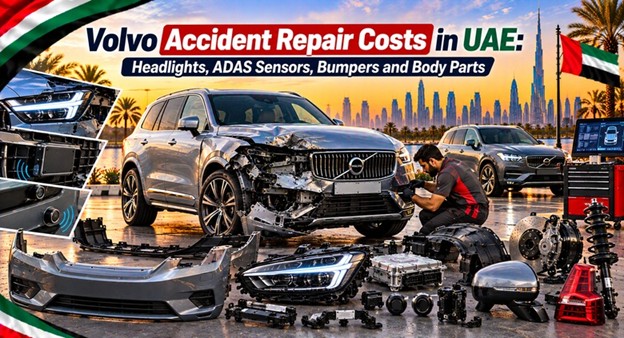
Volvo Accident Repair Costs in UAE: Headlights, ADAS Sensors, Bumpers and Body Parts
October 14, 2026
A Volvo can survive a surprisingly ugly accident and still look, at first glance, as though the main problem is a dented bumper and a cracked headlight.
That is exactly when you need to stop looking at the photograph.
The bumper may be hiding sensors. The headlight may contain electronics. A mirror can carry a camera. A rear bumper can conceal blind-spot hardware. A seemingly harmless nudge to a wheel can alter suspension geometry and, on some cars, create another calibration problem. Volvo's own documentation makes the point rather neatly: its driver-support systems use cameras, radar and other sensing hardware, while specific XC90 radar and BLIS/CTA components are integrated into the bodywork.
So, the real UAE accident-repair question is not “How much are Volvo spare parts in UAE?”
It is:
How much will it cost to return the Volvo to the condition it was in before the crash — physically, electronically and geometrically?
That is a much more interesting number.
The photograph is not the repair
There is a familiar accident scene in every workshop.
A Volvo arrives with a cracked bumper, one headlamp hanging slightly lower than the other, perhaps a scraped wing and a warning on the dashboard.
The owner looks at it and thinks, reasonably enough, that the bumper and lamp are the repair.
Then the bumper comes off.
Behind it is a sensor bracket that has shifted. A wiring connector has been pulled. The radar carrier is bent. One parking sensor is broken. Something else has moved by a few millimetres.
Suddenly the repair estimate has developed a second paragraph.
Modern Volvo systems make this particularly important because driver-support functions can depend on cameras, radar and ultrasonic sensors, and Volvo warns that the equipment has specific limitations and maintenance requirements.
The visible damage is only the opening scene.
Which Volvo are we repairing?
The current UAE XC60 is a 249-hp B5 AWD mild hybrid with an eight-speed automatic transmission, while the current XC90 is offered in mild-hybrid and plug-in-hybrid forms.
Older cars add another layer of variation.
Different generations have different headlights, bumpers, cameras, radar arrangements, suspension systems and body structures.
So a quote saying:
“Volvo XC90 front bumper — AED X”
isn't particularly useful.
The model year matters.
The trim matters.
The factory equipment matters.
The VIN matters.
And after an accident, the exact damaged location matters just as much.
The UAE accident bill has several layers
A proper accident estimate can contain:
body parts
paint
labour
brackets and mounting hardware
electrical components
diagnostics
ADAS calibration
wheel alignment
suspension repairs
programming or configuration
hidden damage
The mistake is adding only the first two.
A UAE ADAS specialist currently quotes front-camera calibration from roughly AED 300–700, radar calibration around AED 500–1,000 and broader full-ADAS calibration around AED 800–1,800, while another Dubai workshop lists ADAS calibration from AED 800. These are general market benchmarks, not Volvo-specific factory prices.
That is already enough to turn a “bumper job” into something rather different.
Volvo headlights are no longer just headlights
The XC60's current UAE specification includes standard Full LED headlights, with an upgraded Active High Beam system that can adapt to traffic, shade oncoming vehicles and swivel with steering input.
That matters after an accident.
A headlamp can be:
- cracked externally;
- internally damaged;
- mounted incorrectly;
- suffering connector damage;
- affected by water ingress;
- electronically faulty;
- physically intact but incorrectly aligned.
So when someone says, “The headlight still works,” that does not necessarily finish the inspection.
It merely proves that some electricity reached some part of it.
How much does a Volvo headlight cost in the UAE?
There is no defensible single Volvo headlight price.
A basic older lamp, a standard LED unit and an advanced active-lighting assembly can sit in completely different price brackets.
Current UAE Volvo parts listings also demonstrate why generic online prices need caution: individual Volvo components appear at very different prices depending on exact part reference and category, with some lighting/body-related listings showing unusually low prices that should not be mistaken for complete modern headlamp assemblies.
For a genuine Volvo headlamp, obtain the exact part number against the VIN.
Then ask whether the quoted price includes the control electronics, installation and any required calibration.
The number on the invoice should describe a usable repair.
Not merely a plastic box.
Can a Volvo headlight be repaired instead of replaced?
Sometimes.
That depends on what actually failed.
A broken mounting tab can be a different proposition from a cracked housing. A connector can be repaired. A lens issue can sometimes be addressed. Internal electronic damage is another matter.
The workshop should establish whether the lamp remains structurally and electronically suitable for repair.
Do not let the cheapest-looking route become an excuse to ignore alignment or lighting performance.
A headlamp that shines is not necessarily a headlamp that shines correctly.
A used Volvo headlight can make financial sense
This is one of the better candidates for used genuine parts, especially on an older XC60 or XC90.
But there are conditions.
The exact part number must match.
The lighting specification must match.
The housing and mounting points must be intact.
The electronics should be tested where applicable.
There should be no unexplained moisture damage.
And you need to know whether programming or calibration is required.
A used lamp can save a substantial amount.
A used lamp that cannot be configured is just an expensive object occupying the passenger seat.
Bumpers are where the cheap-looking accident begins
A bumper cover is deceptively simple.
It is painted plastic.
Fine.
Except that the bumper can carry parking sensors, contain mounting points for other components, interact with radar or camera hardware, and conceal damage behind it.
Volvo's own XC90 documentation is particularly clear about the relationship between bumper repair and safety electronics: the BLIS and Cross Traffic Alert components are located inside the rear bumper/wing areas, and Volvo recommends workshop handling for repairs and bumper repainting around those systems.
So repainting the bumper is not always merely cosmetic.
Volvo bumper repair versus replacement
A bumper that is scratched or lightly damaged may be repairable.
A bumper with cracked mounting points, severe deformation or damage around sensor locations may be better replaced.
The price difference can be considerable.
General UAE bodywork pricing currently puts basic bumper repair in the few-hundred-dirham range, while broader professional repair and repainting can reach roughly AED 400–1,200 depending on damage and finish.
Those figures describe bodywork-market benchmarks.
They are not Volvo bumper retail prices.
The actual calculation should separate:
bumper part
from
repair
from
paint
from
sensor work
from
calibration.
Otherwise the quotation becomes difficult to compare.
A parking sensor can turn a cosmetic repair into an electronic repair
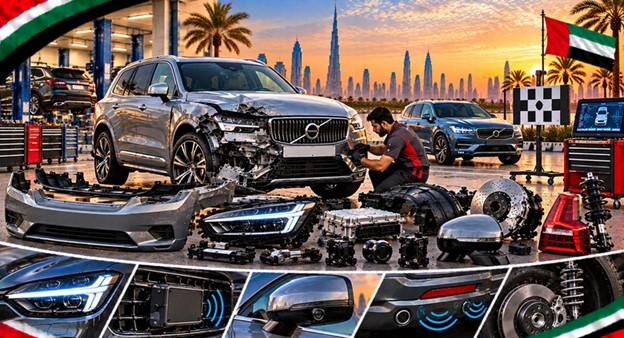
A parking sensor is small enough to lose under the driver's fingernail.
It can still create a headache.
If the sensor is physically broken, replacement may be straightforward.
If the sensor is intact but the wiring or connector has been damaged, replacing the sensor may solve nothing.
If the bumper has been repaired around the sensor opening and its position has changed, the system may behave differently again.
So the workshop should scan the parking system, inspect the sensor and wiring, and verify the mounting position.
Not simply count the visible holes in the bumper.
Volvo rear bumpers can hide BLIS hardware
This is particularly important on applicable XC90 configurations.
Volvo states that the BLIS sensors are located inside each rear corner of the vehicle's wing/bumper area and are also used by Cross Traffic Alert and Rear Collision Warning.
That means a rear-end impact can damage something that the bodywork photograph does not reveal.
Worse, repainting or repairing around the sensor area can itself become relevant to system operation.
This is why Volvo specifically recommends workshop handling for BLIS/CTA repairs and bumper repainting.
A rear bumper is therefore not simply a rear bumper.
Front radar is even less forgiving
Volvo's radar unit can support several driver-assistance functions, including adaptive cruise control, lane assistance, Pilot Assist and City Safety, depending on the vehicle and equipment.
Now imagine a low-speed front collision.
The radar survives.
The bracket bends.
The bumper gets repaired.
Everything looks fine.
Except the radar is no longer pointing exactly where the system expects it to point.
That is the sort of failure that can produce an innocent-looking car with an expensive problem.
ADAS calibration is now part of accident repair
This is probably the biggest change in body repair economics.
Once upon a time, you repaired the panel, painted it, polished the car and sent it home.
Now a collision can finish with a calibration procedure.
Dubai market pricing currently shows roughly AED 300–700 for some front-camera calibration, AED 500–1,000 for radar calibration and approximately AED 800–1,800 for broader ADAS calibration, with another local specialist quoting full ADAS work from AED 800.
These figures are not Volvo tariffs.
They are useful UAE market context.
The exact requirement depends on the vehicle and what was disturbed.
Does every Volvo accident require ADAS calibration?
No.
That would be just as lazy as saying none do.
The relevant question is what equipment the car has and what the accident or repair touched.
Volvo's current XC60 specification includes systems such as Adaptive Cruise Control, BLIS, Lane Keeping Aid, Pilot Assist, parking assistance and 360-degree camera equipment depending on configuration.
An accident affecting a bumper, sensor mount, mirror, windscreen, suspension geometry or relevant camera/radar hardware can therefore create calibration requirements.
The workshop should determine this from the actual vehicle and repair procedure.
Not from a generic checklist.
Camera calibration can be required after apparently unrelated work
This is the part owners often find irritating.
Why should a suspension repair affect a camera?
Because sensor geometry depends on where the vehicle sits and how its reference points relate to the road.
Why should a bumper replacement matter?
Because the radar or camera may be mounted to or positioned relative to the bodywork.
Why should a windscreen matter?
Because a forward-facing camera can depend on its mounting position and the glass specification.
The UAE calibration market itself lists suspension work, accidents, bumper work and windscreen replacement among situations where calibration may be required.
The car doesn't care that the invoice calls it “bodywork”.
It cares whether the sensor is still looking at the right place.
A camera warning after an accident is useful evidence
If the car says:
Driver assistance unavailable
or
Camera blocked
or
Radar unavailable
after an accident, don't simply clear the warning and hope.
The warning tells you something changed.
The workshop should scan the relevant systems, inspect the sensor hardware and mounting points, and establish whether calibration is required.
Volvo's own Pilot Assist documentation describes the system as using camera and radar information and says maintenance of the system's internal components should be carried out by a workshop, with an authorised Volvo workshop recommended.
That's fairly unambiguous.
The mirror may be part of the accident bill
A side mirror is often treated as body trim.
On a modern Volvo, it may contain electronics and camera equipment depending on specification.
That means a damaged mirror can involve:
- housing;
- glass;
- folding mechanism;
- indicator;
- wiring;
- blind-spot hardware;
- surround-view camera.
A used mirror can be an excellent saving.
But it has to match the vehicle's equipment.
A mirror from a lower-specification car may physically fit and still leave you with missing functions.
360-degree cameras make body repairs more complicated
Volvo's current XC60 specification includes a 360-degree camera among its available driver-support equipment.
A camera itself may be inexpensive compared with a headlamp or bumper assembly.
But the system depends on multiple views being stitched together correctly.
If one camera is replaced or its position changes, the system may need calibration or configuration.
This is another reason a used component should be identified by exact part reference rather than merely “XC60 camera”.
Same badge.
Different equipment.
Potentially different hardware.
Body panels are where used parts often win
A genuine used door, fender, bonnet or tailgate can be one of the most sensible accident-repair purchases for an older Volvo.
There is less mystery.
You can inspect the panel.
You can measure it.
You can check mounting points.
You can see previous repairs.
You can assess corrosion or damage.
The biggest remaining variable is paint.
And paint is much easier to understand than an electronic module that refuses to communicate with the car.
A used door is not necessarily a cheap repair
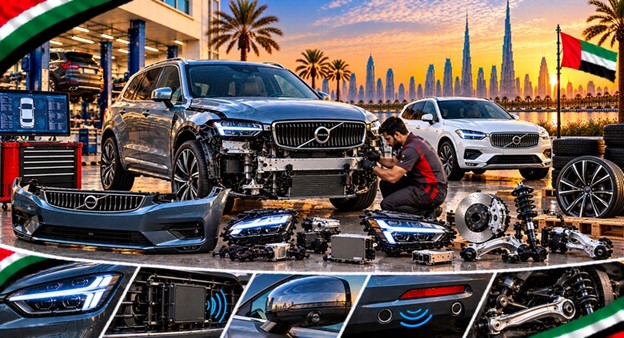
The door shell may be cheap.
Then you discover it does not include:
- glass;
- mirror;
- window regulator;
- lock;
- wiring;
- trim;
- speaker;
- control module.
Now the “door price” has changed.
This is why a used body-part quotation should say exactly what is included.
A door shell for AED 700 and a complete door assembly for AED 2,000 are not competing products.
They are two different repairs.
Structural damage is where the bodywork bill changes character
A scraped fender is cosmetic.
A bent suspension mounting point is not.
A damaged bumper reinforcement is not.
A distorted front-end structure is certainly not.
This is where an accident estimate can jump from bodywork into controlled structural repair.
One current UAE premium-European bodyshop benchmark places structural accident repair around AED 3,000–15,000+, with parts, paint and calibration separately itemised. It also places major accident repair involving parts and systems in a broad AED 10,000–50,000+ planning range. These are not Volvo-specific fixed prices, but they illustrate how quickly the repair changes once structure and systems are involved.
The useful lesson is not the top number.
It is the separation of costs.
Wheel damage deserves attention even when the bumper looks worse
A kerb strike or front-corner impact can transfer force into:
- wheel;
- tyre;
- hub;
- bearing;
- control arm;
- tie rod;
- steering components;
- suspension mounting points.
If the car pulls after repair, the bodywork may be beautiful while the mechanical repair is incomplete.
Wheel alignment is therefore not just a final cosmetic check.
It can be evidence.
If the alignment cannot be brought back into specification, something may still be bent.
ADAS and wheel alignment can become linked
This is where modern accident repair becomes slightly absurd.
You replace a suspension component.
You align the wheels.
Then the camera/radar system may need checking because vehicle geometry has changed.
Dubai calibration specialists specifically list suspension or alignment work among circumstances that can require ADAS calibration.
So when a workshop says:
“It's only suspension.”
ask whether any driver-assistance calibration is required afterwards.
It is a sensible question.
XC60 accident repair has a particularly broad equipment spread
The current XC60 can have full LED lighting, active high beam, BLIS, adaptive cruise control, Lane Keeping Aid, Pilot Assist, 360-degree camera, parking assistance and active air suspension depending on specification.
That means two XC60s with apparently identical front-end damage can produce very different repair bills.
One may need:
bumper + paint + lamp.
Another may need:
bumper + lamp + radar inspection + camera calibration + parking sensors + brackets + coding.
Same model.
Different accident economics.
XC90 rear-end damage is particularly worth inspecting properly
The XC90's rear bumper area can house BLIS and Cross Traffic Alert sensing hardware, while its driver-support systems can also involve radar and camera technology.
So a rear-end collision should not be signed off simply because the tailgate opens and the bumper colour matches.
Check the sensors.
Check the mounting area.
Scan the systems.
Verify the functions.
Then close the job.
That order matters.
Headlight replacement can require more than fitting
After installing a new lamp, the workshop may need to check:
- physical alignment;
- beam pattern;
- electronic communication;
- levelling;
- adaptive-lighting functions;
- fault codes;
- calibration where applicable.
A replacement lamp that fits physically but leaves an electronic fault is not a successful repair.
Nor is a lamp that illuminates but points incorrectly.
The goal is not to make the car look repaired.
The goal is to make the lighting system work as designed.
Genuine versus aftermarket accident parts
Accident repair is one of the areas where the parts decision becomes genuinely nuanced.
A quality aftermarket bumper may be perfectly reasonable.
A used genuine door can be excellent.
A reputable aftermarket body panel may save money.
But I would be much more conservative with:
- advanced headlights;
- radar;
- cameras;
- safety electronics;
- restraint systems;
- critical sensors.
The closer the component gets to controlling what the driver sees, what the car detects or how the car responds, the more valuable verified compatibility becomes.
This is not brand worship.
It is risk management.
Used genuine Volvo parts can be very good for older cars
If an older XC90 needs a door, bumper, mirror or headlamp, a tested used genuine part can dramatically change the repair economics.
But the buyer should establish:
donor vehicle
model year
part number
condition
mileage where relevant
previous accident damage
testing
warranty
return policy
The UAE used-parts market has broad benchmarks showing major body panels and used lamps can cost substantially less than new components, but those figures vary enormously by vehicle and part.
A used part should be cheaper because it has already depreciated.
It should not be cheap because nobody knows what happened to it.
The paint bill can be bigger than the panel
A replacement fender might be inexpensive.
Then comes preparation.
Primer.
Colour matching.
Clear coat.
Blending.
Refitting.
Polishing.
A metallic Volvo colour can make the adjacent-panel blend particularly important.
So when comparing a used panel with a new panel, don't ask:
“Which panel is cheaper?”
Ask:
“Which finished repair is cheaper?”
That distinction can reverse the decision.
Sensors are cheap compared with the consequences of wrong calibration
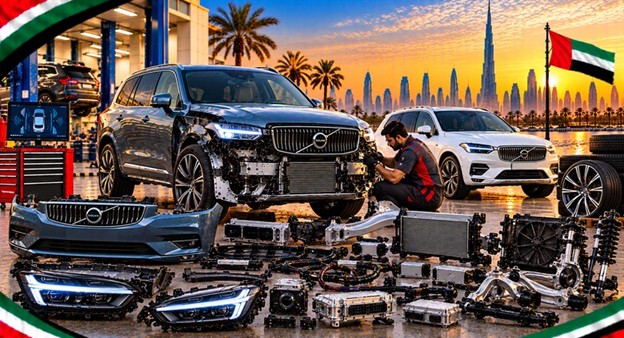
A sensor might cost hundreds.
The calibration may also cost hundreds.
The consequences of incorrect operation can be much larger.
Volvo's own documentation explains that radar is used by multiple driver-support functions and that modifications to the radar unit can affect its legality/type approval.
That is why a radar repair should not be approached like replacing a parking-light bulb.
Identify it.
Mount it correctly.
Configure it as required.
Calibrate it when required.
Verify it.
Then hand the car back.
The accident estimate should separate parts from calibration
Ask the workshop to itemise:
| Cost area | What should be shown |
|---|---|
| Body parts | Exact part and condition |
| Lighting | Exact lamp specification |
| Sensors | Sensor and mounting hardware |
| Paint | Repair, preparation and blending |
| Labour | Removal/refitting |
| Diagnostics | Scan and fault investigation |
| Calibration | Camera/radar/ADAS work |
| Mechanical | Suspension, steering, wheel, cooling |
| Programming | Coding/configuration where required |
| Hidden damage | Additional components found after dismantling |
This makes comparing two quotations much easier.
A workshop quoting AED 8,000 and another quoting AED 11,000 may not actually be more expensive.
One may have included calibration and programming.
The other may have quietly left them out.
What does Volvo accident repair cost in the UAE?
There is no single Volvo accident-repair price.
As a broad UAE market reference, basic bumper repair can begin in the few hundreds of dirhams, while more involved bodywork rises into four figures. ADAS calibration can add roughly AED 300–1,800 depending on the system and provider, with premium-brand or multi-system jobs potentially higher. Structural repair can run into several thousand dirhams, and comprehensive accident repairs involving parts, electronics and structure can reach five figures.
A useful planning framework is therefore:
| Repair situation | UAE market indication |
|---|---|
| Basic bumper repair | AED 250–500+ |
| Bumper repair + paint | AED 400–1,200+ |
| Camera calibration | AED 300–700+ |
| Radar calibration | AED 500–1,000+ |
| Broader ADAS calibration | AED 800–1,800+ |
| Structural accident repair | AED 3,000–15,000+ |
| Major accident repair with systems | AED 10,000–50,000+ |
These are planning benchmarks, not Volvo UAE tariffs. The actual bill depends on vehicle specification, damage, parts source, paint, labour and calibration requirements.
The cost of getting the diagnosis wrong
Here is where accident repair becomes expensive in a particularly stupid way.
You buy a radar.
Fit it.
The warning remains.
Then somebody discovers the bracket is bent.
You repair the bracket.
Now calibration is required.
Then the system still reports another fault because a connector was damaged in the original accident.
You have now paid for three separate interventions because the first inspection was rushed.
The radar was never necessarily the problem.
This is why diagnosis before ordering is not just good technical practice.
It is a cost-control measure.
When a Volvo bumper should be repaired
Repair the bumper when:
- the damage is within a sensible repairable range;
- mounting points remain sound;
- sensor locations can be restored correctly;
- the underlying reinforcement is undamaged;
- the finished surface can be restored properly.
Replace it when:
- structural mounting areas are compromised;
- sensor apertures cannot be restored accurately;
- the material is severely deformed;
- repair would be unreliable;
- hidden damage makes the original assembly unsuitable.
The cheapest option is not always repair.
The best option is the one that returns the complete system to proper function.
When a used headlight is the sensible choice
A used genuine headlamp can make sense if:
- exact part number matches;
- correct lighting technology;
- housing is undamaged;
- mounting points are intact;
- no moisture contamination;
- electronics are tested;
- programming/calibration requirements are understood;
- warranty or returns are available.
If the saving is only a few hundred dirhams, buying new may be the calmer decision.
If the saving is several thousand on an older Volvo, used genuine becomes much more attractive.
That is the economic line.
When not to use a used accident component
I would be extremely cautious about used:
- airbags;
- seatbelt pretensioners;
- unknown crash sensors;
- severely heat-damaged electronics;
- high-voltage accident-damaged components;
- components with unknown flood exposure.
A seller saying “tested” does not remove the need to understand what was actually tested.
For safety systems, uncertainty is not a discount.
It is a liability.
The UAE heat matters after the accident too
A repaired Volvo in the UAE has to live through heat, dust, high cabin temperatures and heavy A/C use.
That makes proper sealing and electrical protection important.
A headlamp with compromised sealing can develop moisture problems.
A badly repaired bumper sensor area can accumulate dirt or suffer connector issues.
A poorly restored panel can develop problems that weren't visible when the repair was signed off.
The climate does not cause every failure.
But it is a good reason to be less tolerant of sloppy finishing.
Ask the workshop what they found after dismantling
This is one of the most useful questions an owner can ask.
Not:
“How much more?”
Ask:
“What did you find, and where?”
If the bumper comes off and the workshop discovers a bent radar carrier, show me the damage.
If the headlamp comes out and the connector is broken, show me.
If the suspension is bent, show me.
A good accident repair should have an evidence trail.
The extra cost should correspond to something physical, diagnostic or technically necessary.
Compare repair quotations like an engineer
Suppose Workshop A quotes:
AED 6,500
Workshop B quotes:
AED 8,200
Workshop A uses a used headlamp.
Workshop B uses a new genuine lamp.
Workshop A excludes calibration.
Workshop B includes it.
Workshop A has not included the bumper bracket.
Workshop B has.
Which one is cheaper?
We don't know.
The headline number is almost meaningless until the scope matches.
That is why an accident quote should be normalised before comparing it.
Same parts.
Same condition.
Same labour.
Same paint.
Same calibration.
Same warranty.
Then compare.
Where PartFinder UAE fits into the repair
When comparing Volvo accident components through PartFinder UAE, don't compare the headline part price alone. Check the exact VIN application, part number, condition, donor history for used parts, lighting or sensor specification, delivery, VAT, fitting, paint, programming, calibration and warranty.
The useful saving is the saving on the finished repair.
Not the saving printed beside a headlamp.
The final Volvo accident-repair checklist
Before authorising the repair, ask:
- Has the VIN been checked?
- Is the exact model year confirmed?
- What lighting specification does the car have?
- Are all damaged sensors identified?
- Has the radar bracket been inspected?
- Have the rear BLIS/CTA areas been checked where fitted?
- Has the vehicle been fully scanned?
- Has suspension and wheel geometry been inspected?
- Is wheel alignment required?
- Is camera calibration required?
- Is radar calibration required?
- Is ADAS calibration included in the quote?
- Does the replacement headlamp include its required electronics?
- Are used parts genuinely tested?
- Is paint and blending included?
- Are brackets and mounting hardware included?
- Is programming included?
- What warranty applies?
- What happens if hidden damage is discovered after dismantling?
Then ask for the final quotation in writing.
Because once the bumper is off, the bargaining position changes.
It is better to know the rules beforehand.
The real price of a Volvo accident is the price of restoring function
A bumper is not the repair.
A headlight is not the repair.
A radar is not the repair.
The repair is the entire chain:
damage assessment → correct component → proper installation → body alignment → paint → diagnostics → programming → calibration → verification.
That is why a Volvo accident that looks like AED 2,000 of plastic can become AED 6,000, AED 10,000 or more once the hidden work appears.
And that is also why a higher initial quotation can occasionally be the cheaper one.
The right Volvo accident repair is not the one that makes the car look normal when it leaves the workshop.
It is the one that makes the car function normally when something unexpected happens next.
UAE Update Reference: October 2026 — current UAE Volvo equipment information and available UAE accident-repair/ADAS market benchmarks were checked against October 2026 information.
FAQ
Categories
- Audi
- BMW
- Car Accessories
- Car Tips
- Ford
- Land Rover
- Mazda
- Range Rover
- Top 10
- UAE Car Parts
- Used Car Parts
- Toyota
- Replacement Engines
- Nissan
- Hyundai
- Mitsubishi
- Volkswagen
- Honda
- Kia
- Chevrolet
- Dodge
- Jeep
- Subaru
- Renault
- Lexus
- Mercedes
- Suzuki
- Hummer
- Porsche
- Infiniti
- Peugeot
- GMC
- Mini
- Volvo
- Replacement Gearboxes
- MG
- Jaguar
- Skoda
- Cadillac
- Daihatsu
- Fiat
- German Car Parts
- Japanese Car Parts
- Aftermarket Car Parts
- Genuine Car Parts
- New Car Parts
- Reconditioned Car Parts
- European Car Parts
- American Car Parts
- Korean Car Parts
- British Car Parts
- Chinese Car Parts
- Sports/Exotic Car Parts
- Luxury Car Parts
- Performance Car Parts
- SUV/4x4 Spare Parts
- Truck Spare Parts
- EV Car Parts
- Hybrid Car Parts
- Auto Spare Parts in UAE
- Tesla
- Isuzu
- Ram
- Ferrari
- Bentley
- Lamborghini
- Genesis
- Maserati
- Lincoln
- Chrysler
- Opel
- Citroen
- SsangYong
- Seat
- McLaren
- Aston Martin
- Rolls Royce
- Maybach
- Alfa Romeo
- Bugatti
- Scion
- Abu Dhabi Car Parts
- Ajman Car Parts
- Al Khan Car Parts
- Al Sajaa Car Parts
- Deira Car Parts
- Dubai Car Parts
- Fujairah Car Parts
- Industrial Area 6 Car Parts
- Mussafah Car Parts
- Ras Al Khaimah Car Parts
- Sharjah Car Parts
- Umm Al Quwain Car Parts
- Acura
- BYD
- Chery
- Dacia
- DS
- Geely Emgrand
- EXEED
- GAC
- GAC Gonow
- Geely
- Gonow
- Great Wall
- Haima
- Haval
- Holden
- Iveco
- JAC
- Jaecoo
- Jetour
- Lotus
- Omoda
- Proton
- Renault Samsung
- Roewe
- Lucid