What a Range Rover Vogue Owner Learned About Engine Replacement Costs, Reliability and Resale Value in UAE
June 12, 2026
There is a moment in many luxury vehicle ownership journeys when the conversation changes.
It stops being about maintenance.
It stops being about servicing.
It stops being about fixing a problem.
Instead, it becomes a question of what kind of owner you want to be going forward.
That moment arrived for one Range Rover Vogue owner in the UAE after several years of ownership that, for the most part, had been exactly what he expected.
Comfortable.
Capable.
Prestigious.
The vehicle handled long journeys between Dubai and Abu Dhabi with ease. Weekend trips to Ras Al Khaimah felt effortless. Family travel was comfortable. Business meetings arrived with the kind of presence that only a luxury SUV can provide.
Then, gradually, the ownership story began to change.
Not dramatically.
Not overnight.
Just enough to raise questions.
Questions that eventually led to one of the most expensive and important decisions in the vehicle's entire life.
An engine replacement.
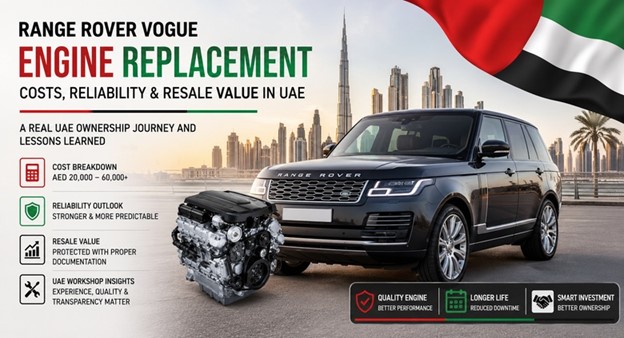
This case study follows that ownership journey and the lessons it revealed about costs, reliability, workshop decisions, resale value and long-term ownership strategy within the UAE.
It Started With a Small Concern That Seemed Easy to Ignore
The story did not begin with a breakdown.
It began with something far less dramatic.
A small warning sign.
An occasional temperature fluctuation.
A slight reduction in fuel efficiency.
The sort of thing many owners dismiss because the vehicle still performs normally.
And for a while, that decision appears justified.
The vehicle starts every morning.
The air conditioning works perfectly.
Performance feels acceptable.
Life continues.
This is precisely why many major ownership costs develop unnoticed.
Early Symptoms
- Slight coolant loss
- Intermittent warning messages
- Occasional rough idling
- Minor oil consumption
- Reduced fuel economy
- Small performance inconsistencies
None of these symptoms individually seemed catastrophic.
Collectively, however, they were quietly creating a larger picture.
Early Decision Matrix
| Observation | Owner Reaction |
| Minor Coolant Loss | Monitor |
| Slight Temperature Increase | Observe |
| Occasional Warning Light | Reset & Continue |
| Reduced Efficiency | Acceptable |
| Small Oil Consumption | Not Urgent |
At this stage, engine replacement was nowhere near the owner's mind.
Why the First Few Repair Bills Did Not Feel Like a Serious Problem
The first workshop visits seemed reasonable.
After all, luxury vehicles require maintenance.
That expectation exists from the moment ownership begins.
The issue was not the size of the bills.
It was their growing frequency.
Initial Repairs
- Cooling-system diagnostics
- Sensor replacement
- Minor leak repairs
- Software updates
- Routine servicing
None of these expenses appeared alarming individually.
Early Cost Summary
| Repair Type | Typical Cost (AED) |
| Diagnostic Inspection | 300 – 1,500 |
| Sensor Replacement | 500 – 3,000 |
| Cooling-System Repairs | 1,000 – 5,000 |
| Software Programming | 500 – 2,500 |
| Scheduled Maintenance | 1,500 – 5,000 |
The owner initially viewed these costs as part of normal luxury-vehicle ownership.
The lesson learned later was different.
The size of individual invoices often matters less than the pattern they create.
The Moment Daily Confidence in the Vehicle Started to Change
One repair does not destroy confidence.
Nor do two.
But repeated uncertainty creates something more expensive than repair bills.
It creates doubt.
The owner began asking questions before every long journey.
Would the vehicle complete the trip without issue?
Would another warning light appear?
Would another workshop visit become necessary?
That shift in mindset changed the ownership experience.
Reliability Concerns Began Affecting
- Business travel planning
- Family journeys
- Long-distance confidence
- Future budgeting
- Ownership satisfaction
This stage is rarely discussed in technical repair articles.
Yet it is often the most important stage in the ownership journey.
Because reliability has financial value.
Reliability Confidence Scale
| Ownership Stage | Confidence Level |
| Early Ownership | Very High |
| Minor Repairs | High |
| Repeated Repairs | Moderate |
| Frequent Issues | Low |
| Major Mechanical Concerns | Very Low |
Confidence is difficult to quantify.
Yet owners notice immediately when it disappears.
What Living with a Range Rover Vogue in UAE Taught About Long-Term Running Costs
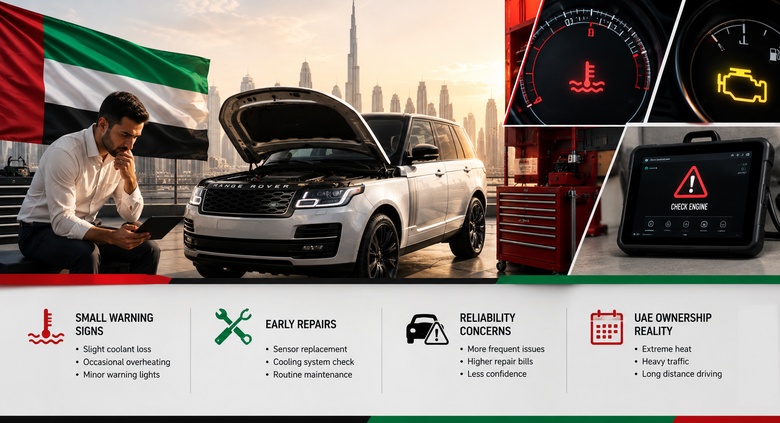
Luxury SUV ownership in the UAE comes with unique pressures.
Extreme summer temperatures.
Heavy air-conditioning loads.
Urban traffic.
Long-distance motorway driving.
Occasional desert use.
All contribute to operating stress.
Common UAE Ownership Pressures
- Ambient temperatures exceeding 45°C
- Extended traffic congestion
- Long inter-emirate journeys
- Heavy cooling-system demand
- Increased thermal stress
The owner learned that premium vehicles remain subject to the same mechanical realities as any other vehicle.
Complexity often increases capability.
It can also increase ownership exposure.
Annual Running Cost Overview
| Category | Typical Annual Cost (AED) |
| Scheduled Servicing | 3,000 – 8,000 |
| Tyres | 3,000 – 10,000 |
| Preventive Repairs | 2,000 – 8,000 |
| Unexpected Repairs | 2,000 – 20,000+ |
| Diagnostics | 500 – 3,000 |
The lesson was simple.
Luxury ownership rewards proactive planning far more than reactive decision-making.
When the Question Stopped Being “What Needs Repairing?” and Became “What Happens Next?”
This was the turning point.
Initially, every workshop visit focused on a specific fault.
Fix the leak.
Replace the sensor.
Investigate the warning light.
Over time, however, the conversation changed.
The owner stopped asking:
"What does this repair cost?"
And started asking:
"What happens after this repair?"
That distinction transformed the decision-making process.
Ownership Questions Began Changing
Before:
- What failed?
- What does it cost?
- How quickly can it be repaired?
After:
- What is the long-term outlook?
- What future repairs are likely?
- Is reliability improving or declining?
- What is the ownership strategy?
These are fundamentally different questions.
And they often produce fundamentally different decisions.
The Unexpected Ways Downtime Started Affecting Everyday Life
One of the biggest lessons from the case study involved costs that never appeared on workshop invoices.
Downtime.
A vehicle in the workshop affects more than transportation.
It affects schedules.
Plans.
Productivity.
Convenience.
Hidden Downtime Costs
- Rental vehicles
- Alternative transportation
- Lost appointments
- Business interruptions
- Personal inconvenience
Example Downtime Cost Comparison
| Downtime Event | Typical Cost (AED) |
| Daily Rental Vehicle | 150 – 500 |
| Weekly Rental Vehicle | 1,000 – 3,500 |
| Recovery Service | 300 – 1,000 |
| Missed Business Opportunity | Variable |
| Emergency Transport | 100 – 1,000+ |
The owner discovered that reliability issues often become expensive long before catastrophic failure occurs.
Because downtime creates financial consequences regardless of whether a major repair is actually required.
The First Lesson Learned Before Any Engine-Replacement Decision Was Made
Contrary to popular belief, the most important lesson was not mechanical.
It was strategic.
The owner realised that delaying a major decision does not always save money.
Sometimes it simply postpones spending while increasing uncertainty.
And uncertainty has a cost.
Early Ownership Reality
- Repairs seemed manageable
- Costs felt isolated
- Reliability concerns appeared temporary
Emerging Reality
- Repair frequency increased
- Confidence declined
- Future costs became harder to predict
- Ownership planning became difficult
Cost Escalation Illustration
| Ownership Phase | Estimated Annual Spend (AED) |
| Stable Ownership | 3,000 – 8,000 |
| Moderate Reliability Issues | 8,000 – 15,000 |
| Frequent Mechanical Concerns | 15,000 – 30,000+ |
| Major Engine Evaluation Stage | 20,000 – 50,000+ |
The lesson was not that engine replacement had become necessary.
Not yet.
The lesson was that the ownership conversation had fundamentally changed.
And once that happens, evaluating long-term solutions becomes more important than focusing solely on the next repair bill.
The Different Engine-Replacement Paths That Were Considered Before Any Money Was Spent
One of the biggest misconceptions about engine replacement is that it involves a single solution.
In reality, several pathways exist.
And each one carries a different balance of cost, risk, reliability and future resale implications.
By the time the Range Rover Vogue owner reached this stage, the conversation had evolved well beyond routine maintenance.
The focus was now on long-term ownership strategy.
Option One: Continue Repairing the Existing Engine
Initially, this appeared to be the least expensive route.
The logic was straightforward.
If the engine still operated, perhaps another repair would extend its life.
Advantages:
- Lowest immediate expenditure
- No major project disruption
- Familiar vehicle history
Disadvantages:
- Uncertain reliability
- Continued downtime risk
- Escalating repair exposure
Option Two: Engine Rebuild
This option generated considerable interest.
The idea of retaining the original engine appealed emotionally.
Advantages:
- Original engine retained
- Potential cost savings compared with some replacement options
Disadvantages:
- Extensive labour requirements
- Variable rebuild quality
- Longer workshop time
Option Three: Replacement Engine
This was the most expensive-looking option on paper.
Ironically, it later became the most financially predictable.
Advantages:
- Reliability reset
- Reduced uncertainty
- Stronger long-term ownership planning
Disadvantages:
- Larger initial investment
- Supporting-part replacement requirements
Ownership Decision Matrix
| Option | Initial Cost | Reliability Outlook |
| Continue Repairs | Low | Uncertain |
| Engine Rebuild | Moderate | Variable |
| Replacement Engine | High | Strong |
The owner eventually learned that the cheapest option and the most economical option are not always the same thing.
The Costs Nobody Mentioned During the First Conversations
The first discussions focused heavily on engine pricing.
That turned out to be only part of the story.
As inspections became more detailed, additional costs emerged.
Not because anyone was hiding them.
Because they could only be identified through proper evaluation.
Supporting Costs Discovered
- Engine mounts
- Cooling-system restoration
- Oil-system servicing
- Sensor replacement
- Software adaptation
- Diagnostic testing
Hidden Cost Analysis
| Additional Item | Typical Cost (AED) |
| Engine Mounts | 1,000 – 4,000 |
| Cooling-System Components | 2,000 – 8,000 |
| Sensors | 500 – 5,000 |
| Software Programming | 500 – 3,000 |
| Diagnostic Testing | 500 – 2,000 |
| Fluids & Filters | 500 – 2,500 |
These costs changed the ownership calculations significantly.
Not because they made replacement less attractive.
Because they created a more realistic understanding of the total investment required.
Why Choosing the Right Workshop Became Almost as Important as Choosing the Engine
This proved to be one of the most important lessons in the entire ownership journey.
At first, workshop selection seemed secondary.
The owner assumed engine quality would determine the outcome.
Eventually, experience suggested otherwise.
Installation quality matters enormously.
What Separated Strong Workshops From Weak Ones
Strong Workshops:
- Detailed inspections
- Clear explanations
- Transparent pricing
- Structured project planning
- Realistic timelines
Weak Workshops:
- Vague estimates
- Minimal diagnostics
- Unclear responsibility
- Limited documentation
Workshop Selection Criteria
| Factor | Importance |
| Technical Experience | Very High |
| Diagnostics Capability | Very High |
| Transparency | High |
| Documentation | High |
| Warranty Support | High |
The owner realised that paying slightly more for expertise often reduced overall ownership risk.
The Decision Framework That Helped Separate Emotion From Financial Reality
Luxury vehicles create emotional attachment.
That attachment can complicate decision-making.
The owner recognised this.
Therefore, the final evaluation became increasingly numerical.
Key Questions Asked
- How long will the vehicle be kept?
- What are future repair risks?
- What is the replacement cost?
- What is the resale outlook?
- What is the cost of doing nothing?
This process transformed the discussion.
Instead of focusing on whether the replacement engine felt expensive, attention shifted to whether avoiding it would become even more expensive.
Decision Evaluation Matrix
| Consideration | Weighting |
| Reliability | Very High |
| Future Costs | Very High |
| Resale Impact | High |
| Downtime Exposure | High |
| Initial Cost | Moderate |
The exercise removed much of the emotion from the decision.
What Future Reliability Was Really Worth Compared With Another Round of Repairs
One of the most revealing moments came when the owner calculated future ownership exposure.
Repeated repairs were not merely consuming money.
They were consuming certainty.
Continuing Repair Scenario
Potential Outcomes:
- Additional downtime
- Further diagnostics
- Future major repairs
- Ongoing uncertainty
Replacement Scenario
Potential Outcomes:
- Improved predictability
- Stronger reliability outlook
- Simplified future budgeting
Future Cost Projection
| Scenario | Three-Year Cost Exposure (AED) |
| Continued Repairs | 20,000 – 60,000+ |
| Engine Replacement Project | 18,000 – 50,000+ |
| Vehicle Upgrade | 80,000 – 300,000+ |
These numbers changed the conversation.
The replacement engine no longer looked like a repair expense.
It looked like a risk-management decision.
The Surprising Role Resale Value Played in the Final Calculation
Initially, resale value was barely considered.
The owner planned to keep the vehicle.
That assumption changed.
Because life changes.
Business circumstances change.
Family requirements change.
Future flexibility became important.
Factors Influencing Resale Confidence
- Engine documentation
- Service history
- Installation records
- Warranty coverage
- Workshop reputation
Resale Confidence Matrix
| Vehicle Condition | Buyer Confidence |
| Documented Replacement Engine | High |
| Full Service History | High |
| Limited Documentation | Moderate |
| Uncertain Repair History | Low |
The owner realised that documentation creates value long after repairs are completed.
The Lesson Hidden Inside the Numbers
By this stage, the ownership journey had revealed something unexpected.
The most important decision was not selecting an engine.
It was understanding the financial consequences of each possible path.
Initial Assumption
- Replacement engine equals major expense.
Final Understanding
- Uncertainty often becomes more expensive than planned investment.
This distinction fundamentally changed the ownership outlook.
For readers researching Range Rover vogue reconditioned engine for sale, the same lesson applies.
Comparing engine prices alone rarely provides enough information.
Ownership outcomes depend on:
- Reliability
- Installation quality
- Documentation
- Supporting-part condition
- Long-term planning
The owner discovered that engine replacement decisions are rarely about engines alone.
They are about future ownership confidence.
And confidence becomes remarkably valuable once it begins disappearing.
The Ownership Journey Reaches Its Most Important Stage
At this point, all major information was available.
The costs were known.
The risks were understood.
The alternatives had been evaluated.
The ownership journey had moved beyond diagnosis and speculation.
The next phase would involve making the final decision, living with the replacement engine, evaluating first-year ownership costs and ultimately determining whether the investment delivered the reliability, value and peace of mind that had originally been sought.
The Day the Engine-Replacement Decision Finally Made Sense
Interestingly, the final decision was not made when the repair estimate arrived.
It was not made when another warning light appeared.
Nor was it made after another workshop visit.
The decision became clear when the owner stopped evaluating the next repair and started evaluating the next three years of ownership.
That shift changed everything.
The focus moved away from immediate spending.
Attention turned towards future exposure.
The Questions That Ultimately Mattered
- How much uncertainty remained?
- How much reliability had been lost?
- How much future spending could still occur?
- How long would the vehicle be kept?
- What would replacement achieve?
For the first time, the replacement engine appeared less like a major expense and more like a strategic ownership decision.
Final Decision Comparison
| Consideration | Continue Repairs | Replacement Engine |
| Predictability | Low | High |
| Reliability Outlook | Uncertain | Strong |
| Downtime Risk | High | Lower |
| Budget Planning | Difficult | Easier |
| Ownership Confidence | Weak | Strong |
The answer was no longer emotional.
It had become practical.
What the First Weeks After Installation Revealed About the Investment
Most ownership stories focus heavily on the replacement itself.
Few discuss what happens afterwards.
Yet those early weeks often determine whether expectations match reality.
The immediate difference was not performance.
It was confidence.
The owner no longer monitored dashboard readings obsessively.
Long journeys felt routine again.
Unexpected noises no longer dominated attention.
Early Ownership Improvements
- More predictable operation
- Reduced anxiety
- Greater confidence on long journeys
- Improved ownership satisfaction
- Reduced workshop dependence
The vehicle felt familiar again.
That may sound insignificant.
For many luxury-vehicle owners, it is one of the most valuable outcomes.
The Lessons Learned During the First Thousand Kilometres
The first 1,000 kilometres became an observation period rather than a celebration period.
The owner understood that even successful projects require monitoring.
Areas Regularly Checked
- Oil levels
- Coolant levels
- Engine temperature
- Fluid leaks
- Warning messages
First 1,000 km Monitoring Checklist
| Inspection Area | Importance |
| Cooling System | Very High |
| Oil Condition | Very High |
| Diagnostic Scan | High |
| Mount Inspection | High |
| Fluid Levels | High |
Several small adjustments were completed during this period.
Nothing unusual.
Nothing alarming.
Exactly the type of refinement expected after major mechanical work.
Looking Back at the First Year: Did the Numbers Justify the Decision?
This was perhaps the most important lesson in the entire ownership story.
The owner decided to review the project after twelve months.
Not emotionally.
Financially.
Before Replacement
Common Characteristics:
- Increasing uncertainty
- Growing repair frequency
- Reliability concerns
- Budget unpredictability
After Replacement
Common Characteristics:
- Stable operation
- Improved confidence
- Reduced downtime
- More predictable ownership costs
First-Year Ownership Comparison
| Category | Before Replacement (AED) | After Replacement (AED) |
| Unexpected Repairs | 8,000 – 20,000+ | Significantly Reduced |
| Diagnostics | Frequent | Occasional |
| Downtime Costs | High | Lower |
| Reliability Confidence | Low | High |
The investment was substantial.
Yet the owner concluded that the financial stability it created justified the expenditure.
The Mistakes That Would Have Been Expensive Had They Been Repeated
Every ownership journey leaves lessons behind.
Some are technical.
Others are financial.
Most Important Lessons
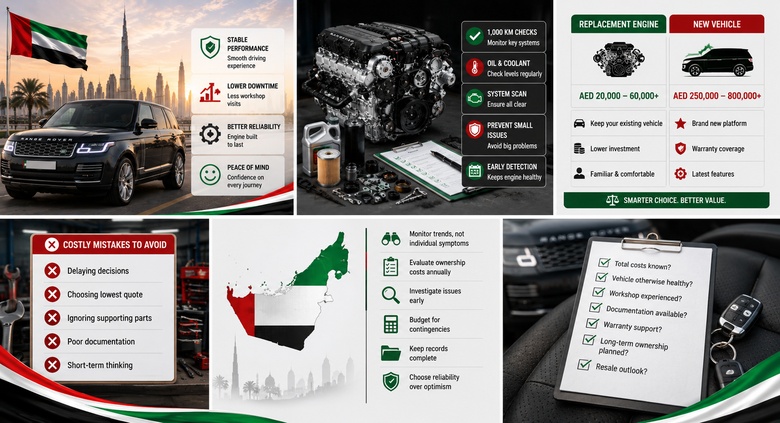
- Do not judge costs in isolation.
- Do not evaluate repairs one invoice at a time.
- Do not underestimate downtime.
- Do not ignore documentation.
- Do not choose workshops solely on price.
The owner realised that several earlier decisions had focused heavily on reducing immediate expenditure.
The later strategy focused on reducing future exposure.
That distinction proved crucial.
Costly Ownership Mistakes Avoided
| Mistake | Potential Consequence |
| Delaying Decisions Too Long | Escalating Costs |
| Selecting Lowest Quote | Variable Outcomes |
| Ignoring Supporting Components | Repeat Repairs |
| Incomplete Documentation | Reduced Resale Value |
| Short-Term Thinking | Higher Long-Term Costs |
The Replace-Engine Versus Replace-Vehicle Reflection
Many readers face this exact dilemma.
Should the vehicle be replaced entirely?
Or should the engine be replaced?
The owner spent considerable time analysing both options.
Replacement Engine Project
Typical Investment:
AED 20,000 – 60,000+
Advantages:
- Retain known vehicle
- Lower capital outlay
- Preserve ownership familiarity
Vehicle Replacement
Potential Investment:
AED 250,000 – 800,000+
Advantages:
- New platform
- Warranty coverage
- Latest technology
Financial Comparison
| Option | Estimated Cost (AED) |
| Replacement Engine | 20,000 – 60,000+ |
| Used Luxury SUV Upgrade | 150,000 – 350,000+ |
| New Luxury SUV Purchase | 250,000 – 800,000+ |
Viewed through this lens, the engine replacement became easier to justify.
The Advice This Ownership Journey Leaves Behind for Other UAE Owners
Looking back, the owner identified several principles that would have improved decision-making from the very beginning.
Key Recommendations
- Monitor trends, not individual symptoms.
- Evaluate ownership costs annually.
- Investigate recurring repairs quickly.
- Budget for contingencies.
- Protect documentation.
- Prioritise reliability over optimism.
These lessons apply not only to Range Rover Vogue ownership.
They apply to most premium vehicle ownership experiences in the UAE.
Buyer Checklist Before Committing to an Engine Replacement
Owners considering a replacement project should answer several questions honestly.
Ownership Assessment Questions
- How long will I keep the vehicle?
- What is the total project cost?
- What supporting repairs are required?
- What documentation is available?
- What warranty support exists?
- What is the resale outlook?
Decision Checklist
| Question | Importance |
| Total Costs Known? | High |
| Vehicle Otherwise Healthy? | High |
| Workshop Experienced? | High |
| Documentation Available? | High |
| Long-Term Ownership Planned? | High |
Structured decision-making usually produces better outcomes than reactive decision-making.
The Advice This Ownership Journey Leaves Behind for Future Range Rover Vogue Owners
The most surprising lesson was not mechanical.
It was psychological.
The owner discovered that uncertainty creates stress.
And stress often becomes expensive.
Not because repairs cost more.
Because indecision prolongs exposure.
The journey revealed that luxury ownership is rarely about avoiding spending.
It is about spending wisely.
It is about recognising when an investment protects value.
And understanding when a delay simply increases risk.
For owners researching options through PartFinder UAE, the most valuable lesson may be this:
Do not evaluate a replacement engine purely by its price.
Evaluate it by what it changes.
Does it improve reliability?
Does it reduce downtime?
Does it restore confidence?
Does it support future resale value?
Those questions matter far more than the headline figure on a quotation.
Final Ownership Lessons
| Lesson | Long-Term Value |
| Early Investigation | High |
| Strong Documentation | High |
| Quality Installation | High |
| Reliability Planning | Very High |
| Strategic Decision-Making | Exceptional |
In the end, the engine replacement was not remembered as the most expensive chapter of ownership.
It was remembered as the decision that restored control over the ownership experience.
And that, ultimately, is what most successful vehicle owners are trying to achieve.
Frequently Asked Questions
Categories
- Audi
- BMW
- Car Accessories
- Car Tips
- Ford
- Land Rover
- Mazda
- Range Rover
- Top 10
- UAE Car Parts
- Used Car Parts
- Toyota
- Replacement Engines
- Nissan
- Hyundai
- Mitsubishi
- Volkswagen
- Honda
- Kia
- Chevrolet
- Dodge
- Jeep
- Subaru
- Renault
- Lexus
- Mercedes
- Suzuki
- Hummer
- Porsche
- Infiniti
- Peugeot
- GMC
- Mini
- Volvo
- Replacement Gearboxes
- MG
- Jaguar
- Skoda
- Cadillac
- Daihatsu
- Fiat
- German Car Parts
- Japanese Car Parts
- Aftermarket Car Parts
- Genuine Car Parts
- New Car Parts
- Reconditioned Car Parts
- European Car Parts
- American Car Parts
- Korean Car Parts
- British Car Parts
- Chinese Car Parts
- Sports/Exotic Car Parts
- Luxury Car Parts
- Performance Car Parts
- SUV/4x4 Spare Parts
- Truck Spare Parts
- EV Car Parts
- Hybrid Car Parts
- Auto Spare Parts in UAE
- Tesla
- Isuzu
- Ram
- Ferrari
- Bentley
- Lamborghini
- Genesis
- Maserati
- Lincoln
- Chrysler
- Opel
- Citroen
- SsangYong
- Seat
- McLaren
- Aston Martin
- Rolls Royce
- Maybach
- Alfa Romeo
- Bugatti
- Scion
- Abu Dhabi Car Parts
- Ajman Car Parts
- Al Khan Car Parts
- Al Sajaa Car Parts
- Deira Car Parts
- Dubai Car Parts
- Fujairah Car Parts
- Industrial Area 6 Car Parts
- Mussafah Car Parts
- Ras Al Khaimah Car Parts
- Sharjah Car Parts
- Umm Al Quwain Car Parts
- Acura
- BYD
- Chery
- Dacia
- DS
- Geely Emgrand
- EXEED
- GAC
- GAC Gonow
- Geely
- Gonow
- Great Wall
- Haima
- Haval
- Holden
- Iveco
- JAC
- Jaecoo
- Jetour
- Lotus
- Omoda
- Proton
- Renault Samsung
- Roewe
- Lucid
- Replacement Headlight