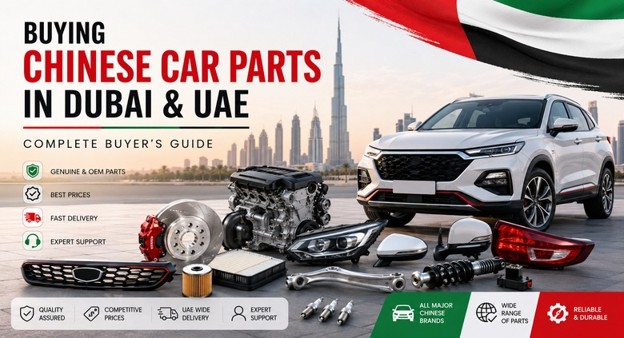
Where to Buy Chinese Car Parts in Dubai and Across the UAE
July 24, 2026
Understanding the Chinese Car Parts Market in the UAE
Walk through almost any car park in Dubai today.
You'll notice something that simply wasn't true a few years ago.
More MGs.
More Geelys.
More Cherys.
HAVAL SUVs are everywhere. Jetour models keep popping up. BYD is gathering attention. GAC, JAC and Bestune? They're no longer unusual sights either. What used to be considered a niche corner of the market has quietly become part of everyday driving across the Emirates.
That shift has changed something else as well.
People aren't asking, "Should I buy a Chinese car?"
They're asking, "Where can I get reliable parts when I need them?"
Fair question.
Because buying the vehicle is only half the story. Keeping it running properly is where the real ownership experience begins.
Why Chinese Car Parts Are Becoming More Popular in Dubai and the UAE
The numbers tell one story.
The roads tell another.
Chinese manufacturers have expanded rapidly across Dubai, Abu Dhabi, Sharjah and the rest of the UAE by offering well-equipped vehicles at prices that make many buyers stop and think twice.
You get modern technology.
Large touchscreens.
Advanced safety features.
Comfortable interiors.
Competitive warranties.
And all without stretching the budget as much as many traditional brands.
Naturally, as more vehicles arrive on UAE roads, demand for replacement parts grows alongside them.
That's how every successful automotive market works.
Sooner or later, owners begin looking for:
- Brake components.
- Suspension parts.
- Cooling system components.
- Body panels.
- Headlights.
- Radiators.
- Engine sensors.
- Air conditioning parts.
- Mirrors.
- Electronic modules.
None of that should come as a surprise.
Cars are built to be driven, not parked.
Most Popular Chinese Car Brands on UAE Roads
Ask ten workshops which Chinese brands they see most often and you'll probably hear similar answers.
MG continues to attract families and daily commuters.
Geely keeps building a loyal customer base.
Chery has become increasingly common.
HAVAL remains popular with SUV buyers, while Jetour continues expanding its presence across the Emirates.
Then there are brands such as:
- BYD.
- GAC.
- JAC.
- Bestune.
- Dongfeng.
- BAIC.
Each manufacturer uses different engineering, different suppliers and different specifications.
That's worth remembering.
A suspension arm designed for one Chinese SUV won't magically fit another simply because they look similar.
It doesn't work like that.
Why More UAE Drivers Buy Chinese Car Parts Online
Not long ago, finding replacement parts often meant driving from one industrial area to another.
You'd make phone calls.
Wait for callbacks.
Visit several suppliers.
Maybe you'd get lucky.
Maybe you wouldn't.
Things have changed.
Today, many owners begin their search online because it allows them to:
- Compare supplier quotations.
- Check stock availability.
- Review warranty options.
- Request compatibility confirmation.
- Arrange delivery across the UAE.
- Save time without driving between multiple locations.
It's practical.
Especially if your vehicle is already sitting in a workshop waiting for the correct component.
There's one catch, though.
Never order purely because the price looks attractive.
Always slow down long enough to verify compatibility.
That small pause can save a surprisingly large repair bill later.
Genuine vs OEM vs Used vs Aftermarket Chinese Car Parts Explained
This question comes up almost every day.
"Which type should I buy?"
The honest answer?
It depends.
Genuine parts are supplied through the manufacturer's official network and are designed to meet the original factory specification.
OEM parts are produced by manufacturers that often supply original equipment but sell components under their own branding.
Used parts come from donor vehicles and, when sourced responsibly, can provide excellent value for owners looking to manage repair costs.
Aftermarket parts are manufactured independently.
Some perform extremely well.
Others...
Let's just say they don't always inspire confidence.
That's why researching both the part and the supplier matters.
Buying blindly rarely ends well.
Why Compatibility Checks Matter Before Buying Chinese Car Parts
Here's a situation technicians know all too well.
A customer orders a replacement radiator after matching the vehicle model online.
Everything appears correct.
Until installation begins.
The hose connections differ slightly.
Mounting brackets don't line up.
The cooling fan assembly doesn't match.
Now the repair stops.
The wrong part goes back into the box.
Another order has to be placed.
Days disappear.
Most of that frustration could have been avoided by checking:
- VIN.
- Production year.
- Engine specification.
- Transmission type.
- OEM reference.
- Trim level.
Five minutes of checking often beats five days of waiting.
Every single time.
How to Buy Chinese Car Parts Without Overpaying
Plenty of buyers think saving money means choosing the cheapest quotation.
Not necessarily.
The smartest buyers compare far more than price.
They look at:
- Warranty.
- Product quality.
- Compatibility support.
- Supplier reputation.
- Delivery times.
- Technical assistance.
Those details rarely appear in the headline price, yet they often determine whether the repair goes smoothly or turns into a frustrating experience.
Before placing an order, it's worth comparing several trusted suppliers, checking warranty terms and confirming compatibility. PartFinder UAE allows buyers to compare multiple supplier options, request fitment support and make more informed purchasing decisions before committing to a replacement part.
That's a far stronger approach than relying on guesswork.
A Workshop Story from Dubai
A Geely owner arrived at an independent workshop after noticing the engine temperature climbing during heavy afternoon traffic.
Nothing dramatic.
Not yet.
Inspection revealed a radiator leak developing along one of the plastic end tanks.
The owner had already found a cheaper replacement online and was ready to order it immediately.
The technician paused for a moment.
"Let's check the VIN first."
Good advice.
The original listing belonged to an earlier production version with different cooling pipe connections.
It looked almost identical in the photographs.
Almost.
The correct radiator was sourced instead, fitted without modification and the cooling system performed exactly as intended.
That extra few minutes spent checking the details avoided another week of delays.
Not a bad trade-off.
Good Decisions Start Before You Spend Any Money
Chinese vehicles are becoming an increasingly familiar sight across the UAE, and the replacement parts market is growing just as quickly.
That's good news.
More choice usually benefits buyers.
Still, choice brings responsibility.
Take your time.
Ask questions.
Verify every important detail.
If something feels uncertain, don't ignore that feeling. Pick up the phone. Send another message. Ask for the VIN check.
You'll almost never regret being careful.
Key Takeaways
- Chinese car brands continue to expand rapidly across Dubai and the wider UAE, increasing demand for quality replacement parts.
- Genuine, OEM, used and aftermarket parts each have their own advantages depending on the repair and budget.
- Online ordering makes it easier to compare supplier quotes, availability, warranty options and nationwide delivery.
- VIN verification and compatibility checks remain essential before purchasing any replacement component.
- Careful planning and supplier comparison help reduce costly mistakes, minimise workshop delays and improve long-term ownership value.
Where to Buy Chinese Car Parts in Dubai and Across the UAE
Finding the part isn't usually the hardest bit.
Finding the right part from the right supplier?
That's where things become interesting.
Dubai has one of the busiest automotive parts markets in the Middle East. Add Abu Dhabi, Sharjah, Ajman, Ras Al Khaimah, Fujairah and Umm Al Quwain into the mix, and buyers suddenly have hundreds of businesses competing for attention. Some specialise in genuine components. Others focus on OEM replacements, while many deal in quality used parts imported from different regions.
Choice is brilliant.
Too much choice can also become confusing.
The trick isn't contacting every supplier you can find. It's knowing how to narrow the list quickly without taking unnecessary risks.
Choosing Trusted Chinese Car Parts Suppliers in the UAE
A professional supplier usually stands out within the first conversation.
Not because they promise everything.
Because they ask questions.
Expect a reputable supplier to request details such as:
- Vehicle Identification Number (VIN)
- Make and model
- Production year
- Engine size
- Transmission type
- Trim specification
- Existing OEM part number, if available
If someone offers to sell a component after hearing only, "It's a 2023 SUV," that should raise an eyebrow.
Modern vehicles are built with countless specification changes throughout their production cycle. Even two cars that appear identical can require completely different parts.
A careful supplier understands that.
Dealer vs Independent Chinese Car Parts Suppliers
Many owners automatically assume dealerships are the only sensible option.
Sometimes they are.
Sometimes they aren't.
Authorised dealers often provide factory-backed genuine parts and manufacturer warranty support. That reassurance matters, particularly for newer vehicles or repairs involving safety systems.
Independent suppliers, however, bring different advantages.
They may offer:
- Larger stock of fast-moving replacement parts
- Genuine and OEM alternatives
- Quality used components
- Faster sourcing for discontinued items
- Competitive pricing
- More flexible delivery options
Neither route is automatically better.
The smarter question is this:
"Which supplier has the correct part, proper compatibility support and reliable after-sales service?"
That's the question worth answering.
Buying Chinese Car Parts Online in Dubai
A few years ago, ordering automotive parts online still felt like a gamble for many buyers.
Today?
It's become normal.
Whether you're sitting in an office in Downtown Dubai or managing a fleet in Abu Dhabi, comparing suppliers online saves hours that would otherwise disappear driving between industrial areas.
Most online enquiries follow a simple pattern.
Upload your vehicle details.
Provide the VIN if possible.
Describe the required component.
Receive quotations.
Compare prices, availability and delivery times.
Simple on paper.
Still, don't rush.
Photographs alone never confirm compatibility. Always ask for verification before making payment.
That extra message can prevent the wrong component arriving at your workshop.
Comparing Multiple Supplier Quotes Before Ordering
The cheapest quotation catches attention first.
Human nature.
But once the excitement fades, it's worth looking beyond the number printed at the bottom of the page.
Compare each quotation carefully.
Consider:
- Part condition
- Brand
- Country of manufacture
- Warranty period
- Estimated delivery time
- Return policy
- Compatibility confirmation
- Technical support
Imagine two suppliers.
One offers a radiator for AED 420 with no warranty.
Another quotes AED 510 but includes compatibility verification, a warranty and next-day delivery.
Which one actually represents better value?
For many buyers, the answer becomes obvious once the full picture is on the table.
Fast Delivery of Chinese Car Parts Across the UAE
Nobody enjoys waiting for replacement parts.
Especially when the vehicle earns money every day.
Taxi operators, delivery companies, ride-hailing drivers and business fleets all understand the cost of downtime. A van parked in a workshop isn't generating revenue. Every extra day waiting for parts has a financial impact that often exceeds the price difference between suppliers.
That's why delivery speed matters.
Reliable suppliers commonly arrange shipping to:
- Dubai
- Abu Dhabi
- Sharjah
- Ajman
- Ras Al Khaimah
- Fujairah
- Umm Al Quwain
Some even provide same-day or next-day delivery for popular components already held in local stock.
That's a significant advantage when time matters more than squeezing the last few dirhams from the purchase.
Benefits of Buying Chinese Car Parts Online
People often assume online ordering is only about convenience.
It isn't.
Done properly, it gives buyers much better visibility before spending their money.
You can compare several suppliers without leaving your chair.
Review warranty terms.
Check stock availability.
Ask technical questions.
Request photographs.
Confirm OEM numbers.
Track delivery.
Everything becomes more transparent.
Of course, online buying still requires common sense.
If a price looks unbelievably cheap, there's usually a reason.
If warranty details seem vague, ask again.
If compatibility isn't confirmed in writing, don't rely on assumptions.
Little checks.
Big difference.
What Experienced Workshops Usually Recommend
Speak to technicians who've spent years repairing Chinese vehicles and you'll hear remarkably similar advice.
Buy once.
Buy correctly.
Trying to save a small amount on an uncertain component often leads to additional labour charges, delayed repairs and unnecessary frustration.
Experienced workshops also encourage customers to keep copies of quotations, invoices and warranty information. Those documents become extremely useful if a future claim or replacement is ever needed.
Paperwork isn't exciting.
Neither is paying twice for the same repair.
Before You Place the Order
Take one final look before clicking "Buy."
Has the VIN been checked?
Is the warranty clear?
Have you compared more than one quotation?
Do you know when the part will actually arrive?
Can the supplier confirm compatibility in writing?
If every answer is yes, you're probably making a well-informed purchase.
If even one answer is uncertain, it's worth spending another few minutes asking questions.
Those few minutes often save days of inconvenience later.
Key Takeaways
- Reliable suppliers prioritise VIN verification and vehicle specifications before recommending any replacement part.
- Dealers and independent suppliers each offer different advantages depending on the repair, budget and urgency.
- Comparing multiple quotations helps buyers assess quality, warranty, availability and overall value rather than focusing only on price.
- Fast nationwide delivery reduces vehicle downtime for both private owners and commercial fleets.
- Careful supplier selection, compatibility checks and written confirmation significantly reduce the risk of ordering incorrect parts.
VIN Matching and Part Compatibility
People often think buying a replacement part is straightforward.
Find the same model.
Choose the same year.
Place the order.
Done.
If only it were that simple.
Modern Chinese vehicles are built with countless production updates, factory revisions and regional specifications. Two cars parked side by side might carry the same badge, wear the same colour and even leave the factory in the same year, yet still require different components underneath.
That catches plenty of buyers out.
Usually at the worst possible moment.
Why VIN Verification Is Essential for Chinese Car Parts
If there's one piece of information that deserves your attention, it's the Vehicle Identification Number.
The VIN is more than just a sequence of letters and numbers stamped onto the car. It acts like the vehicle's fingerprint, recording details that aren't immediately obvious, including production plant, engine specification, transmission type, manufacturing sequence and factory configuration.
That's why experienced suppliers ask for it before discussing prices.
Not afterwards.
A proper VIN check helps confirm:
- Factory-installed specifications
- Original equipment configuration
- Engine variant
- Gearbox type
- Production batch
- Compatible replacement parts
Skipping this step can quickly turn a routine repair into a frustrating exercise in returns, delays and additional labour costs.
Matching Parts by Model Year
Here's where things become surprisingly tricky.
Manufacturers regularly update vehicles during production.
Sometimes the changes are obvious.
A redesigned front bumper.
New headlights.
Updated dashboard controls.
Other times, the differences are almost invisible.
A revised mounting bracket.
An alternative wiring connector.
A different sensor calibration.
The outside of the vehicle looks exactly the same, yet the replacement component no longer fits.
Workshops see this more often than many owners realise.
That's why the production year should never be treated as the only deciding factor.
Matching Parts by Engine Type and Transmission
The engine tells one story.
The gearbox tells another.
A Chinese SUV offered with both naturally aspirated and turbocharged engines may use completely different cooling systems, engine mounts, sensors or intake components. Add manual and automatic transmissions into the equation, and the list of possible variations grows even longer.
One incorrect assumption can affect:
- Cooling components
- Driveshafts
- Transmission mounts
- Engine control sensors
- Exhaust assemblies
- Clutch components
- Gear selector mechanisms
It isn't about making the buying process complicated.
It's about making sure the repair only happens once.
Understanding Trim Levels and Factory Specifications
This is the detail many buyers overlook.
Manufacturers frequently sell one model in several trim levels, each aimed at a different customer.
One version may include adaptive cruise control.
Another adds a panoramic roof.
A higher trim could feature larger brakes, different alloy wheels or advanced driver assistance systems.
Those upgrades don't just change how the vehicle feels to drive.
They often change the parts fitted underneath.
A headlamp designed for a premium trim with LED technology won't necessarily fit a lower specification model using halogen lighting.
Looks can be deceiving.
Very deceiving.
OEM Part Numbers and Cross-Reference Guide
Whenever possible, use the original equipment part number.
It removes much of the guesswork.
Professional suppliers regularly cross-reference OEM numbers to identify equivalent genuine, OEM or high-quality aftermarket alternatives that meet the required specification.
This process becomes particularly valuable when:
- The original part has been discontinued.
- Updated replacement numbers have been introduced.
- Multiple manufacturers produce compatible components.
- Buyers want alternative pricing options without compromising fitment.
The part number speaks a language that photographs simply can't.
Common Compatibility Mistakes Buyers Should Avoid
Some mistakes appear again and again.
Not because people are careless.
Because they assume automotive parts work like household appliances.
Unfortunately, they don't.
Some of the most common buying errors include:
- Ordering based only on the vehicle's registration year.
- Ignoring production month differences.
- Assuming all engine variants use identical components.
- Buying from photographs without checking specifications.
- Forgetting regional market variations.
- Overlooking trim-level differences.
- Matching appearance instead of OEM references.
Each mistake sounds small on its own.
Together, they account for a remarkable number of incorrect orders every year.
A Real Workshop Example
A customer in Sharjah needed a replacement headlamp for a late-model HAVAL SUV after a minor parking accident.
Simple enough.
Or so it seemed.
The damaged unit looked identical to another headlamp advertised online for considerably less money. Same shape. Same housing. Same mounting points.
Almost.
When the replacement arrived, the workshop discovered one crucial difference.
The vehicle originally used an adaptive LED lighting system, while the cheaper unit supported only the standard configuration. Physically, they appeared almost identical. Electronically, they were worlds apart.
The incorrect unit had to be returned.
The repair was delayed.
Additional labour was charged.
The owner admitted afterwards that spending five minutes confirming the VIN would have prevented the entire situation.
An expensive lesson.
But a useful one.
Why Good Suppliers Ask So Many Questions
Some buyers become impatient when suppliers request photographs, VIN numbers and additional specifications.
They shouldn't.
Those questions protect everyone involved.
A supplier who immediately promises, "Yes, that'll fit," without asking for vehicle details is taking a gamble.
A careful supplier isn't slowing the process down.
They're reducing the chances of an expensive mistake.
There's a difference.
Compatibility Is Cheaper Than Guesswork
Nobody enjoys returning parts.
Nobody enjoys paying labour charges twice either.
A proper compatibility check takes minutes.
Correcting an incorrect order can consume days, particularly if the workshop has already dismantled the vehicle or the replacement component needs to be shipped from another emirate.
That's why experienced buyers don't rush this stage.
They gather the information first.
Then they place the order.
It sounds almost boring.
In reality, it's one of the smartest decisions any vehicle owner can make.
Key Takeaways
- VIN verification remains the most reliable method for identifying the correct Chinese car parts in UAE.
- Production year alone should never be used to confirm compatibility.
- Engine type, transmission and trim level all influence replacement part selection.
- OEM part numbers make it easier to identify accurate alternatives and avoid costly ordering mistakes.
- Careful compatibility checks reduce workshop delays, unnecessary labour costs and the inconvenience of returning incorrect parts.
Buying Chinese Replacement Engines and Gearboxes
An engine doesn't usually fail overnight.
Neither does a gearbox.
They give little warnings first. A strange vibration on the motorway. A hesitation pulling away from traffic lights. An odd metallic sound that appears one morning and then mysteriously disappears for a week. Many drivers ignore those signs because, well, the car still moves.
Until it doesn't.
When that day arrives, the conversation changes completely. You're no longer thinking about routine servicing. You're comparing repair bills, replacement options and trying to work out whether the vehicle is still worth keeping.
It's a decision nobody looks forward to.
But it doesn't have to be a confusing one.
Buying Chinese Replacement Engines in the UAE
Replacing an engine sounds dramatic.
Sometimes it is.
Sometimes it's simply the most sensible financial decision.
Modern Chinese vehicles are engineered to last, but extreme UAE temperatures, stop-start traffic, delayed servicing, overheating incidents and poor-quality coolant can all shorten engine life if problems aren't dealt with early.
Common reasons owners begin searching for replacement engines include:
- Severe overheating
- Internal engine damage
- Cracked cylinder blocks
- Excessive oil consumption
- Timing chain or timing belt failure
- Low compression across multiple cylinders
- Flood damage
- Accident-related mechanical damage
Not every engine showing symptoms needs replacing, of course.
A proper inspection should always come first.
Guesswork has emptied plenty of wallets.
Buying Automatic and Manual Gearboxes
Gearboxes tend to fail more quietly.
At least in the beginning.
The first clue might be a delayed gear change. Perhaps a slight shudder during acceleration. Maybe reverse takes an extra second to engage. Drivers often adapt without even noticing.
The transmission, however, notices.
Automatic gearboxes found in many Chinese vehicles rely on clean transmission fluid, accurate electronic control and healthy internal components. Manual gearboxes depend just as much on proper lubrication and sensible driving habits.
Once serious internal wear develops, owners generally face three choices:
- Repair the existing gearbox.
- Install a reconditioned unit.
- Replace it with a compatible used or genuine gearbox.
The best option depends on the gearbox's condition, availability of parts and overall repair costs.
Used vs Reconditioned Engines and Gearboxes
This question appears in workshops almost every day.
"Should I buy used or reconditioned?"
There isn't one universal answer.
A quality used engine or gearbox taken from a low-mileage donor vehicle can provide excellent value, particularly when supported by testing and warranty.
Reconditioned units, meanwhile, have typically undergone extensive inspection, replacement of worn components and careful rebuilding before returning to service.
Both options have advantages.
The real difference comes down to three things:
- Condition
- Documentation
- Reputation of the supplier
A bargain isn't much of a bargain if the replacement develops the same fault a few months later.
Engine and Gearbox Inspection Checklist
Before agreeing to purchase any replacement unit, slow down.
Ask questions.
Request evidence.
Professional suppliers should be able to explain the condition of the component rather than simply describing it as "good."
A sensible inspection checklist includes:
- Verified VIN compatibility
- Mileage confirmation, where available
- Compression test results for engines
- Gear engagement checks for transmissions
- Oil leak inspection
- External damage assessment
- ECU compatibility
- Mounting point inspection
- Cooling system compatibility
- Service history, if available
The more information you receive before buying, the fewer surprises you'll face afterwards.
Warranty, Testing and Quality Assurance
A warranty isn't just a marketing extra.
It says something about the supplier's confidence.
Reliable suppliers usually carry out inspections before offering replacement engines or gearboxes for sale. Some perform compression testing, oil pressure checks or electronic diagnostics depending on the type of component being supplied.
Ask exactly what has been tested.
Not all inspections are equal.
Questions worth asking include:
- Has the engine been compression tested?
- Was the gearbox checked before removal?
- Are sensors included?
- Does the warranty cover replacement only, or labour as well?
- What conditions could invalidate the warranty?
Clear answers build confidence.
Vague answers usually do the opposite.
Delivery and Installation Considerations
Buying the replacement unit is only one part of the project.
Getting it fitted correctly matters just as much.
An engine arriving on time won't help if essential seals, mounts or cooling components are missing. Likewise, fitting an automatic gearbox without checking software compatibility can create entirely new problems that weren't there before.
Experienced workshops often recommend replacing several related items during installation, including:
- Engine mounts
- Gearbox mounts
- Drive belts
- Filters
- Fluids
- Gaskets
- Seals
- Cooling hoses
- Transmission fluid
- Spark plugs where appropriate
Yes, the invoice becomes a little larger.
The repair usually becomes far more reliable too.
A Fleet Owner's Lesson
A delivery company operating several Chinese vans in Dubai noticed one vehicle developing increasingly harsh gear changes.
Nothing catastrophic.
Drivers simply learned to live with it.
Weeks passed.
Eventually the gearbox failed completely during a busy working day, leaving both the van and its deliveries stranded.
After inspection, technicians explained that earlier intervention could have limited the repair to a much smaller internal component. Instead, the business now faced the cost of a complete replacement gearbox, vehicle recovery and several days of lost productivity.
The replacement wasn't the biggest expense.
Downtime was.
Businesses rarely calculate that until it's too late.
Repair or Replace?
It's the question every owner asks.
And the answer isn't always obvious.
If the damage is limited and quality replacement parts are readily available, repairing the original engine or gearbox may be the most economical route.
If internal damage is widespread, labour costs continue climbing and reliability remains uncertain, replacing the complete unit often provides better long-term value.
Every situation deserves its own assessment.
Anyone claiming there's a single correct answer probably hasn't seen enough vehicles.
Making a Decision You Won't Regret
Engines and gearboxes represent some of the largest investments you'll make during vehicle ownership.
That alone is enough reason to avoid rushing.
Compare options.
Review test results.
Understand the warranty.
Confirm compatibility.
Speak with the workshop carrying out the installation before placing the order.
A careful decision today can easily save thousands of dirhams—and a great deal of frustration—over the years that follow.
Key Takeaways
- Engine and gearbox replacement should always begin with a professional diagnosis rather than assumptions.
- Used and reconditioned units both offer advantages when sourced from reputable suppliers with proper testing.
- Compression tests, gearbox inspections and VIN verification help minimise the risk of costly compatibility issues.
- Warranty terms and documented quality checks are just as important as the purchase price.
- Successful installation depends on correct fitment, supporting replacement components and experienced workshop practices.
Suspension, Steering and Brake Parts
Most drivers notice engine problems.
They don't always notice suspension problems.
That's the strange thing.
A worn control arm doesn't usually scream for attention. A tired shock absorber won't flash a warning light across the dashboard. Steering components often wear gradually, so gradually in fact, that many people adapt their driving without realising the car feels completely different from six months earlier.
Then someone else drives it.
"Has it always handled like this?"
Usually, the answer is no.
Suspension Parts Buying Guide
Suspension does far more than make the ride comfortable.
It keeps the tyres planted on the road, helps the vehicle remain stable through corners and allows the braking system to work properly. Once suspension components begin wearing out, other parts often start suffering as well.
On Chinese vehicles driven across the UAE, commonly replaced suspension components include:
- Shock absorbers
- Struts
- Coil springs
- Lower control arms
- Upper control arms
- Ball joints
- Stabiliser links
- Suspension bushes
Dubai's smooth roads certainly help.
Speed humps don't.
Neither do repeated kerb impacts, overloaded vehicles or thousands of kilometres spent carrying passengers, tools or deliveries every single day.
Suspension wears according to how the vehicle is used, not simply how old it is.
Steering Components and Common Wear Items
Good steering should feel predictable.
You turn.
The vehicle responds.
Simple.
When steering components begin wearing, that relationship changes. The wheel may develop excessive play. Small vibrations appear during motorway driving. Sometimes there's a dull knocking sound while turning into a parking space.
Ignore those symptoms for long enough and the repair rarely becomes cheaper.
Common steering components that eventually require replacement include:
- Steering racks
- Tie rods
- Track rod ends
- Steering pumps
- Electric power steering modules
- Steering columns
- Rack bushes
One worn component can place additional stress on another.
That's why experienced workshops inspect the complete steering system instead of replacing only the obviously damaged part.
Brake Parts and Safety Components
There are plenty of repairs you can postpone.
Brake repairs shouldn't be one of them.
Brakes are one of those systems that quietly do their job thousands of times without asking for attention. Then, when something starts wearing out, the first signs are often subtle.
A squeal.
A slight vibration.
The brake pedal feels different.
Stopping distances increase almost without you noticing.
Don't wait.
Typical brake components replaced on Chinese vehicles include:
- Brake pads
- Brake discs
- Brake calipers
- Brake hoses
- Master cylinders
- Brake sensors
- ABS wheel speed sensors
- Brake fluid reservoirs
Some drivers focus only on replacing worn brake pads.
It sounds sensible.
Until heavily worn discs destroy the new pads far sooner than expected.
Sometimes replacing both together actually saves money over the long run.
Wheel Bearings and Hub Assemblies
Wheel bearings rarely attract much attention.
Until they fail.
The first symptom is often a low humming noise that gradually becomes louder with speed. Many owners initially blame the tyres. Others assume it's road noise.
Not always.
As wear progresses, vibration may increase, handling can deteriorate and, in severe cases, excessive bearing play begins affecting braking performance.
Replacing wheel bearings early is generally far less expensive than dealing with damage to surrounding suspension or hub components later.
A small part.
A surprisingly important one.
Cooling System Components That Frequently Need Replacement
Here's something workshops across the UAE know well.
Heat exposes weaknesses.
Summer temperatures regularly push cooling systems to their limits, particularly during heavy traffic, long motorway journeys or extended idling with the air conditioning running.
That's why cooling system maintenance deserves more attention than many owners give it.
Frequently replaced cooling components include:
- Radiators
- Cooling fans
- Thermostats
- Water pumps
- Expansion tanks
- Radiator hoses
- Coolant temperature sensors
- Heater hoses
One tiny coolant leak may not seem urgent today.
Leave it alone for a few weeks in August.
It can become a very different conversation.
Common Mechanical Problems in Chinese Cars Driven in UAE Conditions
No vehicle is completely immune to wear.
Chinese cars are no exception.
Most problems aren't caused by poor engineering. They're usually the result of normal ageing, environmental conditions or delayed maintenance.
Technicians commonly inspect:
- Suspension bush wear
- Brake component deterioration
- Cooling system leaks
- Steering joint wear
- Air conditioning performance
- Wheel bearing noise
- Battery condition
- Engine mount deterioration
The UAE climate simply asks more of every vehicle.
Extreme heat accelerates rubber ageing, increases cooling system demands and places additional pressure on fluids and electronic components.
Cars feel that.
Even if drivers don't.
A Family SUV with an Unexpected Problem
A family in Abu Dhabi booked their Chinese SUV into a workshop because of an irritating knocking sound whenever they drove over small bumps.
Nothing serious, they thought.
Perhaps something loose in the boot.
The inspection told a different story.
Both stabiliser links had developed excessive play, and several suspension bushes were beginning to crack after years of exposure to heat and everyday driving. None of the faults looked dramatic. Yet together they made the vehicle feel older than it really was.
After replacing the worn components and carrying out a wheel alignment, the SUV drove almost like a different vehicle.
Sometimes the biggest improvement comes from fixing the smallest parts.
Buy Parts That Last, Not Just Parts That Fit
There's an old saying in workshops.
Cheap parts have an expensive habit of coming back.
It isn't always true, but it's true often enough.
When choosing suspension, steering or brake components, think beyond today's invoice. Consider durability, manufacturer reputation, warranty support and how the vehicle is actually used.
A daily commuter covering 25,000 kilometres each year has different requirements from a family car that only leaves the driveway on weekends.
Buying the right component for your driving habits usually proves far better value than simply buying the lowest-priced option.
Key Takeaways
- Suspension, steering and braking systems should be inspected together because wear in one area often affects another.
- Common replacement parts include control arms, brake components, steering parts, wheel bearings and cooling system components.
- UAE temperatures accelerate wear on rubber, cooling systems and mechanical components.
- Small noises and minor vibrations often indicate developing faults that are cheaper to repair early.
- Prioritising quality replacement parts and professional installation improves safety, reliability and long-term ownership costs.
Body Parts, Lighting and Exterior Components
Mechanical parts keep a car moving.
Body parts keep it looking like itself.
That distinction matters more than people realise.
A small parking scrape in Dubai Marina. A cracked headlight after motorway debris. A damaged bumper from a tight parking space in Sharjah. None of these incidents usually stop the vehicle from driving home, but they can quickly become expensive if the right replacement parts aren't available.
And here's something worth remembering.
Modern body components aren't just cosmetic anymore.
Many now house sensors, cameras and advanced driver assistance systems that all need to work together.
Front and Rear Bumpers
Years ago, a bumper was little more than a protective panel.
Those days have gone.
Today's bumpers often contain parking sensors, radar units, fog lamps, air ducts and mounting points for safety equipment. Even a minor collision can damage parts that aren't immediately visible from the outside.
When replacing a bumper, check whether it includes:
- Parking sensor openings
- Radar sensor mounts
- Fog light housings
- Air intake ducts
- Grilles
- Tow hook covers
- Reinforcement brackets
- Mounting clips
One missing bracket might sound insignificant.
Until the new bumper refuses to sit properly.
Then it suddenly becomes very significant.
Headlights, Tail Lights and LED Lighting Systems
Lighting technology has changed dramatically over the last decade.
Many Chinese vehicles now feature LED daytime running lights, projector headlights and sophisticated rear lighting assemblies, even on models aimed at everyday family buyers.
That looks fantastic.
It also means replacements deserve a little more attention.
Before ordering any lighting component, confirm:
- Left or right side
- LED or halogen specification
- Adaptive lighting compatibility
- Wiring connector type
- Control module requirements
- Vehicle trim level
A headlight that looks identical online can still differ internally.
It's a surprisingly common problem.
Doors, Bonnets and Tailgates
Body panels appear straightforward.
Measure.
Paint.
Fit.
Finished.
Reality has other ideas.
Replacement doors, bonnets and tailgates may vary depending on production year, trim level and factory updates. Some include mounting points for cameras or electronic latches, while others require different hinges, seals or wiring harnesses.
Professional body shops usually compare every mounting point before beginning paint preparation.
There's a reason for that.
Adjusting poorly matched panels after painting is far more difficult than checking them beforehand.
Mirrors, Grilles and Exterior Trim Parts
These components rarely receive much attention until something happens.
A folded mirror clips a pillar.
A stone damages the front grille.
Exterior trim fades after years under intense sunshine.
It happens.
Frequently replaced exterior components include:
- Door mirrors
- Mirror indicator units
- Front grilles
- Chrome trim
- Wheel arch mouldings
- Door handles
- Roof rails
- Exterior badges
Some mirrors now include:
- Blind-spot monitoring
- Cameras
- Heating elements
- Electric folding motors
- Memory functions
Replacing them isn't simply a case of matching the colour.
The electronics matter just as much.
Radiators, Condensers and Cooling Components
Technically, these aren't body panels.
Yet they're often replaced after front-end collisions, making them an important part of accident repairs.
Even a relatively gentle impact can damage:
- Radiators
- Air conditioning condensers
- Cooling fans
- Intercoolers
- Fan shrouds
- Radiator support panels
At first glance, everything might appear intact.
Pressure testing often reveals a different story.
Tiny leaks become major overheating problems once the vehicle returns to daily driving in UAE summer temperatures.
It's better to discover them in the workshop.
Not on Sheikh Zayed Road.
Paint Matching and Body Panel Compatibility
Here's something many owners don't think about until the repair begins.
Paint codes.
Two silver cars can look almost identical under indoor lighting, then completely different once parked outside in bright sunshine.
Professional repair centres use factory paint codes rather than relying on visual judgement alone. That approach helps ensure repaired panels blend naturally with the rest of the vehicle.
Compatibility matters here as well.
Before painting or fitting any replacement panel, confirm:
- Factory paint code
- Mounting locations
- Panel shape
- Sensor compatibility
- Trim specification
- Production version
Skipping those checks usually creates extra work later.
Nobody enjoys repainting a freshly painted panel.
A Minor Accident That Became More Complicated
A Chery owner in Dubai clipped the front corner of the vehicle while entering an underground car park.
The damage looked modest.
A cracked bumper.
One broken headlamp.
Nothing more.
At least, that's what everyone thought.
During dismantling, technicians discovered damaged parking sensor brackets hidden behind the bumper cover and a slightly bent radiator support panel. The visible damage represented only part of the repair.
Thankfully, the correct replacement components were sourced before painting began, avoiding delays once reassembly started.
That's often the difference between a smooth repair and a frustrating one.
It's the hidden damage that catches people out.
Why Body Parts Should Never Be Chosen by Appearance Alone
Scroll through online listings and you'll notice something.
Many replacement panels look identical in photographs.
Same shape.
Same colour.
Same angles.
Looks can be misleading.
Manufacturing revisions, sensor locations, mounting clips and factory updates often make one component completely unsuitable for another vehicle, even though they appear almost interchangeable.
A careful compatibility check costs nothing compared with repainting or returning the wrong body panel.
That's an easy choice.
Restoring More Than Just Appearance
Replacing damaged exterior components isn't only about making the vehicle look presentable again.
Properly fitted body parts help maintain aerodynamics, support safety systems, protect mechanical components and preserve resale value over time.
A neat repair also gives owners confidence.
And that's difficult to measure with a price tag.
Key Takeaways
- Modern bumpers, lighting systems and exterior panels often contain sensors and electronic components that require careful compatibility checks.
- Body parts should always be matched using VIN details, production specifications and factory paint codes.
- Cooling components hidden behind the front bumper should be inspected after even minor collisions.
- Photographs alone are not enough to confirm fitment or compatibility.
- Accurate body repairs improve vehicle safety, appearance, reliability and long-term resale value.
Model-Specific Chinese Car Parts Buying Guide
Ask a workshop which Chinese brand needs parts most often.
You'll probably get a smile before you get an answer.
Not because one brand is unreliable.
Because every brand has its own patterns.
An MG owner isn't usually searching for the same components as someone driving a HAVAL SUV. A Geely saloon may share certain service items with another model, but suspension parts, lighting assemblies, body panels, electronic modules and engine components can vary enormously between manufacturers—and sometimes even between two versions of the same model.
That's why buying parts by brand name alone is risky.
The badge on the bonnet only tells part of the story.
Chery Car Parts Buying Guide
Chery has become one of the fastest-growing names on UAE roads.
It's easy to see why.
Modern styling, generous equipment levels and competitive pricing have made models such as the Tiggo range increasingly popular with families and commuters alike.
As these vehicles accumulate mileage, owners commonly begin looking for replacement parts such as:
- Brake pads and discs
- Suspension control arms
- Shock absorbers
- Air filters
- Oil filters
- Cooling system components
- Headlights
- Front bumpers
- Side mirrors
- Engine sensors
Most routine maintenance items are straightforward to source, provided compatibility is confirmed using the VIN and original specifications.
Simple.
But important.
Geely Car Parts Buying Guide
Geely has established itself as one of the strongest Chinese automotive brands in the UAE.
The company has invested heavily in engineering, safety and technology, and that shows in everyday ownership.
Still, no vehicle escapes normal wear.
Geely owners frequently search for:
- Suspension bushes
- Steering components
- Brake systems
- Radiators
- Water pumps
- Air conditioning compressors
- Door mirrors
- Lighting assemblies
- Electronic control modules
One thing worth remembering is that Geely regularly updates model specifications during production, making VIN verification particularly valuable before ordering replacement parts.
MG Car Parts Buying Guide
MG has become a familiar sight almost everywhere.
School runs.
Business meetings.
Weekend shopping trips.
Long motorway journeys between emirates.
Its popularity naturally creates strong demand for replacement components.
Frequently requested MG parts include:
- Front grilles
- Bumpers
- Brake components
- Suspension arms
- Wheel bearings
- Clutch components
- Gearbox mounts
- Radiators
- Tail lamps
- Interior switches
Many parts are readily available through UAE suppliers, but electronic components should always be matched carefully to the vehicle's exact specification.
Looks aren't enough.
Not anymore.
HAVAL Car Parts Buying Guide
HAVAL SUVs have developed a loyal following thanks to their spacious interiors, technology packages and comfortable driving characteristics.
With regular servicing, many continue performing reliably for years.
The parts most commonly requested include:
- Engine mounts
- Turbocharger hoses
- Cooling fans
- Brake discs
- Suspension links
- Steering racks
- Air conditioning condensers
- Parking sensors
- Headlamp assemblies
- Tailgate components
Because several HAVAL models share similar styling, owners occasionally assume certain body parts are interchangeable.
They often aren't.
Always verify before ordering.
JAC, GAC and Jetour Car Parts Buying Tips
These brands continue expanding across the UAE, bringing a wider selection of passenger cars, SUVs and commercial vehicles to local buyers.
That growth has naturally increased demand for replacement parts.
Owners commonly search for:
- Engine service components
- Brake systems
- Suspension parts
- Steering components
- Cooling systems
- Door handles
- Exterior trim
- Body panels
- Electrical sensors
- Air conditioning parts
Availability has improved significantly over recent years, particularly for fast-moving maintenance items.
Specialist components, however, may occasionally require additional sourcing time depending on the model.
Planning ahead helps.
Especially before major workshop repairs.
BYD, Bestune and Other Popular Chinese Brands in the UAE
The Chinese automotive market isn't standing still.
Far from it.
Brands such as BYD continue attracting buyers interested in electric and hybrid technology, while Bestune, BAIC, Dongfeng and several others are steadily increasing their presence across the Emirates.
That creates a slightly different parts market.
Traditional service items still wear out:
- Suspension components
- Brake systems
- Steering parts
- Exterior body panels
- Lighting units
But electric and hybrid vehicles also introduce additional components that deserve specialist attention, including:
- High-voltage cooling systems
- Electronic control modules
- Charging system components
- Battery cooling parts
- Electric drive system accessories
These vehicles should always be repaired using components matched precisely to the manufacturer's specifications.
There really isn't any shortcut here.
Why Model Variations Matter More Than Many Buyers Think
Here's an easy mistake to make.
You search for "MG HS headlight."
Hundreds of results appear.
Problem solved?
Not necessarily.
Was it manufactured before or after a facelift?
Does it use adaptive LEDs?
Which trim level?
What production month?
Which regional specification?
Suddenly, that straightforward purchase becomes rather more complicated.
Professional suppliers know these questions aren't being difficult.
They're preventing incorrect orders.
One Owner's Experience
A Geely owner from Ajman needed a replacement side mirror after a minor collision.
Finding one online wasn't difficult.
Finding the correct one was.
Several listings looked identical until the supplier asked whether the vehicle included a 360-degree camera system. It did.
That single feature completely changed the required mirror assembly.
Had the owner ordered purely from the photographs, the replacement would have arrived without the necessary camera housing.
Another return.
Another delay.
Instead, the correct unit was delivered first time.
A few extra questions saved several extra days.
Brand Popularity Is Changing the UAE Parts Market
Ten years ago, finding replacement parts for many Chinese vehicles could sometimes involve lengthy waiting periods.
That's becoming less common.
As Chinese brands continue increasing their market share across Dubai, Abu Dhabi and the wider UAE, supplier networks have expanded, inventories have improved and delivery times have become noticeably faster for many popular models.
That's encouraging for owners.
A larger vehicle population usually means stronger parts availability, greater competition between suppliers and better long-term ownership support.
Everyone benefits.
Key Takeaways
- Every Chinese vehicle brand has its own replacement part requirements and production variations.
- Chery, Geely, MG, HAVAL, JAC, GAC, Jetour, BYD and other manufacturers all require careful VIN-based compatibility checks.
- Electronic features, trim levels and production updates often determine which replacement components are suitable.
- Growing popularity of Chinese vehicles has improved parts availability across the UAE.
- Choosing model-specific components rather than relying on appearance alone helps avoid delays, returns and unnecessary repair costs.
Common Buying Mistakes
Here's the uncomfortable truth.
Most expensive car part purchases don't become expensive because the component itself costs too much.
They become expensive because someone bought the wrong one.
Then paid for shipping.
Then paid for installation.
Then paid for removal.
Then waited another few days while the correct replacement made its way across the country.
It happens far more often than people think.
The frustrating part?
Most of these problems are completely avoidable.
A little patience before ordering usually beats a lot of regret afterwards.
Ordering Parts Without VIN Verification
This sits right at the top of the list.
For good reason.
Some buyers still believe knowing the make, model and year is enough. Sometimes it is. Quite often, it isn't.
Chinese manufacturers regularly update engines, gearboxes, electronics and body components during production. Those changes aren't always obvious from the outside, which is why suppliers ask for the VIN before confirming availability.
Think of the VIN as your vehicle's passport.
It tells the full story.
Without it, everyone is making educated guesses.
And guesses have an unfortunate habit of becoming expensive.
Common problems caused by skipping VIN verification include:
- Incorrect engine sensors
- Wrong lighting assemblies
- Mismatched suspension parts
- Different wiring connectors
- Gearbox compatibility issues
- Incorrect cooling system components
Five minutes spent locating the VIN can save several days of unnecessary delays.
Choosing Parts Based Only on Price
Everyone likes saving money.
Nobody enjoys wasting it.
The cheapest quotation often attracts attention first, but the lowest price rarely tells the complete story.
Ask yourself a few simple questions.
Does the supplier offer a warranty?
Has compatibility been confirmed?
Is the component new, OEM, genuine, reconditioned or used?
What happens if the part doesn't fit?
Suddenly, that bargain begins looking rather different.
Paying slightly more for a correctly matched component supported by a reputable supplier often proves cheaper than replacing an unsuitable part later.
Cheap isn't always economical.
That's worth remembering.
Ignoring Warranty and Return Policies
It's amazing how many buyers reach the payment page without reading the warranty.
Understandable.
Nobody enjoys reading terms and conditions.
Still, this is one document worth checking.
Before ordering, clarify:
- Warranty duration
- Return eligibility
- Exchange process
- Compatibility guarantees
- Inspection requirements
- Installation conditions
- Delivery responsibilities
Some warranties only remain valid if installation is completed by a qualified workshop.
Others exclude labour costs altogether.
Knowing the rules beforehand avoids awkward conversations afterwards.
Buying Counterfeit Chinese Car Parts
Counterfeit automotive parts remain a genuine concern across many global markets.
The UAE is no exception.
Fortunately, reputable suppliers work hard to prevent them entering their inventory, but buyers should still remain alert.
Warning signs can include:
- Unrealistically low prices
- Poor packaging quality
- Missing labels
- Incorrect spelling
- No manufacturer identification
- No warranty documentation
- Refusal to provide photographs
If something feels unusual, trust that instinct.
There are plenty of reliable suppliers available.
There's no need to gamble.
Skipping Compatibility Checks Before Ordering
Photographs create confidence.
Sometimes too much confidence.
A bumper may appear identical.
A radiator may share the same dimensions.
A mirror housing might even match the paint colour.
That still doesn't guarantee proper fitment.
Compatibility should always include confirmation of:
- VIN
- OEM reference
- Engine specification
- Gearbox type
- Trim level
- Production year
- Electronic features where applicable
Appearance tells part of the story.
Compatibility tells the rest.
Not Researching Supplier Reputation
This one surprises people.
Many buyers spend hours comparing prices but only a few seconds checking who they're actually buying from.
That's backwards.
Before placing an order, spend a little time looking into the supplier.
Useful things to consider include:
- Customer reviews
- Years in business
- Warranty support
- Technical knowledge
- Communication quality
- Delivery reliability
- After-sales assistance
A supplier who responds clearly and answers technical questions with confidence usually inspires far more trust than someone who simply repeats, "Yes, it'll fit."
A Costly Shortcut
A business owner operating an MG in Dubai needed a replacement air conditioning compressor just as summer temperatures were climbing.
One supplier offered an unusually cheap unit.
Another quoted a higher price but requested the VIN before confirming compatibility.
The cheaper option won.
Unfortunately.
The compressor arrived looking almost identical to the original component, but the electrical connector differed slightly. Installation stopped immediately.
The workshop removed the new unit, repacked it and waited for another replacement to arrive.
By the time the correct compressor was fitted, the owner had paid additional labour, lost several working days and spent more than the original higher quotation would have cost.
Saving money felt sensible.
Until it wasn't.
Slow Down Before Clicking "Buy"
Online shopping makes everything feel immediate.
Search.
Compare.
Pay.
Done.
Cars don't work like that.
The right replacement part deserves a few careful checks before payment is made.
Take another look at the specifications.
Confirm compatibility.
Read the warranty.
Ask for additional photographs if necessary.
Request written confirmation.
Those tiny steps rarely add more than a few minutes to the buying process.
They can remove hours—or even weeks—of frustration later.
Smart Buyers Rarely Rush
There's an interesting pattern experienced workshops notice.
Owners who ask more questions usually experience fewer problems.
Not because they're lucky.
Because they're careful.
They verify details.
They compare quotations properly.
They understand exactly what they're buying.
It's not the fastest way to shop.
It's probably the safest.
Key Takeaways
- VIN verification remains the most effective way to prevent incorrect part orders.
- The cheapest quotation does not always represent the best long-term value.
- Warranty terms, return policies and supplier reputation should always be reviewed before purchasing.
- Counterfeit components can often be identified through poor documentation, unrealistic pricing and missing manufacturer details.
- Careful compatibility checks and informed buying decisions reduce delays, repeat labour costs and unnecessary repair expenses.
Expert Buying Advice
There comes a point where every buyer has to make a decision.
Not a technical one.
A practical one.
"Am I confident enough to order this part?"
That's the question that matters.
Because once payment has been made and the workshop has booked the vehicle into its schedule, changing your mind becomes a lot more complicated. Experienced mechanics know this. Good suppliers know it too. They'd rather spend an extra ten minutes answering questions than deal with an incorrect order a week later.
It saves everyone time.
And quite a few headaches.
Questions to Ask Before Buying Chinese Car Parts
Don't be shy.
Seriously.
If you're spending your own money, ask every question that comes to mind.
Professional suppliers expect it.
In fact, they usually appreciate buyers who want to get things right the first time.
Before placing an order, consider asking:
- Can you confirm compatibility using my VIN?
- Is this a genuine, OEM, aftermarket or used part?
- Has the component been tested?
- What warranty is included?
- Is the part currently in stock?
- How long will delivery take?
- Can you provide actual photographs?
- What happens if the part doesn't fit?
- Are all required fittings included?
Notice something?
None of those questions are complicated.
Yet together they reveal almost everything you need to know.
Why Professional Fitment Support Saves Money
People often focus on the cost of the part itself.
Understandable.
The bigger savings, though, sometimes come from proper fitment support.
Here's why.
Imagine ordering a replacement headlight that arrives without the correct control module. The part technically fits the vehicle, but the lighting system refuses to communicate with the car's electronics.
Now what?
The workshop has to stop.
More calls.
More waiting.
Possibly another order.
A supplier who checks compatibility before dispatching the component helps avoid exactly this kind of situation.
That's worth something.
Probably more than most people realise.
Workshop Advice for Chinese Car Owners in the UAE
Ask experienced technicians what separates smooth repairs from stressful ones.
The answers are remarkably consistent.
Bring accurate vehicle information.
Don't wait until the failure becomes severe.
Replace related wear items when appropriate.
Use quality fluids.
Keep service records.
Nothing groundbreaking.
Just sensible habits that reduce future problems.
Many workshops also recommend booking the vehicle only after the replacement part has been confirmed and, ideally, delivered.
That small adjustment can reduce unnecessary downtime if shipping takes longer than expected.
Common Installation Mistakes to Avoid
Even the correct component can cause problems if installed incorrectly.
It happens.
Sometimes because of rushed work.
Sometimes because supporting parts were ignored.
Common installation mistakes include:
- Reusing worn seals
- Skipping torque specifications
- Forgetting software calibration
- Mixing incompatible fluids
- Ignoring wheel alignment after suspension work
- Reusing damaged clips and brackets
- Failing to bleed cooling or braking systems properly
One shortcut has a habit of creating another.
Then another.
Eventually the original repair becomes much larger than anyone expected.
Preventive Maintenance to Reduce Future Repair Costs
The cheapest repair is usually the one you never have to make.
That isn't just a saying.
It's surprisingly accurate.
Routine servicing helps identify small problems before they become expensive failures.
Simple maintenance includes:
- Regular engine oil changes
- Coolant inspections
- Brake fluid replacement
- Suspension checks
- Tyre pressure monitoring
- Air filter replacement
- Battery testing
- Transmission fluid servicing where recommended
None of these jobs feel particularly exciting.
Neither does replacing an engine because an overheating problem was ignored.
Perspective helps.
Building Long-Term Reliability
Some owners measure reliability by asking one question.
"Has the car broken down?"
A better question might be:
"Has it been maintained properly?"
Vehicles that receive consistent servicing, quality replacement parts and timely inspections generally remain dependable for much longer than those repaired only after something fails completely.
That's true whether you're driving an MG through Dubai traffic, a HAVAL across the Northern Emirates or a Geely on daily motorway commutes between Abu Dhabi and Sharjah.
Maintenance isn't glamorous.
It works anyway.
A Technician's Observation
A workshop manager in Al Quoz once made an interesting comment while inspecting a customer's suspension.
"The cars that cost owners the least usually belong to the people who visit us before something goes wrong."
He wasn't talking about luxury cars.
Or expensive sports cars.
He meant ordinary family vehicles.
The owners who paid attention to unusual sounds, booked regular inspections and asked questions before ordering parts almost always avoided the major repair bills that appeared later for everyone else.
There's probably a lesson in that.
Think Beyond Today's Repair
It's easy to focus on today's invoice.
Harder to think about next year's.
Yet the decisions made during one repair often influence the next.
Choosing quality components, confirming compatibility and working with experienced suppliers can improve reliability, reduce repeat labour charges and help preserve resale value over time.
Good decisions have a habit of paying for themselves.
Sometimes slowly.
Sometimes much sooner than expected.
Buy with Confidence, Not Guesswork
Confidence doesn't come from finding the cheapest listing online.
It comes from knowing exactly what you're buying.
Knowing it fits.
Knowing it's backed by a warranty.
Knowing the supplier has answered every important question without hesitation.
That's the difference between a stressful repair and a straightforward one.
And it's usually built long before the replacement part ever reaches the workshop.
Key Takeaways
- Asking detailed questions before ordering helps prevent compatibility issues and unexpected costs.
- Professional fitment support often saves more money than choosing the lowest-priced component.
- Proper installation techniques are just as important as the quality of the replacement part itself.
- Preventive maintenance significantly reduces the likelihood of major mechanical failures.
- Long-term vehicle reliability depends on informed buying decisions, regular servicing and experienced workshop support.
Comparing Buying Options
By this stage, you've probably noticed something.
Buying Chinese car parts isn't difficult.
Making the smartest buying decision?
That's where experience starts to matter.
A quick online search might return dozens of suppliers within seconds. Prices vary. Delivery promises vary. Warranty terms vary. Even photographs of what appears to be the same part can look almost identical while representing completely different products.
It's tempting to pick the first listing that looks reasonable.
Resist that temptation.
A little comparison now usually prevents a great deal of frustration later.
Dealer vs Online Chinese Car Parts Supplier Comparison
Dealerships remain an excellent choice for many repairs.
There's no denying that.
Factory-backed support, genuine components and direct manufacturer access give many owners peace of mind, especially for newer vehicles or warranty-related work.
Independent online suppliers, however, have changed the market.
In a good way.
Many now provide:
- Multiple pricing options
- Genuine, OEM and aftermarket alternatives
- Used and reconditioned components
- Nationwide delivery
- VIN compatibility support
- Stock availability updates
- Faster quotation requests
For many routine repairs, that flexibility gives buyers far more control over both cost and availability.
The decision depends on your priorities rather than one option being universally better.
Genuine vs OEM vs Used vs Aftermarket Comparison
Every buyer eventually asks the same question.
"Which option gives me the best value?"
The honest answer depends on the repair, the vehicle's age and how long you intend to keep it.
| Part Type | Best For | Main Advantage | Things to Consider |
| Genuine | Newer vehicles and factory-standard repairs | Original manufacturer specification | Usually the highest purchase price |
| OEM | Buyers seeking factory-level quality without dealership pricing | Excellent balance of quality and value | Confirm the supplier's credibility |
| Used | Budget-conscious repairs | Lower initial cost | Check mileage, condition and warranty |
| Aftermarket | Routine maintenance and selected replacement parts | Wide availability and competitive pricing | Quality varies between manufacturers |
There isn't a single winner.
There never was.
The best choice depends entirely on the situation.
Price vs Long-Term Value Analysis
Price catches your attention.
Value keeps your vehicle running.
Those two things aren't always the same.
Imagine choosing between two suspension control arms.
One costs AED 180.
The other costs AED 260.
At first glance, the cheaper option seems like the obvious winner.
Now imagine the lower-priced component develops excessive play after twelve months, requiring another wheel alignment, fresh labour charges and another replacement.
Suddenly the more expensive option doesn't seem expensive at all.
Looking beyond the purchase price often reveals the real cost of ownership.
Fast Delivery and Nationwide Shipping Across the UAE
Availability matters.
Timing matters even more.
If your vehicle is sitting on a workshop lift waiting for a replacement gearbox mount or radiator, every additional day affects your schedule.
Private owners lose convenience.
Businesses lose income.
Reliable suppliers increasingly offer delivery services covering:
- Dubai
- Abu Dhabi
- Sharjah
- Ajman
- Ras Al Khaimah
- Fujairah
- Umm Al Quwain
Some maintain local stock for popular maintenance items, making same-day or next-day delivery possible depending on location and availability.
That can make a remarkable difference during urgent repairs.
Complete Buying Checklist Before Ordering
Pause for a moment before confirming payment.
Run through this checklist.
It takes less than two minutes.
✓ VIN verified
✓ OEM number confirmed
✓ Correct engine and transmission identified
✓ Trim level checked
✓ Warranty reviewed
✓ Delivery timeframe confirmed
✓ Return policy understood
✓ Supplier reputation researched
✓ Photographs requested if necessary
✓ Workshop installation arranged
Simple list.
Powerful habit.
How to Save Money Without Compromising Quality
Saving money isn't about buying the cheapest part.
It's about avoiding unnecessary expenses.
There's a difference.
Practical ways to reduce ownership costs include:
- Comparing multiple quotations
- Buying before a minor problem becomes major
- Using OEM alternatives where appropriate
- Choosing reputable suppliers
- Replacing related wear items together
- Following scheduled servicing
- Confirming compatibility before payment
Most experienced vehicle owners don't become good buyers because they know everything.
They become good buyers because they make fewer avoidable mistakes.
A Business Owner's Perspective
A small logistics company operating several Chinese vans across Dubai reviewed its repair costs over two years.
Initially, management focused almost entirely on buying the lowest-priced replacement parts available.
The invoices looked encouraging.
The maintenance records didn't.
Vehicles returned more frequently for repeat repairs, labour costs increased and downtime began affecting deliveries.
Eventually, the company changed strategy.
Instead of chasing the lowest price, it compared warranty terms, supplier reputation, compatibility support and delivery reliability alongside cost.
Interestingly, annual maintenance spending became far more predictable.
The business wasn't necessarily buying the cheapest parts anymore.
It was buying smarter.
There's a meaningful difference.
The Best Buying Decision Usually Isn't the Fastest One
The internet has made purchasing remarkably quick.
Sometimes too quick.
A few clicks.
A payment.
An order confirmation.
Job done.
Or perhaps not.
Taking a few extra minutes to compare suppliers, verify specifications and understand warranty conditions rarely feels exciting, but those small decisions often separate straightforward repairs from expensive complications.
Patience still has value.
Even in online shopping.
Choose Confidence Over Convenience
Convenience is wonderful.
Confidence lasts longer.
The ideal purchase isn't simply the part that arrives first or costs the least.
It's the one that fits correctly, performs reliably, carries appropriate warranty protection and keeps your vehicle on the road without unnecessary repeat repairs.
That's the outcome every buyer should be aiming for.
Key Takeaways
- Comparing dealerships and independent online suppliers helps buyers find the best balance between cost, availability and support.
- Genuine, OEM, used and aftermarket parts each suit different repair situations and budgets.
- Long-term ownership costs depend more on reliability than the lowest initial purchase price.
- Fast UAE-wide delivery reduces downtime for both private owners and commercial fleets.
- A structured buying checklist helps minimise ordering mistakes and improves confidence before purchasing replacement parts.
Final Buyer's Guide
The Chinese automotive market in the UAE isn't a passing trend anymore.
It's established.
Every month, more Chinese-built SUVs, saloons, hatchbacks and electric vehicles join roads across Dubai, Abu Dhabi, Sharjah and the rest of the Emirates. That growth naturally creates something else—a stronger replacement parts network, better supplier competition and more options for vehicle owners.
That's good news.
But more choice doesn't automatically make buying easier.
It simply means making informed decisions matters even more.
Future of Chinese Car Parts in Dubai and the UAE
A few years ago, sourcing certain Chinese vehicle parts could involve long waiting periods and limited supplier options.
That picture is changing quickly.
As the number of Chinese vehicles continues to rise, suppliers are expanding their inventories, logistics companies are improving delivery times and workshops are becoming increasingly familiar with these brands.
Owners benefit from:
- Better stock availability
- Faster nationwide delivery
- Greater supplier competition
- Improved technical knowledge
- More replacement options
- Stronger after-sales support
It's a healthier market than it was not long ago.
And it's still growing.
Why Fitment Support Is Becoming Essential
Modern vehicles are packed with electronics.
Sensors.
Cameras.
Control modules.
Advanced safety systems.
Even something as ordinary as a replacement mirror or headlamp may need to communicate with several other systems before everything works correctly.
That's why proper fitment support has become so valuable.
Good suppliers don't simply dispatch parts.
They help buyers confirm compatibility before the order leaves the warehouse.
That reduces delays.
Returns.
Frustration.
It's a small step that makes a remarkably big difference.
Final Smart Buyer's Checklist
Before ordering any Chinese car part in the UAE, ask yourself:
- Have I provided my VIN?
- Has compatibility been confirmed?
- Am I choosing the correct part type?
- Have I compared more than one supplier?
- Is the warranty clearly explained?
- Do I understand the return policy?
- Has my workshop confirmed the replacement is suitable?
- Are delivery times acceptable?
- Have I checked supplier reviews?
- Do I feel confident about this purchase?
If you're answering "yes" to every question, you're already ahead of many buyers.
Key Takeaways
If there's one lesson running through this guide, it's this.
Slow down.
Not while driving.
While buying.
The cheapest listing isn't automatically the best purchase. The first supplier you contact isn't automatically the right one. A component that looks identical in a photograph isn't automatically compatible with your vehicle.
The owners who enjoy the smoothest repairs usually do three things well.
They verify.
They compare.
They ask questions.
Simple habits.
Powerful results.
Whether you're replacing brake pads, sourcing a gearbox, repairing accident damage or searching for an engine component, taking a little extra care before ordering will almost always cost less than correcting a rushed decision afterwards.
That's a good habit for any vehicle owner.
Especially in a market that's growing as quickly as the UAE's.
Final Thoughts on Buying Chinese Car Parts in Dubai and Across the UAE
Chinese vehicles have firmly established themselves across the Emirates, and the replacement parts industry has grown alongside them. Buyers now have more options than ever before, from genuine and OEM components to quality used and aftermarket alternatives.
The opportunity is there.
Use it wisely.
Choose suppliers that value accuracy over speed. Confirm every important detail before paying. Think beyond today's repair and consider the long-term reliability of your vehicle.
Do that consistently, and you'll spend less time chasing replacement parts...
...and more time simply enjoying the drive.
Frequently Asked Questions
Categories
- Audi
- BMW
- Car Accessories
- Car Tips
- Ford
- Land Rover
- Mazda
- Range Rover
- Top 10
- UAE Car Parts
- Used Car Parts
- Toyota
- Replacement Engines
- Nissan
- Hyundai
- Mitsubishi
- Volkswagen
- Honda
- Kia
- Chevrolet
- Dodge
- Jeep
- Subaru
- Renault
- Lexus
- Mercedes
- Suzuki
- Hummer
- Porsche
- Infiniti
- Peugeot
- GMC
- Mini
- Volvo
- Replacement Gearboxes
- MG
- Jaguar
- Skoda
- Cadillac
- Daihatsu
- Fiat
- German Car Parts
- Japanese Car Parts
- Aftermarket Car Parts
- Genuine Car Parts
- New Car Parts
- Reconditioned Car Parts
- European Car Parts
- American Car Parts
- Korean Car Parts
- British Car Parts
- Chinese Car Parts
- Sports/Exotic Car Parts
- Luxury Car Parts
- Performance Car Parts
- SUV/4x4 Spare Parts
- Truck Spare Parts
- EV Car Parts
- Hybrid Car Parts
- Auto Spare Parts in UAE
- Tesla
- Isuzu
- Ram
- Ferrari
- Bentley
- Lamborghini
- Genesis
- Maserati
- Lincoln
- Chrysler
- Opel
- Citroen
- SsangYong
- Seat
- McLaren
- Aston Martin
- Rolls Royce
- Maybach
- Alfa Romeo
- Bugatti
- Scion
- Abu Dhabi Car Parts
- Ajman Car Parts
- Al Khan Car Parts
- Al Sajaa Car Parts
- Deira Car Parts
- Dubai Car Parts
- Fujairah Car Parts
- Industrial Area 6 Car Parts
- Mussafah Car Parts
- Ras Al Khaimah Car Parts
- Sharjah Car Parts
- Umm Al Quwain Car Parts
- Acura
- BYD
- Chery
- Dacia
- DS
- Geely Emgrand
- EXEED
- GAC
- GAC Gonow
- Geely
- Gonow
- Great Wall
- Haima
- Haval
- Holden
- Iveco
- JAC
- Jaecoo
- Jetour
- Lotus
- Omoda
- Proton
- Renault Samsung
- Roewe
- Lucid