Where to Buy Japanese Car Parts in Dubai, Sharjah and Across the UAE
July 21, 2026
Understanding the Japanese Car Parts Market in the UAE
Why Japanese Cars Dominate UAE Roads
Walk through almost any car park in Dubai, Sharjah or Abu Dhabi.
You'll notice a familiar pattern.
Toyota Land Cruisers sit beside Nissan Patrols. Honda Accords share parking spaces with Mitsubishi Pajeros, while Mazda CX-5s, Suzuki Swifts, Subaru Foresters and Lexus saloons continue to prove why Japanese engineering has earned such a loyal following across the Emirates.
This isn't a coincidence.
Japanese vehicles have built a reputation for reliability, practicality and long-term value. They cope well with daily commuting, family life, business use and long-distance motorway driving, making them one of the most popular choices for private owners, corporate fleets and government organisations alike.
That popularity creates another demand.
Replacement parts.
Every vehicle eventually requires maintenance, whether it's routine servicing, accident repairs or replacing components that naturally wear over time. As more Japanese vehicles remain on UAE roads for longer, the demand for dependable replacement parts continues to increase.
Finding the correct part, however, isn't always straightforward.
Owners are presented with genuine parts, OEM alternatives, aftermarket products, used components and professionally reconditioned options. Prices vary considerably.
So does quality.
Making the right decision requires more than comparing costs.
It requires understanding what you're buying, where it comes from and whether it's suitable for your vehicle.
That's exactly what this guide is designed to help with.
Why Japanese Parts Are in High Demand
The popularity of Japanese vehicles naturally drives demand for replacement components.
Simple economics.
When millions of Toyota, Nissan, Honda, Lexus, Mazda, Mitsubishi and Suzuki vehicles are operating worldwide, manufacturers and suppliers produce a vast range of replacement parts to support them.
The UAE reflects that trend.
Busy roads, high annual mileages, extreme summer temperatures and regular motorway journeys all contribute to routine maintenance requirements. Brake pads wear.
Suspension components age.
Cooling systems require attention.
Air conditioning works almost continuously for much of the year.
These aren't signs of poor reliability.
They're normal aspects of vehicle ownership.
Because Japanese vehicles often remain on the road for many years, owners frequently choose to repair rather than replace them, creating sustained demand for quality components across every Emirate.
Availability becomes one of the greatest advantages.
Many commonly required parts can be sourced relatively quickly compared with less common vehicle brands.
Why Demand Continues to Grow
| Reason | Benefit for Owners |
| Large number of Japanese vehicles | Excellent parts availability |
| Strong long-term reliability | Vehicles remain in service longer |
| High resale demand | Owners continue investing in maintenance |
| Wide supplier network | Greater choice and competitive pricing |
| Strong aftermarket support | Multiple replacement options available |
A healthy parts market benefits everyone.
Owners included.
Most Popular Japanese Car Brands in the UAE
Japanese manufacturers have earned the confidence of UAE drivers over several decades.
Some names appear almost everywhere.
Toyota continues to dominate many sectors thanks to its reputation for durability and low running costs. Nissan remains particularly popular among families and SUV owners, while Honda attracts buyers looking for dependable everyday transport with refined engineering.
Lexus combines luxury with proven hybrid and petrol technology.
Mazda has built a loyal following through stylish design and engaging driving characteristics.
Mitsubishi, Suzuki, Subaru and Isuzu each occupy important positions within their respective market segments.
Every manufacturer offers different strengths.
All depend on quality replacement parts to maintain long-term reliability.
Popular Japanese Brands Found Across the UAE
- Toyota
- Nissan
- Honda
- Lexus
- Mazda
- Mitsubishi
- Suzuki
- Subaru
- Isuzu
Although these brands share a reputation for reliability, each model has unique maintenance requirements and component specifications.
Compatibility always matters.
Common Replacement Parts Owners Buy
Not every replacement part attracts the same level of demand.
Some components naturally wear faster than others.
Routine servicing creates regular demand for engine oil filters, air filters, cabin filters, spark plugs and brake components. Suspension parts also require periodic replacement, particularly on vehicles regularly driven over uneven road surfaces.
Cooling system components become increasingly important during UAE summers.
Radiators.
Water pumps.
Thermostats.
Cooling fans.
All contribute to keeping engines operating safely under demanding conditions.
Owners also regularly purchase:
- Shock absorbers.
- Brake discs.
- Brake pads.
- Wheel bearings.
- Batteries.
- Alternators.
- Starter motors.
- Air conditioning compressors.
- Steering components.
- Body panels following accident repairs.
The right replacement part protects the vehicle.
The wrong one often creates another repair.
Why Quality Matters When Buying Parts
Price usually catches the buyer's attention first.
Quality determines whether the purchase was worthwhile.
A poorly manufactured brake component may wear prematurely.
A low-quality suspension bush may introduce unwanted vibration.
Inferior cooling system components may shorten engine life if they fail unexpectedly.
The initial saving can disappear surprisingly quickly.
Quality replacement parts generally provide:
- Better durability.
- Improved fitment.
- Greater reliability.
- Consistent performance.
- Reduced long-term ownership costs.
Choosing reliable components isn't simply about protecting the repair.
It's about protecting the vehicle itself.
Genuine vs OEM vs Aftermarket Overview
Most buyers encounter three common categories when searching for replacement parts.
Understanding the difference removes much of the confusion.
Genuine parts are supplied through the vehicle manufacturer and match the original factory specification.
OEM parts are produced by the original equipment manufacturer but sold without the vehicle brand's packaging.
Aftermarket parts are manufactured independently and vary considerably in quality depending on the supplier.
None of these categories is automatically right or wrong.
Each suits different ownership goals.
Understanding the Main Options
| Part Type | Suitable For |
| Genuine | Maximum manufacturer specification |
| OEM | High quality with competitive pricing |
| Premium aftermarket | Value-conscious owners seeking dependable alternatives |
Selecting the appropriate option depends on budget, vehicle age and intended ownership period.
UAE Climate and Its Impact on Japanese Vehicles
The UAE presents challenges unlike many other markets.
Extreme temperatures.
Fine desert dust.
Heavy urban traffic.
Long motorway journeys.
These conditions accelerate wear on several components, particularly cooling systems, batteries, suspension parts and air conditioning systems.
Routine maintenance becomes increasingly important.
A neglected cooling system may struggle during peak summer temperatures.
Dust can restrict air filters sooner than expected.
Continuous air conditioning use places additional demands on compressors and cabin filtration systems.
Japanese vehicles are engineered to perform reliably.
Consistent maintenance helps them continue doing so.
Common Mistakes Buyers Make
Most expensive mistakes happen before the part is even installed.
Ordering without checking the VIN.
Buying purely on price.
Ignoring warranty information.
Assuming visually similar parts are interchangeable.
Choosing unknown suppliers without confirming product quality.
These decisions may appear to save money initially.
Long term, they often increase repair costs.
A few minutes spent verifying compatibility usually prevents hours of frustration later.
Careful buyers rarely regret taking extra time.
Who This Guide Is For
This guide has been written for every type of Japanese vehicle owner across the UAE.
Private motorists maintaining family cars.
Business owners managing vehicle fleets.
Workshop customers comparing repair options.
Drivers purchasing replacement parts online.
Owners buying used Japanese vehicles.
Whether you're maintaining a Toyota, Nissan, Honda, Lexus, Mazda, Mitsubishi, Suzuki, Subaru or another Japanese model, the principles remain remarkably similar.
Good information leads to better decisions.
Better decisions usually reduce ownership costs.
Key Takeaways
- Japanese vehicles remain among the most popular and reliable cars on UAE roads, creating strong demand for quality replacement parts.
- Understanding the differences between genuine, OEM and aftermarket components helps buyers choose parts that match their budget and ownership plans.
- UAE driving conditions make preventative maintenance especially important for cooling systems, suspension, braking and air conditioning components.
- VIN verification, supplier reputation and product quality should always take priority over price alone.
- Informed purchasing decisions, combined with regular maintenance, help Japanese vehicle owners achieve better reliability, lower long-term running costs and greater confidence throughout the life of their vehicle.
Understanding Different Types of Japanese Car Parts
Engine Components
The engine is often described as the heart of a vehicle.
That's still true.
Whether you drive a Toyota Corolla, Nissan Patrol, Honda Civic, Lexus RX or Mazda CX-5, the engine depends on hundreds of precision-engineered components working together every second. Most owners only think about the engine when something goes wrong.
The smartest owners think about it long before that.
Routine servicing replaces familiar items such as oil filters, air filters and spark plugs. Deeper repairs may involve timing components, water pumps, fuel injectors, gaskets, sensors or engine mounts.
Every part has a purpose.
Ignoring a worn component rarely affects only that single part. A failing water pump can cause overheating. A clogged air filter reduces efficiency. A worn engine mount increases vibration throughout the vehicle.
Small faults rarely stay small.
Common Engine Parts
| Component | Purpose |
| Oil filter | Removes contaminants from engine oil |
| Air filter | Supplies clean air for combustion |
| Spark plugs | Ignite the air and fuel mixture |
| Water pump | Circulates coolant |
| Fuel injectors | Deliver fuel accurately |
| Timing components | Synchronise engine operation |
| Engine mounts | Reduce vibration |
Regular maintenance protects both performance and long-term reliability.
Transmission and Gearbox Parts
Smooth power delivery depends on far more than the engine.
The transmission quietly takes over where the engine leaves off.
Japanese manufacturers have built an excellent reputation for durable manual gearboxes, automatic transmissions and continuously variable transmissions. Even the most dependable gearbox, however, relies on clean fluid, proper servicing and healthy internal components.
Wear develops gradually.
Clutches eventually require replacement.
Transmission filters become restricted.
Seals harden with age.
Sensors fail.
Ignoring early warning signs often turns a relatively straightforward repair into a much larger one.
Common symptoms include delayed gear changes, hesitation, unusual noises, vibration and fluid leaks.
Responding early almost always costs less.
Common Transmission Components
| Component | Function |
| Clutch assembly | Transfers engine power |
| Torque converter | Supports automatic transmission operation |
| Gear selector | Controls gear selection |
| Transmission filter | Keeps transmission fluid clean |
| Transmission seals | Prevent fluid leaks |
| Solenoids | Control hydraulic operation |
The correct transmission part improves both reliability and driving comfort.
Suspension Components
Every road surface tells a different story.
Your suspension listens to all of them.
Japanese vehicles are well known for delivering comfortable, predictable handling, although suspension components naturally wear over time. Daily commuting, speed humps, potholes and uneven roads gradually place stress on bushes, ball joints, control arms and shock absorbers.
The changes usually happen slowly.
Ride quality becomes slightly firmer.
Steering loses some precision.
Tyres begin wearing unevenly.
Many drivers adapt without realising anything has changed.
Regular inspections reveal problems before they affect safety or create unnecessary tyre wear.
Suspension Parts Frequently Replaced
- Shock absorbers.
- Coil springs.
- Control arms.
- Suspension bushes.
- Ball joints.
- Anti-roll bar links.
- Wheel bearings.
Good suspension protects much more than comfort.
It protects confidence behind the wheel.
Brake System Parts
Brakes deserve attention long before they become noisy.
Stopping safely depends on every component working together.
Brake pads, discs, calipers, brake hoses and brake fluid all contribute to predictable braking performance. Japanese braking systems have earned a reputation for reliability, but routine wear remains unavoidable.
Brake pads wear.
Brake discs gradually become thinner.
Brake fluid absorbs moisture over time.
These aren't defects.
They're normal maintenance items.
Replacing components at the correct intervals helps maintain braking efficiency while protecting more expensive parts from unnecessary damage.
Saving money by delaying brake repairs rarely works.
Brake Components
| Component | Why It Matters |
| Brake pads | Create stopping force |
| Brake discs | Dissipate braking heat |
| Brake calipers | Apply braking pressure |
| Brake hoses | Carry hydraulic pressure |
| Brake fluid | Transfers braking force |
Reliable braking always begins with preventative maintenance.
Steering Components
Modern steering systems make driving feel effortless.
Until something changes.
Japanese vehicles commonly use electric power steering or hydraulic steering systems depending on the model and year of manufacture. Both rely on multiple components working together with remarkable precision.
Steering racks.
Tie rods.
Steering pumps.
Electronic control units.
Position sensors.
When one component begins to wear, the steering often feels slightly different before obvious faults appear.
Pulling to one side.
Knocking noises.
Uneven steering weight.
These are early warnings.
Listening to them usually prevents larger repairs later.
Cooling System Parts
Few systems work harder in the UAE than engine cooling.
Summer temperatures leave little room for neglect.
The cooling system continuously regulates engine temperature using coolant, radiators, water pumps, thermostats, hoses and cooling fans. If one component struggles, engine temperatures rise surprisingly quickly.
Heat is unforgiving.
Fortunately, most cooling system problems develop gradually rather than appearing without warning.
Minor coolant leaks.
Reduced air conditioning efficiency.
Rising temperature readings.
These signs deserve prompt attention.
Preventative maintenance costs far less than repairing an overheated engine.
Cooling System Components
| Component | Function |
| Radiator | Removes engine heat |
| Water pump | Circulates coolant |
| Thermostat | Regulates coolant flow |
| Cooling fan | Improves airflow |
| Coolant hoses | Transfer coolant safely |
The cooling system protects everything around it.
Electrical and Electronic Components
Today's Japanese vehicles depend on electronics more than ever before.
Starting the engine.
Operating the lights.
Managing fuel delivery.
Controlling safety systems.
Powering infotainment.
Every function depends on electrical components communicating accurately.
Alternators generate electricity.
Batteries store it.
Starter motors begin the engine's operation.
Sensors provide information.
Electronic control units process it.
A single faulty sensor can sometimes trigger several warning lights, making professional diagnosis essential before replacing expensive components unnecessarily.
Electrical faults often appear complicated.
Many aren't.
Body Panels and Exterior Parts
Not every replacement part affects performance.
Some restore appearance.
Body panels, bumpers, headlights, mirrors, grilles and lighting assemblies are frequently replaced following minor collisions or everyday wear. Correct fitment matters because modern body panels often influence safety systems, aerodynamics and sensor alignment.
Appearance is only part of the picture.
Quality replacement panels also help maintain structural integrity and preserve resale value.
Choosing poorly fitting components often creates problems long after the repair is complete.
Precision matters.
Interior Components
Drivers spend every journey inside the vehicle.
Interior condition matters more than many people realise.
Seats, steering wheels, dashboards, infotainment systems, switches, climate control panels and trim pieces all contribute to comfort, convenience and long-term ownership satisfaction.
Some components wear naturally through daily use.
Others suffer from prolonged exposure to sunlight and heat.
The UAE climate places particular stress on interior materials, making quality replacement components especially worthwhile.
A well-maintained interior supports resale value.
It also makes every journey more enjoyable.
Key Takeaways
- Japanese vehicles rely on high-quality engine, transmission, suspension, braking, steering, cooling and electrical components to deliver their renowned reliability.
- Routine maintenance and early replacement of worn parts help prevent larger repairs and reduce long-term ownership costs.
- Cooling systems, electrical components and suspension parts deserve particular attention in demanding UAE driving conditions.
- Correct compatibility, quality manufacturing and professional installation remain just as important as the replacement part itself.
- Understanding how each major vehicle system operates helps owners make informed purchasing decisions, improve reliability and enjoy safer, more dependable motoring throughout the life of their Japanese vehicle.
Where to Buy Japanese Car Parts Across the UAE
Buying Parts in Dubai
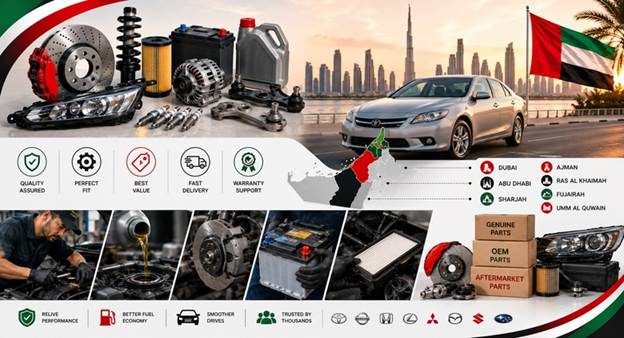
Dubai has become one of the largest automotive parts markets in the Middle East.
That brings plenty of choice.
Whether you're maintaining a Toyota Land Cruiser, Nissan Patrol, Honda Civic, Lexus ES or Mazda CX-5, you'll find everything from routine service items to complete engines, gearboxes, suspension assemblies and body panels.
Choice is valuable.
Knowing how to compare that choice is even more valuable.
Many buyers focus only on price, yet experienced vehicle owners usually compare availability, warranty, supplier reputation and compatibility before making a purchase. A slightly cheaper component that doesn't fit correctly or fails prematurely rarely represents good value.
Quality pays for itself.
Dubai also offers the advantage of specialist suppliers who concentrate on particular Japanese brands, making it easier to source less common components for older vehicles or performance models.
More options.
Better decisions.
Buying Parts in Sharjah
Sharjah has earned a strong reputation among motorists looking for replacement parts.
Especially used and reconditioned components.
The emirate has become an important destination for owners seeking affordable solutions without immediately purchasing brand-new parts. Many dismantlers, specialist suppliers and automotive businesses stock components removed from carefully inspected vehicles.
Condition matters.
Inspection matters even more.
Buying used parts successfully depends on understanding mileage, checking compatibility and confirming the overall condition of the component rather than simply accepting the lowest quotation.
A professionally inspected used alternator or suspension component can provide excellent value.
An unverified one may not.
Taking a few extra minutes to ask questions often prevents costly mistakes later.
Buying Parts in Abu Dhabi
Abu Dhabi combines a strong dealership network with an expanding independent automotive sector.
That gives owners flexibility.
Those looking for genuine manufacturer components can often obtain them through authorised channels, while independent specialists provide OEM, aftermarket and professionally reconditioned alternatives for drivers seeking different budget options.
Every ownership journey is different.
A newer vehicle under manufacturer warranty may benefit from genuine components.
An older family vehicle with higher mileage may justify carefully selected OEM or premium aftermarket alternatives.
There isn't one correct answer.
Only the answer that best suits the vehicle, budget and future ownership plans.
Buying Parts in Ajman
Ajman continues to grow as an attractive destination for automotive repairs and replacement parts.
Many workshops and suppliers serve customers from neighbouring emirates, particularly those comparing prices before committing to major repairs.
Competition benefits buyers.
Independent suppliers often maintain relationships with multiple distributors, increasing the likelihood of locating compatible components quickly without lengthy waiting times.
Speed matters when a vehicle is off the road.
Downtime has a cost.
That applies to private motorists as much as business owners.
Buying Parts in Ras Al Khaimah
Vehicle ownership in Ras Al Khaimah often involves a combination of urban commuting and longer regional journeys.
Reliability therefore becomes particularly important.
Many owners choose replacement parts that prioritise durability over the lowest purchase price because unexpected breakdowns during longer journeys are rarely convenient.
Planning ahead usually proves worthwhile.
Ordering quality components before routine maintenance is due often avoids unnecessary delays and gives workshops greater flexibility when scheduling repairs.
Preparation saves time.
Sometimes money as well.
Buying Parts in Fujairah
Fujairah presents slightly different driving conditions from many other parts of the UAE.
Mountain roads.
Long-distance travel.
Coastal humidity.
Each places different demands on vehicles.
Suspension components, cooling systems and braking parts deserve particular attention because changing road conditions and climate influence long-term wear patterns.
Choosing replacement parts suited to those conditions helps maintain reliability throughout the year.
Maintenance should reflect how the vehicle is actually used.
Not simply how far it has travelled.
Buying Parts in Umm Al Quwain
Owners in Umm Al Quwain increasingly benefit from wider access to suppliers across the UAE.
Distance is becoming less of a limitation.
Many businesses now deliver components directly to workshops or customers, allowing buyers to compare availability, pricing and warranty terms without travelling extensively between emirates.
Convenience has improved dramatically.
That wider access also makes it easier to compare multiple quotations before making an important purchasing decision.
Comparisons rarely hurt.
Rushed decisions often do.
Buying Online Across the UAE
Online purchasing has transformed the replacement parts market.
It offers convenience.
It also demands careful attention.
Buying online allows owners to compare prices, review specifications and search for difficult-to-find components without visiting multiple suppliers. The process becomes even more effective when buyers begin with accurate vehicle information.
The VIN should always come first.
Before completing any order, confirm:
- Vehicle Identification Number compatibility.
- Manufacturer part number where available.
- Warranty coverage.
- Supplier reputation.
- Return policy.
- Product condition.
- Delivery timeframe.
A few careful checks dramatically reduce the likelihood of ordering the wrong component.
Advantages of Buying Online
| Benefit | Why It Matters |
| Wider product choice | Compare more options quickly |
| Competitive pricing | Better value through comparison |
| Convenient ordering | Saves travel time |
| Access to specialist suppliers | Easier sourcing of uncommon parts |
| Home or workshop delivery | Reduced vehicle downtime |
Convenience should never replace careful verification.
Comparing Multiple Suppliers Before Buying
One quotation tells you very little.
Three or four tell you much more.
Comparing suppliers isn't simply about finding the cheapest price. It's an opportunity to evaluate professionalism, technical knowledge, warranty support and customer service before spending your money.
Ask the same questions each time.
Is the part compatible with my VIN?
What warranty is included?
Has the component been inspected?
Is it genuine, OEM, aftermarket or reconditioned?
Can you provide technical support if required?
Clear answers usually indicate an experienced supplier.
Uncertain answers deserve caution.
For buyers looking to compare Japanese car parts in Dubai, Sharjah and across the UAE, platforms such as PartFinder UAE make it easier to request quotations from multiple trusted suppliers, compare availability and evaluate different purchasing options before making a final decision.
An informed comparison often leads to a better purchase.
Not simply a cheaper one.
Key Takeaways
- Dubai, Sharjah, Abu Dhabi and the other Emirates each offer different strengths when sourcing Japanese replacement parts.
- Genuine, OEM, aftermarket, used and reconditioned components are widely available, allowing buyers to match their purchase to their vehicle and budget.
- Online ordering expands access to suppliers but makes VIN verification and warranty checks even more important.
- Comparing multiple suppliers helps buyers evaluate quality, compatibility, technical support and long-term value rather than focusing solely on price.
- Careful research, accurate vehicle information and trusted suppliers help Japanese vehicle owners across the UAE purchase reliable replacement parts with greater confidence while reducing the risk of costly mistakes.
Choosing the Right Replacement Parts
Genuine Parts
The word "genuine" carries weight.
For good reason.
Genuine parts are manufactured to the exact specifications required by the vehicle manufacturer and supplied through authorised distribution channels. They are designed to match the original component in terms of dimensions, materials, performance and durability.
Nothing is left to chance.
For owners of newer Toyota, Nissan, Honda, Lexus, Mazda or Mitsubishi models, genuine parts often provide the greatest peace of mind, particularly when preserving manufacturer warranties or maintaining long-term resale value.
They fit correctly.
They perform consistently.
They also tend to command the highest purchase price.
That doesn't automatically make them the best choice for every repair.
It simply means they're one option within a wider market.
OEM Parts
OEM stands for Original Equipment Manufacturer.
Many buyers misunderstand what that actually means.
An OEM component is often produced by the same manufacturer that supplied the original part fitted during vehicle production. The difference is that it's sold without the vehicle manufacturer's branding.
The quality remains remarkably similar.
The packaging changes.
That distinction allows many owners to purchase components offering factory-level performance while reducing overall repair costs.
It's a sensible compromise.
Especially for vehicles no longer covered by manufacturer warranties.
OEM components are particularly popular for:
- Suspension parts.
- Cooling system components.
- Electrical sensors.
- Engine accessories.
- Steering components.
The balance between quality and value explains why so many experienced workshops recommend them.
Aftermarket Parts
The aftermarket industry offers enormous variety.
That's both its greatest strength and its greatest challenge.
Independent manufacturers produce thousands of replacement components for Japanese vehicles, ranging from routine service items to complete body panels and suspension assemblies.
Some manufacturers produce exceptional products.
Others focus almost entirely on price.
That difference matters.
Premium aftermarket components often perform extremely well when produced by established manufacturers with strong engineering standards. Poor-quality alternatives, however, may wear prematurely, fit incorrectly or create unnecessary reliability concerns.
Choosing aftermarket parts requires research.
Not assumptions.
Genuine vs OEM vs Aftermarket
| Part Type | Advantages | Best Suited For |
| Genuine | Factory specification, excellent fit and warranty support | Newer vehicles and long-term ownership |
| OEM | High quality with competitive pricing | Routine repairs and preventative maintenance |
| Premium aftermarket | Broad availability and value | Budget-conscious owners choosing reputable brands |
Quality should always take priority over the lowest advertised price.
Used Parts
Not every repair requires a brand-new component.
Sometimes a carefully selected used part offers excellent value.
Japanese vehicles enjoy strong support throughout the UAE, creating a healthy supply of professionally removed engines, gearboxes, doors, lighting assemblies, mirrors and interior components from donor vehicles.
Condition remains the deciding factor.
Mileage.
Inspection history.
Physical wear.
Compatibility.
These details matter far more than appearance alone.
Many owners successfully reduce repair costs by choosing quality used components for non-wear items while reserving new or OEM parts for safety-critical systems.
A balanced approach often delivers the best overall value.
Reconditioned Parts
Reconditioned components occupy an important position between new and used parts.
They're neither untouched nor simply removed from another vehicle.
Instead, they have been professionally inspected, cleaned, repaired where necessary and tested before returning to service.
The process restores functionality while reducing waste.
For expensive components such as engines, gearboxes, alternators, steering racks and air conditioning compressors, professionally reconditioned units often provide an attractive balance between affordability and reliability.
Documentation matters.
Testing matters even more.
Choosing a supplier that provides clear inspection records and warranty coverage significantly reduces purchasing risk.
VIN Compatibility Checks
One of the most expensive mistakes buyers make happens before the part even arrives.
Ordering without checking the VIN.
Manufacturers regularly introduce design revisions throughout a vehicle's production cycle. Two cars that appear identical from the outside may contain completely different sensors, wiring connections or mounting points underneath.
Visual similarity proves very little.
The Vehicle Identification Number identifies the precise factory specification, allowing suppliers to confirm compatibility before dispatching replacement components.
Always provide the VIN.
Never rely solely on the model name or registration year.
Accuracy prevents unnecessary returns.
Why VIN Verification Matters
| Benefit | Result |
| Confirms exact specification | Correct replacement part |
| Reduces ordering errors | Faster repairs |
| Prevents compatibility problems | Improved reliability |
| Supports accurate quotations | Fewer unexpected costs |
Five minutes spent checking the VIN can save days of frustration.
Mileage and Condition Assessment
Every replacement part has a history.
Understanding that history helps predict future performance.
When purchasing used or reconditioned components, ask about previous vehicle mileage, inspection procedures, visible wear and available service records where applicable.
Low mileage alone isn't enough.
A well-maintained component from a higher-mileage vehicle may outperform one removed from a poorly maintained car with significantly fewer kilometres.
Condition tells the real story.
Professional inspection reports provide valuable reassurance.
Especially for major mechanical components.
Questions Every Buyer Should Ask
Experienced buyers rarely rush.
They ask questions first.
Before purchasing any significant replacement part, consider asking:
- Is this component compatible with my VIN?
- Is it genuine, OEM, aftermarket or reconditioned?
- Has it been professionally inspected?
- What warranty is included?
- Are there any known defects or previous repairs?
- Does the price include all necessary accessories or fittings?
- Can technical support be provided after purchase?
Clear answers build confidence.
Vague answers should encourage caution.
Parts Buying Checklist
Buying replacement parts becomes much simpler when every purchase follows the same structured process.
Consistency reduces mistakes.
Buyer Checklist
| Inspection Item | Complete |
| VIN verified | ✓ |
| Correct part number confirmed | ✓ |
| Supplier reputation checked | ✓ |
| Warranty reviewed | ✓ |
| Component condition inspected | ✓ |
| Price compared with other suppliers | ✓ |
| Installation arranged with qualified technicians | ✓ |
A checklist may feel simple.
Its value becomes obvious when it prevents an expensive mistake.
Real Buyer Questions
Many Japanese vehicle owners ask the same practical questions before purchasing replacement parts.
Are genuine parts always worth the extra cost?
Not necessarily. Genuine parts offer excellent quality, but OEM components frequently provide similar performance at a lower price for many repairs.
Can used parts be reliable?
Yes. Professionally inspected used components with verified compatibility and reasonable mileage often provide excellent value, particularly for body panels, interior parts and certain mechanical assemblies.
Should I avoid aftermarket parts completely?
No. Premium aftermarket manufacturers produce many dependable components. The key is choosing reputable brands rather than selecting solely on price.
Why is VIN verification so important?
Because production updates can change component specifications even within the same model year. The VIN confirms exactly which part your vehicle requires.
Key Takeaways
- Genuine, OEM, aftermarket, used and reconditioned parts each have a valuable place depending on the repair, vehicle age and ownership goals.
- VIN verification remains one of the most important steps before ordering any replacement component.
- Condition, inspection history and supplier reputation are often more valuable than simply finding the lowest advertised price.
- Asking informed questions before purchasing significantly reduces the likelihood of compatibility issues and unexpected repair costs.
- Careful planning, quality components and experienced suppliers help Japanese vehicle owners make confident purchasing decisions while improving long-term reliability and protecting overall ownership value.
Buying Parts for Popular Japanese Models
Toyota Parts
Toyota has earned one of the strongest reputations for reliability in the UAE.
That reputation doesn't eliminate the need for maintenance.
From the compact Yaris to the Corolla, Camry, Prado and Land Cruiser, every Toyota eventually requires routine servicing and the occasional replacement component. High-mileage vehicles often need suspension bushes, brake components, cooling system parts and steering components, while older SUVs may require attention to drivetrain and suspension systems after years of demanding use.
Fortunately, Toyota enjoys one of the largest replacement parts networks in the Emirates.
Owners can usually choose between genuine, OEM, premium aftermarket, used and professionally reconditioned components depending on the repair and budget.
Availability is rarely the challenge.
Choosing the right quality is.
Nissan Parts
Nissan vehicles remain a familiar sight across Dubai, Sharjah, Abu Dhabi and the other Emirates.
Models such as the Patrol, Sunny, Altima, X-Trail and Navara continue to serve families, businesses and fleet operators alike.
Routine maintenance typically includes filters, brake components and suspension parts, while higher-mileage vehicles may eventually require steering components, cooling system parts or transmission-related repairs.
Owners should always verify compatibility because similar Nissan models can have different engine or transmission specifications depending on the production year and market.
The correct part keeps repairs straightforward.
The wrong one usually creates unnecessary delays.
Honda Parts
Honda has built a loyal customer base by combining efficient engines with dependable engineering.
Vehicles including the Civic, Accord, CR-V and HR-V are widely appreciated for their balance of performance, comfort and fuel efficiency.
Common replacement items include:
- Brake pads and discs.
- Engine mounts.
- Suspension bushes.
- Spark plugs.
- Air conditioning components.
- Wheel bearings.
Preventative maintenance remains particularly important because replacing worn components early often protects neighbouring parts from additional wear.
Looking after small items helps preserve the vehicle as a whole.
Mitsubishi Parts
Mitsubishi continues to perform well in the UAE thanks to models such as the Pajero, Montero Sport, L200 and Outlander.
Many of these vehicles experience mixed driving conditions, from city traffic to long motorway journeys and occasional desert excursions.
That variety places extra demand on suspension systems, cooling components and braking systems.
Owners should inspect shock absorbers, control arms, cooling hoses and brake assemblies regularly, especially if the vehicle frequently carries heavy loads or travels on uneven terrain.
Maintenance schedules deserve attention.
Driving conditions matter just as much.
Mazda Parts
Mazda combines attractive styling with responsive driving characteristics.
Models such as the Mazda3, Mazda6 and CX-5 have become increasingly popular among UAE motorists looking for efficiency without sacrificing driving enjoyment.
Routine servicing typically involves:
| Common Mazda Replacement Parts | Purpose |
| Air filters | Clean engine airflow |
| Oil filters | Protect engine lubrication |
| Brake pads | Maintain braking performance |
| Suspension links | Preserve ride quality |
| Batteries | Ensure reliable starting |
| Cooling components | Control engine temperature |
Although Mazda vehicles are known for dependable engineering, maintaining cooling systems and suspension components remains particularly important during extended UAE summers.
Suzuki Parts
Suzuki vehicles are valued for affordability, practicality and efficient operation.
Popular models such as the Swift, Jimny, Baleno and Ertiga are frequently used for daily commuting, making routine servicing essential for long-term reliability.
Common replacement components include brake pads, filters, batteries, clutch assemblies, suspension bushes and steering components.
Because many Suzuki models are relatively lightweight, owners sometimes underestimate the importance of maintaining suspension geometry and tyre condition.
Proper maintenance improves both comfort and safety.
Even on smaller vehicles.
Subaru Parts
Subaru occupies a unique position within the Japanese automotive market.
Its symmetrical all-wheel-drive systems and Boxer engines provide excellent stability and confident handling.
Those specialised engineering features also require careful attention when sourcing replacement components.
Using incorrect drivetrain or suspension parts can affect vehicle performance.
Owners should ensure compatibility with:
- Drivetrain components.
- Suspension assemblies.
- Wheel bearings.
- Differential components.
- Cooling system parts.
- Engine gaskets.
Professional installation is equally important because many Subaru systems rely on precise alignment and calibration.
Isuzu Parts
Isuzu has established a strong reputation among commercial users and drivers requiring dependable utility vehicles.
Models such as the D-Max and MU-X regularly cover high annual mileages under demanding conditions.
Commercial vehicles experience different wear patterns from private passenger cars.
Suspension systems support heavier loads.
Braking systems work harder.
Cooling systems often operate continuously in challenging temperatures.
Routine inspections reduce unexpected downtime and help businesses manage operating costs more effectively.
Reliability begins with preventative maintenance.
Lexus Parts
Lexus combines premium comfort with proven Japanese engineering.
Many Lexus vehicles share underlying mechanical components with Toyota models, although luxury equipment introduces additional electronic systems, advanced safety technologies and premium interior features.
Owners frequently replace:
- Air suspension components on selected models.
- Brake systems.
- Cooling components.
- Electrical sensors.
- Climate control components.
- Suspension bushes.
Because Lexus vehicles incorporate advanced electronics, accurate diagnosis should always precede component replacement.
Replacing parts without confirming the underlying fault can quickly become expensive.
Precision saves money.
Comparing Parts Across Popular Japanese Brands
Every manufacturer has its own engineering priorities.
Understanding those differences helps owners plan maintenance more effectively.
| Brand | Common Maintenance Focus | Typical Ownership Advantage |
| Toyota | Suspension, cooling, brakes | Excellent reliability and widespread parts availability |
| Nissan | Steering, transmission, suspension | Strong balance of comfort and durability |
| Honda | Engine mounts, braking, suspension | Efficient engines and dependable long-term ownership |
| Mitsubishi | Cooling, suspension, braking | Well suited to mixed driving conditions |
| Mazda | Cooling, filters, suspension | Responsive handling and efficient performance |
| Suzuki | Braking, steering, clutch | Affordable running costs |
| Subaru | AWD components, cooling, suspension | Excellent stability and all-weather capability |
| Isuzu | Suspension, brakes, cooling | Strong durability for commercial use |
| Lexus | Electronics, suspension, braking | Premium comfort with dependable engineering |
Although each brand has different maintenance priorities, one principle remains constant.
Quality replacement parts support long-term reliability regardless of the badge on the bonnet.
Real Buyer Questions
Owners of Japanese vehicles often ask remarkably similar questions.
Do different Japanese brands require different types of replacement parts?
Yes. Every manufacturer uses unique engineering designs, part numbers and specifications. Even vehicles that appear similar may require completely different components.
Can I use aftermarket parts on premium models such as Lexus?
You can, provided they come from reputable manufacturers and are fully compatible with your vehicle. Premium-quality aftermarket components are often suitable for many repairs, while genuine or OEM parts may be preferable for complex electronic systems.
Why are Toyota and Nissan parts generally easier to find?
Their popularity across the UAE has created a larger supplier network, making many replacement components readily available compared with less common models.
Should I always replace worn parts in pairs?
For components such as shock absorbers, brake discs and brake pads, replacing them in pairs is generally recommended to maintain balanced performance and safety.
Key Takeaways
- Every Japanese manufacturer has its own maintenance priorities, but all benefit from high-quality replacement parts and routine servicing.
- Toyota, Nissan, Honda, Mitsubishi, Mazda, Suzuki, Subaru, Isuzu and Lexus all enjoy strong parts availability across the UAE.
- Matching the replacement component to the exact model, engine and VIN helps avoid compatibility issues and unnecessary repair delays.
- Preventative maintenance reduces unexpected breakdowns, protects neighbouring components and lowers long-term ownership costs.
- Choosing reliable suppliers, quality parts and professional installation allows Japanese vehicle owners to enjoy the durability and dependability for which these manufacturers are renowned.
Costs and Pricing Across the UAE
Typical Parts Prices
One of the first questions every vehicle owner asks is simple.
"How much will the replacement part cost?"
The honest answer is that prices vary considerably.
A routine service item such as an oil filter may cost only a small amount, while replacing a gearbox, engine or advanced electronic module can represent a significant investment. The final price depends on several factors, including the vehicle model, the type of replacement part and whether you choose genuine, OEM, aftermarket, used or professionally reconditioned components.
Imported parts may also fluctuate in price due to shipping costs, exchange rates and market demand.
Looking only at the purchase price rarely tells the full story.
Durability, warranty and expected service life are equally important.
Estimated Replacement Parts Costs
| Component | Typical UAE Price Range (AED) |
| Oil filter | 30–120 |
| Air filter | 50–180 |
| Brake pads (front) | 180–700 |
| Brake discs (pair) | 350–1,500 |
| Battery | 350–1,200 |
| Radiator | 450–2,000 |
| Alternator | 600–2,500 |
| Starter motor | 500–2,000 |
| Shock absorber (each) | 300–1,200 |
| Air conditioning compressor | 1,000–4,500 |
Prices vary depending on the manufacturer, vehicle model and component quality.
Labour Costs
The replacement part is only one part of the invoice.
Professional labour also contributes to the total repair cost.
Routine servicing generally requires relatively little labour, while replacing major components such as engines, transmissions or steering racks involves considerably more workshop time.
Experienced technicians may complete complex repairs more efficiently, reducing the overall downtime for the vehicle.
Choosing a qualified workshop often proves better value than selecting the lowest hourly labour rate.
Good workmanship lasts.
Poor workmanship becomes expensive.
Typical Labour Charges
| Repair Type | Estimated Labour Cost (AED) |
| Routine servicing | 150–500 |
| Brake replacement | 250–800 |
| Suspension repairs | 400–1,500 |
| Cooling system repairs | 350–1,500 |
| Steering repairs | 500–2,000 |
| Transmission replacement | 2,000–5,500 |
| Engine replacement | 3,500–8,500 |
Labour costs naturally vary according to workshop experience, vehicle complexity and repair duration.
Hidden Costs
Unexpected expenses often surprise vehicle owners.
Not because they're unusual.
Because they weren't discussed at the beginning.
Replacing one component frequently reveals another worn part that should also be addressed. During a suspension repair, technicians may discover worn bushes or ball joints. A cooling system repair may reveal ageing hoses or a failing thermostat.
These additional costs are not necessarily unnecessary.
They're often preventative.
Ignoring them simply postpones the repair.
Common Hidden Costs
- Diagnostic inspections.
- Replacement seals and gaskets.
- Fluids and lubricants.
- Wheel alignment.
- Electronic calibration.
- Programming of control modules.
- Fasteners and mounting hardware.
Requesting a detailed quotation before authorising repairs helps minimise surprises later.
Repair vs Replacement
Not every faulty component needs replacing.
Equally, not every component is worth repairing.
The correct decision depends on the age of the vehicle, the condition of the existing part, labour costs and expected future reliability.
Minor repairs can extend the life of certain components.
Major mechanical failures often make replacement the more economical long-term solution.
A cheaper repair isn't always the cheaper ownership decision.
Repair or Replace?
| Situation | Usually the Better Option |
| Minor wear with low labour | Repair |
| Extensive internal damage | Replace |
| Safety-critical failure | Replace |
| Repeated previous repairs | Replace |
| Cosmetic damage only | Repair where appropriate |
Long-term reliability should always influence the final decision.
Not simply today's invoice.
Parts Commonly Replaced Together
Many vehicle systems work as complete assemblies.
Replacing only one worn component may reduce the effectiveness of the repair.
For example, replacing brake pads while leaving heavily worn brake discs often shortens the life of the new pads. Installing one new shock absorber while leaving the opposite side heavily worn can affect vehicle stability and ride quality.
Experienced technicians frequently recommend replacing related components together.
Although the initial bill may increase slightly, overall ownership costs often decrease because future labour charges are reduced.
Components Often Replaced Together
| Main Component | Common Associated Parts |
| Brake pads | Brake discs, brake fluid |
| Radiator | Thermostat, coolant hoses, coolant |
| Shock absorbers | Mounts, bushes, wheel alignment |
| Clutch | Release bearing, clutch plate, flywheel inspection |
| Water pump | Timing components where applicable |
| Battery | Charging system inspection |
Preventative replacement often prevents repeat workshop visits.
Warranty Considerations
A warranty offers reassurance.
Provided you understand what it covers.
Warranty terms differ between genuine, OEM, aftermarket, used and reconditioned components. Some cover manufacturing defects only, while others include replacement costs under specific conditions.
Before purchasing any replacement part, ask:
- How long is the warranty?
- What exactly is covered?
- Are labour costs included?
- Are there servicing conditions that must be followed?
- What documentation should be retained?
A clear warranty reflects supplier confidence.
It also protects the buyer.
Insurance and Claims
Insurance policies sometimes contribute towards replacement part costs.
Particularly following accident damage.
Coverage depends on the policy wording, vehicle age and insurer requirements. Some policies specify genuine parts, while others permit equivalent alternatives where appropriate.
Always clarify:
- Which parts are approved.
- Whether your chosen workshop is authorised.
- Whether additional costs require approval.
- Whether depreciation applies.
Understanding the policy before repairs begin helps avoid unnecessary disputes later.
First-Year Ownership Costs
Buying replacement parts is only one aspect of vehicle ownership.
Routine maintenance continues throughout the year.
Owners should budget for servicing, tyres, batteries, filters, brake maintenance and occasional unexpected repairs, particularly on older vehicles with higher mileage.
Planning ahead reduces financial pressure.
Unexpected repairs become easier to manage when maintenance has already been included in the annual budget.
Estimated Annual Maintenance Budget
| Vehicle Category | Typical Annual Maintenance (AED) |
| Small hatchback | 1,500–3,000 |
| Family saloon | 2,000–4,500 |
| SUV | 3,000–6,500 |
| Luxury Japanese vehicle | 4,000–8,500 |
| Commercial pickup | 3,500–7,500 |
Actual costs vary according to mileage, driving conditions and maintenance history.
Cost Saving Tips
Reducing ownership costs doesn't necessarily mean buying the cheapest component.
Smart planning usually delivers better value.
Practical ways to reduce long-term costs include:
- Compare quotations from multiple trusted suppliers.
- Verify every replacement part using the VIN.
- Follow the manufacturer's servicing schedule.
- Replace worn components before they cause secondary damage.
- Choose reputable OEM or premium aftermarket parts where appropriate.
- Keep maintenance records to support future resale value.
- Work with experienced technicians familiar with Japanese vehicles.
Consistent maintenance almost always costs less than major repairs caused by neglect.
Real Buyer Questions
Many owners ask similar questions before approving expensive repairs.
Is the cheapest quotation usually the best value?
Not always. A slightly higher quotation may include better-quality components, professional installation and stronger warranty protection, reducing long-term ownership costs.
Should I repair or replace an ageing component?
If repeated repairs are becoming common or the component has suffered significant internal damage, replacement often provides greater long-term reliability.
Can preventative maintenance really save money?
Yes. Replacing worn components before they fail often prevents damage to surrounding systems, reducing both labour costs and unexpected breakdowns.
Why do workshop quotations sometimes increase after inspection?
Because hidden wear, damaged seals or additional faulty components are often discovered once repairs begin. Reputable workshops explain these findings before carrying out extra work.
Key Takeaways
- The true cost of replacement parts includes both the component itself and the quality of the installation.
- Genuine, OEM, aftermarket, used and reconditioned parts all have different pricing structures and long-term value.
- Labour charges, hidden costs and associated replacement parts should always be considered before approving repairs.
- Comparing quotations, understanding warranty terms and planning annual maintenance budgets help owners make better financial decisions.
- Investing in quality components, preventative maintenance and experienced technicians reduces long-term ownership costs while helping Japanese vehicles remain dependable throughout their service life.
Avoiding Buying Mistakes
Fake Parts
Counterfeit vehicle parts have become a growing concern across global automotive markets.
The UAE is no exception.
At first glance, fake components can appear almost identical to genuine products. Packaging may look convincing. Labels may seem authentic. Even part numbers can resemble the originals.
The difference becomes obvious only after installation.
Inferior materials, inconsistent manufacturing standards and poor quality control often lead to premature wear or complete failure. In safety-critical systems such as brakes, steering and suspension, the consequences can be far more serious than an unexpected repair bill.
Buying from trusted suppliers significantly reduces this risk.
If a price appears dramatically lower than every other quotation, it's worth asking why.
Quality manufacturing has a cost.
So does peace of mind.
Warning Signs of Counterfeit Parts
| Warning Sign | Why It Matters |
| Unusually low price | May indicate counterfeit or poor-quality products |
| Missing warranty | Limited protection if the part fails |
| Poor packaging quality | Possible sign of unauthorised products |
| No manufacturer details | Difficult to verify authenticity |
| Inconsistent markings | Compatibility and quality concerns |
Authenticity should always come before affordability.
Common Scams
Most scams rely on one thing.
The buyer being in a hurry.
Some sellers advertise genuine components before supplying lower-quality alternatives. Others reuse damaged parts, hide previous repairs or exaggerate the condition of used components.
Documentation can also be misleading.
An inspection report should reflect the actual condition of the part rather than serving as a marketing document.
Taking time to verify the supplier, compare quotations and ask detailed questions dramatically reduces the likelihood of becoming a victim of these practices.
Patience is often your strongest protection.
Scams Buyers Should Watch For
- Components advertised as genuine without supporting documentation.
- Used parts presented as reconditioned.
- Incorrect part numbers supplied after payment.
- Hidden damage not disclosed before purchase.
- Unrealistic warranty promises.
- Pressure to make immediate payment.
- Suppliers unwilling to verify VIN compatibility.
Professional businesses welcome informed questions.
Dishonest sellers usually avoid them.
Workshop Red Flags
Selecting the right workshop is every bit as important as selecting the right replacement part.
A high-quality component installed incorrectly may still fail prematurely.
Fortunately, experienced workshops usually demonstrate professionalism long before any repair begins.
They explain the diagnosis.
Provide detailed quotations.
Discuss available repair options.
Answer technical questions clearly.
The opposite should encourage caution.
Signs That Should Raise Concern
| Workshop Red Flag | Possible Risk |
| No written quotation | Unexpected additional charges |
| Refuses VIN verification | Incorrect part supplied |
| Unable to explain diagnosis | Misdiagnosis or unnecessary repairs |
| No warranty offered | Limited protection after installation |
| Pressure to approve repairs immediately | Reduced opportunity to compare options |
| Poor communication | Lack of transparency |
Confidence comes from clear information.
Not sales pressure.
How to Identify Reliable Suppliers
Finding a dependable supplier is easier when you follow a consistent evaluation process.
Rather than focusing solely on price, assess the overall buying experience.
Reliable suppliers generally:
- Confirm compatibility using the VIN.
- Clearly explain whether parts are genuine, OEM, aftermarket, used or reconditioned.
- Provide transparent pricing.
- Offer realistic warranty terms.
- Respond confidently to technical questions.
- Supply detailed invoices and documentation.
- Maintain a positive reputation among customers.
Professionalism usually reveals itself through consistency.
Not advertising.
Understanding Documentation
Paperwork often receives less attention than the replacement part itself.
It shouldn't.
Invoices, warranty documents, inspection reports and compatibility confirmations provide valuable protection if questions arise after installation.
Always retain:
- Purchase invoice.
- Warranty certificate.
- Part number information.
- Installation invoice.
- Inspection reports where applicable.
- Vehicle service records.
Good documentation also supports future resale value by demonstrating responsible vehicle ownership.
Why Preventative Maintenance Matters
Many expensive repairs begin with a relatively minor problem.
A worn hose.
An ageing battery.
A noisy wheel bearing.
Small issues often provide early warning.
Ignoring those warnings rarely saves money.
Routine inspections help identify developing faults before they damage surrounding components or leave the vehicle stranded.
Preventative maintenance isn't simply about avoiding breakdowns.
It's about protecting the overall value of the vehicle.
Real Buyer Questions
Practical questions often reveal the biggest concerns shared by Japanese vehicle owners.
How can I tell whether a replacement part is genuine?
Ask for the manufacturer details, verify the part number where possible and purchase through trusted suppliers who provide proper documentation and warranty support.
Should I avoid buying used parts altogether?
No. Professionally inspected used components can provide excellent value when purchased from reputable suppliers and matched correctly to the vehicle.
Is an expensive part always the best choice?
Not necessarily. Many OEM and premium aftermarket components offer excellent reliability while costing less than genuine alternatives. The suitability depends on the specific repair and your long-term ownership plans.
Why should I compare more than one quotation?
Comparing suppliers allows you to evaluate pricing, warranty, compatibility checks, technical knowledge and overall customer service rather than judging value on price alone.
Final Buying Checklist
A structured buying process helps eliminate unnecessary risk.
Before placing any order, work through each of the following steps.
Smart Buyer Checklist
| Checklist Item | Complete |
| Vehicle VIN confirmed | ✓ |
| Correct part number verified | ✓ |
| Supplier reputation researched | ✓ |
| Warranty reviewed | ✓ |
| Component condition inspected | ✓ |
| Multiple quotations compared | ✓ |
| Installation arranged with qualified technicians | ✓ |
| Documentation retained | ✓ |
Simple preparation often prevents expensive mistakes.
Key Takeaways
- Counterfeit components, misleading advertising and poor workshop practices can significantly increase long-term ownership costs.
- Reliable suppliers provide transparent pricing, VIN verification, clear warranty information and professional customer support.
- Comparing multiple quotations allows buyers to assess quality, compatibility and service rather than focusing solely on price.
- Preventative maintenance and accurate documentation protect both the vehicle and its future resale value.
- Careful research, trusted suppliers and informed purchasing decisions help Japanese vehicle owners across the UAE enjoy safer, more reliable and more cost-effective vehicle ownership.
Final Buyer Guide
Expert Buying Advice
Experienced buyers rarely rely on luck.
They follow a process.
Before ordering any replacement part, gather accurate vehicle information, confirm the exact specification and compare several trusted suppliers.
Don't hesitate to ask technical questions.
Professional suppliers appreciate informed customers because clear communication reduces misunderstandings and incorrect orders.
Whenever possible:
- Compare more than one quotation.
- Confirm warranty terms in writing.
- Keep every invoice and service record.
- Replace safety-critical components with quality products.
- Use qualified technicians for installation.
Small decisions made before the repair often determine whether the ownership experience remains enjoyable afterwards.
Long-Term Maintenance Tips
Japanese vehicles have earned an outstanding reputation for durability.
That reputation depends on consistent maintenance.
Simple servicing completed on time often prevents expensive repairs years later.
Good ownership habits include:
- Following the manufacturer's maintenance schedule.
- Replacing fluids at recommended intervals.
- Inspecting brakes and suspension regularly.
- Monitoring coolant levels and engine temperature.
- Maintaining correct tyre pressures.
- Replacing worn filters promptly.
- Investigating unusual noises before they develop into larger faults.
These habits reduce unexpected breakdowns while helping maintain fuel efficiency, comfort and resale value.
Annual Maintenance Priorities
| Vehicle System | Recommended Attention |
| Engine | Oil, filters and routine inspections |
| Cooling system | Coolant condition, radiator and hoses |
| Braking system | Pads, discs and brake fluid |
| Suspension | Bushes, ball joints and shock absorbers |
| Steering | Alignment and steering components |
| Electrical system | Battery health and charging performance |
| Air conditioning | Cabin filter and cooling efficiency |
Regular maintenance is almost always less expensive than emergency repairs.
The Future of Japanese Parts Availability in the UAE
The outlook remains encouraging.
Japanese vehicles continue to hold a significant share of the UAE automotive market, ensuring ongoing demand for replacement parts across every Emirate.
At the same time, technology is improving the buying experience.
Online comparison platforms.
Digital parts catalogues.
Faster logistics.
Improved inventory management.
These developments allow buyers to locate compatible components more quickly than ever before.
The growing popularity of hybrid and electric Japanese vehicles is also expanding the range of specialised replacement components available throughout the country.
As the market evolves, buyers who stay informed will continue making better purchasing decisions.
Final Buyer Checklist
Before purchasing any Japanese replacement part, review this final checklist.
Smart Purchase Checklist
| Final Check | Complete |
| VIN verified | ✓ |
| Correct part number confirmed | ✓ |
| Genuine, OEM, aftermarket, used or reconditioned option selected | ✓ |
| Supplier reputation checked | ✓ |
| Warranty reviewed | ✓ |
| Price compared with multiple suppliers | ✓ |
| Qualified installation arranged | ✓ |
| Documentation safely stored | ✓ |
Following the same checklist every time dramatically reduces purchasing mistakes.
Consistency protects both your vehicle and your budget.
Final Thoughts
Buying replacement parts should never feel confusing.
With the right information, it becomes a straightforward process.
Understanding the differences between genuine, OEM, aftermarket, used and reconditioned components allows you to make decisions based on value rather than guesswork. Verifying compatibility through the VIN, comparing reputable suppliers and choosing quality over the lowest price all contribute to safer, more reliable vehicle ownership.
Whether you drive a Toyota, Nissan, Honda, Lexus, Mazda, Mitsubishi, Suzuki, Subaru or Isuzu, investing in the right replacement parts in Japanese car parts in UAE today helps protect reliability, reduce long-term maintenance costs and preserve resale value for years to come.
An informed owner rarely regrets taking a little extra time before making a purchase.
The right part, installed correctly and maintained properly, is one of the best investments you can make in any Japanese vehicle.
Key Takeaways
- Genuine, OEM, premium aftermarket, used and reconditioned parts all have their place when chosen carefully and matched to the correct vehicle.
- VIN verification, supplier reputation and warranty protection should always be confirmed before purchasing any replacement component.
- Routine maintenance, preventative inspections and professional installation significantly improve long-term reliability and reduce unexpected repair costs.
- Comparing multiple trusted suppliers helps buyers achieve the best balance between quality, value and after-sales support.
- Careful planning and informed purchasing decisions allow Japanese vehicle owners across Dubai, Sharjah and the rest of the UAE to enjoy dependable motoring while protecting both their investment and future resale value.
Advanced Buyer Advice, Workshop Insights and Ownership Strategies
Building a Long-Term Maintenance Plan
Buying the correct replacement part solves today's problem.
Planning future maintenance prevents tomorrow's.
Many Japanese vehicles comfortably exceed 250,000 kilometres when serviced consistently. That level of reliability doesn't happen by accident. It comes from replacing wear items before they become failures and keeping accurate service records throughout the vehicle's life.
A structured maintenance plan helps owners budget more effectively while reducing the likelihood of unexpected breakdowns.
Rather than reacting to faults, experienced owners anticipate them.
That approach saves both time and money.
Suggested Maintenance Planning
| Mileage Interval | Priority Inspection |
| Every service | Engine oil, filters, fluid levels |
| 20,000–40,000 km | Brake system and tyres |
| 40,000–60,000 km | Suspension and steering |
| 60,000–100,000 km | Cooling system and drive belts |
| 100,000 km+ | Transmission, major rubber components and comprehensive inspection |
Following a preventative schedule almost always proves more economical than emergency repairs.
Understanding Parts Lifespan
No replacement part lasts forever.
Even premium-quality components have a service life.
Driving style, climate, road conditions and maintenance standards all influence how long a component remains reliable.
The UAE presents additional challenges.
Extreme summer temperatures.
Heavy traffic.
Long motorway journeys.
Frequent air conditioning use.
These conditions accelerate wear on several vehicle systems.
Understanding expected lifespan allows owners to prepare financially rather than being caught by surprise.
Approximate Service Life
| Component | Typical Lifespan |
| Brake pads | 30,000–60,000 km |
| Brake discs | 60,000–100,000 km |
| Battery | 2–4 years |
| Shock absorbers | 80,000–120,000 km |
| Radiator hoses | 5–8 years |
| Wheel bearings | 100,000 km+ depending on usage |
Actual lifespan varies according to driving conditions and maintenance quality.
Protecting Your Vehicle's Resale Value
A well-maintained Japanese vehicle usually attracts stronger resale interest.
Buyers notice the details.
Complete service history.
Quality replacement parts.
Professional repairs.
Consistent maintenance.
These factors inspire confidence long before a test drive begins.
Replacing poor-quality components simply because they cost less can reduce buyer confidence later.
Investing sensibly throughout ownership often returns value when it's time to sell.
Maintenance should be viewed as an investment.
Not merely an expense.
Fleet and Business Ownership
Businesses rely on dependable vehicles.
Downtime affects productivity.
Whether managing delivery vans, company saloons or commercial pickups, every unexpected repair influences operating costs.
Fleet managers benefit from:
- Scheduled preventative maintenance.
- Bulk servicing plans.
- Consistent supplier relationships.
- Accurate maintenance records.
- Regular safety inspections.
- Early replacement of wear components.
Reducing unexpected downtime often delivers greater savings than negotiating slightly lower parts prices.
Reliability supports profitability.
Seasonal Maintenance in the UAE
Vehicle requirements change throughout the year.
Summer demands particular attention.
Before periods of extreme heat, owners should inspect:
- Cooling system efficiency.
- Coolant condition.
- Battery performance.
- Air conditioning operation.
- Tyre condition.
- Engine belts.
- Fluid levels.
Following the cooler months, suspension and braking systems should also be inspected, particularly on vehicles that regularly travel long distances.
Preparing the vehicle for seasonal conditions helps reduce avoidable failures.
Workshop Case Study
Consider two owners with identical vehicles.
Both require replacement brake components.
The first owner selects the cheapest available parts without checking compatibility or warranty coverage.
The second compares suppliers, confirms the VIN, chooses quality OEM components and has them installed by experienced technicians.
Initially, the second repair costs slightly more.
Eighteen months later, the difference becomes clear.
The higher-quality components continue performing reliably, while the cheaper parts require premature replacement, increasing both labour and overall ownership costs.
The lesson is straightforward.
Long-term value rarely comes from the lowest initial price.
Final Expert Recommendations
Before approving any repair, remember these practical principles:
- Verify compatibility using the VIN.
- Compare quotations from trusted suppliers.
- Prioritise quality over short-term savings.
- Replace related wear components where appropriate.
- Retain invoices and warranty documentation.
- Follow the manufacturer's maintenance schedule.
- Use experienced technicians familiar with Japanese vehicles.
These habits consistently lead to better ownership experiences.
Real Buyer Questions
How do I know whether it's worth investing in an older Japanese vehicle?
If the vehicle has been maintained properly, has no significant structural damage and repair costs remain reasonable compared with its market value, investing in quality replacement parts can extend its useful life for many years.
Should I keep service records after every repair?
Absolutely. Comprehensive maintenance records improve resale value, simplify future diagnostics and demonstrate responsible ownership.
Does preventative maintenance really reduce overall costs?
Yes. Identifying worn components before they fail often prevents damage to neighbouring systems, lowers labour costs and reduces unexpected downtime.
Is it better to stay with one trusted supplier?
Building a relationship with a reputable supplier can improve consistency, technical support and after-sales service, although it's still wise to compare quotations for major purchases.
Final Key Takeaways
- Preventative maintenance remains the most effective way to reduce long-term ownership costs.
- Understanding component lifespan helps owners budget for future repairs instead of reacting to unexpected failures.
- Quality replacement parts, professional installation and complete service records help preserve both reliability and resale value.
- Fleet operators and private owners alike benefit from structured maintenance planning and trusted supplier relationships.
- Thoughtful purchasing decisions, regular inspections and consistent servicing allow Japanese vehicles to continue delivering the reliability and value for which they are recognised across Dubai, Sharjah and the wider UAE.
Final Expert Conclusion and Smart Buying Strategy
Why Buying the Right Part Matters More Than Buying the Cheapest Part
Every vehicle owner wants to save money.
That's perfectly understandable.
However, the lowest purchase price doesn't always deliver the lowest ownership cost. A replacement component that wears out early, fits poorly or fails unexpectedly often leads to additional labour charges, repeat repairs and unnecessary inconvenience.
Quality parts reduce risk.
They also improve reliability.
Whether you're replacing a simple air filter or investing in a major mechanical component, selecting the correct specification should always come before comparing prices.
A well-informed purchase usually proves to be the most economical one over time.
Building a Relationship with Trusted Suppliers
Finding a reliable supplier shouldn't be viewed as a one-off transaction.
Think of it as a long-term partnership.
Suppliers who understand Japanese vehicles can often provide valuable advice about compatibility, alternative options, expected delivery times and warranty support. They may also help identify related components worth replacing during the same repair, reducing future labour costs.
Good suppliers don't simply sell parts.
They help customers make informed decisions.
Trust becomes increasingly valuable throughout the life of the vehicle.
The Importance of Professional Installation
Even the highest-quality replacement part depends on correct installation.
Precision matters.
Experienced technicians understand manufacturer procedures, tightening specifications, calibration requirements and system testing. Proper installation helps the replacement component perform as intended while protecting surrounding systems from unnecessary wear.
Professional fitting also provides reassurance should warranty support ever become necessary.
A quality part deserves quality workmanship.
The two should always go together.
Looking Beyond the Immediate Repair
Every repair offers an opportunity to improve the vehicle's overall condition.
Rather than replacing only the failed component, experienced workshops often inspect neighbouring parts for signs of wear.
This proactive approach frequently prevents additional breakdowns.
For example:
- Brake repairs may include inspecting brake fluid and discs.
- Suspension repairs often involve checking bushes and ball joints.
- Cooling system repairs usually include examining hoses and the thermostat.
- Battery replacement should be accompanied by charging system testing.
Small additional inspections today can prevent larger repair bills tomorrow.
Ownership Habits That Extend Vehicle Life
Japanese vehicles have earned their reputation through dependable engineering.
Owners play an equally important role.
Simple habits contribute significantly to long-term reliability:
- Service the vehicle at recommended intervals.
- Respond promptly to warning lights.
- Check fluid levels regularly.
- Maintain correct tyre pressures.
- Listen for unusual noises.
- Keep maintenance records organised.
- Use quality replacement parts throughout the vehicle's life.
Consistency is often more valuable than expensive repairs.
Routine care protects every major system.
Future Trends in the Japanese Parts Market
The replacement parts industry continues to evolve.
Digital technology is making it easier than ever for buyers to compare suppliers, verify compatibility and access specialist components across the UAE.
Improved logistics are reducing delivery times.
Inventory systems are becoming more accurate.
The growing popularity of hybrid and advanced safety technologies is also increasing demand for specialised replacement components and skilled technicians.
Owners who stay informed will continue benefiting from these developments.
Knowledge remains one of the most valuable tools in vehicle ownership.
Complete Smart Buyer Checklist
Before purchasing any replacement component, review this final checklist.
Ultimate Buying Checklist
| Checklist Item | Status |
| Vehicle VIN confirmed | ✓ |
| Correct part number verified | ✓ |
| Genuine, OEM, aftermarket, used or reconditioned option selected | ✓ |
| Supplier reputation researched | ✓ |
| Warranty terms understood | ✓ |
| Multiple quotations compared | ✓ |
| Professional installation arranged | ✓ |
| Service records updated | ✓ |
Following the same process for every purchase reduces mistakes and improves long-term ownership confidence.
Real Buyer Questions
Which replacement parts should never be chosen solely because they're cheap?
Safety-critical components such as brakes, steering, suspension and major engine or transmission parts should always prioritise quality, compatibility and reliability over the lowest purchase price.
How can I reduce future repair costs?
Follow the manufacturer's maintenance schedule, replace worn components before they fail, keep accurate service records and work with trusted suppliers and experienced technicians.
Is it worth comparing several suppliers before buying?
Yes. Comparing quotations allows you to assess warranty support, product quality, technical knowledge, delivery times and overall value rather than focusing only on price.
Can proper maintenance improve resale value?
Absolutely. A documented service history supported by quality replacement parts and professional repairs gives future buyers greater confidence and often strengthens resale value.
Final Conclusion
Japanese vehicles continue to be among the most trusted cars on UAE roads because they combine dependable engineering with practical ownership costs.
That reputation, however, depends on proper maintenance.
Choosing high-quality replacement parts, confirming VIN compatibility, comparing reputable suppliers and investing in professional installation all contribute to safer, more reliable motoring. Whether your vehicle requires routine servicing, accident repairs or major mechanical work, informed decisions will always produce better long-term results than rushed purchases.
Across Dubai, Sharjah, Abu Dhabi, Ajman, Ras Al Khaimah, Fujairah and Umm Al Quwain, vehicle owners have more options than ever before. By comparing suppliers through platforms such as PartFinder UAE, understanding the differences between genuine, OEM, aftermarket, used and reconditioned components, and following a preventative maintenance strategy, you can reduce ownership costs while protecting reliability and resale value.
The best replacement part isn't simply the one that fits your budget.
It's the one that keeps your Japanese vehicle performing safely, efficiently and dependably for many years to come.
Final Key Takeaways
- Prioritise compatibility, quality and supplier reputation before comparing prices.
- Always verify replacement parts using your vehicle's VIN to avoid costly ordering mistakes.
- Preventative maintenance and professional installation help extend vehicle life and reduce unexpected repairs.
- Comparing multiple trusted suppliers leads to better value, stronger warranty protection and greater purchasing confidence.
A well-maintained Japanese vehicle delivers lower long-term ownership costs, stronger resale value and the dependable performance that has made Japanese cars so popular throughout the UAE.
Frequently Asked Questions
Categories
- Audi
- BMW
- Car Accessories
- Car Tips
- Ford
- Land Rover
- Mazda
- Range Rover
- Top 10
- UAE Car Parts
- Used Car Parts
- Toyota
- Replacement Engines
- Nissan
- Hyundai
- Mitsubishi
- Volkswagen
- Honda
- Kia
- Chevrolet
- Dodge
- Jeep
- Subaru
- Renault
- Lexus
- Mercedes
- Suzuki
- Hummer
- Porsche
- Infiniti
- Peugeot
- GMC
- Mini
- Volvo
- Replacement Gearboxes
- MG
- Jaguar
- Skoda
- Cadillac
- Daihatsu
- Fiat
- German Car Parts
- Japanese Car Parts
- Aftermarket Car Parts
- Genuine Car Parts
- New Car Parts
- Reconditioned Car Parts
- European Car Parts
- American Car Parts
- Korean Car Parts
- British Car Parts
- Chinese Car Parts
- Sports/Exotic Car Parts
- Luxury Car Parts
- Performance Car Parts
- SUV/4x4 Spare Parts
- Truck Spare Parts
- EV Car Parts
- Hybrid Car Parts
- Auto Spare Parts in UAE
- Tesla
- Isuzu
- Ram
- Ferrari
- Bentley
- Lamborghini
- Genesis
- Maserati
- Lincoln
- Chrysler
- Opel
- Citroen
- SsangYong
- Seat
- McLaren
- Aston Martin
- Rolls Royce
- Maybach
- Alfa Romeo
- Bugatti
- Scion
- Abu Dhabi Car Parts
- Ajman Car Parts
- Al Khan Car Parts
- Al Sajaa Car Parts
- Deira Car Parts
- Dubai Car Parts
- Fujairah Car Parts
- Industrial Area 6 Car Parts
- Mussafah Car Parts
- Ras Al Khaimah Car Parts
- Sharjah Car Parts
- Umm Al Quwain Car Parts
- Acura
- BYD
- Chery
- Dacia
- DS
- Geely Emgrand
- EXEED
- GAC
- GAC Gonow
- Geely
- Gonow
- Great Wall
- Haima
- Haval
- Holden
- Iveco