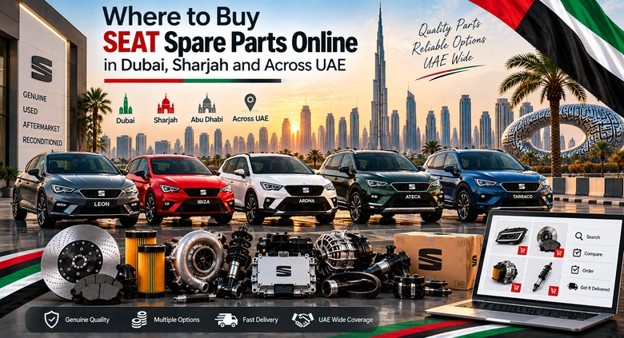
Where to Buy SEAT Spare Parts Online in Dubai, Sharjah and Across UAE
September 24, 2026
Buying the SEAT spare parts online in UAE should not begin with a Google search for the cheapest price. It should begin with one rather less glamorous question: what exactly is fitted to your car?
That matters because “SEAT Leon”, for example, is not enough information to identify every component. Engine, gearbox, production year, trim, drivetrain, market specification and sometimes the actual part number can change the answer. A bargain headlamp that belongs to another specification is still the wrong headlamp. The same goes for an ECU, turbocharger, DSG component, radiator, ABS module or engine assembly.
And there is another complication in the UAE. The car sitting in a Dubai workshop may have been imported from somewhere else, while the part being offered may have come from a different production period again. Online ordering makes the search faster. It does not make fitment magically simpler.
Where can you buy SEAT spare parts online in the UAE?
There are broadly three routes: an authorised SEAT service operation, a specialist parts supplier, or an online marketplace that connects buyers with multiple UAE sellers.
The first route is straightforward when you want manufacturer-supplied parts and manufacturer-level servicing. SEAT states that its Genuine Parts are designed and engineered for its vehicles, with a two-year warranty stated on its global genuine-parts page.
The second and third routes become more interesting when the car is older, the required component is discontinued, or you want to compare genuine, aftermarket, used and reconditioned options.
Dubai is not the only useful sourcing point
A common mistake is assuming that the part has to be physically sitting in a Dubai shop because the vehicle is registered in Dubai.
It doesn't.
A supplier in Sharjah, Ajman, Abu Dhabi or another UAE emirate may have the correct component while a closer-looking seller does not. Online sourcing changes the equation: identify the exact part first, then worry about where it is sitting.
That is particularly useful for older SEATs, where stock can be scattered rather than neatly organised by model.
Sharjah can matter when you're looking for older or used parts
Sharjah has a substantial automotive-parts and workshop ecosystem, so it can be relevant when the requirement is a used body component, engine assembly, gearbox, suspension item or electrical module.
But “used” should never be treated as a condition description by itself.
Ask what the donor vehicle was, how many kilometres it had covered, whether the component was tested, whether the part number can be photographed and what happens if the component proves incompatible.
Abu Dhabi buyers have the same sourcing problem
Distance does not change the technical requirement.
If an Abu Dhabi owner needs a SEAT Leon engine, for instance, the sensible online search is not simply “Leon engine”. It is something closer to Leon + year + engine code + transmission + VIN, with photographs and the exact assembly details requested from the seller.
That reduces the chance of buying a visually similar unit that becomes an expensive workshop problem.
Before ordering, identify the exact SEAT model
This sounds obvious until you see how many parts are listed under broad model names.
SEAT's current online model information covers cars such as the Ibiza, Arona and Leon, while its own SUV page now identifies the Ateca and Tarraco as discontinued models.
That distinction matters when shopping online. A discontinued model may have excellent parts availability, but the search often shifts towards existing stock, specialist suppliers, used components and compatible replacement parts rather than simply ordering a current factory component.
The Leon needs generation-level checking
“SEAT Leon spare parts” is too broad for expensive components.
A first-generation Leon with an older petrol or diesel engine is obviously not a straightforward fitment match for a later-generation car. The UAE market also contains imported vehicles from different years and specifications.
The PartFinder UAE, for example, has listings showing older Leon engine applications such as the 1.8-litre turbocharged BAM engine for 2003–2006 Leon applications, and the 1.6-litre BFQ engine for 2005–2006 Leon applications. Those are useful reminders of how much engine-code information can matter.
Ibiza parts can look simpler than they are
The Ibiza is compact. Its parts catalogue isn't.
Current SEAT information includes different Ibiza power outputs and engine variants, including 1.0-litre petrol applications. Older cars introduce still more variation.
An online listing that says “Ibiza 1.4 engine” is not sufficient evidence for compatibility. Engine code, year and original application should be checked before money changes hands.
Arona fitment deserves the same discipline
Current SEAT information lists the Arona with 1.0-litre petrol applications, including a 95 PS version, while other trim/power configurations also exist.
The UAE parts market also contains cross-model engine applications. One documented listing, for example, identifies the DKJA 1.0-litre engine with 115 PS applications for both SEAT Arona and Ibiza.
That is precisely why model-name matching alone is weak.
Ateca is now a used-parts search as much as a new-parts search
SEAT currently describes the Ateca as discontinued.
That does not mean parts have disappeared. Quite the opposite. It means the sourcing strategy may increasingly involve remaining genuine stock, aftermarket production, used assemblies and specialist suppliers.
For an Ateca owner, the important question is not “Is the model discontinued?” It is “Which supply route gives me the correct part with acceptable condition, warranty and fitment evidence?”
Tarraco follows a similar pattern
The Tarraco is also identified by SEAT as a discontinued model.
For bodywork and service parts, that may not be especially dramatic. For expensive electronic modules, trim-specific components or larger mechanical assemblies, it can make sourcing more dependent on specialist stock.
The older the vehicle becomes, the more useful a well-documented used part can be.
Don't search by model alone
A good online request might look like this:
SEAT Leon, 2010, 1.9 TDI, engine code BXE, manual, front-wheel drive, VIN available, required component: complete engine.
That is infinitely more useful than:
Leon engine wanted.
The more expensive the component, the more information you should provide before asking for a quotation.
VIN is your strongest starting point
The VIN identifies the individual vehicle and can help narrow down the specification.
For complicated electrical, drivetrain and engine components, send the VIN to the seller or workshop where appropriate, then ask them to confirm the proposed part against it.
Do not assume that a supplier's “compatible with Leon” statement constitutes a VIN-level fitment check.
Part numbers beat attractive photographs
Photographs are useful. Part numbers are usually more useful.
A headlamp can look identical from the outside and still carry different electronics, mounting arrangements, coding requirements or market specifications.
Ask the seller for a clear photograph of the identification label or stamped number. Then have the workshop confirm whether that number is suitable for the vehicle.
Engine codes are especially important
This becomes critical when buying an engine.
The UAE market has documented SEAT-related engine listings spanning substantially different generations and specifications: BAM 1.8 turbo, BFQ 1.6 naturally aspirated, BXE 1.9 TDI and newer small-displacement applications such as DKJA.
Same badge. Very different mechanical package.
That is why “SEAT engine” is almost meaningless as a buying description.
Gearbox identification should happen before quotation
A gearbox quotation without transmission identification is a weak quotation.
Ask for the gearbox code where available, transmission type, donor vehicle details and whether the price refers to the bare gearbox or a larger assembly.
Also ask what is excluded. A “gearbox price” may not include oil, filters, seals, torque-converter work, clutch components, programming, adaptation or labour.
Used engines need more than a mileage claim
“Low mileage” sounds reassuring. It isn't evidence by itself.
For a used SEAT engine, ask for donor information, mileage evidence where available, engine-code confirmation, photographs, signs of overheating or oil contamination, and what testing has actually been performed.
If the engine is being sold as a complete assembly, establish exactly what comes with it. One supplier may include the long block; another may include ancillaries; another may sell an assembly that still needs substantial component swapping.
Compression testing can be useful
For a used petrol engine, compression readings can help identify differences between cylinders, although the test has to be performed correctly and interpreted alongside other evidence.
A single number does not certify an engine.
For a serious engine purchase, the workshop may also want to examine oil condition, coolant contamination, leak-down behaviour where appropriate, turbo condition, crankcase pressure and external leakage before installation.
Used gearboxes require a different inspection
You cannot compression-test a gearbox.
The useful questions are different: donor mileage, transmission code, fluid condition, evidence of impact, shaft play, casing damage, reported shifting behaviour and whether the unit has been opened or rebuilt.
For automatic or dual-clutch transmissions, ask specifically whether adaptation or programming will be required after installation.
Electronics are where online buying gets tricky
An ECU, ABS module, body-control module, instrument cluster or infotainment unit can be mechanically perfect and still fail to operate correctly after installation.
Coding, immobiliser pairing, software version and vehicle configuration can matter.
SEAT itself describes specialised electronic diagnosis as part of its workshop process, which underlines the point: an electronic fault should not be treated as a simple “swap the box and see” exercise.
Headlights need specification checking
A headlamp is not necessarily just a headlamp.
Halogen, LED and higher-specification systems can differ considerably. There can also be differences in sensors, control modules, left-hand/right-hand traffic requirements and coding.
Send the old unit's label and photographs before ordering.
Body parts are more forgiving — sometimes
A bumper, bonnet, wing or door shell generally has fewer electronic complications than an ECU.
But colour, trim, parking sensors, camera apertures, headlamp washers and mounting points can still turn an apparently cheap panel into a mismatch.
For painted bodywork, provide the paint code rather than relying on “white Leon”.
Air-conditioning parts deserve careful matching
Dubai summers put little sympathy into a weak air-conditioning system.
If the compressor has failed, do not automatically order another compressor simply because the part looks identical. The workshop should establish why the original failed and whether contamination has entered the refrigerant circuit.
Otherwise the replacement compressor can become the second expensive casualty.
Cooling-system parts should not be guessed
Radiators, condensers, coolant pumps, thermostats, fans and associated sensors can differ by engine and equipment.
This is one area where the cheapest online listing can become expensive quickly. A wrong cooling component does not merely inconvenience the owner; it can contribute to overheating.
For older SEATs, check the engine code and compare the old component before ordering.
Brakes are specification-sensitive
SEAT says its Genuine brake discs and pads are designed around the vehicle's weight, engine power and top speed.
That is a useful principle even when you are buying outside the authorised network.
Don't order brake parts purely by model name. Confirm disc diameter, thickness, axle position, calliper arrangement and vehicle specification where relevant.
Suspension parts should be bought by axle and specification
“Front suspension” is not one part.
Control arms, bushes, ball joints, struts, springs, top mounts and links all have different failure modes and different replacement decisions.
If a workshop has diagnosed a worn front-right control-arm bush, buying an entire suspension assembly because it happens to be advertised cheaply may make little financial sense.
Genuine, OEM and aftermarket are not interchangeable words
This distinction matters.
Genuine means the manufacturer's branded component supplied through its genuine-parts channel.
OEM is commonly used for parts produced by the original-equipment manufacturer, but sellers do not always use the term consistently.
Aftermarket covers a much wider field. Quality can vary.
Used genuine means an original component removed from another vehicle, with condition and history becoming crucial.
Reconditioned means the component has been inspected or rebuilt to some stated process. Ask what that process actually included.
When genuine parts make the most sense
Genuine parts can be particularly attractive for safety-critical components, complicated electronics, trim-specific components and situations where exact fitment matters more than initial purchase price.
SEAT says its Genuine Parts are designed specifically for its vehicles and carries a two-year warranty statement on its global parts page.
That does not mean genuine is automatically the right choice for every component. It means the buyer should understand what they are paying for.
When a good aftermarket part can make sense
For routine wear items, established aftermarket manufacturers can offer a sensible alternative when the specification is correct.
The crucial phrase is when the specification is correct.
A cheap filter, belt, brake component or sensor is not a saving if it creates a second repair. Ask for manufacturer details, part number, warranty and fitment evidence rather than accepting “same as original”.
Used parts are often about availability
A used component can be particularly useful for an older SEAT where a new original component is costly, unavailable or disproportionately expensive relative to the vehicle's value.
But used does not mean “cheap and therefore good”.
It means the buyer is trading some certainty for potentially lower cost. The condition, donor history, testing and return terms determine whether that trade is sensible.
Reconditioned parts need a definition
“Reconditioned” is not a magic word.
Ask what was replaced.
Ask what was measured.
Ask whether the unit was tested after rebuilding.
Ask what warranty is provided.
For a gearbox, for example, “reconditioned” could mean a thorough rebuild, or it could mean a much lighter intervention. Those are not equivalent products.
Dubai delivery is useful, but confirm what “delivery” means
An online seller may offer delivery to a Dubai address, workshop or collection point.
Before paying, confirm whether the quoted price includes delivery, whether the part is actually in UAE stock, how quickly it can move and whether the seller accepts returns after inspection.
For a heavy engine or gearbox, delivery arrangements can be very different from sending a sensor or filter.
Sharjah-to-Dubai sourcing can be perfectly practical
There is no mechanical advantage to buying a component merely because it is closer.
If the correct part is in Sharjah and the wrong part is in Dubai, the Sharjah part wins on logic before price even enters the conversation.
The online buying process is at its best when it expands the pool of suitable suppliers rather than simply giving the buyer more advertisements to scroll through.
Abu Dhabi buyers should compare the complete transaction
A slightly cheaper component from another emirate may cease to be cheaper once delivery, fitting, inspection or return arrangements are added.
Compare landed cost, not just listing price.
That means part + delivery + fitting + required fluids + programming/calibration + any refundable or non-refundable charges.
Ask whether the part is actually in stock
“In stock” should mean something concrete.
Ask where it is located and whether the photograph shows the actual unit.
This matters particularly for used engines, gearboxes, body panels and electronic modules. A generic catalogue photograph tells you very little about the condition of the component you will actually receive.
Ask for photographs before buying used
For a used mechanical assembly, useful photographs include identification labels, mounting points, connectors, casing condition and visible damage.
For body parts, request close-ups of corners, mounting tabs, scratches, dents and repair marks.
For electronic modules, photograph the label and connector side.
It takes minutes. Returning the wrong part can take considerably longer.
Warranty wording deserves more attention than the headline price
A seller offering a used gearbox with a written return period may be offering a materially different proposition from one offering a cheaper gearbox with no meaningful recourse.
Ask:
- How long is the warranty?
- What exactly does it cover?
- Who pays removal and return transport?
- Does installation have to be performed by an approved workshop?
- What evidence is required if the component fails?
Those details belong in the purchase decision.
Returns matter because fitment mistakes happen
An online seller can provide a perfectly genuine part that still isn't correct for your particular car.
That is why return conditions should be established before payment, not after the mechanic has installed the component.
Some sellers may reject returns after installation, modification or coding. Get the terms in writing.
PartFinder UAE can simplify the comparison stage
For UAE buyers who want to search across supplier options, PartFinder UAE provides a route for submitting the vehicle and required part, receiving supplier quotations and comparing available options. Its platform states that it connects buyers with sellers across Dubai, Sharjah, Abu Dhabi and other UAE locations, with options covering new, used, genuine and aftermarket parts.
The useful part of that process is not simply receiving several prices.
It is being able to compare what each price actually represents.
Don't compare two quotes until their specifications match
Suppose one seller quotes AED X for a used Leon gearbox and another quotes AED Y.
That comparison is meaningless until you know whether both units have the same gearbox code, whether both are tested, whether both include the same components, whether the warranty is comparable and whether fitting is excluded from both.
A low number can be genuinely cheaper.
Or it can simply be a smaller product.
Your workshop should be part of the buying process
The mechanic does not need to choose the supplier for you.
But the mechanic should ideally confirm the diagnosis and required specification before you order.
This is particularly important for engines, gearboxes, ECUs, ABS modules, air-conditioning compressors and other components where replacing the part without confirming the original fault can create a second problem.
A practical online buying matrix
| What you need | Usually worth checking first | What to verify before payment |
| Filters and routine service parts | Genuine or reputable aftermarket | Part number, engine, service specification |
| Brake pads/discs | Genuine or established aftermarket | Axle, dimensions, brake package |
| Body panel | Used or aftermarket | Model year, mounting points, paint code |
| Headlamp | Genuine or quality used | Part number, lighting type, electronics |
| ECU/module | Genuine or tested used | Part number, software/coding compatibility |
| Engine | Used/reconditioned/new depending case | Engine code, donor, testing, inclusions, warranty |
| Gearbox | Used/reconditioned/new depending diagnosis | Gearbox code, donor, condition, warranty, adaptation |
| AC compressor | Genuine/OEM/quality aftermarket | Compressor number, system contamination, pulley/specification |
| Suspension component | Genuine/aftermarket/used depending component | Axle, variant, dimensions and diagnosis |
Before You Click Buy
Stop for two minutes.
Have you supplied the VIN?
Have you confirmed the engine or gearbox code where relevant?
Have you checked the part number?
Do you know whether the component is new, genuine, aftermarket, used or reconditioned?
For used parts, do you know the donor vehicle and mileage, where available?
Have you asked whether the part was tested?
Does the quotation include delivery?
Does it include fitting, or is that separate?
Will an ECU, module or infotainment component require coding or programming?
What happens if the part does not fit?
If several of those answers are missing, you are not really comparing parts yet. You are comparing listings.
The cheapest online SEAT part can become the expensive one
This is where online shopping occasionally goes wrong.
A used component at AED 800 may look attractive beside a new component at AED 1,500. But if the AED 800 unit has no warranty, arrives with the wrong specification and costs another fitting charge to remove, the saving has evaporated.
Price matters.
So does certainty.
UAE heat changes the way some parts should be judged
Heat, long periods of air-conditioning use, traffic and dusty operating conditions can make cooling, electrical and HVAC components particularly important to inspect carefully.
That does not mean every SEAT part fails because of the climate. It means that when you're evaluating a used component, visible condition and operating history are worth taking seriously.
A compressor, radiator fan, battery, electronic module or rubber component should not be judged purely from a photograph.
The best online purchase is the one you can explain
If someone asks you why you bought that particular component, the answer should not be “because it was the cheapest one I found”.
A better answer sounds like this:
The part number matches. The VIN was checked. The engine code is correct. The seller supplied photographs of the actual component. The workshop confirmed the diagnosis. The warranty and return terms are clear. The total installed cost makes sense.
That is a purchase you can defend.
And that is really the point of buying SEAT spare parts online in Dubai, Sharjah or anywhere else in the UAE. The internet should shorten the search, widen the supplier pool and make price comparison easier. It should not remove the checks that prevent an expensive mistake.
FAQs
Categories
- Audi
- BMW
- Car Accessories
- Car Tips
- Ford
- Land Rover
- Mazda
- Range Rover
- Top 10
- UAE Car Parts
- Used Car Parts
- Toyota
- Replacement Engines
- Nissan
- Hyundai
- Mitsubishi
- Volkswagen
- Honda
- Kia
- Chevrolet
- Dodge
- Jeep
- Subaru
- Renault
- Lexus
- Mercedes
- Suzuki
- Hummer
- Porsche
- Infiniti
- Peugeot
- GMC
- Mini
- Volvo
- Replacement Gearboxes
- MG
- Jaguar
- Skoda
- Cadillac
- Daihatsu
- Fiat
- German Car Parts
- Japanese Car Parts
- Aftermarket Car Parts
- Genuine Car Parts
- New Car Parts
- Reconditioned Car Parts
- European Car Parts
- American Car Parts
- Korean Car Parts
- British Car Parts
- Chinese Car Parts
- Sports/Exotic Car Parts
- Luxury Car Parts
- Performance Car Parts
- SUV/4x4 Spare Parts
- Truck Spare Parts
- EV Car Parts
- Hybrid Car Parts
- Auto Spare Parts in UAE
- Tesla
- Isuzu
- Ram
- Ferrari
- Bentley
- Lamborghini
- Genesis
- Maserati
- Lincoln
- Chrysler
- Opel
- Citroen
- SsangYong
- Seat
- McLaren