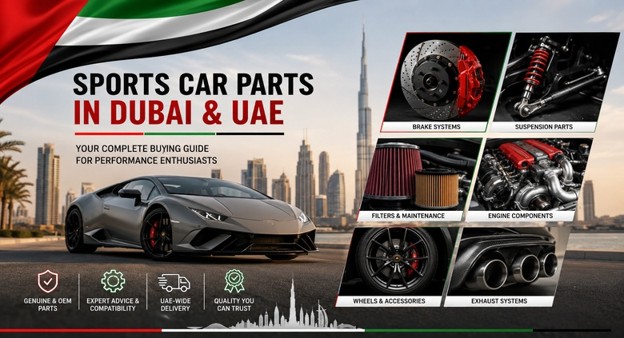
Where to Buy Sports Car Parts in Dubai and Across the UAE
July 24, 2026
Understanding the Sports Car Parts Market in the UAE
Sports cars aren't bought by accident.
People choose them because they enjoy driving. The sound. The acceleration. The way the steering feels through a fast corner. Even a routine journey to grab a coffee somehow feels more interesting behind the wheel of a Porsche, a Nissan GT-R or a Ferrari than it does in an ordinary family hatchback.
That's exactly why owners think differently when something needs replacing.
They don't just want a part.
They want the right part.
There's a big difference.
Across Dubai and the wider UAE, the market for sports car parts has grown quickly over the past few years. More specialist workshops have opened their doors, more suppliers are importing performance components and more owners are comparing quotations online before spending thousands of dirhams on replacement parts.
Good news, really.
It means buyers have more choice than ever before.
It also means separating the genuine experts from the smooth sales talk has become a little harder.
Why Sports Car Parts Are in High Demand Across Dubai and the UAE
Walk through Dubai Marina, Jumeirah, Business Bay or Downtown on a Friday evening.
You'll understand immediately.
Performance cars are everywhere.
Some are daily drivers. Others only appear at weekends. A few spend their lives on carefully planned road trips between Dubai, Abu Dhabi and the Northern Emirates, covering hundreds of motorway kilometres in conditions that are surprisingly demanding on brakes, tyres, cooling systems and suspension components.
Then summer arrives.
Forty-five degrees outside.
Traffic barely moving.
Air conditioning working flat out.
That combination asks a lot from any vehicle. It asks even more from a high-performance one.
As ownership continues to rise, demand has naturally increased for:
- Brake discs and performance brake pads
- Suspension arms and dampers
- Cooling system components
- Engine sensors
- Turbochargers
- Radiators
- Intercoolers
- Clutch assemblies
- Gearbox components
- Exterior body panels
None of this is unusual.
Performance cars still experience everyday wear. They simply experience it at a different level.
Most Popular Sports Car Brands on UAE Roads
Some names instantly come to mind.
Porsche.
Ferrari.
Lamborghini.
McLaren.
Then you have performance legends that have built loyal followings over many years, including the Nissan GT-R, Toyota Supra, Chevrolet Corvette, BMW M models, Mercedes-AMG vehicles and Audi RS cars.
Each has its own personality.
Each has its own engineering.
And each comes with its own replacement part requirements.
A brake disc designed for a Porsche 911 isn't going to fit a Mercedes-AMG C 63 simply because both produce impressive horsepower.
Seems obvious.
Yet workshops still receive enquiries like that.
More often than you'd expect.
Why More Sports Car Owners Buy Parts Online
Things have changed.
Not long ago, finding performance parts usually meant making endless phone calls or driving from one industrial area to another hoping someone had the required component sitting on a shelf.
Sometimes you got lucky.
Sometimes you went home empty-handed.
Now the process looks very different.
Owners can request quotations from several suppliers in a single afternoon, compare availability, check warranty terms and arrange delivery almost anywhere in the UAE without leaving the house.
That's a huge advantage.
Especially when the car is already waiting in a workshop.
Buying online also makes it easier to:
- Compare several suppliers
- Check imported stock availability
- Request compatibility confirmation
- Review warranty options
- Arrange nationwide delivery
- Find specialist performance components
- Compare genuine and OEM alternatives
Convenient?
Absolutely.
Still, don't let convenience replace common sense.
Always verify compatibility before reaching for your wallet.
Genuine vs OEM vs Used vs Aftermarket Sports Car Parts Explained
Here's the question nearly every owner asks sooner or later.
"Which type should I buy?"
The answer depends on the repair.
Nothing more.
Nothing less.
Genuine parts come through the manufacturer's official supply chain and match the original factory specification.
OEM parts are produced by manufacturers that often supply original equipment, although they're sold under their own branding rather than the vehicle manufacturer's name.
Used parts can offer excellent value, particularly when removed from carefully maintained donor vehicles with verified histories.
Aftermarket parts cover an enormous range.
Some outperform factory components.
Others don't come close.
That's why researching both the manufacturer and the supplier matters every bit as much as comparing prices.
Performance cars deserve careful decisions.
Not rushed ones.
Why VIN Matching Is Essential Before Buying Sports Car Parts
Performance cars are rarely as straightforward as they appear.
One model year can include several engine variants.
Different braking systems.
Optional performance packages.
Revised suspension geometry.
Updated electronic control units.
Even production changes made halfway through the year can affect compatibility.
That's exactly why reputable suppliers ask for the Vehicle Identification Number before confirming a quotation.
The VIN helps identify:
- Factory specification
- Engine configuration
- Transmission type
- Performance package
- Brake system
- Production batch
- Original equipment references
Ignore the VIN, and you're relying on guesswork.
Guesswork has an expensive habit of turning into courier charges, workshop delays and replacement labour.
How to Buy Sports Car Parts Without Overpaying
Here's a mistake plenty of buyers make.
They compare only one thing.
Price.
That works when you're buying a phone charger.
Not when you're buying a turbocharger.
Smart buyers compare the complete package.
They look at:
- Compatibility support
- Warranty
- Supplier reputation
- Imported stock availability
- Delivery times
- Technical advice
- Return policy
- Product condition
A quotation that's slightly higher may actually save money if it includes proper fitment support, genuine documentation and faster delivery.
That's the part many people overlook.
Until something goes wrong.
A Quick Story from a Dubai Workshop
A Porsche owner arrived at a specialist workshop after ordering replacement brake discs from an overseas supplier because the price looked impossible to ignore.
Everything seemed perfect.
Until installation started.
The discs were manufactured for a different braking package fitted to another version of the same model. They looked almost identical. Same diameter at first glance. Same finish. Same bolt pattern.
Almost.
The offset was different.
That tiny difference stopped the installation completely.
The vehicle stayed on the lift for another week while the correct components were sourced.
The cheaper purchase wasn't cheaper anymore.
Not even close.
Slow Down. Then Buy.
Sports car ownership has always been about precision.
The buying process should follow the same principle.
Take a little extra time.
Ask awkward questions.
Request the VIN check.
Compare more than one quotation.
If a supplier seems impatient because you want confirmation, keep looking.
The best suppliers never complain about careful buyers.
They usually encourage them.
Key Takeaways
- Sports car ownership continues to grow across Dubai and the UAE, increasing demand for specialist replacement parts.
- Genuine, OEM, used and aftermarket components each suit different repairs, budgets and ownership goals.
- Buying online makes it easier to compare supplier quotations, imported stock and delivery options.
- VIN verification is essential for confirming compatibility, particularly on high-performance models with multiple specifications.
- Looking beyond the lowest price helps reduce workshop delays, repeat labour costs and expensive ordering mistakes.
Where to Buy Sports Car Parts in Dubai and Across the UAE
Owning a sports car is exciting.
Buying the right replacement part?
That's where things become interesting.
The UAE gives owners plenty of options. Walk through Al Quoz, Ras Al Khor or Sharjah's industrial areas and you'll find shelves stacked with everything from brake calipers and suspension arms to complete performance engines. Search online and you'll uncover dozens more suppliers promising the "best prices" and "fastest delivery".
Sounds brilliant.
But here's the catch.
Not every supplier understands performance cars, and not every bargain is actually a bargain.
So, where should you buy? Let's break it down.
Finding Trusted Sports Car Parts Suppliers in the UAE
Trust isn't built with flashy adverts.
It's earned through consistency.
A dependable supplier won't simply ask, "Which car do you drive?" They'll dig a little deeper. They'll ask for your VIN, confirm the engine variant, check the production year and sometimes even request photographs of the existing component before preparing a quotation.
Why?
Because they want to get it right the first time.
That's exactly what you should expect.
A reliable supplier will usually offer:
- VIN-based compatibility checks
- Clear warranty information
- Genuine advice rather than sales pressure
- Multiple purchasing options where available
- Transparent pricing with no hidden surprises
- Technical support before you place an order
- Reasonable return and exchange policies
If someone rushes you into paying without confirming compatibility, that's a warning sign. Slow the conversation down. Ask more questions. A trustworthy supplier won't mind.
Dealer vs Independent Sports Car Parts Specialists
Many owners assume the dealership is always the safest option.
Sometimes it is.
Sometimes it isn't.
Dealerships generally provide factory-backed parts and manufacturer procedures. That's reassuring, especially for newer vehicles or those still covered by warranty. The downside? Prices can be noticeably higher, and certain components may need to be ordered from overseas.
Independent specialists offer a different experience.
Many focus exclusively on performance vehicles. They've worked on hundreds of Porsche, Ferrari, Lamborghini and McLaren models. They often know which OEM manufacturers produce the original equipment, which imported alternatives have proven reliable and which aftermarket brands are best left alone.
Experience counts.
Especially when you're buying components that influence performance and safety.
Here's a simple comparison:
| Dealer | Independent Specialist |
| Factory-backed genuine parts | Genuine, OEM, used and selected aftermarket options |
| Manufacturer procedures | Flexible solutions based on experience |
| Higher average pricing | Wider range of price points |
| Limited alternative choices | Multiple supplier quotations available |
| Suitable for warranty work | Ideal for older and performance-focused vehicles |
Neither option is automatically better.
It depends on your car, your budget and the repair you're carrying out.
Buying Imported Sports Car Parts in Dubai
Some parts simply aren't sitting on a shelf in the UAE.
That's perfectly normal.
High-performance vehicles often require specialised components produced in Europe, Japan or North America. Whether it's a carbon fibre splitter, a limited-slip differential or an electronic suspension module, importing the correct part may be the quickest route to getting your car back on the road.
Still, don't assume every imported component is identical.
Before placing an order, ask:
- Which country is the part coming from?
- Is it genuine, OEM or aftermarket?
- Has compatibility been confirmed using the VIN?
- How long will shipping actually take?
- Does the quoted price include customs and delivery?
- What happens if the part arrives damaged or incorrect?
Five minutes spent asking those questions can save weeks of frustration later.
Comparing Multiple Supplier Quotes Before Ordering
Never settle for the first quotation.
Even if it looks attractive.
Prices vary because suppliers work with different distributors, hold different levels of stock and source components from different markets. One supplier may have the part available immediately, while another may need two weeks to import it.
Look beyond the number at the bottom of the quotation.
Compare:
- Product condition
- Brand
- Warranty period
- Delivery time
- Availability
- Technical support
- Return policy
- Installation recommendations
A slightly higher quotation often delivers far better value once everything is taken into account.
Remember, you're buying confidence as much as you're buying a component.
Fast UAE-Wide Delivery for Sports Car Parts
When your car is sitting in a workshop with half the front suspension removed, every extra day feels longer than it really is.
That's why delivery matters.
Many suppliers now provide shipping across:
- Dubai
- Abu Dhabi
- Sharjah
- Ajman
- Ras Al Khaimah
- Fujairah
- Umm Al Quwain
Some keep frequently requested items in local stock, allowing same-day or next-day dispatch within certain areas. Less common performance parts may still need to be imported, but a good supplier should tell you that upfront rather than making unrealistic promises.
Ask for tracking information.
Confirm estimated delivery times.
And don't be afraid to ask whether the part is physically available or simply "expected soon". There's a big difference.
Benefits of Buying Sports Car Parts Online
Buying online has changed the way enthusiasts maintain their cars.
Instead of spending an entire Saturday driving between industrial areas, you can compare suppliers from your sofa, request several quotations, review warranty details and organise delivery before you've finished your morning coffee.
It's efficient.
But only if you use it wisely.
The biggest advantages include:
- Faster quotation requests
- Easier price comparisons
- Access to imported stock
- Nationwide delivery options
- Better availability of specialist performance parts
- More opportunity to compare genuine, OEM, used and aftermarket components
Just don't let convenience replace due diligence.
Read carefully.
Double-check every specification.
And always ask for compatibility confirmation before paying.
A Workshop Story Worth Remembering
A Nissan GT-R owner wanted to replace a damaged intercooler after a spirited weekend drive. He found an imported unit online for considerably less than several local quotations and placed the order immediately.
Everything looked promising.
Until installation day.
The mounting points were designed for a different market specification, and the pipe routing didn't line up with the factory setup. By the time modification costs, extra labour and replacement fittings had been added, the original saving had disappeared.
The lesson?
Cheap doesn't always stay cheap.
Before You Click "Buy"
Take your time.
Request the VIN check.
Compare at least three quotations.
Read the warranty.
Confirm delivery.
Ask who's responsible if the wrong part arrives.
Simple steps, aren't they?
Yet they're the same steps that help experienced sports car owners avoid expensive headaches year after year.
Key Takeaways
- Choose suppliers that verify compatibility rather than relying on basic vehicle details.
- Compare dealerships and independent specialists based on expertise, availability and overall value—not just price.
- Imported sports car parts can be an excellent option when sourced from reputable suppliers with clear warranty terms.
- Always compare several quotations before making a purchase.
- Fast delivery is valuable, but accurate fitment and technical support are even more important for high-performance vehicles.
- Buying online offers convenience, wider choice and competitive pricing when combined with careful research and VIN verification.
I'll continue in the same style and will not use "PartFinder UAE" in this section, ensuring the phrase appears only once in the entire blog as required.
VIN Matching and Performance Part Compatibility
Have you ever heard someone say,
"It's the same model, so it'll fit."
Be careful.
That single sentence has emptied plenty of wallets.
Sports cars are engineered differently from ordinary vehicles. Two cars may share the same badge, the same engine size and even the same colour, yet underneath they can be fitted with completely different brakes, suspension components, cooling systems or electronic modules.
It catches people out all the time.
That's why experienced workshops don't guess.
They verify.
Every single time.
Why VIN Verification Matters for Sports Cars
A Vehicle Identification Number isn't just a long string of random letters and numbers.
Think of it as your car's fingerprint.
No two are exactly alike.
Within those seventeen characters sits a surprising amount of information, including the production plant, model year, engine specification, transmission type and factory equipment fitted when the car left the assembly line.
That's priceless information when you're ordering replacement parts.
Imagine owning a Porsche 911.
Simple enough?
Not really.
Depending on the year, it could have different braking systems, multiple suspension configurations, optional sport packages, ceramic brake upgrades, active aerodynamic components or revised cooling layouts.
Without checking the VIN first, you're taking a gamble.
And sports cars are expensive places to gamble.
Matching Parts by Model Year and Generation
People often focus on the model name.
Workshops focus on the generation.
There's a reason for that.
Manufacturers constantly improve their vehicles. One year they revise the gearbox software. The next year they redesign the front suspension. A mid-cycle facelift might introduce new lighting electronics or a completely different radiator arrangement while the exterior changes barely catch your eye.
Looks can be deceiving.
Take the Nissan GT-R as an example.
Across its production life, numerous updates affected braking systems, suspension tuning, cooling components and electronic control units. At a glance, many parts appear interchangeable.
They aren't.
Ordering by model name alone can easily lead to delays, returns and extra labour costs.
Engine and Transmission Compatibility Checks
Engines and gearboxes are among the most expensive components you'll ever replace.
That makes compatibility even more important.
Performance engines often include:
- Different turbocharger configurations
- Revised fuel injection systems
- Alternative engine control software
- Updated cooling layouts
- Model-specific sensors
- Performance calibration packages
The same applies to transmissions.
An automatic gearbox designed for one production year may require different software coding or electronic modules compared with a visually identical unit from another year.
That's why reputable suppliers ask questions.
Lots of them.
Don't see that as an inconvenience.
See it as protection.
Performance Package and Trim-Level Differences
Here's where things become even more interesting.
Many sports cars are available with optional factory performance packages.
Some receive upgraded brakes.
Others gain adaptive suspension.
Some feature carbon ceramic braking systems, active exhausts, lightweight body components or electronically controlled differentials.
Now imagine ordering replacement brake discs without realising your vehicle was factory-equipped with the larger braking package.
The part arrives.
The workshop lifts the vehicle.
And suddenly nothing lines up.
Not exactly the afternoon anyone was hoping for.
Always confirm the exact trim level before ordering.
It makes life much easier.
OEM Part Numbers and Cross-Reference Guide
Every original component leaves the factory with its own identification number.
That number tells an important story.
It helps suppliers identify the correct replacement and, where appropriate, locate compatible OEM alternatives produced by the original equipment manufacturer.
Cross-referencing those numbers can also uncover:
- Updated replacement components
- Manufacturer supersessions
- Alternative production batches
- Compatible OEM equivalents
- Components designed for specific regional markets
This process isn't about making things complicated.
It's about making sure you buy once rather than buy twice.
Common Compatibility Mistakes Sports Car Owners Make
Some mistakes appear again and again.
Not because owners are careless.
Because performance cars are more complicated than many people realise.
The most common problems include:
- Ordering parts using only the registration number
- Ignoring the VIN completely
- Assuming identical-looking parts are interchangeable
- Choosing the cheapest option without checking specifications
- Forgetting optional factory performance packages
- Overlooking production-year updates
- Purchasing overseas parts designed for different market specifications
- Skipping professional compatibility advice
One small oversight can create a chain reaction.
Wrong part.
Delayed repair.
Extra labour.
Additional shipping costs.
Nobody enjoys that sequence.
A Real Workshop Example
An Audi RS owner booked his car in for a suspension refresh after noticing uneven tyre wear and a slight knocking sound over speed bumps.
He'd already sourced the control arms himself.
At least, he thought he had.
Everything matched the photographs online, and the seller assured him they were compatible.
Once the technicians removed the original components, the problem became obvious. The replacement arms were manufactured for a different suspension specification fitted to another RS variant.
The mounting geometry wasn't identical.
Neither was the ball joint design.
The workshop had to stop.
Fresh parts were ordered, the vehicle remained on the lift for several more days and the owner paid twice for labour because the incorrect components couldn't be installed.
All because compatibility had been assumed instead of confirmed.
Don't Guess. Verify.
Performance cars reward precision.
Maintenance should be no different.
Before ordering any component, ask for the VIN check.
Confirm the production year.
Mention any factory options or performance packages.
Request the OEM part number if possible.
Those few extra minutes might save you hundreds—or even thousands—of dirhams, not to mention the frustration of watching your sports car sit in a workshop waiting for the correct parts to arrive.
Key Takeaways
- The VIN is the most reliable way to identify the correct sports car parts in UAE.
- Model year, generation and factory options can significantly affect compatibility.
- Engine and transmission components should always be verified before purchase.
- OEM part numbers help suppliers identify the correct replacement or suitable equivalent.
- Many costly repairs begin with simple compatibility mistakes that could have been avoided through proper verification.
- Accurate fitment checks reduce delays, unnecessary labour costs and the risk of ordering incorrect performance components.
Buying Sports Car Engines and Gearboxes
There are expensive repairs.
Then there are engine and gearbox repairs.
When either of these major components fails, every sports car owner asks the same question sooner or later.
"Should I repair it, or is replacing it the smarter move?"
The answer isn't always obvious.
Sometimes rebuilding an engine makes perfect financial sense. Sometimes replacing it saves both money and time. The same goes for gearboxes. It all depends on the extent of the damage, the availability of quality replacement units and, of course, how you plan to use the car afterwards.
Let's look at it properly.
Buying Replacement Engines for Sports Cars
Modern sports car engines are remarkable pieces of engineering.
They're powerful.
They're efficient.
And they're packed with technology.
Turbochargers, direct fuel injection, variable valve timing, electronic throttle systems and sophisticated engine management all work together to produce incredible performance. The downside? When something goes seriously wrong, repairs can become surprisingly expensive.
That's why replacement engines are often considered after:
- Major overheating
- Cracked engine blocks
- Internal bearing failure
- Severe oil starvation
- Broken connecting rods
- Timing chain or belt failures causing internal damage
- Flood damage
- Fire damage
Not every damaged engine needs replacing.
Equally, not every damaged engine is worth rebuilding.
A specialist inspection should always come first.
Buying Performance Gearboxes and Transmissions
Power means very little if the gearbox can't transfer it to the road.
Sports car transmissions work under enormous stress. Rapid acceleration, high engine speeds and aggressive driving all place extra demands on internal gears, synchronisers, clutches and electronic control systems.
Over time, problems can begin to appear.
You might notice:
- Delayed gear engagement
- Slipping gears
- Rough shifting
- Warning lights
- Transmission overheating
- Unusual noises during acceleration
- Fluid leaks
- Sudden loss of drive
Ignore those warning signs, and the repair bill usually grows.
Quite quickly.
Whether your car uses a manual gearbox, a dual-clutch transmission or an advanced automatic system, buying the correct replacement is absolutely essential.
Used vs Reconditioned Performance Engines and Gearboxes
This is one of the biggest decisions owners face.
Each option has advantages.
Each comes with trade-offs.
Used engines and gearboxes are removed from donor vehicles and sold largely in their existing condition. When sourced from low-mileage vehicles with documented histories, they can offer excellent value.
Reconditioned units go a step further.
They're dismantled, inspected and rebuilt where necessary using replacement internal components. Worn bearings, seals, gaskets and other critical parts are often renewed before testing.
Here's a simple comparison.
| Option | Best Suited For | Main Benefit | Considerations |
| Used | Budget-conscious repairs | Lower purchase price | Condition depends on donor vehicle |
| Reconditioned | Long-term ownership | Refreshed internal components | Higher initial investment |
| Genuine New | Maximum reliability | Factory-new condition | Highest overall cost |
| OEM | Excellent balance | Original equipment quality | Availability varies by model |
There isn't a universal winner.
The right choice depends on your budget, the vehicle's value and how long you intend to keep it.
Inspection Checklist Before Buying High-Performance Components
Never buy an engine or gearbox based solely on photographs.
Ask questions.
Lots of them.
Request supporting information before making a decision.
A proper inspection should include:
- Mileage confirmation
- Compression or leak-down test results where applicable
- Service history if available
- Oil condition
- Signs of overheating
- Turbocharger inspection
- Cooling system assessment
- Transmission fluid condition
- External damage inspection
- ECU compatibility confirmation
If the supplier struggles to answer straightforward questions, don't ignore that feeling.
Move on.
Another option will always come along.
Warranty, Testing and Quality Assurance
A warranty doesn't guarantee perfection.
What it does provide is confidence.
That's why reputable suppliers explain exactly what their warranty covers before the sale is completed.
Ask about:
- Warranty duration
- Covered components
- Testing procedures
- Exchange policy
- Installation requirements
- Conditions that may void the warranty
Don't leave those conversations until after delivery.
Have them before you pay.
Everything becomes much simpler.
Specialist Installation and Workshop Considerations
Even the best replacement engine won't perform properly if it's installed badly.
The same applies to gearboxes.
Performance vehicles often require specialised tools, manufacturer software and precise calibration during installation. Certain models also need ECU programming, transmission adaptation or clutch calibration before they're ready to drive again.
It's not a job to rush.
Choose a workshop that regularly works on performance vehicles rather than one learning as it goes.
Experience matters.
Especially when labour costs are significant.
A Workshop Story That Says It All
A BMW M4 owner arrived at a specialist garage after noticing an intermittent drivetrain warning light. Another workshop had already suggested replacing the gearbox immediately, quoting a substantial figure for the work.
The technicians decided to investigate further.
Good thing they did.
After carrying out a detailed inspection, they discovered the gearbox itself wasn't the problem at all. A faulty mechatronic control unit was causing the symptoms. Replacing that component restored normal operation, and the original gearbox remained in service.
Imagine if the owner had accepted the first recommendation without asking questions.
A perfectly healthy gearbox would have been replaced unnecessarily.
Sometimes the smartest repair is the one that isn't carried out.
Repair or Replace?
There isn't a single answer that suits every situation.
If internal damage is limited, rebuilding may be the better route.
If catastrophic failure has occurred, replacement often proves more practical.
Either way, don't make the decision based purely on cost.
Consider reliability.
Future maintenance.
Downtime.
Warranty.
Parts availability.
Long-term ownership plans.
Those factors usually matter far more than the cheapest quotation on the page.
Key Takeaways
- Engine and gearbox replacements should always begin with a professional diagnosis rather than assumptions.
- Used, reconditioned, OEM and genuine units each offer different advantages depending on budget and ownership goals.
- Compression testing, mileage verification and service history provide valuable insight into engine condition.
- Gearbox compatibility should be confirmed through VIN verification and transmission specifications.
- A clear warranty and documented testing process offer additional peace of mind.
- Specialist installation is just as important as choosing the correct replacement component for long-term reliability and performance.
Performance Brakes, Suspension and Steering
Horsepower gets the headlines.
Brakes, suspension and steering keep you alive.
It sounds dramatic, doesn't it?
But it's true.
A sports car that can sprint from 0 to 100 km/h in a few seconds also needs the confidence to stop just as quickly, change direction with precision and remain stable whether it's cruising along Sheikh Zayed Road or tackling the winding mountain roads around Jebel Jais.
These systems work hard.
Really hard.
And in the UAE, they work even harder.
Heat, heavy traffic, sudden braking and rough road surfaces all take their toll over time. Ignore the early warning signs and what begins as a small repair can quickly become a much bigger bill.
Performance Brake Parts Buying Guide
Ask any experienced technician what matters most on a performance car.
The answer is usually immediate.
Brakes.
Without them, all that power means very little.
Performance braking systems are engineered differently from those fitted to ordinary passenger cars. Larger ventilated discs, multi-piston calipers, high-friction brake pads and advanced electronic braking systems all work together to deliver strong, predictable stopping power.
Eventually, though, every component wears out.
Look out for symptoms such as:
- Squealing or grinding noises
- Brake pedal vibration
- Increased stopping distance
- Pulling to one side while braking
- Brake warning lights
- Cracks or excessive wear on brake discs
- Uneven brake pad wear
- Fluid leaks around the braking system
Don't wait for the problem to get worse.
Brakes rarely fix themselves.
When replacing components, always check whether your sports car has optional factory upgrades. Many models were offered with larger brake packages or carbon ceramic systems, and those parts are not interchangeable with standard versions.
Suspension Upgrades and Replacement Components
Sports cars are designed to communicate with the driver.
Every corner.
Every bump.
Every steering input.
That connection depends heavily on the suspension.
Control arms, bushings, shock absorbers, springs, anti-roll bars and ball joints all work together to keep the tyres firmly planted on the road.
Over time, however, wear begins to creep in.
You might notice:
- Knocking noises over uneven roads
- Excessive body movement
- Uneven tyre wear
- Reduced grip during cornering
- A steering wheel that no longer feels centred
- Suspension warning messages on newer vehicles
Small symptoms often point to bigger issues developing underneath.
Catch them early and repairs tend to stay manageable.
Leave them alone, and other components may begin wearing out too.
Steering System Components for Sports Cars
A sports car should feel precise.
Almost effortless.
If the steering suddenly feels vague, unusually heavy or starts making strange noises, something isn't quite right.
The steering system includes several important components:
- Steering rack
- Tie rods
- Track rod ends
- Steering pump where applicable
- Electric steering motor
- Steering angle sensors
- Hydraulic hoses on older systems
Each plays an important role in maintaining accuracy and driver confidence.
A tiny amount of play at the steering wheel today can easily become a major handling problem tomorrow.
That's why experienced workshops never ignore steering complaints, even if they seem minor.
Wheel Bearings, Hub Assemblies and Performance Handling
Wheel bearings rarely attract much attention.
Until they start making noise.
A worn bearing often announces itself with a low humming sound that gradually becomes louder as speed increases. Some drivers mistake it for tyre noise. Others assume it's simply the road surface.
It isn't.
Ignoring a worn bearing can place additional stress on surrounding suspension and braking components.
When replacing wheel bearings or hub assemblies, check:
- Vehicle specification
- Drive configuration
- ABS sensor compatibility
- Performance package differences
- Production year updates
Precision matters here.
Even slight variations can affect installation.
Cooling System Parts for High-Performance Driving
Heat is the enemy of performance.
There's no getting around it.
Sports cars generate enormous amounts of heat, particularly during spirited driving or long periods of stop-start traffic in the UAE summer.
That's why the cooling system deserves far more attention than many owners give it.
Key components include:
- Radiator
- Water pump
- Thermostat
- Cooling fans
- Expansion tank
- Coolant hoses
- Intercooler on turbocharged models
- Oil cooler where fitted
If engine temperatures begin climbing unexpectedly, don't hope the problem will disappear.
Investigate it.
Immediately.
Overheating one afternoon could easily lead to engine replacement a few weeks later.
Common Mechanical Problems in Sports Cars Driven in UAE Conditions
The UAE offers fantastic roads.
It also presents unique challenges.
Long motorway journeys.
Heavy city traffic.
Intense summer temperatures.
Occasional desert drives.
Each places different demands on performance vehicles.
Workshops frequently encounter problems including:
- Premature brake wear caused by repeated heavy braking
- Suspension bush deterioration from constant heat exposure
- Cooling system fatigue during prolonged traffic
- Steering component wear after high-mileage motorway driving
- Cracked rubber mounts due to extreme temperatures
- Brake fluid degradation from excessive heat cycles
None of these issues appear overnight.
They develop gradually.
The sooner they're identified, the less disruptive—and less expensive—the repair usually becomes.
A Day in the Workshop
A Chevrolet Corvette owner booked his car in because the steering felt slightly unsettled at motorway speeds. Nothing dramatic. No warning lights. Just a feeling that something wasn't quite right.
Some garages might have suggested a wheel alignment and sent him on his way.
The specialist workshop looked further.
After a thorough inspection, they discovered worn front control arm bushes and a wheel bearing beginning to fail. Individually, neither issue seemed particularly serious.
Together, they completely changed the way the car handled.
Once both components were replaced and the alignment reset, the difference was immediate. The steering regained its sharpness, tyre wear returned to normal and the owner commented that the car felt "like it did the day I bought it."
That's the value of proper diagnosis.
It solves the cause, not just the symptom.
Don't Chase Performance. Preserve It.
Many owners spend thousands increasing horsepower.
Then delay replacing worn suspension bushes or tired brake components.
That doesn't make much sense.
Performance isn't created by one spectacular modification.
It's protected by dozens of well-maintained components quietly doing their jobs every single day.
Look after them, and your sports car will continue rewarding you every time you get behind the wheel.
Key Takeaways
- Performance brakes, suspension and steering components are fundamental to safety, handling and driving enjoyment.
- Always confirm brake and suspension specifications, especially on sports cars with factory performance packages.
- Early signs such as unusual noises, vibration or uneven tyre wear should never be ignored.
- Cooling system maintenance is particularly important in the UAE's demanding climate.
- Accurate diagnosis often prevents unnecessary repairs and protects surrounding components from additional wear.
- Maintaining chassis and braking systems preserves both performance and long-term vehicle value.
Body Parts, Lighting and Exterior Components
People notice the body first.
Before they hear the exhaust.
Before they admire the engine.
Before they ask what's under the bonnet.
They see the way the car looks.
That's the reality of sports car ownership.
Whether it's a Ferrari parked outside a luxury hotel in Dubai, a Porsche waiting at a traffic light in Abu Dhabi or a McLaren arriving at Cars & Coffee, appearance matters. Owners invest time and money keeping these cars looking as sharp as they perform.
But body parts aren't only about looks.
Far from it.
Modern bumpers house sensors. Bonnets channel airflow. Grilles improve cooling. Headlights communicate with electronic control systems. Even a simple side mirror may contain cameras, heating elements and blind-spot monitoring technology.
Replace the wrong component, and you'll soon discover that "it looks the same" doesn't always mean "it works the same."
Performance Body Panels and Carbon Fibre Parts
Sports cars are built with performance in mind.
That's why many manufacturers use lightweight materials instead of traditional steel.
Depending on the model, you may find:
- Aluminium body panels
- Carbon fibre bonnets
- Carbon fibre roofs
- Composite bumpers
- Lightweight front wings
- Aerodynamic diffusers
- Rear spoilers
- Side skirts
These parts reduce weight while improving handling and fuel efficiency.
Unfortunately, they also tend to cost more when replacement becomes necessary.
If you're buying body panels, always ask:
- Is the panel genuine, OEM or aftermarket?
- Has it been repaired previously?
- Does it include mounting brackets?
- Is it suitable for your exact model and year?
- Has it been painted already?
- Will additional preparation be required before installation?
Those questions save time.
They also prevent expensive surprises once the vehicle reaches the body shop.
Headlights, Tail Lights and Advanced LED Systems
A headlight isn't simply a bulb anymore.
Today's sports cars often use sophisticated lighting technology that works alongside cameras, sensors and onboard computers.
Some systems include:
- LED matrix headlights
- Adaptive cornering lights
- Dynamic indicators
- Laser lighting
- Automatic high-beam assistance
- Daytime running lights
- Intelligent levelling systems
Looks impressive.
Because it is.
However, replacing these units requires careful attention to compatibility.
A headlight designed for one trim level may require different control modules or programming compared with another version of the same vehicle.
Always confirm the exact specification before ordering.
Doors, Bonnets, Boot Lids and Aero Components
Accidents don't always happen at high speed.
A garage wall.
A tight parking space.
A reversing vehicle.
That's all it takes.
Sports car owners frequently replace:
- Doors
- Bonnets
- Boot lids
- Front bumpers
- Rear bumpers
- Front splitters
- Rear diffusers
- Active aerodynamic components
It can be tempting to purchase whichever panel appears cheapest.
Resist that temptation.
Small differences in mounting points, sensor locations or aerodynamic design can turn a straightforward installation into a frustrating project.
The correct part nearly always proves cheaper in the long run.
Mirrors, Grilles and Exterior Trim Parts
Exterior trim may seem relatively simple.
Often, it isn't.
Take a side mirror.
On older vehicles, replacing one might have taken only a few minutes.
Modern sports cars are another story altogether.
Many mirrors now include:
- Heated glass
- Folding mechanisms
- Blind-spot monitoring
- Memory functions
- Integrated cameras
- Turn signal indicators
Likewise, front grilles often support radar sensors used for adaptive cruise control or collision avoidance systems.
A component that appears purely cosmetic may actually play an important role in vehicle safety.
That's worth remembering before ordering replacement parts.
Radiators, Intercoolers and Cooling Components
Performance generates heat.
Lots of it.
The exterior cooling system works constantly to keep engine temperatures under control, especially during the UAE summer when ambient temperatures can push cooling systems close to their limits.
Important components include:
- Radiators
- Intercoolers
- Condensers
- Cooling fans
- Air ducts
- Radiator supports
- Cooling shrouds
Damage isn't always obvious.
Even a minor front-end collision can bend mounting brackets or reduce airflow enough to affect engine cooling.
That's why experienced workshops inspect the entire cooling assembly rather than replacing only the visibly damaged component.
It saves repeat visits later.
Paint Matching and Body Panel Compatibility
Here's something many owners overlook.
Paint codes matter.
A lot.
Two cars may both appear black.
One may actually be metallic.
The other pearl.
Another could have a completely different finish despite looking identical under showroom lighting.
Ordering a painted panel without confirming the factory paint code often creates disappointment.
Professional body shops rely on:
- Manufacturer paint codes
- VIN information
- Colour blending techniques
- Factory finish specifications
- Panel alignment measurements
Getting the fit right is important.
Getting the finish right is equally important.
The two go hand in hand.
A Body Shop Story from Sharjah
A Porsche Cayman owner needed a replacement front bumper after a low-speed parking incident.
The damage looked straightforward, and an aftermarket bumper was sourced quickly because it appeared almost identical to the original.
Almost.
Once installation began, the technicians realised the openings for the parking sensors and front camera were positioned differently. The mounting tabs also required modification before the bumper would fit correctly.
What seemed like a bargain ended up requiring additional labour, repainting and several replacement clips.
Had the correct specification been confirmed from the beginning, the repair would have been completed in a fraction of the time.
That's the difference accuracy makes.
Looks Matter. Fitment Matters Even More.
A beautifully painted panel loses its appeal if the gaps don't line up.
A premium headlight becomes a headache if it won't communicate with the vehicle's electronics.
And a carbon fibre spoiler isn't much use if it was designed for a different model.
Sports cars demand precision.
Not just mechanically, but visually too.
Choose carefully.
Verify everything.
And remember, the best-looking repair is usually the one nobody can spot.
Key Takeaways
- Body and exterior components affect both appearance and vehicle functionality.
- Carbon fibre and lightweight panels require careful specification checks before purchase.
- Modern lighting systems often include advanced electronics that must match the vehicle precisely.
- Exterior trim and mirrors may contain sensors, cameras and safety technology that influence compatibility.
- Cooling components should always be inspected after front-end damage, even when the impact appears minor.
- Correct paint codes and accurate panel fitment help preserve the vehicle's appearance, value and long-term ownership satisfaction.
Brand-Specific Sports Car Parts Buying Guide
Here's something every experienced workshop knows.
Not all sports cars age in the same way.
A Ferrari doesn't usually ask for the same replacement parts as a Nissan GT-R. A Porsche owner faces different maintenance priorities from someone driving a McLaren. Even two performance cars producing similar horsepower can have completely different engineering philosophies.
That's why buying parts by simply searching for the vehicle's brand isn't enough.
You need to understand what typically wears out, which components are difficult to source and where specialist knowledge makes the biggest difference.
Let's look at some of the most popular performance brands found across Dubai and the UAE.
Porsche Parts Buying Guide
Porsche has earned a reputation for building sports cars that can be driven every day.
That's one reason they're so common across the Emirates.
Owners appreciate the balance between comfort and performance, but regular use naturally means regular maintenance.
Components frequently replaced include:
- Brake discs and pads
- Suspension control arms
- Water pumps
- Cooling system hoses
- Engine mounts
- Ignition coils
- Radiators
- Adaptive suspension components
Many Porsche models also offer optional factory upgrades, including ceramic brakes and sports suspension packages.
Never assume two 911s use identical parts.
Check the VIN first.
Every time.
Ferrari Parts Buying Guide
Ferrari ownership is about passion.
There's no other word for it.
These cars are engineered with incredible attention to detail, and replacement parts should reflect that same standard.
Owners commonly source:
- Carbon ceramic brake components
- Clutch assemblies
- Suspension arms
- Cooling system parts
- Engine sensors
- Exhaust components
- Interior trim pieces
- Body panels
Availability can vary depending on the model, so imported components are often necessary.
Patience usually pays off.
Ordering the correct part once is far better than ordering the wrong one twice.
Lamborghini Parts Buying Guide
Lamborghinis attract attention wherever they go.
They also demand careful maintenance.
Many models feature advanced all-wheel-drive systems, active aerodynamics and sophisticated electronic control units.
Parts regularly requested include:
- Front suspension components
- Brake systems
- Cooling radiators
- Gearbox sensors
- Air intake components
- Exterior carbon fibre panels
- Hydraulic lifting system parts
- Electronic modules
Because production numbers are relatively low, certain components may require longer lead times.
It's worth planning ahead whenever possible.
McLaren Parts Buying Guide
McLaren approaches performance differently.
Lightweight engineering sits at the heart of almost every model.
Carbon fibre construction, active suspension and advanced cooling systems create an incredible driving experience—but they also require specialist knowledge during repairs.
Frequently replaced components include:
- Suspension accumulators
- Hydraulic suspension parts
- Cooling radiators
- Turbocharger components
- Carbon fibre body panels
- Electronic sensors
- Brake assemblies
- Cooling fans
General repair experience isn't enough here.
Choose technicians who genuinely understand McLaren engineering.
It makes all the difference.
Nissan GT-R, Toyota Supra and Chevrolet Corvette Parts Buying Guide
These three performance icons have built loyal followings across the UAE.
Each offers thrilling performance, yet each has its own maintenance priorities.
Nissan GT-R
Owners regularly search for:
- Turbochargers
- Transmission components
- Differential parts
- Brake upgrades
- Suspension bushes
- Cooling system components
Toyota Supra
Common replacement items include:
- Ignition coils
- Turbo piping
- Suspension arms
- Cooling fans
- Water pumps
- Performance brake components
Chevrolet Corvette
Frequently purchased parts include:
- Steering components
- Wheel bearings
- Suspension bushings
- Brake discs
- Radiators
- Cooling hoses
Although these cars are known for reliability, they're still high-performance machines.
Treat them accordingly.
Audi RS, BMW M and Mercedes-AMG Performance Parts Guide
German performance cars are hugely popular throughout Dubai and Abu Dhabi.
They're practical enough for daily driving while offering serious performance whenever the road opens up.
That's a combination many owners appreciate.
Audi RS Models
Parts commonly replaced include:
- Adaptive suspension components
- Brake assemblies
- Water pumps
- Thermostats
- Cooling system sensors
- Engine mounts
BMW M Models
Owners frequently require:
- Suspension control arms
- Brake discs
- Oil cooler components
- Ignition systems
- Differential bushes
- Cooling hoses
Mercedes-AMG Models
Common replacement parts include:
- Air suspension components
- Brake calipers
- Radiators
- Transmission sensors
- Engine mounts
- Steering components
These vehicles often feature multiple factory options.
Even within the same model year, specifications can vary considerably.
That's another reason why compatibility checks should never be skipped.
Choosing the Right Supplier for Your Brand
Different suppliers specialise in different vehicles.
Some have excellent access to German performance parts.
Others focus on Italian supercars.
Some maintain strong relationships with Japanese distributors.
Ask them.
A reputable supplier won't pretend to specialise in everything.
Instead, they'll explain what they know, where they source components and how they'll confirm compatibility before preparing your quotation.
That honesty is worth far more than exaggerated promises.
A Specialist Workshop Story
A Mercedes-AMG GT owner arrived at a performance workshop after ordering front brake discs from an overseas seller.
The listing looked convincing.
The photographs matched.
The dimensions seemed close enough.
Once the technicians compared the new discs with the originals, they discovered the replacements were manufactured for a different AMG braking package. The diameter was correct, but the thickness and ventilation design weren't.
Installation stopped immediately.
Correct components were sourced, the repair resumed and the owner learned a valuable lesson.
On high-performance cars, "close enough" usually isn't close enough at all.
Every Sports Car Has Its Own Personality
That's one of the reasons enthusiasts love them.
But it also explains why buying replacement parts requires more than a quick internet search.
Understand your model.
Know its common wear points.
Choose suppliers with genuine experience.
Verify every component before ordering.
Do those things consistently, and sports car ownership becomes far less stressful—and far more enjoyable.
Key Takeaways
- Every sports car brand has unique engineering, maintenance priorities and replacement part requirements.
- Porsche, Ferrari, Lamborghini, McLaren, Nissan GT-R, Toyota Supra, Chevrolet Corvette, Audi RS, BMW M and Mercedes-AMG models all require careful compatibility checks.
- Imported components may be necessary for low-volume performance vehicles, particularly Italian supercars.
- Specialist suppliers and experienced workshops reduce the risk of ordering incorrect parts.
- Understanding common wear items helps owners plan maintenance before problems become major repairs.
- Choosing the right component for the exact specification protects reliability, performance and long-term vehicle value.
Common Buying Mistakes
Buying sports car parts should feel exciting.
Unfortunately, it sometimes turns into an expensive lesson.
Not because the parts are difficult to find.
Not because suppliers don't exist.
But because buyers rush.
They assume.
They trust the wrong information.
Or they focus on saving a few hundred dirhams while unknowingly risking thousands.
The surprising part?
Most of the costly mistakes we see in UAE workshops have nothing to do with bad luck. They're completely avoidable.
Let's look at the ones that cause the biggest headaches.
Ordering Performance Parts Without VIN Verification
This mistake sits comfortably at the top of the list.
And it keeps happening.
A customer searches online, finds a component labelled for the correct model, checks the photographs and places the order.
Simple.
Except it isn't.
Performance cars often change during production. Manufacturers update brake systems, suspension geometry, cooling layouts and electronic modules without changing the model name.
The result?
The new part arrives.
The workshop unwraps it.
Five minutes later, everyone realises it won't fit.
A proper VIN check usually prevents that situation before it even starts.
Choosing Parts Based Only on Price
Everyone enjoys saving money.
There's absolutely nothing wrong with that.
The problem begins when price becomes the only factor in the decision.
Imagine two quotations.
One is AED 2,400.
The other is AED 2,950.
Many buyers immediately choose the cheaper option.
But what if the higher quotation includes:
- Better warranty coverage
- Compatibility verification
- Faster delivery
- Technical support
- Easier returns
- A supplier with years of specialist experience
Suddenly the "expensive" quotation doesn't seem expensive at all.
Always compare value.
Not just numbers.
Ignoring Warranty and Return Policies
Here's a question worth asking before every purchase.
"What happens if the part doesn't fit?"
If the supplier struggles to answer that, don't ignore the warning.
Warranty terms differ from one supplier to another.
Some cover manufacturing defects.
Some offer exchanges.
Others apply strict installation conditions before any claim will be considered.
Read everything.
Especially the small print.
It may not be exciting, but it can save an enormous amount of frustration later.
Buying Counterfeit Performance Parts
Counterfeit parts have become increasingly convincing.
Packaging looks authentic.
Brand logos appear genuine.
Even experienced buyers can be caught out.
The danger isn't only financial.
Poor-quality brake pads, suspension components or steering parts can seriously affect vehicle safety.
Watch out for warning signs such as:
- Prices that seem impossibly low
- Missing manufacturer labels
- Poor packaging quality
- No serial numbers
- Unclear product history
- Sellers unable to explain where the part originated
If something feels wrong, trust your instincts.
Walk away.
There will always be another supplier.
Skipping Compatibility Checks Before Ordering
Compatibility isn't simply about engine size.
Or model year.
Sports cars often include:
- Factory performance packages
- Different brake systems
- Alternative suspension options
- Market-specific specifications
- Software revisions
- Production updates
Ignoring any one of those details can lead to ordering the wrong component.
Compatibility checks might take a few extra minutes.
Replacing incorrectly ordered parts usually takes much longer.
Choosing Non-Specialist Suppliers
Not every parts supplier understands sports cars.
That's perfectly normal.
Some specialise in commercial vehicles.
Others focus on family SUVs or everyday passenger cars.
High-performance vehicles are different.
They demand specialist knowledge.
A supplier familiar with Ferrari cooling systems or Porsche suspension options can often identify potential issues before the order is even placed.
That's valuable experience.
Experience that generic catalogues simply can't replace.
A Workshop Story That Started with a "Great Deal"
A Toyota Supra owner proudly arrived at a workshop carrying a large box he'd purchased from an overseas marketplace.
He couldn't believe the price.
Neither could the technicians.
Inside were suspension components advertised specifically for his model.
At first glance, everything looked correct.
During installation, however, the lower control arms failed to align with the factory mounting points. Further investigation revealed they had been manufactured for a different market specification.
The saving disappeared instantly.
Replacement parts had to be ordered.
Additional labour was charged.
The vehicle remained off the road for another week.
The owner summed it up perfectly.
"I thought I was saving money. I ended up paying twice."
It's a lesson many enthusiasts remember for a long time.
Slow Down Before You Buy
Sports car ownership often encourages excitement.
Buying parts shouldn't.
Pause for a moment.
Ask another question.
Request another photograph.
Double-check the specification.
Read the warranty.
Compare another quotation.
Those small habits rarely add much time to the buying process.
They often remove enormous amounts of stress from the repair.
A Simple Buying Checklist
Before confirming your order, make sure you've answered "yes" to these questions:
- Has the VIN been checked?
- Does the supplier understand your exact model?
- Have you confirmed the production year and trim?
- Is the part genuine, OEM, used or aftermarket?
- Have you reviewed the warranty?
- Is the return policy clear?
- Have you compared more than one quotation?
- Has the workshop confirmed compatibility?
If even one answer is "no", stop.
Find the answer first.
Then place the order.
Key Takeaways
- Most expensive sports car parts mistakes begin with assumptions rather than mechanical problems.
- VIN verification remains the most effective way to avoid compatibility issues.
- The cheapest quotation isn't always the best overall value.
- Warranty terms, return policies and supplier expertise deserve as much attention as the purchase price.
- Counterfeit components can compromise both performance and safety.
- Choosing experienced performance parts specialists helps reduce delays, incorrect orders and unnecessary repair costs.
Expert Buying Advice
Here's a question.
Why do some sports car owners enjoy years of trouble-free motoring while others seem to face one expensive repair after another?
It's rarely because one car was built better than the other.
More often than not, it comes down to the decisions made before a replacement part is even ordered.
Experienced owners don't buy in a hurry.
They ask questions.
They compare options.
They work with specialists.
Most importantly, they understand that maintaining a high-performance car isn't about chasing the cheapest solution. It's about making the smartest one.
Let's look at the habits that separate confident buyers from frustrated ones.
Questions to Ask Before Buying Sports Car Parts
Never feel awkward about asking questions.
In fact, if a supplier seems annoyed because you're asking too many, that tells you something straight away.
A professional supplier expects careful buyers.
Before placing an order, ask:
- Has compatibility been confirmed using the VIN?
- Is the part genuine, OEM, used or aftermarket?
- What warranty is included?
- Is the component currently in stock?
- If imported, how long will delivery take?
- Has the part been tested or inspected?
- What happens if it doesn't fit?
- Are there any additional parts recommended during installation?
Simple questions.
Valuable answers.
Those conversations often reveal far more than glossy advertisements ever could.
Why Specialist Fitment Matters for Performance Cars
Buying the right component is only half the job.
Installing it correctly matters just as much.
Perhaps even more.
Performance vehicles frequently require:
- Manufacturer-specific diagnostic equipment
- Software programming
- ECU coding
- Transmission adaptation
- Suspension calibration
- Brake bleeding procedures
- Wheel alignment
- Sensor configuration
Skip any of those steps, and the car may never perform the way it was designed to.
A skilled technician doesn't simply replace parts.
They restore the vehicle to the standard its engineers intended.
That's an important difference.
Workshop Advice for Sports Car Owners in the UAE
Technicians who work on performance cars every day tend to offer remarkably similar advice.
Not because they've memorised the same script.
Because they've seen the same problems repeated hundreds of times.
Their recommendations are refreshingly straightforward:
- Don't ignore warning lights.
- Replace worn components before they damage others.
- Keep detailed service records.
- Use the correct fluids.
- Avoid guessing when ordering replacement parts.
- Have the vehicle inspected regularly.
- Listen when the car starts behaving differently.
It isn't complicated.
Consistency usually beats expensive repairs.
Common Installation Mistakes to Avoid
Even quality replacement parts can fail to deliver the expected result if installation isn't carried out properly.
Workshops regularly encounter problems caused by:
- Incorrect torque settings
- Reusing worn mounting hardware
- Skipping calibration procedures
- Forgetting software updates
- Using unsuitable lubricants
- Poor wheel alignment after suspension work
- Mixing incompatible components
Some of these mistakes don't become obvious immediately.
They quietly shorten the life of perfectly good parts.
That's frustrating.
And entirely avoidable.
Preventive Maintenance for Performance Vehicles
Here's an idea that often saves money.
Fix small issues while they're still small.
Performance cars usually provide early warning signs long before a major failure occurs.
Pay attention if you notice:
- New vibrations
- Strange noises
- Fluid leaks
- Warning messages
- Changes in steering feel
- Brake performance that seems slightly different
- Engine temperatures creeping upwards
Many owners wait.
They hope the symptom disappears.
It rarely does.
Act early instead.
Your wallet will probably thank you.
Protecting Long-Term Reliability and Resale Value
A well-maintained sports car tells its own story.
Potential buyers notice.
So do specialist dealers.
A complete service history, documented repairs and properly fitted replacement parts all contribute to stronger resale values.
Think beyond today's repair.
Ask yourself:
"How will this decision look two years from now?"
Choosing the correct component today often protects the value of the entire vehicle tomorrow.
That's a worthwhile investment.
A Lesson from a Specialist Garage
An Audi RS5 owner arrived with a persistent suspension warning light after replacing several components at different workshops over the previous few months.
Each garage had solved one problem.
None had solved the actual cause.
The specialist technicians began again from the beginning.
They inspected every suspension arm, checked the ride height sensors, recalibrated the adaptive suspension system and reviewed the previous repair history.
The culprit?
A single incorrectly installed suspension sensor.
Replacing expensive components hadn't been necessary at all.
Careful diagnosis and proper installation solved the issue in a single afternoon.
Sometimes expertise saves far more money than discounted parts ever could.
Build a Relationship, Not Just an Invoice
Many enthusiasts spend years searching for the cheapest supplier.
Experienced owners often do something different.
They build relationships with specialists they trust.
That relationship becomes valuable.
The supplier remembers the vehicle.
The workshop understands its service history.
Advice becomes more accurate.
Repairs become more efficient.
And unexpected problems are often spotted before they become expensive ones.
Trust takes time to build.
But once it's there, it pays for itself again and again.
A Few Habits Worth Keeping
You don't need to be a professional mechanic to make smart decisions.
Just develop a few simple habits.
Keep your maintenance records organised.
Photograph part numbers before removal.
Store invoices.
Confirm compatibility.
Listen to experienced technicians.
And if something doesn't feel right, ask another question.
Nobody has ever regretted being too careful with a high-performance car.
Plenty have regretted the opposite.
Key Takeaways
- Asking detailed questions before buying helps prevent costly ordering mistakes.
- Specialist installation is essential for modern sports cars with advanced electronic and mechanical systems.
- Preventive maintenance reduces long-term repair costs and improves reliability.
- Proper installation procedures protect the lifespan of new components.
- Maintaining accurate service records supports stronger resale values.
- Trusted suppliers and experienced workshops become valuable long-term partners throughout sports car ownership.
Comparing Buying Options
Here's something worth remembering.
Not every expensive part is overpriced.
And not every cheap part is good value.
There's a difference.
Sports car owners often spend hours comparing prices, yet overlook the details that matter most. Warranty. Compatibility. Delivery time. Supplier expertise. Product history. Those factors rarely appear in bold at the top of an advertisement, but they're usually the reason one purchase turns into a success while another becomes an expensive headache.
So, before you click "Order Now", let's compare your options properly.
Dealer vs Specialist Performance Parts Supplier Comparison
The first decision many owners face is where to buy.
Do you visit the dealership?
Or do you speak to an independent performance parts specialist?
Both have strengths.
Both have limitations.
Dealerships generally provide factory-backed components supplied through the manufacturer's official network. That's reassuring, especially for newer vehicles or warranty-related repairs.
Independent specialists, however, often offer greater flexibility.
They can source genuine parts, OEM alternatives, carefully inspected used components and selected aftermarket products depending on your budget and the repair involved.
Here's a practical comparison.
| Dealer | Specialist Performance Supplier |
| Genuine factory parts | Genuine, OEM, used and selected aftermarket options |
| Manufacturer-backed procedures | Flexible sourcing from multiple distributors |
| Usually higher prices | Wider range of budgets |
| Limited alternative choices | More purchasing options |
| Strong warranty support | Personalised technical guidance |
| Suitable for warranty repairs | Excellent for long-term ownership |
Neither route is automatically right or wrong.
Choose the one that suits your situation rather than assuming one size fits all.
Genuine vs OEM vs Used vs Aftermarket Comparison
This question appears almost every day in specialist workshops.
"Which type should I buy?"
There isn't a universal answer.
Each option serves a different purpose.
| Type | Advantages | Things to Consider |
| Genuine | Factory specification, excellent fitment | Highest purchase price |
| OEM | Original equipment quality, competitive pricing | Availability varies |
| Used | Lower cost, ideal for certain repairs | Condition depends on donor vehicle |
| Aftermarket | Wide choice, performance upgrades available | Quality differs between manufacturers |
The smartest buyers don't choose based purely on category.
They choose based on the specific repair.
A cooling fan might work perfectly as an OEM replacement.
Brake components? You may decide genuine offers extra peace of mind.
Context matters.
Imported Parts vs Locally Available Stock
Some sports car components are sitting on warehouse shelves in Dubai.
Others are still thousands of kilometres away.
Imported parts often become necessary for:
- Low-volume supercars
- Older performance models
- Rare trim levels
- Carbon fibre components
- Electronic control modules
- Special-order body panels
The obvious advantage?
Greater availability.
The obvious disadvantage?
Waiting.
Before confirming an imported order, ask:
- Is the part physically available?
- Where is it being shipped from?
- Does the quotation include customs charges?
- How long is delivery expected to take?
- Is tracking provided?
Clear answers now prevent confusion later.
Price vs Long-Term Value Analysis
Let's imagine two replacement radiators.
The first costs AED 1,200.
The second costs AED 1,650.
At first glance, the cheaper option seems like the easy decision.
But then you discover the second radiator includes a stronger warranty, verified compatibility, quicker delivery and technical support if installation questions arise.
Suddenly the comparison changes.
Value isn't simply about spending less today.
It's about avoiding additional costs tomorrow.
Think beyond the invoice.
Consider:
- Repeat labour charges
- Workshop downtime
- Return shipping
- Lost driving time
- Replacement costs if the component fails prematurely
Those expenses often outweigh the original saving.
Complete Buying Checklist Before Ordering
Before making payment, pause for a moment.
Run through this checklist.
Have you:
- Confirmed compatibility using the VIN?
- Verified the part number?
- Compared more than one quotation?
- Reviewed warranty terms?
- Understood the return policy?
- Confirmed delivery times?
- Checked whether additional installation parts are required?
- Spoken with the workshop carrying out the repair?
If every answer is yes, you're in a strong position to proceed.
If not, don't rush.
Take another few minutes.
It could save you days later.
How to Save Money Without Compromising Performance
Saving money doesn't mean buying the cheapest part available.
Experienced sports car owners usually save money in smarter ways.
They:
- Compare several suppliers
- Plan maintenance before failures occur
- Replace related worn components together
- Keep service records organised
- Use experienced workshops
- Confirm compatibility before ordering
- Invest in quality where it matters most
Those habits reduce repeat repairs and unexpected labour costs.
Over the life of the vehicle, that's where the real savings appear.
A Workshop Story That Changed One Owner's Perspective
A BMW M3 owner needed replacement front suspension components after noticing uneven tyre wear.
He received three quotations.
The cheapest looked tempting.
The most expensive seemed excessive.
The middle quotation included something the others didn't—complete compatibility verification, new mounting hardware, alignment recommendations and a longer warranty.
He chose the middle option.
Installation went smoothly, the alignment was completed correctly and the car drove beautifully afterwards.
A few months later, another owner who had chosen cheaper components for a similar repair returned with premature wear and additional suspension noise.
The difference wasn't luck.
It was preparation.
Make Decisions Like an Owner, Not a Shopper
There's an important distinction.
Shoppers chase discounts.
Owners protect investments.
Sports cars deserve decisions based on reliability, safety and long-term performance rather than impulse purchases.
Compare carefully.
Ask questions.
Challenge vague answers.
Choose suppliers who explain rather than simply sell.
That's usually where the best buying decisions begin.
Key Takeaways
- Dealers and specialist performance suppliers each offer distinct advantages depending on the repair and ownership goals.
- Genuine, OEM, used and aftermarket parts should be selected according to the specific component and intended use.
- Imported parts increase availability but require careful planning around delivery times and compatibility.
- Long-term value depends on warranty, technical support and fitment—not simply the lowest purchase price.
- A structured buying checklist helps reduce expensive mistakes before an order is placed.
- Careful planning and informed decisions protect both your sports car and your ownership budget over the years.
Final Buyer's Guide
The sports car parts market in the UAE isn't what it was a decade ago.
It's bigger.
It's faster.
And, thankfully, it's far more competitive.
Whether you own a Porsche that covers hundreds of motorway kilometres every week, a Ferrari reserved for weekend drives, a Nissan GT-R that's been tastefully modified or a Lamborghini that only comes out on special occasions, finding quality replacement parts has become much easier than it once was.
That doesn't mean every purchase will automatically be a good one.
Choice is wonderful.
Too much choice can also be confusing.
The smartest owners don't simply search for the lowest price. They look at the whole picture. Compatibility. Supplier reputation. Warranty. Delivery. Technical support. Workshop experience. When those pieces come together, repairs become smoother, downtime becomes shorter and ownership becomes far more enjoyable.
After all, sports cars reward precision.
Buying parts should follow the same philosophy.
The Future of Sports Car Parts in Dubai and the UAE
The market continues to evolve.
More suppliers are importing specialist performance components.
Delivery times are improving.
Digital catalogues are becoming more accurate.
VIN-based compatibility checks are now far more common than they were just a few years ago.
Workshops are also investing in advanced diagnostic equipment, manufacturer software and technician training to keep pace with increasingly sophisticated performance vehicles.
That's good news for owners.
It means greater availability, better technical support and more confidence when sourcing replacement components.
As hybrid and electric performance cars become more common, the range of specialist parts will continue expanding as well.
The industry isn't slowing down.
It's moving forward.
Why Specialist Workshops Are Essential for Performance Cars
Owning a sports car isn't the same as owning an ordinary commuter vehicle.
The engineering is more advanced.
The tolerances are tighter.
The electronics are more complex.
That makes specialist knowledge incredibly valuable.
A workshop that regularly works on performance vehicles is more likely to:
- Recognise model-specific problems quickly
- Confirm compatibility before installation
- Use manufacturer-approved procedures
- Carry out software coding where required
- Identify related wear before it becomes expensive
- Recommend suitable replacement options based on experience
That's expertise you simply can't replace with guesswork.
Final Smart Buyer's Checklist
Before ordering any sports car part, take a few minutes and work through this checklist.
✔ Confirm the VIN.
✔ Verify the exact model year and specification.
✔ Check whether the vehicle has factory performance packages.
✔ Compare several supplier quotations.
✔ Understand whether the component is genuine, OEM, used or aftermarket.
✔ Review warranty coverage.
✔ Read the return policy carefully.
✔ Confirm delivery times.
✔ Ask whether additional components should be replaced at the same time.
✔ Choose a workshop experienced with performance vehicles.
It doesn't take long.
Yet those simple steps dramatically reduce the likelihood of expensive mistakes.
Key Takeaways
- The UAE offers an extensive and growing market for sports car parts, from genuine and OEM components to carefully sourced used and aftermarket options.
- Successful purchases depend on accurate compatibility checks, informed supplier selection and experienced workshop installation.
- Price matters, but warranty, technical support, fitment accuracy and long-term reliability matter just as much.
- Preventive maintenance and careful buying decisions help reduce repair costs while protecting performance and resale value.
- Working with knowledgeable suppliers and specialist technicians makes sports car ownership significantly less stressful.
Final Thoughts
Sports cars were never designed to be ordinary.
They stir emotions every time the engine fires into life, every time the road opens up and every time a perfectly judged corner reminds you why you bought the car in the first place.
Looking after one requires that same level of care.
Take your time when buying replacement parts. Ask the extra question. Verify the specification. Compare suppliers properly. Choose quality over shortcuts whenever it genuinely matters.
Do that consistently, and you're not simply repairing a vehicle.
You're preserving the performance, character and driving experience that made you fall in love with it in the first place.
And that's always a worthwhile investment.
Frequently Asked Questions
Categories
- Audi
- BMW
- Car Accessories
- Car Tips
- Ford
- Land Rover
- Mazda
- Range Rover
- Top 10
- UAE Car Parts
- Used Car Parts
- Toyota
- Replacement Engines
- Nissan
- Hyundai
- Mitsubishi
- Volkswagen
- Honda
- Kia
- Chevrolet
- Dodge
- Jeep
- Subaru
- Renault
- Lexus
- Mercedes
- Suzuki
- Hummer
- Porsche
- Infiniti
- Peugeot
- GMC
- Mini
- Volvo
- Replacement Gearboxes
- MG
- Jaguar
- Skoda
- Cadillac
- Daihatsu
- Fiat
- German Car Parts
- Japanese Car Parts
- Aftermarket Car Parts
- Genuine Car Parts
- New Car Parts
- Reconditioned Car Parts
- European Car Parts
- American Car Parts
- Korean Car Parts
- British Car Parts
- Chinese Car Parts
- Sports/Exotic Car Parts
- Luxury Car Parts
- Performance Car Parts
- SUV/4x4 Spare Parts
- Truck Spare Parts
- EV Car Parts
- Hybrid Car Parts
- Auto Spare Parts in UAE
- Tesla
- Isuzu
- Ram
- Ferrari
- Bentley
- Lamborghini
- Genesis
- Maserati
- Lincoln
- Chrysler
- Opel
- Citroen
- SsangYong
- Seat
- McLaren
- Aston Martin
- Rolls Royce
- Maybach
- Alfa Romeo
- Bugatti
- Scion
- Abu Dhabi Car Parts
- Ajman Car Parts
- Al Khan Car Parts
- Al Sajaa Car Parts
- Deira Car Parts
- Dubai Car Parts
- Fujairah Car Parts
- Industrial Area 6 Car Parts
- Mussafah Car Parts
- Ras Al Khaimah Car Parts
- Sharjah Car Parts
- Umm Al Quwain Car Parts
- Acura
- BYD
- Chery
- Dacia
- DS
- Geely Emgrand
- EXEED
- GAC
- GAC Gonow
- Geely
- Gonow
- Great Wall
- Haima
- Haval
- Holden
- Iveco
- JAC
- Jaecoo
- Jetour
- Lotus
- Omoda
- Proton
- Renault Samsung
- Roewe
- Lucid