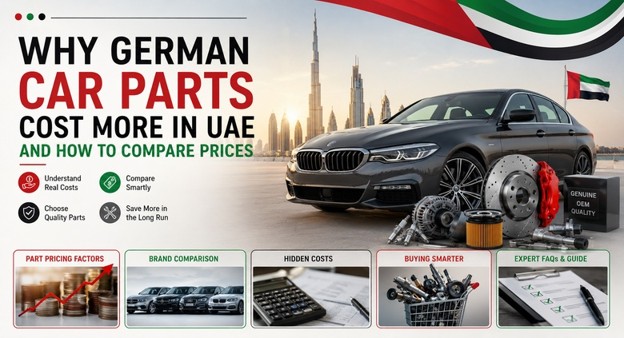
Why German Car Parts Cost More in UAE and How to Compare Prices
July 21, 2026
Understanding Why German Car Parts Are More Expensive
Why German Cars Command Premium Prices
Park outside almost any shopping centre in Dubai or Abu Dhabi for ten minutes.
You won't have to wait long.
A Mercedes-Benz glides past. Then a BMW. An Audi follows. A Volkswagen Tiguan pulls into a parking bay, while a Porsche Cayenne quietly steals everyone's attention without trying too hard. German cars aren't rare in the UAE. They're woven into everyday life, driven by executives, families, enthusiasts and business owners alike.
That popularity, though, creates a question nearly every owner asks sooner or later.
Why does replacing one part cost so much?
It's a fair question.
Especially when someone discovers that a German brake disc, suspension arm or electronic sensor can cost noticeably more than an equivalent component for many Japanese or Korean vehicles.
The answer isn't as simple as "because it's German."
If only it were.
The reality is a tangled mix of engineering philosophy, manufacturing precision, global supply chains, specialist materials, electronic complexity and market demand. Add import costs, shipping, warehouse logistics and the UAE's climate into the equation, and the price tag starts making a lot more sense.
Not everyone needs the most expensive option.
But everyone should understand why the prices differ before making a buying decision.
That's where this guide comes in.
What Makes German Car Parts Different
German manufacturers have never been famous for taking shortcuts.
Quite the opposite.
Every major brand approaches engineering with an obsession for precision. Components are designed to work together within extremely tight tolerances, often integrating mechanical, hydraulic and electronic systems into one carefully balanced package.
Take a modern suspension arm.
It doesn't simply connect two components anymore.
It influences steering feel, tyre wear, stability systems and ride comfort simultaneously. Change the material or manufacturing quality, and the vehicle behaves differently. Sometimes subtly. Sometimes dramatically.
That's why replacement parts often demand such careful selection.
Even relatively small components are expected to perform consistently in temperatures exceeding 45°C, during motorway cruising, stop-start commuting and occasional desert journeys.
Engineering at this level isn't cheap.
Neither is reproducing it accurately.
Popular German Car Brands in the UAE
German engineering has carved out a distinctive place across every Emirate.
Some brands dominate the luxury market.
Others appeal because they balance refinement with practicality.
Among the most commonly maintained German vehicles are:
- Mercedes-Benz
- BMW
- Audi
- Volkswagen
- Porsche
- MINI
- Opel
Each manufacturer follows its own engineering philosophy.
Mercedes-Benz often prioritises comfort and advanced technology.
BMW leans towards driving dynamics.
Audi blends sophisticated electronics with all-weather capability.
Volkswagen focuses on everyday usability.
Porsche delivers uncompromising performance.
Those differences influence everything from servicing schedules to replacement part prices.
There is no universal "German part."
Every brand tells a different engineering story.
The Engineering Behind Premium Components
Here's something workshops notice all the time.
Owners often compare two parts by appearance alone.
That's understandable.
Unfortunately, appearance rarely reveals what matters.
A control arm might look almost identical to another version sitting beside it on a workbench. Inside, however, the metallurgy, rubber compound, machining accuracy and corrosion protection may differ considerably.
Those hidden details influence:
- Longevity.
- Ride quality.
- Noise levels.
- Handling precision.
- Overall reliability.
Manufacturers invest heavily in research, testing and quality control before approving components for production.
That investment doesn't disappear.
It's reflected in the selling price.
You aren't simply paying for metal.
You're paying for the engineering behind it.
Why Precision Manufacturing Increases Costs
Precision sounds impressive.
It also costs money.
Many German vehicle components are manufactured with exceptionally small production tolerances. A fraction of a millimetre can influence how bearings rotate, how seals prevent leaks or how electronic sensors communicate with control units.
That level of accuracy requires sophisticated machinery, strict quality inspections and advanced manufacturing techniques.
The result?
Components generally fit correctly the first time.
They also tend to perform more consistently throughout their service life.
Cheaper alternatives sometimes achieve similar results.
Sometimes they don't.
That's the gamble every buyer faces.
Why Manufacturing Standards Affect Pricing
| Factor | Impact on Cost |
| Precision machining | Higher production costs |
| Advanced materials | Improved durability and performance |
| Extensive testing | Greater quality assurance |
| Tight quality control | Consistent fitment and reliability |
| Specialist manufacturing equipment | Increased production investment |
Precision isn't marketing.
It's measurable.
UAE Climate and Its Effect on German Vehicles
Owning a German vehicle in the UAE isn't quite the same as owning one in northern Europe.
Heat changes everything.
Rubber components age more quickly.
Cooling systems work harder.
Air conditioning runs for months without much of a break.
Batteries experience greater stress.
Fine desert dust gradually finds its way into filters, cooling fins and ventilation systems.
Then there's traffic.
A luxury saloon crawling through city congestion experiences completely different operating conditions from one cruising effortlessly on the Autobahn.
Regular maintenance becomes essential rather than optional.
Vehicles maintained properly generally cope remarkably well.
Neglected ones become expensive surprisingly quickly.
Common Replacement Parts German Cars Need
Every vehicle eventually asks for attention.
German cars are no exception.
Some components naturally wear through everyday driving, while others become more vulnerable as mileage increases.
Owners commonly replace:
- Brake pads and brake discs.
- Suspension bushes.
- Control arms.
- Wheel bearings.
- Air filters.
- Oil filters.
- Spark plugs.
- Ignition coils.
- Water pumps.
- Thermostats.
- Batteries.
- Alternators.
- Air conditioning compressors.
- Electronic sensors.
That doesn't mean every German vehicle suffers frequent failures.
Far from it.
Most of these replacements are simply part of responsible long-term ownership.
Mistakes Buyers Make When Purchasing Parts
Experience teaches expensive lessons.
Fortunately, they don't have to be your lessons.
One of the biggest mistakes is assuming every replacement part advertised online offers identical quality.
It doesn't.
Another common error is ignoring VIN verification because the vehicle "looks like" another model from the same year.
Looks can be deceptive.
Production updates happen regularly.
A component fitted in January may differ from one installed six months later.
Other costly mistakes include:
- Choosing the cheapest quotation without checking specifications.
- Ignoring warranty coverage.
- Buying from unknown suppliers.
- Overlooking installation quality.
- Replacing parts without proper diagnosis.
A little patience often saves a substantial amount of money.
Who Should Read This Guide
This guide isn't written solely for automotive enthusiasts.
It's for anyone responsible for keeping a German vehicle on the road.
Private owners comparing repair quotations.
Families maintaining everyday transport.
Business owners managing executive fleets.
Workshop customers looking for honest advice.
Drivers purchasing replacement parts online.
Even buyers considering their first German vehicle will benefit from understanding where maintenance costs come from before ownership begins.
Knowledge changes expectations.
And better expectations usually lead to better decisions.
Key Takeaways
- German car parts often cost more because of precision engineering, advanced materials, strict manufacturing standards and complex vehicle technology.
- The UAE's climate, driving conditions and import logistics all influence long-term maintenance requirements and replacement part pricing.
- Different German manufacturers follow different engineering philosophies, resulting in varying maintenance costs and component designs.
- VIN verification, supplier reputation and proper diagnosis remain essential before purchasing any replacement part.
- Understanding why prices differ helps owners compare value rather than simply chasing the lowest quotation, leading to more reliable repairs and lower long-term ownership costs.
Factors That Influence German Car Parts Prices
Genuine Parts Explained
Open the bonnet of almost any German car and you'll notice something straight away.
Very little has been left to chance.
Every component has been engineered to work alongside dozens of others, often with astonishing precision. That's why genuine parts continue to command premium prices across the UAE.
A genuine part is supplied through the vehicle manufacturer or its authorised distribution network. It has been produced to match the exact specifications of the component originally fitted at the factory.
Simple enough.
Yet there's more going on behind the scenes.
Before that part ever reaches a dealership shelf, it has travelled through years of research, durability testing, climate simulations and manufacturing inspections. Engineers don't simply ask whether the component works.
They ask how it performs after years of vibration, scorching temperatures, heavy braking and thousands upon thousands of kilometres.
That development process isn't cheap.
The customer ultimately pays for it.
Still, for owners of newer Mercedes-Benz, BMW, Audi or Porsche models, genuine parts often provide confidence that's difficult to ignore.
Especially when warranty protection is involved.
OEM Parts Explained
Here's where plenty of confusion begins.
People often assume OEM and genuine mean exactly the same thing.
They don't.
OEM stands for Original Equipment Manufacturer.
In many cases, the company producing the component is the very same supplier that manufactures parts for the vehicle manufacturer. The difference is branding rather than engineering.
Imagine buying a premium suit directly from the fashion house.
Now imagine buying that same suit from the company that stitched it together before the label was attached.
That's broadly how OEM parts work.
Not always.
But often enough to make them an excellent option for many repairs.
Owners looking for quality without paying dealership prices frequently choose OEM components because they offer an appealing middle ground.
You keep much of the engineering.
You lose some of the branding cost.
Genuine vs OEM
| Comparison | Genuine Parts | OEM Parts |
| Manufacturer approval | Directly supplied by the vehicle brand | Produced by the original supplier |
| Quality | Factory specification | Usually equivalent manufacturing quality |
| Price | Higher | Often more competitive |
| Best suited for | New vehicles and warranty protection | Long-term ownership with balanced costs |
For many repairs, OEM components make excellent financial sense.
Premium Aftermarket Parts
Now things become interesting.
The aftermarket isn't one single market.
It's an enormous spectrum.
At one end sit respected engineering companies producing exceptionally high-quality components. At the other, manufacturers compete almost entirely on price, sacrificing durability and consistency along the way.
That's why sweeping statements rarely help.
Some premium aftermarket suspension arms, brake discs or cooling components perform impressively well on German vehicles.
Others don't last anywhere near as long.
The challenge isn't choosing between genuine and aftermarket.
It's separating outstanding aftermarket manufacturers from mediocre ones.
That takes research.
Not guesswork.
A trusted workshop can usually point you in the right direction because technicians quickly learn which brands return with problems and which quietly keep performing year after year.
Experience counts.
Used German Car Parts
A surprising number of owners immediately dismiss used parts.
Sometimes unfairly.
Not every used component has reached the end of its useful life. Vehicles involved in accident damage often contain perfectly serviceable mechanical parts, interior components and body panels.
The key word is condition.
Not age.
A professionally inspected alternator removed from a carefully maintained vehicle may offer far better value than an unknown aftermarket alternative of questionable quality.
Of course, caution still matters.
Always ask about:
- Previous mileage.
- Inspection procedures.
- Compatibility.
- Warranty.
- Visible wear.
- Service history where available.
Buying used should never feel like a gamble.
It should feel informed.
Reconditioned Components
Reconditioned parts occupy an interesting position.
They're no longer new.
They're certainly not ordinary used components either.
Instead, they have been dismantled, inspected, repaired where necessary, rebuilt using suitable replacement parts and tested before returning to service.
Done properly, the results can be remarkably impressive.
Gearboxes.
Steering racks.
Turbochargers.
Alternators.
Air conditioning compressors.
These are all examples of components commonly rebuilt by experienced specialists.
Quality varies between suppliers, though.
Documentation becomes incredibly important.
So does warranty support.
New, Used and Reconditioned Compared
| Type | Typical Advantage | Considerations |
| New | Maximum lifespan and manufacturer specification | Highest purchase price |
| Used | Lower initial cost | Condition must be carefully verified |
| Reconditioned | Balanced value and reliability | Quality depends on rebuilding standards |
The cheapest option isn't automatically the smartest one.
Import and Shipping Costs
Most German vehicle components don't magically appear in UAE warehouses.
They travel.
Sometimes a very long way.
Manufacturing centres across Germany and Europe supply distribution hubs before components continue through shipping networks, customs procedures, warehousing and local logistics.
Every stage adds cost.
Ocean freight fluctuates.
Air freight costs considerably more.
Storage isn't free.
Neither are customs procedures.
Even packaging contributes to the final retail price.
The replacement part sitting on the shelf represents a surprisingly long journey.
That journey has a price.
Currency Exchange and Market Fluctuations
Pricing isn't determined solely by engineering.
Financial markets quietly influence replacement part costs too.
Many German automotive components are purchased internationally before reaching UAE distributors. Exchange rate movements between currencies can therefore affect wholesale pricing, particularly over extended periods.
Sometimes prices remain stable.
Sometimes they shift unexpectedly.
Inflation, shipping demand, manufacturing costs and global supply chain pressures all contribute.
The buyer rarely sees these changes happening.
The invoice eventually reflects them.
Brand Reputation and Pricing
Let's be honest.
Brand reputation carries value.
Mercedes-Benz, BMW, Audi and Porsche have spent decades building global reputations for engineering excellence.
Maintaining that reputation requires continual investment in research, manufacturing technologies and quality assurance.
Those investments naturally influence replacement part pricing.
Prestige alone doesn't explain the cost.
Engineering plays a much larger role.
Still, reputation allows premium manufacturers to maintain pricing that reflects customer expectations regarding reliability, refinement and long-term performance.
Supply and Demand in the UAE
The UAE has one of the region's healthiest premium vehicle markets.
That creates opportunities.
It also creates demand.
Popular German models generally enjoy better replacement part availability because suppliers know those components will sell consistently. Less common models may require special ordering, increasing both waiting times and overall cost.
Availability shapes pricing.
So does competition.
Comparing multiple suppliers often reveals surprisingly large differences for exactly the same component.
Taking an extra day to compare quotations can sometimes save hundreds or even thousands of dirhams.
Patience pays.
Real Buyer Questions
One conversation seems to repeat itself in workshops across the UAE.
Only the names change.
Why are two apparently identical parts priced so differently?
Because appearance tells only part of the story. Manufacturing standards, materials, warranty coverage, testing procedures and supplier quality all influence the final price.
Is OEM always the better choice than aftermarket?
Not automatically. Premium aftermarket manufacturers often produce excellent components, while lower-quality alternatives may disappoint. The reputation of the manufacturer matters more than the category alone.
Do imported German parts always cost more?
Generally yes, although strong supplier networks and competitive distribution can reduce the price difference for commonly replaced components.
Should I always buy genuine parts?
Not necessarily. The right decision depends on vehicle age, intended ownership period, repair type and budget.
Key Takeaways
- Genuine parts reflect extensive engineering, testing and manufacturer-backed quality assurance, which contributes to their premium pricing.
- OEM components frequently deliver factory-level quality at a more competitive cost, making them a popular option for many German vehicle owners.
- Premium aftermarket, used and professionally reconditioned parts can all represent excellent value when sourced from reputable suppliers.
- Import logistics, exchange rates, supply chains and market demand all influence replacement part prices throughout the UAE.
- Comparing component quality, warranty protection and supplier reputation leads to far better purchasing decisions than focusing on price alone.
Comparing Prices Across the UAE
Buying Parts in Dubai
Dubai doesn't have one automotive parts market.
It has dozens of them.
Drive across the city and you'll quickly notice the contrast. On one side, authorised dealerships with spotless showrooms and factory-trained technicians. On the other, independent specialists, performance workshops and parts suppliers who've spent years building relationships with distributors across Europe and the Gulf.
That variety is both a blessing and a headache.
One supplier may quote AED 2,400 for a water pump assembly. Another, only a few kilometres away, might ask AED 3,100 for what appears to be exactly the same component.
Appears.
That's the important word.
Before comparing prices, compare everything else.
Is the part genuine?
OEM?
Premium aftermarket?
Does it include a warranty? Has the supplier checked the VIN? Is the item already in stock, or will it arrive from Germany next week?
Suddenly, the cheaper quotation isn't always the better one.
Buying Parts in Sharjah
Mention replacement car parts anywhere in the UAE and Sharjah usually enters the conversation within minutes.
There's a reason.
The emirate has built a reputation over many years for offering an enormous selection of used, reconditioned and replacement automotive components. Owners of older Mercedes-Benz, BMW and Volkswagen models often begin their search here because availability tends to be strong.
Still, don't let reputation replace judgement.
One steering rack may have been removed from a carefully maintained vehicle with modest mileage.
Another might have lived a much harder life.
They'll look remarkably similar sitting on a shelf.
That's where questions become valuable.
Ask how the part was inspected.
Ask about mileage.
Ask whether any components were rebuilt.
Good suppliers won't mind.
In fact, they'll expect those questions.
Buying Parts in Abu Dhabi
Abu Dhabi approaches vehicle maintenance a little differently.
Many owners place long-term reliability above short-term savings.
That mindset often influences buying decisions.
Authorised dealerships remain popular, particularly for newer vehicles under warranty, yet independent German vehicle specialists continue to grow because they offer owners more flexibility without necessarily compromising quality.
It's common to see customers comparing three or four repair options before making a final decision.
That's sensible.
Modern German vehicles contain sophisticated electronics and highly integrated systems. Saving a few hundred dirhams on the wrong component can easily create a much larger invoice later.
Better to compare carefully.
Then commit.
Buying Parts in Ajman
Ajman has quietly become an attractive option for motorists prepared to shop around.
Competition is healthy.
That usually benefits the customer.
Independent suppliers frequently source components from multiple distributors, giving buyers access to genuine, OEM and premium aftermarket options without travelling extensively across the country.
Price differences still exist.
Sometimes surprisingly large ones.
The smartest buyers don't ask only, "How much?"
They also ask, "What's included?"
A slightly higher quotation might cover delivery, warranty support or additional hardware that another supplier charges separately.
Those details matter.
Buying Parts in Ras Al Khaimah
Vehicle ownership in Ras Al Khaimah often means covering longer distances.
Reliability becomes more than a convenience.
It becomes a necessity.
Owners replacing major components frequently prefer products with proven durability because unexpected failures on regular inter-emirate journeys are inconvenient and expensive.
Planning ahead also helps.
Ordering replacement parts before scheduled maintenance gives workshops greater flexibility and reduces the pressure to accept the first available quotation.
Rushed purchases rarely produce the best results.
Buying Parts in Fujairah
Fujairah brings a different set of driving conditions.
Mountain roads.
Coastal humidity.
Long stretches of open highway.
Each influences how vehicles age over time.
Cooling systems deserve particular attention, while braking and suspension components often experience additional stress depending on driving habits.
That doesn't necessarily increase ownership costs.
It simply changes maintenance priorities.
Experienced workshops understand these local conditions and often recommend preventative inspections before small problems become expensive repairs.
It's practical advice.
Not unnecessary upselling.
Buying Parts in Umm Al Quwain
Buying parts in Umm Al Quwain has become much easier over the past few years.
Online ordering has changed the landscape.
Owners are no longer limited to nearby suppliers. They can compare quotations from businesses across Dubai, Sharjah, Abu Dhabi and beyond without leaving home.
That wider choice encourages healthier competition.
It also rewards patient buyers.
Spending an extra evening comparing prices, warranty terms and delivery times can make a noticeable difference to the final bill.
Sometimes the savings are substantial.
Sometimes the better warranty is worth far more than the discount.
Buying Online Across the UAE
Ordering replacement parts online sounds wonderfully convenient.
Most of the time, it is.
Yet convenience shouldn't replace careful verification.
One incorrect digit in a part number can delay repairs for days.
Sometimes weeks.
Before placing any order, check:
- Vehicle Identification Number compatibility.
- Manufacturer part number.
- Product description.
- Warranty terms.
- Supplier reviews.
- Delivery schedule.
- Return policy.
Those few minutes of checking often prevent hours of frustration.
Advantages of Online Comparison
| Benefit | Why It Matters |
| Wider supplier network | More pricing options |
| Faster quotation requests | Easier comparison |
| Access to specialist suppliers | Better availability for uncommon models |
| Transparent product information | Improved buying confidence |
| Home or workshop delivery | Reduced downtime |
Buying online works best when combined with careful research.
How to Compare Multiple Suppliers Effectively
Here's where experienced buyers quietly save money.
They compare value.
Not just price.
Request quotations from several suppliers for exactly the same specification. Confirm whether the component is genuine, OEM, premium aftermarket, used or professionally reconditioned.
Ask identical questions each time.
Is this compatible with my VIN?
How long is the warranty?
Is the item physically in stock?
Does the quotation include VAT?
Are fittings or sensors included?
The answers quickly reveal which suppliers understand German vehicles and which simply compete on price.
For buyers looking to compare German car parts in UAE, platforms such as PartFinder UAE simplify the process by allowing motorists to request quotations from multiple trusted suppliers, compare availability, review different replacement options and make more informed purchasing decisions before committing to a repair.
Comparing properly isn't time wasted.
It's usually money saved.
Real Buyer Questions
The same practical concerns appear again and again.
Why can identical-looking parts have completely different prices?
Because appearance doesn't reveal manufacturing quality, warranty support, inspection standards or the origin of the component.
Should I always buy from the cheapest supplier?
Only after confirming compatibility, warranty, supplier reputation and the exact specification of the replacement part.
Is online buying safe?
Yes, provided the supplier verifies your VIN, explains the product clearly and offers transparent warranty and return policies.
How many quotations should I compare?
Three or four is usually enough to understand the market and identify unusually high or suspiciously low prices.
Key Takeaways
- Every Emirate offers different strengths, from dealership support to independent specialists and competitive online suppliers.
- Comparing quotations involves much more than looking at the final price; compatibility, warranty, quality and supplier expertise matter just as much.
- Online purchasing provides wider access to German car parts but makes VIN verification and product checks even more important.
- Careful comparison between multiple trusted suppliers helps buyers achieve better long-term value rather than simply lower upfront costs.
- Taking time to research replacement options leads to more reliable repairs, stronger warranty protection and greater confidence throughout German vehicle ownership in the UAE.
Cost Comparison by Vehicle System
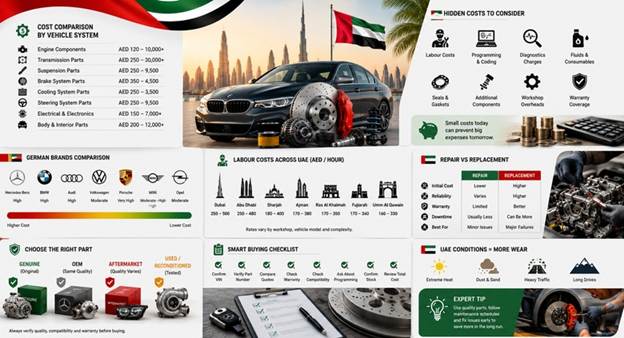
Engine Components
Ask any experienced German car technician where repair bills begin to climb.
You'll hear one answer more often than any other.
The engine.
Not because German engines are unreliable. Far from it. The reality is that modern Mercedes-Benz, BMW, Audi and Volkswagen engines are packed with sophisticated technology. Turbochargers, direct fuel injection, variable valve timing, electronic sensors and complex cooling systems all work together with remarkable precision.
It's clever engineering.
It also means replacement components are manufactured to exceptionally high standards.
Consider something as ordinary as a water pump.
Years ago, replacing one was relatively straightforward. Today, some pumps are integrated into larger assemblies, communicate with electronic control systems or require additional seals, software checks and specialised labour.
The part itself is only one piece of the puzzle.
Typical Engine Parts Costs
| Engine Component | Typical UAE Price Range (AED) |
| Air filter | 120–350 |
| Oil filter | 80–250 |
| Spark plugs (set) | 350–1,200 |
| Ignition coils | 250–900 each |
| Water pump | 900–3,500 |
| Fuel injectors | 700–2,800 each |
| Turbocharger | 3,500–10,000+ |
The exact figure depends on the vehicle, engine variant and replacement part category.
Gearbox and Transmission Parts
Gearboxes rarely fail overnight.
They usually whisper first.
Slight hesitation.
A delayed shift.
A faint vibration pulling away from traffic lights.
Ignore those early warnings for long enough and the repair becomes considerably more expensive.
Modern German transmissions, whether automatic, dual-clutch or continuously variable, contain hundreds of precision-machined components working together inside a compact housing. That complexity influences both parts pricing and labour costs.
Transmission fluid matters too.
Skipping scheduled servicing simply to save money often produces the opposite result later.
Common Transmission Components
| Component | Typical UAE Price Range (AED) |
| Transmission filter | 250–800 |
| Mechatronic components | 2,000–7,000 |
| Torque converter | 2,500–7,500 |
| Clutch kit | 1,800–5,500 |
| Complete gearbox | 9,000–30,000+ |
Routine maintenance almost always costs less than transmission replacement.
Suspension Components
Here's something drivers often overlook.
A suspension system doesn't wear evenly.
One bush deteriorates.
Then another.
Eventually the steering begins to feel different, tyre wear becomes uneven and small bumps suddenly seem much larger than before.
German manufacturers invest heavily in ride quality.
Maintaining that refinement requires high-quality suspension components manufactured with precise tolerances and durable materials.
Cheaper alternatives sometimes fit.
They don't always perform the same way.
Frequently Replaced Suspension Parts
- Shock absorbers.
- Suspension bushes.
- Control arms.
- Ball joints.
- Anti-roll bar links.
- Wheel bearings.
- Suspension mounts.
Replacing worn suspension components restores more than comfort.
It restores confidence.
Brake System Parts
Brakes are one area where compromise rarely makes financial sense.
Or practical sense.
German vehicles often use larger braking systems than many mainstream cars, particularly performance and luxury models. Bigger discs, advanced calipers and specialised brake materials naturally increase replacement costs.
Heat management also plays a role.
Vehicles travelling regularly on UAE motorways or descending mountain roads place significant demands on braking systems.
Quality components maintain consistent stopping performance.
Inferior ones often struggle.
Brake Cost Comparison
| Brake Component | Typical UAE Price Range (AED) |
| Front brake pads | 450–1,500 |
| Rear brake pads | 350–1,200 |
| Brake discs (pair) | 900–3,500 |
| Brake fluid service | 250–700 |
| Brake caliper | 1,200–4,500 |
Stopping safely is never the place to chase the lowest quotation.
Cooling System Parts
Heat is relentless in the UAE.
Your cooling system knows that better than anyone.
Radiators, electric water pumps, thermostats, coolant reservoirs and cooling fans operate almost continuously during the hotter months. A single weak component can upset the balance of the entire system.
That's why technicians often recommend inspecting related components during cooling system repairs.
It isn't about increasing the invoice.
It's about preventing repeat visits.
Replacing a worn thermostat while the system is already dismantled often makes perfect financial sense.
Steering Components
Steering should feel predictable.
If it doesn't, pay attention.
Modern German steering systems combine mechanical precision with sophisticated electronics. Electric power steering modules, steering angle sensors and advanced driver assistance systems all depend on accurate calibration.
Even replacing a steering rack may require software programming afterwards.
Many owners don't expect that additional cost.
Yet it's essential.
Skipping calibration isn't an option.
Steering System Costs
| Steering Component | Typical UAE Price Range (AED) |
| Tie rod end | 250–700 |
| Steering rack | 3,000–9,500 |
| Steering pump | 1,500–4,000 |
| Steering angle sensor | 700–2,500 |
| Wheel alignment | 180–450 |
Mechanical repairs and electronic calibration increasingly go hand in hand.
Electrical and Electronic Parts
Modern German vehicles contain dozens of electronic control units.
Sometimes more.
Each manages a specific system, from engine performance and transmission operation to lighting, parking sensors and climate control.
That's wonderful when everything works.
Less so when it doesn't.
Electrical diagnosis often takes longer than replacing the faulty component because technicians must identify the true cause before ordering expensive parts.
Guesswork has no place here.
Accurate diagnosis protects the customer's wallet.
Common Electronic Components
- Engine control modules.
- Parking sensors.
- Oxygen sensors.
- ABS sensors.
- Battery management modules.
- Alternators.
- Starter motors.
- Infotainment components.
The most expensive electronic part isn't always the faulty one.
Diagnosis comes first.
Body Panels and Exterior Components
Accident repairs introduce another layer of cost.
Body panels for German vehicles frequently require exceptional fitment because modern designs integrate parking sensors, radar systems, cameras and advanced lighting technologies.
Replacing a front bumper isn't simply cosmetic anymore.
It may involve recalibrating multiple driver assistance systems.
That's why quotations sometimes appear higher than expected.
The panel itself tells only half the story.
Interior Components
Luxury interiors deserve careful attention.
Leather seating, digital displays, ambient lighting, premium audio systems and electronic climate controls create the experience many owners value most.
Replacing interior components often requires specialist knowledge because trim pieces and electronic modules are closely integrated.
A damaged switch may seem insignificant.
Behind it sits an intricate electrical network.
Precision continues inside the cabin.
Real Buyer Questions
These are the conversations technicians hear almost every day.
Why are German engine repairs often more expensive than Japanese vehicles?
Because many German engines incorporate more advanced technology, tighter manufacturing tolerances and integrated electronic systems that require specialist parts and labour.
Should I replace related components during major repairs?
In many cases, yes. Replacing accessible wear items while the system is already dismantled often reduces future labour costs.
Why does replacing a steering component sometimes require programming?
Many modern steering systems interact with electronic safety features that must be recalibrated after installation.
Can cheaper brake parts perform just as well?
Sometimes, but quality varies considerably. For safety-critical systems, reputable OEM or premium-quality components are generally the wiser investment.
Key Takeaways
- Different vehicle systems carry different replacement costs, with engines, transmissions and advanced electronics typically representing the highest investments.
- German engineering combines mechanical precision with sophisticated electronics, increasing both component and labour costs.
- Cooling, steering and braking systems require careful maintenance in demanding UAE driving conditions.
- Accurate diagnosis and professional installation are just as important as selecting high-quality replacement parts.
- Understanding where repair costs originate helps owners compare quotations more effectively and make informed long-term maintenance decisions rather than focusing solely on the lowest upfront price.
Comparing Major German Brands
Not every German car is expensive to maintain.
And not every premium badge guarantees sky-high repair bills.
That's where many buyers get caught out.
Someone assumes a Volkswagen will always be cheaper than a BMW. Another driver believes every Mercedes-Benz part costs a fortune. Neither statement is always true. It depends on the model, the engine, the transmission, the technology fitted to the vehicle and—perhaps most importantly—the replacement part you're actually buying.
A brake pad? One story.
An adaptive headlight module? A completely different one.
Let's break the brands down properly.
Mercedes-Benz Parts
Mercedes-Benz has spent decades building cars around comfort, refinement and engineering sophistication. You feel it the moment you close the door. Everything seems solid. Deliberate. Quiet.
That quality comes with responsibility.
Modern Mercedes models rely heavily on electronics. Air suspension systems, adaptive lighting, advanced driver-assistance features and turbocharged engines all introduce components that are highly engineered—and priced accordingly.
Routine maintenance isn't necessarily outrageous. Filters, brake pads and service items are generally predictable.
Major repairs?
That's another conversation.
Electronic control modules, AIRMATIC suspension components, turbochargers and infotainment systems can quickly move a repair estimate from hundreds of dirhams into several thousand.
Commonly Replaced Mercedes-Benz Components
- Brake discs and pads.
- Air suspension compressors.
- Control arms.
- Engine mounts.
- Turbochargers.
- Ignition coils.
- Electronic sensors.
- Water pumps.
Mercedes owners who follow scheduled maintenance usually avoid many of the larger repair bills.
Delay servicing, though, and costs have a habit of stacking up.
BMW Parts
BMW builds cars for people who enjoy driving.
Steering feel.
Balanced handling.
Strong engines.
Responsive transmissions.
Those qualities don't happen by accident.
They're the result of sophisticated engineering, lightweight materials and finely tuned mechanical systems.
One interesting thing about BMW ownership is that preventative maintenance often has a bigger financial impact than many owners realise.
Ignore a small oil leak.
It grows.
Delay replacing a worn cooling component.
The repair expands.
Wait too long to investigate a warning light.
Several systems may eventually become involved.
The lesson?
Fix small problems while they're still small.
Typical BMW Replacement Items
| Component | Typical UAE Price Range (AED) |
| Oil filter | 90–220 |
| Ignition coil | 280–850 |
| Water pump | 1,200–3,800 |
| Control arm | 700–2,400 |
| Electric coolant pump | 2,000–5,500 |
| Turbocharger | 4,000–10,500+ |
Regular inspections usually cost far less than unexpected engine repairs.
Audi Parts
Audi likes technology.
Actually, that's putting it mildly.
Digital dashboards, quattro all-wheel drive, sophisticated lighting systems and advanced driver assistance technologies have become part of the brand's identity.
Owners appreciate those innovations every day.
Until something stops working.
Electrical diagnosis on modern Audi vehicles often requires specialist equipment because many systems communicate continuously with one another. Replacing a faulty sensor without confirming the underlying issue rarely solves the problem.
That's why experienced workshops begin with diagnosis rather than replacement.
It saves money.
And frustration.
Frequently Replaced Audi Components
- Wheel bearings.
- Suspension bushes.
- Ignition coils.
- Water pumps.
- Parking sensors.
- LED lighting modules.
- Cooling fans.
- Electronic control units.
Technology makes ownership enjoyable.
It also demands informed maintenance.
Volkswagen Parts
Volkswagen often surprises people.
Despite sharing German engineering principles with premium brands, many Volkswagen models remain relatively affordable to maintain.
Relatively.
Not universally.
Popular vehicles such as the Golf, Passat and Tiguan benefit from widespread parts availability across the UAE. Strong demand encourages healthy competition between suppliers, helping to keep many routine servicing costs under control.
Performance variants tell a different story.
A Golf R doesn't cost the same to maintain as a standard Golf.
Neither should anyone expect it to.
Choosing the correct replacement component always depends on the exact specification of the vehicle.
Not simply the badge on the bonnet.
Porsche Parts
Owning a Porsche is rarely about practicality.
It's about experience.
Performance.
Precision.
Emotion.
Those qualities naturally influence maintenance costs.
High-performance braking systems, specialised suspension components, lightweight materials and powerful engines all require premium replacement parts manufactured to exceptionally demanding standards.
Even routine servicing often costs more simply because the components themselves are engineered for higher levels of performance.
Does that make ownership unrealistic?
Not at all.
It simply rewards owners who budget sensibly and maintain the vehicle proactively rather than reactively.
MINI Parts
MINI has personality.
Loads of it.
Compact dimensions, lively handling and distinctive styling make these cars enormously enjoyable around towns and cities.
Mechanically, however, many modern MINI models share engineering with BMW.
That's worth remembering.
Some replacement components, particularly engine, suspension and electrical parts, reflect that shared engineering relationship.
Routine maintenance generally remains manageable.
Ignoring warning lights doesn't.
MINIs have little patience for postponed repairs.
Opel Parts
Opel doesn't always receive the same attention as the larger German manufacturers, yet plenty of examples continue to serve families and businesses throughout the UAE.
Replacement parts often prove more affordable than those for premium luxury brands, particularly for routine servicing.
Availability depends heavily on the specific model.
Popular vehicles generally present fewer sourcing challenges, while older or less common versions occasionally require additional waiting time for imported components.
Planning ahead helps.
Especially if the vehicle plays an important role in daily commuting.
Land Rover and Range Rover Parts Compared with German Brands
This comparison surprises many buyers.
Land Rover and Range Rover aren't German manufacturers, yet they frequently appear alongside German brands when owners discuss maintenance costs.
Why?
Because they're competing in the same premium ownership space.
Many replacement components—air suspension systems, advanced electronics, turbocharged engines and sophisticated transmissions—occupy a similar pricing bracket to Mercedes-Benz, BMW and Audi.
The biggest difference often comes down to availability.
Popular German models usually benefit from broader supplier networks across the UAE, making price comparison easier.
That wider availability can translate into better value.
Premium Brand Maintenance Comparison
| Brand | Typical Parts Cost | Parts Availability | Long-Term Maintenance |
| Mercedes-Benz | High | Excellent | High |
| BMW | High | Excellent | High |
| Audi | High | Very Good | High |
| Volkswagen | Moderate to High | Excellent | Moderate |
| Porsche | Very High | Good | Very High |
| MINI | Moderate to High | Good | Moderate to High |
| Opel | Moderate | Moderate | Moderate |
| Land Rover / Range Rover | High to Very High | Good | High |
These are broad ownership trends rather than fixed rules.
Specific models can vary considerably.
Which German Brand Costs the Most to Maintain?
People ask this constantly.
They're hoping for one simple answer.
There isn't one.
A Porsche 911 and a Volkswagen Polo don't belong in the same conversation.
Likewise, comparing an entry-level BMW 3 Series with a high-performance Mercedes-AMG model tells you very little.
Maintenance costs depend on factors such as:
- Vehicle age.
- Annual mileage.
- Service history.
- Engine type.
- Transmission.
- Driving habits.
- Parts availability.
- Previous repair quality.
That's why sweeping claims about "the most expensive German brand" rarely hold up under scrutiny.
The better question is this:
How well has the individual vehicle been maintained?
That answer usually predicts future costs more accurately than the badge alone.
Real Buyer Questions
These are some of the questions buyers ask before committing to ownership.
Is Volkswagen always cheaper to maintain than Mercedes-Benz?
Often, but not always. Model specification, engine size and technology fitted to the vehicle can narrow the difference considerably.
Which German brand has the widest parts availability in the UAE?
Mercedes-Benz, BMW, Audi and Volkswagen generally enjoy excellent supplier coverage because of their popularity across the Emirates.
Should premium brands always receive genuine parts?
Not necessarily. Many owners successfully choose high-quality OEM components for appropriate repairs without compromising reliability.
Which ownership habit saves the most money?
Routine maintenance. Addressing small issues early consistently reduces the likelihood of expensive major repairs later.
Key Takeaways
- Every German manufacturer follows a different engineering philosophy, resulting in noticeable differences in replacement part pricing and long-term maintenance costs.
- Mercedes-Benz, BMW and Audi generally involve higher repair costs because of advanced technology and sophisticated engineering, while Volkswagen and Opel often offer more affordable ownership for comparable repairs.
- Porsche ownership brings premium performance alongside premium maintenance expectations, whereas MINI shares many engineering characteristics with BMW.
- Vehicle condition, maintenance history and component quality influence ownership costs far more than the badge alone.
- Comparing quotations, understanding the exact vehicle specification and maintaining the car proactively remain the smartest ways to control long-term repair expenses in the UAE.
A premium badge tells only part of the story. The real costs reveal themselves in the workshop, not the showroom.
Hidden Costs Most Buyers Overlook
Buying the replacement part is only the beginning.
That's the bit many owners underestimate.
Someone receives a quotation for a new water pump and thinks they've worked out the repair cost. Then the workshop calls back.
"We've found a couple of other things while we're in there."
Sound familiar?
It happens every day across the UAE.
Sometimes those additional costs are unavoidable. Sometimes they could have been anticipated from the very start. The trick is knowing what usually sits behind the headline price before you approve the repair.
Let's lift the bonnet on the hidden expenses.
Labour Costs Across the UAE
Replacing a part and fitting a part aren't the same thing.
Some jobs take thirty minutes.
Others consume an entire working day.
Modern German vehicles are beautifully engineered, but that engineering often means technicians must dismantle several surrounding components simply to reach the faulty one. On certain models, replacing a thermostat involves removing intake components. A turbocharger replacement may require extensive dismantling, while some cooling system repairs involve draining, bleeding and recalibrating multiple systems.
Labour isn't charged because someone is turning a spanner.
It's charged because trained technicians know exactly what to remove, what to protect and what must be recalibrated before handing the vehicle back.
Typical Labour Costs by Emirate
| Emirate | Typical Labour Rate (AED/hour) |
| Dubai | 250–500 |
| Abu Dhabi | 250–480 |
| Sharjah | 180–400 |
| Ajman | 170–380 |
| Ras Al Khaimah | 170–350 |
| Fujairah | 170–340 |
| Umm Al Quwain | 160–330 |
These figures vary depending on the workshop, vehicle complexity and technician expertise.
The cheapest hourly rate isn't automatically the best value.
A skilled technician who completes the repair correctly the first time can save considerably more money than a lower hourly rate followed by repeat visits.
Programming and Electronic Coding Costs
Here's something that catches plenty of first-time German car owners off guard.
Some replacement parts don't simply bolt on.
They need introducing to the car.
Modern vehicles contain dozens of electronic control units communicating continuously with one another. Replace a battery management module, steering component, adaptive headlight or engine control unit and the vehicle often expects software coding before everything functions correctly.
Skip that step?
Problems begin.
Warning lights appear.
Safety systems may stop working as intended.
In some cases, the vehicle refuses to recognise the newly installed component altogether.
Programming isn't an optional extra.
It's part of the repair.
Components That Commonly Require Coding
- Battery management systems.
- Adaptive headlights.
- Steering angle sensors.
- Parking assistance modules.
- Engine control units.
- Transmission control modules.
- Air suspension modules.
- Infotainment systems.
The invoice may include coding separately.
That's perfectly normal.
Diagnostic Charges
People often ask why they're paying for diagnosis before any parts have been replaced.
The answer is simple.
Because guessing is expensive.
Modern German vehicles generate fault codes, but fault codes don't always identify the failed component directly. A warning message might point towards a sensor when the real issue lies elsewhere.
Experienced technicians investigate before ordering parts.
That investigation takes specialist diagnostic equipment, technical knowledge and time.
Would you rather pay for one accurate diagnosis or three unnecessary replacement parts?
Exactly.
Typical Diagnostic Costs
| Diagnostic Service | Typical UAE Cost (AED) |
| Basic fault scan | 150–350 |
| Advanced diagnostic investigation | 350–900 |
| Electrical system diagnosis | 400–1,200 |
| Performance diagnosis | 500–1,500 |
Proper diagnosis often reduces the overall repair bill.
It rarely increases it.
Fluids, Seals and Additional Components
This catches more people than almost anything else.
A replacement part rarely works alone.
Install a new water pump?
Fresh coolant.
Replace a gearbox?
Transmission fluid.
Fit new brake discs?
Brake fluid inspection, mounting hardware and occasionally sensors.
Repair the suspension?
Wheel alignment.
Individually, these items don't look particularly expensive.
Together?
They soon add up.
Common Supporting Parts
- Gaskets.
- O-rings.
- Coolant.
- Engine oil.
- Transmission fluid.
- Filters.
- Mounting bolts.
- Clips and fasteners.
- Drive belts.
- Hose clamps.
They're small purchases.
Ignoring them can create very large problems.
Repair vs Replacement Cost Analysis
This is where decisions become genuinely interesting.
Repairing always sounds cheaper.
Sometimes it is.
Sometimes it isn't.
Imagine rebuilding an ageing turbocharger for slightly less than replacing it, only to face another failure twelve months later because the surrounding components were already heavily worn.
The cheaper decision suddenly becomes the expensive one.
Context matters.
Mileage matters.
Vehicle age matters.
Future ownership plans matter.
Repair vs Replacement Comparison
| Factor | Repair | Replacement |
| Initial cost | Lower | Higher |
| Long-term reliability | Depends on component condition | Generally stronger |
| Downtime | Often shorter | Can vary depending on parts availability |
| Warranty | Usually limited | Frequently more comprehensive |
| Future maintenance | May require additional repairs | Often reduced in the short term |
There's no universal answer.
Every repair deserves its own assessment.
Warranty Considerations
Warranty isn't just paperwork.
It's peace of mind.
Some suppliers provide extensive coverage on genuine, OEM and professionally reconditioned components. Others offer only minimal protection.
Read the small print.
Seriously.
Questions worth asking include:
- How long does the warranty last?
- Does it cover labour?
- Are there mileage limits?
- What documentation is required?
- Must installation be completed by an approved workshop?
A slightly more expensive component with a comprehensive warranty may prove considerably better value over time.
Insurance and Claims
Insurance doesn't cover ordinary wear and tear.
That's widely understood.
What surprises some owners is how replacement part choice may influence accident repairs.
Certain insurers specify genuine parts.
Others approve OEM alternatives under particular circumstances.
Understanding those conditions before an accident occurs prevents confusion later.
A quick conversation with your insurer today can save lengthy discussions tomorrow.
First-Year Ownership Costs
Buying a used German vehicle often feels like the biggest expense.
It isn't.
The first twelve months usually reveal the car's true maintenance needs.
Even well-maintained vehicles may require:
- Preventative servicing.
- Fluid changes.
- Brake maintenance.
- Tyres.
- Suspension work.
- Battery replacement.
- Software updates.
- Routine inspections.
Budgeting realistically from the beginning makes ownership considerably less stressful.
Estimated First-Year Maintenance Budget
| Vehicle Category | Typical Annual Maintenance (AED) |
| Volkswagen / Opel | 2,500–6,000 |
| BMW / Audi | 4,000–9,500 |
| Mercedes-Benz | 4,500–10,000 |
| MINI | 3,500–7,000 |
| Porsche | 8,000–18,000+ |
These are ownership estimates rather than guaranteed expenses.
Condition changes everything.
Smart Ways to Reduce Repair Bills
Want to know the biggest money-saving trick?
Don't wait.
That strange vibration?
Investigate it.
The small coolant leak?
Fix it.
The warning light that's "probably nothing"?
Find out.
Minor problems have an annoying habit of becoming major ones.
Other sensible habits include:
- Compare multiple supplier quotations.
- Verify VIN compatibility.
- Choose reputable workshops.
- Keep detailed service records.
- Replace related wear items during major repairs.
- Follow factory maintenance schedules.
- Use quality replacement components.
Saving money isn't about cutting corners.
It's about making informed decisions.
Real Buyer Questions
These questions crop up repeatedly in workshops throughout the UAE.
Why did my repair bill increase after work began?
Because technicians sometimes discover worn supporting components once the affected system has been dismantled. Good workshops explain these findings before carrying out additional work.
Should I skip diagnostic testing to save money?
Usually not. Accurate diagnosis often prevents unnecessary parts replacement and reduces the total repair cost.
Are labour charges negotiable?
Sometimes, but expertise has value. A lower labour rate doesn't always produce a lower final bill if repairs need repeating.
Is it worth replacing nearby components at the same time?
In many situations, yes. If labour overlaps significantly, replacing related wear items during the same repair often proves more economical.
Key Takeaways
- Labour, programming, diagnostics and supporting components frequently represent a significant proportion of the total repair cost for German vehicles.
- Modern electronics mean many replacement parts require software coding and calibration before the repair is complete.
- Comparing repair and replacement options should involve long-term reliability rather than focusing only on the initial invoice.
- Strong warranty protection, accurate diagnosis and preventative maintenance often save substantially more money than choosing the cheapest quotation.
- Understanding these hidden ownership costs helps German car owners budget realistically, compare workshop estimates with confidence and avoid expensive surprises throughout vehicle ownership in the UAE.
Buying Smarter and Avoiding Costly Mistakes
You know what's expensive?
Buying the wrong part twice.
It happens far more often than people admit.
Someone spots an unbelievably cheap deal online. The photographs look convincing. The description sounds professional. A few days later, the parcel arrives, the workshop fits the part, and everything seems fine.
For a while.
Then the warning light comes back.
Or the suspension starts knocking again.
Or the cooling system develops another leak.
The original "saving" quietly disappears, replaced by another invoice, more labour charges and another weekend without the car.
That's why experienced owners don't simply hunt for bargains.
They hunt for value.
Let's look at the mistakes worth avoiding.
Counterfeit German Parts
Counterfeit automotive parts have become remarkably convincing.
Gone are the days when fake packaging was easy to spot.
Today, some copies look almost identical to genuine products until they're fitted—or worse, until they fail.
That's the real danger.
The problem isn't only losing money.
Inferior materials, inconsistent manufacturing and poor quality control can affect braking performance, suspension stability, cooling efficiency and engine reliability.
Would you trust an unknown brake component travelling at motorway speeds?
Probably not.
Neither should anyone else.
Warning Signs of Counterfeit Parts
- Unusually low prices.
- Missing manufacturer labels.
- Poor packaging quality.
- Incorrect spelling or printing.
- No warranty documentation.
- Missing serial numbers.
- Suspiciously vague product descriptions.
If something feels wrong, don't talk yourself into it.
Walk away.
Common Pricing Tricks
Not every attractive quotation tells the whole story.
Some suppliers advertise a remarkably low price for the replacement component, only for additional charges to appear later.
Delivery.
VAT.
Programming.
Mounting hardware.
Diagnostic work.
None of these costs are necessarily unreasonable.
Hiding them is.
A trustworthy quotation explains exactly what's included before the repair begins.
That level of transparency makes comparison much easier.
Questions Worth Asking Before Accepting Any Quote
- Does the price include VAT?
- Is labour included?
- Are seals, clips and bolts supplied?
- Will coding or programming cost extra?
- Is the component currently in stock?
- Does the quotation include warranty coverage?
Simple questions.
Very valuable answers.
Workshop Red Flags
Finding the right workshop can save thousands of dirhams over the lifetime of a German vehicle.
Finding the wrong one?
That's another story entirely.
Watch carefully.
Does the technician explain the diagnosis clearly?
Can they justify replacing each component?
Do they encourage questions?
Professional workshops rarely become defensive when customers want explanations.
Instead, they enjoy discussing the repair because they understand the reasoning behind every recommendation.
On the other hand, caution is sensible if you encounter:
- Immediate pressure to approve expensive work.
- Reluctance to provide written quotations.
- No explanation of diagnostic findings.
- Unclear warranty terms.
- Poor workshop organisation.
- Missing service documentation.
Trust isn't built through promises.
It's built through evidence.
Real Buyer Questions
Let's imagine a few conversations that happen in UAE workshops almost every week.
"This supplier is AED 1,500 cheaper. Should I take the deal?"
Maybe.
Maybe not.
Ask what you're comparing.
Is the cheaper quotation for the same manufacturer? Does it include warranty? Has the VIN been checked? Is installation included? Without those answers, the numbers alone don't mean much.
"Do I really need to replace both suspension arms?"
Sometimes yes.
If wear is similar on both sides, replacing them together often restores balanced handling and avoids paying for repeated labour later.
"Can I mix genuine and OEM parts?"
Absolutely—provided the components are appropriate for the repair and sourced from reputable manufacturers.
Good workshops recommend solutions based on engineering rather than branding.
Smart German Parts Buying Checklist
Before spending a single dirham, pause.
Run through this checklist.
✔ Confirm your VIN.
✔ Verify the exact part number.
✔ Ask whether the component is genuine, OEM, premium aftermarket, used or professionally reconditioned.
✔ Request written quotations from several suppliers.
✔ Compare warranty periods.
✔ Check whether programming or calibration is required.
✔ Confirm labour charges separately.
✔ Ask if related components should be replaced simultaneously.
✔ Read customer reviews.
✔ Keep every invoice and warranty document.
Ten minutes of checking can prevent weeks of frustration.
A Short Workshop Story
Here's a situation that illustrates the point perfectly.
An owner of a five-year-old BMW noticed a slight vibration while braking.
Nothing dramatic.
Just enough to be annoying.
One workshop immediately recommended replacing the complete braking system.
Another inspected the vehicle more carefully.
The brake discs had reached the end of their service life, but the calipers remained in excellent condition. The technician explained the measurements, showed the wear and recommended replacing only the necessary components using quality OEM parts.
The second quotation wasn't the cheapest.
Nor was it the most expensive.
It was simply the most accurate.
Months later, the braking system continued to perform exactly as expected.
That's what informed buying looks like.
Not lucky buying.
How Good Maintenance Protects Resale Value
People often focus entirely on repair costs.
Fair enough.
But there's another side to the equation.
Resale.
Buyers of German vehicles usually ask similar questions.
Has the car been serviced properly?
Are there invoices?
Were quality replacement parts used?
Can the maintenance history be verified?
Strong documentation builds confidence.
Confidence supports stronger resale values.
Skipping maintenance may reduce today's expenses, yet it often reduces tomorrow's selling price by much more.
That's a trade-off worth thinking about.
When Paying More Actually Saves Money
It sounds backwards.
Sometimes spending more today reduces spending tomorrow.
Imagine two replacement water pumps.
One costs significantly less.
The other comes from a respected OEM manufacturer with proven reliability and a comprehensive warranty.
If the cheaper pump fails early, you'll likely pay for labour twice.
Coolant twice.
Workshop time twice.
Suddenly, the "budget" option becomes the expensive one.
Value and price aren't the same thing.
Never confuse them.
Key Takeaways
- Counterfeit components, vague quotations and poor workshop practices remain some of the biggest financial risks facing German car owners.
- Comparing suppliers requires more than checking prices; warranty, compatibility, labour charges and technical expertise deserve equal attention.
- Following a structured buying checklist significantly reduces the likelihood of purchasing incorrect or low-quality replacement parts.
- Well-documented maintenance using reputable components supports stronger reliability and better resale value.
- Smart ownership isn't about finding the cheapest part. It's about making decisions that deliver dependable performance, predictable costs and long-term peace of mind across every kilometre driven in the UAE.
Expert FAQs and Final Buying Guide
You've made it this far.
Which probably means one thing.
You're not just looking for a cheap replacement part. You're trying to understand how to spend your money wisely without compromising the reliability of your German car.
That's exactly the right approach.
German vehicles reward informed owners. They don't respond nearly as well to guesswork.
Before wrapping things up, let's tackle some of the questions workshops hear most often across the UAE.
How Professionals Compare German Parts Prices
Ask experienced workshop managers how they compare replacement parts, and you won't hear them begin with price.
They start somewhere else.
Compatibility.
Because a perfectly priced component that doesn't fit your exact vehicle has no value whatsoever.
Once compatibility has been confirmed, professionals typically compare:
- Manufacturer.
- Warranty coverage.
- Supplier reputation.
- Stock availability.
- Manufacturing origin.
- Delivery time.
- Total installed cost.
- Long-term reliability.
Notice what's missing?
The cheapest quotation.
It appears eventually.
Just not first.
That's a useful lesson for every vehicle owner.
Professional Comparison Matrix
| Comparison Factor | Why It Matters |
| VIN compatibility | Prevents incorrect purchases |
| Manufacturer quality | Influences durability |
| Warranty | Reduces financial risk |
| Supplier reputation | Improves buying confidence |
| Total installed cost | Reflects true repair expense |
| Future availability | Simplifies later maintenance |
Professionals think beyond today's invoice.
That's why they often spend less over several years.
Long-Term Ownership Advice
German cars appreciate consistency.
Regular servicing.
Quality fluids.
Proper diagnostics.
Reliable replacement parts.
Those habits don't eliminate repairs.
Nothing can.
They simply reduce unexpected failures while preserving the driving experience that attracted most owners in the first place.
Keeping accurate maintenance records also pays dividends.
Future buyers notice.
So do insurance assessors.
And workshops diagnosing later repairs.
Documentation is surprisingly valuable.
Don't underestimate it.
When Genuine Parts Are Worth the Premium
Sometimes paying extra is completely justified.
Engine timing components.
Brake systems.
Safety-related electronics.
Airbags.
Advanced driver assistance sensors.
These are areas where proven quality matters enormously.
Elsewhere, quality OEM components may provide a sensible balance between reliability and cost.
Every repair deserves its own decision.
Blanket rules rarely help.
Future Outlook for German Car Parts in the UAE
The market isn't standing still.
More specialist suppliers continue entering the UAE, improving competition and giving owners greater choice than ever before.
Digital quotation platforms make price comparison much easier.
Faster international logistics reduce waiting times.
Independent German vehicle specialists continue investing in advanced diagnostic equipment and manufacturer-level servicing capabilities.
That's encouraging news.
Better competition usually benefits the customer.
The smartest owners will continue comparing suppliers carefully, maintaining their vehicles proactively and making purchasing decisions based on value rather than impulse.
Real Buyer Questions
Before finishing, let's answer a few final questions that genuinely matter.
How many quotations should I request before buying an expensive part?
Three to five detailed quotations usually provide a clear picture of the market without becoming overwhelming.
Should I replace parts before they fail completely?
If inspections reveal predictable wear, preventive replacement often reduces overall ownership costs and avoids inconvenient breakdowns.
Can I safely use one workshop for servicing and another supplier for parts?
Yes—provided both communicate clearly and the workshop is comfortable installing externally sourced components that meet the correct specifications.
What's the single biggest mistake German car owners make?
Waiting.
A small coolant leak becomes overheating.
Minor suspension wear damages tyres.
An ignored warning light develops into a far more expensive repair.
Most major repair bills begin as minor issues.
Final Buyer Guidance
There isn't a magic formula for reducing the cost of owning a German vehicle.
If there were, every workshop in the UAE would already be using it.
What does work is surprisingly straightforward.
Understand your vehicle.
Keep up with maintenance.
Compare suppliers properly.
Verify every replacement part.
Ask questions.
Read quotations carefully.
Invest in quality where it genuinely matters.
Most importantly, think long term.
A repair shouldn't simply solve today's problem.
It should reduce tomorrow's problems as well.
That's the difference between spending money and investing it.
Key Takeaways
- German car part prices reflect engineering quality, manufacturing precision, advanced technology and international supply chains rather than branding alone.
- Comparing suppliers effectively requires evaluating compatibility, warranty, installation costs and long-term reliability instead of focusing only on the lowest quotation.
- Preventive maintenance, accurate diagnosis and high-quality replacement components consistently reduce long-term ownership costs.
- Genuine, OEM and premium aftermarket parts each have their place when selected thoughtfully for the right repair.
- Patient, informed buying decisions help German vehicle owners across the UAE enjoy dependable performance, stronger resale value and fewer expensive surprises throughout the life of their vehicle.
Owning a German car isn't about avoiding maintenance costs altogether. It's about understanding where your money goes, making smarter decisions at every stage and enjoying the engineering these vehicles were built to deliver.
Platforms such as PartFinder UAE make this comparison process easier by allowing buyers to evaluate multiple suppliers, compare suitable replacement options and make more informed decisions based on compatibility rather than price alone.
Frequently Asked Questions
Categories
- Audi
- BMW
- Car Accessories
- Car Tips
- Ford
- Land Rover
- Mazda
- Range Rover
- Top 10
- UAE Car Parts
- Used Car Parts
- Toyota
- Replacement Engines
- Nissan
- Hyundai
- Mitsubishi
- Volkswagen
- Honda
- Kia
- Chevrolet
- Dodge
- Jeep
- Subaru
- Renault
- Lexus
- Mercedes
- Suzuki
- Hummer
- Porsche
- Infiniti
- Peugeot
- GMC
- Mini
- Volvo
- Replacement Gearboxes
- MG
- Jaguar
- Skoda
- Cadillac
- Daihatsu
- Fiat
- German Car Parts
- Japanese Car Parts
- Aftermarket Car Parts
- Genuine Car Parts
- New Car Parts
- Reconditioned Car Parts
- European Car Parts
- American Car Parts
- Korean Car Parts
- British Car Parts
- Chinese Car Parts
- Sports/Exotic Car Parts
- Luxury Car Parts
- Performance Car Parts
- SUV/4x4 Spare Parts
- Truck Spare Parts
- EV Car Parts
- Hybrid Car Parts
- Auto Spare Parts in UAE
- Tesla
- Isuzu
- Ram
- Ferrari
- Bentley
- Lamborghini
- Genesis
- Maserati
- Lincoln
- Chrysler
- Opel
- Citroen
- SsangYong
- Seat
- McLaren
- Aston Martin
- Rolls Royce
- Maybach
- Alfa Romeo
- Bugatti
- Scion
- Abu Dhabi Car Parts
- Ajman Car Parts
- Al Khan Car Parts
- Al Sajaa Car Parts
- Deira Car Parts
- Dubai Car Parts
- Fujairah Car Parts
- Industrial Area 6 Car Parts
- Mussafah Car Parts
- Ras Al Khaimah Car Parts
- Sharjah Car Parts
- Umm Al Quwain Car Parts
- Acura
- BYD
- Chery
- Dacia
- DS
- Geely Emgrand
- EXEED
- GAC
- GAC Gonow
- Geely
- Gonow
- Great Wall
- Haima
- Haval
- Holden
- Iveco