Why Volkswagen Golf Engines in UAE Often Struggle More in Daily City Driving Than Owners Realise
May 25, 2026
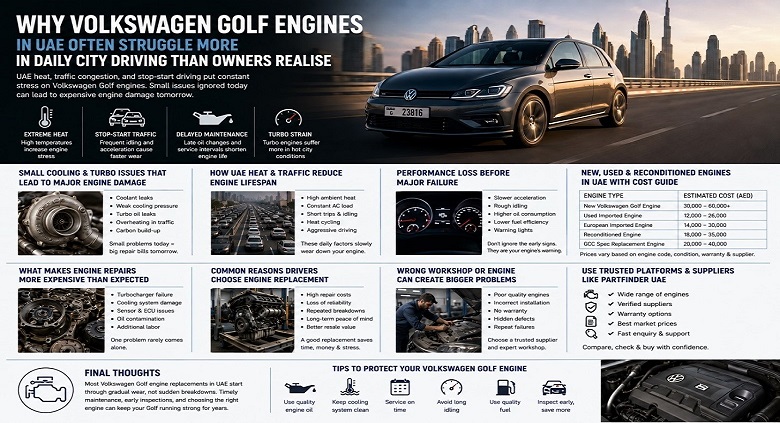
For many UAE drivers, the Volkswagen Golf feels perfectly suited to modern city life. Compact enough for crowded Dubai parking areas. Fast enough for Sheikh Zayed Road overtakes. Comfortable enough for endless commuting between Sharjah apartments and Downtown offices where traffic somehow feels permanent now.
But underneath that refined driving experience, the engine often lives a much harder life than owners realise.
A Golf engine in UAE conditions rarely gets proper breathing space mechanically. Morning traffic begins before temperatures even peak properly. By afternoon, the turbo system already operates under heavy heat pressure while the AC keeps pulling extra load continuously. Then there are drivers weaving aggressively through urban gaps because the Golf encourages spirited driving in a way many ordinary sedans simply do not.
The problem is not one dramatic event.
It is repetition.
Thousands of small heat cycles. Endless idling. Constant acceleration bursts. Years of short trips where the engine barely settles into stable operating temperatures before shutting off again.
And because the car continues feeling smooth during all of this, many owners never realise how much internal stress quietly builds underneath.
The Small Cooling-System and Turbo Problems That Quietly Lead to Major Volkswagen Golf Engine Damage
The first signs usually feel almost insignificant.
A faint coolant smell after parking.
The turbo feeling slightly inconsistent during acceleration.
A temperature fluctuation appearing briefly during Dubai traffic before returning to normal again.
Nothing alarming enough initially.
So people continue driving because the Golf still feels mechanically composed. That becomes part of the trap. European turbocharged engines often hide deterioration surprisingly well during the early stages.
Meanwhile underneath:
- Cooling pressure weakens gradually
- Turbo lubrication efficiency drops
- Oil temperatures rise repeatedly
- Carbon deposits begin spreading internally
- Small coolant leaks worsen under heat
And UAE summers accelerate everything much faster than many owners expect.
A problem that may develop slowly in colder countries often escalates aggressively here because engines spend months fighting extreme ambient temperatures daily.
Then eventually the symptoms become impossible to ignore:
- Heavy white smoke
- Persistent overheating
- Serious turbo lag
- Oil contamination
- Major power loss
By then workshops are rarely discussing minor maintenance anymore.
They are discussing survival plans for the engine itself.
How UAE Heat and Stop-Start Traffic Slowly Reduce the Lifespan of Volkswagen Golf Engines
There is no real recovery period for engines operating in UAE traffic.
A Volkswagen Golf driving through Al Barsha congestion during August experiences relentless thermal pressure almost continuously. The turbocharger generates enormous heat internally while airflow remains weak during long queues. Then drivers finally reach open motorway sections and accelerate hard immediately because traffic briefly clears.
The engine goes from crawling heat stress to high-load acceleration repeatedly.
That cycle slowly exhausts components over time:
- Turbo seals weaken
- Cooling systems fatigue
- Engine oil breaks down faster
- Internal temperatures spike repeatedly
- Lubrication performance declines gradually
And because deterioration happens progressively, many owners psychologically adjust to small changes without fully recognising how much engine performance has already disappeared.
The Golf still feels quicker than many cars around it.
So, the damage remains invisible emotionally.
Until eventually one overheating incident or turbo failure suddenly exposes years of accumulated wear underneath.
Why Some Volkswagen Golf Engines Begin Losing Performance Long Before Serious Failure Becomes Visible
This is usually where many UAE Golf owners become frustrated afterwards.
Looking back, the signs were often there for months:
- Slightly rougher idle behaviour
- Reduced fuel economy
- Slower turbo response
- Occasional hesitation during acceleration
- Increased oil consumption
But because the changes happen gradually, drivers adapt without noticing fully. What once felt sharp and immediate now feels merely “normal” after years of daily use.
And Golf engines are particularly good at disguising early-stage problems because the overall driving experience remains refined longer than expected.
The steering still feels tight.
The cabin still feels premium.
The acceleration still feels acceptable enough for ordinary traffic.
Meanwhile internally:
- Compression may already be falling
- Turbo efficiency may already be declining
- Cooling performance may already be weakening
- Bearings may already be wearing excessively
By the time major symptoms finally appear outwardly, the internal damage has often progressed much further than owners imagined possible.
New, Used, and Reconditioned Volkswagen Golf Engines in UAE With Practical Cost and Warranty Comparisons
Once replacement discussions begin, most owners quickly discover how complicated the UAE engine market actually is.
A brand-new Golf engine offers obvious reassurance. Factory condition. Zero mileage. No hidden overheating history from previous owners. But dealership replacement pricing across Dubai often shocks people immediately once labour and calibration costs get added properly.
Which is why much of the UAE replacement market revolves around alternatives instead:
- Imported European engines
- GCC-spec motors
- Reconditioned turbocharged units
- Japanese-imported engines
Some arrive in excellent condition.
Others carry hidden problems that Gulf heat exposes frighteningly quickly afterwards.
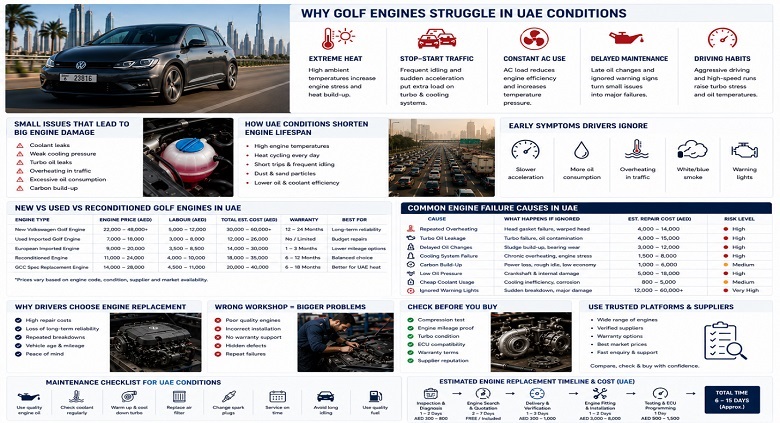
Typical UAE pricing generally looks like this:
| Engine Type | Engine Price (AED) | Labour Cost (AED) | Total Estimated Cost (AED) | Main Advantage | Main Risk |
| New Volkswagen Golf Engine | 22,000 – 48,000+ | 5,000 – 12,000 | 30,000 – 60,000+ | Long-Term Reliability | Extremely Expensive |
| Used Imported Golf Engine | 7,000 – 18,000 | 3,000 – 8,000 | 12,000 – 26,000 | Lower Initial Cost | Unknown Usage History |
| European Imported Engine | 9,000 – 20,000 | 3,500 – 8,500 | 14,000 – 30,000 | Better Mileage Availability | Limited Verification |
| Reconditioned Golf Engine | 11,000 – 24,000 | 4,000 – 10,000 | 18,000 – 35,000 | Balanced Reliability | Workshop Quality Differences |
| GCC Spec Replacement Engine | 14,000 – 28,000 | 4,500 – 11,000 | 20,000 – 40,000 | Better UAE Heat Compatibility | Higher Purchase Cost |
Experienced UAE mechanics usually say the same thing repeatedly because they have watched too many rushed decisions fail later. The cheapest Golf engine often becomes the most expensive option after repeated labour and repair cycles begin.
What Usually Makes Volkswagen Golf Engine Repairs in UAE Become More Expensive Than Expected
Most people budget emotionally for the engine itself.
Then the surrounding costs start appearing.
Once workshops dismantle a damaged Golf engine, additional weaknesses commonly reveal themselves almost immediately:
- Turbocharger wear
- Cooling-system corrosion
- Radiator fatigue
- Oil cooler leakage
- Sensor failures
- Carbon build-up inside intake systems
And because modern Volkswagen systems depend heavily on electronics, software calibration and sensor accuracy, diagnostic work alone can become expensive surprisingly quickly.
Typical UAE repair costs often include:
- Turbocharger repairs
- ECU diagnostics
- Cooling-system restoration
- Sensor replacement
- Oil system flushing
- Gearbox inspection
Then there are the hidden expenses owners rarely expect initially:
- Storage charges while sourcing engines
- Delayed part availability
- Additional labour during dismantling
- Repeated coolant-system repairs
That is usually the moment where repair estimates start climbing far beyond the original budget mentally prepared by the owner.
Common Volkswagen Golf Engine Failure Causes in UAE
| Common Engine Problem | What Usually Happens If Ignored | Estimated UAE Repair Cost (AED) |
| Repeated Overheating | Head gasket and cylinder head damage | 4,000 – 14,000 |
| Turbocharger Oil Leakage | Turbo failure and oil contamination | 4,000 – 15,000 |
| Delayed Oil Servicing | Sludge build-up and bearing wear | 3,000 – 12,000 |
| Cooling-System Failure | Chronic overheating and engine stress | 1,500 – 8,000 |
| Carbon Build-Up | Rough idle and fuel inefficiency | 1,000 – 6,000 |
| Low Oil Pressure Problems | Crankshaft and internal engine wear | 5,000 – 18,000 |
| Cheap Coolant Usage | Cooling inefficiency and corrosion | 800 – 5,000 |
| Ignored Warning Lights | Full engine failure risk | 12,000 – 60,000+ |
The Most Common Reasons UAE Drivers Replace Volkswagen Golf Engines Instead of Repairing Them
At some stage, many owners stop chasing repairs because the uncertainty becomes exhausting financially and emotionally.
A turbocharged Golf engine with overheating history, oil contamination and internal wear can technically be rebuilt. But long-term reliability afterwards often becomes difficult to guarantee confidently, especially under UAE conditions where the engine will immediately return to fighting extreme heat again.
Which is why many owners eventually prefer:
- Warranty-covered replacement engines
- GCC-spec units
- Low-mileage imported motors
- Professionally reconditioned engines
The decision usually depends on several things happening simultaneously:
- Rising repair costs
- Frequent workshop visits
- Vehicle age
- Daily commuting dependence
- Future resale concerns
And after enough mechanical problems, many drivers simply want the car dependable again rather than repeatedly gambling on partial repairs.
How Choosing the Wrong Workshop or Imported Engine Creates Bigger Problems Later for Volkswagen Golf Owners
This part becomes brutally important in the UAE replacement market.
A poor-quality imported engine paired with weak installation work can create another round of overheating, turbocharger failure or ECU problems only months later. And because Volkswagen systems rely heavily on proper calibration, small installation mistakes eventually become expensive mechanical consequences.
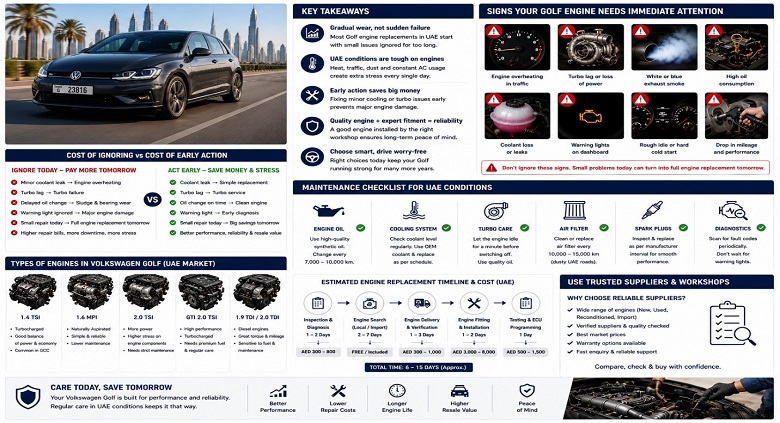
Experienced UAE Volkswagen specialists usually recommend checking:
- Compression results
- Turbocharger condition
- ECU compatibility
- Cooling-system health
- Engine mileage records
- Warranty coverage
- Import source credibility
Before approving any purchase.
Reliable workshops normally welcome detailed questions because they understand how expensive mistakes become later.
The unreliable workshops usually try rushing decisions quickly instead.
Many UAE owners now use platforms like PartFinder UAE to compare:
- Used Volkswagen Golf engines
- Reconditioned engine options
- GCC-spec motors
- Imported European engines
- Warranty-backed suppliers
Particularly across Dubai, Sharjah, Abu Dhabi and Ajman where engine availability changes constantly while workshop storage fees continue building quietly in the background.
Final Thoughts: Most Volkswagen Golf Engine Replacements in UAE Start Through Gradual Wear Rather Than One Sudden Breakdown
A Volkswagen Golf engine replacement in UAE rarely begins through one catastrophic moment. More often it develops quietly through years of heat exposure, turbo stress, delayed servicing, cooling-system problems and warning signs owners convinced themselves could wait slightly longer.
Then suddenly the engine that once felt smooth, premium and enjoyable becomes financially overwhelming to repair properly.
Handled carefully, with experienced labour and correctly sourced replacement engines, a Golf can still return to being exactly what owners originally enjoyed about it: refined, responsive and genuinely satisfying to drive across UAE roads.
Handled badly, through rushed installation or poor-quality imported engines, the same problems often return much faster than expected.
And turbocharged European engines, especially under Gulf heat, rarely forgive shortcuts forever.
Categories
- Audi
- BMW
- Car Accessories
- Car Tips
- Ford
- Land Rover
- Mazda
- Range Rover
- Top 10
- UAE Car Parts
- Used Car Parts
- Toyota
- Replacement Engines
- Nissan
- Hyundai
- Mitsubishi
- Volkswagen
- Honda
- Kia
- Chevrolet
- Dodge
- Jeep
- Subaru
- Renault
- Lexus
- Mercedes
- Suzuki
- Hummer
- Porsche
- Infiniti
- Peugeot
- GMC
- Mini
- Volvo
- Replacement Gearboxes
- MG
- Jaguar
- Skoda
- Cadillac
- Daihatsu
- Fiat
- German Car Parts
- Japanese Car Parts
- Aftermarket Car Parts
- Genuine Car Parts
- New Car Parts
- Reconditioned Car Parts
- European Car Parts
- American Car Parts
- Korean Car Parts
- British Car Parts
- Chinese Car Parts
- Sports/Exotic Car Parts
- Luxury Car Parts
- Performance Car Parts
- SUV/4x4 Spare Parts
- Truck Spare Parts
- EV Car Parts
- Hybrid Car Parts
- Auto Spare Parts in UAE
- Tesla
- Isuzu
- Ram
- Ferrari
- Bentley
- Lamborghini
- Genesis
- Maserati
- Lincoln
- Chrysler
- Opel
- Citroen
- SsangYong
- Seat
- McLaren
- Aston Martin
- Rolls Royce
- Maybach
- Alfa Romeo
- Bugatti
- Scion
- Abu Dhabi Car Parts
- Ajman Car Parts
- Al Khan Car Parts
- Al Sajaa Car Parts
- Deira Car Parts
- Dubai Car Parts
- Fujairah Car Parts
- Industrial Area 6 Car Parts
- Mussafah Car Parts
- Ras Al Khaimah Car Parts
- Sharjah Car Parts
- Umm Al Quwain Car Parts
- Acura
- BYD
- Chery
- Dacia
- DS
- Geely Emgrand
- EXEED
- GAC
- GAC Gonow
- Geely
- Gonow
- Great Wall
- Haima
- Haval
- Holden
- Iveco
- JAC
- Jaecoo
- Jetour
- Lotus
- Omoda
- Proton
- Renault Samsung
- Roewe
- Lucid